PART 2: HOA Gave Me 10 Days to Shut Down My Quarry—Then I Checked Who Owned the Road Beneath Her Feet
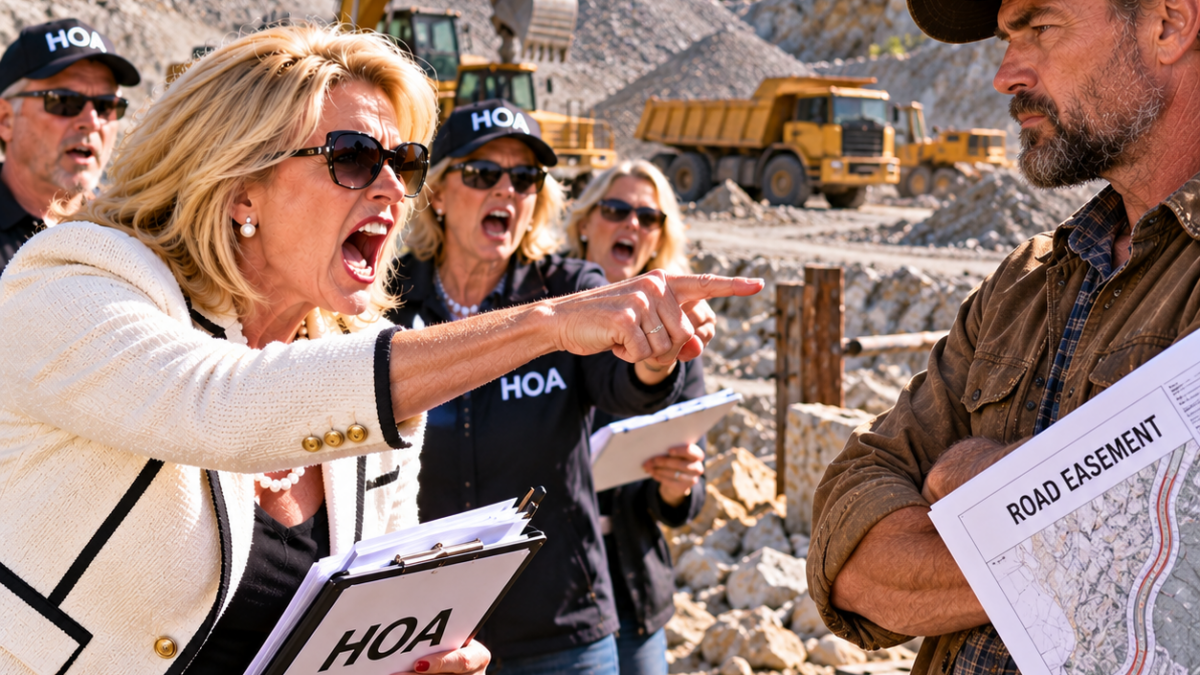
The HOA president gave me ten days to shut down the quarry my family had operated since 1974, but while she stood at my gate threatening an emergency injunction, I kept looking at the pale limestone road beneath her shoes because I recognized the exact batch that had come out of my own crusher.
She thought the issue was blasting, dust, and trucks disturbing the 112 expensive homes behind her, yet the blue production mark on the curb told me her subdivision had used stone from my quarry to build the very road she had driven in on—and I had no memory of ever approving construction anywhere near that part of my property.
By the end of that evening, one unpaid invoice, a strange delivery route, and a strip on an engineering map would make me wonder whether Vanessa Pike had come to threaten my business because somebody desperately needed me looking at the quarry instead of the ground beneath Silver Mesa.
“You have ten days, Mr. Holt.”
Vanessa Pike held a red folder against one hip and pointed toward the crusher behind me.
A hundred tons of Texas limestone passed through those steel jaws every hour when we were running full production.
“If blasting continues after Friday,” she said, “Silver Mesa Estates will pursue emergency relief.”
“My quarry is permitted.”
“Your quarry materially affects our residents.”
“That wasn’t what I said.”
Her lips tightened.
I’m Mason Holt. I was fifty-eight that spring, and Holt Ridge Aggregates sat six miles west of Bellweather, Texas, on land my father first started cutting limestone from in 1974.
By the time I took over, we owned 860 acres, employed twenty-three people, and supplied road base to four counties.
Our blasting records were dull.
I considered dull records a compliment.
Silver Mesa Estates had arrived three years earlier along my eastern boundary.
Redstone Residential bought an old ranch and turned it into 112 gated homes advertised as “authentic Hill Country living.”
Apparently authentic country living meant decorative windmills, stone monuments, and complaints about the actual quarry that had been there forty-six years before them.
Vanessa became HOA president six months after moving in.
She was organized, polished, and very good at making preference sound like law.
Her first letter complained about dust.
The second complained about truck noise.
Now she had driven to my gate demanding operating restrictions from ten in the morning until three in the afternoon.
I opened her notice.
“Which authority gives your HOA control over my operating hours?”
“You may find the county more receptive than you expect.”
That sentence bothered me.
Not because I thought Silver Mesa could suddenly regulate us.
Because it sounded like somebody had told her something.
Before she left, a dump truck approached along Canyon Spur Road, the newer private road leading toward Silver Mesa’s unfinished third phase.
Vanessa stepped aside.
The truck rolled over pale crushed limestone.
I looked down.
Three-quarter-inch base.
Washed fines.
Slightly darker than our standard blend.
North Cut material.
Then I saw the blue paint on the curb.
**NC17.**
My scale manager, Elena Ruiz, used that code for North Cut production batch seventeen.
I pointed down.
“Where did this road base come from?”
Vanessa glanced at the pavement.
“I don’t manage construction materials.”
“But you manage the road?”
“I manage the community affected by your operation.”
She opened her SUV door.
“Ten days, Mr. Holt. Use them carefully.”
She drove away.
I stood there staring at the blue mark.
Stone changes hands.
Contractors buy it.
Developers move it.
Seeing our mix in a subdivision road did not prove anything by itself.
But that evening, Elena entered my office carrying three binders and shut the door behind her.
“You remember Arrow Sitework?”
“Late account?”
“Ninety days.”
She opened the first binder.
Sixty-eight deliveries.
1,504 tons.
All to Canyon Spur.
“How much unpaid?”
“Thirty-six thousand four hundred twelve dollars.”
I leaned back.
“That’s a lot of stone to forget paying for.”
“That isn’t the strange part.”
She rotated the delivery records toward me.
Every ticket had been accepted by the same superintendent.
The purchase orders came from Arrow Sitework.
But the compaction specifications carried Redstone Residential’s project code.
Then Elena pulled out a route diagram.
Our trucks had been instructed to enter Canyon Spur from the quarry side instead of through Silver Mesa.
The route crossed a shaded strip labeled:
**HOLT BUFFER.**
I stared at it.
“Who here approved trucks crossing that?”
“Nobody I can find.”
I looked back at the sixty-eight tickets.
Our stone.
Our trucks.
Our property name printed on their construction route.
Elena reached for the last binder.
“There’s one more thing.”
She opened it.
And when I saw what Arrow’s flagman had told our drivers about where that road was being built, I stopped thinking Vanessa’s ten-day deadline had anything to do with quarry noise.
PART 2
The note was short.
That was what made it useful.
One of our drivers, Luis Medina, had called dispatch during an early delivery because the route looked wrong.
Luis had worked for us twelve years. He knew our property almost as well as I did.
His question had been logged at 6:42 in the morning.
**OLD CATTLE FENCE DOES NOT MATCH ROUTE MAP. CONFIRM DELIVERY STILL INSIDE REDSTONE LIMITS?**
Below it, Elena had written the response from Arrow’s flagman.
**YES. ALL ROAD WORK INSIDE REDSTONE PROPERTY. FOLLOW STAKES.**
I read it twice.
“When was this?”
“First week of base delivery.”
“And nobody told me?”
Elena looked irritated with herself.
“Why would we? We were selling aggregate to a contractor working next door. Dispatch thought the shaded area was their job boundary.”
That was reasonable.
Which made the problem worse.
Nobody at Holt Ridge had knowingly permitted construction across our land.
We had been told construction was not on our land.
I tapped the map.
“Get me every ticket, dispatch recording, route diagram, credit application, invoice, and email involving Arrow.”
“You think the road is ours?”
“I think I don’t know.”
She nodded.
That was one reason Elena had lasted fourteen years managing our scale house.
She didn’t need certainty to start preserving records.
I called Claire Donnelly.
Claire had represented my company for nine years.
Before opening her property practice, she spent more than a decade representing contractors and material suppliers, so she understood the difference between a deed problem and a billing problem—and how one could hide inside the other.
I explained Vanessa’s notice.
Then Canyon Spur.
Then the unpaid account.
Claire was quiet for a few seconds.
“Do not block that road.”
“I wasn’t planning to.”
“Good.”
“You sound disappointed.”
“I sound like someone who does not want tomorrow’s photograph to show a bulldozer across an evacuation route while frightened homeowners stand behind it.”
“That’s not what this is.”
“Maybe not. But photographs are simpler than title law.”
I leaned back.
“So what do we do?”
“We establish the property line.”
“I know where my line is.”
“That sentence has financed more surveyors than any other in American history.”
I smiled despite myself.
Claire continued.
“Send me Vanessa’s notice. I’ll pull the declarations, county road files, Redstone’s plats, and your deed. And I’m hiring Nathan Bell.”
“Bell still surveying?”
“Unfortunately for people who prefer vague boundaries.”
Nathan was sixty-three, sun-browned, and almost aggressively unimpressed by confident people.
He arrived the next morning with a robotic total station, two younger crew members, old monument records, and my 1998 boundary survey.
I met him near the low saddle where Canyon Spur curved from Silver Mesa toward the north.
An old cattle fence wandered through cedar and rock.
Nathan looked at it once.
“Don’t tell me you think that’s the property line.”
“My father treated it as one.”
“Your father kept cattle.”
“Yes.”
“Fences tell me where cattle stopped.”
He pointed toward his equipment.
“Deeds tell me where ownership stops.”
We started from a brass county monument half a mile south.
Nathan recovered the first recorded pin under eight inches of soil.
Exactly where my old survey showed it.
The second pin had been cut off below grade.
The cattle fence at that point stood forty-one feet west of the controlling deed line.
I stared at the distance.
“That much?”
“That much.”
By noon, Nathan’s crew had carried the geometry north.
Orange survey stakes appeared across the slope.
Then they reached Canyon Spur.
One stake landed in the drainage shoulder.
Another near the edge of pavement.
The line cut diagonally across the private road.
Nathan kept working.
The deed boundary crossed to the other side.
Then continued alongside the road.
“How far is the road inside?” I asked.
“Let me finish.”
He followed the controlling calls around a limestone outcrop.
Another stake.
Another.
The road did not return to Redstone land for more than seven hundred feet.
At the widest point, the paved surface, swale, and shoulder spread across nearly an acre and a half of my property.
I stood in the middle of Canyon Spur.
My road.
At least according to the line taking shape beneath my boots.
Then I looked toward Silver Mesa.
A decorative stone entrance sign stood on the shoulder.
**SILVER MESA — PHASE THREE**
Nathan drove another stake.
Right beside the sign.
“Is their sign mine too?”
“It appears to be sitting on yours.”
A white pickup came down the hill.
Behind it was Vanessa’s crossover.
The pickup stopped hard.
A man got out before the dust settled.
Mid-fifties.
Pressed jeans.
Construction boots that looked expensive enough to have never met wet concrete.
He walked directly toward Nathan.
“You’re staking from an obsolete call.”
Nathan continued writing in his field book.
The man stopped.
“Did you hear me?”
Nathan looked up.
“Yes.”
“The western boundary on the old plat is obsolete.”
“Which controlling monument superseded it?”
The man hesitated.
“The development plat reflects the accepted line.”
Nathan nodded.
“A plat can show a purple elephant. I still follow the controlling deed calls and monuments.”
Vanessa approached.
“Mason, this is Grant Mercer, Redstone’s project director.”
Grant did not offer his hand.
Instead, he looked at me.
“You authorized construction access.”
“Show me where.”
“Your trucks delivered the base.”
“My company sold stone to Arrow Sitework.”
“Which was constructing Canyon Spur.”
“Buying limestone doesn’t buy my land.”
Vanessa stepped between us.
“This road is critical life-safety infrastructure. It provides Silver Mesa with a secondary wildfire exit.”
I looked around.
“Then the people building critical life-safety infrastructure should have been especially careful where they put it.”
She pointed at Nathan’s stakes.
“Remove those before residents see them.”
Nathan finally looked directly at her.
“They’re survey control points.”
“They’re causing alarm.”
“Move one and I’ll document who moved it.”
Vanessa’s face tightened.
She looked at me.
“This is retaliation for the quarry notice.”
“No.”
I pointed to Nathan.
“This is measurement. It only feels like retaliation when you’ve been depending on nobody measuring.”
Grant walked the line twice.
The second time, he photographed every stake.
That concerned me more than an argument would have.
Grant believed Nathan enough to start documenting the damage.
Three days later, Nathan delivered the certified survey.
Canyon Spur entered my parcel near the dry creek.
Stayed inside for 736 feet.
Included pavement, graded shoulder, drainage swale, and the Silver Mesa sign.
The road had been constructed in 2022.
Less than three years earlier.
Claire spread the survey across her conference table.
“Good news first.”
“I like that phrase.”
“Recorded title favors you strongly. No easement has shown up in the title search so far. Construction is recent enough that they cannot plausibly rely on the kind of long historical use associated with a normal prescriptive claim.”
“And bad news?”
“People can still make arguments.”
“Such as?”
“Implied permission. Estoppel. Reliance. Your conduct.”
“My conduct?”
“You watched construction nearby.”
“On what I thought was their land.”
“You sold aggregate that was delivered there.”
“To a contractor.”
“You didn’t object during construction.”
“Because nobody told me it crossed my property.”
Claire nodded.
“Those answers matter. But I want documents supporting them.”
She tapped the survey.
“Never fall in love with one piece of evidence.”
I sighed.
“You and Nathan should start a club.”
“We meet Thursdays.”
She sent preservation letters that afternoon.
Redstone.
Silver Mesa HOA.
Arrow Sitework.
Management company.
All instructed to preserve surveys, plats, title work, contracts, delivery records, road approvals, fire-access communications, financial records, and anything concerning Canyon Spur.
Claire also demanded proof of any easement, license, right-of-way, written permission, or landowner authorization covering my parcel.
And she demanded payment or escrow of the $36,412 Arrow still owed for our stone.
Redstone’s attorney responded within forty-eight hours.
His name was Lowell Brand.
The letter argued that Redstone had built the road in good-faith reliance on an approved county plat and on my course of conduct.
It proposed a standstill.
I would allow unrestricted use of Canyon Spur.
Waive interference claims while negotiations proceeded.
In return, Silver Mesa would postpone its quarry enforcement action.
I read that paragraph twice.
Then a third time.
“They’re offering not to exercise power they don’t have if I temporarily surrender property rights they don’t have.”
Claire smiled.
“You’re learning.”
“I’ve seen better trades at equipment auctions.”
“At least auctions sometimes include a tractor.”
Her response was straightforward.
I would not obstruct verified emergency use while the title issue was resolved.
That temporary accommodation would not create an easement, consent, waiver, or permanent right.
The HOA would withdraw its unsupported quarry notice.
Redstone would identify the legal basis for Canyon Spur.
And the unpaid material charges would be escrowed.
Vanessa did not withdraw her notice.
Instead, on day seven of her ten-day deadline, Silver Mesa sent a “community safety bulletin” to all 112 households.
A copy reached me within two hours.
The bulletin said nearby industrial blasting had intensified.
It said heavy quarry trucks threatened neighborhood roads.
It said the board was pursuing all remedies necessary to protect families and property values.
It did not say every recorded blast remained within permitted limits.
It did not say our quarry trucks traveled on a state farm-to-market road and never needed Silver Mesa’s internal streets.
And it certainly did not tell homeowners their second exit crossed land the quarry owned.
At noon, my customer from Kendall County called.
“Mason, are you shutting down?”
“No.”
“Your permit okay?”
“Completely.”
“We saw something online.”
“Nothing from the county has changed.”
Two hours later, another customer called.
By evening, a third.
That made Vanessa’s campaign more than annoying.
It was interfering with my livelihood.
Claire filed for temporary relief.
She attached our permit records.
Seismograph data.
Silver Mesa’s declaration map showing Holt Ridge outside the HOA.
Vanessa’s bulletin.
Nathan’s survey.
Two days later, the court granted a narrow temporary order.
Silver Mesa could not represent that it possessed regulatory authority over Holt Ridge.
It could not state that any government agency had found our quarry unsafe when no such finding existed.
Neither side could alter the disputed road strip pending further hearing.
The order did not decide permanent ownership.
It did not close Canyon Spur.
It did not punish Vanessa.
It simply prevented the fight from being changed by louder public claims or physical alteration.
Vanessa called a special HOA meeting Friday night.
I didn’t attend.
I wasn’t a member.
Forty minutes after it began, Elena walked into my office.
“You have a visitor.”
“Vanessa?”
“No.”
A woman stood near the scale counter.
Late thirties.
Dark hair pulled back.
Navy scrubs under a jacket.
She looked exhausted.
“I’m Rachel Kim.”
“Mason Holt.”
“I know.”
She glanced toward Elena.
“Could we talk privately?”
We stepped into my office.
Rachel remained standing.
“I live in Silver Mesa. Phase two.”
“All right.”
“I’m an ER nurse. I have two boys.”
She inhaled.
“Are you planning to put a gate across Canyon Spur?”
“No.”
She stared at me.
“Vanessa said you might close our emergency exit if the HOA doesn’t stop challenging your blasting.”
“The quarry doesn’t need Canyon Spur to keep operating.”
“So you aren’t using the road as leverage?”
“No.”
I unfolded Nathan’s survey.
“The road is a separate problem. It appears to be on our property.”
Rachel looked at the orange boundary line.
Then at me.
“Redstone sold us houses with two permanent exits.”
“Then Redstone owes you two permanent exits.”
She sat down.
For the first time since the fight began, I saw Silver Mesa through someone other than Vanessa.
Rachel had not designed Canyon Spur.
She had not shifted a road across an old fence.
She had not issued a quarry threat.
She bought a house believing the developer had secured legal access.
Her children slept there.
If a wildfire came over the ridge, title law would be the last thing she cared about.
I had spent a week thinking in terms of my land versus their subdivision.
Rachel reminded me that families had purchased promises they did not draft.
Property rights did not require me to stop caring about the people caught inside someone else’s mistake.
They told us who should have asked.
Who could say no.
And who should pay when those steps were skipped.
Rachel opened her bag.
“I brought this.”
It was the board packet from that night’s meeting.
Inside was a proposed special assessment.
**ROAD DEFENSE AND QUARRY MITIGATION — $2,400 PER HOUSEHOLD**
One hundred twelve homes.
$268,800.
I stared at it.
Residents were being asked to finance a legal fight over a road Redstone had built across my land before anyone had even told them there might be a title problem.
“Did Vanessa disclose Redstone’s role?”
Rachel shook her head.
“She said the developer’s lawyers were supporting the board.”
“Financially?”
“She didn’t say.”
I handed the packet to Claire the next morning.
She read it.
Then said, “Now I want every reimbursement agreement between Redstone and the HOA.”
That request would matter later.
First, we needed to inspect the road itself.
—
The following Monday, Redstone agreed to a documented joint inspection.
Claire insisted everything be photographed before anyone touched pavement.
Nathan marked the boundary.
An engineer located the culvert and drainage swale.
Redstone’s representatives brought the original compaction report.
Someone pulled shallow cores from the pavement and base.
Elena came because she knew our aggregate codes better than anybody.
The engineer flipped through a packet.
She stopped him.
“Go back.”
He did.
Elena pointed.
**NC17.**
Six attached batch sheets.
North Cut batch seventeen.
Holt Ridge Aggregates listed as material source.
Arrow Sitework listed as purchaser.
Redstone Residential listed as project owner.
Quantities matched our scale tickets within fourteen tons.
Grant reached for the packet.
Claire put one hand on the copy.
“This was provided as part of the joint inspection record.”
Grant looked at her.
“It contains proprietary construction data.”
“It contains material-source documentation for the road presently located on my client’s property.”
Vanessa looked at Grant.
“You told us this road had been fully conveyed.”
Grant’s face hardened.
“It was approved.”
“That is not what I asked.”
For the first time, Redstone and Vanessa were looking at each other instead of me.
The alliance had a crack.
Independent survey measurements now placed the road on my land.
Construction records traced unpaid Holt Ridge aggregate into the road.
And Redstone’s own compaction report identified Redstone as project owner.
Two days later, Claire found the county condition.
She called me after dinner.
“Come to the office tomorrow morning.”
“What is it?”
“Phase three.”
“What about it?”
“Bring coffee.”
That meant she had something worth reading in person.
The next morning, she placed Silver Mesa’s county approval letter on the conference table.
Phase three could not receive final occupancy approval for its last twenty-seven homes until two conditions were met.
A compliant secondary fire-access route.
And a recorded right-of-way benefiting the subdivision.
I looked up.
“So the county required the road.”
“The county required a secondary route.”
“And approved Canyon Spur.”
“The engineering.”
“What’s the difference?”
She pointed to a paragraph.
The county expressly stated that approval of the road design did not grant private-property rights and that Redstone remained responsible for securing all necessary easements.
I read it slowly.
“They approved the plan.”
“Yes.”
“They did not give Redstone my land.”
“Correct.”
“How close are they to those last houses?”
“Redstone’s schedule shows nine finished homes closing within about six weeks.”
I understood.
If there was no legal right-of-way, those closings could be delayed.
If closings were delayed, the construction lender could freeze or condition future draws.
Suddenly Vanessa’s phrase made sense.
*You may find the county more receptive than you expect.*
Someone had told her phase three had a county-access problem.
The pressure campaign against my quarry had not started because of dust.
They wanted cooperation.
The question was who had connected those two issues.
The answer came from a twenty-dollar state filing.
Elena was checking Arrow Sitework’s business address because the account was still unpaid.
She noticed its registered agent shared an office suite with another company.
Redstone Land Services.
Claire pulled formation records.
Arrow Sitework had been formed nineteen days before the first Canyon Spur purchase order.
Its manager was Grant Mercer’s brother-in-law.
Its mailing address had changed twice.
Both forwarding addresses eventually led back to Redstone-controlled offices.
That did not automatically make Arrow improper.
Developers create single-purpose entities constantly.
But it destroyed Redstone’s claim that Arrow was some unrelated contractor whose billing problems they could not explain.
Claire amended our complaint.
We sought a declaration confirming the boundary.
A declaration that no permanent recorded easement existed.
Payment of the unpaid aggregate account.
Damages for trespass.
And a remedy requiring Redstone either to lawfully acquire what it needed or remove and relocate the improvements after a reasonable safety transition.
We did not ask the court to lock homeowners inside Silver Mesa.
We asked the people who created the road problem to fix it.
The HOA counterclaimed.
Easement by estoppel.
Detrimental reliance.
Implied permission.
Redstone’s argument worried me more than I admitted.
They said I had watched construction.
Allowed trucks.
Sold the aggregate.
Waited until the road was finished before objecting.
Part of that was true.
I had seen construction equipment from my haul road.
I had not confronted anybody.
Our company delivered material.
I did not object until Vanessa walked into my quarry with her red folder.
One night I told Claire:
“They might win that.”
She didn’t reassure me.
“They will argue that your silence created reasonable reliance.”
“That’s what I’m worried about.”
“Good.”
I frowned.
“Good?”
“Fear makes you look for records instead of speeches.”
She leaned forward.
“We need to prove what you knew, when you knew it, and what Redstone represented to your company.”
Elena went to work.
Dispatch recordings.
Credit application.
Driver notes.
Route maps.
Emails.
Every document identified Arrow as customer.
Every route map shaded the work as inside **SILVER MESA CONSTRUCTION LIMITS.**
Luis’s recorded question about the old fence showed he noticed the uncertainty.
Arrow’s flagman answered that all work remained on Redstone land.
Then Nathan overlaid the construction-limits map against the certified boundary.
The shaded block had been shifted west approximately forty-six feet.
It followed the old cattle fence.
Not the deed line.
That could still have been a mistake.
An engineer tracing the wrong physical feature.
A drafting error copied across sheets.
Then discovery began.
Redstone produced thirty-two thousand pages.
Most were duplicates.
Routine invoices.
Daily reports.
Insurance certificates.
Subcontractor releases.
Claire’s team indexed them.
Elena and I spent four nights searching keyword combinations.
Holt.
Arrow.
Canyon Spur.
Western line.
Easement.
Fire access.
Fence.
On the fourth night, at 11:18, Elena stopped scrolling.
“Mason.”
I looked up.
“Read this.”
Subject:
**WESTERN ACCESS GAP**
From Grant Mercer.
To Redstone’s land acquisition director.
Dated eleven days before Canyon Spur grading began.
I read the first paragraph.
The title company had not located an easement across the Holt parcel.
Second paragraph.
Approaching Holt before construction could delay phase three.
Third paragraph.
Grant recommended aligning the road to the existing fence, completing the base, and resolving ownership during final dedication.
My hands stopped moving.
Then I read the final sentence.
**Once homeowners depend on the route, Holt will have no practical choice but to sign.**
I read it again.
Then again.
There was no mistaken plat.
No innocent belief that the cattle fence controlled title.
Redstone knew the easement was missing before the first grader moved.
Elena pointed lower in the email chain.
The land acquisition director replied:
**Proceed only if civil confirms county will accept.**
Grant answered:
**County reviews engineering, not private title. Board pressure can handle Holt.**
Board pressure.
Claire found another email eight months later.
Grant to Vanessa.
Attached:
Draft quarry complaint.
Talking points about blasting.
Property-value concerns.
A note stating Redstone would reimburse Silver Mesa for outside legal expenses associated with securing access documentation.
Vanessa had edited the draft.
Where Grant wrote:
**Request voluntary operating limits**
Vanessa changed it to:
**Demand immediate compliance**
She inserted the ten-day deadline.
I sat in Claire’s conference room looking through the glass toward the dark quarry.
For weeks I had tried to decide whether Vanessa was being manipulated by Redstone or collaborating with Redstone.
The documents suggested both.
Grant had hidden the original title problem from her when the road was constructed.
Later, once she learned Silver Mesa’s emergency exit lacked a permanent easement, she chose pressure instead of disclosure.
Why?
Because she was afraid.
Afraid the second exit could disappear.
Afraid phase three values would fall.
Afraid homeowners would discover their developer had sold them certainty that did not exist.
Redstone used that fear.
Vanessa used the authority of the board.
And residents like Rachel were stuck between them.
Claire filed for expedited relief.
She attached the critical email chain under seal.
She formally notified Redstone’s construction lender through the litigation process.
We did not send documents to reporters.
We did not post screenshots online.
I wanted to.
Claire refused.
“Evidence looks stronger when it doesn’t look like revenge.”
Within twenty-four hours, Redstone requested mediation.
Before that happened, Vanessa had to sit for a deposition.
I was not in the room.
I read the transcript afterward.
She arrived with her own attorney.
Not Redstone’s.
That told Claire the alliance was over.
At first, Vanessa defended the quarry notice as a normal safety action.
Claire walked her through Holt Ridge’s permits.
Then Silver Mesa’s declaration boundary.
Then the county phase-three condition.
Then Grant’s draft complaint.
“Who wrote the first version of the notice delivered to Mr. Holt?”
The transcript recorded an eleven-second pause.
“Mr. Mercer supplied some language.”
“Why was Redstone involved in a quarry enforcement letter?”
“He believed cooperation on quarry operations could lead to cooperation on access.”
“What did that mean to you?”
“That if the operating dispute was resolved, Mr. Holt might be more willing to sign the road documents.”
“Did you disclose to residents that those road documents had never been signed?”
“No.”
“Did you know Redstone had built Canyon Spur after its title team reported no easement?”
“I did not know that when construction began.”
“When did you learn?”
“Later.”
“Before proposing the special assessment?”
Another pause.
“Yes.”
I stopped reading.
That answer destroyed the practical credibility of the HOA’s counterclaim.
Vanessa knew there was no permanent easement before asking residents for $268,800 to fight for the road.
Claire continued.
“Did Redstone agree to reimburse legal expenses associated with securing access?”
“Yes.”
“Was that commitment disclosed in the special-assessment packet?”
“No.”
“Why were homeowners asked for $268,800 while Redstone also promised reimbursement?”
“The board believed litigation could exceed any reimbursement.”
“Where is Redstone’s reimbursement agreement disclosed in the packet?”
“It isn’t.”
When I reached that section, I expected satisfaction.
Instead, I felt tired.
Vanessa had not stolen assessment money.
The vote was canceled before collection.
But she had asked neighbors to finance a legal campaign while withholding information they needed to judge whether that campaign made sense.
Once a board does that, every earlier statement becomes questionable.
Rachel and twenty-six other homeowners petitioned for access to legal and financial records.
Two directors resigned.
The assessment vote was canceled.
Redstone still had nine homes approaching closing.
County inspection was nineteen days away.
At mediation, they came prepared to buy speed.
—
The mediation took place inside an old bank converted into offices.
Claire and I sat in one room.
Redstone in another.
Silver Mesa in a third with independent counsel.
A retired judge carried offers between us and drank coffee strong enough to remove paint.
Redstone’s first proposal:
$100,000.
Permanent sixty-foot easement.
Dismissal of all claims.
Confidentiality.
And permission for Silver Mesa to impose certain quarry operating limits.
“No.”
The mediator looked at me.
“Do you want to discuss it?”
“No.”
Second offer:
$185,000.
Full payment of the aggregate invoices.
No HOA regulatory jurisdiction over Holt Ridge.
Permanent road easement.
I said no again.
The mediator leaned back.
“What number are you looking for?”
“It’s not only a number.”
He waited.
I unfolded a quarry map.
“Canyon Spur passes through our safety buffer near the north cut.”
“How close?”
“Residential traffic would be within roughly four hundred feet of active quarry operations in parts of the corridor.”
“Could you stop blasting during traffic periods?”
“That’s the problem.”
I pointed to the map.
“If the road becomes permanent, every future blast plan has to account for civilians moving here. Every expansion shifts west. Drainage obligations change. Liability changes. Ten years from now, somebody will ask why we’re blasting so close to a subdivision road that has ‘always been there.’”
The mediator nodded slowly.
“They aren’t buying one strip of pavement.”
“No. They’re buying permanent influence over everything beside it.”
Claire offered two alternatives.
Option one:
A narrowly drafted emergency-only easement at an independently appraised price.
No normal residential traffic.
No construction traffic.
Blast-rated gates controlled by emergency services.
Drainage restoration.
Payment of the $36,412 material account.
Survey costs.
Documented legal expenses.
Option two:
Remove Canyon Spur from my parcel.
Build Silver Mesa’s required secondary access entirely on Redstone-owned land.
Restore the quarry buffer.
Pay the same account and costs.
Redstone rejected both.
The mediator returned.
“Grant says there isn’t enough time to redesign before the county deadline.”
I laughed once.
“That deadline existed before they poured the road.”
We left without agreement.
The next morning, Nathan called at 7:10.
“Three of my reference stakes are gone.”
I sat upright.
“What?”
“And somebody dumped broken concrete over the southwest pin.”
I drove out.
The permanent reference locations had been disturbed.
That was stupid.
Nathan had photographed each monument.
Recorded coordinates.
Placed two discrete survey nails away from the main work area.
And we had a motion-activated camera nearby because people occasionally dumped debris along our fence.
The footage showed a Redstone subcontractor’s skid steer entering at 6:42.
I did not confront him.
I did not call Vanessa.
Claire filed an emergency motion.
The court ordered Redstone to restore the monuments under Nathan’s supervision and cease all work inside the disputed area.
Grant said the operator had only been clearing construction debris.
Then the subcontractor produced a text message.
**Clean all Holt markings before inspection.**
Sent from Grant’s project phone.
By then I stopped treating each new discovery as a surprise.
The pattern mattered more.
Whenever Redstone encountered a document it could not change, someone tried changing the physical ground around it.
The county postponed Silver Mesa’s phase-three inspection.
Redstone’s lender froze the next construction draw pending resolution of access.
Subcontractors began asking about payment.
For the first time, the cost of skipping the easement landed where it belonged.
On the people who had chosen to build without it.
But homeowners still needed emergency access.
So I signed a ninety-day revocable emergency license.
Fire.
Ambulance.
Evacuation.
Nothing else.
No sales traffic.
No phase-three construction.
No ordinary resident shortcut.
The fire marshal reviewed temporary gates.
Redstone paid for controls.
Rachel came to the quarry after the agreement was signed.
“You didn’t have to do that.”
“Yes, I did.”
“No, legally.”
“That isn’t the only question.”
She waited.
“An ambulance isn’t a developer.”
Rachel smiled.
I meant it.
Protecting my boundary did not require punishing families Redstone had placed behind it.
—
Four months after Vanessa first gave me ten days, Claire filed for partial summary judgment on three narrow issues.
My ownership of the disputed strip.
The absence of any recorded permanent easement.
The unpaid aggregate account.
Redstone continued arguing estoppel and implied consent.
Claire answered with ordinary records.
Arrow’s credit application naming Arrow as customer.
Dispatch maps stating the work was inside Redstone construction limits.
Luis’s question about the cattle fence.
The flagman’s written assurance.
Nathan’s survey.
The road’s recent construction date.
And Grant’s email:
**Once homeowners depend on the route, Holt will have no practical choice but to sign.**
The hearing took place in January before District Judge Helen Ward.
No packed courtroom.
No television crew.
Two legal teams.
Several witnesses.
Three HOA directors.
A handful of homeowners.
Lowell Brand argued first.
“Holt Ridge knowingly benefited from construction by supplying aggregate and observing development of the route. Equity should prevent Mr. Holt from denying access after a residential community relied upon the completed road.”
Judge Ward looked at him.
“Where is the representation from Mr. Holt that Redstone could use this parcel?”
Lowell paused.
“His course of conduct, Your Honor.”
“That wasn’t my question.”
The room became still.
Lowell pointed toward the old cattle fence.
“Redstone reasonably believed the fence reflected the boundary.”
Claire stood.
She placed Grant’s email beside Nathan’s survey.
“A party cannot reasonably rely on a fence after its own title team identifies an access gap.”
She did not raise her voice.
“And it cannot manufacture reliance by intentionally creating the dependency it later asks equity to protect.”
She displayed the sequence.
First:
Redstone learns no easement exists.
Then:
Construction mapping shifts west toward the cattle fence.
Then:
Arrow Sitework is formed.
Then:
Canyon Spur is built using unpaid Holt Ridge aggregate.
Then:
Homeowners begin depending on it.
Then:
Redstone sends the HOA a quarry-pressure strategy.
Then:
The HOA gives me ten days.
Nothing dramatic happened when Claire finished.
The dates simply remained on the screen.
That was enough.
Judge Ward confirmed my title to the disputed strip.
She found no recorded permanent Silver Mesa easement.
She entered judgment on the unpaid material account against Arrow, subject to the remaining collection and related claims.
She denied Redstone permanent access at that stage.
She did not decide every damage issue.
She did not order the road ripped out that afternoon.
Instead, she set the remaining matters for trial and gave the parties thirty days to propose a safe transition.
Outside the courtroom, Grant approached me.
For once, no attorney stood between us.
“You know moving that road will cost close to a million dollars.”
“I know.”
“That affects every homeowner in Silver Mesa.”
“Maybe asking before construction would have been cheaper.”
His jaw tightened.
“They’re going to blame you.”
A voice came from behind him.
“No.”
Rachel stood six feet away.
Two other homeowners were with her.
“We read the emails.”
Grant looked around.
Several Silver Mesa residents had gathered near the elevator.
Redstone had always assumed homeowner dependence would force me to surrender.
It had never considered that once the homeowners understood how that dependence had been created, they might direct their anger somewhere else.
The case settled twenty-three days later.
—
Redstone agreed to build a new secondary exit along the southern end of phase three.
Entirely on land it owned.
The route was 320 feet longer than Canyon Spur.
It reached the same public road.
A performance bond and lender reserve covered most of the construction.
Canyon Spur would remain available under the emergency license while the new road was built.
Once the new exit passed fire inspection, Redstone had sixty days to remove everything from my parcel.
Pavement.
Base.
Culvert.
Drainage structures.
Silver Mesa sign.
Restoration would follow a plan prepared by a soil engineer and reviewed by Nathan.
Redstone and Arrow paid the full $36,412 aggregate balance plus contractual interest.
Redstone paid my survey expenses and a negotiated portion of my attorney’s fees.
The trespass claim settled for an amount tied to temporary use and restoration risk.
Not millions.
Not some revenge number.
A documented settlement.
Most important were the three items recorded in county records.
The confirmed boundary.
The absence of a permanent Silver Mesa easement across the disputed strip.
And the exact expiration conditions of the temporary emergency license.
No handshake.
No “everybody understands.”
No future board president relying on a conversation she never heard.
Paper.
Vanessa resigned as HOA president before the settlement became public.
Her letter to residents said she had acted to preserve emergency access and relied on information provided by Redstone.
Both statements contained truth.
Neither explained why she withheld the missing easement from residents after learning about it.
Neither explained the undisclosed reimbursement agreement.
I did not demand her resignation.
Homeowners did that.
Rachel joined the temporary board.
She refused the presidency.
Instead, she helped hire independent counsel.
Canceled the quarry-mitigation committee.
And created a policy requiring any special-assessment packet to disclose outside reimbursements, developer contributions, or related financial arrangements.
That outcome mattered to me more than seeing someone dragged away in handcuffs.
Arrests make good stories.
Better procedures make better neighborhoods.
In March, the new southern exit opened.
The fire marshal drove it in a full engine.
Checked turning radius.
Stopped at the connection.
Backed.
Turned again.
Signed the inspection.
The nine delayed home sales eventually closed.
Buyers received corrected disclosures.
Nobody lost emergency access.
Removal of Canyon Spur began the following Monday.
Elena and I stood near the north cut as an excavator broke the pavement.
Underneath was pale compacted limestone.
Our limestone.
The aggregate we had sold two years earlier.
The operator loaded it into dump trucks.
Redstone planned to reuse suitable material in the new road.
Elena watched the first load pull away.
“You think they’ll pay for it this time?”
“They already did.”
She smiled.
“Then I finally like that road.”
The Silver Mesa entrance monument came down last.
When the excavator lifted one footing, Nathan raised his hand.
“Stop.”
Inside the concrete was a crushed orange survey stake.
One of the early boundary markers.
Encased beneath the sign.
Nathan photographed it.
Another quiet witness.
By early summer, Canyon Spur was gone from my parcel.
The old roadbed had been ripped.
Regraded.
Planted with native grass.
The drainage swale returned to its original channel.
We installed a proper wildlife fence along the deed line.
Set back enough so Nathan’s brass monuments remained visible.
An acre and a half of ground did not become magically valuable.
It simply became usable again.
That was enough.
—
My daughter Sophie came home during restoration.
She was twenty-nine.
Civil engineer in Austin.
Smart enough to correct me about drainage in ways that reminded me too much of my father.
For years she had been uncertain whether she wanted anything to do with Holt Ridge after I retired.
She loved the land.
She did not love the disputes.
The permits.
The neighbors.
The idea that every acre came with some historical argument waiting in a filing cabinet.
We walked the restored buffer one evening.
Blue flags marked new grass seed.
The north cut glowed pale gold under the setting sun.
Sophie looked across the saddle.
“Granddad would’ve blocked that road the first day the survey came back.”
“Your granddad also believed every carburetor could be repaired with a hammer.”
She laughed.
Then her expression changed.
“Why didn’t you take the hundred eighty-five thousand?”
“That was real money.”
“Yes.”
I looked toward the new Silver Mesa exit far south of us.
“They weren’t buying sixty feet.”
“What were they buying?”
“Influence.”
She waited.
“Put permanent residential traffic here and everything around it changes. Blasting. Expansion. Drainage. Insurance. Complaints. Ten years from now somebody points at the pavement and says it’s always been there.”
Sophie looked at the straight new fence.
“So you were protecting the quarry.”
“And the choice.”
“What choice?”
“To decide what this land becomes before somebody creates a situation and tells us changing it would cost too much.”
We walked farther.
The newly seeded ground was still uneven.
Machines had left shallow tracks.
Sophie stopped near one of Nathan’s monuments.
“What happens when you’re done here?”
“That is a dangerous question to ask a man who owns filing cabinets.”
She smiled.
The following month, Sophie started spending Fridays at Holt Ridge.
At first she said she was helping digitize records.
Old surveys.
Reclamation plans.
Mineral documents.
Water studies.
I did not pretend one dispute suddenly decided her life.
Real families do not resolve succession in one cinematic conversation.
But I noticed she began asking more questions about operations.
Production.
Permits.
Long-term reclamation.
Not just because she saw us win.
Because she saw how we won.
Engineering.
Records.
Restraint.
Measured decisions.
The work was not only breaking stone.
It was keeping promises attached to land.
Vanessa’s red ten-day notice sits in one of those digital files now.
So does Nathan’s survey.
Elena’s load tickets.
Luis’s dispatch note.
The county approval condition.
Grant’s email.
The ninety-day emergency license.
The settlement.
The final restoration report.
The folder that was meant to frighten me became the first page of a much larger record.
I still think about one sentence from Grant’s email.
**Once homeowners depend on the route, Holt will have no practical choice but to sign.**
He misunderstood two things.
Dependence created through someone else’s misconduct is not the same thing as consent.
And protecting private property does not require punishing innocent people trapped inside the problem.
We kept the emergency route open while Redstone corrected its mistake.
The residents stayed safe.
The quarry stayed open.
The party that created the access problem paid to move the road.
That outcome felt better than revenge.
It felt like restoration.
—
Today, our crusher starts at seven.
The first loaded truck usually crosses Elena’s scale around 7:15.
Weight.
Customer.
Destination.
Batch.
Payment terms.
Every line recorded.
North Cut still supplies base for ranch roads, county projects, schools, utility sites, and new subdivisions.
Occasionally Silver Mesa buys from us.
They pay before delivery now.
Nobody has to say why.
Sometimes I drive along the restored eastern buffer before the first blast.
The place where Canyon Spur once curved across my property is mostly grass now.
Cedar is starting to return.
The new fence runs straight across the saddle.
Four strands of wire.
Steel posts.
Visible brass monuments.
Nothing dramatic.
Boundaries rarely are.
Vanessa once stood on that road holding a red folder and gave me ten days to shut down a quarry older than her subdivision.
She believed the deadline would force me to defend myself on the issue she had chosen.
Noise.
Dust.
Blasting.
Operating hours.
Instead, those ten days gave Elena time to find sixty-eight unpaid loads.
They gave Nathan time to put the deed line back on the ground.
They gave Claire time to read the county condition.
And eventually they gave us time to ask the question Redstone hoped nobody would ask until homeowners depended on the answer being inconvenient.
Who owned the ground beneath Canyon Spur?
Nothing about that answer had been hidden.
It was in the deed.
The monuments.
The title work.
The missing easement.
The truth was simply expensive for Redstone.
So they built first.
Then tried to make the cost of correcting it somebody else’s problem.
One evening after work, Sophie and I stopped beside the restored fence.
A Silver Mesa SUV moved along the new southern road in the distance.
Far enough away that I could barely hear it.
She looked at the grass.
“Hard to believe there was pavement here.”
“That’s the idea.”
“You ever regret not keeping the emergency easement?”
“No.”
“Why?”
I looked toward the quarry.
“Because temporary help is one thing. Permanent surrender is another.”
She nodded.
Then pointed at one of Nathan’s brass monuments.
“That thing doesn’t look like much.”
“No.”
I pushed a cedar branch away from it so the cap remained visible.
“It doesn’t need to.”
The crusher shut down behind us.
For a few seconds, the whole ridge became quiet.
No litigation.
No board letters.
No dump trucks.
Just wind moving through cedar and the new fence running exactly where the deed had always said it belonged.
The line never needed to shout.
It only needed someone willing to check where it actually was.
[END OF STORY]








