PART 2: HOA Forged My Signature, Buried My 20 Acres Under $74,000 in Fake Fines—Then Fraud Agents Stormed the Closing Before I Signed Away My Land
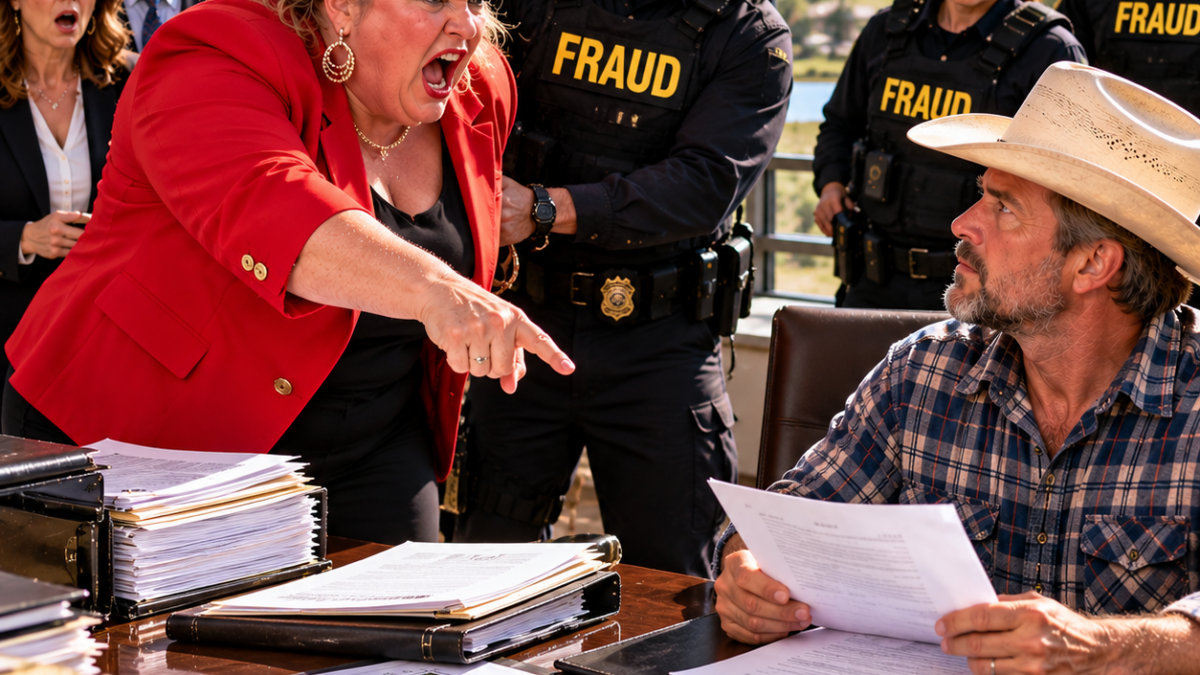
Three months earlier, I hadn’t known Marla Voss well enough to hate her.
I knew her name.
Most people around Brier Glen did.
She was the president of the homeowners association and had built a reputation for getting what she wanted.
People described her as organized, demanding, and extremely effective.
She liked polished presentations, strict deadlines, and contracts full of language that made ordinary people feel foolish for asking simple questions.
But none of that mattered to me.
I didn’t live in Brier Glen.
I wasn’t an HOA member.
And my twenty acres had existed long before the development’s first house was built.
My father bought the property when the surrounding area was mostly pastureland.
He wasn’t a wealthy man.
He worked hard, saved carefully, and believed that owning a piece of ground outright meant something.
When he first bought the land, there wasn’t much on it.
A rough access road.
An old fence.
A small equipment shed.
And enough open ground to graze a few animals.
Over the years, we improved it.
I helped him clear brush when I was a teenager.
We replaced fence posts together.
Hauled gravel onto the road.
Repaired drainage ditches.
And built a larger shed using lumber from a building that had been torn down two counties away.
My father wasn’t sentimental about machinery.
If a tractor broke, you repaired it.
If a truck stopped running, you found out why.
But he was sentimental about that land.
He used to say that a man shouldn’t have to explain why he wanted to keep something he’d worked his whole life to own.
I didn’t fully understand him until years later.
After he died, I inherited the property.
I turned part of the pasture into a small machinery repair business.
Farmers brought me tractors with ruined transmissions, combines that refused to start, and engines that other mechanics had already given up on.
I wasn’t the only mechanic in the county, but I’d built a reputation for taking difficult jobs and finishing them.
Some customers drove more than a hundred miles because they trusted my work.
I had two full-time employees, a part-time bookkeeper, and more bills than I cared to count.
But it was an honest living.
The land made the business possible.
I needed space to park heavy machinery.
I needed a road wide enough for equipment trailers.
And I needed enough distance from neighboring homes that early morning engines and welding work wouldn’t become everyone’s problem.
For more than twenty years, that arrangement worked.
Then Brier Glen started expanding west.
The development wanted a larger clubhouse, a recreational complex, additional parking, and a new entrance to serve a proposed fourth phase of residential construction.
Beautiful drawings appeared online.
A landscaped boulevard.
Stone columns.
Decorative lighting.
A gatehouse.
Walking paths.
And a wide road connecting the new homes to the county highway.
The drawings looked expensive.
They also had one serious problem.
The proposed entrance and construction route crossed directly through my twenty acres.
At first, I didn’t know that.
I discovered it because three surveyors showed up one morning and began driving stakes into my land without asking permission.
I was in the shop rebuilding a hydraulic pump when I heard a truck engine near the western fence.
I wiped my hands on a rag and walked outside.
A white pickup was parked near the pasture.
Three men in reflective vests were working beside a measuring instrument.
Bright orange stakes had been placed along a line cutting through my gravel yard.
One of the men was marking another spot.
I walked toward them.
“Morning.”
The nearest surveyor looked up.
“Morning, sir.”
“Can I help you find something?”
He glanced at his clipboard.
“We’re marking the Phase Four expansion boundary.”
I looked at the stakes.
“On whose property?”
He pointed toward the development.
“Brier Glen.”
I shook my head.
“No. You’re on mine.”
The man frowned.
“Are you Mr. Mercer?”
“Yes.”
He looked down at the paperwork.
Then handed me a printed site plan.
I unfolded it.
Across the top were the words:
BRIER GLEN — PHASE FOUR WESTERN EXPANSION.
My entire twenty-acre parcel had been incorporated into the drawing as though it already belonged to the development.
Not a narrow access strip.
Not a temporary construction easement.
The whole property.
The proposed road crossed my yard.
The clubhouse parking overflowed toward my pasture.
And the expansion boundary swallowed the land my father had purchased decades earlier.
I looked up.
“Who authorized this?”
The surveyor appeared uncomfortable.
“We’re working from the project documents.”
“Who gave you those documents?”
“The association’s development office.”
I looked down at the map again.
The clean lines made it look official.
But lines on a proposal don’t transfer ownership.
I folded the drawing.
“This land doesn’t belong to Brier Glen.”
The surveyor nodded slowly.
“Then there’s been a misunderstanding.”
“Maybe. But until it’s resolved, I need you to stop marking my property.”
He hesitated.
Then looked toward the other two men.
“Let’s hold up.”
I appreciated that.
He wasn’t the problem.
He was doing a job based on instructions someone else had given him.
I asked for the name of the project contact.
He gave me Marla Voss.
By lunchtime, I was driving to the association office.
I figured I’d show her the deed, explain the boundary, and ask her to revise the plans.
At worst, I expected an argument over a purchase offer.
I didn’t expect her to threaten me.
But that was exactly what she did.
PART 2
Marla’s office occupied the second floor of Brier Glen’s management building.
Everything about it was designed to look expensive.
Polished floors.
Glass doors.
A reception desk with a decorative stone wall behind it.
Framed photographs showing landscaped streets, clubhouse events, and smiling families standing in front of beautiful houses.
I walked in wearing work boots and a clean denim shirt.
The receptionist looked at me as though she wasn’t sure whether I had an appointment or had come to repair the air conditioning.
“I’m here to see Marla Voss.”
“Do you have an appointment?”
“No. But her surveyors are on my property, and I need to discuss it.”
She asked for my name.
Then made a call.
A few minutes later, Marla appeared.
She was in her early fifties, with carefully styled hair, a dark business suit, and a smile that looked practiced.
“Mr. Mercer,” she said. “I’ve been expecting you.”
That bothered me.
Not enough to start an argument.
But enough to notice.
If she was expecting me, she already knew something about the surveyors.
She led me into a conference room.
I placed the development plan on the table.
“Your surveyors are marking my land.”
She glanced at it.
“Yes. We’re conducting preliminary work for the west entrance.”
“Then you’re conducting it in the wrong place.”
She sat down.
“Mr. Mercer, the association has identified your parcel as essential to the long-term expansion of Brier Glen.”
I remained standing.
“That doesn’t make it yours.”
“Of course not.”
She opened a folder.
“That’s why we’ve prepared an offer.”
She slid a proposal toward me.
I read the figure.
It was roughly forty percent of what comparable commercial-access land in the area was worth.
I looked up.
“You’re offering me less than half the market value.”
She folded her hands.
“It’s a fair offer considering the property’s present use.”
“My present use is a functioning business.”
“An industrial equipment yard.”
“A machinery repair shop.”
She smiled.
“However you prefer to describe it.”
I felt my jaw tighten.
She continued.
“Our development will significantly improve the surrounding area. We’re offering you an opportunity to benefit.”
I pushed the paper back.
“No.”
Her smile remained.
“You haven’t considered the advantages.”
“I’ve considered the fact that I don’t want to sell.”
“Everyone says that at first.”
“Then everyone doesn’t mean it.”
She looked at me more carefully.
“Mr. Mercer, I think you’re underestimating the seriousness of the expansion schedule.”
“That schedule isn’t my responsibility.”
“Delays affect hundreds of residents and a substantial investment.”
“Then you should have secured the land before drawing roads across it.”
For the first time, her expression hardened.
She leaned forward.
“Let me offer some advice.”
I waited.
“You can cooperate now and receive compensation, or you can make this unnecessarily difficult.”
I looked at her.
“Is that a threat?”
“Consider it a prediction.”
She slid the proposal closer.
“You’re going to find that circumstances change quickly when you’re standing in the way of something this important.”
I left the offer on the table.
Then stood.
“Remove your stakes from my property.”
She didn’t answer.
At the door, I looked back.
“And don’t send anyone else onto my land without permission.”
Marla smiled.
“Have a good afternoon, Mr. Mercer.”
I drove back to the shop thinking she was arrogant.
I didn’t yet understand how much damage she was prepared to do.
Three days later, the first HOA violation arrived.
The envelope looked ordinary.
White paper.
Brier Glen letterhead.
My name and address.
Inside was a formal notice accusing me of operating an unauthorized commercial business in a residential community.
I read it twice.
Then laughed.
Not because it was particularly funny.
Because the idea was so ridiculous.
My repair shop had operated there long before Brier Glen expanded anywhere near me.
More importantly, my property wasn’t part of the association.
I had never signed any HOA agreement.
Never paid dues.
Never attended a board meeting.
Never requested architectural approval.
I wasn’t subject to their rules.
I mailed back a copy of my deed and a short letter explaining that the association lacked jurisdiction.
Two days later, another notice arrived.
This one cited landscaping violations.
The following week, a third demanded architectural review fees.
Then came a road-maintenance assessment.
Then another fine related to commercial equipment storage.
I began stacking the letters on my kitchen table.
By the end of two weeks, Brier Glen claimed I owed more than $30,000.
Thirty thousand dollars.
For violations of rules that didn’t apply to my land.
I called the association office.
The receptionist transferred me to Marla.
She answered pleasantly.
“Grant. I was wondering when you’d call.”
I stared at the letters.
“What are these fines?”
“Association enforcement notices.”
“I’m not a member.”
“That may not be as clear as you believe.”
I frowned.
“What does that mean?”
“Perhaps you should review your property’s legal status.”
“My legal status is that I own twenty acres outside Brier Glen.”
“Records change, Grant.”
I sat up.
“What records?”
She paused.
Then said almost gently, “You might want to visit the county recorder’s office.”
I looked at the phone.
“Marla, what have you done?”
She ignored the question.
“I’ve offered you a reasonable solution. You should seriously consider it before this becomes more expensive.”
The line went dead.
I sat there for several seconds.
Then gathered every document I had.
My deed.
Tax records.
The survey.
The development map.
And the growing pile of violation notices.
The next morning, I went to the county recorder’s office.
I expected to confirm what I already knew.
Instead, I discovered that someone had filed a document bearing my forged signature.
The clerk brought me the property record.
Near the front of the file was an instrument recorded six weeks earlier.
Its title read:
CONSENT TO ANNEXATION.
I stared at the words.
The document claimed I had voluntarily requested that my twenty acres become subject to the Brier Glen homeowners association.
It contained a legal description of my parcel.
References to association covenants.
A statement of voluntary consent.
And near the bottom, a signature.
Grant Mercer.
My name.
Written in handwriting that looked disturbingly similar to mine.
I felt my stomach turn.
I’d never signed it.
I hadn’t authorized anyone to sign it.
And until that morning, I hadn’t even known the document existed.
Below the signature was a notarial acknowledgment.
Darlene Moss.
A woman I had never met.
The acknowledgment stated that I personally appeared before her on a specific date and signed the annexation consent.
I stared at that date.
Then something clicked.
I knew exactly where I’d been.
Nearly 180 miles away.
At an equipment auction.
I’d spent the night in a motel near the auction grounds.
Bought several used hydraulic components.
Filled my truck with diesel.
And checked in at the registration desk that morning.
I still had the receipts.
The motel invoice.
Fuel purchases.
Auction registration.
Bidding records.
All of it.
I looked at the clerk.
“I need a certified copy of this.”
She nodded.
“Of course.”
I pointed toward the signature.
“That isn’t mine.”
Her expression changed.
“I’m sorry?”
“Somebody forged my name.”
She looked down at the document.
Then back at me.
“You’ll need to address that through the appropriate legal process.”
“I understand.”
But I barely heard the rest.
I kept staring at the signature.
There is something deeply unsettling about seeing your own name attached to a decision you never made.
My father had worked for years to buy those twenty acres.
I’d spent most of my adult life building a business there.
And someone I’d never met had supposedly watched me sign away control of the property while I was sitting in an equipment auction almost three hundred kilometers from home.
The forged document had been accepted into the recording system.
That didn’t make it valid.
But it gave Marla something that looked official enough to frighten people.
A recorded instrument.
A notarial seal.
A signature resembling mine.
And a false history she could point to whenever I challenged her authority.
I left the recorder’s office with the certified copy in my hand.
Then drove directly to Brier Glen.
This time, I wasn’t there to discuss an offer.
I was there to demand an explanation.
Marla didn’t look surprised when I entered her office.
She glanced at the document and smiled faintly.
“Did you find what you were looking for?”
I placed the certified copy on her desk.
“Where did this come from?”
She looked down.
“The annexation consent.”
“Who prepared it?”
“It’s part of the recorded association file.”
“I didn’t ask what it is.”
Her smile faded.
I pointed to the signature.
“That’s not mine.”
She leaned back.
“Grant, if you’re disputing a recorded document, you’ll need to address that through an attorney.”
“I was nearly 180 miles away on the date this says I appeared before a notary.”
She folded her hands.
“Then present your evidence through the proper channel.”
“You knew about this?”
“The document was properly filed.”
“That’s not an answer.”
She glanced toward the door.
“I think this conversation has become unproductive.”
I stared at her.
“Somebody used my name to bring my land into your HOA without my permission.”
“You’re making allegations.”
“I’m stating what happened.”
She looked at the certified copy.
Then at me.
“Perhaps you should have accepted the purchase offer before things became complicated.”
For a moment, I couldn’t speak.
It wasn’t merely the arrogance.
It was the calmness.
She was treating a forged signature like an inconvenient customer-service complaint.
I picked up the document.
“You’re going to regret this.”
Her smile returned.
“Be careful, Grant. Threats won’t improve your position.”
I turned and left before I said something I couldn’t take back.
Outside, I sat in my truck gripping the steering wheel.
My hands were shaking.
Not from fear.
From anger.
I had spent years dealing with people who believed they could take advantage of someone because he looked ordinary.
A mechanic.
A farmer’s son.
A man who wore faded work clothes and drove a truck with two hundred thousand miles on it.
But I’d never encountered someone so comfortable building an entire legal claim around a signature she apparently knew was false.
I drove home.
Pulled the auction receipts from my office files.
Copied everything.
Then placed the forged annexation beside my real signature on an old business contract.
The differences were subtle but obvious to me.
The shape of the M.
The angle of the final stroke.
The way the letters connected.
Whoever had copied my handwriting had practiced.
I stared at the pages until the shop went dark.
Then I turned on the desk lamp and kept working.
Because I understood something important.
If Marla could put a false annexation in the county records, she could create more paperwork.
More fines.
More threats.
And eventually, something that might interfere with my ownership in a way that would take years to unwind.
I was right.
The next document was a lien.
And that was when the fight stopped being an argument over HOA rules and started threatening the future of my business.
The fines continued arriving.
Landscaping.
Commercial use.
Architectural review.
Road maintenance.
Administrative assessments.
Collection fees.
Attorney charges.
Every notice seemed designed to make the next one appear routine.
The original amount climbed past $31,000.
Then $45,000.
Then $60,000.
Finally, the claimed balance exceeded $74,000.
I stopped opening the letters at the kitchen table.
I took them directly to my office and filed them by date.
My employees noticed.
One afternoon, Eddie, my senior mechanic, found me standing beside a tractor with a notice in my hand.
“Another one?”
I nodded.
He wiped grease from his fingers.
“How much now?”
“Seventy-four thousand and change.”
He stared.
“For what?”
“Apparently, existing.”
He shook his head.
“That’s insane.”
“Pretty much.”
Eddie looked toward the equipment yard.
“Are they really going to make you pay?”
“I’m not paying fines I don’t owe.”
“Can they shut us down?”
I looked at him.
The honest answer was that I didn’t know how much damage a determined association could cause before a court stopped it.
And I hated not knowing.
“I’m working on it,” I said.
He nodded.
Then returned to the tractor.
But I could see the concern in his face.
That bothered me more than the notices.
My problems were beginning to affect the people who depended on the shop.
And Marla wasn’t finished.
A recorded lien soon appeared against the property.
The association claimed the assessments were overdue and enforceable under the annexation instrument.
I remember reading the lien at my desk.
My stomach felt hollow.
The money wasn’t the point.
At least, I didn’t think it was.
A lien could make a property difficult to sell or refinance.
It could create title problems.
It could frighten a lender.
It could force the owner into costly litigation merely to prove that the recorded claim should never have existed.
Marla wasn’t trying to collect ordinary HOA dues.
She was making my land harder to use as a financial asset while pressuring me to surrender it.
A few days later, another envelope arrived.
This time, the association offered what it called a settlement.
If I transferred my twenty acres to Westmere Development Holdings, Brier Glen would cancel the fines and release the lien.
I would receive $185,000.
All claims would disappear.
I read the proposal carefully.
Then read the purchaser’s name again.
Westmere Development Holdings.
Not Brier Glen.
Not the HOA.
Not the company building the new clubhouse.
A private limited liability company I had never heard of.
I called Marla.
“Who’s Westmere?”
“A development partner.”
“Why does your HOA want me to transfer my property to them?”
“It’s part of the acquisition structure.”
“Why not buy the land directly?”
She sighed.
“Grant, these are ordinary real estate arrangements.”
“Then explain it.”
“The details aren’t your concern.”
I felt anger rise.
“They are when you’re asking me to sign over everything I own.”
She paused.
Then said, “You can accept the settlement or continue facing the association’s lawful remedies.”
I looked at the $74,000 balance.
“You’re calling this lawful?”
“That’s for the courts to decide if you insist on fighting.”
I took a slow breath.
“I’m not selling.”
Her voice cooled.
“Then you’ll have to live with the consequences.”
The next morning, a temporary security gate appeared across the access road I used for my business.
Two guards stood beside it.
And a sign announced that the route was now under Brier Glen access control.
I drove up in my truck and stopped.
One guard approached.
“Morning, sir. This entrance is restricted.”
I stared at him.
“Restricted by whom?”
“The association.”
“This is the access I’ve used for decades.”
“Sorry. New policy.”
I held up a copy of my deed and road-access documents.
“Your employer doesn’t have the authority to shut me out of my business.”
He looked uncomfortable.
“I’m just following instructions.”
“Who gave them?”
“Management.”
I looked beyond the gate.
The road continued toward the highway.
A few hundred yards.
That was all.
But the alternative route required my trucks to travel eleven additional miles.
For a pickup, it was an inconvenience.
For a tractor being transported on a heavy trailer, it was expensive.
For a business already working on thin margins, it was a serious problem.
I called the management office.
They transferred me to Marla.
She answered almost cheerfully.
“Grant.”
“Open the gate.”
“I’m afraid access is restricted while your property status remains unresolved.”
“You created the dispute.”
“That’s your interpretation.”
“I have customers expecting equipment deliveries.”
“Then perhaps you should settle the matter.”
I closed my eyes.
She was doing exactly what she’d threatened.
Using the HOA’s claimed authority to make my refusal more painful every day.
I looked at the guards.
Then at the road I couldn’t use.
“You’re blocking a working business to force a land sale.”
Marla said nothing for a moment.
Then replied, “I offered you an easy solution.”
The call ended.
I drove the long way around.
That afternoon, I added another expense to the growing spreadsheet on my desk.
Extra fuel.
Extra driver time.
Late deliveries.
And money lost because one woman had decided I wasn’t entitled to keep land my family had owned for decades.
I didn’t know it yet, but every one of those expenses would eventually become part of the case against her.
The detour cost more than fuel.
It cost time.
And in my business, time can ruin a week’s schedule.
When a farmer’s combine breaks during harvest, he doesn’t want to hear that the mechanic is fighting an HOA over access.
He wants the machine working.
When a contractor needs a loader by Tuesday, he doesn’t care why the delivery route suddenly takes longer.
He needs the loader by Tuesday.
I understood that.
I couldn’t expect customers to absorb my problems.
But I also couldn’t make Marla open the gate simply by explaining how much damage she was causing.
One customer canceled a major repair because the transportation delay interfered with his harvest schedule.
Another moved his regular equipment work to a shop farther away.
Two long-standing accounts.
Gone in the same month.
I watched the numbers on my spreadsheet grow.
Fuel costs rose.
Overtime increased.
Deliveries took longer.
And I spent hours every week dealing with paperwork that had nothing to do with repairing machinery.
At night, I sat at the kitchen table with invoices spread around me.
My father’s old oak table had a scratch near the edge where I’d once dropped a wrench.
He never bothered repairing it.
He said furniture that had been used honestly was allowed to show it.
I ran my thumb along the scratch while reviewing the shop’s expenses.
The familiar sound of the refrigerator filled the kitchen.
Outside, the property was dark.
I thought about my father asking me what I’d accomplished that day.
The answer would have embarrassed me.
I’d spent most of the day defending paperwork instead of fixing engines.
And yet I knew I couldn’t simply surrender.
Marla wasn’t asking me to sell a spare strip of land.
She wanted the entire twenty acres.
The shop.
The yard.
The place where I’d built my adult life.
I opened the settlement proposal again.
Westmere Development Holdings.
That name bothered me.
The HOA claimed the land was needed for community expansion.
But the actual buyer was a private company.
Why?
What did Westmere gain that the association couldn’t acquire directly?
And why was Marla so determined to force the transfer through that particular entity?
The more I looked at the documents, the more convinced I became that the fake fines were only one part of the scheme.
Then the foreclosure notice arrived.
It warned that continued failure to resolve the claimed assessments could result in further collection and foreclosure proceedings.
Attached was another copy of the settlement offer.
Transfer the property.
Receive $185,000.
Release the lien.
Cancel the debt.
End the dispute.
I stared at the papers for a long time.
Marla had created a problem and was selling me the solution.
Except her solution required giving her what she’d wanted from the beginning.
My land.
I finally understood that I needed somebody who did more than send angry letters.
I needed someone who could find out where the documents came from, who actually controlled Westmere, and why Marla was willing to go so far.
The next morning, I called Audrey Pike.
And that decision changed everything.
Audrey Pike practiced real estate law out of a small office near the county courthouse.
Her reception area wasn’t impressive.
No marble floors.
No expensive artwork.
No glass conference room overlooking a landscaped entrance.
Just shelves filled with legal books, a receptionist who seemed to know every property dispute in the county, and a woman who had spent enough years reading deeds to recognize when somebody was trying to disguise a land grab as a routine administrative matter.
Audrey was in her forties, sharp-eyed, and direct.
She didn’t interrupt while I explained the situation.
I placed the documents on her table in the order they’d arrived.
The original purchase offer.
The first HOA violations.
The forged annexation.
The mounting assessments.
The lien.
The access restriction.
The settlement proposal.
And the foreclosure warning.
By the time I’d finished, the stack was several inches high.
Audrey pulled the forged annexation toward her.
“You’re certain this isn’t your signature?”
“Absolutely.”
“And you weren’t present before this notary?”
“I was at an equipment auction nearly 180 miles away.”
“Can you prove it?”
I handed her the receipts.
She examined them.
Then studied the notarial acknowledgment.
“Darlene Moss,” she said quietly.
“Never met her.”
Audrey looked up.
“Grant, this isn’t an ordinary disagreement over HOA jurisdiction.”
“I figured that out when somebody forged my name.”
She didn’t smile.
“I want to know exactly how they supposedly annexed your parcel.”
She pulled a copy of Brier Glen’s recorded governing documents from a file and began reviewing them.
The annexation procedure wasn’t simple.
Bringing new property into the association required several steps.
The owner’s consent.
A formal board vote.
An amendment to the applicable recorded documents.
And certification by the board secretary.
Audrey looked at me.
“According to the file, they completed every step.”
“I didn’t consent.”
“I know.”
“Then the rest has to be wrong.”
“Maybe. But we need to establish exactly where the records fail.”
She pointed to the annexation package.
There were documents supporting each required step.
A signed consent.
A board resolution.
Meeting minutes.
A recorded amendment.
Secretary certification.
Everything was arranged neatly.
Almost too neatly.
Audrey frowned.
“Someone went to considerable effort to create a complete paper trail.”
I looked at her.
“Can they do that?”
“They can create documents. Whether those documents are genuine and legally effective is another question.”
She studied the meeting minutes.
“Let’s start with the board vote.”
The record claimed that five directors had unanimously approved the annexation of my land.
Five to zero.
It listed a meeting date and bore the signature of the association secretary.
Reid Sutter.
Audrey requested the original board records.
Marla refused to release them voluntarily.
She described the request as unnecessary and accused Audrey of harassing the association.
Audrey responded with a formal records demand through the appropriate legal process.
When the minutes were finally produced, she compared them with other board records.
Then she contacted Reid directly.
I was in her office when he called back.
Audrey placed the phone on speaker after confirming he was comfortable speaking with me present.
“Mr. Sutter, I’m reviewing the minutes from the meeting identified in the annexation package.”
“All right.”
“Do you remember a vote concerning Grant Mercer’s twenty-acre parcel?”
There was silence.
Then Reid said, “What vote?”
Audrey looked at me.
“The recorded minutes show a unanimous board vote.”
“That’s not possible.”
“Why?”
“Because we never voted to annex his property.”
I felt my heart start beating harder.
Audrey remained calm.
“Would you be willing to review the document?”
“Send it.”
She emailed the copy.
We waited.
I could hear Reid moving papers on the other end.
Then he spoke.
“Where did you get this?”
“From the association’s records production.”
His voice sounded different now.
Angrier.
“That’s not what happened at that meeting.”
Audrey asked him to examine the signature.
“Is that your certification?”
There was another long pause.
Then Reid said the words I’d been hoping to hear.
“That’s not my signature.”
I stared at the phone.
Audrey asked him to repeat the statement clearly.
He did.
He hadn’t signed the certification.
The board hadn’t conducted the vote described in the minutes.
And the records didn’t reflect the meeting as he remembered it.
I leaned back.
For weeks, I’d felt as though I were losing my mind.
Every time I pointed to my deed, Marla produced another official-looking document.
Every time I denied joining the HOA, she referred to the recorded annexation.
Every time I challenged the fines, she threatened stronger enforcement.
Now somebody inside Brier Glen was saying that part of the association’s own paperwork had been fabricated.
Two signatures.
Mine.
And Reid’s.
Both disputed by the people whose names appeared on them.
Audrey thanked Reid and arranged for his account to be documented properly.
After the call ended, I looked at her.
“That’s enough to sue, isn’t it?”
“Yes, we have substantial grounds to challenge the records.”
“Then let’s do it.”
She studied me for a moment.
“Grant, I think we need to consider something first.”
“What?”
“If we file a civil case immediately, Marla will know exactly which parts of the documents we’ve challenged.”
“She already knows I didn’t sign.”
“Yes. But she may not know we’ve spoken to Reid.”
I frowned.
“So?”
“So she may change her story, conceal records, or shift responsibility before investigators can establish who actually created the documents.”
I looked toward the folder.
“You’re saying we should wait.”
“I’m saying we should preserve the evidence and find out who benefits.”
She tapped the settlement proposal.
“Starting with Westmere.”
Audrey’s investigation into Westmere Development Holdings began with ordinary business-registration records.
The company had been formed less than a year earlier.
Its registered address led to a commercial mailbox service above a small retail storefront.
It had no obvious office.
No visible development projects.
No long operating history.
And no recognizable relationship to my land other than the fact that Marla wanted me to transfer twenty acres to it.
The listed manager wasn’t an individual.
It was another limited liability company.
That company had been registered in another state.
Its management records led to yet another entity.
Audrey spent days untangling the ownership structure.
At first, the paperwork looked deliberately boring.
Company names.
Registered agents.
Addresses.
Annual filings.
Business identifiers.
But beneath the layers, patterns emerged.
The same addresses appeared more than once.
The same service providers handled filings.
And eventually, one name surfaced.
Voss Strategic Properties.
I stared at Audrey when she showed me.
“Voss?”
She nodded.
“That’s the name.”
“Marla Voss?”
“We need documentary proof of the beneficial ownership and her personal involvement before drawing a final conclusion.”
I understood her caution.
But the connection was hard to ignore.
A company linked through several layers to Voss Strategic Properties was trying to buy my land.
And the woman demanding I sell was Marla Voss.
I looked at the settlement agreement.
“She’s been telling everyone this is for the community.”
Audrey nodded.
“That’s what makes the transaction structure significant.”
“Then why use Westmere?”
“Potentially to separate the apparent buyer from the person directing the pressure. But investigators will need to establish the purpose.”
I stared at the company records.
For the first time, the outline of something larger became visible.
Marla wasn’t simply trying to force the HOA’s expansion through my property.
Someone stood to profit privately from the transfer.
And that made the forged annexation, fake fines, and lien look less like aggressive HOA enforcement and more like parts of a financial operation.
Audrey closed the folder.
“Grant, this needs to go to the fraud unit.”
I nodded.
“How soon?”
“Now.”
Nolan Greer didn’t look impressed by the amount of paperwork we brought him.
He looked concerned.
Which, in some ways, was worse.
Nolan worked in the county’s fraud investigation unit.
He was a deliberate man who asked short questions and rarely wasted words.
Beside him sat Tessa Whitcomb, a financial investigator who specialized in following money through businesses that didn’t want their connections to be obvious.
Audrey explained the dispute.
I described the forged signature.
Reid’s denial.
The $74,000 assessments.
The lien.
The road blockade.
And the proposed transfer to Westmere.
Nolan listened.
Then examined the records.
“Have you ever met Darlene Moss?”
“No.”
“Have you signed any document consenting to HOA annexation?”
“No.”
“Have you attended a board meeting where your property was annexed?”
“No.”
He looked at the auction records.
“You can establish your location on the notarization date?”
“Hotel receipt, fuel purchases, registration, bidding records.”
He nodded.
Then turned toward Tessa.
She was studying the company documents.
“Westmere,” she said.
I looked at her.
“What about it?”
“That’s where the money may lead.”
I leaned forward.
“So you can arrest Marla?”
Nolan shook his head.
“Not based on what we’ve established so far.”
I stared at him.
“Somebody forged my name.”
“That’s what the evidence strongly indicates.”
“Somebody forged Reid’s signature.”
“That’s also being investigated.”
“And Marla is the one using those documents to take my land.”
Nolan nodded.
“But we still need to establish who created them, who directed the conduct, and who knowingly participated.”
I felt frustration rising.
“She’s destroying my business while we’re sitting here talking.”
His expression softened slightly.
“I understand the urgency.”
“Then why not act?”
“Because acting before we can prove her role may allow her to blame someone else.”
I said nothing.
He continued.
“She could claim the management company filed the wrong records. She could blame an outside notary. She could say a board employee prepared documents without authorization.”
I thought about Marla’s calm expression when I’d confronted her with the forged annexation.
She hadn’t panicked.
She’d told me to speak to an attorney.
As though she’d already prepared an explanation.
Nolan continued.
“We don’t want to prove merely that fraudulent paperwork exists. We want to establish who was directing the operation.”
Tessa looked up from the Westmere file.
“And who was going to receive the money.”
That caught my attention.
“What money?”
She pointed to the ownership structure.
“We’re going to examine the financial relationships connected to this transaction.”
“Can you trace them?”
“With the appropriate legal process, we can follow the records.”
I looked at Audrey.
She nodded.
“We need to let them work.”
I took a slow breath.
“How do I keep the shop open while they do?”
Nolan didn’t offer false reassurance.
He couldn’t.
The civil remedies and business-access dispute still needed attention.
Audrey was already working on those issues separately.
But the criminal investigation required evidence that couldn’t be gathered simply by confronting Marla with accusations.
I understood the distinction.
I didn’t like it.
But I understood.
So I went back to my shop.
Kept copies of every notice.
Recorded every new restriction.
Documented the detours.
And tried to keep the business running while the investigators followed a trail that was beginning to stretch far beyond Brier Glen.
The financial records changed everything.
Westmere had entered into a development arrangement with an outside company.
Under that contract, Westmere would receive a substantial payment if it delivered clear title to my twenty acres by a specified deadline.
Not merely an option to negotiate.
Not a vague future interest.
A transaction tied to acquiring my property and transferring it to another developer.
The outside developer wanted the land because it connected the western expansion to a viable access route.
Without the parcel, the project faced major design and infrastructure problems.
With the parcel, the new development could proceed and the land’s value would rise dramatically.
I sat across from Audrey and Nolan as Tessa explained the arrangement.
“So Westmere buys my land for $185,000.”
“That’s the proposal,” she said.
“And then sells it to the developer for much more.”
“The contract provides for a substantially higher acquisition value, contingent on delivery of title.”
I stared at her.
“How much higher?”
She explained that the total potential transaction value ran into the millions, depending on the agreed conditions.
I leaned back.
For weeks, Marla had told me I was being unreasonable for refusing her offer.
She’d acted like she was doing me a favor.
Now I understood why she kept imposing deadlines.
Westmere had its own deadline.
And someone behind that company stood to make a fortune if I signed.
Tessa continued.
“We’re also examining vendor payments from the association.”
“What kind of payments?”
“Consulting fees. Administrative support. Landscaping-related invoices. Payments to entities connected through the business records.”
She explained how money had moved in smaller amounts over time.
Association funds went to vendors.
Some vendors had business relationships with entities linked to Voss Strategic Properties.
The same addresses and associated individuals appeared repeatedly.
Each payment alone might have looked ordinary.
Together, the pattern warranted serious scrutiny.
I shook my head.
“So she’s been using HOA money too?”
“We’re investigating whether association funds were improperly routed through related businesses.”
I looked toward Nolan.
“How many other people has she done this to?”
He didn’t answer immediately.
“We don’t know yet.”
That unsettled me.
I had assumed I was being targeted because my land sat in the path of the expansion.
But the financial pattern suggested something older.
Something that might have been happening quietly for years.
Nolan folded his hands.
“Grant, we want to propose an approach.”
I waited.
“You’re going to tell Marla you’re ready to accept the offer.”
I stared at him.
“No.”
He didn’t react.
I continued.
“Absolutely not.”
“Listen to the full plan.”
“I’ve spent months refusing to sell. I’m not putting my land at risk.”
“Your deed won’t be transferred.”
I looked at Audrey.
She leaned forward.
“The transaction would be controlled. We would establish clear safeguards to prevent any actual transfer or recording.”
I remained skeptical.
Nolan explained that they wanted Marla to believe the pressure had finally worked.
If she thought I was surrendering, she might confirm the relationship between the fines, lien, access restrictions, and land transfer in her own words.
She might reveal details about Westmere.
And the closing documents could expose further attempts to conceal coercion.
I stared at him.
“You want me to pretend I’m beaten.”
“Yes.”
I looked toward the window.
For three months, I’d been fighting to keep my business alive.
I’d argued with security guards.
Spent money on attorneys.
Lost customers.
Read forged documents bearing my own name.
And now the investigators wanted me to call the woman responsible and tell her she’d won.
I hated the idea.
Not because I couldn’t pretend.
Because I was afraid she’d believe it.
And because some part of me feared that once I sat at a closing table, the pressure would become real in a way I couldn’t control.
Audrey seemed to understand.
“Grant, you won’t sign the deed.”
I looked at her.
“You’re certain?”
“That is a condition of the operation.”
Nolan nodded.
“The goal is evidence. Not a completed transfer.”
I sat silently.
Then asked the question that mattered most.
“Will this give you what you need to stop her?”
Nolan considered his answer.
“It may give us important evidence directly connecting her decisions to the attempted acquisition. We won’t proceed unless the plan can be handled safely and lawfully.”
I looked at the photograph of my father that I carried in my wallet.
He was standing beside the old fence with a shovel in his hand.
I thought about what he’d say.
Probably something simple.
Don’t let somebody bully you into signing what you don’t mean.
I closed the wallet.
Then looked at Nolan.
“All right.”
He nodded.
“We’ll prepare carefully.”
I took a deep breath.
“Tell me what you need me to do.”
I called Marla the following afternoon.
My hands were shaking.
I didn’t want her to hear it.
The phone rang twice.
Then she answered.
“Grant.”
I swallowed.
“Marla.”
“Have you reconsidered?”
I looked toward the shop window.
Outside, Eddie was guiding a tractor into the service bay.
The access gate was still blocking our regular route.
Another delivery had arrived late that morning.
I let the silence last long enough to sound defeated.
“I can’t keep doing this.”
Marla didn’t respond immediately.
I continued.
“The fines. The legal bills. The road. It’s killing my business.”
Her voice softened.
“I’m sorry you’ve had such a difficult time.”
I almost lost my composure.
She was sorry.
After creating the pressure herself.
After threatening foreclosure.
After blocking my trucks.
She was speaking as though she’d found me stranded beside the road and offered a ride.
“I’ll take the offer,” I said.
There was a pause.
Then I heard the change in her breathing.
“That’s a sensible decision.”
“One hundred eighty-five thousand?”
“Yes.”
“And the lien disappears?”
“Once the transfer is complete.”
“The violations?”
“All resolved.”
“The gate?”
“Removed.”
I took a slow breath.
“All of it?”
“Every issue we’ve created for you can disappear once you sign.”
I stared at the phone.
She’d said it.
Not an outright confession to every allegation.
But an extraordinary admission.
Every issue we’ve created for you.
I let my voice remain tired.
“Okay.”
Marla sounded almost cheerful now.
“I’ll have the closing arranged.”
“How soon?”
“Ten days.”
I hesitated.
“That’s fast.”
“The paperwork is largely prepared.”
Of course it was.
She’d apparently been preparing for my surrender long before I agreed to anything.
She continued.
“Grant, you really should have done this earlier.”
I looked down at the forged annexation on my desk.
“Probably.”
She laughed softly.
“Let’s make sure we don’t have any more unnecessary conflict.”
We ended the call.
I sat still for several seconds.
Then looked at the recording documentation arranged through the investigators.
Nolan had heard the conversation.
So had Audrey.
I felt sick.
Not because Marla had threatened me.
Because she sounded so pleased.
Three months of damage to my business.
A fraudulent lien.
Forged signatures.
And she considered my surrender a business success.
I stood and walked into the shop.
Eddie was bent over a gearbox.
He looked up.
“You okay, boss?”
I nodded.
“Yeah.”
He studied my face.
“You don’t look okay.”
I tried to smile.
“Just tired.”
He wiped his hands.
“Anything I can do?”
I looked around the workshop.
At the machinery.
The tools.
The shelves stacked with parts.
The business we’d kept alive through bad harvest years, recessions, and equipment failures.
“Keep that tractor moving,” I said.
He grinned.
“That I can do.”
I returned to my office.
And waited for the closing instructions that might finally expose the woman trying to steal everything I’d built.
The title company’s document package arrived two days later.
Audrey reviewed it first.
Then called me.
“Grant, there’s another problem.”
I was sitting in the shop office.
“What now?”
“A declaration supposedly signed by you.”
I closed my eyes.
“Another forged signature?”
“That’s what it appears to be.”
The document was dated two months earlier.
It stated that I had voluntarily entered negotiations concerning the property.
It denied that any coercion, economic pressure, threats, or improper penalties had influenced my decision.
I stared at the copy Audrey sent me.
The document was absurd.
Two months earlier, I’d been fighting the first wave of HOA fines.
The access restrictions had begun escalating.
Marla had already threatened me for refusing the original purchase offer.
Yet someone had prepared a statement claiming I was voluntarily negotiating without pressure.
Audrey sounded angry.
“She wasn’t just trying to make you sign a deed.”
“What was she doing?”
“Trying to create evidence that the transfer was voluntary.”
I looked at the false declaration.
“Even before the closing.”
“Yes.”
I understood the implication.
Marla appeared to anticipate that I might later challenge the transaction by saying I’d been forced into it.
So someone had prepared documents denying coercion.
A manufactured history designed to protect a future transfer.
I shook my head.
“How far ahead was she planning?”
Audrey sighed.
“Far enough that we need to preserve everything.”
The investigators added the document to the case.
Meanwhile, I had to continue pretending I’d accepted defeat.
That was harder than I’d expected.
Marla became bolder with every passing day.
Survey crews returned to my land.
Representatives connected to the development began marking the proposed western entrance.
A large sign appeared near the property boundary.
FUTURE BRIER GLEN WEST ENTRANCE.
I stood looking at it.
The land still belonged to me.
The deed hadn’t been signed.
No legitimate transfer had occurred.
But Marla was already acting as though the twenty acres were hers to plan, advertise, and develop.
I wanted to tear the sign down.
I wanted to confront the surveyors.
I wanted to call her and demand that everybody leave.
Instead, I photographed everything.
Recorded dates.
Preserved communications.
And followed the investigative plan.
Every day felt like swallowing another insult.
At a community meeting, Marla announced that the western expansion property had been secured.
I wasn’t there, but Reid Sutter heard her.
He later told Audrey he couldn’t understand how she was making that claim when no legitimate board vote had ever occurred.
His concern deepened.
He began examining the association’s digital board records.
And eventually, he found something that gave the investigators another critical piece of evidence.
The meeting minutes used to support my annexation had been uploaded into the board portal seventeen days after the meeting supposedly occurred.
The upload happened late at night.
The account associated with the upload was tied to Marla’s administrative access.
The timestamps contradicted the story that the minutes had been prepared and certified as ordinary contemporaneous board records.
Reid preserved the metadata and provided it through the appropriate channels.
I remember Audrey telling me.
“Grant, the records are becoming very difficult for Marla to explain.”
I looked at her.
“Then why are we still waiting?”
“Because the closing is approaching.”
I stared at the calendar.
Six days.
Then five.
Then four.
Every day felt longer than the last.
Three days before the scheduled closing, Marla called again.
Her tone had changed.
The friendly voice was gone.
She wanted confirmation.
“Grant, I need to know that you’re not going to change your mind.”
I kept my voice flat.
“I’m coming.”
“You understand what happens if you back out.”
I stared at the phone.
“What happens?”
“The association continues enforcement.”
“The fines?”
“Yes.”
“The lien?”
“Of course.”
“And the foreclosure?”
“We’ll pursue every available remedy.”
I swallowed.
“The road gate too?”
“The restrictions stay in place until the outstanding matters are resolved.”
I let the silence grow.
Then asked, “But if I sign the deed, all of it goes away?”
“Exactly.”
I looked at the prepared questions beside me.
“And the land goes to Brier Glen?”
“No.”
Her answer was immediate.
“Westmere Development Holdings.”
“Why Westmere?”
“That’s the designated purchaser.”
“But isn’t this supposed to be for the HOA?”
She sighed.
“Grant, you don’t need to understand every aspect of the development structure.”
I stared at the wall.
“It’s my land.”
“And we’re offering a settlement that solves your problems.”
Problems she had created.
I took another breath.
“All right.”
“Good.”
Then she added something that made my blood run cold.
“Don’t make me regret giving you this opportunity.”
After the call, I sat in silence.
I could still hear her voice.
Every available remedy.
The lien.
The gate.
The foreclosure.
All disappearing if I signed over the property.
Nolan had heard the conversation through the lawful recording arrangement.
He called afterward.
“You did well.”
I stared at my desk.
“I feel like I agreed to let her rob me.”
“You didn’t sign anything.”
“Not yet.”
“And you won’t sign the deed.”
I closed my eyes.
“She thinks she has me.”
“That’s what we need her to believe.”
I looked toward the calendar.
Three days.
I had survived three months of pressure.
Now I needed to survive one more closing meeting.
But the investigators were about to discover that Marla had an even more urgent reason to force the sale.
She had already accepted money for the property.
And much of it was gone.
The $240,000 advance explained Marla’s desperation.
Tessa Whitcomb had been tracing Westmere’s accounts through records obtained by lawful investigative process.
The outside developer had paid Westmere a substantial advance under an agreement requiring delivery of clear title to my twenty acres.
The amount was $240,000.
More than Marla’s entire proposed payment to me.
And the financial records showed that most of the advance had already been transferred out of the account where it was received.
When Nolan explained the discovery, I stared at him.
“She took money for land she didn’t own?”
“Westmere received money under a contract requiring it to deliver title.”
“But they didn’t have my land.”
“No.”
“And they already spent most of the advance?”
“The funds moved through additional accounts and payments. We’re establishing the destination and purpose of each transfer.”
I leaned back.
Suddenly, the entire timetable made sense.
The deadlines.
The threats.
The insistence that I sign quickly.
Marla wasn’t merely trying to obtain the land cheaply.
She was racing to fulfill a financial obligation that depended on a property transfer I had repeatedly refused.
If I didn’t sign, Westmere couldn’t deliver clear title.
If Westmere couldn’t deliver title, the developer could demand its money back under the contract’s terms.
And if much of that money was already gone, someone had a serious problem.
I looked at Audrey.
“She’s been threatening to foreclose on my land because she’s afraid of what happens if I don’t sell.”
Audrey nodded.
“That appears to be part of the pressure driving her.”
I stared at the financial summary.
For months, I’d believed I was fighting an HOA president who wanted an expansion road.
Now I was looking at an alleged scheme involving forged records, layered companies, false assessments, and money paid in advance for land still legally owned by me.
My father had once told me that the most dangerous person in a negotiation wasn’t always the one who wanted something.
Sometimes it was the one who needed something so badly that telling the truth became impossible.
I understood that now.
Marla needed my signature.
Without it, the transaction collapsed.
And the investigation might expose what had happened to the money.
Nolan closed the file.
“The closing goes forward tomorrow.”
My stomach tightened.
“Everything ready?”
“The operation is coordinated. The closing officer is cooperating. The relevant legal safeguards are in place.”
I looked at him.
“And the deed?”
“Will not be signed or transferred.”
I nodded.
Then he said something I hadn’t expected.
“Grant, you can still decide not to participate.”
I looked at him.
He was serious.
After everything we’d prepared, he was giving me the choice.
I thought about the fake fines.
The road gate.
The customers I’d lost.
The sleepless nights.
And the photograph of my father hanging above my desk.
“No,” I said.
“I’m going.”
The morning of the closing, I woke before sunrise.
I made coffee.
Didn’t drink much of it.
Then walked outside.
The shop was quiet.
Dew covered the gravel near the fence.
My machinery stood in rows under the pale morning sky.
A tractor waited near the service bay.
A broken combine sat beside the parts shed.
The land looked exactly as it had for years.
Ordinary.
Useful.
Mine.
I walked to the western boundary.
Beyond it, Brier Glen’s planned expansion was visible through the trees.
A few survey stakes.
The temporary access gate.
The large sign announcing the future entrance.
Everything Marla had tried to build over my refusal.
I stood there for several minutes.
Then returned to the house.
Put on a clean shirt.
Gathered the documents Audrey had instructed me to bring.
And drove toward the title company.
I arrived early.
Paige Elson greeted me near the reception desk.
She was a professional closing officer who had already coordinated with the investigators.
Her expression was calm.
“Good morning, Mr. Mercer.”
“Morning.”
She led me to a small conference room.
Nolan was there in plain clothes.
Tessa Whitcomb was working from an adjoining office.
Two additional investigators were positioned nearby.
The arrangement had been carefully planned so the transaction could be documented without any actual conveyance of my property.
Paige reviewed the file with me one final time.
“The documents will be presented in the ordinary sequence,” she explained.
I nodded.
“The settlement agreement?”
“Yes.”
“The lien release?”
“Yes.”
“The deed?”
“That remains unsigned.”
I looked toward Nolan.
He nodded.
“Remember, you’re not required to argue. Let her explain the transaction.”
I took a slow breath.
“And if she becomes suspicious?”
“We’ll handle it.”
I looked at the conference table.
It seemed strange that such an ordinary room could hold so much danger.
Wooden chairs.
A polished surface.
A water pitcher.
Pens arranged beside the closing folders.
Thousands of real estate transactions probably took place in rooms like this every day.
Families bought homes.
Businesses acquired property.
People signed documents and began new chapters of their lives.
But I was walking into a room where someone intended to take the land I’d spent my life protecting through a transaction built on documents I believed were fraudulent.
I looked at Nolan.
“How do you stand doing this for a living?”
He smiled faintly.
“What?”
“Waiting for people to tell you the truth by accident.”
His expression became serious.
“Most people tell us more through their choices than they realize.”
I looked down at my hands.
They were rough from years of mechanical work.
Small scars crossed my knuckles.
There was still a faint trace of grease beneath one thumbnail, no matter how thoroughly I’d scrubbed it.
Those hands had repaired thousands of machines.
Built fences.
Carried tools.
Buried my father.
And signed plenty of ordinary business contracts.
But today, the one signature Marla wanted was the one I absolutely could not give her.
A few minutes later, Nolan left the room.
Paige arranged the documents.
And Marla arrived.
She entered with her attorney and a representative of Westmere Development Holdings.
She wore a cream-colored blazer.
Her hair was perfectly arranged.
And she carried herself with the cheerful confidence of somebody arriving to collect a prize.
The Westmere representative placed a folder on the table.
Marla brought the champagne.
I watched her put the bottle into a silver ice bucket near the cabinet.
She smiled at Paige.
“I thought we might celebrate once everything is complete.”
Paige nodded politely.
“Let’s review the paperwork first.”
Marla turned toward me.
“Grant.”
“Marla.”
“You look better than the last time we spoke.”
I didn’t answer.
She sat across from me.
“Hopefully, now that you’ve come to your senses, you can get back to repairing tractors instead of spending money on lawyers.”
I stared at her.
She smiled.
“That was meant kindly.”
“I’m sure.”
Her attorney opened his file.
Paige began.
The settlement agreement came first.
It described the payment and the release of certain claims.
Then came the documents addressing the association’s lien.
The closing instructions.
The proposed deed transferring my twenty acres to Westmere.
And the declaration stating that the transaction was voluntary and free of coercion.
I studied every page.
Not because I didn’t already know what they said.
Because I wanted Marla to believe I was frightened, uncertain, and trying to protect myself at the last possible moment.
She seemed increasingly impatient.
At one point, she tapped the table.
“Grant, these are standard documents.”
I looked up.
“Then you won’t mind answering a few questions.”
She sighed.
“Go ahead.”
I pointed toward the voluntary transfer declaration.
“This says nobody threatened me.”
“Correct.”
“But your HOA threatened foreclosure.”
“That was a lawful collection measure.”
“And the road gate?”
“An access-control issue.”
“The fines?”
“Association enforcement.”
I nodded slowly.
“So if I refuse to sign, those things continue?”
Marla leaned forward.
“Grant, we’ve already discussed the consequences.”
“I want to be sure I understand.”
She glanced toward her attorney.
Then answered.
“Yes. The lien remains. The collection remedies remain. And the access restrictions remain until the matter is properly resolved.”
Paige kept her eyes on the documents.
I turned another page.
“And if I sign?”
“Everything is settled.”
“The $74,000?”
“Canceled under the settlement.”
“The lien?”
“Released.”
“The gate?”
“Removed.”
“The foreclosure threats?”
“Finished.”
I looked toward the Westmere representative.
“And who gets my property?”
“Westmere Development Holdings,” Marla said.
“Not Brier Glen?”
“No.”
“Not the HOA?”
“No, Grant.”
“Why?”
Her face tightened.
“Because that’s how the transaction has been structured.”
I waited.
She continued.
“You don’t need to concern yourself with what happens after the transfer.”
I looked at the deed.
“Actually, I do.”
She exhaled sharply.
“Grant, the only thing standing between you and a clean financial settlement is your signature.”
I looked at her.
“So you’re telling me that if I sign my twenty acres over to Westmere, your association will cancel the debt, lien, and access restrictions it placed against me?”
“Yes.”
I paused.
“And those were the problems you created after I refused your first purchase offer?”
Marla’s expression changed.
She stared at me.
Then looked toward Paige.
I could almost see the thought forming.
Why was I asking these questions?
Why was I being so precise?
Why wasn’t I simply signing?
Her attorney shifted in his chair.
“Perhaps we should conclude the transaction.”
Paige placed the limited acknowledgment before me.
I signed it as arranged.
Then she presented the deed.
I looked at the signature line.
Marla leaned forward.
“Go ahead, Grant.”
I held the pen above the paper.
For one terrible second, I remembered the nights when I had wondered whether surrendering might be easier.
The nights I sat at my father’s table calculating fuel bills and lost work.
The mornings I drove eleven extra miles because the road gate remained closed.
The way Eddie looked at me when he asked whether the shop would survive.
I could understand why someone might sign.
Not because he believed the documents were right.
Because he wanted the pressure to stop.
That was what made the scheme so dangerous.
It didn’t need every victim to be foolish.
It only needed them to become exhausted.
I set the pen down.
Marla stared.
“Grant.”
I looked up.
She pointed toward the deed.
“You haven’t signed.”
I nodded.
“I know.”
Her voice hardened.
“What are you doing?”
I looked directly at her.
“Before I transfer my land, I want you to explain why your association used fines, a lien, foreclosure threats, and a blocked access road to force this sale to a private company.”
The room went silent.
Marla’s eyes moved toward the door.
Then back to me.
Her face lost its color.
“Stop the closing.”
Paige remained seated.
Marla stood.
“I said stop the closing!”
The conference room door opened.
And Nolan Greer walked in.
He wasn’t shouting.
There was no dramatic rush of officers overturning chairs or drawing weapons.
Just Nolan entering with the other investigators and identifying himself.
Tessa Whitcomb followed.
The room became so quiet I could hear the ice shifting inside the champagne bucket.
Marla stared at them.
“What is this?”
Nolan looked at her.
“Mrs. Voss, step away from the closing documents.”
Her attorney stood.
“What’s going on?”
Nolan identified the investigation and directed that the relevant evidence remain undisturbed.
Marla looked toward me.
“You set me up.”
I didn’t answer.
She turned back toward Nolan.
“This is a civil real estate dispute.”
He placed a file on the table.
“Mrs. Voss, we’re investigating suspected forgery, fraudulent real estate instruments, and related financial conduct.”
Her expression hardened.
“The HOA has legal counsel.”
“You’re entitled to counsel.”
She pointed toward the deed.
“Grant agreed to sell.”
I looked at the blank signature line.
“No, Marla. I didn’t.”
She stared at it.
For the first time, the certainty disappeared from her face.
Nolan began explaining the evidence supporting the investigation.
The purported annexation consent bearing my forged signature.
The notarial acknowledgment by Darlene Moss.
The auction records establishing my whereabouts on the date I supposedly signed.
The board minutes describing a vote that never occurred.
Reid Sutter’s disputed certification signature.
The digital records showing the minutes had been uploaded seventeen days after the meeting.
The fraudulent assessments and lien.
The connections between Westmere and Voss Strategic Properties.
The developer’s advance.
And the communications documenting the pressure used to obtain my property.
Marla interrupted.
“I don’t own Westmere.”
Tessa Whitcomb stepped forward.
She presented the financial and business records obtained during the investigation.
The connections extended through several companies.
The beneficial ownership and management trail led back to interests associated with Marla.
The records also documented payments connected to the development transaction.
Marla glanced toward her attorney.
Then said, “The board approved the annexation.”
Nolan looked toward the open doorway.
A moment later, Reid Sutter appeared.
Marla went pale.
Reid looked at her.
Then at the documents.
“I never voted to annex Grant Mercer’s property,” he said.
Marla opened her mouth.
Nothing came out.
Reid continued.
“And the signature on that certification isn’t mine.”
I watched her face.
For months, she’d been able to answer every accusation with another document.
Another threat.
Another claim of authority.
Now the people whose names appeared on those records were explaining that the records weren’t genuine.
Marla tried another explanation.
She suggested the management company had mishandled the paperwork.
That the secretary had forgotten a vote.
That outside consultants had prepared the transaction documents.
But Nolan had more than disputed signatures.
He had the financial trail.
The electronic records.
The documented communications.
And her own statements tying the removal of penalties to the transfer of my land.
When one investigator secured the closing documents, Marla reached toward the folder.
“Those are association records.”
Nolan stopped her.
“Do not touch the file.”
She froze.
For a moment, she looked toward the champagne bottle.
I followed her eyes.
The ice was melting.
A small pool of condensation had formed beneath the bucket.
The bottle remained unopened.
Marla looked at me again.
“You planned this.”
I met her eyes.
“No.”
She laughed bitterly.
“You expect me to believe you didn’t?”
“I came to the closing you insisted I attend.”
Her face twisted.
“You pretended to surrender.”
“You spent three months trying to make me surrender.”
She looked away.
Nolan informed her that she was being arrested in connection with the active fraud investigation.
The suspected offenses included forged instruments, fraudulent lien activity, attempted real estate fraud, and related conduct under review.
Her attorney began speaking.
Marla protested.
But the investigators followed their procedures.
A moment later, handcuffs closed around her wrists.
I watched without moving.
I had imagined that moment more times than I cared to admit.
During the sleepless nights.
When the gate appeared.
When the lien was recorded.
When my customers canceled.
I thought seeing her finally held accountable would make me feel triumphant.
Instead, I felt almost numb.
The woman who had seemed capable of controlling every aspect of my life was standing beside a closing table with her hands restrained behind her back.
And the deed she’d wanted so desperately remained unsigned.
Nolan looked toward me.
“Grant, the transfer did not occur.”
I stared at the paper.
Twenty acres.
Still mine.
Exactly as they’d been that morning.
Exactly as they’d been before Marla forged anything.
Exactly as they’d been when my father walked the pasture and told me never to let another person convince me that ownership could be taken simply through confidence and pressure.
I sat down.
For the first time in months, I felt like I could breathe.
The investigation didn’t end at the closing.
While Nolan’s team secured the transaction records, another authorized search was underway at the Brier Glen association office.
Investigators located a locked file cabinet containing records that went far beyond my property.
Eleven additional property files.
Eleven.
Some involved owners who had already transferred land.
Others involved disputed easements or access agreements.
Several were still labeled as active settlement negotiations.
The documents contained familiar patterns.
Violation notices.
Unusual assessments.
Access restrictions.
Pressure to resolve alleged debts.
And proposed transfers to private entities.
I remember Nolan telling me about the discovery after the initial evidence review.
I was sitting in Audrey’s office.
He spoke carefully.
“We’re examining other property transactions connected to the association.”
I looked at him.
“How many?”
“Eleven additional files were identified during the search.”
I stared.
“Eleven people?”
“Eleven property files. We’re still determining who was affected and what occurred in each case.”
I leaned back.
For weeks, I’d believed Marla was targeting me because my twenty acres were essential to the expansion.
That was true.
But it wasn’t the whole truth.
My property was the largest piece of a larger pattern.
I wasn’t necessarily the first person she’d pressured.
I was simply the one who had resisted long enough for investigators to uncover the structure behind it.
That realization disturbed me more than the arrest.
I thought about how close I’d come to signing.
Then imagined another owner without a lawyer.
A widow living alone.
An older couple frightened by foreclosure threats.
A small business owner already struggling to make payroll.
How many people would look at a recorded lien and assume they had no choice?
How many would believe an HOA president simply because she spoke confidently and carried official-looking documents?
And how many would accept an unfair settlement to make the letters stop?
I looked at Audrey.
“I thought she wanted my land because it was valuable.”
“She did.”
“But she was doing this to other people.”
“The records suggest a broader pattern that now needs to be investigated.”
I stared toward the window.
The thought made me sick.
Marla’s system apparently depended on wearing people down.
Not through one dramatic act.
Through ordinary-looking paperwork.
A notice.
Then a fine.
Then a collection demand.
Then a lien.
Then a settlement offer.
Each step made the previous one seem harder to challenge.
By the time an owner reached the point of signing, the transaction could be described as voluntary.
Even when the pressure had been deliberately manufactured.
I understood that because I’d almost lived the entire process.
But my deed was still unsigned.
And now the people who’d built the scheme were facing questions they couldn’t control.
Brier Glen’s board called an emergency meeting after Marla’s arrest became public.
Reid Sutter insisted that the association’s records be opened for a complete review.
Some board members claimed they knew nothing about the fraudulent annexation.
Others appeared stunned by the connections between Westmere and Voss Strategic Properties.
Audrey attended on my behalf.
Her demands were straightforward.
The fraudulent lien had to be released.
Every false violation and assessment had to be canceled.
The security gate blocking my access road had to be removed.
The association had to acknowledge that my twenty acres had never been subject to its covenants.
And my legal expenses and documented business losses had to be addressed.
This time, nobody laughed.
Nobody accused me of standing in the way of progress.
Nobody told me to accept a bad offer before I regretted it.
The board had seen what happened when Marla’s paperwork was examined by investigators rather than simply accepted as fact.
The corrections began.
The fabricated assessments were withdrawn.
The lien release was processed.
The improper annexation was addressed through the necessary corrective recording procedures.
And the gate came down.
I was at the shop when Eddie walked into my office.
“Boss?”
I looked up.
“What?”
He was smiling.
“You need to see something.”
I followed him outside.
At the entrance to the access road, workers were removing the temporary gate.
The guards were gone.
The barricade was gone.
A truck was lifting the gate structure away from the road.
I stood watching.
For weeks, that gate had become the symbol of everything Marla was doing to us.
It wasn’t just metal.
It was lost deliveries.
Extra fuel.
Canceled jobs.
Late nights.
And the constant reminder that somebody was trying to force me off my own land.
Now it was being removed.
Eddie folded his arms.
“Think we can start using the regular route again?”
I looked at the road.
“Looks like it.”
He grinned.
“About time.”
I smiled for the first time in what felt like months.
“Yeah.”
Then I climbed into my truck.
Drove down the access road.
Passed the place where the guards had stopped me.
And continued toward the highway without turning around.
No eleven-mile detour.
No argument.
No paperwork.
Just the road I’d used for years.
I didn’t realize how much I’d missed that ordinary freedom until it returned.
The broader investigation continued.
The outside developer sought to recover the advance it had paid to Westmere.
Its representatives claimed they had not understood that clear title to my property had never been secured.
Their contractual and financial disputes became part of a separate review.
Westmere’s relevant assets were subjected to legal restrictions while investigators examined the business relationships and money transfers.
The proposed Brier Glen expansion was suspended.
The development drawings showing my property as part of the western entrance were withdrawn.
The association hired a forensic accountant to review vendor payments.
Past property transactions came under scrutiny.
Its insurer began examining the association’s exposure.
And the management company ended its relationship with Brier Glen.
The community’s residents were furious.
Some had supported Marla for years.
They’d believed she protected their investments.
Now they were discovering that association funds and official documents may have been used to support transactions that benefited private interests.
At one meeting, an elderly couple stood with a folder of documents.
They’d agreed to transfer a small easement two years earlier after receiving repeated notices and warnings about potential enforcement.
The husband held the folder in both hands.
His voice trembled.
“Are you going to review what happened to us?”
Nobody answered immediately.
Then Reid stood.
“Yes.”
The man looked almost unable to believe him.
Reid continued.
“We’re going to review every affected transaction. We can’t promise an outcome before the records are examined, but we’re not ignoring this.”
I heard about that exchange afterward.
It stayed with me.
Because I recognized the look those people must have had.
The uncertainty.
The humiliation.
The fear that they’d been made to sign away something valuable because somebody with more authority claimed it was necessary.
I didn’t want Brier Glen’s residents punished for Marla’s conduct.
I didn’t want families losing homes.
I didn’t want retirees losing savings because the association had to pay for mistakes they hadn’t made.
But the truth needed to come out.
And the people who’d been pressured deserved the opportunity to challenge what had happened.
My own civil case continued after the arrest.
Audrey pursued compensation for the losses caused by the false assessments, blocked access, and related conduct.
We documented everything.
The canceled repair jobs.
Additional mileage.
Fuel.
Driver time.
Legal fees.
Survey expenses.
Administrative work required to correct the property records.
It wasn’t glamorous.
Some days, it felt like the dispute was continuing in another form.
Instead of fighting Marla, I was collecting receipts.
Instead of arguing about my deed, I was explaining how many extra miles a loaded equipment trailer had traveled because the gate was closed.
But I knew why it mattered.
An injury to a business doesn’t disappear merely because the immediate threat ends.
Lost customers don’t automatically return.
Money spent on needless detours doesn’t come back.
And the time I lost worrying about my property was time I couldn’t recover.
Eventually, we reached a civil resolution addressing my documented losses and legal expenses.
The association’s new leadership also completed the necessary record corrections confirming that my twenty acres were outside Brier Glen’s jurisdiction.
I remember the day Audrey handed me the updated property file.
“Check it.”
I looked at her.
“Again?”
She smiled.
“Especially now.”
I opened the record.
Owner: Grant Mercer.
Twenty acres.
No valid HOA annexation.
No outstanding Brier Glen lien.
No association claim attached to the parcel.
I read it slowly.
Then read it again.
For months, I’d been looking at documents bearing my name that I hadn’t signed.
Documents claiming obligations I had never accepted.
Documents trying to transform my own land into somebody else’s development property.
Now the records reflected what had always been true.
I owned the land.
I looked up at Audrey.
“Thank you.”
She shook her head.
“You did the hardest part.”
“What’s that?”
“You refused to let them make a false record more important than the truth.”
I smiled faintly.
“It nearly cost me everything.”
“I know.”
I closed the file.
For the first time, it felt as though the fight had finally ended.
The criminal investigation into Marla and the related transactions continued through its separate legal process.
There were still unanswered questions about the other property files, the movement of money, and the roles various people had played.
I didn’t pretend the arrest meant every allegation had already been proven in court.
That would take evidence, proceedings, and lawful decisions.
But the central fact of my own case was no longer in doubt.
I had never voluntarily joined Brier Glen.
I had never consented to transfer my twenty acres.
And the deed Marla wanted had never been signed.
That autumn, the shop began returning to normal.
Customers started coming back.
Some had followed the news and wanted to know whether we were accepting equipment again.
Others simply noticed that the regular access road was open.
Eddie and I spent several long evenings catching up on repairs that had been delayed during the dispute.
There were transmissions to rebuild.
Hydraulic systems to test.
Engines waiting for parts.
Work that smelled of oil, hot metal, and diesel fuel.
Work I understood.
I repaired the section of fence damaged by the survey crews.
Replaced gravel where development vehicles had torn up the entrance.
And removed the large sign announcing Brier Glen’s future western entrance.
I used one of my smaller excavators to lift its posts carefully from the ground.
Then moved the sign to the association’s side of the boundary for collection.
Beside the property line, I installed a new sign.
PRIVATE PROPERTY.
NO HOA AUTHORITY BEYOND THIS LINE.
It wasn’t elegant.
It wasn’t expensive.
But it was accurate.
A few Brier Glen residents stopped to look at it.
Nobody challenged me.
I stood beside the sign one evening as the sun settled over the pasture.
Across the boundary, the unfinished expansion area looked almost abandoned.
Gravel paths ended in open ground.
Survey stakes remained beside plans that might never be completed.
The new clubhouse expansion had been halted.
The western entrance was gone from the development proposal.
Marla had spent months treating that future as inevitable.
Now it existed only in canceled drawings and incomplete construction plans.
I didn’t feel particularly happy about the failure of the project.
I wasn’t opposed to development.
I wasn’t opposed to people buying homes.
And I wasn’t opposed to a community wanting better roads and recreational facilities.
I simply believed those plans needed to respect the people who already owned the land.
If Brier Glen had come to me honestly, we might have discussed options.
Maybe a narrow access agreement.
Maybe a legitimate purchase offer.
Maybe nothing.
But the choice would have been mine.
Marla had tried to eliminate that choice.
That was what made the difference.
A few months later, the new board sent me a letter.
I almost laughed when I saw the Brier Glen return address.
For so long, those envelopes had meant trouble.
Fines.
Threats.
Deadlines.
Now the letter was polite.
The new leadership asked whether I would consider selling a narrow strip of land for a possible future access route.
They offered to obtain an independent appraisal and negotiate at fair market value.
There were no threats.
No liens.
No claims of authority.
No suggestion that refusal would bring consequences.
Just a request.
I read it carefully at my kitchen table.
Then set it down.
The offer was reasonable in the way a real offer should be.
It gave me the right to say yes.
And the right to say no.
I thought about it for several days.
Then wrote a short response.
I appreciated the respectful approach.
But I wasn’t interested in selling any portion of the property.
The board acknowledged my decision.
And that was the end of the conversation.
No additional notices arrived.
No new violations appeared.
Nobody blocked my road.
The association accepted my answer.
It was such an ordinary outcome that I almost didn’t know what to make of it.
After everything Marla had done, it turned out that a property negotiation could still be as simple as one person making an offer and another person declining.
Months later, I had unrelated business at the same title company where Marla had been arrested.
A small equipment-financing transaction required routine paperwork, and the company handled the necessary closing services.
Paige Elson was still working there.
When I entered, she smiled.
“Mr. Mercer.”
“Paige.”
She glanced toward the hallway.
“Would you prefer a different conference room?”
I followed her gaze.
The old room was visible through the glass.
Same table.
Same chairs.
Same cabinet where Marla had placed the champagne.
For a moment, I remembered everything.
The unsigned deed.
The voluntary transfer declaration.
Marla’s voice demanding that I sign.
The door opening.
Nolan entering.
The sound of handcuffs.
I stood quietly.
Then said, “That room’s fine.”
Paige studied me.
“You’re sure?”
I nodded.
“Positive.”
We went inside.
The documents were ordinary.
No forged signatures.
No fabricated penalties.
No threats.
No one telling me I’d lose my business if I refused.
I reviewed the paperwork.
Asked a question.
Received a straightforward answer.
Then signed what I actually intended to sign.
When we finished, Paige gathered the pages.
“That was easier than last time.”
I laughed.
“A little.”
She smiled.
“How’s the property?”
“Still there.”
“Good.”
I stood and looked once more at the place where the champagne bottle had been.
I could almost see Marla sitting across from me.
So certain that the deal was finished.
So certain that my exhaustion would give her everything she wanted.
I remembered the pen resting in my hand.
And how close the entire matter had come to turning on one signature.
If I’d signed the deed and it had been recorded, recovering the land could have required years of litigation.
Especially if Westmere had attempted to transfer it again to a third party claiming to have purchased in good faith.
I thought about that often.
The narrow distance between keeping my land and losing it to a scheme built out of forged documents and manufactured fear.
Marla hadn’t needed a weapon.
She’d used paper.
Official seals.
Fake votes.
Threatened assessments.
A lien.
A gate.
And a closing package declaring that I had volunteered for all of it.
That was the part that frightened me most.
How ordinary the process had looked from the outside.
How easily someone could confuse an official-looking document with a genuine legal right.
And how quickly financial pressure could make an honest person question whether resisting was worth the cost.
I thanked Paige.
Then drove home.
The access road was open.
The shop lights were on.
Eddie was working on a tractor near the service bay.
And the sun was beginning to settle behind the far edge of my twenty acres.
I parked beside the fence and got out.
The evening smelled of cut grass and warm machinery.
Beyond the shop, the land stretched toward Brier Glen.
Open.
Quiet.
Unchanged in the ways that mattered.
I walked to the boundary.
My new sign stood beside the road.
Private property.
The line was clear.
I rested one hand on the fence post and thought about my father.
He used to tell me that owning land wasn’t about being better than the people around you.
It was about responsibility.
Respect both sides of the fence.
Don’t take what isn’t yours.
And don’t let anybody convince you that what belongs to you doesn’t matter.
For years, I’d thought those were simply the rules he lived by.
Now I understood how much they meant.
Marla had believed power was something she could manufacture.
If she controlled enough documents, she could control the owner.
If she created enough debt, she could force a sale.
If she blocked enough access, she could turn resistance into surrender.
And if she wrapped the entire transaction in legal language, perhaps nobody would ever ask how the land had actually changed hands.
But the truth had been there from the beginning.
My father bought the property.
I inherited it.
I never joined the HOA.
I never consented to annexation.
And I never agreed to sell.
Everything Marla built around those facts was designed to make them seem less important.
The fake fines.
The forged signatures.
The lien.
The threats.
The $185,000 offer.
The $240,000 advance.
And the closing package she expected me to sign.
She spent three months trying to make the lie stronger than the truth.
In the end, the truth didn’t need to become stronger.
It only needed to be proven.
I looked toward the shop.
An engine started inside.
Eddie gave it a little throttle.
The familiar sound rolled across the yard.
I smiled.
Tomorrow there would be more repairs.
More customers.
More invoices.
Probably another piece of equipment that refused to cooperate.
Ordinary problems.
The kind I knew how to solve.
I turned toward the house.
Behind me, the twenty acres remained exactly where they’d always been.
Marla Voss had walked into that closing expecting to leave with my property.
She’d brought champagne because she believed the forged documents, fabricated debt, and economic pressure had finally given her the one thing I refused to sell.
But she made one mistake.
She assumed that getting me into the closing room meant she’d already won.
Marla entered that room expecting to walk out with twenty acres worth millions to her scheme; instead, she walked out in handcuffs, the champagne remained unopened, and the deed she wanted so desperately never received my signature.








