PART 2: HOA Forced Me to Remove My Grain Bins—So I Put Up a Legal 120-Foot Tower They Couldn’t Touch
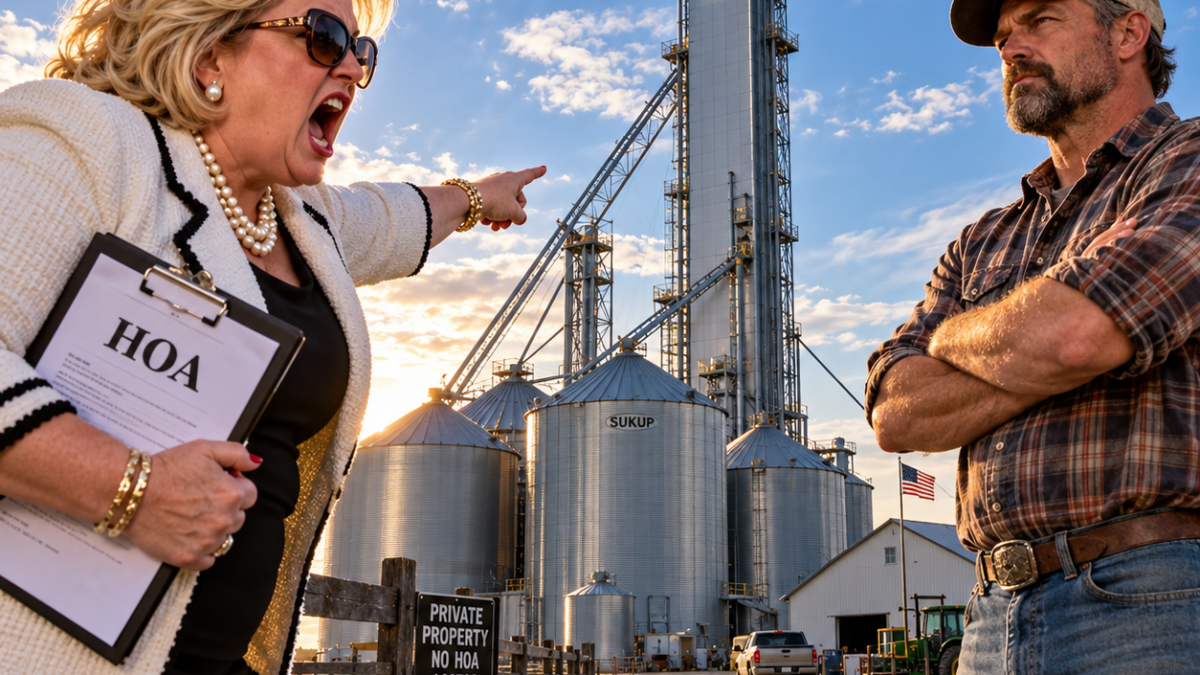
The HOA president thought she had finally beaten me when she forced the removal of the grain bins beside my irrigation yard, because from the windows of her ridge-top house she could once again see an uninterrupted sweep of mountains across land her developer friends had been trying to buy from me for more than a year. I signed the removal paperwork without arguing, dismantled exactly what her notice complained about, and then filed a completely legal agricultural permit for a replacement structure so tall that the county inspector actually looked at the plans twice before stamping them approved. What Karen didn’t understand was that the 120-foot structure rising on the same side of my ranch was only the first consequence of her decision to keep pushing a man whose patience she had mistaken for surrender.
My name is Daniel Mercer, and I owned 280 acres of working agricultural land on the western edge of Ridgeline Valley.
My family hadn’t lived there for generations.
That mattered.
I had bought it with my wife, Laura, after twenty years of moving wherever my work sent us. The ranch was supposed to be the first place in our marriage that nobody else could order us to leave.
Laura died three years after we settled there.
I stayed.
The grain bins were already part of the operation when we bought the ranch—three galvanized steel structures beside the irrigation yard, functional, maintained, and entirely legal under the agricultural zoning that had governed the property long before the first luxury house appeared on the ridge.
Karen Whitmore hated them.
She also happened to be president of the Ridgeline Property Owners Association, a subdivision built north of my land after a national developer began buying acreage across the valley.
My ranch was never part of that association.
Karen knew it.
That did not stop the letters.
The first notice called the bins “visually incompatible industrial structures.”
I sent back my zoning map.
The second accused me of violating Ridgeline architectural standards.
I sent back my deed.
The third threatened daily fines.
I sent nothing.
Then Karen arrived personally.
She stepped from a white luxury SUV and looked across my irrigation yard as if she were inspecting property she already owned.
“These have to go,” she said.
She pointed at the grain bins.
“No.”
Her mouth tightened.
“We have received numerous complaints.”
“From HOA members?”
“Yes.”
“About property outside the HOA?”
“They can see it.”
“So?”
“It impacts their values.”
I looked toward the ridge.
Her own house sat high above the others, all glass, stone, and oversized windows facing west.
That was when I understood which “property value” bothered her most.
The bins interrupted her view.
Karen handed me a folder.
Inside were notices citing nuisance rules, landscape standards, and what she called an emergency visual-hazard provision.
Half the sections did not apply to agricultural land.
The other half applied only inside Ridgeline.
But buried behind the nonsense was one problem I could not ignore.
A county setback interpretation tied to a recent irrigation-yard modification gave Karen enough procedural leverage to force a review of the oldest bin.
Not all three.
One.
She used that review to create pressure on the entire cluster.
My ranch manager, Cole Ramirez, wanted me to fight.
“You can bury her in appeals.”
“Yes.”
“So do it.”
I looked at the bins.
Then at Karen’s house.
“No.”
Cole stared.
“You’re taking them down?”
“Yes.”
His face fell.
Then I handed him another set of drawings.
He unfolded them across the hood of my truck.
For several seconds, he said nothing.
Finally he looked up.
“How tall?”
“One hundred twenty feet.”
“You’re serious?”
“County agricultural water-storage exemption.”
Cole looked toward the ridge again.
Then back at the drawings.
A slow smile crossed his face.
“Oh, she is going to hate you.”
I folded the plans.
“No.”
“What?”
“She’s going to hate the permit.”
Two weeks later, the first foundation crews arrived.
And when Karen saw what was being built where her mountain view had just opened up, she came down the ridge so fast her SUV threw gravel halfway across the county road.
PART 2
Karen stopped hard at the ranch gate.
I heard the tires before I saw the vehicle.
Cole and I were standing near the new foundation excavation with the civil contractor, reviewing anchor-bolt locations and the reinforced pad design, when Karen’s driver’s door flew open.
She crossed the roadside shoulder in heels that had no business being near agricultural gravel.
“What is that?”
I looked at the circular formwork.
“Concrete.”
Her eyes flashed.
“I know what concrete is.”
“Good.”
“What are you building?”
I took a folded copy of the permitted plan from the temporary job box.
“Water storage.”
She snatched it.
Her eyes moved over the county stamp.
Then the elevation drawing.
Her face changed.
“One hundred twenty feet?”
“Yes.”
“That cannot be legal.”
“It is.”
“You can’t put this here.”
“I can.”
“It will be visible from the entire ridge.”
“Probably.”
Karen’s gaze lifted toward the footings as though she could already see the finished tower.
“You did this deliberately.”
“I needed replacement agricultural water storage after removing infrastructure near the irrigation yard.”
“Those were grain bins.”
“Yes.”
“They had nothing to do with water storage.”
“Removing them allowed me to redesign the entire irrigation service area.”
“You’re being cute.”
“No.”
I pointed at the permit.
“I’m being compliant.”
She looked at Cole.
“Do you think this is funny?”
Cole had the good sense not to answer immediately.
Then:
“A little.”
I gave him a look.
He found something extremely important to inspect twenty yards away.
Karen stepped closer.
“You’re going to regret this.”
There it was again.
Not an argument.
Not a rule.
A threat.
I folded the plans and put them away.
“If there’s a problem with the permit, call the county.”
“I will.”
“Good.”
She left.
By noon she had called.
So had two Ridgeline board members.
Then the development company.
Then county planning.
The inspector came out the following morning.
His name was Warren Pike.
Mid-fifties.
Sunburned neck.
Clipboard.
Zero interest in neighborhood politics.
He measured setbacks.
Checked foundation plans.
Reviewed zoning.
Looked up at the ridge.
Then looked at me.
“This about that house?”
I kept my face neutral.
“What house?”
He sighed.
“Don’t.”
I smiled.
“The tower meets agricultural-use requirements.”
“Yes.”
“You approved the permit.”
“Yes.”
“So we’re okay?”
Warren closed the file.
“Build what’s on the plan.”
“Nothing more?”
“Nothing less.”
He pointed at me.
“And if you put a giant smiley face on the side just to annoy somebody, I’m finding a code section.”
“I wasn’t planning to.”
“Good.”
Cole waited until Warren drove away.
“Can we paint it pink?”
“No.”
“American flag?”
“No.”
“Karen’s portrait?”
“Go back to work.”
Construction took eleven weeks.
A specialized crew assembled the galvanized sections.
The structure rose thirty feet.
Then sixty.
Then ninety.
By the time they installed the upper tank and access platform, it could be seen from almost every western-facing home in Ridgeline.
Most residents didn’t care.
Some thought it looked like normal farm infrastructure.
One retired engineer walked down the road to compliment the design.
Karen cared enough for everybody.
Her house had been marketed around its panoramic valley view.
The tower now occupied the center of it.
Not the entire view.
Not even most of it.
But enough.
At sunset, the galvanized steel caught the light.
At certain angles it shone like a vertical mirror.
At others, it cast a long narrow shadow across the lower portion of her landscaped slope.
She filed appeal after appeal.
The county rejected them.
Then she shifted tactics.
Ridgeline sent me notices for:
“Unapproved vertical infrastructure.”
“Commercial industrial equipment.”
“Reflective exterior material.”
“Visual nuisance.”
“Skyline incompatibility.”
My ranch was outside their association.
I kept every letter anyway.
That habit came from my actual career.
Karen believed I was primarily a ranch owner with some vague government background.
That was intentional.
I had never hidden my name.
Never used an alias.
Never lied about my employment.
But I also didn’t introduce myself to neighbors by announcing:
Hello, I’m a supervisory deputy United States marshal assigned to a multi-agency task force.
People behave differently around badges.
At home, I wanted people to behave normally.
My job involved fugitive operations, complex warrant service, financial-crime support, and task-force work involving organized fraud.
I had spent decades learning that evidence collected badly was often worse than evidence never collected at all.
So when Karen began sending fake fines, I did not tear them up.
I logged them.
When one of her association contractors moved a boundary stake during the night, I did not confront him.
I had already installed cameras.
When private security vehicles began idling near the ranch entrance after dark, I recorded dates and plates.
Nothing dramatic.
Just documentation.
Cole thought I was too calm.
One evening he found me placing another notice into a file.
“That’s fourteen.”
“Thirteen.”
He counted.
“Fourteen.”
“One is a duplicate.”
“That makes you feel better?”
“No.”
“Then why aren’t we suing them?”
“Because letters are cheap.”
“Lawyers aren’t.”
“Exactly.”
“You could tell her what you do.”
“Why?”
Cole looked toward the tower.
“She might leave us alone.”
“Or behave differently because of the badge.”
“That’s the idea.”
“No.”
He shook his head.
“You are an unnecessarily complicated human being.”
Laura used to say the same thing.
The harassment might have remained merely ridiculous if money had not been behind it.
Ridgeline Development had a problem.
Their original master plan required a major entry road through the middle of my ranch.
Not the edge.
Not a small easement.
A permanent landscaped boulevard splitting the lower pasture and crossing one irrigation corridor.
The first offer came fourteen months before the tower.
Karen delivered it personally.
She sat at my dining table.
Spread maps where Laura used to arrange Christmas cards.
A development executive named Bryce Dalton came with her.
He barely spoke.
Karen did most of the talking.
“This road benefits the entire valley.”
“No.”
She blinked.
I had answered before the presentation ended.
“The offer is two-point-eight million dollars.”
“No.”
“Mr. Mercer, agricultural valuation of that strip is nowhere near—”
“No.”
Bryce finally spoke.
“Would you hear the terms?”
“I heard enough.”
Karen smiled tightly.
“Everyone has a price.”
“Probably.”
“Then what is yours?”
“Not selling.”
“That isn’t a number.”
“Exactly.”
She stared at me.
The meeting ended five minutes later.
There was no dramatic reason.
No secret mineral rights.
No buried family fortune.
I simply did not want a boulevard through land Laura and I had bought so we could finally stop moving.
Karen could not understand that.
People who spend their lives negotiating often mistake refusal for an opening position.
The next offer was higher.
I refused.
Then came the HOA notices.
Then nighttime security patrols.
Then moved survey stakes.
Then the grain-bin campaign.
The water tower was my legal answer to that.
I thought it might teach Karen something.
It taught her the opposite.
She stopped pretending the conflict was about appearance.
One month after the tower became operational, I received a document titled:
**RIDGELINE COMMUNITY ACCESS COMPLIANCE ORDER**
It claimed my agricultural traffic damaged a shared county road.
Ridgeline demanded $18,000 for repairs.
The county maintained that road.
I called public works.
They had issued no such bill.
Then came a demand that I move my eastern fence twelve feet west.
My survey showed the fence already sat nine inches inside my parcel.
Then a notice asserted that my irrigation pumps created unlawful nighttime noise.
They ran automatically for forty minutes at dawn.
I collected everything.
Dates.
Signatures.
Certified mailing envelopes.
Phone messages.
I did not use government resources.
That boundary mattered.
Then somebody crossed it.
At 2:46 one morning, a motion alert woke Cole, who lived in the manager’s house near the equipment barns.
He called me.
“Truck at the east survey line.”
I opened the camera system.
Two men.
Reflective vests.
Survey equipment.
They removed a wooden boundary marker.
One man carried it about eighteen feet onto my property.
Then drove a new stake.
Cole said:
“Want me to go out there?”
“No.”
“They’re stealing land one stick at a time.”
“No.”
“Daniel.”
“Stay inside.”
We watched.
One man’s face was visible.
The truck logo was visible too.
A contractor who regularly worked for Ridgeline.
The next morning I called a private surveyor.
Not law enforcement.
He documented the moved stake and restored the recorded boundary.
Then I called attorney Claire Bennett.
She reviewed the footage.
“They’re manufacturing a boundary dispute.”
“My thought.”
“You need a civil injunction.”
“Probably.”
“You say that like you resent lawyers.”
“I respect plumbers too. Doesn’t mean I want one at breakfast.”
Claire ignored me.
She sent formal notices to the contractor, association, and developer.
Stop entering.
Stop altering markers.
Preserve records.
Direct all communication through counsel.
For a while, they did.
Then the money trail started surfacing somewhere else.
I did not know that at first.
Federal financial investigators were already looking at a group of suspicious transactions involving shell companies linked to regional real-estate projects.
Ridgeline appeared on their radar because large payments labeled “land-acquisition consulting” had moved through the property owners association.
Some funds came from legitimate association accounts.
Some came from developer entities.
Then money left through companies with almost no operating history.
One had an address matching Karen’s accountant.
Another belonged to a board member’s brother.
A third existed only on paper.
I had nothing to do with that investigation.
That point became critical later.
The financial case began independently.
An association attorney named Martin Hale eventually accelerated it.
Martin had represented Ridgeline for several years.
He was not a heroic whistleblower from the beginning.
He admitted that publicly later.
At first, he believed Karen was merely aggressive.
He had warned her repeatedly about asserting authority beyond Ridgeline’s recorded boundaries.
She ignored him.
He disliked it.
But aggressive clients ignore lawyers every day.
What frightened him was paperwork.
While preparing insurance-renewal disclosures, Martin found land-acquisition documents bearing notary seals he did not recognize.
Several signatures appeared inconsistent with originals in county records.
One parcel listed as “association-controlled expansion property” still belonged to an elderly couple who had never sold anything.
Martin checked.
Then checked again.
He found altered plats.
Fabricated consent forms.
Transfers through shell companies.
He took his concerns to Karen.
She told him:
“Stop making problems.”
He resigned.
Then contacted federal investigators through counsel.
That was when two separate stories began moving toward each other.
My property harassment.
Their financial fraud.
I did not know Martin’s name at the time.
I only knew Karen was getting more desperate.
The water tower became her obsession.
Ridgeline residents later told me she complained about it at nearly every board meeting.
“The tower represents what happens when agricultural owners are allowed to ignore community standards.”
One homeowner apparently replied:
“He doesn’t live in the community.”
Karen said:
“He lives next to it.”
As though geography created jurisdiction.
The irony was that the tower actually improved my ranch.
Our old well-storage arrangement had limited pressure during simultaneous irrigation.
The new tank stabilized the system.
Fire protection improved too.
The county fire marshal liked it enough to discuss emergency access during wildfire conditions.
That infuriated Karen more.
The thing she hated had public value.
Cole loved telling people.
“You seen our spite tower?”
“It is not a spite tower.”
“Then why is it exactly in Karen’s sight line?”
“Engineering.”
“God bless engineering.”
He eventually convinced Luis and several ranch hands to call it “Mount Mercer.”
I banned the name.
They ignored me.
Months passed.
Then Claire called.
“Have you heard of something called Ridgeline Expansion Holdings?”
“No.”
“Shell entity.”
“Whose?”
“Working on it.”
“How does it involve me?”
“An instrument was drafted claiming an option interest over thirty-two acres of your lower pasture.”
I stood from my desk.
“What?”
“It wasn’t successfully recorded against your title.”
“Who signed it?”
“Supposedly you.”
I went completely still.
“Send it.”
Ten minutes later the document appeared.
My name.
A fake signature.
Not even a good one.
Witness line.
Notary stamp.
Purported land option.
The developer would acquire a right-of-way at a predetermined price after “community compliance conditions” were satisfied.
I called Claire.
“That isn’t my signature.”
“I know.”
“How?”
“You sign everything in blue ink with a distinctive final stroke. This isn’t close.”
“Where did it come from?”
“Attached to a lender due-diligence packet.”
“Federal?”
“Not yet my concern.”
“It may become one.”
She paused.
“Daniel.”
“Yes.”
“Is there something about your job I should know?”
I had never lied to Claire either.
I had simply said federal service.
Now the line had been crossed.
“I’m a supervisory deputy U.S. marshal.”
Silence.
“You’re joking.”
“No.”
“Of course you are.”
“What does that mean?”
“It means I have spent six months telling a federal law-enforcement officer not to confront people.”
“Excellent advice.”
“Does Karen know?”
“I don’t think so.”
“Are you investigating this?”
“No.”
“Good.”
“I need to disclose the forged instrument through internal channels.”
“Yes.”
“And recuse from anything directly involving my property.”
“Also yes.”
Claire exhaled.
“I hate your life.”
“Cole agrees.”
The disclosure changed my role.
From that point forward, anything potentially criminal concerning my ranch was handled by independent agents.
I became a victim and witness.
Not case officer.
That frustrated me more than I expected.
I knew how to investigate.
I knew what questions to ask.
I knew how to trace records.
Now I had to hand my own evidence to someone else.
Rachel Kim took primary coordination on our side.
She had worked with me for twelve years.
She enjoyed enforcing my recusal far too much.
“No databases.”
“I know.”
“No interviews.”
“I know.”
“No warrant drafting.”
“I know.”
“No asking people in the office what we found.”
“I know.”
“Say it like you mean it.”
“I know.”
“Better.”
She took copies of my harassment file.
Not originals until evidence transfer was documented.
She requested camera files through proper chain of custody.
She interviewed Cole without me.
Then my employees.
Then Claire.
I hated being excluded.
Laura would have enjoyed it.
She always said I became unbearable when I couldn’t control a process.
The investigation widened.
Then something happened that neither Karen nor I planned.
A bank compliance officer independently flagged transfers linked to Ridgeline Expansion Holdings.
That referral reinforced Martin Hale’s documents.
Another lender discovered inconsistent property records.
The FBI joined.
Federal prosecutors began presenting evidence to a grand jury.
The case became less about petty HOA harassment and more about possible wire fraud, forged land instruments, extortion, money laundering, and conspiracy.
Karen continued issuing me fines.
That fact still amazes me.
Somebody under quiet federal scrutiny remained focused on my water tower.
The alleged balance eventually exceeded $40,000.
Ridgeline had no legitimate authority to collect it from my nonmember agricultural parcel.
Claire filed for declaratory and injunctive relief in state court.
We won an interim order barring the association from recording liens or entering my property based on its invented rules.
Karen reacted by publishing a community letter.
She called me:
“A hostile neighboring landowner exploiting agricultural loopholes to damage Ridgeline property values.”
The tower was mentioned four times.
Apparently it was:
“Menacing.”
“Industrial.”
“Retaliatory.”
“Psychologically aggressive.”
Cole framed that last phrase.
I made him remove it from the office.
He moved it to the equipment shop.
The criminal investigation continued quietly.
Then Karen did something I still struggle to explain.
She created a document called an Emergency Community Protection Order.
It was not a court order.
Not a county order.
Not a sheriff’s order.
It was association letterhead dressed in legal language.
The document claimed Ridgeline had emergency authority to enter neighboring property where “ongoing agricultural violations threatened community safety.”
It specifically identified my ranch.
It authorized removal of “noncompliant structures.”
The grain bins were already gone.
The water tower was permitted.
So the document broadened itself to irrigation equipment, fences, barns, and access roads.
Claire called me.
“This is imaginary.”
“I know.”
“Do they know?”
“Karen thinks paper creates reality.”
“I’m sending an immediate warning.”
“Do it.”
Association counsel—new counsel by then—also warned the board.
Several directors reportedly objected.
Karen pushed forward anyway.
Private security vehicles began appearing more frequently.
One photographed our gates.
Another followed Cole on the county road.
The firm was called Sentinel Ridge Enforcement.
It sounded governmental.
It wasn’t.
They provided private security.
Some guards were licensed to carry weapons.
None had police authority.
Claire wrote to them directly.
Their attorney responded:
“Sentinel acts solely within the scope of lawful client instructions.”
Good.
We preserved that.
Then Rachel called one Friday evening.
“Any unusual activity?”
“Security vehicle outside the south pasture this afternoon.”
“Plate?”
“Camera has it.”
“Send it through the portal.”
“What aren’t you telling me?”
“Nothing I can tell you.”
“That sentence contains something.”
“You trained me.”
“Unfortunately.”
She paused.
“Review ranch emergency procedures with Cole.”
My instincts sharpened.
“Threat?”
“General precaution.”
“Rachel.”
“Daniel.”
“If there’s a specific operation—”
“You are recused.”
I hated that word.
Then Tuesday came.
I woke at 5:18.
Coffee.
Boots.
Routine.
At 5:44, Rachel called.
“Where are you?”
“House.”
“Stay there.”
“Why?”
“Operational activity in the valley.”
“Related?”
“Yes.”
My body went cold and focused at once.
“Am I needed?”
“Not yet.”
“What do I do?”
“Remain available.”
She disconnected.
At 6:07, Cole called.
His voice was low.
“We have company.”
“How many?”
“Nine black SUVs.”
I stood.
“Sentinel?”
“Yes.”
“Call sheriff.”
“Already tried.”
“Tried?”
“They took Luis’s phone.”
“What?”
“Daniel, they’ve cut the east chain.”
I was moving toward my safe automatically.
Then stopped.
I wasn’t the arrest team.
“Are they on the property?”
“Yes.”
“Any warrant?”
“Karen has some binder.”
“How many armed?”
“Several.”
“Workers?”
“Seven in the irrigation trench.”
Then I heard shouting through Cole’s phone.
“Cole?”
“I’m here.”
“What happened?”
“They’re putting Luis against the fence.”
Every instinct in me screamed to drive down there.
Rachel’s order held me in place.
Barely.
“Do not resist physically.”
“You serious?”
“Yes.”
“They’re zip-tying Miguel.”
“I know.”
“You don’t know.”
“Cole, listen.”
He went quiet.
“Get cameras recording. Stay visible. Ask for judicial authority. Do not threaten them.”
“You sound like you know something.”
“I know enough to tell you not to make this worse.”
“Great.”
He hung up.
Thirty seconds later Rachel called.
“Vehicle coming for you.”
“What?”
“You’re being transported to command.”
“How close are you?”
“Ten minutes.”
“You knew they were going in?”
“We knew Karen had scheduled an action. We did not know she would unlawfully detain workers.”
“Can you move faster?”
“We are.”
That was the longest ten minutes of my life.
I watched ranch cameras from the house.
Karen stood near the irrigation yard.
Dark suit.
Leather binder.
Megaphone.
She looked nothing like the caricature people later turned her into.
She looked convinced.
That was worse.
Sentinel guards forced workers toward the woven-wire fence.
Plastic restraints.
Phones confiscated.
One guard argued with another.
Not everyone wanted to continue.
Karen pointed toward the equipment shed.
Cole came from the office.
He walked directly toward her.
The camera microphone caught his voice.
“Court order.”
Karen held up the binder.
“Emergency community protection authority.”
“Judge?”
“The board approved it.”
“Judge.”
She stared.
“This supersedes your obstruction.”
Cole laughed.
Not loudly.
One dry sound.
Then he looked at the nearest guard.
“You’re about to commit crimes because somebody printed a logo on paper.”
Karen’s face darkened.
“Restrain him.”
The guard hesitated.
Cole checked his watch.
Then looked at her.
“Wrong morning, Karen.”
She folded her arms.
“What is that supposed to mean?”
“Exactly what I said.”
Two excavators rolled through the broken gate.
I saw them on the camera.
One carried a hydraulic attachment.
Another had a blade.
Karen pointed toward the irrigation-yard structures.
The water tower stood above everything.
One hundred twenty feet of galvanized steel.
Untouchable by HOA paper.
I finally understood what she intended.
She couldn’t legally make me remove it.
So she had decided legality no longer mattered.
My transport arrived.
Unmarked SUV.
Agent Owen Price driving.
“Get in.”
I did.
“Status?”
“Workers detained. No shots. Security divided.”
“Warrants?”
“Already signed.”
“For Karen?”
“Yes.”
“Others?”
“Yes.”
“Financial?”
“Among other things.”
I stared forward.
“How long have you known?”
“Not my call.”
“Fair.”
Owen looked over.
“You are a witness.”
“I know.”
“You do not take command.”
“I know.”
“You do not arrest anyone personally unless there’s an immediate safety emergency.”
“I know.”
“Rachel said you’d hate that.”
“I hate Rachel.”
“No, you don’t.”
“No.”
The convoy formed two miles from the ranch.
FBI.
U.S. Marshals personnel.
Financial-crimes agents.
Local deputies for perimeter support.
No one gave speeches.
Final briefing.
Targets.
Weapons risk.
Civilian workers.
Heavy equipment.
Private armed guards.
Search locations.
Arrest teams.
Medical support.
I sat in the command vehicle.
Rachel approached my window.
“Daniel.”
“Yes.”
“Your employees are priority.”
“Thank you.”
“Your tower is not.”
“I know.”
“I’m serious.”
“So am I.”
Then:
“Move.”
The convoy entered.
No sirens.
No Hollywood line abreast.
Vehicles moved to assigned positions.
Agents controlled the broken gate.
Another team isolated the security SUVs.
Commands echoed.
“Hands visible!”
“Do not touch your weapon!”
“Step away!”
Several Sentinel guards surrendered immediately.
One shouted that they had been told the order was lawful.
Another slowly placed a handgun on the ground.
No shots fired.
Nobody needed them.
Karen stood frozen near the excavator.
Then she saw me.
My tactical vest carried my credentials.
Her face went blank.
Not because I suddenly became powerful.
Because a fact she had never bothered to learn destroyed the picture she had built of me.
“You’re a marshal?”
I did not answer.
Rachel had already moved toward her.
“Karen Whitmore?”
Karen looked at me.
Then Rachel.
“This is private association enforcement.”
Rachel said:
“State your name.”
“You know who I am.”
“I need you to state it.”
“Karen Whitmore.”
“Keep your hands visible.”
“This is outrageous.”
The security chief started talking loudly.
“We were told there was a judge’s order.”
Rachel looked toward him.
“You’ll have an opportunity to speak separately.”
Karen pointed at Cole.
“He is interfering with a lawful seizure.”
Cole laughed again.
Rachel asked:
“Where is the judicial order?”
Karen opened her binder.
“This.”
Rachel looked at the first page.
Then closed it.
“This is an HOA document.”
“It grants emergency authority.”
“By what court?”
“The association—”
“By what court?”
Karen stopped.
That silence mattered.
Agents cut the plastic restraints from the workers.
Luis rubbed his wrists.
Miguel looked like he wanted to fight every person wearing black.
Medical personnel checked them.
I approached only after Rachel allowed it.
Luis saw me.
Then my vest.
His eyebrows rose.
“Well.”
“Sorry.”
“You got another job?”
“Something like that.”
He looked at the federal vehicles.
“You could have mentioned it.”
“Usually doesn’t come up during irrigation.”
Miguel pointed toward Karen.
“Can I yell now?”
“No.”
“Worth asking.”
Cole walked over.
One wrist red where a guard had started tightening a restraint before stopping.
“You owe me an explanation.”
“Yes.”
“Long one.”
“Yes.”
“Beer involved?”
“Probably.”
“Good.”
Then he looked toward the ranch office.
His expression changed.
“Where’s Karen’s bag?”
I followed his gaze.
Karen still held a large leather tote.
“What?”
Cole lowered his voice.
“She went into the office.”
“Did you see her?”
“Camera should.”
Rachel heard us.
She signaled an agent.
Security footage was reviewed.
Karen had entered the operations office while workers were detained.
Stayed four minutes.
Exited carrying her bag tighter against her body.
Cole said:
“There was a folder on my desk.”
“What folder?”
“Ridgeline civil file.”
Claire’s duplicate evidence packet.
Not federal originals.
Copies of emails.
Shell-company research.
Forged-option documents.
Payment schedules produced during civil discovery.
It had been on Cole’s desk because he and Claire were reviewing damage documentation.
Rachel approached Karen.
“You are under arrest pursuant to a federal warrant.”
Karen’s expression collapsed.
“For what?”
“You’ll receive the charges and have the right to counsel.”
“This is retaliation.”
Rachel advised her of her rights.
Karen asked for an attorney.
Questioning stopped.
A female agent conducted a lawful search incident to arrest.
Wallet.
Keys.
Phone.
Then the folder.
Cole pointed.
“That came from my office.”
The agent preserved it.
Karen saw the label.
Ridgeline Expansion.
She panicked.
“That belongs to me.”
No one asked anything.
Karen continued anyway.
“He stole those records from association files.”
Her attorney wasn’t there to stop her.
Rachel simply said:
“Do not question the defendant.”
An agent documented the spontaneous statement.
Karen realized too late what she’d done.
The folder contained copies.
Copies were enough.
Her own statement connected her knowledge to the underlying documents.
Not a complete confession.
Not magic.
Another piece.
One piece among hundreds.
At the same time, other warrant teams were at Ridgeline headquarters.
Martin Hale’s earlier evidence had given investigators probable cause to search specific offices and digital systems.
They seized servers.
Accounting records.
Vendor contracts.
Altered plats.
Notary equipment.
Land-option drafts.
Phones.
Computers.
One physical binder sat in Karen’s office.
**RIDGELINE EXPANSION**
It contained planning notes.
Not a cartoon villain manual.
But bad enough.
Acquisition targets.
Pressure strategies.
Projected development bonuses.
Vendor routing.
Shell-company references.
My parcel appeared repeatedly.
So did the water tower.
One note read:
**Mercer tower devalues ridge-facing lots. Remove leverage by control of parcel.**
Another:
**Agricultural compliance campaign failed. Need direct action before developer deadline.**
A later handwritten line:
**Tuesday—secure site first, litigate after.**
That line ended several defense arguments before they began.
Financial agents also found evidence that legitimate HOA funds had mixed with developer payments.
Some money paid real expenses.
Some flowed through related vendors.
Some was used for land-acquisition activities homeowners had never authorized.
Several board members had approved pieces without understanding the whole.
Others knew more.
The investigation sorted them one by one.
That took months.
There was no instant collapse by sunset.
Karen was booked.
So were several others.
Some defendants received bond.
Some faced stricter conditions.
The court did not simply deny everyone bail because the story felt dramatic.
The developer’s executives hired excellent lawyers.
So did Karen.
Their first strategy was predictable.
I had abused federal power.
A marshal with a personal grudge had created a federal case because an HOA criticized his water tower.
That narrative appeared in local press.
My name became public.
So did my career.
Ridgeline residents who thought I was merely a quiet farmer suddenly had camera crews driving past.
Emily called.
“Dad.”
“Hello.”
“Why is your face on television?”
“Occupational hazard.”
“You said retirement would be boring.”
“I lied.”
“You’re not retired.”
“Technically correct.”
She sighed.
“Mom would find this hilarious.”
“No.”
“She absolutely would.”
Then her voice softened.
“You okay?”
I looked out at the tower.
“Yes.”
“Your people?”
“Shaken.”
“Come see us.”
“Soon.”
“No.”
She used Laura’s tone.
“This weekend.”
I went.
That decision probably saved me from becoming consumed by the case.
My granddaughters did not care about federal indictments.
They cared that I had promised pancakes.
Grace wanted chocolate chips.
Sophie wanted blueberries.
Emily made me leave my government phone in the hall.
For forty-eight hours I was not a witness.
Not a marshal.
Not the man from the ranch raid.
Just Dad.
Grandpa.
It reminded me what the tower had really represented.
Not revenge.
Boundary.
My property.
My decision.
My life outside work.
Back at the ranch, the security-company employees faced separate scrutiny.
Most had believed Karen possessed some form of judicial authority.
That did not excuse unlawful detention.
But prosecutors distinguished levels of responsibility.
The security chief, Victor Shaw, cooperated.
Messages showed he had repeatedly asked Karen:
**Need actual court docs before physical detention.**
Karen replied:
**Counsel confirms board authority. Do not delay.**
Association counsel had confirmed no such thing.
Victor eventually testified that Karen personally demanded zip ties, phone confiscation, and worker confinement when several guards resisted.
His cooperation reduced his exposure.
The security firm lost contracts.
Its insurer became involved in civil settlements with the workers.
Luis received compensation.
So did Miguel.
Others.
Money did not erase fear.
Luis told me:
“I thought they were taking us somewhere.”
I hadn’t known that.
“Why?”
“They took phones.”
He looked at the equipment shed.
“Then Karen said lock us inside.”
His voice became quieter.
“We didn’t know who knew we were there.”
That sentence stayed with me.
I increased employee assistance coverage.
Paid for counseling.
Nobody had to prove injury.
Nobody had to explain why they needed it.
Cole approved.
“Best thing you’ve done.”
“Today?”
“Ever.”
“Harsh.”
The state civil case about the fake HOA fines ended quickly after the federal arrests.
Ridgeline’s interim board disavowed them.
Every dollar vanished.
The association formally acknowledged its jurisdiction ended at its recorded boundary.
No claim over my ranch.
No claim over the tower.
No claim over grain bins if I ever built new ones within agricultural code.
That last part amused Cole.
“Build six.”
“No.”
“Three?”
“No.”
“One decorative?”
“Go away.”
The new board was not elected immediately.
First came a court-supervised transition through the management company and counsel.
Then homeowners voted.
The new president was Anita Brooks, a middle-school principal.
She requested a boundary meeting.
We held it beside the tower.
Not in a conference room.
Not at a lawyer’s office.
I brought a survey.
So did she.
The lines matched.
Good beginning.
Anita looked up.
“That really is one hundred twenty feet.”
“Yes.”
“I’ve wanted to see it up close.”
“Disappointed?”
“Honestly?”
“Yes.”
“It looks like a water tower.”
Cole coughed behind us.
I ignored him.
Anita said:
“We’d like emergency fire access to the tank connection if the county recommends it.”
“County fire marshal already has contact protocol.”
“We can coordinate.”
“Fine.”
She studied the tower.
“Karen said you built it to ruin her view.”
“I built it because I needed water storage.”
Cole coughed again.
Anita smiled.
“And the location?”
“Compliant.”
“That wasn’t my question.”
I looked at Karen’s old house on the ridge.
Then back at Anita.
“It was the best legally available location after the grain-bin dispute.”
She laughed.
“Diplomatic.”
“I have government training.”
The federal financial case took nearly two years.
Some defendants pleaded.
Some charges were dismissed.
Others narrowed.
A few board members avoided criminal charges because evidence showed negligence rather than knowing participation.
One cooperated early and helped reconstruct accounts.
The developer’s land-acquisition vice president pleaded guilty to conspiracy and wire-fraud charges.
A senior financial officer followed.
The parent development company entered a major settlement, restructured, and ultimately sold its Ridgeline interests.
Karen went to trial.
I testified.
So did Martin Hale.
Victor Shaw.
Financial agents.
Document examiners.
Bank analysts.
County officials.
A forensic accountant.
Karen’s defense focused heavily on me.
They showed photographs of the tower.
Large ones.
The defense attorney asked:
“Mr. Mercer, you built this after Ms. Whitmore challenged your grain bins?”
“Yes.”
“One hundred twenty feet tall.”
“Yes.”
“Directly in her primary view corridor.”
“It was on my agricultural property within permitted setbacks.”
“That wasn’t my question.”
“Yes.”
“So you intentionally retaliated.”
“I intentionally built permitted agricultural infrastructure.”
“Did you know she’d hate it?”
I thought about lying.
Didn’t.
“Yes.”
The attorney smiled.
“Thank you.”
He turned toward the jury.
Then I added:
“But she did not have to like it for it to be legal.”
The prosecutor did not object.
The defense attorney looked back.
I continued only after he asked his next question.
“You enjoyed seeing her lose that view, didn’t you?”
“At first.”
“At first?”
“Yes.”
“What changed?”
“She escalated from annoying me to hurting people.”
The courtroom quieted.
“What people?”
“My employees.”
The defense attorney shifted.
“We are discussing your motive.”
“So am I.”
He moved away from the tower.
Good decision.
Later, the government introduced the handwritten Ridgeline note:
**Tuesday—secure site first, litigate after.**
The prosecutor asked a document examiner to authenticate Karen’s handwriting.
Then Victor testified that Karen told him the same thing orally:
“Once we’re on the property, Mercer will spend years getting us off.”
That was the strategy.
Create reality through force.
Argue legality afterward.
The jury saw camera footage from the ranch.
Workers against the fence.
Phones collected.
Cole demanding a warrant.
Karen waving her self-authored order.
Heavy machinery entering.
Her walk into the office.
Her exit with the folder.
Then federal agents arriving.
Watching it in court was different from watching it on the command tablet.
On video, I noticed details I’d missed.
Luis turning his face from hot wire mesh.
Miguel looking toward the gate every few seconds.
One young worker silently crying.
A Sentinel guard lowering his baton because he clearly wanted no part of what was happening.
Cole checking his watch.
Karen’s posture.
Total certainty.
That certainty collapsed when real authority arrived.
Not because federal badges are magic.
Because federal agents arrived carrying warrants signed by a judge.
That distinction was the entire story.
Karen had paper too.
Her paper had her signature.
Our paper had due process behind it.
The jury convicted her on multiple fraud and conspiracy counts, along with offenses tied to forged documents and the scheme’s financial activities.
Not every count survived.
Some kidnapping-related theories were resolved differently among defendants based on who knew what and what prosecutors could prove.
Karen also faced consequences tied to ordering the ranch invasion and theft of records.
Sentencing came months later.
I submitted a victim statement.
So did several employees.
Luis spoke.
That took courage.
He described being pushed against the fence.
Not knowing whether the armed men were police.
Not knowing whether his wife knew where he was.
He ended with one sentence:
“I came to work that morning to fix irrigation.”
Karen looked at him.
For the first time during the entire proceeding, she lowered her head.
The judge imposed substantial prison time.
Not forever.
Long enough that the next chapter of Karen’s life would look nothing like the one she expected when she stood on the ridge with her binder.
Financial judgments and restitution followed.
Assets tied to fraud were pursued.
Civil claims continued.
Karen’s luxury house eventually sold.
I did not buy it.
Cole suggested I should.
“Turn it into employee housing.”
“No.”
“Observation deck facing the tower?”
“No.”
“You lack imagination.”
“I have restraint.”
“Debatable.”
Ridgeline Development’s original plan died.
Another company eventually purchased unfinished portions.
Their first land-use attorney contacted Claire before contacting me.
Smart.
They redesigned the entrance around my ranch.
More road.
More cost.
No conflict.
One representative visited.
“We’re not asking you to sell.”
“Excellent.”
“We do need to coordinate drainage.”
“Show me plans.”
He did.
Actual plans.
Stamped.
Reviewed.
Reasonable.
That meeting lasted forty minutes.
Nobody threatened anybody.
No secret cameras.
No federal agents.
No one moved survey stakes.
Civilization.
The water tower remained.
By then it had stopped being controversial.
Ridgeline residents used it as a landmark.
Directions became:
“Turn left when you see the big silver tower.”
One homeowner jokingly printed a neighborhood running map with the tower silhouette marking Mile Three.
Anita sent me a copy.
Cole framed it beside Karen’s old “psychologically aggressive infrastructure” letter.
I gave up trying to control the shop walls.
Then something happened I never expected.
Karen’s former house sold to a family named Peterson.
No relation.
Parents.
Two children.
The father came down one Saturday.
I saw him at the gate.
“Mr. Mercer?”
“Yes.”
“I’m Evan Peterson. We bought the Whitmore place.”
I almost apologized.
He laughed.
“We knew.”
“About the history?”
“The realtor disclosed enough that we Googled the rest.”
“Sorry.”
“Why?”
He looked up at the tower.
“My son loves that thing.”
“What?”
“He thinks it’s the coolest structure in the valley.”
As if summoned, a boy of maybe eight leaned from the passenger window.
“Is that yours?”
“Yes.”
“Can I see it?”
Evan looked embarrassed.
“Not today.”
The boy called:
“Is it really one hundred twenty feet?”
“Yes.”
“Can you climb it?”
“Maintenance personnel can.”
“Have you?”
“Yes.”
His eyes widened.
“Awesome.”
Evan shook his head.
“We wanted to ask something else.”
“What?”
“The afternoon shadow.”
I braced.
Here we go again.
“It crosses the lower corner of our property in winter.”
“Yes.”
“Perfect for a shade garden.”
I stared at him.
“Excuse me?”
“My wife wants hostas.”
I laughed so hard Cole came outside to see what happened.
That might have been the moment the tower finally stopped belonging to Karen.
For years I had thought of it as a consequence she created.
Then a symbol of resistance.
Then evidence.
Now a kid thought it was cool and somebody wanted to plant hostas in its shadow.
Objects outlive arguments.
That was comforting.
I gradually reduced my federal workload.
Eventually retired.
Actual retirement this time.
Rachel attended my ceremony.
Cole did too.
Emily and the girls sat in front.
My supervisor told stories I hoped never reached the ranch crew.
Then Emily spoke privately afterward.
“You finally finished?”
“Yes.”
“No secret task force?”
“No.”
“No consulting?”
“Maybe—”
“Dad.”
“No.”
She hugged me.
“Good.”
Retirement was hard.
Again.
But this time I knew what the problem was.
I had spent too much of my life needing missions.
So I gave myself smaller ones.
Restore the north pasture.
Rebuild a 1948 Farmall tractor.
Teach Sophie to drive the utility vehicle.
Teach Grace why she was absolutely not allowed to climb the water tower.
Help the volunteer fire department review rural access.
Normal things.
Luis eventually became ranch manager when Cole retired.
On Cole’s last day, we stood beside the tower.
He had gray in his beard now.
So did I.
“You remember the grain bins?”
“Yes.”
“Should’ve kept them.”
“We couldn’t.”
“Could’ve fought harder.”
“Then we might not have built this.”
He looked upward.
The afternoon light flashed off the tank.
“So technically Karen improved the ranch.”
“Don’t ever say that again.”
“Better water pressure.”
“Cole.”
“Fire reserve.”
“Stop.”
“Landmark value.”
“Your retirement begins now.”
He laughed.
Then became quiet.
“She almost got people hurt.”
“I know.”
“I still think about that morning.”
“Me too.”
“She really believed she could do it.”
“Yes.”
“That’s the part I never understood.”
I did.
By then, I understood it too well.
Karen had spent years getting away with slightly too much.
A fine nobody challenged.
A rule stretched beyond its wording.
A contract awarded without questions.
A related company hired because “everybody trusted her.”
A boundary interpreted in her favor.
A lawyer’s warning ignored.
Each victory taught her the wrong lesson.
Not:
I was lucky.
But:
I was right.
Eventually she could not distinguish authority from obedience.
If people obeyed, she assumed she had authority.
When I stopped obeying, she escalated until force replaced legitimacy.
The water tower had enraged her because it proved something simple.
Her dislike did not create jurisdiction.
One afternoon, long after the trials ended, Anita invited me to a Ridgeline town hall.
I almost declined.
She insisted.
“We’re doing a governance review.”
“I don’t live there.”
“Exactly.”
“That makes no sense.”
“We want a boundary perspective.”
I went.
Residents debated amendments.
Transparency.
Contract disclosures.
Private security limits.
Land-use coordination.
At one point a homeowner asked:
“How do we stop another Karen?”
People turned toward me.
I did not want the question.
Anita smiled.
“You’re here.”
I thought before answering.
“You probably can’t.”
The room shifted.
I continued.
“You can stop another person from having the same unchecked tools.”
That landed better.
“Require records.”
I counted on my fingers.
“Require votes.”
“Disclose conflicts.”
“Let people appeal.”
“Make authority traceable to an actual document.”
“And?”
A woman in back asked.
“Read the document.”
Laughter.
Then I added:
“And don’t treat disagreement as disloyalty.”
Anita nodded.
“That’s going in the minutes.”
“Fine.”
“Anything else?”
“Yes.”
“If your HOA president ever shows up with armed private security and bulldozers, call the police before holding a board meeting.”
That got the biggest laugh.
Years later, the grain bins were almost forgotten.
One remained on another section of the ranch.
Older.
Smaller.
Sophie asked me about it during a visit.
“Is that one of the bins from the story?”
“No.”
“What happened to those?”
“Sold.”
“That’s boring.”
“Most real endings are.”
She looked at the water tower.
“So you really built that because someone made you remove grain bins?”
“Partly.”
“Mom says it was revenge.”
“Your mother exaggerates.”
Emily was standing twenty feet away.
“No, I don’t.”
Sophie grinned.
I surrendered.
“Fine. There was an element of satisfaction.”
“How much?”
“Enough.”
“Worth it?”
I looked upward.
The tower still served the ranch.
Still stored water.
Still met fire-reserve needs.
Still stood entirely within the law.
“Yes.”
Then I thought of Luis against the fence.
Karen in handcuffs.
Years of litigation.
“No.”
Sophie frowned.
“Which?”
“The tower was worth it.”
I looked toward Ridgeline.
“The war wasn’t.”
She seemed disappointed.
Teenagers prefer clean answers.
I had stopped trusting them.
Life around the valley normalized.
Houses filled Ridgeline.
Children who knew nothing about Karen grew up beneath the tower’s silhouette.
Anita eventually left the board.
David Chen—an accountant from another story in my life, not this one—no, that wasn’t relevant. Ridgeline elected ordinary people.
Most meetings became boring.
Budgets.
Trees.
Pool maintenance.
Boring was success.
The ranch changed too.
I leased part of the south acreage to a younger farmer named Matt Ellis.
He grew seed corn.
Luis ran cattle.
We upgraded irrigation controls.
The tower became more useful every year.
Then one summer wildfire changed how everybody saw it.
Lightning ignited grassland six miles west.
High wind pushed the fire toward scattered rural homes.
County crews established a defensive line.
Our stored water became an emergency refill point for tanker trucks under a preexisting agreement.
For nine hours, rigs cycled through.
Fill.
Leave.
Return.
Ridgeline evacuated part of its western row as a precaution.
The fire never reached the homes.
Weeks later, Anita’s successor sent me a letter.
Not an official resolution.
Just a thank-you.
**The water tower Karen once called a threat to property values helped protect those same properties.**
I stared at that sentence for a long time.
Then gave the letter to Cole.
He framed it.
Of course he did.
It went beside:
**PSYCHOLOGICALLY AGGRESSIVE INFRASTRUCTURE.**
Two documents.
Same tower.
Different understanding.
That was probably the most fitting ending Karen could have created without being there to see it.
I never visited her in prison.
Never wrote.
Never followed her life beyond what public proceedings required.
People sometimes asked whether I forgave her.
I never knew what they meant.
Did I want revenge forever?
No.
Did I want her released from consequences?
Also no.
Forgiveness, if it existed, had nothing to do with whether court judgments remained valid.
She made choices.
Those choices hurt people.
The system responded.
My job was to stop carrying her around after the case ended.
That took longer.
One evening, fifteen years after Laura and I bought the ranch, Emily and I climbed the service stairs of the tower.
Not to the tank roof.
Only the permitted maintenance platform below it.
She hated heights.
I did not remind her.
Halfway up she looked down.
“Why did I agree to this?”
“Genetics.”
“That doesn’t make sense.”
“Keep climbing.”
At the platform, the valley opened beneath us.
Ridgeline spread across the north slope.
The ranch below.
Barns.
Fields.
Irrigation lines.
The old county road.
The distant mountains.
Emily stood at the railing.
“So this was Karen’s view.”
“More or less.”
She looked west.
“I understand why she liked it.”
“Me too.”
“And you put this directly in front of it.”
“Permitted location.”
Emily laughed.
“You are still impossible.”
“Family trait.”
We stood in silence.
Laura would have loved the view from up there.
That thought hit me unexpectedly.
I had built the tower partly in anger after Karen forced the grain bins out.
But Laura never saw it.
For years I associated it with conflict.
Now I imagined her standing beside me, hair blowing across her face, telling me not to lean over the railing.
I smiled.
Emily noticed.
“Mom?”
“Yes.”
“She would’ve loved this.”
“I think so.”
Then Emily said:
“She would’ve hated why you built it.”
“Also yes.”
We stayed until the light softened.
When we climbed down, the tower’s shadow stretched east across our own pasture.
Not Karen’s old lawn.
Not Ridgeline.
Mine.
I watched the shadow move over grass.
It didn’t feel like revenge anymore.
Just infrastructure.
Exactly what the permit had always called it.
The grain bins were gone.
The woman who demanded that outcome had been gone even longer.
The lawsuits were over.
The federal files archived.
The broken ranch gate replaced twice since.
My old tactical vest lived in a box.
The employees she tried to intimidate had lives that moved forward.
Luis’s oldest son worked part-time at the ranch.
Miguel owned a landscaping company.
Cole sent me bad fishing photographs from Arizona.
Karen’s old house had a shade garden beneath the seasonal edge of the tower shadow.
And the 120-foot structure she believed would ruin the valley had become part of the valley.
That may have been the most satisfying consequence of all.
She fought so hard to control what everyone was allowed to see that she eventually lost control over how anything was remembered.
One summer morning, I stood beside the irrigation yard while pumps started automatically.
Water moved from the tower into the main line.
Pressure gauge climbed.
Sprinklers opened across the east field.
Nothing dramatic.
No federal convoy.
No lawyers.
No angry SUVs throwing gravel.
Just water doing the job the tower had been built to do.
Sophie pulled up in a pickup.
She was in college by then.
“Grandpa.”
“What?”
“Mom says you have the original Karen letter.”
“Which one?”
“The tower one.”
“There were several.”
“The psychologically aggressive one.”
I sighed.
“Shop wall.”
She smiled.
“We’re using it for your retirement scrapbook.”
“I already retired.”
“Family scrapbook.”
“No.”
“Too late.”
She started walking away.
“Sophie.”
She turned.
“What?”
“Don’t make me sound like I built the tower only to spite her.”
She considered.
“How much was spite?”
“Ten percent.”
She stared.
“Twenty.”
Still staring.
“Thirty.”
She smiled.
“That’s more believable.”
Then she left.
I looked up at the tower.
One hundred twenty feet.
County permitted.
Agricultural.
Useful.
Legal.
The thing Karen could never understand was that I had not beaten her by breaking her rules better than she broke mine.
I had beaten her by refusing to confuse her rules with the law.
The first time she came after my grain bins, she expected an argument.
I gave her compliance where compliance was actually required.
Then I built something the law allowed.
When she escalated, I documented.
When crimes emerged, I stepped out of the investigation that involved me.
Independent agents built the case.
A judge signed warrants.
A jury heard evidence.
Even at the end, procedure mattered more than power.
Especially at the end.
I shut off the manual irrigation bypass.
The pump settled into its steady rhythm.
Far above me, sunlight crossed the galvanized tank.
For one bright second, the tower flashed against the morning sky.
Then the light shifted and it became ordinary steel again.
That was how I preferred it.
Not a monument to Karen.
Not a trophy.
Not revenge.
Just something useful standing exactly where it had every legal right to stand.
[END OF STORY]








