PART 2: HOA Forced Me to Remove My Colony Cats as “Strays”—Then Rats Overran the President’s Kitchen
PART 2
I was out of bed before I fully understood that I had moved.
The room was dark except for the cold blue light of my phone.
On the screen, one of the men stepped off the common walking path and moved toward the retaining wall.
Patches was about fifty yards away.
He had come back.
Of course he had.
Animals understand routine in ways people underestimate. For almost two years, there had been food and water near my porch around the same time every evening. I had stopped putting it out because I knew Karen intended to have the colony trapped, but Patches didn’t understand legal notices or HOA fines.
He only understood that this had been one of the few predictable places in his world.
The man with the net crouched.
I zoomed the camera image.
The second man carried a rectangular wire cage.
Neither wore anything identifying a company.
No uniform.
No county logo.
No animal-control markings.
The van was equally anonymous.
“Come on, Patches,” I whispered.
The cat turned his head.
For half a second, I thought he had sensed them.
Then the net came down.
Patches exploded sideways.
The man stumbled.
The cat twisted once beneath the mesh.
I heard nothing through the security feed, but I could see the violence of the movement.
The second man rushed forward.
Between them, they forced Patches into the cage.
My jaw tightened so hard my teeth hurt.
I wanted to run outside.
Everything inside me said to confront them.
But another part—the part trained over years to recognize when emotion was about to destroy strategy—stopped me.
The common strip where they had captured Patches was not my property.
If I walked out there furious at two strangers at two in the morning, I could turn the cleanest evidence I had into a messy confrontation.
So I watched.
And recorded.
One camera captured their faces when they crossed beneath a streetlight.
The other captured the trapping.
My driveway camera caught the side of the van.
Mud covered part of the plate, but several characters were visible.
The timestamp remained in the corner of every frame.
They searched for another forty minutes.
They found no other cats.
Stopping the feeding routine had worked.
The rest of the colony had dispersed deeper into the preserve and surrounding neighborhoods.
Patches had been the only one stubborn enough to return.
At 3:27 a.m., the van drove away.
I stood in my kitchen afterward with the lights off.
The empty food dish was still beside the back door.
I had removed it from the porch but couldn’t bring myself to put it away.
For the first time since this began, anger stopped feeling abstract.
Karen wasn’t merely threatening fines.
Something alive had trusted the small system I had built around it, and Karen had treated that life as an aesthetic violation.
I made coffee.
Then I started copying files.
Original footage to my desktop.
Copy to an external drive.
Second copy to another drive.
Encrypted cloud backup.
Still images of the van.
Still images of the men.
Still image of the cage containing Patches.
Partial plate.
Timestamp.
At 5:40, I typed a written account while the memory was fresh.
I didn’t editorialize.
I didn’t call anyone a criminal.
I recorded what I had personally observed.
By seven, I had another section in my growing file.
At eight, I called the county shelter.
A tired-sounding woman answered.
“I’m trying to locate an ear-tipped black community cat that may have been brought in overnight.”
“Do you have an intake number?”
“No.”
“Name?”
“Patches, but that’s what I call him. He isn’t a pet.”
“Description?”
“Adult black male. Small white patch on the chest. Left ear tipped. Previously had a slight hind-leg limp. Neutered and vaccinated.”
She put me on hold.
I paced through my kitchen.
When she returned, her voice had changed.
“We did receive a black ear-tipped male early this morning.”
My eyes closed.
“Is he alive?”
“Yes.”
I put one hand against the counter.
“Can I get him?”
“That may be complicated.”
“Why?”
“The intake was submitted as nuisance feral removal through a private contractor.”
“From where?”
She hesitated.
“I can’t release client information over the phone.”
“He’s part of a managed TNR colony protected under county policy.”
Another pause.
“Do you have records?”
“A binder full.”
“Bring them.”
I was at the shelter forty minutes later.
Patches was in a stainless-steel kennel.
He crouched against the back wall, eyes enormous.
There was dried blood near one nostril, probably from striking the cage.
“Hey, buddy.”
His ears flattened.
He had never let me touch him before.
He wasn’t about to start in a shelter.
The technician beside me said, “He’s terrified, but physically he seems okay.”
I showed her veterinary records.
Vaccination dates.
Neuter documentation.
Photographs.
My caretaker log.
She looked through everything.
“You’re organized.”
“I had a feeling I might need to be.”
The shelter supervisor eventually came out.
She studied the documents.
Then she studied me.
“Whoever brought him in identified the cats as unmanaged ferals creating a health nuisance.”
“They lied.”
“I’m telling you what the intake says.”
“Was it county animal control?”
“No.”
“Licensed nuisance wildlife operator?”
“I can’t speak to their licensing without checking.”
“Please check.”
She sighed.
“I will.”
I pointed gently toward Patches.
“What happens to him?”
“Because he’s ear-tipped and you’ve provided TNR records, we’ll place a hold while we sort out the dispute.”
“Meaning?”
“He stays here for now.”
That hurt.
But it was better than the alternative.
“Can I pay whatever boarding costs there are?”
“You don’t need to do that yet.”
“I will if I need to.”
She handed the binder back.
“You really care about these cats.”
“They do a job nobody notices until they’re gone.”
She gave me a strange look.
I didn’t understand it then.
A month later, everyone would.
When I returned home, the HOA portal showed another $500 fine.
My total had passed $3,000.
Karen sent an email that afternoon.
Continued harboring of nuisance animals will result in additional enforcement.
I almost replied.
Instead, I forwarded everything to the attorney I had contacted about the dispute.
His name was David Park.
He lived two streets over.
I knew him only casually before all this began.
David had offered help after hearing about Karen’s treatment of several residents, and unlike Karen’s HOA counsel, he dealt with disputes by first reading the actual governing documents.
He called me.
“You have video?”
“Yes.”
“Original files?”
“Yes.”
“Metadata preserved?”
“Yes.”
“You military guys really are exhausting.”
“I’ve heard worse.”
“Do not post the full footage yet.”
“I wasn’t planning to.”
“You were thinking about it.”
“I was.”
“Don’t.”
“Why?”
“Because right now we don’t know who those men were, who hired them, what license they had, or exactly what agreement exists between them and the HOA. We establish facts first.”
“What about Patches?”
“Shelter?”
“Yes.”
“Alive?”
“Yes.”
“Good. We’ll work that angle too.”
Then David asked something that surprised me.
“Have you seen rats yet?”
“Yes.”
“How many?”
“Four confirmed sightings.”
“Before the cats disappeared?”
“Almost none in two years.”
“Document every one.”
“I already started.”
David laughed.
“Of course you did.”
The rat sightings multiplied.
At first, people thought I was exaggerating.
Then Mr. Henderson called.
Mr. Henderson was eighty-three and had the posture of a man who still considered slouching a moral weakness.
He had served in Korea as a young Marine and had lived in Cedar Ridge almost twenty years.
“You were right about the damned rats.”
“What happened?”
“One ate through a bag of birdseed in my garage.”
“Did you see it?”
“Saw two.”
“Pictures?”
“You want pictures?”
“Yes.”
“Of rat damage?”
“Yes.”
“You’re a strange man.”
“Documentation.”
He grunted.
“Fine.”
Maria Alvarez called the next day.
“I saw one by the storm drain.”
“Photo?”
“It ran before I could.”
“Time?”
“Six forty-five.”
“Location?”
“Near the playground.”
“Write it down.”
“What are we doing?”
“Counting.”
“Why?”
“Because Karen will eventually say there isn’t a problem.”
She was quiet.
“You really think so?”
“Yes.”
Karen did exactly that.
The next monthly newsletter addressed “rumors” about pests.
Cedar Ridge, she wrote, remained a clean, professionally maintained community.
Any isolated rodent sightings were most likely caused by homeowners failing to secure garbage containers or maintaining “attractive nuisance conditions” such as bird feeders, compost bins, gardens, and stacked firewood.
I reread that last sentence.
Then laughed.
She had removed predators.
The rodent population was increasing.
And her solution was to fine the people noticing it.
The newsletter included a reminder that exterior conditions could be inspected.
Maria called me within ten minutes.
“She’s going after my vegetable beds again.”
“Probably.”
“She creates a rat problem and then blames my tomatoes?”
“Apparently.”
“This woman is insane.”
“Don’t write that anywhere.”
“Why?”
“Because we’re going to win with facts.”
“You’re no fun.”
“Correct.”
By then, our little group had formed.
Mr. Henderson.
Maria.
David.
Several young families.
A retired schoolteacher named Nancy.
A contractor named Paul.
And others who had spent years having individual disputes with Karen.
Once people began comparing experiences, the pattern became impossible to ignore.
Karen had challenged Mr. Henderson’s flagpole.
She had photographed Maria’s backyard vegetable garden from an upstairs window.
She had opposed a wheelchair ramp for an elderly resident because its railings “disrupted the architectural line.”
She had fined a family over a toddler’s plastic slide.
She had issued a notice about a basketball hoop.
She had complained about the color of patio furniture that could barely be seen from the road.
Every story sounded ridiculous alone.
Together, they described a governing philosophy.
Karen believed the neighborhood existed to reflect her preferences.
David kept bringing us back to the same point.
“Don’t make this about whether she’s unpleasant.”
“She is,” Maria said.
“I know. That’s irrelevant.”
“It shouldn’t be.”
“Legally, it is. Focus on authority. Selective enforcement. Financial practices. External law. Due process. Those matter.”
Mr. Henderson leaned back.
“I still think ‘she’s a pain in the ass’ belongs in the record.”
David smiled.
“Unofficial appendix.”
Meanwhile, the rats became bolder.
Within three weeks, I saw them during daylight.
A mother pushing a stroller saw one cross the sidewalk near the mail kiosk.
Paul found droppings inside his outdoor grill.
Nancy discovered a nest behind her recycling bins.
A rat chewed through Maria’s seed-storage container.
The neighborhood group chat became half legal strategy, half wildlife surveillance.
We created a shared map.
Red marker for live sighting.
Black marker for droppings, nests, or confirmed damage.
Every entry needed a date.
Approximate time.
Location.
Photo or video when possible.
We were almost laughing about it at first.
“Rat at 8:14 p.m. near Henderson roses.”
“Two behind pool pump house.”
“Droppings behind mailbox cluster.”
“Large one near Karen’s hydrangeas.”
Then that last category began multiplying.
Karen’s property sat closest to the preserve.
It was also the largest house in Cedar Ridge.
She had a lush irrigated landscape.
A built-in outdoor kitchen.
A grill station.
Garbage storage behind decorative fencing.
Multiple rooflines.
Vents.
A crawl space.
Decking.
A stone retaining wall.
Everything a rat needed.
Water.
Food.
Shelter.
By the fifth week, our map looked like it had developed a rash around Karen’s property.
Maria stared at it one night during a meeting at my kitchen table.
“Oh my God.”
“What?”
“They’re all around her house.”
David leaned closer.
“Not all.”
“You know what I mean.”
Mr. Henderson chuckled.
“Seems the rats have elected a new president.”
I tried not to laugh.
Failed.
David pointed at the map.
“Careful. This is useful evidence, not entertainment.”
Maria raised an eyebrow.
“It can be both.”
The turning point came when Karen called a pest-control company to treat the clubhouse.
We knew because the truck was parked outside all day.
The next newsletter never mentioned it.
Then one evening I was carrying trash to the garage when I heard shouting across the cul-de-sac.
Karen.
I could see her standing outside her kitchen door in slippers and a robe.
A man in work clothes was beside her holding a flashlight.
Even from a distance I could hear fragments.
“Inside?”
“…droppings behind appliances…”
“How many?”
“…can’t tell until…”
Then Karen looked toward my house.
Even from forty yards away, I knew she saw me.
She went quiet.
I nodded once.
Not sarcastically.
Not triumphantly.
Just acknowledgment.
She turned and went inside.
The pest-control truck returned the next morning.
And the next.
Then a contractor came.
Then another van.
Our neighborhood group chat exploded.
Maria:
Something big is happening at Karen’s.
Paul:
Saw insulation bags coming out.
Henderson:
Rats winning the first round.
David:
Nobody post anything publicly.
Maria:
You ruin everything.
Two days later, Karen sent another HOA email.
Emergency Board Communication: Pest Concerns
For the first time, she admitted there was a “developing rodent-control issue.”
She described it as regional.
Unexpected.
Possibly seasonal.
No reference to the cats.
No acknowledgment of the warnings.
No mention of her kitchen.
Then she proposed a neighborhood-wide pest-management contract.
Cost:
Potentially hundreds of thousands of dollars.
My phone rang.
David.
“You read it?”
“Yes.”
“She’s going to make everyone pay.”
“Yes.”
“Can she?”
“Not the way she’s trying.”
“What’s our move?”
“Health department.”
I stopped.
“We report her?”
“No.”
“What?”
“We report the infestation.”
David explained.
The county did not care about HOA politics.
It cared about public-health conditions.
If Cedar Ridge had a significant rodent infestation, documented complaints would trigger inspection.
No speeches about Karen.
No revenge language.
Just sightings.
Droppings.
Property damage.
Known concentration areas.
So people filed complaints.
Separately.
Truthfully.
Maria reported rodents near her garden and neighboring lots.
Mr. Henderson reported garage damage.
Paul reported droppings near outdoor food-preparation spaces.
Nancy reported daytime sightings.
I submitted our documented neighborhood pattern and explained that the managed community-cat population had recently been removed after a dispute with the HOA.
I attached county TNR records.
A week later, a health-department truck entered Cedar Ridge.
The inspector was named Elaine Brooks.
She wore work boots, khaki pants, and the expression of someone who had spent twenty years being lied to about things she could smell herself.
She started at the common areas.
Storm drains.
Trash enclosure.
Pool equipment room.
Wooded boundary.
Then she knocked on doors.
When she reached mine, I had the binder ready.
She saw it.
“Oh.”
“What?”
“You’re one of those.”
“One of what?”
“Document people.”
“Yes, ma’am.”
“Good.”
I showed her the TNR records.
Cat vaccination records.
Photographs.
Dates.
The notice from Karen.
My formal response.
Video stills of the trapping operation.
Rodent sightings before and after removal.
Our map.
Elaine studied it quietly.
“You collected all this?”
“Residents contributed.”
“How many cats?”
“Roughly twelve stable adults at peak.”
“All sterilized?”
“As far as I could confirm.”
“Vaccinated?”
“Yes.”
“Ear-tipped?”
“Yes.”
She shook her head.
“Who ordered removal?”
“The HOA president said the board had contracted a service.”
“Do you have that in writing?”
I showed her the minutes and correspondence.
Elaine took photographs of relevant pages.
Then she asked, “Where’s the highest activity?”
I pointed across the street.
She followed my hand.
Karen’s house.
Elaine looked back at the map.
Then at the house.
“Interesting.”
She spent almost two hours there.
We didn’t gather outside and watch.
David would have killed us.
But windows exist.
Through mine, I saw Elaine walk the perimeter with Karen.
At one point, Karen was gesturing furiously toward the woods.
Elaine knelt beside an exterior vent.
Photographed something.
Moved to the outdoor kitchen.
Photographed again.
Then the garage.
Then a side wall.
A pest-control technician arrived during the inspection.
The three of them spoke near the driveway.
Karen’s body language grew more agitated by the minute.
At one point she pointed toward my house.
Elaine looked over.
I was standing behind the curtain.
I stepped away.
The next morning, an orange notice appeared on Karen’s front door.
Not from the HOA.
County Health Department.
NOTICE OF VIOLATION AND ORDER TO ABATE.
Nobody trespassed to read it.
Paul had a long camera lens and photographed it from a public sidewalk.
The notice cited evidence of significant rodent activity.
Nesting.
Entry points.
Contamination affecting food-preparation areas.
Required licensed remediation.
Repairs.
Follow-up inspection.
Failure to comply could trigger escalating county penalties.
Maria stared at the image in our group chat.
Is that on her front door?
Paul:
Yep.
Henderson:
I believe community standards call that orange. Is orange approved?
David:
Please never become my client.
I laughed so hard I had to put my coffee down.
But underneath the humor was something strange.
I didn’t feel victorious.
Not exactly.
Rats inside a home are miserable.
They contaminate food.
Damage wiring.
Chew insulation.
Create smells that linger long after removal.
I wouldn’t wish that on a decent neighbor.
But Karen had been warned.
Repeatedly.
She had ignored veterinary evidence.
County guidance.
Ecological reality.
Resident concerns.
She had treated every warning as a challenge to her authority.
And nature did not care who held the gavel.
The remediation at Karen’s house became extensive.
Pest-control vans appeared almost daily.
Workers removed contaminated insulation.
Contractors sealed roof gaps and vents.
Part of the outdoor kitchen was dismantled.
A damaged pantry wall was opened.
That was when we learned how bad her kitchen really was.
Not from gossip.
From Karen herself.
She exploded at an emergency board meeting.
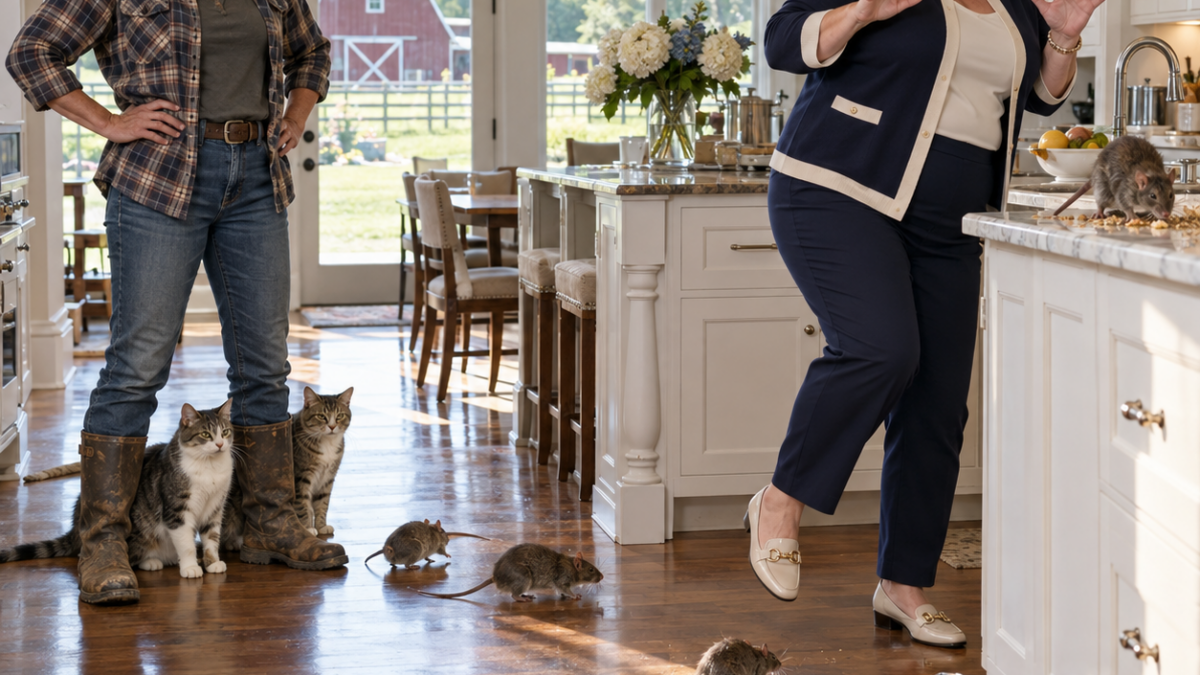
“There were rats in my cabinets!” she shouted.
The room went quiet.
Karen seemed to realize what she had admitted.
Then she doubled down.
“In my kitchen! Do you understand? My kitchen!”
Mr. Henderson sat beside me.
He whispered, “I believe we understand.”
I kicked his shoe before he could say it louder.
Karen stood at the front of the clubhouse with Gerald and Brenda.
The emergency meeting had been called to authorize a $1,000 special assessment on every household for “comprehensive community pest abatement.”
Cedar Ridge had roughly 250 homes.
A quarter million dollars.
Karen had a contractor ready.
Of course she did.
“This is an emergency,” she said. “Property values are at risk. Public health is at risk. Families are at risk.”
David raised his hand.
Karen ignored him.
“We must vote immediately.”
David stood.
“Point of order.”
Her face tightened.
“Sit down.”
“The bylaws require homeowner discussion before a special assessment of this size.”
“This is an emergency.”
“Emergencies don’t suspend the governing documents.”
“I am the board president.”
“And you are bound by the same bylaws as everyone else.”
The room murmured.
Karen gripped the table.
“What exactly are you trying to accomplish?”
David lifted a thick binder.
“Prevent homeowners from paying for consequences they explicitly warned the board about.”
Every head turned.
Karen’s face changed.
David looked at me.
“Would you present the timeline?”
I stood.
I had rehearsed.
Not because I enjoyed public speaking.
Because anger makes people ramble, and facts lose force when buried beneath emotion.
“My name is Daniel Mercer. I live at the end of Hawthorne Cul-de-sac.”
Karen interrupted.
“Everyone knows who you are.”
David said, “Let him speak.”
I continued.
“For approximately two years, I voluntarily managed a small community-cat colony along the preserve boundary.”
I showed photographs.
Ear-tipped cats.
Veterinary records.
Patches sitting at a distance near my porch.
“All identified cats were trapped, sterilized, vaccinated, documented, and returned.”
Next.
County TNR information.
“The colony did not grow.”
Next.
A map showing our location against the preserve.
“The cats occupied the same edge habitat now experiencing the highest rodent activity.”
Next.
Karen’s original violation notice.
A few people muttered when the $500 daily fine appeared on the screen.
“This notice ordered me to stop feeding the colony within forty-eight hours.”
Next.
My written response.
“I warned the board that removing established predators from a neighborhood directly bordering undeveloped land could produce a rodent increase.”
Next.
Meeting notes.
“The board declined to reconsider.”
Next.
Video still.
White van.
2:13 a.m.
Two men.
Cages.
Someone said, “What the hell?”
Next image.
Patches beneath the net.
The room reacted immediately.
Several people had seen him for years.
Maria covered her mouth even though she had already watched the footage.
“The colony was trapped and dispersed.”
Next.
Rodent map.
Red and black markers filled the neighborhood.
The highest concentration sat around Karen’s property.
I didn’t emphasize it.
I didn’t need to.
People could see.
Next.
Karen’s newsletter blaming unsecured garbage and homeowner landscaping.
A few people laughed bitterly.
Then the county notice.
“This week, we were told the infestation was unforeseen.”
I looked at Karen.
“It was not.”
Silence.
“We warned the board.”
Next.
My original letter.
Date highlighted.
“The board chose removal anyway.”
Then I closed my folder.
“I am not asking anyone to punish Karen because rats entered her home.”
Her eyes flashed.
“I am asking homeowners not to approve a quarter-million-dollar assessment until we understand why a predictable problem was created, who approved the actions that caused it, who hired the contractor that removed the cats, what that contractor was paid, and why residents who warned the board were fined instead of heard.”
That last sentence changed the room.
Because until then, this had still been framed as cats versus Karen.
Now it was governance.
Money.
Responsibility.
Karen stood.
“This is absurd.”
I sat.
She pointed toward me.
“He created this problem by feeding wildlife!”
Maria stood.
“No.”
Karen turned.
“You sit down.”
“No.”
Maria’s voice shook.
But she stayed standing.
“You came after my vegetable garden.”
“This has nothing to do with—”
“You took pictures into my backyard from your upstairs window.”
“I was conducting an inspection.”
“From inside your house?”
Karen’s cheeks reddened.
“My responsibility is to protect community standards.”
Mr. Henderson stood.
“You tried to make me remove my flagpole.”
“That pole was installed without architectural—”
“I had it before you moved here.”
“The documentation—”
“You knew federal law protected the flag and tried to play games over the pole.”
Karen slammed her palm on the table.
“This meeting is about rats!”
A man behind us called out, “Exactly.”
Someone else:
“Rats you caused.”
Karen’s voice rose.
“I did not cause rats!”
David stood again.
“No one is claiming you personally manufactured rodents.”
A ripple of laughter moved through the room.
Even I smiled.
David continued.
“We are saying the board received a documented warning that removing the managed cat colony could significantly reduce predation pressure at the preserve boundary.”
Karen rolled her eyes.
“Cats are not a municipal pest-control program.”
“No. They were a functioning ecological factor the board eliminated without having any replacement plan.”
He lifted another document.
“And there is an additional concern.”
Karen’s expression changed.
David looked toward Gerald.
“The company hired to remove the cats.”
Gerald visibly swallowed.
Karen snapped, “That contract is privileged.”
“No, it isn’t.”
“It is confidential.”
“It involves association funds.”
“I am not going to debate this with you.”
“Then I’ll simply tell the membership what the management company produced after our formal records request.”
He held up an invoice.
The room became very quiet.
“The HOA paid $8,900 to remove a managed cat colony.”
I almost turned around in surprise.
David had told me he had received financial information that afternoon.
He had not told me the amount.
Karen said quickly, “It was a complex nuisance-animal remediation.”
David looked at the invoice.
“It describes three nights of trapping.”
Someone whistled.
David continued.
“We have also been unable to identify the contractor as a licensed county animal-control agency.”
Karen’s face drained.
Gerald stared at the table.
Brenda looked at Karen.
“What?”
Karen shot her a glare.
Brenda whispered, “You told us they were licensed.”
“They are professionals.”
“That wasn’t what I asked.”
It was the first crack between them.
David continued.
“We have asked the county to review whether the trapping complied with applicable community-cat policy and licensing rules. That review is ongoing. No conclusion should be assumed tonight.”
He placed the invoice on the table.
“But before homeowners are asked for another $250,000, they deserve answers about the first decision.”
Karen grabbed her gavel.
“This discussion is over.”
David remained standing.
“No.”
She stared at him.
“No?”
“No. Under the special-assessment provision, homeowner discussion continues until the chair properly closes it following recognized speakers.”
Karen laughed sharply.
“You think you run this board now?”
“No.”
He looked around the clubhouse.
“They do.”
For the first time in months, Karen appeared uncertain.
Mr. Henderson rose.
“I move that the special assessment be rejected.”
A dozen voices called, “Second.”
Karen hammered the gavel.
“That motion is out of order.”
David said, “It is not.”
She hit the gavel again.
“I decide what is in order!”
Then Gerald spoke.
Quietly.
“No, Karen.”
She slowly turned toward him.
Gerald had served as treasurer during her entire presidency.
He was thin, nervous, and usually appeared to want every meeting to end five minutes before it started.
Karen stared at him.
“What did you say?”
“The bylaws do.”
His voice shook.
“The bylaws decide.”
The room went so quiet that his next words sounded louder than they were.
“He’s right.”
Karen looked genuinely stunned.
“You approved this assessment.”
“I approved presenting it.”
“You voted for it.”
“I didn’t vote to skip owner discussion.”
“You are the treasurer.”
“Yes.”
“Then act like it.”
Gerald swallowed.
“I am.”
Brenda shifted in her chair.
Karen looked from Gerald to Brenda.
“What about you?”
Brenda hesitated.
That hesitation was enough.
Karen understood.
Her coalition was collapsing.
Mr. Henderson repeated his motion.
The assessment went to a vote.
Hands rose against it across the room.
Almost every hand.
When Karen called for supporters, fewer than ten appeared.
The $250,000 assessment died.
Nobody cheered.
Not yet.
Because David was still standing.
“One more matter.”
Karen’s eyes narrowed.
“No.”
“Yes.”
“This meeting was called for pest abatement.”
“And the governing documents allow removal proceedings to be initiated by membership petition.”
Karen gripped the gavel.
“There is no petition.”
Maria stood.
“There is.”
Then people began passing papers forward.
I had known signatures were being collected.
I hadn’t known how many.
David laid the pages on the table.
“Forty-three percent of the membership.”
Karen stared.
The bylaws required twenty-five percent to trigger a recall process.
We had almost double that.
“This is a coup.”
Mr. Henderson shook his head.
“No, ma’am.”
His voice was gentle.
“That’s an election.”
Karen stood so quickly her chair rolled backward.
“You people have no idea what I’ve done for this neighborhood.”
No one responded.
“I have spent thousands of hours!”
Still silence.
“I have protected your investments!”
Maria said, “You fined me for tomatoes.”
Someone laughed.
Karen’s face hardened.
“I kept standards.”
Mr. Henderson answered, “You kept control.”
That one hit.
Karen pointed at him.
“You’ve hated me since the flagpole.”
“I barely knew you before the flagpole.”
“You all think you can do better?”
Arthur from the back called, “At this point, a rat could probably poll well.”
The room erupted.
David rubbed his forehead.
Karen’s eyes filled.
For one second, the room shifted.
She didn’t look like a tyrant.
She looked like a woman suddenly realizing that an identity she had built over years was disappearing in public.
“I gave everything to this association.”
Her voice was quieter.
I believed that part.
People like Karen are often more complicated than pure villains.
She probably had worked hundreds of unpaid hours.
Probably had solved real problems.
Probably had taken phone calls at dinner and argued with contractors and reviewed insurance renewals when everyone else was sleeping.
The trouble was that somewhere along the way she had decided sacrifice entitled her to obedience.
That was where service became ownership.
David’s voice softened.
“Then let the members decide.”
Karen gathered her papers.
“I resign.”
The room froze.
Brenda said, “Karen—”
“I resign.”
She grabbed her purse.
“As president?”
“As everything.”
“You can’t just—”
“Watch me.”
She walked toward the door.
Before leaving, she stopped beside me.
For months, she had looked at me like something unpleasant she intended to remove.
Now she looked exhausted.
“Are you happy?”
I thought about Patches in the shelter.
The rats.
The fines.
The nights spent copying documents.
The people who had been afraid to put up wheelchair ramps and vegetable beds.
“No.”
She seemed surprised.
“You ruined me.”
“No.”
“You turned everyone against me.”
“No.”
“You made me look incompetent.”
I lowered my voice.
“Karen, I told you exactly what would happen if the colony disappeared.”
“You wanted this.”
“I wanted you to leave the cats alone.”
Her eyes filled.
For half a second, I thought she might say something human.
Instead she whispered, “I hate those animals.”
Then she walked out.
The door closed.
Mr. Henderson exhaled.
“Well.”
David turned toward Gerald.
“As treasurer, I believe you are now the highest remaining officer.”
Gerald looked horrified.
“No.”
Everyone laughed.
Even Gerald eventually did.
An interim board was formed that evening.
The recall became unnecessary once Karen submitted a formal resignation the following morning.
Brenda resigned three days later.
Gerald stayed temporarily because, despite years of cowardice around Karen, he had not personally engineered most of her decisions and seemed genuinely determined to cooperate.
The first thing the interim board did was freeze my fines.
Total balance:
$20,350.
Twenty thousand dollars for feeding vaccinated community cats and another legal charge Karen had added.
The second thing they did was release every record David requested.
The third was contact the county shelter about Patches.
The shelter supervisor called me.
“You can bring him home.”
I sat down.
“Today?”
“Yes.”
“What changed?”
“The county reviewed the colony documentation.”
“And?”
“He should not have remained impounded.”
My voice went tight.
“Was the trapping legal?”
“There are still questions about the contractor and process. I can’t give you an official legal conclusion.”
“Understood.”
“But Patches can be released.”
I drove there immediately.
They brought him out in a humane carrier.
He looked smaller than I remembered.
Thinner.
Angrier.
His white chest patch stood out against the black fur.
“Hey, buddy.”
He hissed.
The technician smiled.
“He missed you too.”
“I can tell.”
“We don’t recommend releasing him directly into a dense residential area until you know what the neighborhood plan is.”
“We’re working on one.”
Patches glared at me through the carrier door.
“You and me both.”
For forty-eight hours, I kept him in a large recovery enclosure in my garage with hiding boxes, food, water, and litter.
He hated every second.
Then the new interim board voted to formally recognize the TNR colony.
Not merely tolerate it.
Recognize it.
We partnered with the clinic I had used originally and a local rescue.
Volunteers began locating the remaining displaced cats.
Some had moved deeper into the preserve.
Two appeared near another subdivision.
One was found behind a grocery store almost a mile away.
Patches was the first returned.
At dusk, I carried his carrier to the edge of my property.
Several neighbors stood back.
Maria had brought her children.
Mr. Henderson leaned against his cane.
David kept insisting he was only there because he happened to be walking past.
I opened the carrier.
Patches didn’t move.
“Typical,” I said.
Maria laughed.
After nearly a minute, he crept forward.
Paused.
Looked at me.
Then vanished into the brush.
Maria’s daughter whispered, “Is he coming back?”
“I hope so.”
The girl looked worried.
“Does he know this is his home?”
I looked toward the woods.
“I think animals know more about home than we give them credit for.”
Three nights later, Patches was sitting near my porch at feeding time.
Ten feet away.
Exactly where he used to wait.
I put down the bowl.
Stepped back.
He watched me.
Then ate.
It was one of the most satisfying moments of the entire fight.
Not Karen resigning.
Not the failed assessment.
Not the orange county notice.
That.
A wary little black cat eating dinner in peace.
But rebuilding the colony did not instantly solve the rodent problem.
Nature had momentum.
The rat population had exploded.
Even with professional community-wide remediation funded from existing HOA reserves rather than a special assessment, it took months to bring conditions under control.
And something interesting happened during those months.
People became invested in understanding why the problem had happened.
Not because everyone suddenly became a cat lover.
Some residents still disliked the cats.
That was fine.
We didn’t need sentiment.
We needed a workable system.
The rescue organization helped us develop feeding stations placed away from homes.
Food was provided only at scheduled times and removed afterward.
Water dishes were cleaned.
Every cat was cataloged.
New arrivals were trapped, vaccinated, sterilized, and documented.
Sick animals received treatment.
Adoptable kittens, when found, were socialized and placed in homes rather than returned.
We did it properly.
Ironically, the system Karen had called chaotic became one of the most organized things Cedar Ridge had ever managed.
Mr. Henderson called it the Feline Defense Department.
Maria called me Secretary of Cats.
David refused to call it anything.
He just kept donating money to the veterinary fund when he thought no one noticed.
The new board also began reviewing Karen’s policies.
The approved mailbox vendor?
Gone.
The company had been charging almost three times normal retail.
No proof emerged that Karen had received money from them, but there was no legitimate reason for the exclusive arrangement.
Door-color restrictions were expanded back to the original palette.
Holiday-decoration rules became reasonable again.
Maria’s vegetable garden received retroactive approval.
The wheelchair ramp was approved unanimously.
The toddler’s slide remained offensively green.
Nobody cared.
Mr. Henderson’s flagpole stayed exactly where it had always been.
One evening, I saw him standing beneath it.
I walked over.
“You win?”
He looked up at the flag.
“Nobody wins against time.”
“That’s cheerful.”
“I’m eighty-three. I’m allowed.”
He handed me a folded paper.
“What’s this?”
“My old HOA file.”
“You’re giving it to me?”
“Don’t need it anymore.”
I opened it.
Years of notices.
His flagpole dispute.
Letters.
Certified-mail receipts.
“Keep it.”
“Why?”
“You keep everything.”
“That isn’t an answer.”
Mr. Henderson looked toward the houses.
“Because people forget.”
His voice changed.
“When people forget what bad leadership felt like, they start accepting it again.”
That stayed with me.
Cedar Ridge became friendlier after Karen left.
Not immediately.
People who had spent years avoiding each other didn’t become close overnight.
But something loosened.
Neighbors started talking in driveways.
The unofficial Facebook group reopened under independent administrators.
The first post was Maria uploading a photograph of her vegetable garden.
Caption:
STILL ILLEGAL IN SPIRIT.
The second was Mr. Henderson’s flag.
The third was a blurry image of Patches stalking something near a storm drain.
David commented:
No legal opinion offered.
I stared at that photograph for a long time.
The cat was only a dark shape.
But he was home.
Six weeks after Karen resigned, the for-sale sign appeared outside her house.
I wasn’t surprised.
Neither was anyone else.
The county violation had been corrected.
The infestation was under control.
Contractors had sealed the structure.
Damaged materials were replaced.
The orange placard was long gone.
But Karen had lost something harder to repair.
Authority.
For years, she had driven through Cedar Ridge in her white SUV like a patrol officer.
After resigning, she barely came outside.
Her curtains stayed closed.
Her vehicle remained in the garage.
Her husband, whom I had rarely seen during her presidency, suddenly appeared often.
He met real-estate agents.
Contractors.
Inspectors.
Once, I saw them arguing in the driveway.
I walked inside.
Whatever happened inside their marriage was none of my business.
A month later, moving trucks arrived.
Karen saw me on the sidewalk that afternoon.
She was standing beside the SUV.
For a moment, we simply looked at each other.
Then she walked toward me.
I considered leaving.
Instead, I waited.
She stopped several feet away.
“The buyers asked about the rat problem.”
“I imagine they did.”
“We had to disclose the remediation.”
“I imagine you did.”
Her face tightened.
“We lost money.”
I said nothing.
“You think that’s funny?”
“No.”
“You and those cats cost me tens of thousands of dollars.”
There it was.
Even now.
I looked toward the wooded strip.
“No, Karen.”
“Don’t.”
“You ordered the colony removed.”
“Because they were filthy.”
“You were warned.”
“You exaggerated.”
“The county disagreed.”
“You reported me.”
“I reported a neighborhood rodent infestation.”
“You knew they’d inspect my house.”
“No. I knew that’s where the sightings were concentrated.”
She laughed bitterly.
“How convenient.”
I felt tired.
Not angry.
Just tired.
“Do you remember the meeting when I brought you the veterinary records?”
She didn’t answer.
“I told you they were sterilized.”
Silence.
“Vaccinated.”
Nothing.
“I showed you county guidance.”
Her mouth tightened.
“I warned you what could happen.”
“And you enjoyed being right.”
That landed harder than I expected.
Because part of me had.
Not the rats.
Not Patches being trapped.
Not the damaged homes.
But yes—when the orange notice appeared on Karen’s door, there had been satisfaction.
I wasn’t proud of it.
“I enjoyed knowing you couldn’t fine nature into obeying you.”
She looked at me.
For a moment, the anger disappeared.
“You really believe I was some monster.”
“No.”
That surprised her.
“I think you started believing that because you worked harder than everyone else, your judgment mattered more than everyone else’s.”
She stared.
“You don’t know anything about me.”
“You’re right.”
“Then stop pretending.”
“I’m not.”
She turned toward her house.
Before leaving, she said, “Cedar Ridge will become a dump.”
I looked at Maria’s garden.
Mr. Henderson’s flag.
Children riding bicycles.
A wheelchair ramp newly installed two streets over.
Patches sleeping beneath a hedge.
“I think we’ll manage.”
She left the following week.
I never saw her again.
The new board election happened in December.
Mr. Henderson somehow allowed people to nominate him for president.
Then acted offended when he won.
“I’m eighty-three.”
Maria laughed.
“You should have thought about that before becoming likable.”
“You people are idiots.”
“That’s President Idiot now.”
He pointed at me.
“You’re secretary.”
“No.”
“Yes.”
“Absolutely not.”
“You keep records.”
“That doesn’t mean—”
“You have three backups of everything.”
“Four.”
“Exactly.”
David leaned back in his chair.
“I support the nomination.”
“Of course you do.”
Maria raised her hand.
“Second.”
I looked around the room.
Everyone was smiling.
“You’re all terrible.”
Mr. Henderson nodded.
“Motion passes.”
So I became secretary.
Not because I wanted authority.
Because someone needed to write things down accurately.
Our first formal resolution recognized the managed TNR program.
The HOA set aside a modest annual amount for veterinary assistance.
Most feeding supplies still came from volunteers.
Residents adopted a simple policy:
No uncontrolled feeding.
No breeding colony.
No removal without coordination with county animal services or the designated rescue partner.
Data mattered.
Health mattered.
Animal welfare mattered.
Human comfort mattered.
We tried to balance all of them.
That was the difference between governance and control.
Governance accepts competing interests.
Control simply declares one interest supreme.
By spring, rat sightings had dropped dramatically.
Professional pest control helped.
Sealed garbage containers helped.
Repairing entry points helped.
But the cats were hunting again too.
Patches had regained weight.
His limp was almost gone.
He still wouldn’t let me touch him.
Fine by me.
Trust did not have to look like affection.
Sometimes trust was simply returning.
One evening, I stepped onto the porch and found him sitting closer than usual.
Maybe six feet.
I sat down.
He stayed.
Neither of us moved for several minutes.
The sun disappeared behind the trees.
Birds quieted.
Somewhere across the neighborhood, a child laughed.
Patches began washing one paw.
“You caused a lot of trouble,” I told him.
He ignored me.
“Twenty thousand dollars in fines.”
Nothing.
“Emergency meetings.”
He scratched behind one ear.
“Lawyers.”
No reaction.
“Presidential resignation.”
Then he looked at me.
I laughed.
“Yeah. You don’t care.”
That was probably why I liked him.
The neighborhood held a spring block party.
That would have been unimaginable under Karen.
She technically hadn’t banned block parties.
She simply made communal anything exhausting enough that eventually no one volunteered.
Now folding tables lined the cul-de-sac.
Someone brought a smoker.
Someone else brought three kinds of potato salad.
Maria supplied tomatoes from the garden Karen had tried to eliminate.
Mr. Henderson sat under an umbrella telling stories nobody could verify.
David brought expensive beer and denied that it was expensive.
The family with the wheelchair ramp brought the grandmother Karen had once made feel like an inconvenience.
Her name was Evelyn.
She rolled up beside me.
“You’re the cat man.”
“I’ve been called worse.”
“My daughter says you’re the reason we finally got our ramp.”
“No. The new board approved it.”
“She says you helped get rid of the old board.”
“A lot of people did that.”
Evelyn smiled.
“That means yes.”
Then she looked toward the woods.
“I like those cats.”
“You do?”
“One sits under my bedroom window.”
“What color?”
“Gray. One eye cloudy.”
“Smokey.”
“You named all of them?”
“Most.”
“He watches birds.”
“I suspect he has professional interest.”
She laughed.
Then her face softened.
“My husband loved cats.”
I waited.
“He died before we moved here.”
“I’m sorry.”
“It’s been eleven years.”
She looked toward the tree line.
“I know that cat doesn’t know me. But some mornings, when I see him sitting there, I don’t feel quite so alone.”
That sentence stayed with me longer than any legal victory.
People kept framing the whole story as ecology.
Cats versus rats.
And that mattered.
But the colony had become part of Cedar Ridge in quieter ways too.
Children looked for them on walks.
Elderly residents watched them from windows.
They existed between wild and domestic life, belonging completely to neither.
Maybe that was why I understood them.
After decades in the service, retirement had felt strange.
People assume coming home is simple.
It isn’t always.
For years, your value is attached to usefulness.
Mission.
Role.
Structure.
Then suddenly you wake up and no one needs you to solve anything before breakfast.
The silence you spent years wanting can become heavier than expected.
Caring for that colony had given my days a small rhythm.
Morning water.
Evening food.
Trap appointments.
Vet records.
Winter shelters.
Nothing heroic.
Nothing impressive.
Just responsibility.
Karen had called it my hobby.
Maybe it was.
But there are worse things than having something small depend on you.
Summer came.
Then fall.
Cedar Ridge remained imperfect.
We still argued.
One meeting ran almost three hours over whether sheds should require architectural review.
Mr. Henderson nearly resigned over pool-furniture replacement.
Maria wanted composting permitted.
Three residents objected because they feared rats.
That debate became heated for obvious reasons.
David finally said, “We are not banning decomposing organic matter because everyone has post-traumatic rodent disorder.”
Even I laughed.
We approved sealed compost containers.
No disaster followed.
The board published financial statements online.
Meeting minutes were posted monthly.
Residents could comment before approval.
Fines required documented violations.
Appeals went to more than one person.
No officer could create new interpretations alone.
It was slower.
Messier.
Sometimes frustrating.
Democracy usually is.
But nobody was afraid of the president.
Mr. Henderson made sure of that by beginning every meeting with:
“Remember, you can fire me.”
Eventually Maria said, “Please stop encouraging them.”
My old fine balance disappeared entirely after the board voted it invalid.
The resolution was brief.
All penalties related to community-cat feeding under the previous interpretation of Bylaw 7.4 are hereby rescinded.
Balance:
$0.
I printed the page anyway.
Old habits.
That winter, the rescue called me.
They had located two cats from the original colony.
One was a calico I called June.
The other was a gray-and-white female called Sparrow.
Both had been living near an industrial lot.
Could we take them back?
Yes.
We reintroduced them gradually.
Patches recognized June.
At least I think he did.
Cats don’t hold reunions the way people want them to.
He sniffed her.
She hissed.
He walked away.
Maria said, “That’s it?”
“That’s cats.”
“I expected emotion.”
“Wrong species.”
But that evening, both were eating twenty feet apart at the same station.
Close enough.
A year after Karen’s laminated notice appeared on my door, I found another card taped there.
For one terrible second, my stomach tightened.
Then I read it.
It was handmade.
Construction paper.
Probably from Maria’s kids.
A badly drawn black cat stood over an enormous terrified rat.
Underneath:
CEDAR RIDGE SECURITY DEPARTMENT
I laughed loud enough for Patches to run from beneath my hydrangea.
I brought the card inside and put it in the same file as Karen’s notice.
Not because I needed evidence anymore.
Because documents can hold more than conflict.
They can hold endings.
Mr. Henderson came over later that afternoon.
He had two beers.
This seemed to be how every important neighborhood conversation started.
He handed me one.
“Anniversary.”
“Of what?”
“The Cat War.”
“Don’t call it that.”
“Everyone calls it that.”
“No one should.”
“Too late.”
We sat on my porch.
Patches appeared near the woods.
Then June.
Then another cat I didn’t recognize.
I made a mental note.
New arrival.
Trap appointment needed.
Henderson noticed.
“You’re working right now, aren’t you?”
“Possibly.”
“You’re hopeless.”
“You elected me secretary.”
“That was my first mistake.”
“Your first?”
“At my age, I no longer keep a complete list.”
We drank quietly.
Then he said, “Do you ever feel bad for her?”
I knew who he meant.
“Sometimes.”
He looked surprised.
“Karen?”
“Yes.”
“She tried to bankrupt you.”
“I know.”
“Had your cats hauled away.”
“I know.”
“Nearly turned her kitchen into a rat condominium.”
“That part wasn’t intentional.”
He considered.
“You’re nicer than I am.”
“No.”
“Then why?”
I thought about Karen’s last conversation with me.
The moving truck.
Her accusation that we had ruined her.
“She had convinced herself that control and responsibility were the same thing.”
Henderson waited.
“I understand how someone gets there.”
“You controlled people in the military?”
“No. But command structures can make certainty feel safe.”
He nodded slowly.
“You knew your job.”
“Yes.”
“Everybody knew the rules.”
“Mostly.”
“And retirement took that away.”
I looked toward the trees.
“In a way.”
Henderson understood.
Maybe that was why he had asked.
“She should’ve gotten a dog,” he said.
I laughed.
“Probably.”
Then he became serious.
“Understanding her doesn’t excuse her.”
“No.”
“Good.”
“I never said it did.”
The sunlight turned orange.
Patches moved through the grass.
I watched him pause beside the fence.
Healthy.
Alert.
Free.
Sometimes people ask whether the cats truly caused the rat reduction.
I’m careful answering.
Ecology is rarely simple.
Professional extermination mattered.
Structural repairs mattered.
Trash practices mattered.
Weather mattered.
Population cycles mattered.
Restoring predators helped too.
The lesson was never that twelve cats possessed magical rat-erasing powers.
The lesson was that Karen had made a system-level decision without respecting the system.
She saw unwanted animals.
I saw a managed population occupying an ecological niche.
She saw messy appearances.
I saw disease prevention, reproduction control, predator pressure, and territorial stability.
She believed removing one visible thing would produce cleanliness.
Instead, it shifted pressure somewhere else.
That happens in communities too.
Suppress every complaint and dissatisfaction doesn’t disappear.
It goes underground.
Fine every homeowner into silence and resentment doesn’t disappear.
It accumulates.
Delete every critical comment and opposition doesn’t disappear.
It organizes somewhere you cannot control.
Karen’s greatest mistake wasn’t removing the cats.
It was believing removal was the same thing as solving a problem.
Two years later, Cedar Ridge looked almost identical from the street.
Same houses.
Same preserve.
Same entrance monument.
Same pool.
Different culture.
People attended meetings.
Not everyone.
Enough.
Residents asked where money went.
Contracts were posted.
Board members explained decisions.
Sometimes residents disagreed.
Sometimes loudly.
No one received a fine for disagreeing.
The cats remained.
Their population gradually declined exactly as a sterilized colony should.
A few older animals disappeared.
That part was hard.
June stopped showing up one spring.
We searched.
Never found her.
I like to believe she moved somewhere else.
Realistically, I know what outdoor life means.
Patches grew older.
His black coat turned slightly brown in sunlight.
Then gray appeared around his face.
He became slower.
Bolder around me.
One winter evening, almost four years after I first put water out for him, he walked onto my porch while I was sitting there.
I froze.
He approached the empty chair beside me.
Sniffed it.
Then sat.
Three feet away.
I didn’t reach for him.
Didn’t speak.
We sat together in silence.
After ten minutes, he left.
That was all.
But I remember it more clearly than Karen’s resignation.
Trust earned slowly has a different weight than victory.
The following year, Patches disappeared.
Three days passed.
Then five.
Then seven.
I searched the preserve boundary.
Called shelters.
Checked roads.
Asked neighbors.
Nothing.
At two weeks, I knew.
Maria found me replacing water at the feeding station.
“You okay?”
“Yeah.”
“You’re a terrible liar.”
I shrugged.
Her daughter—older now—came running over carrying something.
A photograph.
Patches sitting on my retaining wall.
The same spot where he had been trapped years earlier.
“When did you take this?”
“Last summer.”
It was a good picture.
He looked strong.
Alert.
White patch visible.
His tipped ear silhouetted against the evening sky.
Maria’s daughter handed it to me.
“You should keep it.”
I swallowed.
“Thank you.”
That photograph sits in my study now.
Beside my service pictures.
Beside family photographs.
Beside a small framed copy of the first Cedar Ridge community-cat resolution.
That might sound ridiculous.
I don’t care.
Patches never knew he became the center of an HOA rebellion.
He never knew lawyers discussed him.
Never knew a health inspector read his veterinary record.
Never knew his capture video helped bring down a board president.
He was just a cat surviving where woods met pavement.
Maybe that simplicity is why the whole thing mattered.
Karen looked at him and saw disorder.
I looked at him and saw something trying to exist without bothering anyone.
And perhaps because I had spent so much of my life around large systems, I had learned that the smallest things often reveal whether those systems are decent.
How do we treat what cannot argue back?
How do we use authority when nobody is forcing us to be kind?
Do rules solve real problems, or merely make powerful people feel powerful?
Cedar Ridge eventually answered those questions better than it once had.
Not perfectly.
Better.
The old orange county notice on Karen’s house disappeared years ago.
Her family’s name gradually stopped coming up at meetings.
New residents arrived who never knew her.
They sometimes ask why our HOA documents contain a strangely detailed section on community cats.
Mr. Henderson, now nearing ninety, answers every time.
“Historical reasons.”
Maria usually laughs.
I say nothing.
Then someday somebody sees one of the cats at dusk.
A dark shape crossing the road.
Ear tipped.
Moving toward the trees.
And the old residents exchange a look.
We remember.
We remember the $500-a-day fines.
The white van.
Patches in the cage.
The first rat under Henderson’s azaleas.
The map slowly turning red around Karen’s house.
The county truck.
The orange notice.
The emergency assessment.
Gerald finally finding the courage to tell Karen the bylaws applied to her too.
The signatures.
The resignation.
The day Patches came home.
People like dramatic justice.
They want the villain humiliated.
The victim vindicated.
A perfect reversal.
And yes, there was something undeniably poetic about Karen declaring the cats filthy nuisances, only to have rats invade her own kitchen weeks later.
There was satisfaction when the county—not me, not the HOA reform group, but an independent inspector—placed a violation notice on the same front door of the woman who had covered our neighborhood in violation notices.
There was irony when she tried to make everyone pay for the infestation created after the board ignored our warnings.
But none of that was the part that mattered most.
The best revenge was quieter.
Maria grew tomatoes without someone photographing her yard.
An elderly woman got the wheelchair ramp her family needed.
Mr. Henderson flew his flag.
Children learned the names of neighborhood cats.
Residents read the budget.
People attended meetings without being afraid.
The HOA stopped being Karen’s kingdom and became what it should have been all along:
A boring administrative organization serving the people who paid for it.
And me?
I got my quiet back.
Not the same quiet I had when I first moved in.
That had been isolation.
This was different.
Now I knew my neighbors.
Maria sometimes left vegetables on my porch.
David still corrected everyone’s legal theories whether asked or not.
Mr. Henderson occasionally wandered over with beer and stories.
The new families knew where the cat feeding stations were.
The woods still began beyond my fence.
At dusk, shadows still moved through the grass.
One evening, years after everything ended, I sat on the porch watching a young ear-tipped tabby patrol the exact route Patches once used.
A rat moved beneath the storm drain.
The cat froze.
Low.
Patient.
Focused.
Then both vanished into the darkness.
I smiled.
No gavel.
No warning letter.
No fine.
No board vote.
Just nature doing what Karen had once believed she could legislate away.
There’s an old laminated card in my filing cabinet.
FINAL NOTICE OF VIOLATION.
Unauthorized feeding of stray animals.
$500 per day.
Immediate removal.
I kept it.
Not because I remain angry.
Because it reminds me how close we came to accepting something stupid simply because someone had printed it in red ink and attached the word FINAL.
Nothing about authority becomes correct because it is laminated.
Nothing about a bad decision becomes wise because a board voted for it.
And nothing about consequences changes because the person responsible refuses to believe they are coming.
Karen demanded a neighborhood without cats.
For several weeks, she got exactly what she wanted.
The cats disappeared.
The lawns remained immaculate.
The mailboxes matched.
The doors stayed inside the approved color palette.
Everything looked perfect.
Then the rats came.
First to the storm drains.
Then the fences.
Then the garages.
Then the attics.
And finally, into the kitchen of the woman who had declared herself the guardian of Cedar Ridge’s spotless standards.
By the time she understood what those quiet little animals had been doing for all of us, her cabinets were contaminated, the county had posted an orange violation on her door, her own board members had abandoned her, and her neighbors were signing papers to remove her from office.
She thought removing the cats would restore order.
Instead, it exposed how much disorder her kind of leadership had created.
And whenever I see an ear-tipped shadow slip silently along the tree line at dusk, I remember something Karen never understood:
Not everything valuable looks neat.
Not every protector wears a uniform.
And sometimes the creatures someone dismisses as “strays” are the only ones quietly holding the rats back.