PART 2: HOA Flooded My Apple Orchard With a 24-Inch Pipe—Then Offered Me $10,000 to Make It Permanent
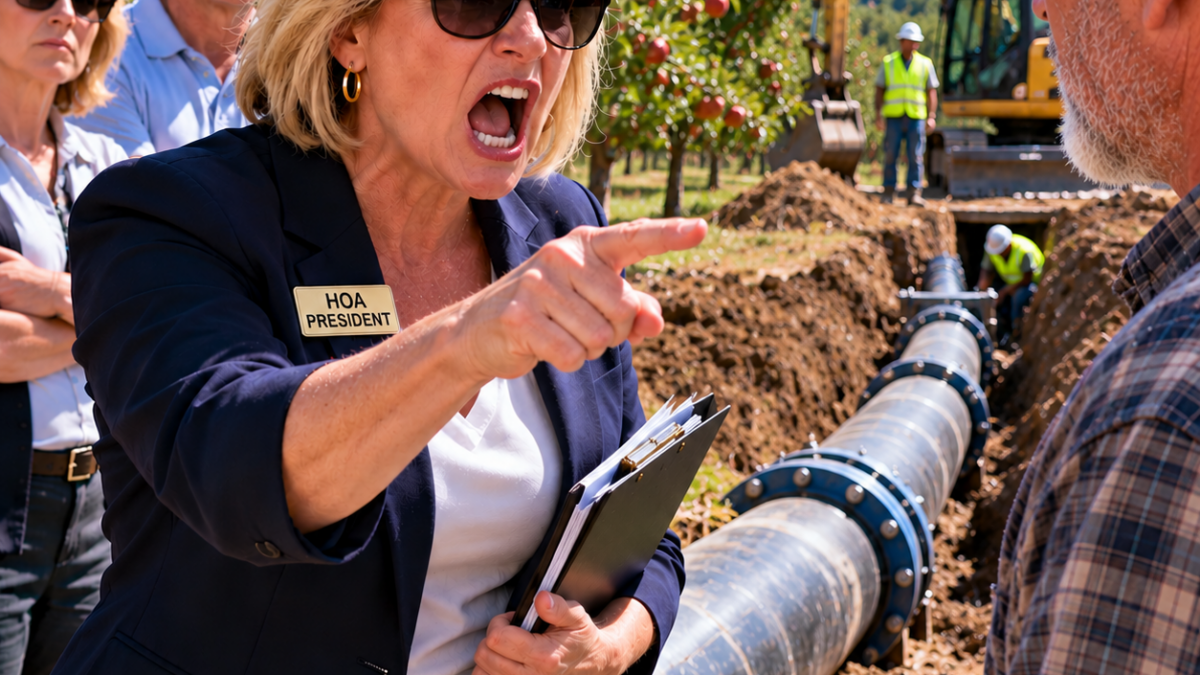
PART 2
By noon, we had four pumps running.
The rain had ended hours earlier.
That bothered me almost as much as the flooding.
Natural runoff rises with rain and falls afterward.
The twenty-four-inch pipe kept pushing water.
Not as violently as it had at six in the morning, but steadily enough that every gallon we removed seemed to be replaced by another gallon from Cedar Hollow.
Luis stood beside me near Row Nine.
His jeans were soaked to the knee.
“How long?”
“What?”
“How long can the trees sit like this?”
“Young ones can tolerate some saturation.”
“And the old ones?”
I looked at the oldest Honeycrisp block.
“Depends on depth. Soil temperature. How quickly the oxygen comes back.”
“That sounds like you don’t know.”
“It means there isn’t a clock hanging on the trunk.”
Luis rubbed mud off his boot.
“Can we cap the pipe?”
That thought had already crossed my mind.
Several times.
I looked uphill.
“If we block it and their detention pond rises into somebody’s house, Denise will blame us before the water reaches their front porch.”
“So we let them flood us.”
“For today, we document it.”
Luis looked toward the trees.
“That’s a lousy answer.”
“I know.”
It was still the right answer.
At 1:15, the management company emailed me.
Subject:
**DRAINAGE EASEMENT COMPLIANCE**
That wording was deliberate.
Not “possible drainage dispute.”
Not “stormwater issue.”
Easement compliance.
They wanted the starting assumption to be that a legal right already existed and I was the person refusing to respect it.
The message said Cedar Hollow had performed emergency maintenance within an established drainage corridor and that I was not to interfere with discharge.
It warned that obstructing the outlet could cause property damage within the subdivision and expose me to liability.
Attached was one page.
A conceptual sketch.
Broad blue arrow traveling from Cedar Hollow toward my orchard.
In one corner:
**CONCEPTUAL DRAINAGE AREA**
No survey seal.
No recording reference.
No easement book and page.
No permit number.
No date.
It looked official only if you did not ask official questions.
I replied with four.
**Who designed the new twenty-four-inch outlet?**
**What permit authorized installation?**
**Where is the recorded easement granting Cedar Hollow the right to discharge through my property?**
**When did Cedar Hollow or its contractor receive permission to remove my boundary fence and enter the orchard?**
Nobody answered that day.
The following morning, water had fallen only about two inches.
Dr. Nina Patel arrived just after eight.
Nina worked with the agricultural extension service and had advised us for years on disease pressure, root problems, and fruit quality.
She stepped into the lower block wearing rubber boots and carrying a soil probe.
Near one of the oldest Honeycrisp trees, she pushed the probe down.
When she pulled it free, water filled the hole almost immediately.
She frowned.
“Saturated below the root zone.”
“I know.”
“How long has it been standing?”
“More than twenty-four hours.”
She looked at the leaves.
Then at the fruit.
“If it drains today, you may lose some fruit.”
“And if it doesn’t?”
“If another storm comes while this stays saturated, we could start losing trees.”
“How many?”
“I can’t responsibly tell you.”
I hated that answer.
Because it was honest.
Nina pointed toward the rows.
“Mark water depth twice a day. Photograph leaf color. Photograph fruit drop. Keep pump logs.”
“Done.”
“And don’t let anyone tell you a dead tree next month proves nothing happened this week.”
I looked at her.
“You think it could take that long?”
“Root injury does not always show itself immediately.”
She pushed the probe into another row.
“The tree may look fine while the root system is suffocating.”
The forecast showed another storm arriving in five days.
Five days.
That was my clock.
Not the HOA election.
Not a ribbon cutting.
Five days to understand exactly where Cedar Hollow had redirected its water and figure out how to stop it without turning eighty-six homes into collateral damage.
I started with the physical evidence.
The temporary fence panels had been attached from the subdivision side.
On my side, the cut wire ends bent inward.
Fresh clay lay across a strip of grass ten feet wide.
A cedar branch held yellow paint transferred from heavy equipment.
Near the pipe, I found a wooden survey stake marked:
**WBP-2**
Not one of mine.
I photographed it.
Left it untouched.
Then I checked the trail camera I used for deer.
It faced east.
Not ideal.
But three days earlier, at 2:14 in the afternoon, it captured a compact excavator coming through the opening in my fence.
A section of black corrugated pipe sat in the bucket.
A man in a reflective vest walked ahead of it.
Next frame:
Truck.
Logo.
**PIKE CIVIL & DRAINAGE**
I called the number.
A man answered.
“Pike Civil.”
“Roy Pike?”
“Speaking.”
“My name is Ethan Cole.”
A pause.
“Yes.”
“That tells me you know why I’m calling.”
Another pause.
“We completed the work we were contracted to complete.”
“Did the work include entering Cole Orchard?”
“You need to discuss property issues with Cedar Hollow.”
“Did Cedar Hollow show you a recorded easement?”
“There was a drainage plan.”
“What drainage plan?”
“Mr. Cole, I’m not discussing client documents.”
“Was the outlet described to you as temporary?”
Silence.
“Or permanent?”
Longer silence.
Then:
“Call Cedar Hollow.”
He hung up.
Sometimes the hesitation before an answer tells you where to look next.
I drove to county development services.
Cedar Hollow had been approved in 2007.
The clerk said old grading and stormwater files were partly digital and partly archived.
I requested:
Original drainage plan.
All revisions.
Stormwater calculations.
Detention design.
Final inspection.
Any permit issued during the previous six months.
She searched the current database first.
“No recent stormwater permit under Cedar Hollow’s address.”
“That means the work was unpermitted?”
“Not necessarily.”
She was careful.
Good.
“Routine maintenance can sometimes be performed under existing approvals.”
“Would moving a discharge point onto neighboring land count as routine maintenance?”
Her eyebrows lifted slightly.
“That is not a determination I can make at the counter.”
“Fair enough.”
“I’ll flag your records request.”
Back at the orchard, I went looking for something older.
My father saved everything.
Seed catalogs from years before we grew seed crops.
Tractor manuals for tractors we no longer owned.
Tax cards.
Hand-drawn maps.
Receipts folded into envelopes labeled by season.
At the bottom of a gray cabinet, I found aerial photographs from before Cedar Hollow existed.
Pasture covered the hill.
Runoff spread in shallow sheets.
A grass swale turned east toward Mill Creek.
No concentrated channel pointed at the lower orchard.
No stream.
No twenty-four-inch equivalent.
No historical drainage path where Denise claimed one existed.
The following evening, a woman from Cedar Hollow came to see me.
Her name was Mara Benson.
She parked beside the packing shed.
Before getting out, she looked back toward the subdivision.
“You expecting someone?”
“No.”
“You keep looking uphill.”
“I still live there.”
That was answer enough.
She had served as Cedar Hollow’s treasurer until spring.
She carried a folder.
“I should have come yesterday.”
“Why didn’t you?”
“Because Denise controls the message board, half the committees, and most of the people who decide whether your life becomes annoying.”
“Sounds healthy.”
Mara almost smiled.
Then she opened the folder.
Photographs.
Cedar Hollow’s detention pond.
Older images showed a broad grass berm.
Concrete outlet on the eastern side.
Newer photographs showed dark water, sediment, cattails.
The original concrete outlet appeared partly buried.
The western berm had been opened.
Mara pointed.
“That opening lines up with your pipe.”
“What happened?”
“Pond overflowed twice during summer storms.”
“Engineering review?”
“March.”
She handed me the report summary.
Recommended work:
Dredge sediment.
Rebuild section of berm.
Repair original outlet control.
Estimated cost:
$118,400.
I looked at her.
“Instead they spent what?”
“Twenty-six thousand eight hundred on the bypass.”
“Why?”
“Board election.”
Of course.
Mara continued.
“Denise didn’t want a special assessment before the election.”
“So she sent the water to me.”
“She called it a western relief route.”
“Did anyone ask about the orchard?”
“I asked for the easement.”
“What did she say?”
“Legal had reviewed it.”
“Had legal reviewed it?”
Mara took out an email.
Four paragraphs.
Attorney’s advice.
The key sentence:
**Board should confirm legal right to discharge across any property outside the recorded Cedar Hollow boundary before construction.**
Mara tapped it.
“Denise read the first paragraph to the board.”
“And not this.”
“No.”
“What did the first paragraph say?”
“That emergency stabilization measures may be appropriate if the detention pond presents an immediate overflow risk.”
“So she read the sentence she liked.”
“Yes.”
“And skipped the one telling her to verify permission.”
“Yes.”
That shifted everything.
Before Mara came to me, Cedar Hollow could still argue:
Contractor mistake.
Old drain misunderstood.
Boundary confusion.
Routine maintenance gone wrong.
Now there was a different possibility.
They had a known $118,400 maintenance problem.
They chose a $26,800 bypass instead.
And before construction, their lawyer told them to verify whether they had the right to discharge outside their property.
Mara had one more document.
Payment authorization.
“What happened?”
“I refused to sign the check.”
“Why?”
“No easement.”
“And?”
“No permit I could find.”
“And?”
“I asked whether our insurer had reviewed it.”
“What did Denise do?”
“Called it emergency maintenance. Vice president signed instead.”
“Why’d you resign?”
Mara looked at the flooded rows.
“Because once people start telling you that asking where the water goes is disloyal, you’re not functioning as a treasurer anymore.”
Before leaving she said:
“Most people in Cedar Hollow don’t know.”
“Know what?”
“The pond wasn’t fixed.”
“What were they told?”
“That the drainage problem had been resolved.”
The next morning, Denise returned.
This time with Cedar Hollow’s property manager.
Red raincoat.
Black document case.
Luis stood with me beside the temporary fence.
The property manager removed a proposed agreement.
“The association would like to resolve this without unnecessary conflict.”
“That would have been easier before you dug into my orchard.”
He ignored that.
The agreement offered me:
$10,000.
For “crop disruption.”
In exchange, I would:
Acknowledge a permanent stormwater easement across the lower six acres.
Accept existing discharge.
Maintain the receiving area at my expense.
Release Cedar Hollow from existing damage claims.
Agree never to obstruct future flow.
I read the payment line again.
“Ten thousand dollars.”
Denise said:
“We believe it is generous given the pre-existing drainage condition.”
“You want six productive acres to become your detention basin.”
“We’re asking you to acknowledge the natural direction water has always traveled.”
“Water used to spread across pasture uphill and leave through a swale.”
I pointed at the pipe.
“That concentrates runoff from eighty-six homes into one point.”
Denise glanced at the pumps.
“Those homes cannot be endangered because you dislike the topography.”
“And my trees can be endangered because you dislike a repair bill?”
The property manager stepped in.
“The offer expires Friday at five.”
I closed the folder.
“Take it.”
Denise stared.
“You should have counsel review it.”
“I intend to.”
“That is why I am not signing it standing in six inches of water.”
“If you obstruct this outlet and Cedar Hollow floods, you will be responsible.”
“If another gallon comes through that pipe, I’ll document what it does.”
They left.
Luis watched the SUV climb the service road.
“Ten grand.”
“For six acres.”
“And all their water.”
“And I maintain it.”
He laughed without humor.
“Good deal.”
“That’s why they’re in such a hurry.”
That afternoon I hired Rachel Kim, an Asheville property attorney who handled land-use and construction disputes.
Different Rachel from the Brier Glen story? No matter. In this story Rachel Kim is lawyer.
She read everything.
The $10,000 proposal.
Mara’s documents.
Trail-camera photographs.
Management messages.
County records request.
Then she looked at me.
“Runoff cases are technical.”
“I was hoping for easy.”
“Then you hired the wrong lawyer.”
“Can they force me to take natural runoff?”
“Natural runoff is one issue.”
“And this pipe?”
“Different issue if they materially changed volume, velocity, concentration, or point of discharge.”
“Can they force a permanent easement?”
“Not with a document asking you to grant one.”
She tapped the proposal.
“They’re requesting a right they haven’t shown they already have.”
That sentence mattered.
Rachel sent preservation notices to Cedar Hollow and Pike Civil.
Preserve:
Plans.
Emails.
Minutes.
Invoices.
Photographs.
Texts.
Electronic files.
Engineering reports.
Communications concerning pond maintenance and the western bypass.
She also demanded that Cedar Hollow not increase discharge.
Two hours later, their attorney denied wrongdoing.
Reserved all rights.
The pipe kept running.
Before the third day ended, the county released Cedar Hollow’s original approved drainage plan.
Rachel came to the packing shed with Javier Morales, a civil engineer who had designed mountain stormwater systems for twenty years.
We spread the plans over the grading table.
Javier ignored the notes first.
He studied contour lines.
Then drainage areas.
Then detention routing.
The approved system was straightforward.
Roofs.
Roads.
Driveways.
Runoff collected in Cedar Hollow’s northwest detention pond.
The pond stored peak flow.
Water released gradually through a controlled concrete outlet on the east side.
A stabilized swale carried it roughly nine hundred feet east.
Then into a county culvert near Mill Creek Road.
There was an emergency spillway on the western berm.
But it ended inside Cedar Hollow.
Not in my orchard.
Javier laid a ruler across the boundary.
“The new pipe isn’t on this plan.”
“Could it be maintenance?”
“No.”
“Why?”
“Maintenance restores function.”
He traced the original outlet.
“This bypasses the control structure.”
Then traced west.
“And relocates the discharge more than three hundred feet.”
He studied the pond data.
Then frowned.
“What?”
“The storage volume.”
“What about it?”
“Designed for original impervious area.”
Cedar Hollow had changed since 2007.
Pool deck.
Expanded clubhouse parking.
Paved cart areas.
More hard surface.
More runoff.
Meanwhile, nobody had dredged the pond.
Sediment reduced storage.
Cattails occupied part of the basin.
More water entering.
Less volume available.
Then instead of restoring detention capacity, someone had punched a twenty-four-inch bypass toward the orchard.
Javier calculated.
During a heavy event, peak flow through that pipe could reach thousands of gallons per minute.
“No wonder our pumps can’t keep up.”
“They were never going to.”
I looked at the plan.
“So this solves their pond problem.”
“It transfers it.”
We had a strong theory.
But Rachel wanted proof of where the water in the pipe originated.
Not assumption.
Not even a very good engineering inference.
Proof.
Javier recommended a dye test.
County-supervised.
The county assigned the complaint to Laya Grant, a senior stormwater engineer.
She arrived the next morning.
She did not act like my advocate.
Good.
She measured pipe diameter.
Water depth at twelve trees.
Outlet elevation.
Fence location.
Boundary points.
Then walked uphill with Cedar Hollow’s permission and inspected the pond.
When she returned, clay covered her boots.
Her face had changed.
“The twenty-four-inch line connects to a new junction box below the pond.”
“Approved plan?”
“No.”
“Permit?”
“I haven’t located one.”
“What happens now?”
“I gave the association forty-eight hours to provide its construction documents.”
“Storm arrives in three days.”
“I know.”
The following morning, the dye test began.
County staff poured a measured amount of fluorescent green tracing dye into a curb inlet on Cedar Hollow’s highest street.
Another crew waited in my orchard.
Sampling bottles.
Cameras.
Time logs.
For nine minutes, nothing changed.
At eleven minutes, the pipe water took on a faint green tint.
At fourteen, it glowed.
Bright green.
Visible from twenty feet away.
The water flooding my father’s orchard was physically connected to Cedar Hollow’s street-drainage system.
Laya filled sample bottles.
Sealed them.
Logged them.
Denise stood on the service lane with the HOA attorney.
When the test ended, she came to the fence.
“This proves water moves downhill.”
Laya answered before I could.
“It proves Cedar Hollow’s collection system is connected to this outlet.”
“Our consultant determined this was an acceptable emergency measure.”
“Provide that determination with the permit file.”
Denise looked at me.
“You could have accepted a reasonable solution.”
I looked down.
Fluorescent green water moved between trees my father had planted.
“This is your reasonable solution.”
That evening, Cedar Hollow sent a community-wide notice.
A “neighboring commercial property owner” was challenging necessary flood-control work.
Possible legal costs.
Threat to homes.
It did not mention:
$10,000 easement offer.
$118,400 pond repair.
Unapproved discharge.
Missing permit.
Attorney warning.
Mara forwarded the email.
Then residents began calling me.
One retired contractor had seen Pike Civil trenching.
Another homeowner said Denise had described the work as cleaning an existing drain.
Then Carol Webb called.
Current board member.
She had voted yes.
“I need to talk to your attorney.”
Rachel met her.
Carol brought the emergency board packet.
Inside:
Pike Civil’s full proposal.
Page one:
**DETENTION POND RELIEF AND WESTERN OUTFALL**
Scope:
310 feet of twenty-four-inch pipe.
New junction box.
Removal of forty feet of boundary fence.
Outlet stabilization.
And then the words:
**WITHIN COLE ORCHARD**
Clear.
Not hidden.
Not ambiguous.
Another line:
**OWNER TO SECURE ALL EASEMENTS AND PERMISSIONS BEFORE MOBILIZATION.**
Pike Civil had identified Cedar Hollow as the client/owner responsible for access rights.
The contractor had not certified permission existed.
The HOA had told the contractor it would obtain permission.
Rachel asked Carol:
“Did Denise show you an easement?”
“No.”
“What did she say?”
“That the orchard fell within a broad drainage easement.”
“Did management produce it?”
“No.”
The best “easement” management ever sent me was the undated conceptual blue arrow.
Property records showed utility easements.
None allowed Cedar Hollow to install a stormwater outfall.
Now we had a chain.
New physical pipe.
Trail-camera entry.
Original approved plan.
Engineering analysis.
County dye test.
Contractor proposal.
Missing easement.
Board packet.
And the HOA’s own prior legal warning.
The following morning, Laya issued a preliminary notice of violation.
Cedar Hollow appeared to have:
Materially altered an approved stormwater system.
Created an unapproved discharge point.
Performed work beyond its property without documented authorization.
The association had forty-eight hours to stop active discharge or submit an emergency stabilization plan acceptable to the county.
Cedar Hollow did not close the pipe.
Their attorney argued that closing it before the incoming storm might flood homes around the detention pond.
And that was the most dangerous part.
He wasn’t entirely wrong.
The pond had lost capacity.
Original outlet partly clogged.
Simply sealing the new pipe could push water over the weakened berm.
Cedar Hollow had created a system that shifted risk to me.
Then claimed removing it would shift risk back to their homeowners.
They had built dependence before obtaining permission.
Laya ordered a site meeting.
Cedar Hollow.
Pike Civil.
Javier.
Rachel.
Me.
We met beside the detention pond beneath a gray sky.
It was the first time I saw the whole system from above.
The pond looked tired.
Sediment shelf.
Cattails.
Original control structure choked with material.
Fresh junction box near the western berm.
Then the big black pipe disappearing beneath the service lane.
Laya looked at Roy Pike.
“Who authorized your company to cross the Cole boundary?”
Roy looked at Denise.
“Our contract documents showed the work area.”
Rachel asked:
“Who told you access had been secured?”
“Client.”
“Which client?”
“Cedar Hollow.”
“Cedar Hollow does not own Cole Orchard.”
Roy stared at the ground.
“That is now understood.”
Denise stepped forward.
“The association relied on professional contractors and long-standing drainage patterns. We acted to protect eighty-six homes.”
Laya held up the 2007 plan.
“This protected the eighty-six homes.”
She pointed at the pond.
“Storage.”
Then the original outlet.
“Controlled release.”
Then east.
“Approved swale and culvert.”
Denise said:
“Restoring the pond immediately was financially unreasonable.”
Laya’s voice stayed flat.
“Financially unreasonable does not create permission to discharge across another parcel.”
“Our residents could not wait months for a capital project.”
“Neither can my orchard.”
Denise turned toward me.
“You chose to farm low ground below a development.”
I stared at her.
“My father planted those trees twenty-nine years before Cedar Hollow existed.”
Several board members standing behind her looked at one another.
Laya gave the emergency stabilization plan.
Pump down the pond before the storm.
Clear the original eastern control structure.
Install temporary sediment controls.
Close the western bypass at the junction box.
Monitor pond elevations.
After the storm:
Permanent restoration plan.
Denise asked:
“Can the county force this before our appeal is heard?”
Laya answered:
“Your counsel may challenge our determination.”
Then she looked at the clouds.
“The weather will not wait for your appeal.”
Meeting ended at 11:30.
At two, temporary pumps began drawing down the pond.
At four, a crew opened the eastern control structure.
Mud.
Roots.
Compacted sediment.
Years of neglect came out in slabs.
At 6:15, Roy Pike closed the valve feeding the western pipe.
For the first time in six days, the water pouring into my orchard slowed.
Stream.
Trickle.
Then nearly nothing.
Luis stood beside me.
“Quiet.”
I nodded.
I had forgotten how quiet the lower block was supposed to sound.
The storm arrived after midnight.
Heavy rain hammered the packing-shed roof.
Luis and I stayed there.
Every thirty minutes, we walked the lower block with flashlights.
Water gathered naturally between rows.
Nothing unusual.
The black pipe remained quiet.
At three in the morning, Laya texted.
**POND STABLE. EAST OUTLET FUNCTIONING.**
Cedar Hollow did not flood.
My orchard did not flood.
That storm destroyed the HOA’s strongest argument.
Protecting their homes had never required sacrificing my land.
It required maintaining the system they already had.
The financial consequences came slower.
So did the biological ones.
At first, I thought we might have saved most of the trees.
Then leaves began yellowing.
Fruit dropped.
Some roots never recovered.
Dr. Patel marked thirty-one trees as lost.
Another forty-six survived but produced fruit that could not meet our distributor’s contract standards.
The erosion near the pipe exposed root systems.
Damaged an irrigation line.
Washed mulch and soil downslope.
Luis kept labor records.
Pump hours.
Fuel.
Temporary hoses.
Cleanup.
Dr. Patel documented tree mortality.
Javier calculated altered discharge.
Our distributor supplied reduced-delivery figures.
Rachel assembled everything.
Not guesses.
Evidence.
Invoices.
Photographs.
Measurements.
Expert reports.
Crop records.
Cedar Hollow’s liability carrier eventually funded:
Tree replacement.
Soil restoration.
Irrigation repair.
Emergency pumping.
Documented lost crop.
Other verified costs.
The settlement did not make me rich.
It kept me from borrowing against the farmhouse to repair damage somebody else had caused.
The county required Cedar Hollow to do what its engineer had recommended before any of this happened.
Dredge the pond.
Rebuild the western berm.
Restore the original outlet controls.
Remove the unapproved bypass.
Stabilize the bank cut.
Replace my fence.
Funny how the “unaffordable” repair eventually became unavoidable once the cheap alternative was exposed.
Homeowners got the special assessment Denise had wanted to avoid.
I took no pleasure in that.
Mara had been right.
Most residents had no idea what the board had done.
At the membership meeting, they received the full engineering report.
Pike’s proposal.
Attorney warning.
County records.
They learned that before a shovel entered my property, the paperwork had already said:
Get permission.
They learned permission had not been obtained.
Denise did not run for another term.
I did not attend the election.
By then, Luis and I were removing dead trees.
The last damaged trunk came out one cold morning in November.
Roots rose from the soil.
Dark.
Rotting in places.
Luis leaned against the shovel.
“You ever think about planting something else in this block?”
“Every day for three months.”
“And?”
“Honeycrisp.”
He laughed.
“Of course.”
“What would you plant?”
“Something easier.”
“That’s why you work for me.”
“That makes no sense.”
“Exactly.”
That winter, the orchard looked wounded.
Thirty-one empty holes in rows that had once been continuous.
If you manage an orchard long enough, you become accustomed to individual losses.
Disease.
Wind.
Old age.
A tractor mistake.
But thirty-one empty spaces caused by one decision uphill felt different.
Every gap reminded me of the first morning.
Brown water.
Floating mulch.
That black pipe.
The following spring, my daughter Emma came home from college.
She had grown up in the orchard but never shown much interest in farming full-time.
That had never bothered me.
Land should be inherited by choice, not guilt.
We spent Saturday planting new trees.
Thirty-one.
One for each dead tree.
I dug.
Emma positioned roots.
We filled.
Watered.
Staked.
At the ninth hole she asked:
“Why not move the row uphill?”
“Because the soil is good here.”
“But it flooded.”
“It was flooded.”
“Difference?”
“Yes.”
She leaned on the shovel.
“Explain.”
I pointed uphill.
“For years, rain fell on Cedar Hollow.”
“Okay.”
“It entered their detention pond.”
“Okay.”
“It released through a control structure.”
“Then swale.”
“You actually listened growing up.”
“Occasionally.”
“Then county culvert.”
“So?”
“The land was not the failure.”
“The pipe was.”
“The decision was.”
Emma looked toward the cedar bank.
“They treated your orchard like extra pond space.”
“Exactly.”
She pushed the shovel into the soil.
“So we’re putting the trees back.”
“Yes.”
“Stubborn.”
“Genetic.”
She laughed.
Those new trees looked tiny.
My father’s old trees had canopies wide enough that you could stand beneath them in rain and barely get wet.
The replacements looked like sticks.
That hurt more than I expected.
Then one afternoon Emma found an old photograph of me at eleven.
My father beside me.
Rows of saplings behind us.
Small.
Barely branches.
She brought it outside.
“Those look terrible.”
“Thank you.”
“I mean tiny.”
“So were you.”
“Is that you?”
“Yes.”
“You had weird hair.”
“It was 1978.”
“No excuse.”
She held the photograph beside the new row.
“Trees need room for the years you can’t see yet.”
I looked at her.
“What?”
“You say that all the time.”
“My father said it.”
“Well, apparently he was right.”
For the first time since the flooding, the empty spaces felt less like losses and more like beginnings.
Cedar Hollow changed too.
The new board hired an independent stormwater consultant.
Not because the county forced every future decision.
Because residents demanded it.
Mara joined the infrastructure committee reluctantly.
She told me:
“I swore I was done with board work.”
“What happened?”
“They needed someone willing to read page four.”
“And five.”
“Especially five.”
The pond restoration took months.
Excavators removed sediment.
The original storage volume returned.
The east outlet was rebuilt.
Berm repaired.
Vegetation replanted.
The western bypass disappeared from Cedar Hollow’s side.
On my side, the pipe was removed back to the property line.
The county let me keep a short discarded section that had extended into the orchard.
It was maybe four feet long.
Black corrugated plastic.
Twenty-four inches across.
Luis asked:
“What are you going to do with it?”
“Not sure.”
“Mount it on a wall?”
“No.”
“Put Denise’s $10,000 offer inside?”
“Too dramatic.”
He laughed.
Eventually I stood it upright in the equipment shed.
I use it to hold irrigation hose.
That seems appropriate.
Something designed to carry Cedar Hollow’s stormwater now holds the system that waters my trees when I choose.
The first summer after replanting was dry.
We irrigated frequently.
One evening, I went down to shut a valve.
The short pipe section stood near the wall with a coil of blue hose inside it.
I remembered Denise telling me:
“Water follows the natural grade.”
She had been technically right.
Gravity had not committed the trespass.
Gravity had simply done what gravity does.
People concentrated the water.
People changed the discharge point.
People dug through my fence.
People chose the cheaper project.
People offered me ten thousand dollars to legitimize it afterward.
Water had not chosen Cole Orchard.
Cedar Hollow had.
That distinction became important again about a year later.
A new Cedar Hollow board president called me.
His name was Alan Price.
“Mr. Cole, we’re updating our emergency overflow plan.”
“Good.”
“We may need temporary access near the eastern fence for survey work.”
“Whose side?”
“Ours.”
“Then why call me?”
“Because one crew may need to set a target on your side for less than an hour.”
I paused.
“When?”
“Tuesday morning.”
“Who?”
He gave me the survey company.
“Insurance?”
“Yes.”
“Written scope?”
“I can email it.”
“Send it.”
He hesitated.
“Is that a yes?”
“That’s a send-it.”
He laughed.
The scope arrived.
One survey technician.
No excavation.
No equipment access.
One target stake.
Removed same day.
I signed permission.
Tuesday morning, the surveyor came to my door.
“Mr. Cole?”
“Yes.”
“I have your access letter.”
“I know.”
“I’ll be forty minutes.”
“Take fifty if you need it.”
He finished in thirty-five.
Closed the gate.
No drama.
That tiny interaction taught me something.
I was not against Cedar Hollow using my property under any circumstances.
I was against them deciding they had already used it before asking.
Permission changes everything.
Not because a signature is magical.
Because permission recognizes the other person exists.
Denise’s mistake was not simply poor drainage engineering.
She treated consent as a cleanup item.
Something to obtain after the project was real enough that saying no became expensive.
That is why the $10,000 offer bothered me more than the amount itself.
People asked:
“Would you have taken fifty thousand?”
Wrong question.
“Hundred thousand?”
Still wrong.
Maybe there was a price at which selling an easement could make sense.
Landowners sell easements every day.
But first you study the impacts.
Negotiate.
Design.
Protect crops.
Define maintenance.
Assign liability.
Record boundaries.
Then build.
Cedar Hollow reversed every step.
Build.
Flood.
Threaten.
Offer money.
Ask me to admit it was natural.
That wasn’t negotiation.
It was retroactive permission.
One autumn, three years after the incident, we had a storm almost as intense as the one everyone had feared during the dispute.
I knew it was coming.
So did Cedar Hollow.
The restored pond had been inspected.
Sediment levels normal.
East outlet open.
Emergency spillway clear.
No western bypass.
Rain began after dark.
By midnight, gutters overflowed.
Mill Creek rose.
I put on boots.
Luis arrived anyway.
“I didn’t call you.”
“I know.”
“Then why are you here?”
“Because you would have called me at one in the morning.”
“Fair.”
We walked the lower block.
Some standing water.
Normal for heavy rain.
No current cutting through grass.
No black pipe roaring beneath the cedars.
At 1:40, Alan from Cedar Hollow texted me.
**POND AT 72%. EAST OUTLET FUNCTIONING.**
At 2:15:
**POND AT 78%. STABLE.**
At three:
**RAIN EASING. NO INCIDENTS.**
Luis looked at my phone.
“That’s boring.”
“Best kind of storm report.”
By morning, Cedar Hollow had wet lawns.
We had wet rows.
Nobody had a flooded basement.
Nobody had drowned trees.
No one sacrificed anybody else’s land.
The system simply worked.
Which meant the original $118,400 recommendation had never been extravagant.
It was the cost of maintaining what Cedar Hollow had already built.
Avoiding that bill had created legal fees, crop damage, engineering costs, insurance claims, emergency work, bank restoration, and eventually the same pond repair anyway.
Cheap solutions become expensive when they depend on someone else not fighting back.
Mara visited during harvest that year.
She bought apples.
I tried not to charge her.
She insisted.
“You have a business.”
“You brought me the file that saved it.”
“I brought you information I should have made public earlier.”
“You were the treasurer, not the president.”
“I still signed budgets.”
“You refused the bypass check.”
“After the contract was already approved.”
I put a bag of Honeycrisp on the counter.
“Take these.”
She put twenty dollars down.
“You’re impossible.”
“Runs in the orchard.”
Before leaving, she looked toward the lower rows.
“Which are the replacements?”
I pointed.
The young trees were finally carrying meaningful fruit.
Not full mature production.
Enough.
Mara walked down.
Touched one apple gently.
“Hard to believe thirty-one died.”
“Not really when you watched them.”
“Do you hate us?”
“Cedar Hollow?”
“Yes.”
“No.”
“Denise?”
I thought about it.
“No.”
She looked surprised.
“I was angry.”
“And now?”
“Now I have too much work.”
Mara smiled.
“That may be the healthiest answer I’ve heard.”
I did not forgive the decision in the sense of pretending it was acceptable.
I did not forget.
But hatred is a poor maintenance plan.
The orchard needed pruning.
Spraying.
Harvest.
New plantings.
Labor.
Markets.
Water.
Those demands did not care whether I spent every evening thinking about Denise Harrow.
Eventually, she became part of the record instead of part of my daily life.
That felt like winning.
My father’s maps remain in the orchard office.
I added new documents behind them.
County dye-test results.
Restoration drawings.
Photographs of the flood.
Photos of the new trees.
Then, in the back, I placed one copy of the $10,000 easement proposal.
Emma found it.
“Why keep this?”
“History.”
She flipped through it.
“They wanted you to maintain their drainage at your expense?”
“Yes.”
“For ten thousand dollars?”
“Yes.”
“For six acres?”
“Yes.”
She stared at me.
“Did they think you were stupid?”
“Maybe they thought I was tired.”
“That seems worse.”
“It can be.”
Pressure makes bad contracts look reasonable.
When your crop is underwater, someone offering money can sound like someone offering rescue.
That is why I was glad Luis asked about capping the pipe and I said no.
Glad Rachel told me runoff law was technical instead of promising an easy win.
Glad Laya did not arrive assuming I was right.
Glad Javier demanded proof.
Each pause kept me from making the kind of emotional decision Denise expected.
She thought physical reality would force the deal.
The pipe exists.
The water is flowing.
Your trees are flooding.
Sign.
Instead, the flowing water became evidence.
Trail camera.
Dye.
Flow estimates.
Tree damage.
Pumping records.
Erosion.
Every day the shortcut remained made the record stronger.
That is the irony of unauthorized infrastructure.
The longer it operates, the more physical facts it produces.
Five years after the flood, one of the replacement Honeycrisp trees produced its first truly heavy crop.
Emma happened to be home.
We were picking together.
She held up an apple.
“This one from the drowned row?”
“Replacement row.”
“Same dirt.”
“Exactly.”
She wiped it on her shirt.
Took a bite.
“Good.”
“You sound surprised.”
“I remember this whole area as mud.”
“So do I.”
A few rows uphill, one of my father’s original trees remained.
Old.
Crooked.
Still producing.
I walked over.
Ran my hand along the bark.
I thought about being eleven.
Carrying saplings.
Not understanding why he gave each tree so much empty room.
“Trees need room for the years you can’t see yet.”
That lesson had changed for me.
Land needs room too.
Drainage needs room.
Ponds need storage.
Roots need oxygen.
Neighbors need boundaries.
And decisions need enough space for someone to say no before concrete, pipes, or political deadlines make refusal expensive.
The new Cedar Hollow board eventually installed a small sign near its detention pond.
Not flashy.
**STORMWATER FACILITY — DO NOT ALTER WITHOUT APPROVAL**
Mara sent me a photograph.
Caption:
**Imagine that.**
I replied:
**Put one on Denise’s old office.**
Mara sent a laughing emoji.
That was about as much revenge as I needed by then.
The final practical loose end was the fence.
Cedar Hollow’s contractor replaced the forty feet they had removed.
The new section looked different.
Brighter galvanized wire.
Straighter posts.
For a while I disliked it because it made the trespass visible.
Then weather dulled the metal.
Grass grew around the posts.
The line blended again.
I left the trail camera in place.
Not out of paranoia.
Deer still came through.
One winter morning it captured three does crossing at sunrise.
No excavators.
No black pipe.
I saved that image.
It felt like a better record of the land restored than any engineer’s report.
Years later, Denise and I crossed paths at a county planning meeting.
I was there because another orchard owner had a road-drainage issue.
She was sitting near the back.
No red blazer.
Gray coat.
When the meeting ended, she approached.
“Ethan.”
“Denise.”
She looked older.
So did I.
“I heard the new trees are producing.”
“They are.”
She nodded.
“I’m glad.”
I waited.
She said:
“You still think I did it for the election.”
“I think the records show you wanted to avoid a $118,400 assessment before the election.”
“We were trying to protect homeowners.”
“I know.”
“You say that as though it means nothing.”
“No.”
I looked at her.
“It explains the pressure.”
“And?”
“It doesn’t create an easement.”
Her jaw tightened.
“We were facing pond failure.”
“Your engineer gave you a repair.”
“We couldn’t complete it quickly.”
“So you chose my land.”
“We believed the orchard was the natural receiving area.”
“Then why offer ten thousand dollars for a permanent easement?”
She looked away.
That question still worked years later.
Finally she said:
“I thought you’d take it.”
“Why?”
“You had crop damage.”
“You caused the crop damage.”
“I thought a settlement would help both sides.”
“You wanted me to sign away the argument after your pipe was installed.”
Silence.
Then:
“You made the whole thing much more expensive.”
I almost laughed.
“No, Denise.”
She looked at me.
“Maintaining your pond was always going to cost money. You spent extra trying to make my orchard pay the difference.”
For once, she didn’t answer.
We parted without apology.
No dramatic confession.
No reconciliation.
That was fine.
The orchard did not need her apology to produce fruit.
The county did not need it to enforce the restored plan.
I did not need it to know what happened.
A year later, I was cleaning the equipment shed and nearly threw away the four-foot section of black pipe.
Luis stopped me.
“You can’t.”
“Why?”
“That’s history.”
“I thought you hated it.”
“I do.”
“Then help me load it.”
“No.”
He pulled out the irrigation hose.
“Where are we putting this?”
I looked at the pipe.
“Fine.”
We put the hose back inside.
The black corrugated section still sits there.
Not framed.
Not polished.
No plaque.
Just a hose stand.
Visitors rarely ask about it.
When they do, I tell them:
“That used to carry an HOA’s stormwater into my orchard.”
Most think I’m joking.
Then they notice I’m not.
The lower six acres recovered.
Not perfectly.
Some replacement soil settled differently.
A few young trees grew faster than others.
Dr. Patel says that is normal.
Our grocery contract eventually returned to full volume.
Some seasons better.
Some worse.
Farming teaches you not to confuse recovery with returning to exactly what existed before.
You don’t get the old thirty-one trees back.
You plant new ones.
You don’t erase the six flooded days.
You make sure the next storm has somewhere else to go.
One September morning, nineteen days before harvest—same point in the season as the original flooding—I walked the lower block alone.
Fruit hung heavy.
Red-green Honeycrisp.
Grass dry beneath the rows.
The cedar bank stood quiet.
No pipe.
I stopped where the outlet had once blasted through.
You could still see subtle grading where the soil was restored.
Nothing dramatic.
I thought about that first morning.
Water above my boots.
Luis bringing pumps.
Denise standing above me saying:
“Stormwater follows the natural grade.”
That sentence stayed with me because it was almost true.
Gravity did send water downhill.
But gravity did not buy 310 feet of twenty-four-inch pipe.
Gravity did not cut my fence.
Gravity did not connect a detention pond to my property.
Gravity did not omit a lawyer’s warning.
Gravity did not offer me ten thousand dollars for six acres after the flooding started.
Gravity had no vote in Cedar Hollow’s election.
People made those choices.
That is the difference between a natural condition and an engineered one.
A difference Denise spent months trying to blur.
The orchard taught it better than any courtroom could.
After the pipe was closed and Cedar Hollow restored its original outlet, the next heavy storm came.
Same hills.
Same gravity.
Same eighty-six homes.
Same orchard below them.
Their houses stayed dry.
My trees stayed dry.
The only thing that changed was where Cedar Hollow chose to send its water.
That was the whole case.
The final harvest that year went well.
Emma came down on the last Saturday.
Luis brought his grandchildren.
We filled bins until evening.
One of Luis’s grandsons, maybe eight years old, wandered near the equipment shed.
He pointed at the black pipe.
“What’s that?”
Luis looked at me.
I said:
“That’s what happens when somebody tries to solve a hundred-thousand-dollar problem on somebody else’s land.”
The boy stared.
He clearly had no idea what I meant.
Luis laughed.
“Tell him when he’s older.”
“Probably.”
The boy ran back toward the apples.
I stood there looking at that ugly piece of corrugated plastic.
Once, it had frightened me.
Not the pipe itself.
What it represented.
A project already built.
Water already flowing.
Trees already drowning.
An HOA president telling me the easiest way to make it stop being a dispute was to sign away a permanent right.
At the time, ten thousand dollars felt insulting.
Years later, the amount hardly matters.
The dangerous part was the assumption behind it.
That once somebody creates enough pressure, consent becomes a price instead of a choice.
My answer changed that.
Not because I stopped gravity.
Not because I wanted eighty-six homes flooded.
I never did.
I forced Cedar Hollow to repair the system it already had instead of turning my orchard into the part they did not want to pay for.
The new trees stand there today.
Thirty-one replacements among the older rows.
When spring comes, their blossoms look no different from the others.
Bees move across them.
Fruit sets.
Branches bend under summer weight.
By harvest, unless you know the story, you would never guess which trees exist because someone once believed my land was cheaper than maintaining a detention pond.
Maybe that is the most satisfying ending.
The orchard kept working.
Cedar Hollow kept standing.
Their pond works.
Their original outlet works.
Their homes stayed protected.
My property stayed mine.
Nobody needed to lose everything.
They just needed to stop solving their problems by sending them downhill.
One evening after harvest, I stood at the lower row while the sun dropped over the foothills.
Emma was loading the last empty bins.
Luis had already gone home.
The orchard was quiet.
I could hear Mill Creek in the distance.
No pumps.
No rushing pipe.
No excavators.
Just the normal sound of land doing what it had done long before Cedar Hollow existed.
Water following gravity.
Within the paths the ground and the approved system had given it.
I looked toward the cedar bank.
For a moment I could still see the black pipe in my memory.
Twenty-four inches wide.
Brown current pouring out.
My father’s trees standing underwater.
Then I looked at the new Honeycrisp row.
Healthy leaves.
Fruit picked.
Roots in aerated soil.
And I remembered Denise’s favorite argument one last time.
“Water follows the natural grade.”
She was right about gravity.
She was wrong about everything that came after it.
The water had never chosen my orchard.
Cedar Hollow had.
And when they finally stopped pretending those were the same thing, both sides of the hill survived.
[END OF STORY]








