PART 2: HOA Fined My Wife’s Memorial Garden $5,000 for Being “Ugly”—The Next Morning, the City Declared It a $500,000 Historic Landmark
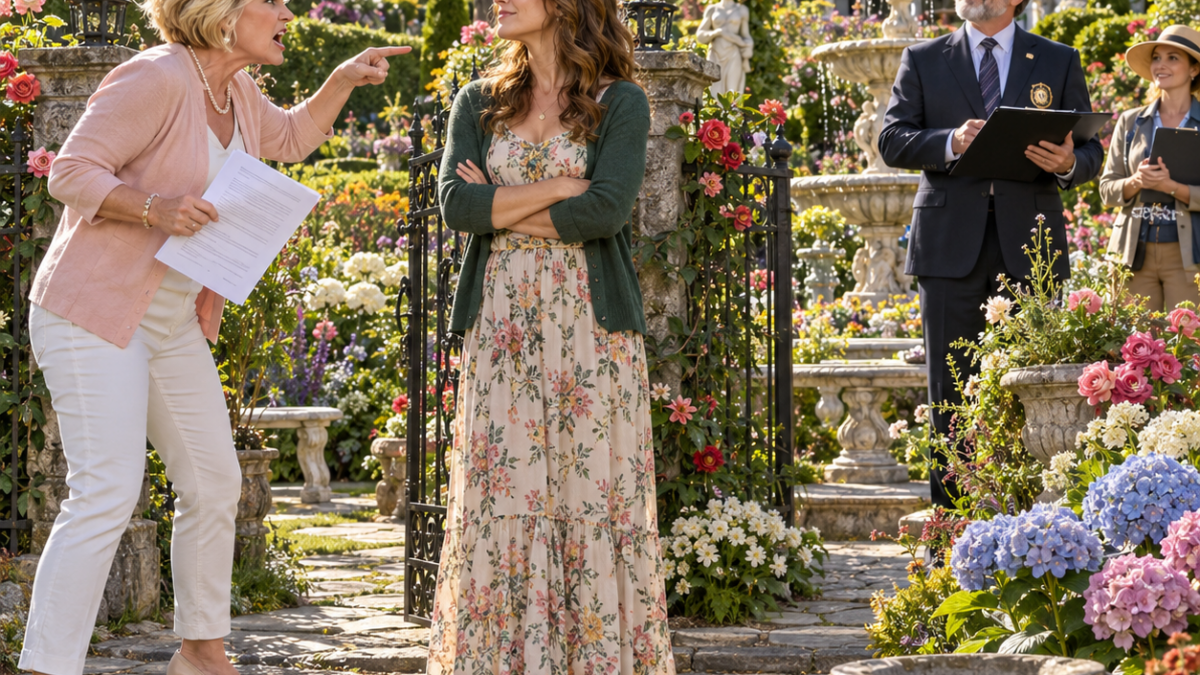
The HOA president stood in my dead wife’s garden and called it ugly. She handed me a $5,000 fine while her shoes pressed into the same soil where Sarah had asked me to leave part of her forever. And by the next morning, the woman who wanted that garden destroyed would learn she had just threatened the one piece of land in our town that nobody was allowed to touch.
My name is Marcus Hartwell. I’m fifty-two years old, and eight months ago, cancer took my wife, Sarah, after thirty-one years of loving me in ways I still don’t know how to live without.
Sarah wasn’t loud. She wasn’t dramatic. She was the kind of woman who remembered which neighbor had surgery, which grocery cashier was putting a son through college, and which rosebush needed shade before the afternoon sun burned it.
She believed gardens remembered people.
Our house had belonged to my grandmother Rosalind, who raised me after my parents fell apart. Behind that house was her old garden, a strange, beautiful half-acre tucked behind stone borders and iron gates. It was nothing like the manicured lawns our HOA loved. It had heritage roses, lavender paths, old brick walkways, an enormous oak tree, and plants Sarah said had “old souls.”
When Sarah got sick, that garden became her favorite place.
On the days she was strong enough, I wheeled her chair beneath the oak tree, and she would close her eyes while the wind moved through the roses.
“Promise me something,” she whispered one afternoon, her fingers thin inside mine.
“Anything.”
“When I’m gone, don’t put all of me in a cold wall somewhere.”
My throat closed.
“Sarah—”
“Listen to me, Marcus.” Her voice was weak, but her eyes were clear. “Mix some of my ashes into Grandmother Rosalind’s garden. Let me feed the roses. Let me stay where love kept growing even when everything else hurt.”
I promised.
After the funeral, I kept that promise.
I placed a smooth river stone beneath her favorite rose arch. I rehung her copper wind chimes. I planted lavender along the path because she loved the smell. Every morning, I sat on the bench and read to her from the poetry book she kept beside the bed.
That was how I survived.
Then Delilah Thornfield decided survival looked messy.
Delilah was our HOA president, a polished real estate woman with pearl earrings, sharp nails, and the kind of smile that made you check your wallet after she hugged you. She had wanted my grandmother’s property for years. Everyone knew developers had been circling our street, hoping to tear down the older homes and replace them with luxury townhouses.
I didn’t know then that Delilah was one of the people behind that plan.
All I knew was that she showed up at my door the day after Sarah’s funeral with a casserole in one hand and a business card in the other.
“Marcus, honey,” she said softly, “this house is too much for a grieving man. I know investors who could make you a generous cash offer.”
I told her no.
That was when the letters began.
First, anonymous complaints about my mental health.
Then HOA notices about “neglected landscaping.”
Then whispered rumors that I was unstable because I still talked to my wife’s memorial.
Finally, on the morning of Sarah’s eight-month anniversary, Delilah walked through my open garden gate without permission.
I found her standing beside Sarah’s memorial stone, holding a clipboard.
“This has gone far enough,” she said.
I stepped between her and the roses.
“You need to leave.”
She looked around the garden with open disgust.
“Overgrown vines. Unapproved stones. Dead-looking antique plants. Wind chimes. Personal memorial objects. This entire area violates our aesthetic harmony standards.”
“My wife’s ashes are here,” I said.
Delilah’s face didn’t change.
“Then you should have put them somewhere appropriate.”
For a moment, I couldn’t breathe.
She tore a yellow notice from her clipboard and held it out.
“Five thousand dollars. Thirty days to remove the noncompliant garden features, restore approved landscaping, and eliminate unauthorized memorial use.”
The paper shook in my hand.
“You’re fining my wife’s resting place?”
“I’m enforcing community standards.”
Behind her, the roses Sarah loved moved in the morning wind.
Then Delilah leaned closer and said the words that turned my grief into steel.
“Dead women don’t need gardens, Marcus. Living people need property values.”
That afternoon, I found Sarah’s hidden file behind my grandmother’s jewelry box.
Inside were deeds, trust documents, handwritten notes, and a photograph of my grandmother standing in that same garden in 1962.
On top of everything was one letter from Sarah.
Marcus, if Delilah comes for the garden, don’t let her scare you. Your grandmother protected this land for a reason. Call Helen Martinez at the city archives before you let anyone touch a single rose.
My hands were still trembling when I made the call.
The woman who answered went silent when I told her my address.
Then she said, “Mr. Hartwell, please don’t let anyone from the HOA near that garden until I get there.”
PART 2
Helen Martinez arrived forty minutes later in a faded blue sedan with a cracked dashboard and a trunk full of file boxes.
She was seventy-four, small, sharp-eyed, and moved with the urgency of someone who had spent her entire career waiting for a particular door to open.
When she stepped into the garden, she stopped under the oak tree and removed her glasses.
“Oh, Rosalind,” she whispered. “You really did save it.”
I stood beside the gate, holding Sarah’s letter.
“Helen?”
She turned toward me slowly.
“Marcus, your grandmother came to the city archives in 1989. She brought photographs, plant records, and handwritten notes from her own mother. She said one day somebody would try to destroy this garden for money.”
My throat tightened.
“Why didn’t anyone tell me?”
“She asked us not to file the preliminary materials publicly until the family requested review. She was afraid publicity would draw developers before she had legal protections in place.”
Helen walked to the nearest rosebush and touched a bloom with two fingers.
“Your grandmother was not just a gardener. She was a local botanical historian. Some of these roses came from the original 1887 Hartwell homestead. Others were propagated from cuttings believed to have come from the town founders’ estate.”
I looked around the garden I had been too broken to fully see.
The crooked brick path.
The ancient roses.
The oak tree.
The lavender Sarah loved.
The wind chimes I had rehung with shaking hands.
“To me,” I said quietly, “it was Sarah’s place.”
Helen looked at me with unexpected gentleness.
“It still is.”
Then she opened the first file box.
Inside were yellowed photos, maps, handwritten plant lists, and brittle newspaper clippings.
One photograph showed my grandmother Rosalind as a young woman, kneeling beside the same rose arch where Sarah’s memorial stone now rested.
Another showed a group of women in long dresses standing beneath the oak tree, dated 1911.
Helen handed me a folder labeled:
HARTWELL-ROSALIND BOTANICAL GARDEN — HISTORIC REVIEW PENDING
My knees almost gave out.
“Helen, what does this mean?”
“It means Delilah Thornfield just fined a property that may qualify as a protected historic botanical landmark.”
I stared at her.
“She can’t do that?”
“She can try,” Helen said. “But if this garden is what I think it is, her HOA rules are about to become the smallest problem in the room.”
Sarah’s second promise
That night, I didn’t sleep.
I sat at the dining room table surrounded by Sarah’s hidden notes.
Her handwriting covered pages and pages.
She had documented Delilah’s comments at board meetings, property records, unusual purchases by shell companies, conversations with older neighbors, and every “friendly” suggestion Delilah made after Sarah became sick.
The woman I had been trying to protect from cancer had been protecting me from something else.
One note broke me.
Marcus thinks Delilah is just pushy. She isn’t. She wants the garden because Grandmother’s trust makes the property valuable only if the garden stays intact. If she can prove the garden is neglected or noncompliant, she may try to force a sale or break the trust condition. I need to leave him everything before I’m too tired.
I pressed the paper to my chest and cried like I had not cried since the hospital.
Sarah had known.
While I counted medication bottles and drove her to chemo, she had been fighting a battle I couldn’t even see.
She had found the trust language.
My grandmother Rosalind had left the house to us with a preservation clause attached to a $750,000 family trust. The trust could support taxes, upkeep, legal defense, and restoration, but only if the historic garden remained intact as a living memorial and botanical preservation site.
If the garden was destroyed, declared abandoned, or legally separated from the house, the trust would become vulnerable to legal challenge.
Delilah had not fined my ugly garden by accident.
She had aimed at the lock on a vault.
I pulled out every notice she had sent.
Neglected vines.
Unauthorized memorial stone.
Unapproved plantings.
Dead vegetation.
Noise violation for wind chimes.
Improper garden structures.
Each one was designed to create a paper trail showing the garden was a nuisance.
Not sacred.
Not historic.
Not preserved.
A nuisance.
That was how she planned to steal it.
The next morning, Helen returned with Dr. Patricia Reeves from the state university’s botany department.
Dr. Reeves was in her early sixties, with silver hair clipped back and the kind of intensity that made even silence feel scientific.
She stepped into the garden carrying a magnifying lens, soil bags, gloves, and a field notebook.
Within ten minutes, she was kneeling beside Sarah’s rose arch, breathing like she had just found treasure.
“Mr. Hartwell,” she said, “do you know what this is?”
“A rose?”
She smiled without looking up.
“A heritage rose cultivar that disappeared from commercial records around 1948.”
I blinked.
“What?”
She moved to another plant.
“And this lavender variety is unusual. Older genetic line. Possibly local propagation.”
Helen stood behind her, trembling with excitement.
Dr. Reeves continued moving through the garden.
By noon, she had flagged twelve plantings for testing.
By two, she had called three colleagues.
By four, the city’s historic preservation officer was standing beneath my oak tree, saying the sentence that would change everything.
“We are placing a temporary emergency preservation hold on this garden.”
I looked at him.
“What does that mean?”
“It means no removal, no alteration, no HOA enforcement affecting the garden, no tree work, no landscaping change, and no construction activity until the city completes its historic review.”
Helen smiled.
I didn’t.
Not yet.
Because across the street, Delilah had come out onto her porch.
And she was watching.
Delilah’s first mistake
The emergency preservation hold was delivered to the HOA board that afternoon.
By evening, Delilah was at my door.
She didn’t ring the bell.
She knocked hard enough to rattle the frame.
I opened the door but left the chain on.
Her face was tight, her eyes bright with fury.
“What have you done?”
I looked at her calmly.
“I called the city archives.”
“You had no right dragging outsiders into an internal community matter.”
“You walked into my wife’s memorial garden and fined it.”
“It is not a memorial garden,” she snapped. “It is a private yard inside an HOA community.”
“It is also under emergency historic review.”
“That review will go nowhere.”
“Maybe.”
Her nostrils flared.
“You think this saves you? Marcus, I can make your life very difficult.”
I almost laughed.
She had already done that.
“No,” I said quietly. “You can try.”
Her eyes narrowed.
“You are not well. Everyone can see it. You spend your mornings talking to dirt and dead roses.”
I felt the old wound open.
For eight months, every morning, I had sat beside Sarah’s memorial and read to her.
Sometimes I told her about the weather.
Sometimes I told her I missed her.
Sometimes I told her I didn’t know how to make dinner for one person without cooking enough for four.
It was grief.
It was love.
Delilah wanted to make it sound like madness.
“You should leave,” I said.
She leaned closer.
“Sarah is gone, Marcus. And clinging to that garden will not bring her back.”
I looked past her toward the street, where neighbors were pretending not to watch.
Then I said something I hadn’t known I was strong enough to say.
“No. But it may bring you down.”
Her expression changed.
For the first time, I saw fear under the polish.
She left without another word.
That night, my phone rang at 2:13 a.m.
Unknown number.
I didn’t answer.
A voicemail appeared.
Only breathing.
Then a woman’s voice whispering, “Let dead things stay dead.”
I saved it.
By morning, three more things happened.
The health department received an anonymous report claiming I had illegally buried human remains in the garden.
Adult Protective Services received a report that I was mentally unstable and unable to care for myself.
And the HOA sent a notice demanding access to inspect the “unauthorized memorial features.”
Sarah had warned me.
Delilah was making her move.
The inspection
The health inspector looked embarrassed the moment I showed him the cremation certificate.
His name was Alan Price, and he had the tired kindness of a man who had seen too many people weaponize bureaucracy against their neighbors.
“Mr. Hartwell,” he said, reviewing the paperwork, “cremated remains may be scattered or placed on private property with the owner’s consent, subject to local rules. This is not a health hazard.”
I swallowed hard.
“She was my wife.”
His expression softened.
“I understand.”
“No,” I said. “You really don’t.”
He lowered his clipboard.
“You’re right. I don’t.”
That honesty kept me from snapping.
He completed his inspection and found no violation.
But by then, Delilah had what she wanted: strangers photographing Sarah’s memorial like a crime scene, neighbors watching from windows, and one more official-looking incident she could twist into evidence.
Officer Martinez came next.
A concerned citizen had reported that I was “behaving erratically” in the garden.
He found me sitting on the bench, reading Sarah’s favorite poem.
He was younger than I expected, maybe mid-thirties, with careful eyes.
“Mr. Hartwell?”
I closed the book.
“That’s me.”
“We received a call.”
“I know who made it.”
“I’m not allowed to confirm that.”
“I’m sure.”
He looked around the garden.
“May I ask what you were doing?”
“Reading to my wife.”
His expression didn’t change, but something in his eyes softened.
“Your wife is buried here?”
“Her ashes are mixed into the soil beneath the roses.”
He nodded once.
“My mother talks to my father’s picture every morning,” he said. “Grief looks different in every house.”
That almost broke me.
“I’m not unstable, Officer.”
“I didn’t say you were.”
He took my statement, looked at the paperwork from the health inspector, and left without incident.
But that afternoon, Delilah’s attorney filed a petition questioning my fitness to administer my grandmother’s trust.
The petition described me as irrational, obsessive, isolated, and emotionally unstable.
It cited my “garden fixation.”
It cited the police wellness call.
It cited the health department inspection.
It claimed a responsible trustee should be appointed to preserve my financial interests, including possible sale of the property.
There it was.
Not hidden anymore.
She wanted my house.
She wanted the garden.
She wanted the trust.
And she was willing to turn my love for Sarah into evidence against me.
I sat at the dining room table holding the legal papers until the words blurred.
Then I opened Sarah’s file again.
Near the bottom was a sealed envelope labeled:
If she says you’re crazy.
Inside was a list.
Dr. Jennifer Walsh — oncology grief counselor.
Father Daniel — hospital chaplain.
Helen Martinez — archives.
Miguel Santos — investigator.
Amanda Reed — trust attorney.
At the bottom, Sarah had written:
You are not crazy for loving me after I’m gone.
That was when I stopped feeling broken.
Not healed.
Not even close.
But no longer broken.
I called every name on the list.
The neighbors Delilah had already buried
Miguel Santos was a private investigator with quiet shoes, sharp suits, and eyes that missed nothing.
He arrived the next day, listened to the whole story, reviewed Sarah’s notes, and asked one question.
“Who else lost property after Delilah got involved?”
I thought about that.
“Eleanor Vance.”
“Who is she?”
“Former neighbor. Elderly widow. Sold her house below market after years of citations.”
“Who bought it?”
“I don’t know.”
“We’ll start there.”
Within seventy-two hours, Miguel had a map spread across my dining room table.
Red dots marked fifteen properties around our street.
Each had belonged to an elderly homeowner, a disabled resident, a widower, or someone under financial strain.
Each had received escalating HOA citations.
Each had sold below market.
Each had been purchased by a company connected through layers of paperwork to Delilah Thornfield or her development partners.
Miguel tapped the map.
“This is not aggressive HOA enforcement. This is a property acquisition scheme.”
My mouth went dry.
“How long?”
“At least eight years.”
“How much?”
“If the development plan we found is current? Projected value after redevelopment could exceed twelve million.”
I stared at the red dots.
People I had waved to.
People who had disappeared quietly.
People whose homes had been treated like pieces on a board.
“And Sarah knew?”
Miguel looked at her notes.
“She knew enough to be afraid.”
That night, I visited Eleanor Vance at the assisted living facility where Delilah had “helped” her move.
The place smelled of disinfectant and overcooked soup.
Eleanor sat by the window in a cardigan too thin for the room.
When she saw me, her eyes filled.
“Marcus.”
I knelt beside her chair.
“I need to ask you about Delilah.”
Her hands trembled.
“She told me she was helping.”
“How?”
“The fines kept coming. Window boxes too low. Mailbox too old. Sidewalk crack. Paint trim. I couldn’t keep up. Then she said she knew an investor who could buy quickly and spare me foreclosure.”
“Did you know the investor was connected to her?”
Eleanor’s face collapsed.
“No.”
I took her hand.
“She did the same kind of thing to others.”
A tear slid down her cheek.
“I thought I was just old and foolish.”
“No,” I said. “You were targeted.”
She covered her mouth.
“I left my husband’s roses behind.”
I could barely speak.
“I’m going to stop her.”
Eleanor gripped my hand with surprising strength.
“Then stop her for all of us.”
I promised.
That was the second promise.
The first was to Sarah.
The second was to everyone Delilah had already erased.
The roses come back
While Miguel followed the money, Dr. Reeves followed the plants.
The test results came back faster than expected.
Three rose varieties in Sarah’s memorial garden did not match any commercial genetic records currently available.
One appeared to be a lost cultivar linked to early agricultural records from the county.
Another had disease resistance traits that interested the university’s conservation team.
The lavender line showed unusual drought tolerance.
Dr. Reeves called me from the lab, breathless.
“Marcus, this is extraordinary.”
I sat down.
“How extraordinary?”
“Scientifically significant. Historically significant. Potentially valuable.”
“Valuable how?”
“For conservation, research, seed banking, heritage tourism. A garden like this, properly protected and interpreted, could be worth hundreds of thousands in grant funding and public value.”
I looked out the window at the roses.
Sarah’s roses.
The same roses Delilah had called ugly.
“Half a million?” I asked, remembering something Helen had mentioned.
“At least,” Dr. Reeves said. “Possibly more in long-term cultural and scientific value.”
The next morning, the city historic commission held an emergency session.
Helen presented archives.
Dr. Reeves presented preliminary botanical findings.
Miguel provided evidence that development pressure placed the site at risk.
Amanda Reed, the trust attorney, explained my grandmother’s preservation clause.
I sat in the back row wearing the suit I had worn to Sarah’s funeral.
Delilah sat three rows ahead of me in a cream blazer, whispering angrily to her attorney.
When the commission chair announced the temporary landmark designation, Delilah went still.
“The Hartwell Memorial Garden,” he said, “is hereby designated an emergency protected historic botanical site pending full landmark proceedings.”
My eyes burned.
Hartwell Memorial Garden.
They had used Sarah’s name.
Then the chair continued.
“All local enforcement actions, private covenant demands, landscaping requirements, removal orders, or alterations affecting the protected garden are stayed pending review.”
Delilah turned slowly and looked at me.
I did not smile.
I thought of Sarah whispering in the hospital.
Let me stay where love kept growing.
The city had just said she could.
The lawsuit that became a confession
Delilah did not stop.
People like Delilah don’t stop when they lose authority. They search for a different weapon.
Her next weapon was adverse possession.
The legal papers arrived on a Tuesday morning, claiming that Delilah and the HOA had maintained the boundary portion of my garden for more than ten years, giving them some ownership interest or control over the land.
It was absurd.
But it was also dangerous.
She produced receipts, photos, and witness statements.
The receipts were vague.
The photos were misleading.
The witness statements came from board allies who had suddenly remembered Delilah “tending” the garden over the years.
I laughed when I saw one photo.
Not because it was funny.
Because Sarah had taken the original.
Delilah’s version showed her standing near the roses with pruning shears.
Sarah’s original photo showed Delilah in the background of a neighborhood tour, holding a glass of wine, nowhere near the plants.
The image had been cropped and presented out of context.
Another mistake.
Amanda filed a counterclaim.
Fraud.
Harassment.
Intentional infliction of emotional distress.
Tortious interference with trust administration.
Abuse of process.
Miguel delivered his property acquisition map to the district attorney.
Helen delivered the archives to the state preservation office.
Dr. Reeves contacted federal botanical preservation experts.
And Sarah Morren, an investigative reporter, called me after receiving a tip from someone at city hall.
“I want to tell this story carefully,” she said. “Not as a weird HOA feud. As a widower’s memorial garden targeted for redevelopment.”
I almost said no.
I did not want cameras near Sarah’s resting place.
But Eleanor’s words came back.
Stop her for all of us.
So I agreed.
Sarah Morren visited the garden on a cool morning in early spring.
She was quiet as she walked the paths.
No dramatic questions.
No invasion.
She asked about Sarah.
I told her how Sarah danced barefoot in the kitchen while making sauce. How she hated carnations but loved wildflowers. How she kept a notebook of every plant she wanted to restore. How she made me promise not to let grief turn the house into a mausoleum.
Then I showed her the $5,000 fine.
The reporter read it twice.
“She fined a protected garden the day before the city review?”
“Yes.”
“And your wife’s ashes are here?”
“Yes.”
“And the HOA president knew?”
“Yes.”
The story ran Sunday morning.
By noon, people were leaving flowers at our gate.
By evening, former residents began contacting the reporter.
By Monday, state investigators were asking Miguel for his files.
By Wednesday, Delilah’s attorney stopped returning reporter calls.
Public sympathy did what legal filings alone could not.
It broke Delilah’s perfect image.
For years, she had hidden cruelty behind words like standards, harmony, and property values.
Now people saw the garden.
They saw Sarah’s memorial stone.
They saw the poisoned roses trying to bloom again.
And they understood.
This was not about an ugly garden.
It was about greed stepping on a grave.
The night she tried to burn it
The attempted arson happened at 2:47 a.m.
My phone buzzed with a motion alert.
I opened my eyes in darkness, already reaching for it.
On the screen, a man moved through the garden carrying a red fuel can.
For one second, my body forgot how to breathe.
Then another alert appeared.
Federal preservation officers had already been assigned to monitor the site after threats escalated. Miguel had insisted. Amanda had pushed. Dr. Reeves had warned that any destruction of botanical specimens could trigger serious charges.
I called 911 anyway.
Then I heard a voice outside.
Low.
Male.
Cursing.
I moved to the window.
The man was pouring gasoline near Sarah’s rose arch.
Near her memorial stone.
Near the soil that held her ashes.
Rage came so fast I nearly opened the door.
Then my phone rang.
Special Agent Jennifer Walsh.
The FBI had joined after the property fraud investigation crossed state lines and shell companies began connecting to multiple victims.
“Marcus,” she said, “stay inside. We have officers in position.”
“He’s at Sarah’s roses.”
“I know. Stay inside.”
“He’s pouring gasoline.”
“Stay inside.”
I gripped the windowsill so hard my fingers hurt.
The man struck a match.
He never got to drop it.
Lights exploded across the garden.
Men in tactical vests moved from the darkness.
“Federal agents! Drop it!”
The arsonist froze.
Then ran three steps before two officers tackled him near the lavender bed.
The fuel can rolled, spilling gasoline across the brick path Sarah and I had restored together.
I stood behind the window shaking so hard I could barely hold the phone.
The man’s name was Tommy Martinez, a small-time arsonist with a record of insurance fires.
By sunrise, he had confessed enough to implicate Delilah.
By noon, investigators had obtained recordings and messages showing she had arranged the attack through an intermediary.
She wanted the garden burned before full landmark status could be finalized.
She wanted the rare plants gone.
The memorial gone.
The evidence gone.
Sarah gone.
Again.
That was the day something inside me stopped being afraid of Delilah at all.
She had crossed from cruelty into evil.
And this time, every camera, every investigator, every scientist, every neighbor, every file Sarah left behind was watching.
The hidden foundation
The archaeological discovery came three days later.
Because of the attempted arson, the city ordered a full subsurface review before any restoration work began.
Dr. Elena Rodriguez arrived with ground-penetrating radar, expecting to locate old irrigation lines, buried edging, maybe remnants of early garden walls.
She found a house.
Not standing, of course.
But beneath Sarah’s favorite roses were geometric stone patterns consistent with an 1880s foundation.
The original Hartwell homestead.
The first house built on that ridge before Pinewood Road even existed.
Dr. Rodriguez stared at the radar screen like she was looking at a ghost.
“Marcus,” she whispered, “this garden isn’t just botanical history. It’s archaeological history.”
I looked at the roses.
“At Sarah’s memorial?”
“Directly beneath it.”
Within hours, the garden became a controlled archaeological site.
Yellow protection tape fluttered around the beds.
State preservation officers arrived.
Then federal officials.
Then more scientists.
Every HOA notice became legally meaningless.
Every demand to remove the garden became evidence of attempted interference.
Every threat Delilah had made now looked like what it was: a campaign to destroy protected historic property for private profit.
The full review found more than foundation stones.
Ceramic fragments.
Handmade nails.
Old drainage structures.
Seed deposits preserved in unusual soil conditions.
Dr. Rodriguez explained that cremation ash could alter soil chemistry in ways that sometimes affected mineral content and preservation.
“Sarah’s remains may have contributed to preserving dormant seed material near the memorial bed,” she said gently.
I could not speak.
Sarah had wanted to feed the roses.
Instead, she had helped preserve a lost piece of history.
I walked to the edge of the protected area and knelt.
For the first time in months, I did not read poetry.
I just whispered, “You were right.”
The wind moved through the oak tree.
The broken wind chimes had not yet been replaced, but for one second, I swore I heard them.
The town turns
The next public meeting was not held at the HOA clubhouse.
It was held at Riverside Community Center because too many people wanted to attend.
Eight hundred chairs were set up.
They were not enough.
People stood along the walls.
Reporters lined the back.
Former residents came with folders, photographs, closing documents, and stories they had kept quiet for years.
Eleanor sat in the front row with a small bouquet of roses from the assisted living courtyard.
Frank Morrison, the veteran who had lost his garden therapy space after Delilah’s citations drove him to sell, sat beside her.
He held his cap in both hands and stared at the floor until I walked over.
“Frank?”
He looked up.
“I should’ve fought harder.”
I sat beside him.
“You were fighting things nobody should have had to fight alone.”
His eyes filled.
“They took my peace.”
I looked toward the stage, where federal prosecutors and city officials were organizing files.
“Then today we start taking it back.”
The meeting began with the city’s historic designation announcement.
The Hartwell Memorial Garden had been granted emergency landmark protection with an assessed public cultural value of at least $500,000 in preservation, research, and heritage tourism potential.
Then Dr. Reeves explained the rare plants.
Dr. Rodriguez explained the archaeological foundation.
Helen explained my grandmother’s archives.
Amanda explained the trust.
Miguel explained the property acquisition pattern.
Then the prosecutor explained the criminal investigation.
Delilah Thornfield was not present at first.
She arrived late.
In custody.
No pearl earrings.
No cream blazer.
No clipboard.
Just an orange county jumpsuit beneath a coat, her wrists restrained in front of her.
The room went silent when she entered.
I did not feel joy.
I felt the weight of all the people she had diminished.
All the homes sold under pressure.
All the gardens destroyed.
All the grief mocked.
All the letters written to frighten people who had already lost enough.
The prosecutor announced charges related to fraud, conspiracy, harassment, attempted destruction of protected property, and the arson plot.
Additional federal charges were under review.
Then victims spoke.
Eleanor described losing her family home.
Frank described losing the garden that helped him manage PTSD.
A retired nurse described selling below market after citations made her believe she was too old to keep up.
One by one, Delilah’s polished version of herself died in public.
Then she demanded to speak.
Her attorney tried to stop her.
She ignored him.
She stood, trembling with fury.
“You people have no idea what I did for this town,” she snapped. “I kept values high. I kept standards. I cleared out decay.”
A sound moved through the crowd.
Not anger exactly.
Horror.
She pointed toward me.
“He ruined everything. That garden should have been developed. Sarah was dying, and everyone knew he couldn’t maintain that property alone.”
My whole body went cold.
She looked directly at me.
“I should have bought it years ago.”
There it was.
The truth.
Not dressed in concern.
Not hidden inside HOA language.
Just greed.
A reporter’s camera clicked rapidly.
The prosecutor made a note.
Delilah seemed to realize too late that every microphone in the room had caught her.
Then Eleanor stood.
She was tiny, trembling, leaning on a cane.
But her voice reached every corner.
“You did not clear decay,” she said. “You created it.”
The room erupted in applause.
Delilah screamed something I couldn’t hear over the sound.
Federal marshals guided her out.
For a long moment, everyone remained standing.
Then Frank Morrison began to cry.
Not quietly.
Not politely.
He bent forward with his face in his hands, and Eleanor put one arm around him.
That was the moment I understood what justice really looked like.
Not Delilah in cuffs.
Not cameras.
Not applause.
Justice was the first breath people took after years of holding it.
The sentence
The legal process took months.
Delilah’s network was larger than even Miguel had suspected.
A mortgage broker.
A probate attorney.
A developer.
Two appraisers.
Several shell companies.
Not every person received the same charges. Not every case moved at the same pace. Real law is not as neat as storytelling. But the pattern was undeniable.
Vulnerable homeowners were pressured.
Fines were manufactured.
Properties were acquired below market.
Development interests profited.
Delilah stood at the center.
The arson plot made everything worse for her.
So did the forged adverse possession materials.
So did the false mental health narrative.
So did her recorded statements about wanting the garden destroyed.
In the end, she pleaded guilty to several major charges to avoid risking an even longer sentence at trial.
At sentencing, I brought Sarah’s poetry book.
I don’t know why.
Maybe because I had carried it through the worst months.
Maybe because some part of me wanted the court to know Sarah had been a whole person, not just a victim in a case file.
When the judge allowed victim statements, I stood.
Delilah sat at the defense table.
She looked older.
Smaller.
But not sorry.
I opened the book but did not read from it.
Instead, I looked at the judge.
“My wife Sarah died once from cancer,” I said. “After she was gone, Delilah Thornfield tried to make her disappear again.”
The courtroom was silent.
“She called Sarah’s garden ugly. She fined it. She poisoned roses. She cut wind chimes. She used my grief as evidence that I was unstable. She tried to turn my promise to my wife into a reason to take my home.”
My voice shook.
I steadied it.
“But Sarah knew something none of us understood. She knew love could protect land better than greed could destroy it. She left notes. She preserved records. She trusted me to keep one promise.”
I looked at Delilah.
“You thought dead women don’t need gardens.”
Her expression tightened.
I continued.
“You were wrong. Sometimes the dead leave gardens because the living still need truth.”
The judge sentenced Delilah to eighteen years in federal prison after considering the full plea agreement, related conduct, victim impact, and cooperation issues involving other defendants.
She was ordered to pay restitution. Her real estate license was permanently revoked. She was banned from serving in any HOA, property management, or fiduciary role. Her assets tied to the fraud network were forfeited to compensate victims.
Some people said eighteen years was too little.
Others said it was enough.
I only knew that when the gavel fell, I felt Sarah’s book warm beneath my hand.
And I felt tired.
So tired.
After court, Eleanor came to me.
“She heard you,” she said.
“I don’t think she cared.”
Eleanor touched my arm.
“It was not for her.”
She was right.
It was for Sarah.
For me.
For every person Delilah had made feel powerless.
Sarah’s Garden
Six months later, the Hartwell Memorial Garden opened to the public for the first time.
Not every day.
Not as a tourist circus.
But carefully, respectfully, under the supervision of the city, the university, and the new preservation trust.
The garden had been restored.
Not polished into something fake.
Restored.
The brick paths were cleaned but still old.
The oak tree was supported by a certified arborist.
The wind chimes were replaced with new copper chimes made by a local artist using pieces of the old ones.
Sarah’s memorial stone was repaired, but the crack remained visible.
I asked them not to hide it.
Some things should show what they survived.
A bronze plaque stood near the entrance:
HARTWELL MEMORIAL GARDEN
Protected Historic Botanical Landmark
In memory of Sarah Hartwell, who believed love grows deeper roots than grief.
The first annual Love Grows Eternal Festival was held that spring.
Children planted heritage seeds in small clay pots.
Veterans attended a garden therapy workshop in Frank Morrison’s honor.
Eleanor cut the ribbon with hands that no longer shook.
Helen Martinez cried openly beside the archive display.
Dr. Reeves presented the first conservation report.
Dr. Rodriguez showed visitors the protected archaeological viewing area where the old foundation stones had been carefully exposed beneath glass.
The city estimated the garden’s historic, educational, tourism, and conservation value at more than $500,000, with future grants likely to increase that impact.
Property values in the neighborhood rose.
Not because Delilah forced every yard to look the same.
Because people wanted to live near something meaningful.
The HOA changed, too.
After the scandal, residents elected a new board led by Eleanor Vance.
Yes, Eleanor came home.
Her former house could not be returned exactly as it was, but restitution funds and community pressure allowed her to buy a smaller cottage two streets over. The first thing she planted was a rosebush.
The new HOA bylaws included protections for memorial gardens, native landscaping, elderly residents, disabled residents, and transparent enforcement procedures.
No more secret fines.
No more board friends deciding who suffered.
No more “aesthetic harmony” used like a weapon.
Frank Morrison helped design a veterans’ healing garden near the community center.
The retired nurse began organizing transportation for older residents.
A scholarship fund was created in Sarah’s name for students studying botany, historic preservation, grief counseling, and elder advocacy.
The first recipient was a girl whose grandmother had lost her home to Delilah’s network.
When she hugged me after the ceremony, she whispered, “My grandma said Sarah saved us.”
I couldn’t answer.
I just held her and cried.
Patricia
I did not expect to love again.
For a long time, I didn’t even want to.
Love felt like a room I had locked after Sarah died, not because it was empty, but because everything inside was too precious to touch.
Then Dr. Patricia Reeves kept showing up.
At first, she was there for the plants.
Then the research.
Then the preservation plan.
Then the educational programs.
She never tried to step into Sarah’s place.
That was why, eventually, I let her sit beside me.
One evening, after a school group left the garden, Patricia found me near the rose arch.
“Hard day?” she asked.
“Good day,” I said. “That’s what makes it hard.”
She nodded like she understood.
The children had been laughing, asking questions, planting seeds.
Sarah would have loved every second.
That joy hurt more than sorrow sometimes.
Patricia stood beside me quietly.
“I don’t think grief ends,” she said. “I think it changes jobs.”
I looked at her.
“What does that mean?”
“At first, grief keeps you alive because it proves the love was real. Later, if you let it, grief becomes a teacher.”
I looked toward Sarah’s memorial stone.
“What is it teaching me?”
Patricia smiled gently.
“That love can become work worth doing.”
I thought about the garden.
The scholarships.
Eleanor home again.
Frank’s therapy program.
The restored roses.
The hidden foundation stones.
The children carrying clay pots.
Maybe she was right.
Months later, Patricia and I began spending time together outside the garden.
Coffee.
Walks.
Quiet dinners.
Nothing rushed.
Nothing that felt like betrayal.
One evening, I brought her to Sarah’s memorial and told her the truth.
“I will always love my wife.”
Patricia looked at the roses.
“I would think less of you if you didn’t.”
That was when I knew Sarah would have liked her.
Not because Patricia replaced anything.
Because she understood nothing needed replacing.
Some loves become roots.
Others become new branches.
A life can hold both if the heart is brave enough to keep growing.
The final letter
On the first anniversary of Sarah’s death, I opened the last envelope in her file.
I had saved it without knowing why.
It was labeled:
When the garden blooms again.
That morning, the roses were full.
The lavender was alive with bees.
The oak tree cast shade over the bench where I had read to her through the worst months of my life.
I sat there and opened the envelope.
My darling Marcus,
If the garden is blooming, then you kept your promise.
I know you. You probably think you barely survived, but surviving with love still in your hands is its own kind of courage.
If Delilah came for the house, I’m sorry. I tried to leave you enough breadcrumbs. I wish I could have stayed to fight beside you, but maybe love sometimes prepares the battlefield before the war begins.
Do not let this garden become only a shrine to loss.
Let children learn here.
Let tired people rest here.
Let widows sit here without explaining themselves.
Let veterans breathe here.
Let science grow here.
Let something beautiful outlive both of us.
And Marcus, if one day you laugh here with someone else, don’t apologize to me.
I loved you alive.
Stay alive for me.
I read the letter once.
Then again.
Then a third time through tears.
That afternoon, a group of children arrived for a seed-saving workshop. Patricia led them along the lavender path, explaining how old plants carry stories in their genes.
A little boy raised his hand.
“Is this the garden the mean lady tried to destroy?”
Patricia looked toward me.
I nodded.
She answered carefully.
“Yes. But it is also the garden a lot of good people helped save.”
The boy looked around.
“Good. It’s too pretty to be mean to.”
That made everyone laugh.
Including me.
A real laugh.
The kind that did not feel like betrayal.
The kind Sarah had asked me to find again.
What Delilah never understood
Delilah thought value meant money.
She saw my grandmother’s property as acreage.
She saw Sarah’s illness as opportunity.
She saw my grief as weakness.
She saw the garden as an obstacle to development.
And because she saw everything through greed, she missed the one thing that made the garden untouchable.
Love had made records.
Love had saved seeds.
Love had written letters.
Love had preserved stone paths and old roots and family promises.
Love had turned ash into soil and soil into evidence and evidence into justice.
The $5,000 fine still hangs in the archive room at the garden visitor center.
Not because I need to remember the insult.
Because visitors should understand how close destruction came wearing ordinary paper.
A fine.
A notice.
A friendly offer.
A concerned report.
A board vote.
That is how people like Delilah operate. They don’t always break down doors. Sometimes they send certified mail. Sometimes they speak softly. Sometimes they call theft “helping you move on.”
But the garden survived.
Sarah survived in every bloom.
My grandmother survived in every preserved record.
Eleanor survived in the rosebush outside her new cottage.
Frank survived in the veterans who now sit quietly beneath the oak tree and breathe easier.
I survived, too.
Not the same man.
Not untouched.
But rooted.
One evening, near sunset, I stood beside Sarah’s memorial plaque while the last visitors left.
Patricia was helping a little girl label a seed envelope near the education table.
Eleanor was locking the archive cabinet.
Frank was sitting beneath the oak tree with two younger veterans, all three silent in a way that looked peaceful rather than lonely.
The copper wind chimes moved in the breeze.
For the first time since Sarah died, their sound did not hurt.
I touched the repaired crack in her memorial stone.
“Dead women don’t need gardens,” Delilah had said.
I looked around at everything Sarah’s garden had become.
A historic landmark.
A scientific resource.
A sanctuary.
A school.
A courtroom of truth.
A place where stolen homes were remembered and broken people found a path back to themselves.
“No,” I whispered. “But the living do.”
The wind moved through the roses.
The chimes answered softly.
And I finally understood what Sarah had known before any of us.
A garden is never just a garden when love is buried there.
It is a promise waiting for the right season.
It is proof that roots can outlast greed.
It is the place where grief stops being an ending and becomes something that feeds the world.
I stood in the golden light until the shadows stretched across the brick path.
Then I picked up Sarah’s poetry book, locked the garden gate, and walked home through a neighborhood that no longer felt like a battlefield.
Behind me, the roses kept blooming.
[THE END]








