PART 2: HOA Fined My “Ugly” Hay Bales $7,500—Then Their Own Equestrian Club Came Looking for Them
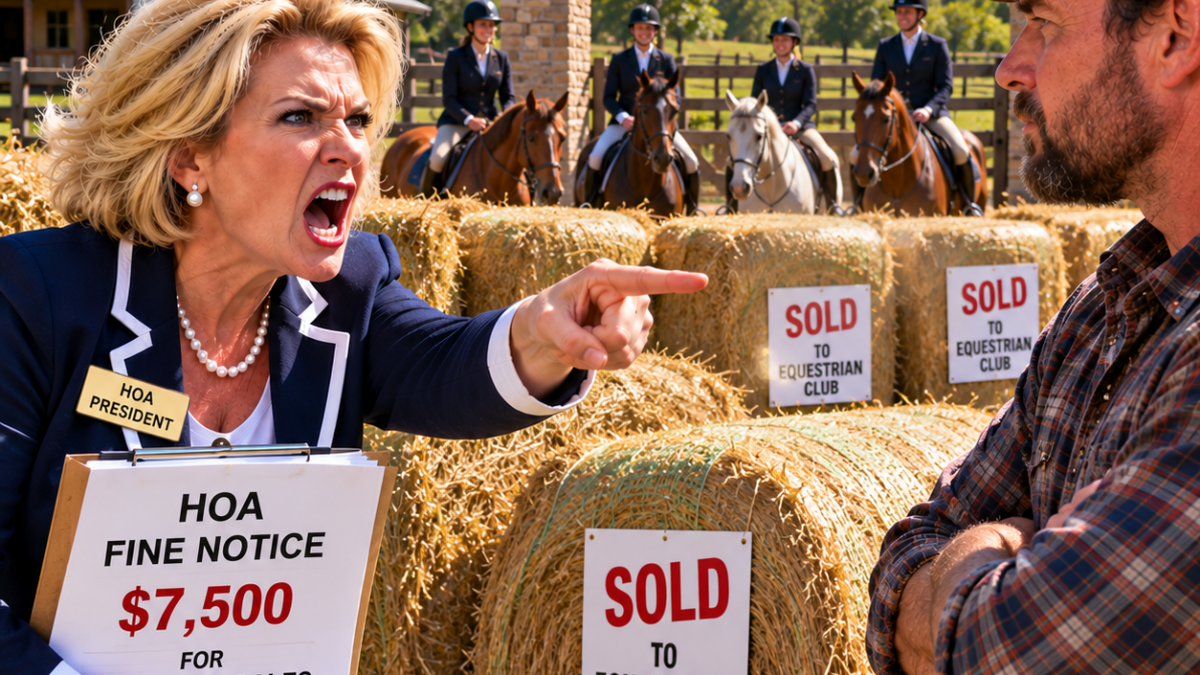
PART 2
Brenda exhaled hard enough that I heard it through the phone.
“That bad?”
“Depends.”
“On what?”
“Whether you consider an HOA threatening to lien my farm because your horses’ food is ugly to be bad.”
There was silence.
Then:
“She did what?”
I walked toward the barn, the violation notice still folded in my hand.
“Karen classified the bales as an unsightly material under Article Nine, Section Four-B.”
“You’re joking.”
“No.”
“The hay I already bought?”
“All 170 bales.”
“The hay due Friday?”
“Yes.”
Another silence.
This time I could practically hear her temper building.
Brenda Cole managed the Oak Creek Equestrian Club like an Army first sergeant ran a motor pool—efficiently, directly, and with no patience for people who confused appearance with function.
She was in her mid-forties, had spent most of her adult life around horses, and knew more about feed quality than most people knew about their own diets.
The first time she’d tested my alfalfa, she’d broken open a bale, smelled it, checked leaf retention, and said, “If the rest is like this, I’ll take everything you can grow.”
Now she sounded ready to climb through the phone.
“Mark, we are down to maybe nine days of premium feed.”
“I thought you had a backup supplier.”
“He had irrigation trouble.”
“So you need this.”
“Yes, I need this. More importantly, I bought this.”
“I tried explaining that.”
“What exactly did Karen say?”
I told her.
The fine.
The seventy-two hours.
The lien threat.
Karen’s suggestion that the club find another supplier.
That last part produced the most dangerous silence yet.
“She said that?”
“Pretty close to those exact words.”
“Send me a picture of the notice.”
I did.
Thirty seconds later she said, “Don’t move a single bale.”
“That’s currently my plan.”
“No. I mean don’t move anything until I make some calls.”
That gave me pause.
“Brenda—”
“Mark, do you know who keeps horses here?”
“Rich people?”
“Very funny.”
“Accurate.”
“Gerald Pike.”
I recognized the name.
HOA treasurer.
“My Gerald?”
“The one whose wife owns two Hanoverians that eat your hay.”
I stopped walking.
“You’re kidding.”
“No. Patricia Sloan keeps her daughter’s jumper here too.”
“Secretary Patricia?”
“Same one.”
I stared toward Oak Creek’s immaculate roofs beyond the pasture.
Two of the three people Karen relied on to enforce the hay fine had horses at the club purchasing the hay.
“And they voted for this?”
“I have no idea what they voted for.”
Brenda’s voice tightened.
“But I’m going to find out.”
“Don’t start a civil war yet.”
“I’m running a barn with forty-two horses. Feed logistics outrank diplomacy.”
She hung up.
I stood there smiling despite myself.
Then Sarah called from the kitchen door.
“Mark?”
“Yeah?”
“You planning to stand in the pasture all night?”
I walked inside.
Sarah was sitting at the island with hospital paperwork spread around her laptop. She worked as an administrative nurse manager at the regional medical center, which meant she had spent years developing the kind of calm that made panicking surgeons and angry patients both slow down.
She saw the paper in my hand.
“What happened?”
I slid it toward her.
She read.
Her eyebrows rose.
Then kept rising.
“Seven thousand five hundred dollars?”
“That was my reaction.”
“For hay?”
“Apparently Class Four Rural Blight.”
She looked through the window.
“Our hay?”
“Apparently there is another kind.”
Then she reached the lien language.
Her expression changed.
“Can they do that?”
“I don’t think so.”
“That’s different from no.”
“I know.”
“How much authority does the associate membership actually give them?”
“I’ve never had reason to test it.”
“Well, now you do.”
She kept reading.
“Seventy-two hours.”
“Karen likes deadlines.”
“What are you going to do?”
I opened my laptop.
Sarah watched me type.
“Please tell me you are not naming this something ridiculous.”
At the top of the document I wrote:
**OPERATION HAYMAKER**
She closed her eyes.
“Twenty-two years in the Army and this is what retirement looks like.”
“Good name.”
“It sounds like a bad action movie.”
“You married me.”
“That was before PowerPoint turned you into a tactical personality disorder.”
I smiled.
Then the smile faded.
Because beneath the absurdity was something that wasn’t funny.
A lien.
A cloud on title.
Potential interference with a contract.
A board president who believed a $50 annual road-maintenance arrangement gave her control over fifteen acres of working farmland.
I had spent most of my adult life working inside systems.
One thing I understood about systems was that they usually contained their own limits.
You just had to find them.
That night I printed the Oak Creek covenants.
One hundred twelve pages.
I began with Article Nine.
Karen’s clause prohibited open-air storage of “refuse, construction debris, unused building materials, junk equipment, and other unsightly materials inconsistent with residential character.”
Hay wasn’t mentioned.
Neither was agriculture.
The word *residential* bothered me.
My land wasn’t residentially zoned.
It was AG-2.
I pulled up county records.
Agricultural production.
Hay.
Livestock.
Farm equipment.
Storage incidental to agricultural use.
All expressly permitted.
That alone didn’t necessarily answer what private covenants could regulate, but it gave me a foundation.
Then I read the associate-membership provision.
It took three passes.
Sarah found me at one in the morning with three highlighters open beside me.
“You find something?”
“I think so.”
“Good something?”
“Very.”
The document defined full members as owners of lots within the recorded Oak Creek subdivision.
Associate members were owners of designated outside parcels granted limited access rights over specific HOA-maintained roads.
I read the next line aloud.
“Associate membership carries financial responsibility only for proportional maintenance of designated access infrastructure and conveys no voting rights, recreational privileges, or architectural-control obligations unless separately recorded against the associate parcel.”
Sarah leaned over my shoulder.
“Do we have anything separately recorded?”
“No.”
“You sure?”
“Closing attorney found nothing.”
“Then why does Karen think she controls us?”
“Because we’ve paid fifty bucks a year and nobody challenged her.”
Sarah sat down.
“That doesn’t answer the question.”
“It may be the whole answer.”
I kept digging.
Around two-thirty, I found the state’s Right to Farm statute.
It protected established agricultural operations from certain nuisance claims when they followed accepted farming practices and predated conflicting nonagricultural uses.
I didn’t assume that statute automatically erased every private contract.
George later corrected me on exactly that point.
But it reinforced something important:
Stacking hay on agriculturally zoned land was not some bizarre fringe use.
It was farming.
The next morning I started documenting.
Photographs of the bales.
Distances from roads.
Zoning maps.
Deed.
Associate agreement.
Hay contract.
Purchase orders.
Certified copies.
A habit from the military had followed me home: if something mattered, document it before anyone had time to rewrite what happened.
At 10:14, Brenda called.
“You free?”
“Yes.”
“I’ve got Gerald with me.”
I sat straighter.
“In person?”
“At the club.”
A man’s voice came through.
“Mark?”
“Gerald.”
“I just saw the violation letter.”
“You signed it?”
“No.”
That interested me.
“The notice says ‘Board-authorized enforcement.’”
Gerald sighed.
“Karen handles routine compliance.”
“Seven thousand five hundred dollars is routine?”
“No.”
“Did the board vote?”
“I don’t recall a specific vote on your hay.”
“Then why is she saying the board approved it?”
“I don’t know.”
Brenda cut in.
“Gerald, your wife’s horse goes through almost three quarters of a bale a day.”
“I know.”
“And the club bought this entire stack.”
“I know that now.”
“So tell me again how Mark is supposed to remove it because it’s ugly.”
“Brenda, I’m not defending Karen.”
“Sounds like you’ve been funding her.”
Gerald exhaled.
“Mark, send me your associate agreement.”
“Why don’t you already have it?”
Another silence.
“We should.”
That answer went into my notes.
Two hours later, Patricia called.
She was more defensive.
“We support agriculture, Mark.”
“That’s reassuring.”
“But Karen believes the bales are visible from common areas.”
“They’re visible because they’re hay.”
“You know what I mean.”
“No, I don’t.”
“Residents paid a premium to live in a certain environment.”
“And I paid for agricultural land.”
“Could you move them temporarily?”
“Where?”
“Behind the barn.”
“The barn is full.”
“What about tarps?”
“They’re already covered against weather.”
“Something more decorative?”
I actually pulled the phone away and looked at it.
“Decorative hay?”
“I’m trying to find a compromise.”
“Patricia, the first truck arrives Friday.”
“Then this may resolve itself naturally.”
“If Karen withdraws the fine.”
“I can’t promise that.”
“Then there isn’t a compromise.”
She became quiet.
I lowered my voice.
“Did you vote to fine me seventy-five hundred dollars?”
“No.”
“Did Gerald?”
“I don’t know.”
“Did anyone?”
“Karen has enforcement authority.”
“That’s not the question.”
“I have to go.”
She hung up.
I added another entry to the log.
That afternoon Karen returned.
Golf cart.
Clipboard.
Sunglasses.
She stopped on her side of the fence.
“I’ve been informed you’ve contacted board members individually.”
“They contacted me.”
“You are attempting to intimidate them.”
“No.”
“Brenda Cole has made several inappropriate calls.”
“She’s trying to feed horses.”
“You’re deliberately making this difficult.”
I almost admired the consistency.
“Karen, did the board vote on the $7,500 fine?”
She smiled.
“The president has delegated authority.”
“That’s not what you told me yesterday.”
“I told you the association had acted.”
“You said the board approved it.”
She shifted.
“The board has approved the enforcement framework.”
“Different statement.”
Her face hardened.
“You are not an attorney.”
“No.”
“You should stop pretending you understand the covenants.”
“I read the associate-membership section.”
That did it.
A small pause.
Not much.
Enough.
“You have limited membership obligations.”
“Yes.”
“Which include maintaining standards visible from association property.”
“Show me the recorded document that says architectural standards apply to my parcel.”
She tapped her clipboard.
“Our counsel has interpreted—”
“Show me.”
“You will receive all appropriate information through proper channels.”
“Good.”
I nodded.
“Put it in writing.”
She drove away.
No triumphant ending.
No shouted insult.
Just another useful conversation documented in my log.
The seventy-two-hour deadline expired Friday morning.
At 8:10, the first equestrian-club flatbed arrived.
Brenda climbed out wearing boots and an Oak Creek Equestrian Club jacket.
Behind her came two stable hands.
“You look disappointed,” she said.
“About what?”
“I expected barricades.”
“Karen isn’t stupid enough to block a truck.”
A golf cart turned the corner.
Brenda smiled.
“You were saying?”
Karen pulled up before we had loaded the first bale.
“What is happening?”
Brenda didn’t stop walking.
“I’m picking up my hay.”
“This property is under active enforcement.”
“Not my problem.”
“Brenda.”
That stopped her.
She turned.
Karen lowered her voice.
“The board has issued a removal order.”
“Excellent. I’m removing it.”
I bit the inside of my cheek.
Karen pointed toward the truck.
“This shipment constitutes an attempt to circumvent enforcement.”
Brenda stared at her.
“Are you listening to yourself?”
“You know how much pressure we’ve had from residents about preserving appearance.”
“I know my horses need feed.”
“You can buy elsewhere.”
“I already bought here.”
Karen looked at me.
“You intentionally involved the club to embarrass the association.”
“The contract predates your fine.”
Brenda folded her arms.
“By six weeks.”
Karen glanced toward the Oak Creek logo on Brenda’s jacket.
Then toward the bales.
“You cannot allow commercial loading activity to obstruct the HOA access road.”
“It won’t.”
I pointed to my driveway.
“The truck never touches your road except entering and leaving.”
Karen stepped closer.
“I am warning you both.”
Brenda laughed.
That was probably a mistake politically.
Emotionally, it was magnificent.
“You’re warning the Equestrian Club not to collect hay we already paid for because you think the hay is ugly?”
Karen’s face reddened.
“This is bigger than hay.”
“I agree.”
Brenda opened the driver’s door.
“This is about whether you have lost your mind.”
The loading continued.
By noon, forty bales were gone.
Enough to get the club through its immediate shortage.
The remaining delivery schedule would stretch over several days.
I should have felt relieved.
Instead, a certified letter arrived that afternoon.
Initial fine: $7,500.
Continuing penalty: $100 per day.
The letter stated the violation would remain open until every bale was removed.
I photographed it.
Then drafted my response.
AG-2 zoning.
Associate-membership limitation.
Contract documentation.
Right to Farm protections where applicable.
Formal objection to any claim of architectural jurisdiction.
Demand for the board authority supporting the fine.
Demand to preserve all communications.
Notice that interference with the hay contract could cause commercial damages.
I sent copies to Karen, Gerald, Patricia, and the management company.
A week passed.
The deliveries continued.
The fine continued too.
Then something unexpected happened.
People in Oak Creek started stopping at my fence.
The first was Dave Holloway.
Mid-fifties.
Pickup truck.
Golf shirt.
He leaned against the fence while I greased the baler.
“You’re Hay Guy.”
“I have a name.”
“I know. But you’re Hay Guy now.”
“Could be worse.”
“I heard the fine is ten grand.”
“Not yet.”
“Karen says you’re refusing to clean up industrial debris.”
I stared at him.
He smiled.
“I know what hay looks like.”
“What do you want, Dave?”
He lowered his voice.
“You want to beat her?”
“I want her off my farm.”
“Same thing around here.”
He told me about trash-can fines.
A custom treehouse ordered removed.
A contractor’s pickup cited because it remained overnight.
Then he told me about George Miller.
“Retired attorney. Willow Lane. Twenty-foot flagpole.”
“Why does the flagpole matter?”
“Karen tried to make him remove it.”
“Who won?”
Dave grinned.
“Look for the flag.”
That afternoon, I drove to Willow Lane.
You couldn’t miss George’s house.
Twenty feet of polished aluminum rose from his lawn.
The American flag snapped hard in the afternoon breeze.
I rang the bell.
A man in his late sixties answered.
Sharp eyes.
White hair.
No wasted movement.
“George Miller?”
“Yes.”
“Mark Davies.”
He looked past me toward the road.
“The hay.”
“Apparently.”
His mouth curled.
“Come in.”
His study looked exactly like a room belonging to a retired attorney who had never stopped being an attorney.
Books.
Case files.
Legal pads.
A flagpole photograph framed behind his desk.
I gave him the short version.
Then the longer version.
Then the documents.
He read quietly.
Unlike Karen, George didn’t immediately tell me what he thought.
He asked questions.
“When did you buy?”
“Three years ago.”
“Associate agreement signed at closing?”
“Yes.”
“Any declaration recorded against your acreage?”
“None that my attorney found.”
“County zoning?”
“AG-2.”
“Hay operation started?”
“Second year.”
“Subdivision age?”
“About seven years in this phase. Older sections about ten.”
“Contract with the club signed before the citation?”
“Yes.”
“Have deliveries actually been prevented?”
“Delayed slightly, not prevented yet.”
He looked up.
“Good.”
“Good?”
“Accuracy matters. Don’t claim damages you don’t have.”
That alone made me trust him more.
He read Karen’s fine letter.
Then the associate clause.
A slow smile appeared.
“Oh, she hates this clause.”
“You’ve seen it?”
“Not yours specifically.”
He tapped the page.
“But this is narrow. Very narrow.”
“So they can’t regulate the farm?”
“I didn’t say that yet.”
He leaned back.
“You have several arguments. County agricultural status matters. The recorded documents matter more. The Right to Farm statute may help depending on exactly what she’s alleging. But don’t turn it into a magic phrase.”
“That’s what I thought it was.”
“Statutes aren’t magic. Facts matter.”
I nodded.
“What would you do?”
“First? Force them to state their theory in writing.”
“I already asked.”
“Good.”
“Then?”
“Challenge the fine under their own process.”
“That seems slow.”
“Slow isn’t always weak.”
He looked at me.
“You spent twenty-two years in uniform?”
“Army Corps of Engineers.”
“Then you understand logistics.”
“Yes.”
“Legal fights are logistics with worse coffee.”
I liked him immediately.
George opened a cabinet.
Inside were two thick binders.
“The flagpole war.”
“You named yours too?”
“I didn’t.”
“Good.”
“My wife did.”
He opened one.
Months of letters.
Invoices.
Meeting minutes.
Legal bills.
Then financial statements.
“I found something while they were wasting member money trying to regulate my flag.”
He turned to a landscaping contract.
**Evergreen Artisans.**
Annual value over $100,000.
“High?” I asked.
“Very.”
“Who owns it?”
“Darren Peterson.”
He waited.
“Karen’s?”
“Nephew.”
Of course.
George showed me bid comparisons he had obtained informally.
Evergreen appeared substantially more expensive.
But that alone wasn’t proof of wrongdoing.
Maybe the scope differed.
Maybe the quality differed.
Then George opened another folder.
Invoices.
High-end rose bushes.
Japanese maples.
Decorative stone.
A custom fountain component.
“These were charged to common-area beautification.”
“So?”
“I walked every common area.”
“And?”
“No fountain.”
He slid a photograph toward me.
Karen’s front walkway.
Expensive rose bushes.
Another photograph.
Japanese maple.
Another.
Backyard patio visible from a neighbor’s second story.
Stone water feature.
I looked up.
“You think HOA money paid for her landscaping.”
“I think the invoices deserve an audit.”
“That’s lawyer language.”
“Yes.”
“Do you believe it?”
He smiled.
“Strongly.”
My hay dispute had just become less isolated.
But George stopped me before I got ahead of myself.
“Do not mix claims carelessly.”
“What do you mean?”
“Your hay case stands or falls on authority, documents, procedure, and harm. Karen’s possible self-dealing is separate until evidence connects it.”
“So we wait?”
“We gather.”
I leaned back.
“I spent half my Army career gathering.”
“Then congratulations. Retirement’s over.”
Sarah met George that weekend.
Within twenty minutes, they were discussing spreadsheets like old colleagues.
I accused them both of enjoying paperwork.
Neither denied it.
The next step came from Brenda.
She asked me to meet at the equestrian club.
I found her beside a gray mare named Athena.
“Gerald’s wife is here,” Brenda said.
“Okay.”
“Patricia’s daughter too.”
“So?”
“They’re angry.”
“At me?”
“At Karen.”
That was more useful.
Mrs. Pike came out of the tack room.
Unlike Gerald, she didn’t sound nervous.
She sounded furious.
“Mr. Davies?”
“Mark.”
“Fine. Mark. I pay dues to Oak Creek. I pay boarding fees here. Then Karen decides to block the feed my horse already eats?”
“The hay is still being delivered.”
“Because Brenda ignored her.”
“Correct.”
“She told Gerald this was about construction debris.”
I laughed once.
“That’s creative.”
“She did not tell him the bales were contracted to this club.”
“That seems important.”
“She also told him the initial fine was automatic under management policy.”
“Gerald told me he never voted.”
Mrs. Pike’s expression hardened.
“That’s not what she told him.”
There it was.
Two versions.
I asked:
“Would Gerald say that in writing?”
She hesitated.
“I’ll ask.”
Patricia’s daughter didn’t say much.
She listened.
Then quietly asked for a copy of the hay contract.
I gave Brenda permission to show her the relevant page.
The club manager drafted a formal letter that afternoon.
It stated the club had contracted for all 170 bales before the HOA action.
The hay was necessary feed inventory.
Interference with scheduled deliveries could harm club operations.
Several Oak Creek members boarded horses there.
The club requested immediate withdrawal of any HOA action obstructing the contract.
Brenda copied Karen.
Gerald.
Patricia.
The management company.
The club board.
That last one mattered.
Because one of the club directors was a banker who also chaired Oak Creek’s finance committee.
Suddenly Karen’s private enforcement campaign had an audience she hadn’t chosen.
The response came two days later.
Not a retreat.
A lien notice.
The fine balance had crossed $10,000 after accumulated penalties.
The HOA announced its intent to record a lien if the amount remained unpaid.
Sarah read it at the kitchen counter.
Her face lost color.
“This can affect the house?”
“The parcel.”
“The house is on the parcel.”
“Yes.”
“Can they actually file it?”
“They can file paperwork.”
“That’s not what I asked.”
“No.”
I took a breath.
“I don’t know if it’s valid.”
She pushed the letter toward me.
“Then this needs to stop being your personal war.”
That stung.
“It’s not.”
“You named it Operation Haymaker.”
“That’s organizational.”
“Mark.”
I looked at her.
She was scared.
I had been enjoying the strategic part.
The documents.
The contradictions.
The feeling of being back inside a problem I could solve.
Sarah wasn’t enjoying any of it.
“This is our home,” she said.
“I know.”
“Leo graduates in two years. We finally stopped moving every few years. I don’t want our title tangled up because you and Karen are trying to prove who’s tougher.”
That landed.
“I’ll call a property attorney.”
“Not George?”
“He’s retired.”
“Good.”
She folded her arms.
“And stop smiling when bad letters arrive.”
“I don’t.”
“You absolutely do.”
“I smile when they make mistakes.”
“Normal people don’t do that.”
“I never claimed normal.”
She almost smiled.
Almost.
George recommended an active attorney named Claire Bennett.
She reviewed everything.
Her conclusion was careful but encouraging.
“The lien threat gives us a concrete reason to seek relief.”
“Can we stop it?”
“We can challenge it. Depending on what they record and under what authority, we may seek to discharge it and pursue damages if it clouds your title wrongfully.”
“George called it slander of title.”
“Potentially. Don’t skip ten legal steps because George likes dramatic nouns.”
“He said you’d say something like that.”
“That’s why he’s retired and I’m still billing.”
Claire sent a final demand.
Withdraw the fine.
Withdraw the lien threat.
Confirm the limited scope of associate membership.
Preserve documents.
Cease interference with agricultural activity and the club contract.
The board refused.
Karen signed the response.
So did Gerald.
So did Patricia.
That was a turning point.
Not because all three were equally responsible.
But because all three were now formally tied to the position.
Claire filed suit.
She did not throw every accusation imaginable onto the page.
She targeted what we could support.
Declaratory relief over the associate agreement.
Challenge to the fines.
Challenge to any lien.
Interference with contractual relations where the evidence supported it.
Claims arising from arbitrary enforcement and wrongful encumbrance.
Separately, Oak Creek members exercised their statutory and bylaw rights to demand financial records.
George helped them.
That distinction mattered.
My lawsuit wasn’t a vehicle for settling every neighborhood grievance.
The homeowners’ governance challenge belonged to them.
The first court hearing was uneventful by television standards.
No shouting.
No gasps.
Just lawyers.
Documents.
A judge asking exact questions.
The HOA’s attorney argued that the associate agreement incorporated general standards intended to protect common-area appearance.
Claire pointed to the clause stating architectural-control obligations required separate recorded application to outside parcels.
The judge asked the HOA attorney to identify that recorded application.
He couldn’t.
The matter wasn’t fully decided that day.
But the court temporarily prevented enforcement of the lien while the underlying authority was litigated.
When Claire told Sarah, my wife sat down at the kitchen table and exhaled.
“That means they can’t take the farm?”
“They were never taking the farm.”
She gave me a look.
“Say the useful sentence.”
“The lien enforcement is paused.”
“Thank you.”
Then the discovery phase began.
That was where Karen’s problems multiplied.
The association produced financial records because members had demanded them and litigation required relevant material.
At first, the production was thin.
Summary budgets.
Redacted invoices.
Missing attachments.
George laughed when he saw it.
“What?”
“They think we’re going away.”
Claire wasn’t amused.
She filed motions where appropriate and demanded proper production.
Records arrived in boxes.
Arthur Jenkins, a retired accountant who lived three streets from George, volunteered to help the homeowner group review financial statements.
Sarah joined him several evenings.
I handled contract dates and enforcement records.
George reviewed minutes.
Claire handled what actually mattered legally.
The Evergreen contract stood out immediately.
Karen’s nephew’s landscaping company had received the work without a clearly documented competitive process we could locate.
Its costs were significantly above comparison estimates gathered later.
Then came the beautification purchases.
Roses.
Trees.
Stonework.
Water feature components.
Some were visible at Karen’s house.
That alone wasn’t enough.
Maybe she had purchased identical items personally.
So Arthur traced payment records.
Then Sarah found a delivery address.
She stared at the invoice.
“Mark.”
“What?”
“Come here.”
The nursery invoice showed HOA billing information.
But the delivery address was Karen Prescott’s home.
I read it twice.
“Maybe the nursery made an error.”
“Then we’ll verify.”
That’s why I married Sarah.
She never let satisfaction outrun proof.
George contacted the nursery through formal channels available to the association’s records review.
The delivery information matched.
Several purchases charged to Oak Creek had been delivered directly to Karen’s residence.
Then George found board minutes claiming Karen had recused herself from voting on the Evergreen contract because of the family relationship.
“Good for her,” I said.
George shook his head.
“No.”
He held up Gerald’s handwritten notes from the same meeting.
**K pushing Evergreen hard. Says others unreliable. Wants vote tonight. P and G agreed.**
The official minutes showed recusal.
The contemporaneous handwritten notes suggested participation.
That contradiction mattered.
Still, Claire kept us disciplined.
“This is evidence for the homeowners’ fiduciary-duty concerns. Don’t start calling it fraud in public until the record is complete.”
“What do I call it?”
“An inconsistency.”
“That’s boring.”
“Boring keeps you from being sued for defamation.”
“Fine. A deeply interesting inconsistency.”
“I can live with that.”
Meanwhile, Karen escalated socially.
An HOA newsletter described “outside agricultural interests” as threatening Oak Creek’s character.
No name.
Didn’t need one.
Someone taped a copy to my mailbox.
Leo found it.
He was seventeen then.
Quiet kid.
Smart.
More like Sarah than me in the ways that matter.
He put the newsletter on the table.
“Is this about us?”
“Yes.”
“Why does she hate the farm?”
“She doesn’t.”
“She obviously does.”
I thought about it.
“No. She hates what she can’t control.”
Leo looked through the window toward the bales.
“They’re just hay.”
“I know.”
“People pay to have farms near neighborhoods because it looks nice.”
“I know.”
“And then they complain farms look like farms.”
“Welcome to land-use politics.”
He frowned.
“Can I say something?”
“Always.”
“You seem like you’re having fun.”
That stopped me.
“What?”
“With the fight.”
“I wouldn’t call it fun.”
“You do the same thing you did when you told Army stories.”
“What thing?”
“You get focused.”
I sat down.
He wasn’t accusing me.
That made it worse.
“Does that bother you?”
“Mom worries.”
“I know.”
“I think you like having a mission.”
He was right.
Retirement had been harder than I’d admitted.
Farming gave me work.
But Karen had given me an opponent.
Those weren’t the same thing.
“I need to be careful about that.”
Leo shrugged.
“Just don’t turn into her.”
I stared.
“That was unnecessary.”
He smiled.
“Effective, though.”
Very.
A week later, Oak Creek homeowners submitted enough signatures to force a special meeting.
Karen delayed scheduling.
The bylaws gave her limited room.
George knew every clause.
She eventually set the meeting at the local middle-school auditorium.
The notice described it as an opportunity to correct misinformation.
That phrase guaranteed attendance.
Then a local reporter called.
Jessica Lane from the County Herald.
She had heard about the lien dispute through public court filings.
“Mr. Davies, can I ask why your HOA fined you for hay?”
“They’re not exactly my HOA.”
That became the first twenty minutes of the interview.
I explained the associate road arrangement.
Agricultural zoning.
The hay contract.
The Equestrian Club.
I gave her court-filed documents.
I did not give her rumors.
George provided public association records.
Brenda agreed to be interviewed.
So did several homeowners.
The resulting article was restrained.
That made it devastating.
It didn’t call Karen corrupt.
It reported that a farmer bordering Oak Creek had been fined thousands over stored hay already purchased by Oak Creek’s own equestrian facility.
It described the lien dispute.
It reported the family relationship involving the landscaping vendor and noted homeowners were seeking answers about procurement and beautification spending.
Karen declined comment beyond a written statement defending the board’s commitment to property values and consistent enforcement.
The story spread.
The regional television station picked it up.
By the morning of the special meeting, Karen had lost the one advantage she had relied on for years.
Control of the narrative.
The auditorium was packed.
Oak Creek had two hundred homes.
I would guess nearly every household sent somebody.
Brenda arrived with equestrian-club members wearing club jackets.
George sat beside me.
Sarah on my other side.
Leo insisted on coming.
“You sure?” I asked.
“I want to see whether you turn into her.”
“Still not funny.”
“Little funny.”
Karen sat onstage between Gerald and Patricia.
Both looked miserable.
The HOA attorney sat at the end of the table.
Karen struck the gavel.
“This meeting will come to order.”
The room quieted.
She read from prepared remarks.
“Misinformation.”
“Hostile outside interests.”
“Misrepresentation of fiduciary decisions.”
“Protection of community character.”
Then she came to me.
“The agricultural parcel adjoining Oak Creek has repeatedly refused to maintain a condition compatible with the community despite enjoying association-maintained access.”
Someone shouted:
“It’s hay!”
Laughter.
Karen’s face tightened.
She continued.
“The material in question was stored in large industrial quantities visible from common areas.”
Brenda stood.
Karen stopped.
Brenda didn’t have a microphone.
Didn’t need one.
“It’s my hay.”
The room turned.
Karen stared at her.
Brenda continued.
“The Oak Creek Equestrian Club bought every bale before the fine.”
People began whispering.
Karen struck the gavel.
“Ms. Cole, you are not recognized.”
“Several board members keep horses at my facility.”
Gerald closed his eyes.
“Those horses eat Mark’s hay.”
The room erupted.
Not angrily yet.
Confused laughter.
Questions.
Karen hit the gavel again.
“This is precisely the type of sensationalism—”
George stood.
His voice carried better than hers.
“Point of order.”
Karen looked as if she’d swallowed something sharp.
“Mr. Miller.”
“Under Article Four, Section Two, a member in good standing may introduce a motion during a properly called special meeting where the motion concerns the stated purpose.”
“Our stated purpose is misinformation.”
“Excellent.”
A few laughs.
George held up a folder.
“I move that the membership hear the financial documents underlying the concerns residents have been asking about.”
Karen’s attorney leaned toward her.
She whispered back.
George waited.
Someone shouted:
“Let him show it.”
Another voice:
“Where did our money go?”
Then several.
Karen finally said, “Five minutes.”
George walked to the projector.
He did not start with her house.
Smart.
He started with procurement.
Evergreen contract.
Comparison bids.
Relationship disclosure.
Then official minutes showing Karen’s recusal.
“See?” Karen interrupted. “The record clearly shows I followed the conflict policy.”
George nodded.
“That’s what the official minutes say.”
He clicked.
Gerald’s handwritten note appeared.
**K pushing Evergreen hard. Says others unreliable. Wants vote tonight.**
The room changed.
Karen turned toward Gerald.
He wouldn’t look at her.
George didn’t accuse.
He asked.
“Mr. Pike, is that your handwriting?”
Gerald slowly stood.
“Yes.”
Karen snapped:
“Gerald.”
He looked at her.
“You told me to destroy those notes.”
The microphone caught it.
Absolute silence.
Karen’s face went white.
Her attorney stood halfway out of his chair.
“Do not answer further questions.”
Too late.
George clicked again.
Nursery invoices.
HOA billing.
Karen’s home delivery address.
Rose varieties.
Japanese maple.
Water feature stone.
Then photographs documenting matching installations at her residence.
People stood.
Not everybody.
Enough.
A woman shouted:
“You bought your garden with our dues?”
Karen grabbed the microphone.
“No. Those were reimbursements associated with model landscaping and community design testing.”
George looked toward the board.
“Where is that program authorized?”
Patricia began crying.
Karen turned.
“Patricia, pull yourself together.”
That may have been the cruelest thing she could have said.
Patricia looked up.
Then reached for her own microphone.
“No.”
Karen froze.
Patricia’s voice shook.
“No, Karen.”
“Don’t.”
“You told me the nursery coded those wrong.”
The auditorium became completely still again.
“What?” George asked.
Karen’s attorney said, “My clients should not discuss pending legal matters.”
Patricia looked at him.
“I’m getting my own lawyer.”
Gerald stood.
“So am I.”
Karen’s coalition ended right there.
Not with my hay.
Not with my lawsuit.
With her own board deciding they no longer trusted the person they had been protecting.
George let the moment breathe.
Then he returned to the original dispute.
He put the associate-membership clause on screen.
Limited road maintenance.
No architectural-control obligations absent separate recorded application.
Then the club contract.
170 bales.
$45 each.
$7,650.
Signed before the fine.
Brenda stood.
“The club purchased the entire harvest shown in Karen’s violation photographs.”
George looked around the room.
“So Oak Creek fined an agricultural neighbor $7,500 because the hay Oak Creek’s own horses had already purchased was aesthetically offensive to Oak Creek.”
That sentence destroyed whatever remained of Karen’s argument.
People laughed.
Not kindly.
Karen struck the gavel.
“Enough.”
Nobody stopped.
She hit it again.
“I said enough!”
George closed his laptop.
“I agree.”
He turned toward the membership.
“Under the bylaws, members may remove directors for specified misconduct upon the required vote at a duly called meeting.”
The HOA attorney stood.
“There are procedural requirements.”
George nodded.
“Yes. Which is why the petition circulated before tonight included notice of potential removal motions relating to governance and financial stewardship.”
Karen stared at him.
He had planned correctly.
Of course he had.
A motion was made to remove Karen.
Seconded.
Karen shouted that the meeting was invalid.
The attorney asked for a short recess.
Residents refused to adjourn.
Votes were counted according to the bylaws and proxies that had been validated beforehand.
The threshold was met.
Karen Prescott was removed from the board.
Gerald resigned before a second removal vote.
Patricia did the same.
Karen remained seated for several seconds after the result.
Everyone watched.
For most of the fight, I had imagined enjoying that moment.
Instead, I felt tired.
She looked smaller.
Not sympathetic.
Just human.
Power had made her seem larger than she was.
Without the gavel, she was a frightened woman facing consequences.
She gathered her papers.
Then her eyes found me.
“This is what you wanted.”
I shook my head.
“No.”
“You turned them against me.”
“You fined hay.”
A laugh escaped somewhere in the audience.
Karen’s face twisted.
“This community will become a disaster without standards.”
George answered calmly.
“Standards aren’t the problem.”
She looked at him.
“People who think standards belong to them are.”
Karen walked offstage.
Nobody booed.
That was better.
Silence followed her.
Then the room began talking.
Neighbors to neighbors.
People comparing notices.
Asking questions.
Looking at budgets.
For years, Karen had kept people isolated through individualized enforcement.
The moment they compared experiences, the system changed.
The interim board formed that week.
George agreed to serve temporarily as legal adviser, not president.
He claimed he had “already survived one HOA war and had no intention of developing a career addiction.”
Brenda joined a governance committee.
Arthur handled finance review.
A civil engineer named Michael Reeves became interim president.
His first conversation with me lasted twelve minutes.
“Mark, I want the hay issue resolved.”
“Good.”
“The board is withdrawing the fine pending counsel’s formal review.”
“Good.”
“We’ll cooperate in removing any lien filing.”
“Better.”
“And I want a written agreement clarifying exactly what your associate membership covers.”
“Best thing you’ve said.”
He smiled.
“I also own a horse.”
“Of course you do.”
“Brenda says your hay is excellent.”
“Brenda has taste.”
The new board formally rescinded the fines.
The lien claim was released.
They acknowledged my agricultural parcel was outside their architectural-control jurisdiction except for whatever limited road obligations were actually recorded.
They also apologized.
Not dramatically.
A letter.
Unanimously approved.
That meant more than I expected.
My lawsuit did not vanish immediately.
Claire negotiated.
The insurance carrier wanted settlement.
We wanted enough to cover legal fees, documented commercial harm, costs arising from the lien, and reasonable damages tied to the improper enforcement.
We did not want to bankrupt Oak Creek.
The residents hadn’t personally ordered Karen to invent authority she didn’t have.
Many had been misled.
The settlement ultimately covered my actual losses and legal costs, with additional compensation negotiated through counsel.
The insurance carrier separately reserved whatever rights it had regarding individuals whose conduct might fall outside coverage.
Dry.
Complicated.
Not cinematic.
Very satisfying.
The financial investigation continued independently.
The association hired a forensic accountant.
Records showed Evergreen had received substantial contracts while Karen was involved in the selection process despite official minutes suggesting otherwise.
Several personal-property deliveries had been paid using association funds.
Some charges had innocent explanations.
Others did not.
The board referred findings to appropriate authorities and its insurer.
I was not involved beyond providing documents when asked.
That mattered to me.
Justice stopped being my mission once my property was safe.
I had a farm to run.
The hay deliveries resumed without interruption.
The final load went to the Equestrian Club three weeks after the special meeting.
Brenda stood beside the receiving shed counting bales.
“One seventy.”
“All there.”
She cut open one.
“Still smells perfect.”
“You doubted me?”
“I doubt everybody.”
“Healthy.”
She handed me a folder.
“What is this?”
“New contract.”
I opened it.
Five years.
Exclusive alfalfa supplier, subject to quality and production requirements.
Guaranteed minimum annual purchase.
I looked at her.
“This is bigger than the old contract.”
“Yes.”
“Why?”
“Because we need reliable feed.”
“That all?”
She smiled.
“No.”
“What else?”
“Half the club board feels guilty.”
“I don’t price hay based on guilt.”
“That’s why we kept the price commercial.”
I scanned the numbers.
She was right.
Fair price.
Stable volume.
Predictable outlet.
For a small farm, that mattered enormously.
“This could let me expand the north field.”
“Then expand it.”
“I may need more equipment.”
“Buy ugly equipment.”
“Very ugly.”
“Make sure Karen can see it.”
We both laughed.
A month after the board change, a real estate sign appeared in Karen’s front yard.
I learned about it because Dave Holloway drove over specifically to tell me.
“She’s selling.”
“Okay.”
“That’s it?”
“What do you want me to do?”
“I expected champagne.”
“I have work.”
“You’re disappointing.”
Sarah was less surprised.
“She doesn’t want to live around people who know what happened.”
“Probably.”
“You going to miss her?”
“No.”
“Be nice.”
“No.”
Karen moved before Christmas.
I never saw her again.
The landscaping around her house became a neighborhood joke because several of the expensive plants had become evidence in the audit.
The new owner apparently hated roses.
He ripped half of them out.
George called that “horticultural restitution.”
The new HOA board rewrote enforcement policies.
No instant ruinous fines.
Notice.
Opportunity to respond.
Documented board authorization where required.
Clear appeal procedures.
Related-party transactions disclosed.
Competitive bids for major contracts.
Budgets published in useful detail.
Subjective language narrowed.
The neighborhood didn’t collapse.
Property values did not plummet because one child had a brightly colored play set.
George’s flag remained twenty feet tall.
The Welches occasionally left a wheelbarrow outside.
Civilization survived.
My relationship with Oak Creek changed too.
Before Karen, I saw the subdivision as a wall of expensive houses slowly swallowing farmland.
Some residents had probably seen me as the stubborn farmer with tractors and dust.
Neither picture was fair.
Dave started stopping by.
George came over for coffee.
Brenda became almost family.
Michael asked me to advise the board when agricultural issues affected the common boundary.
I told him I wasn’t joining a committee.
He said:
“We’ll call it consultation.”
“No.”
“Occasional conversation?”
“Maybe.”
“Done.”
Sarah laughed when I told her.
“You’ve been absorbed.”
“Never.”
“You’re HOA-adjacent government now.”
“Don’t say that.”
Leo found it funniest.
He graduated high school the following spring.
At his graduation party, half the people in our barn were Oak Creek residents.
I looked around and realized something had changed without my noticing.
The farm felt less isolated.
Not less private.
Different.
People finally understood that respecting a boundary didn’t mean pretending nobody existed beyond it.
That summer was one of my best hay seasons.
Rain came at the right times.
The second cutting was thick.
Protein tests were excellent.
The new contract gave me confidence to improve storage.
I built a proper covered hay structure behind the barn.
Not because Karen had been right.
Because the farm had grown.
One evening Leo helped me stack the final load.
He looked toward the old spot beside the barn where the original 170 bales had sat.
“Remember the Rural Blight?”
“I try not to.”
“You framed the notice.”
“For evidence.”
“The lawsuit is over.”
“It has historical value.”
“You are emotionally attached to paperwork.”
“Get back to work.”
He tossed a flake of hay at me.
I threw one back.
Sarah found us both covered in alfalfa dust.
“Two adults,” she said.
“Technically one adult,” Leo replied.
“I meant you.”
The most important consequence arrived quietly.
Arthur called about nine months after the special meeting.
“The audit is done.”
“And?”
“Enough improper spending to justify reimbursement demands against former leadership and vendor review.”
“Criminal?”
“Authorities decide that.”
“Good answer.”
“George is contaminating us with lawyer language.”
Later, court records showed that Karen resolved charges related to misuse of association funds through a plea arrangement that required restitution and probationary supervision.
The exact legal consequences were less spectacular than neighborhood rumor.
No dramatic prison bus.
No handcuffs in the clubhouse.
But she lost the position she had built her identity around, repaid money, and faced public legal consequences attached to choices she had once assumed nobody would question.
Gerald and Patricia avoided the same level of consequence by cooperating, documenting what they knew, and accepting responsibility for failing to challenge Karen earlier.
Gerald came to see me once.
I was repairing fencing.
He parked by the gate and stood awkwardly for a while.
“Mark.”
“Gerald.”
“I owe you an apology.”
“Yes.”
That startled him.
Most people expect you to make apologies easier.
I didn’t.
He looked at the ground.
“I should have asked more questions.”
“Yes.”
“I knew the fines sounded extreme.”
“Then why sign?”
He rubbed the back of his neck.
“Karen always had an explanation.”
“That doesn’t answer it.”
“No.”
He looked toward Oak Creek.
“I didn’t want the fight.”
That was honest.
“So you let her fight other people.”
He winced.
“Yes.”
I leaned against the fence.
“That’s the part you need to remember.”
“I will.”
He held out his hand.
I shook it.
Not forgiveness exactly.
Not friendship.
Something functional.
A recognition that cowardice doesn’t always look like fear.
Sometimes it looks like signing whatever is placed in front of you because objecting would be uncomfortable.
Patricia never came.
Brenda told me she stopped keeping horses at the club and moved closer to her daughter.
I wished her well.
Karen remained a story.
People exaggerated her.
They always did.
By year three, someone claimed she had tried to fine each bale individually for $100 a day and threatened to seize my tractor.
The individual-bale threat had indeed been uttered in anger early on, but the actual written continuing penalty was different.
Details grew in retelling.
George hated that.
“Truth was already ridiculous enough.”
“People improve stories.”
“They ruin evidence.”
“Retirement has not helped you.”
“No.”
The local paper ran a follow-up about Oak Creek governance reform and the partnership with nearby agricultural properties.
They photographed me beside the hay stacks.
The photographer asked me to hold the original violation notice.
I refused.
“Why?”
“Because then the story becomes me versus Karen.”
“Wasn’t it?”
“Not by the end.”
“What was it?”
I thought about Brenda.
George.
Sarah.
Leo.
Gerald.
The residents who finally demanded records.
“The difference between authority and accountability.”
The reporter stared at me.
“That’s very quotable.”
“Don’t use it.”
She used it.
Of course.
The equestrian contract became the most stable part of my farm business.
Five years turned into another renewal.
The club expanded.
I added acreage through a lease from a neighboring farmer.
Leo went away to college but came home during harvests.
He told friends his father had once nearly started a constitutional crisis over hay.
I told him there was no constitution involved.
He said accuracy made the story worse.
Sarah eventually reduced her hospital hours.
On quiet evenings, we’d sit on the porch.
Oak Creek’s roofs visible beyond the field.
Horses sometimes audible from the club when the wind carried right.
One evening she asked:
“Do you ever think about selling?”
“The farm?”
“Yes.”
“Why?”
“Just asking.”
I looked across the field.
“No.”
“Because of Karen?”
“God, no.”
“Because of Leo?”
“Maybe someday.”
She waited.
“You really don’t know, do you?”
“No.”
She smiled.
“That might be progress.”
“What does that mean?”
“For years every decision had to be permanent. Army. Retirement. Farm. Fight.”
“I like decisions.”
“You like control.”
I stared at her.
“That sounds suspiciously relevant.”
“Don’t worry. I’m not calling you Karen.”
“Good.”
“Yet.”
I laughed.
She leaned against me.
The truth was uncomfortable.
Karen’s greatest flaw had been her belief that control itself proved competence.
But I had my own version.
Documentation.
Planning.
Winning.
For months I told myself every step was simply necessary.
Most were.
But I enjoyed some of it too much.
The binders.
The strategy.
Watching contradictions collapse.
There is danger in becoming addicted to being right.
Because eventually you start needing someone else to be wrong.
Sarah knew that before I did.
Leo almost said it directly.
The farm corrected me.
Farming doesn’t care whether you’re right.
Rain comes late.
Equipment breaks.
Alfalfa tests lower than expected.
A perfect field gets hail.
You adjust.
No enemy required.
That realization may have saved retirement for me more than defeating Karen did.
Years after the dispute, George died.
Not suddenly.
Cancer.
We had time to know it was coming.
His wife asked me to speak at the memorial.
I said no.
Then she asked again.
I said yes.
I didn’t talk about legal strategy.
I talked about the first afternoon I knocked on his door and told him I thought we had a common enemy.
Everyone laughed.
Then I talked about what he taught me.
“George understood that rules aren’t strong because someone can enforce them. They’re strong because everyone, including the person enforcing them, has to live under them.”
His flagpole stood outside the reception hall.
Oak Creek had lowered the flag to half-staff.
Karen would have hated the symbolism.
George would have pretended not to enjoy it.
Afterward, his wife gave me one of the binders from the flagpole case.
“What am I supposed to do with this?”
“He wrote your name on it.”
I opened the cover.
George’s handwriting:
**MARK — WHEN IN DOUBT, READ THE FOOTNOTES.**
I still have it.
The original $7,500 violation notice sits inside.
Not framed.
Leo lied about that.
Filed.
Where paper belongs.
One autumn morning, long after all the legal pieces had disappeared into history, I loaded a flatbed for the equestrian club.
The bales were clean, tight, sweet-smelling.
My grandson—Leo had made me a grandfather much sooner than I thought reasonable—sat on the tractor seat pretending to steer while I strapped the load.
Sarah came outside carrying coffee.
“You know,” she said, “those are extremely ugly.”
I looked at the hay.
“Class Four Rural Blight.”
“Absolutely.”
“Potential threat to property values.”
“Severe.”
“Should probably remove them.”
“Immediately.”
We laughed.
Then I climbed into the truck.
The route to the club still passed through Oak Creek’s main road.
The neighborhood looked different from Karen’s era.
Not dramatically.
The differences were small.
A basketball hoop she would have hated.
A mailbox that wasn’t exactly regulation bronze.
A child’s bright blue play structure.
George’s old flagpole, maintained by the family who bought his house.
The American flag moving in the morning air.
People waved.
I waved back.
At the club, Brenda was waiting.
Older now.
Still impossible.
“You’re late.”
“Three minutes.”
“Late.”
“Fire me.”
“Can’t. Contract renewal is next month.”
“Then suffer.”
Stable hands began unloading.
One bale broke slightly at the corner.
Brenda pulled out a handful, smelled it, and nodded.
“Good.”
“You’ve been saying that for fifteen years.”
“I re-evaluate.”
“Control issues.”
“Look who’s talking.”
Fair.
A chestnut gelding reached over a stall door as the hay passed.
Brenda pulled a small flake loose and offered it.
The horse ate immediately.
Neither of us said anything for a moment.
Then she smiled.
“Ugly stuff.”
“Terrible.”
“Good thing we bought all of it.”
That was the part of the story I always liked best.
Karen had tried to reduce the hay to appearance.
Golden rectangles visible from a road.
Something rural intruding on her planned landscape.
But hay was never decoration.
It was food.
Work.
Contracts.
Animals.
A family’s income.
A farmer’s season compressed into bales.
The mistake wasn’t that she disliked how it looked.
People are allowed bad taste.
Her mistake was believing dislike created jurisdiction.
Years earlier, I thought winning meant forcing her to admit she was wrong.
She never really did.
Not to me.
Eventually I stopped needing that.
The lien disappeared.
The farm remained mine.
The club kept buying.
The board changed.
The residents learned to ask questions.
Karen left.
Those were facts.
More useful than an apology.
That evening, after the final load was delivered, I drove home with the flatbed empty.
The setting sun stretched long shadows across the pasture.
New bales stood near the barn waiting for the next pickup.
Sarah sat on the porch.
My grandson chased a dog near the fence.
I parked and climbed out.
The field smelled like cut alfalfa and dust.
For twenty-two years in uniform, peace had always sounded like silence to me.
Afterward, I learned better.
Peace sounded like ordinary things continuing without permission.
A tractor starting.
A horse chewing.
A kid laughing.
My wife’s voice from the porch asking whether I planned to leave my boots outside this time.
And hay sitting exactly where hay belonged, ugly only to people who had forgotten what it was for.
[END OF STORY]








