PART 2: HOA Fined Me $5,000 Over My Compost—Then a Health Complaint Turned Back on Their Own Garden
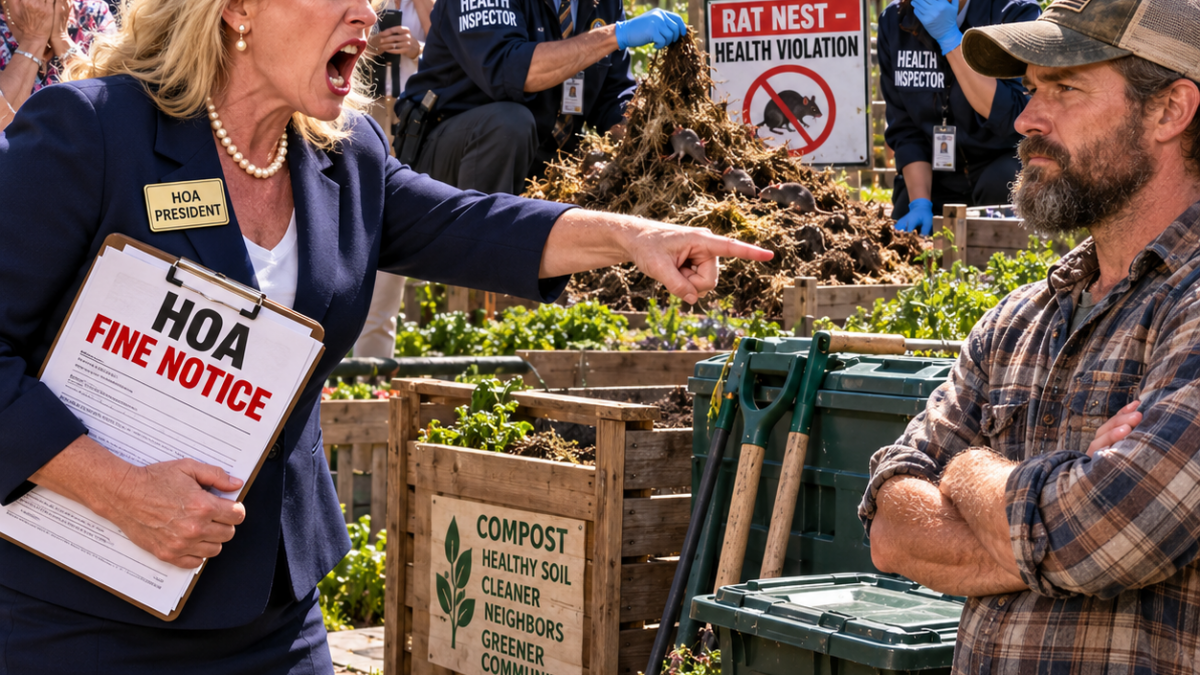
PART 2
I enlarged the picture until the pixels started breaking apart.
Four black plastic bins sat along the rear fence of the community garden.
The lids were either missing or pushed aside.
Something pale hung over one edge.
At first I thought it was cardboard.
Then I remembered what Karen called those containers.
Community compost.
I leaned back.
Sarah was sorting mail at the other end of the table.
“What?”
“Nothing yet.”
“That means something.”
I turned the laptop toward her.
“See those?”
She squinted.
“The black bins?”
“Community compost.”
She looked toward our backyard.
Then back at the photograph.
“And she’s fining you?”
“Apparently.”
Sarah pulled out a chair.
“Are theirs allowed?”
“I assume so.”
“Then how can yours be illegal?”
“Good question.”
“Are you going over there?”
“Not tonight.”
She gave me the look I had learned to respect.
“Marcus.”
“I said not tonight.”
“That is not the same as no.”
“No.”
“You promised this wouldn’t become your whole life.”
“It’s been three days.”
“Exactly.”
I closed the photograph.
“I’m preparing for the hearing.”
“That I understand.”
“And if the president is applying one sanitation standard to me while the HOA operates the same activity on common property, that seems relevant.”
Sarah sighed.
“You’re enjoying that sentence.”
“A little.”
“Be careful.”
She walked away.
I stared at the photograph for another minute.
She was right.
Karen had gotten under my skin faster than I wanted to admit.
Retirement had been strange for me.
For two decades, my days had structure.
Purpose.
Problems with measurable solutions.
After leaving the Army, I told everyone I wanted peace.
What I discovered was that peace could feel uncomfortably close to purposelessness if you had spent long enough defining yourself by missions.
My workshop helped.
The garden helped.
So did the compost system.
There was something satisfying about taking scraps and dead leaves and turning them into something useful.
No emergency.
No hierarchy.
No one shouting.
Just biology and patience.
Then Karen handed me a problem with regulations, evidence, procedures, deadlines, and an opponent.
The old part of my brain woke up immediately.
That should have concerned me more than it did.
The next morning, I went to see John Henderson.
He was leaning over his lawnmower with one hand black from grease.
I carried two coffees.
“Bribery?”
“Consulting fee.”
“About lawnmowers?”
“Compost.”
He took the cup.
“That sounds worse.”
We stood beside his driveway.
“Has my compost setup ever bothered you?”
John looked genuinely confused.
“The cedar bins?”
“Yes.”
“Why?”
“Odor?”
“No.”
“Flies?”
“No.”
“Rodents?”
“Never seen one around there.”
“Have you complained to Karen?”
He stared at me.
Then laughed.
“About your compost?”
“She says neighbors complained.”
His expression changed.
“Mary and I definitely didn’t.”
“Do you know anyone who might?”
“Not unless they’re bothered by vegetables growing too well.”
He wiped his fingers on a rag.
“What did Karen do?”
I showed him the notice.
He read it.
His eyebrows rose.
“Five thousand?”
“Yes.”
“For leaves?”
“And coffee grounds.”
“Dangerous combination.”
“Apparently.”
John shook his head.
“That woman fined Mary over a welcome mat last month.”
I thought I’d misheard him.
“A welcome mat.”
“She said the lettering was too playful.”
“What did it say?”
**HELLO, SUNSHINE.**
I stared.
John shrugged.
“We bought a different one.”
“Why?”
“Because we’re sixty-eight years old and didn’t feel like spending six weeks arguing over twelve dollars worth of doormat.”
There it was.
Karen’s real enforcement system.
Not the bylaws.
Exhaustion.
She didn’t need every rule to survive serious scrutiny.
She only needed resistance to cost homeowners more time and energy than surrender.
“How many people does she do this to?”
John looked toward the street.
“More than you’d think.”
That afternoon, I started a new section in my binder.
Not “Enemies.”
Not “Operation Something.”
Sarah would have killed me.
I labeled it:
**ENFORCEMENT PRECEDENTS**
Three days later, the HOA newsletter arrived.
The *Whispering Pines Whisperer.*
Usually it contained pool schedules, yard-sale dates, and aggressive reminders about recycling bins.
This issue had a new section:
**COMMUNITY STANDARDS SPOTLIGHT: HEALTHY HOMES, HEALTHY NEIGHBORHOODS**
I read the first paragraph.
Then the second.
By the third, Sarah had noticed my face.
“What?”
I handed her the newsletter.
She read.
The article warned that improperly contained household and yard waste could attract rats, spread disease, produce foul odors, and damage property values.
No name.
No address.
But next to the article was a photograph.
My compost enclosure.
Taken through a gap in the lattice.
From inside my lot.
Sarah stood so fast her chair scraped backward.
“She came onto our property?”
“Looks like it.”
The photo had been taken from an angle that made the active bin appear much larger than it was.
Low perspective.
Close crop.
Cloudy light.
No view of the clean surrounding area.
No view of the cedar enclosure as a whole.
Just decomposing plant matter filling the frame.
Sarah pressed one finger against the page.
“This is deliberate.”
“Yes.”
“Can she do this?”
“Photographing from a public area is one thing. Entering our lot without permission is another.”
“Do we know she took it?”
“No.”
“Who else?”
“Could have been management.”
“That makes it better?”
“No.”
She sat again.
For the first time since the fine arrived, I wasn’t amused.
The newsletter had turned a private dispute into a public accusation.
I had spent years trying to become anonymous in the most peaceful possible way.
Good neighbor.
Clean yard.
No drama.
Now people would see a picture of rotting vegetables and read about disease.
That evening I took our dog, Max, for a walk.
Near the mailboxes, two women stopped talking when I approached.
One glanced at Max.
Then at me.
Then toward Chestnut Lane.
As I passed, I heard one whisper:
“That’s the compost house.”
Something hot moved through me.
I kept walking.
At home, I saved a PDF of the newsletter.
Photographed the print edition.
Logged the date.
Added it to the binder.
Sarah watched from the doorway.
“You’re angry.”
“Yes.”
“Then don’t make decisions tonight.”
“I’m documenting.”
“Good.”
I closed the binder.
She came closer.
“Marcus, I know you.”
“I know.”
“You get quieter when you’re really mad.”
“I’m okay.”
“No, you’re controlled. Different thing.”
She touched my arm.
“Fight the fine. Fight the lie. But don’t build your whole day around beating her.”
I nodded.
She was right.
Again.
Unfortunately.
The following afternoon, someone knocked.
Tall man.
Lean.
Short gray hair.
The posture gave him away before he introduced himself.
“Marcus Jensen?”
“Yes.”
“Dave Sterling. Retired Air Force.”
“Come in.”
He sat at the kitchen table.
Refused coffee.
Went straight to the point.
“The newsletter was about you.”
“Yes.”
“I figured.”
He smiled without humor.
“Karen tried to fine me two thousand dollars last year over my flag.”
“What was wrong with it?”
“Six-foot flagpole.”
“That’s it?”
“She wanted four.”
“Why?”
“Uniform streetscape.”
He leaned forward.
“VFW lawyer wrote one letter. She dropped it.”
“Did she apologize?”
Dave laughed.
“No.”
He told me about other residents.
A therapy swing installed for a child with developmental needs.
Wind chimes.
A basketball hoop.
A portable ramp.
Seasonal decorations.
Not every dispute had been illegitimate.
Some residents genuinely ignored rules.
But Karen’s pattern was unmistakable.
If she disliked something, she started with the most aggressive interpretation available and expected the homeowner to prove innocence.
“Why hasn’t anyone voted her out?” I asked.
Dave shrugged.
“Because most people only see their own fight.”
“What do you mean?”
“Mary gets a doormat letter. Pays twelve bucks. Done.”
He held up one finger.
“Family with therapy swing gets a violation. They negotiate an exception. Done.”
Another.
“I get the flag nonsense. Lawyer handles it. Done.”
Another.
“Everybody thinks theirs is isolated.”
He lowered his hand.
“Karen understands that.”
I thought about my spreadsheet.
“Then we stop treating them as isolated.”
Dave smiled.
“Now you’re talking.”
He became the first person besides Sarah I trusted with the full file.
When I showed him the appeal materials, he whistled.
“You built this in three days?”
“Four.”
“You missed the Air Force.”
“No.”
“You sure?”
“Positive.”
Then I showed him the old photograph of the community garden.
He leaned closer.
“That compost?”
“Supposedly.”
“Have you seen it recently?”
“Not up close.”
“We should.”
“No trespassing.”
“Public path runs beside it.”
That evening, we took separate walks.
I went first.
The community garden looked beautiful from the front.
Raised beds.
Painted signs.
Late-season kale.
Chard.
A small white gazebo.
Decorative fencing.
Karen loved that garden.
She photographed it for newsletters.
Used it in election materials.
Called it proof that Whispering Pines was “a community committed to sustainable beauty.”
I followed the public walking path around the side.
Then the smell reached me.
Sour.
Wet.
Sweet in the wrong way.
Anaerobic decomposition.
I stopped.
Fifty yards away, the black bins were overflowing.
Whole vegetables.
Pumpkins.
Food scraps.
Greasy cardboard.
No visible carbon cover.
No lids secured.
Liquid stained the ground around them.
I took photographs with my phone from the public path.
Then walked away.
Dave called two days later.
“You were right.”
“About what?”
“That pile is disgusting.”
“Anything else?”
Silence.
“Dave?”
“I saw a rat.”
I stood up.
“Where?”
“Under the far bin.”
“Sure?”
“Marcus, I spent twenty-three years around flight lines and garbage dumpsters. I know a rat.”
“One?”
“One I saw.”
“That doesn’t prove infestation.”
“No.”
“But it proves activity.”
“Yes.”
“Any photos?”
“No.”
“Good.”
He sounded confused.
“Good?”
“I don’t want us chasing blurry rat pictures like Bigfoot.”
He laughed.
“Fair.”
I checked county sanitation guidance that evening.
The regulations didn’t prohibit compost.
Quite the opposite.
Proper composting was encouraged.
But common waste areas had to be managed to prevent vermin attraction, nuisance odors, uncontrolled food-waste accumulation, and unsanitary conditions.
That was the distinction Karen had ignored.
My compost process was not automatically sanitary because I liked it.
Her community pile was not automatically acceptable because it belonged to the HOA.
The question was management.
Evidence.
Conditions.
I added the county guidance to the binder.
Sarah found me printing it.
“What are you planning?”
“Nothing dramatic.”
“That’s not reassuring.”
“Karen accused my compost of being a health hazard.”
“Yes.”
“If the HOA’s system may actually be attracting rodents, the board should know.”
“Agreed.”
“She won’t listen privately.”
“Probably not.”
“So I raise it at the hearing.”
Sarah sat.
“Are you asking them to inspect it, or are you trying to embarrass her?”
The question irritated me.
Which meant I needed to answer honestly.
“Both.”
She waited.
I exhaled.
“Mostly inspect.”
“Marcus.”
“Fine. I want her hypocrisy exposed.”
“I know.”
“She trespassed. She smeared me publicly.”
“I know.”
“She threatened our house over leaves.”
“I know.”
“And now her own project smells like a landfill.”
“All true.”
I looked away.
Sarah’s voice softened.
“Just make sure the thing you’re asking for would still make sense if Karen’s name wasn’t attached.”
That was the test.
I thought about children playing beside the garden.
Dave seeing a rat.
Food waste.
The smell.
“Yes.”
“Then ask for the inspection.”
The board hearing was Tuesday at seven.
By six-forty-five, thirty people had already filled the clubhouse.
Karen had made my appeal public enough that residents were curious.
Some looked at me like they expected me to smell.
I carried one binder.
No projector.
No theatrics.
Dave sat in the first row.
John and Mary behind him.
Sarah sat near the aisle.
The board consisted of five people.
Karen in the center.
Gary Wells, who rarely challenged her.
Linda Price, who spent most meetings looking at her phone.
Maria Alvarez, an attorney.
Frank Whitcomb, retired accountant.
Karen approved previous minutes.
The board debated petunias.
Then she smiled.
“Next item. Appeal of Violation 88-12, unsightly storage of refuse.”
She looked directly at me.
“Mr. Jensen, you have five minutes to explain why you believe you should be exempt from standards that apply to everyone else.”
I stood.
“I’m not requesting an exemption.”
Her smile weakened.
“I’m stating the violation doesn’t describe what I’m doing.”
I placed the binder on the table.
Then I began.
Photographs.
Clean enclosure.
Distances to property lines.
Temperature logs.
No odor complaints.
County guidance.
Definitions.
Process.
I avoided turning the meeting into a science lecture.
The point was simple.
Composting is a managed biological process.
The HOA rule prohibited storage of rubbish and unsightly material.
My system was contained, screened, functional, and consistent with county recommendations.
Then I addressed procedure.
“Your notice says neighbors complained.”
Karen folded her arms.
“They did.”
“I asked my immediate neighbors.”
“That proves nothing.”
“Agreed.”
She looked surprised.
“I’m not claiming nobody complained. I am asking whether the board verified the condition before imposing a five-thousand-dollar assessment.”
Maria looked at Karen.
“Did the architectural committee inspect?”
Karen said:
“I inspected personally.”
“From where?”
Silence.
Maria’s expression sharpened.
I put the newsletter photograph on the table.
“This photograph appears to have been taken from inside my property.”
Karen snapped:
“You cannot prove who took it.”
“I didn’t say you did.”
That bothered her more.
Frank picked up the newsletter.
“Did management provide this?”
Karen answered:
“Community Standards supplied it.”
Maria asked:
“Who is Community Standards?”
“Me.”
There it was.
Nobody gasped.
Real meetings rarely do.
But something shifted.
I continued.
“Even if the board believes compost can be regulated, enforcement still has to be reasonable and consistent.”
Karen interrupted.
“It is consistent.”
“Good.”
I opened the second section.
“Then we should discuss the community garden.”
Her face changed instantly.
Small.
But obvious.
“This hearing is about your property.”
“It is about your allegation that compost creates a health and sanitation risk.”
“Your compost.”
“Health rules don’t change at my fence.”
Frank looked toward me.
“What concern do you have?”
I showed the photographs.
Not exaggerated.
Not cropped for effect.
The full bins.
Whole food waste.
Greasy cardboard.
Wet material around the base.
“I photographed these from the public path.”
Maria leaned over.
“When?”
“Saturday.”
Karen said:
“They’re community compost bins.”
“I know.”
“They’re managed.”
“I see no evidence of proper carbon cover, secure containment, or routine turning.”
“You are not authorized to inspect association operations.”
“I didn’t inspect them. I walked past.”
Dave stood only when Maria recognized him.
“My name is Dave Sterling. I walk that path most evenings.”
Karen rolled her eyes.
“Of course.”
Maria looked at her.
“Let him speak.”
Dave said:
“I’ve smelled those bins for weeks. Last Thursday, I saw a rat come out from underneath one.”
The room became louder.
Karen stood.
“This is ridiculous.”
I stayed seated.
“You’ve spent a month telling residents compost can attract vermin.”
“Your compost.”
“Why would rats understand property lines?”
A few people laughed.
Karen’s face reddened.
“This is a deliberate deflection.”
“No.”
I looked toward the board.
“It’s a health question. I don’t expect anyone here to take my word for it.”
Then I said the sentence that shifted the whole meeting.
“I’m asking the HOA to request a county health inspection of the community garden.”
Karen stared.
Frank leaned back.
Maria immediately wrote something down.
I continued.
“If the garden is fine, we get objective confirmation.”
I looked at Karen.
“If there is a problem, we fix it.”
She snapped:
“You’re trying to humiliate me.”
“No.”
That wasn’t entirely true.
So I corrected myself.
“I’m angry with you.”
The room quieted.
“You fined me five thousand dollars, threatened my home, published a distorted photograph, and implied to every resident here that I was endangering them.”
Karen’s jaw tightened.
“I have every reason to be angry.”
I looked back at the board.
“But an inspection should not depend on whether I like the person managing the garden.”
Maria nodded.
Frank looked at Karen.
“If we’ve received a credible report of rodent activity, we should inspect.”
Karen glared.
“One rat.”
Maria responded.
“One reported rat plus exposed food waste.”
“It is compost.”
“Then an inspector can confirm it is being handled properly.”
Karen turned to Gary.
“Gary?”
He stared at the table.
Linda finally put down her phone.
“I have kids.”
Karen looked betrayed.
Linda continued.
“They play near that garden.”
Karen’s voice became sharp.
“So now we’re going to waste association money because Mr. Jensen staged some photographs?”
I stood again.
“I staged nothing.”
“Prove it.”
“Call the county.”
That ended it.
Maria made the motion.
Frank seconded.
Official health and sanitation inspection of the community garden.
Four votes yes.
Karen alone voted no.
When I returned to my seat, Sarah squeezed my hand.
Not victory.
A warning.
“Now let the professionals do their job.”
I nodded.
The county inspection happened four days later.
I stayed home.
That was deliberate.
I had made the complaint at a board meeting.
The board requested the inspection.
My part was done.
A county environmental-health specialist arrived in a white vehicle around nine.
Maria and Frank met her.
From my workshop window, I could see them crossing the green.
Karen did not appear.
The inspector spent nearly two hours there.
Gloves.
Camera.
Probe.
Flashlight.
She examined the bins.
Raised beds.
Fence line.
Woodland edge.
Ground under the gazebo.
At one point she crouched for several minutes behind the far bin.
Then Maria stepped backward quickly.
Even from a distance, I knew they’d found something.
I turned away from the window.
No point guessing.
Around four, Maria and Frank knocked on our door.
Sarah was home.
We invited them in.
Maria didn’t sit.
“Marcus, the inspection found an active Norway rat infestation.”
I said nothing.
Frank looked ill.
“Multiple burrows.”
“Where?”
“Under the compost area, fence line, woodland edge, and under part of the gazebo.”
Sarah covered her mouth.
Maria continued.
“The inspector believes the unmanaged food waste is the primary attractant.”
“How established?”
“Not new.”
That mattered.
Karen would later accuse me of somehow causing it.
The inspection itself made that theory absurd.
Frank finally sat.
“They’re closing the garden temporarily.”
“What remediation?”
“Professional pest control first. Remove all exposed food waste. Secure the area. Eliminate burrows and harborage. Remove materials that can’t be effectively sanitized.”
“The raised beds?”
“Some may have to go.”
“Gazebo?”
“Inspector wants the area underneath opened because there are active burrows.”
Sarah asked:
“Are residents in danger?”
Maria answered carefully.
“People should stay out until remediation. They’re concerned about rodent waste and potential disease exposure, but nobody is saying anyone is already sick.”
That was an important distinction.
Karen had accused me of creating danger without evidence.
I wasn’t going to do the same.
“What about fines?” I asked.
Frank exhaled.
“There will be a county violation notice and compliance costs. Exact penalties depend on corrective action and deadlines.”
The source version of the story later got repeated around Whispering Pines as if the county instantly fined us sixty thousand dollars.
That wasn’t exactly how it happened.
The initial civil penalties were significant.
Professional pest control, disposal, excavation, replacement of contaminated materials, and reconstruction drove most of the financial damage.
By the time contractors submitted estimates, total exposure approached sixty thousand dollars.
The number was brutal.
And visible.
Yellow closure tape went across the community garden entrance the next morning.
The same garden Karen had used in every campaign flyer.
Closed.
Not my compost.
Hers.
Or, more accurately, ours.
That distinction mattered.
HOA property belonged collectively to residents.
Karen had mismanaged the project.
But every homeowner would pay if the reserves were drained.
There was nothing satisfying about that.
Not yet.
The board formally suspended my violation case two days later.
Then rescinded it completely.
Maria drafted the letter.
**Violation 88-12 withdrawn.**
**All fines cancelled.**
**No lien action authorized.**
Then an apology.
Sarah read that line twice.
“You okay?”
“Yes.”
“You’ve been waiting for this.”
“I thought I’d feel more.”
“Maybe because the garden is still full of rats.”
“Probably.”
She handed the letter back.
“Put it in your binder.”
I did.
New tab:
**RESOLUTION**
Not “Vindication.”
I was learning.
Karen, however, was not.
The first email came from her personal account.
Subject:
**THE TRUTH ABOUT THE SO-CALLED GARDEN CRISIS**
She accused me of coordinating a smear campaign.
She said I had manipulated board members.
She claimed the infestation had been exaggerated.
Then she wrote something so reckless that Maria forwarded it to association counsel.
Karen suggested I might have introduced rodents or food waste into the garden to manufacture evidence.
Sarah read that sentence.
“She thinks you planted rats.”
“Apparently.”
“How?”
“Military training.”
She laughed despite herself.
Then became serious.
“Could that hurt you?”
“It could if people believe it.”
“Do they?”
No.
In fact, the email destroyed what remained of Karen’s credibility.
The county report described multiple established burrow systems and widespread activity.
This was not a problem someone created between Tuesday and Friday.
Residents knew that.
Maria knew it.
Frank knew it.
Even Gary stopped defending her.
Then the stories started coming out.
Not about compost.
Everything.
Mary Henderson and the welcome mat.
Dave’s flag.
The therapy swing.
Wind chimes.
A shed painted a shade Karen considered “visually heavy.”
A family’s trash cans photographed seven minutes after the allowed morning deadline.
A retired widower fined because his lawn grew while he was hospitalized.
Some stories were more complicated than residents remembered.
I made a point of that.
Not every enforcement action was illegitimate.
Rules existed for reasons.
But the pattern showed something dangerous.
Karen treated discretion as ownership.
If the bylaw was vague, she didn’t interpret it carefully.
She interpreted it personally.
Maria and Frank called a special membership meeting.
The agenda had two issues.
Authorize emergency remediation funding.
Consider removal of Karen as HOA president and director.
The notice went to every homeowner.
Karen spent the week campaigning.
She called friends.
Visited homes.
Sent emails.
Her defense had three parts.
First, the garden had been a successful community amenity for years.
True.
Second, volunteers besides her had contributed organic material and failed to manage the bins correctly.
Also partly true.
Third, I had exploited the problem because I resented legitimate enforcement against my own violation.
False.
But not completely absurd.
I did resent her.
And I had looked closely at the garden because she targeted me.
Sarah forced me to confront that.
“What if she says you only cared about the rats because they helped you?”
“She’d be partly right.”
Sarah raised her eyebrows.
“That’s unusual.”
“What?”
“You admitting complexity.”
“Don’t get used to it.”
She smiled.
“Then what are you going to say at the meeting?”
“The truth.”
“Which is?”
“I wouldn’t have investigated the garden if she hadn’t accused me.”
“And?”
“Once I saw a real sanitation issue, ignoring it would have been irresponsible.”
“Good.”
I paused.
“And yes, I wanted her exposed.”
“Also true.”
“I don’t like that part.”
“Why?”
“Because it makes me more like her.”
Sarah shook her head.
“Wanting accountability after someone hurts you isn’t the same as inventing reasons to hurt them.”
I looked at her.
“When did you become annoying?”
“Twenty-six years ago.”
The special meeting filled the clubhouse.
More than a hundred people.
Every chair taken.
Residents along the walls.
No petunia discussion.
No seven-layer dip recipe.
Maria called the meeting to order.
Karen sat at the table, but the space between her and the other directors was unmistakable.
Gary had moved his chair closer to Frank.
Linda sat beside Maria.
Karen sat alone at the end.
Frank presented the money.
Professional extermination.
Sanitation.
Disposal.
Soil removal where required.
Replacement of damaged raised beds.
Gazebo repair.
Monitoring.
Temporary closure.
Projected total.
$58,700 at the midpoint estimate.
Gasps.
Then anger.
One homeowner asked:
“From reserves?”
Frank nodded.
“Mostly.”
“What about road resurfacing next year?”
“Delayed.”
“The pool roof?”
“Potentially delayed.”
“So we’re paying for this?”
“We all fund the association.”
That answer did not make people happier.
Then Maria presented the legal issue.
“The current board had a credible health report and acted promptly once notified. That reduces ongoing liability.”
She looked toward Karen.
“However, questions remain about management decisions preceding the inspection and about the president’s conduct during related enforcement.”
Karen grabbed her microphone.
“This is a political execution.”
Maria didn’t flinch.
“You will have time to speak.”
“You already decided.”
“No.”
“I know what this is.”
“So do the members.”
The floor opened.
Dave stood first.
He told his flag story.
No exaggeration.
No speech about tyranny.
Just dates.
Letters.
Lawyer.
Withdrawal.
Then Mary Henderson.
Her hands shook as she held the microphone.
“Maybe a welcome mat sounds silly.”
Nobody laughed.
“But that was the point.”
She looked at Karen.
“You made me feel like I was doing something wrong in my own home over the word *sunshine.*”
Karen looked away.
A father named Michael Brooks stood.
His son’s therapy swing had been temporarily installed near the front walkway because physical therapy required specific movement exercises.
Karen had threatened fines before the family obtained a formal accommodation.
“She knew why it was there,” Michael said. “She knew.”
Karen responded:
“We eventually approved it.”
Michael’s voice hardened.
“After you made my wife cry.”
That silenced the room.
Others spoke.
Some defended Karen.
A woman named Judith said:
“Whispering Pines looked better after Karen became president.”
A few nodded.
“She organized the garden. She improved entrance landscaping. She enforced rules previous boards ignored.”
That was fair.
Karen seized it.
“Exactly.”
Judith looked at her.
“I’m not finished.”
Karen stopped.
“You did good things.”
Judith’s voice softened.
“And then you started thinking that meant you couldn’t be questioned.”
Karen stared.
Judith sat.
That statement landed harder than any insult could have.
Then Maria recognized me.
I stood.
No binder this time.
Only two photographs.
Mine.
The HOA garden.
“My name is Marcus Jensen.”
Everyone knew.
“This started with a five-thousand-dollar fine.”
I held up the photograph of my cedar bays.
“This is my compost system.”
Then the garden.
“This is what the community bins looked like before inspection.”
I lowered both.
“For the record, I don’t believe Karen created a rat infestation on purpose.”
Karen looked surprised.
“I don’t believe she wanted anybody harmed.”
Someone muttered.
I continued.
“I think she wanted the garden to look successful from the sidewalk, and she paid less attention to what happened behind it.”
That was more accurate.
“I also don’t think every violation she ever issued was wrong.”
Karen’s expression changed again.
Maybe she thought I was helping.
Then I said:
“The problem is that she decided her judgment could replace evidence.”
Silence.
“She called my compost a health hazard without inspecting it properly.”
I looked at the residents.
“She threatened my home before asking whether the system actually smelled, attracted pests, or violated health guidance.”
Then toward Karen.
“When evidence contradicted her, she didn’t reconsider.”
I held up the county garden report.
“She did the same thing here. Appearance first. Facts later.”
Karen grabbed the microphone.
“You went looking for something to use against me.”
“Yes.”
The room moved.
A murmur.
I let it happen.
“Yes, I did.”
I looked at Sarah.
Then back.
“I was angry.”
Karen smiled.
“There.”
She pointed.
“He admits it.”
“I do.”
Her smile widened.
Then I finished.
“But I did not write the health inspector’s report.”
The smile disappeared.
“I did not build the rat burrows.”
Silence.
“I did not put food waste into unmanaged open bins for months.”
I placed the report on the table.
“And most importantly, once the problem was verified, I did not deny it.”
Karen’s eyes hardened.
“That is the difference.”
I sat.
No applause at first.
Then someone started.
Dave.
Others followed.
I wished they hadn’t.
It made the moment feel more theatrical than I wanted.
But the message had landed.
Maria explained the removal procedure.
The vote used written ballots rather than a shout.
More believable.
More orderly.
More painful for Karen, because she had to sit there while volunteers counted.
Frank checked.
Maria checked again.
Then she announced the result.
Eighty-seven percent in favor of removal.
Karen sat motionless.
Maria’s voice was professional.
“The motion carries.”
Karen’s hands closed around her purse.
For a moment, I expected her to shout.
She didn’t.
She stood.
Looked around the room.
People who had once avoided her eyes now met them.
“After everything I did for this neighborhood.”
Nobody answered.
She looked at me.
“This is what you wanted.”
I considered denying it.
I didn’t.
“I wanted you to stop.”
“You destroyed me over compost.”
“No.”
My voice was quiet.
“You lost this over what you did after someone told you no.”
She stared.
Then walked out.
No cheering.
No boos.
Just a door closing.
I liked that ending better.
The cleanup began the following week.
Professional pest-control technicians came first.
They mapped burrows.
Removed attractants.
Set secured bait stations and traps in compliance with county requirements.
The garden remained closed.
Then contractors removed the badly contaminated material around the compost zone.
Several raised beds had to be dismantled because burrows ran beneath them.
Parts of the gazebo skirt were opened.
Food waste was hauled away.
Soil in heavily affected areas was excavated and replaced according to the remediation plan.
For several weeks, Karen’s beautiful community garden looked like a construction site.
Bare earth.
Fencing.
Equipment.
Yellow tape.
It was sad.
That surprised me.
The garden had been useful.
Children had grown pumpkins there.
Retired couples grew peppers.
Residents shared herbs.
Karen’s failure hadn’t made every part of the project bad.
It had simply shown that attractive ideas still require competent maintenance.
Dave Sterling ran for HOA president in the special election.
He won.
I did not run.
That differed from the version people later told.
They said I joined the board immediately and wrote half the new rules.
The truth was that Sarah threatened to change the locks if I volunteered for governance while I was still mentally living inside the fight.
So I accepted a temporary technical-advisory role instead.
Maria stayed on the board.
Frank became treasurer.
Linda stayed too.
Gary resigned voluntarily.
Dave’s first meeting lasted forty-seven minutes.
Karen’s meetings often lasted three hours.
Sarah noticed.
“Efficient.”
“Air Force.”
“Don’t start.”
Their first governance project was rewriting the sanitation and nuisance section.
Maria handled legal structure.
I handled technical definitions.
Frank asked the irritating but necessary question:
“How much will each standard cost to enforce?”
Dave asked:
“Can an ordinary homeowner understand it without an attorney?”
Those four questions improved almost everything.
Instead of “unsightly material at the sole discretion of the committee,” the new rule identified specific prohibited conditions.
Accumulated garbage.
Open food waste attracting pests.
Materials creating documented odor or sanitation problems.
Obstructions affecting safety.
Composting became expressly permitted if responsibly managed.
Covered food scraps.
Reasonable setbacks.
No meat, grease, or pet waste in home systems unless an approved method was used.
Adequate carbon material.
No persistent nuisance odor.
No evidence of rodent infestation.
Clear.
Measurable.
Boring.
Perfect.
Then we reviewed other rules.
Flag dimensions became safety-focused rather than aesthetic.
Therapy equipment was explicitly subject to accommodation requirements.
Temporary medical accessibility equipment received expedited approval.
Minor decorative items stopped requiring committee review.
Mailbox colors remained regulated because residents bizarrely cared deeply about mailboxes.
Compromise has limits.
John Henderson immediately built his own compost bin.
It was terrible.
I found him standing beside it one morning.
“Why is it wet?”
“Compost is supposed to be damp.”
“Damp. Not soup.”
He pointed.
“Coffee grounds.”
“How much?”
“All week.”
I looked inside.
“Where are your browns?”
“My what?”
“Leaves. Shredded cardboard. Dry material.”
“Oh.”
“John.”
“You never told me.”
“I absolutely told you.”
“I was drinking beer.”
“Apparently.”
I helped him rebuild the pile.
Three months later, he brought me a tomato almost the size of a softball.
“Look at that.”
“Genetics.”
“Compost.”
“Genetics.”
“My compost.”
“My instructions.”
“Team effort.”
He cut it in half and left me one side.
Fair.
The old community garden did not reopen.
Not immediately.
The board converted the remediated area into a native meadow for a season while environmental-health follow-up confirmed the rodent population had collapsed.
Wildflowers replaced raised beds.
Pollinators arrived.
The visual change was striking.
Less manicured.
More alive.
Karen would have hated it.
That thought still pleased me more than it should have.
One afternoon, about six months after her removal, Dave stopped by while I was turning my compost.
“Board question.”
“No.”
“I haven’t asked.”
“Answer remains no.”
“We want a new community garden.”
I stopped.
“Seriously?”
“Yes.”
“After sixty thousand dollars?”
“Approximately fifty-eight.”
“That’s your defense?”
“No.”
He leaned against the fence.
“Residents miss it.”
“So rebuild.”
“We want to do it correctly.”
“Good.”
“We want a proper composting program.”
“Better.”
“We want you to design it.”
“No.”
He waited.
“Why not?”
“Because Sarah will kill me.”
“She likes me.”
“Not enough.”
He smiled.
“Technical consultant only.”
“No board title?”
“None.”
“No enforcement?”
“None.”
“No weekly meetings?”
“Maybe one planning meeting.”
“Dave.”
“One.”
I looked toward the kitchen window.
Sarah stood there.
Arms folded.
She had heard enough.
She opened the window.
“One meeting.”
Dave laughed.
I sighed.
“Fine.”
The new garden went on the opposite side of the green.
Better sun.
Better drainage.
Farther from the woodland edge.
We surveyed interested residents before designing it.
That alone seemed revolutionary.
The compost system used three large cedar bays modeled after mine.
Scaled up.
Ventilated.
Front access.
A secure container for kitchen scraps until they were mixed properly.
Clear signage.
No dumping.
No meat.
No grease.
No mystery bags.
Then came the most important part.
Education.
I held a Saturday workshop.
Thirty-two people attended.
I expected maybe eight.
I stood beside two buckets.
One labeled GREENS.
One BROWNS.
“This is not magic.”
A kid in the front row raised his hand.
“Then why does it get hot?”
“Bacteria.”
“That’s gross.”
“Those bacteria are helping.”
“Still gross.”
His mother apologized.
“No. He’s right.”
People laughed.
I explained carbon and nitrogen in plain English.
Moisture.
Air.
Particle size.
Why a healthy pile smells earthy.
Why a sour smell usually means too little air or too much wet nitrogen-rich material.
Why exposed food attracts rodents.
Why compost is not the same thing as dumping garbage behind a fence.
Maria stood in back taking notes.
Afterward she said:
“If Karen had attended one of these, none of this happens.”
“Maybe.”
“You don’t think?”
“I think information only helps people willing to hear it.”
She nodded.
“Fair.”
The new garden opened in spring.
No ribbon-cutting.
Dave hated ceremony.
Residents simply showed up.
They planted tomatoes.
Peppers.
Beans.
Herbs.
A kid planted three watermelon seeds in one square foot and refused all advice.
By July, vines had invaded two neighboring plots.
Nobody fined him.
They helped build a trellis.
That was when Whispering Pines started feeling different.
Under Karen, people learned to mind their own business because involvement created risk.
Under Dave, people started helping because involvement no longer meant surrendering control.
The Hendersons invited neighbors over.
Dave organized a veterans barbecue.
Maria started an annual legal-document review so nobody could claim ignorance of the bylaws.
Frank posted quarterly financial summaries ordinary human beings could understand.
Linda created a resident feedback form.
No anonymous accusations unless there was a genuine safety concern.
If someone complained about a neighbor’s property, management verified the condition before sending anything.
Radical concept.
Karen’s house went on the market about a month after the recall.
I didn’t celebrate.
Not publicly.
When the **FOR SALE** sign appeared, Dave sent me a photograph.
I replied:
**Leave it alone.**
He answered:
**I didn’t say anything.**
Then:
**Mary baked a cake.**
I showed Sarah.
She laughed.
“Hypocrites.”
“We’re not eating it.”
“We absolutely are.”
Karen moved quietly.
No block party.
No cheering.
Some residents felt relief.
Some felt guilty.
A few genuinely missed her organizational ability.
That complexity mattered.
Karen had not been useless.
She had been controlling.
Those are different things.
She organized events.
Improved entrance landscaping.
Started the original garden.
Pushed vendors to respond.
Remembered every deadline.
The same traits that made her effective also made her dangerous when nobody challenged her.
She was competent enough to create authority.
Not humble enough to limit it.
The house sold to a woman named Susan Patel.
Biologist.
Late forties.
First week in the neighborhood, she walked over while I was working near the new garden.
“Marcus Jensen?”
“Yes.”
“I bought the Whitmore house.”
I tried not to react.
“Welcome.”
She smiled.
“Everyone reacts like that.”
“Like what?”
“Like I bought a haunted mansion.”
“Nothing supernatural.”
“Just governance?”
“Worse.”
She laughed.
Then she pointed toward the compost bays.
“I heard about those.”
“Already?”
“I’ve been here five days.”
“Neighborhood efficiency.”
“I’ve composted for fifteen years.”
I liked her instantly.
She inspected the sign.
“Good rules.”
“Thank you.”
“Maybe a little conservative on moisture targets.”
I turned.
“You want to fight?”
She smiled.
“I’m a soil biologist.”
“Fine. You win.”
Susan eventually helped us improve the workshops.
She knew more microbiology than I did.
I knew more about building durable bins.
Good partnership.
A year after the fight, the community garden produced so much food that residents voted to donate surplus to a local pantry.
John won the best-tomato contest.
He carried the trophy to my house.
It was plastic.
Gold.
Approximately eleven inches tall.
“Observe.”
“You’re never entering my home with that.”
“It belongs here.”
“You grew the tomato.”
“With your compost expertise.”
“You ignored half my instructions.”
“Creative independence.”
Sarah opened the door.
“Let him in.”
Traitor.
John placed the trophy on my workshop shelf.
It stayed there for six years.
The county’s final health follow-up cleared the old garden area.
Rodent activity returned to background levels.
No continuing sanitation violation.
No new nests.
The meadow remained because residents liked it.
That was another change.
Karen would have asked whether wildflowers looked controlled enough.
The new board asked whether residents wanted them.
Bees didn’t care either way.
Two years passed.
The story turned into neighborhood folklore.
Details mutated.
According to one version, health inspectors found hundreds of rats pouring from the gazebo.
False.
Another claimed a rat jumped into Karen’s purse during the inspection.
Completely false.
Dave encouraged that rumor until Maria threatened to fine him for misinformation.
He asked under what bylaw.
She told him she would write one specifically for him.
Progress, apparently, is never complete.
One Saturday morning, I was sanding an oak board in my workshop when Sarah walked in holding an envelope.
“Law firm.”
I turned off the sander.
“What?”
She handed it over.
Thick paper.
Downtown address.
For one irrational second, I thought Karen had surfaced again.
My stomach tightened.
Old reflex.
I opened it.
Read the first paragraph.
Then again.
Sarah watched me.
“Well?”
“It’s not a lawsuit.”
“What is it?”
“Invitation.”
“To what?”
I handed her the letter.
A statewide association for common-interest communities was holding its annual conference.
Theme:
**Modernizing Community Standards for Sustainable Neighborhoods.**
Someone had submitted Whispering Pines’ revised bylaws as a case study.
They wanted me to speak.
Sarah reached the end.
“They’re paying you.”
“Apparently.”
“To talk about compost.”
“Governance.”
“Compost.”
“Governance.”
She smiled.
“They want the man Karen tried to fine into submission to teach HOA boards how to write rules.”
“The irony is unpleasant.”
“The irony is magnificent.”
“I’m not doing it.”
“Yes, you are.”
“No.”
“Marcus.”
“I hate public speaking.”
“You briefed colonels.”
“They had to listen.”
“These people are asking.”
“Worse.”
She sat on the workbench.
“Remember the mother with the therapy swing?”
“Yes.”
“Imagine how many people in other neighborhoods have their version of that.”
I looked at the letter again.
Sarah continued.
“You spent months saying Karen’s biggest weapon was that everyone thought their problem was isolated.”
“That was Dave.”
“You agreed.”
“Yes.”
“So go show them it isn’t isolated.”
I accepted.
Preparing the presentation turned out to be harder than fighting Karen.
I did not want it to become an HOA horror-story performance.
No villain photo.
No mocking clothing.
No caricature.
Problem.
Evidence.
Failure mechanism.
Cost.
Correction.
I built the presentation like an engineering brief.
Old bylaw:
**Unsightly material at sole discretion.**
New bylaw:
Specific conditions.
Objective criteria.
Notice.
Verification.
Appeal.
Accommodation.
Proportional enforcement.
I showed my compost setup.
Then the community garden.
Then the county closure tape.
Then the remediation invoices.
Not for revenge.
To demonstrate what bad governance costs.
Money.
Trust.
Volunteer participation.
Community cohesion.
I used Karen’s name nowhere.
She had become irrelevant to the lesson.
The conference ballroom held several hundred people.
HOA directors.
Community managers.
Attorneys.
Insurance representatives.
Property owners.
I stood behind the podium thinking about every meeting I had ever disliked.
Then I began.
“I’m Marcus Jensen, retired Army Corps of Engineers.”
A few heads lifted.
“Several years ago, my HOA president fined me five thousand dollars for compost.”
People laughed.
“I laughed too.”
More laughter.
“Then she threatened a lien.”
The room quieted.
I told the story.
Not every detail.
Enough.
My contained system.
The vague bylaw.
The smear campaign.
The appeal.
The community garden.
The inspection.
The rats.
The cleanup.
The recall.
Then what mattered.
Reform.
At one point I projected both photographs.
My cedar bays.
The old HOA bins.
“Neither photograph proves good governance.”
People looked confused.
I continued.
“The first system is not acceptable because I say it is.”
I pointed.
“It is acceptable because we can define conditions, inspect them, and compare them against objective standards.”
Then the garden.
“This is not unacceptable because I disliked the president.”
I changed slides.
County findings.
“It was unacceptable because professionals documented conditions that violated health requirements.”
I paused.
“Rules become dangerous when the person enforcing them thinks personal certainty is evidence.”
That line made the room very still.
Afterward, applause came slowly.
Then strongly.
I wished George—no, wrong story. Dave—could have seen it.
Actually, he did.
He insisted on attending and sat in the third row wearing an Air Force tie.
After the presentation, people lined up.
A woman described a wheelchair ramp dispute.
A man described solar panels.
Another board member asked how to rewrite landscaping rules without eliminating legitimate standards.
A property manager asked how to design an appeal process that didn’t become endless litigation.
Those were better questions than “How do I beat my HOA?”
Because beating isn’t the point.
Function is.
Near the end, a man in an expensive suit introduced himself as the association president.
“That was one of the more uncomfortable presentations we’ve hosted.”
I wasn’t sure what to say.
He smiled.
“That’s a compliment.”
“Good.”
“You forced half this room to recognize themselves.”
“Still sounds dangerous.”
“It probably is.”
He shook my hand.
“Can we distribute your sample standards?”
“With Whispering Pines’ permission.”
“We’ll ask.”
On the drive home, Sarah called.
“How did it go?”
“I survived.”
“Dave texted me.”
“Traitor.”
“He said standing ovation.”
“Exaggeration.”
“He sent video.”
“Delete it.”
“No.”
I smiled.
The highway stretched ahead.
For the first time, I understood that the fight with Karen had changed something in me beyond anger.
Before it, I wanted to disappear into retirement.
Garden.
Workshop.
Sarah.
Quiet.
After it, I still wanted those things.
But I no longer believed being left alone was the same as belonging.
Whispering Pines became home because we finally learned how to disagree without fear.
That required participation.
Annoying, time-consuming participation.
The conference didn’t turn me into a professional activist.
Thank God.
I spoke occasionally.
Helped two nearby communities review vague rules.
Mostly, I stayed home.
That was enough.
Years later, Dave stepped down as president.
He served two terms.
At his last meeting, someone asked who should replace him.
Dave pointed at me.
I pointed at Maria.
Maria pointed at Susan.
Susan left the room.
Eventually a younger father named Ben Carter volunteered.
Engineer.
I warned him.
“Don’t tell anyone.”
“Why?”
“They’ll give you committees.”
He did fine.
The systems we built mattered more than personality.
That was the goal.
No one should have to depend on getting a good Karen.
Or a good Marcus.
Good governance survives mediocre people.
Great governance survives difficult ones.
My compost pile kept working.
Every fall, leaves.
Every winter, kitchen scraps.
Every spring, black soil.
No drama.
John’s tomatoes remained competitive.
Susan introduced us to vermicomposting.
I rejected worms in my garage on principle.
She called me scientifically backward.
Sarah sided with her.
Betrayal everywhere.
One morning, several years after everything happened, I noticed a young couple standing by the community garden.
They had just moved into Whispering Pines.
The man was reading the compost sign.
The woman held a bucket of kitchen scraps.
I walked over.
“First time?”
“Yes.”
She looked embarrassed.
“We don’t want to put the wrong thing in.”
“Good instinct.”
I showed them the bays.
Greens here.
Browns there.
Cover fresh food.
Turn the active pile.
Watch moisture.
They listened.
Then the man asked:
“Is this the compost system from the rat story?”
I closed my eyes.
“Of course you’ve heard it.”
“Our realtor told us.”
“What version?”
“He said an HOA president fined somebody over compost and then inspectors found an entire rat colony under her garden.”
“Mostly correct.”
“Was it you?”
“Yes.”
His eyes widened.
“No way.”
His wife elbowed him.
“Don’t make it weird.”
“Too late.”
They laughed.
Then she looked toward the meadow where the old garden once stood.
“Why didn’t you rebuild over there?”
“People liked the wildflowers.”
She nodded.
“They’re beautiful.”
They were.
Goldenrod.
Asters.
Black-eyed Susans.
Bees moving between them.
Nothing manicured.
Nothing uniform.
Useful in ways Karen probably never would have approved.
I walked home carrying a bucket of finished compost.
Sarah was in the garden.
She had planted tomatoes.
Again.
“You disappeared.”
“New neighbors.”
“Teaching?”
“Correcting realtor mythology.”
She pointed at the bucket.
“Bed three.”
I poured the compost around the plants.
Dark soil fell between my fingers.
Years earlier, Karen had stood at the edge of my property and called the same material rotting filth.
She was not entirely wrong about one thing.
Compost begins with what people throw away.
Dead leaves.
Coffee grounds.
Peels.
Stems.
Things finished with one purpose.
But if you manage them correctly, they don’t stay waste.
They become something useful.
Whispering Pines had done something similar.
We took a bad conflict.
A failed garden.
Vague rules.
Embarrassment.
Money lost.
People hurt.
And instead of pretending none of it happened, we worked it back into the community.
Better bylaws.
Better leadership.
Better habits.
Better soil.
I don’t know where Karen went.
I never searched.
For a while I thought not knowing meant she had escaped consequences.
Eventually I understood consequences are not always a final confrontation.
Sometimes the consequence is simply losing the authority you mistook for identity and watching the place you controlled function perfectly well without you.
The garden thrived.
The meadow thrived.
The HOA reserves recovered.
No one received another five-thousand-dollar compost fine.
And every year, when I turned that cedar bin and steam rose from the dark pile on a cold morning, I remembered how close I had come to ripping the whole thing out just to make the problem disappear.
I was glad I didn’t.
Not because keeping the compost meant I defeated Karen.
Because years later, it no longer meant anything about Karen at all.
It was just compost again.
Leaves.
Coffee grounds.
Time.
Air.
Patience.
Sarah stepped out onto the porch one cool Saturday morning holding two mugs.
“You done fighting with the dirt?”
“I’m not fighting.”
“Looked serious.”
“Temperature check.”
“Of course.”
She handed me coffee.
The active pile read 138 degrees.
Healthy.
Controlled.
Doing exactly what it was supposed to do.
Across the green, children were helping their parents in the community garden.
Someone turned the shared compost.
A volunteer added dry leaves after a bucket of vegetable scraps.
The sign beside the bays was faded now.
One corner curled from weather.
But the rule printed across the top was still readable:
**COMPOST RESPONSIBLY. KEEP IT HEALTHY. KEEP IT SIMPLE.**
Sarah leaned against me.
“Five thousand dollars.”
“I know.”
“For this.”
“I know.”
She shook her head.
Then we stood there in the quiet, drinking coffee while something old and discarded slowly became good soil.
[END OF STORY]








