PART 2: HOA Fined Me $500 an Hour for Smoking Brisket—Then the People I Was Cooking For Pulled Up
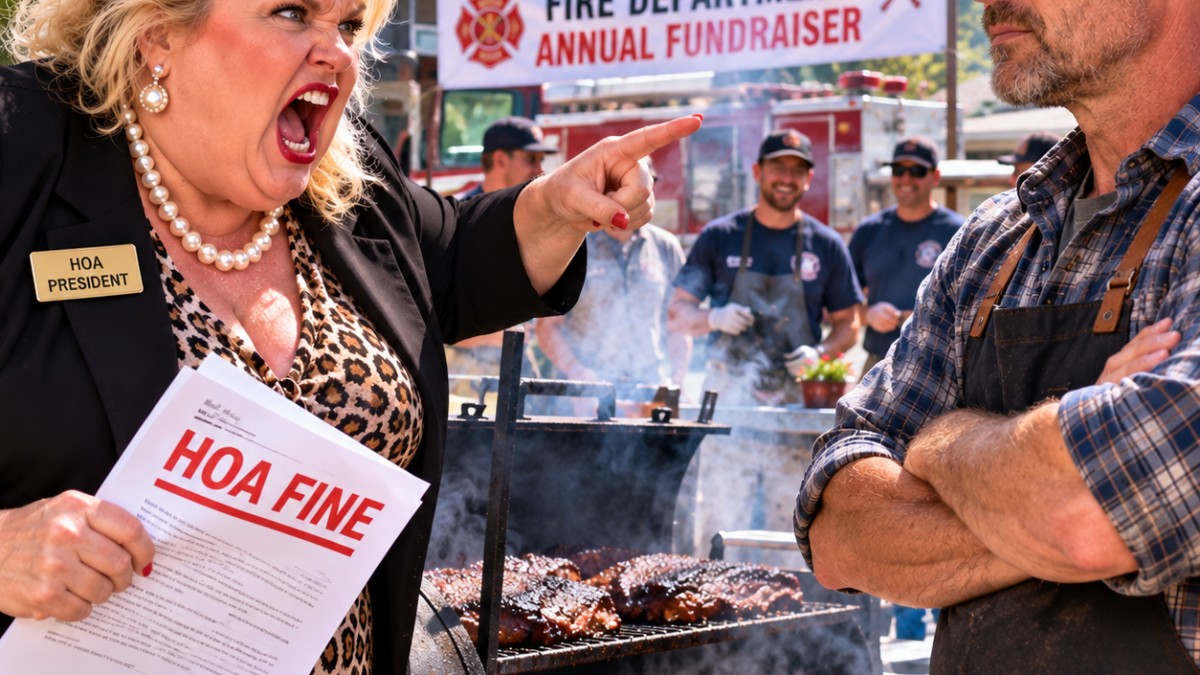
PART 2
I stared at the check mark for several seconds.
Then I photographed it.
Old habits.
You do not trust memory when paper exists.
I checked the time, adjusted the firebox vent, and called Chief Miller.
He answered over a burst of voices.
“Tell me the brisket survived.”
“The brisket’s fine.”
“That pause means something else isn’t.”
“My HOA president just fined me five hundred dollars.”
“For what?”
“The smoker.”
He laughed.
Then realized I wasn’t.
“You’re serious?”
“Five hundred now. Five hundred an hour if I keep cooking.”
There was silence.
“Jack, you’re cooking for us.”
“I mentioned that.”
“And?”
“She compared it to a fireworks stand.”
Chief Miller inhaled slowly.
“Do you need me there?”
“No.”
“You sure?”
“Yes.”
That was the Marine answer.
I reconsidered.
“Actually, I need a letter.”
“What kind?”
“Something on department letterhead confirming I’m volunteering, the food is for your fundraiser, and I’m not operating a business out of my driveway.”
“I’ll have it in your email before you load the brisket.”
“Thank you.”
“Jack?”
“Yeah?”
“Bring the smoker too.”
I looked at the General.
“You want me to tow ten feet of steel across town after a twelve-hour cook?”
“Yes.”
“Why?”
“Because half the department has been asking to see the thing.”
I smiled despite myself.
“All right.”
Sarah came outside carrying fresh coffee.
She noticed my expression immediately.
“What happened?”
I handed her the notice.
She read the first page.
Then the second.
Then looked at the smoker.
“They’re fining you by the hour?”
“Karen says they are.”
“For charity barbecue?”
“That detail failed to move her.”
Her eyes stopped on the lien language.
The coffee mug lowered.
“Jack.”
“I saw it.”
“Can they actually put a lien on the house?”
“Under some circumstances, HOAs can pursue liens for valid assessments or enforceable charges, depending on state law and governing documents.”
“That sounded like a lawyer.”
“It means I don’t know yet.”
She looked toward Karen’s street.
“What do you want to do?”
That question mattered.
Not because I needed permission to defend myself.
Because the house belonged emotionally to both of us even if my name was the one appearing on half the paperwork.
“I finish the cook.”
Sarah nodded.
“And after?”
“I appeal exactly the way the bylaws say.”
“And if she denies it?”
“Then we figure out whether the fine is enforceable.”
Sarah leaned against the porch rail.
“Please don’t turn this into Kandahar.”
“I’m not planning artillery.”
“I’m serious.”
“So am I.”
She looked at me for a long moment.
“You get quiet when you’re angry.”
“I’m always quiet.”
“No. You’re conversationally quiet.”
I almost laughed.
“When you’re really angry, you get organized.”
That was true.
“Then I’ll try to be disorganized.”
“Impossible.”
The General went to the fire department fundraiser that afternoon.
I hitched it behind my truck and pulled into the county fairgrounds with smoke still drifting lightly from the stack.
Firefighters applauded.
Some because they were hungry.
Most because firefighters appreciate absurd machinery almost as much as Marines do.
Chief Miller came over with a folded letter.
“Official enough?”
Blackwood County Fire Department letterhead.
Fundraiser name.
Date.
My volunteer role.
Statement that no food sales or commercial activity were being conducted at my residence.
Perfect.
“Very.”
“What’s she claiming?”
I showed him Karen’s notice.
He got halfway through.
“Five hundred per hour?”
“Yes.”
“Is that even in the covenants?”
“I’m going to find out.”
Chief Miller handed it back.
“If she tries to say this event is unsafe, call me.”
“I don’t want the department dragged into an HOA fight.”
“You’re feeding two hundred people for free.”
“Still.”
He put one hand on my shoulder.
“You spent twenty years serving. Let people stand next to you once in a while.”
That sentence followed me all day.
The fundraiser raised $32,740.
More than the previous year.
Families came.
Kids climbed into a parked engine.
Firefighters ran gear demonstrations.
A burn-survivor family spoke briefly about the crew that had saved their home.
At six, Chief Miller thanked sponsors and volunteers.
Then he called my name.
I hated that.
Public praise has always made me feel like somebody left a spotlight on in a bathroom.
I walked up anyway.
Chief Miller held the microphone.
“Jack Thorne has now fed this fundraiser three years running and refused payment every single time.”
People applauded.
He continued.
“I tried to give him a gift card last year.”
I leaned toward the mic.
“He bought it from my own favorite hardware store.”
Laughter.
Chief Miller grinned.
“This year Jack and his smoker produced two hundred pounds of brisket.”
More applause.
“And every dollar that would’ve gone to catering stayed in the equipment fund.”
That part mattered.
Later, as the crowd thinned, he showed me a preliminary purchase list.
Breathing apparatus.
Replacement hose fittings.
A contribution toward a thermal-imaging unit.
That was what Karen’s fine had interrupted.
Not dinner.
Service.
I went home exhausted and found another notice taped to my front door.
Sarah was standing in the entryway holding it.
Her face told me enough.
“What now?”
“Failure to cure.”
“How much?”
“One thousand.”
“That’s not possible. The General wasn’t here.”
“The notice says continued violation because the smoker remained on the property.”
“In the garage?”
“Yes.”
I took the paper.
Karen was now interpreting ownership itself as noncompliance.
At the bottom:
**Hourly penalties reserved.**
Behind the notice was the envelope containing my appeal packet.
Certified-mail label intact.
Unopened.
Across the front, in blue ink:
**REFUSED — BOARD DECISION FINAL**
I knew the handwriting.
Same blue ink as the check mark.
Sarah whispered:
“She didn’t even open it.”
“No.”
“Didn’t you ask her directly about appealing?”
“Yes.”
“And she said it would be reviewed.”
“Yes.”
Sarah pressed her lips together.
This angered her more than the smoker fine.
She was a teacher.
Process mattered to her.
“You did exactly what they told you to do.”
“I know.”
“And she didn’t even read it.”
“I know.”
Sarah turned toward the kitchen.
“Now I’m mad.”
That should have frightened Karen more than me.
We scanned everything that night.
I created folders.
Original notice.
Appeal.
Postal tracking.
Returned envelope.
Fire department letter.
Photographs showing the smoker stored inside the garage after the event.
Fundraiser program.
My volunteer acknowledgement.
Sarah leaned over my shoulder.
“What are you calling the folder?”
“HOA Smoker Dispute.”
“Liar.”
I looked at her.
She pointed toward the screen.
I had typed:
**OPERATION BRISKET FREEDOM**
“It needed a working title.”
“You are twelve.”
“Possibly.”
The next morning I read the governing documents from beginning to end.
Not highlights.
Not Karen’s citation.
Everything.
Covenants.
Bylaws.
Architectural guidelines.
Enforcement policy.
Collection policy.
Meeting procedures.
Fine schedule.
Covenant 7B-4 did address temporary exterior structures and certain permanently installed appliances visible from the street.
The General was neither permanently installed nor left outside after use.
There was also a nuisance clause covering smoke or odors that substantially interfered with neighboring property.
No one had filed a smoke complaint that I could find.
More interesting was the fine schedule.
The board could assess a standard violation penalty after written notice and an opportunity to cure.
Escalating daily penalties required additional notice.
Hourly penalties?
I found nothing.
Nothing remotely authorizing five hundred dollars per hour.
Then I found the appeals procedure.
A homeowner disputing a fine had thirty days to request a hearing.
The board was supposed to schedule one within a defined period.
Collection activity should not proceed to serious enforcement until required notice and hearing rights had been provided.
Karen had told me forty-eight hours.
Then refused the appeal unopened.
I printed those pages.
Sarah watched me.
“You’re doing the quiet thing.”
“Yes.”
“What now?”
“Formal records request.”
“For?”
“Board minutes.”
“You think the board never voted?”
“I think Karen avoided answering when I asked.”
That afternoon I sent a certified records request to the management company.
I asked for the minutes showing adoption of the hourly fine policy.
Any board resolution classifying my smoker as a commercial appliance.
My enforcement history.
Any complaints relating to smoke.
Minutes from meetings at which my matter was discussed.
Current fine schedule.
Conflict-of-interest policy.
Vendor disclosures.
Sarah read the last two items.
“Why those?”
“Because if I’m requesting records, I might as well understand the system.”
“That sounds ominous.”
“I’m curious.”
“You are never just curious.”
Three days passed.
Then a week.
No response.
Karen, however, found time to drive slowly past our house twice a day.
Sometimes she photographed the driveway.
The General stayed inside.
The only thing visible was my truck.
I began walking Oak Haven in the evenings.
Partly to clear my head.
Partly because once you read a rule book closely, you start seeing how selectively people live under it.
Karen’s house was impossible to miss.
Ceramic gnomes lined one flower bed.
I counted eleven.
Oak Haven rules allowed one visible decorative lawn item outside seasonal periods.
Her mailbox was shaped like a largemouth bass.
The standard required a uniform black mailbox.
Her backyard fence appeared taller than the approved maximum.
I photographed those things from public sidewalks only.
Not because I intended to become Karen.
Because selective enforcement is difficult to demonstrate without comparators.
Then I started noticing everyone else.
Basketball hoops hidden behind garages.
Vegetable beds screened by hedges.
A bird feeder removed, leaving only the hook.
Front doors in slightly different shades of beige.
Tiny signs of people adapting themselves around fear.
I met Evelyn Gable on Rosewood Court.
Everyone called her Mrs. Gable.
Small woman.
White hair.
Perfect roses.
She was trimming stems when I introduced myself.
“I know who you are,” she said.
That surprised me.
“The barbecue man.”
“That’s better than some names.”
She smiled, then looked toward the street.
“What do you need?”
“I’m asking residents how HOA enforcement works.”
Her shears stopped.
“Why?”
“I was fined for my smoker.”
“Oh.”
That one syllable carried warning.
“I’m appealing.”
“You should pay it.”
I studied her face.
“You think it’s valid?”
“No.”
“Then why pay?”
Her voice dropped.
“Because Karen doesn’t stop.”
There it was.
I sat on the edge of the low retaining wall while she told me about her bird feeder.
Her late husband, George, had served in the Navy.
He loved cardinals.
After he died, Mrs. Gable kept the feeder because watching those birds every morning made breakfast feel less empty.
Karen cited it as a nuisance.
Rodents.
Seed shells.
Visual clutter.
Two hundred dollars.
Mrs. Gable appealed.
The hearing was postponed twice.
Late fees appeared while she waited.
Eventually she removed the feeder and paid because legal letters frightened her.
“How long ago?”
“Four years.”
“You still miss it?”
She looked toward the empty hook.
“Every morning.”
That hit harder than my smoker.
Karen had cost me anger.
She had cost Mrs. Gable comfort.
I asked permission before photographing the old violation notice.
She hesitated.
Then nodded.
“Don’t tell her I gave you this.”
“I won’t.”
My next conversation was with Mark Henderson.
Two sons.
Former portable basketball hoop.
He had sold it after six months of notices.
“The boys thought it broke,” he said.
“Why didn’t you tell them the truth?”
He looked embarrassed.
“Because I didn’t want them knowing adults can make you remove harmless things just because they’re tired enough to fight longer than you are.”
I understood that too well.
A young couple had removed a backyard vegetable garden after being told it violated landscaping guidelines.
A retired teacher had received repeated cleaning notices for faint stains on his driveway.
A family with a wooden swing set had accumulated hundreds in penalties before moving it behind a taller privacy screen.
Not every story meant the HOA was wrong.
Some people admitted they had broken clear rules.
But a pattern emerged.
Karen enforced aggressively against residents who challenged her.
Those who stayed friendly received warnings.
Those who questioned her received paperwork.
By the time I came home after the fifth evening, Sarah was sitting at the kitchen table.
“You’re enjoying this.”
“No.”
“You look energized.”
“That’s different.”
“What are you finding?”
I told her.
Mrs. Gable.
Basketball hoop.
Garden.
The retired teacher.
Sarah listened.
Then asked:
“What exactly are you trying to accomplish?”
“Stop the lien.”
“That’s not what I asked.”
I looked away.
She knew me too well.
“I don’t know anymore.”
“Yes, you do.”
I took a breath.
“I think Karen’s abusing the board.”
“And?”
“I think people are afraid of her.”
“And?”
“I think if I just get my fine canceled, nothing changes for them.”
Sarah was quiet.
Then:
“Are you trying to save everybody?”
“No.”
“Jack.”
“I’m gathering facts.”
“You came home from the Marines because you were tired of carrying responsibility for everybody around you.”
That hurt because it was true.
“I know.”
“And now one awful woman puts a lien threat on the house and suddenly you’ve adopted the whole subdivision.”
“I’m not adopting anybody.”
“Mrs. Gable?”
I stopped.
Sarah softened.
“I’m not telling you to walk away.”
“Then what are you saying?”
“I’m saying remember you’re my husband before you become everybody’s commanding officer.”
I reached across the table.
“I’m sorry.”
She squeezed my hand.
“Fight the right fight.”
That became another rule.
Two days later, a certified letter arrived from the HOA’s attorney.
Not a lien itself.
Notice of intended collection action.
The balance listed:
$12,500.
I stared at it.
Even using Karen’s imaginary hourly penalty, the math barely made sense.
The smoker had not remained outside.
The appeal had been refused.
No hearing.
Yet the demand treated every disputed amount as settled debt.
Sarah read it standing beside me.
Her breathing changed.
“Twelve thousand five hundred.”
“I see it.”
“Jack, our emergency fund is seventeen.”
“I know.”
“What if legal fees get added?”
“I know.”
“What if they actually record a lien?”
“I know.”
She snapped.
“Stop saying you know!”
I looked at her.
Tears were already in her eyes.
“This was supposed to be our forever house.”
“It is.”
“Don’t promise things you can’t control.”
That silenced me.
She wiped her face angrily.
“I followed you everywhere for twenty years.”
I swallowed.
“I know.”
“Germany. North Carolina. California. Virginia. Two years where I unpacked dishes and then packed them again.”
“I know.”
“When you retired, you told me no one could send us anywhere again.”
“No one is.”
“They’re threatening the house.”
I stepped toward her.
She backed away.
Not because she feared me.
Because she was trying not to collapse.
“I can handle a barbecue fine,” she said. “I can handle Karen. I can handle stupid rules. I cannot do temporary again.”
That was the real stake.
Not brisket.
Not pride.
Home.
“I won’t treat this like a game,” I said.
Sarah nodded.
“Good.”
The next morning I called an attorney.
Her name was Ava Rostova.
Former JAG.
We had served on the same joint task force years earlier.
She had since built a practice around property disputes, community associations, and nonprofit governance.
Her office was smaller than I expected.
Her questions were sharper.
She read the entire file before saying much.
Then:
“First, stop using phrases like ‘unconstitutional covenant’ in your letters.”
I frowned.
“I used it once.”
“I know.”
“Vague isn’t a problem?”
“It may be a contract-enforcement problem. That doesn’t automatically make it constitutional litigation.”
“Fine.”
“Second, the hourly fine authority appears questionable from what you’ve shown me.”
“Questionable?”
“That is a lawyer word meaning I would enjoy asking them where it comes from.”
I smiled.
“Third, their appeal handling is bad.”
“Bad enough?”
“For what?”
“To cancel the fine.”
“Possibly.”
“To stop a lien?”
“If they haven’t recorded one yet, we send immediate notice disputing the debt and demanding they comply with governing procedures before any encumbrance.”
She flipped another page.
“Fourth, you have evidence of selective enforcement.”
“Karen’s gnomes.”
“Please never make me say ‘Karen’s gnomes’ in court unless necessary.”
“No promises.”
Ava almost smiled.
“Anything else?”
I showed her the unanswered records request.
She read it.
“You asked for vendor disclosures?”
“Yes.”
“Why?”
“Curiosity.”
“You military people are exhausting.”
I told her about the residents.
Ava leaned back.
“If there’s a governance problem, residents need to address it through the association’s procedures. You cannot conduct a coup because your brisket got fined.”
“Disappointing.”
“However.”
She pulled the bylaws closer.
“There is a special-meeting provision.”
That was the first real opening.
Twenty-five percent of eligible homeowners could petition for a special meeting.
Board-member removal had its own voting requirements.
Not impossible.
But not my decision.
“The homeowners would have to want it,” Ava said.
“Exactly.”
“Do not manipulate them.”
“I wasn’t planning to.”
“Do not promise refunds.”
“Okay.”
“Do not accuse Karen of crimes unless you have evidence.”
“I haven’t.”
“Do not weaponize the fire department.”
“I definitely wasn’t planning—”
She stared.
I stopped.
“Fine.”
Ava continued.
“Your job is your fine. Their job is their community.”
That night an email arrived from my old platoon sergeant Dave Martinez.
I had asked him to look at three years of HOA financial disclosures.
Dave had become a forensic accountant after retirement.
His subject line read:
**CALL ME. NOT EMAIL.**
I called.
“What did you find?”
“Maybe something. Maybe nothing.”
“Helpful.”
“I see landscaping expenses nearly doubling over three years.”
“Karen likes landscaping.”
“I also see repeated payments to Prestige Lawn Care without obvious competitive-bid references in the public summaries.”
“Problem?”
“Could be normal if contract renewals are allowed. Could be lazy governance.”
“Anything else?”
“Consulting expenses.”
“How much?”
“Enough to ask what they’re for.”
“To who?”
“An LLC called Community Image Solutions.”
“Who owns it?”
“I’m still checking.”
“Fraud?”
“No.”
He said it sharply.
“Do not say that.”
“Ava already yelled at me.”
“Good. Listen to your lawyer.”
“I hate when everybody agrees.”
Dave continued.
“Public financial summaries can suggest questions. They do not prove theft.”
“What do I do?”
“Request underlying records through whatever rights you have.”
“I already did.”
“Good.”
“And if they refuse?”
“Then homeowners should use their inspection rights.”
That sent me back to Mark Henderson.
This time I went with no petition.
No speeches.
I told him what Ava had found in the bylaws.
Twenty-five percent could force a special meeting.
His eyes changed.
“You think we can remove Karen?”
“I think you can ask residents whether they want a meeting.”
“You’re not signing?”
“I’m not leading it.”
“Why?”
“Because Sarah reminded me this is your HOA.”
Mark stared at me.
Then smiled.
“Smart woman.”
“Extremely.”
Mrs. Gable signed first.
Her hand shook as she wrote her name.
Then she looked toward the photograph of George on her mantel.
“He would have signed faster.”
One by one, residents added signatures.
Mark did most of the door knocking.
Other homeowners joined.
The family with the swing set.
The retired teacher.
The garden couple.
Some refused.
Some liked Karen.
Some disliked Karen but disliked conflict more.
That was normal.
Within a week, the petition crossed thirty percent.
Then thirty-five.
Then forty.
And that was when Karen noticed.
Violation notices multiplied.
Mark’s lawn allegedly exceeded height standards.
Mrs. Gable’s mulch color was questioned.
One petition signer got a notice about holiday lights that had been down for two months.
Another was cited for an oil stain that disappeared after rain.
Ava documented timing.
“Retaliation argument gets stronger,” she said.
“Can we sue?”
“You ask that like Marines ask for air support.”
“Can we?”
“Maybe later.”
The petition forced a special meeting.
Karen scheduled it for Thursday at 7:30 p.m.
Then she announced a “Community Standards and Beautification Summit” for the same evening at six.
That alone would have been petty.
But there was another event on the calendar.
The Blackwood County Fire Department had already planned a community barbecue that afternoon to recruit volunteers and start organizing the next fundraiser.
Chief Miller called me.
“Did she seriously schedule lawn-rule PowerPoint night against firefighters and brisket?”
“I believe so.”
“What does she think is going to happen?”
“I try not to occupy Karen’s mind.”
“Good policy.”
The fire department barbecue was scheduled in Oak Haven’s community park.
The park was HOA property.
That meant we needed approval.
Ava helped draft the request.
Charitable event.
Temporary food service.
Fire department participation.
Noise limits.
Cleanup plan.
Insurance certificate.
Everything Karen might use as an excuse.
The board approved it three to two.
Karen added conditions.
No music above the local ordinance limit.
No equipment blocking emergency access.
Complete cleanup within two hours.
Smoker placement approved by the fire marshal.
I accepted every condition.
Then I obtained the county temporary-food permit.
Chief Miller arranged a fire inspector.
The General passed without issue.
Sarah taped the permit in our garage window.
“Think she’ll drive by?”
“She already has.”
“How many times?”
“Three.”
“You counting?”
“Obviously.”
The day before the barbecue, Ava called.
“We have a response to the records demand.”
“And?”
“Partial production.”
“Anything useful?”
“Enough to justify more questions.”
We met that afternoon with Dave on video.
Vendor contracts.
Board minutes.
Payment summaries.
Prestige Lawn Care had indeed received substantial no-bid work.
But its owner was not Karen’s brother-in-law, as neighborhood rumor claimed.
Dave traced the ownership to Harold Bennett, Karen’s sister’s husband.
Close enough to require disclosure questions.
Not automatically illegal.
The minutes contained one conflict disclosure two years earlier.
But subsequent contract renewals lacked clear recusal documentation.
Community Image Solutions was more troubling.
The LLC’s registered agent was a woman sharing Karen’s maiden surname.
Her cousin.
Again, related-party business.
Again, not necessarily theft.
But invoices used vague descriptions:
**Community image consultation.**
**Resident compliance strategy.**
**Aesthetic preservation support.**
Dave stared at the screen.
“What exactly did they provide?”
Ava said:
“That is what an audit would answer.”
“How much?”
“Forty-six thousand over three years,” Dave said.
I whistled.
“Don’t.”
“What?”
“Do not become emotionally attached to a suspicious number.”
“Is that accounting advice?”
“Yes.”
The barbecue began at four Thursday afternoon.
By five, the park was full.
Children bounced inside an inflatable castle.
Firefighters let kids climb into an engine.
A local trio played classic rock at a volume low enough for conversation.
The General sat in a marked cooking area with extinguishers nearby and a temporary barrier keeping children away from the firebox.
I had cooked overnight again.
Brisket.
Pork shoulder.
Sausage.
Chief Miller wore his dress uniform shirt for the first hour, then gave up and put on an apron.
Mrs. Gable brought potato salad.
Mark Henderson brought his sons.
Their new basketball hoop had not yet returned.
But the boys ran around with everyone else.
At 5:40, I saw Karen walking toward us.
Clipboard.
Bob Turner beside her.
Linda Hayes on the other side.
Sarah noticed too.
“Here we go.”
“You don’t have to stay near me.”
She stared.
“I followed you to Twenty-Nine Palms.”
“Fair.”
Karen stopped in front of the General.
“Mr. Thorne.”
“Karen.”
“This smoker was not approved for common-area use.”
I pointed toward the inspection sheet clipped beside the permit.
“Board approval. Fire inspection. Temporary food permit.”
“I’m speaking about architectural approval.”
“It has wheels.”
“That is not responsive.”
Chief Miller walked over.
“Evening.”
Karen’s mouth tightened.
“Chief.”
He smiled politely.
“Food’s free if you’re hungry.”
“I am here on official association business.”
“So am I.”
She blinked.
“This is an HOA park.”
“And today it’s hosting a permitted fire department community event approved by your board.”
Karen looked at me.
“The music is too loud.”
A county decibel meter sat with the fire inspector because Ava had predicted this.
I gestured toward it.
“Measured fifteen minutes ago.”
“Children are running through landscaped areas.”
Chief Miller said:
“They’re children.”
Karen’s face darkened.
“This entire event has become a political demonstration.”
That drew attention.
Neighbors stopped talking.
Mark walked closer.
“What political demonstration?”
Karen pointed at him.
“The petition.”
Mark’s voice stayed calm.
“The petition meeting starts at seven-thirty.”
“And this barbecue is clearly designed to influence votes.”
Chief Miller looked confused.
“We planned this before I knew there was a petition.”
That was true.
Karen’s eyes moved across the crowd.
People she had fined were eating together.
Laughing.
Talking.
She saw control slipping and interpreted fellowship as conspiracy.
“The event is over.”
The band stopped on its own.
Not because she had authority.
Because everyone heard her.
Chief Miller removed his apron.
“Karen.”
“You do not have authority over HOA common property.”
“No. Your board does.”
“I represent the board.”
Ava stepped forward from a picnic table.
She had been eating brisket.
Karen recognized her.
“You.”
Ava wiped her hands.
“Yes.”
“This is your doing too.”
“No. I’m eating dinner.”
A few people laughed.
Karen pointed at the General.
“I am ordering that appliance removed.”
Ava took the approval letter from her bag.
“Board vote approved charitable use of the park.”
She handed Karen a copy.
“Three to two.”
Karen already knew.
Her jaw tightened.
Then a news van pulled to the curb.
I turned toward Mark.
He raised both hands.
“Not me.”
Mrs. Gable looked innocent in a way that made me suspicious.
The reporter, Maria Flores, climbed out with a cameraman.
She had apparently been tipped about the unusual HOA dispute involving a fire department fundraiser and a special removal meeting later that evening.
Karen’s posture changed instantly.
Public image mattered to her almost as much as authority.
Maria approached.
“Are you Karen Miller?”
Karen smiled tightly.
“I am HOA president. This is a private community event.”
Chief Miller corrected her gently.
“It’s a fire department-sponsored public charity event being hosted here with approval.”
Maria looked at the General.
“This is the smoker?”
I wanted to disappear.
“Yes.”
“The one that resulted in more than twelve thousand dollars in HOA penalties?”
Karen interrupted.
“That figure is disputed.”
Ava said:
“Correct. It is disputed.”
I appreciated that.
Maria turned to me.
“Mr. Thorne, why are you fighting the fine?”
I looked around before answering.
Firefighters.
Children.
Mrs. Gable.
Mark’s boys.
Sarah.
“I’m fighting because I followed the appeal process and my appeal came back unopened.”
Karen snapped:
“That is false.”
I turned.
I had the envelope photographed and secured.
Ava had a copy.
She held it up.
“Certified mail. Refused unopened.”
Karen’s face changed.
Maria asked:
“Did the HOA refuse his appeal?”
Karen said:
“There were procedural deficiencies.”
“What deficiencies?”
“This is pending litigation.”
“No lawsuit has been filed,” Ava said.
Karen glared.
Maria’s cameraman kept recording.
Mark stepped forward with the petition.
“This isn’t only about Jack.”
Karen’s face paled.
Mark continued.
“Forty-three percent of eligible homeowners signed a petition for tonight’s special meeting.”
Maria’s eyebrows rose.
“For removal of the HOA president?”
“For a vote under the bylaws concerning leadership and governance.”
That was Ava’s wording.
Precise.
Harder to attack.
Karen looked at Mark as if he had betrayed her personally.
“You brought media here?”
“No.”
“Who did?”
Mrs. Gable lifted her hand.
Every head turned.
She smiled.
“I called.”
Karen stared.
Mrs. Gable’s voice shook at first.
“You took George’s bird feeder away from me.”
Karen actually scoffed.
“This is about a bird feeder now?”
“No.”
Mrs. Gable straightened.
“It’s about the fact that I was afraid to tell you no.”
The park went silent.
Karen opened her mouth.
Nothing came.
Mrs. Gable continued.
“I’m not afraid tonight.”
That was stronger than anything I could have said.
Maria Flores moved the microphone toward her.
Mrs. Gable did not perform.
She simply told the truth.
Her husband.
The cardinals.
The fine.
The appeal delays.
Paying because she feared a lien.
Mark told his basketball-hoop story.
The garden couple spoke.
No yelling.
No exaggeration.
Just accumulation.
Karen realized the camera had transformed her favorite weapon—public authority—into public accountability.
She left.
Not dramatically.
She turned and walked toward the clubhouse.
At 6:45, we cleaned the park.
Every bag tied.
Every table wiped.
Music off.
Bouncy castle deflated.
Permit conditions met.
At 7:20, residents walked together toward the clubhouse.
Not a mob.
Neighbors.
That distinction mattered.
The room could not hold everyone.
People stood in the hall.
Karen sat at the center table.
Bob and Linda beside her.
Two other directors, James Park and Helen Reeves, looked nervous.
Karen opened with a prepared statement.
“For years, this board has protected Oak Haven property values against declining standards and outside influences.”
Outside influences.
I knew who that meant.
She continued.
“Recently, a small faction has exploited misunderstandings and personal grievances to attack volunteer leaders.”
Murmurs.
Karen raised the gavel.
“I intend to correct the record.”
Ava stood.
“Point of procedure.”
Karen looked at her.
“You are not a homeowner.”
“No. I am counsel for Mr. Thorne and have been invited by petitioners to advise on process. I am not voting.”
Karen looked toward Mark.
He nodded.
Ava continued.
“The notice calling this special meeting states the purpose is consideration of the petitioned governance matters. The board should address those matters before unrelated business.”
Karen turned to the association’s own attorney.
A man named Paul Kendrick sat near the wall.
He looked uncomfortable.
Then nodded.
“She’s correct.”
That was the first visible blow.
Karen said:
“Fine.”
Mark moved for consideration of the leadership petition.
Seconded.
Before voting, the bylaws allowed discussion.
I spoke last.
I had planned something longer.
Then I looked at Mrs. Gable.
Changed my mind.
“I started this because Karen fined my smoker.”
Some people smiled.
“But I don’t think this meeting is about barbecue anymore.”
Karen crossed her arms.
I continued.
“It’s about whether rules belong to one person or the community that agreed to them.”
I looked toward Mrs. Gable.
“Whether a widow loses a bird feeder because somebody can outlast her financially.”
Toward Mark.
“Whether children lose a basketball hoop because their father has a job and doesn’t have time for six hearings.”
Toward the garden couple.
“Whether people who ask questions become targets.”
Then toward Karen.
“And whether a president gets to refuse an appeal unopened while still threatening a homeowner’s house.”
Karen said:
“You’re making this sound sinister.”
“No.”
I shook my head.
“Your own paperwork does that.”
I sat.
Then Dave Martinez came forward.
Not as prosecutor.
Not as investigator.
As a forensic accountant retained by several petitioning homeowners to conduct a preliminary review of records they were legally entitled to inspect.
He projected three slides.
Not fifty.
Three.
First:
Fine revenue.
It had more than tripled during Karen’s presidency.
That did not prove abuse.
But residents deserved explanation.
Second:
Related-party vendor payments.
Prestige Lawn Care, owned by Karen’s brother-in-law Harold Bennett, had received repeated contracts.
Some board minutes disclosed the relationship.
Others did not show Karen recusing herself.
Community Image Solutions, operated by her cousin, received tens of thousands for loosely described services.
Again, not automatically improper.
But worthy of independent review.
Third:
Legal spending.
The association had spent a large and growing amount on enforcement disputes.
Including my case.
Residents reacted.
Karen stood.
“This is defamatory.”
Dave shook his head.
“No.”
His voice stayed calm.
“I have accused you of nothing.”
He pointed at the slide.
“These are payments reported in the association’s records.”
“You implied theft.”
“I explicitly said the records require independent verification.”
Bob interrupted.
“Our financial reports are reviewed monthly.”
Dave turned.
“By you?”
“Yes.”
“You’re the treasurer?”
“Yes.”
“Are you a CPA?”
“No.”
“Bookkeeper?”
“No.”
“Accountant?”
“No.”
Bob reddened.
Dave continued.
“That isn’t criticism. It is why independent financial review exists.”
Helen Reeves spoke from the board table.
“I want an audit.”
Karen turned.
“Helen.”
“I asked about Community Image Solutions last year.”
The room shifted.
Karen’s expression hardened.
“We discussed it.”
“You told me it was marketing.”
“It was.”
“What marketing?”
No answer.
James Park looked toward Karen.
“I’d like to know too.”
There it was.
The board cracking from inside.
Karen grabbed the gavel.
“This meeting is about my removal, not a financial witch hunt.”
Mrs. Gable called from the front row:
“Then let us vote.”
Karen stared at her.
The vote proceeded by written ballot because Ava and the association lawyer agreed that would reduce pressure and create a cleaner record.
Homeowners lined up.
Signed in.
Ballots distributed.
Collected.
Counted in front of observers from both sides.
I could not vote for anyone else.
I voted only because Sarah and I were members in good standing despite the disputed fine, which Ava had ensured was noted.
The room waited.
Final count:
Enough for removal under the bylaws.
Karen Miller was removed from the board.
Not merely the presidency.
Her seat was vacant.
She sat motionless.
Bob whispered something to her.
She ignored him.
Linda looked down.
Then Karen stood.
“You think this fixes anything?”
Nobody answered.
“You think he cares about this neighborhood?”
She pointed at me.
“He wanted revenge.”
That was partly true at the beginning.
I had wanted her humiliated.
I was glad Sarah had forced me to notice that.
I stood.
“I wanted you to stop threatening my house.”
“You built a political movement over a smoker.”
“No.”
I looked at Mrs. Gable.
“They did this because you gave them reasons.”
Karen’s face crumpled for just a second.
Then hardened.
“You’ll regret it.”
Ava spoke from beside me.
“Karen.”
She stopped.
“Do not threaten my client.”
Karen looked at the camera phones raised around the room.
Then left.
The members voted next to authorize an independent forensic audit.
Passed overwhelmingly.
Then a ninety-day review of disputed fines.
Passed.
Then replacement procedures for the vacant board seat.
Passed.
I was nominated.
I refused.
Immediately.
Mark laughed.
“Coward.”
“I promised Sarah retirement.”
Sarah called from the back:
“Keep refusing.”
Everyone laughed.
Mrs. Gable accepted an interim seat.
That brought the loudest applause of the night.
Her face turned pink.
“I don’t know anything about boards.”
Ava said:
“That may be an advantage.”
The audit took three months.
Not three dramatic days.
Real forensic work is slow.
Invoices.
Bank statements.
Contracts.
Checks.
Emails.
Credit-card charges.
Vendor records.
Approvals.
Tax filings.
Interview notes.
Some of Dave’s suspicions turned out to have innocent explanations.
Community Image Solutions had provided legitimate newsletter design, event materials, and resident surveys.
The fees were high, but work existed.
That mattered.
Prestige Lawn Care had also done actual work.
Mowing.
Tree service.
Irrigation repair.
The problem was pricing and disclosure.
The audit found several contracts materially above competing estimates and weak documentation around related-party approval.
More serious findings involved reimbursements.
Personal expenses charged to an HOA card and later categorized broadly.
Restaurant bills unrelated to documented meetings.
Travel.
Home-office electronics.
Decor items delivered to Karen’s address.
Small individually.
Significant together.
Then auditors found duplicate invoicing involving Prestige.
Certain jobs billed once through the HOA’s maintenance account and again through special-project invoices.
Harold Bennett claimed clerical error.
Maybe some were.
Others were harder to explain.
The auditors referred their findings to the board’s counsel.
The board’s counsel referred specific concerns to law enforcement and the association’s insurance carrier.
That was when the matter became criminal.
Not because I declared it fraud.
Not because Dave made a slide.
Because investigators got bank records and testimony.
I stayed away from that process.
Mostly.
It was difficult.
One afternoon I asked Ava:
“Any news?”
“No.”
“You know something.”
“Yes.”
“What?”
“Something you do not need.”
“I hate lawyers.”
“You selected me.”
“Poor judgment.”
Months passed.
Oak Haven changed faster than the investigation.
The first major policy change was simple.
No fine without a warning for ordinary curable violations unless safety required immediate action.
Second:
Written citation to an actual rule.
No vague “community standards” by themselves.
Third:
Real appeal hearings.
Fourth:
Any director with a financial relationship to a vendor had to disclose it and recuse from selection and voting.
Fifth:
Competitive bids above a threshold.
Sixth:
Published financial summaries.
Seventh:
Liens required outside counsel review and full procedural verification.
My $12,500 smoker balance disappeared at the first post-Karen board meeting.
Mrs. Gable insisted on reading the motion herself.
“All penalties assessed against Jack Thorne arising from charitable use of his temporary smoker during the Blackwood County Fire Department fundraiser are hereby rescinded.”
She looked at me.
“Did I say that right?”
“Perfect.”
“Good.”
She banged the gavel much too hard.
The handle cracked.
Everyone stared.
Mrs. Gable said:
“I never liked this thing.”
Oak Haven bought a new gavel.
Mark Henderson bought his sons another basketball hoop.
The first Saturday they rolled it to the driveway, half the neighborhood showed up.
I brought ribs.
Mrs. Gable rehung her bird feeder.
That moment affected me more.
Mark called to tell me.
I walked over early the next morning.
She stood at the kitchen window.
A bright red cardinal sat on the feeder.
Neither of us spoke for a while.
Then she whispered:
“George would’ve liked that one.”
I nodded.
“Good color.”
“He always liked the red ones.”
She wiped beneath one eye.
“I spent four years being angry every morning.”
“At Karen?”
“At myself.”
“For taking it down?”
“Yes.”
“You were trying to protect your home.”
“I know.”
“Then don’t make yourself the villain.”
She looked at me.
“Did your wife tell you that?”
“Something similar.”
“Smart woman.”
Everybody liked Sarah.
Including people she had never met.
The fire department fundraiser became an annual neighborhood event.
Not because I planned it.
The first year after Karen’s removal, Chief Miller asked whether Oak Haven wanted to host the fundraiser picnic.
The new board voted unanimously.
I rolled the General into the park with a permit and fire inspection.
No fine.
No special treatment either.
That mattered to me.
Same safety rules as everyone else.
A firefighter checked my extinguishers.
I thanked him.
Chief Miller laughed.
“You enjoy inspections now?”
“I enjoy predictable rules.”
“Marine.”
“Fire chief.”
The criminal investigation concluded more than a year after the original smoker fight.
Ava called me.
“Karen and Harold were charged.”
I sat down.
“What charges?”
She told me carefully.
The prosecutor alleged theft and fraudulent billing relating to specific HOA funds and vendor invoices.
Not every suspicious transaction.
Only those investigators believed could be proven.
Karen’s personal HOA-card charges became part of the case.
So did several documented vendor payments.
Harold faced charges tied to duplicated or improperly represented invoices.
They both pleaded not guilty initially.
The case moved.
Slowly.
Karen sold her house during that period.
Sarah saw the sign before I did.
“You going to stand outside with a brisket when she leaves?”
“No.”
“Disappointed.”
“Are you?”
“A little.”
We watched movers one Saturday.
Karen did not approach us.
I did not approach her.
Before leaving, she stood beside her SUV and looked down the street.
At the Henderson hoop.
Mrs. Gable’s bird feeder.
A front-yard vegetable box that would have given her heart failure two years earlier.
Children drawing chalk across a driveway.
The neighborhood had not collapsed.
Property values had not cratered.
Lawns had not become jungles.
Oak Haven simply looked less frightened.
Karen looked toward my house.
I was on the porch.
Our eyes met.
No wave.
No smile.
She got into the car.
Sarah stood beside me.
“That’s it?”
“That’s it.”
“Feels anticlimactic.”
“Good.”
Sarah nodded.
“Yeah.”
The criminal case ended in negotiated pleas.
Karen admitted to a felony fraud-related offense connected to unauthorized association expenditures and false documentation involving particular transactions.
Other counts were dismissed under the agreement.
She received probation, restitution obligations, community service, and financial penalties.
As part of Oak Haven’s separate governance settlement and bylaws, she was permanently ineligible to serve on the association’s board again.
Harold entered his own plea on a lesser charge and agreed to restitution related to invoices the prosecution challenged.
Prestige Lawn Care lost the Oak Haven contract.
The company did not disappear.
It simply had to survive without guaranteed HOA work.
That felt more realistic than cinematic justice.
The recovered and repaid money did not suddenly make Oak Haven rich.
Some went back into reserves.
Some covered audit and legal costs.
The board used a portion, after member approval, to repair the neglected playground and address deferred maintenance.
Mrs. Gable proposed a scholarship fund for neighborhood students going into fire science, EMS, nursing, or public service.
That idea passed too.
I liked that most.
Money once lost inside bad governance would help kids choose careers built around service.
Chief Miller cried when we told him.
He denied it.
Firefighters are terrible liars about crying.
I never joined the HOA board.
Sarah held me to that.
I did volunteer on a temporary covenant committee.
She called that “technically violating the spirit of the agreement.”
I argued it was only six meetings.
She counted nine.
We rewrote Covenant 7B-4.
The infamous smoker clause.
The new language distinguished permanent installations from temporary recreational cooking equipment.
Charitable and community events had a clear permit process.
Smoke nuisance rules focused on actual substantial interference rather than personal dislike.
Ava reviewed it.
“Boring.”
“Good.”
“Specific.”
“Better.”
“You’re learning.”
“Never say that again.”
The General became locally famous.
I hated that too.
People asked to photograph it.
One firefighter put a small magnetic sign on its side during fundraisers:
**THE GENERAL — NO HOURLY HOA FINES APPLY**
I removed it.
He put it back.
Eventually I surrendered.
The third fundraiser after the whole mess raised more than fifty thousand dollars.
The department purchased upgraded breathing equipment and funded a training program for volunteer firefighters.
That year Chief Miller invited Mrs. Gable to make the first donation.
She placed a twenty-dollar bill in the collection bucket.
“For George,” she said.
Then pointed toward me.
“And for the meat.”
“Priorities.”
She nodded.
“Your brisket’s better than your speeches.”
True.
Mark Henderson’s sons became teenagers.
The basketball hoop stayed.
They dented the garage door.
Mark complained constantly.
Never removed it.
The young couple replanted their vegetable garden.
Then expanded it.
They started leaving baskets of tomatoes outside with a sign:
**TAKE SOME. LEAVE SOME.**
No architectural committee approval.
No crisis.
The retired teacher stopped pressure-washing his driveway twice a month.
It remained a driveway.
Oak Haven survived.
That sounds obvious.
At the time it felt revolutionary.
Years passed.
Mrs. Gable grew slower.
Her roses remained perfect because she bullied three of us into helping.
“Not like that, Jack.”
“I planted defensive positions in Afghanistan.”
“And yet you still don’t know where to cut a rose.”
She was right.
She died at eighty-seven.
Peacefully.
Her daughter found me at the memorial.
“Mom left you something.”
It was George’s bird feeder.
I stared.
“She wanted you to have it.”
“I don’t have birds.”
Her daughter laughed.
“She said you’d figure it out.”
I mounted it near the back fence.
Sarah bought seed.
Within a week we had cardinals.
The first red one that landed there stopped me cold.
Sarah saw me from the kitchen.
She came outside.
“Mrs. Gable?”
“Yeah.”
We stood quietly.
The General sat inside the garage.
The bird feeder moved slightly in the wind.
Two things Karen once thought threatened Oak Haven.
Neither seemed dangerous.
Chief Miller retired eventually.
His replacement was a woman named Rachel Torres who had eaten my brisket as a rookie firefighter years earlier.
At her first fundraiser as chief, she walked over while I was slicing.
“You going to make me give a speech about you?”
“No.”
“Good.”
“Daniel used to ambush me.”
“I know.”
“He was a bad man.”
“He warned me.”
She sampled one piece.
“Needs salt.”
I stared.
She laughed and walked away.
I respected her immediately.
My marriage survived Operation Brisket Freedom.
That may sound like a strange thing to say.
But fights about principle can become addictive.
There was a stretch when I cared more about defeating Karen than about the fear Sarah felt each time legal mail arrived.
I had been right about the fine.
I had still been wrong about something else.
Being right did not excuse making my wife feel alone inside the same fight.
Years later, I told her that.
We were sitting on the porch while the General ran overnight for another fundraiser.
She looked at me.
“Took you long enough.”
“You knew?”
“Obviously.”
“Why didn’t you say more?”
“I did.”
“Fair.”
She sipped tea.
“You were unbearable.”
“How unbearable?”
“Marine with a printer.”
“That bad?”
“The worst.”
I laughed.
Then apologized.
She accepted.
Mostly.
The house became what we had wanted from the beginning.
Not a headquarters.
A home.
Sarah taught until retirement.
Then turned half the backyard into flowers.
Some were technically outside the old approved palette.
No one cared.
I built a small covered pad for the General.
Approved properly.
I submitted plans.
The architectural committee chair called.
“Jack, you know you don’t have to write a six-page engineering description for a smoker roof.”
“You asked for dimensions.”
“I asked for width and height.”
“Now you have wind-load notes.”
“You need hobbies.”
“I smoke meat.”
“Apparently not enough.”
The permit was approved unanimously.
I framed that too.
Sarah stopped me from hanging it in the living room.
Reasonable boundary.
One spring, a new family moved into Karen’s old house.
The Parkers.
Young couple.
Two daughters.
No idea about the history.
For their first neighborhood cookout, Mr. Parker knocked on my door.
“Hey, I’m Chris.”
“Jack.”
“I hear you’re the barbecue guy.”
“I hear lies spread quickly.”
He laughed.
“We’re doing burgers Saturday. Any chance you want to bring that giant smoker everybody talks about?”
“No.”
His face fell.
“Too much machine for burgers.”
“Oh.”
“I’ll bring ribs.”
He brightened.
That Saturday, I stood in Karen’s old backyard eating off a paper plate.
For a moment, the irony almost overwhelmed me.
Sarah noticed.
“You okay?”
“Yeah.”
“You’re staring at the house.”
“Old habit.”
Chris walked over.
“Something wrong?”
“No.”
I looked around.
Kids.
Music.
Neighbors.
Normal life.
“Actually, everything’s fine.”
That was the truth.
Karen’s house had stopped being Karen’s.
The neighborhood had stopped being the battlefield where I proved I could still fight.
The General had stopped being evidence.
It became a smoker again.
That may have been the final victory.
Not removing her.
Not the audit.
Not the plea.
Not the canceled $12,500.
Being able to cook without thinking about her.
Ten years after the first fine, Blackwood County Fire Department celebrated its hundredth anniversary.
They combined the centennial with the annual fundraiser.
Hundreds attended.
Former chiefs returned.
Old engines were displayed beside modern rescue equipment.
Chief Torres asked me to cook.
I told her I was getting old.
She said:
“So is the firehouse. Show up.”
The General was older too.
Paint burned away near the firebox.
Steel seasoned dark.
One wheel had been replaced.
The thermometer on the main chamber was newer.
The welds remained perfect.
My old buddy who built it had died a few years earlier.
Another piece of history carried in steel.
I started the fire at two in the morning.
Sarah came outside in a robe.
“You need help?”
“No.”
“You sure?”
“Yes.”
She handed me coffee anyway.
The street was dark.
Oak Haven slept.
Hickory caught.
Thin blue smoke rose through the trees.
No golf cart.
No clipboard.
No violation notice.
At sunrise, Chris Parker walked over from the house Karen once owned.
He carried breakfast sandwiches.
Behind him came one of Mark Henderson’s sons, now home from college.
Then Chief Torres.
Then two rookie firefighters.
By six, my driveway was full of people helping.
That was something I never had during the first fight.
Back then, I thought strength meant handling the problem myself until others became strategically useful.
Age corrected me.
Strength was sometimes letting people bring coffee.
By noon, the fundraiser was packed.
Mrs. Gable’s daughter came.
She brought her mother’s potato-salad recipe.
Mark stood beside his adult sons beneath the same basketball hoop they had once lost and later replaced.
The garden couple donated baskets of vegetables.
The scholarship fund had produced its first firefighter recruit, a twenty-two-year-old named Elena Ruiz.
She walked up wearing Blackwood County turnout pants and a department T-shirt.
“Mr. Thorne?”
“Jack.”
“I got the Oak Haven public-service scholarship.”
“I heard.”
“I wanted to thank you.”
“Thank Mrs. Gable.”
“I never met her.”
I looked toward the bird feeder visible beyond my backyard.
“You would’ve liked her.”
Elena smiled.
“The scholarship paid for EMT classes.”
“That’s exactly what she wanted.”
She looked at the General.
“So this is the smoker that started everything?”
“No.”
She frowned.
“That’s what everybody says.”
“The smoker didn’t start anything.”
“What did?”
I thought about the first notice.
The blue check mark.
The unopened appeal.
Mrs. Gable’s empty bird-feeder hook.
Mark telling his sons their hoop had broken.
Sarah crying over a lien letter.
Karen sitting alone after a vote she thought she controlled.
Then years of meetings.
Audits.
Apologies.
Rewritten rules.
People learning one another’s names.
“People finally talked to each other,” I said.
Elena waited for more.
That was all.
In the afternoon, Chief Torres announced the fundraiser total.
A record.
The crowd applauded.
Someone asked me to come up.
I refused.
Torres threatened to send firefighters after me.
That felt legally questionable.
I went.
She handed me a small wooden plaque.
I groaned.
“No.”
“Accept the plaque, Marine.”
“I hate plaques.”
“Everybody knows.”
The engraving read:
**TO JACK THORNE — FOR TEN YEARS OF FEEDING THE PEOPLE WHO RUN TOWARD THE FIRE.**
That got me.
Not because of Karen.
Because the inscription understood why I had started cooking in the first place.
Service.
That was the thing almost buried beneath the fight.
I ran a thumb across the letters.
Then looked toward the firefighters.
Some I knew.
Some new.
Young enough to be my children.
Behind them stood Sarah.
She was crying.
I pointed at her.
“This is her fault.”
People laughed.
I handed the microphone back before anyone asked for a speech.
That evening, the fundraiser wound down.
Tables folded.
Trash collected.
Engines drove away.
The General sat at the edge of my driveway cooling slowly.
I wiped the cutting board.
Cleaned knives.
Closed the firebox.
Sarah came outside carrying two glasses of iced tea.
“Good day?”
“Best one yet.”
She handed me a glass.
We sat on the porch.
A cardinal landed on Mrs. Gable’s feeder.
Sarah saw it.
“Look.”
“I see him.”
The bird hopped once.
Twice.
Then stayed.
Smoke from the General thinned into the evening air.
Ten years earlier, almost the same smell had brought Karen Miller to my driveway with a clipboard and a threat.
Back then I had believed peace meant nobody bothering me.
No deployments.
No orders.
No emergencies.
A garage.
A lawn.
A house that stayed ours.
I had been wrong about one part.
Peace was not the absence of people.
It was being surrounded by people who understood that living together did not require controlling one another.
The cardinal flew away.
Sarah leaned against me.
Across the street, somebody started a grill.
Farther down, I heard the hollow bounce of a basketball.
Children laughed.
No one measured the sound.
No one wrote it down.
No one fined anyone.
Behind us, the General released one last faint ribbon of hickory smoke before the fire finally went out.
And this time, nobody came to stop it.
[END OF STORY]








