PART 2: HOA Fined Me $250 a Day for My Dock—So I Used Their Own Rules to Lock Them Out of the Lake
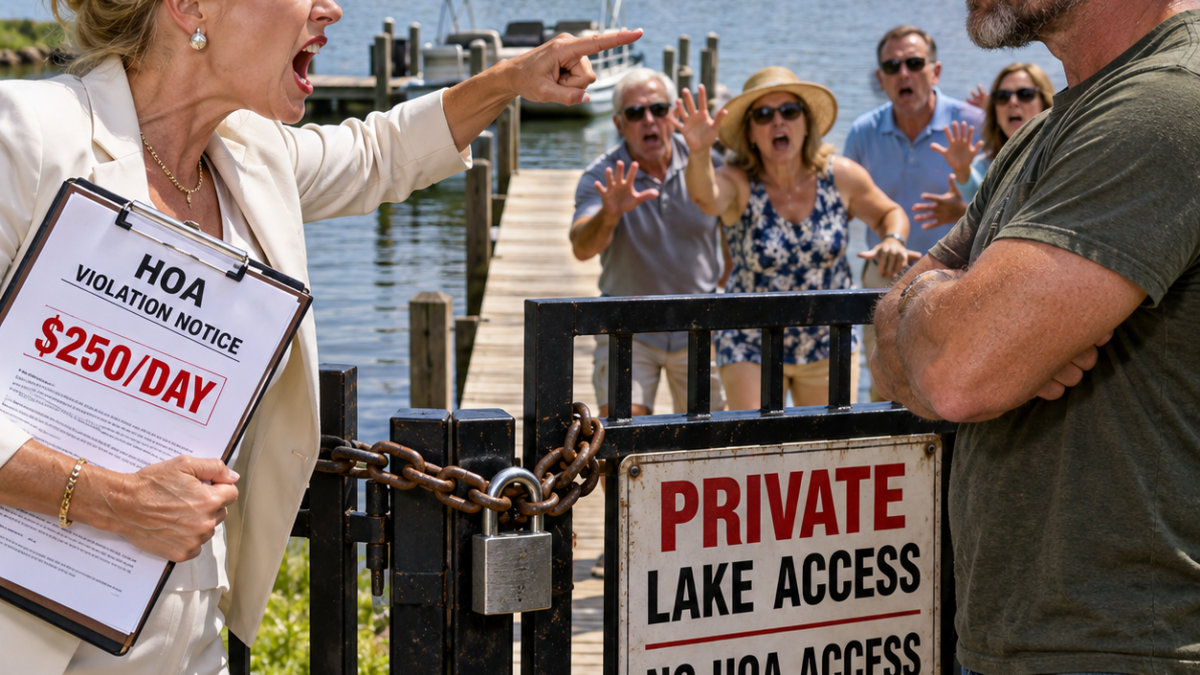
By the time Gail Whitaker realized the six-foot fence across the lakefront was perfectly legal, sixty of my neighbors were standing behind her with picnic tickets in their hands, a community pontoon boat was stranded on a trailer, and the shoreline she had promised them was locked behind a padlock whose key belonged to me.
For weeks, she had fined me $250 a day over a fifteen-year-old permitted dock, threatened a lien against the house I had just bought, and walked onto my property whenever she pleased because she believed being HOA president made her authority stronger than my deed.
What she still did not understand that Saturday morning was that I had stopped trying to beat her at her own game—and started following every word of her rules more carefully than she ever had.
My name is Ethan Brooks, and eight months before that scene I thought buying Lot 17 in Lakeshore Pines Estates was the best decision I had ever made.
The house sat on Lake Marin beneath tall pines, with a green lawn sloping gently toward the water and an old cedar dock extending from my shoreline. The dock had been there fifteen years, complete with a small bench and boat lift, and the county permit had transferred with the property. I bought a twenty-foot blue-and-white family boat, and the first Saturday I took it out, I remember sitting in the middle of the lake thinking I had finally bought myself peace.
Three weeks later, a yellow envelope was taped to my front door.
**NOTICE OF VIOLATION**
**UNAUTHORIZED DOCK STRUCTURE**
**FINE: $250 PER DAY UNTIL REMOVED**
I read it twice.
Then I laughed.
The letter was signed by Gail Whitaker, president of the Lakeshore Pines HOA.
Everyone seemed to know Gail before I did.
She wore a navy blazer with a little association badge even when she wasn’t attending meetings, spoke to adults as if she were conducting inspections, and had a reputation for treating minor rules like criminal statutes.
I called the HOA office.
Treasurer Phil Norton answered.
“Phil, I think there’s been a mistake.”
He lowered his voice.
“What kind?”
“I got a violation for my dock. It has a county permit.”
Silence.
Then he said, “That’s Gail’s decision.”
“Is Gail the county now?”
“No.”
“Then what’s the violation?”
“I just send the letters, Ethan.”
Two weeks passed.
Another notice arrived.
Then another.
My fines reached $3,750.
The latest envelope threatened a lien if I didn’t pay within ten days.
That afternoon, my neighbors Harold and Betty Miller waved me onto their porch.
Betty handed me iced tea.
Harold shook his head at the letters.
“She fined me over my mailbox once.”
Betty added, “She fined Margaret Evans for a wind chime.”
“A wind chime?”
“Wrong location.”
I thought they were joking.
They weren’t.
The following Saturday at seven in the morning, footsteps woke me.
I looked through the bedroom window.
Gail was standing on my lawn near the dock with a camera and clipboard.
No call.
No knock.
No permission.
I walked outside.
“Gail.”
She turned.
“Good. You’re awake.”
“You’re on my property.”
“I am inspecting an active violation.”
“You didn’t ask permission.”
“I don’t need permission to inspect association violations.”
I pointed toward the house.
“I want you to leave.”
She photographed my boat.
“That vessel is also inconsistent with neighborhood standards.”
“It is a normal family boat.”
“It’s excessive.”
“Where’s the architectural rule?”
“You never obtained approval.”
“I emailed the application three months ago.”
Her mouth curled into a small smile.
“Nothing in our records.”
That smile bothered me more than the fine.
That night I opened the full HOA rulebook.
One hundred twelve pages.
I read everything.
At 1:17 in the morning, I reached Article 4, Section 2.
Lakefront owners held **exclusive riparian rights**, including docks and watercraft.
I read it again.
Then Article 9.
No member or guest could enter a privately owned lot without written owner consent.
Then Rule 14.
Private lots could be secured using approved black chain-link fencing up to six feet high, provided the fence followed surveyed boundaries and displayed private-property signage.
I sat back in my chair.
For the first time since the yellow notices started arriving, I wasn’t angry.
I was curious.
The next morning, I drove to the county records office.
And what the clerk pulled from Lot 17’s file gave me a reason to stop arguing with Gail entirely.
PART 2
The clerk was a woman named Melissa Hart who had clearly spent enough years behind a county counter to recognize the difference between somebody looking for information and somebody preparing for war.
She took my parcel number, typed for less than a minute, and frowned at the screen.
“What exactly are you trying to verify?”
“My dock.”
“What about it?”
“My HOA says it’s unauthorized.”
Melissa looked at me over the rim of her glasses.
“Unauthorized by who?”
“That’s what I’m trying to figure out.”
She disappeared through a side door.
Ten minutes later she returned with a scanned permit file and a man wearing a county inspections polo.
“This is Tom Delgado. He handled waterfront structures for planning before moving to inspections.”
Tom pulled up a chair.
“You own Lot 17?”
“Eight months.”
He scrolled through the file.
“There it is.”
“What?”
“Original dock permit. 2009.”
He turned the monitor toward me.
Permit number.
Site plan.
Setback approval.
Dock dimensions.
Boat-lift authorization.
Final inspection.
Everything.
Tom clicked through the photographs.
Same dock.
Same cedar deck.
Same lift.
Even the bench.
“No violations?”
“None.”
“No expired approval?”
“Not how this permit works.”
“Any requirement that a later HOA approve it again?”
He shook his head.
“County doesn’t enforce HOA covenants, but as far as us? This structure was legally permitted and passed final inspection.”
I pulled out my phone.
“Would you put that in writing?”
Tom smiled.
“Been dealing with an HOA?”
“Is it that obvious?”
“The people who ask for things in writing usually are.”
He printed the permit history and signed a short verification letter.
I should have felt finished.
Instead I asked Melissa about shoreline ownership.
She pulled the deed.
Then the plat.
Then another document.
“Interesting.”
I was starting to hate that word.
“What?”
She zoomed in.
My lot extended all the way to the ordinary high-water line.
A twenty-foot shoreline strip I had assumed was shared landscaping was inside my parcel.
The walking path that curved along part of it wasn’t HOA property either.
It existed through a courtesy easement granted by the previous owner.
“Can I see the easement?”
She printed it.
It was short.
The former owner had allowed Lakeshore Pines residents to walk across part of Lot 17 to reach a common viewing point.
But there were conditions.
The HOA had to maintain liability coverage naming the lot owner as an additional insured.
Annual proof had to be provided.
Failure to maintain coverage allowed the owner to revoke access.
I read the insurance clause twice.
“When was the last proof filed?”
Melissa shrugged.
“County doesn’t track private compliance.”
That meant one more trip.
The man who sold me the house, Arthur Penn, lived twenty minutes away.
Seventy-seven.
Retired surveyor.
When I called, he remembered me immediately.
“House still standing?”
“So far.”
“Dock?”
“Apparently controversial.”
He laughed.
“You met Gail.”
That told me enough.
I drove over.
Arthur lived in a small brick ranch with a woodworking shed in back.
He made coffee, listened to the story, then leaned back in his chair.
“She’s fining you for the dock?”
“Two hundred fifty a day.”
“That’s new.”
“You never had trouble?”
“She hated the bench.”
“The bench?”
“Said it encouraged loitering.”
I stared at him.
“On your dock?”
“Correct.”
“What did you tell her?”
“That if I wanted to loiter on my property, I’d try to do it respectfully.”
I laughed.
Then showed him the easement.
Arthur’s expression changed.
“You found this.”
“County did.”
“Gail never asked.”
“Did the HOA keep the insurance current?”
Arthur stood.
“Wait.”
He disappeared into a hallway closet.
When he returned, he carried a dusty file folder.
Inside were insurance certificates from years earlier.
Then they stopped.
The last one was four years old.
“After that?”
“Nothing.”
“You asked?”
“Twice.”
“What happened?”
“Gail said their master policy covered everything.”
“Did it name you?”
“No.”
“So the condition lapsed.”
“That’s how I read it.”
I leaned back.
Arthur looked toward me.
“You’re thinking about closing the path.”
“Maybe.”
“Good.”
I expected enthusiasm.
Instead he said:
“Just know what you’re doing.”
“What does that mean?”
“The path isn’t the problem.”
“Gail is.”
“Yes.”
“But if you lock everybody out, innocent neighbors will be angry too.”
“I know.”
He tapped the easement.
“Then make sure you’re locking out the abuse, not just the people.”
That stayed with me.
Before I left, Arthur mentioned one more thing.
“You know she hosts Founders Day down there?”
“Where?”
“Your shoreline.”
I thought I’d misheard.
“My shoreline?”
“Every summer.”
“How many people?”
“Dozens.”
“Did you allow it?”
“The first year.”
“And after?”
“She acted like that was permanent.”
“Was it free?”
Arthur looked at me for a moment.
“No.”
“How much?”
“Last I heard, forty dollars a pass.”
My stomach tightened.
“You’re telling me the HOA sells tickets to use Lot 17?”
“She called it lake-access programming.”
“How many years?”
“Three that I know.”
I drove home with the survey on the passenger seat.
By the time I reached Lakeshore Pines, my anger had changed shape.
Fines were one thing.
Annoying.
Threatening.
Possibly invalid.
Selling access to my property was different.
I called Harold.
“You ever pay for Founders Day?”
“Every year.”
“How much?”
“Forty bucks.”
“Where is it held?”
He paused.
“Your shoreline.”
“Did you know that’s private property?”
Another pause.
“No.”
“Did Gail tell you it belonged to the HOA?”
“Yeah.”
I gripped the steering wheel.
“How many people come?”
“Fifty. Sixty. Sometimes more.”
“Where does the money go?”
“No idea.”
“Phil collects it?”
“Usually.”
The next thing I did was schedule an attorney.
Priya Nair worked out of a small office above a bank.
The source file spelled her name differently in one place, but the business card on her desk said **PRIYA NAIR — PROPERTY & ASSOCIATION LAW**, so that was the name I used.
She read everything.
Not dramatically.
No big reaction.
Permit.
CC&Rs.
Survey.
Courtesy easement.
Fine notices.
Emails.
She stopped occasionally to mark pages with tabs.
Twenty minutes later she looked up.
“The fines appear defective.”
“Appear?”
“I’m a lawyer. We charge by avoiding words like obvious.”
“Fine.”
“Also, their hearing procedure appears inconsistent with their own documents.”
“I haven’t had a hearing yet.”
“You will.”
“How do you know?”
“Because they’re threatening a lien.”
She held up the permit.
“The county permit is strong evidence.”
“Can the HOA still regulate docks?”
“Possibly, if valid covenants apply. But their own Article 4 gives lakefront owners exclusive riparian rights, and I don’t see a provision authorizing removal of a preexisting permitted structure like yours.”
“What about Gail coming onto my property?”
“Article 9 is remarkably clear.”
“And the easement?”
She read it again.
“Do you have evidence the insurance requirement isn’t being met?”
“Former owner says no certificates for four years.”
“We confirm with the carrier.”
“And if it’s lapsed?”
“You can revoke.”
I leaned forward.
“Immediately?”
“With proper notice, yes.”
She studied my face.
“What are you thinking?”
I told her.
Fence.
Signage.
Lock.
Founders Day.
She was quiet for a moment.
Then she smiled.
Not mischievously.
Professionally amused.
“Gail wrote or adopted Rule 14?”
“Apparently.”
“She wants strict compliance?”
“Very.”
“Then give her strict compliance.”
That became the strategy.
Not revenge.
Not yet.
Compliance.
First, we confirmed the liability problem.
The HOA’s carrier had not listed Lot 17’s owner as an additional insured for years.
No certificate.
No endorsement.
No cure.
Priya drafted a certified notice revoking the courtesy easement.
It identified the parcel.
Quoted the insurance condition.
Documented the lapse.
Revoked all permissive community access.
Required written owner consent for entry.
Then she sent separate notice disputing the fines.
Phil signed for both.
He called me that afternoon.
“Ethan.”
“Yeah?”
“You really revoked the lake path?”
“I revoked access across my property.”
“Gail is furious.”
“Did she read the notice?”
Silence.
“Phil?”
“She threw it away.”
I stared at the phone.
“What?”
“She said you’re bluffing.”
“It’s certified legal notice.”
“I know.”
“Does she?”
“She knows.”
“Then why throw it away?”
He lowered his voice.
“Because Gail doesn’t do well with no.”
That sentence explained almost everything that happened later.
Four days after notice, the fence crew arrived.
Black chain link.
Six feet.
Exactly what Rule 14 allowed.
I had the survey pins exposed beforehand.
The contractor measured twice.
Priya made me photograph every line.
“No shortcuts,” she said.
“I wasn’t planning any.”
“I know. That’s why I’m reminding you.”
Posts went in.
Concrete set.
Fence followed my property edge without touching the public road or blocking common land.
The gate sat where the old courtesy path entered Lot 17.
I hung red-and-white signs.
**PRIVATE PROPERTY**
**NO ENTRY WITHOUT WRITTEN OWNER CONSENT**
**LOT 17**
Harold watched from his yard.
He eventually wandered over.
“You’re actually doing it.”
“Apparently.”
“Gail’s going to lose her mind.”
“That isn’t the goal.”
He looked at me.
“Sure.”
“It isn’t.”
“Sure.”
I handed him the survey.
He read.
“Wait.”
“What?”
“This whole strip is yours?”
“Yes.”
“The picnic area?”
“Yes.”
“The boat-loading patch?”
“Yes.”
“The little bench under the pine?”
“Yes.”
He whistled.
“I’ve lived here eleven years.”
“I’ve lived here eight months.”
“And you’re the one who checked?”
“That seems to be the problem.”
By noon, half the street had driven past slowly.
Phones out.
Neighbors talking.
One man stopped.
“You closing the lake?”
“No.”
“That fence looks like you’re closing the lake.”
“The lake is still there.”
“Can we get through?”
“Not across my lot without permission.”
His face tightened.
“We’ve always used it.”
“Under an easement.”
“So?”
“It lapsed.”
“Because you wanted it to.”
“No. Because the HOA failed the insurance condition.”
He looked confused.
“Gail said this shoreline belongs to the community.”
“Gail should read the survey.”
He left without responding.
Two hours later, the HOA email arrived.
**MANDATORY FOUNDERS DAY LAKE PICNIC**
Saturday.
11:00 a.m.
Community shoreline.
Guests welcome.
Forty-dollar tickets.
I stared at the screen.
My fence had been up less than a day.
Either Gail hadn’t seen it—
or she intended to ignore it.
I forwarded the email to Priya.
Her response:
**Send final written notice. Do not threaten.**
I emailed Gail.
Certified copy too.
Lot 17 was private.
Easement revoked.
No permission for Founders Day.
No ticketed event.
No HOA entry.
Her reply arrived three minutes later.
**Nice try.**
That was all.
I called the sheriff’s non-emergency line.
Deputy Kyle Brennan took the call.
I explained ownership.
Survey.
Revocation.
Certified notice.
Upcoming event.
“Anybody threatening violence?”
“No.”
“Any dispute over boundary markers?”
“No. Survey’s recent and recorded.”
“They’re aware access is revoked?”
“Yes.”
“Written notice?”
“Yes.”
“Keep copies with you.”
“What happens if they enter?”
“If they’re clearly notified and enter anyway, we deal with trespass. If they damage your fence or lock, that’s separate.”
“You’ll come?”
“If needed.”
“I don’t want a scene.”
He paused.
“Then don’t create one.”
“I wasn’t planning to.”
“Good. Let them decide how Saturday goes.”
Friday night I barely slept.
That’s the part people skip when they tell stories about “malicious compliance.”
They imagine you’re sitting in the dark laughing while some perfect revenge plan unfolds.
I wasn’t laughing.
I kept wondering whether I’d gone too far.
Arthur’s warning repeated in my head.
Don’t punish the people for Gail’s abuse.
Residents had used that path for years.
Children fished near the shoreline.
Older couples walked at sunset.
Most had no idea insurance had lapsed.
Most had no idea the land was mine.
Was fencing them out fair?
At midnight I almost unlocked the gate.
Then I looked at the latest fine statement.
$250 per day.
The total had climbed past $8,000.
The letter still threatened a lien.
Gail had walked onto my land after being told to leave.
She had ignored my permit.
Ignored the survey.
Ignored Priya’s letter.
Ignored certified notice.
And now she was selling tickets again.
I left the lock closed.
Saturday morning was beautiful.
Of course it was.
Perfect blue sky.
No wind.
The lake almost flat.
At 9:30, I made coffee.
At 10:00, I sat on my dock.
At 10:30, Harold appeared on the other side of my fence.
“You okay?”
“Why wouldn’t I be?”
“You’ve checked the road eleven times.”
“I have not.”
“Twelve.”
Betty joined him.
She held up two Founders Day tickets.
“You bought tickets?”
“Months ago.”
I winced.
“I’m sorry.”
She shrugged.
“Not your fault.”
“I could let you in.”
“No.”
“Betty—”
“If Gail sold access she didn’t own, she can explain it.”
Harold smiled.
“That’s my girl.”
At 10:45, truck engines came around the corner.
First Gail’s SUV.
Then a pickup towing the HOA pontoon boat.
Then another vehicle loaded with folding tables.
Coolers.
Benches.
Children.
Families.
About sixty people.
They turned toward Lot 17.
Then stopped.
I watched the recognition move through them.
Six-foot black chain link.
Red signs.
Locked gate.
Nobody had expected it.
Gail got out.
She stared.
Her face changed so quickly Harold whispered:
“Oh, Lord.”
She marched toward the fence.
“Ethan!”
I stood.
Walked up from the dock.
Stopped inside the gate.
“Morning, Gail.”
“What is this?”
“A fence.”
“Don’t be cute.”
“You asked.”
“You cannot restrict HOA lake access.”
“I didn’t.”
She pointed at the padlock.
“That looks restricted.”
“This is Lot 17.”
“The shoreline is a community amenity.”
“Your resolution doesn’t change title.”
She looked behind her.
People were listening.
Gail lowered her voice.
“Open this gate.”
“No.”
“Now.”
“No.”
Her cheeks reddened.
“I am directing you as association president.”
I held up the handbook.
“Rule 14.”
Her eyes narrowed.
I read it.
Approved black chain-link fencing.
Up to six feet.
Private-property signs.
She stared at me.
Then I turned pages.
“Article 9.”
No member or guest may enter a private lot without owner consent.
I looked at the crowd.
“My name is on Lot 17.”
Silence.
“I do not consent to this event.”
Betty looked at her ticket.
A man near the pontoon said:
“Gail, you said this belonged to us.”
Gail turned.
“It does.”
I held up the recorded survey.
“No.”
She spun toward Phil.
“Get the bolt cutters.”
Phil froze.
“What?”
“From the maintenance truck.”
“Gail—”
“Get them.”
“I don’t think that’s a good idea.”
She marched toward the truck herself.
My stomach tightened.
I took out my phone.
“Gail.”
She returned carrying cutters.
“I’m recording.”
“I don’t care.”
“You’ve received written notice.”
She put the cutters around my padlock.
“Move.”
“That’s my property.”
“You’re obstructing association access.”
“If you cut that lock, you’re damaging private property after notice.”
She looked me dead in the eye.
“I’m president of this HOA.”
Then she squeezed.
Metal snapped.
The broken padlock hit the ground.
She shoved the gate open.
One step.
Two.
Five.
Six.
A patrol SUV rolled up behind the crowd.
Deputy Brennan stepped out.
“Ma’am.”
Gail stopped.
“Stop right there.”
The whole street went silent.
He walked toward us.
Looked at the broken lock.
Then the gate.
Then Gail.
“Are you Gail Whitaker?”
“Yes, and I’m glad you’re here.”
“I bet.”
She pointed at me.
“This homeowner has illegally blocked a community amenity and is preventing a sanctioned association event.”
Kyle looked at me.
“Mr. Brooks?”
I handed him the folder.
Survey.
Deed.
Revocation.
Certified receipt.
Email.
Gail’s **Nice try** response.
He read each.
Then he looked at the cut padlock.
“You cut this?”
Gail crossed her arms.
“As association president, yes.”
“You received notice the property owner revoked access?”
“The HOA disputes that.”
“Received it?”
She hesitated.
“Yes.”
“Mr. Brooks told you not to enter?”
“He has no authority to—”
“Did he?”
Another pause.
“Yes.”
Kyle nodded.
“Then step back outside the fence.”
“This is ridiculous.”
“Outside.”
She didn’t move.
He repeated:
“Ma’am.”
Something in his voice changed.
Gail stepped out.
Kyle closed the gate.
He looked at the broken lock.
“Mr. Brooks, value?”
“About eighty dollars.”
Gail scoffed.
“Eighty dollars?”
Kyle looked at her.
“The dollar amount isn’t your main problem.”
“What main problem?”
“You were notified.”
“I am the HOA president.”
He almost smiled.
“Ma’am, the law doesn’t have a blazer exemption.”
A few people laughed.
Gail’s face went crimson.
Kyle began writing.
Criminal trespass citation.
Property damage.
The exact charge classification would be decided later, but he documented everything.
Her hand shook when she signed the citation.
I said nothing.
Didn’t need to.
Betty stepped forward.
She held up the ticket.
“Gail.”
Gail looked at her.
“We paid forty dollars for this.”
“This event will be rescheduled.”
“You told us the shoreline belonged to the HOA.”
“It does.”
Kyle looked at the survey again.
Betty continued.
“So why is the deputy saying it doesn’t?”
“I didn’t say—”
A man shouted:
“Where does the picnic money go?”
Another:
“Refund us.”
Another:
“I bought six tickets.”
Phil looked like he wanted the earth to open under him.
Gail turned.
“Phil, don’t.”
That was the wrong thing to say.
Everybody heard it.
Phil stared at her.
Then at the deputy.
Then at the cash box he was carrying.
“I can’t do this.”
Gail’s voice sharpened.
“Do what?”
He swallowed.
“Keep pretending.”
“Phil.”
“The ticket money isn’t in the regular event account.”
The crowd went silent.
Gail stepped toward him.
“Stop talking.”
Kyle moved slightly between them.
Phil continued.
“She told me to put it into a separate account.”
A man asked:
“How much?”
Phil looked sick.
“About forty-eight thousand dollars over three summers.”
The reaction was instant.
“What?”
“Forty-eight thousand?”
“For picnics?”
“Where is it?”
Gail shouted:
“Those funds are accounted for.”
Phil shook his head.
“Not properly.”
“Phil!”
“You told me the shoreline agreement made it legal.”
“It did.”
“You told me Arthur Penn had transferred permanent access.”
My attention snapped toward him.
“No, he didn’t.”
Phil looked at me.
“I know that now.”
Gail said:
“Do not discuss financial records on the street.”
Betty held up the ticket.
“You sold us access to Ethan’s yard.”
Gail pointed at me.
“He is twisting technicalities.”
Priya’s voice came from behind the crowd.
“No.”
I hadn’t known she was coming.
She stepped forward carrying a thin folder.
“Title isn’t a technicality.”
Gail stared.
“Who are you?”
“Priya Nair. Mr. Brooks’s attorney.”
That changed the scene again.
Priya handed Kyle a copy of the revoked easement and the insurance verification.
Then she faced the residents.
“The former courtesy easement was conditional on liability coverage naming the owner. That condition has not been met for years.”
Gail snapped:
“Because our master policy covers common amenities.”
Priya said:
“Lot 17 is not a common amenity.”
“It has functioned as one.”
“Use doesn’t transfer title.”
“Residents have relied on it.”
“Then the HOA should have maintained the agreement.”
No one had an answer to that.
Gail turned toward me.
“You planned this humiliation.”
I felt heat rise.
Part of me wanted to say yes.
Wanted to enjoy it.
Then I remembered Arthur.
The problem was Gail.
Not sixty confused neighbors.
“No.”
I nodded toward the fence.
“I planned to keep people from entering my property after you ignored the notice.”
“Same thing.”
“No.”
“You knew Founders Day was today.”
“You emailed everybody after the fence went up.”
“That was scheduled months ago.”
“And I warned you.”
“You wanted this scene.”
I looked at the broken lock on the ground.
“I didn’t put the bolt cutters in your hands.”
She had no answer.
Kyle told everyone the event could not proceed on Lot 17.
Families started leaving.
Some angry at Gail.
Some angry at me.
A few embarrassed.
Children disappointed.
That part hurt.
A little girl asked her mother:
“Are we not having the picnic?”
Her mother crouched.
“We’ll do something else.”
I turned away.
Revenge looks cleaner when you don’t have to see the innocent people standing around it.
Harold noticed.
“You okay?”
“No.”
“You did the right thing.”
“Tell the kids.”
He looked toward them.
“Gail sold something that wasn’t hers.”
“I know.”
“You letting her do it again wouldn’t make that better.”
Maybe.
At noon, the shoreline was quiet.
The pontoon left.
Tables left.
Coolers left.
The fence remained.
Priya stayed behind.
“Regret it?”
I looked at the dock.
“Some.”
“Good.”
I frowned.
“You wanted me to regret it?”
“I wanted you to understand this wasn’t entertainment.”
“I do.”
“Then we’re fine.”
She picked up the broken padlock.
“Keep this.”
“Why?”
“Evidence.”
“Of course.”
Within twenty-four hours, Lakeshore Pines turned on itself.
Residents demanded event-account records.
Insurance records.
Board minutes.
Fine schedules.
Phil called an emergency board meeting.
Gail tried to cancel it.
The other directors overruled her.
Then the insurance problem exploded.
Because the courtesy easement had lapsed, the HOA’s carrier reexamined whether its policy covered association-sponsored events on private shoreline.
The answer was ugly.
Not only had Gail been hosting paid gatherings on property the HOA didn’t own, she’d apparently represented the shoreline as an association-controlled amenity on renewal paperwork.
The carrier issued a reservation of rights and threatened nonrenewal unless the HOA corrected the exposure.
Residents panicked.
Insurance for one hundred twenty homes wasn’t something Gail could dismiss as a technicality.
The county also opened a financial review of the separate ticket account after complaints about the paid lake-access program.
I wasn’t part of that investigation.
I learned details later through board records and the emergency meeting.
Priya focused on my fines.
By the week after Founders Day, they had reached more than ten thousand dollars.
She sent a formal demand:
Void them.
Withdraw lien threat.
Correct my account.
Reimburse legal costs caused by improper enforcement.
The HOA’s attorney responded for the first time.
Not Gail.
An actual law firm.
The lawyer asked for time.
Priya gave them five days.
Gail emailed me directly.
**You are destroying this community over a dock.**
I forwarded it to Priya without answering.
She replied:
**Excellent decision.**
The emergency meeting was scheduled for Thursday.
All one hundred twenty households were notified.
By six-thirty, the clubhouse parking lot was full.
People stood outside.
I sat beside Priya near the front.
Harold and Betty were behind us.
Phil looked gray.
Gail sat at the board table wearing the navy blazer.
Badge still pinned.
That surprised me.
Maybe it was armor.
The association attorney started.
“This meeting concerns governance, financial controls, pending enforcement matters, and officer conduct.”
Gail interrupted.
“It concerns an organized campaign against me.”
The lawyer looked at her.
“Please don’t.”
She leaned back.
Phil presented the event account first.
Over three summers, $48,000 had been collected from paid shoreline events.
Some money went toward food.
Boat fuel.
Rental tents.
Music.
But records were inconsistent.
Receipts missing.
Cash deposits delayed.
Transfers into a discretionary “community programming” account controlled largely through Gail’s authorization.
No evidence showed Gail simply pocketed all the money, and I didn’t want the story turned into something it wasn’t.
The problem was governance.
No valid agreement allowed the HOA to sell access to Lot 17.
No complete event accounting existed.
No board vote authorized several expenses.
Residents had been told they were paying for access to HOA property.
They weren’t.
Then Priya stood.
She projected the survey.
Lot 17 highlighted.
Twenty-foot shoreline strip.
Dock.
Walking path.
Fence.
Everything.
“This is county-recorded title.”
No drama.
She moved to the permit.
“Dock approved in 2009.”
Then Article 4.
“Exclusive riparian rights.”
Then Article 9.
“No member or guest may enter a private lot without written owner consent.”
Then Rule 14.
Black chain-link fence.
Six feet.
Signs.
A resident laughed.
“You’re kidding.”
Priya shook her head.
“No.”
Someone asked:
“Who wrote Rule 14?”
Phil looked at Gail.
That was enough.
Gail leaned toward the microphone.
“These provisions were never intended to be weaponized against the community.”
I felt my jaw tighten.
Priya stayed calm.
“They were enforced against Mr. Brooks.”
“His dock altered neighborhood aesthetics.”
“The dock predates him.”
“He failed to apply.”
I pulled out the email.
“June 3.”
She looked at me.
“My application.”
Phil’s head snapped up.
“What?”
I handed the printed email to Priya.
She projected it.
Sent to HOA architectural committee.
Attachments.
Dock photos.
County permit.
Boat specifications.
Read receipt.
One recipient.
Gail Whitaker.
The room became silent.
Gail stared at the screen.
Phil said:
“You told us there was no application.”
“I didn’t recall receiving it.”
I spoke.
“You replied.”
Priya changed slides.
Gail’s response:
**Received. Will review.**
That was the moment I saw Phil stop defending her in his own head.
He leaned away.
Gail recovered quickly.
“Receipt isn’t approval.”
“No,” Priya said. “But it destroys the claim that no application existed.”
The HOA attorney rubbed his forehead.
Priya continued.
“There is another procedural problem.”
Fine notice requirements.
The association’s covenants required a written hearing opportunity before continuing daily fines past an initial compliance period.
Mine had been assessed continuously before a proper hearing.
At the one hearing Gail eventually scheduled, the board had refused to consider the county permit and voted without making written findings.
Priya had requested the audio.
There wasn’t any.
Meeting minutes simply said:
**Violation affirmed based on community standards.**
The attorney looked miserable.
Priya finished:
“The fines are indefensible.”
A resident shouted:
“Then why did we threaten his house?”
Another:
“Who else got fined like this?”
Betty stood.
“The widow with the wind chime.”
Harold added:
“My mailbox.”
A woman near the aisle:
“My basketball hoop.”
Another:
“My Christmas lights.”
Voices spread.
The meeting was no longer about my dock.
It was about years of people being too tired or intimidated to ask whether the president’s decisions were actually authorized.
Gail banged the gavel.
“This association has standards because standards preserve values.”
Harold stood.
“Nobody’s arguing against rules.”
She glared at him.
He continued.
“We’re arguing against you deciding what the rules mean depending on who you’re mad at.”
Applause.
She banged again.
“Order.”
Phil reached toward the gavel.
“Gail.”
She looked at him.
“Stop.”
The room froze.
Phil was soft-spoken.
Everybody knew it.
Hearing him challenge her felt more dramatic than shouting.
He took a breath.
“You told me Ethan never applied.”
“He wasn’t approved.”
“You said he never applied.”
She said nothing.
“You told me the shoreline belonged to us.”
“We have historic rights.”
“The survey says otherwise.”
“Surveys can be interpreted.”
Priya said:
“Not that creatively.”
Laughter moved through the room.
Gail’s face reddened.
Phil opened another file.
“You told me the Founders Day account was approved by the board.”
“It was.”
“Show me the vote.”
Silence.
“Gail.”
She looked at him.
“You signed checks.”
“Yes.”
His voice shook.
“And I’m responsible for that.”
The honesty changed the energy in the room.
He continued.
“I should’ve asked more questions.”
Gail said:
“Don’t perform remorse because you’re scared.”
Phil actually flinched.
Then something in him settled.
“No.”
He looked around.
“I’m saying I was wrong.”
That was the first apology residents had heard from any board member.
It mattered.
Then the association attorney cleared his throat.
“The board has received a motion signed by three directors requesting removal of the president under the bylaws.”
The room erupted.
Gail shot to her feet.
“You cannot do this tonight.”
The lawyer said:
“The bylaws permit it.”
“Not during pending legal matters.”
“They do.”
“This is retaliation.”
“It’s governance.”
She turned toward the residents.
“You are letting one angry newcomer dismantle everything we’ve built.”
I stood.
I didn’t mean to.
But her eyes were on me.
“I’m not asking anyone to remove you.”
She laughed.
“Of course you are.”
“No.”
I looked around.
“My dock is permitted.”
I held up the survey.
“My property is mine.”
Then toward Phil.
“Your money is your business.”
I looked back at Gail.
“What happens to you isn’t my vote.”
That was important to me.
I had locked my gate.
I had defended my land.
But if they removed her, it had to be because they decided she’d abused their trust.
Not because I demanded punishment.
The board voted first.
Then, under the governing documents, the members ratified removal.
The final member vote was ninety-six to twelve.
Gail lost.
For several seconds she didn’t move.
Then she reached up.
Unpinned the HOA badge.
Set it on the table.
That tiny metallic click became the loudest sound in the room.
She gathered her folder.
Before leaving, she stopped near me.
“Happy?”
I looked at her.
“Not really.”
“You got what you wanted.”
“My dock?”
She stared.
“My dock was already legal.”
She walked away.
The meeting didn’t end there.
The board voted to void my dock fines.
Then appointed a committee to review prior enforcement actions.
Over the next two months, several homeowners received refunds or reversals for penalties that had been improperly imposed.
Not every fine.
Some people really had violated valid rules.
But mailbox-color penalties based on nonexistent standards?
Refunded.
The widow’s wind-chime fine?
Refunded.
A series of improperly noticed landscaping penalties?
Refunded.
Harold received a check.
He held it up on my porch.
“One hundred seventy-five dollars.”
“Retirement.”
“I’m buying steak.”
Betty said:
“You’re buying groceries.”
He looked disappointed.
The HOA also replaced its event accounting procedures.
No cash event account controlled by one officer.
No paid activity on property without proof of ownership or written license.
No enforcement fine above a threshold without documented hearing procedures.
The insurance issue took longer.
The carrier didn’t instantly “drop” everyone the way rumors claimed.
Instead, the HOA faced a coverage problem serious enough that renewal was threatened unless lake-access arrangements were corrected.
That put something unexpected on me.
The new interim president was Harold.
He hated that.
“I was drinking iced tea two months ago.”
“Now you’re government.”
“Don’t insult me.”
He and Priya came to my house.
“We want to discuss the path,” he said.
I looked at Priya.
“She made me come.”
“I advised him you might be willing to negotiate.”
“Why?”
Harold pointed toward the fence.
“Because Mrs. Jennings is seventy-two and has walked that shoreline every evening for nine years.”
I knew Mrs. Jennings.
White hair.
Red walking shoes.
Always waved.
He continued.
“And the kids used the fishing spot.”
“I know.”
“No paid events.”
“Good.”
“No assumption it’s HOA property.”
“Better.”
“Insurance gets fixed.”
“Required.”
“Written agreement.”
“Absolutely.”
He sighed.
“Then what do you want?”
I thought about Arthur’s warning.
Lock out the abuse.
Not the people.
“I want control over my property.”
“Fair.”
“I want the dock excluded from community use unless I specifically invite people.”
“Fine.”
“I want no commercial or ticketed event.”
“Fine.”
“Walking path during daylight?”
“Yes.”
“No alcohol events.”
“Fine.”
“HOA maintains insurance naming me.”
“Yes.”
“Annual proof.”
“Yes.”
“I can revoke if terms are violated.”
Harold looked at Priya.
She said:
“Reasonable with notice provisions.”
He looked back at me.
“Anything else?”
“No.”
“You’re making this disturbingly easy.”
“Ask before taking.”
He nodded.
“Apparently that’s the trick.”
We drafted a new agreement.
Real this time.
Recorded.
Clear.
The walking path reopened.
The fence stayed.
The gate got a new lock.
Residents received access during agreed hours.
The first evening it reopened, Mrs. Jennings walked past.
She stopped on the other side.
“Ethan?”
“Yes?”
“May I come through?”
I laughed.
“You don’t have to ask every day.”
“I know.”
She pointed to the sign.
“Feels polite.”
I unlocked the gate.
“Come on.”
She walked toward the lake.
No ticket.
No clipboard.
No argument.
That’s what sharing was supposed to look like.
A few days later, I saw Gail again.
She stood on the public side of the fence near sunset.
No navy blazer.
No badge.
Just jeans and a gray sweater.
I almost stayed inside.
Then I walked down.
She watched the water.
“You keeping the fence?”
“Yes.”
“Looks ugly.”
I laughed despite myself.
“That sounds familiar.”
She looked at me.
For once, there was no anger in her face.
Mostly fatigue.
“I thought I was protecting the community.”
“I know.”
“You don’t believe me.”
“I do.”
That surprised her.
I leaned against the fence.
“I think you started that way.”
She looked back at the lake.
“Standards matter.”
“Yes.”
“If everyone does whatever they want, places decline.”
“Sometimes.”
“People don’t understand how quickly neighborhoods fall apart.”
I nodded.
“Maybe.”
She looked at me.
“Then why did you fight me so hard?”
“Because protecting a community doesn’t give you ownership over everyone in it.”
Her jaw tightened.
“I never said I owned you.”
“You fined a permitted dock because you didn’t like it.”
“You ignored association aesthetics.”
“I submitted an application.”
“You didn’t wait for approval before using the boat.”
“The dock already existed.”
She exhaled.
“You always have an answer.”
“No.”
I shook my head.
“I had documents.”
That landed.
She looked down.
After a moment she said:
“Phil told the auditor everything.”
“Good.”
“He made me sound like a criminal.”
“I wasn’t in those conversations.”
“Forty-eight thousand dollars sounds huge when people say it all at once.”
“It is huge.”
“It was three years of events.”
“Then records should prove where it went.”
“They mostly do.”
“Good.”
“Mostly.”
I didn’t press.
That wasn’t my fight anymore.
She reached toward the fence, then stopped before touching it.
“I should’ve read the easement.”
“Yes.”
“I should’ve opened Priya’s letter.”
“Yes.”
“You enjoy saying that.”
“A little.”
She almost smiled.
Then she asked:
“Why did you reopen the path?”
“Because the neighbors weren’t the problem.”
She looked toward the water.
“And I was?”
“Your decisions were.”
She nodded slowly.
That was the closest thing to an apology I ever got from her.
Maybe it was enough.
The financial audit ultimately found poor controls, improper account handling, and expenditures that had not followed required board procedures.
Not every rumor residents spread proved true.
There wasn’t a suitcase of stolen cash.
No secret yacht.
No hidden mansion.
Reality was less cinematic.
Gail had treated association accounts like executive tools instead of member funds requiring oversight.
Event revenues were commingled.
Receipts were incomplete.
Some expenditures lacked approval.
That was serious enough.
Phil accepted his share of responsibility.
He resigned as treasurer but stayed in the neighborhood.
Months later he stopped by while I was washing my boat.
“Still mad at me?”
“Depends.”
“On?”
“You bringing another fine?”
“No.”
“Then less.”
He laughed.
“I should’ve told you earlier.”
“About the account?”
“About Gail.”
“You did warn me.”
“I whispered.”
“That’s not the same.”
“No.”
He sat on the end of the dock.
“I spent years telling myself I was just the guy sending letters.”
I turned off the hose.
“You weren’t.”
“I know.”
“You signed checks too.”
“I know.”
We sat quietly.
Then he said:
“She was exhausting.”
“That’s your defense?”
“No.”
He rubbed his hands together.
“Just the truth.”
I understood.
People imagine controlling leaders rule because everyone around them agrees.
Often they rule because everyone around them gets tired.
Tired of arguing.
Tired of being targeted.
Tired of meetings.
Tired of being called difficult.
Tired of checking whether every decision is legal.
Eventually, silence starts looking like peace.
Until somebody receives a $250-a-day fine for a dock that has been legal fifteen years.
I asked:
“What are you going to do now?”
“Not be treasurer.”
“Strong plan.”
He smiled.
“And ask more questions.”
“Better.”
Summer returned.
My dock remained.
My boat remained.
The fence remained too.
At first I thought the chain link would make the property feel like a compound.
Instead vines eventually softened parts of it.
I planted native shrubs nearby.
The HOA couldn’t complain.
Priya made sure.
Harold became surprisingly good at being interim president.
His first meeting lasted forty-two minutes.
Betty told me Gail’s shortest had been two hours.
“How?”
I asked.
“He only discusses things that require discussion.”
“Revolutionary.”
The board updated procedures.
No officer inspected private property alone.
No daily fine without written authority identifying the exact rule.
No lien referral without legal review.
No paid use of private land without an agreement.
No event tickets without published accounting.
The changes weren’t dramatic.
That’s why they worked.
Rules stopped being Gail’s voice.
They became procedures.
A year after the fence incident, Founders Day returned.
Not on my shoreline.
The HOA rented the county park on the west side of Lake Marin.
Proper permit.
Insurance.
Restrooms.
Public parking.
Ticket price was twelve dollars.
Harold sent me two free passes.
I called him.
“Bribery?”
“Formerly known as community programming.”
“I thought you banned me.”
“Betty says you have to come.”
That settled it.
I went.
Children ran around.
Music played.
Phil operated the grill badly.
Mrs. Jennings complained the park’s view wasn’t as nice as my shoreline.
I told her she was biased.
Near sunset, Harold stood beside me.
“You know, this is easier.”
“What?”
“Using property we’re allowed to use.”
“Remarkable.”
He laughed.
Then he became serious.
“People blamed you at first.”
“I know.”
“Some still do.”
“I know.”
“You okay with that?”
I watched kids throwing rocks into the lake.
“Not really.”
He glanced over.
“Thought you’d say yes.”
“I don’t like being hated.”
“Fair.”
“But I’m okay being disliked if the alternative is pretending something belongs to someone else.”
He nodded.
“That sounds healthier.”
“Priya would bill me for saying that.”
He laughed.
My legal dispute formally closed a few months later.
All fines void.
Lien threat withdrawn.
Part of my legal fees reimbursed through settlement.
The trespass and property-damage citation against Gail resolved through local court procedures.
She paid restitution for the lock and completed the conditions imposed.
Nothing movie-like.
No prison.
No dramatic judge pounding a gavel.
Just consequences.
That suited me.
I kept the broken padlock in a drawer for almost a year.
One afternoon, Arthur visited.
He wanted to see what I’d done with his old place.
We walked to the dock.
He sat on the bench.
“Still here.”
“Apparently unauthorized.”
He laughed.
“You keep the lock?”
“Yeah.”
“Why?”
I shrugged.
“Reminder.”
“Of Gail?”
“Maybe.”
Arthur looked at me.
“Throw it away.”
“You and Priya have a club?”
“No.”
“Why does everyone want me to throw evidence away?”
“Because it’s not evidence anymore.”
He looked across the lake.
“Keeping a broken lock is how you let the fight keep owning shelf space.”
I considered that.
Then tossed it into the scrap bin the next day.
He was right.
The fence itself became less symbolic over time.
It was just a fence.
The gate stayed locked when I wasn’t home.
Open during path hours.
Children learned not to run onto the dock unless invited.
Neighbors stopped calling it “the community shoreline.”
They called it “Ethan’s place.”
That tiny language change meant more than I expected.
One Saturday, a family new to Lakeshore Pines stopped beside the gate.
The father said:
“Are we allowed through here?”
“Path hours are posted.”
He read the sign.
“Oh.”
His daughter pointed at my dock.
“Can we fish?”
I said:
“Not from the dock today.”
She looked disappointed.
Then I added:
“There’s a bank spot twenty yards down the path.”
Her face brightened.
“Thanks!”
That was it.
Question.
Answer.
Boundary respected.
No insult.
No authority fight.
Nobody collapsed from hearing no.
I thought of Gail.
She’d treated every refusal as rebellion.
Maybe because power feels strongest when nobody tests its edge.
Years later, Betty died.
Harold sold their house six months after that.
The day before closing, he came over.
We sat on the dock with two beers.
He looked older.
“Never thought I’d leave.”
“I know.”
“Too quiet without her.”
I didn’t know what to say.
So I didn’t.
After a while he pointed toward the fence.
“You know what Betty loved most about that whole mess?”
“What?”
“The look on Gail’s face.”
I laughed.
“That sounds like Betty.”
“She also liked that you reopened the path.”
“That sounds more respectable.”
“She contained multitudes.”
We sat in silence.
Then Harold said:
“You saved this neighborhood.”
“No.”
“You did.”
“I locked a gate.”
“Exactly.”
I looked at him.
He continued.
“Not because of the gate itself.”
“I know.”
“People had stopped asking questions.”
That was true.
“You gave everyone a reason.”
I shook my head.
“Gail gave them the reason.”
“You gave them the fence.”
Fair enough.
Harold left the next morning.
The new owner repainted his old mailbox.
Bright red.
Nobody fined him.
I sent Harold a picture.
He replied:
**Civilization has fallen.**
I laughed for five minutes.
Gail eventually moved too.
Not immediately.
About eighteen months later.
I heard she bought a condo closer to her daughter.
No HOA office there, someone joked.
I didn’t ask whether that was true.
By then I didn’t care enough.
The lake stayed.
That’s the funny thing about all those fights.
At the time, they felt enormous.
Fines.
Meetings.
Surveys.
Attorneys.
Police.
Votes.
Insurance.
Everybody acting like civilization depended on who controlled twenty feet of grass.
And through all of it, Lake Marin kept moving against the dock posts exactly the same way.
Water doesn’t know who the HOA president is.
One summer evening, I sat at the end of the dock.
My boat was tied beside me.
A family walked the permitted path behind the fence.
Mrs. Jennings—older now, slower—came through the gate.
She stopped.
“You mind if I sit?”
“On the bench?”
“Yes.”
“Go ahead.”
She sat.
For a while we watched the water.
Then she said:
“I remember the day Gail cut your lock.”
“So do I.”
“Everybody thought you were crazy.”
“I know.”
“I thought you were.”
“Thanks.”
She smiled.
“I mean before we knew.”
“I know.”
“She told us you were trying to privatize the lake.”
“I don’t own the lake.”
“You own more shoreline than she did.”
“That wasn’t hard.”
Mrs. Jennings laughed.
Then she became quiet.
“You could’ve kept us locked out.”
“Yes.”
“Why didn’t you?”
I looked at the path.
“Because I never wanted to keep you out.”
She nodded.
“That difference matters.”
I thought about it long after she left.
The original title people gave the story later was always some version of:
**HOA Fined Man for Dock, So He Locked Them Out of Lake.**
It sounded clean.
Funny.
Revenge.
But that’s not really what happened.
I never locked anyone out of Lake Marin.
There were other public access points.
Boat ramps.
County park shoreline.
Private lots.
What I locked was my own gate.
What I stopped was the assumption that friendliness created ownership.
That’s different.
The HOA’s mistake had begun years before I arrived.
Arthur had allowed access.
Then repeated use started feeling permanent.
The HOA forgot the condition.
Insurance lapsed.
Events grew.
Tickets appeared.
People stopped remembering where the legal line actually was.
Then Gail arrived with the personality to turn a bad assumption into policy.
By the time I bought the place, she wasn’t acting like she was borrowing access.
She believed the association possessed it.
That belief became strong enough for her to fine the owner of the land she was using.
That’s the part that still amazes me.
Not that she was mean.
She wasn’t always.
Not that she loved power.
Plenty of people do.
What amazed me was how thoroughly confidence had replaced verification.
Nobody checked the deed.
Nobody checked the permit.
Nobody checked the insurance condition.
Nobody checked my application.
Nobody checked where ticket money was supposed to go.
They just kept repeating:
**Community shoreline.**
Until repetition sounded like ownership.
After everything, Priya gave me one piece of advice I actually wrote down.
We were finishing the final access agreement.
She tapped the signature page.
“Generosity should be documented too.”
I looked at her.
“That sounds depressing.”
“No.”
“Explain.”
“When people make agreements only during conflict, paperwork feels hostile.”
She turned the page.
“But if you’re sharing something valuable, clarity protects the sharing.”
I hated how lawyer-like it sounded.
I also knew she was right.
The new path agreement is seven pages.
Insurance.
Hours.
Maintenance.
No commercial activity.
No motorized access.
Termination.
Indemnity.
The first version with Arthur had been one page.
Which agreement feels friendlier?
The seven-page one.
Because nobody has to guess.
Years later, my dock needed repairs.
Some cedar boards had softened.
Boat-lift cable needed replacement.
I filed the county permit update.
Then, mostly as a joke, I submitted an architectural application to the HOA.
Photos.
Materials.
Dimensions.
Existing permits.
I emailed it to the committee.
Two days later:
**APPROVED.**
No fine.
No drama.
The committee chair was a woman named Lisa.
She added a handwritten note:
**Thanks for making this easy.**
I laughed when I saw it.
Gail would have hated that.
The contractor replaced the boards.
One Saturday afternoon, as I was staining them, a boy walking the path stopped.
“New dock?”
“Old dock.”
“Looks new.”
“That’s the idea.”
“Can I jump off?”
“Your parents here?”
He pointed.
His dad waved from the path.
I waved back.
“Go ahead.”
He dropped his shoes.
Ran.
Jumped.
Splash.
His sister followed.
Soon four kids were using the dock.
I sat on the bench.
No tickets.
No HOA event.
No clipboard.
Just kids jumping into a lake from a dock somebody once fined me $250 a day for owning.
That felt better than revenge.
At sunset, their parents gathered them.
The father came over.
“Thanks, Ethan.”
“No problem.”
He looked toward the fence.
“My realtor told me about the whole Gail thing.”
“I’m sorry.”
He laughed.
“He said there’s a rule named after you.”
I frowned.
“What rule?”
“Private-property verification policy.”
“I didn’t know that.”
“Apparently before the HOA uses land for anything, somebody has to confirm title and written authority.”
I shook my head.
“That should not need a name.”
“He called it the Brooks Rule.”
“That’s terrible.”
He laughed.
“Could be worse.”
“How?”
“They could name the fence after me.”
He left.
I walked back toward the house.
At the gate, I stopped.
The same red private-property sign still hung there.
Faded now.
One corner bent.
I considered replacing it.
Then decided not to.
It had done its job.
People understood the line.
Not because the sign threatened them.
Because the agreement explained it.
A week later, I removed one of the signs entirely.
Mrs. Jennings noticed.
“Getting trusting?”
“Maybe.”
“Dangerous.”
“Apparently.”
She smiled.
The last time I saw Priya professionally, she came out for a final signature related to a minor path-insurance update.
We sat at the kitchen table where I had first read the HOA handbook years earlier.
The same table where my coffee had gone cold while I discovered Article 4.
She signed.
I signed.
She packed her folder.
“Anything else?”
“I think I’m retiring from HOA litigation.”
“You say that as if it was a career.”
“Felt like one.”
She looked out toward the lake.
“You still glad you bought the place?”
I didn’t answer immediately.
Eight months into ownership, I might have said no.
A year after the fight, maybe.
Now?
I looked at the dock.
The path.
The gate.
The boat rocking beside the lift.
“Yes.”
Priya smiled.
“Good.”
Then she pointed toward my refrigerator.
“What?”
A yellow envelope was held there by a magnet.
Old violation notice.
Unauthorized dock.
$250 per day.
I’d forgotten it was still there.
“Throw that away.”
I laughed.
“Everybody hates my souvenirs.”
“You don’t need it.”
“It’s funny now.”
“Then keep it.”
She left.
I stood in the kitchen holding the notice.
The total fine listed on that particular letter was $3,750.
At the time, it had scared me.
Lien threat.
New house.
New neighborhood.
What if I had misunderstood?
What if fighting cost more than surrendering?
That was how unfair authority worked best.
Not by proving itself right.
By making resistance feel expensive.
I tore the letter in half.
Then again.
Dropped it in recycling.
That night, I sat on the dock.
No big revelation.
No legal victory.
No dramatic crowd.
Just water.
A neighbor walked through the path gate.
She waved.
I waved back.
Farther down the shore, kids yelled from a canoe.
The new HOA president—someone boring and reasonable named Eric—was probably home doing anything except inspecting docks.
Perfect.
I thought about Gail’s words from years before.
**The lake is for everyone.**
She had said it like the sentence erased property lines.
It didn’t.
But maybe there was a better version of the idea.
The lake could be enjoyed by everyone without everything around it belonging to everyone.
Sharing didn’t require surrender.
Boundaries didn’t require hostility.
Permission wasn’t the enemy of community.
Sometimes permission was what made community honest.
The sun dropped behind the pines.
I stood.
Walked up the dock.
At the gate, I checked the lock.
Then I stopped.
Mrs. Jennings was coming down the path.
Slow.
Walking stick in one hand.
“Closing?”
“Not yet.”
“Good.”
I opened the gate.
She stepped through.
“Thank you.”
“Anytime.”
She continued toward her favorite bench.
I left the gate open.
Not because the HOA had forced it.
Not because Gail had won.
Not because the shoreline belonged to anybody who demanded it.
I left it open because it was mine to open.
And after everything that happened, that difference meant more to me than the lock ever had.
[END OF STORY]








