PART 2: HOA Enforcers Smashed the Gate I Built for My Late Wife—Then They Crossed My Property Line at Dawn
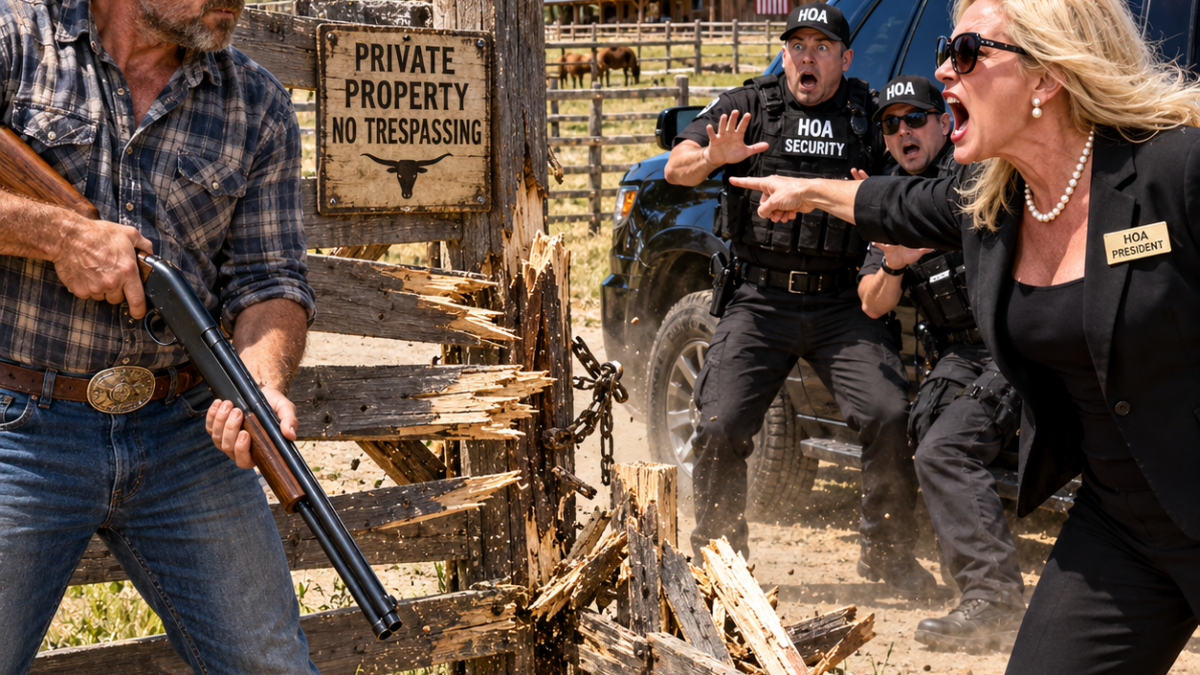
PART 2
“Attention, Mr. Anderson.”
His amplified voice rolled across the desert morning.
“Pursuant to the enforcement authority of the Saguaro Ridge Homeowners Association, you are directed to open the gate immediately.”
I stood behind the living-room curtain and watched.
Seven men.
Gerald.
A flatbed truck equipped with a small crane.
Three white pickups.
Tools.
No sheriff.
No constable.
No court officer.
No one carrying anything that looked remotely like a judicial order.
My phone was already connected to 911.
The dispatcher had my address, my earlier case number, and the background from the threat I had reported during the previous week.
“Are they attempting entry now?” she asked.
“They’re outside the gate.”
“Stay inside if you safely can.”
“I will.”
“Do not confront them.”
“Understood.”
Then Gerald raised the megaphone again.
“You have sixty seconds before the association exercises its right of forced access.”
I almost laughed.
Forced access.
He had invented language that sounded official enough to frighten someone who didn’t know better.
That had been his entire strategy from the beginning.
Not law.
Tone.
I watched a thick-necked man I later learned was named Tony Breslin remove a large pair of cutters from the flatbed.
Another worker carried a pry bar.
A younger man stayed closer to the trucks, looking less certain.
Gerald checked his watch theatrically.
“Thirty seconds.”
The dispatcher heard him through my phone.
“Sir, deputies are en route.”
“Thank you.”
I looked toward Elena’s photograph above the fireplace.
The day before she died, she had still been worrying about whether Lily remembered to submit a scholarship application.
That was Elena.
Cancer could be eating through her body and she would still worry about everyone else first.
After the funeral, I had stopped making decisions unless I absolutely had to.
The gate had been different.
It was the first thing I chose because I wanted it.
Not because a hospital needed a form.
Not because a lawyer needed a signature.
Not because Lily needed dinner.
Because I wanted to build something that looked toward light instead of loss.
Gerald had no way of knowing any of that when he selected it as his battlefield.
Maybe it wouldn’t have mattered if he had.
***
Tony walked toward the lock.
I opened the front door.
The shotgun remained low in my hands.
I had gone over this repeatedly with myself.
It was not there to win an argument.
It was not there to punish trespass.
It was there because seven men with tools had announced they intended to force entry onto the property where my daughter and I lived, and I had no idea how far Gerald was willing to take his obsession.
I stayed on the porch.
Well back from the driveway.
“Stop.”
Every head turned.
Gerald lowered the megaphone.
Then he saw the shotgun.
His expression changed for half a second.
Not fear.
Opportunity.
“Are you threatening us with a firearm, Mr. Anderson?”
“No.”
My voice stayed level.
“The sheriff has already been called. You do not have permission to enter. You do not have a court order. Leave the property alone and wait for law enforcement.”
He lifted his phone.
Recording.
Good.
My cameras were recording him recording me.
“You’re brandishing a weapon at HOA representatives.”
“The firearm is pointed at the ground. I’m standing on my porch. I have told you not to enter.”
Gerald’s smile returned.
“Put it down.”
“No.”
Tony looked back toward him.
“Gerald?”
“Continue.”
I heard one of the men say quietly:
“Man, maybe we should wait.”
Gerald snapped:
“We have board authority.”
I raised my voice.
“You do not have my consent to cut that lock.”
Tony hesitated again.
Gerald pointed.
“Do it.”
The cutters closed around the hardware.
For a moment nothing happened.
Then the lock snapped.
The sound cracked across the yard.
My stomach tightened.
Tony pulled one side of the gate.
It resisted.
Another man helped.
The lower hinge twisted.
The sun motif in the center bent sideways.
I felt something inside me react before my mind caught up.
My hands tightened.
I forced them loose.
The shotgun stayed pointed down.
Call.
Record.
Wait.
Not anger.
Not revenge.
Wait.
The gate gave way with an ugly metallic groan and sagged inward.
The flatbed rolled through.
That was the moment the conflict stopped being theoretical.
Gerald’s people were now physically inside the property after weeks of written objections, after certified notice, and after I had personally told them not to enter.
I raised my voice.
“You are on private property without permission. Stop where you are.”
The truck stopped about thirty feet from the porch.
Tony climbed down.
Gerald walked through the damaged gate.
No hesitation.
He looked almost relieved.
Like he had finally reached the scene he had imagined for weeks.
“Put the gun down, Albert.”
“You need to leave.”
“You’ve lost.”
“No.”
“You could have avoided all of this.”
“So could you.”
His face tightened.
“I gave you multiple opportunities.”
“To destroy something your own committee approved.”
“You keep hiding behind that letter.”
“It’s your association’s letter.”
“Standards changed.”
“Show me the vote.”
He said nothing.
“Show me the amendment.”
Nothing.
“Show me the hearing where my approval was revoked.”
Gerald took another step.
“Enough.”
I stayed still.
“You have cameras everywhere,” he said. “You have attorneys. You keep sending certified letters. You think drowning people in paperwork makes you right.”
“No.”
“What then?”
“The approval makes me right.”
His jaw flexed.
Behind him, the workers had stopped moving.
They were listening now.
This wasn’t what Gerald needed.
He needed action.
Noise.
Momentum.
If people had time to think, the absurdity of the situation became obvious.
Seven grown men had arrived before sunrise with a truck to tear down an approved gate because one HOA president had decided it offended him.
Then we heard sirens.
Faint.
Distant.
Tony turned toward the road.
Gerald didn’t.
He looked at me.
“You called them.”
“I told you I did.”
“You’re making a mistake.”
“No, Gerald.”
The sirens grew louder.
“You made it.”
***
Two Pima County Sheriff’s Department units came around the corner fast but controlled.
Lights flashing.
No dramatic tire squeal.
No movie-style deputies jumping out with guns drawn.
They stopped outside the broken gate.
Two deputies emerged, hands visible near their belts, eyes moving rapidly over the scene.
Truck.
Tools.
Workers.
Broken gate.
Me on the porch.
Shotgun.
One deputy raised his voice immediately.
“Sir on the porch, set the firearm down.”
I did.
Slowly.
Placed it on the porch boards.
Stepped away.
Hands open.
The second deputy ordered the workers to place their tools down and remain where they were.
Tony dropped the pry bar.
Others followed.
Gerald looked offended.
“I’m the HOA president.”
The deputy didn’t even glance at him.
“Keep your hands visible, sir.”
A third vehicle arrived minutes later.
Sergeant Ray Delgado stepped out.
I recognized the voice before I recognized the man.
We had spoken twice by phone.
He was broad-shouldered, maybe early fifties, calm in the way people become calm after decades of other people’s emergencies.
He walked to the middle of the driveway.
“Who owns the property?”
“I do.”
“Albert Anderson?”
“Yes.”
“You called?”
“Yes.”
He turned toward Gerald.
“You’re in charge of this group?”
Gerald adjusted his polo.
“Gerald Gomez. President of the Saguaro Ridge Homeowners Association.”
Delgado looked toward the broken gate.
“What are you doing?”
“Executing an enforcement action.”
“Meaning?”
“Removing an architectural violation.”
“Court order?”
Gerald hesitated.
“Our governing documents—”
“Court order?”
Gerald’s expression hardened.
“No.”
Delgado nodded once.
“Written consent from the homeowner?”
“He has been properly noticed.”
“That wasn’t my question.”
“No.”
“Did he tell you not to enter?”
Gerald looked toward me.
“This is more complicated than—”
“Yes or no?”
Gerald swallowed.
“He disputed our authority.”
“Did he tell you not to enter?”
“Yes.”
Delgado looked at the cut lock.
Then the twisted gate.
Then the tools.
“Okay.”
Gerald apparently mistook the calm tone for agreement.
“Exactly. He’s been noncompliant for months. We have every right under the CC&Rs to correct a continuing violation after notice.”
Delgado said:
“Show me the provision authorizing you to physically enter private property and destroy an installed structure without a court order.”
Gerald opened the folder.
Flipped pages.
“This section gives us enforcement power.”
Delgado took the document.
Read.
“This says you can levy assessments and pursue remedies authorized by law.”
“Correct.”
“Where does it say you can cut a lock?”
Gerald stared.
“We have an obligation to protect the community.”
“Where does it say you can cut the lock?”
Silence.
Delgado handed the document back.
Gerald’s voice became sharper.
“Sergeant, this homeowner has been threatening us for weeks. He came outside with a shotgun.”
Delgado looked at the deputy who had spoken with me.
The deputy said:
“Firearm was down when we arrived. Homeowner complied immediately.”
Gerald’s face reddened.
“He used it to intimidate my workers.”
I spoke.
“The 911 dispatcher was on the phone before I came outside.”
Delgado turned toward me.
“You have video?”
“Four angles.”
Gerald looked at the cameras.
For the first time, I saw true uncertainty.
Not because he hadn’t noticed them.
He had.
But Gerald had lived for years inside a system where his version became the official version.
Someone complained.
He wrote the minutes.
Someone resisted.
He issued the violation.
Someone accused him of harassment.
He labeled them hostile.
Now the cameras had written minutes he couldn’t edit.
***
I retrieved my laptop after a deputy checked that it was okay for me to go inside.
We watched the first clip near the hood of a patrol vehicle.
6:15.
Convoy arrival.
Gerald’s ultimatum.
Tony approaching with cutters.
My verbal warning.
Gerald:
**Continue.**
Lock cut.
Gate pushed.
Truck crossing the property line.
Then another camera.
Side angle.
Before they entered, Gerald stood beside the flatbed talking to Tony.
The audio was surprisingly clear.
Tony asked:
“You sure we’re covered?”
Gerald replied:
“Just go in. He’s bluffing. I’ll take responsibility.”
Delgado paused the video.
Tony closed his eyes.
Gerald said immediately:
“That’s out of context.”
“What context changes ‘I’ll take responsibility’?” Delgado asked.
“We were discussing HOA liability.”
“Okay.”
Then Gerald made the mistake that turned the morning against him.
He started talking.
Fast.
Angry.
Defensive.
“I’ve been dealing with this man for months. He refuses every reasonable request. He poisoned the community atmosphere. He threatens legal action over everything. Somebody had to enforce standards. Yes, I authorized the removal. Yes, I told them to enter. The board has been paralyzed because everyone is afraid of confrontation.”
Delgado didn’t interrupt.
Gerald continued.
“Do you know what happens if every homeowner decides their written approval means they can ignore future standards? Property values collapse. Rules become meaningless.”
I watched Delgado.
He had the expression of a man letting another person complete his own statement.
Finally:
“You personally authorized them to cut the lock?”
Gerald stopped.
Too late.
His attorney wasn’t there to kick him under the table.
“I authorized enforcement.”
“Did that include cutting the lock?”
Gerald looked at Tony.
Tony looked away.
“I expected them to gain access as necessary.”
Delgado nodded.
“All right.”
That was when Gerald realized calm questions can be more dangerous than arguments.
***
Nobody was dramatically convicted on my driveway.
Real life moves slower.
Gerald and the workers were separated.
Statements were taken.
Identification recorded.
The truck remained temporarily while deputies photographed the damage.
Tony cooperated immediately.
He handed over text messages.
He told deputies Gerald had assured the crew that the association had legal authority to enter.
Two other workers said the same.
The youngest one looked physically sick.
“I thought this was like repossession work.”
A deputy asked:
“Are you a licensed repossession agent?”
“No.”
“Did you verify any court process?”
“No.”
He stared at his shoes.
“Gerald said lawyers cleared it.”
That sentence repeated all morning.
**Gerald said.**
**Gerald told us.**
**Gerald assured us.**
Power is useful until responsibility arrives.
Then everybody remembers who gave the order.
By late morning, Gerald was taken for further questioning and booked on suspicion of offenses related to trespass and property damage. The county attorney would decide formal charges later.
Tony and the other workers were released after statements, subject to follow-up.
The truck left empty.
My gate stayed on the ground.
Bent.
One hinge torn away.
The sun in the middle twisted but not broken.
When the last patrol vehicle left, the neighborhood became strangely quiet.
People stood at the ends of driveways.
Watching me.
For weeks they had looked away whenever I walked outside.
Now none of them could stop looking.
I wanted to shout at them.
Ask where they had been when Lily ate alone.
When my water disappeared.
When Gerald’s SUV sat outside at two in the morning.
When a seventeen-year-old girl was punished because her father refused to destroy a gate.
Instead, I turned away.
I didn’t have enough energy left for anger.
***
I called Lily.
She answered on the first ring.
“Dad?”
“It’s done.”
“What happened?”
“The sheriff came.”
“Are you okay?”
“Yes.”
“The gate?”
I looked toward it.
“Not so much.”
Silence.
Then:
“Did you use Grandpa’s shotgun?”
“No.”
“Good.”
“I had it with me.”
She exhaled.
“Dad.”
“I know.”
“Did you point it at anyone?”
“No.”
“You promise?”
“I promise.”
Another silence.
“Can I come home?”
“Yes.”
Her voice cracked.
“I want to come home.”
That hurt more than anything Gerald had done.
Home had become a place my daughter needed permission to feel safe returning to.
“I’ll pick you up.”
***
Before I left, I walked to the gate.
The center sun was bent inward.
One ray had snapped loose.
I touched the metal.
Cold despite the morning heat.
Jorge had built it from my drawing after Elena died.
She never saw the finished gate.
She had been alive when I sketched the first version on a hospital notepad.
“What’s that?” she had asked.
“A gate.”
“Very exciting.”
“It’s symbolic.”
“Oh God.”
I laughed.
She smiled weakly.
“What’s the sun?”
“I don’t know yet.”
“You drew it.”
“Doesn’t mean I know.”
She studied the sketch.
“Looks like something opening.”
That became the design.
The last thing Elena ever helped me create, even if she never knew it.
Gerald saw metal.
I saw that hospital room.
I saw her hand holding the pencil.
I saw Lily asleep in the chair beside her.
That was why surrender had felt impossible long before the dispute became about legal rights.
I had never told Gerald.
Maybe if I had, he would have understood.
I doubted it.
***
Lily came home that afternoon.
She got out of the car before I had fully parked.
Saw the gate.
Stopped.
“Oh.”
That one syllable contained everything.
She walked over slowly.
Touched the bent sun.
“They really broke it.”
“Yes.”
“For what?”
I didn’t have an answer good enough.
She turned toward me.
“I’m sorry I told you to take it down.”
“You don’t have anything to apologize for.”
“I did.”
“You were scared.”
“I thought if we just gave him what he wanted, it would stop.”
“So did I.”
She frowned.
“You never said that.”
“Because dads are supposed to pretend we know what we’re doing.”
“Mom never believed that.”
“Your mother had unreasonable standards.”
Lily almost smiled.
Then she hugged me.
Hard.
I held her beside the broken gate until she let go.
***
Two days later, Detective Maria Santos arrived.
She was with the Pima County Sheriff’s Department and had been assigned to follow the complaint beyond the immediate property-damage case.
Compact.
Sharp eyes.
Little patience for storytelling when facts were available.
We sat at my dining table.
She turned on a recorder.
“Start with the original approval.”
I gave her the date.
Architectural application.
Committee review.
Written approval.
Installation.
First notice.
Second notice.
Gerald’s visit.
The “hill worth dying on” statement.
Patrol SUV.
Service disruptions.
Community email.
School consequences.
Final removal notice.
Sunday morning.
Three hours.
She interrupted only to pin down specifics.
“Who physically shut off the irrigation?”
“I don’t know.”
“Did you see Gerald do it?”
“No.”
“Then we cannot attribute that to him yet.”
“Understood.”
“Garbage service?”
“Driver said obstruction notice.”
“From HOA?”
“He didn’t specify.”
“Good. Keep those separate.”
She sounded like David Moreno.
Evidence, not assumptions.
When we finished, she opened my documentation folder.
Her expression changed.
“You made an index.”
“I’m an engineer.”
“Color coded?”
“Don’t judge me.”
She smiled for the first time.
“Mr. Anderson, I’ve had corporate fraud investigators bring me worse files.”
She went through:
Certified-mail receipts.
Approval letter.
Emails.
Screenshots.
Security-camera logs.
Patrol-pass timestamps.
Photographs of the irrigation valve.
Waste-service correspondence.
School messages Lily had saved.
Final notice.
911 incident number.
Sunday recordings.
“You backed up the originals?”
“Yes.”
“Cloud and local.”
“Of course.”
“Checksums?”
I looked at her.
She laughed.
“Software engineer.”
“Yes.”
“Thought so.”
Then she became serious again.
“Your incident may not be isolated.”
“What does that mean?”
“We’re checking.”
“Checking what?”
“Prior complaints involving Mr. Gomez.”
My chair creaked as I leaned forward.
“How many?”
“I don’t know yet.”
“That means more than one.”
Santos didn’t answer.
Which was an answer.
***
David Moreno filed a civil preservation notice before we filed any lawsuit.
He wanted the association to retain:
Board emails.
Architectural records.
Security contracts.
Utility communications.
Meeting minutes.
Complaints.
Gerald’s messages.
Insurance correspondence.
Any document relating to my gate.
“Why before filing?” I asked.
“Because once litigation becomes obvious, everybody suddenly discovers email-cleanup habits.”
“Are you saying they’ll destroy evidence?”
“I’m saying we make sure they know not to.”
The association’s lawyer responded within forty-eight hours.
Professional.
Measured.
Very different from Gerald.
They denied intentional harassment by the board as a whole.
Claimed Gerald may have acted beyond authorized procedure.
Promised internal investigation.
That irritated me.
“Now they think he acted alone?”
David said:
“Maybe he did.”
“The patrol SUV had their logo.”
“Doesn’t prove every board member knew everything.”
“The violation notices were official.”
“That’s stronger.”
“The email went to the whole neighborhood.”
“Also stronger.”
“My water got shut off.”
“Still need attribution.”
I leaned back.
“You enjoy saying things I don’t want to hear.”
“That’s why lawyers charge hourly.”
***
The emergency HOA meeting happened the following Thursday.
I didn’t attend.
Everyone expected me to.
Kelly Reyes—three houses down, the neighbor who warned me about the truck—came to my door beforehand.
“You should be there.”
“No.”
“Why?”
“Because if I walk into that room, the entire meeting becomes about me.”
“It is about you.”
“No. Gerald made it about me. It should be about how the association allowed this.”
Kelly crossed her arms.
“You’re letting them off easy.”
“I’m suing them.”
“Fair.”
She looked toward the broken gate.
“We have thirty-seven signatures asking the board to resign.”
“That’s good.”
“Come say something.”
“No.”
“Lily?”
“Also no.”
Kelly nodded reluctantly.
“You’re stubborn.”
“So I’ve been told.”
She turned to leave.
Then looked back.
“Gerald hated that gate because the architectural committee approved it while he was out of town.”
I stared.
“What?”
She looked surprised.
“You didn’t know?”
“No.”
“The approval meeting was the week he had surgery.”
“What does that have to do with anything?”
“Gerald had been pushing for standardized entry designs. Same three models. The committee approved yours anyway.”
My mind started moving.
“Was there a vendor?”
Kelly’s expression changed.
“What?”
“Standardized gates. Was there a preferred installer?”
“I don’t know.”
That was the first clue the fight might have contained something beyond aesthetics.
***
I called David.
He told me not to speculate.
Then requested association procurement records through discovery once litigation was filed.
Three weeks later we found something.
Not criminal.
But ugly.
Gerald had pushed a “community uniformity initiative” the previous year.
Part of it proposed approved fencing and gate packages from Desert Crest Ironworks.
Gerald’s brother-in-law owned a minority interest in that company.
The relationship had been disclosed in one board meeting.
Barely.
Gerald had recused himself from the formal vote.
But emails showed him lobbying committee members.
My custom gate had been approved outside that preferred-vendor framework.
Suddenly his obsession made more psychological sense.
It wasn’t just that mine looked different.
It represented a committee telling Gerald no.
It undermined a system he had spent years centralizing.
David stared at the emails.
“This isn’t proof he targeted you for financial gain.”
“No.”
“But it helps explain motive.”
“He wanted everyone using his preferred system.”
“Possibly.”
“Because his family benefited.”
“Maybe. Be careful.”
I hated legal verbs.
Might.
Could.
Possibly.
But by then, I understood why they mattered.
Certainty without evidence was Gerald’s language.
I didn’t want to become him while fighting him.
***
Detective Santos called a week later.
“Can you meet?”
We sat at a coffee shop away from Saguaro Ridge.
She brought no case file.
Only a notebook.
“We found prior complaints.”
“How many?”
“Three substantial ones over five years.”
“What kind?”
“Pattern varies. Same underlying issue.”
She told me about the Erwins.
Backyard vegetable garden.
Perfectly legal under the recorded rules when installed.
Gerald disliked visible trellises.
Violations followed.
Then noise complaints.
Then parking complaints.
Then disputes about paint.
Fourteen months later, they sold.
“Where are they now?”
“Phoenix area.”
“Will they talk?”
“Yes.”
The Crawfords came next.
Solar panels.
Arizona law and the association’s own rules gave owners substantial protection.
Gerald fought them anyway.
Demanded relocation.
Fines.
Hearings.
Legal fees.
They eventually prevailed on the solar issue.
Then sold because they were exhausted.
Third family:
Santos would not initially name them.
They had experienced landscaping disputes and selective enforcement.
Eventually left the neighborhood abruptly.
“Did Gerald commit crimes in those cases?”
“Not necessarily.”
“Then why does it matter?”
“Pattern. Knowledge. Governance. Depends what records show.”
“Did the board know?”
“That’s what we’re investigating.”
I looked through the window.
A mother was helping a toddler climb into a minivan.
Normal life.
“How did nobody stop him?”
Santos closed the notebook.
“Small power is hard to challenge because every individual incident looks too small to justify a war.”
That sentence stayed with me.
A $75 fine.
A sprinkler complaint.
A garbage pickup.
A gate color.
Each one trivial.
Together, they can make a person abandon a home.
Gerald understood accumulation.
So did I.
The difference was what we used it for.
***
The harassment hit Lily harder than I knew.
After Gerald’s arrest, she started receiving apology messages.
Some sincere.
Some awkward.
One girl wrote:
**My mom said we shouldn’t hang out because your dad was unstable. I’m sorry.**
Lily showed me.
“What am I supposed to say?”
“You don’t have to say anything.”
“That’s rude.”
“Sometimes silence is an answer.”
She sat at the kitchen table.
“Mom would answer.”
“Your mother would write four paragraphs and make the girl feel guilty for the rest of her life.”
Lily smiled.
“That’s true.”
Then she looked serious.
“Do you hate everyone here?”
“No.”
“I do.”
“That’s understandable.”
“They all knew.”
“Some knew pieces.”
“They looked away.”
“Yes.”
“How is that different?”
It was a difficult question.
“Sometimes people look away because they’re cowards.”
“Great.”
“Sometimes because they’re scared they’ll become next.”
“Still cowardly.”
“Yes.”
She looked surprised.
I continued.
“But humans are complicated. Fear doesn’t excuse everything. It does explain some of it.”
“You’re defending them?”
“No. I’m trying not to let Gerald decide how we see everyone forever.”
She looked at her mother’s photograph.
“I hate that he took my senior year.”
That hurt.
“He took part of it.”
“Same thing.”
“No.”
She looked at me.
“You still have graduation.”
“Dad.”
“Prom if you want it.”
“I don’t.”
“Maybe you will.”
“What if everyone acts fake?”
“Some will.”
“Great pep talk.”
“I’m improving.”
She rolled her eyes.
It was the first truly seventeen-year-old thing she had done in weeks.
I almost celebrated.
***
Jorge came to inspect the gate.
He stood at the bottom of the driveway silently.
Ran one hand along the bent iron.
“Idiots.”
“Can it be fixed?”
“Anything can.”
“That sounds expensive.”
“Different question.”
He crouched near the broken hinge.
“They pulled the post out of alignment.”
“I saw.”
“You want identical?”
“Yes.”
He looked toward the sun motif.
“Maybe stronger.”
“I don’t want a fortress.”
“Good. Fortresses are ugly.”
I laughed.
He stood.
“I remember Elena’s sketch.”
“My sketch.”
“No.”
“What?”
“You brought me three drawings. One had handwriting on the bottom.”
I stared.
“What handwriting?”
He pulled out his phone.
“I photograph every original design.”
He scrolled.
Then showed me.
My rough sketch.
And underneath, in Elena’s handwriting:
**Make the center less angry. More sunrise.**
I sat down on the driveway edge.
I had forgotten.
Completely.
Jorge lowered the phone.
“Sorry.”
“No.”
I rubbed my eyes.
“Send me that.”
“I will.”
For the rest of the afternoon, I couldn’t think about the lawsuit.
Or Gerald.
Or the HOA.
Only that note.
**More sunrise.**
That became what I wanted the gate to mean again.
Not a battlefield.
Not defiance.
A sunrise.
Gerald had nearly stolen even that by turning it into a symbol of conflict.
I wasn’t going to let him.
***
The county attorney filed charges several days later.
Gerald faced allegations connected to criminal trespass and property damage, along with conspiracy-related theories based on directing others to enter and damage the gate.
The charging decision was narrower than neighborhood gossip.
People online said felony home invasion.
Armed raid.
Attempted burglary.
None of those labels accurately described what happened.
That mattered.
Gerald’s behavior was serious enough without exaggeration.
Tony faced lesser exposure.
The other workers cooperated.
Most genuinely appeared to believe Gerald and association management had legal authority.
I struggled with that.
At first, I wanted all of them punished.
Every man who walked through the broken gate.
Then I watched the videos again.
The youngest worker hesitated before Tony cut the lock.
One asked to wait.
Two never touched the gate.
They were responsible for choices.
But responsibility has degrees.
Gerald had designed the confrontation.
They had trusted him.
Badly.
That was not the same as creating the plan.
***
Our civil suit named Gerald personally and the association.
David wrote claims around:
Property damage.
Improper enforcement.
Emotional harm.
Potential selective enforcement.
Negligent oversight.
The insurance company called quickly.
First settlement offer:
$80,000.
Confidential.
No admission.
Mutual nondisclosure.
David explained it carefully.
“It’s not insulting.”
“I didn’t say it was.”
“For how early we are, it’s significant.”
“What does confidentiality cover?”
“Broadly, dispute facts and settlement.”
“No.”
“Albert.”
“No.”
“Trials are expensive.”
“I know.”
“Unpredictable.”
“I know.”
“You could lose claims even if Gerald was obviously wrong.”
“I know.”
“Then why five-second answer?”
I looked through the office window.
“Because Lily got called unstable by association families while Gerald was emailing 237 houses that one resident threatened property values.”
“That doesn’t mean a jury gives you what you want.”
“I don’t need a giant verdict.”
“What do you need?”
“A public correction.”
“That can be negotiated.”
“And the board acknowledging the entry was unauthorized.”
“Also negotiable.”
“And no gag order.”
David smiled slightly.
“Now we’re negotiating instead of rejecting.”
“Fine.”
“I’ll counter.”
***
The association fractured.
Three board members resigned.
One remained and publicly claimed Gerald had exceeded instructions.
Kelly Reyes collected enough signatures to trigger a special election under the governing documents.
At the first open meeting after Gerald’s arrest, residents filled the clubhouse.
I still didn’t attend.
Kelly called afterward.
“You missed chaos.”
“Good chaos?”
“Mixed.”
“What happened?”
“Gerald loyalists said the association was being destroyed by mob rule.”
“How many?”
“Seven.”
“Out of?”
“Eighty-nine.”
“Not bad.”
“Then Mrs. Crawford showed up.”
I sat up.
“The solar-panel family?”
“She drove from Flagstaff.”
“What did she say?”
Kelly was quiet for a moment.
“She brought a box.”
The Crawfords had kept everything.
Violation letters.
Appeal denials.
Attorney bills.
Photos.
Board emails.
Mrs. Crawford stood in front of the membership and described spending nearly two years defending solar panels the association should never have forced them to remove.
At the end she said:
“We won our legal issue and still sold our house because living here felt like being watched by a man who needed you to lose.”
That sentence reportedly ended the room.
People who thought my conflict was an isolated personality clash began to understand the system.
***
Detective Santos later showed me something from the board records after it became discoverable through the case.
A spreadsheet.
Created by Gerald.
Rows of addresses.
Columns:
Compliance.
Appeal history.
Board support.
“Risk.”
My address had:
**HIGH RESISTANCE / LEGAL THREAT / PUBLIC EXAMPLE RECOMMENDED**
I read it twice.
“What does public example mean?”
“We don’t know.”
“I can guess.”
“Don’t.”
I almost laughed.
“You and David should start a club.”
“Evidence club. Membership requirement: stop guessing.”
She turned the page.
Erwin address:
**REPEATED DEFIANCE / PRESSURE EFFECTIVE**
Crawford:
**LEGALISTIC / COST SENSITIVE**
I stared.
“He was profiling residents.”
“Yes.”
“For pressure.”
“Appears that way.”
My anger returned.
Not explosive.
Cold.
Gerald had treated neighbors like error conditions in a system.
Find weakness.
Increase pressure.
Force compliance.
I knew that mindset.
Ironically, software engineers use similar models for systems.
But houses contain people.
Gerald had forgotten that somewhere along the way.
***
The irrigation issue finally came together.
Association management records showed a service request had been sent to the landscape contractor.
Reason:
**Temporary isolation pending compliance inspection.**
Authorized by Gerald.
My property’s irrigation line had been shut off intentionally.
No emergency.
No repair.
No accidental maintenance.
Gerald had used common-system access to punish us.
Waste-service emails were less direct.
A board administrator had sent the hauler an “access concern” notice about my address.
No actual obstruction photograph existed.
Again, the pattern.
If Gerald couldn’t take the gate immediately, he would make daily life expensive and irritating enough that removing it felt easier.
David’s reaction was one word.
“Excellent.”
I stared at him.
“My cactus dying is excellent?”
“For liability.”
“I hate lawyers.”
“You hired one.”
“Temporary lapse.”
***
Lily eventually decided to attend prom.
Not because the committee apologized.
Because Maya Chen—one of the few classmates who had never participated in the gossip—showed up at our house with a dress bag and said:
“You’re coming, and if anybody says anything stupid, I’ll accidentally dump punch on them.”
I overheard from the kitchen.
“Please don’t commit battery.”
Maya yelled back:
“It’ll be an accident!”
Lily laughed.
That sound stopped me.
It had been missing.
For months.
On prom night, she came down the hallway wearing a dark blue dress Elena had once said would make her look “dangerously grown-up.”
I had to turn away for a second.
Lily noticed.
“Dad.”
“Dust.”
“In the living room?”
“Arizona.”
She rolled her eyes.
Then softened.
“Mom would’ve taken like four hundred pictures.”
“Five hundred.”
“You get ten.”
“I get unlimited.”
“Ten.”
We settled at thirty-two.
When the girls left, I sat on the porch.
The broken gate was gone temporarily, replaced by a basic chain-link barrier while Jorge worked.
For the first time, I realized the house felt quiet without fear.
A car passed.
I didn’t check the camera.
Progress.
***
Gerald’s criminal case took months.
His attorney did what competent attorneys do.
Challenged intent.
Argued Gerald sincerely believed the CC&Rs authorized self-help enforcement.
Pointed out that he had not personally cut the lock.
Characterized the incident as an HOA dispute that escalated beyond proper boundaries.
Some of that was reasonable.
Then prosecutors produced emails.
One from association counsel weeks before the removal:
**The board should not enter an owner’s enclosed property or remove structures without voluntary access or appropriate judicial relief.**
Gerald had received it.
He replied:
**Understood.**
That email changed everything.
He could no longer credibly claim he never knew a court process might be required.
Another email to Tony:
**Counsel is overly cautious. We cannot let one resident make the board look powerless.**
There was the motive.
Not property values.
Power.
The gate had become an institutional insult.
Gerald believed backing down would expose the limits of his authority.
So he crossed the limit instead.
***
Six months after the morning at the gate, I sat in a county courtroom behind David.
Lily wanted to come.
I told her she didn’t have to.
She came anyway.
Gerald accepted a plea agreement.
No dramatic trial.
No ten-year prison sentence.
The evidence was strong enough that his lawyer recommended avoiding the risk of more serious consequences.
He pleaded to reduced charges arising from the unauthorized entry and property damage.
The judge imposed probation, substantial community-service hours, restitution, fines, and restrictions tied to serving in HOA leadership during the probationary period and through the agreement with the association.
The exact consequences were less spectacular than neighborhood rumor had predicted.
They were also real.
The judge looked directly at Gerald.
“You were warned by counsel. You were told the homeowner disputed your authority. You were told law enforcement had been contacted. Yet you chose self-help destruction because you believed your position entitled you to resolve the dispute personally.”
Gerald stared straight ahead.
The judge continued:
“Leadership does not expand the law to fit frustration.”
That was the line I remembered.
Not the fine.
Not probation.
That.
Gerald turned once after sentencing.
Our eyes met.
For months, I had imagined enjoying that moment.
I didn’t.
He looked tired.
Smaller.
Not because I had beaten him.
Because the room no longer treated his certainty as authority.
He looked away.
***
Tony received a lighter result after cooperation.
Outside the courtroom, he approached me.
No white enforcement polo.
Work shirt.
Baseball cap in his hands.
“Mr. Anderson.”
“Tony.”
“I know this doesn’t fix anything.”
“No.”
“I really thought we had authority.”
“You also heard me tell you not to enter.”
He nodded.
“I know.”
“You saw the cameras.”
“Yes.”
“You heard Gerald say counsel had approved it?”
“Yes.”
“Did you ask to see that?”
“No.”
There it was.
Not evil.
Failure.
“I should’ve asked,” he said.
“Yes.”
He looked surprised that I didn’t soften it.
Then nodded.
“Yes.”
We stood there awkwardly.
Finally, I said:
“Ask next time.”
“I will.”
He held out his hand.
I shook it.
Not absolution.
Closure.
***
The civil case settled two weeks before trial.
Final terms:
$120,000.
Legal fees separately covered.
Gate replacement.
Correction of all improper fines.
Restoration of my account to good standing.
Written acknowledgment that the removal attempt lacked appropriate legal authority.
Formal apology signed by the remaining association leadership.
No broad nondisclosure preventing me from discussing what happened.
Most importantly, the association adopted new procedures as part of its internal resolution.
No physical entry onto a homeowner’s property for enforcement without consent or lawful process.
Independent legal review for major enforcement.
Written appeal procedure.
Board conflicts disclosed.
Service interruptions prohibited as punishment.
Enforcement authority narrowly defined.
I signed.
Not because I stopped caring about trial.
Because accountability was now in writing.
And Gerald’s criminal case had already created the public record I wanted.
David put down his pen.
“You rejected eighty.”
“Correct.”
“And took one-twenty plus fees and reforms.”
“Correct.”
“Do you feel principled?”
“Extremely.”
“You’re exhausting.”
“So I’ve heard.”
***
Kelly won a board seat.
Then, against everyone’s expectations, she convinced two residents who had originally supported Gerald to run with her.
I asked why.
“If we only elect people who hated him,” she said, “half the neighborhood will think this is revenge government.”
That was smarter than anything I would have done.
The new board hired independent counsel.
Audited prior violations.
Reviewed old fines.
Some were valid.
Some weren’t.
That was important too.
Gerald had not invented every violation ever issued.
Not everyone who hated him was automatically right.
Good governance required saying no to residents sometimes.
The difference was procedure.
Evidence.
Appeal.
Limits.
The Erwins received partial reimbursement after review of fines connected to their garden dispute.
The Crawfords received a formal letter acknowledging mishandling of their solar case.
They had already moved.
Money and letters couldn’t return those years.
Still, Mrs. Crawford called Kelly and cried.
Sometimes being officially believed matters even after practical damage is done.
***
The gate took longer.
Jorge refused to rush.
“You rushed grief once?”
“What does that mean?”
“You built original three months after Elena died.”
“I designed it.”
“Exactly.”
He tapped the bent sun, which he had saved from the old gate.
“You want same?”
“Yes.”
“No.”
I stared.
“I’m paying.”
“And I’m artist.”
“You are a blacksmith.”
“Same thing, more burns.”
He had a point.
“What do you want to change?”
“Nothing front.”
“Then what are we arguing about?”
“Back.”
He showed me a sketch.
Small script on the inside crossbar.
**STAND YOUR GROUND**
I flinched.
“Too aggressive.”
“Not about gun.”
“I know.”
“About life.”
Still.
The phrase had legal and political baggage I didn’t want on the gate.
“What about ‘Still Standing’?”
Jorge thought.
“Too sad.”
“‘More Sunrise’?”
He stared at me.
I showed him Elena’s old handwriting.
His face softened.
“More Sunrise.”
He nodded.
“That’s better.”
So on the inside, invisible from the street, he forged two words:
**MORE SUNRISE**
That became the only change.
***
The new gate went in late June.
Same wrought iron.
Same sun.
Same rays opening outward.
But stronger hinge mounts.
Jorge stood beside me when the crew finished.
“Better.”
“Looks the same.”
“Exactly.”
Lily came outside.
Walked up.
Touched the hidden words.
Her eyes filled.
“Mom wrote that?”
“On the original sketch.”
“She’d hate that you made it sentimental.”
“She made everything sentimental.”
“No, you did.”
“Revisionist history.”
She laughed.
Then hugged me.
The gate closed behind us with a clean metallic click.
For months, that sound would have made my shoulders tense.
That day, it felt normal.
That was victory.
Not Gerald’s arrest.
Normal.
***
Lily graduated in May before the replacement was finished.
Bright Arizona morning.
Hundreds of families.
Cameras.
Flowers.
Noise.
When her name was called, I stood before I realized I had.
She crossed the stage.
Diploma cover in one hand.
Looked into the crowd.
Found me.
For a second I saw the little girl Elena used to carry on her hip.
Then the teenager who had cried at our kitchen table because her classmates treated her like a criminal’s daughter.
Then a young woman heading to the University of Arizona.
I cried.
Publicly.
No defense.
Afterward she hugged me.
“Mom would’ve been embarrassing.”
“She’d have screamed your name.”
“She would’ve brought a sign.”
“Glitter.”
“Oh God.”
We laughed.
That evening, we sat on the porch.
She said:
“I learned something from all this.”
“That I’m always right?”
“No.”
“Disappointing.”
“That standing up for yourself isn’t the same as wanting a fight.”
I looked at her.
“Your mother used to say that.”
“I know.”
Then she smiled.
“And backup cameras.”
I laughed so hard I spilled coffee on my shirt.
***
The neighborhood summer barbecue happened two weeks after the new gate installation.
For years, Gerald had used community events like political rallies.
Supporters near him.
Critics avoided.
Everyone watching everyone else.
The new board held it in the common area and made one rule:
No HOA business.
Kelly enforced it like federal law.
Someone tried asking about dues.
“No.”
“What about landscaping—”
“Monday.”
“Pool hours?”
“Eat your burger.”
It worked.
The Erwins drove down from Phoenix.
I recognized them from Santos’s files but had never met them.
Mrs. Erwin stood beside me near the grill.
“So you’re the gate guy.”
“Apparently.”
“We were the vegetable people.”
“I know.”
She smiled sadly.
“We should’ve fought harder.”
“No.”
“We left.”
“You had kids.”
“We were tired.”
“Exactly.”
She looked toward the crowd.
“I kept telling myself Gerald won.”
“What do you think now?”
She watched Kelly arguing with someone about burnt hot dogs.
“I think maybe leaving was how we survived him.”
That mattered.
Not every victory looks like staying.
Sometimes staying would cost too much.
Gerald’s greatest cruelty had been making people judge themselves for choosing peace.
I squeezed her hand.
“You did what you had to.”
She nodded.
“Thank you for finishing it.”
I didn’t know what to say.
So I said nothing.
***
The saguaros took longer to recover than everything else.
Three had developed stress during the irrigation shutoff.
One never fully recovered.
A horticulturist told me damage sometimes appears months after extreme dehydration.
I hated that plant for becoming a metaphor.
Lily loved it.
She photographed the damaged section every month.
“What are you doing?”
“Documenting.”
“You’ve become me.”
“Horrifying.”
Eventually the cactus produced new growth above the scar.
Lily showed me.
“See?”
“Yes.”
“You’re not going to say anything emotional?”
“No.”
“Dad.”
“It’s a cactus.”
She looked toward Elena’s photograph through the window.
“Coward.”
Probably.
***
Detective Santos stopped by almost a year later.
Not official.
She had been in the area.
The case was closed.
Gerald was complying with probation.
No new incidents.
She looked at the new gate.
“Nice.”
“Approved.”
She laughed.
“You kept the letter?”
“Three copies.”
“Of course.”
We sat outside.
She said:
“You know what was weird about your case?”
“Only one thing?”
“You had every advantage.”
I frowned.
“What do you mean?”
“Lawyer. Cameras. Stable job. Documentation skills. You knew enough to call before the confrontation.”
“That makes me lucky.”
“Yes.”
She looked toward the neighboring houses.
“The families before you often didn’t.”
That thought stayed with me.
It would have been easy to tell myself I won because I was tougher than the Erwins.
Smarter than the Crawfords.
More principled than people who paid fines.
That would be a lie.
I had money for an attorney.
A job I could do from home.
Cameras.
Time.
A teenage daughter old enough to stay with trusted friends.
Gerald had succeeded against people with fewer resources.
That didn’t make them weak.
It made his methods calculated.
Power seeks the cheapest target.
***
Santos continued.
“What matters is your file gave us a way to connect complaints.”
“I thought the cameras mattered most.”
“They mattered.”
“The certified letters?”
“Also.”
“What mattered more?”
“Sequence.”
I understood immediately.
One violation looked normal.
Two looked annoying.
A patrol SUV sounded paranoid.
Water shutoff could be maintenance.
Garbage issue could be a contractor mistake.
School gossip was social.
A broken gate was property damage.
Each alone had alternate explanations.
Together?
System.
Gerald had relied on nobody assembling the whole timeline.
I had.
Software engineering again.
One error log means little.
Correlated logs show failure.
Gerald’s mistake wasn’t only breaking the gate.
It was generating three months of logs first.
***
Years later, when people asked why he hated that gate so much, I stopped answering with one reason.
There wasn’t one.
Part of it was aesthetics.
Gerald genuinely believed uniformity protected property values.
Part was ego.
The architectural committee approved something outside his preferred designs while he was unavailable.
Part was money.
His brother-in-law had an interest in a vendor connected to standardized installations, although no evidence ever proved Gerald targeted me solely to enrich that business.
Part was reputation.
Once I challenged the first violation publicly and in writing, he needed me to be wrong.
Otherwise every homeowner he had pressured might start asking whether he had been wrong about them too.
That was what made the conflict escalate.
The gate itself became irrelevant.
Gerald wasn’t trying to remove iron.
He was trying to preserve certainty.
His.
***
The strangest part was how close I came to giving him what he wanted.
The night Lily asked:
“Why won’t you just change the stupid gate?”
I nearly did.
After she went upstairs, I sat alone at the kitchen table.
Opened the contractor website.
Found a basic approved gate.
Clicked through the quote form.
I got as far as entering my address.
Then stopped.
Not because Elena whispered from beyond the grave.
Not because of some heroic principle.
Because I asked myself one question:
What happens after I replace it?
Noise fine?
Landscaping?
Paint?
Truck parked wrong?
Christmas decoration?
Gerald had already changed the fight from compliance to obedience.
I could satisfy a rule.
I could never satisfy someone who needed surrender.
So I closed the browser.
That was the real decision.
Everything after followed from it.
***
Lily left for college that August.
Her room looked wrong empty.
Again.
Another absence.
Different from Elena.
Healthy absence.
Necessary.
Still difficult.
Before leaving, she handed me a small box.
Inside:
One of the broken pieces from the original gate.
A short iron ray.
Jorge had cleaned it.
Mounted it on wood.
Small brass plate:
**6:47 A.M. — STILL HERE**
I laughed.
“You said ‘Still Standing’ was too sad.”
“That was Jorge.”
“You talked to Jorge?”
“We have secrets.”
“Disturbing.”
She hugged me.
“Don’t start another war while I’m gone.”
“I didn’t start the first one.”
“Exactly what people who start wars say.”
“Go to college.”
She climbed into her car.
At the gate, she stopped.
Got out.
Touched the sun motif once.
Then drove away.
I stood there longer than necessary.
***
The house became quiet.
At first I hated it.
Then I learned the quiet was different now.
After Elena died, silence meant something missing.
After Lily left for college, silence meant someone growing.
That distinction helped.
I worked.
Gardened badly.
Helped Kelly redesign the association’s online document archive because she bribed me with tacos.
I refused every formal HOA position.
Absolutely no chance.
At one meeting, someone nominated me anyway.
I said:
“I would rather rebuild the gate by hand.”
Motion withdrawn.
***
Gerald disappeared from neighborhood life.
He didn’t move immediately.
That surprised people.
For several months, he remained three streets over.
No board position.
No patrol SUV.
No clipboard.
Occasionally I saw him at the grocery store.
We ignored each other.
Then one afternoon we ended up in the same checkout line.
He looked older.
Nothing dramatic.
Just a man without the armor of position.
He noticed me.
“Albert.”
“Gerald.”
Silence.
The cashier scanned groceries.
Finally he said:
“I never wanted it to go that far.”
I looked at him.
“You rented a truck.”
His jaw tightened.
“I meant the whole thing.”
“You could’ve stopped it any day.”
“So could you.”
There it was.
Still him.
I almost became angry.
Instead:
“I stopped when I asked you to follow the approval.”
He looked away.
“I thought if I backed down, nobody would follow anything anymore.”
That was the first honest thing I ever heard from him.
“You were afraid of losing control.”
“I was trying to maintain standards.”
“Both can be true.”
He picked up his grocery bag.
“You ruined my life.”
“No.”
He stared.
“You did that yourself.”
He left.
The cashier pretended not to have heard anything.
Then said:
“Paper or plastic?”
I laughed.
Gerald’s final dramatic confrontation reduced to grocery bags.
Life has a sense of proportion stories often lack.
***
He eventually sold his house.
Moved somewhere north.
I heard rumors.
Ignored them.
He had occupied enough of my life.
The new owners were a young couple with twins.
They knew nothing about him.
Good.
Houses deserve second lives too.
***
Three years after the gate incident, Jorge died unexpectedly from a heart attack.
That hit harder than I expected.
He had become connected to Elena in my mind.
To the gate.
To rebuilding.
At his memorial, his son Mateo found me.
“My dad kept something for you.”
He handed me an envelope.
Inside was the original tracing paper for the sun motif.
My lines.
Elena’s handwritten note.
**More sunrise.**
And beneath it, Jorge had written:
**Some iron is stronger after heat. People too.**
I rolled my eyes because it was exactly the kind of blacksmith wisdom he would have mocked himself for writing.
Then I cried in my truck.
No one saw.
I hope.
***
The gate never caused another violation.
That became funny over time.
The exact structure Gerald claimed threatened property values remained at the entrance for years.
Homes sold.
Values rose and fell with the broader market like everywhere else.
Nobody’s investment collapsed because my gate contained a custom sun.
No civilization ended.
No neighborhood became lawless.
People still trimmed trees.
Paid dues.
Argued about parking.
Complained about dogs.
The apocalypse of individuality never arrived.
That was perhaps the most complete rejection of Gerald’s worldview.
He had treated variation as chaos.
It turned out a neighborhood could survive one different gate.
***
Five years later, Lily came home after finishing graduate school.
She stood in the driveway.
Looked at the gate.
“It seems smaller.”
“You were seventeen.”
“No. I mean the whole thing.”
I knew what she meant.
For months, that gate had occupied our entire emotional world.
Now it was just twenty feet of iron.
She touched the hidden inscription.
**MORE SUNRISE.**
“I used to hate this thing.”
“I know.”
“I thought Mom would want us to remove it.”
“I know.”
“I was wrong.”
“You were scared.”
She looked at me.
“You always say that like being scared means nothing counts.”
“No.”
“What then?”
“It means I understand why it felt right.”
She nodded.
“I’m glad you didn’t listen to me.”
“I have that in writing?”
“Don’t ruin it.”
We sat on the porch.
Same desert.
Same mountains.
Different lives.
She asked:
“Do you still keep Grandpa’s shotgun?”
“Yes.”
“Why?”
“Because it was his.”
“Do you ever use it?”
“Range once in a while.”
“Still think about that morning?”
“Sometimes.”
“What part?”
Not the sirens.
Not Gerald.
Not the arrest.
Not the gun.
“The lock breaking.”
She looked toward the gate.
“Why?”
“Because that was the moment I realized being right doesn’t automatically protect you.”
“What does?”
I thought.
“Other people.”
“Meaning?”
“Attorney. Sheriff. Cameras. Neighbors who finally spoke. You.”
“Me?”
“You gave me a reason not to lose my head.”
She leaned back.
“That’s a very dad answer.”
“Occupational hazard.”
***
That evening we ate dinner outside.
The sun lowered behind the Catalina Mountains.
The iron rays in the gate caught orange light.
For a few minutes, the design looked almost exactly like the sketch Elena had corrected from her hospital bed.
Not angry.
Opening.
That was when I finally understood what had bothered me about Jorge’s first proposed inscription.
**Stand Your Ground** would have made the gate about Gerald forever.
About conflict.
Lines.
Resistance.
**More Sunrise** returned it to Elena.
To why I built it before Gerald ever appeared.
He had tried to redefine the gate.
For a while, he succeeded.
It became evidence.
A legal dispute.
A weapon in neighborhood politics.
A broken object in photographs.
Then, slowly, it became ours again.
That was the part of the story nobody saw from the police footage.
Reclaiming meaning takes longer than winning.
***
After dinner, Lily went inside to call a friend.
I stayed outside.
The street was quiet.
A dog barked two houses over.
Someone’s garage door closed.
Sprinklers clicked on across the road.
Ordinary noises.
Once, every engine made me look through the curtains.
Every white SUV tightened my chest.
Every late-night sound sent me toward the security monitor.
That faded.
Not all at once.
But enough.
I walked to the gate.
Placed my hand against the center sun.
Cool iron.
Strong welds.
No damage.
On the inside:
**MORE SUNRISE.**
I thought about Elena.
Jorge.
Lily.
Even Gerald, briefly.
A man who had confused being obeyed with being respected until the difference cost him everything he valued about his position.
Then I looked back at the house.
The porch Elena and I rebuilt.
The room where Lily had cried.
The window where I watched Gerald’s patrol SUV in the dark.
The front steps where I stood that Sunday morning.
I had spent years thinking the story was about the moment I grabbed my father’s shotgun.
It wasn’t.
The shotgun never decided anything.
The cameras mattered more.
The approval letter mattered more.
The certified mail mattered more.
The 911 call mattered more.
Tony telling the truth mattered more.
The prior families speaking mattered more.
Lily coming home mattered most.
The weapon had been one frightened widower’s response to seven strangers announcing they intended to force their way onto his property.
The victory came from everything that prevented fear from becoming violence.
I opened the gate.
Closed it again.
The latch settled cleanly.
No screeching metal.
No sirens.
No megaphone.
Just a gate doing the ordinary job Gerald should have allowed it to do from the beginning.
I turned toward the house.
Above the mountains, the last orange strip of sunset was disappearing into purple.
For a moment I could hear Elena’s voice exactly as I remembered it from that hospital room.
**Make the center less angry. More sunrise.**
I smiled.
Then I went inside and left the gate standing behind me.
[END OF STORY]








