PART 2: HOA Drained 186,420 Gallons From My Private Well—Then Their Fake Easement Shut Down Their Own Pool
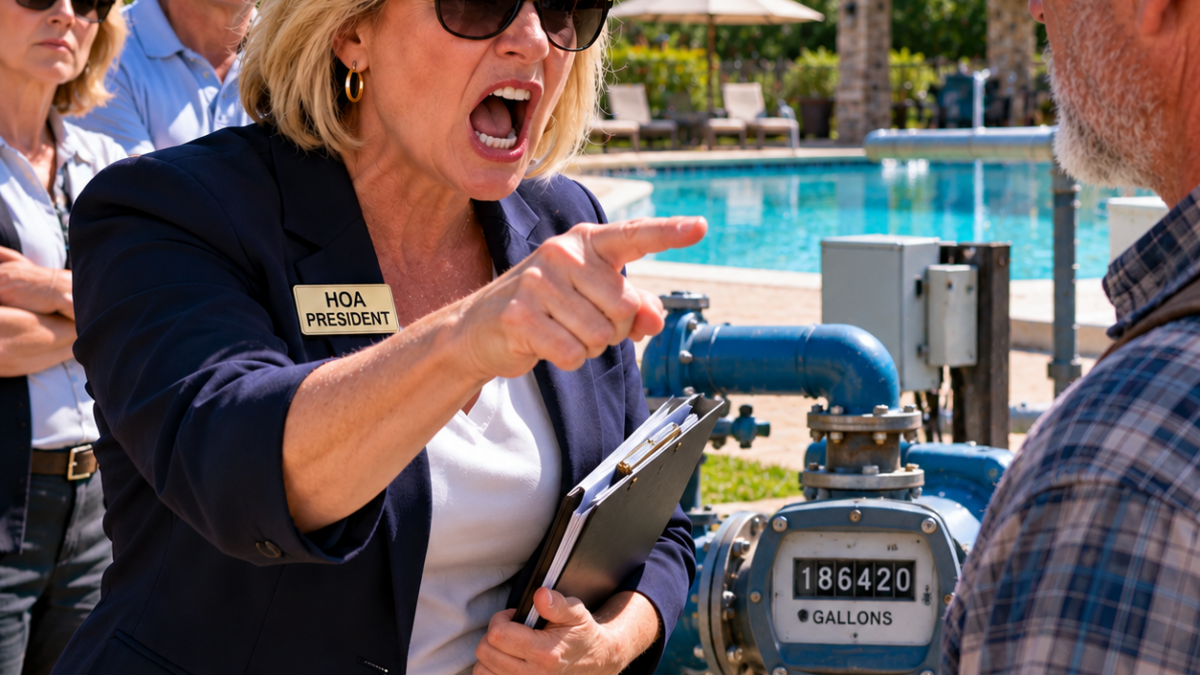
PART 2
My name is Caleb Mercer.
I was sixty-one that spring and three years retired from Dry Creek Municipal Water.
For most of my working life, people only thought about water when it stopped doing what it was supposed to do.
A main broke beneath an intersection.
A pump tripped.
A storage tank failed to refill.
A pressure zone lost supply.
A laboratory sample came back wrong.
When water systems worked, people barely noticed them.
Turn the faucet.
Water comes out.
Flush the toilet.
Gone.
Fill a glass.
Done.
That invisibility makes water easy to take for granted.
It also makes it easy for someone with enough confidence and the right paperwork to misuse a system before anyone asks the right question.
My nine acres existed long before Stonebridge Heights.
My wife, Anna, and I bought the farmhouse in 1998.
The original well was shallow and old, more dug shaft than modern well, and during dry years it started pulling sediment.
We replaced it.
Four hundred twenty feet.
High-yield formation.
The driller joked that we had enough water to “supply half a subdivision.”
Neither Anna nor I knew how prophetic that sentence would become.
The well supplied our house, workshop, a small irrigation circuit, and Anna’s courtyard garden.
After she died, I stopped changing much in that garden.
Not because everything she planted survived.
It didn’t.
Some roses died.
One apple tree split during an ice storm.
A section of lavender failed after a bad winter.
But the fountain still worked.
Flat stones Anna had selected from three different landscaping yards because she said every one I chose looked “too rectangular.”
When the fountain ran, you could hear it through the kitchen window.
Not loud.
Just enough.
After she died, that sound became part of the house.
Stonebridge Heights arrived in 2008.
Two hundred twelve homes.
Clubhouse.
Walking paths.
Decorative ponds.
Eventually, plans for an infinity pool.
The developer bought fields around us.
He approached us several times about selling.
Anna always said the same thing.
“Build around us.”
So they did.
Our property sat outside the HOA.
County taxes.
Our fence.
Our rules.
Stonebridge could tell residents what color to paint a front door.
It could not tell me what to do with my well.
At least that was how it was supposed to work.
By seven o’clock Monday morning, I had two cases of bottled water on the kitchen floor and Nate Collins inside my wellhouse.
Nate was a licensed well contractor with shoulders too broad for the little building.
He checked the control box.
Measured resistance.
Tested the overload.
Then lowered a probe.
He looked at me.
“Motor windings are cooked.”
“I figured.”
“Static water level’s down almost thirty feet.”
That got my attention.
“How long to recover?”
“If nobody keeps pulling eighty gallons a minute?”
He shrugged.
“Probably.”
“Probably.”
“I don’t lie to customers before breakfast.”
He looked back at the pump.
“But this motor is finished.”
His written estimate came to $18,400.
Temporary household tank.
Replacement pump.
Cable.
Labor.
Camera inspection of the casing.
Testing.
“How long?”
“Five days if I can get the right motor.”
“And if you can’t?”
“Seven.”
Memorial Day was six days away.
Vanessa had a countdown.
So did I.
The difference was hers ended with a ribbon cutting.
Mine ended with whether I could shower in my own house.
At 9:42 a.m., an email from Stonebridge’s law firm appeared.
Subject:
**TEMPORARY COMMUNITY UTILITY ACCESS — NOTICE OF ACTIVATION**
The letter said Stonebridge possessed a recorded right to install and maintain utilities within a twenty-foot corridor along my eastern boundary.
It called the pool connection a temporary emergency measure necessary to protect HOA property while the permanent municipal connection underwent final certification.
Attached was the map Vanessa showed me.
The title block read:
**MERCER UTILITY EASEMENT — EXHIBIT B**
Survey date:
June 14, 2008.
My signature sat at the bottom.
I enlarged the drawing.
The base map looked old.
The yellow line did not.
Different color density.
Cleaner.
The label **WATER ACCESS CORRIDOR** used a font that appeared nowhere else.
I went to the hall closet and pulled out the fireproof document box.
Anna used to tease me about that box.
“You keep every paper except the ones I ask you to keep.”
She wasn’t entirely wrong.
But I had the original easement.
Recorded copy.
Page one.
Ten-foot corridor.
Purpose:
Underground electrical.
Telephone.
Fiber optic communication.
Page two.
No surface structures.
No interference with my water system.
No interference with septic.
No interference with agricultural use.
Page three.
My signature.
There was no Exhibit B.
No water.
No well.
No shared supply.
Somebody had taken my signature from a legitimate recorded document and placed it beneath something else.
I called the law firm.
The attorney named on the letter was unavailable.
His assistant sounded careful.
“Our office relied upon documents supplied by our client’s management office.”
“Did your office verify the recording number?”
Pause.
“I cannot discuss privileged client communications.”
“Then tell your client the line described in that file just destroyed an $18,400 pump.”
At 10:15, Vanessa called.
“I understand you’re alleging the exhibit is inaccurate.”
“I’m not alleging anything. I’m holding the recorded document.”
“The board acted in good faith based on information provided.”
“Provided by who?”
“Our management consultant assembled the utility package.”
“Name?”
“Caleb, turning this into a personal accusation will not restore your water.”
“Neither will pretending my signature belongs on a fake map.”
She breathed out slowly.
“Let’s solve the immediate problem.”
That sentence usually means someone wants you to sign something.
“The HOA will contribute eighty-five hundred dollars toward pump replacement if you sign a temporary-access acknowledgment through June thirtieth. We’ll deliver a portable water tank today.”
“Contribute?”
“Yes.”
“That’s less than half the estimate for a pump your project destroyed.”
“We’re making a good-faith offer.”
“Send it in writing.”
“Does that mean you’ll consider it?”
“It means I want a record.”
The proposal arrived nineteen minutes later.
I read it twice.
Then a third time.
The temporary-access section wasn’t temporary.
It stated that Stonebridge’s **existing utility rights included water conveyance and extraction**, while I merely acknowledged continued use through June thirtieth.
If I signed it, I wouldn’t be granting temporary permission.
I would be admitting they had always possessed a right they did not have.
That was when the situation changed.
Vanessa wasn’t trying only to keep the pool full.
She was trying to fix the missing easement after the pipe was already in the ground.
I drove to the county recorder.
The clerk searched everything associated with my parcel and the clubhouse lot.
2008 electrical easement.
Two drainage agreements.
Road dedication.
Landscaping covenant.
No water easement.
No shared-well agreement.
No temporary water license.
No Exhibit B.
I asked for certified copies.
The clerk stamped them.
Then looked at the page Stonebridge sent me.
“If somebody is circulating a different exhibit with your signature, preserve exactly what you received.”
“Already did.”
From there, I went to county environmental health.
Lena Ortiz met me in a small office overlooking a parking lot full of county trucks.
She was a groundwater specialist.
Soft voice.
No wasted questions.
She read the well permit.
Then Stonebridge’s pool permit.
Then my recorded easement.
“The pool permit lists Dry Creek Municipal as final source.”
“Yes.”
“It does not list your well.”
“No.”
“Any temporary source?”
“No.”
“Cross-connection application?”
“None that I know of.”
She checked the database.
“None.”
I showed her photographs of the blue pipe.
“No visible backflow assembly at your property line.”
“That was my concern.”
Lena looked at me.
“A direct connection between a chlorinated pool system and a private domestic well can create a contamination pathway if pressure reverses.”
“Did it?”
“I cannot say that.”
“I know.”
“We test before saying contamination.”
That distinction mattered to me.
I had spent thirty-one years around people who heard one possibility and repeated it as fact.
I didn’t want that.
The unauthorized connection was bad enough.
We did not need to exaggerate.
Lena opened Stonebridge’s final inspection file.
“The pool still needs operating approval.”
“When?”
“Final inspection is Wednesday.”
“Memorial Day is Saturday.”
“Yes.”
She looked at the photos again.
“I’m adding the source connection to Wednesday’s inspection.”
“How long?”
“Forty-four hours.”
There it was.
Forty-four hours until a county inspector physically traced the system.
Forty-four hours during which Vanessa had every incentive to make the blue pipe disappear.
When I returned home, two private-security vehicles were parked on the Stonebridge side of my fence.
A laminated notice hung from my gate.
**UNAUTHORIZED INTERFERENCE WITH COMMUNITY INFRASTRUCTURE PROHIBITED**
It warned that anyone closing valves, disabling pumps, or obstructing access could be liable for property damage and public-safety costs.
My gate.
My fence.
My well.
Their warning.
I photographed it.
Cut the zip tie.
Put the paper in my document box.
Then installed cameras.
One on the wellhouse.
One facing the trench.
One watching the property line.
At 4:30 that afternoon, Nate delivered a five-hundred-gallon household tank.
We were connecting it when a man approached from the Stonebridge side.
Gray work shirt.
Sunburned neck.
Tired face.
He stopped at the fence.
“Mr. Mercer?”
“That’s me.”
“Ben Harlow. Harlow Site Services.”
I recognized the company logo from one of the trucks I photographed.
“You installed the line.”
“Yes.”
He held a folder.
“I’m staying on this side unless you invite me over.”
“Good choice.”
He gave me an awkward half smile.
“I need you to understand what we were told.”
“Go ahead.”
“Work order described an existing shared sleeve and approved temporary connection.”
“Did your crew enter my wellhouse?”
“No. We weren’t hired to touch your pump.”
“Where’d you connect?”
“There was a capped utility sleeve near the old corridor. We tied a new lateral through it.”
“Who showed you where?”
“Vanessa Crowe and Douglas Pike. Property manager.”
“Permit?”
Ben looked down.
“I saw the easement exhibit.”
“That wasn’t my question.”
“No.”
“Cross-connection approval?”
“No.”
“They called it repair work?”
“Yes.”
He handed me his work order.
Client authorization:
Vanessa Crowe.
Scope:
**ACTIVATE EXISTING 4-INCH EMERGENCY WATER LATERAL BETWEEN MERCER CORRIDOR AND STONEBRIDGE CLUBHOUSE. COMPLETE BEFORE MAY 20. NIGHT WORK AUTHORIZED TO AVOID RESIDENT DISRUPTION.**
“Why night work?”
“Vanessa said the parking area needed to remain open.”
I looked toward the clubhouse.
“The parking lot’s on the other side.”
“I noticed.”
“Why are you here now?”
He glanced toward the temporary tank beside my house.
“I was told this was a shared supply.”
“And?”
“Shared supplies usually don’t leave one house carrying bottled water.”
Before he left, I asked about installation photographs.
“Insurance requires them.”
“Originals?”
“Backed up.”
“Keep them that way.”
“I intend to.”
That evening, Stonebridge residents started messaging me.
Vanessa posted on the HOA portal:
**NEIGHBORING OWNER THREATENS MEMORIAL DAY POOL OPENING**
She wrote that one private objection was blocking a long-established utility corridor and placing a major community investment at risk.
No name.
She didn’t need one.
One message called me selfish.
Another said two hundred families shouldn’t lose an amenity because one man wanted “leverage.”
A third asked how much money I was demanding.
Then Rachel Kim wrote me.
I knew her only vaguely.
She lived three streets into Stonebridge.
Her message said:
**My closing documents say the pool uses city water. Are we actually connected to your private well?**
Vanessa had deleted Rachel’s identical question from the resident portal within three minutes.
Rachel saved a screenshot.
That deletion mattered.
If Vanessa genuinely believed the HOA possessed lawful well access, the easiest response in the world was:
**Yes. Temporary connection under our recorded easement.**
Instead, she removed the question.
I spent Monday night at my dining table.
Anna’s chair across from me.
Four stacks of paper.
Laptop.
Well-monitor export.
Coffee.
The flow history ran ninety days.
I expected one abnormal event.
There were dozens.
The first unexplained draw began February seventeenth.
Between two and four in the morning.
Roughly seven thousand gallons.
Then another.
Then another.
By April, four nights in some weeks.
Six thousand.
Nine thousand.
Twelve thousand.
The final event—the night the pump died—pulled 41,680 gallons.
Total abnormal usage:
186,420.
Stonebridge’s pool capacity was roughly 118,000 gallons.
That left more than sixty-eight thousand unaccounted for.
I overlaid the dates with construction announcements Rachel had saved.
February draws.
New landscaping.
March draws.
Pressure testing.
April.
Sod installation.
May.
Pool filling.
This wasn’t one emergency.
They had been using my private well as an unmetered construction supply for ninety-three days.
I sat there for a long time.
Not because I didn’t believe the monitor.
Because Anna had always treated water with almost ridiculous care.
She’d turn off the hose while moving between flower beds.
Catch rain in barrels.
Complain if I let the kitchen faucet run while washing vegetables.
Not because we were short on water.
Because she hated waste.
Now sixty-eight thousand gallons had apparently gone into sod and shrubs while my house carried the electrical cost and aquifer draw.
Tuesday morning, I called Vanessa.
“February sixteenth.”
Silence.
“What about it?”
“Your work order authorized night work on February sixteenth. First unexplained draw started six hours later.”
“I authorized activation of an existing utility.”
“My flow monitor says you’ve been using that utility for ninety-three days.”
“Then your issue is with whoever designed the original system.”
“My issue is with whoever ordered the valve opened.”
Her voice sharpened.
“Caleb, I’m trying to protect this community from catastrophic cost over a temporary supply issue.”
Finally.
Not safety.
Cost.
“What cost?”
“The permanent municipal connection required modifications after city capacity requirements changed.”
“How much?”
“That is internal HOA financial information.”
“Then I’ll ask the homeowners paying for it.”
Her voice dropped.
“If you create panic before the board has time to address this responsibly, you will hurt people who did nothing wrong.”
That was the first argument she made that had truth in it.
Two hundred twelve households had not installed the pipe.
Teachers lived there.
Retirees.
Young parents.
People with mortgages.
People already stretching budgets.
A special assessment could hurt them.
Vanessa was using those families as a shield.
That did not make them imaginary.
“You had ninety-three days to address it responsibly.”
I looked at the water-use graph.
“You chose to hide the meter.”
She ended the call.
By noon, Rachel had downloaded six months of board packets from the association portal.
Buried in March finance material:
**AQUATIC INFRASTRUCTURE CONTINGENCY — $284,000**
Moved into executive-session appendix.
Another line:
**DEVELOPER CONTRIBUTION — $150,000 — PAYABLE UPON FINAL OPERATIONAL APPROVAL BEFORE MEMORIAL DAY**
I did the math.
City connection problem:
$284,000.
Developer money at risk:
$150,000.
Total pressure:
$434,000.
And Vanessa faced a board election six weeks later.
My water had allowed the problem to disappear.
At least temporarily.
Then Rachel found the memo.
Four paragraphs.
Stonebridge’s own attorney had reviewed the 2008 easement three months earlier.
Paragraph three:
**The recorded corridor does not authorize water withdrawal, private-well access, or connection to any private water supply. Any such use requires a new written agreement signed by the Mercer property owner and recorded with the county.**
Addressed to Vanessa Crowe.
And Douglas Pike.
Attached was Vanessa’s reply.
I read the sentence once.
Then again.
Then out loud.
**We cannot take a $434,000 hit over language drafted before the pool existed. Use the existing sleeve as a temporary source while legal works on an acknowledgment. Once water is flowing, Mercer will have every reason to settle.**
I sat still.
Once water is flowing.
That was the entire strategy.
Put the pipe in first.
Fill the pool.
Make residents emotionally invested.
Create the opening date.
Let the well owner wake up without water.
Then offer partial reimbursement in exchange for a document retroactively acknowledging the right.
Vanessa had not misunderstood the easement.
Her own lawyer had told her exactly what it did not allow.
The fake Exhibit B wasn’t a fifteen-year-old map someone misread.
It was leverage manufactured because the real document didn’t say what she needed.
I did not post the email.
I wanted to.
Every angry part of me wanted to send it to all 212 homes and watch the resident portal explode.
I didn’t.
If Vanessa learned we had the email before Wednesday, she might make the line disappear.
Rachel preserved the original.
I sent Lena a copy.
Then we let the inspection clock run.
Tuesday afternoon Lena called.
“We located Harlow’s county notification for the pool equipment work.”
“What does it say?”
“Internal fill-line replacement.”
“Nothing about crossing my parcel?”
“No.”
“Anything about private source?”
“No.”
“So tomorrow?”
“We inspect source to destination.”
She paused.
“And Caleb?”
“Yes.”
“Leave everything exactly as it is.”
“That was already my plan.”
“I’m putting it in writing anyway.”
“Why?”
“Because Vanessa told you not to touch it for the wrong reason. I’m telling you not to touch it for the right one.”
At 11:38 Tuesday night, Camera Two alerted.
Two men crossed the cedar line.
Tools.
One wore a Stonebridge maintenance jacket.
The other was Douglas Pike.
I switched on the floodlights.
Called the sheriff.
Then walked outside but stayed thirty feet away.
“Can I help you?”
Douglas froze beside the trench.
“We’re securing association infrastructure ahead of tomorrow’s inspection.”
“You’re standing on my parcel after midnight.”
“The utility corridor grants access.”
“For cable.”
He held up a wrench.
“The president instructed us to isolate the temporary line.”
“The county instructed me in writing to preserve the configuration.”
Douglas looked toward the pipe.
Then toward the road.
The maintenance worker put his tools down immediately.
Douglas didn’t.
For several seconds he seemed to calculate whether he could get the valve closed before anyone arrived.
He couldn’t.
The deputy came six minutes later.
He did not decide the easement dispute.
He didn’t need to.
He documented the time.
Photographed the tools.
Confirmed I had not invited them.
Told both men to leave pending county inspection.
As Douglas walked away, he muttered:
“You have no idea what this will cost them.”
I almost answered.
Then I realized I did know.
$434,000.
What he didn’t know was what it had already cost me.
Wednesday morning was gray and warm.
Lena arrived at eight.
With her was Marcus Bell, county plumbing inspector.
Nate stood beside the wellhouse.
Ben Harlow waited near the fence with his tablet.
Vanessa arrived in her red suit.
Douglas.
HOA attorney.
Three board members.
The three directors looked irritated and confused.
That told me a lot.
Lena spoke before anyone touched anything.
“We document from source to destination. Nobody operates a valve without Marcus’s direction.”
We started at the well.
Nate showed the burned motor readings.
Pressure log.
Static-level change.
The flow history.
Marcus traced my discharge line toward the eastern boundary.
Near the utility corridor he found a removable panel hidden beneath decorative gravel.
Under it:
A tee.
New.
He wiped dirt from the fitting.
Manufacturing stamp.
Ben opened his invoice.
Same batch series.
Vanessa had repeatedly called this an existing water connection.
The utility sleeve was old.
The tee was not.
Ben opened an installation photograph.
Before work:
Capped empty sleeve.
No water line.
Second photograph:
His crew cutting into my private discharge pipe.
New tee.
Isolation valve.
Four-inch lateral.
Alan Price, one of the HOA directors, stared at Vanessa.
“You told us they were opening an old valve.”
Vanessa looked at the pipe.
“That’s how the project was described to me.”
Ben spoke quietly.
“My invoice says new tee, new isolation valve, new four-inch lateral.”
Douglas stepped forward.
“We aren’t here to debate administrative wording.”
I looked at him.
“Administrative wording is why everyone is standing in a trench on my land.”
Nobody answered.
Marcus followed the blue line.
Halfway toward the clubhouse, he stopped at a black device inside a shallow box.
“Backflow?”
Ben shook his head.
“Pressure reducer.”
“We were told the clubhouse already had backflow?”
“Yes.”
We continued.
Inside the pool equipment room, Marcus found the approved backflow assembly on the municipal stub.
The blue private-well pipe bypassed it entirely.
It entered downstream.
Near the chemical feed equipment.
Marcus shut down the chlorine pump.
Photographed everything.
Then said the sentence I expected.
“This configuration creates a potential cross-connection pathway.”
Vanessa immediately said, “So the well could be contaminated?”
Marcus turned.
“I did not say contamination occurred.”
His voice was flat.
“I said the required separation is absent and a pressure reversal could create a pathway.”
I appreciated him for that.
Evidence of risk.
Not invented catastrophe.
Lena collected samples.
Kitchen.
Wellhead.
Blue lateral.
Clubhouse.
Then she asked Vanessa:
“Permit authorizing private source.”
Vanessa produced Exhibit B.
Lena put it beside my certified recorder copy.
“This drawing isn’t recorded.”
“It was provided as a working exhibit.”
“By whom?”
“Management assembled the utility documents.”
Douglas looked at her.
For the first time, their stories didn’t move together.
Lena turned to him.
“Did your office create the overlay?”
Douglas hesitated.
“We prepared a visual summary from historic plans.”
“Who placed Caleb Mercer’s signature on it?”
Silence.
The HOA attorney asked to speak privately with his client.
Lena said, “You may step outside. Inspection continues.”
Through the window, I watched them.
Vanessa spoke with both hands.
Douglas kept shaking his head.
The attorney barely moved.
When they returned, Vanessa’s voice had changed.
“The association will suspend use pending document review.”
Marcus looked at her.
“The county is ordering suspension.”
He walked to the inspection card.
At 10:37 a.m., he wrote:
**NOT APPROVED**
Then signed.
The grand-opening banners outside the clubhouse moved in the wind.
Vanessa stared through the glass.
Six days earlier they had looked like promises.
Now they looked like evidence of motive.
The pool was closed.
No final operating approval.
No Memorial Day opening.
No developer contribution unless the deadline terms changed.
But the inspection wasn’t over.
I had sixty-eight thousand gallons still unexplained.
Ben’s installation plan showed a branch in the blue lateral before it entered the pool equipment room.
Douglas said:
“Future drinking-fountain supply.”
Marcus followed it.
The line passed beneath a walkway.
Entered an irrigation control vault.
Inside were four valves.
Clubhouse lawn.
Entry landscaping.
Pool landscaping.
Model-home irrigation.
Each circuit had a small mechanical counter.
Marcus wrote down the totals.
67,980 gallons.
My unexplained amount:
About 68,000.
Difference:
Less than one percent.
There it was.
The whole theft divided into valves.
Sod.
Shrubs.
Pressure testing.
Pool.
Ninety-three days.
No meter bill.
No agreement.
No water permit.
No approval.
Alan Price removed his glasses.
“Did the board authorize this?”
Vanessa answered carefully.
“The board authorized completion of the amenity package within the approved budget.”
Alan put his glasses back on.
“That was not my question.”
Silence.
“Did we vote to take water from Caleb’s private well?”
“The operational details were delegated.”
Rachel stood outside the fence with several residents.
She held up her phone.
“The attorney told you the easement didn’t allow it.”
Vanessa turned toward her.
“You are distributing privileged communications.”
I said, “The communication concerns use of my property and a map carrying my signature.”
The HOA attorney closed his folder.
“My firm did not create Exhibit B.”
Everyone looked at him.
He continued.
“And our prior advice did not authorize this connection.”
Controlled.
Professional.
Devastating.
Lena issued orders.
Unauthorized connection isolated.
Physical configuration preserved until county review complete.
Pool closed.
Corrective plan required.
Well to be retested after recovery.
No alteration without inspection approval.
Then we waited for the water samples.
Those mattered more to me than Vanessa.
More than the pool.
More than money.
Thursday morning Lena called.
“No chlorine residual in your domestic samples.”
I closed my eyes.
“Bacteria?”
“Nothing dangerous.”
“Chemical crossover?”
“Nothing detected.”
I sat at the kitchen table.
For the first time all week, my shoulders dropped.
The well was stressed.
The pump destroyed.
But the water supply did not appear contaminated.
I looked out toward Anna’s dry fountain.
That result felt more like victory than the pool closure.
I could replace machinery.
I could argue over money.
I did not want the place Anna and I built remembered because someone contaminated the well trying to open an HOA amenity.
By Wednesday afternoon, the story had spread through Stonebridge.
Residents were angry about the pool.
But increasingly, they were angrier about being told I was the problem.
Messages changed.
A man who called me selfish Monday wrote:
**I owe you an apology. We were told you were demanding money to release an easement.**
Another:
**Did Vanessa know the line was private?**
Rachel sent me screenshots from the portal.
Residents asked for:
Easement.
Attorney memo.
Contractor invoices.
Pool permit.
Finance records.
Board minutes.
The HOA scheduled an emergency meeting for Thursday.
Before it started, Vanessa made me one more offer.
Stonebridge would pay:
Full pump replacement.
Temporary water tank.
Fence repair.
Water use.
Attorney fees.
Additional inconvenience compensation.
Total:
$72,400.
In exchange:
I would call the incident a documentation error.
Withdraw any claim of intentional misconduct.
Agree not to release internal communications.
Grant a sixty-day temporary water license while the city connection was completed.
Three days earlier she offered $8,500.
Now:
$72,400.
That was the value of evidence.
I sat with the proposal at my dining table.
Anna’s chair across from me again.
It would have been easy to take it.
The money covered everything.
More than everything.
But the sixty-day license would restart my pump before the aquifer fully recovered.
Worse, the confidentiality language allowed the same story to survive.
Caleb misunderstood.
Paperwork confusion.
HOA resolved the issue generously.
Vanessa protected residents.
I called the lawyer who had begun advising me.
Her name was Mara Chen.
She had reviewed the recorder documents and county orders after Monday.
“What do you think?” I asked.
“What do you want?”
“My house repaired.”
“The offer does that.”
“I want them off my well.”
“Sixty-day license doesn’t.”
“I want residents to know what happened.”
“Confidentiality complicates that.”
I was quiet.
Mara said:
“This is where you decide whether your claim is only about your loss.”
“It isn’t.”
“Then don’t pretend it is.”
I declined.
Not because I wanted to punish 212 households.
Because the problem was larger than an unpaid water bill.
A system had allowed one officer to receive correct legal advice, ignore it, authorize night excavation, circulate an altered map, accuse the property owner publicly, and then demand retroactive permission after the physical connection created pressure.
Money repaired a pump.
Silence did not repair that system.
The clubhouse was full an hour early Thursday night.
Parents along the walls.
Retirees in folding chairs.
People standing in the hall.
Vanessa sat at the center of the board table.
Red suit.
Thick binder.
Douglas two seats away.
The HOA attorney sat at the far end with the other directors.
Not beside Vanessa.
That seating arrangement said plenty.
Alan Price opened the meeting.
“Tonight we are addressing the unauthorized connection between Stonebridge property and the Mercer parcel, resulting damage, and the accuracy of statements made to the board and residents.”
Vanessa interrupted.
“I object to the word unauthorized before document review is complete.”
Alan looked down the table.
“The county has found the connection was not part of the permitted pool system.”
He held up a certified recorder copy.
“The county recorder confirms no water easement.”
Then he looked directly at her.
“Authorized by whom?”
Vanessa opened her binder.
She did what effective leaders do when the facts turn against them.
She widened the frame.
City connection costs had changed.
The developer contribution was at risk.
The pool belonged to everyone.
The old utility corridor created ambiguity.
The board faced a $434,000 exposure.
She had acted temporarily to protect homeowners.
Some people nodded.
I understood why.
If someone tells you they broke a rule to save you two thousand dollars, part of you wants to forgive them before learning what rule they broke.
Then Alan gave me the floor.
I didn’t start with the fake map.
I started with the kitchen faucet.
“Monday at 5:17 a.m., I turned on my sink and got air.”
I showed a photograph of the pressure gauge.
“Twelve PSI.”
Pump estimate.
“Eighteen thousand four hundred dollars.”
Flow graph.
“Eighty-seven gallons a minute.”
Then twelve pages.
One at a time.
Recorded 2008 easement.
No water rights.
Exhibit B.
Yellow overlay.
My copied signature.
Ben’s February work order.
Night excavation.
New tee.
Flow logs.
Ninety-three days.
186,420 gallons.
Irrigation counters.
67,980.
Pool permit listing municipal water.
$284,000 connection cost.
$150,000 deadline contribution.
Attorney memo saying a new signed agreement was required.
Then Vanessa’s email.
I read it.
“Use the existing sleeve as a temporary source while legal works on an acknowledgment. Once water is flowing, Mercer will have every reason to settle.”
No one moved.
Then I displayed the $72,400 proposal from that afternoon.
“I’m not asking anyone in this room to take my word over Vanessa’s.”
I looked at the board.
“I’m asking one question.”
I let the pages remain on the screen.
“At what point in this sequence did I agree?”
Silence.
Vanessa leaned toward her microphone.
“You benefited from the original development’s utility improvements.”
“I paid for power service on my property.”
“Our properties have never been as separate as you are suggesting.”
“Shared geography isn’t shared ownership.”
She raised her voice slightly.
“If we missed the deadline, every household could have faced more than two thousand dollars in combined costs and lost funding. I chose a temporary solution while we negotiated.”
“You didn’t negotiate.”
I looked directly at her.
“You took the water first and wrote the acknowledgment afterward.”
Douglas reached for his microphone.
“Exhibit B was intended as a conceptual summary.”
Rachel stood.
“Then why did the HOA law firm send it to Caleb as proof of a recorded right?”
The HOA attorney answered before Douglas.
“Our office received that exhibit in a folder identified as recorded utility documents.”
Douglas turned.
The lawyer continued.
“We were not informed it was conceptual.”
Alan looked at Douglas.
“Who created the yellow overlay?”
“Our office assembled it from historical plans.”
“And Caleb’s signature?”
Douglas hesitated.
“That signature layer was already present in the digital file supplied by the president.”
Every face turned toward Vanessa.
She shook her head.
“I supplied the survey archive. I did not direct anyone to fabricate a signature.”
Two people who had spent days speaking as one organization were suddenly separate.
Then Ben Harlow raised his hand.
Alan recognized him.
Ben walked forward with his tablet.
“Our job package preserves original file metadata.”
Vanessa’s attorney—no longer exactly her attorney, by the look of things—said:
“Ben, what are you showing?”
“Exhibit B.”
He connected the tablet to the display.
Creation timestamp:
February 15.
10:14 a.m.
One day before excavation.
Author field:
**VCRO-BOARD**
Vanessa stared at the screen.
“Usernames are not proof of authorship.”
I nodded.
“Correct.”
Then I looked at Ben.
“Show the email.”
Forty-two minutes after the file was created, the same account emailed it to Harlow Site Services.
Message:
**This exhibit confirms access. Proceed discreetly. We will secure Mercer’s acknowledgment before public opening.**
The room went completely still.
Vanessa looked down at her binder.
A woman in the back stood.
I never learned her name.
“If you were protecting us, why did you tell us Caleb was the problem?”
Vanessa’s answer was quieter than anything she had said all week.
“Because public uncertainty could have jeopardized the project.”
There it was.
Not a confession to every allegation.
Something more useful.
An explanation.
Protecting the project required controlling the story.
My dry house was inconvenience.
My signature was a tool.
My consent was a problem to solve after the fact.
The six-member board voted five to one to remove Vanessa as president pending independent investigation.
Vanessa cast the only no vote.
Douglas lost authority to act for Stonebridge.
The altered exhibit was referred to independent counsel and the county.
No police marched into the clubhouse.
Nobody was handcuffed.
There was no dramatic criminal sentence before midnight.
Real accountability began with document holds.
Insurance notices.
Professional review.
Civil claims.
Board minutes Vanessa no longer controlled.
The board also voted unanimously to accept responsibility for all verified physical damage and water use.
Most importantly, they did not vote to keep the pipe.
Friday morning Nate arrived with Marcus and Ben’s crew.
County supervision.
We stood near the old corridor.
Marcus documented pressure.
Nate isolated my system.
Ben’s crew cut the blue lateral free.
The illegal tee came out.
My discharge line was rebuilt using a section Nate selected.
Pressure test.
Disinfection.
Flush.
Test again.
When the final valve closed, the pool fill controller displayed:
**0.0 GPM**
I stared at that little number.
Zero.
That was the clearest answer of the entire dispute.
Stonebridge’s “community water” had been mine.
The HOA paid the pump replacement.
Temporary tank.
Electrical work.
Camera inspection.
Water testing.
Fence repair.
Pipe removal.
And compensation for 186,420 gallons calculated at the county’s documented bulk-water rate.
Not some invented penalty.
A measurable loss.
They still had to deal with the real city connection.
$284,000.
The developer contribution deadline passed.
Stonebridge residents eventually approved a staged municipal connection after receiving full cost disclosure.
The pool opened seven weeks late.
No giant Memorial Day ribbon cutting.
No banners.
No water sneaking through my pasture.
It opened with legally supplied municipal water passing through an inspected meter.
My pump took longer.
Nine days after the failure, Nate finished installation.
He called me into the kitchen.
“Ready?”
“Go.”
He opened the system.
The faucet sputtered.
Air.
Then water.
Cloudy for two seconds from flushing.
Then clear.
I put my hand beneath it.
Nate laughed.
“You know you can turn it off now.”
“In a minute.”
I stood there longer than necessary.
Then I walked outside.
Anna’s courtyard fountain was still dry.
I opened its small valve.
Water moved slowly into the basin.
Reached the first flat stone.
Spilled over.
Then the second.
That uneven sound returned.
The same sound I had heard through the kitchen window for nearly twenty years.
I sat on the courtyard wall.
I had spent the week thinking about 186,420 gallons as a number.
Evidence.
Flow.
Loss.
But water wasn’t abstract there.
It was the fountain Anna designed.
Coffee.
A shower.
A garden hose.
A glass beside the bed.
Ordinary things only become emotional after someone takes away the ability to do them.
Stonebridge’s new board recorded a formal release.
It confirmed that the 2008 corridor granted no water rights.
No well access.
No extraction rights.
Permanent boundary markers were installed.
Any future project crossing private property required two board signatures plus independent verification of recorded rights.
Vanessa resigned three weeks later.
An independent review concluded she had knowingly exceeded her authority and used an altered exhibit in securing contractor access.
Douglas’s management role ended as well.
Other civil and county processes continued.
I let those processes move at their own speed.
I didn’t need to make the story bigger.
The documents were enough.
Then something happened I had not expected.
Stonebridge residents began coming to my gate.
Not all at once.
One at a time.
The first was Rachel.
She brought a small potted rosemary plant.
“For Anna’s garden.”
I stared at it.
“How do you know about Anna?”
“Ben mentioned the garden. Then somebody told me she designed the fountain.”
Rachel looked embarrassed.
“If that’s too personal—”
“No.”
I took the pot.
“She loved rosemary.”
“Good.”
We stood by the fence.
Rachel said:
“I’m sorry.”
“For what?”
“I believed Vanessa Monday morning.”
“Most people did.”
“I messaged my neighbor that you were probably holding the pool hostage.”
I smiled slightly.
“Probably?”
“It sounded better than definitely.”
“You saved the screenshots.”
“I did.”
“That mattered.”
She looked toward the clubhouse roof.
“I keep thinking about how easy it was.”
“What?”
“To believe the board because they sounded official.”
I nodded.
“Water systems are like that.”
She frowned.
“HOAs?”
“Anything people don’t see working.”
The next visitor was Alan Price.
He came with a folder.
“New board wants to show you this before recording.”
Inside was the release.
Boundary acknowledgment.
Future access controls.
I read every page.
Alan waited.
“You’re allowed to breathe.”
He smiled.
“After this month, I don’t sign anything before someone reads it.”
“Good policy.”
“We also hired an outside engineer for the city-water project.”
“Better.”
Alan looked toward my wellhouse.
“Some residents think you should have shut the valve Monday morning.”
“I thought about it.”
“Why didn’t you?”
“Evidence.”
He nodded.
“Ben told us the entire line probably would’ve been removed before Wednesday if you’d closed it immediately.”
“That was my concern.”
Alan was silent.
Then:
“You know what bothers me most?”
“The fake map?”
“No.”
He looked at the cedar trees.
“She told the board you were negotiating.”
I waited.
“She made it sound like the only dispute was price.”
“That was useful for her.”
“I voted for the pool budget believing she already had a temporary supply agreement.”
I looked at him.
“Did you ask to see it?”
“No.”
He said it without defending himself.
“I do now.”
That was progress.
Mara handled the civil resolution.
The HOA’s insurer initially disputed portions of the water claim.
Not whether water had been used.
How to price it.
Domestic rates?
Bulk rates?
Agricultural rates?
Replacement cost?
Pump depreciation?
Aquifer recovery monitoring?
Those arguments took months.
That was normal.
I had no interest in turning 186,420 gallons into some fantasy million-dollar theft award.
We documented.
County bulk-water rate.
Electrical cost.
Pump damage.
Temporary supply.
Fence repair.
Testing.
Expert fees.
Attorney fees where recoverable.
Actual numbers.
Stonebridge paid.
Their insurer contributed.
Management coverage handled parts of the governance claim.
Residents absorbed the $284,000 municipal upgrade through a structured payment plan rather than one immediate special assessment.
It still hurt.
Some households paid more each month.
That bothered me.
But the alternative had been letting a private property owner subsidize the project secretly through water nobody admitted they were taking.
That wasn’t a solution.
It was a hidden bill.
A few residents remained angry at me.
One man stopped his truck beside my mailbox that summer.
“You know our dues went up because of you.”
I looked at him.
“Your dues went up because your pool needed a legal water connection.”
“It was working.”
“So was my well before it filled your pool.”
He stared at me.
“You could’ve worked something out.”
“They offered me eight thousand five hundred after burning an eighteen-thousand-dollar pump.”
“I heard they later offered seventy.”
“With a sixty-day water license.”
“So?”
“So my well isn’t a municipal main.”
He shook his head.
“You people always hide behind property rights.”
I almost asked who “you people” were.
Instead I said:
“You bought a home with city water. Your board built a pool permit based on city water. My property was never part of your purchase.”
He drove away.
Not everyone needed to agree with me.
That took me longer to accept than I expected.
During my career, I could point to a regulation.
Design standard.
Operating permit.
Once I retired, I discovered people often cared less about the rule than whether following it inconvenienced them.
The following spring, Stonebridge invited me to observe the final city-water connection test.
I almost declined.
Then Alan called.
“Please come.”
“Why?”
“You spent thirty-one years doing this.”
“You hired an engineer.”
“We did.”
“Then trust him.”
Alan was quiet.
“Residents would feel better if you were there.”
That was ironic.
A year earlier, residents blamed me for blocking the pool.
Now they wanted me watching the legitimate supply go live.
I went.
The new municipal line entered through a properly permitted route.
Meter.
Backflow assembly.
Isolation valve.
Pressure control.
Sampling port.
Everything visible.
Everything documented.
Marcus Bell attended for the county.
Ben Harlow had done part of the installation.
He saw me.
“Better than the last one.”
“Lower chance of meeting beside my well at five in the morning.”
“That too.”
When Marcus opened the municipal valve, the meter began counting.
A simple digital display.
One gallon.
Ten.
Fifty.
One hundred.
Alan watched it.
“That’s it?”
“That’s usually what legal infrastructure looks like.”
“Boring.”
“Boring is underrated.”
He laughed.
Stonebridge’s pool reopened that afternoon for the season.
No ceremony.
Kids jumped in.
Parents sat under umbrellas.
The world kept moving.
That mattered too.
I never wanted the pool permanently destroyed.
I wanted the lie disconnected from my property.
There is a difference.
Later that year, the county completed its review of Exhibit B.
The findings were careful.
The map was not part of any recorded easement.
My signature image had been duplicated from a legitimate document.
Digital metadata supported creation shortly before contractor mobilization.
The HOA’s prior counsel had advised that a separate water agreement was required.
Professional consequences followed for the individuals involved.
Those details belonged to their processes.
What mattered to me was that no county file treated Exhibit B as a valid property right.
Mara brought me the certified correction.
I put it in the same fireproof box as the original easement.
Next to Anna’s death certificate.
Our deed.
Well log.
Funny what ends up living beside the most emotional documents in your life.
Water-right correspondence.
Insurance settlement.
A corrected map.
I used to think paperwork was separate from the things that mattered.
Age changed that.
Sometimes paper is how you protect the things that matter after you’re no longer standing there to explain them.
Anna had understood that better than I did.
She kept receipts.
Garden diagrams.
Warranty cards.
Notes on the well.
The original 2008 easement had her handwriting in the margin:
**Cable only. No water.**
I found that months after the settlement.
Three words.
Underlined once.
I sat on the hallway floor holding the page.
For a moment I could hear her.
“Caleb, don’t sign something because a developer says it’s standard.”
I had laughed at her then.
“I read utility easements for a living.”
“Then read ours twice.”
She always won arguments after she died.
That autumn, I replaced the temporary cameras with two permanent ones.
Not because I expected Stonebridge to return.
Because I had learned something.
Boundaries that are obvious to the owner can be invisible to someone who needs what lies beyond them.
I also installed a locked valve enclosure where my private discharge passed near the old utility sleeve.
No shared key.
County fire department had contact information if some real emergency ever required discussion.
Nothing automatic.
Nothing assumed.
Rachel became secretary of the new Stonebridge board.
Alan stayed one more year, then stepped down.
Their revised policies were painfully specific.
No board officer could authorize construction across non-HOA property without verified recorded rights.
Outside counsel had to review land-access documents directly from the recorder rather than management files.
Contracts over a threshold required two signatures.
Alterations to survey exhibits had to be labeled conceptual.
Board packets included supporting attachments.
Residents complained the packets were too long.
Rachel sent me a screenshot of that comment.
**Why do we need seventy pages for a pool-maintenance project?**
She added:
**Progress.**
I laughed.
The following Memorial Day, exactly one year after the canceled opening, Stonebridge held a small cookout.
Rachel invited me.
I said no.
Then Alan showed up at my gate.
“You’re being difficult.”
“I’m sitting on my own porch.”
“Exactly.”
“What do you want?”
“Come eat a hamburger.”
“I can make one here.”
“Stonebridge is paying.”
“That’s less persuasive.”
He looked toward Anna’s garden.
“Rachel planted rosemary around the new municipal-meter enclosure.”
I stared at him.
“She what?”
“She said you’d understand.”
I went.
Not because the HOA and I had become friends.
Organizations don’t become friends.
People can.
The pool was full.
This time the municipal meter had records to prove where the water came from.
Children played near the shallow end.
A teenager cannonballed despite a sign prohibiting it.
Some rules never win.
Near the equipment room, I found the rosemary.
Four small plants.
One looked half dead.
I crouched.
Rachel came up behind me.
“Too much shade?”
“Too much water.”
She laughed.
“Of course.”
I adjusted the drip emitter.
Then stood.
“You didn’t need to do this.”
“I know.”
“Anna would have moved them.”
“Why?”
“She never accepted the first planting location for anything.”
Rachel smiled.
“Then we’re honoring tradition.”
That was probably the moment I stopped thinking of Stonebridge only as the place that stole my water.
Vanessa made those decisions.
Douglas helped.
Other people failed to ask questions.
But two hundred twelve homes contained more than one story.
Families lived there.
People who apologized.
People who changed rules.
People who had never known their pool was connected to my well.
Punishing all of them forever would have been easier emotionally.
It would not have been fair.
That did not mean forgetting.
I kept the tee.
The actual fitting Ben’s crew removed from my discharge line.
Nate cleaned it.
I mounted it on a board in my workshop.
Beside it:
A copy of Exhibit B.
Below that:
The legitimate 2008 easement.
And underneath both, a small label:
**186,420 GALLONS**
Visitors sometimes asked why I displayed it.
I never called it a trophy.
A trophy celebrates an opponent losing.
That wasn’t the point.
It reminded me how close a fake right came to becoming permanent because water was already flowing.
Vanessa’s email had been right about one thing.
Once water was flowing, I had every reason to settle.
She just misunderstood what that meant.
Every gallon created a record.
Every pressure drop had a timestamp.
Every nighttime draw stayed in the monitor.
Every invoice had a date.
Every pipe had a manufacturer stamp.
Every controller counted flow.
Every digital file had metadata.
The more they used the system, the more evidence it produced.
I had spent my career telling younger operators:
“Water remembers.”
Not literally.
Systems do.
Meters.
Pressure histories.
Pump hours.
Chemical logs.
Valve positions.
Maintenance records.
Someone can lie about why a system was used.
The system often still tells you when.
Years later, the number 186,420 matters less to me than the first five seconds that morning.
The kitchen faucet.
Air.
Pipe knocking in the wall.
I remember standing there irritated before I understood anything.
Then I remember looking through the back window.
Stonebridge’s lights.
The pool glowing.
At the time, I thought the insult was that they had water while I didn’t.
Eventually, I understood the deeper problem.
They believed possession could come before permission.
Use first.
Paper later.
Make the owner solve the inconvenience you created.
It is the same mistake people make with roads, fences, docks, easements, driveways, and wells.
They confuse necessity with entitlement.
Stonebridge needed water before Memorial Day.
That did not make my well theirs.
Their project was expensive.
That did not make my consent optional.
Two hundred twelve households cared about the pool.
That did not transform an electrical corridor into a water right.
Vanessa was under pressure.
That did not make my signature hers to place where she needed it.
Anna’s garden changed slowly after that.
The rosemary Rachel brought survived.
I planted it beside the fountain.
One spring it became so large I had to cut it back.
I stood there with pruning shears remembering Anna’s habit of telling me I cut everything too square.
I left one side uneven.
For her.
Stonebridge’s cedar-side landscaping matured.
The illegal trench eventually disappeared beneath grass.
If you didn’t know where it had been, you wouldn’t find it.
My boundary markers remained.
The wellhouse got a new roof.
Nate eventually replaced the temporary household tank with a cleaner pressure setup.
The pump ran normally.
I upgraded the monitor.
The new model stored data remotely.
Nate teased me.
“You think somebody’s coming back for another hundred eighty thousand gallons?”
“No.”
“Then why upgrade?”
“Because data is cheaper than arguing.”
He couldn’t disagree.
Three years after the incident, a drought lowered groundwater levels across the county.
Stonebridge imposed irrigation restrictions under its municipal-service agreement.
Residents cut lawn watering.
The pool stayed open because it now had legal supply and accurate metering.
My well level dropped too.
Not dangerously.
Enough to remind me that groundwater wasn’t infinite.
One afternoon Rachel came by.
“We’re planning native landscaping around the clubhouse.”
“Good.”
“Less irrigation.”
“Better.”
“Board wants recommendations.”
I looked at her.
“From me?”
“You spent a week proving how much water we wasted.”
“I spent a week proving you were stealing mine.”
“Same spreadsheet.”
I laughed.
She wasn’t wrong.
I helped them choose lower-water plantings.
Not as a consultant.
No fee.
No easement.
No hidden right.
Just advice.
That difference mattered.
Permission given freely feels completely different from permission extracted under pressure.
I think Vanessa never understood that.
To her, consent was one more project condition.
Something to obtain.
Something to work around.
Something legal could fix later.
To me, consent was the beginning.
No agreement?
Stop.
That is not stubbornness.
It is what keeps one person’s urgency from becoming another person’s obligation.
The last time I saw Vanessa was almost two years after the pool incident.
I was coming out of the county administration building after renewing a well permit for a workshop sink.
She was standing near the entrance.
Gray coat.
No red suit.
For a moment, neither of us spoke.
Then she said:
“I heard the pool is doing well.”
“It has city water.”
A faint smile.
“I know.”
I waited.
She looked older.
Not dramatically.
Just tired.
“I was trying to keep the project from collapsing.”
“I know.”
“You always say that like it makes things worse.”
“No.”
I looked at her.
“It makes it understandable.”
She seemed surprised.
Then I added:
“Understandable isn’t the same as acceptable.”
Her face tightened.
“Do you know what that cost Stonebridge?”
“Yes.”
“I mean all of it.”
“Do you know what it cost me?”
She looked away.
For several seconds, we stood there while people walked around us carrying folders.
Then she said:
“I thought you would sign once the connection existed.”
“I know.”
“I thought eighty-five hundred would get the pump handled and we could finish the legal part after.”
“The pump cost eighteen-four.”
“I didn’t have the estimate then.”
“You had my phone number.”
She said nothing.
I didn’t feel angry anymore.
That surprised me.
For months, I imagined if I ever saw Vanessa again I would have something sharp to say.
But most anger loses its edge once the thing underneath it has been repaired.
Not forgotten.
Repaired.
I said:
“The mistake wasn’t the amount.”
“What was?”
“You thought making it difficult for me to say no was the same as getting a yes.”
She looked at me.
Then nodded once.
We went separate directions.
No apology.
No dramatic breakdown.
No satisfying confession.
I didn’t need one.
My kitchen faucet worked.
The county records were correct.
The well belonged to my property.
The pool had a legal meter.
Sometimes closure is mechanical.
That evening, I went home and opened the workshop.
The old tee still hung on the wall.
Exhibit B beneath it.
I looked at the fake yellow line for maybe ten seconds.
Then turned off the light.
Outside, Anna’s fountain was running.
I sat beside it until dusk.
Across the cedars, the top of the Stonebridge clubhouse was visible.
I could hear faint laughter from the pool.
That sound didn’t bother me.
Children weren’t responsible for the trench.
Families weren’t responsible for the copied signature.
The pool itself had never been the enemy.
The lie was.
And the lie had finally been disconnected.
I walked back toward the house.
At the wellhouse, the digital monitor glowed through the window.
Normal pressure.
Normal flow.
No unexplained draw.
For years, I had thought of a property boundary as a line on a plat.
After Stonebridge, I thought of it differently.
A boundary is the place where another person has to ask.
That is all.
They can ask for water.
Access.
A temporary line.
An easement.
Help.
A favor.
An emergency connection.
And sometimes the answer can be yes.
But the asking comes first.
Vanessa reversed that order.
She connected first.
Pumped for ninety-three days.
Filled landscaping.
Filled the pool.
Burned out my pump.
Then handed me paperwork and expected the physical reality to force my signature.
Instead, the physical reality left evidence.
One hundred eighty-six thousand four hundred twenty gallons of it.
I opened my kitchen door.
The fountain murmured outside.
I turned the faucet.
Clear water ran over my hand.
I shut it off.
Then I smiled, because after everything that had happened, that simple act still belonged entirely to me.
[END OF STORY]








