PART 2: HOA Demanded I Tear Down My Weather Station—Then the NWS Warned What Losing Its Data Could Cost Us
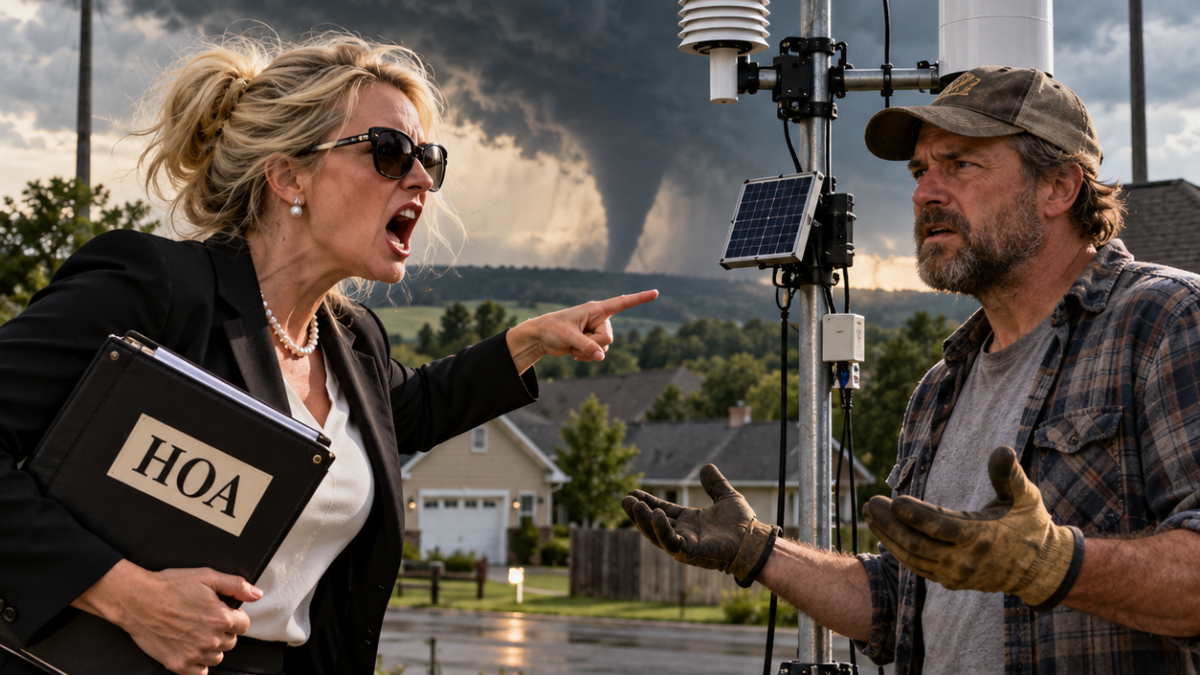
PART 2
I called him Sunday afternoon.
Dr. Aris Thorne answered on the second ring.
“Jackson.”
“Aris.”
“You trying to disappear on me?”
“What?”
“DW789.”
I leaned back in my office chair.
“So you do notice.”
“Of course I notice.”
That surprised me more than it should have.
Citizen stations can be easy to misunderstand from the outside. People hear “personal weather station” and picture some plastic thermometer mounted over a barbecue grill.
Mine wasn’t that.
The hardware itself was professional-grade, but hardware was only part of the equation. Placement mattered. Maintenance mattered. Calibration mattered. Data quality mattered. An inaccurate station was worse than no station because it could introduce bad information into a system built on pattern recognition and comparison.
I had spent two decades learning that.
Aris knew it.
“What’s going on?” he asked.
“HOA.”
He was silent for half a second.
Then:
“Oh no.”
I laughed.
“You say that like you’ve heard this story.”
“My cousin had to repaint a shed because somebody decided blue-gray was not sufficiently gray.”
“That sounds about right.”
I explained the violation.
The daily fines.
The Architectural Control Committee.
The demand that I remove the mast entirely.
When I finished, Aris asked:
“Do they understand what the station does?”
“I tried explaining.”
“And?”
“She called it an aesthetic issue.”
He exhaled.
“Send me the notice.”
“I already did.”
“I saw the attachment.”
“Then why ask?”
“I was hoping there was context that made it less stupid.”
“There isn’t.”
I heard papers moving on his end.
“Jack, let me be precise, because I know how this kind of thing gets exaggerated.”
“Please.”
“Your station is not the only thing standing between Tarrant County and a tornado warning.”
“I know.”
“Radar matters. Spotter networks matter. Automated surface observations matter. Emergency management matters. Multiple data sources get integrated.”
“I know.”
“But.”
There it was.
“But your site is useful.”
“How useful?”
“Very.”
I sat forward.
He continued.
“You’re located in a gap where we don’t have as much high-quality surface data as I’d like. Your wind shifts, pressure tendencies, rainfall rates, temperature changes, and severe-weather reports have been consistently reliable.”
“Enough that losing it matters?”
“Yes.”
“How much?”
“That depends on the event.”
He paused.
“Radar tells us a great deal about what’s happening above ground. Surface observations help confirm what the storm is actually doing near people.”
I looked through the office window.
The mast was visible beyond the fence.
Quiet.
Unremarkable.
“Can you put that in writing?”
Aris laughed softly.
“I knew that question was coming.”
“Officially?”
“If I can support it officially, yes.”
“Not as a favor.”
“Jack.”
His voice sharpened.
“I don’t write public-safety statements as favors.”
That was one reason I trusted him.
“If I send something, it’ll say exactly what I can defend.”
“That’s all I want.”
“Give me a day.”
The next morning, the HOA sent me an email before Aris did.
My appeal would be heard at the monthly board meeting.
The fines would continue during the appeal.
I read that part twice.
The balance was already climbing.
Sarah came into the office while I was printing the email.
“How much now?”
“Eight hundred.”
Her shoulders dropped.
“Eight hundred dollars because of a pole.”
“Station.”
She gave me a look.
“I know what it is, Jack.”
“Sorry.”
She crossed her arms.
“I’m on your side.”
“I know.”
“But?”
“But I need you to understand that being right and being able to afford being right are two different things.”
That landed.
I turned away from the printer.
“I understand.”
“Do you?”
“Yes.”
“We have two kids.”
“I know.”
“We just bought this house.”
“I know.”
“Then don’t give me the Air Force briefing voice.”
I stopped.
She was right.
I had slipped into the tone I used when I wanted emotion out of a problem.
Sarah had endured enough of that during my career.
Deployments.
Late-night calls.
Moves.
Schedules changing without warning.
Me saying everything was under control because I thought control was something I owed my family.
I reached for her hand.
“I’m scared too.”
She studied me.
“That’s better.”
“Not much.”
“It’s honest.”
I looked at the spreadsheet on my screen.
“I think we can fight it without spending ourselves into the ground.”
“You think?”
“Yes.”
“And if you’re wrong?”
I had no good answer.
“I’ll make a different decision.”
She squeezed my hand.
“That’s all I needed to hear.”
The HOA meeting was held in the clubhouse eleven days later.
About twenty residents attended.
Karen sat in the center of the board table.
Her husband was two seats over.
Brenda McMillan sat on the other side, flipping through a binder.
The Architectural Control Committee was effectively the same circle as the board.
Convenient.
Karen moved through the agenda quickly.
Pool maintenance.
Landscaping.
Holiday decorations.
Then:
“Violation appeals.”
She lifted my packet.
“Lot Seventy-Two. Mr. Jackson. Unapproved structure.”
I stood.
Karen sighed theatrically.
“Mr. Jackson submitted an unusually lengthy appeal regarding the large metal pole in his backyard.”
A couple people glanced at me.
“The committee reviewed his claims. We find no basis for an exception. The structure was erected without prior approval and violates Article Four.”
She raised the gavel.
“Appeal denied.”
Bang.
“Next.”
I stayed standing.
“Excuse me.”
She looked irritated.
“You have a question?”
“I have the appeal.”
“We read it.”
“I’m entitled to speak.”
“You submitted everything in writing.”
A man in the back raised his hand.
Karen ignored him.
I kept my voice level.
“I’m asking for two minutes.”
Her jaw tightened.
Then she looked around the room and apparently decided refusing would look worse.
“Two minutes.”
I walked forward.
“My name is Jack Jackson. I moved here three months ago with my wife Sarah and our two children after retiring from the Air Force.”
Karen glanced at the clock.
“I spent twenty years working weather.”
That got a few heads up.
“The station in my yard is not decorative. It feeds meteorological observations into a network used by forecasters. Wind, pressure, rainfall, temperature, severe-weather verification.”
Karen interrupted.
“None of that changes the architectural rule.”
“I’m explaining why an exception is reasonable.”
“There are no exceptions.”
Her husband looked at her.
I noticed that.
I continued.
“If the board wants screening, paint, or another reasonable aesthetic mitigation that does not compromise sensor accuracy, I’m willing to discuss it.”
“No.”
Again, immediate.
The man in the back finally spoke.
“Karen, why not?”
She looked toward him.
“Mr. Henderson, please follow meeting procedure.”
“I’m asking a question.”
“And you are out of order.”
He shook his head.
“I think the weather guy has a point.”
A murmur moved through the room.
Karen struck the gavel.
“Mr. Jackson’s time has expired.”
I looked at her.
“Then please confirm the fines continue during appeal.”
“They do.”
“And if I don’t remove the station?”
“Collection action will follow.”
“Lien?”
“If necessary.”
The room got quieter.
She held my gaze.
“Those are the rules.”
I went back to my seat.
The diplomacy phase was over.
By the end of the week, the balance passed seventeen hundred dollars.
Then came a letter mentioning possible lien enforcement.
Sarah read it at the kitchen table.
“Jack.”
“I know.”
“No, I need you to hear me.”
I sat down across from her.
She pushed the letter toward me.
“I don’t care if Karen is wrong. I care if we end up spending twenty thousand dollars proving she’s wrong.”
“That won’t happen.”
“You don’t know that.”
She was right again.
I hated how often she was right during that month.
“I have another plan.”
Her expression changed.
“What plan?”
“Records.”
“Meaning?”
“If the board wants to enforce rules aggressively, fine. I want to know whether they enforce them consistently.”
She leaned back.
“This sounds like one of your operations.”
“I haven’t named it.”
“Yet.”
I waited.
“Operation Overlord.”
Sarah stared at me.
“You named a suburban paperwork dispute after D-Day.”
“It’s motivational.”
“It’s ridiculous.”
“Both can be true.”
That was the first time she laughed about the situation.
I needed that.
I requested five years of association records.
Financial statements.
Board minutes.
Violation logs.
Contract records.
Enforcement dispositions.
The HOA charged me a substantial copying and administrative fee and limited inspection to a two-hour weekday window.
Karen probably expected that to discourage me.
It did not.
I arrived with a portable high-speed scanner.
The administrative assistant looked at the scanner.
Then at me.
“You’re serious.”
“Yes.”
“You have two hours.”
“I brought batteries.”
Her mouth twitched.
For the next hundred and twenty minutes, I scanned everything they placed in front of me.
Invoices.
Minutes.
Violation lists.
Vendor contracts.
Payment records.
Correspondence.
The records were disorganized enough to be either incompetence or strategy.
I didn’t care which.
I took them home and built a database.
Vendor.
Amount.
Date.
Approval.
Violation type.
Homeowner.
Resolution.
Repeat enforcement.
Board member involvement.
Within days, patterns appeared.
The landscaping contractor bothered me first.
Same company.
Repeated work.
No obvious competing bids.
Prices high.
Owner connected to Karen through family.
I verified the relationship through public records and information already circulated within the neighborhood.
Then the violation files.
New residents were disproportionately represented.
Minor issues escalated quickly.
Trash cans.
Garden hoses.
Holiday lights.
Children’s equipment.
Paint shades.
People who paid disappeared from the record.
People who appealed accumulated correspondence.
Three properties had gone through serious collection actions after disputes that began with relatively modest fines.
I did not know the details yet, so I refused to draw conclusions.
But the pattern was enough to keep digging.
The man from the meeting approached me first.
David Henderson.
Retired firefighter.
He was washing his car when I jogged past.
“Weather man.”
I slowed.
“Gavel rebel.”
He laughed.
“Fair.”
I thanked him for speaking up.
His smile disappeared.
“Cost me.”
“What?”
He pointed toward the driveway.
A hairline crack ran near one corner.
“Violation notice showed up three days after the meeting.”
“For that?”
“Two hundred dollars if I don’t repair it.”
“Has it changed recently?”
“Been there six years.”
I looked toward Karen’s street.
David lowered his voice.
“She does that.”
“Retaliation?”
“Call it what you want.”
“How long has she been president?”
“Eight years.”
“And people keep electing her?”
“People don’t run.”
“Why?”
He shrugged.
“Because sane people don’t want the job.”
That answer was more plausible than anything conspiratorial.
Karen had not conquered Oakmont Meadows.
People had surrendered it through exhaustion.
David kept old notices.
He agreed to copy them.
Then I met Mrs. Gable.
Her violation file was thick.
Garden ornaments.
Birdbath.
Decorative edging.
Gnomes.
Lots of gnomes.
When I spoke with her in person, she explained why.
Her late husband, Harold, collected them on road trips.
Each one had a story.
Wisconsin.
Colorado.
Tennessee.
A ridiculous little fisherman from Branson.
Karen saw clutter.
Mrs. Gable saw forty years of marriage.
“I tried putting them in the garage,” she said.
“What happened?”
“I cried every time I went in there.”
She looked embarrassed.
“I know that sounds foolish.”
“No.”
“It’s just ceramic.”
“No.”
I shook my head.
“It’s memory.”
She looked at me for a long time.
Then brought out the notices.
Thousands in cumulative fines over several years.
Some paid.
Some disputed.
Some waived.
No obvious objective standard for why one month produced a warning and another produced a penalty.
“Why didn’t you fight?”
“I did.”
“What happened?”
“More letters.”
That was the answer I kept hearing.
People had not agreed with Karen.
They had run out of energy before she did.
Then David called me one evening.
“Got a guy you should meet.”
“Who?”
“Marcus Thorne.”
The name meant something.
I had seen it in the directory.
Retired Army colonel.
Former JAG officer.
“He knows about the records?”
“A little.”
“You gave him my number?”
“Yes.”
My phone rang thirty minutes later.
“Jackson?”
“Speaking.”
“Marcus Thorne.”
“Colonel.”
“Retired.”
“So am I.”
“Doesn’t seem to help.”
I laughed.
He continued.
“David says you’re poking the bear.”
“I’m scanning the bear’s receipts.”
“That’s better.”
He invited me over the next morning.
Marcus’s dining table looked like a legal command post.
HOA covenants.
State statutes.
Yellow pads.
My scanned financial records.
He had already printed sections before I arrived.
“Sit.”
I did.
“Coffee?”
“Black.”
“Good.”
He poured.
Then:
“Start at the beginning.”
I did.
Karen.
Mast.
Fines.
Appeal.
Meeting.
Records.
Vendor relationships.
Enforcement patterns.
Marcus interrupted only when something mattered.
“Did you receive written notice?”
“Yes.”
“Certified?”
“No, hand-delivered initially.”
“Your response?”
“Certified.”
“Good.”
“Records request?”
“Written.”
“Copies?”
“Everything.”
When I showed him the landscaping invoices, his face changed.
“Who owns this company?”
“Karen’s brother-in-law.”
“You sure?”
“I have supporting records.”
“Any disclosure in the minutes?”
“Not that I found.”
Marcus tapped the invoice.
“Now I’m interested.”
“You weren’t before?”
“I was mildly entertained before.”
He kept reading.
“Jack, be careful with words like corruption.”
“I haven’t used it publicly.”
“Good.”
“Looks bad.”
“It does.”
“Illegal?”
“That requires analysis.”
He looked at me.
“Bad governance is not automatically criminal conduct. Nepotism is not automatically illegal. High pricing is not automatically fraud.”
“So what is it?”
“Evidence that justifies more questions.”
That became our rule.
Questions before accusations.
Documents before conclusions.
Marcus reviewed the enforcement files.
“These are stronger than I expected.”
“Selective?”
“Potentially.”
“What about the station?”
He turned to the covenants.
“The rule is broad.”
“So Karen could win?”
“You installed without prior architectural approval.”
I did not like hearing that.
“You’re supposed to be on my side.”
“I’m on the side of not lying to you.”
Fair.
He continued.
“The board has an argument that the mast fits the rule. Your stronger position is that enforcement must comply with governing documents, statutory procedure, good faith, and consistency. Your public-safety function strengthens your equitable argument. It does not magically erase the covenant.”
That was less satisfying than “Karen is obviously wrong.”
It was also realistic.
“So what do I do?”
“What does the National Weather Service say?”
I showed him my email exchange with Aris.
Marcus read it.
“When does the letter arrive?”
“Soon.”
“Then we wait.”
“I hate waiting.”
“You spent twenty years in weather. Your entire profession is waiting for things to happen.”
“I forecast them.”
“Exactly.”
The NWS letter arrived the next afternoon.
Official letterhead.
Signed.
Carefully worded.
No exaggeration.
It explained that DW789 was one of several useful surface observation sources in the area.
It described the value of ground observations in verifying pressure changes, wind shifts, precipitation, hail, and other conditions associated with severe weather.
It emphasized that the National Weather Service used multiple independent data sources and that no single private station controlled warning issuance.
Then came the important part.
Removing a reliable station from a relatively sparse surface-observation area would create a local data gap and could reduce the specificity of ground-truth verification during fast-evolving severe weather.
Marcus read it twice.
“This is excellent.”
“It doesn’t say people die if the station goes away.”
“Of course it doesn’t.”
“Karen will use that.”
“Let her.”
He pointed at one paragraph.
“This is what credible institutions do. They don’t make dramatic claims they can’t support.”
I understood immediately.
Karen’s weakness was absolute language.
Everything was final.
Everything was authority.
Everything was compliance.
The NWS letter was powerful precisely because it was measured.
We sent copies to every board member.
Certified.
Not just Karen.
Cover letter:
Given the documented public-safety value of the station, I requested reconsideration, rescission of fines, and a reasonable accommodation allowing the station to remain while discussing aesthetic mitigation.
Ten business days.
No response.
The fines crossed four thousand dollars.
Then five.
On the eleventh day, Karen sent the board’s answer.
She dismissed the NWS letter as irrelevant to private covenant enforcement.
She accused me of attempting to intimidate the HOA with outside authority.
She insisted that no federal agency controlled Oakmont Meadows architectural standards.
On that narrow point, she was correct.
But then she went further.
The board would continue daily penalties.
A final enforcement hearing was scheduled.
Lien action would follow.
I read the letter in Marcus’s office.
“She’s insane.”
Marcus looked up.
“No.”
“She just dismissed the National Weather Service.”
“She dismissed an argument she believes threatens her authority.”
“That’s insane.”
“It’s pride.”
“Difference?”
“Pride is predictable.”
He pushed the letter back toward me.
“She cannot afford to back down now because she made the station symbolic.”
“Symbolic of what?”
“Whether she can be forced to reverse herself.”
I understood.
That was bigger than the weather station.
Karen had trained the neighborhood to believe challenging her produced pain.
If she yielded to me publicly, every other homeowner with a file cabinet full of notices might realize she could be beaten.
Marcus leaned back.
“So we change the audience.”
The next board meeting was one week away.
David built attendance quietly.
Mrs. Gable did it her way.
Cookies.
No kidding.
She went door to door with plates of cookies and told people:
“You should come hear what they’re doing about the weather machine.”
David called it the most effective political operation in Oakmont history.
I prepared slides.
Nothing theatrical.
County map.
Radar image.
Surface station locations.
Basic explanation of why radar and ground observations complement each other.
Excerpts from the NWS letter.
Then Karen’s written response dismissing it.
Final slide:
**WHEN PUBLIC SAFETY AND AESTHETICS CONFLICT, WHAT SHOULD OUR BOARD CONSIDER?**
Sarah reviewed it.
“Better.”
“Better than what?”
“The first version.”
“What was wrong with the first?”
“Your last slide said, ‘Is aesthetic harmony more important than your family’s safety?’”
“That’s strong.”
“That’s manipulative.”
“It’s true.”
“It’s designed to make anyone who disagrees sound like they want children killed by tornadoes.”
I stared at her.
She was right again.
I changed it.
That decision mattered later.
Because when the room filled, I did not need exaggeration.
Facts were enough.
More than sixty residents showed up.
Karen visibly disliked that.
She rushed through the opening agenda.
When she reached new business, she tried to move directly past my case.
Marcus stood.
“Point of order.”
Karen closed her eyes briefly.
“Yes, Marcus?”
“Article Two, Section Four permits members to add a discussion item with support from five members.”
“I know the bylaws.”
“Excellent.”
He held up a sheet.
“Twenty-seven signatures.”
The room murmured.
Karen stared at the paper.
“Five minutes.”
I connected my laptop.
The first slide showed Oakmont Meadows inside the broader county warning area.
I explained what radar does.
What surface instruments do.
What trained observers do.
What they do not do.
I emphasized that my station did not “trigger tornado sirens.”
That claim would have been false.
Warnings come from professional meteorologists using multiple data sources.
My station was one useful piece.
Then I showed the NWS letter.
Not my interpretation.
Their language.
Reliable local data.
Ground-truth verification.
Loss creates a gap.
Potential degradation of specificity.
Then the HOA response.
A woman near the front whispered:
“They ignored that?”
Another resident asked loudly:
“Did every board member see this?”
Karen slammed the gavel.
“No interruptions.”
I looked at the board.
“That’s actually a fair question. Did every director receive my certified copy?”
Her husband nodded reluctantly.
Brenda did not answer.
Gary, another director, said:
“Yes.”
Karen glared at him.
I finished.
“I am still willing to discuss screening, color, placement of supporting equipment, or any accommodation that does not compromise the meteorological function. I am not willing to remove a functioning public-safety observation point because three people think the mast is unattractive.”
The room erupted.
Not cheering.
Questions.
Good ones.
“How many complaints were there?”
“Was the station ever evaluated before the fine?”
“Why are fines still accruing during appeal?”
“Who decides aesthetic harmony?”
“Does the board have an engineering opinion?”
“Did the association’s lawyer review the NWS letter?”
Karen hammered the gavel.
“This is not a debate.”
David stood.
“It should be.”
“Sit down.”
“No.”
“I will have you removed.”
Marcus stood too.
“By whom?”
Karen pointed toward the door.
“This meeting is adjourned.”
Marcus stayed where he was.
“Before you leave, I believe members deserve answers about the broader governance concerns we have documented.”
Her face changed.
“Those are not on the agenda.”
“Financial records are.”
The treasurer went pale.
Marcus continued.
“Why has the association’s primary landscaping contract gone to a company owned by the president’s brother-in-law without documented competitive bidding?”
The room went dead quiet.
Karen looked at her husband.
Then at Brenda.
“This is defamatory.”
Marcus held up copies of invoices.
“It is a question.”
David stood again.
“I request an independent audit.”
“Second,” someone called.
“Third.”
“Fourth.”
Karen’s face lost color.
That was the moment the meeting stopped being about my mast.
Everything people had tolerated separately entered one room at once.
Mrs. Gable stood holding a folder.
“My fines.”
A man across the aisle raised another.
“My fence.”
Someone else:
“My trash cans.”
Then:
“My mailbox.”
“My daughter’s chalk drawings.”
“My basketball hoop.”
“My Christmas lights.”
Karen kept trying to restore order.
But volume had stopped being authority.
Marcus turned toward me.
He did not smile.
This was not victory yet.
It was exposure.
The real leverage had already been sent elsewhere.
A week earlier, Marcus had notified the HOA’s directors-and-officers insurer of a potential claim.
The letter was careful.
It described the dispute.
It attached the NWS communication.
It attached the board’s rejection.
It asked a coverage question.
If directors knowingly removed a documented safety-related observation asset after receiving formal warning of its public-safety value, and a later claim alleged gross negligence or willful misconduct, what coverage position might apply?
No dramatic accusation.
No claim that tornado deaths would definitely result.
Just risk.
Insurance companies understand risk.
The insurer responded.
Karen had received the letter one day before the packed meeting.
Marcus knew because the board’s counsel had copied him on a related communication.
At the clubhouse, he finally said:
“There is one more issue.”
Karen stared at him.
“No.”
Marcus looked at the membership.
“The association’s liability carrier has opened a coverage review concerning the board’s conduct.”
The room froze.
Karen stood.
“That is confidential legal correspondence.”
“I have not quoted confidential advice.”
He continued.
“The carrier has not canceled the policy. But it has raised concerns about whether intentional or knowing misconduct could fall outside coverage.”
That distinction mattered.
Marcus never claimed the insurer had already “dropped” the HOA.
It hadn’t.
The danger was that continued misconduct could create uncovered exposure or materially affect renewal terms and premiums.
A homeowner in the back asked:
“Could our insurance go up?”
Marcus answered:
“Yes.”
“How much?”
“I don’t know.”
“Could we lose coverage?”
“Potentially, depending on what happens.”
Another voice:
“Because of the weather station?”
“Because of the board’s overall conduct and the risk it creates.”
Karen shouted:
“This is fearmongering.”
Marcus looked at her.
“Then release the carrier’s nonprivileged notice to the membership.”
Her mouth opened.
Nothing came out.
Her husband looked down.
Brenda pushed her chair backward slightly.
A woman near the aisle stood.
“I move for a vote of no confidence.”
David immediately said:
“Second.”
Karen struck the gavel.
“You cannot do that.”
Marcus opened the bylaws.
“Article Three, Section Five.”
She stared at him.
He read the removal provision.
Two-thirds of members present at a regular or properly convened meeting, subject to the governing procedures.
Karen’s face turned red.
“This was not noticed.”
Marcus had expected that objection.
The meeting itself was regular.
The bylaws allowed removal motions under the language he cited, though he had already cautioned us that procedural compliance had to be exact.
Volunteers verified attendance.
Membership status.
Voting rights.
Ballots were prepared.
Karen kept talking.
“These people do not understand what I have done for this neighborhood.”
No one answered.
“I have protected your property values for eight years.”
A man near the door said:
“Then why are we afraid of you?”
That silenced her.
I watched her expression.
For the first time, I saw something more complicated than arrogance.
She was hurt.
Genuinely.
That did not excuse anything.
But it explained part of her.
Karen had built an identity around being the person who maintained standards when everyone else was too lazy to serve.
She had probably started with overgrown lawns and unpaid dues.
Then success reinforced control.
Every homeowner who gave in proved her method worked.
Every quiet board member made her more certain that leadership and obedience were the same thing.
Eventually, disagreement itself became a violation.
The ballots were counted.
Forty-eight to four.
Removal.
Karen remained seated for several seconds.
Then stood.
“This will destroy Oakmont Meadows.”
Marcus answered quietly.
“No. It may finally make Oakmont Meadows belong to the people who live here.”
She grabbed her purse.
Her husband followed.
Brenda hesitated before leaving.
For a moment, she looked at the room as if she wanted to say something.
She didn’t.
An interim board had to be formed.
Marcus tried to avoid the presidency.
He failed spectacularly.
Someone nominated him.
Then another person seconded.
The room approved him overwhelmingly.
David became vice president.
A young accountant named Melissa Grant agreed to handle treasury duties temporarily.
Marcus’s first sentence as president was:
“I already regret this.”
Everyone laughed.
Then he looked at me.
“Next motion.”
David stood.
“I move that the association immediately suspend and rescind all fines associated with Lot Seventy-Two’s weather station pending formal review, and that the station be provisionally recognized as a community-benefit installation.”
“Second.”
Vote.
Unanimous.
The balance disappeared.
More than five thousand dollars in threatened fines.
Gone.
The lien threat.
Gone.
Sarah called while I was still in the clubhouse.
“Well?”
I stepped outside.
“They’re gone.”
“The fines?”
“Yes.”
“The board?”
“Yes.”
Silence.
Then I heard her exhale.
“Come home.”
When I walked through the door, she hugged me before I could say anything.
Our daughter came running from the hallway.
“Did you win?”
I looked at Sarah.
She gave me a warning expression.
I knelt.
“We fixed part of it.”
“That means yes.”
“Go brush your teeth.”
“That means yes!”
She ran away shouting to her brother.
Sarah laughed.
Then she hit my shoulder.
“What?”
“You scared me.”
“I know.”
“No more operations.”
“I can’t promise that.”
“Jack.”
“Fewer operations.”
“Better.”
The next week felt like the air after a cold front.
Cleaner.
Lighter.
The new board froze disputed enforcement files.
Not every fine.
That would have been irresponsible.
Genuine violations still existed.
But cases involving vague standards, retaliation claims, or inconsistent penalties were reviewed.
Mrs. Gable’s gnome fines were rescinded.
She cried.
Then she brought three additional gnomes out of storage.
David’s driveway violation disappeared after an inspection confirmed the crack was cosmetic and comparable to dozens throughout the subdivision.
Other homeowners filed appeals.
Some won.
Some lost.
The important difference was they were heard.
Marcus scheduled a town hall focused entirely on transparency.
Melissa presented preliminary audit findings.
The landscaping contract looked exactly as bad as I feared.
No consistent competitive bidding.
Prices significantly higher than comparable estimates.
Family relationship not properly disclosed in the records we reviewed.
Several discretionary accounts had poor documentation.
Fine revenue had flowed into categories residents barely understood.
Marcus stopped anyone who called it theft.
“We are conducting an audit,” he said. “Do not turn incomplete records into criminal accusations.”
I respected that.
The board retained an independent accountant.
Then outside counsel.
After further review, they referred portions of the findings to the appropriate county authorities for evaluation.
That was where my direct knowledge ended.
I never claimed Karen went to prison.
I never saw handcuffs.
I never saw a criminal judgment.
What I knew was that the records were referred.
Investigators requested documents.
The new board cooperated.
Anything beyond that belonged to the authorities.
Karen and her husband listed their house within days of the removal vote.
The sign appeared on a Thursday.
I saw it during my morning run.
David was outside.
He nodded toward it.
“Think she’ll blame you?”
“Probably.”
“You feel bad?”
I slowed.
“A little.”
He looked surprised.
“Seriously?”
“She built her life around that board.”
“She terrorized people with it.”
“Both can be true.”
David folded his arms.
“You’re getting philosophical.”
“I’m retired.”
“Apparently that’s what happens.”
Brenda resigned from every remaining committee.
Gary stayed in the neighborhood but withdrew from HOA activities completely.
Several months later, I ran into him near the mailbox.
He looked uncomfortable.
“Jack.”
“Gary.”
“I owe you an apology.”
I waited.
“I knew Karen was too aggressive.”
“How long?”
“Years.”
“Then why did you vote with her?”
He stared at the pavement.
“Because if I fought every stupid thing, meetings lasted four hours.”
I laughed once, but there was no humor in it.
“That’s your answer?”
“No.”
He rubbed his forehead.
“The real answer is I was afraid she’d turn on me.”
That was more honest.
“I told myself I could moderate her from inside.”
“Did you?”
“No.”
We stood quietly.
Finally he said:
“The station should have been approved.”
“Yes.”
“I’m sorry.”
“Thank you.”
I did not absolve him.
I also did not need to punish him forever.
There were enough consequences already.
The architectural rules were rewritten.
Not abolished.
Objective standards replaced vague phrases where possible.
Applications required written decisions with reasons.
Appeals went before people who had not made the original determination.
Conflicts of interest had to be disclosed.
Major vendor contracts required competitive review.
Lien procedures received additional safeguards.
The garden-ornament rule disappeared almost entirely.
Mrs. Gable called that “the greatest civil-rights achievement in Oakmont history.”
Marcus told her that was a dramatic misuse of history.
She brought him a gnome wearing a judge’s robe.
He put it on his desk.
My weather station received formal approval.
The board asked whether I would allow its real-time feed to appear on the community website.
I agreed.
David convinced me to hold a Saturday weather workshop for neighborhood kids.
I expected eight.
Twenty-nine showed up.
I showed them the rain gauge.
The anemometer.
Pressure trends.
How clouds can tell you something but not everything.
Why meteorologists sometimes issue warnings that seem unnecessary afterward.
“Because the point,” I told them, “is not to be right after the storm. It’s to make the best decision before you know exactly what the storm will do.”
A boy raised his hand.
“Can the pole tell you when there’s a tornado?”
“No.”
“Then what can?”
“Nothing by itself.”
I pointed at the instruments.
“This tells us what’s happening here.”
Then at my tablet showing radar.
“This tells us something different.”
Then I pointed toward the sky.
“People put those pieces together.”
That became important because I wanted the neighborhood to understand what the station was—and what it wasn’t.
I never wanted Karen’s mistake reversed into a different kind of myth.
The mast was useful.
It was not magical.
Months passed.
Oakmont became a real neighborhood instead of a collection of people hiding behind identical garage doors.
There was a spring potluck.
A community garden.
A volunteer storm-preparedness group started by David.
Melissa created a dashboard showing HOA spending.
Residents began attending meetings.
Sometimes painfully many residents.
One meeting lasted almost three hours over whether the pool should close at nine or ten.
Marcus called me afterward.
“I miss tyranny.”
“No, you don’t.”
“I miss efficiency.”
“That I believe.”
The local television story came later.
An investigative reporter had heard about the board upheaval.
He interviewed Marcus.
David.
Mrs. Gable.
Then me.
He stood in my backyard looking up at the mast.
“So this started everything?”
“This exposed everything.”
“Difference?”
“The problem existed before I moved here.”
He nodded.
“What did the station actually do?”
I explained carefully.
Supplemental data.
Ground truth.
No single sensor controls warnings.
No dramatic switch.
He appreciated that.
“Less cinematic.”
“More accurate.”
The story aired anyway.
They showed my station.
The NWS letter.
The old HOA response.
Mrs. Gable standing in her garden surrounded by what the reporter called “a newly liberated gnome population.”
She loved that phrase.
Karen declined comment.
Her house sale closed not long afterward.
A family with young children moved in.
The first thing they did was install a trampoline.
I laughed for five straight minutes.
Then summer arrived.
North Texas summer.
Heat.
Humidity.
Days when the atmosphere felt heavy enough to touch.
I kept working in my shop.
Sarah planted tomatoes.
The kids settled into school and finally stopped talking about our house like a temporary assignment.
That meant more to me than winning any HOA fight.
One evening our son asked:
“Are we staying here until I finish high school?”
Sarah looked at me.
“Yes.”
He smiled.
“Good.”
That one word was worth every certified letter.
By late spring the following year, severe-weather season became active.
I upgraded several sensors.
Added backup power.
Improved communications redundancy.
Not because the HOA fight made me paranoid.
Because weather work had taught me redundancy is what keeps useful systems useful.
I also added soil-moisture monitoring for the community garden.
David complained that I had turned tomatoes into a military operation.
“They’re overwatered.”
“They’re vegetables.”
“They deserve standards.”
“You sound like Karen.”
I stared at him.
He backed away laughing.
“Too soon?”
“Always.”
Then came the afternoon I remember more clearly than the removal vote.
It had been warm since morning.
Too warm.
The dew point was high.
Low clouds moved fast from the south.
By midafternoon, towering convection was building west of us.
I checked radar.
Then surface observations.
Then the mesoscale discussion.
Nothing unusual for severe-weather season yet.
But I did what I always did.
Watched.
At 3:41 p.m., pressure at DW789 began dropping more sharply.
Wind backed.
Then veered.
Temperature shifted.
The gust pattern changed.
I opened the observer chat.
Reports were coming in west of us.
Large hail.
Wall cloud.
Strong inflow.
Sarah walked into the workshop.
“That face.”
“What face?”
“Storm face.”
I looked at radar again.
“Bring the kids inside.”
“How bad?”
“Don’t know yet.”
“Jack.”
“Bring them inside.”
She didn’t argue.
I transmitted an observation.
Wind shift.
Pressure fall.
Measured gust.
Cloud-base behavior.
A few minutes later, Aris appeared in the chat.
**DW789 data confirmed. Strong low-level response east of main circulation. Continue reports.**
My hands moved automatically.
Check.
Verify.
Report.
No speculation.
Radar showed increasing rotation farther northwest.
Spotters reported lowering cloud base.
Emergency management traffic increased.
Then the tornado warning issued.
My phone screamed.
Seconds later, outdoor warning sirens began sounding across the area.
The same sirens Karen’s title had once treated as an abstract talking point were now very real.
Sarah was already moving the children toward our interior shelter.
“Jack.”
“I’m coming.”
I sent one final observation.
Then joined them.
We had prepared the shelter after moving in.
Helmets.
Shoes.
Flashlights.
Weather radio.
Water.
Blankets.
The kids knew what to do.
Our daughter sat beside Sarah.
Our son held the weather radio too tightly.
Wind rose outside.
Not tornado wind.
At least not where we were.
But strong.
Rain struck the windows.
Thunder vibrated through the house.
My phone buzzed.
David.
**Heard scanner traffic. Tornado confirmed north of us. Moving northeast.**
Then another message.
**Warning came fast. Thanks for the heads-up.**
I did not answer immediately.
I listened.
Sirens.
Wind.
The weather radio.
My family breathing in the dark.
That was the first moment the HOA fight truly became small.
Not unimportant.
Small.
Karen had treated the mast like an aesthetic offense.
For months, I had treated defending it like a campaign.
But inside that shelter, I remembered why I installed it in the first place.
Not to defeat anyone.
Not to prove expertise.
Not to win.
To observe.
To contribute.
To keep doing, in one small civilian way, the job I had done most of my adult life.
Watch the sky.
Measure what it is doing.
Tell someone who needs to know.
The tornado stayed north of Oakmont.
Damage occurred several miles away.
Trees down.
Roof damage.
Power outages.
No catastrophic loss in our neighborhood.
Later, after the warning expired, we came out.
The backyard was covered with small branches.
Rain still fell.
The mast stood exactly where it had before the storm.
Anemometer spinning.
Data transmitting.
I walked outside.
Sarah followed.
“You’re checking it now?”
“Yes.”
“You’re impossible.”
“Probably.”
She stood beside me beneath the covered patio.
“What did they say?”
“Who?”
“The weather people.”
I showed her Aris’s message.
DW789 data confirmed.
She read it.
Then looked toward the mast.
“So it mattered.”
“Yes.”
“How much?”
I smiled slightly.
“Exactly as much as they said it did.”
Not everything.
Not nothing.
Useful.
Reliable.
One piece in a much bigger system.
Sarah slipped her arm through mine.
“That seems like enough.”
“It is.”
The following day, David stopped by.
He brought coffee.
“You look terrible.”
“Thanks.”
“You were up all night?”
“Mostly.”
He handed me a cup.
“The volunteer storm group had twenty-seven families checking in.”
“Good.”
“People used the community page.”
“Good.”
“Your weather dashboard nearly crashed.”
“Not good.”
He laughed.
“We’ll upgrade it.”
“We?”
“Community asset, remember?”
I looked at him.
“That motion is becoming expensive.”
“Democracy.”
The tornado outbreak became the first real test of Oakmont’s new culture.
The old board had equated safety with control.
The new board treated it as participation.
Marcus scheduled an after-action meeting.
Not because anything failed badly.
Because that was how you improve.
Emergency contacts were updated.
Older residents were paired with neighbors during warnings.
The clubhouse was evaluated as a secondary information point, not a designated tornado shelter unless structural criteria were met.
Residents learned the difference between watch and warning.
Outdoor sirens were explained properly.
They were meant primarily to alert people outdoors, not guarantee everyone inside would hear them.
Weather radios were promoted.
Nobody made the station the hero.
I insisted on that.
At the meeting, one homeowner said:
“If Jack’s station goes down, do the warnings stop?”
“No.”
I answered immediately.
“Then why did we fight so hard for it?”
“Because resilient systems use multiple good sources.”
I looked around the room.
“Public safety is rarely one dramatic piece. It’s layers.”
Marcus smiled.
“Like governance.”
I pointed at him.
“Don’t turn my weather talk into an HOA lecture.”
“Too late.”
The audit wrapped up several months later.
The final report identified governance failures, conflicts of interest, poor procurement controls, inconsistent enforcement, and unsupported expenditures that required further review.
The new board pursued recovery where appropriate.
The county authorities retained the records they had requested.
Again, I stayed out of speculation about criminal consequences.
I had learned something from Marcus.
Justice gets weaker when you exaggerate it.
Facts were enough.
Karen was gone.
Her system was gone.
The money issues were being handled by professionals.
That was enough for me.
One afternoon, almost a year after the first violation notice, I opened the old file drawer.
**OPERATION OVERLORD**
Sarah walked past.
“You still have that?”
“It’s evidence.”
“It’s a folder full of HOA emails.”
“Historical evidence.”
“You named it after the largest amphibious invasion in history.”
“Yes.”
“For a weather pole.”
“Station.”
She laughed.
“Throw it away.”
“Absolutely not.”
“Why?”
I pulled out the first violation notice.
One hundred dollars.
Unapproved structure.
I remembered Karen standing in the yard.
The absolute certainty.
The phrase:
**You should think about your family before turning this into a crusade.**
I put the paper back.
“Not yet.”
Sarah’s expression softened.
“Does it still bother you?”
“Less.”
“Then keep it until it doesn’t.”
She left.
I closed the drawer.
Three years later, I still had the folder.
But I almost never opened it.
Oakmont changed.
Boards rotated.
Marcus served one full elected term and refused another.
His explanation:
“I defended people in uniform for twenty-five years. I will not spend retirement adjudicating mailbox colors.”
David eventually became president.
I laughed for an unreasonable amount of time when he told me.
“You?”
“Yes.”
“The driveway rebel?”
“Yes.”
“You’re the establishment now.”
“Shut up.”
He turned out to be good at it.
Mostly because he hated the power.
He delegated.
Published minutes.
Asked for opinions.
Occasionally became visibly miserable during long debates.
All healthy signs.
Mrs. Gable remained the unofficial conscience of the neighborhood.
Her gnome population grew to thirty-two.
She placed the telescope gnome at the base of my weather mast and declared him Chief Forecast Officer.
Our daughter painted a tiny badge on him.
**DW789**
I left it.
The kids grew.
The station aged.
Sensors were replaced.
Software changed.
The mast needed fresh grounding inspection after a nearby lightning strike.
Technology moved on.
But the basic work remained.
Observe.
Check.
Report.
One morning, Aris called.
“You still transmitting?”
“Obviously.”
“You missed two packets at 4:17.”
I stared at the phone.
“You called me about two missing packets?”
“I’m retiring.”
That stopped me.
“When?”
“End of month.”
“Congratulations.”
“Don’t sound so happy.”
“I’m jealous.”
“You’re already retired.”
“Apparently I’m bad at it.”
He laughed.
Then got quiet.
“Jack.”
“Yeah?”
“You know that HOA letter?”
“The one you wrote?”
“Yes.”
“I almost didn’t.”
“Why?”
“Because I didn’t want NWS dragged into a private property dispute.”
“That would’ve been fair.”
“But then I looked at your station history.”
I waited.
“Years of clean observations. Quality control. Severe-weather reports. Never sensational. Never guessing.”
“Thank you.”
“So I wrote what I could defend.”
“That letter saved the station.”
“No.”
He corrected me.
“The truth saved the station. The letter just documented it.”
That sounded like Marcus.
Maybe age makes everyone a philosopher.
Before we hung up, Aris said:
“Keep it running.”
“I will.”
“And teach someone younger.”
That stayed with me.
Until then, the station was still largely mine.
My expertise.
My maintenance.
My system.
I realized that was a vulnerability.
So I started teaching.
Not the whole neighborhood.
Anyone interested.
A high-school student named Ethan became the first serious one.
He loved computers and storms.
Dangerous combination.
The first time he came over, he pointed at the anemometer.
“How high can it read?”
“Wrong first question.”
“What should I ask?”
“How accurate is it?”
He smiled.
“I like you.”
“Most teenagers don’t.”
He started helping with maintenance.
Learned calibration.
Learned quality control.
Learned that spectacular numbers are suspicious until verified.
During storms, I made him write observations before looking at social media.
“Why?”
“Because if you read everybody else first, you start seeing what they saw instead of what you saw.”
“That’s weird.”
“It’s human.”
Two years later, he studied atmospheric science.
His mother blamed me.
I accepted responsibility.
Sarah and I grew older.
The kids left for college.
The house became quieter.
For the first time since moving into Oakmont, the weather station sometimes felt loud—not physically, but because the data display was always alive.
Numbers changing.
Wind shifting.
Rain accumulating.
Pressure rising and falling.
Evidence that the atmosphere never sits still even when people do.
One evening Sarah and I sat on the patio during a gentle rain.
No thunder.
No warnings.
Nothing dramatic.
The telescope gnome stood beneath the mast, faded from years of sun.
“You should repaint him,” Sarah said.
“Original finish has historical value.”
“He’s ceramic.”
“Provenance matters.”
“He came from a garden center.”
“Legend is forming.”
She laughed.
Then looked up at the station.
“Do you ever think about taking it down?”
That surprised me.
“Why?”
“You’re getting older.”
“So?”
“Maintenance.”
“I have Ethan.”
“He’s in graduate school.”
“He comes home.”
“Sometimes.”
I knew where she was going.
“Eventually.”
She nodded.
“Eventually.”
For years, the idea of removing the mast had felt like surrender.
Karen had wired that meaning into it.
Take it down and she wins.
Leave it up and I win.
Time dismantled that logic.
Eventually, the station would come down because equipment changes, bodies age, houses change hands, or better networks replace old ones.
Nothing had to stand forever to have mattered.
“I’ll know when,” I said.
Sarah leaned against me.
“That’s all I wanted.”
But that day was still far away.
The next spring, Oakmont installed a neighborhood emergency-information board near the clubhouse.
Not a siren.
Not some grand command center.
A simple display connected to verified public weather feeds, emergency alerts, and local data.
DW789 appeared in one corner.
I attended the dedication because David threatened to fine me if I didn’t.
“You can’t fine me.”
“I know people.”
“That sounds corrupt.”
“Learned from history.”
Mrs. Gable came in a wheelchair by then.
Her daughter pushed her.
She looked at the display.
Then at me.
“Your ugly pole won.”
“No winners.”
“Don’t ruin this.”
She pointed at the live wind reading.
“Harold would’ve liked that.”
“Why?”
“He loved storms.”
“Smart man?”
“No.”
She smiled.
“He stood on porches during tornado watches.”
“Absolutely not smart.”
“He would’ve liked you.”
That meant more than I expected.
Mrs. Gable died the following winter.
Her daughter invited several neighbors to help sort the house.
Most of the gnomes went to family.
One came to me.
Chief Forecast Officer.
She handed him over wrapped in a towel.
“Mom said this one belongs with the station.”
I took it.
“Thank you.”
“He was apparently very important.”
“Essential personnel.”
She laughed through tears.
I placed him back beneath DW789.
By then, Karen’s reign felt like something from another lifetime.
New residents barely knew the story.
Sometimes someone would ask why the covenants contained unusually detailed language about meteorological equipment.
David would say:
“Long story.”
I preferred that.
Rules should outlive grudges.
People do not need the whole battle to benefit from what it taught.
Ten years after the first violation notice, a major severe-weather day arrived.
I was slower by then.
Gray hair.
Reading glasses.
More careful knees.
But weather still sharpened me.
Morning outlook elevated.
Afternoon instability extreme.
Strong low-level shear.
I checked the station.
Checked backup power.
Checked communications.
Ethan, now working professionally in meteorology, texted from another city.
**You seeing this setup?**
I replied:
**Unfortunately.**
By afternoon, clouds raced north.
The sky turned the strange green-gray color Sarah had learned to hate.
She came into the workshop.
“Storm face.”
“Yep.”
“How bad?”
“Potentially significant.”
She nodded.
No fear now.
Preparation.
Shoes.
Phones.
Weather radio.
Shelter.
The habits had become part of our life.
DW789 began recording a pressure fall.
Then a sharp wind shift.
I transmitted.
Professional forecasters were already watching the same system through radar, satellites, upper-air data, neighboring stations, spotters, and every other available source.
My observation joined them.
One more piece.
Then the tornado warning sounded.
Outdoor sirens came alive across Oakmont.
Long.
Rising.
Urgent.
Sarah and I went inside.
Our children no longer lived at home, but both texted within seconds.
**You sheltered?**
I smiled.
Roles reverse.
I replied:
**Yes.**
We sat in the interior room listening.
The storm passed north again.
A damaging tornado touched down beyond us.
Warnings gave people time.
Some properties were destroyed.
Lives were shaken.
The event was not a neat story where one backyard station saved a town.
Real systems do not work that way.
Hundreds of people contributed.
Meteorologists.
Emergency managers.
Radar technicians.
Dispatchers.
Spotters.
Broadcasters.
Neighbors knocking on doors.
Families who took warnings seriously.
DW789 was one thread.
That was enough.
Afterward, I went outside.
The sky behind the storm was yellow.
Rainwater dripped from the mast.
The anemometer slowed.
Sarah stood beside me.
“You know what I remember?”
“What?”
“Karen saying it was ugly.”
I looked up.
The mast was objectively not beautiful.
Galvanized metal.
Cables.
Sensors.
Functional geometry.
“She had a point.”
Sarah laughed.
“Don’t let David hear you.”
“I’m serious.”
“It is ugly.”
“Very.”
“But?”
I looked at the rain gauge.
The wind sensor.
The little faded gnome beneath it.
“But useful things don’t always need to be beautiful.”
She slipped her hand into mine.
“Good thing.”
I looked at her.
“What is that supposed to mean?”
“Nothing.”
“Sarah.”
She walked toward the house laughing.
I stayed outside another minute.
Ten years earlier, I had looked at that same mast while holding a cheap HOA violation notice.
I had thought the conflict was about property rights.
Then public safety.
Then corruption.
Then governance.
In the end, it was about something simpler.
Whether people with authority are willing to listen when information contradicts what they already decided.
Karen had seen a pole and decided nuisance.
No amount of explanation mattered because explanation required reconsideration.
The board followed her because resistance was uncomfortable.
Homeowners stayed silent because individual fines seemed easier to endure than collective conflict.
Then everyone started sharing information.
That broke the system she built.
Not rage.
Information.
Records.
Letters.
Invoices.
Policies.
Witnesses.
Data.
The same principle that made weather forecasting work.
One observation can be wrong.
One sensor can fail.
One radar image can be misread.
Confidence comes from independent pieces agreeing.
That was how Karen lost too.
My records matched David’s experience.
David’s matched Mrs. Gable’s.
The financial statements matched the vendor relationship.
The NWS letter contradicted the board’s dismissal.
The insurer saw risk.
Homeowners saw the same pattern.
Eventually, there were too many independent signals pointing in one direction to ignore.
I had spent my career watching weather systems reveal themselves through data.
Oakmont Meadows did the same thing.
The pressure fell.
The winds shifted.
The warning signs accumulated.
And eventually everybody noticed the storm.
I went inside.
Before closing the door, I looked once more toward DW789.
Still transmitting.
Still ordinary.
Still useful.
The tornado sirens had not gone silent because my data vanished.
That was never the truth.
The real truth was better.
The station stayed because a community finally understood that losing good information for the sake of appearances was a foolish trade.
Years after Karen tried to erase it from the skyline, that “ugly metal monstrosity” was still standing in my backyard, feeding numbers into a system far larger than itself.
And beneath it, weathered almost white by the sun, Mrs. Gable’s little telescope gnome kept staring faithfully at the sky.
[END OF STORY]








