PART 2: HOA Demanded I Sell My 18-Acre Ranch for $200,000—Then Threatened to Destroy Everything My Family Built
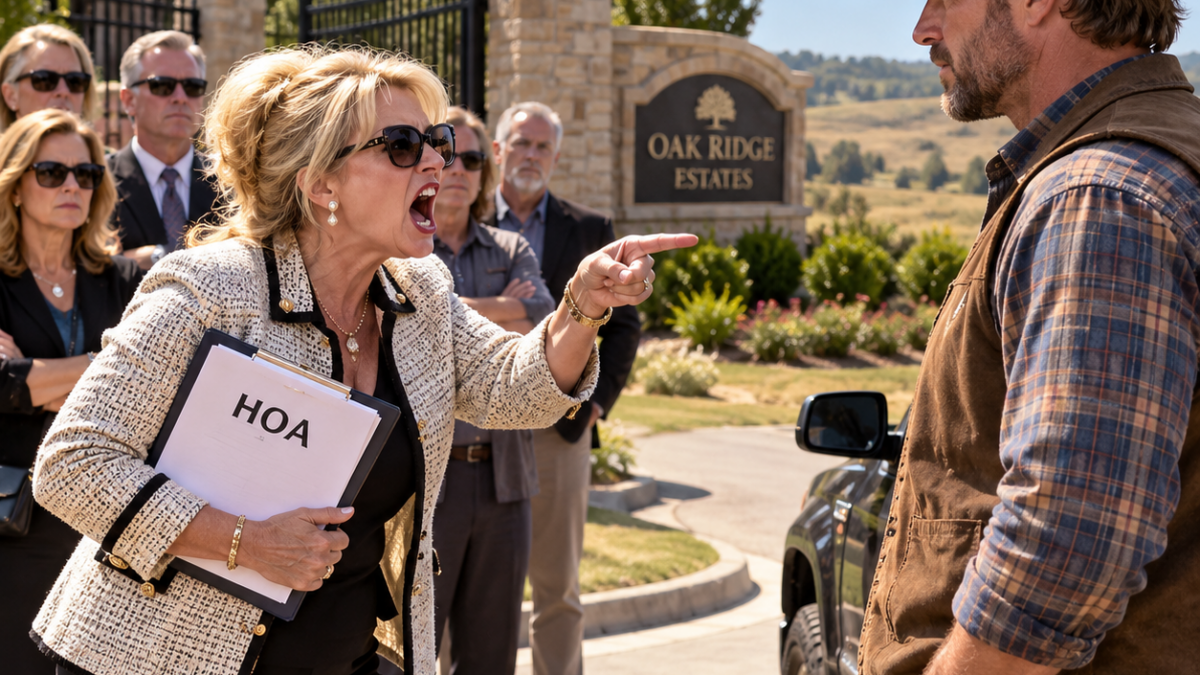
The president of the Maple Hills HOA showed up at my ranch with a $200,000 offer for land worth more than a million dollars, and when I refused, she gave me thirty days to leave the home my family had spent generations building. She claimed her board had already voted to take my eighteen acres, and the way she smiled while threatening to make my life miserable told me this wasn’t an ordinary disagreement between neighbors. But when I noticed a familiar name buried in the paperwork she shoved against my chest, I began to suspect her little neighborhood improvement project was hiding something far more serious than anyone realized.
My name is Trevor Reigns, and for twenty-two years, I’ve lived on a ranch just outside a growing suburban development called Maple Hills.
That Thursday morning, I was elbow-deep in grease, repairing the electric motor on my front gate, when a white BMW came racing down the gravel road.
The driver stopped so abruptly that dust rolled across my boots.
A woman stepped out wearing expensive sunglasses, a cream-colored blazer, and the kind of expression people usually reserve for finding a dead rat in their kitchen.
“Are you Trevor Reigns?” she demanded.
I wiped my hands on an old shop rag.
“Depends who’s asking.”
“Odessa Kensington. President of the Maple Hills Homeowners Association.”
She said her title like I was supposed to stand at attention.
“Well, Odessa, unless your neighborhood needs help fixing a gate, I’m not sure what brings you out here.”
She ignored that.
Instead, she pulled a stapled packet from her leather folder and pressed it into my chest.
“Your property has been identified as a serious aesthetic concern affecting our community’s future development.”
I glanced down at the first page.
OFFICIAL NOTICE OF PROPERTY ACQUISITION.
I looked back at her.
“Property acquisition?”
“The board has unanimously approved a proposal to purchase your ranch. You’ll have thirty days to accept our offer and begin vacating the premises.”
For a moment, I genuinely thought I’d misunderstood.
“Vacating?”
“Yes, Mr. Reigns. We’re expanding the neighborhood’s recreational trail system, and your land is essential to our redevelopment plan.”
She gestured toward my barn, pastures, and the old farmhouse behind me.
“This property simply doesn’t reflect the standards we’ve established.”
I followed her gaze.
My grandfather had built that barn with his own hands. My father had repaired its roof after a tornado ripped through the county. I’d spent countless weekends replacing fences, repairing drainage ditches, and keeping the property alive after both men were gone.
And now a woman who’d probably never held a shovel was calling it an eyesore.
“How much?” I asked.
Her expression softened into something dangerously close to satisfaction.
“Two hundred thousand dollars.”
I stared at her.
“For what?”
“For the entire eighteen acres, including existing structures.”
I actually laughed.
Not because it was funny.
Because the alternative was getting angry enough to say something I’d regret.
“Lady, that land is worth more than five times your offer.”
“Our valuation reflects the property’s current condition.”
“Your valuation doesn’t mean a damn thing to me.”
Her smile disappeared.
“Mr. Reigns, I’d strongly encourage you to reconsider your tone.”
“And I’d strongly encourage you to get back in that BMW.”
For the first time, she seemed genuinely surprised.
Then she stepped closer.
“You should understand that refusing to cooperate with the association can have consequences.”
“What consequences?”
“County inspections. Environmental complaints. Access disputes. There are several avenues available when a landowner becomes uncooperative.”
Something about how easily she listed those possibilities bothered me.
It didn’t sound like a warning she’d invented on the spot.
It sounded rehearsed.
I held up the packet.
“Did you actually have a lawyer review this?”
“Everything has been handled properly.”
“Then why doesn’t this document have a county case number?”
Her eyes flickered toward the pages.
Only for a second.
But I caught it.
“That’s an administrative matter,” she said.
“Funny. Administrative matters usually come before somebody tells me to abandon my house.”
She took a sharp breath.
“Thirty days, Mr. Reigns. After that, we may be forced to pursue less pleasant alternatives.”
She turned toward her car.
I called after her.
“Odessa.”
She stopped.
“This ranch isn’t for sale.”
She didn’t answer.
She simply climbed into the BMW and drove away, leaving two fresh tire marks across my gravel entrance.
I stood there until the dust settled.
Then I carried the packet into my kitchen.
At first, I intended to throw it away.
But something on the final page caught my attention.
The proposed acquisition involved more than my ranch. It referenced an older development agreement, a series of recorded easements, and a property holding arrangement that predated the Maple Hills subdivision itself.
I recognized the recording number immediately.
It matched a document I’d signed fifteen years earlier.
I reached for my phone and called Rebecca Lynwood, the real estate attorney who had handled several property matters for my family.
“Rebecca, I’ve got a problem.”
“What kind?”
“An HOA president just ordered me to sell my ranch.”
She laughed once.
Then I read her the recording number.
The laughter stopped.
“Trevor,” she said quietly, “don’t sign anything.”
“I wasn’t planning to.”
“Listen carefully. Go to your safe and find the original development agreement.”
“Why?”
There was a pause.
“Because I need to know whether the woman threatening your ranch understands whose signature is on the land beneath her entire subdivision.”
I looked through the kitchen window toward the neat rows of Maple Hills houses beyond my eastern pasture.
Then I walked straight to the safe.
PART 2
The safe was tucked into the wall behind an old oak cabinet in my father’s former office.
I’d opened it plenty of times over the years, usually to retrieve tax records, insurance documents, or the occasional deed someone needed copied. But that afternoon, with Odessa Kensington’s threat still ringing in my ears, the three-number combination suddenly felt like it took forever to dial.
I pulled out a heavy brown envelope marked MAPLE HILLS DEVELOPMENT AGREEMENT.
The paper inside smelled faintly of dust and old filing cabinets. Fifteen years earlier, I’d signed those documents in a downtown law office with a developer named Franklin Mercer.
At the time, Mercer had been trying to build an upscale residential community on roughly ninety acres of land my grandfather had acquired decades before.
I hadn’t wanted to sell.
That had been the beginning and end of my position.
Mercer, however, had been persistent.
He came to the ranch three times, brought surveyors, showed me renderings of landscaped streets and family homes, and talked about how the county was expanding.
Eventually, he proposed a long-term ground lease rather than an outright sale.
Under the arrangement, his company would develop the neighborhood, create individual residential interests, construct roads and community facilities, and retain responsibility for the improvements through the development process.
The agreement was complicated. It created long-term leasehold rights for the residential parcels while reserving certain underlying ownership interests, mineral rights, access easements, and land-use approval rights to me.
The deal had been structured so existing homeowners could enjoy stable residential occupancy under recorded agreements. I couldn’t simply order families out of their homes, and I had never wanted that kind of power.
But any attempt by the developer or its successor organization to expand onto neighboring agricultural acreage required my written consent.
There were additional provisions concerning zoning compliance, common areas, and prohibited development activity.
I’d insisted on those terms because I knew what could happen when developers started treating neighboring farms as empty space waiting to be paved.
Now, fifteen years later, someone was apparently pretending those provisions didn’t exist.
I photographed the relevant pages and sent them to Rebecca.
Twenty minutes later, she called.
“Trevor, I’ve reviewed the original agreement.”
“And?”
“Tell me exactly what Odessa said.”
I repeated the conversation as accurately as I could.
When I reached the part about being given thirty days to vacate, Rebecca interrupted.
“She actually used that word?”
“Vacate.”
“Did she claim the HOA had authority over your ranch?”
“Pretty much.”
Rebecca exhaled.
“That’s interesting.”
“Interesting good or interesting bad?”
“Potentially very good for us. Very bad for them.”
I sat down at my kitchen table.
“Explain.”
“Trevor, the HOA has no authority to compel you to sell your property. Your ranch isn’t even subject to their residential covenants. They can’t issue you a valid HOA violation notice, much less order you to leave.”
“That’s what I figured.”
“But there’s something else.”
I heard pages moving on her end.
“Do you remember the reserved approval provisions in the original development agreement?”
“Of course.”
“Well, whoever drafted this supposed acquisition notice either didn’t read the agreement or is deliberately ignoring it. Maple Hills was developed on land you retained an ownership interest in, and the recorded documents place significant restrictions on any expansion beyond the original residential footprint.”
I looked through the window again.
Beyond the pasture, I could see the tops of the houses along Maple Hills Drive.
Most of those homeowners had no idea who I was.
To them, I was probably just the guy with the old barn and the tractor.
“Does Odessa know?” I asked.
“I don’t know. But she should.”
“Why?”
“Because the HOA’s records should identify the land agreements governing the development.”
Rebecca paused.
“Trevor, I want you to bring me every document Odessa gave you. And until we understand what they’re doing, don’t discuss your ownership arrangement with her.”
“Why keep it quiet?”
“Because people make mistakes when they believe nobody can challenge them.”
I glanced at the stapled packet on my kitchen table.
Odessa had made one already.
And judging by the confidence in her voice, I doubted it would be her last.
Three mornings later, someone knocked on my front door at 7:12.
I know the exact time because I was standing in my kitchen pouring coffee when my security camera chimed.
Three county employees stood on my porch.
The man in front wore a tan uniform shirt and carried a clipboard. Two others waited behind him in reflective vests.
I opened the door.
“Morning.”
“Mr. Reigns?”
“That’s me.”
“I’m Daniel Morris with county code enforcement. We’ve received several complaints about conditions on your property.”
I leaned against the doorframe.
“What kind of complaints?”
“Unsafe fencing, overgrown vegetation, improper equipment storage, and possible fire hazards.”
I looked past him toward my freshly maintained pasture.
“That’s quite a list.”
He shifted his clipboard.
“We’re here to inspect the reported conditions.”
“Who filed the complaints?”
He hesitated.
“The Maple Hills Homeowners Association was identified as the reporting party.”
I almost smiled.
Odessa had promised consequences.
Apparently, she’d decided not to waste time delivering them.
“You’re welcome to inspect anything you’re legally authorized to inspect,” I said. “But I’d like to record the process.”
“That’s fine.”
I stepped onto the porch, pulled out my phone, and started filming.
For the next ninety minutes, the inspectors walked around my property.
They photographed the barn, the tractor, several pieces of farm equipment, the chicken coop, and the eastern boundary fence.
One employee measured the distance between my machinery storage area and the property line.
Another examined the gate I’d been repairing when Odessa arrived.
At one point, Daniel stopped beside my tractor.
“How long has this been parked here?”
“Since yesterday afternoon.”
“Is it operational?”
I climbed into the cab and turned the key.
The engine started immediately.
He nodded and made a note.
Near the chicken coop, another inspector crouched to examine the fencing.
“This installed recently?”
“Last summer. County-approved specifications. I’ve got the contractor’s invoice if you need it.”
He looked up.
“No, sir. It appears fine.”
By the time they finished, the morning sun had climbed above the barn roof.
Daniel stood near his truck reviewing his notes.
“Mr. Reigns, I don’t see anything here that warrants a citation.”
“Good.”
“Your fence is in good condition. The machinery storage appears consistent with agricultural use. And the vegetation complaints don’t reflect what we’re seeing.”
I folded my arms.
“So somebody wasted your morning.”
He gave me a tired look.
“We investigate the complaints we receive.”
“Fair enough.”
He lowered his voice.
“Between you and me, we see property disputes sometimes. People use complaints to put pressure on neighbors.”
“That’s exactly what’s happening.”
“I’d recommend keeping records.”
“Already started.”
He handed me his card.
“You’ll receive the written inspection results.”
After the county trucks disappeared down the road, I walked toward my mailbox.
That’s when I noticed the white BMW.
It was parked two blocks away, partially concealed behind the decorative hedges near the Maple Hills entrance.
I could see someone sitting in the driver’s seat.
A moment later, sunlight flashed off what looked like binoculars.
I raised my phone and photographed the car.
Then I waved.
The BMW pulled away.
I stood there for several seconds, looking at the empty street.
Odessa wasn’t merely trying to buy my ranch.
She was watching to see whether the pressure was working.
That evening, I spread the inspection documents across my dining room table.
Beside them sat the acquisition notice, the original ground lease, and a legal pad Rebecca had told me to keep.
I wrote down every interaction.
Dates.
Times.
Names.
Exact statements.
I’d never been a particularly organized person when it came to paperwork. For most of my life, if something broke, I fixed it. If somebody had a disagreement with me, we talked it through.
But Odessa had made it clear that an ordinary conversation wasn’t going to solve this.
I installed two additional motion-activated cameras the following morning.
One faced the entrance road.
The other covered the eastern fence and the dry grass behind my barn.
My neighbor, Hank Porter, stopped by while I was mounting the second camera.
Hank was seventy-one, had lived on the adjoining property for nearly forty years, and knew every fence line in the county.
“What’re you doing, Trevor?”
“Upgrading security.”
He looked at the camera.
“Somebody been stealing?”
“Not yet.”
I explained what had happened.
By the time I finished, Hank’s jaw was tight.
“That woman came by my place last month.”
“Odessa?”
“Yep. Asked whether I’d ever considered selling my back five acres.”
“What’d you tell her?”
“Told her the same thing I told that developer twenty years ago. I’m not interested.”
“How’d she take it?”
“Not well.”
He looked toward Maple Hills.
“She said the neighborhood was growing, and people who refused to cooperate might find themselves surrounded by construction.”
I slowly lowered my screwdriver.
“She said that?”
“Those were her words.”
I thought about the notice Odessa had handed me.
“Would you be willing to tell my attorney?”
Hank didn’t hesitate.
“Give her my number.”
That conversation bothered me more than I expected.
Until then, I’d assumed Odessa had singled me out because my ranch occupied the land her board wanted for its trail project.
But Hank’s account suggested a broader effort to pressure neighboring landowners.
I called Rebecca.
She listened without interrupting.
When I finished, she said, “Trevor, this is starting to look less like an isolated dispute and more like a coordinated acquisition strategy.”
“What do we do?”
“We document it. And we find out who’s paying for it.”
Two nights later, I woke to the smell of smoke.
Not the familiar woodsmoke from somebody’s backyard fire pit.
This was sharp and chemical, with an ugly metallic edge that made me sit straight up.
The bedroom clock read 11:47.
I swung my feet onto the floor.
For a moment, I wondered whether the old wiring in the hallway had overheated.
Then I saw an orange flicker beyond the bedroom window.
I grabbed my boots and ran.
Outside, the air was warm and dry.
Behind my barn, a narrow stretch of grass along the eastern fence was burning.
Flames crawled through the dead vegetation, carried by a light breeze toward the stacked lumber I’d been saving for a greenhouse.
My stomach tightened.
If the fire reached that lumber, the barn could go next.
And if the wind shifted, the flames might spread across the dry pasture toward the farmhouse.
I called 911 while running to the irrigation control box.
“Fire department. What’s your emergency?”
“Brush fire behind my barn. Eighteen-acre ranch off County Road 14. Flames are moving toward the structures.”
“Are you in immediate danger?”
“Not yet. I’ve got irrigation water available.”
“Don’t put yourself in the fire’s path. Units are being dispatched.”
I opened the nearest irrigation line, then dragged a hose toward the edge of the burning grass.
Water struck the flames with a hiss.
Smoke rolled over me.
I coughed and backed away.
Within minutes, I heard sirens approaching.
A fire engine pulled through the gate, followed by a smaller emergency vehicle.
Firefighters moved quickly, pulling hoses and cutting off the fire before it could reach the lumber.
I stood beside the farmhouse, hands shaking around my phone.
The flames were out in less than half an hour.
But when Fire Chief Aaron Bell walked toward me, his expression wasn’t reassuring.
“Trevor, did you burn anything out here tonight?”
“No.”
“Any welding? Machinery? Electrical work?”
“Nothing.”
He held up a partially burned object inside an evidence bag.
It was a flare.
The casing was blackened, but the shape was unmistakable.
“We recovered this near the likely ignition point.”
I stared at it.
“Somebody threw that into my field?”
“That’s one possibility. We’d like the fire investigator to examine the scene.”
I looked toward the fence.
The new security camera was still mounted on its post.
Its small indicator light glowed green.
“Chief,” I said, “I might have video.”
We reviewed the footage at my kitchen table.
At 11:39, a dark SUV appeared on the road outside my eastern fence.
It slowed.
Stopped.
The driver’s door opened.
A figure wearing a hooded sweatshirt stepped out and walked toward the property line.
The camera’s night vision captured the figure raising an arm.
A small bright object crossed the fence.
Seconds later, orange light appeared in the grass.
The figure ran back to the SUV.
The vehicle sped away.
Chief Bell watched the recording twice.
Then he looked at me.
“Do you know who that is?”
“No.”
“Any reason someone would want to damage your property?”
I thought about Odessa standing beside her BMW.
Thirty days, Mr. Reigns.
After that, we may be forced to pursue less pleasant alternatives.
“Yes,” I said.
And I told him everything.
The sheriff’s office sent investigators the next morning.
I gave them the original video files, the acquisition notice, photographs of Odessa’s car, and copies of the inspection complaints.
Sheriff Daniel Nalin arrived personally.
He was a broad-shouldered man with a calm voice and a habit of studying people before asking questions.
He’d known my father years ago.
“Trevor,” he said as we stood near the burned fence, “I need you to understand something.”
“Go ahead.”
“If this fire was intentional, we’re dealing with a serious criminal matter.”
“I understand.”
“And if you believe the HOA is involved, don’t confront anybody yourself.”
I nodded.
“Wasn’t planning on it.”
He gave me a look.
“Your father used to say that right before doing something stubborn.”
Despite everything, I smiled.
“Yeah. Sounds like him.”
Nalin walked toward the charred grass.
“Let us do our job.”
I watched him leave with a strange mixture of relief and dread.
The fire had been contained.
My house was standing.
Nobody was hurt.
But that didn’t change the fact that someone had come to my property in the middle of the night and tried to burn it.
For the first time since Odessa’s visit, I locked every door before going to bed.
I also left the porch lights on.
The license plate on the SUV wasn’t fully visible.
But investigators recovered enough detail from several frames to narrow the vehicle down.
Traffic cameras at a nearby intersection supplied additional footage.
Two days later, Sheriff Nalin called.
“Trevor, we’ve identified the vehicle.”
I was standing beside the tractor when he said it.
“Who owns it?”
“Mark Feldon.”
The name meant nothing to me.
“Should I know him?”
“He’s the treasurer of the Maple Hills HOA.”
I lowered myself onto the tractor step.
For several seconds, I couldn’t speak.
“Are you certain?”
“We’ve confirmed the registration and obtained corroborating evidence.”
“Did you arrest him?”
“He’s in custody. We’re still investigating his involvement and whether anyone else participated.”
I looked toward the blackened grass behind my barn.
Odessa had threatened me.
The county complaints had followed.
Now the HOA treasurer’s vehicle had been connected to an attempted fire.
I knew enough not to assume every suspicion was proven.
But the pattern was getting harder to ignore.
“What’s next?” I asked.
“We’re seeking additional records.”
“From the HOA?”
“Among other places.”
Then Nalin said something that made me sit upright.
“Trevor, we recovered documents during a lawful search of Feldon’s garage. Some appear to concern your property.”
“What kind of documents?”
“Maps. Timelines. Acquisition materials.”
He paused.
“There’s a binder labeled Reigns Property Transition Plan.”
I gripped the phone harder.
“Transition?”
“That’s what it says.”
My land.
My father’s barn.
The house where I’d buried two generations of memories.
They had a transition plan for all of it.
And somebody had apparently decided that setting a fire was part of the process.
Rebecca came to the ranch that afternoon.
She placed her briefcase on the kitchen table and examined the photographs I’d taken after the fire.
When she reached the picture of the burned grass, she stayed silent for a long moment.
“How close did it get to the barn?”
“Maybe forty yards.”
“And the farmhouse?”
“Farther. But the wind could’ve changed.”
She folded her hands.
“Trevor, I want you somewhere else for a few nights.”
“No.”
“At least consider it.”
“This is my home.”
“I know.”
“My grandfather’s barn is out there. My father’s tools are still hanging on the wall. I’m not leaving because Odessa Kensington doesn’t understand the word no.”
Rebecca watched me carefully.
“You’re not being asked to surrender the property. I’m asking you not to get killed defending it.”
That landed harder than I expected.
I looked down at my coffee.
For years, I’d treated the ranch as an extension of myself. The idea of leaving, even temporarily, felt like admitting defeat.
But Rebecca was right about one thing.
A fence could be replaced.
A barn could be rebuilt.
My life couldn’t.
I agreed to stay with Hank for two nights while additional patrols passed the property.
It was one of the hardest practical decisions I’d made in years.
That first evening at Hank’s house, I sat by his living room window looking across the fields toward the silhouette of my barn.
Hank brought me a mug of coffee.
“Your dad would be proud of you,” he said.
I shook my head.
“I don’t feel particularly proud.”
“Why?”
“Because somebody nearly burned down the place he spent his whole life protecting.”
Hank sat beside me.
“Trevor, you’re doing the protecting now. Sometimes that means knowing when to let somebody help.”
I stared into the mug.
For once, I didn’t argue.
Over the following week, investigators obtained records from the HOA under search warrants and subpoenas.
The investigation had started with the fire, but the documents recovered from Feldon’s garage raised financial questions.
According to information later disclosed in court filings, the board had maintained accounts that weren’t reflected in the financial statements distributed to residents.
Money had been collected through questionable fines, special assessments, and what the board called redevelopment contributions.
Some payments flowed through a landscaping company connected to Odessa’s nephew.
Others went to consulting businesses with little evidence of actual services.
Rebecca called me one afternoon.
“Trevor, the district attorney’s office has found something significant.”
I set down the fence pliers I was holding.
“What?”
“They believe HOA funds were being diverted into an acquisition reserve.”
“For my ranch?”
“Your property appears repeatedly in the records.”
I looked toward Maple Hills.
“How much money?”
“They’re still tracing it. But the preliminary total could be substantial.”
“Who knew?”
“That’s one of the questions investigators are trying to answer.”
She hesitated.
“There’s something else you need to understand. The residents may be victims here, too.”
I’d spent the previous two weeks thinking of Maple Hills as the place the threats were coming from.
I’d looked at its perfectly trimmed lawns and matching mailboxes and imagined the people inside those houses cheering Odessa on.
But now Rebecca was telling me the homeowners themselves might have been paying for the operation without knowing it.
That possibility unsettled me.
Because if it was true, Odessa wasn’t just trying to take my ranch.
She was exploiting the very families she claimed to represent.
The sheriff’s department held a public information meeting at the local middle school.
I almost didn’t attend.
Rebecca convinced me.
“People need to see that you’re a person, Trevor. Not just the property owner Odessa has been talking about.”
“What has she been saying?”
“According to several residents, she told them you were obstructing a safety improvement project.”
I stared at her.
“She tried to buy eighteen acres for two hundred grand, and I’m the problem?”
“That’s the story they’ve heard.”
So I went.
The auditorium was nearly full.
Young couples sat shoulder to shoulder with retirees. Parents held restless children. People whispered over folded notices they’d brought from home.
I recognized a few faces from the walking trail that ran near my eastern pasture.
When I entered, several heads turned.
A man near the aisle muttered something I couldn’t hear.
A woman beside him looked at me with open suspicion.
I took a seat in the front row.
Sheriff Nalin stepped to the microphone.
“Ladies and gentlemen, thank you for coming. Our investigation into the recent fire near the Maple Hills development has uncovered evidence of possible financial misconduct and coercive activity involving members of the homeowners association.”
The room went quiet.
Nalin explained that investigators were examining accounts, contracts, and collection practices.
He emphasized that charges would depend on the evidence and that the investigation remained ongoing.
Then a woman stood near the center aisle.
“Are you saying the HOA stole our money?”
Nalin answered carefully.
“We believe some funds were collected or transferred under potentially fraudulent representations. We are working to determine who authorized those transactions and who benefited.”
Another resident raised his hand.
“I paid twelve hundred dollars in special assessments last year. They told us it was for trail safety.”
A woman behind him spoke up.
“They fined me for putting a swing set in my backyard.”
Someone else said, “They threatened to put a lien on my house over a mailbox.”
The room erupted.
Nalin asked everyone to remain seated.
I watched the residents turn toward one another.
Some looked furious.
Others looked embarrassed.
A few looked frightened.
Then a woman holding a little girl’s hand walked down the aisle toward the front.
She stopped beside my seat.
“Mr. Reigns?”
I stood.
“Yes, ma’am.”
“My name is Melissa Carter.”
Her eyes were tired, and she held a folded piece of paper so tightly that it had creases running through the ink.
“I’ve been wanting to ask you something.”
“Go ahead.”
“Did you actually agree to sell your ranch?”
“No.”
She looked confused.
“Odessa told us the purchase was almost finalized. She said you were demanding more money at the last minute.”
I felt heat rise behind my ears.
“That’s not true.”
Melissa stared at me.
“She told us the special redevelopment fees were necessary because you kept changing the terms.”
I took a slow breath.
“Melissa, I never agreed to sell. Not for a dollar. Not for a million.”
Her mouth opened slightly.
Then she looked down at the paper in her hand.
“She made us pay eight hundred dollars for a swing set,” she whispered. “I had to put it on a credit card.”
I looked at the little girl standing beside her.
She couldn’t have been older than six.
“What’s your name, sweetheart?”
“Sophie.”
“Did you like your swing set?”
She nodded.
“Mommy took it down.”
Melissa turned her face away.
That was the moment something shifted inside me.
Until then, I’d been thinking about winning a property dispute.
Now I understood that winning wasn’t enough.
Odessa had created a system where ordinary people were afraid to live in their own homes.
And she’d used that fear to finance her attempt to take mine.
By the end of the following week, five board members had resigned.
Odessa disappeared from public view.
The county and state investigators continued tracing financial records, while attorneys representing homeowners sought court oversight of the association’s accounts.
A judge appointed a receiver to preserve records and manage essential expenses during the dispute.
Rebecca explained the process over lunch.
“The receiver’s job is to keep necessary services operating while the court determines what can be done with the association.”
“Can the HOA be dissolved?”
“Potentially. But it’s not as simple as a judge snapping her fingers. We have to examine the governing documents, state law, the residents’ rights, and any obligations tied to common property.”
I nodded.
“I don’t want the residents punished.”
“Good. Because some of those people depend on the association for things like road maintenance and common facilities.”
“I want Odessa’s operation shut down. Not the whole neighborhood abandoned.”
Rebecca smiled faintly.
“That’s the distinction we need to maintain.”
I looked out the diner window.
For the first time, I was beginning to see a path forward that didn’t involve merely defeating Odessa.
It involved making sure the residents could regain control of their own community.
But before we could get there, the investigation uncovered something worse.
It started with a call from Sheriff Nalin.
“Trevor, can you come by the courthouse annex?”
“What’s happened?”
“We found documents involving your signature.”
My hand tightened around the phone.
“What documents?”
“I’d rather show you.”
An hour later, I sat across from Nalin in a small conference room.
He opened a folder.
Inside was a copy of a proposed purchase agreement.
My name appeared on the first page.
Trevor Reigns.
Owner and authorized seller.
The property description matched my ranch.
The proposed buyer was an entity connected to Maple Hills redevelopment.
And near the bottom of the final page was a signature that looked almost like mine.
Almost.
I stared at it.
“That’s not my signature.”
“We didn’t think so.”
“Where did you find this?”
“Among documents obtained from an HOA-associated business.”
I picked up the page.
The signature had a familiar shape, but the R was wrong.
Whoever had copied my handwriting had paid attention to the obvious strokes and missed the small details.
I had a habit of connecting the lower curve of the R directly into the next letter.
The forged version didn’t.
Nalin watched me examine it.
“Did you authorize anyone to negotiate a sale on your behalf?”
“No.”
“Did you give the HOA permission to represent your ownership interest?”
“Absolutely not.”
He turned another page toward me.
It was a letter to a title company.
The letter claimed the HOA had secured the consent of adjoining landowners for a consolidated redevelopment project.
Several names were listed.
Some belonged to people I’d never heard of.
Others referred to property interests that didn’t match any of the boundaries I knew.
“Trevor,” Nalin said, “we believe somebody attempted to create a paper trail supporting a land transaction that never actually occurred.”
I looked at the forged signature again.
All those years, I’d worried about storms, drought, livestock disease, equipment failures, and property taxes.
I’d never imagined someone might try to steal my ranch with a printer and a fake signature.
“Who signed off on this?” I asked.
“That’s under investigation.”
I pushed the document back across the table.
“Then find out.”
Two days later, the sheriff’s office announced additional arrests.
Odessa Kensington was taken into custody outside her home.
Victor Hatch, an attorney who had served on the HOA board, was arrested at his downtown office.
Miriam Delaney, another board member, was questioned and subsequently charged in connection with financial transactions.
The arrests became local news almost immediately.
A television crew parked outside the Maple Hills entrance.
Reporters knocked on my door.
I declined interviews.
It wasn’t because I had nothing to say.
I had plenty.
But I’d watched Odessa use appearances, official-looking letters, and confident statements to convince people she had authority she didn’t possess.
I wasn’t interested in fighting her publicity campaign with one of my own.
I wanted documents.
Witnesses.
Bank records.
And ultimately, accountability.
One reporter left a business card on my gate with a handwritten note.
Everyone wants to know whether you really own the land under Maple Hills.
I stared at the note for a long time.
Then I called Rebecca.
“Looks like the ownership arrangement is getting attention.”
“It was bound to.”
“What happens if residents get scared?”
“Then we explain what the documents actually mean.”
I paused.
“They can’t lose their homes because of this, can they?”
“Trevor, the recorded residential agreements give homeowners important protections. Your retained interests do not give you the right to evict innocent families on a whim.”
“Good.”
“Your leverage is over certain development approvals and compliance obligations, not over people’s right to sleep in their own houses.”
I leaned against the kitchen counter.
“That’s all I ever wanted.”
She was quiet for a moment.
“Then make sure the residents hear that from you.”
The opportunity came unexpectedly.
An older man arrived at my gate one Saturday morning driving a battered blue pickup.
He wore faded work pants, heavy boots, and a baseball cap that looked older than the truck itself.
I recognized him vaguely.
He introduced himself as Joseph Landry.
“I worked on the original Maple Hills development,” he said. “Concrete and framing. Supervised construction on the first phase.”
I shook his hand.
“What can I do for you?”
He reached into his truck and pulled out a worn folder.
“Actually, I think I can do something for you.”
Inside were construction drawings, handwritten notes, change orders, and copies of correspondence dating back to the development’s later phases.
Joseph spread the papers across my workbench.
“I was the lead contractor on the first twenty houses,” he explained. “Franklin Mercer wanted things built properly. We had inspections, engineering approvals, the whole process.”
“What happened?”
“Management changed. Costs went up. People started pushing to save money.”
He pointed to a drawing.
“See this retaining wall?”
I nodded.
“Original plan called for reinforcement and drainage behind it.”
He placed a second drawing beside the first.
“This revision reduced the specifications.”
“Was it approved?”
“That’s the question.”
I studied the notes.
“What did you do?”
“Refused to build it that way. Told them they’d have movement problems when the soil got saturated.”
“And?”
“They replaced me.”
He looked toward Maple Hills.
“I kept copies because I figured someday somebody would ask why those walls were cracking.”
“Have they been cracking?”
Joseph’s expression darkened.
“Three homeowners have contacted me over the last two years. One said her back patio is separating from the house.”
I felt a slow anger build.
“Did you report it?”
“I reported concerns when the changes were proposed. I don’t know what happened after I was removed.”
He tapped the folder.
“But now that everyone’s finally looking at the HOA’s records, somebody needs to compare what was approved with what was actually built.”
I called Rebecca while Joseph was still sitting there.
She listened to his account, then asked him to preserve the originals and provide copies for review.
By the following week, the county building department had opened a separate safety inquiry.
Inspectors eventually identified several retaining walls requiring stabilization and two homes with significant foundation movement.
The findings didn’t establish that every defect resulted from deliberate wrongdoing.
But they confirmed serious problems that couldn’t be ignored.
When Melissa called me, her voice trembled.
“Trevor, one of those walls is behind my street.”
“Has anyone contacted you?”
“An inspector came yesterday.”
“Then cooperate with them. Make sure they document everything.”
She hesitated.
“Do you think our houses are safe?”
I looked toward the pasture.
I wanted to tell her yes.
I wanted to promise that everything would be fine.
But I couldn’t.
“I think the county needs to finish its investigation,” I said. “And I think every family deserves a clear answer.”
After we hung up, I sat quietly for a long time.
I’d spent years looking toward Maple Hills and seeing only a subdivision that had replaced open fields.
Now, every roof represented people whose lives had been affected by decisions made far above their heads.
The financial investigation continued.
Bank records revealed more than $400,000 in transfers investigators believed were connected to fraudulent fees, shell companies, and unauthorized expenditures.
Some of the transactions went back three years.
The documents showed payments routed through an out-of-state account controlled by a consulting entity connected to Odessa.
Victor Hatch’s name appeared on several agreements.
Miriam Delaney had authorized certain payments.
Mark Feldon’s records linked the acquisition planning to the pressure campaign against my ranch.
When Rebecca explained the evidence, I asked a question that had been bothering me.
“Why go through all this for my eighteen acres?”
She leaned back in her chair.
“Because acquiring your ranch would have given them direct access to land adjoining the development. They could have pursued additional facilities, trails, and potentially other projects.”
“But they couldn’t legally expand without my approval.”
“Exactly.”
“So they needed me to sell.”
“Or they needed paperwork that made it appear you had.”
I thought about the forged agreement.
“And the residents paid for it.”
“That’s what the investigators believe happened.”
I stared at the original development documents lying on my desk.
“How did Odessa miss this?”
Rebecca turned toward me.
“Trevor, she may not have missed it.”
I looked up.
“What do you mean?”
“Think about it. She tried intimidation. Then inspections. Somebody connected to her board became involved in a fire. Investigators found forged acquisition paperwork.”
She let the silence settle.
“Maybe she understood perfectly well that she needed your consent.”
I slowly nodded.
“And decided it would be easier to manufacture it.”
The decisive hearing concerning the HOA’s governance came several weeks later.
By then, residents had organized their own legal representation.
The court-appointed receiver had completed a preliminary review of the association’s books.
And Rebecca had uncovered another problem.
The board had amended its bylaws the previous year without following the voting and notice requirements established in the governing documents.
Those amendments had been used to justify new redevelopment assessments and broader enforcement powers.
Rebecca explained the implications.
“The amendments are vulnerable to challenge. If the court finds they were improperly adopted, the board may have lacked authority to impose many of those fees.”
“Can residents recover the money?”
“Potentially, through restitution, civil claims, or proceedings involving the association’s assets and the individuals responsible.”
“What about dissolution?”
“The court will need to consider the homeowners’ petition and the practical arrangements for community property. But with the evidence we have, there’s a strong case for removing the current governance structure.”
I looked through the paperwork.
“Will Odessa testify?”
“Her criminal attorney will decide whether that’s advisable.”
“Probably not.”
“Probably not.”
But she would be there.
And after everything she’d done, I wanted to see her face when the truth finally reached the courtroom.
The courthouse was packed.
I arrived with Rebecca twenty minutes before the hearing.
Residents filled nearly every bench.
Melissa sat near the front with several neighbors.
Joseph Landry was a few rows behind us.
Hank occupied a seat near the aisle, wearing the same dark jacket he’d worn to my father’s funeral.
When Odessa entered, a noticeable murmur passed through the room.
She wore a tailored gray suit and kept her eyes forward.
Her hair was immaculate.
Her posture was rigid.
But she looked different from the woman who had marched onto my ranch carrying a clipboard.
There was no confident smile.
No casual contempt.
She sat beside her attorneys without looking at anyone.
The hearing began with testimony about the association’s governance, disputed fees, and the board’s authority.
The receiver presented financial summaries.
Homeowners described notices they’d received and assessments they’d paid.
The court reviewed the flawed bylaw amendments and disputed contracts.
Then Rebecca addressed the land acquisition effort.
She introduced the original recorded development agreement.
Odessa’s attorney objected to several interpretations.
The judge listened carefully.
Rebecca explained the distinction between the developer’s residential interests and the ownership rights I’d retained.
She also explained that my separate ranch had never been placed under the HOA’s residential covenants.
The judge examined the documents.
“Am I understanding correctly that the association attempted to compel the sale of property over which it had no governing authority?”
“Yes, Your Honor,” Rebecca replied.
“And that any legitimate expansion involving the adjoining agricultural parcel required the owner’s consent under the recorded agreements?”
“Correct.”
The judge looked toward Odessa’s table.
“Counsel, does your client dispute that interpretation?”
Odessa’s attorney rose.
“Your Honor, the board believed it was acting to advance community improvements, and there were ongoing discussions concerning land acquisition.”
Rebecca stood.
“With respect, there were no negotiations. Mr. Reigns rejected the offer immediately. The subsequent notice threatened consequences if he refused to vacate.”
She handed the clerk a copy.
The judge read it.
A long silence followed.
Then she looked over her glasses.
“An association board does not acquire ownership rights over neighboring agricultural property merely by voting to purchase it.”
Several people in the gallery shifted.
The judge continued.
“Nor does an association’s interest in recreational amenities give it power to issue eviction demands to nonmembers.”
I felt Hank’s hand settle briefly on my shoulder.
Odessa stared straight ahead.
Rebecca then introduced the ownership records establishing my retained interest in the underlying development land.
There it was.
The fact Odessa had either ignored or tried to work around.
I wasn’t merely the owner of the ranch beside Maple Hills.
I also held the underlying ownership interests established when the neighborhood had been developed.
The association that had tried to seize my property operated within a legal framework rooted in agreements I’d signed long before Odessa arrived.
I watched her attorney lean toward her and whisper.
For the first time, Odessa turned and looked directly at me.
Her expression wasn’t quite anger.
It was something closer to realization.
I didn’t smile.
I simply held her gaze.
The court didn’t pretend the neighborhood could function without roads, maintenance, insurance, and basic administration.
Instead, after reviewing the homeowners’ petition and the receiver’s recommendations, it approved a process for winding down the existing association structure, subject to the legal requirements governing the community’s shared property.
The existing board’s authority was removed.
A trustee would oversee essential obligations during the transition.
Residents would have the opportunity to adopt a lawful replacement arrangement for necessary shared services.
No more unilateral redevelopment fees.
No more secret acquisition account.
No more Odessa Kensington deciding that the entire neighborhood belonged to her.
When the judge announced the ruling, Melissa covered her mouth.
A man behind me exhaled so loudly that several people turned.
Hank leaned close.
“Your old man would have enjoyed this.”
I looked toward the bench.
“Yeah,” I whispered. “He would’ve.”
Outside the courthouse, reporters gathered near the steps.
Odessa left through another exit.
I stood beside Rebecca while residents emerged into the afternoon sunlight.
Melissa approached carrying Sophie on her hip.
“Mr. Reigns?”
“Trevor.”
She smiled.
“Trevor. What happens now?”
I looked at the people gathering around us.
Some were hugging.
Others were discussing practical concerns—maintenance payments, road access, and how to recover their money.
“Now,” I said, “you get a say in how your neighborhood is run.”
Melissa glanced at Sophie.
“And the swing set?”
I smiled.
“That’s between you, your property documents, and the law. Not Odessa’s personal taste.”
Sophie grinned.
“Can Mommy put it back?”
Melissa laughed through her tears.
“I think we can work on that.”
The criminal cases followed their own path.
Mark Feldon faced charges connected to the attempted fire.
Evidence from his vehicle, recovered materials, and the investigation into the property transition plan played a central role.
Odessa, Victor, and Miriam faced proceedings involving alleged fraud, financial misconduct, and falsified documents.
The cases did not all resolve at once.
There were hearings, motions, negotiations, and months when almost nothing seemed to happen.
That waiting was harder than I’d expected.
I’d imagined that once the evidence was uncovered, justice would move in a straight line.
It didn’t.
Some mornings, I checked for updates before feeding the animals.
Other days, I deliberately left my phone inside so I could finish repairing a fence without thinking about court dates.
Rebecca reminded me repeatedly that criminal cases required proof, not merely suspicion.
She was right.
But I still struggled with the possibility that people who’d frightened an entire community might escape meaningful consequences.
One evening, I admitted as much to Hank.
We were sitting on my porch watching the sun drop behind the north pasture.
“What if they get away with it?”
Hank took a sip of coffee.
“Then you still have your ranch.”
“That’s not enough.”
He looked at me.
“No?”
“Not after what they did to those families.”
Hank nodded slowly.
“Good.”
I frowned.
“Good?”
“Means you’re finally seeing the people instead of just the property lines.”
I didn’t answer.
Because he was right.
The following spring, Odessa’s state criminal case reached sentencing after a negotiated plea.
Her attorney argued for leniency.
He spoke about her community involvement, her lack of a comparable prior conviction, and her stated belief that the redevelopment effort would benefit homeowners.
The prosecutor answered by presenting the financial records, falsified agreements, and testimony from affected residents.
The court imposed a three-year state prison sentence, with parole eligibility determined under the applicable rules.
Victor and Miriam received probationary sentences under their respective agreements, along with restrictions and financial obligations.
Restitution proceedings addressed money wrongfully collected or diverted.
Some residents recovered significant portions of what they’d lost.
Others received partial payments.
It wasn’t perfect.
No court order could give Melissa back the nights she’d spent worrying about bills.
No restitution check could undo the fear Sophie had felt when adults argued about losing their home.
And no sentence could erase the sight of flames creeping toward my barn.
But the system Odessa had built was gone.
I thought that would be the end of it.
Then Councilwoman Vera Martinez called.
Vera and I met at a diner halfway between the courthouse and the ranch.
She arrived carrying a thick folder.
“Trevor,” she said after we ordered coffee, “I’ve been reviewing the redevelopment proposals submitted by the former HOA.”
“That sounds unpleasant.”
“It has been.”
She opened the folder.
“Did you ever authorize the association to use part of your eastern pasture for a community center?”
“No.”
“Not even conditionally?”
“Absolutely not.”
She slid a document across the table.
It was a grant application.
The project description proposed a multiuse resilience center on land adjoining Maple Hills.
The application included environmental representations, preliminary construction details, and a statement claiming the landowner had consented.
I read the authorization section.
Then I read it again.
The signature line said T. Remes.
Not Trevor Reigns.
T. Remes.
It was close enough to suggest someone had attempted to imitate my name while failing to reproduce it correctly.
I looked up.
“Who submitted this?”
“Victor Hatch was listed as the authorized representative. Odessa’s correspondence forwarded the application materials.”
“Was the grant approved?”
“We’re confirming the application’s status and whether any funds were disbursed. The discrepancies have been referred to the appropriate investigators.”
I leaned back.
There was something almost exhausting about the discovery.
Every time I thought we’d found the bottom of Odessa’s scheme, another layer appeared.
“She was planning to build on my land using a fake authorization.”
“That’s what the documents suggest.”
I traced the false signature with my finger.
“Vera, I never gave them permission.”
“I believe you.”
“Then I’ll testify.”
She nodded.
“I thought you would.”
Federal investigators visited the ranch two weeks later.
There were two of them.
Agent Claire Morgan and Agent Thomas Reed.
They were courteous, methodical, and uninterested in dramatic speeches.
They asked questions.
Lots of questions.
Had I ever discussed donating land to the HOA?
No.
Had I authorized an agent to sign grant documents?
No.
Had Odessa contacted me before the acquisition notice?
There had been an earlier email about possible trail access.
I retrieved it.
Agent Morgan compared the wording with the grant application.
Several phrases were strikingly similar.
She asked for the original email file.
I provided it.
Then she asked whether I could identify any other documents bearing my name without authorization.
I gave her copies of the false purchase agreement and the title company letter.
The agents spent nearly three hours reviewing the materials.
Before leaving, Agent Reed said, “Mr. Reigns, please preserve all original electronic records. We may need to authenticate dates and sources.”
“I understand.”
“And don’t communicate with the former board members about this investigation.”
“Wasn’t planning to.”
Agent Morgan closed her notebook.
“One more question.”
“Go ahead.”
“If you had been offered fair market value, would you have sold the ranch?”
I looked past her toward the barn.
“No.”
“Why?”
“Because not everything is for sale.”
She studied me for a moment.
Then she nodded and wrote something down.
The federal investigation expanded over the following months.
Additional residents came forward.
Some described being pressured to sign redevelopment petitions they didn’t understand.
Others reported threats involving community access or disputed assessments.
A woman said she had encountered obstacles during a mortgage transaction after refusing to support a board proposal.
Investigators examined what could be corroborated through records, messages, and testimony.
Eventually, a second set of criminal charges emerged from the federal grant and financial evidence.
Odessa and Victor faced additional proceedings.
Rebecca explained that the federal case concerned a separate set of alleged offenses and would move according to its own timetable.
“Does this mean she’s getting out of state prison?” I asked.
“No. The two systems have separate processes. Any resulting sentences and custody arrangements will depend on the courts.”
I stared at her.
“How long is this going to keep going?”
“I can’t promise you a date.”
I rubbed my forehead.
“I just want it finished.”
“I know.”
She placed a hand on the folder.
“But this is how the record gets established. One piece at a time.”
That sentence stayed with me.
One piece at a time.
It was how I’d repaired the ranch after my father’s death.
One fence post.
One broken pipe.
One field.
One season.
Apparently, rebuilding trust worked the same way.
While the legal cases continued, Maple Hills began changing.
Not overnight.
Not without arguments.
The residents still needed a way to manage shared property, insurance, drainage, snow removal, and the neighborhood pool.
Some people wanted a replacement HOA with strict limits and independent financial oversight.
Others wanted as little formal governance as possible.
There were disagreements at nearly every meeting.
But for the first time, the disagreements happened in rooms where people could ask questions without fear of retaliation.
The residents eventually organized a volunteer neighborhood committee to coordinate routine activities, while the trustee and appropriate legal arrangements continued handling obligations that couldn’t simply be abandoned.
The committee published its accounts.
Meetings were open.
Decisions were documented.
Participation in voluntary activities was actually voluntary.
I was invited to the first neighborhood potluck.
At first, I declined.
Melissa called me.
“Trevor, please come.”
“I don’t know, Melissa. Seems like a neighborhood thing.”
“That’s exactly why you should.”
I looked toward the pasture.
“What would I even do there?”
“Eat something. Talk to people. Maybe stop acting like you’re allergic to company.”
I laughed.
“Fine. But I’m bringing ribs.”
“Deal.”
The gathering was held in a common area near the walking trail.
Long tables stood beneath strings of lights.
Children chased one another across the grass.
Someone had brought homemade lemonade.
Someone else had brought enough potato salad to feed a football team.
When I arrived carrying two large trays of smoked ribs, several people turned.
For a second, I felt the same discomfort I’d experienced at the middle school meeting.
Then Melissa waved.
“Trevor! Over here!”
A man I’d never met came forward.
“You’re the ranch owner?”
“That’s me.”
He shook my hand.
“I’m David. My wife and I moved here four years ago.”
“Nice to meet you.”
He looked slightly embarrassed.
“I owe you an apology.”
“For what?”
“I believed Odessa when she said you were trying to hold the neighborhood hostage for more money.”
I studied him.
“Why?”
“Because she showed us documents. She said everything had been negotiated.”
“Those documents weren’t what she claimed.”
“I know that now.”
He looked down.
“I should’ve asked questions.”
I thought about how confidently Odessa had presented herself at my gate.
“She fooled a lot of people.”
David nodded.
“But you were the one she went after.”
I shifted the trays in my hands.
“Well, she picked the wrong ranch.”
He smiled.
“Seems that way.”
Later, as the sun began setting, I stood near the edge of the trail watching children run through the grass.
Rebecca joined me with two paper plates.
She handed me one containing a vanilla cupcake.
“Looks like you’re becoming popular.”
“Don’t start.”
She laughed.
“Seriously, Trevor. You could turn this into something bigger. Property rights. HOA transparency. Public speaking.”
I looked around the gathering.
“I’ve spent my whole life trying to avoid meetings.”
“Yet somehow you’ve ended up at the center of an entire county debate.”
“That’s what I get for fixing my gate.”
She smiled.
Then her expression softened.
“You did something good here.”
I looked toward Melissa, who was laughing with Sophie near a picnic table.
“We did.”
Rebecca followed my gaze.
“Fair enough.”
A few weeks later, I received a letter from a high school student named Elise.
She lived in Maple Hills and was preparing a civics project about property rights and community governance.
She asked whether she could interview me.
I agreed.
She arrived on a Saturday afternoon carrying a spiral notebook and a pen.
We sat on the porch.
Her first question surprised me.
“Do you hate HOAs?”
I considered it.
“No.”
She looked up.
“Really?”
“I hate people abusing authority. That’s different.”
She wrote something down.
“Do you think neighborhoods need rules?”
“Some rules, sure. Roads have to be maintained. Shared facilities need insurance. People need clear expectations.”
“But?”
“But the rules should be lawful, transparent, and fair. And the people enforcing them need to answer to the residents.”
Elise nodded.
“Why didn’t you sell your ranch?”
I looked toward the barn.
“Because it was the only place my grandfather ever wanted to live. My father spent his life taking care of it. And I wasn’t ready to let it go.”
“But what if they’d offered you a lot more money?”
I smiled.
“Then I’d have told them no more politely.”
She laughed.
Then she asked, “Were you scared when somebody set the fire?”
That question caught me off guard.
For a moment, I watched a hawk circle over the north pasture.
“Yes,” I said.
“Of losing the ranch?”
“That. And of dying. And of somebody else getting hurt.”
She waited.
I continued.
“I spent a couple nights at a neighbor’s house because I didn’t know whether they’d come back.”
Elise stopped writing.
“People make you sound fearless.”
“I’m not.”
She looked at me.
“Then how did you keep fighting?”
I took a breath.
“Being scared doesn’t mean you have to let someone decide your life for you.”
She wrote that down.
At the end of the school year, Elise sent me a copy of her essay.
It was titled The Land Beneath the Law.
She’d won a regional competition.
I pinned the first page to the bulletin board in my barn beside an old photograph of my grandfather.
By fall, Councilwoman Vera Martinez had introduced a county proposal requiring stronger financial transparency and independent review procedures for homeowners associations where local law permitted such regulation.
The proposal followed public hearings and consultation with attorneys, residents, and county officials.
One provision addressed association-supported land acquisitions.
It called for documented owner consent, proper authorization, and transparent approval procedures before an association could commit community funds to certain proposed property transactions.
People around town started calling it the Reigns Clause.
I hated the name.
Vera insisted it was appropriate.
“You were the person who forced everyone to take the problem seriously,” she told me.
“I was the person trying to repair a gate.”
“And look where that got you.”
The county adopted the measure within the scope of its authority, and nearby jurisdictions later examined similar reforms.
I didn’t attend every meeting.
I had cattle to feed.
Fences to repair.
And a greenhouse I’d been promising myself I’d build for years.
But I followed the discussions closely enough to see something important.
People were no longer talking about HOAs as though every board was automatically corrupt or every regulation was automatically wrong.
They were talking about transparency, accountability, conflicts of interest, and the limits of authority.
That was a better conversation.
And it was one I hoped would continue long after everyone forgot Odessa Kensington’s name.
That winter, I finally started work on the greenhouse.
My grandfather had dreamed about building one near the old orchard.
He’d even drawn a rough sketch on the back of a feed-store receipt.
I found the receipt inside a coffee tin while cleaning the barn.
The drawing showed a simple rectangular building with raised beds and windows facing south.
Underneath, in his crooked handwriting, he’d written:
For growing things when the weather says no.
I stood there holding that paper for a long time.
Then I took it to my workbench and began measuring lumber.
Over the next several weekends, Hank helped me frame the structure.
Joseph Landry stopped by to advise us on the foundation.
David from Maple Hills brought over a truckload of reclaimed windows.
Melissa arrived one afternoon with Sophie, who insisted on helping carry small pieces of wood.
I watched her walk across the yard holding a board almost as long as she was tall.
“Careful there, boss,” I told her.
She grinned.
“I’m strong.”
“That you are.”
For a moment, I remembered her standing beside her mother at the middle school, holding a folded fine notice.
Now she was laughing in my yard.
Helping build something.
It struck me that the best part of what we’d accomplished wasn’t a court ruling.
It was the simple fact that people no longer seemed afraid of one another.
The following spring, the Maple Hills residents organized their first community festival under the new arrangement.
Thomas Bennett, a newer resident, came to my ranch with a handmade flyer.
“We’re planning food, music, games, and a little fundraiser for the volunteer maintenance crew.”
“Sounds good.”
“We’d like you to come.”
I smiled.
“Melissa already warned me.”
Thomas laughed.
“Then you know you’re bringing ribs.”
“Apparently.”
He unfolded the flyer.
At the bottom was a list of people helping with the event.
My name was third.
I pointed to it.
“I didn’t sign up for anything.”
Thomas shrugged.
“We figured you’d show up.”
I shook my head.
“You people are getting awfully comfortable ordering me around.”
He grinned.
“At least we’re not sending violation notices.”
I laughed harder than I had in months.
The festival took place on a warm Saturday afternoon.
A local band played country songs from a makeshift stage.
Children ran between game booths.
Families spread blankets across the grass.
Nobody inspected the height of a mailbox.
Nobody demanded a permit for the color of a lawn chair.
The community still had responsibilities.
There were bills to pay, shared facilities to maintain, and occasional disagreements to settle.
But those things were being handled openly, without the intimidation that had once defined life there.
That evening, I stood beside the trail entrance watching the last light fade across my pasture.
A small wooden sign had been installed near the fence.
Nobody admitted putting it there.
The lettering was uneven but carefully painted.
RESPECT THE LAND. RESPECT EACH OTHER.
I looked at it for a long time.
Then I heard footsteps behind me.
It was Hank.
“Good sign,” he said.
“Yeah.”
“Your grandfather would’ve liked it.”
I smiled.
“He probably would’ve complained that the lettering wasn’t straight.”
Hank chuckled.
“That too.”
We stood there watching the neighborhood lights appear one by one.
Different colors.
Different shapes.
Different lives.
And for the first time in years, the houses beyond my pasture didn’t feel like something encroaching on the ranch.
They felt like neighbors.
The final developments in Odessa’s federal case came later.
Additional charges concerning falsified grant documentation and financial transactions proceeded separately from the state convictions.
The resulting plea negotiations and court orders brought further penalties and financial consequences, although not every affected resident recovered everything they’d lost.
Victor’s involvement in the grant paperwork was also addressed through the federal proceedings.
The legal cases eventually stopped dominating local conversations.
People moved on.
Children grew.
New families arrived.
Some residents sold their homes.
Others stayed and began putting down roots of their own.
The old HOA sign near the entrance was replaced with a simple Maple Hills neighborhood marker.
No president’s name.
No intimidating warnings.
Just the name of the place.
My ranch remained exactly where it had always been.
I repaired the north pasture fence.
Replanted the grass damaged by the fire.
Finished the greenhouse.
And replaced the gate motor that had been broken on the morning Odessa first drove up.
One quiet evening, almost two years after the whole ordeal began, I was closing that same gate when a car slowed on the road.
It was a family I’d never seen before.
A man rolled down his window.
“Excuse me, sir. Are you Trevor Reigns?”
“That’s me.”
He smiled.
“We just moved into Maple Hills.”
“Welcome.”
“My wife heard you know a lot about the history of this area.”
“A little.”
He looked across the pasture.
“Did your family really own all this before the subdivision was built?”
I glanced toward the old barn.
“Sure did.”
“Must’ve been strange watching it change.”
I thought about the fields that used to stretch beyond the eastern fence.
The sound of my father’s tractor.
My grandfather sitting on the porch with a glass of iced tea.
The first construction trucks rolling in fifteen years earlier.
“Yeah,” I said. “It was.”
The man’s young son leaned forward from the back seat.
“Do you have horses?”
“Not anymore. Just cattle these days.”
The boy looked disappointed.
I smiled.
“But I’ve got a greenhouse full of tomatoes, and the chickens are always looking for somebody to feed them.”
His face brightened.
The father laughed.
“Maybe we’ll stop by sometime.”
“You’re welcome to. Just call ahead.”
They drove away.
I stood beside the gate for a moment, watching their taillights disappear into Maple Hills.
Then I turned toward the farmhouse.
The porch light was on.
A breeze moved through the pine trees I’d planted along the trail.
Behind the barn, the new greenhouse windows caught the last orange light of the evening.
I walked across the gravel, past the place where Odessa had stood with her clipboard and her threats.
For years, I’d thought protecting the ranch meant keeping the world outside its fences.
But the people who’d helped me save it had come from the other side.
Hank, who gave me a place to sleep when I was afraid to stay home.
Rebecca, who refused to let anger replace evidence.
Joseph, who brought forward records because he cared about families living in houses he’d helped build.
Melissa, Sophie, Elise, David, and all the neighbors who had found the courage to question people they’d once trusted.
They hadn’t taken anything from the land.
They’d given something back.
At the trail entrance, I stopped beside the wooden sign.
The paint had started fading.
I ran my thumb along the edge, then took a pencil from my pocket and marked a small spot where the bottom board needed replacing.
Another job for the weekend.
I looked past the fence toward the neighborhood and remembered Odessa telling me that my ranch didn’t fit her vision.
She’d wanted every acre controlled.
Every decision approved.
Every homeowner obedient.
And she’d assumed the man with grease on his hands had no power to challenge her.
But all along, the truth had been written into the very ground beneath her neighborhood.
I hadn’t needed to threaten anyone with it.
I’d only needed to stand my ground long enough for the truth to come out.
I closed the gate gently and headed toward the house.
Above the barn, the first stars appeared.
The land was quiet.
The neighbors were home.
And for the first time in a very long while, nobody was trying to tell either of us we didn’t belong.
[END OF STORY]








