PART 2: HOA Cut the Steel Anchors Under My Hillside for a $3.7M Glass Lounge—Then My Slope Monitor Moved for the First Time in 14 Years
PART 2
I stayed beside the fireplace for several seconds after Cal disappeared.
Around me, residents gathered coats and umbrellas while Marissa stood near the front of the room talking with two board members as if nothing unusual had happened.
Revision 4B.
Two words and a number.
That was all Cal had given me.
But men like Cal did not whisper document revisions at angry landowners unless they were afraid of what those revisions contained.
Daniel Cho approached while I was still watching the door.
He was in his early forties, broad-shouldered, with the permanently tired look of someone balancing a job, a mortgage, children, and volunteer fire calls.
“I wasn’t trying to put you on the spot,” he said.
“You didn’t.”
“My daughter’s bedroom is on the upper terrace.”
I nodded.
“I know where your house is.”
“So is there actually a problem?”
“I don’t know yet.”
He seemed surprised.
“You sounded pretty sure in there.”
“I’m sure they cut steel they had no business cutting. I’m sure my instruments moved. I’m not going to tell you your house is in danger until I have evidence that says it is.”
Daniel glanced toward Marissa.
“She says the steel is abandoned.”
“She also refused to show you the engineer who supposedly said so.”
“That bothered me.”
“It should.”
“Then what do I do?”
“Nothing dramatic. If you see new cracks, doors sticking, walls separating, water where you haven’t seen it before—take pictures and note the time.”
His expression changed.
“You think it could get that far?”
“I think guessing is how people get hurt.”
He nodded slowly.
As he turned away, Marissa called across the room.
“Owen.”
I looked at her.
She approached without the board members.
“You’re frightening people.”
“I’m measuring a slope.”
“You stood up in a meeting and implied our contractor is destabilizing the hillside.”
“I asked for the engineering report.”
“You know exactly what you were doing.”
“And you know exactly what you refused to show.”
Her eyes narrowed.
“If you interfere with the investor event, the association will hold you financially responsible.”
“I’m not in your association.”
“You don’t have to be. Tortious interference doesn’t require membership.”
I almost smiled.
“Neither does trespass.”
Her face hardened.
“Tomorrow morning, the corridor will be cleared. Stay out of it.”
“It’s my land.”
“That question is already with counsel.”
“No. You drew a blue line on a marketing map. That isn’t the same thing.”
For the first time, she stepped closer.
“The lounge opens Friday.”
“That doesn’t make the ground care.”
She stared at me.
Then she walked away.
—
I returned to the ridge before dark.
Rain had darkened the cut steel, making the fresh surfaces shine against twenty-seven years of rust.
I found the old brass survey monument beneath pine needles and stretched a line toward the western marker.
The boundary landed exactly where my deed said it should.
Marissa’s map was clever.
It had not invented an entirely new line.
It had taken the edge of an old construction-access zone from the original subdivision work and labeled it as HOA-controlled property.
To someone unfamiliar with the old plans, the difference looked plausible.
Thirty-one feet at the deepest point.
Thirty-one feet was enough to capture the maintenance track.
The monitoring wells.
And all seventeen anchors.
I set my survey instrument over Monument Five.
Seven millimeters of movement from the baseline I had checked the previous fall.
I measured again.
Same result.
Seven millimeters alone did not mean disaster.
Soil moved.
Moisture changed.
Temperature changed.
Old slopes settled.
But paired with eleven millimeters on the slope monitor immediately after six tiebacks had been severed, it was not something I was willing to ignore.
Headlights climbed the ridge.
I turned.
The contractor had returned.
Portable lights.
Skid steer.
Dump truck carrying crushed rock.
A security vehicle.
Cal was not with them.
The new foreman climbed out with a clipboard.
“You’ve been served notice not to interfere.”
“You’re trespassing.”
He held up Marissa’s laminated map.
“We were told this is HOA property.”
“You were told wrong.”
I pointed toward the brass monument.
“That is the recorded corner. Your blue line is uphill of it.”
He looked at the marker.
One of the laborers behind him walked toward my orange monitoring stakes.
“Don’t touch those.”
The worker pulled one from the ground.
Another employee yanked my trail camera from a fir tree.
“What are you doing?”
The man dropped the camera beneath the rear tire of a truck.
The truck rolled backward.
Plastic cracked.
I raised my phone and started recording.
The security guard called Marissa.
He put her on speaker.
“Clear the corridor,” she said. “We’ll address Mr. Hail’s complaints through counsel.”
The foreman looked uncomfortable.
“We have a written change order.”
“Then preserve it.”
He frowned.
“You threatening me?”
“No. I’m telling you that you may need it later.”
The skid steer moved forward.
Its bucket pushed crushed rock over the monitoring corridor.
First one cap disappeared.
Then another.
On its next pass, the operator pushed gravel into the shallow drainage throat above the lounge site.
I ran toward the machine.
The security guard blocked me.
“That channel carries hillside water.”
The foreman shrugged.
“It carries mud into our construction area.”
“Because your construction area is below a drainage system.”
Rain intensified.
The operator kept moving.
By the time a deputy arrived, the trail camera was crushed, the warning stakes were gone, two monitoring caps were buried, and the drainage channel had disappeared beneath tons of rock.
The deputy listened to both sides.
Marissa’s representative showed him the same map.
I gave him my deed and recorded plat.
He looked at the documents.
Then at the dark hillside.
“I’m not resolving a boundary dispute at nine o’clock at night.”
“I’m not asking you to,” I said. “I’m asking you to document that they’ve been given my deed and are still working.”
That he could do.
The crew left at 9:40.
The slope did not stop moving with them.
—
At ten that night, I stood alone inside my workshop.
Rain tapped against the metal roof.
The room smelled of cedar dust, machine oil, and the lemon finish Ruth used to rub into finished cabinets.
Three years after she died, I had learned something about grief.
It did not leave places.
It settled into them.
Her mug still hung from a hook beside the sink.
Her old gardening gloves remained on a nail near the back door.
And on the highest shelf sat a dented gray field box with a brass latch.
I had not opened it since her funeral.
I pulled it down.
Dust streaked my hands.
Twenty-seven years earlier, Summit Crest had been little more than raw roads cut into a wooded slope.
Back then, I had not been Owen the retired carpenter.
I had been a junior field geologist working on the subdivision stabilization project.
The developer had discovered an old slide plane during grading.
Not a dramatic open landslide.
A buried weakness.
A zone where soil and weathered material had moved in the past and could move again if slope geometry, groundwater, or loading changed enough.
The repair was not one thing.
It was a system.
Deep steel tiebacks reinforced the historically unstable section.
Drainage galleries lowered groundwater pressure.
Retaining structures controlled localized movement.
Monitoring wells and survey monuments allowed us to see changes before they became obvious.
I spent eight months on that ridge.
Ruth used to bring coffee to the field trailer.
She had no geology degree.
She didn’t need one.
She understood the purpose better than most people.
“Those numbers matter because somebody is eventually going to sleep downhill from them,” she once told me.
After construction, I kept authorized working copies of field plans and test sheets.
Years later, when the engineering firm closed, formal records went into the county archive.
My personal field box stayed with me.
I opened it.
Faded photographs.
Boring logs.
Inspection sheets.
Load calculations.
Plans covered in my younger handwriting.
Then I found a yellow note clipped to a folder.
Ruth’s handwriting.
**If they ever build below this line, make them read page 14.**
I sat down.
I remembered the note the second I saw it.
I had forgotten where she left it.
Page 14 showed Anchor Group C.
Seventeen tiebacks installed along the southern edge of what later became my parcel.
Their depth.
Angle.
Spacing.
Drainage relationship.
Reinforced zone.
Six of those seventeen were now cut into pieces beneath blue tarps.
Four more were damaged.
The proposed lounge foundation sat directly above part of the anchor fan.
My name appeared at the bottom of the old sheet.
**Field Geologist — Owen Hail.**
The sight of it did not make me feel vindicated.
It made me sick.
Because Page 14 referred to Appendix C.
The load-test record.
I emptied the box.
Once.
Twice.
Appendix C was missing.
Without it, I could show where the anchors were installed.
I could not prove what loads they had carried when the system was accepted.
And if the HOA’s engineers claimed the anchors had been redundant for decades, I needed more than memory.
—
At 7:30 Wednesday morning, I walked into the county engineering office carrying the gray box.
Elena Ruiz met me in a windowless conference room.
She was thirty-nine, wore her dark hair tied low, and had the expression of somebody who had spent her career hearing residents announce that their personal emergency should become the county’s emergency.
She did not treat me like an expert because I said I used to be one.
That immediately made me trust her.
She placed my deed beside the recorded slope-maintenance easement.
“The property line matches your monuments.”
“Yes.”
“The HOA has access rights for inspection and maintenance of the stabilization infrastructure.”
“Correct.”
“I’m not seeing authority to remove it.”
“There isn’t any.”
She tapped the paper.
“So they’ve interpreted a duty to maintain as a right to alter.”
“Exactly.”
She brought up the county archive.
Page 14 appeared.
Appendix C did not.
Elena searched again.
Then another database.
Nothing.
“Scanning gap,” she said.
“When?”
“Looks like the archive conversion in 1999.”
“So your official copy is missing the same appendix mine is.”
“Yes.”
I leaned back.
She studied my photographs.
“These are useful.”
“Useful enough to shut the project down?”
“No.”
I looked at her.
She continued before I could object.
“Your twenty-seven-year-old field plan tells me where the anchors were. It doesn’t tell me their current load condition. And I’m not ordering forty-one homes evacuated because a retired geologist remembers what the system used to do.”
“I didn’t ask you to evacuate anybody.”
“What are you asking?”
“Come measure it.”
That changed her expression slightly.
I showed her the eleven-millimeter reading.
The seven-millimeter monument shift.
The sealed M3 well.
The timestamps.
The anchor cuts.
She checked the calibration certificate on my portable monitor.
Then she pulled historical readings.
Fourteen years.
Near-flat.
Seasonal changes.
Nothing like Tuesday.
She leaned forward.
“The old plan tells me where to look.”
“Yes.”
“It doesn’t tell me what the steel is carrying today.”
“No.”
“So we test it.”
“That’s all I want.”
Her phone chimed.
Weather alert.
She read it.
Then turned the screen toward me.
The main rain band had accelerated.
Heavy precipitation was expected before midnight.
Several inches possible on the steep terrain by Thursday morning.
We had less time than I thought.
—
Elena reached my property shortly after ten.
She carried her own equipment.
County seals.
Tripod.
Gauges.
Documentation kit.
Marissa arrived nine minutes later with the HOA attorney and the same security guard.
“This inspection is unauthorized,” the attorney said.
Elena pointed to the recorded easement.
“The county retained inspection authority over this stabilization corridor.”
Marissa folded her arms.
“There is no stabilization corridor. There’s abandoned steel on HOA land.”
Elena looked at the brass monument.
Then at Marissa’s laminated map.
“That drawing is not a recorded property document.”
Marissa’s face barely moved.
But something in the atmosphere did.
It was the first time someone with actual regulatory authority had rejected her map in public.
Elena established a reference instrument on bedrock.
I uncovered two survey marks.
Both had shifted in the same direction.
Then we moved to one of the seven untouched anchor heads.
Elena attached a test gauge.
For three seconds, the needle barely responded.
Marissa smiled.
Then the gauge climbed.
And climbed.
Then held.
The steel was still carrying force.
Marissa’s smile disappeared.
“That doesn’t prove the removed pieces were active.”
Elena crouched beside the anchor plate.
She photographed the stamped installation number.
Then compared it to Page 14.
“This confirms the exposed components are part of the legacy stabilization system.”
“That isn’t what I said.”
“I heard what you said.”
We moved downhill toward the lounge.
The unfinished structure was impressive.
Steel frame.
Floor-to-ceiling glass.
Wide valley view.
Polished concrete.
Millions of dollars designed to make eighteen premium lots feel more exclusive.
Elena stopped at the eastern foundation corner.
A hairline crack crossed the concrete.
Thin.
Barely visible.
But the contractor’s Monday photographs showed no crack there.
Elena photographed it.
Measured it.
Then pulled out a field suspension notice.
“No excavation. No anchor work. No pouring. No occupancy of the pavilion until emergency review is completed.”
Marissa accepted the document.
“You are making a serious mistake.”
Elena capped her pen.
“Then the measurements will correct me.”
That was the moment the argument changed.
Until then, Summit Crest had been asked to choose between Marissa’s confidence and my warnings.
Now the county had measured loaded steel.
Verified ground movement.
And documented new structural distress.
I thought the suspension bought us a night.
It bought us three hours.
—
At 2:15 that afternoon, Daniel called.
“Owen, are they supposed to be working?”
“No.”
“Then you better come down here.”
When I reached the lounge terrace, a different crew was unloading materials behind the temporary fence.
Glass panels.
Electrical equipment.
Interior fixtures.
Marissa had found a distinction.
The county suspension covered excavation, cutting, pouring, and occupancy.
She argued that interior finish work was separate.
The investor preview had been moved forward to 8:30 that night.
The eighteen premium-lot commitments expired at ten Thursday morning.
Without signed commitments, the next construction draw would freeze.
The HOA could be left carrying unpaid project costs.
This was no longer about opening a lounge Friday.
Marissa was trying to get investors committed before the risk became impossible to hide.
Elena issued a broader written stop-work notice.
Service took time.
Lawyers exchanged emails.
Workers continued.
I found Cal standing outside the fence without his hard hat.
“You’re back.”
“Northline pulled our people.”
“Then who are they?”
“Not mine.”
“You told me about Revision 4B.”
He looked toward a construction camera mounted on a pole.
“Come here.”
We walked to his truck.
He opened a file on his tablet.
**REVISION 4B.**
Versions one through three referred to the steel as **unidentified existing elements**.
Revision 4B changed the wording.
**LANDSCAPING DEBRIS — REMOVE.**
“What triggered the revision?” I asked.
Cal scrolled.
An email appeared.
Three weeks old.
Subject:
**EXISTING STEEL ELEMENTS — VERIFICATION REQUIRED**
It came from the project’s consulting engineer.
Below it was an attachment.
My breath caught.
Appendix C.
Seventeen original load values.
The missing sheet from the county archive.
“Where did this come from?”
“The engineer found a paper copy in the old firm’s private records.”
I stared at him.
“You had Appendix C?”
“The project file did.”
“For how long?”
“Three weeks.”
I read the engineer’s email.
He had reviewed an early site photograph showing an anchor head.
His warning was precise.
The exposed steel might be active tiebacks associated with a legacy stabilization system.
No cutting.
No burial.
No removal.
No change to the load path.
No obstruction of related drainage.
Not without subsurface verification and county review.
Cal had forwarded the warning to Marissa.
His recommendation beneath it:
**PAUSE DEMOLITION UNTIL VERIFIED.**
Her reply contained twelve words.
**The launch cannot absorb another delay. Classify them as landscaping debris and proceed.**
I read it twice.
Then looked at Cal.
“Why did you follow this?”
His eyes stayed on the tablet.
“Because she put it in writing.”
“That isn’t an answer.”
“My company was waiting on a six-figure final payment.”
“Closer.”
“And I told myself the engineer was being cautious.”
“You asked the right question.”
He nodded.
“And accepted the wrong answer.”
“Yes.”
He gave me copies of the email, change order, work log, and timestamped photographs.
I sent everything to Elena.
Then I noticed something on the construction plan.
The lounge’s eastern footing sat above Anchor Group C.
That I knew.
But the plan also showed a temporary vehicle route for the investor event.
The route crossed the old drainage throat.
I looked at Cal.
“They filled this?”
He rubbed a hand over his face.
“Three truckloads.”
“With what?”
“Crushed rock.”
“That drainage isn’t optional.”
“I know that now.”
“No. You knew it yesterday.”
He didn’t argue.
—
We climbed to the drainage throat.
Crushed rock covered it completely.
At first glance, the fill looked dry.
I pushed a shovel into it.
Water rose around the blade.
Cal crouched.
“How much?”
“Enough.”
We began digging by hand.
Using heavy machinery on a slope already showing movement made no sense.
After several minutes, my shovel struck the old concrete lip.
I pulled back.
Mud-colored water pulsed through the opening.
Then another surge.
Pine needles spun downhill.
“This isn’t just covered,” I said. “You’ve created a dam.”
Cal measured the fill depth.
I called Elena on video.
He read the construction log aloud.
First rock delivery: 8:52 the previous night.
I checked my movement graph.
Second acceleration: less than an hour later.
A security SUV appeared on the track.
The guard stepped out.
“Mr. Warren, you need to leave.”
Cal stood.
“I no longer work on this site.”
“Exactly.”
“That means I can finally tell you to read the survey.”
The guard looked at me.
“Put the shovel down.”
Before he reached it, something gave beneath the rock.
A pocket of trapped water burst through.
Brown water rushed across his boots.
He jumped backward.
The flow continued.
Elena watched through my phone.
“Do not widen that opening,” she said. “Mark the outlet and get below the upper track. I’m upgrading the site review.”
We backed away.
The water kept running.
The anchor cuts had reduced reinforcement.
The blocked drainage had increased water pressure.
And the incoming storm would add more.
The rain did not need to create the weakness.
It only needed to load it.
For the first time, Cal looked less worried about losing money than about what his crew had helped create.
—
I called Daniel.
“Walk around the uphill side of your house.”
“What am I looking for?”
“Anything new. Cracks. Ground separation. Doors that suddenly stick.”
“You think we should leave?”
“I think you should look first.”
He called back eleven minutes later.
His voice had changed.
“There’s a crack below my daughter’s window.”
I drove down.
Daniel was kneeling beside a narrow opening in the soil.
It ran from the flower bed toward the foundation.
His wife had already taken their eight-year-old daughter to a neighbor’s house.
Daniel held a tape measure.
His hand shook enough that the numbers were difficult to read.
“Was it here yesterday?”
“No.”
“Any doors sticking?”
He looked toward the house.
“Her bedroom door.”
Inside, the door rubbed the frame.
A ceramic pencil cup had fallen from a shelf.
None of those things alone proved a major slope failure.
Together, in that location, after verified movement, they required caution.
Daniel leaned against the wall.
“At the meeting, I thought you were trying to kill the project.”
“I know.”
He looked out toward the ridge.
“If you knew that hillside could move, why didn’t you ever tell us?”
The question hit harder than anything Marissa had said.
I could have defended myself.
The county had records.
The stabilization system was documented.
The HOA had an easement describing maintenance responsibilities.
None of this had been secret in a legal sense.
But that was not what Daniel was asking.
For fourteen years, I had checked markers by myself.
I had sent measurements to the county when necessary.
I had never invited the people living downhill to understand what those measurements meant.
After Ruth died, I stopped going to meetings.
Stopped volunteering information.
Stopped explaining why the ugly steel existed.
I told myself the system wasn’t their responsibility.
The truth was less comfortable.
Keeping the ridge private helped me keep grief private.
“I should have shown you,” I said.
Daniel looked at me.
“The HOA had no right to touch those anchors. But I helped make it easy for people to forget what they were.”
He didn’t forgive me with some grand speech.
He simply handed me the tape measure.
“Then show me now.”
So I did.
We packed medications.
Insurance documents.
Two bags of clothing.
I showed him the safest route west, away from the active slope.
Then I asked him to contact the volunteer fire coordinator and begin preparing for a possible evacuation.
“Do you think the houses are going down?”
“I think guessing has stopped being useful.”
—
Residents began sending photographs.
Most were ordinary.
Hairline drywall cracks that had been there for years.
Settled patio joints.
Old concrete stains.
We needed sequence, not panic.
One photograph came from a birthday party Sunday.
Behind a family standing around a cake, a garden wall joint was visible.
Straight.
Closed.
Daniel photographed the same joint Wednesday.
Open wide enough to catch a house key.
Another resident found doorbell footage from Tuesday morning.
Timestamp: 8:19.
Two minutes after the first anchor was cut.
The image trembled.
A wind chime moved on a windless porch.
Again, none of that proved catastrophe.
But it established timing.
The HOA had already begun describing the cracks as “historic settlement recently noticed due to resident anxiety.”
The photographs contradicted that.
I made a simple map.
No predictions.
No red circles labeling houses dangerous.
Just locations and times.
For the first time since Ruth died, my workshop filled with neighbors.
Wet boots lined the wall.
Phones charged beside my saw bench.
People compared photographs over coffee.
Someone brought sandwiches.
Someone else brought extension cords.
Fear had brought them there.
Evidence gave them something useful to do.
Daniel’s daughter sat at my worktable drawing while adults discussed survey marks.
She noticed my yellow field notebook.
“Is that what tells you if the mountain is moving?”
“Part of it.”
She touched the cover.
“Can I see?”
I opened to a blank page.
“One number doesn’t tell you much.”
“What does?”
“A pattern.”
She nodded as if that made perfect sense.
At six that evening, Elena and I checked the instruments again.
Twenty-four millimeters.
Water flowed from an old drainage outlet below the lounge.
That outlet normally remained dry until groundwater reached a higher internal level.
Now muddy discharge stained the concrete.
Elena took out her phone.
“I’m calling Emergency Management.”
I watched construction lights illuminate the glass pavilion above us.
Marissa was still preparing for the investor event.
—
By 8:30, the storm had settled over the ridge.
Rain moved sideways through the temporary lights.
The unfinished sky lounge glowed above the subdivision like a glass display case.
Black SUVs climbed the access road.
Caterers hurried beneath umbrellas carrying covered trays.
White flowers had been arranged along an interior wall.
That wall was already separating slightly from its sealant.
Elena arrived with an expanded stop-work and evacuation-preparation notice.
I carried Cal’s documents and the latest readings in a waterproof folder.
The same guard stood at the entrance.
“Private event.”
Elena showed county identification.
“Unsafe-structure inspection.”
He stepped aside.
Inside, Marissa stood beneath hanging pendant lights speaking to a group of investors.
Red pants suit.
Perfect hair.
Valley windows behind her.
Rain streaming across the glass.
She saw us.
Did not stop talking.
“As you can see, the rumors surrounding our hillside have not interrupted progress.”
Elena ignored the speech.
She walked to the eastern foundation joint.
Placed a crack gauge.
Measured.
The opening had widened since morning.
“Everyone needs to leave.”
Marissa stepped between her and the investors.
“Our counsel is reviewing your notice.”
“You can review it outside.”
“This is private property.”
“This structure is under county safety authority.”
I held out the engineer’s warning.
Marissa looked at the first page.
Her face changed.
Not dramatically.
Just enough.
“This is confidential project material.”
“It was also correct.”
She glanced around the room.
Investors were watching now.
So were two board members.
Marissa had one final opportunity to change course.
She could have said the engineering risk was under review.
She could have cleared the building.
She could have admitted she received the warning.
Instead, she blamed the storm.
“This is normal settlement during an unusual weather event. Mr. Hail has spent years opposing development near his property, and now he is exploiting rain to manufacture a crisis.”
I opened my mouth.
Never got the chance to answer.
A sharp sound snapped through the pavilion.
One glass panel moved in its frame.
It did not shatter.
The lower corner dropped.
The gasket peeled free.
Then a fracture shot across the polished concrete floor.
From the eastern wall.
Toward the middle of the room.
The pendant lights began to sway.
Investors moved before anybody told them twice.
Chairs scraped.
Someone dropped a folder.
A caterer abandoned an entire tray.
Elena reached for her radio.
“Emergency coordinator, this is Ruiz. We have verified structural movement. Expand the order.”
Marissa stared at the crack.
“You cannot evacuate forty houses over a line in concrete.”
Elena looked at her.
“I’m not.”
Rain hammered the windows.
“I’m evacuating because every independent measurement says the line is moving.”
—
The next four hours dissolved into headlights, rain, radios, and names on a list.
Forty-one occupied homes on the two lower terraces were ordered evacuated.
Daniel put on his yellow volunteer-fire jacket and helped direct residents west along the safer route.
Fire crews went door to door.
Families emerged carrying whatever mattered enough to grab when told there might not be time for a second trip.
Pets.
Medicine.
Passports.
Photo albums.
Laptop bags.
Children wrapped in blankets.
One elderly couple refused to leave until someone located their cat.
A firefighter found it beneath a bed.
I moved between the monitoring line and the evacuation checkpoint.
Every fifteen minutes, I called Elena with another reading.
Twenty-seven millimeters.
Thirty-one.
Thirty-four.
Rain soaked through my jacket at the shoulders.
Mud covered my boots.
At Marissa’s house, a crack split the edge of the pool deck.
Water disappeared into it.
Firefighters placed a red marker at the driveway.
Marissa arrived in her SUV.
“I need to get inside.”
Daniel stepped forward.
“Road’s closed.”
“My office is in that house.”
“You can’t go in.”
She looked at me.
“My house has nothing to do with your property dispute.”
“This stopped being a property dispute hours ago.”
“I have investor agreements in my office.”
“Then leave them.”
“Those documents are worth millions.”
“They’re worth less than your life.”
Her hands tightened on the wheel.
For a second, I thought she might drive around us.
Then a retaining block came loose from the uphill wall.
It dropped into the road twenty yards ahead.
Heavy enough that the pavement shook.
Marissa stared at it.
Then reversed.
At 1:06 Thursday morning, the final family cleared the lower terrace.
No one missing.
No injuries.
That was the first result that mattered.
The slope monitor read thirty-eight millimeters over thirty-one hours.
I sent the number to Elena.
Then stepped behind the safety line.
A few minutes later, the upper retaining face dropped.
Not all at once.
First, the eastern side of the lounge terrace settled several inches.
The steel frame twisted.
Glass exploded outward in a bright chain.
Then saturated soil moved beneath the foundation.
Slow for perhaps two seconds.
Fast for the next five.
The unfinished lounge pulled away from its western supports.
The glass structure folded into the empty terrace.
Mud.
Steel.
Concrete.
Broken panels.
Debris traveled downslope toward Marissa’s property.
Her pool deck failed.
The pool wall ruptured.
Blue water poured into brown mud and disappeared toward the access road.
The sound rolled across the valley.
Then the movement stopped.
The entire mountain had not collapsed.
Summit Crest had not disappeared.
The historic slide zone had partially failed.
Exactly in the area where the damaged anchors and blocked drainage had reduced its margin of safety.
No one died.
I stood in the rain looking at the ruined lounge.
That fact mattered more than every argument we’d had.
—
At dawn, the storm weakened.
Fog lifted slowly.
The lounge was gone.
Not completely.
A section of twisted steel frame remained attached to the western side.
But the eastern glass wall was shattered across the mud.
Broken concrete lay where the investor terrace had been.
At the evacuation shelter, Marissa wore borrowed sweatpants and a county emergency jacket.
I saw her watching phone footage of the collapse.
She didn’t speak.
Daniel found me near the coffee table.
“My daughter wants to know if our house is gone.”
“I don’t know.”
“What do I tell her?”
I thought of Ruth.
The field trailer.
Twenty-seven years earlier.
“Tell her being alive to ask about the house is the first good measurement.”
Daniel nodded.
Neither of us smiled.
County engineers entered the site after daylight under a controlled access plan.
The damaged corridor was exposed piece by piece.
Six anchor heads fully severed.
Four deeply cut or damaged.
Seven intact.
Fresh fill over the steel.
M3 sealed beneath concrete.
Surface drainage blocked by the investor access path.
Marissa’s attorney released a statement calling the event an unprecedented storm-related slope failure.
The instruments told a more complicated story.
Elena overlaid movement data with Cal’s work log and rainfall records.
The first measurable acceleration came after the anchor cutting.
Before the heaviest rain.
Movement increased after M3 was sealed and the drainage throat filled.
The storm then added groundwater pressure to an already compromised system.
Rain was the visible trigger.
The damage had changed the slope’s ability to absorb it.
That distinction mattered.
So did the fact that no single piece of evidence had to carry the whole case.
The old plans identified the system.
The gauge showed intact anchors remained loaded.
Appendix C documented their original capacity.
The email proved the project engineer warned against removal.
Cal’s records established timing.
The instruments established movement.
Drainage observations established rising water pressure.
Photographs from residents established new distress.
And the partial failure occurred in the same historic slide zone the system had been built to stabilize.
It was no longer my word against Marissa’s.
—
The insurer received Revision 4B within days.
So did the board’s outside counsel.
Marissa’s twelve-word instruction was attached.
**The launch cannot absorb another delay. Classify them as landscaping debris and proceed.**
Coverage was reserved while the insurer investigated whether the HOA had concealed a known condition.
The eighteen premium-lot commitments froze.
County officials revoked the lounge permit.
Emergency reserve money that had been intended to finish the amenity went instead to temporary housing, drainage inspections, road repairs, and stabilization work.
At the first open HOA meeting after residents were allowed back into part of Summit Crest, the clubhouse was fuller than I had ever seen it.
Marissa was not there.
Daniel stood.
He asked the treasurer one question.
“How much would the geotechnical review have cost?”
The treasurer hesitated.
“Put it on the screen,” Daniel said.
She did.
The number was less than one-tenth of one percent of the lounge budget.
Nobody spoke.
Millions had been committed to glass walls, premium finishes, marketing events, landscaping, and investor staging.
The engineering review that might have stopped the anchor removal had been treated as an unacceptable delay.
Some residents wanted someone arrested immediately.
Others wanted lawsuits filed before the meeting ended.
Reality was slower.
Engineering orders.
Insurance disputes.
Invoices.
Depositions.
Document preservation.
Board investigations.
Contract claims.
A recall petition.
Marissa resigned three days before the scheduled recall vote.
The board terminated the sky-lounge project.
It released the project correspondence.
Removed the false property map.
And entered a restitution agreement covering the damage to my monitoring corridor and equipment.
The emergency budget was redirected toward the slope and displaced families.
Daniel’s house survived.
The foundation beneath his daughter’s room required repair.
Several retaining structures needed reconstruction.
Marissa’s house remained standing.
Her pool deck and home office did not.
People later called that poetic justice.
I never did.
Poetic justice sounds satisfying when nobody you know is packing family photographs into plastic tubs because mud moved through their yard.
Up close, destruction smells like wet drywall.
—
Cal came to my workshop several weeks later.
He stood outside until I noticed him.
“You can come in.”
He stepped through the door.
The repaired trail camera sat on my workbench.
He noticed it.
“Insurance cover that?”
“Eventually.”
He nodded.
For a moment neither of us spoke.
Then he said, “I lost the contract.”
“I assumed.”
“Company might lose more.”
“I assumed that too.”
“I wanted to tell you something.”
I waited.
“When the engineer sent that warning, I thought he was protecting himself.”
“Engineers do that sometimes.”
“I told myself that’s what it was.”
“Because you wanted it to be.”
“Yes.”
He looked at the cabinets along my wall.
“Marissa put the order in writing. I thought that meant the risk had moved to her.”
“That isn’t how gravity works.”
A humorless smile crossed his face.
“No.”
“Why are you here, Cal?”
He rubbed both hands together.
“My daughter asked why I kept working after I knew.”
I said nothing.
“I didn’t have a good answer.”
“You had six figures waiting.”
“That was my answer.”
“Maybe it’s the honest one.”
He looked at me.
“Does that make it better?”
“No.”
He nodded.
“I figured.”
I poured coffee.
He accepted it.
We sat at Ruth’s old worktable.
Cal did not ask me to forgive him.
That helped.
Instead, he gave me the remaining copies of his field records and agreed to explain the work sequence to the board’s investigators and insurers.
Before he left, he stopped beside the gray field box.
“Those the old plans?”
“Some of them.”
“If I’d seen them—”
“You saw the engineer’s warning.”
He closed his mouth.
There was nothing else to say.
—
The new board asked me to chair a safety committee.
I declined.
Daniel came to the workshop afterward.
“You hate committees that much?”
“Yes.”
“That isn’t the whole reason.”
“No.”
“What is?”
“I don’t want safety dependent on one person again.”
He sat on the edge of my bench.
“So what do you want?”
“Teach everybody enough that they know when to call someone better qualified.”
He smiled.
“That sounds suspiciously like a committee.”
“Don’t ruin this.”
We compromised.
I would help train residents.
No title.
No authority.
No ceremonial seat at the front of a meeting.
The first clear Saturday after people returned home, Daniel and eight volunteers climbed the maintenance track.
His daughter carried my yellow notebook.
I showed them the survey monuments.
Monitoring wells.
Drain outlets.
Anchor plates.
I explained what baseline measurements meant.
Why a single number might be noise.
Why a changing pattern mattered.
Why nobody should declare a slope safe because it had behaved for decades.
Daniel’s daughter looked toward the repaired hillside.
“Is the mountain safe now?”
I considered the answer.
“Safer.”
“That’s not yes.”
“No.”
She frowned.
“Then how do you know when it is?”
“You watch.”
“For how long?”
“As long as people live below it.”
She seemed satisfied with that.
Adults usually were not.
—
The stabilization repair took months.
Engineers installed replacement tiebacks where appropriate.
The damaged anchor group was redesigned rather than simply copied.
Drainage routes were reopened and improved.
Monitoring stations were relocated so they could be inspected without entering private work areas.
Readings became part of a monthly public report.
Anyone living at Summit Crest could see them.
Green did not mean “nothing can happen.”
It meant measurements remained within the defined operating range.
Yellow triggered review.
Red triggered specific emergency actions.
For the first time, residents understood the system protecting their homes.
Not perfectly.
They didn’t need to become geotechnical engineers.
They simply needed to know enough to respect it.
Months later, Summit Crest approved a replacement overlook.
Much smaller.
Timber instead of a glass palace.
Built on verified stable ground.
Before approval, the board projected the recorded plat at an open meeting.
Then the slope easement.
Then the geotechnical report.
The project engineer answered questions.
Nobody claimed correspondence was privileged simply because the answer was inconvenient.
Daniel sat near the front.
I sat near the back.
Old habits.
When someone asked whether any underground stabilization components were within the work area, the engineer displayed the actual plan.
“No.”
A resident raised her hand.
“Can we get that in the packet?”
“Yes.”
That simple exchange felt more significant than the design itself.
The answers stayed on the screen.
—
After the meeting, I returned to my workshop.
The gray field box sat on the shelf.
I opened it one more time.
Ruth’s note remained clipped to Page 14.
**If they ever build below this line, make them read page 14.**
I ran my thumb across the protective sleeve.
For years, that box had felt private.
A remnant of the younger man I had been.
Of Ruth bringing coffee to the field trailer.
Of evenings when she was still alive and Summit Crest was only lines on a construction plan.
After she died, I used privacy as armor.
I told myself I didn’t owe a growing subdivision explanations.
Technically, maybe I didn’t.
But forty-one families had slept below that stabilization system without understanding it.
That ignorance had not created Marissa’s decision.
She had received a direct engineering warning and ignored it.
But ignorance made her sales pitch easier.
People saw rusty steel.
They believed rusty meant obsolete.
They saw an old man objecting.
They believed private meant unreasonable.
They saw a deadline.
They believed urgent meant necessary.
I made a certified copy of Page 14.
Placed Ruth’s note in a protective sleeve.
Then assembled a new weatherproof field box.
The county retained the official archive.
The HOA received a duplicate set.
I kept the original records.
No single person would ever again be the only one who knew what those anchors meant.
—
The following spring, moss began growing over the repaired ground.
Water ran cleanly through the restored drains.
The scar from the partial slide remained visible if you knew where to look.
Nature does not erase engineering failures quickly.
It covers them.
That distinction matters.
I walked the ridge one morning with Daniel and his daughter.
The new overlook was open below us.
People stood at its railing with coffee.
No glass walls.
No investor presentation.
No construction touching my property.
Daniel’s daughter carried the yellow notebook again.
She stopped beside one of the new monitoring stations.
“Can I read it?”
I nodded.
She crouched.
Called out the number.
I wrote it down.
“Is that good?”
“Compared to baseline, yes.”
She looked pleased.
Daniel looked toward the valley.
“I still think about that night.”
“So do I.”
“I remember being angry at you before all of it.”
“You weren’t entirely wrong.”
He looked at me.
“What do you mean?”
“I should’ve explained the ridge years earlier.”
“That doesn’t make cutting the anchors your fault.”
“I know.”
“You sure?”
“Yes.”
I was.
There is a difference between regretting silence and accepting responsibility for someone else’s deliberate choice.
Marissa had been warned.
Not vaguely.
Not by rumor.
By the project engineer.
She had the load record.
She had Cal’s recommendation.
She had the county easement.
She chose the launch deadline anyway.
That choice belonged to her.
My choice was what happened afterward.
I could keep the knowledge in a gray box.
Or I could teach people how to read the ground beneath their homes.
I chose the second.
—
On the anniversary of the collapse, I climbed to the ridge before sunrise.
No ceremony.
No meeting.
Just me.
The repaired anchor corridor ran beneath wet grass.
Survey monuments stood where they belonged.
The drains carried water downslope.
I checked the instrument.
Stable.
I wrote the reading in my notebook.
Then I stood beside the place where the first saw had struck steel.
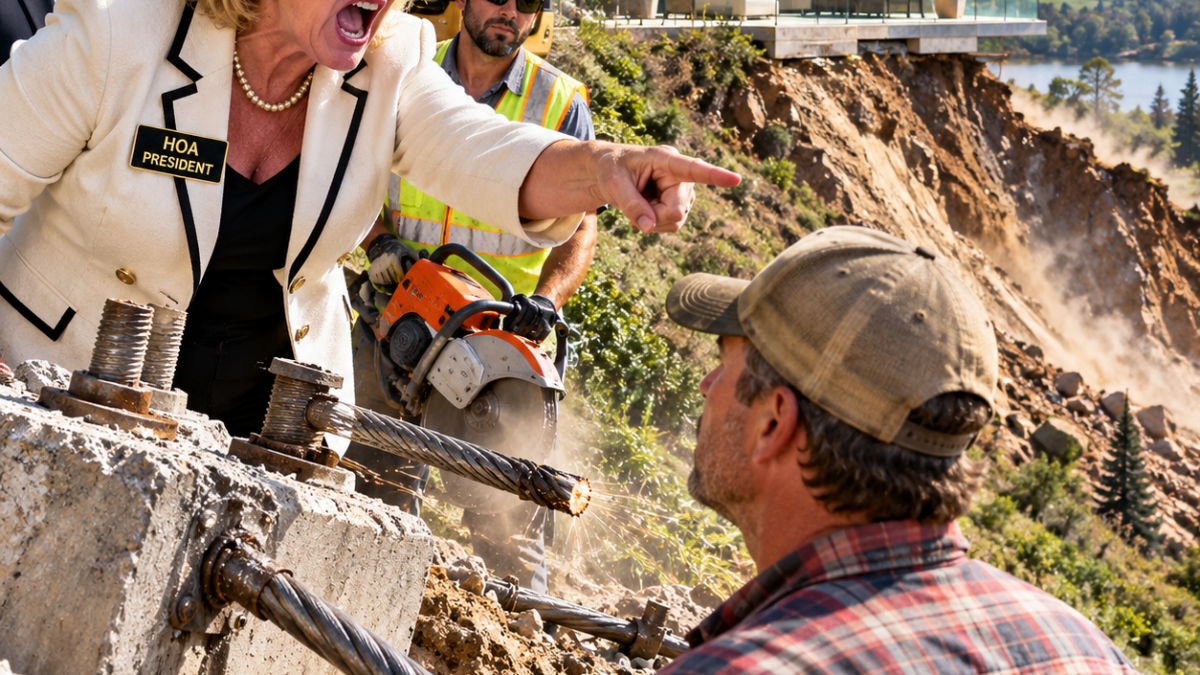
I could still picture Marissa in her cream raincoat.
Sparks spraying.
The guard’s hand against my chest.
Her finger pointing toward the next anchor.
“Continue.”
At the time, she had believed the hardest thing in her way was a stubborn widower.
She was wrong.
The real obstacle had been physical reality.
A recorded property line does not move because a board approves a prettier map.
A loaded anchor does not become decorative because someone calls it debris.
Water does not stop creating pressure because an investor event starts at 8:30.
And a hillside does not negotiate with a deadline.
I closed the notebook.
Below me, sunlight reached the roofs of Summit Crest.
Daniel’s house was still there.
His daughter’s repaired window caught the light.
Farther down, Marissa’s former property had a new retaining wall where the pool deck once stood.
I felt no satisfaction looking at it.
Only relief that no one had been inside when the ground moved.
I walked back toward my workshop.
Before going in, I stopped at the new weatherproof field box beside the monitoring station.
Inside were the copied plans.
The easement.
Emergency contacts.
The current monitoring protocol.
And Page 14.
Ruth’s words were not in that public copy.
Those remained mine.
But the knowledge no longer was.
That was the part I had finally understood.
A safety system nobody remembers is only one confident person away from being mistaken for junk.
And on that ridge, nobody would ever again need to trust confidence when the measurements were sitting right in front of them.
[END OF STORY]








