PART 2: HOA Cut the Chain on My Private Ranch Road and Gave 74 Families Access—Then I Found the Document Their President Tried to Bury
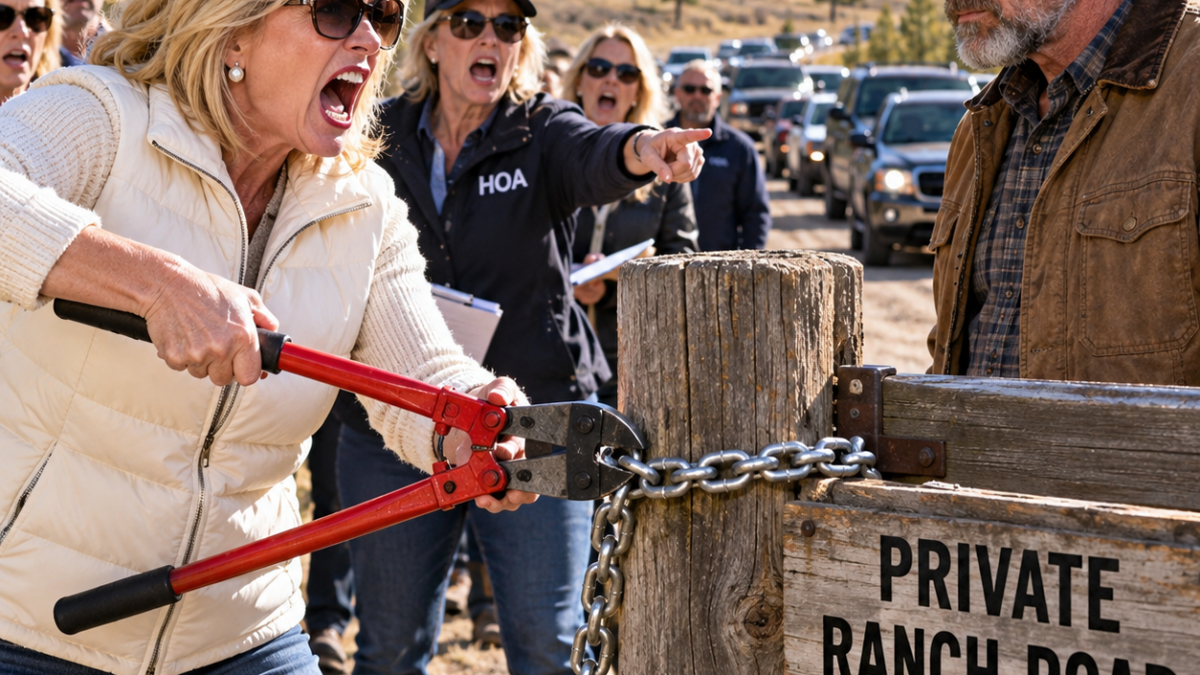
PART 2
I stared at the driver.
“Who told you that?”
He was a heavyset man in his early forties, wearing a faded blue work shirt with the name Curtis stitched above the pocket. He glanced toward Victoria, then back at me.
“Dispatch said the property owner had approved the work. That’s why they sent us out.”
“Did you see my signature?”
“No, sir. I just got the instructions.”
“Then call your dispatcher. Right now.”
Victoria stepped between us.
“Curtis, you don’t need to involve yourself in a legal disagreement. The association’s attorney has already reviewed the access agreement.”
Curtis shifted his weight.
“Ma’am, this is becoming a liability issue.”
“The HOA will indemnify your company.”
“That’s not the same thing as permission from the landowner.”
I liked Curtis immediately.
Not because he took my side, but because he understood that a signed work order didn’t magically turn somebody else’s land into a construction site.
Victoria turned toward me.
“You are deliberately interfering with an authorized project.”
I held up my phone.
“Then authorize it with something other than your own opinion.”
She looked at Curtis.
“Get your equipment off the road until I speak with counsel.”
Curtis nodded and walked away.
But before he reached his truck, he stopped and looked back.
“Mr. Ortiz, you might want a copy of the site plan we received.”
Victoria’s head snapped toward him.
“That document belongs to the association.”
Curtis hesitated.
I watched the exchange carefully.
“Why shouldn’t I see a plan showing construction on my own property?”
Victoria didn’t answer.
Curtis pulled a folded drawing from his clipboard and handed it to me.
The document showed my gravel road as a thick green line running directly from County Road 12 into Mesa Vista.
Across the top were the words:
SOUTH COMMUNITY ACCESS IMPROVEMENT — PHASE ONE.
Someone had drawn a rectangular security gate near my lower corral.
Two keypad posts.
A wider road shoulder.
A concrete drainage crossing.
And a little red circle marking the location of the old cattle guard my father had installed decades earlier.
Beside that circle were two words.
REMOVE EXISTING.
I felt my jaw tighten.
The cattle guard was still functional. It prevented livestock from wandering toward the county road, and replacing it had never been part of any agreement with the HOA.
They weren’t simply planning to let cars through my gate.
They were preparing to rebuild my ranch road into something my family would no longer control.
“Who drew this?” I asked.
Curtis pointed to a company name in the title block.
“Engineering consultant hired by the association.”
“Did anybody from that company come out here?”
“Not while I’ve been on the job.”
Victoria snatched the opportunity to speak.
“Daniel, nobody is trying to hurt your ranch. We’re improving a roadway that has existed for years.”
“Then why does your drawing remove the cattle guard?”
“For safety.”
“Whose safety?”
“Everyone’s.”
I looked toward the corral.
Isabelle was holding Juniper steady while blood soaked through the white cloth wrapped around her leg.
“My horse is bleeding because you sent traffic past her fence. You’re standing on private property with plans to remove equipment I own, and you’re telling me this is for everyone’s safety?”
Victoria’s expression hardened.
“Don’t turn an unfortunate animal incident into an argument against community improvements.”
For a moment, I couldn’t speak.
Not because I lacked an answer.
Because I was trying very hard not to say something that would make the situation worse.
I folded the drawing carefully and handed it back to Curtis.
“Take your crew out through the county road. Nobody pours concrete. Nobody digs another hole.”
He nodded.
Victoria opened her mouth.
Curtis raised one hand.
“With respect, ma’am, I’m not touching another thing until the ownership issue is resolved.”
He left.
Victoria remained beside the new sign, watching the equipment roll away.
Then she turned to me.
“This is going to cost you more than you think.”
I looked directly at her.
“Maybe.”
She seemed pleased.
Then I added, “But I won’t be the one explaining to seventy-four families why you promised them property you didn’t own.”
Her expression changed again.
And I realized that was what frightened her most.
Not the lawsuit.
Not the construction delay.
The possibility that people might discover what she’d been telling them.
By noon, twenty-seven vehicles had driven through my private gate.
Some drivers slowed when they saw me standing beside the lane. Others passed without acknowledging me.
One man in a silver SUV rolled down his window.
“Hey, are you the ranch owner?”
“Yes.”
“Victoria said you approved a trial period.”
“No, I didn’t.”
He frowned.
“Really?”
“Really.”
He glanced toward the entrance.
“Then why did they send us access codes?”
“That’s an excellent question.”
He looked embarrassed.
“I’m sorry, man. I thought everything was settled.”
He turned around and left.
That was the first time I understood how cleverly Victoria had positioned the entire dispute.
She had not told the residents they were entering my land without permission.
She had told them the HOA had secured a new amenity.
The residents weren’t looking for a fight. Most simply wanted a shorter drive to school or work.
And if I confronted every vehicle, Victoria could make me look like an unreasonable rancher harassing innocent families.
I had spent nearly three decades managing road crews. I understood how easily a dangerous situation could be created by people who believed somebody else had handled the paperwork.
I also understood something else.
Once an unauthorized road starts carrying regular traffic, the person trying to close it becomes the visible problem.
The person who opened it can stand back and call the disruption unfair.
At 12:40, a delivery van met my hay truck near the narrow wash crossing.
There wasn’t enough room for both vehicles.
The van driver tried backing toward the subdivision.
His rear tire dropped off the gravel.
I got out and guided him back onto the road.
“Who sent you this way?” I asked.
“Navigation app.”
He showed me the screen.
The route had been labeled South Community Drive.
I stared at it.
Somebody had already submitted the new entrance to a digital mapping service.
A road that had never been legally approved was being advertised as part of the public navigation network.
I took a photograph of the screen.
Twenty minutes later, a landscaping trailer clipped an irrigation riser.
Water sprayed across the gravel, carving a muddy channel toward the lower pasture.
I shut off the valve and watched the water pressure drop in three horse troughs.
That was when I stopped treating Victoria’s behavior as a personal insult.
She was creating real damage.
Damage I would have to repair whether or not a judge eventually agreed with me.
Isabelle returned from the veterinary clinic shortly after three.
I heard her truck before I saw it.
She parked beside the barn and sat behind the wheel for several seconds.
When I walked over, her eyes were red.
“How bad?” I asked.
“Seven stitches.”
I closed my eyes.
“Did it hit a tendon?”
“No. The vet said we were lucky.”
I leaned against the truck.
“How long before she’s working again?”
“At least three weeks.”
Juniper was not just another horse.
She was a gentle gray mare with an extraordinary ability to remain calm around people who were frightened.
Isabelle used her in an equine therapy program for veterans and children with mobility challenges.
Some of those children had spent months learning to trust a large animal.
One little boy had taken almost six sessions before he felt comfortable sitting in the saddle.
Juniper had stood perfectly still through every one.
Now she was injured because strangers had decided that saving eleven minutes mattered more than asking permission.
“How much?” I asked.
“Fourteen hundred dollars.”
I nodded.
Isabelle stared toward the new sign.
“Dad, they’re going to keep doing this.”
“I know.”
“Then why aren’t you locking the gate?”
“Because there are cars coming through every few minutes, and I don’t want somebody hitting a chain or getting trapped between vehicles.”
She rubbed her forehead.
“I hate that you’re the one worrying about their safety.”
“So do I.”
That evening, I called Maya Chen.
Maya was a property attorney in Santa Fe who had helped us renew a water service agreement two years earlier.
She didn’t waste time offering sympathy.
“Tell me exactly what happened.”
I told her about the cut chain.
The access codes.
The expired license.
The injured horse.
The construction plans.
Then I read the sentence from Victoria’s email.
“The board’s counsel is reviewing all established access rights.”
Maya went quiet.
“Daniel, did you ever grant the developer an easement?”
“No.”
“Did the agreement allow assignment to the HOA?”
“No.”
“Did you sign any extension?”
“No.”
“Did you give Victoria verbal permission for a trial period?”
“Absolutely not.”
“Good. Don’t change anything until I get there.”
She arrived at four with a leather briefcase and shoes that were entirely inappropriate for ranch gravel.
We walked the road together.
At the gate, she studied the two pieces of chain.
At the irrigation line, she photographed the damaged riser.
Then she stopped near the corral and watched a car pass within twenty feet of the fence.
“How many vehicles normally use this road?” she asked.
“Maybe a dozen movements on a busy working day. Sometimes fewer.”
“And now?”
“Twenty-seven before lunch. More since.”
She looked toward the blind curve.
“This road wasn’t designed for that.”
“No.”
“All right. Let’s see the agreement.”
We sat at my kitchen table while she read every page.
She took longer than I expected.
At first, that worried me.
Finally, she set the document down.
“Daniel, this license is unusually clear.”
“Meaning?”
“Meaning it gave temporary access to a specific developer for a specific purpose. It expired thirty days after the final certificate of occupancy. It couldn’t be assigned. It didn’t create an easement.”
“So they have nothing?”
“They may still raise legal arguments. But this document strongly supports your position.”
I felt the first small measure of relief since finding the gate open.
Then Maya said something I didn’t like.
“There’s one thing we need to avoid.”
“What?”
“Victoria wants you to look like the man shutting seventy-four families inside their neighborhood.”
“They have another entrance.”
“Then we’re going to prove that clearly.”
She leaned forward.
“No tractors across the road. No confrontation with drivers. No threatening signs. Document everything and let me handle the legal notices.”
I looked down at the two pieces of chain lying beside my coffee cup.
It went against every instinct I had.
But I nodded.
That night, Maya sent formal notice to the HOA, its management company, the developer, and the contractor.
The letter stated that the construction license had expired.
It demanded that resident traffic stop.
It demanded removal of the unauthorized sign and equipment.
And it warned that continued use could lead to legal action for trespass and property damage.
We gave the HOA until noon the next day to confirm compliance.
At nine that night, Victoria sent an email to all seventy-four households.
Carla James, a homeowner I had met twice at the feed store, forwarded it to Isabelle.
The subject line read:
IMPORTANT UPDATE: SOUTH GATE ACCESS.
I read the message at my kitchen table.
It said the new entrance was experiencing an unexpected challenge from an adjacent property owner.
It said the HOA was working to preserve long-established community access rights.
And then came the sentence that made Maya call me immediately.
Residents should continue normal use unless otherwise advised.
I stared at the screen.
“She just told them to keep trespassing.”
Maya sighed.
“Yes.”
“After receiving your letter?”
“Yes.”
“What do we do?”
“We make sure the judge sees that email.”
I looked out the window.
Headlights were moving past my lower pasture.
Victoria had received a legal warning and responded by encouraging more traffic.
That was no longer a misunderstanding.
By Wednesday morning, the situation had become almost unrecognizable.
Our trail cameras recorded eighty-six vehicle movements overnight and into the early morning.
Some were residents.
Others were delivery drivers using navigation directions that now treated my ranch lane like a neighborhood street.
The most unsettling part was how quickly people began behaving as though the arrangement had always existed.
Drivers honked when my tractor slowed to turn.
One resident complained that a hay wagon was blocking “the community access lane.”
A woman stopped beside the corral and asked whether I could move my horses farther from the road.
I stared at her.
“Move them where?”
“Somewhere quieter.”
“Ma’am, this is their home.”
She looked uncomfortable.
“Well, the HOA said this was an approved entrance.”
“The HOA was wrong.”
She drove away without answering.
I wanted to be angry with every driver.
Sometimes I was.
But Isabelle reminded me that most of them had been told the road belonged to their neighborhood.
“Victoria made them part of the problem without telling them,” she said.
She was right.
That distinction mattered.
The following afternoon, a licensed surveyor named Owen Price arrived.
Owen was in his early sixties, with a weathered face and the patient manner of someone accustomed to settling arguments with measurements.
He had worked in Santa Fe County for decades.
I knew him by reputation.
He knew the land.
We walked the boundary while he located the original survey monuments.
At one corner, he knelt beside a metal cap partly hidden beneath dry grass.
“Here it is.”
He brushed away the soil.
The cap bore the survey identification recorded decades earlier.
He checked it against his equipment.
Then he moved toward the new HOA sign.
I followed him.
After recovering the remaining boundary points, Owen set temporary stakes along the property line.
When he finished, he stood beside the road and looked at me.
“Daniel, there’s no ambiguity about where this lane sits.”
“How much of it is mine?”
“The new sign, the keypad holes, and approximately nine hundred twelve feet of the route are inside your parcel.”
“All of it?”
“Every section they’re trying to turn into this entrance.”
He unfolded the county parcel map.
Mesa Vista’s property ended at its southern fence.
The gravel lane belonged to Rancho Cielo.
So did the cattle guard.
The drainage crossing.
The shoulder beside my lower corral.
And the ground where Victoria’s contractor had intended to pour concrete.
“Could they have an easement that doesn’t show up on this map?” I asked.
“That requires a title search. I’ve already checked the county index for recorded access instruments.”
He turned a page.
“I found a utility easement, an irrigation maintenance agreement, and your temporary construction license.”
“Anything granting Mesa Vista permanent residential access?”
“No.”
I looked toward the subdivision fence.
For the first time, I felt as though the land itself had answered the argument.
Not through emotion.
Through measurements.
Owen wrote a field memorandum that afternoon.
Maya added it to our evidence.
But she wasn’t satisfied.
“The survey shows where the road is,” she said. “Now we need the county records showing what the subdivision was actually approved to use.”
I thought that would be straightforward.
I was wrong.
Because Victoria had spent the previous four days presenting a completely different version of Mesa Vista’s original development plans.
And somewhere in the county archives was the document that would settle which version was real.
On Wednesday morning, Maya and I met Leah Morgan at the county land-use office.
Leah coordinated development access permits and had worked on Mesa Vista’s final closeout.
She led us into a conference room with a large monitor and a stack of subdivision files.
“You’re here about the south entrance,” she said.
Maya nodded.
“We need to establish what was approved, what was temporary, and whether any amendment authorized residential traffic.”
Leah opened the approved subdivision plan.
There it was.
Mesa Vista.
Seventy-four residential lots.
Internal roads.
Drainage areas.
Utility corridors.
And one permanent vehicular entrance.
Camino Verde.
The western gate connected to a county-approved road with two paved lanes and space for emergency vehicles.
It had been serving the neighborhood since the first homes were occupied.
Leah zoomed in.
“This is the approved permanent access.”
She pointed to another line inside the development.
“This is a possible future connection to land east of the subdivision.”
“Not to my ranch?” I asked.
“No.”
“Victoria keeps saying Mesa Vista was designed with two entrances.”
“Early concepts showed more than one possible entrance. But concepts aren’t approvals.”
Leah opened another file.
It was a construction logistics sheet.
My ranch road appeared as a dashed line.
Beside it was a notation.
TEMPORARY HAUL ACCESS — REMOVE AT PROJECT CLOSEOUT.
I leaned forward.
“Can you print that?”
“Absolutely.”
Leah clicked through the permitting records.
Then she opened the driveway file for County Road 12.
My private entrance was listed for agricultural and ranch residential use.
The engineering study assumed fewer than thirty vehicle trips per day.
Not hundreds.
“The sight distance isn’t approved for subdivision traffic,” Leah explained. “And the drainage crossing hasn’t been evaluated for that load.”
“Could the HOA apply for approval now?” I asked.
“They could submit an application.”
I felt my stomach tighten.
Then she continued.
“But an access permit wouldn’t give them ownership of your land. First they’d need legal access rights. Then they’d need proper engineering, drainage, and emergency-service review.”
“Have they submitted any of that?”
“No.”
“Nothing?”
“Nothing in this file.”
Maya looked at me.
That was the second independent record contradicting Victoria’s claims.
Then Leah showed us the final certificate of occupancy.
It had been issued October 17, eighteen months before the gate was cut.
Under my agreement, the developer’s temporary access license ended thirty days later.
November 16.
Not a complicated date.
Not an uncertain interpretation.
A specific contractual deadline that had come and gone long before Victoria began distributing access codes.
I stared at the certificate.
For four years, I had allowed construction vehicles across my land because a developer needed temporary help finishing a project.
Now the president of the completed subdivision was trying to turn that favor into an ownership claim.
“Can you order them to close the entrance?” I asked Leah.
She shook her head.
“We can address the unpermitted roadway work and prevent anyone from representing the approach as county approved. The private-property dispute belongs in court.”
Maya nodded.
“That’s where we’re going.”
Leah scheduled an inspection for Thursday morning.
As we left, she handed me copies of the plans.
I carried them against my chest all the way to the truck.
They were ordinary government records.
Black lines.
Parcel numbers.
Approval dates.
But after three days of hearing Victoria insist that my road was part of her community, they felt more valuable than anything in my barn.
When I returned home, Isabelle was standing beside the lower corral.
Her arms were folded.
I could tell something had happened.
“What’s wrong?”
She handed me her phone.
A parent had canceled the following day’s therapy appointment.
The message was polite.
The mother had seen the increased traffic and didn’t feel comfortable bringing her son to a riding session beside an active neighborhood road.
The lost fee was sixty-five dollars.
Financially, it wasn’t disastrous.
But I knew the boy.
He was ten years old and wore braces on both legs.
He had worked for months to build enough confidence to guide Juniper along the fence.
Now he was losing time with her because strangers wanted a shortcut through our working ranch.
I looked at Isabelle.
“I’m sorry.”
She shook her head.
“Don’t apologize for something you didn’t do.”
“I opened the road to the developer.”
“You opened it for construction trucks. You didn’t give Victoria the ranch.”
She looked toward the traffic.
“Do you know what bothers me most?”
“What?”
“She keeps calling this a safety improvement. But she hasn’t spent ten minutes watching what happens when a horse gets frightened.”
I had no answer.
That evening, we counted one hundred thirty-two vehicle movements.
The fastest car passed our corral at forty-one miles per hour.
The lane was posted at fifteen.
I sent the footage to Maya.
Her response came within minutes.
We’re filing tomorrow.
Thursday began with the sound of a backhoe.
It was 6:20 in the morning.
I was pouring coffee when I heard the engine.
At first, I assumed somebody was using equipment on the subdivision side of the fence.
Then came the unmistakable scrape of a steel bucket cutting into dry earth.
I set down the cup and walked outside.
A backhoe was removing soil from the shoulder near the southern end of my ranch road.
The operator had already carved several feet into the bank.
Loose dirt rolled toward a shallow telephone conduit serving the north barn.
I waved from a safe distance.
The operator stopped.
I pointed to Owen’s survey stakes.
“You’re inside my property.”
He looked puzzled.
“The work order says HOA common area.”
“It isn’t.”
He climbed down and studied the markers.
“You sure?”
“Licensed surveyor was here Tuesday.”
He took off his gloves.
“Nobody told me that.”
“That’s becoming a pattern.”
I showed him the field memorandum.
He read enough to understand the problem, then called his dispatcher.
Ten minutes later, he was loading the machine onto a trailer.
That’s when Victoria arrived.
She stepped out of her SUV with a phone pressed to her ear.
The moment she saw the equipment leaving, she ended the call.
“Daniel, what are you doing?”
“Stopping somebody from excavating my land.”
“This is a board-approved safety project.”
“Monday it was an amenity.”
“It can be both.”
“Then show me the fire approval.”
She hesitated.
“It’s part of the county review.”
“Interesting. I was at the county office yesterday. They couldn’t find one.”
Her jaw tightened.
“You’ve been going around trying to undermine this project.”
“I’ve been asking people to show me a legal document.”
She stepped closer.
“You’re not the only person whose interests matter.”
“No, I’m not. But this land still belongs to me.”
For a moment, I thought she might finally concede something.
Instead, she looked toward the new survey stakes.
“You know, boundary disputes are rarely as simple as one man’s interpretation of a map.”
I almost laughed.
“That’s why I hired a surveyor.”
Before she could answer, a county vehicle pulled into the approach.
Leah Morgan stepped out with a roadway inspector.
Behind them came a fire department SUV.
Captain Rosa Alvarez climbed out carrying a clipboard.
Victoria adjusted her blazer.
“Captain, I’m glad you’re here. We’ve been trying to improve emergency access for the neighborhood.”
Rosa looked down the road.
“Show me what you’re proposing.”
Victoria began explaining the benefits of a second gate.
Shorter response times.
Improved evacuation options.
Alternative access if Camino Verde became blocked.
She made it sound reasonable.
And I had to admit that, in isolation, some of those goals were reasonable.
But Captain Alvarez wasn’t evaluating a sales pitch.
She was evaluating a road.
She walked toward the narrow wash crossing.
“What’s the load rating on this structure?”
Victoria glanced at me.
I answered.
“It was built for ranch equipment. I’ve never certified it for a fire engine.”
Rosa nodded.
“Our largest engine weighs about forty thousand pounds loaded.”
She studied the gravel surface.
“What’s the available width?”
“Fourteen feet,” I said.
She looked toward the blind curve.
Then toward the corral fence.
Then back at Victoria.
“Is this entrance included in Mesa Vista’s approved emergency access plan?”
Victoria’s face remained composed.
“We’re in the process of updating the plan.”
“That wasn’t my question.”
Silence.
Rosa continued.
“Until the necessary engineering and property authorization are completed, we dispatch through Camino Verde. I would not direct our apparatus across this route.”
Victoria opened her mouth.
Then closed it.
Leah issued a correction notice stopping unpermitted excavation, concrete work, signage installation, and gate-control improvements associated with the county approach.
She also instructed the association not to represent my agricultural driveway as an approved subdivision entrance.
Victoria read the notice twice.
Then she looked up.
“This doesn’t explicitly order residents to stop driving.”
Leah nodded.
“It addresses the work and representations within county authority. Property access is being handled separately.”
Victoria folded the paper.
“Then resident access remains a legal question.”
Maya, who had arrived during the inspection, spoke from behind me.
“Yes. And the court will hear that question.”
Victoria turned.
Maya held a folder containing our new filing.
“Good morning, Victoria.”
For the first time all week, the HOA president looked uncertain.
By Thursday afternoon, Maya had filed a complaint seeking declaratory relief, an injunction against unauthorized residential use, restoration, and compensation for the damage.
The filing included Owen’s survey.
The expired license.
The county-approved subdivision plan.
Photographs of the cut chain.
The veterinary records.
The damaged irrigation system.
And the email instructing residents to continue using the disputed route after notice.
But Victoria did not retreat.
Instead, the HOA sent another communication describing the county inspection as a routine permitting matter.
The message said the board remained confident in its access rights.
It also announced that Saturday’s ribbon-cutting ceremony was still scheduled.
I sat at my kitchen table reading that message.
Isabelle stood beside me.
“She’s actually going through with it.”
“Apparently.”
“After the county inspection?”
“Apparently.”
She pulled out a chair.
“Dad, what if the judge believes her?”
I looked at the papers spread across the table.
“I don’t think that’s likely.”
“That’s not what I asked.”
I sighed.
“I don’t know.”
It was the first time I had admitted that aloud.
I had spent most of my working life around disputes involving roads and property boundaries. I knew how persuasive a confident person could sound when the other side was forced to explain technical details.
Victoria had seventy-four households listening to her.
She had an HOA attorney.
She had professional-looking drawings, a security contractor, and a new entrance sign.
I had a gravel road, an expired construction agreement, and an injured horse.
The facts mattered.
But I couldn’t pretend the process was comfortable.
That evening, a sheriff’s deputy stopped by after receiving another complaint about access.
He examined my deed and the HOA’s letter.
Then he shook his head.
“This is going to need a court ruling.”
“I know.”
“Just don’t take matters into your own hands.”
I looked toward the cut chain hanging from a nail beside my workbench.
“I’ve managed not to so far.”
He nodded.
“Keep doing that.”
After he left, I sat outside the barn until the sun disappeared behind the hills.
Cars continued through the gate.
Every passing set of headlights reminded me that somebody else was making decisions about my land.
For the first time, I wondered whether opening that temporary road four years earlier had been a mistake.
My father had believed in helping neighbors.
He had allowed stranded motorists to shelter in our equipment shed during snowstorms.
He had let utility crews stage equipment beside the barn after major storms.
He had never been particularly interested in charging people for small favors.
But he had also been very clear about one thing.
People had to ask.
I remembered him telling me that when I was a teenager.
“Daniel, being generous doesn’t mean giving somebody the right to take.”
At the time, I thought he was being stubborn.
Now I understood exactly what he meant.
The next morning, a woman named Carla James knocked on my front door.
She lived in Mesa Vista.
I recognized her from the feed store.
She held a thick closing binder against her chest.
“Mr. Ortiz, I’m sorry to show up unannounced.”
“You’re fine. Come in.”
She stayed near the doorway.
“I think the HOA has been misleading us.”
I said nothing.
Carla continued.
“Victoria keeps saying every homeowner was promised two entrances. I bought my house eleven months ago, and I don’t remember any such promise.”
She opened the binder.
“I checked my closing documents.”
She spread the papers across my kitchen table.
There was the recorded subdivision plat.
One permanent entrance at Camino Verde.
There was the title insurance policy.
No easement across Rancho Cielo.
Then she pulled out a community map supplied during closing.
It showed the temporary construction road as a gray dashed line outside the subdivision boundary.
Four words appeared beside it.
NO RESIDENT ACCESS RIGHTS.
I leaned over the table.
“Can I photograph this?”
“Please do.”
I looked at her.
“Why bring it to me?”
Carla hesitated.
“Because I used your road Monday morning.”
I waited.
“My daughter had a dentist appointment. I was running late. The new entrance saved me about ten minutes.”
She swallowed.
“Then my husband told me your horse had been hurt.”
“It’s going to be all right.”
“I know. But I kept thinking about what happened. I wouldn’t want someone opening my backyard to traffic just because it was convenient.”
I appreciated her saying that.
Still, I had learned to be careful.
“Carla, the HOA may argue that this map isn’t the complete legal picture.”
“I understand.”
She reached into the binder again.
“But there’s someone else you should talk to.”
She handed me a business card.
PAUL BRENNER — FORMER HOA SECRETARY.
“Paul resigned from the board after an argument about missing records,” she said. “He used to complain that the turnover documents weren’t being stored properly.”
“What kind of documents?”
“Developer handover records. Warranties. Contracts. Property maps.”
I looked toward the community map.
“Does he still have copies?”
“I think so.”
That was the first time I heard Paul’s name.
And it was the beginning of the discovery that would eventually destroy Victoria’s argument.
Maya contacted Paul that afternoon.
He wasn’t eager to get involved.
According to Maya, his first response was that he had already spent enough time fighting with the Mesa Vista board.
He had served as secretary during the transition from developer control to homeowner control.
The experience had left him frustrated.
When Maya explained that we were investigating the south access road, he became quiet.
Then he asked for a photograph of the sign.
Maya sent one.
Eleven minutes later, he called back.
“I remember that road.”
Maya put him on speakerphone.
I was sitting beside her at my kitchen table.
“What do you remember?” she asked.
Paul answered carefully.
“It was supposed to be removed.”
I sat forward.
“Removed?”
“The temporary construction connection. It was on the developer’s final restoration list.”
Maya glanced at me.
“Do you have that list?”
“I kept a paper copy of the turnover index.”
“Why?”
“Because half the electronic folders disappeared from the board portal after turnover. I didn’t trust the system.”
“Can you bring it?”
Paul hesitated.
“I don’t want another fight with Victoria.”
Maya didn’t push him.
Instead, she asked one question.
“Did the documents identify Mr. Ortiz’s ranch road as a permanent HOA entrance?”
“No.”
“Did they identify it as a temporary construction route?”
“Yes.”
“Then the judge needs to see what the association received.”
There was a long silence.
Finally, Paul sighed.
“I’ll be there in an hour.”
When he arrived, he carried a blue envelope and a thin stack of papers.
He was a quiet man in his late sixties, with silver hair and reading glasses hanging from his shirt collar.
He shook my hand.
“I’m sorry about your gate.”
“Thank you.”
He looked toward the road through the kitchen window.
“Victoria always wanted that second entrance.”
I studied him.
“How long has she been talking about it?”
“Since before the homeowners took over the association.”
I felt something tighten in my chest.
Paul opened the paper index.
It was dated three days before developer turnover.
He turned to a section labeled outstanding closeout obligations.
Then he pointed to item forty-two.
REMOVE TEMPORARY SOUTH HAUL ACCESS. RESTORE ORTIZ CATTLE GUARD AND FENCE. LICENSE EXPIRES 11/16.
Beside it was a handwritten notation.
OPEN — DEVELOPER RESPONSIBILITY.
I read the line twice.
“Victoria received this?”
Paul nodded.
“Everyone on the transition team received the index.”
“Did she read it?”
“She initialed the item during the turnover meeting.”
I looked up.
“What?”
Paul reached into the blue envelope.
“That’s not all.”
He unfolded a large map across my kitchen table.
The paper was creased from years of storage.
Mesa Vista’s common parcels were highlighted in yellow.
Third-party property was white.
My ranch occupied a large white section along the southern boundary.
Across it, someone had written:
ORTIZ PARCEL — NO HOA INTEREST.
A red cloud surrounded the temporary construction gate.
Inside the cloud were the words:
CONSTRUCTION LICENSE TERMINATES AFTER FINAL C.O. DO NOT ACTIVATE OR MARK AS RESIDENT ACCESS. RESTORATION PENDING.
I felt my pulse pounding in my ears.
Every sentence contradicted what Victoria had been telling residents.
Every notation confirmed what I had told her before she cut my chain.
But the most important part was at the bottom.
Three signatures acknowledged receipt of the map.
One belonged to the management company.
One belonged to Paul.
The third belonged to Victoria Hail.
She had signed as president-elect.
Maya leaned forward.
“Paul, are you certain this is the document distributed during turnover?”
“Absolutely.”
“Did Victoria receive it?”
“I handed her the packet myself.”
“Did the board discuss the road?”
Paul removed his glasses.
“Yes.”
“What was said?”
“We discussed whether the developer should be required to finish the cattle guard restoration before the association accepted closeout.”
“Who responded?”
“Victoria.”
“What did she say?”
Paul looked at me.
“She said counsel would preserve the association’s claim against the developer.”
Maya wrote something down.
“Did she ever say the HOA owned the road?”
“No. Not then.”
I stared at Victoria’s signature.
For days, I had been trying to understand whether she had misunderstood the construction license.
Maybe she believed some obscure rule had transferred rights to the HOA.
Maybe she had relied on incomplete advice.
Maybe she had simply failed to read the agreement carefully.
But this document suggested something much more troubling.
She had been specifically warned that my road was temporary, that the HOA had no interest in my parcel, and that the gate should never be activated for residents.
And she had signed the acknowledgment.
Maya looked toward Paul.
“Will you sign an affidavit describing how this document was received?”
He nodded.
“Yes.”
Then he added something that made the room go silent.
“There may also be a record of what happened to the electronic copy.”
The management company maintained an online document portal for Mesa Vista’s board.
According to Paul, the developer had uploaded its closeout package before turnover.
That package included the restoration index, parcel maps, insurance records, and outstanding obligations.
After Paul resigned, several folders were no longer visible in the ordinary board directory.
He had complained about it.
The management company had described the change as routine archiving.
Now Maya wanted the audit log.
She sent a document-preservation request and asked the management company to produce the access history for the turnover folder.
The response arrived the following afternoon.
Victoria had downloaded the turnover package twice.
Both downloads occurred before she sent me the offer to purchase a permanent easement.
After I rejected that offer, the folder had been moved from the active board directory into a historical archive.
The management representative also had access, and the log did not establish who made the archive decision.
Maya was careful about that.
“We cannot claim she committed a crime,” she told me.
“I wasn’t going to.”
“Good. What we can establish is that she received the records and had access to them before she represented the road as an existing HOA right.”
I looked at the audit report.
“Then why offer me forty-five thousand dollars for an easement if she believed she already owned access?”
Maya tapped her pen against the table.
“That’s one of the questions we’ll ask.”
I remembered that conversation clearly.
Three weeks earlier, Victoria had called me at home.
She had offered thirty thousand dollars for permanent access.
I declined.
She increased it to forty-five thousand.
I declined again.
She had sounded irritated but professional.
At the time, I thought the matter was closed.
Now those offers looked different.
They showed that she had considered purchasing a right she later claimed the HOA already possessed.
And the timing mattered.
She had received the developer’s documents.
She had offered to buy an easement.
She had been refused.
Then she authorized a contractor to cut the gate chain and begin building an entrance.
It was a sequence the court could evaluate without relying on my opinion of her character.
That was the strength of the documents.
They didn’t need me to shout.
Friday evening, Mesa Vista held an emergency board meeting.
Sixty-three residents attended.
Maya advised me to go.
I didn’t want to.
I had spent nearly five days watching strangers drive across my ranch while Victoria presented herself as the reasonable person trying to solve a transportation problem.
The last thing I wanted was to sit in a room full of homeowners who might blame me for taking away their new shortcut.
But Maya said the board needed to see the records.
Not just Victoria.
The entire board.
So I went.
Isabelle offered to come with me.
I asked her to stay with Juniper.
“I’ll be fine.”
She looked unconvinced.
“Dad, you don’t have to prove anything to those people.”
“I know.”
“Then why go?”
I picked up the folder.
“Because some of them deserve to know what they’ve been told isn’t true.”
The clubhouse parking lot was nearly full when Maya and I arrived.
Owen came with his survey.
Paul carried the blue envelope.
Carla brought her closing binder.
We entered together.
Victoria sat at the center of the board table in her familiar red blazer.
Franklin Reed, the association’s attorney, sat to her right.
Four other directors occupied the remaining seats.
A projector displayed a watercolor illustration of the subdivision.
It showed landscaped streets, decorative walls, and two elegant gates.
The southern gate appeared as a beautiful stone structure surrounded by trees.
There were no property lines.
No cattle guard.
No horse corral.
No ranch house.
Just a pleasant architectural rendering.
Victoria began speaking before the room had fully settled.
“Our goal has always been to improve safety, convenience, and property values for every Mesa Vista homeowner.”
A few people nodded.
She explained that Camino Verde could become congested during school traffic.
That emergency vehicles benefited from alternate routes.
That the community had been envisioned with two entrances.
Then she pointed toward the projected drawing.
“As you can see, the south entrance was part of the original development concept.”
Maya leaned toward me.
“Watch the bottom right corner.”
I squinted.
There, beneath the decorative artwork, was a line of tiny print.
CONCEPTUAL — SUBJECT TO LAND ACQUISITION AND GOVERNMENT APPROVAL.
Maya whispered, “That’s going to matter.”
Victoria continued.
“Mr. Ortiz accepted payment for construction access and allowed the road to serve this development for years. After the association invested in improvements, he reversed his position.”
I felt my jaw tighten.
Maya touched my arm.
“Let her finish.”
Victoria looked directly at me.
“We respect our neighboring property owners. But we also have a responsibility to seventy-four families who purchased homes with reasonable expectations about community access.”
A few residents applauded.
Then Maya stood.
“May I ask a question?”
Victoria glanced at Franklin.
He nodded.
“Of course.”
Maya pointed toward the rendering.
“Is that the county-approved subdivision plat?”
Victoria hesitated.
“It’s the developer’s original design.”
“That wasn’t my question.”
Franklin leaned toward his microphone.
“The conceptual history is relevant to the association’s equitable claims.”
Maya nodded.
“Then let’s discuss the difference between a concept and a recorded property right.”
She connected her laptop to the projector.
The watercolor disappeared.
Owen’s boundary survey appeared.
A thick line marked my parcel.
Another marked Mesa Vista’s common property.
The entire disputed road was clearly inside my ranch.
Maya stepped aside.
“Owen, would you explain what you measured?”
He stood.
Using a laser pointer, he identified the recovered survey monuments.
He explained that the gate improvements, road shoulder, and approximately nine hundred twelve feet of the route lay inside Rancho Cielo.
Then he displayed the county index search.
“No permanent ingress or egress easement benefiting Mesa Vista was found in the recorded instruments affecting this parcel.”
A man in the audience raised his hand.
“Then what did the developer use?”
Owen turned toward him.
“A temporary construction license.”
Maya put the agreement on the screen.
She highlighted the expiration date.
Then the non-assignment clause.
Then the provision stating that the agreement created no continuing property interest.
Victoria shifted in her chair.
Franklin spoke.
“The association contends that equitable rights may have survived the written license.”
Maya nodded.
“That’s a legal theory the court can evaluate.”
She changed the slide.
“Now let’s look at what the county actually approved.”
Leah’s development plan filled the screen.
One permanent entrance.
Camino Verde.
The temporary construction route appeared only on a logistics sheet.
Several residents began whispering.
Victoria leaned toward her microphone.
“None of that eliminates the possibility of equitable access.”
“No,” Maya replied. “But it does eliminate the claim that the county approved this as a residential entrance.”
The treasurer, a woman named Evelyn Brooks, leaned forward.
“Victoria, did the county approve the south gate?”
Victoria paused.
“Our counsel was evaluating the permitting requirements.”
Evelyn frowned.
“Before or after we sent access codes to everyone?”
Franklin interjected.
“Some permits may depend on the final legal determination.”
Evelyn looked at him.
“That’s not what I asked.”
The room grew quieter.
Then Carla stood.
“I have something.”
She carried her closing binder to the table.
She opened it to the community map.
“I bought my house eleven months ago. My documents clearly say there are no resident access rights across Mr. Ortiz’s ranch.”
Victoria’s expression tightened.
“Carla, individual closing packets may contain preliminary materials.”
“This was the final packet from my title company.”
Carla turned toward the room.
“I’d love a shorter drive to town. But I don’t want it taken from someone else’s property.”
Several residents nodded.
Others looked uncertain.
A man near the back stood.
“Victoria, you told us Daniel approved a trial period. Did he?”
Victoria held his gaze.
“The association communicated its legal position.”
“That isn’t what I asked.”
The man remained standing.
“Did he agree to let us drive through?”
Franklin leaned forward.
“I would caution against characterizing ongoing legal discussions—”
“No,” the man interrupted. “I’m asking a simple question.”
For the first time that evening, Victoria looked uncomfortable.
Maya didn’t press her.
Instead, she turned toward Paul.
“Paul, would you bring the turnover documents forward?”
He rose slowly.
I watched Victoria’s face.
She recognized the blue envelope before he opened it.
I was certain of that.
Her eyes moved from Paul’s hands to Franklin.
Then back to the envelope.
Paul unfolded the developer’s map.
The room became quiet enough that I heard the paper crackle.
Maya placed it beneath the document camera.
The map appeared on the screen.
ORTIZ PARCEL — NO HOA INTEREST.
Then the warning inside the red cloud.
DO NOT ACTIVATE OR MARK AS RESIDENT ACCESS.
I watched the board members lean forward.
Vice President Samuel Price adjusted his glasses.
“Where did that come from?”
Paul answered.
“The developer’s turnover package.”
Samuel frowned.
“I’ve never seen that.”
Evelyn shook her head.
“Neither have I.”
Two other directors exchanged looks.
Victoria reached for her microphone.
“That is a developer punch-list exhibit. It doesn’t determine legal access.”
Maya remained calm.
“Correct. The deed, license, and recorded instruments determine the relevant property interests. The map is important for a different reason.”
She pointed to the bottom.
“These signatures acknowledge receipt.”
Samuel leaned closer.
He recognized the management company’s name.
Then Paul’s signature.
Then the third.
He looked toward Victoria.
“That’s your signature.”
Victoria nodded stiffly.
“I signed hundreds of turnover documents.”
Paul spoke quietly.
“You also initialed item forty-two.”
Maya placed the index on the screen.
There it was.
RESTORE ORTIZ CATTLE GUARD AND FENCE. LICENSE EXPIRES 11/16.
Beside the notation were Victoria’s initials.
Samuel turned toward her.
“Victoria, we discussed this.”
She looked at him.
“What?”
“Whether we should make the developer finish the restoration before accepting turnover.”
Victoria glanced toward Franklin.
Samuel continued.
“You told us counsel would preserve the developer claim. You never said we had a permanent easement.”
Victoria’s voice sharpened.
“The legal status evolved.”
Samuel looked at her for several seconds.
“How?”
She didn’t answer.
He pushed his chair back slightly.
“What happened between acknowledging that the road belonged to Mr. Ortiz and telling seventy-four homeowners that we owned access?”
Franklin raised one hand.
“The association’s position involves questions of equity, reliance, and historic use.”
Samuel turned to him.
“Did we spend money on this gate after we were told the property owner refused an easement?”
Franklin paused.
“I would need to review the exact expenditure dates.”
Evelyn opened the financial packet in front of her.
“I can answer that.”
She found the payment authorization.
“The initial gate contractor deposit was approved after Daniel rejected the second offer.”
I looked at Victoria.
She was staring at the table.
Maya asked one final question.
“Victoria, why did you offer Mr. Ortiz forty-five thousand dollars for permanent access if the HOA already possessed that right?”
Victoria lifted her head.
“Because settlement can be preferable to litigation.”
It wasn’t an impossible answer.
But it sounded very different after the map, the index, the county permit, and the closing documents.
Maya nodded.
“Then why was the contractor instructed to proceed after Mr. Ortiz refused?”
Victoria looked directly at me.
“Because I believe the residents deserve a second entrance.”
For a moment, nobody spoke.
Then Samuel said something I will remember for the rest of my life.
“Deserving something doesn’t mean we own it.”
Victoria’s eyes narrowed.
“The board elected me to improve this community.”
Samuel shook his head.
“We elected you to manage property we actually have.”
A murmur spread through the room.
I looked around.
Some residents were visibly angry.
Others seemed embarrassed.
A few were reading the projected documents on their phones.
But the strongest reaction came from Evelyn.
She closed her financial packet.
“I want an immediate vote to suspend the ribbon cutting and direct residents back to Camino Verde until the court hearing.”
Victoria turned sharply.
“That could prejudice our legal position.”
“Continuing to send people onto land we may have no right to use could prejudice it too.”
Samuel seconded the motion.
Franklin cautioned that suspension should not be construed as an admission concerning the association’s legal claims.
The board agreed.
Then the vote began.
Samuel voted yes.
Evelyn voted yes.
A third director voted yes.
Victoria voted no.
The remaining director voted no.
Three to two.
The Saturday ribbon cutting was canceled.
Residents were instructed to stop using the south entrance pending Monday’s hearing.
Victoria remained seated.
Her hands were folded on the table.
She didn’t shout.
She didn’t storm out.
And somehow that made the defeat more powerful.
For nearly a week, she had controlled the story by speaking with absolute certainty.
Now her own board had begun asking questions she couldn’t answer.
At 9:12 that Friday night, Mesa Vista sent a new email.
SOUTH GATE TEMPORARILY INACTIVE. ALL RESIDENTS SHOULD USE CAMINO VERDE.
I read it twice.
Then I walked outside.
The lower pasture was quiet.
No headlights.
No tires grinding over gravel.
No impatient horns.
Just the soft rustling of hay and the distant sound of a horse shifting inside the barn.
Isabelle came out carrying Juniper’s lead rope.
“Want to see something?”
She brought the gray mare into the yard.
Juniper’s leg was neatly bandaged.
She moved carefully but without the frightened tension I had seen earlier in the week.
We stopped beside the road.
Juniper lifted her head.
She listened.
Then she lowered her nose toward the grass.
Isabelle smiled.
“She knows.”
I reached over and rubbed the mare between her ears.
For the first time in five days, I felt something approaching peace.
But I also knew we had only won a vote.
Not a court order.
And Victoria still had Monday morning to persuade a judge that her version of events should prevail.
I barely slept Sunday night.
Maya called around eight.
She reviewed the documents one last time.
“Daniel, remember that this hearing isn’t going to decide every issue.”
“I know.”
“The judge is deciding whether temporary restrictions are justified while the dispute proceeds.”
“I understand.”
“Don’t expect a final ruling on damages. Don’t expect the court to determine every legal theory in fifty minutes.”
I looked toward the barn through my window.
“I just want the traffic stopped.”
“Then stay focused on that.”
Monday morning, I put on a clean shirt, fed the horses, and drove to the district courthouse.
Maya met me outside.
Owen was there.
Paul had agreed to be available if needed.
Across the courtyard, Victoria stood with Franklin and another board representative.
She wore a dark jacket instead of her usual red blazer.
When she noticed me, she looked away.
The hearing began shortly after nine.
Judge Eleanor Ruiz entered.
Everyone stood.
Once seated, she reviewed the basic nature of the request.
Maya spoke first.
She explained that I owned the land beneath the disputed road, that the construction license had expired, and that the association had initiated residential use without obtaining a permanent easement.
She described the property damage.
The injured mare.
The irrigation repair.
The unauthorized excavation.
Then she addressed the issue she believed was most important.
“Mesa Vista is not landlocked, Your Honor. Its approved western entrance has remained open throughout this dispute.”
She displayed photographs of Camino Verde.
Two paved lanes.
Visitor check-in.
Normal traffic.
No barricades.
No closure.
Judge Ruiz studied the images.
Then she looked toward Franklin.
“What immediate access problem is the association asking me to prevent?”
Franklin stood.
He was a good attorney.
Careful.
Measured.
He didn’t make the mistake of claiming the HOA had a recorded easement it couldn’t produce.
Instead, he argued that the developer’s long use of the road, the payment made to me, and the physical improvements had created equitable considerations that warranted preserving access while the parties litigated.
He described the road as part of the development’s historic construction access network.
He also argued that a second entrance could improve emergency flexibility.
I watched the judge take notes.
When Franklin finished, she asked a question.
“Was the construction license assignable?”
Franklin paused.
“The association contends that rights arising from the historical use may extend beyond the written license.”
“That wasn’t my question.”
He acknowledged the non-assignment provision.
She looked down at the agreement.
“And the license expired thirty days after the final certificate of occupancy?”
“Under its written terms, yes.”
“Was there an extension?”
“Not a signed extension presently in the record.”
The judge turned a page.
“Do any of the homeowners hold recorded access rights across the plaintiff’s parcel?”
Franklin answered carefully.
“The association is continuing its title and equitable-rights review.”
Judge Ruiz made another note.
Then she asked about the fire district.
Franklin explained that a second entrance could provide emergency benefits.
The judge looked at the inspection report.
“Does the fire district currently recognize this ranch lane as an approved emergency apparatus route?”
“No, Your Honor. Additional evaluation would be required.”
The judge leaned back.
She looked toward Maya.
“Counsel, what access are you asking me to restrict?”
“HOA-directed residential and service traffic, Your Honor. Not verified emergency responders.”
“And the west entrance?”
“Unaffected.”
The judge looked back at Franklin.
Then she asked the question that settled the immediate dispute.
“If Camino Verde remains open, what present emergency requires continued entry across Mr. Ortiz’s land before the underlying property rights are determined?”
Franklin described congestion.
He described delays.
He described inconvenience for residents traveling south.
He argued that closing an activated entrance could disrupt expectations.
Judge Ruiz listened.
Then she said, “Those may be legitimate community concerns.”
For one terrible moment, I thought she was agreeing with him.
But she continued.
“They do not, by themselves, establish a right to cross another person’s property.”
I gripped the edge of my chair.
The judge looked down at the evidence again.
“On the present record, the plaintiff has demonstrated a substantial basis for his request for interim protection. The association has not established that continued residential use of this private lane is necessary to prevent an immediate harm, particularly when the approved entrance remains available.”
She granted the preliminary injunction.
Mesa Vista could not direct, authorize, or facilitate ordinary resident traffic across my ranch road while the underlying access dispute remained unresolved.
The unauthorized sign and keypad equipment had to be removed.
The order preserved exceptions for genuine emergency responders acting within their lawful authority.
Damages and any future negotiated access arrangement remained separate matters.
I didn’t stand up.
I didn’t cheer.
I sat very still.
Maya leaned toward me.
“Breathe, Daniel. We got the order.”
I looked at her.
“Can I put my chain back?”
She smiled faintly.
“After we handle the restoration arrangements, yes.”
Across the aisle, Victoria was speaking quietly to Franklin.
For the first time, she looked like somebody who understood that a confident statement wasn’t enough.
Outside the courthouse, a local homeowners blogger approached her.
I stayed several yards away.
He asked whether the association had lost its claim.
Victoria responded that the HOA would continue defending the interests of its residents.
She spoke carefully.
No threats.
No dramatic accusations.
No promises to reopen the gate by Saturday.
And for some reason, that was more satisfying than watching her lose her temper.
She had spent days treating my land as something she could control through determination.
Now she had to answer questions about documents.
Dates.
Recorded rights.
Actual approvals.
Things that didn’t change because she spoke more forcefully.
Curtis returned the following Tuesday.
This time, he parked outside the gate and called me before unloading anything.
“Mr. Ortiz?”
“Yes?”
“I’ve got a restoration work order.”
“Whose property does it list?”
He laughed.
“Rancho Cielo. Owner Daniel Ortiz.”
“That’s a good start.”
Owen marked the boundary.
I marked the irrigation line.
Curtis photographed the existing damage before his crew began.
They removed the red-and-gold sign.
They filled the unfinished keypad holes.
They carried away the temporary security box.
The sign came down in one piece.
I watched it lying in the bed of the contractor’s truck.
Five days earlier, Victoria had treated that sign as proof that the road belonged to Mesa Vista.
Now it was a loose piece of metal being hauled away.
Curtis approached me as the crew finished.
“Sorry about how this started.”
I shook his hand.
“You stopped when you found out.”
“Still should’ve verified the property before sending equipment.”
“Probably.”
He glanced toward the old gate.
“Your cattle guard’s going to need more work.”
“I know.”
“Developer still responsible?”
“That’s what the agreement says.”
He nodded.
“Well, I hope they finally do it right.”
Then he left.
The damaged chain remained on my workbench.
I didn’t throw it away.
I wasn’t sure why.
Maybe because it had become evidence.
Maybe because I wanted to remember how quickly something as ordinary as a private gate could become the center of a dispute involving lawyers, surveyors, contractors, and seventy-four households.
Or maybe because my father had installed the original gate, and seeing the chain cut still hurt in a way I couldn’t entirely explain.
The lawsuit did not end with a dramatic jury trial.
Over the following weeks, attorneys and insurers began sorting out responsibility.
The developer had failed to complete restoration after the construction license expired.
That obligation was separate from the HOA’s later decision to cut my chain and open the road to residents.
The developer’s insurer accepted responsibility for the unfinished closeout restoration under the relevant agreement.
The HOA’s coverage and legal contingency addressed the newer damage associated with opening and using the lane.
Maya negotiated carefully.
We documented the irrigation repair.
Juniper’s veterinary care.
Owen’s survey costs.
The damaged fencing.
The gate work.
The recoverable legal expenses.
I kept detailed photographs and receipts.
After spending five days feeling powerless, there was something strangely calming about matching each damaged item with an invoice and a date.
Nobody could say the irrigation line had been fine when the photographs showed water pouring across the road.
Nobody could say Juniper’s injury was imaginary when the veterinary records showed seven stitches and a recovery period.
Nobody could say the chain had always been broken when the photographs showed fresh cuts and bolt cutters beside the maintenance cart.
Eight weeks after the hearing, we reached a settlement.
Mesa Vista formally disclaimed permanent residential access across Rancho Cielo.
The developer agreed to complete the original restoration work.
The cattle guard would be rebuilt.
The temporary branch would be removed.
The fence would be restored.
The wash would be stabilized.
The HOA agreed to reimburse the losses attributable to the unauthorized activation and use of the route, including the veterinary expenses, irrigation repair, survey costs, and recoverable legal fees.
The combined restoration and reimbursement amount was $42,600.
Insurance covered $27,000.
The HOA paid the remaining balance from its legal contingency.
There was no special assessment.
No family lost a home.
No resident was forced to sell.
Nobody went to jail.
I know that might disappoint people who imagine every HOA dispute ending with handcuffs and a television crew.
But I didn’t need Victoria arrested to feel that justice had been done.
I needed my land restored.
I needed my daughter’s therapy program operating safely.
And I needed the association to acknowledge that a temporary favor had never become permanent permission.
The settlement accomplished those things.
Still, I couldn’t help thinking about the residents who had trusted Victoria.
Some had believed they were buying homes with two entrances.
Some had repeated her claims without ever seeing the license.
Some had become angry with me because she presented the dispute as one stubborn rancher fighting an entire neighborhood.
I wondered whether they would ever understand that the real problem began long before the chain was cut.
It began when someone decided that a desirable outcome mattered more than the authority required to achieve it.
Three weeks after the settlement, Samuel Price called me.
He had become interim HOA president.
The board had voted three to two to remove Victoria from the presidency.
She remained a director temporarily but no longer controlled the board’s agenda or public communications.
Samuel sounded tired.
“Daniel, I wanted you to hear this directly.”
“What?”
“We completed an independent review of the south entrance project.”
I sat down.
“All right.”
“We found no evidence Victoria personally took association money.”
“I never claimed she did.”
“I know. But residents have been speculating.”
He paused.
“What the review did find was that the board was not given all the relevant turnover documents before authorizing the work.”
I looked toward the restored gate.
“She had the documents.”
“Yes.”
“She signed them.”
“Yes.”
“Then why didn’t the other directors see them?”
Samuel was quiet.
“That’s the question we’ve been asking ourselves.”
He explained that the active claims folder had focused on defects in homes, landscaping warranties, and unfinished common-area work.
The temporary road restoration had been moved into the historical archive.
Newer directors had not seen the warning map.
Several had relied on Victoria’s summary of the situation.
Some admitted they should have demanded more documentation before approving construction.
Samuel didn’t try to excuse that.
“We were wrong to authorize the project without confirming the land rights.”
I appreciated hearing him say it.
Then he added, “Victoria won’t be running for another term.”
I thought about the woman standing beside my cut chain, promising that the South Gate would open permanently.
“That’s probably best.”
Samuel cleared his throat.
“There’s something else.”
“What?”
“We’re commissioning a traffic study at Camino Verde.”
I almost smiled.
“That seems like a good place to start.”
A few months later, Samuel sent me the results.
The study confirmed that the western entrance experienced morning congestion.
That part of Victoria’s argument had been true.
What wasn’t true was that the only reasonable solution involved taking access across my ranch.
The problem was surprisingly ordinary.
One outbound lane shared space with visitor check-in.
Cars waiting for guests to be processed interfered with residents leaving for work or school.
The school bus pickup arrangement inside the neighborhood also contributed to backups.
The HOA hired a contractor to restripe the entrance.
They moved the visitor kiosk thirty feet.
They coordinated school bus pickup inside the clubhouse lot.
The project cost eighteen thousand dollars.
Every inch of construction remained on HOA-owned land.
Morning delays dropped from roughly nine minutes to less than four.
Samuel called after the improvements were finished.
“Daniel, I thought you’d want to know.”
“How’s traffic?”
“Better.”
“How much better?”
“Enough that people have stopped complaining about the south gate.”
I laughed.
“Imagine that.”
He chuckled.
Then his voice turned serious.
“I owe you an apology.”
“You’ve already apologized.”
“Not for this.”
I waited.
“We let convenience get ahead of judgment. We should’ve asked harder questions before a contractor ever touched your chain.”
I looked out toward the pasture.
“Yes,” I said. “You should have.”
He accepted that without arguing.
Then he said, “I hope we can be better neighbors from here.”
I thought about Carla bringing her closing binder.
Paul producing the turnover map.
Curtis refusing to pour concrete.
The board members who eventually voted to stop the traffic.
Not everyone in Mesa Vista had behaved badly.
Many had simply been given the wrong information.
“I’d like that,” I told him.
And I meant it.
I thought the access issue was finally over.
Then Captain Rosa Alvarez called me.
She asked whether I would consider meeting her at the ranch.
I agreed.
When she arrived, she wasn’t accompanied by Victoria or anyone from the HOA.
She came alone.
We walked the restored road together.
The cattle guard had been rebuilt.
The temporary gravel branch near the subdivision fence was gone.
Fresh native grass seed had been spread over the disturbed ground.
Rosa stopped near the lower crossing.
“Daniel, I want to ask you something, but I want you to understand that no is a perfectly acceptable answer.”
I smiled.
“That’s a refreshing way to start a conversation about this road.”
She smiled back.
Then she explained.
The fire district had been reviewing contingency plans for emergencies involving the western access corridor.
Mesa Vista had one approved permanent entrance.
Under normal circumstances, that was sufficient for its current operating plan.
But Rosa wanted to explore whether a narrow, controlled emergency arrangement might be possible if Camino Verde became physically blocked.
“Not residential traffic,” she said.
“Good.”
“Not delivery vehicles.”
“Even better.”
“Not another sales amenity.”
I laughed.
“Captain, you’re saying all the right things.”
She became serious.
“I mean it. This would be emergency-only access, under separate conditions, and it would require the appropriate safety review. The HOA wouldn’t receive a gate code.”
I looked toward the restored fence.
For months, I had fought to keep strangers from turning my ranch into a neighborhood road.
Now the fire captain was asking whether I might voluntarily allow limited emergency access.
I didn’t answer immediately.
Part of me wanted to say no.
A very large part.
I had spent thousands of dollars, lost sleep, watched my daughter’s horse suffer, and sat through a legal fight I had never wanted.
Why should I make another exception?
But I also thought about my father.
He had never confused protecting the ranch with refusing to help people.
During one winter storm, when I was seventeen, a utility truck became trapped on the county road.
My father opened our lower gate so the crew could turn around safely.
They stayed for three hours while he made coffee and helped them free the vehicle.
I remembered asking why he had let strangers bring heavy trucks into the pasture.
He looked at me as though the answer were obvious.
“Because they asked, Danny. And because somebody might need the lights back on.”
Standing beside Captain Alvarez, I remembered that conversation clearly.
I looked at the cattle guard.
Then at the road.
“I’ll consider it.”
She nodded.
“That’s all I’m asking.”
For the next month, Maya and I discussed the idea.
We did not reopen residential access.
We did not grant the HOA an easement.
Instead, Maya prepared a narrowly defined, revocable emergency-access license, subject to the necessary safety conditions.
It limited use to verified emergencies.
It prohibited ordinary traffic.
It prohibited assignment.
It required annual review.
It created no permanent property interest.
A fire district lockbox would be controlled by emergency personnel.
The HOA would receive no key.
No resident would receive a code.
No neighborhood marketing brochure could advertise the arrangement as a second entrance.
When I signed, Samuel thanked me.
I told him something I had been thinking about for months.
“Samuel, this isn’t a gift to the HOA.”
“I understand.”
“It’s a safety arrangement with people I trust to use it only when necessary.”
“I understand that too.”
I looked at the document.
“Then we shouldn’t have another problem.”
He smiled.
“I don’t intend to give you one.”
By September, the ranch finally looked like itself again.
The lower fence stood straight.
The irrigation line was working.
The temporary branch road had disappeared beneath new grass.
The rebuilt cattle guard carried my hay truck without rattling.
Juniper had returned to therapy sessions.
The first time Isabelle led her back into the north arena, I stood beside the fence watching.
I knew Juniper had recovered physically.
The veterinarian had cleared her.
The stitches were gone.
Her leg was strong.
But horses remember frightening experiences.
I wasn’t sure how she would react when a vehicle passed somewhere in the distance.
Isabelle worked with her patiently.
First inside the barn.
Then in the enclosed arena.
Then along the quieter fence line.
Each session went well.
Eventually, the children began returning.
One Thursday afternoon, I watched the ten-year-old boy who had missed his appointment climb carefully into the saddle.
He wore braces on both legs.
His mother stood beside the arena.
Isabelle adjusted the stirrups and checked his position.
Juniper waited.
The boy gripped the reins.
“Ready?” Isabelle asked.
He nodded.
“Ready.”
She led Juniper forward.
One slow step.
Then another.
The boy sat upright, concentrating so hard that his lips pressed together.
They approached the corral rail.
I found myself holding my breath.
A delivery truck passed along County Road 12, well beyond the cottonwoods.
Juniper lifted one ear.
For a brief moment, I saw her remember the noise.
Then she continued walking.
Calmly.
One step at a time.
The boy smiled.
He looked toward Isabelle.
“She’s not scared anymore.”
Isabelle glanced at me.
“No,” she said softly. “She’s doing just fine.”
I turned away before they could see my eyes.
For months, people had talked about property values.
Traffic efficiency.
Legal rights.
Insurance.
Recorded instruments.
Those things mattered.
But watching that boy guide Juniper around the arena reminded me why I’d fought so hard.
My land wasn’t an empty strip on a developer’s map.
It was a working ranch.
It was my daughter’s livelihood.
It was a place where frightened children learned courage beside patient animals.
It was the home my family had spent nearly fifty years maintaining.
And the people trying to turn it into a shortcut had never bothered to understand what was already there.
A few days later, I installed a smaller sign beside the restored gate.
Nothing decorative.
Nothing elaborate.
Just black lettering on a white background.
PRIVATE RANCH ROAD
ENTRY BY PERMISSION ONLY
Below it, mounted where authorized emergency personnel could reach it, was the fire district lockbox.
I stood there for a while after tightening the final bolt.
The old broken chain was still hanging in the barn.
I had considered throwing it away after the settlement.
Instead, I cleaned it and put it on a shelf above my workbench.
Not as a trophy.
Not as proof that I’d beaten Victoria.
Just as a reminder.
Four years earlier, I had opened my road to construction vehicles because someone asked for temporary help.
That permission had a purpose.
A deadline.
And an end.
Victoria tried to erase those limits by treating the road as a promise that could be fulfilled without my consent.
She wanted shorter drives, better real estate listings, and a second entrance before the summer selling season.
When my answer was no, she acted as though the strength of her desire created the right to proceed.
She cut the chain.
Distributed the codes.
Put up the sign.
And encouraged seventy-four households to use the entrance before anyone could stop her.
But the developer’s records had been sitting there all along.
The warning map.
The restoration index.
The expired license.
And her own signature.
She hadn’t been defeated by a clever trap I set.
She had been defeated by documents she had received before she ever ordered the gate opened.
The consequences were serious, but they were not theatrical.
She lost the presidency.
Her board lost confidence in her judgment.
The association paid for the damage it caused.
The developer finally completed the restoration it had owed for eighteen months.
And the neighborhood solved its traffic problem without taking a single foot of my land.
One evening, I watched the sun settle over the dry hills beyond the pasture.
Isabelle was closing the barn.
Juniper stood quietly beside the rail.
Far down the county road, headlights moved toward Santa Fe.
None turned into my driveway.
For the first time since that Monday morning, the ranch felt entirely peaceful.
I walked over to the gate and rested my hand on the new chain.
It was heavier than the old one.
Brand-new steel.
A stronger lock.
But those weren’t the things that made me feel secure.
The real protection had been sitting in ordinary files all along.
A deed.
A survey.
A temporary license.
A county-approved plan.
And a map the HOA president had signed before deciding she could ignore it.
I looked toward the little fire district lockbox.
Then back at the private-road sign.
My father had always believed that a good neighbor opened his gate when someone genuinely needed help.
I still believed that.
The difference was that I now understood something he had known all along.
A gate you choose to open is an act of generosity. A gate someone cuts open without asking is something entirely different.
I checked the lock one last time.
Then I went home.
[END OF STORY]








