PART 2: HOA Cut My Power and Gave Me 24 Hours to Leave—Then the Utility Chief Asked One Question That Destroyed Her Entire Plan
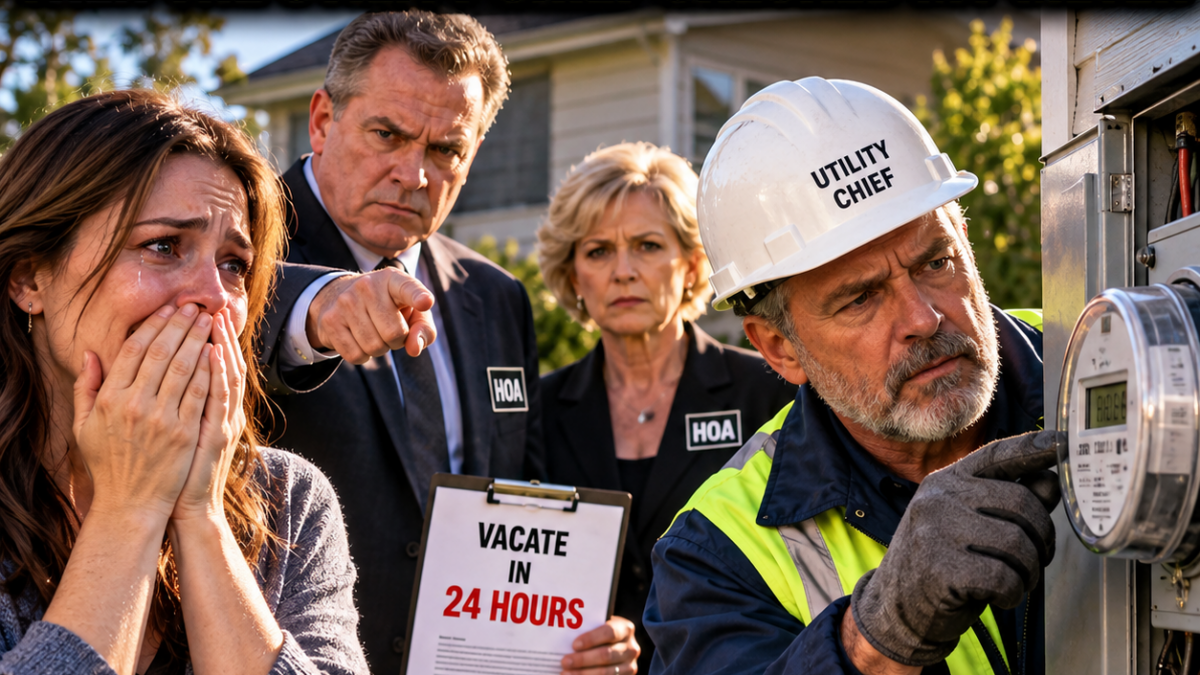
PART 2
Three utility trucks appeared at the end of the gravel lane.
Marissa turned toward them.
A look of relief crossed her face.
“There,” she said. “Perhaps now you’ll listen to someone who understands the regulations.”
She actually straightened her blazer.
I remember that clearly because it was the last moment that morning when she looked completely confident.
The lead truck stopped beside my gate.
A tall man in his late fifties climbed out, followed by a younger technician carrying a tablet.
The older man wore a dark utility jacket with his name stitched above the pocket.
DEAN HARROW.
I recognized him.
He was the utility company’s regional field operations chief. I’d met him several years earlier during a transformer upgrade after a summer storm damaged equipment along our road.
Dean wasn’t a man who wasted words.
He preferred checking the facts himself.
Marissa stepped forward.
“Mr. Harrow, I’m Marissa Vale, president of the Stonebridge Crest Homeowners Association. I’m glad you’re here because we’ve encountered a serious compliance issue with this property.”
Dean glanced at her.
Then he walked past.
He didn’t ask for her clipboard.
He didn’t acknowledge the notice.
He didn’t discuss HOA regulations.
He went straight to the meter on the side of my workshop.
“Morning, Elliot.”
“Morning, Dean.”
“When did you notice the outage?”
“About six-twelve.”
“Anything unusual before that?”
“Not that I know of.”
He nodded and crouched beside the enclosure.
For several seconds, he said nothing.
Then he leaned closer.
He put on a pair of work gloves and angled his flashlight toward the edge of the metal housing.
I watched his expression change.
He wasn’t surprised exactly.
He looked like a man who had found something he had hoped not to find.
“Ronan,” he called.
The younger technician approached.
“Yes, sir?”
“Pull the remote activity log for this meter.”
Ronan entered the service number into his tablet.
Dean studied the enclosure.
Then he pointed toward a narrow metal seal near the access panel.
“See that?”
I stepped closer without crossing the distance he indicated.
“Yeah.”
“That seal should be intact.”
I looked carefully.
A thin piece of metal hung loose beside the enclosure.
It had been cut.
Not worn down.
Not accidentally broken.
Cut cleanly through.
Fresh scratches surrounded two screws on the access cover.
Dean straightened.
He turned toward Marissa.
“Who touched this meter?”
The question was quiet.
That made it worse.
Marissa blinked.
“I’m sorry?”
“Who opened this enclosure?”
She looked toward the meter, then back at him.
“The association arranged for a licensed contractor to address an electrical safety concern.”
Dean didn’t move.
“What contractor?”
“A contractor working under our community improvement program.”
“Name?”
“That information is in our project files.”
“I need the name.”
Marissa swallowed.
“Surely we can discuss this through the appropriate administrative channels.”
Dean glanced toward Ronan.
“Anything?”
Ronan looked up from his tablet.
“No disconnect command. No field order. No technician assignment.”
Dean faced Marissa again.
“Then I’ll ask one more time. Who authorized somebody to open our equipment?”
Nobody answered.
Not Marissa.
Not Brooke.
Not the younger security guard.
The gravel lane went so quiet I could hear a sprinkler ticking across the road.
Finally, Marissa lifted her clipboard.
“We have legal covenants governing the infrastructure serving this community.”
Dean didn’t reach for it.
“Ma’am, your covenants don’t authorize you to operate our equipment.”
Her mouth opened.
He continued.
“This meter belongs to the utility company. The service was interrupted without an authorized order. The tamper seal is broken, and the enclosure shows fresh tool marks.”
Marissa’s face lost its color.
Dean looked back at the meter.
“This isn’t an HOA compliance issue anymore.”
I felt something change inside me.
Until that moment, I’d been angry.
Angry about the darkness.
Angry about the notice.
Angry about the months Marissa had spent treating my property line as an inconvenience she intended to eliminate.
But hearing Dean explain what he had found made my anger feel almost secondary.
Someone had deliberately interfered with the electricity serving my livelihood.
Someone had sent people onto my property before sunrise.
And someone had expected me to believe it was all legitimate.
Dean instructed everyone to stand back while he documented the scene.
He photographed the broken seal, the scratched screws, the meter identification number, and the condition of the service enclosure.
Ronan photographed the surrounding area.
One of the other technicians began checking the upstream service equipment.
Nobody made jokes.
Nobody treated it like a misunderstanding.
I asked Dean if he could tell how long the power had been off.
“Ronan’s checking that now.”
Marissa tried to interrupt.
“If there has been an error on the contractor’s part, the association will certainly review it.”
Dean didn’t look up.
“I’m sure you will.”
“I would appreciate being included in the investigation.”
“At the appropriate time.”
“I am the elected president of the adjoining homeowners association.”
Dean finally stood.
“And I’m responsible for the safety and integrity of the electrical system.”
He looked toward my workshop.
“Right now, I’m concerned with what happened to this meter.”
I didn’t smile.
But I understood the difference between the two people standing in front of me.
Marissa expected authority to come from her title.
Dean expected it to come from facts he could verify.
Ronan approached.
“I have the last reporting sequence.”
Dean held out his hand for the tablet.
Ronan pointed to the time.
“Five-forty-three this morning. That’s when the interruption occurred.”
I repeated it quietly.
“Five-forty-three?”
“Yes, sir.”
I remembered something.
My gate camera.
I’d installed it two years earlier after tools disappeared from a storage shed farther back on the property. It recorded continuously to a local storage unit, independent of the workshop’s main electrical service.
I opened the camera application on my phone.
The first clip loaded.
Five-thirty-nine a.m.
A plain white van appeared at the edge of the frame.
It came down my gravel lane without its headlights on.
I enlarged the image.
A small company logo was visible on the passenger door.
I recognized it immediately.
The same contractor had been working on Stonebridge Crest’s expansion site for months.
I showed Dean.
He watched the footage twice.
The van stopped near the eastern service entrance.
A man climbed out carrying a tool bag.
Another followed him.
They moved toward the area where the meter enclosure stood.
The camera angle didn’t show the enclosure itself.
But it showed their arrival.
Four minutes later, the exterior security light went out.
Dean looked at the timestamp.
Then he looked toward Marissa.
She was staring at my phone.
I could see her trying to decide whether to deny what the camera showed.
She didn’t get the chance.
Dean turned to his crew.
“Nobody restores service until we’ve finished documenting this.”
I felt a jolt of alarm.
“Dean, I’ve got customer jobs in there. Some of that equipment can’t sit idle indefinitely.”
He nodded.
“I understand.”
“Then how long?”
“As soon as it’s safe and we’ve preserved what we need.”
He looked toward the broken enclosure.
“Right now, Elliot, this meter is evidence.”
That word settled heavily between us.
Evidence.
Not an inconvenience.
Not a disagreement.
Evidence.
Marissa glanced toward her SUV.
For the first time, I wondered whether she might simply drive away.
But she stayed.
Perhaps she still believed she could talk her way out of it.
Perhaps she was waiting for somebody else to take the blame.
Or perhaps she couldn’t imagine a situation in which her authority meant nothing.
I didn’t know.
What I did know was that she’d arrived at my gate prepared to take away my workshop.
Now the utility chief was photographing the equipment used to carry out her threat.
And the morning was far from over.
***
My eleven acres had belonged to my family long before Stonebridge Crest existed.
My father bought the property when the surrounding area was mostly pasture, scrub trees, and narrow county roads.
He wasn’t wealthy.
He was a mechanic who believed a man should own the ground beneath the building where he worked.
He started with a small shed, a welder, and an old lathe that shook whenever it handled anything heavier than it should.
I grew up around that machine.
I learned to sweep steel filings before I learned to drive.
My father used to say that a workshop had two foundations: the concrete under the machines and the reputation of the person running them.
He cared about both.
When I eventually took over, I expanded the building, improved the electrical service, and added equipment capable of handling the larger fabrication jobs that kept our doors open.
By then, Dad’s health had started failing.
He lived long enough to see the new bay doors installed.
I still remembered him standing beside the entrance, one hand against the frame, looking pleased without wanting to say too much.
“Built something worth keeping,” he told me.
He meant the shop.
But I knew he meant the land, too.
After he died, I never seriously considered selling.
Not when developers began buying farms along the highway.
Not when property taxes increased.
Not when Stonebridge Crest started building expensive houses across the road.
The subdivision arrived in stages.
First came the entrance road.
Then the decorative stone walls.
Then rows of homes with matching mailboxes and landscaped lawns.
Eventually, the neighborhood had its own clubhouse, security patrols, and a homeowners association.
I didn’t object.
People were entitled to build homes and enjoy their community.
I kept my machines running.
They kept their lawns trimmed.
For years, we coexisted without much trouble.
The eastern edge of my property bordered the subdivision, and a narrow utility easement ran along that boundary.
It had existed for decades.
The recorded agreement allowed the utility provider to access its equipment for maintenance, inspection, and legitimate service operations.
It did not give the HOA ownership of the land.
It did not allow private construction vehicles to use the corridor as a road.
And it certainly didn’t authorize a neighborhood president to disconnect my electricity.
That distinction was clearly recorded in the county documents.
I had reviewed them more than once.
Unfortunately, Marissa Vale had apparently decided they were optional.
Her interest in my property began about six months before the power outage.
She came to the workshop one afternoon while I was finishing a steel bracket for a local agricultural contractor.
I heard a car pull up, shut down the machine, and walked outside.
Marissa stood beside her SUV with an envelope in her hand.
“Mr. Branson, I’d like to discuss an opportunity.”
She spoke as though she’d scheduled an appointment.
I wiped my hands on a shop towel.
“What kind?”
“The association is interested in purchasing a small portion of your eastern acreage.”
“How small?”
“Approximately one acre.”
I asked why.
She described a community improvement initiative, something involving infrastructure, landscaping, and better coordination between adjoining properties.
It sounded vague.
I asked where the acre was located.
She showed me a preliminary map.
It included the old service road and part of the utility corridor.
I knew immediately that I wasn’t interested.
“That ground isn’t for sale.”
She smiled.
“Surely you would at least consider a reasonable offer.”
“I already have.”
“You haven’t heard the amount.”
“It doesn’t matter.”
Her smile tightened.
I told her the road was part of my working property. Trucks used it to reach the storage building, and I needed access to the equipment along the eastern fence.
She suggested that an alternative route could be created.
I told her I wasn’t looking for an alternative.
That should have ended the discussion.
Instead, she returned several weeks later.
This time, she wanted to lease a forty-foot strip along the property line.
She called it a shared-access arrangement.
She talked about community cooperation and infrastructure efficiency.
I asked if she intended to put construction traffic through my land.
“Only limited access associated with our improvement program.”
“Then the answer is still no.”
“You haven’t reviewed the financial terms.”
“I don’t need to.”
She looked toward my workshop.
“You’re operating a commercial facility next to a growing residential development, Mr. Branson. Cooperation would benefit everyone.”
I understood the implication.
My shop had been there before the houses.
But now that the neighborhood had grown, she wanted me to behave as though I were the inconvenience.
I told her I had all the permits I needed and operated within county requirements.
She left without shaking my hand.
Her third visit came about a month later.
This time, she brought a thirty-page agreement.
It was filled with legal language about access coordination, temporary control, emergency utility operations, and future infrastructure development.
I read enough to understand that signing it would give the association far more control than Marissa had admitted.
The document allowed entry under broadly defined circumstances.
It gave the HOA authority to coordinate certain operations along the boundary.
It included language that could have restricted my ability to use portions of my own service road.
I asked who had drafted it.
“Our legal advisers.”
“Did they review my deed?”
“Of course.”
“Then they already know the association has no ownership interest in this property.”
She placed both hands on the table.
“Elliot, you need to understand the bigger picture.”
I hadn’t invited her to use my first name.
I let it pass.
“What bigger picture?”
“Stonebridge Crest is growing. Property values are increasing. Infrastructure has to evolve.”
“Then develop infrastructure on land you own.”
Her expression changed.
For a second, the polished HOA president disappeared.
I saw something harder.
“You are making this unnecessarily difficult.”
“No,” I said. “I’m making it clear.”
She gathered her papers.
Before leaving, she gave me a final warning.
“Eventually, the county may require a more cooperative solution.”
I remember looking at the doorway after she left.
The words bothered me.
Not because I believed she could force me to sell, but because she’d stopped asking and started threatening.
Within weeks, I discovered what she had been trying to accomplish.
Stonebridge Crest was planning a substantial eastern expansion.
Twenty-eight luxury homes.
A new clubhouse.
A fitness center.
A maintenance facility.
And a major utility connection needed to serve all of it.
The expansion was being advertised as the neighborhood’s next great achievement.
Marissa had promoted it heavily.
Residents had been shown elegant renderings and promises of increased property values.
What those presentations didn’t explain was that the least expensive route for the necessary utility infrastructure crossed land the association didn’t own.
My land.
Without permission to use the corridor, the expansion would require a redesigned route.
That meant additional engineering.
Different construction access.
New approvals.
More money.
And delays that might stretch for months.
I began to understand why Marissa couldn’t accept my refusal.
She hadn’t merely proposed buying a strip of property.
She’d apparently built an expansion plan around the assumption that I would eventually surrender it.
When I didn’t, she treated the obstacle as something to be eliminated.
The pressure started small.
First came violation notices.
One accused me of maintaining an improperly screened commercial structure.
Another cited exterior storage standards.
A third complained about the color and condition of my fencing.
Every notice referenced Stonebridge Crest regulations.
Every notice ignored the fact that I wasn’t a member.
I mailed back copies of the relevant property records.
The notices continued.
Then came noise complaints.
A county inspector arrived one afternoon to investigate alleged excessive industrial activity.
He walked through the workshop, checked the equipment, reviewed our hours, and measured sound levels at the property boundary.
When he finished, he looked almost embarrassed.
“Everything appears to be within the county’s requirements.”
“I thought so.”
“Has somebody been complaining repeatedly?”
“Apparently.”
He closed his notebook.
“I can’t tell you who filed the complaints.”
“I didn’t ask.”
But we both understood.
The inspection took most of an afternoon.
That meant delayed work, lost production time, and a customer who needed a tractor attachment repaired before the following morning.
I stayed late to finish it.
The next problem involved delivery trucks.
Security vehicles began stopping near my entrance.
They parked close enough to make drivers uncomfortable without always blocking the road outright.
A steel supplier called me one morning.
“Elliot, there’s some kind of neighborhood security guy taking pictures of my truck. Is there a problem?”
“No problem with you.”
“He’s writing down my plate number.”
“Tell him he’s welcome to call me.”
The guard didn’t call.
Instead, I started receiving complaints from customers who felt they were being treated like trespassers simply for entering my property.
One driver told me a guard had asked whether he was authorized to use an HOA emergency access road.
I almost dropped the phone.
It was my private service road.
There was no recorded HOA right to use it.
I asked Marissa to explain.
She sent an email referring to a “shared community access corridor.”
I replied with the recorded plat.
She never acknowledged the difference.
By the time she appeared at my gate with that eviction notice, I’d stopped believing any of this was accidental.
Still, I hadn’t imagined she would go so far as to interfere with my electricity.
That changed everything.
***
Dean’s investigation continued through the morning.
He moved carefully, checking each component before allowing the technicians to proceed with restoration.
I stayed nearby, answering questions and showing him camera recordings.
Marissa remained outside the gate.
She made two phone calls.
I couldn’t hear the conversations, but I noticed she kept turning away whenever Dean looked in her direction.
At one point, she tried to approach Ronan.
“I need copies of your findings for our association’s records.”
Ronan glanced at Dean.
Dean answered before the younger man could speak.
“Any formal request can go through our office.”
“We’re responsible for neighborhood infrastructure.”
“Not this meter.”
She pressed her lips together.
“You’re being unnecessarily adversarial.”
Dean looked at her for a moment.
“Ma’am, somebody opened an energized utility enclosure without authorization. That’s a safety issue, and we’re handling it accordingly.”
She walked back to her SUV.
I watched her go.
For months, she’d used official-looking language to make ordinary harassment sound like enforcement.
Now that actual professionals were involved, her vocabulary wasn’t accomplishing much.
Shortly before nine, my attorney arrived.
Tessa Langford had handled several property matters for me over the years, including a boundary dispute with a former neighboring landowner.
She was practical, sharp, and unimpressed by intimidation.
I had called her after the utility representative confirmed there was no disconnect order.
When Tessa stepped out of her car, she looked at the security vehicles, the utility trucks, and Marissa standing beside my gate.
Then she looked at me.
“Well,” she said, “this appears more interesting than your voicemail suggested.”
I handed her the notice.
She read it.
Her expression tightened.
“Where’s the rest?”
“What rest?”
“Was there an attachment?”
I remembered the folder Marissa had placed near the gate.
It contained several additional pages and a form labeled acknowledgment of receipt.
I showed Tessa.
She read the first page.
Then the second.
Then she stopped.
“Elliot, have you signed any of this?”
“No.”
“Did you initial anything?”
“Not a thing.”
“Good.”
She looked back at the document.
“Very good.”
Something about her tone made me uneasy.
“What is it?”
She turned the papers toward me.
Near the bottom of the acknowledgment form was a clause headed:
TEMPORARY HOA ADMINISTRATIVE POSSESSION.
I read the words slowly.
Tessa pointed to the language beneath them.
The form stated that, by acknowledging the emergency occupancy action, I would consent to temporary association control over the primary gate, specified access areas, and utility coordination along the eastern corridor.
I looked at her.
“That’s not just acknowledging receipt.”
“No.”
“That gives them control of my gate.”
“And potentially creates an argument that you consented to their access arrangement.”
I stared at the document.
Marissa had presented it like routine paperwork.
Something I was supposed to sign while I stood outside a powerless workshop, worried about customers and equipment, with twenty-four hours supposedly remaining before eviction.
Tessa lowered her voice.
“They’re trying to use the power outage to pressure you into signing away access.”
I felt a cold anger spread through me.
“She told me this was about electrical safety.”
“Then why does the acknowledgment grant control over your utility corridor?”
I had no answer.
Tessa continued studying the paperwork.
“They want you frightened. They want you thinking the building has suddenly become unusable. They want you worried about your livelihood.”
She looked up.
“And they want a signature before you have time to understand what you’re agreeing to.”
I turned toward Marissa.
She was watching us from beside her SUV.
I remembered all three proposals.
The acre she wanted to buy.
The forty-foot lease.
The thirty-page access agreement.
Each had been rejected.
Now she had arrived with another agreement hidden inside an eviction notice.
The pattern was suddenly unmistakable.
I felt sick.
Not frightened exactly.
Betrayed.
I had spent years trying to keep my business honest, pay my bills, respect the neighboring community, and stay out of disputes that had nothing to do with me.
Yet somebody had decided those things made me an easy target.
Tessa folded the acknowledgment.
“Don’t argue with her about it yet.”
“Why not?”
“Because I want to know who drafted this and whether the association board approved it.”
I looked toward the dark workshop.
“And what about my power?”
“Dean appears to have that under control.”
She paused.
“What we need to understand is why they were so desperate to get your signature this morning.”
Within an hour, we had another answer.
Ronan approached Dean with additional information from the utility company’s commercial services records.
Three days earlier, somebody had submitted a request to disconnect service at my address.
The request claimed an unsafe private electrical installation had been identified.
It also claimed to come from a person exercising property authority.
The utility company had rejected it.
There was no valid authorization from the account holder.
No supporting inspection record.
No legitimate basis for disconnecting service.
I felt a brief flash of relief that the company’s internal process had worked.
Then Dean showed us the attachment.
It carried my name.
And what appeared to be my signature.
For a moment, I simply stared.
I’ve signed thousands of invoices over the years.
My signature isn’t particularly elegant, but I know what it looks like.
The one on that document was wrong.
The first letter was too wide.
The final stroke was too straight.
The entire thing looked like someone had practiced my name a few times and decided the result was close enough.
“That’s not mine,” I said.
Tessa leaned forward.
“May I see the full document?”
Dean allowed us to inspect the displayed copy.
Attached to the request was an old scan of my driver’s license.
I recognized the photograph immediately.
The license had expired years earlier.
I couldn’t understand why anyone involved in Stonebridge Crest would possess it.
Then I remembered that I’d provided identification during an earlier property records transaction.
Copies of old documents sometimes passed through more hands than they should.
Somebody had apparently obtained one.
And used it.
I looked at Tessa.
“How much of my information do they have?”
“We don’t know yet.”
“That signature isn’t even close.”
“It doesn’t have to be convincing if the person receiving it doesn’t check.”
She looked toward Dean.
“Thankfully, somebody did.”
Marissa denied knowing anything about the document.
When Dean informed her that the utility company had located a rejected disconnect request bearing my name, she seemed genuinely unsettled.
“I have no knowledge of any falsified authorization,” she said.
“Then who submitted it?” Tessa asked.
“I don’t manage every communication sent by our contractors.”
“Did your association request that Elliot’s service be disconnected?”
Marissa lifted her chin.
“We requested appropriate action concerning a safety concern.”
“Which safety concern?”
“That is under review.”
“By whom?”
Marissa looked toward Dean.
Dean said nothing.
Tessa waited.
Finally, Marissa answered.
“I’m not going to conduct a legal examination in somebody’s driveway.”
Tessa nodded.
“That’s fine. We’ll request the records through the proper channels.”
Marissa looked away.
And I began to realize that the closer we moved toward the actual documents, the less she wanted to talk.
***
My electricity was restored late that morning.
Dean’s crew first completed its documentation and secured the evidence related to the unauthorized access.
They then followed the proper restoration procedure, replaced the temporary sealing components, and verified that the installation was safe to energize.
I stood inside the workshop while Ronan completed the final checks.
He looked toward me.
“Ready?”
I nodded.
A moment later, the overhead lights flickered.
The ventilation fan began turning.
A small indicator illuminated on my compressor panel.
I heard the familiar electrical hum of the building returning to life.
It was an ordinary sound.
I’d heard it thousands of times.
But that morning it felt different.
For several hours, I’d been forced to wonder whether somebody could destroy my business simply by creating an emergency and pretending it was my fault.
Now the machinery was alive again.
I put my hand against the nearest workbench.
I didn’t realize how tense I’d been until I felt my shoulders relax.
Ronan gave me a brief nod.
“Everything looks stable.”
“Thank you.”
He shrugged slightly.
“Shouldn’t have happened.”
I appreciated those three words more than he knew.
Outside, Marissa was still waiting.
The eviction notice remained taped to my gate.
I walked over and removed it.
I didn’t rip it into pieces.
I folded it carefully and put it in my pocket.
Marissa watched.
“Removing the notice doesn’t invalidate the association’s action.”
I looked at her.
“Neither does putting it on my gate make it legal.”
Her eyes narrowed.
“Tomorrow morning, you’re still expected to comply.”
I took one step closer.
“Marissa, you arrived here claiming the utility company shut off my service.”
“That was the information provided to us.”
“The utility company says no such order existed.”
“We’ll sort out the administrative confusion.”
“Somebody cut a seal, interfered with a meter, and used a forged signature to request a disconnection.”
“You’re implying—”
“I’m telling you what the investigators found.”
Her face reddened.
I didn’t raise my voice.
“You’re not getting my gate, my road, or my land.”
For a moment, neither of us spoke.
Then Dean approached.
“Ms. Vale.”
She turned immediately.
“Yes?”
“I need you to understand something about the association’s expansion project.”
Her expression became guarded.
Dean explained that all nonemergency utility work associated with the expansion would be suspended pending the investigation into the unauthorized disconnection.
I saw the reaction before she spoke.
Her shoulders stiffened.
“What do you mean, suspended?”
“No additional connection work will proceed until we’re satisfied the contractor and project authorization records are reliable.”
“That’s completely unacceptable.”
Dean remained calm.
“Then you’ll need to address the underlying problem.”
“You don’t understand the financial implications.”
“I understand the safety implications.”
“The expansion is already under construction. We have schedules. We have contractors. We have homeowners expecting completion.”
Dean nodded.
“Those issues don’t authorize anyone to tamper with utility equipment.”
She took a step toward him.
“You’re jeopardizing a multimillion-dollar project over a paperwork discrepancy.”
Dean looked toward the meter.
“A broken seal and an unauthorized service interruption aren’t paperwork discrepancies.”
Her mouth tightened.
“I’ll be contacting your superiors.”
“You’re welcome to.”
He handed her the appropriate office contact information.
She didn’t take it immediately.
For a moment, she just stared at the paper.
Then she snatched it from his hand, turned, and walked back to her SUV.
Brooke followed.
The younger guard climbed into the second vehicle.
Neither security officer looked particularly eager to remain involved.
As Marissa drove away, I watched the tail lights disappear around the bend.
For the first time in months, she hadn’t gotten the last word.
But Tessa wasn’t celebrating.
She stood beside me with the folded notice in her hand.
“She’s going to escalate.”
I glanced at her.
“You think so?”
“Look at the amount of money tied up in that expansion.”
“That’s her problem.”
“It should be.”
She turned toward the subdivision.
“But people who’ve built a plan around property they don’t own sometimes have trouble accepting that reality.”
I looked back at my shop.
The lights were on.
The machines were ready.
My work was waiting.
Yet the relief I’d felt a few minutes earlier was fading.
Because I knew she was right.
Marissa had already crossed a line I never expected her to cross.
There was no reason to believe she’d suddenly stop.
***
The following afternoon, Tessa and I drove to the county records office.
I had brought my original deed, copies of the utility easement, the earlier proposals Marissa had delivered, and the paperwork from the attempted eviction.
Tessa carried a thick folder of documents she’d obtained from the association’s public filings and permit submissions.
We met with Wesley Pritchard, a longtime county records clerk who knew more about local land boundaries than most surveyors I’d encountered.
Wesley had a reputation for remembering old property transactions.
When I told him which parcels we needed to review, he nodded.
“Branson property. Eastern boundary of the old Miller tract.”
“That’s the one.”
He disappeared into the records area.
Several minutes later, he returned carrying a large rolled plat.
He spread it across a long table.
The paper was old enough that its edges had begun to soften.
He placed transparent weights at the corners and carefully smoothed the center.
I recognized the layout immediately.
My eleven acres.
The old service road.
The eastern boundary.
And the narrow utility easement.
Everything was exactly where it had always been.
Wesley pointed toward the corridor.
“Limited-purpose easement.”
Tessa nodded.
“For utility maintenance and related authorized service access.”
“Correct.”
“Any recorded right for the homeowners association to use it as a construction road?”
“No.”
“Any transfer of ownership?”
“No.”
“Any amendment?”
Wesley shook his head.
“Not that I’ve found.”
Tessa opened her folder.
“Then I’d like you to compare that with this.”
She placed the expansion project’s newer map beside the original plat.
At first, the two looked similar.
Same general shape.
Same adjoining properties.
Same road network.
But as Wesley adjusted the documents side by side, I noticed something strange.
On the expansion map, the corridor was shaded differently.
It appeared to form part of the association’s land.
My boundary line had also shifted.
Not dramatically.
Only several dozen feet.
But enough to change the entire meaning of the drawing.
I bent closer.
“That’s not where my line runs.”
“No,” Wesley agreed.
He traced the boundary on the original plat.
Then he traced the version submitted with the expansion materials.
The two lines diverged precisely where Marissa’s proposed utility route would cross my land.
I looked at Tessa.
“Somebody moved my property line on their drawing.”
“That’s what it appears.”
“Can they do that?”
“They can draw anything they want,” she answered. “That doesn’t make it legally accurate.”
Wesley checked the record index.
He searched for a boundary adjustment.
Nothing.
A deed transfer.
Nothing.
A newly recorded access agreement.
Nothing.
A valid easement amendment.
Nothing.
The county’s official records still showed exactly what they had shown for decades.
I owned the land.
The utility company had limited maintenance access.
The HOA did not.
Yet Stonebridge Crest’s internal project documents presented the corridor as though it belonged to the association.
The implication was obvious.
If contractors trusted the altered map, they might install infrastructure on my land without ever realizing there was a title problem.
And if they did realize it later, the association could claim the project had been approved using the documents available to them.
I felt my hands curl into fists.
“She didn’t just try to pressure me.”
Tessa studied the map.
“No.”
“She tried to make it look like my land wasn’t mine.”
Wesley continued searching.
Then he paused.
“There’s something else you should see.”
He opened a county correspondence record associated with the expansion permit.
Several weeks earlier, the county had requested written authorization from me before approving the proposed utility alignment.
The request was straightforward.
Since the project appeared to involve private land outside the subdivision, the applicant needed to demonstrate a legal right to use it.
I had never been contacted.
Yet the file contained a later submission labeled:
UTILITY ACCESS CONSENT.
My name appeared beneath the acknowledgment language.
So did another signature.
I stared at it.
It wasn’t mine.
Again.
The first forged signature had been attached to the utility disconnect request.
This one appeared in county planning records.
Whoever had created them hadn’t even managed to make the signatures match each other.
One had a wide, looping first letter.
The other had a narrow, angular one.
The final strokes were different.
Even the spacing between my first and last names was inconsistent.
I looked up.
“Wesley, did anybody verify this?”
He frowned.
“The document was submitted as part of a project package. I can’t speak for the review process beyond what the records show.”
Tessa made a note.
“Was a formal authorization ever recorded?”
“No.”
“Then this wasn’t sufficient to change the property rights.”
“Correct.”
I took a slow breath.
For months, Marissa had insisted the corridor was part of Stonebridge Crest’s infrastructure.
Now I understood why.
She had submitted documents designed to make that claim appear true.
When the county asked for my consent, somebody supplied a forged signature.
When the utility company refused to disconnect my service without authorization, somebody physically interfered with the equipment.
And when I still wouldn’t cooperate, Marissa had appeared with a twenty-four-hour eviction notice.
It was no longer a collection of irritating incidents.
It was a sequence.
Each move attempted to overcome the obstacle that defeated the previous one.
Tessa gathered the documents.
“We need certified copies.”
Wesley nodded.
“I can arrange that.”
I stood at the table looking at my father’s original property line.
It wasn’t just a boundary on a map.
It represented a lifetime of work.
My father’s savings.
The long nights he spent repairing equipment because he couldn’t afford replacements.
The years I worked to expand what he’d started.
And somebody had tried to erase a piece of that history with a revised drawing.
I said quietly, “My father would have been furious.”
Tessa looked at me.
“You’re allowed to be furious, too.”
I nodded.
“But anger won’t fix the records.”
“No,” she agreed. “That’s why we’re keeping copies of everything.”
Before leaving, I looked once more at the altered map.
A few lines.
A different shade.
A narrow strip of ground made to appear as though it belonged to somebody else.
It struck me how little effort it could take to create a lie on paper.
And how much effort it took to undo the damage once other people began relying on it.
***
The next morning, Marissa returned.
She didn’t come alone.
I heard the vehicles before I saw them.
A security SUV turned into the lane.
Behind it came a pickup pulling a trailer loaded with metal barriers.
Another security vehicle followed.
Then a tow truck.
I was standing outside the workshop drinking coffee when the convoy stopped near my gate.
I counted five security guards.
Brooke Talmage was among them.
Marissa stepped out of the lead SUV.
She wore a dark blazer this time.
Her expression was colder than I’d ever seen it.
I set my coffee cup on the workbench inside the doorway.
Then I reached for my phone.
Tessa had warned me not to engage physically with anyone attempting to interfere with the property.
So I started recording.
Marissa approached the gate.
“Mr. Branson, the association is taking temporary measures to secure the disputed utility corridor.”
I looked at the barriers.
“Disputed by whom?”
“That matter is under county review.”
“The county records show I own it.”
“Your attorney has presented one interpretation.”
“There’s only one recorded boundary.”
Her eyes flashed.
“We’re not going to repeat yesterday’s arguments.”
I glanced toward the tow truck.
“What’s that for?”
“Vehicle removal if necessary.”
“Removal of whose vehicle?”
“Any vehicle obstructing the association’s access.”
I felt a surge of anger.
“My equipment is parked on my property.”
“That remains subject to the access dispute.”
I looked past her toward Brooke.
“Are you planning to tow my trucks?”
Brooke hesitated.
“We’ve been instructed to secure the corridor.”
“By whom?”
She glanced at Marissa.
Marissa answered.
“By association management.”
I nodded.
“Then you’d better make sure those instructions are legal.”
She stepped closer.
“Mr. Branson, your refusal to cooperate is creating unnecessary expense for every resident of Stonebridge Crest.”
“I didn’t authorize your expansion route.”
“And now you’re deliberately obstructing a community improvement project.”
“On land I own.”
Her voice rose.
“That is precisely the issue under review!”
I kept recording.
“Then why are you putting barriers across it before the review is finished?”
She didn’t answer.
Instead, she motioned toward the security team.
“Proceed.”
Two guards began unloading metal barriers.
Another moved toward the driveway.
I stayed inside my property line.
Every instinct told me to walk over and stop them.
My father had spent his life teaching me to protect what belonged to us.
Watching strangers unload barriers across his road felt like standing helplessly while somebody carried tools out of his shop.
But I knew what Marissa wanted.
She wanted a confrontation.
Something she could photograph.
Something she could describe as threatening behavior.
Something that might distract everyone from the documents and the broken meter.
I refused to give it to her.
I kept my voice steady.
“You’re on camera. I do not consent to any obstruction of my driveway or interference with my property.”
The younger guards looked uncomfortable.
One paused with a barrier in his hands.
Brooke spoke quietly to him.
He lowered it to the gravel without positioning it.
Marissa noticed.
“What are you waiting for?”
Before anyone answered, another vehicle approached.
Tessa stepped out of her car carrying a document folder.
She looked at the convoy.
Then at me.
“Please tell me you haven’t touched anything.”
“I haven’t.”
“Good.”
She walked toward Marissa.
“Ms. Vale, the county’s recorded plat does not support your claimed right of access. We formally object to any attempt to occupy or obstruct this property.”
Marissa folded her arms.
“The matter is still under review.”
“That doesn’t create a new property right.”
“We’re taking temporary protective measures.”
“Protective measures against what?”
“Unsafe utility access.”
Tessa looked toward my fully functioning workshop.
“Has the utility company issued any new order?”
Marissa ignored the question.
“I don’t believe you have authority to interfere with association security operations.”
Tessa opened her folder.
“I represent the property owner. I’m advising you that your actions are unauthorized.”
Marissa turned away.
“Continue.”
The guards looked toward Brooke.
Brooke looked toward the road.
And then I heard another engine.
A familiar utility truck came around the bend.
Dean Harrow.
Two service vehicles followed him.
I watched Marissa’s expression change.
For an instant, she looked irritated rather than frightened.
As though Dean were merely another person who had failed to respect her schedule.
He parked beside the trailer.
Climbed out.
Looked at the barriers.
Then at the tow truck.
“What’s going on here?”
Marissa approached.
“We’re securing the utility corridor pending resolution of a property dispute.”
Dean glanced toward me.
“Elliot?”
I held up my phone.
“I haven’t touched them. They arrived about ten minutes ago.”
Dean nodded.
Then he addressed the security crew.
“Stop moving those barriers.”
Marissa stiffened.
“You can’t issue orders to our private security team.”
Dean looked at her.
“I can direct people to stop interfering with utility access and equipment while an investigation is ongoing.”
“We’re protecting the corridor.”
“By placing barriers across it?”
“Until the county clarifies the boundaries.”
Dean held out his hand.
“Show me the map you’re using.”
Marissa seemed pleased by the request.
She opened her clipboard and removed the expansion plan.
“This is the approved project alignment.”
Dean spread it across the hood of his truck.
He examined it without speaking.
Then he retrieved another document from a folder inside the vehicle.
The utility company’s recorded easement exhibit.
He placed it beside the HOA map.
For a long moment, he studied both.
Then he pointed to the eastern boundary.
“These don’t match.”
Marissa leaned closer.
“That is a revised project map.”
“Revised by whom?”
“Our engineering consultants.”
“Based on what recorded land instrument?”
“The association has documented access rights.”
Dean looked at her.
“Where?”
Marissa began explaining the development’s infrastructure history.
Dean waited until she finished.
Then he tapped the original easement.
“This is the recorded utility corridor.”
He moved his finger to the other document.
“This is the corridor shown on your project plan.”
He looked up.
“They’re in different places.”
Marissa’s voice sharpened.
“You’re oversimplifying a complicated engineering issue.”
“No. I’m comparing two boundaries.”
I stepped closer.
Tessa stood beside me.
Dean pointed toward the metal utility cabinet near the road.
“Ms. Vale, do you know who owns that cabinet?”
Marissa glanced at it.
“That’s part of the association’s utility infrastructure.”
Dean shook his head.
“No.”
Her face tightened.
“It was installed as part of neighborhood development.”
“That equipment belongs to the utility company.”
“Then it’s located within our community access area.”
“It’s located within the recorded easement on Mr. Branson’s property.”
She stared at him.
Dean continued.
“And we have information suggesting unauthorized personnel opened that cabinet earlier this week.”
Brooke visibly flinched.
I noticed.
So did Tessa.
Dean turned toward her.
“Ms. Talmage, does your security company maintain camera records for activity along this boundary?”
Brooke hesitated.
“Yes.”
“Are those records preserved?”
“Yes, sir.”
“I’d recommend making sure they remain preserved.”
Marissa interrupted.
“Our security records are association property.”
Brooke looked at her.
“Actually, the recordings are maintained by our company.”
Marissa’s expression changed.
It was small.
But I saw it.
For months, she’d behaved as though everyone working around Stonebridge Crest answered personally to her.
Now one of those people had just reminded her that she didn’t control everything.
Dean looked toward the barriers.
“Until we’ve completed the equipment inspection and resolved the authorization issues, no further contractor activity involving these utility facilities is permitted.”
Marissa threw up one hand.
“This is outrageous.”
Dean didn’t raise his voice.
“Move the barriers away from the access area.”
“You’ll be hearing from our attorneys.”
“That’s fine.”
He looked toward the younger guards.
“Please keep the equipment clear.”
One guard immediately picked up the barrier he’d set down earlier.
Another began moving the trailer.
Nobody waited for Marissa’s permission.
I stood beside Tessa and watched the entire operation reverse itself.
The tow truck driver climbed into his cab.
The engine started.
Marissa turned toward him.
“We haven’t finished here.”
He looked out the window.
“Ma’am, I’m not towing anything until somebody establishes legal authority.”
Then he drove away.
The security guards loaded the barriers.
Brooke directed the process quietly.
And Marissa stood in the middle of the gravel lane, watching the intimidation campaign she’d brought to my property fall apart.
I didn’t say a word.
I didn’t need to.
***
The second inspection widened the investigation.
What Dean had originally treated as a single unauthorized service interruption now appeared connected to activity at other utility facilities along the boundary.
His crew inspected the roadside cabinet.
They checked access records, enclosure condition, and project authorization details.
The utility company had to establish whether the contractor involved in my disconnection had also accessed equipment it wasn’t authorized to operate.
Dean made one thing clear.
No occupied home in Stonebridge Crest would lose electricity because of the dispute.
The existing neighborhood’s service would continue.
Residents who had paid their bills and done nothing wrong were not going to be punished for decisions made by their HOA leadership.
But work associated with the twenty-eight-home expansion was another matter.
The new utility connection approvals remained suspended.
The contractor could not proceed with the proposed alignment.
Any work requiring access to the affected utility facilities was stopped pending review.
When Marissa realized the implications, she stopped arguing about my driveway.
She focused on the project.
“You cannot hold an entire community hostage.”
Dean looked at her.
“Nobody’s holding your community hostage.”
“Those homes are scheduled for completion.”
“Then your association needs to provide valid authorization for the work.”
“We have authorization.”
“Then submit it.”
“We already have.”
Dean pointed toward the mismatched maps.
“Not for this route.”
Marissa stared at the documents.
For the first time, she appeared to understand that the actual easement record was not something she could talk her way around.
The property boundary wasn’t negotiable simply because her contractors had drawn it differently.
And my refusal wasn’t an administrative inconvenience.
It was a legal obstacle she’d failed to resolve.
Dean turned toward his crew.
“Document the remaining equipment. No additional nonemergency connection work until the review is complete.”
Ronan nodded.
The technicians returned to their vehicles.
Marissa made another call.
This time, she walked far enough away that nobody could hear.
I watched her pace beside the subdivision entrance, gesturing angrily with her free hand.
Tessa stood next to me.
“She’s losing control of the project.”
I looked toward the expansion site.
Through the trees, I could see unfinished structures and parked construction machinery.
For months, the project had seemed unstoppable.
Trucks moved daily.
Crews worked long hours.
Concrete was poured.
Walls went up.
And every time I refused to sign away access, Marissa behaved as though the construction itself proved she was entitled to my property.
Now the work that depended on the disputed corridor couldn’t move forward.
I didn’t feel joy.
I felt a complicated kind of relief.
Because I knew there were ordinary homeowners who had invested money and trust in the expansion.
Some had purchased new homes.
Others expected the promised clubhouse and facilities.
They weren’t the people who had cut my electricity.
They hadn’t forged my signature.
But the project delays would affect them.
I hated that.
I also knew I couldn’t solve their problem by surrendering land I had every right to keep.
Tessa seemed to understand what I was thinking.
“You didn’t create this problem, Elliot.”
“I know.”
“Then don’t let somebody else’s bad planning make you feel responsible for fixing it.”
I looked at the empty road where the tow truck had been.
“That woman would have had my trucks hauled away this morning if nobody stopped her.”
“She tried.”
“And yesterday she tried to make me leave my building.”
“She did.”
I took a long breath.
“What happens now?”
Tessa closed her folder.
“Now we find out who gave those instructions.”
***
The contractor’s cooperation began after the stop-work order reached its management office.
Until then, the company had treated the disconnection as a routine field issue.
Once its executives realized the utility provider was investigating unauthorized access and potentially falsified documentation, the situation changed.
The company conducted an internal review.
A field supervisor eventually acknowledged that his crew had received direct instructions connected to Stonebridge Crest management.
The instructions contained several critical claims.
That I had already signed the necessary access consent.
That the corridor was controlled by the association.
That the utility company had approved the requested disconnection.
And that the service needed to be isolated before six o’clock on the morning Marissa delivered her eviction notice.
I read that last detail several times.
Before six.
The camera had recorded the van arriving at 5:39.
The meter log showed the interruption at 5:43.
The contractor had been told to finish before six.
Then Marissa appeared with a prepared twenty-four-hour notice.
It wasn’t the kind of timing that happened by chance.
Tessa obtained a copy of the contractor’s work packet through the investigation process.
Inside were the job instructions and supporting documents.
The authorization information was wrong.
The property description relied on the altered map.
The supposed approval had not come from the utility company’s actual dispatch system.
And the packet referenced an intermediary business I’d never heard of.
Veil Property Coordination, LLC.
I stared at the name.
“Veil?”
Tessa nodded.
“Close enough to Vale to catch my attention.”
“Is it hers?”
“Not necessarily. We need to look at the filings.”
That afternoon, she searched the state business registry.
The company had been formed less than a year earlier.
Its registered mailing address was a rented mailbox in a small commercial strip two towns away.
The listed manager was not Marissa.
There was nothing inherently illegal about that.
Plenty of legitimate businesses use mailbox services and managers who are not their owners.
But the company had no obvious public history matching the scale of the project work it was handling.
And its name appeared repeatedly in documents related to Stonebridge Crest’s access operations.
Tessa gathered every publicly available filing.
Then she began comparing them against HOA financial disclosures and project invoices.
The numbers raised new questions.
Stonebridge Crest had paid repeated consulting fees to Veil Property Coordination.
The invoices used descriptions such as utility coordination, site access, survey revision, and administrative support.
Some were substantial.
Yet the broader board records contained little explanation of what services had actually been provided.
I sat across from Tessa in her office as she arranged the invoices in chronological order.
“Tell me what you’re seeing,” I said.
She tapped the first document.
“Before the disconnection, this company was being paid to coordinate access for the expansion.”
She moved to the next.
“Then there are charges associated with revised survey materials.”
Another.
“Then security access coordination.”
Another.
“And emergency property control.”
I looked up.
“Emergency property control?”
“That’s how the invoice describes it.”
I remembered the guards.
The barriers.
The tow truck.
The eviction notice.
“Those were all connected?”
“We can’t establish the full relationship from invoices alone,” she said. “But the timing and descriptions give investigators a clear trail to follow.”
I leaned back.
For months, Marissa had presented herself as the voice of Stonebridge Crest.
She spoke about community interests, homeowners’ rights, and financial responsibility.
Yet the association appeared to have been paying an obscure intermediary company to coordinate activities aimed at gaining control of property it didn’t own.
I asked whether Marissa personally benefited from the payments.
Tessa shook her head.
“We don’t have enough evidence to say that.”
“But she directed the project.”
“According to the documents we’ve seen, she appears to have had significant involvement.”
“Did the other board members approve it?”
“That’s another question they need to answer.”
I sat quietly for a moment.
The whole situation had begun to feel larger than my workshop.
I thought about the residents across the road.
Most of them probably believed the expansion was proceeding through ordinary contracts and permits.
They’d attended presentations, voted on budgets, and trusted their leadership.
They likely had no idea an intermediary company was issuing work instructions based on questionable access documents.
And I doubted any of them had imagined the president would attempt to remove a neighboring landowner by cutting his electricity.
Tessa looked at me.
“There’s one more development.”
“What?”
“The security company is cooperating.”
I thought immediately of Brooke.
“Really?”
“They’ve offered to preserve and provide their camera records.”
I remembered the way Brooke had looked away when Marissa first arrived at my dark workshop.
She’d known something was wrong.
Maybe not everything.
But something.
“What’s on the footage?”
Tessa’s expression became serious.
“We haven’t reviewed all of it, but there’s a recording from the night before your power was disconnected.”
I sat forward.
“At my gate?”
“Yes.”
“Who’s in it?”
“Marissa. And somebody associated with the contractor.”
I felt the room grow strangely quiet.
Tessa continued.
“The audio includes her discussing what would happen to you the next morning.”
I stared at her.
“What did she say?”
Tessa glanced at her notes.
“Words to the effect that by tomorrow, you wouldn’t have any reason left to stay.”
I didn’t answer.
For several seconds, I couldn’t.
I pictured Marissa standing at my gate in the darkness while I was inside my house, unaware that people were apparently discussing how to force me out.
I remembered the workshop lights refusing to come on.
The notice.
The security guards.
The fabricated deadline.
And her smile.
That smile had bothered me more than anything.
Now I understood why.
She’d arrived believing the plan was already working.
***
Brooke Talmage contacted Tessa directly two days later.
She wanted to make sure the investigators had everything her security company could provide.
I met her in Tessa’s conference room.
Without her uniform, Brooke looked younger than I remembered.
She sat with her hands folded on the table.
A small stack of records lay in front of her.
I didn’t know what to expect.
For months, she’d been part of the security operation that made deliveries difficult and photographed my customers.
On the morning my electricity went out, she’d stood beside Marissa while I was ordered to leave.
I couldn’t pretend none of that mattered.
Brooke looked at me.
“Mr. Branson, I owe you an apology.”
I didn’t respond immediately.
She continued.
“I knew the association wanted access to your road. I knew there was some dispute about the property line.”
I waited.
“I didn’t know anyone was planning to disconnect your power.”
“Did you know they intended to evict me?”
She looked down.
“I was told there would be an emergency compliance notice.”
“Did you ask who had authority to issue it?”
Her face tightened.
“Not the way I should have.”
I let the silence sit.
She looked back up.
“I believed the association’s legal department had reviewed the matter.”
“Because Marissa said so?”
“Yes.”
I thought about that.
Marissa had relied heavily on people accepting her claims without checking.
The contractor believed the access had been approved.
The guards believed the property was under association authority.
And somebody had expected the utility company to accept a forged disconnect request.
The entire scheme depended on people trusting documents and instructions simply because they looked official.
Brooke pushed the first record toward Tessa.
“We have vehicle logs from the night before the outage.”
Then another.
“Camera footage from the east entrance.”
Then a third.
“And incident notes from the morning the barriers were brought to the property.”
Tessa reviewed the materials.
“Have these been provided to the investigators?”
“Yes. Our company preserved the originals.”
Brooke looked toward me.
“I want you to understand something. Our contract was for patrol services and property security. It didn’t authorize us to enter private land, remove equipment, or interfere with utilities.”
“Yet your people were at my gate.”
“I know.”
She swallowed.
“That’s why I’m here.”
I studied her for a moment.
She wasn’t asking me to forget what happened.
She was acknowledging that she’d been part of it.
I respected that.
But I still needed answers.
“Who told you to bring the barriers?”
“Association management.”
“Marissa?”
“Her office issued the directive.”
“And the tow truck?”
“Same work order.”
“What were you told the purpose was?”
“Securing a disputed access corridor.”
“Did anyone show you a court order?”
“No.”
“A recorded easement granting the HOA access?”
“No.”
“Any written authorization from me?”
She shook her head.
“No.”
I leaned back.
“Then why did you come?”
Brooke looked embarrassed.
“Because I assumed the people issuing the instructions had already done their jobs.”
There it was.
The exact weakness Marissa had exploited.
Not one dramatic act of deception.
A chain of ordinary people assuming somebody else had verified the truth.
Brooke’s voice softened.
“That morning, when the utility chief said there was no disconnect order, I realized the information we’d been given wasn’t reliable.”
I nodded.
“I noticed.”
She looked at me.
“I should have spoken up sooner.”
I didn’t tell her it was fine.
It hadn’t been fine.
But I didn’t need to humiliate her either.
“You’re speaking up now.”
She nodded.
“Yes.”
Tessa gathered the records.
“We appreciate your cooperation.”
Brooke stood.
Before leaving, she looked at me again.
“I’m sorry your business was put at risk.”
I thought about the dark machines.
The unfinished customer jobs.
The notice on my gate.
“Thank you,” I said.
After she left, Tessa sat quietly for a moment.
Then she opened the file containing the security footage summary.
“The board has scheduled an emergency meeting.”
“About what?”
“Marissa.”
I raised an eyebrow.
“She’s finally going to explain herself?”
Tessa shook her head.
“According to the agenda, they’re considering removing her as president.”
I looked toward the window.
For months, Marissa had used the HOA as a weapon against me.
Now the people who had elected her were preparing to examine what she’d done in their name.
I wasn’t looking forward to another confrontation.
But I intended to be there.
***
The emergency board meeting took place at the Stonebridge Crest clubhouse that evening.
I’d been inside the building only twice before.
Both visits involved property discussions I’d rather forget.
The clubhouse was impressive.
High ceilings.
Large windows overlooking a landscaped courtyard.
Polished floors.
Framed photographs of community events.
Everything suggested stability and prosperity.
That evening, the atmosphere was anything but peaceful.
Residents filled the folding chairs arranged across the meeting room.
Several stood along the walls.
Board members sat behind a long table at the front.
An attorney representing the association sat near the center, surrounded by documents.
I recognized some of the homeowners.
People who waved when driving past my workshop.
A retired couple who occasionally purchased metalwork for their garden.
A young father who had once asked me to repair a broken trailer hitch.
Most had never caused me trouble.
Yet the room was full of angry conversations.
I heard words like investigation, contractor, utility, and forged signature.
Some people looked frightened.
Others looked embarrassed.
A few were openly furious.
Tessa and I took seats near the back.
I hadn’t come to make a speech.
I wanted the board to see the documents.
I wanted them to understand what had happened.
And I wanted them to stop pretending Marissa’s actions were legitimate HOA enforcement.
A board member called the meeting to order.
The room gradually quieted.
The attorney explained that the association was reviewing serious concerns about unauthorized activities related to the expansion project and neighboring property access.
He emphasized that some matters remained under investigation.
Then Marissa entered.
The room changed.
People turned in their seats.
Conversations stopped.
She walked down the center aisle carrying a thick binder.
Her posture was straight.
Her expression was controlled.
For one strange moment, she looked exactly as she had on the morning she taped the notice to my gate.
Confident.
Prepared.
Certain that if she spoke firmly enough, everybody would eventually accept her version of events.
She sat near the front.
When given the opportunity to address the board, she stood.
“I appreciate the chance to correct the misinformation circulating throughout this community.”
A low murmur spread across the room.
She ignored it.
“Stonebridge Crest has spent considerable time and money developing an expansion that will benefit every homeowner.”
She described the twenty-eight new homes.
The clubhouse.
The fitness center.
The new infrastructure.
She spoke about increased property values and the importance of leadership during complex development projects.
Then she turned toward me.
“Unfortunately, one adjoining property owner has consistently refused reasonable efforts to coordinate necessary access.”
Several people looked in my direction.
I remained seated.
Marissa continued.
“Mr. Branson’s refusal has created delays and misunderstandings that are now being exaggerated into accusations of misconduct.”
Tessa placed a hand lightly on my arm.
Not to restrain me.
Simply to remind me why we were there.
Marissa described the utility disconnection as a contractor error.
She suggested the company had misunderstood a safety request.
She characterized the altered project map as a technical revision.
And she insisted the occupancy notice had been a good-faith attempt to address an emergency.
At one point, she actually said, “Every action taken by the association was intended to protect our homeowners.”
A woman near the front raised her hand.
“Then why was his electricity cut?”
Marissa paused.
“As I explained, that matter is being investigated.”
The woman didn’t lower her hand.
“Did you tell somebody to cut it?”
Marissa’s tone hardened.
“I did not personally operate any electrical equipment.”
That wasn’t the question.
Everyone knew it.
The room began murmuring again.
A board member asked her to sit down temporarily while the supporting records were reviewed.
She hesitated.
Then she sat.
Tessa was invited forward.
She carried two folders.
One contained the property records.
The other contained the utility and contractor documentation we were permitted to share.
She placed the original county plat on the table.
Then the association’s revised project map.
She explained the boundary discrepancy without exaggeration.
My eleven acres remained privately owned.
The recorded utility easement was limited in scope.
The HOA had no recorded right to use the corridor as a construction road.
And no valid document transferred that property to the association.
Several board members leaned forward.
One asked where the boundary line had been moved.
Tessa showed him.
He stared at the drawings.
“That’s our project plan?”
“Yes.”
“And this is the recorded county plat?”
“Correct.”
He looked toward Marissa.
“Why don’t they match?”
Marissa stood halfway out of her chair.
“Because the engineering consultants prepared a revised alignment.”
Tessa nodded.
“Then the consultants should be able to identify the recorded instrument supporting that revision.”
Marissa said nothing.
Tessa moved to the next document.
The utility access consent.
She explained that it bore my name and a signature I denied making.
Then she produced the separate disconnect request submitted to the utility company.
Another signature.
Also attributed to me.
I stood when she asked me to confirm the facts.
“Mr. Branson,” she said, “did you sign either document?”
“No.”
“Did you authorize the HOA to request disconnection of your electrical service?”
“No.”
“Did you consent to the association using your private service road for the expansion?”
“No.”
“Did you authorize any transfer of your property or grant of access beyond the recorded utility easement?”
“No.”
I looked at the board.
“I refused three separate proposals because I needed that land for my business. Every time I refused, another problem appeared.”
The room was silent.
I continued.
“First came the violation notices. Then the county complaints. Then the security patrols harassing my deliveries.”
Marissa shook her head.
I didn’t look at her.
“Then somebody came onto my property before sunrise and disconnected my workshop.”
I paused.
“I was standing in the dark when your president arrived with a notice ordering me out in twenty-four hours.”
A man near the back muttered something angry.
I continued.
“I pay my utility bills. I maintain my equipment. I operate a legal business on land my family owned before this subdivision existed.”
My voice tightened despite my efforts to keep it steady.
“I never asked this association for anything except to respect my property line.”
I sat down.
Tessa placed the final documents on the table.
The meter activity report.
The contractor work packet.
The documentation of the broken seal.
The rejected disconnect request.
And the records connecting Veil Property Coordination to the project.
The board members began asking questions.
Who had authorized the contractor?
Why was the utility company given inaccurate information?
Why were invoices paid through an intermediary?
Why had security guards been sent to block a road the association didn’t own?
Why had an eviction notice been issued against a nonmember property?
Marissa’s answers grew shorter.
Then sharper.
She blamed the contractor.
She blamed the county.
She blamed consultants.
She accused Tessa of selectively presenting documents.
Finally, she accused me of deliberately sabotaging the expansion.
I almost stood.
But Tessa spoke first.
“Mr. Branson’s refusal to surrender private property is not sabotage.”
Marissa turned toward her.
“You’re ignoring the interests of hundreds of homeowners.”
Tessa replied calmly.
“The interests of hundreds of homeowners do not create a right to take one person’s land.”
A quiet voice near the front said, “She’s right.”
Then another.
And another.
Marissa looked around the room.
For the first time, she seemed to realize the people she had spent years addressing as a loyal audience were no longer willing to accept her words without evidence.
She turned toward Brooke, who was standing near the side wall.
“Brooke, you can confirm that security was acting under association authority.”
Brooke stepped forward.
“Our company followed instructions provided by association management.”
Marissa nodded quickly.
“Exactly.”
But Brooke continued.
“Those instructions were represented to us as legally authorized. We were not provided a court order or a verified property instrument granting the association possession of Mr. Branson’s land.”
Marissa’s face tightened.
“Your company works for this association.”
Brooke looked directly at her.
“Our company was hired to provide security services.”
She paused.
“That doesn’t include destroying evidence or falsely claiming ownership of somebody else’s property.”
The room went still.
Marissa stared at her.
“You should be very careful.”
Brooke didn’t move.
“I am being careful.”
A board member asked whether the company had preserved its recordings.
Brooke confirmed that it had.
She explained that relevant footage had been provided to investigators.
The board attorney asked that no one attempt to alter or delete any related records.
Marissa sat back down.
Her hands were gripping the edge of her binder.
I could see the pressure in her knuckles.
Then the clubhouse door opened.
Dean Harrow walked inside.
I hadn’t expected him.
Neither, judging by her face, had Marissa.
He approached the front table carrying a sealed document packet.
The board attorney greeted him and asked whether he was prepared to provide a factual statement regarding the utility company’s findings.
Dean nodded.
“I can explain what our records confirm.”
He didn’t accuse Marissa of a crime.
He didn’t speculate about motives.
He didn’t raise his voice.
He simply explained that my service had been interrupted without a valid utility disconnect order.
The meter enclosure had been accessed without company authorization.
The tamper-evident seal had been cut.
The company had no record of dispatching a technician to disconnect me.
And the original request submitted through commercial services had been rejected.
Someone asked whether the HOA had authority to arrange the work independently.
Dean answered.
“No.”
Another board member asked whether a licensed private electrician could disconnect utility-controlled equipment under an HOA instruction.
Dean explained that licensing did not substitute for the utility provider’s authorization and applicable safety procedures.
Then he added one final detail.
The contractor’s work packet contained a purported utility authorization number.
Investigators had checked it.
The number did not exist in the company’s system.
Somebody had fabricated it.
The room fell completely silent.
I looked toward Marissa.
Her expression had changed.
It wasn’t anger anymore.
It was the look of someone who had run out of explanations and knew the next question could be worse than the last.
Dean closed his packet.
“We are continuing to cooperate with the appropriate investigators. I won’t speculate about criminal responsibility.”
Then he looked around the table.
“But I can tell you this with certainty: our company never authorized the HOA or its contractor to disconnect Mr. Branson’s service.”
He stepped back.
That statement landed harder than anything I could have said.
For months, Marissa had built her authority around the claim that she was acting through proper channels.
Now the person responsible for the actual electrical system had publicly confirmed that those channels had never approved what happened.
A board member turned toward Marissa.
“Did you know the authorization number was false?”
She shook her head.
“I relied on professionals.”
“Which professionals?”
“Our project team.”
“Who specifically?”
“I don’t have every name in front of me.”
The man looked down at the contractor packet.
“Your name appears on several of these project instructions.”
Marissa gripped her binder.
“I was coordinating a complicated development.”
“Did the board approve disconnecting his power?”
“No one approved an unauthorized disconnection.”
“That’s not what I asked.”
She didn’t answer.
The board member leaned forward.
“Did you tell anyone to have his electricity shut off?”
Marissa looked toward the association attorney.
“I think I need legal advice before continuing.”
The attorney nodded.
“That would be appropriate.”
There was no dramatic confession.
No sudden admission that she’d planned everything.
Just a room full of people realizing how many of her claims couldn’t survive examination.
The board recessed briefly.
Tessa and I remained near the back.
I could hear small groups of homeowners talking quietly.
Some were angry about the expansion delays.
Others were furious about the documents.
A few looked as though they were trying to understand how something like this could happen inside a neighborhood they considered safe and well managed.
Then a man approached me.
He was probably in his sixties.
I’d seen him walking his dog past my workshop many times.
He stopped a few feet away.
“Elliot?”
“Yes?”
“I’m sorry.”
I looked at him.
He glanced toward the front table.
“I had no idea they were treating you this way.”
I nodded.
“Thank you.”
He shook his head.
“We voted for an expansion. We didn’t vote for that.”
He pointed toward the documents.
“I don’t know how she thought she could do this.”
Neither did I.
At least, I didn’t know how she’d convinced herself it would work.
But I knew how she’d attempted it.
One official-looking paper at a time.
One assumption at a time.
One person following orders without checking the underlying authority.
The meeting resumed.
The board considered the removal of Marissa Vale as president.
She made one final statement.
She insisted that every difficult decision she’d made had been intended to protect the financial future of Stonebridge Crest.
She described herself as the only person willing to make unpopular choices.
She warned that removing her would damage the expansion project.
Then she looked directly at me.
“And I hope Mr. Branson understands that his actions have consequences for the entire community.”
I met her eyes.
For once, I didn’t feel intimidated.
“Your decisions brought us here,” I said.
That was all.
The board proceeded with its vote.
Marissa was removed from the presidency.
There was no applause.
No cheering.
The room remained tense and quiet as the decision was recorded.
Marissa sat motionless for several seconds.
Then she gathered her binder, stood, and walked toward the exit.
Nobody stopped her.
Nobody asked her to stay.
I watched her pass.
Only a few days earlier, she’d stood at my gate and ordered me out of my own building.
Now she was leaving the clubhouse under the eyes of the people who had once trusted her to lead them.
But I knew the vote wasn’t the end.
The documents were still there.
The forged signatures.
The altered map.
The contractor’s instructions.
The money paid through Veil Property Coordination.
Removing Marissa’s title didn’t make any of those things disappear.
***
The financial review began almost immediately.
The new HOA leadership ordered a deeper examination of the expansion project’s spending.
Records that had received little attention during ordinary monthly meetings were now inspected line by line.
The board discovered invoices for services that had never been clearly explained.
Survey revisions.
Electrical consulting.
Access coordination.
Private security operations.
Emergency property control.
Some payments had been approved under broad project budgets without the individual board members understanding what work was actually being commissioned.
Other transactions required additional scrutiny.
The consulting payments to Veil Property Coordination became a central concern.
Investigators and the association’s financial reviewers began reconstructing who had approved the payments, who had provided the services, and how the intermediary company was connected to the contractor’s instructions.
The deeper they looked, the more difficult it became to describe the power disconnection as an isolated mistake.
There were too many documents pointing in the same direction.
A false access consent.
A rejected disconnection request.
An altered project map.
A fabricated authorization number.
A contractor packet demanding that my service be isolated before six in the morning.
And a prepared eviction notice delivered shortly afterward.
I couldn’t prove which person had created each document.
That was for investigators to determine.
But the evidence no longer depended on my word against Marissa’s.
It existed independently.
On utility servers.
In county records.
On security footage.
In contractor files.
And in financial transactions.
Marissa attempted to resign from her remaining association role after the board’s decision.
The board accepted that she would no longer serve, but refused to treat her departure as a reason to stop investigating.
Records were preserved.
Requests for information continued.
The association’s attorney made clear that no document destruction or private agreement would erase the obligations created by the investigation.
I found that reassuring.
Not because I wanted revenge.
But because I had spent months watching Marissa try to replace reality with whatever version suited her.
I wanted the actual records to survive long enough for somebody impartial to examine them.
The expansion suffered serious consequences.
The county placed further approvals for the affected phase on hold while the property authorization issues were addressed.
The utility company required a revised connection design supported by valid documentation.
The contractor suspended its relationship with the HOA pending resolution of its own exposure.
The bank financing part of the expansion began asking questions about the regulatory delays and the legal status of the proposed infrastructure route.
What had once been presented as a straightforward community investment became a complicated problem involving engineering, property rights, finances, and regulatory review.
Marissa had apparently believed that twenty-four hours of pressure could force me to solve the problem for her.
Instead, the effort exposed issues that would take months to untangle.
I watched construction activity slow beyond the eastern boundary.
Some work not dependent on the disputed corridor continued where legally permitted.
But the utility connection supporting the expansion couldn’t proceed on the original assumptions.
The project had to be redesigned.
The association would have to bear the cost.
I took no pleasure in seeing ordinary workers lose scheduled jobs or homeowners worry about their investments.
But I couldn’t change the facts.
The association never owned my land.
And no amount of money already spent on construction could make a forged signature valid.
***
Several Stonebridge Crest residents came to see me in the weeks after the meeting.
The first was an elderly woman named Mrs. Whitcomb.
She’d been a schoolteacher before retiring.
She had lived in the neighborhood since its earliest development phase.
I recognized her because she frequently walked along the public road near my workshop in the afternoons.
One morning, she stopped at my gate.
I was loading finished brackets into a customer’s pickup when I saw her waiting.
I walked over.
“Morning.”
“Good morning, Elliot.”
She looked uncomfortable.
“May I speak with you for a moment?”
“Of course.”
She glanced toward the workshop.
“I wanted to apologize for what happened.”
“You weren’t involved.”
“I voted for Marissa. Twice.”
I leaned against the gate.
“That doesn’t mean you knew what she was doing.”
She shook her head.
“I thought she was organized. She always had reports, charts, plans. She made everything sound so official.”
I didn’t interrupt.
“Whenever somebody questioned her, she acted as though they simply didn’t understand the regulations.”
I thought about my own conversations with Marissa.
That sounded familiar.
Mrs. Whitcomb looked toward the eastern property line.
“I never imagined someone would forge a signature to get access to another person’s land.”
I was quiet for a moment.
Then I said, “Most people don’t expect that.”
She nodded.
“We trusted her.”
I looked across the road at the houses.
“Trust is supposed to make ordinary things easier. It’s not supposed to replace checking the important ones.”
She considered that.
“You’re right.”
Then she asked something I hadn’t expected.
“Are you angry with all of us?”
I looked at her.
“No.”
“Even after everything?”
“Mrs. Whitcomb, you didn’t cut my power. You didn’t send guards to block my driveway. You didn’t sign my name on those documents.”
She pressed her lips together.
“I just feel ashamed that we didn’t notice sooner.”
I understood that.
But I didn’t think the people who’d been misled needed to carry the same responsibility as the people who’d created the false information.
“You elected somebody to manage your association,” I said. “You didn’t authorize her to do whatever she wanted.”
She looked relieved.
We talked for a few more minutes.
Before leaving, she looked toward the workshop.
“Your father built the original place, didn’t he?”
I was surprised.
“You remember him?”
“Oh, yes. He fixed a broken garden gate for my husband years ago. Wouldn’t take more than a few dollars.”
I smiled.
“That sounds like Dad.”
“He was a good man.”
I felt a tightness in my chest.
“Thank you.”
She walked away slowly.
I stood by the gate longer than necessary.
The conflict had consumed so much of my attention that I’d almost forgotten how many good memories were tied to the same road and the same neighbors.
Marissa had tried to turn the boundary between us into a battlefield.
But the boundary itself had never been the problem.
Respecting it should have been simple.
More residents visited after that.
Some apologized.
Some asked what the records actually showed.
Others wanted reassurance that the existing utility service to their homes would remain unaffected.
I told them what Dean had confirmed.
Their electricity wasn’t being shut off.
The dispute concerned unauthorized work and the expansion’s proposed connections.
Several homeowners expressed frustration that they hadn’t been shown the original maps earlier.
A few admitted they’d approved budgets without reviewing the underlying contracts.
I didn’t lecture them.
They were already learning expensive lessons.
One younger homeowner asked whether I would ever reconsider selling the corridor.
I thought about that for a moment.
Then I shook my head.
“No.”
He looked disappointed.
“Not even for a fair price?”
“It’s part of my working property.”
“But the expansion needs access.”
“Then the expansion needs another design.”
He was quiet.
I added, “I’m not preventing the utility company from doing legitimate maintenance. That easement stays exactly as recorded.”
He nodded.
“But you’re not letting the HOA build across it.”
“Correct.”
I looked toward the service road.
“That land was never offered as a free solution to somebody else’s construction problem.”
He didn’t argue.
And that, more than anything, showed me how much the situation had changed.
For months, Marissa had described my refusal as unreasonable.
Now people were beginning to understand that refusing to give away property wasn’t the same as causing a problem.
***
Tessa and I had several conversations about what to do next.
We had enough evidence to pursue compensation for the damages caused by the unauthorized disconnection and the association’s actions.
The workshop had lost production time.
I had incurred legal expenses.
The utility enclosure had required attention.
The security operations had interfered with access.
And the repeated attempts to occupy my property had forced me to spend time defending rights that should never have been questioned.
Tessa prepared a detailed record of the losses.
We reviewed invoices, interrupted jobs, correspondence, photographs, and the utility investigation reports available to us.
I wanted the damages addressed.
I wanted a formal acknowledgment that the association had no right to control my property.
And I wanted assurances that its employees and contractors wouldn’t return with another invented authorization.
But I didn’t want the dispute to consume the rest of my life.
One afternoon, Tessa asked how far I wanted to pursue the civil matter.
We were sitting in her office.
The documents covered most of the table.
I looked at the files.
“I want them to pay for what they caused.”
She nodded.
“That’s reasonable.”
“I want the boundary respected.”
“Absolutely.”
“And I want the records preserved for the investigators.”
“They will be.”
I paused.
“But I’m not interested in making every homeowner across the road suffer because of Marissa.”
Tessa studied me.
“That’s an important distinction.”
“Those people didn’t vote to cut my power.”
“No.”
“And I don’t want to spend years fighting them if there’s a fair way to settle.”
She nodded.
“We can pursue compensation and protective terms without treating the entire neighborhood as an enemy.”
That’s what we did.
The settlement discussions took time.
There were arguments about the value of lost production hours.
Questions about responsibility for contractor conduct.
Disagreements over certain legal expenses.
And detailed negotiations about future access and property boundaries.
But eventually, the association agreed to a resolution covering the wrongful service interruption, associated losses, legal fees, repairs, and the unauthorized interference with my property.
The final arrangement also reinforced what the public records had already established.
The HOA did not possess my land.
It had no independent right to control my gate.
And it could not use the recorded utility easement as a general-purpose construction corridor.
The utility company’s legitimate rights remained unchanged.
I never wanted to interfere with its ability to maintain equipment.
Dean and his crews had done exactly what they were supposed to do when the problem was discovered.
I had no reason to punish them for Marissa’s conduct.
The settlement didn’t determine whether anyone would eventually face criminal charges.
That investigation remained separate.
It also didn’t magically undo the damage done to Stonebridge Crest’s expansion.
The association still had to redesign the utility route.
It still faced additional costs.
And it still had to rebuild trust among its own members.
But it resolved my civil dispute with the association and gave me something I’d been missing for months.
Peace.
I could finally work without wondering whether another security vehicle was about to block my deliveries.
I could open the workshop without checking the gate for another notice.
And I could make plans for my business without calculating how much time I’d lose fighting an HOA I had never joined.
Within a week, I installed a stronger steel gate along the affected boundary.
It wasn’t elaborate.
Just a sturdy barrier positioned where the recorded property line permitted it.
I added a simple sign.
PRIVATE PROPERTY.
UTILITY ACCESS BY RECORDED EASEMENT ONLY.
I stood back and looked at it after the installation was finished.
No threat.
No insult.
No mention of Marissa.
Just a statement of the rights that had existed all along.
I thought my father would have approved.
He never believed in making a bigger scene than necessary.
But he believed firmly in knowing where your property ended and somebody else’s began.
***
The workshop gradually returned to normal.
Customers brought in damaged equipment.
Farmers needed brackets and replacement parts.
A contractor wanted several custom steel frames fabricated before winter.
One of my longtime customers dropped off an old machine component that should probably have been replaced years earlier.
He insisted it could be repaired.
I told him that was optimistic.
He told me optimism was cheaper than buying a new machine.
We both laughed.
Those ordinary moments meant more to me than they had before.
For several weeks, my life had revolved around something I never expected to fight over.
Electricity.
A gate.
A narrow utility corridor.
A signature I hadn’t written.
Now my biggest concern was whether I could finish a customer’s order by Friday.
That was a problem I knew how to handle.
Sometimes, while closing the shop in the evening, I’d look across the road toward Stonebridge Crest.
The neighborhood still looked the same.
Porch lights.
Landscaped yards.
Children riding bicycles.
Neighbors collecting mail.
Nothing about the place revealed how close its leadership had come to creating a much larger disaster.
Marissa’s name disappeared from the association’s communications.
A new president began handling correspondence.
The tone changed almost immediately.
Letters became factual.
Requests were supported by documents.
Questions received answers.
It was surprising how much easier relations became once nobody was pretending the association controlled my property.
The expansion remained under review.
Engineers developed alternative utility routes.
The revised design would cost more than Marissa had planned.
There was no getting around that.
The association had to deal with its financing and construction schedules.
But the new leadership seemed to understand something Marissa never accepted.
A more expensive lawful plan was better than a cheaper plan based on rights the association didn’t possess.
I met the new HOA president briefly one afternoon.
He came to the workshop without security guards.
No clipboard.
No eviction notice.
He simply introduced himself and asked whether we could establish a better working relationship.
I told him I had no objection to being a good neighbor.
He asked whether the utility company could continue using the existing easement for legitimate service operations.
I almost smiled.
“That’s what the easement has always allowed.”
He nodded.
“Then we understand each other.”
It was the shortest and most productive conversation I’d ever had with anyone representing Stonebridge Crest.
I realized afterward how exhausting the previous six months had been.
Not because the property rights were complicated.
But because Marissa had insisted on making them complicated.
I had spent months explaining the same basic fact.
My land was mine.
Now, finally, I no longer had to.
***
Several weeks after the settlement was finalized, Dean returned to my property.
It was a quiet morning.
I had just raised the workshop doors and was preparing to start a fabrication job when I heard vehicles approaching.
I stepped outside.
A county vehicle stopped near the gate.
Dean’s utility truck pulled in behind it.
Two investigators climbed out of the county vehicle carrying evidence cases.
I recognized Dean immediately.
Seeing him with investigators brought back the memory of that first morning.
The dark workshop.
Marissa’s clipboard.
The guards.
The broken meter seal.
For an instant, I felt the old tension return.
Dean noticed.
He gave me a faint smile.
“Morning, Elliot.”
“Morning.”
I looked toward the investigators.
“Please tell me somebody hasn’t cut the power again.”
Dean shook his head.
“Nothing wrong with your service.”
I glanced toward the workshop.
The lights were on.
The machines were running normally.
“That’s good to hear.”
He looked toward the meter.
“We’re completing another part of the original-source review.”
One investigator opened a case.
The other removed a folder.
They explained that they were examining the physical evidence and the original service request records as part of the continuing investigation.
The first morning had established that the meter had been tampered with.
The following weeks had uncovered documents and instructions connected to the attempted disconnection.
Now the investigators were working backward through the records to identify the original sources of the authorization claims and signatures.
I stepped aside.
They photographed the meter enclosure.
They reviewed identification numbers.
They documented the preserved evidence associated with the broken seal.
Every movement was deliberate.
Nothing about the process was theatrical.
That struck me.
Marissa had arrived at my gate with security guards and a fabricated deadline.
She had tried to create the appearance of authority through vehicles, paperwork, and urgency.
These investigators didn’t need any of that.
They had records to examine.
Evidence to preserve.
Questions to answer.
And procedures they were following carefully.
Dean stood beside me while they worked.
“How’s business?” he asked.
“Busy.”
“That’s good.”
“Feels good to worry about ordinary things again.”
He nodded.
I looked toward the original meter location.
“Did you ever imagine a cut seal would lead to all this?”
Dean considered the question.
“I’ve seen plenty of equipment tampering over the years.”
“But not like this?”
“Every case has its own story.”
He looked toward the investigators.
“The important thing is not assuming the first explanation is the correct one.”
I thought about Marissa.
She had given everyone an explanation before anyone asked.
The utility company had supposedly ordered the disconnection.
The county had supposedly recognized her access rights.
The contractor had supposedly received proper approval.
The association had supposedly gained emergency authority over my property.
Each claim sounded official.
Each depended on someone accepting it without checking.
Dean hadn’t accepted it.
He’d looked at the meter.
Then he’d checked the records.
And everything had started unraveling.
Across the road, a familiar SUV slowed near the subdivision entrance.
I recognized it.
Marissa.
She stopped at a distance.
For a moment, I wondered whether she intended to approach.
Then she stepped out.
She stood beside the open driver’s door, looking toward the utility trucks.
I couldn’t read her expression from that far away.
But she didn’t have a clipboard.
There were no security guards.
No notices.
No demands.
She remained beside her vehicle while the investigators continued their work.
Dean didn’t turn toward her.
Neither did the investigators.
They were focused on the evidence.
One opened the folder he’d brought.
I caught the heading as he placed it on the hood of the county vehicle.
AUTHORIZED SERVICE REQUEST — ORIGINAL SOURCE REVIEW.
He began comparing records.
The original request.
The supporting attachments.
The signatures.
The references used to justify the proposed disconnection.
I stood quietly beside Dean.
After a few minutes, one investigator asked him where they should begin reconciling the document trail.
Dean answered without hesitation.
“Start with the signature.”
I looked across the road.
Marissa was still standing beside her SUV.
For months, she’d tried to make herself the most powerful person in every conversation.
She’d controlled the agenda at HOA meetings.
She’d instructed contractors.
She’d directed security teams.
She’d treated my refusal as an obstacle she could overcome by applying enough pressure.
But none of that mattered now.
The investigation would follow the evidence wherever it led.
Not her explanations.
Not her reputation.
Not her title.
The actual documents.
And the people who created them.
I watched one investigator carefully label an evidence envelope.
It amazed me that something so small could matter so much.
A piece of metal.
A forged signature.
A timestamp.
A camera recording.
Each had seemed insignificant when viewed alone.
Together, they told a story Marissa had never intended anyone to assemble.
I remembered the first moment I’d looked at her twenty-four-hour notice.
I’d stood outside my powerless workshop, trying to understand how a woman who didn’t own my land could order me to abandon it.
For a few terrible minutes, she’d made me feel as though the ground beneath my feet was becoming uncertain.
Not because the law had changed.
But because she’d created a crisis and then presented herself as the person with the authority to resolve it.
That was what made her scheme so dangerous.
She hadn’t needed to convince me that she owned the property.
She’d only needed to frighten me into signing something before I understood what it meant.
The power outage was pressure.
The deadline was pressure.
The security guards were pressure.
The fabricated paperwork was designed to make surrender look easier than resistance.
And if I’d signed the acknowledgment that morning, the fight might have become much more complicated.
I looked toward my workshop.
The building was exactly where my father had started it.
The concrete floor was worn.
The steel doors carried scratches from years of use.
The equipment inside wasn’t new or fashionable.
But every part of it represented work.
Real work.
Early mornings.
Late nights.
Promises kept to customers.
Bills paid.
Machines repaired.
A life built steadily on land my family had owned for decades.
Marissa had looked at the same property and seen an inexpensive route for somebody else’s development.
When I refused to give it to her, she had decided my livelihood was something she could disrupt.
That was the part I would never forget.
Not the money.
Not the legal paperwork.
Not even the notice.
The willingness to put another person’s work and security at risk simply because he wouldn’t surrender what belonged to him.
One investigator finished checking a document and placed it in a labeled folder.
Another photographed the meter.
Dean signed a record acknowledging the handling of the utility evidence.
The process continued quietly.
Across the road, Marissa finally closed her car door.
She stood for another moment, then got back inside.
Her SUV pulled away.
I watched it disappear beyond the subdivision entrance.
There was no dramatic confrontation.
No final speech.
No opportunity for me to tell her how wrong she’d been.
And I realized I didn’t need one.
She no longer controlled the outcome.
The investigation was continuing.
The board had removed her.
The HOA had settled the damage it caused.
The expansion had to be redesigned.
My property rights remained intact.
And my workshop was operating again.
That was enough.
When the investigators finished, Dean walked back toward his truck.
He paused beside me.
“You should be all set.”
I looked toward the meter.
“Nothing else you need?”
“Not from you today.”
I nodded.
“Dean?”
He turned.
“Yeah?”
“Thank you for checking.”
He looked at me for a moment.
Then he gave a small shrug.
“That’s the job.”
I smiled.
“Maybe. But you did it right.”
He nodded once.
Then he climbed into his truck.
I watched the utility vehicles leave, followed by the county car.
The gravel settled behind them.
The road became quiet again.
I walked back through my gate.
For a moment, I stopped beside the steel post and looked at the small sign I’d installed.
PRIVATE PROPERTY.
UTILITY ACCESS BY RECORDED EASEMENT ONLY.
Simple words.
No threats.
No deadline.
No invented authority.
Just the truth.
I closed the gate behind me and returned to the workshop.
Inside, the overhead lights were shining.
The ventilation fan hummed.
My machines stood ready for another day’s work.
I walked to the first workbench, picked up a steel bracket, and checked the measurements against the customer’s drawing.
Then I switched on the machine.
The motor started immediately.
I stood listening to it for a second.
That steady sound had followed me through most of my adult life.
I’d once taken it for granted.
Now I knew better.
I thought about my father and the first little shed he’d built.
I thought about the years we’d spent improving the property.
I thought about how close I had come to signing a document that could have given someone else control over land I had promised myself I’d protect.
And I thought about Marissa’s confident smile the morning she handed me twenty-four hours to leave.
She had believed the darkness would make me desperate.
She had believed an official-looking notice would frighten me.
She had believed a forged signature and a contractor’s instructions could substitute for actual ownership.
But she hadn’t counted on one man doing something remarkably simple.
Checking the meter.
That was where everything changed.
Not in a courtroom.
Not during an angry confrontation.
Not through some dramatic act of revenge.
It changed beside a metal box on the wall of my workshop, when Dean Harrow noticed a broken seal and refused to accept an explanation that didn’t match the records.
Marissa had spent months trying to make her version of the story louder than the truth.
In the end, she couldn’t make the evidence agree with her.
I never learned the final outcome of every investigative question, and I wasn’t going to pretend otherwise. Whatever legal consequences followed would depend on facts established through the proper process.
But the essential outcome for me was already clear.
I still owned my eleven acres.
My workshop still stood.
The recorded easement still meant exactly what it had always meant.
The association could develop its own property, but it couldn’t take mine.
And no woman with a clipboard could turn a private landowner into a trespasser simply by giving him twenty-four hours to disappear.
I lowered the protective shield on my machine and returned to work.
Outside, the morning sun moved across the gravel.
Across the road, Stonebridge Crest carried on with its ordinary day.
And inside my workshop, the lights stayed on.
For the first time in months, I wasn’t listening for approaching security vehicles or wondering what notice might appear on my gate next.
I was listening to the sound my father had taught me to appreciate.
A machine doing honest work.
On land that was still ours.
And that was the ending Marissa Vale had never planned for.








