PART 2: HOA Cut Apart My Air Ambulance—Then I Recognized the Photo They Used to Justify It
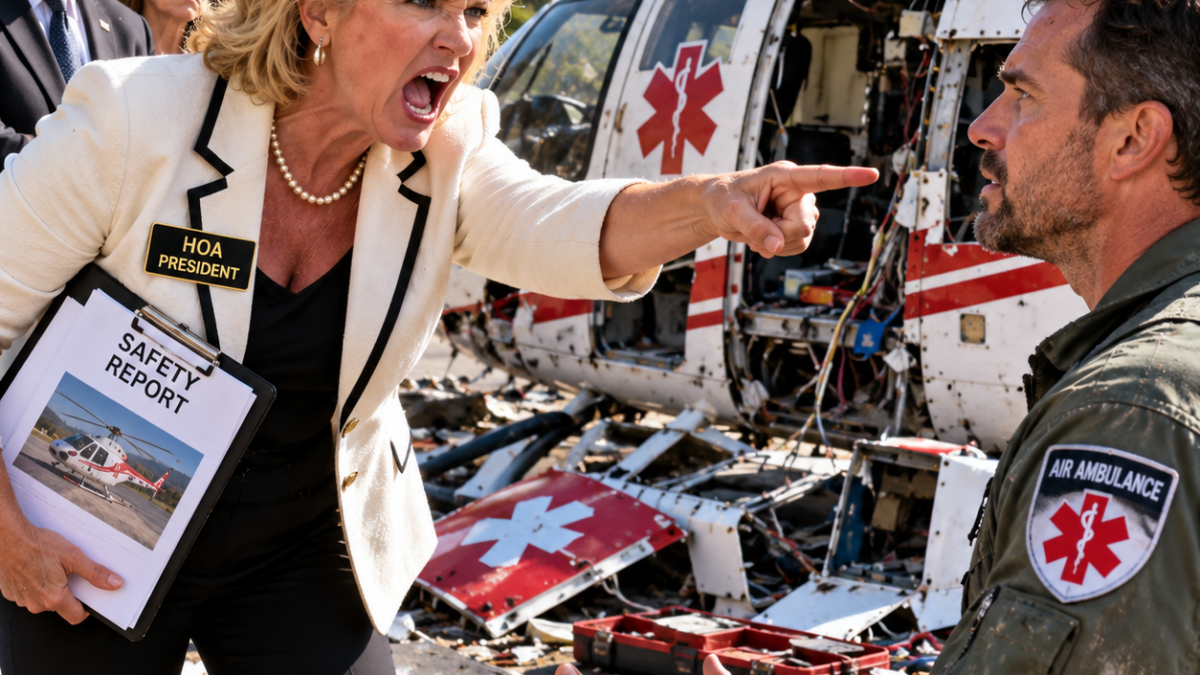
PART 2
I photographed the delivery stub before I touched anything else.
Then I photographed the empty engine mounts.
The severed wing.
The saw blades.
The crew’s tire tracks.
The handwritten work order Vance had left with the deputy.
Years earlier, when I still worked for an insurance engineering firm, I had investigated aircraft losses, hangar collapses, transport damage, and disputed claims.
One habit had survived retirement.
When something looked wrong, document before interpreting.
Assumptions could wait.
Evidence could disappear.
The deputy walked back toward me.
“You know this warehouse?”
“No.”
“Know what the batch number means?”
“Not yet.”
He nodded toward the hangar.
“I’ve stopped them from doing more today. I’m not declaring the HOA liable from your driveway.”
“I understand.”
“Keep everything as-is until you’ve photographed it.”
“I will.”
He looked at Elaine’s report again.
“She’s claiming your own communications established a safety issue.”
“They established a repair issue.”
“Difference?”
“A repair issue means you fix the damaged component before display. It doesn’t mean a neighboring association gets to dismantle the entire aircraft and haul away valuable parts.”
“That sounds like something your attorney should put in writing.”
“I’m already calling her.”
He left me with a report number.
Elaine was still by her car.
“Monday’s property tour is going forward,” she said.
I stared at her.
“You cut apart an airplane my father maintained because tourists might see it?”
“That is not what happened.”
“Then tell me what did.”
“Your refusal to cooperate created a safety problem.”
“My refusal to let you control my property created a problem for you.”
Her jaw tightened.
“The board has obligations to residents.”
“So do I.”
“To whom?”
I looked toward the house.
Nora stood behind the kitchen window holding the little display card against her chest.
“To people who believed this airplane would still be here Monday.”
Elaine glanced toward the window and then back at me.
“You’re emotional.”
“That doesn’t make you authorized.”
She got into her car.
Before closing the door, she said, “Read your own emails.”
Then she drove away.
—
My first call went to Tessa Brooks at North County Heritage Museum.
She was the collections manager who had spent nearly a year coordinating the aircraft donation.
“Anyone hurt?” she asked before anything else.
“No.”
“The students?”
“Shaken. Not hurt.”
“And the airplane?”
I looked through the hangar.
“Bad.”
I sent her photographs.
She went silent for almost a full minute.
Then she said, “We can’t collect it Monday like this.”
“I know.”
“The wing structure needs evaluation.”
“I know.”
“Silas, I’m not trying to pile on.”
“You’re not.”
I looked at the delivery stub.
“There’s something else.”
“What?”
“They removed both propellers and several engine covers before they started cutting.”
“Where are they?”
“That’s what I’m trying to find out.”
I photographed the stub and sent it.
Tessa read the information aloud.
“Warehouse collection. Monday noon.”
“Exactly.”
“We were scheduled to arrive Monday morning.”
“Exactly.”
Another pause.
“That timing is strange.”
“Yes.”
“I’ll call our transport specialist and check the inventory list against what’s missing.”
“Can the museum still take the airplane if we get the parts back?”
“I can’t promise that.”
The answer hurt more than I expected.
I had spent years thinking Monday was the finish line.
Not because the airplane would ever fly.
Because it would finally stop being a half-restored machine in my hangar and become what I believed it deserved to be.
A record.
A piece of local history.
Something children could walk around and understand.
Now even recovering the missing parts might not repair the structural damage.
Tessa softened her voice.
“We’ll assess it properly.”
“I know.”
“Don’t let anyone pressure you into moving it before that.”
“I won’t.”
I hung up.
Then I closed the hangar to visitors.
—
The students were waiting on the porch.
Nora stood first.
“Is Grandpa’s exhibit canceled?”
“I don’t know.”
Her mouth tightened.
“He was coming Monday.”
“I know.”
“He’s been talking about it for months.”
“I know that too.”
Eli asked, “Can we help?”
I almost said no.
Then I remembered what I had spent years teaching them.
Restoration was not pretending damage had never happened.
It was learning exactly what happened, preserving what could be preserved, and refusing to hide what could not.
“We work outside,” I said. “Nobody goes inside the aircraft until an independent specialist clears it.”
They nodded.
We set up folding tables beneath the awning.
Photographs.
Inventory sheets.
Museum tags.
Witness notes.
Nora checked every labeled component.
Eli documented the saw cuts from the doorway.
Ben listed who had been present and when.
The pattern became obvious before dinner.
The wing cuts were crude.
Destructive.
Fast.
But the missing engine covers and propellers had been removed carefully.
Fasteners were bagged.
Mounting surfaces were intact.
Identification tags had been preserved.
That bothered me.
“You see it?” I asked Nora.
She studied the photographs.
“They didn’t take those off like garbage.”
“No.”
“They wanted them usable.”
“That’s the question.”
“Question?”
I looked at her.
“We document what we know. We don’t write the conclusion we want.”
She nodded and changed her note.
Instead of:
**They stole usable parts.**
She wrote:
**Selected removable components appear to have been removed intact before destructive cutting began.**
Better.
At four that afternoon, another document arrived.
Vance emailed an invoice.
**\$18,400.**
Removal.
Transport.
Storage.
Then a final line:
**Estimated salvage proceeds to be credited against total charge.**
I read it twice.
Then called Nora over.
“What does that mean?” she asked.
“It means somebody expects money from our parts.”
I immediately sent written notice to Elaine, Vance, the HOA board, and the warehouse listed on the stub.
I did not consent to sale, disposal, transfer, destruction, or salvage.
All components were my property.
Preserve everything.
No further disposition.
Then I called Ruth Bennett.
She had handled my father’s estate years earlier.
Now she handled the problem that had started with his airplane.
—
Ruth arrived before six.
She wore reading glasses low on her nose and carried a yellow legal pad.
“Start with ownership.”
I gave her the bill of sale.
Then property records.
The museum agreement.
The road-access agreement.
Elaine’s notices.
The demolition report.
The invoice.
The delivery stub.
Ruth spread everything across the dining table.
“Messages too.”
“I have them.”
“All of them.”
“I know.”
“The uncomfortable ones too.”
I looked at her.
She tapped the table.
“If you wrote something that sounds bad out of context, I want it before their lawyer does.”
That took us back six weeks.
I had discovered deterioration in a bracket supporting a cabin display panel.
Nothing dramatic.
No collapsing fuselage.
No falling wing.
But enough that I stopped cabin work.
I emailed Tessa.
I wrote:
**Reinforcement required before interior public display.**
Elaine had been copied because she had demanded documentation before permitting a large museum transport vehicle along the HOA-maintained access road.
Later emails clarified the condition.
Cabin closed.
Student work moved to exterior fittings and lettering.
Repair designed.
Independent review planned.
But the first message alone looked worse.
Ruth leaned back.
“She circulated this?”
“Apparently.”
My phone rang.
A neighbor had forwarded Elaine’s announcement to residents.
I opened it.
Elaine had quoted only my first sentence.
Then added that I had admitted the aircraft was unsafe while continuing to allow children around it.
My hand tightened around the phone.
“That’s dishonest.”
Ruth shook her head.
“Don’t use that word yet.”
“She left out the restrictions.”
“I know.”
“She left out the repair plan.”
“I know.”
“She’s telling people I endangered kids.”
“I know.”
Before I could say more, Ben’s father called.
“Silas, Ben won’t be coming back until this is sorted out.”
“I understand.”
“I’m not accusing you of anything.”
“I can send the complete emails.”
“Maybe later.”
“The cabin was closed.”
“I hear you.”
“You’ve known me twelve years.”
He sighed.
“That’s exactly why I’m calling instead of just disappearing. But an email doesn’t tell me what actually happened in that hangar.”
He was right.
That hurt.
Because he was right.
Intentions were not proof.
I needed records showing what we had actually done.
—
Tessa called again twenty minutes later.
“Elaine contacted the museum director.”
“Of course she did.”
“And one of the exhibit donors.”
I closed my eyes.
“What happens now?”
“Acceptance is suspended pending independent assessment.”
“Until when?”
“Friday at the latest.”
“The airplane was supposed to be there Monday.”
“I know.”
“What about funding?”
“The donor is holding the installation money.”
Elaine had done something more damaging than cut metal.
She had attacked the project’s credibility.
Then another message arrived.
The HOA was restricting heavy collection vehicles from using the shared road until the board reviewed the “hazardous aircraft situation.”
I sent it to Ruth.
“That blocks the museum truck,” I said.
“It may.”
“They maintain the road. They don’t own my access rights.”
“We’ll challenge it.”
“Tonight?”
“No.”
“Ruth—”
“You have two urgent problems.”
I stared at her.
“She gave you two fires because you only have enough time to fight one before Monday.”
She pointed to the delivery stub.
“Parts first.”
I hated that she was right.
—
Elaine’s next email sounded almost helpful.
The HOA would assist in recovering the removed components.
One condition.
I needed to sign a written acknowledgment stating that Friday’s removal had been a necessary safety intervention taken for community protection.
I forwarded it to Ruth.
“Would signing get the parts back?”
“Possibly.”
“They could be sold Monday.”
“I know.”
“If I sign, we get them sooner.”
“Possibly.”
“What am I risking?”
“Your ability to later argue that the cutting itself was unauthorized and wrongful.”
I stared at the document.
The sentence was simple.
**I acknowledge that removal of the aircraft components was reasonably necessary to address an immediate safety condition.**
If I signed, Elaine gained something she did not currently have.
My agreement that she had been justified.
I put the pen down.
“Getting my property back shouldn’t require me to approve its destruction.”
Ruth nodded.
“Then don’t let their deadline make the decision for you.”
At eight that night, Brier Glenn treasurer Julian Marks emailed me.
He had been copied on Vance’s invoice.
His message was cautious.
**Did you authorize any salvage of aircraft components?**
I replied:
**No. I expressly refused permission for removal or sale. Please preserve all board records, invoices, communications, and contractor instructions.**
Julian responded that he would contact association counsel.
He did not accuse Elaine.
He did not promise me victory.
At the time, that frustrated me.
Later I realized it was exactly how a responsible treasurer should have reacted.
He had my allegation.
Not yet the complete evidence.
—
Saturday morning, I returned to the workbench.
Thirty-one years of old investigative habits took over.
Before retirement, I had reconstructed damage events from photographs that were incomplete, badly framed, sometimes misleading, and occasionally supplied by people with reasons to make them misleading.
I could not order the warehouse to return my propellers.
I could reconstruct how they got there.
First I compared the museum’s Thursday photographs to Friday’s damage.
Then I reviewed our security camera footage.
The camera did not cover the entire hangar interior.
It faced the pedestrian door and the main workbench.
I started two days earlier.
Wednesday morning.
Two Keeler employees entered.
Nora was visible beside them.
One carried a tape measure.
The other had a phone camera.
Nora sat next to me.
“They said you approved the inspection.”
“I wasn’t here.”
“I know.”
“Did they say who sent them?”
“Vance.”
“What did they inspect?”
She pointed toward the screen.
“That shelf. The engine covers. Propeller tags. Some fittings.”
“Did they go near the damaged bracket?”
“I don’t think so.”
“You don’t think or they didn’t?”
She swallowed.
“I couldn’t see them the entire time.”
“Good answer.”
She looked ashamed.
“I let them in.”
“They lied about having permission.”
“I should have called.”
“Yes.”
Her eyes dropped.
Then I added, “And next time, you will.”
She looked up.
“This time, the lie belongs to them.”
With her mother present, we wrote down everything Nora remembered.
The video did not prove criminal intent.
It proved Keeler employees had photographed removable components two days before the demolition.
That was enough to start asking better questions.
—
The warehouse confirmed that the batch number belonged to a contractor delivery.
The clerk would not tell me what was inside.
He should not have.
I was a stranger calling with an ownership dispute.
Ruth sent documentation and a formal preservation notice.
Meanwhile, Tessa and I searched aircraft equipment listings.
Propellers.
Engine covers.
Cowling sections.
Historic aircraft fittings.
Most results were useless.
Then Tessa sent me a link.
“Look at the second photo.”
A retired-aircraft dealer had listed a pair of engine covers.
I enlarged the image.
The covers looked like mine.
That alone proved very little.
Then I looked behind them.
The seller’s photograph had been taken inside my hangar.
Both wings were still attached in the background.
Meaning the photograph existed before Friday’s cutting.
Then I noticed a blue mug on my workbench.
Nora’s.
Beside it were lettering stencils.
I called her.
“When did you bring the blue mug?”
“Wednesday.”
“And the stencils?”
“Same day.”
That narrowed the photo window.
Keeler employees had visited Wednesday.
They had photographed removable aircraft components.
By Friday, those same types of components were gone.
The dealer put Ruth in contact with a prospective buyer.
His name was Warren Holt.
He had already paid a deposit.
At first, he refused to send private correspondence.
Reasonable.
He wanted proof we were talking about the same parts.
Nora supplied it.
Inside one engine cover, she had painted a temporary museum inventory code.
The code appeared in the dealer’s photograph.
We sent Warren our original workshop photograph showing the same mark.
He paused the purchase.
Then forwarded his messages.
Vance had promised a signed owner release would accompany collection paperwork.
Warren had asked for it twice.
Both times, Vance said it was coming.
I had signed nothing.
One buyer had stopped.
The larger shipment had not.
The warehouse pickup was still Monday at noon.
—
Ruth began preparing an emergency court application.
“We need something that reaches the identified property,” she explained.
“Not just Elaine?”
“Elaine can promise whatever she wants. I want the warehouse and anyone handling the batch legally notified.”
“Can we get an order before Monday?”
“I’m trying.”
“That isn’t reassuring.”
“Court is not a vending machine, Silas.”
I paced her office.
“They’re moving my property.”
“And we need evidence the court can act on.”
“What else do you need?”
“Authority. The supposed safety report. Who ordered destruction. Who authorized sale. We keep those questions separate.”
That afternoon, I finally reached Martin Heller.
His name appeared on Elaine’s safety report.
He was a structural consultant.
“Did you inspect my airplane?”
“No.”
“Did anyone from your office?”
“I performed a photographic desk review for Keeler.”
“Did you recommend immediate demolition?”
A pause.
“Send me the document you’re reading.”
I did.
He called back twenty minutes later.
“That recommendation does not sound like my wording.”
“Was it yours?”
“I need to compare it against the issued file.”
“When?”
“Monday morning.”
“They’re shipping parts Monday at noon.”
“I understand.”
“Then check it today.”
“I am not going to certify a comparison from memory.”
I gripped the phone.
“My property is disappearing.”
“And if I make an unsupported statement because you’re under pressure, I help nobody.”
I hated the answer.
I respected it.
Heller did send one thing immediately.
His signed assignment agreement.
It described:
**Photographic desk review only.**
No site inspection.
No supervision of removal.
No demolition authority.
That was our first independent break in Elaine’s version of a professionally inspected emergency.
—
Sunday morning, Sophia Hart arrived.
She was the museum’s independent aircraft-conservation adviser.
She had reviewed the planned exhibit before the destruction.
I gave her everything.
Including the emails Elaine had circulated.
Including the damaged bracket.
Sophia examined it.
“You were right to stop cabin work.”
“Was it dangerous?”
“It required reinforcement.”
“That wasn’t my question.”
She looked at me.
“It was not something I would have allowed visitors to lean against in its existing condition.”
“Students?”
“Not in the affected cabin area.”
“They weren’t working there.”
“Show me.”
I produced our task sheets.
Photos.
Sign-in logs.
Cabin closure note.
The students had worked on detached fittings at the bench.
Exterior lettering.
Inventory tags.
The cabin door had been secured.
Sophia checked the records against the physical setup.
Then she moved to the saw damage.
Her expression changed.
“This is worse.”
“How much worse?”
“I need measurements.”
“Can it be repaired?”
“Possibly.”
“For the museum?”
“Possibly.”
I hated that word.
She continued.
“Silas, restoration is one question. Economical restoration is another.”
There it was.
Economical.
The word I had been avoiding.
Even if we recovered every propeller, cover, trim panel, and label, the wing damage might make the project too expensive to complete.
Sophia documented what she could.
Her preliminary findings went to the museum.
The museum reconsidered the safety allegation concerning the workshop.
But exhibit funding remained frozen until the damaged aircraft could be evaluated.
We had cleared one accusation.
The future of the airplane remained uncertain.
—
Elaine responded by shifting tactics.
She emailed residents and the museum board again.
This time, she focused on my career.
She described my background in insurance investigations as experience “defending disputed claims.”
I almost admired the construction of that sentence.
It made expertise sound suspicious without accusing me of anything specific.
Then Julian sent me the agenda for Tuesday’s HOA meeting.
Elaine wanted the board to retroactively approve Friday’s removal.
She also wanted permission to apply salvage proceeds against Vance’s \$18,400 invoice.
Julian refused to approve payment before supporting documents were reviewed.
But several directors still believed Elaine had acted under professional safety advice.
Ruth read the agenda.
“She has changed the argument.”
“How?”
“She no longer needs every fact in the report to be correct.”
“She needs the emergency to be real.”
“Exactly.”
She wrote three questions on a legal pad.
**1. What condition existed?**
**2. What action was authorized?**
**3. Who consented to disposal?**
“Keep these separate,” she said. “A bad bracket does not automatically authorize a saw. A safety concern does not automatically authorize sale.”
That afternoon, I found Nora sitting outside the hangar with the old aircraft logbook.
Her grandfather’s flight was near the middle.
Remote departure.
Broken pelvis.
Hospital transfer.
She ran her finger down the handwritten line.
“He wanted to thank your dad.”
“My father would’ve hated that.”
“Why?”
“He never liked being thanked for doing his job.”
Nora smiled faintly.
Then she asked, “What if the museum doesn’t take it?”
I sat beside her.
“Sophia doesn’t know yet.”
“Then we save the log too.”
I looked at her.
“The metal isn’t the only history.”
She was right.
We scanned the log that afternoon.
Whatever happened to the aircraft, that record would survive.
—
That evening, I returned to Elaine’s safety report.
Not the language.
The photograph.
The one showing the dramatic crack.
The image had been tightly cropped.
A damaged support filled most of the frame.
Three scratches ran beside it.
Near the bottom edge was a small orange crescent.
I stared at it.
Orange inspection light.
Maybe.
Thousands of people used orange work lights.
That meant nothing.
But the scratches bothered me.
The framing bothered me.
I had seen photographs like this for decades.
Then a memory surfaced.
Not of my hangar.
A training seminar.
Insurance engineers.
Structural failure examples.
I contacted the archive manager at my former firm.
I did not ask for confidential claim material.
I asked whether they had publicly released training images matching my sketch and approximate time period.
I sent the cropped photograph.
Then I went to bed.
I barely slept.
—
Monday at 7:40 a.m., Ruth called.
“Heller found his issued report.”
I sat up.
“And?”
“Elaine’s copy was altered.”
I swung my feet to the floor.
“How?”
“The recommendation language was changed. His original called for onsite inspection before action.”
“What else?”
“His warning that source images had not been independently verified is missing from Elaine’s version.”
“Can he prove it?”
“He sent a signed comparison and archive metadata.”
“Does he know who changed it?”
“No.”
That mattered.
We had proof the report Elaine circulated was not the issued report.
We did not yet have proof of who altered it.
At 8:12, another email arrived.
My former firm’s archive manager.
Subject:
**PUBLIC TRAINING IMAGE — MATCH FOUND**
I opened the attachment.
Full photograph.
For several seconds I simply stared.
There was the cracked support.
The scratches.
The same angle.
The orange crescent was no longer a crescent.
It was an inspection light.
My inspection light.
Then I saw what Elaine’s cropped version had removed.
An aircraft identification plate.
Different serial number.
Different model.
Different airplane.
I had taken the original photograph fourteen years earlier during an unrelated investigation.
The image had later been cleared for use in a public training handout.
I had not recognized a defect on my aircraft.
I had recognized the edge of my own photograph.
My own light.
My own framing.
My own scratches.
I called Ruth.
“Open your email.”
“What am I looking at?”
“The full source photograph.”
Silence.
Then:
“Oh.”
“That crack isn’t mine.”
“I see that.”
“It’s not even the same aircraft.”
“I see that too.”
Sophia independently compared the identifiers.
Heller confirmed the cropped version was among the files Vance had supplied for his desk review.
Now the comparison was reproducible.
Not my memory.
Not my accusation.
Anyone could place the two images side by side and see exactly what had been removed.
And we had less than four hours before the warehouse collection.
—
Ruth submitted the new evidence immediately.
Ownership records.
Inventory.
Delivery stub.
Seller correspondence.
Warren’s messages.
The report comparison.
The authenticated training image.
Tessa and I drove to the warehouse.
We brought papers.
No trailer.
No bolt cutters.
No dramatic plan.
Through the office window, I could see a covered pallet beside the loading area.
One padded engine cover protruded slightly.
Along its edge was a stripe of paint.
Nora’s paint.
I gave the clerk our documents.
He checked the batch number.
“It matches.”
“Can I inspect it?”
“No.”
“Those are my parts.”
“I understand what you’re saying.”
“Then don’t load them.”
“We have a collection instruction from our customer.”
“And a dispute notice from my lawyer.”
“Our manager is getting advice.”
He was doing exactly what he should.
That did not make waiting easier.
At 10:40, my phone rang.
Vance.
“I can stop the shipment.”
“Then stop it.”
“If you sign the HOA acknowledgment.”
I looked through the glass at the pallet.
“You still want me to say the demolition was necessary.”
“It was.”
“Then you don’t need my signature.”
“You want your parts or not?”
“Send the proposal to Ruth.”
“Your lawyer is costing you time.”
“Then send it quickly.”
He hung up.
I stood there staring at the warehouse clock.
Eleven.
Eleven fifteen.
A carrier arrived.
Loading bay door opened.
A worker moved pallets toward the dock.
Tessa’s phone rang.
The museum director.
“Anything?”
“Not yet.”
At 11:36, Ruth called.
“We have a temporary preservation order.”
I closed my eyes.
“Does the warehouse have it?”
“Not yet. Service is being transmitted.”
That distinction mattered.
Knowing an order existed did not mean the warehouse had received it.
I stayed where the manager had told me.
No touching the pallet.
No blocking the dock.
No argument.
The manager’s phone rang.
He opened an email.
Read.
Compared the inventory schedule to the batch sheet.
Then walked into the loading area.
“Hold that batch.”
The worker stopped.
The carrier took other loads.
The truck left.
My aircraft parts remained inside.
Tessa sat down hard in a plastic chair.
I had not noticed she had been standing nearly an hour.
The order preserved the property.
It did not return it.
But for the first time all weekend, the deadline stopped moving toward us.
—
The warehouse produced its intake paperwork that afternoon.
The load description read:
**OWNER-APPROVED SALVAGE.**
The signature space for the owner release was blank.
Vance immediately said Elaine had authorized disposal.
Elaine said any sale beyond emergency removal was Vance’s decision.
Julian requested the full correspondence.
The conflict that had started in my hangar was now moving inside the HOA itself.
Association counsel reviewed minutes, contracts, emails, and payment records.
Julian called Ruth Monday night.
“The board authorized an assessment of the aircraft situation.”
“Did it authorize demolition?”
“No.”
“Cutting?”
“No.”
“Sale?”
“No.”
“Salvage credit?”
“No.”
Then he said something more important.
“There’s a contractor message I want counsel to review before tomorrow.”
“What does it say?”
“I’ll let the records speak.”
—
Tuesday’s meeting was packed.
Elaine sat at the front.
Vance sat with his lawyer several chairs away.
Julian had a laptop connected to the projector.
Residents filled every row.
Some had seen Elaine’s emails.
Some had seen my photographs.
Most knew only that an HOA contractor had cut apart an aircraft and that lawyers were now involved.
Elaine opened first.
She described a difficult safety decision.
A deteriorating aircraft.
An uncooperative owner.
Professional concern.
Children working nearby.
She said she had acted to protect residents and that any contractor mishandling of disposal should be evaluated separately.
Julian did not allow a retroactive approval vote.
“Not until the supporting records are heard.”
Heller spoke by video.
He explained his assignment.
Desk review.
No site visit.
No supervision.
No authorization to demolish.
Then he displayed his issued report beside Elaine’s copy.
The differences appeared on the screen.
His warning about unverified image sources had disappeared.
His recommendation for an on-site inspection had been replaced by stronger emergency-removal language.
Elaine interrupted.
“I relied on the version supplied to the association.”
Heller remained calm.
“That version is not the report my office issued.”
Then Sophia presented.
She confirmed the real bracket defect.
She also confirmed the cabin had been restricted.
Student work records were consistent with that restriction.
She described the new structural damage caused by the saw.
Finally, she displayed two photographs.
Elaine’s cropped crack image.
And my full fourteen-year-old training photograph.
Different identification plate.
Different aircraft.
Same scratch pattern.
Same lighting.
Same orange inspection lamp.
The room went quiet.
I watched Elaine.
She stared at the screen for several seconds.
Then she turned toward me.
“You admitted there was a defective bracket.”
“Yes.”
“You knew the airplane was unfinished.”
“Yes.”
“You knew it presented hazards.”
“I knew one bracket required reinforcement. That is why the cabin was closed and the repair was scheduled.”
Sophia confirmed it.
Elaine leaned back.
Her argument had narrowed.
But it had not disappeared.
“I did not instruct anyone to sell Mr. Reed’s property.”
Julian looked at the screen.
“Then we need to discuss this.”
He opened an email.
Sender:
**Vance Keeler.**
Thursday afternoon.
Before the cutting crew arrived.
Vance had written:
**Owner has not signed salvage release. Do you want us to proceed with recovery and disposal?**
Elaine’s reply appeared beneath it.
**He has refused permission. Proceed under the safety report. Credit the parts against removal cost. Complete before the property tour.**
Nobody spoke.
Not even Elaine.
The sentence contained everything.
My refusal.
Her knowledge of it.
Her instruction to proceed.
The salvage credit.
And the deadline.
Vance’s lawyer whispered something urgently to him.
Elaine turned toward Vance.
“You told us your company could manage the removal legally.”
Vance leaned toward his microphone.
“We relied on HOA authorization.”
“You were the contractor.”
“You were the client.”
Both lawyers spoke at nearly the same time.
“Stop.”
Elaine’s lawyer placed a hand over the microphone.
Association counsel stood.
“The record will reflect that neither party should continue addressing potential liability in an open meeting without advice.”
For months, Elaine had used certainty like a weapon.
Property concerns became nuisance complaints.
Repair language became danger.
My objection became obstruction.
Now her own words were on the wall behind her.
Written when she knew I had refused permission.
The board voted against retroactive approval.
It withheld the \$18,400 invoice.
It directed independent counsel to resolve the property claim.
And the vice president assumed chairing duties for the remainder of the meeting.
Elaine’s removal as president followed through the association’s formal process afterward.
No dramatic gavel.
No crowd chanting.
No instant punishment.
Just authority being taken away document by document.
—
Outside the clubhouse, someone called my name.
Ben’s father.
He approached carefully.
“I saw Sophia’s findings.”
I nodded.
“And the work logs.”
“Yes.”
“I owe you an apology.”
“You were protecting your son.”
“I also believed an incomplete story.”
“Both things can be true.”
He looked toward the parking lot.
“When the workshop is cleared to reopen, let us know.”
That was the first thing all day that made me smile.
“I will.”
—
The aircraft components came back through a documented return agreement.
No midnight rescue.
No triumphant warehouse confrontation.
Inventory first.
Chain of custody.
Condition records.
Nora checked her stenciled markings against her notebook.
Eli checked tags.
Ben returned and documented the unloading.
One trim component had been damaged beyond reuse.
One propeller needed additional inspection.
The engine covers survived.
The wing damage remained severe.
We wrote all of it down.
No pretending that return meant restoration.
The civil claim took months.
The final settlement removed the disputed demolition invoice.
It funded documented repair costs, disruption losses, and necessary professional inspections.
The future road-access language was clarified so the HOA’s maintenance role could not be repackaged as control over my parcel.
The altered safety report and sale records also went to the appropriate investigators.
That process followed its own timeline.
I was not entitled to manufacture an ending for it.
My concern was the airplane.
—
Specialists rebuilt the damaged sections for static display.
Not perfectly.
That became important to me.
One cut section was intentionally preserved rather than hidden.
Sophia reviewed each structural repair.
Museum conservators documented what was original, what was restored, and what had been replaced.
The students returned when their work areas were cleared.
Nora finished lettering.
Eli restored fittings.
Ben helped rebuild the exhibit inventory.
The project moved slower than before.
But it moved.
Seven months after the morning I found the wing in the grass, the transport truck finally came through my gate.
This time, every document was correct.
Every component was listed.
Every person knew where the airplane was going.
I stood beside the road as the truck carried it away.
The hangar felt enormous afterward.
Empty.
For twenty-two years, the aircraft had occupied that space physically.
For longer than that, it had occupied part of my family.
My father had kept it flying when it was still transporting injured people out of places where road ambulances could not reach quickly.
I had preserved it after flight was no longer practical.
Now the museum would preserve what came next.
—
Opening day arrived on a cold morning.
Nora met me near the entrance.
Her grandfather was with her.
He walked slowly with a cane.
She had not told him every detail of what happened.
Only that the project had been delayed.
When we reached the aircraft, he stopped.
The museum had positioned it beneath soft overhead lighting.
The restored wing looked good.
Not invisible.
Good.
The display did not pretend the damage had never occurred.
Beside the aircraft was a panel describing its medical-service history.
Another explained the restoration.
One preserved cut section showed the later damage and repair.
But Nora was watching only her grandfather.
She led him to the cabin door.
The little display card she had been holding the morning of the demolition was mounted beside it.
His name.
The date.
Remote pickup point.
Hospital destination.
He stared at it.
Then touched the lettering.
“You made this?”
Nora nodded.
He looked at her.
Then through the open cabin door.
“I remember this airplane.”
Her eyes filled.
“I know.”
He touched the doorframe.
“I thought I was going to die before we got to the hospital.”
Nora said nothing.
Neither did I.
He looked toward me.
“Your father kept these flying, didn’t he?”
“He did.”
“I never thanked him.”
“He wouldn’t have wanted you to.”
That made the old man laugh.
Then Nora showed him the original flight-log entry.
The one we had scanned when none of us knew whether the airplane itself would survive.
He read it slowly.
My father’s handwriting appeared nearby in maintenance records.
He was not there to hear the thanks.
But the work was.
That was enough.
—
After the museum opened, I returned to my property.
The hangar was almost empty.
The marks from the aircraft tires still showed on the floor.
For several days, I kept expecting to see the nose when I opened the door.
Instead there was space.
Nora arrived the following Saturday carrying a fresh notebook.
Eli and Ben were behind her.
Ben pointed toward an old wooden canoe sitting on a trailer outside.
“Is that ours?”
“Project ours,” I said.
The hull was split along one side.
Several ribs were cracked.
The finish was gone.
Nora walked around it.
“What happened?”
“Tree fell on it.”
“Worth fixing?”
“I don’t know.”
She smiled.
“Sounds familiar.”
I handed her a packet of blank inventory tags.
“Where do we start?” she asked.
I looked at the damaged canoe.
Then at the notebook she had opened.
“Before we decide what it needs, we figure out exactly what we have.”
She began numbering components.
I opened the hangar doors wider.
Sunlight spread across the workbench where, months earlier, we had laid out photographs of an airplane someone had tried to turn into salvage.
There were no saws running now.
No HOA folders.
No truck waiting to haul history away.
Just three students, a damaged canoe, clean tags, and a blank page.
Nora wrote the first line.
And we started again.
“And we started again.”
The words sounded simple when I said them.
They weren’t.
Starting again after something has been damaged is different from starting with something untouched. When you begin with a clean project, there is optimism built into every decision. You imagine what the thing might become.
When you begin after destruction, you spend the first few days trying not to compare every new step with what was taken from you.
The canoe helped.
It had no connection to Elaine Porter.
No connection to Brier Glenn.
No lawyers, no invoices, no safety reports, no warehouse batch numbers.
It was simply a sixty-year-old wooden canoe with a split hull and three broken ribs.
Nora placed the first inventory tag beside the bow.
“Number one,” she said.
“Description?”
She looked at the damaged stem.
“Forward stem assembly.”
“Condition?”
“Cracked.”
“Too vague.”
She frowned.
“Longitudinal crack extending approximately fourteen inches from the lower fastener line.”
“Better.”
Eli groaned from behind her.
“You’ve created another Silas.”
“I’m seventeen,” Nora said. “There’s still time to recover.”
Ben laughed.
The sound filled the hangar.
For months, every loud noise inside that building had brought me back to the saw.
That afternoon, laughter finally replaced it.
I didn’t tell them.
Some things feel weaker when you announce them.
We spent the morning documenting the canoe before removing a single screw.
Photographs from every side.
Measurements.
Wood species.
Previous repairs.
Old fasteners.
Water damage.
Paint layers.
Nora wanted to begin sanding immediately.
I stopped her.
“Why?”
“Because you don’t know what you’re sanding off.”
“It’s ugly.”
“So was the airplane.”
She looked toward the empty section of floor where the air ambulance had sat for more than two decades.
For a second, none of us spoke.
Then she lowered the sandpaper.
“Inventory first.”
“Exactly.”
The lesson had become more than workshop procedure.
All four of us knew it.
Brier Glenn changed slowly.
Not dramatically.
Nobody tore down the clubhouse.
Nobody dissolved the HOA.
Most residents still wanted roads maintained, snow cleared, common landscaping handled, and neighborhood rules administered by somebody.
The problem had never been the existence of an association.
The problem was what happened when authority became something people stopped asking to see documented.
After Elaine was removed as president, the vice president served temporarily while the board scheduled an election.
Julian Marks stayed on as treasurer.
He called me about three weeks after the museum opening.
“I wanted you to hear this directly.”
“What?”
“We adopted new contracting rules.”
I leaned against the canoe workbench.
“What kind?”
“No contractor can remove privately owned property based solely on board direction anymore. Counsel has to verify authority in writing.”
“That seems like something you shouldn’t have needed to learn.”
“I agree.”
“What else?”
“Any vendor receiving salvage value from a project has to disclose where the property goes, what it’s worth, and who authorized disposal.”
I looked toward the row of inventory tags Nora had arranged along the bench.
“Good.”
“And safety reports have to be provided in complete form to the board.”
“That should probably have been obvious too.”
Julian sighed.
“You’re enjoying this.”
“A little.”
“I deserve that.”
“No, you don’t.”
He was quiet.
I continued.
“You asked questions when the invoice reached you. You didn’t pretend you knew more than you did.”
“I wish I’d asked sooner.”
“So do I.”
There was no reason to lie to make him feel better.
Then I added, “But sooner and never are different things.”
He thanked me.
Before we hung up, he told me Brier Glenn had hired outside counsel to review older vendor contracts Elaine had approved.
He didn’t give me details.
I didn’t ask.
I had learned something during those months that I wished more angry people understood.
Once evidence enters the proper process, your job is not always to keep touching it.
Sometimes stepping away protects it.
The investigators who received the altered safety report and salvage records continued their work.
I was interviewed twice.
Both times, I answered questions.
I provided originals where requested.
I explained the chronology.
Then I went home.
Nobody called me with dramatic updates.
Nobody said, “We got her.”
Real investigations rarely give victims that kind of theater.
One afternoon, months later, Ruth called.
“There’s movement on the contractor side.”
“What kind?”
“Keeler’s insurer has completed part of its review.”
“And?”
“They’re not accepting the position that the HOA’s instruction automatically insulated Vance from responsibility.”
I sat down.
That mattered.
Vance had spent weeks after the board meeting arguing that he had simply followed a client’s order.
Elaine had argued that she relied on his company to perform legally.
Both versions had the same convenient shape.
Responsibility belonged to the other person.
But contractors have their own duties.
So do clients.
So do board officers.
A bad instruction does not become safe because somebody else carries it out.
A contractor does not become the owner because a customer tells him to act like one.
“What happens now?” I asked.
“Negotiations.”
“Meaning more waiting.”
“Meaning fewer saws.”
That made me laugh.
Ruth rarely made jokes.
Maybe she had been around me too long.
The civil settlement eventually covered the documented damage, professional review, restoration expenses, disruption to the museum project, and certain transport costs.
The $18,400 removal invoice disappeared entirely.
That part gave me a particular satisfaction.
For months, Elaine and Vance had tried to convert the destruction of my property into a debt I supposedly owed them.
Seeing that invoice formally withdrawn felt less like winning money and more like correcting a sentence.
They had not performed a service for me.
I was never going to pay them as if they had.
The museum exhibit developed a life I hadn’t expected.
Originally, the plan was simple.
Air ambulance.
Local medical transport history.
Photographs.
Flight records.
A few oral histories.
After the destruction and restoration, Tessa asked whether we wanted to include that chapter too.
My first answer was no.
“I don’t want Elaine in the exhibit.”
“She doesn’t have to be.”
“I don’t want the HOA in it.”
“Then don’t make it about the HOA.”
“What would it be about?”
“Preservation.”
I looked at her.
She explained.
“Objects survive because people document them. Your students preserved inventory. The warehouse preservation order prevented parts from disappearing. The conservators documented every repair. That belongs to the history of the object.”
I still resisted.
For weeks, the destruction had swallowed everything else.
I didn’t want visitors to stand beside an aircraft that had carried injured people for decades and remember only a neighborhood dispute.
Then Nora surprised me.
“Keep one cut section.”
We were standing in the museum restoration area.
A damaged piece of wing structure rested on a padded table.
“Why?”
“So people can see what happened.”
“That’s exactly what I don’t want dominating the exhibit.”
“It doesn’t have to dominate.”
She touched the edge of the cut metal.
“Grandpa’s trip is still the important part. All the medical flights are. But this happened too.”
I studied her.
Seventeen years old and already better at separating memory from resentment than I was.
“What would you write on the label?”
She thought.
Then said:
“Damaged during unauthorized removal before museum transfer. Preserved as part of the aircraft’s restoration history.”
No names.
No revenge.
No accusations beyond what the records established.
Tessa smiled.
“That’s better than what our exhibit writer drafted.”
Nora looked horrified.
“Do I get paid?”
“No.”
“Then I take it back.”
We kept the section.
Her grandfather returned to the museum several times after opening day.
His name was Harold Mercer.
The first time I met him properly, he shook my hand with both of his.
“I remember your father.”
“So you said.”
“He yelled at me.”
I blinked.
“For what?”
“Trying to get up.”
Nora started laughing.
Harold pointed toward the aircraft.
“I had a broken pelvis and apparently believed I knew more about moving injured patients than everybody around me.”
“That sounds believable.”
“He told me if I wanted to walk again, I should stop trying to prove I already could.”
I could hear my father saying it.
Not elegantly.
Not gently.
Accurately.
Harold stood beside the air ambulance for almost an hour.
He studied the cabin.
The medical fittings.
The photographs.
Then he stopped in front of the log entry bearing his name.
“That handwriting your dad’s?”
“Some of it.”
He leaned closer.
“Funny.”
“What?”
“You spend fifty years remembering the pain. The cold. The noise. Then you see one line in a book and realize for the people saving you, it was Tuesday.”
I had never thought about it that way.
Harold turned to Nora.
“That’s what service usually looks like. Somebody else’s worst day written down as another job completed.”
Nora became quiet.
Later, while driving home, I kept thinking about that sentence.
My father had never described himself as heroic.
Neither had the pilots, nurses, mechanics, or dispatchers whose names appeared throughout the records.
They had done jobs.
The museum was what turned those jobs back into stories.
That was why losing the airplane had hurt so badly.
Elaine had seen an ugly object near expensive homes.
Vance had seen recoverable components and salvage value.
The museum saw evidence.
Nora saw her grandfather’s worst day connected to somebody else’s ordinary workday.
Those were completely different ways of looking at the same metal.
One Saturday, Ben’s father came to the workshop.
His name was Michael.
He stood just inside the hangar while Ben worked on the canoe ribs.
“Can I talk to you?”
“Sure.”
We stepped outside.
He shoved his hands into his coat pockets.
“I’ve been meaning to do this without Ben around.”
“That usually means something bad.”
He smiled awkwardly.
“I’m sorry.”
“You already apologized.”
“Not properly.”
I waited.
“When Elaine sent that email, I believed enough of it to pull him out.”
“You were responsible for your son.”
“I know. But I also knew you.”
“Yes.”
“I should’ve called before deciding.”
“You did call.”
“After deciding.”
That was true.
He looked through the open hangar door.
Ben was showing Eli how to clamp a replacement rib.
“I was scared.”
“That’s allowed.”
“Doesn’t make it fair.”
“No.”
He nodded.
“I appreciate you letting him come back.”
“It wasn’t punishment.”
“I know.”
“If I thought you were wrong to protect your son, I’d be lying.”
Michael looked at me.
“You’re not making this easy.”
“I’m not trying to.”
We stood quietly.
Then he asked the question I think had been bothering him most.
“Were the kids ever in danger before the demolition?”
I answered carefully.
“The cabin bracket needed reinforcement. That is why cabin work stopped. Could somebody have ignored the restriction and gotten hurt? Possibly. That is why we had the restriction.”
“So Elaine wasn’t completely inventing the defect.”
“No.”
“She distorted it.”
“Yes.”
He looked toward Ben again.
“That distinction matters.”
“A lot.”
It was easier to hate people when every sentence they said was false.
Elaine’s most effective arguments had been built around something true.
There had been a defect.
The airplane had been unfinished.
Students had been working in the hangar.
Those facts created emotional weight.
The lie was in what she claimed those facts authorized.
That lesson stayed with all of us.
Especially the students.
Nora graduated from high school the following spring.
Her final school project was about documenting historical objects before restoration.
She used the canoe.
Not the airplane.
I asked why.
“Everybody expects me to use the dramatic story.”
“And?”
“The process should work even when nobody is trying to steal anything.”
I stared at her.
“That is annoyingly wise.”
“I learned from an old man.”
“Which one?”
“Grandpa.”
I threw a shop towel at her.
Her presentation included photographs of damaged wood, inventory tags, moisture readings, fastener maps, and repair decisions.
No dramatic before-and-after reveal until the very end.
When she brought the finished canoe back to the hangar, the three of them stood around it like they had rebuilt a spacecraft.
The hull still showed age.
We had not polished history out of it.
Some dents remained.
A previous repair had been retained because removing it would have destroyed original wood.
One cracked rib was displayed beside the finished canoe with its tag still attached.
Ben ran his hand along the gunwale.
“What’s next?”
I knew that question was coming.
There was always a next project now.
The hangar had changed.
For years, it had been arranged around one aircraft.
One mission.
One endpoint.
After the museum transfer, I had feared the place would become a storage building full of tools I no longer needed.
Instead, the students kept bringing damaged things.
A farm sign.
An old wooden sled.
Two fire-department helmets.
A battered medical chest.
A set of carved church doors damaged by water.
Small history.
Local history.
Things nobody would insure for millions.
Things worth preserving anyway.
I looked at the canoe.
“What do you want next?”
Eli said, “Something mechanical.”
Ben said, “Something we can finish before I’m thirty.”
Nora pointed toward a dusty object beneath a tarp in the corner.
“What’s that?”
I knew what it was.
I had ignored it for years.
We pulled the tarp away.
An old wheeled stretcher.
Aircraft medical equipment.
My father’s handwriting was still visible on a maintenance label.
Nobody spoke for a moment.
Nora looked at me.
“Was this from the air ambulance?”
“Same service. Different aircraft.”
“Can we restore it?”
I touched the cracked leather strap.
“Yes.”
Then I corrected myself.
“We can document it.”
She smiled.
“Inventory first.”
Brier Glenn’s summer property tour returned the following year.
Julian called me before the event.
“You may enjoy this.”
“What?”
“The board removed your hangar from the tour materials.”
“It should never have been in them.”
“I know.”
“And?”
“And there’s a note telling visitors not to enter private property adjoining the subdivision.”
“That is exciting.”
“I thought you’d appreciate it.”
I did.
Not because excluding my hangar was a grand victory.
Because it restored the boundary to something boring.
Boundaries should be boring.
You should not have to stand beside a deputy explaining why somebody else cannot cut your property into pieces.
You should not need emergency court orders to keep components from being sold.
A line on a deed should mostly spend its life unnoticed.
The fact that ours had become boring again felt like success.
During the tour weekend, I worked with the students.
Cars passed along the access road.
People looked toward the hangar.
Nobody entered.
Nobody complained.
Nobody sent me a notice.
By afternoon, I had almost forgotten the tour was happening.
That might have been the most satisfying outcome of all.
Elaine moved away from Brier Glenn eventually.
I learned that through Julian, not because I followed her life.
He mentioned during a call that her house had sold.
I asked no questions.
Months earlier, I would have imagined that news giving me satisfaction.
It didn’t.
She was simply gone.
The board had corrected the access language.
Our settlement was complete.
The museum had the aircraft.
The students had returned.
There was nothing useful left for me in tracking whether Elaine regretted what she had done.
People sometimes asked if she ever apologized.
No.
Not to me.
At least not directly.
For a while, that bothered me.
Then I realized I had been assigning too much importance to something I could never control.
An apology might have been satisfying.
It would not have repaired the wing.
It would not have preserved the warehouse batch.
It would not have restored the museum funding.
Records had done those things.
Actions had done those things.
People willing to check claims had done those things.
I stopped waiting for words.
Vance Keeler never returned to my property.
His company eventually resolved its portion of the claim through counsel and insurance.
One of his former employees—the man who had quietly handed me the delivery stub—came by the museum months later.
I recognized him before he recognized me.
He was standing near the aircraft reading the restoration panel.
“You worked for Keeler,” I said.
He turned.
His face changed.
“Yes.”
“You gave me the stub.”
He looked embarrassed.
“I wasn’t sure I should.”
“I’m glad you did.”
He stared at the cut wing section.
“I thought we were removing junk.”
“Until when?”
He rubbed his jaw.
“When we started bagging hardware.”
That answer interested me.
“What do you mean?”
“Vance told us certain pieces had value. We were supposed to keep them clean.”
“And the wing?”
“Cut it.”
“So that didn’t bother you?”
“It did after a while.”
“But you kept working.”
“Yes.”
No excuse.
Just yes.
He looked at the airplane.
“I’m sorry.”
I nodded.
“Thank you.”
That was all.
He walked away.
I watched him stop near Nora’s grandfather’s display card.
For a moment, he read about a medical flight connected to the same aircraft he had helped damage.
I wondered whether that changed anything for him.
I never asked.
Tessa eventually asked me to volunteer at the museum one day a month.
I refused.
Then accepted two days later.
My first assignment was not with the airplane.
She put me in collections storage.
“You’re punishing me.”
“I’m using you.”
“What’s the difference?”
“Paperwork.”
She handed me a box of unidentified aviation components.
“Figure out what these are.”
I spent six hours reading faded tags and comparing part numbers.
I loved it.
By closing time, we had identified eight of twelve objects.
One belonged to an agricultural aircraft.
Two came from training planes.
Another was part of a radio rack.
History is often less romantic from the back side of a museum.
Dust.
Labels.
Humidity checks.
Database fields.
Condition reports.
That work suited me.
One afternoon, a school group stopped near the air ambulance while I was helping Tessa move equipment.
A boy pointed at the preserved cut section.
“Why didn’t they fix that part?”
The guide answered.
“Because damage can be part of an object’s history too.”
I stopped walking.
That was the argument Tessa and Nora had made months earlier.
Hearing it from someone else made me finally understand.
Preservation was not the same as returning an object to the moment before anything bad happened.
Sometimes that moment was gone.
Preservation meant deciding what could still tell the truth.
Harold’s health declined the following winter.
Nora told me before one of our Saturday sessions.
“He’s back in the hospital.”
“Serious?”
She nodded.
I closed the tool cabinet.
“Do you want to go?”
“I’m going tonight.”
The following week, she returned looking tired.
“He asked about the airplane.”
“What did you tell him?”
“That it’s still there.”
“He like that?”
“Yes.”
She took out her phone.
“He wanted me to show you this.”
It was a photograph.
Harold standing beside the museum aircraft on opening day.
One hand rested near the cabin door.
Nora stood beside him.
On the back of the printed copy she later gave me, he had written:
Made it back to the airplane. This time under better circumstances.
Harold died several weeks later.
Nora missed two workshop Saturdays.
When she returned, she did not want a long conversation about grief.
I understood that.
She walked to the workbench.
Put on her apron.
Opened the stretcher inventory.
I handed her a pencil.
For an hour, we worked quietly.
Then she said, “He was glad the airplane survived.”
“I’m glad he got to see it.”
She tightened a tag around one of the stretcher brackets.
“So am I.”
That was enough.
Grief, I had learned, did not need constant explanation.
Sometimes giving it work to sit beside was useful.
Years earlier, I had believed the air ambulance project belonged to my father.
Then I thought it belonged to me.
By the time it reached the museum, I understood that ownership and stewardship were not the same thing.
I had owned the metal.
My father had cared for it when it flew.
Patients had depended on it.
Students had documented it.
Conservators had rebuilt it.
The museum protected it.
Nora had connected it to her grandfather.
Even the damaged section had become part of what visitors learned from.
The airplane had outgrown my hangar long before the truck finally carried it away.
I just had not realized it.
The empty space helped me understand.
At first, I thought emptiness meant the project was gone.
Instead, the space became available for everything that came after it.
The canoe.
The stretcher.
The doors.
The helmets.
Students.
Neighbors.
Boxes waiting to be identified.
Work without a deadline imposed by somebody else.
That was a better ending than putting another airplane there.
One evening, long after the lawsuits and board meetings had stopped controlling my calendar, I went to the museum alone.
Tessa had asked me to help verify a new label.
The building was almost empty.
A security guard unlocked the aviation gallery.
The air ambulance sat beneath the lights.
I walked around it slowly.
The repaired wing.
The engine covers we nearly lost at the warehouse.
The restored propellers.
The preserved cut section.
Nora’s lettering.
Then I stopped at the cabin door.
Her grandfather’s display card remained there.
I read the date again.
The aircraft had carried a badly injured man to a hospital.
Decades later, his granddaughter had helped preserve the same machine.
None of that had been part of anyone’s plan when the flight happened.
That is the strange thing about records.
You rarely know which ordinary detail will matter later.
A handwritten flight entry.
A workshop photograph.
A blue coffee mug.
A stencil inside an engine cover.
A warehouse batch number.
A contractor email.
A cropped photograph.
An orange inspection light.
At the time, each one looked small.
Together, they had kept a story from being replaced by somebody else’s version.
I stood there until the gallery lights dimmed automatically.
Then I walked outside.
The next Saturday, Nora arrived at the hangar before me.
She was at the bench when I opened the door.
A new object sat between her and Eli.
Small wooden box.
Broken latch.
Water stains.
“What is that?”
She smiled.
“Found it at Grandpa’s house.”
I walked closer.
Inside were old medical papers, photographs, and a faded hospital bracelet.
Nora lifted one photograph.
It showed Harold many years younger.
Standing on crutches.
Beside him was an aircraft.
Not ours.
Another air ambulance from the same regional service.
On the back was a date from weeks after his accident.
“What do you want to do with it?” I asked.
“Document it.”
“Restore the box?”
“Maybe.”
“Donate the papers?”
“Maybe.”
“Then where do we start?”
She gave me the look people give you when you ask a question whose answer they have heard too many times.
“Inventory first.”
I smiled.
“Good.”
She opened a fresh page.
Outside, cars passed occasionally on the road.
Nobody stopped.
No HOA vehicle entered the driveway.
No contractor carried a saw toward the hangar.
No one was waiting with a report telling me what they had decided about my property.
The building was quiet except for pencils, camera shutters, and the scrape of a measuring rule across wood.
Nora numbered the first item.
Eli photographed it.
I wrote the description.
The empty place where the airplane had once stood was no longer empty.
It was simply space.
Space to examine things before changing them.
Space to preserve what remained.
Space to admit damage without letting damage become the entire story.
And whenever someone new came into the workshop and asked how we worked, I gave them the same rule the students had learned the hard way.
Before you cut.
Before you repair.
Before you throw anything away.
Before you trust someone else’s description.
Find out exactly what you’re looking at.
Then write it down.
Only after that do you decide what happens next.
[END OF STORY]








