PART 2: HOA Cut 4 Feet Off My Protected Dune for a Better Ocean View—Then the Storm Track Shifted Toward Us
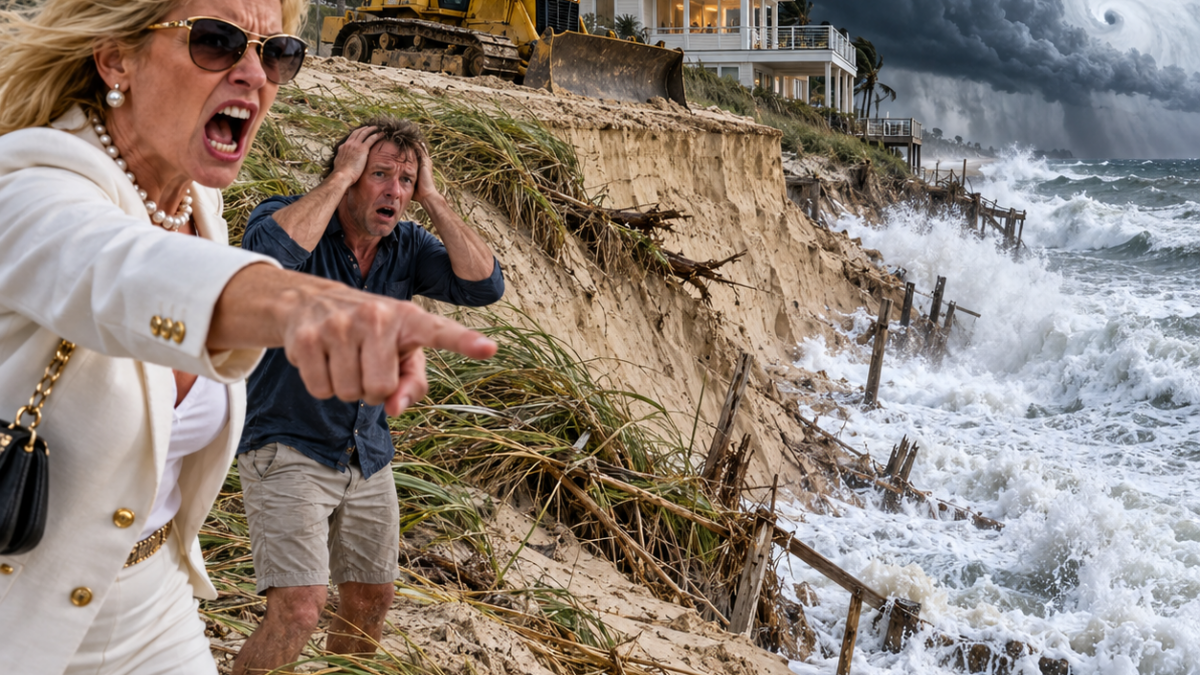
PART 2
I stared at the two maps until the lines stopped looking like lines and started looking like intent.
The concrete monument on my survey sat near the marsh side of the property, half-hidden by wax myrtle and thirty years of salt weather.
I had seen it thousands of times.
The stone entrance column on Miranda’s exhibit was decorative.
It held a bronze plaque with the Ocean Crest name.
It had been installed six years earlier.
No surveyor would confuse the two.
I called the company whose logo appeared in the lower corner of Miranda’s blue exhibit.
A receptionist transferred me twice before I reached a project manager.
I gave him the drawing number.
There was a pause.
“That’s not a survey,” he said.
“What is it?”
“A conceptual landscape exhibit.”
“Does your company certify property boundaries with it?”
“No.”
“There’s a signature.”
“Landscape architect.”
“Not a surveyor?”
“No, sir.”
“Was Ocean Crest told that?”
Another pause.
“The drawing itself says conceptual only.”
I looked at the copy in front of me.
The legend box had been cropped.
Miranda’s version ended exactly where the disclaimer would have appeared.
“Can you send me the full original?”
“I’ll need authorization.”
“Then preserve it.”
His voice changed slightly.
“Why?”
“Because somebody is using it to excavate my land.”
That got his attention.
“I’ll notify legal.”
I hung up and added a line to the yellow legal pad on my workbench.
7:41 P.M. — LANDSCAPE FIRM CONFIRMS BLUE EXHIBIT IS NOT A BOUNDARY SURVEY.
Then I wrote three questions across the top of a clean page.
WHO OWNED THE CUT?
WHO AUTHORIZED IT?
WHAT DID THEY KNOW BEFORE THE MACHINE ARRIVED?
I underlined the third twice.
Anger makes you want to answer every insult.
Evidence makes you choose which questions matter.
That was something my father had understood better than I did.
The workshop still smelled faintly of cedar oil and machine grease. Above the workbench hung a photograph taken after Hurricane Hugo.
I was twenty-seven in it.
Dad stood beside me.
Behind us, the dune looked wounded—half its grass gone, the seaward face chewed back—but our cedar house remained standing.
Two houses farther down Gull Point had been destroyed.
People called us lucky.
Dad hated that word.
“A storm doesn’t decide who prepared,” he told me while we rebuilt the fencing. “People make decisions before the water arrives. The storm just shows everybody what those decisions were.”
For three decades, he repaired that dune.
Not dramatically.
A fence panel here.
Sea oats there.
Sand caught after winter storms and shaped back into the ridge.
He never pretended it was a concrete wall.
It wasn’t.
A dune could erode.
It could overtop.
It could fail.
But it slowed water, absorbed wave energy, trapped debris, and—most important on our stretch of coast—redirected ordinary surge toward the lower undeveloped marsh south of us.
I knew that professionally.
I knew it personally.
And that afternoon I had watched someone cut a seventy-foot shortcut through it.
I took my laser level outside.
The sun was dropping behind the inland pines when I measured the raw excavation.
Six inches of fall from the middle of the cut toward my access lane.
Another nine inches across Sandpiper Lane.
Then the ground dropped toward Ocean Crest’s underground garage ramp.
I checked twice.
Same result.
If enough water crossed the dune, gravity would do the rest.
I set a trail camera on a cedar post facing the opening.
Then I drove to the county records office before closing.
A clerk named Patricia Bellamy pulled my father’s conservation agreement within ten minutes.
The document was older than Ocean Crest.
Older than the HOA.
Older than the road improvements Miranda kept claiming gave her authority over me.
The agreement protected the dune as a coastal buffer.
Routine maintenance was permitted.
Major lowering or removal required approval.
Then Patricia found the original Ocean Crest development plan.
She spread it across the counter.
Across my dune, in block letters, were four words.
EXISTING COASTAL BUFFER — DO NOT DISTURB.
I looked at her.
“When was this accepted?”
She pointed to the stamp.
“Original subdivision approval.”
“So they built Ocean Crest knowing the dune existed.”
“Yes.”
“And knowing it wasn’t theirs.”
She gave me the look clerks develop when they know exactly how much they are allowed to say.
“The recorded documents show what they show.”
“Fair enough.”
She pulled an older hazard map.
It showed storm-flow arrows curving south along the mature ridge toward open marsh.
A second scenario showed what happened if the center section was lowered.
The arrows went across Sandpiper Lane.
Straight toward the future condominium parcel.
I had seen models like it many times in my career.
I had never expected to see one describing my own backyard.
Patricia stamped three certified sets.
“You expecting trouble?”
I looked at the red tropical-disturbance symbol printed on a weather monitor behind her desk.
“I’m hoping paper can stop it.”
She slid the documents toward me.
“Then don’t bring only paper.”
I understood what she meant before I reached home.
My trail camera had recorded an Ocean Crest maintenance worker walking into the excavation at 6:22.
He looked around.
Found an old iron survey stake near the north edge.
Pulled it out.
Carried it to his utility truck.
And threw it into the bed.
I watched the clip twice.
Then a third time.
The man wore an Ocean Crest maintenance shirt.
His face was clear.
So was the truck number.
I copied the video onto my computer.
Now I had a bad map.
A recorded conservation agreement.
A historical development plan.
And video of someone removing a physical marker after the excavation began.
But evidence and enforcement are not the same thing.
That distinction became painfully clear the next morning.
I was walking the beach when Joan Mercer called my name.
Joan lived in the first Ocean Crest house south of the clubhouse. She was a retired school librarian in her seventies and one of those people who remembered exactly what someone said at a meeting twelve years earlier.
She had supported the new condominium.
Most residents had.
Harbor Meridian, the developer, had promised additional dues would help pay for Ocean Crest’s failing clubhouse roof, drainage improvements, and reserves.
Joan held out her phone.
“Is this your picture?”
It was a still from my trail camera.
Someone had already forwarded it around the neighborhood.
“Yes.”
“I know that truck.”
“Maintenance?”
“Frank Dole.”
“You know him?”
“He fixed my irrigation valve last month.”
She looked toward the dune.
“Why would he remove a survey stake?”
“I’d like him to answer that.”
Joan hesitated.
Then she said, “Come with me.”
She led me to her house and returned from a closet carrying a plastic storage box.
Inside were old newsletters, insurance letters, and photographs.
Her late husband had photographed the 1997 nor’easter.
One aerial image stopped me.
The debris line followed the curve of Dad’s dune.
Behind the central ridge, the land where Ocean Crest’s condominium now stood was relatively clean.
South of the dune, debris spread into marsh grass.
Joan tapped the picture.
“Miranda told us that mound had never protected anything.”
“Mound.”
“That’s what she calls it.”
“Words make decisions easier.”
Joan looked at me.
“What do you mean?”
“If she calls it a protected coastal dune, she has to explain why she cut it. If she calls it landscaping, she only has to explain why I’m being difficult.”
She sat down.
“I supported the condominium.”
“I know.”
“My dues are going up every year.”
“I know.”
“If these units sell, the association gets relief.”
“I know that too.”
She looked irritated.
“Stop saying you know.”
I nodded.
“Fair.”
She took a breath.
“If I accuse Miranda and you’re wrong, I still have to live beside these people.”
“Then don’t accuse anybody.”
“What?”
“Keep the original photo. Let the measurements do the accusing.”
That seemed to relieve her.
Not because she trusted Miranda.
Because she didn’t want to choose sides before she had facts.
People later described the neighborhood as if everyone had been blind.
They weren’t.
Most were dealing with mortgages, insurance, aging roofs, medical bills, retirement accounts, and property values.
The condominium promised money.
The dune offered protection from something invisible on a sunny morning.
Miranda understood which one was easier to sell.
That evening I checked offshore conditions.
A tropical disturbance east of the Bahamas had strengthened.
Most model tracks kept it weak and offshore.
One curved toward South Carolina near the weekend’s elevated tide cycle.
It was not a hurricane.
It was not even a tropical storm yet.
I knew better than to exaggerate uncertainty.
Overstating the weather would let Miranda dismiss my entire argument as panic.
So I wrote a short email to the HOA, Harbor Meridian, and county coastal office.
The excavation has created a low channel toward Sandpiper Lane and the Ocean Crest condominium garage. A tropical disturbance is currently being monitored offshore. Regardless of development, temporary stabilization of the cut is advisable until the property, permitting, and coastal-buffer questions are resolved.
Miranda answered fourteen minutes later.
Mr. Voss, please stop using speculative weather events to obstruct a permitted community improvement.
I replied with one sentence.
Please provide the coastal permit number.
She did not.
The next morning, Naomi Price arrived at seven.
Naomi was a licensed surveyor from Charleston County, fifty-three, sunburned, practical, and unimpressed by expensive letterhead.
She set her robotic total station beside the old concrete monument.
“You sure this is the recorded control?”
I handed her the plat.
“I want you to tell me.”
“Good answer.”
For two hours, she worked without talking much.
She shot the monument near the marsh.
Then another reference point near the road.
Then the excavation.
At 9:18, she drove a new capped pin beside the access lane.
She walked thirty yards north and installed another.
Miranda’s flags were nowhere close.
Naomi showed me the screen.
“Deepest portion of the excavation is thirty-eight feet inside your parcel.”
“And their northern flag?”
“Forty-nine feet wrong.”
“They measured from the entrance column.”
Naomi turned and stared toward the decorative stone pillar.
“That?”
“Yes.”
“That’s landscaping.”
“Will you put that in writing?”
“I’ll put it on a signed survey.”
I thought that would stop everything.
I was wrong.
The county coastal office agreed the excavation required review.
But Naomi’s field measurements were preliminary until she signed and sealed the final sheet.
The enforcement officer was covering storm preparations in another district.
Earliest site inspection: next afternoon.
My attorney filed for emergency relief.
The property judge’s docket was full.
Earliest hearing: uncertain.
I called coastal contractors.
The first had already begun moving equipment inland in case the weather developed.
The second required an approved emergency profile.
The third could inspect in five days.
At 6:03 that evening, I drove toward Sandpiper Lane and found a chain stretched across my access.
Two steel posts had been installed.
A sign hung between them.
PRIVATE HOA ROAD
ACCESS SUSPENDED FOR SAFETY
Miranda stood beside it with a private security guard.
I parked.
“You locked my easement.”
“The road is closed because your behavior created a hazard.”
“You excavated the hazard.”
“Counsel can discuss that with counsel.”
“My tractor is behind that chain.”
“Submit a written access request.”
“You know I have a recorded easement.”
She glanced toward the Ocean Crest banner.
“The opening proceeds Friday.”
I could have cut the chain in thirty seconds.
My bolt cutters were in the truck.
For several seconds, I pictured doing it.
Then I noticed Miranda holding her phone.
Camera pointed toward me.
She wanted the photograph.
Angry landowner destroys HOA safety barrier.
It would replace the excavator photographs in every neighborhood email.
I left the chain intact.
That decision cost me more than inconvenience.
A supplier I had contacted earlier arrived forty minutes later carrying geotextile tubes and six pallets of empty sandbags.
Twelve thousand dollars’ worth of stabilization material.
The security guard refused entry.
I walked to the gate.
“He’s delivering to my property.”
“Road closed.”
“Open it.”
Miranda stood on the clubhouse steps.
“Only the board can authorize vehicle access.”
“You’re the board president.”
“Submit a request.”
“When is your next regular meeting?”
“Tuesday.”
The driver waited twenty minutes.
Then his dispatcher called.
Another emergency job had opened farther north.
He left.
I watched the truck disappear.
The wrong map could be corrected.
The illegal fines could be withdrawn.
The road access could eventually be enforced.
But time spent could not be returned.
That was Miranda’s most effective weapon.
Joan saw the truck leave.
That evening she forwarded me an HOA email.
It said I had “rejected board-funded safety materials” and was refusing reasonable cooperation.
I sent her the delivery receipt.
Then a photograph of the locked gate.
Her reply arrived one minute later.
I am done staying quiet.
Outside, high clouds streamed west across the sky.
The disturbance had become a tropical depression.
I walked to the dune as darkness settled.
Near the excavator tracks, I found the other half of Dad’s broken sign.
The words on it read:
THE DUNE IS DOING ITS JOB.
I pressed the two pieces together.
DO NOT DISTURB.
THE DUNE IS DOING ITS JOB.
For the first time since this started, doubt hit harder than anger.
I knew what the elevations meant.
I knew what surge could do.
But knowing something and being able to stop it are different things.
I had a deed.
A conservation agreement.
A correct survey.
Years of experience.
Miranda had machinery, access control, lawyers, and a sales deadline.
The next morning my phone rang.
“Mr. Voss?”
“Yes.”
“This is Evan Rusk with Harbor Meridian.”
The condominium developer.
“I know who you are.”
“We’d like to resolve the access and landscaping dispute without affecting the grand opening.”
“Restore the dune.”
“We can discuss restoration after buyer tours.”
“No.”
“We’re prepared to offer ten thousand dollars for a fourteen-day temporary access license.”
“For what?”
“Visual-corridor use.”
I almost laughed.
“You want me to sign permission after the excavation?”
“We want to resolve an unclear boundary situation.”
“The boundary is not unclear.”
“We’re willing to install new landscaping. Privacy fencing if you prefer.”
“You cut a protective dune.”
“Mr. Voss, with respect, it is not a certified flood barrier.”
“That’s correct.”
He paused, apparently surprised I agreed.
“It’s a dune,” I continued. “Which means it’s one layer of coastal protection. You removed that layer and created a lower path toward your garage.”
“There is no hurricane warning.”
“There’s also no coastal permit.”
His voice lowered.
“If the opening is delayed, people lose money.”
“If the opening fails, people lose more than money.”
I refused the offer.
That afternoon, Luis Ortega came walking down the beach.
No excavator.
No crew.
He carried a manila envelope beneath his jacket.
“I shouldn’t be here.”
“Then I assume whatever’s in that envelope matters.”
He handed it to me.
Inside were printed emails.
Six weeks earlier, Luis had asked Miranda and Harbor Meridian for a certified boundary stakeout before bidding the work.
No answer.
A week later he asked for the coastal disturbance permit.
Miranda replied that the work was routine landscaping on HOA common property.
Then Luis photographed Dad’s DO NOT DISTURB sign and asked again.
Evan responded:
The board accepts responsibility for sight control. Proceed on HOA direction.
I turned another page.
The night before excavation, Luis had sent a final warning.
Tropical development is possible offshore. Recommend delaying excavation until temporary stabilization materials can be staged.
Miranda replied:
Sightline must be open before buyer tours Friday.
I looked at Luis.
“This doesn’t prove she knew a hurricane was coming.”
“No.”
“It proves you warned her about the property line, permit, and weather.”
“Yes.”
“And she ordered you forward.”
“Yes.”
“Why give me this?”
He stared toward the opening.
“I have three kids.”
I waited.
“I can deal with a contract fight,” he said. “I don’t want to spend the rest of my life explaining why I helped create a flood path because somebody needed balcony photographs.”
“Will you tell the county?”
He looked at the envelope.
“If they ask me officially.”
“They’re going to ask.”
“I know.”
The county arrived the next morning.
Enforcement officer Dana Bell brought a coastal engineer and two inspectors.
Naomi met them with her signed survey.
Luis arrived separately in his company truck.
Miranda showed up with an attorney and two board members.
Dana walked the cut from north to south.
She measured exposed root zones.
Elevation loss.
Distance from Naomi’s pins.
Then she turned to Miranda.
“Coastal permit.”
Miranda handed her the blue exhibit.
Dana looked at it.
“This is not a permit.”
“Our counsel considers the work exempt maintenance.”
The coastal engineer pointed toward the seventy-foot opening.
“Maintenance does not remove four feet from a primary dune crest.”
Miranda folded her arms.
“Mr. Voss has exaggerated this mound for years. It’s not a levee.”
“No,” I said.
Everybody looked at me.
“She’s right about that.”
Miranda seemed almost pleased.
I continued.
“A dune is not a concrete flood wall. It will not stop every storm. Coastal protection works in layers—elevation, vegetation, dunes, wetlands, drainage, evacuation. Remove one layer and you increase pressure on the others.”
Dana nodded once.
That was all.
She issued a stop-work order.
Then she ordered temporary stabilization.
The problem was that a government order cannot manufacture time, labor, sand, or equipment.
The approved emergency profile required roughly eighty-four thousand dollars of work and two days under good conditions.
The largest coastal contractor nearby was already repositioning machinery inland.
Ocean Crest’s board called an emergency meeting.
I attended because the stabilization involved my land.
Miranda placed the estimate on the table.
“Eighty-four thousand dollars,” she said. “For sand.”
The coastal engineer answered.
“For material, equipment, labor, engineered profile, erosion controls, transport, and the time you no longer have.”
One board member rubbed his forehead.
“Do we have a second estimate?”
“Not yet,” Miranda said.
Dana looked at him.
“You may seek one. Understand that weather is part of your timeline.”
The board voted three to two to wait.
Joan stared at Miranda.
“You’re delaying this again?”
“I’m protecting owners from an unnecessary expenditure.”
The words had barely left her mouth when phones began sounding around the room.
Mine vibrated on the table.
TROPICAL STORM ARA FORMS EAST OF THE BAHAMAS.
The updated forecast cone widened over South Carolina.
Landfall was uncertain.
Surge effects could begin within forty-eight hours if the western track verified.
A resident near the back raised his hand.
“What about the condominium garage?”
Evan Rusk had joined by video call.
“The building meets required residential finished-floor elevations.”
“That wasn’t my question.”
Silence.
“Is the garage protected?”
Evan adjusted his microphone.
“The garage is a non-residential lower level.”
Again, not an answer.
After the meeting, Dana and I walked across the road.
Behind the Ocean Crest sales office sat a long object wrapped in white plastic.
She pulled back one corner.
Aluminum flood-barrier panels.
Uninstalled.
Mounting plates along the garage ramp were incomplete.
I looked at Evan, who had come outside behind us.
“This is your garage protection?”
“It is scheduled before occupancy.”
“You have buyer tours tomorrow.”
“Buyer tours are not occupancy.”
Technically, he was right.
Water has never respected technical distinctions.
Dana ordered the lower garage closed during any storm warning.
Evan agreed.
That evening Miranda overruled the sales-team recommendation to cancel the preview.
Her neighborhood email described Ara as “a distant developing weather event.”
She accused unnamed individuals of spreading fear to damage property values.
The preview opened the next morning beneath a strange yellow sky.
Luxury SUVs lined Sandpiper Lane.
Sales agents carried white Ocean Crest umbrellas.
A photographer posed a smiling couple on a second-floor balcony.
The newly opened ocean view filled the background.
From the beach, the damage looked exactly like the amenity Miranda had promised.
No grass.
No ridge.
Just horizon.
Joan walked into the sales office carrying the 1997 aerial photograph.
A security guard tried to stop her.
A woman standing near the model units heard the argument.
Her name was Rachel Chen.
She was considering a second-floor unit.
Joan later told me Rachel spent fifteen years adjusting commercial property claims.
That explained what happened next.
“What does the photograph show?” Rachel asked.
Joan put it on the sales desk.
“Storm debris after the ninety-seven nor’easter.”
Rachel studied it.
“And this ridge?”
“The dune they removed this week.”
The sales agent stepped forward.
“There is no safety concern with the property.”
Rachel looked at him.
“Can I see the coastal permit for the dune work?”
“That would be through corporate.”
“Call corporate.”
Miranda entered.
“Is there a problem?”
Rachel pointed through the window toward the wrapped barrier.
“Is that the garage flood protection described in your engineering summary?”
“The residential portions of Ocean Crest meet code,” Evan said.
Rachel looked at him.
“I didn’t ask about the residential floors.”
No answer.
She photographed the wrapped barrier.
Then the mounting plates.
Then Joan’s old aerial photograph.
“I’ll hold my reservation paperwork.”
Two other buyers overheard.
They left too.
For the first time, Miranda’s decision began costing the exact sale it was supposed to protect.
That night, somebody removed Dana’s temporary fencing from the lowest section of the dune cut.
My trail camera recorded it.
2:13 a.m.
An Ocean Crest utility cart arrived.
Frank Dole, the maintenance supervisor, loaded both fence sections and drove away.
Dana questioned him the next morning.
Frank looked miserable.
“Mrs. Vale told me to.”
Miranda was standing ten feet away.
“I told him the site needed to be presentable. He misunderstood.”
Frank pulled out his phone.
“No, ma’am.”
He showed Dana the message.
REMOVE TEMPORARY FENCE BEFORE 6:00 A.M.
PHOTOS MUST SHOW CLEAR OCEAN SIGHTLINE.
Miranda’s face changed.
Only slightly.
But enough.
Dana issued a second violation.
The more important consequence happened inside Ocean Crest.
Board members who had defended Miranda began requesting copies of her emails.
That afternoon, nearly forty residents packed the clubhouse.
Half believed I was protecting their property.
The other half thought I was using the storm to stop a development that might stabilize their finances.
I could feel the hostility when I walked in.
So I did not give them a speech.
I showed four images.
First: Joan’s 1997 aerial photograph.
Second: Naomi’s signed survey, with the cut thirty-eight feet inside my parcel.
Third: an elevation model showing the low path across Sandpiper Lane toward the condominium garage.
Fourth: Miranda’s text ordering emergency fencing removed for photographs.
I stood beside the screen.
“You don’t have to trust me.”
Nobody spoke.
“Trust the elevations. Trust the recorded boundary. Trust the timestamps. Trust her own words.”
A man in the second row raised his hand.
“If we rebuild the dune tonight, are we safe?”
“Safer.”
“Safe?”
“No.”
I let the word sit.
“If anyone promises you a dune makes a coastal property invincible, they’re selling something. I’m saying we removed protection at the exact place the terrain already wants water to go.”
Miranda leaned toward her microphone.
“Mr. Voss is enjoying this.”
That accusation hit me harder than the fines.
I looked around the room.
At older couples.
Families.
People whose cars were parked below grade.
People who had spent retirement savings on homes they expected to keep.
“I have measured mudlines in children’s bedrooms,” I said. “I have watched people stand in houses where every photograph they owned was floating in brown water. There is nothing here I enjoy.”
The room went quiet.
Joan raised her hand.
“I move we fund emergency stabilization tonight.”
A board member seconded.
The vote was four to one.
Miranda voted no.
Luis could supply one loader, a crew of six, biodegradable sand tubes, and temporary fencing.
The county approved a profile that closed the direct center channel first and curved overflow south toward the undeveloped marsh.
Work began with roughly thirty-six hours before forecast landfall.
Residents showed up.
Not everyone.
Enough.
Under portable lights, people filled tubes and carried fencing.
Luis pushed sand in broad lifts.
Naomi checked elevation after each pass.
I used Dad’s old hand level to mark the curve he had maintained for three decades.
A dune looks simple from a distance.
Pile sand high enough and walk away.
That is not how it works.
A straight steep wall erodes quickly.
We needed a wide seaward face.
Compacted layers.
Room for wave energy to spread.
And a lower relief route toward marsh instead of road.
Every foot of height required several feet of base.
The mature crest on each side stood above seven feet.
The excavated section had been taken down nearly four feet.
We marked posts.
FOUR FEET.
FIVE.
FIVE AND A HALF.
Each time the loader backed up, its alarm sounded like a clock.
Joan organized volunteers.
Frank Dole arrived on foot.
He carried posts.
“You don’t have to be here,” I told him.
“Yes, I do.”
He shoved one into the sand.
“Miranda told me the county approved the grading.”
“Did you believe her?”
He pushed harder.
“I believed keeping my job required me to.”
I did not know what to say to that.
At 9:15 p.m., rain began.
At ten, offshore stations recorded tropical-storm gusts.
Luis watched his wind meter.
“When we reach our cutoff, everyone goes.”
“We know.”
“I mean everyone, Caleb.”
“I know.”
At 11:40, a courier appeared with a cease-work letter from Harbor Meridian’s attorney.
Luis shut down the loader immediately.
“What now?”
The letter claimed our emergency equipment had crossed a corner of the condominium parcel.
I almost laughed.
“They excavate thirty-eight feet onto my land and now we’re discussing inches?”
Dana did not laugh.
“Procedure.”
We lost forty-seven minutes while she reviewed the approved emergency plan.
I called Evan.
“Did you request this letter?”
“No.”
“Then who did?”
Silence.
“Evan.”
“I’m looking into it.”
The cease-work letter copied Miranda.
Dana authorized the work to continue under the county’s emergency process.
The loader restarted.
By dawn, we had restored roughly sixty percent of the missing elevation.
It was imperfect.
Fresh sand.
No mature root system.
No decades of compacted growth.
But the straight channel was gone.
The new profile curved south.
Then the loader’s hydraulic hose burst.
Fluid sprayed beneath the machine.
The bucket dropped.
Luis climbed down.
“How bad?”
He looked under the engine compartment.
“Bad enough.”
“Spare?”
“Not this line.”
“How long?”
“Three hours if the parts truck can get here.”
I looked toward the ocean.
The wind was already strengthening.
Every phone on the beach sounded almost simultaneously.
I pulled mine out.
HURRICANE WARNING — GULL POINT INCLUDED.
Ara had strengthened faster than forecast and shifted west.
The county ordered evacuation of the lowest coastal zones.
Ocean Crest was included.
Miranda sent residents an email describing the order as precautionary and saying they should “use personal judgment.”
Dana read it.
Then called her.
She put the phone on speaker.
“This is Dana Bell with county coastal enforcement. Your message is inconsistent with the evacuation order.”
“It says residents should make responsible choices.”
“The responsible choice is to leave.”
“We don’t control individual owners.”
“Then stop giving them language that suggests the order is optional.”
A long pause.
Miranda revised the email.
By noon, Sandpiper Lane was packed with vehicles headed inland.
Luis sent his crew home to their families.
Nobody argued.
Residents left half-filled tubes beside the broken loader.
The dune was unfinished.
And now nobody could safely finish it.
I went home.
Closed hurricane shutters.
Moved documents upstairs.
Backed up every photograph, email, survey, video, and map to three locations.
Then I walked to the dune.
Wind ripped sand from the new crest in thin sheets.
The rebuilt center stood lower than the mature ridge on both sides.
Temporary fencing shuddered.
I carried Dad’s two broken sign pieces with me.
I pressed them together.
DO NOT DISTURB.
THE DUNE IS DOING ITS JOB.
For thirty years, it had done that job quietly.
We had given it less than two days to recover from a machine.
I mounted one camera beneath my roofline.
Another faced the access lane.
Then I drove inland to my sister’s house.
Ara made landfall after midnight as a Category 2 hurricane.
The strongest winds passed south of Gull Point.
That sounded like good news.
It wasn’t enough.
The angle pushed water into the bay.
I sat at my sister’s kitchen table watching tide gauges on a laptop.
The water rose.
Paused.
Rose again.
Storm surge arrived near elevated tide.
At 1:37 a.m., the camera showed water reaching the seaward base of the dune.
At 1:49, waves began cutting into the new sand.
At 2:03, the image shook so badly I had trouble seeing anything.
White water climbed the repaired face.
The first surge overtopped the lowest section.
Water reached my access lane.
But the temporary curve worked.
Most of the flow spread south.
Toward the marsh.
For twelve minutes, our repair held.
Then a second surge arrived.
The center collapsed.
Water crossed Sandpiper Lane in a dark moving sheet.
Sea oats.
Fence boards.
Sand.
Foam.
Debris.
All of it followed the grade we had measured.
Toward Ocean Crest.
My camera microphone captured the sound.
People who have never stood near moving surge imagine one dramatic crash.
It does not always sound like that.
This sounded like grinding.
Water moving timber, shells, sand, fencing, and debris together.
The flow hit the road curb.
Split around a utility box.
Rejoined.
Then accelerated down the garage ramp.
One wrapped flood-barrier panel lifted.
Rotated.
And disappeared into the lower level it had been designed to protect.
For about ninety seconds, the camera recorded something I would later watch with county engineers and insurance investigators.
At the southern portion, where we had restored the curve, water spread wider.
It slowed in marsh grass.
Through the center failure, water remained narrow.
Deeper.
Faster.
That difference mattered.
Not because it proved the dune could have stopped the hurricane.
It could not.
It showed the cut had changed the pathway.
The last clear image was foam pouring down the unfinished garage ramp.
Then the power failed.
We waited for daylight.
Those hours were worse than the storm itself.
You sit inland.
Safe.
Dry.
You know people evacuated.
You know your house is only wood and glass and insurance paperwork.
Still, every sound makes you imagine what is happening where you cannot see.
At sunrise, the county began reopening roads for emergency access.
I drove back as soon as officials allowed.
Sand covered parts of Sandpiper Lane two feet deep.
Tree limbs lay across driveways.
Street signs leaned at odd angles.
The Ocean Crest clubhouse kitchen had flooded.
The pool deck was buried.
The condominium’s residential floors remained dry.
That mattered more than anything else.
Everyone had evacuated.
No one had been trapped.
No one had drowned.
The lower level was different.
Nearly four feet of surge water had entered the garage.
Twelve display vehicles sat in salt water.
Electrical equipment was ruined.
Stacks of flooring and finish materials had floated into walls.
The uninstalled flood barrier lay twisted inside.
My own cedar house had lost shingles and part of the porch railing.
Water reached the bottom step.
It did not enter the living floor.
I walked toward the dune.
North of the cut, the mature ridge was scarred.
Same to the south.
But recognizable.
Behind those intact sections, debris stopped closer to the road.
Behind the center opening, the debris line continued across Sandpiper Lane.
Straight toward the condominium.
Two days later, the county flew a drone.
From above, the damage pattern was unmistakable.
A pale fan of sand and wreckage spread from the seventy-foot cut.
Miranda called the hurricane an unprecedented act of nature.
At the first post-storm board meeting, she stood before residents and said no dune could have prevented the damage.
She was partly right.
That was the problem with good lies.
They often contain one sentence nobody disputes.
When I was given the floor, I said, “No one is claiming the dune could stop a hurricane.”
She crossed her arms.
“Then why are we here?”
“Because that was never the question.”
The county coastal engineer presented his comparison.
Three nearby sections had experienced similar surge.
Behind intact dune sections, water reached the road with less concentrated velocity and debris.
At the lowered center, flow had been concentrated toward the garage.
His written conclusion was careful.
The unauthorized removal materially increased the pathway and severity of flooding at Ocean Crest.
Not caused.
Increased.
The storm caused the surge.
The tide contributed.
The unfinished flood barrier contributed.
The dune removal opened and intensified the route.
That distinction sounded small.
Financially, it was enormous.
The HOA’s insurer requested records.
Harbor Meridian’s carrier requested records.
County investigators requested records.
Board minutes.
Permits.
Surveys.
Contractor emails.
Maintenance logs.
Miranda described the excavation as routine vegetation management.
Luis provided his warning emails.
Frank provided the text ordering temporary fencing removed.
Naomi provided the survey.
Dana provided both violation notices.
I provided the conservation agreement, trail-camera footage, elevation model, and historical maps.
Then Rachel Chen contacted investigators.
The prospective buyer.
She still had the photographs she took during the preview.
Her phone’s metadata showed the date and time.
The flood barrier remained wrapped and uninstalled less than a day before evacuation.
Her sales brochure described garage flood protection as an existing feature.
Not planned.
Not future work.
Existing.
Harbor Meridian blamed a subcontractor.
The subcontractor produced its change-order log.
Installation had been postponed.
Why?
To keep the garage ramp clear for display vehicles during the buyer preview.
No single document solved the case.
That was what people misunderstood later.
There was no magical email that explained everything.
No witness who knew every fact.
Each piece answered one question.
Naomi’s survey answered where.
Luis’s emails answered warning.
Frank’s text answered interference with stabilization.
Rachel’s photographs answered barrier status.
The change orders answered why the barrier was delayed.
The drone footage answered what path the water took.
The conservation agreement answered what protection existed before Ocean Crest.
Together, the pieces were stronger than any dramatic accusation.
Harbor Meridian froze its final payment to the HOA improvement fund.
Three buyers withdrew during their cancellation periods.
The sales campaign stopped.
Miranda responded by proposing an $11,800 special assessment against every Ocean Crest owner.
Her resolution described the losses as an “unforeseeable natural disaster.”
That phrase lasted two days.
Then the board treasurer found the sealed minutes from an executive session six weeks before excavation.
I was not present at that meeting.
I learned what happened when the minutes were later introduced during the insurance review.
The board had discussed my easement.
The missing coastal permit.
Luis’s first warning.
One director had specifically asked who would pay if the boundary claim proved wrong.
According to the minutes, Miranda answered that Harbor Meridian had agreed to indemnify the association.
The treasurer asked to see the executed agreement.
There wasn’t one.
Only a draft.
Evan had sent proposed language.
Nobody from Harbor Meridian had signed it.
Miranda had presented a draft as if it were protection already in force.
That changed the board faster than the hurricane had.
A membership meeting was called.
Every chair filled.
People stood along the walls.
Joan sat in the front row with the old 1997 photograph on her lap.
Miranda wore another scarlet suit.
Maybe even the same one.
She spoke for fifteen minutes.
She blamed abnormal weather.
County delay.
Contractors.
The developer.
Me.
Then Joan made a motion.
“To remove Miranda Vale as president.”
Miranda stared at her.
“You are punishing leadership for a hurricane.”
Joan shook her head.
“No.”
The room became quiet.
“We’re removing you for what you did before it.”
The vote was not close.
Afterward, I walked outside.
Residents were carrying wet records from the clubhouse office.
Miranda came through the door behind me.
“You think you won?”
I looked at her.
“No.”
She seemed surprised.
“Winning would’ve been you reading Naomi’s survey before the excavator arrived.”
Her jaw tightened.
“You wanted this board humiliated.”
“I wanted my dune left alone.”
“You got your property protected.”
“After it flooded your garage.”
She looked toward the damaged condominium.
“You’ve been waiting for years to prove Ocean Crest needed you.”
That one caught me off guard.
Because there was something underneath it.
Fear, maybe.
Pride.
Or simply resentment that a man outside the gate had known something her consultants had not wanted to say.
“I didn’t need you to need me,” I said. “I needed you to believe the elevation.”
She looked away.
For the first time since the excavator arrived, she had no folder.
No security guard.
No machine running behind her.
No polished blue map.
Just wind moving through damaged sea oats.
Four months later, Gull Point looked different.
The dune had been reconstructed with a wider profile.
Harbor Meridian contributed to the work as part of the settlement.
Ocean Crest funded ongoing coastal inspections.
New permanent reference points were recorded beyond the active sand zone so nobody could move one stake and pretend a boundary changed.
The garage flood barrier was finally installed.
The HOA cancelled every fine against me.
The red violation notices disappeared from my workbench.
I kept one.
Not because it mattered legally.
Because I wanted to remember how official nonsense can look when printed on expensive paper.
Luis’s company survived.
He lost the Ocean Crest landscaping contract.
He told me he considered that a benefit.
Frank kept his job under the new board.
The first time I saw him after the settlement, he was replacing fencing along the restored buffer.
He looked at me.
“Straight enough?”
I checked the line.
“Straighter than your old boss’s survey.”
He laughed.
It was the first easy sound I had heard from him in months.
Joan became one of the loudest advocates for formal document review before any future HOA project.
She hated when people called her an activist.
“I’m a librarian,” she told me. “I just want people to read things before voting on them.”
Rachel Chen never bought her Ocean Crest unit.
She sent Joan a short note thanking her for speaking up during the preview.
Another family eventually purchased the unit after the flood barrier and coastal restoration were completed.
My father’s sign took longer.
One half had split along the grain.
The paint was almost gone.
I brought both pieces into the workshop.
Cleaned the salt.
Clamped the wood.
Reinforced the back.
Then I repainted the letters by hand.
DO NOT DISTURB.
THE DUNE IS DOING ITS JOB.
When I carried it outside, Joan happened to be walking along Sandpiper Lane.
She stopped.
“Did the architectural committee approve that?”
I looked at her.
“This property isn’t in your HOA.”
She smiled.
“I know.”
I drove the posts into my side of the boundary.
The restored dune behind it was still young.
Rows of sea oats had not yet filled in.
Fresh fencing caught blowing sand.
It would take years before the ridge looked the way it had before Miranda’s excavator arrived.
Maybe decades.
That bothered me at first.
Then one evening I stood there during a strong northeast wind.
Sand moved across the beach in pale ribbons.
The fencing caught some.
Grass held some.
A little ridge was forming where there had been bare repair sand weeks before.
Nothing dramatic.
Maybe half an inch.
My father would have noticed.
That was how he had built the dune the first time.
Not in one heroic day.
One fence.
One storm.
One planting.
One repair.
Then another.
People later remembered the hurricane because storms are easy to remember.
Wind speeds have numbers.
Flood lines leave stains.
Drone photographs look dramatic.
But Ara did not create the truth of what happened at Gull Point.
The deed existed before the forecast.
The conservation agreement existed before the clouds.
The contractor’s warnings existed before the warning cone.
The correct boundary existed before Miranda planted the first HOA flag.
And gravity existed before anybody sold a million-dollar ocean view.
The hurricane merely put water through the decisions people had already made.
Sometimes I still stand beside Dad’s sign when storms are far offshore.
I look toward Ocean Crest.
Then down the gentle curve of the restored dune toward the marsh.
The view from the condominium balconies is not quite as wide as Miranda wanted.
The ocean disappears behind grass in a few places.
Nobody has asked me to lower it again.
And on Gull Point, that narrower view has become the one almost everybody prefers.
The hurricane did not settle the argument overnight.
If anything, sunrise made everything more complicated.
By eight that morning, photographs of Ocean Crest were already circulating among residents who had evacuated inland. The images showed brown water inside the garage, display cars sitting crooked in saltwater, sand piled against stairwells, and broken fencing tangled around the lower-level columns.
One picture showed the wrapped flood-barrier panel floating against a concrete wall.
Another showed my dune.
Or what remained of it.
The mature sections north and south were scarred and bitten back, but still recognizable. The center section Miranda had ordered lowered looked completely different. The temporary repair had been sliced open again, leaving a broad pale channel stretching from the beach toward Sandpiper Lane.
From ground level, it looked chaotic.
From above, it looked like a diagram.
Two days after the storm, the county drone team flew the entire section of Gull Point.
Dana called me that afternoon.
“You need to see this.”
I met her at the coastal office.
She had the drone image projected on a screen.
The room included the county engineer, Naomi, an insurance representative, and two people I had never met from Harbor Meridian.
Dana pointed toward my parcel.
“Here’s the cut.”
From that point, a fan-shaped trail of debris crossed Sandpiper Lane and narrowed as it approached the garage ramp.
Then she shifted the image south.
Behind the intact dune, water had crossed in patches, but the debris spread wider and lost definition through marsh grass.
The difference was visible even before anyone calculated anything.
The engineer zoomed in.
“Look at the distribution.”
One of the Harbor Meridian representatives leaned forward.
“What exactly are you saying?”
“I’m saying the flow characteristics differ behind the altered dune profile.”
“Differ how?”
He brought up elevation measurements.
“The intact sections forced more lateral spread before water reached the road. The lowered center provided a more direct route toward the garage.”
The representative looked at me.
“So Mr. Voss is claiming the dune would have prevented the flood.”
“No,” I said.
He seemed surprised.
“I’ve never claimed that.”
The engineer nodded.
“That distinction is important. This was a hurricane. Surge would have reached Gull Point regardless. The question is whether alteration of the dune increased the concentration, speed, or volume of water entering this specific location.”
“And did it?”
He looked toward the drone image.
“Our preliminary assessment says yes.”
Nobody spoke for several seconds.
That sentence mattered more than anything dramatic I could have said.
The dune had not caused the storm.
Miranda had not created the tide.
The HOA had not summoned a hurricane by cutting four feet of sand.
But they had removed one protective layer from the exact place where the ground naturally carried water toward the most vulnerable part of the development.
That was enough to change the entire investigation.
Insurance companies became involved almost immediately.
The HOA’s carrier requested every permit associated with the dune work.
There wasn’t one.
Harbor Meridian’s insurer asked for the contractor’s scope.
Luis provided it.
Then they asked for his preconstruction communications.
He provided those too.
The email warning Miranda about property ownership appeared first.
Then his request for a boundary stakeout.
Then the request for a coastal permit.
Then his recommendation to delay work because of offshore tropical development.
And finally Miranda’s answer.
The sightline must be open before buyer tours begin Friday.
I had read the sentence before.
Seeing an insurance attorney read it was different.
She did not react dramatically.
She simply circled the date.
“What time was this sent?”
Luis checked his phone.
“Eight forty-three the evening before excavation.”
“And when did your crew begin?”
“Seven the next morning.”
“So less than eleven hours later.”
“Yes.”
“Did anyone provide the permit you requested during that period?”
“No.”
“Certified survey?”
“No.”
“Emergency stabilization plan?”
“No.”
“Why did you proceed?”
Luis looked down.
“My contract was with the HOA.”
“That wasn’t the question.”
He rubbed both hands over his jeans.
“I proceeded because they told me their lawyers had approved it.”
“Who specifically?”
“Miranda Vale.”
That interview lasted nearly three hours.
When Luis walked outside afterward, I was waiting beside my truck.
He looked exhausted.
“You okay?”
“No.”
I understood.
People had begun treating him as if he had suddenly become one of the heroes in the story.
He wasn’t comfortable with that.
Neither was I.
Luis had operated equipment on my land after recognizing warning signs.
He knew enough to question the work.
He still continued.
The fact that he eventually came forward mattered.
It did not erase what happened before.
“I should’ve stopped the machine that first morning,” he said.
“Yes.”
He looked at me, probably expecting something softer.
I didn’t give it to him.
After a moment, he nodded.
“I know.”
Then he looked toward the coast.
“I kept telling myself it was paperwork. Boundary argument. HOA nonsense.”
“Most disasters look smaller before they happen.”
“My kids saw the flooding on television.”
He swallowed.
“My youngest asked if my excavator made the water go into those houses.”
“What did you tell him?”
“That hurricanes make water move. But I helped make a bad path.”
I nodded.
“That’s probably the right answer.”
Luis never asked me to forgive him.
That made forgiving him easier.
A few days later, another piece of evidence surfaced.
Rachel Chen contacted Joan.
The prospective buyer who had walked away from the Ocean Crest preview had kept everything Harbor Meridian gave her.
Brochures.
Emails.
A digital engineering summary.
Renderings.
Reservation paperwork.
She also had photographs from the morning before evacuation.
One showed the flood barrier still wrapped behind the sales office.
Another showed unfinished mounting plates at the garage entrance.
Her phone stored automatic timestamps.
Less than twenty-four hours before the evacuation order, the barrier had not been installed.
The insurance investigator compared those images to Harbor Meridian’s sales materials.
The brochure described the garage as having “integrated storm-protection barriers.”
Not planned barriers.
Not future barriers.
Integrated.
The difference sounded minor until lawyers became involved.
Harbor Meridian argued the installation belonged to a subcontractor.
The subcontractor responded by producing change-order records.
Installation had originally been scheduled earlier.
Then it was postponed.
The reason was written plainly in the log.
GARAGE RAMP TO REMAIN CLEAR FOR PREVIEW VEHICLE DISPLAY.
When I first heard that, I sat quietly at my kitchen table.
It was the same decision in a different form.
The dune had been lowered for photographs.
The temporary fence had been removed for photographs.
The flood barrier had been delayed so expensive cars could sit where buyers would see them.
Every safety conflict lost whenever it competed against presentation.
That realization bothered me more than Miranda’s insults.
She had not made one terrible decision.
She had built a pattern.
And patterns are what investigators understand best.
The HOA insurer separated wind damage from the disputed flood losses.
The wind claims continued normally.
Roof damage.
Broken windows.
Siding.
Landscaping.
The garage flooding, dune excavation, and related damage went into a separate review.
Residents became furious.
Some directed that anger at Miranda.
Others directed it at me.
One afternoon, a man named Dennis Rowe came to my house.
He lived three streets inside Ocean Crest.
I recognized him from the emergency meeting.
He stood on my porch with his arms folded.
“My insurance adjuster says part of this could take months because of the dune dispute.”
“I’m sorry.”
“Are you?”
“Yes.”
He stared at me.
“You’ve got your house.”
“I lost part of my dune.”
“That’s sand.”
I almost answered too quickly.
Then I stopped.
Dennis wasn’t Miranda.
He was a man with a damaged property and bills arriving.
“What did you lose?”
That caught him off guard.
“My downstairs storage room.”
“What was in it?”
“My wife’s mother’s things. Furniture. Boxes. Photographs.”
“Were they insured?”
“Some.”
He looked toward the ocean.
“My daughter’s wedding dress was down there.”
I said nothing.
His anger changed shape.
“I know Miranda screwed up.”
He rubbed the back of his neck.
“But every lawyer involved means another month before people get paid.”
“I understand.”
“No, you don’t.”
“I’ve spent twenty-seven years walking through homes after floods.”
He looked at me.
“That doesn’t make this easier.”
“No. It doesn’t.”
We stood there quietly.
Then he asked, “If she hadn’t cut the dune, would my storage room be dry?”
“I can’t tell you that.”
“You really don’t know?”
“I know the cut increased the pathway. I cannot honestly tell you the storm would have left your room untouched.”
His shoulders dropped slightly.
“So nobody gets a clean answer.”
“Not if they want a truthful one.”
Dennis left without apologizing.
He didn’t need to.
Two weeks later, he came back with a shovel and helped volunteers replant sea oats.
That was how a lot of relationships changed after the storm.
Not through speeches.
Through people deciding what they would do next.
The biggest financial shock arrived when Harbor Meridian froze its final contribution to the HOA improvement fund.
The board had expected that money to cover clubhouse repairs and reserve shortages.
Without it, Ocean Crest faced a serious gap.
Miranda called an emergency meeting.
Her proposed solution was an $11,800 special assessment per household.
I was not a member, but Joan sent me the resolution.
The document blamed “extraordinary and unforeseeable hurricane impacts.”
She called me fifteen minutes later.
“Unforeseeable?”
“I noticed that word too.”
“She had Luis’s email.”
“Yes.”
“She had the county warning.”
“Yes.”
“She had your letter.”
“Yes.”
“So how is it unforeseeable?”
“Ask your board.”
Joan did.
That question led the treasurer to search records from an executive session held six weeks before the excavation.
The minutes were sealed because they involved legal discussion.
When counsel reviewed them, another problem surfaced.
The board had discussed my access easement.
They had discussed whether the dune sat inside HOA property.
They had discussed Luis’s request for a permit.
One director had asked what happened if the HOA was wrong.
According to the minutes, Miranda told them Harbor Meridian had agreed to indemnify the association against any dispute related to the view corridor.
That sounded comforting.
There was only one problem.
No signed indemnity agreement existed.
Evan Rusk had sent draft language.
Harbor Meridian’s attorneys had never executed it.
Miranda presented a proposed agreement to her own board as completed protection.
The treasurer, Harold Benson, confronted her during a closed session.
I wasn’t there.
Harold later described it during sworn testimony.
“I asked her where the signed agreement was,” he told investigators.
“What did she say?”
“She said Evan had assured her they would stand behind the project.”
“Did you ask again?”
“Yes.”
“And?”
“She said I was getting distracted by paperwork.”
The attorney interviewing him paused.
“What did you say?”
“I told her paperwork is what makes an indemnity agreement exist.”
That sentence eventually spread through Ocean Crest faster than anything I said.
Residents who had defended Miranda began requesting records themselves.
The anger changed.
Before the hurricane, the dispute was me against the HOA president.
After the records surfaced, homeowners realized Miranda had exposed their money too.
She had gambled with land that was not hers using legal protection that did not exist.
Joan helped gather enough signatures for a special membership meeting.
The clubhouse was still being repaired when it happened.
Temporary fans hummed in one corner.
Sections of drywall were missing.
The smell of disinfectant never completely covered the odor of saltwater.
Every chair was occupied.
People lined the walls.
Miranda sat at the front wearing the same kind of scarlet suit she had worn beside my dune.
For a moment I remembered her standing behind the excavator.
Confident.
Clean.
Untouchable.
This time there was no excavator.
No security guard.
No blue landscape map projected behind her.
Just homeowners holding copies of emails.
Miranda spoke first.
She said leaders had to make difficult decisions.
She said nobody could have predicted Ara’s exact track.
That part was true.
She said the hurricane had been unusually destructive.
Also true.
Then she said critics were using hindsight to punish the board for a natural disaster.
Joan stood.
“We aren’t voting on the hurricane.”
Miranda stared at her.
“We’re voting on you.”
The room became completely still.
Joan walked to the microphone.
“You were warned that the land might not belong to us.”
She placed Naomi’s survey on the table.
“You were warned there was no permit.”
She placed Dana’s violation notice beside it.
“You were warned about weather risk.”
Luis’s email went down next.
“You told us the developer had signed an indemnity agreement.”
Finally, she placed the draft.
“No one signed it.”
Miranda pushed back her chair.
“Harbor Meridian made commitments to this community.”
“Then you should have waited until those commitments were written.”
“We were nine days from opening.”
Joan looked around the damaged clubhouse.
“That is exactly the problem.”
The removal vote was not close.
Miranda resigned before the final count was formally entered.
The membership completed the vote anyway.
They wanted the record clear.
When I walked outside afterward, Miranda followed me.
“You’re enjoying this.”
I turned around.
Months earlier, that accusation had made me furious.
This time it just made me tired.
“No.”
“You got everything you wanted.”
I looked through the clubhouse windows.
Residents were stacking wet files into cardboard boxes.
“What I wanted was for you not to cut my land.”
“You think the dune saved you?”
“I think it helped.”
“And the storm still damaged everything.”
“Yes.”
She looked almost relieved.
As if my agreement proved something.
I continued.
“That’s why your decision matters. Protection doesn’t have to be perfect to be worth keeping.”
Her face tightened.
“You’ve spent this whole time making me look reckless.”
“You had the survey warning.”
She said nothing.
“You had Luis’s email.”
Nothing.
“You had no permit.”
Still nothing.
“You removed emergency fencing for photographs.”
Her eyes shifted away.
“And you told your board a draft agreement was signed.”
Finally she looked back at me.
“You have no idea what pressure that development was under.”
That was the first honest thing she had said to me.
“What pressure?”
“Sales targets. The reserve shortfall. The clubhouse roof. Insurance increases. Residents screaming about dues. Harbor Meridian threatening to rethink its contribution if the opening slipped.”
Her voice shook slightly.
“Everybody wanted the money until something went wrong.”
I believed her.
That did not excuse her.
But for the first time, I understood the shape of the trap she had built around herself.
Every delay threatened money.
So she treated every warning as an obstacle.
Survey.
Permit.
Weather.
Contractor.
Me.
Once she made the first bad decision, admitting the second warning would mean admitting the first decision had been wrong.
So she kept going.
“You could have stopped,” I said.
She laughed bitterly.
“When?”
“The first time Luis asked for a survey.”
She looked toward the damaged condominium.
“And told everyone the grand opening was delayed because one man didn’t like his view changing?”
“It wasn’t about my view.”
“I know that now.”
Those four words surprised me.
She seemed surprised too.
Neither of us spoke for a moment.
Then she walked toward the parking lot.
That was the last private conversation I ever had with Miranda Vale.
There were no handcuffs.
No dramatic courtroom confession.
No television crew waiting outside.
The county issued civil penalties tied to the unauthorized disturbance.
The altered work became part of insurance and civil litigation between the HOA, developer, and contractors.
Miranda lost her board position and was no longer authorized to act for Ocean Crest.
That consequence was less theatrical than prison.
It was also real.
The people she had controlled through procedure stopped trusting her with procedure.
Four months after Ara, restoration finally began in full.
This time, nobody arrived with a decorative map.
Naomi’s survey pins controlled the boundary.
The county engineer approved the dune profile.
Harbor Meridian contributed to the cost.
Ocean Crest paid part.
My insurer covered damage specific to my structures.
Responsibility was divided instead of magically placed on one person.
That was frustrating to some residents.
Reality usually is.
The reconstructed dune was wider than before at the base.
Crews installed sand fencing in staggered rows.
Native sea oats went in by hand.
The county placed new permanent survey references farther inland where shifting beach sand could not confuse them.
Ocean Crest received no ownership interest.
No visual corridor.
No right to lower the dune.
The garage flood barrier was finally installed and inspected.
During the inspection, I watched workers slide the panels into place.
Evan Rusk stood nearby.
“You want to say it?” he asked.
“Say what?”
“That you told us so.”
“No.”
“Why not?”
“Because I told you before the storm. Saying it afterward doesn’t protect anything.”
He nodded.
Harbor Meridian eventually restarted sales.
The brochures changed.
The phrase “unobstructed ocean panorama” disappeared.
So did the claim that the garage protection was already integrated before installation.
New buyers received updated flood-zone documents.
Ocean Crest’s prices didn’t collapse.
The development didn’t disappear.
Life was less dramatic than that.
People still wanted to live near the ocean.
They simply received more honest paperwork.
Luis returned once the heavy restoration was finished.
He brought three workers.
They helped replace the old fence line.
When the work was done, he walked over to my truck.
“I kept wondering whether your dad would’ve hated me.”
I looked toward the restored dune.
“He probably would’ve yelled at you.”
Luis laughed.
“That sounds fair.”
“Then he would’ve put you to work fixing it.”
His smile faded into something quieter.
“I can live with that.”
Frank Dole kept his maintenance job under the new HOA board.
The first project Joan assigned him was maintaining the coastal fencing.
I found him one morning driving posts along the restored dune.
He stopped when he saw me.
“Before you say anything, I checked the survey.”
I looked at the line.
“Twice?”
“Three times.”
“Then we’re improving.”
He grinned.
Joan became the board secretary.
She refused every suggestion that she run for president.
“No,” she told me. “Presidents start believing people listen because they’re brilliant.”
“What does a secretary believe?”
“That someone has to keep the minutes.”
That suited her.
One afternoon, she brought me a cardboard box.
Inside were my cancelled HOA fines.
All of them stamped VOID.
“You keeping these?”
I asked.
“One copy for the records.”
I took the red notice Miranda had handed me beside the excavator.
The paper was creased and sand-stained.
“I’m keeping this one.”
“Sentimental?”
“Educational.”
I pinned it above my workbench.
Right beside Dad’s repaired sign.
Repairing the sign took longer than I expected.
Salt had opened the grain.
The excavator had split one board diagonally.
I cleaned both pieces, reinforced the back with cedar strips, and repainted the letters slowly.
DO NOT DISTURB.
THE DUNE IS DOING ITS JOB.
When I carried it outside, Joan was walking along Sandpiper Lane.
She stopped.
“You get architectural approval for that?”
I looked at her.
“My land isn’t in your HOA.”
She smiled.
“I know.”
I planted the posts inside my surveyed boundary.
The restored dune behind it looked young.
That was the only word for it.
The mature grass my father planted had taken decades to establish.
The new sea oats were thin.
Sand fencing showed through everywhere.
Parts of the profile looked almost artificial.
For weeks, I hated that.
I wanted the old dune back immediately.
But coastal land does not care what people want immediately.
Restoration works on the same schedule as damage in reverse.
Wind moves sand.
Grass traps it.
Roots hold it.
Another storm rearranges it.
You repair again.
One evening in late fall, I stood beside Dad’s sign during a northeast wind.
Fine sand moved across the beach.
Most of it passed around my boots.
Some struck the fence.
Dropped.
Collected.
Maybe half an inch had formed along one section.
Almost nothing.
I smiled anyway.
That was how Dad had built the old ridge.
Not in one grand project.
A little sand.
A fence.
A planting.
A storm.
Then another repair.
For years, I had thought the lesson he left me was about hurricanes.
It wasn’t.
It was about preparation that nobody notices while it is working.
A dune is easy to call ugly when the sky is blue.
A permit is easy to call paperwork when the excavator is already running.
A boundary monument is easy to ignore when a decorative column produces the answer you want.
A contractor’s warning is easy to dismiss when buyers arrive Friday.
Everything looks unnecessary until the moment it becomes the only thing separating inconvenience from disaster.
Ara did not create the truth at Gull Point.
The hurricane only made the truth visible.
The property line existed before the first cloud formed.
The conservation agreement existed before Ocean Crest.
Luis’s warnings existed before the forecast shifted.
The elevation toward the garage existed before Miranda ordered the first bucket lowered.
And my father’s dune had been doing its job long before anyone decided an ocean view was worth more without it.
Ocean Crest still has beautiful balconies.
People still stand on them at sunset.
From some angles, the restored dune blocks the bottom strip of water.
Nobody has complained to me.
Not once.
The view is narrower now.
But every time I walk past Dad’s repaired sign and see new grass holding new sand against the wind, I think that may be the most valuable four feet anyone on Gull Point can no longer see over.
[END OF STORY]








