PART 2: HOA Crushed My Working Snowplows and Billed Me—Five Days Later, Their Mountain Road Disappeared Under Snow
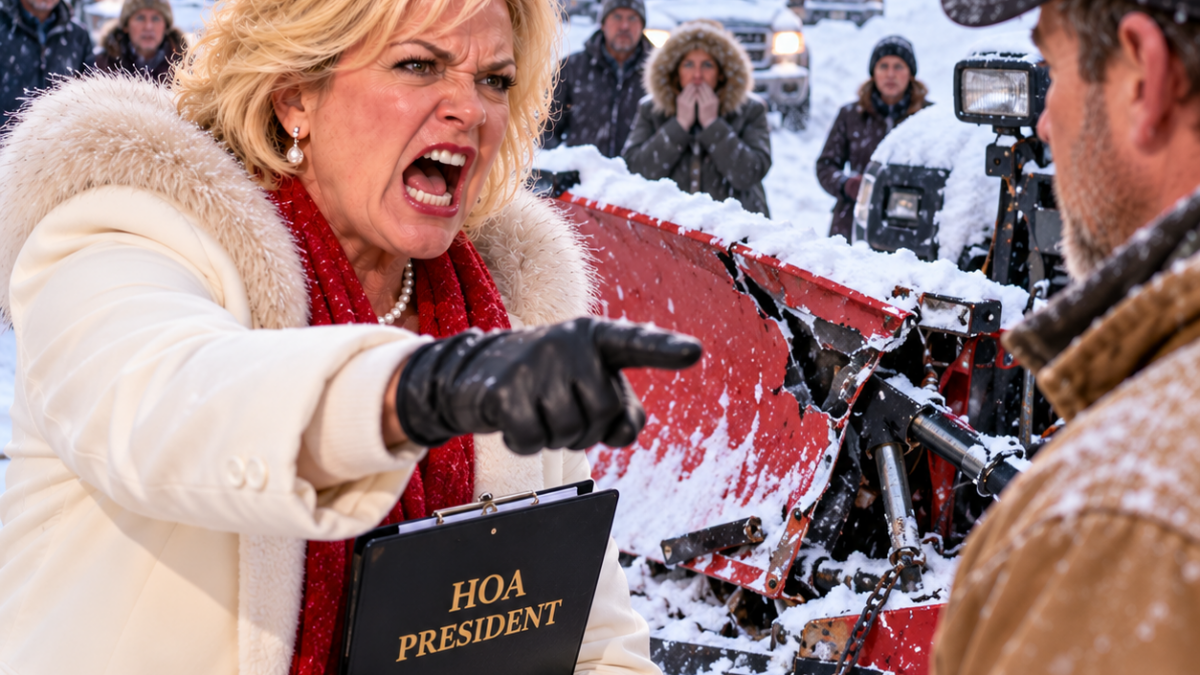
PART 2
The deputy’s name was Carver.
I had seen him around town, but we had never met properly.
He got out, looked once at the excavator, then at the collapsed workshop, then at the cut chain lying in the slush.
“What am I walking into?”
“My property,” I said.
Paige answered at the same time.
“An HOA enforcement action.”
Carver looked between us.
“Those sound like two very different things.”
He started with ownership.
Not opinions.
Not history.
Ownership.
I gave him my parcel record.
Tax statement.
Photographs from before the demolition.
The equipment registrations I kept in my truck.
The serial number from the rotary blower.
Paige gave him the HOA notice and the contractor authorization.
Carver read both.
Then asked Paige, “Do you have a deed, easement, court order, or other document showing Cedar Summit owns or controls this yard?”
“This area affects the community entrance.”
“That wasn’t what I asked.”
Paige’s jaw tightened.
“The HOA has nuisance-enforcement responsibilities.”
“On property outside the association?”
“Our counsel can answer that.”
“Then your counsel can send documents.”
Carver walked the wreckage.
Photographed the cut chain.
The orange truck.
The overturned second plow.
The blower engine.
The nearly severed shaft.
The collapsed roof.
The contractor foreman stayed with him and answered questions.
He wasn’t defensive anymore.
He was worried.
That made sense.
A contractor can survive a client being wrong.
What contractors fear is discovering they acted on somebody else’s confidence without verifying the right that confidence depended on.
The foreman showed Carver the work order.
Under CLIENT AUTHORITY was a signed representation from Paige.
CEDAR SUMMIT HOA WARRANTS AUTHORITY TO ENTER IDENTIFIED WORK AREA AND REMOVE LISTED ASSETS.
That sentence changed the temperature of the conversation.
Carver photographed it.
The foreman immediately called Ridgeway Recovery’s office.
Nobody resumed work.
Nothing else left my property.
Paige put her invoice on the hood of my pickup.
“We can discuss the charge when you’re calmer.”
Before I could answer, Helen picked it up.
The wind almost took one corner.
She folded it once.
“Keep this,” she told me.
Then she looked directly at Paige.
“She put the job in writing.”
Paige left before the deputy finished.
No apology.
No acknowledgment.
Just a promise that counsel would contact us.
I watched her cross the county turnaround toward Cedar Summit’s entrance sign.
Behind that sign, two miles of private road climbed into timber, crossed three switchbacks, then cut along an exposed ridge before splitting toward seventy-four homes.
For eleven winters, I had known every trouble spot on that road.
Where morning shade preserved black ice.
Where meltwater crossed from the rock face.
Where the outside shoulder disappeared under drifted snow.
Where a loader could safely push.
Where a loader absolutely could not.
And where a rotary blower was not convenient equipment but necessary equipment.
Paige believed she had replaced all of that for twenty-three thousand five hundred dollars less.
At that moment, the money wasn’t what scared me.
The calendar was.
It was late November.
Storm season had arrived.
The following morning, an independent heavy-equipment mechanic came to inspect what was left.
She crawled beneath the overturned plow first.
I followed her as far as my knee allowed.
Years at the highway district had left me with enough arthritis that cold concrete could make every step afterward feel like a negotiation.
She pointed her flashlight toward the steering assembly.
“Cracked here.”
“Repairable?”
“Anything is repairable with enough time and money.”
“That’s not what I asked.”
She slid out.
“This truck does not go back onto a mountain road without major work.”
I looked toward the orange truck.
Its frame had twisted when the roof beam dropped across the cab and the excavator moved debris over it.
“What about that one?”
She walked around it slowly.
“Frame measurement first. Cab replacement. Hydraulic lines. Plow mount.”
“It drove Sunday.”
“I believe you.”
“What about the blower?”
The engine sat beneath a temporary cover where Ridgeway had left it.
She examined the damaged gearbox mount.
Then the cut drive shaft.
“We can reconnect the engine.”
I felt hope.
Then she kept talking.
“Gearbox mount is damaged. Shaft has to be fabricated, then aligned. Bearings need checking.”
“How long?”
“Where’s your lifting system?”
I pointed toward the collapsed workshop.
The overhead hoist lay under twisted roof framing.
She followed my hand.
“Oh.”
“Can you have one machine running by the weekend?”
She shook her head.
“No.”
The answer was quiet.
It still felt like another roof beam dropping.
The night before, I had given myself imaginary repair work to keep my mind occupied.
Order this part.
Straighten that bracket.
Rebuild the shaft.
Replace glass.
Repair hydraulics.
If I could turn the loss into jobs, then the loss had limits.
The mechanic took that away.
She documented everything.
Recent brake parts.
Clean grease.
Service stickers.
Hydraulic maintenance.
Newer bearings.
The fact that the machines had been maintained and the damage pattern matched demolition, not years of abandonment.
Helen found something even better.
Our yard security camera had been destroyed with the workshop.
But its footage uploaded automatically.
Sunday afternoon video showed my orange truck driving across the yard.
Amber warning light rotating above the cab.
The second truck backing out of the workshop.
The blower running while I tested its hydraulic controls.
Two days later, Paige had called them obsolete junk.
My lawyer sent preservation letters that afternoon.
To Cedar Summit.
To Ridgeway Recovery.
To the property management company.
Full job file.
Initial estimate.
Revisions.
Photographs.
Emails.
Text messages.
Instructions issued after the first scope.
Scrap receipts.
Nothing was to be destroyed.
By noon, Paige sent Cedar Summit homeowners an email.
Someone forwarded it to me.
SUBJECT: ENTRANCE CLEANUP COMPLETED.
The message described me as a “former winter-service vendor resisting a necessary transition.”
It said obsolete equipment near the entrance had been removed under board authority.
It assured residents that winter service was fully arranged.
One homeowner wrote beneath the forwarded email:
Are we actually covered?
That question mattered more than every insult in Paige’s message.
I called Joel Benton.
Joel owned Alpine Grounds, Paige’s new winter contractor.
We had met once at a county equipment auction.
“Joel.”
“Graham.”
“How many times have you driven Cedar Summit’s upper road?”
“We’re scheduled to survey Thursday.”
I closed my eyes.
“You haven’t driven it?”
“My estimator inspected the residential areas.”
“All three switchbacks?”
A pause.
“Our packet shows parking areas and residential spurs.”
“What does it show between the county turnaround and the clubhouse?”
I heard paper moving.
“Existing access.”
“What does that mean?”
“I’m looking.”
Helen walked into the kitchen.
“Ridgeway’s back.”
“What?”
“Their crew. They’re moving roof fragments.”
“Are they touching equipment?”
“No.”
“Tell them the machinery stays exactly where it is until inspectors finish.”
She nodded and went back outside.
Joel was still on the line.
“Graham.”
“Yes?”
“The connecting road is gray.”
“And?”
“Our maintenance areas are blue.”
I stared through the kitchen window.
“Come this afternoon.”
“I can do Thursday.”
“Today.”
Another pause.
“Why?”
“Because you’ve been hired to maintain a mountain road that apparently isn’t in your contract.”
He arrived at two.
Paige arrived six minutes later.
She carried a glossy folder showing Cedar Summit’s proposed entrance overlook.
Timber shelter.
Stone viewing terrace.
Landscaping.
The proposed overlook sat opposite my yard, which explained something I hadn’t fully understood.
My equipment didn’t merely offend her.
It occupied the visual backdrop of the project she wanted residents to approve.
“You don’t need Graham for a site inspection,” Paige told Joel.
Joel put one hand on his truck door.
“I need someone who knows what wasn’t in my packet.”
She got into the back.
I rode up front.
The first half mile wasn’t difficult.
Wide pavement.
Timber shelter from wind.
Plenty of storage on the inside shoulder.
Joel’s standard plow trucks could handle it.
Beyond the second switchback, everything changed.
The road narrowed between exposed rock and a steep outside shoulder.
Then we reached the ridge cut.
An open meadow rose on one side.
Wind crossed that meadow almost perfectly perpendicular to the road.
The first substantial snow usually arrived from the west.
The wind lifted it and dropped it into the cut.
I told Joel to stop.
“How deep?”
I pulled out my phone.
Found a photograph from February.
The drift stood above the hood of my orange plow.
A narrow trench ran through its center.
Opened by my rotary blower.
Joel enlarged it.
“A pickup plow didn’t do that.”
“No.”
Paige leaned forward.
“We rarely experience weather that severe.”
I turned.
“That was February.”
“One event.”
“Your clubhouse camera recorded three similar closures last winter.”
She didn’t answer.
Joel opened his bid.
“This section isn’t included.”
Paige frowned.
“We hired you for winter maintenance.”
“You hired us for areas shaded blue.”
He held up the scope.
Entrance apron.
Clubhouse lot.
Residential spurs.
The two-mile connecting road was gray.
“You approved this drawing,” he said.
“Our office told you the entire community required coverage.”
“Your office told us the gray line had separate maintenance.”
I looked back at Paige.
“Who did you tell him was maintaining it?”
She ignored me.
Joel continued reading.
“Heavy drift recovery is excluded.”
Paige’s voice sharpened.
“You quoted eighteen thousand five hundred for the season.”
“For the listed areas.”
“My previous contractor charged forty-two thousand.”
I pointed toward the drift photograph.
“My forty-two covered the two-mile road, standby equipment, assigned operators, patrols, and the residential areas.”
Joel nodded.
“Extreme drift recovery is a separate rate in both contracts.”
There it was.
The twenty-three-thousand-five-hundred-dollar savings Paige had promised residents did not come from buying the same service more cheaply.
It came from buying less service.
She needed that savings.
The proposed overlook hadn’t been fully funded.
Her budget presentation shifted the winter-maintenance reduction into the capital line for the new entrance project.
Friday night’s owner meeting was supposed to celebrate the overlook.
Now she had an uncovered road and a destroyed fleet.
“The county can clear the main access,” Paige said.
Joel looked toward the turnaround far below.
“Do you have that in writing?”
“The highway district has always serviced the entrance.”
“Their trucks reach the turnaround,” I said.
“That’s where their route ends.”
Paige closed the rendering folder.
“Let’s not turn a contract adjustment into an emergency.”
I asked Joel to stop at the outer bend.
Two orange stakes stood beside the roadway.
One reflective band.
Two reflective bands.
I pointed.
“Single band marks the drainage ditch.”
Then the other.
“Double band marks the outside road edge above the drop.”
Joel stepped out.
“Snow covers both.”
“Yes.”
“So how do operators know?”
“Markers. Rock references. Experience.”
I pointed toward a distinct outcrop.
“Double-band stake lines up with that corner.”
He photographed it.
“Outside that line?”
“Do not push equipment outside that line unless someone verifies what’s underneath.”
Paige watched from the truck.
Joel did not promise full-route coverage when we got back down.
He called his dispatcher and put any such representation on hold pending revised scope.
Thursday morning, the forecast changed.
A significant winter storm was expected Sunday.
That gave us roughly three days.
I printed the highway district maintenance map and drove to my old office.
I had spent twenty-eight winters there before knee surgery pushed me into early retirement.
For years, I had assigned crews, managed closures, watched radar, and learned the hard way that equipment cannot be wished into two places at once.
The superintendent knew me.
He brought up the equipment board.
“Our blowers are committed to public routes.”
“I’m not asking you to abandon public work.”
“What are you asking?”
“Written route boundary.”
He pulled up the map.
County responsibility ended at the paved turnaround.
Exactly where I had told Paige.
He sent that clarification directly to Cedar Summit management and Joel.
My old career earned me a quick answer.
It did not earn Cedar Summit a spare blower.
I went home and started calling private contractors.
One blower was under repair.
Another was assigned to a ski-access road.
A third company could stage two loaders Saturday.
Its rotary blower would not be available until Monday because it was finishing work on another mountain contract.
“Book the loaders,” I said.
“Need signed authorization and deposit.”
I called Cedar Summit’s manager.
Dana Ruiz.
She had just received the county map.
“Paige says a revised agreement is being prepared.”
“Prepared doesn’t put loaders on the mountain.”
“I know.”
“This company needs a signature today.”
Dana arranged an emergency board call.
Paige argued against the deposit.
“We are about to erase the entire savings achieved by changing winter contractors.”
Joel was on the call.
“Those savings never included the connecting road.”
Silence.
I could picture Paige sitting at the clubhouse table.
She hated a sentence that could be checked against paper.
The board authorized the deposit.
Dana signed while we were still on the call.
The replacement crew foreman was Luis Ortega.
He asked for road photographs.
Widths.
Grades.
Snow storage.
Known hazard points.
I sent everything I had.
We scheduled a Friday walkthrough.
Then I started calling residents I knew.
Not to frighten them.
To tell them exactly what coverage existed.
The former treasurer and his wife had a Monday medical appointment.
They booked a hotel near town and left Saturday.
A family with an infant decided to stay with relatives.
Others stayed.
I couldn’t order anyone off the mountain.
I could tell them the road had two staged loaders and no rotary blower until Monday.
That evening, Paige came to our house.
Helen answered the door.
Paige stayed on the porch.
She carried an envelope.
“We can resolve the equipment dispute quickly.”
I opened it.
$28,000.
No admission.
Release of all claims related to the workshop, machines, lost use, cleanup, demolition, and disposal.
I looked at her.
“How did you get twenty-eight thousand?”
“They’re older vehicles.”
“The blower drive rebuild alone cost more than that.”
“You can take the proposal to your adviser.”
“You had equipment destroyed Tuesday. It’s Thursday.”
“And I’m trying to avoid years of litigation.”
Helen took the offer from my hand.
“He also doesn’t have to sell you everything you broke for twenty-eight thousand dollars.”
Paige’s expression tightened.
“I’m trying to help.”
“No,” Helen said quietly. “You’re trying to buy finality before he knows what you destroyed.”
I loved her a little more for that sentence.
Paige left.
Inside, I opened the drawer where I kept the blower rebuild invoices.
Empty.
Then I remembered.
I had carried the folder into the workshop during the last service inspection.
The workshop was now a collapsed pile of steel and lumber.
“Can the shop send copies?” Helen asked.
“I hope so.”
Ridgeway’s preliminary inventory called the equipment obsolete units with salvage value.
That phrase was already infecting the claim.
My mechanic’s report proved they had been operational.
Sunday’s video proved they moved.
But proving what I had invested in them was another problem.
I called the rebuild shop.
Parts supplier.
Bank.
Sent statements to my lawyer.
That night I understood something important.
There were two emergencies.
My destroyed business.
And Cedar Summit’s winter access.
If I spent every waking hour fighting Paige about the first, people could get hurt because I neglected the second.
Friday morning, Luis met me at the turnaround.
We walked the route.
He was methodical.
That was what I wanted.
He photographed every storage pocket.
Measured the narrow bend.
Marked where his transport could unload.
At the ridge, I showed him the orange stakes.
“One band ditch.”
“Two bands edge.”
“What if marker moves?”
I pointed toward the rock outcrop.
“Verify against the rock.”
He took another photograph.
“You worked highway?”
“Twenty-eight winters.”
“Dispatcher told me.”
He looked toward the exposed cut.
“Then you know why I’m not guaranteeing this with two loaders.”
“Yes.”
“Good.”
“Put it in writing anyway.”
He did.
Dana circulated his limitation to every owner.
The Friday overlook celebration was cancelled.
Volunteers checked homes.
Medication.
Fuel.
Food.
Backup heat.
One of the seventeen households still occupied by Saturday afternoon belonged to the Hendersons near the third switchback.
Ellen Brooks was staying with them.
She had ongoing hospital treatment Monday afternoon.
Her daughter planned to collect her, but a delayed flight pushed the daughter’s arrival to Sunday night.
I offered to take Ellen down Saturday.
She shook her head.
“I’ve stayed through worse.”
“With my equipment here.”
She looked toward the two loaders staged lower on the route.
“They’ll open it Monday.”
“They can’t promise that.”
“You think I should leave?”
“I think you should understand the risk.”
She did.
She chose to stay.
I didn’t like it.
It was still her choice.
Dana recorded her hospital information and daughter’s contact number.
Snow began before dawn Sunday.
At eight, Joel’s standard trucks handled the lower areas.
Luis’s loaders worked above the second bend.
For roughly two hours, the fallback plan held.
Then wind increased.
Snow came off the meadow sideways.
The ridge cut started filling almost as quickly as the loaders opened it.
Luis called.
“Graham, we’ve got a problem.”
“How bad?”
“Bucket pushes a path. By the time we back out, half of it’s filling.”
“Don’t push outside the edge stakes.”
“We’re hauling snow backward.”
“That’s slow.”
“I know.”
The next pass met a packed drift face too deep for efficient bucket work.
At 11:20, Luis could no longer see the next marker.
He pulled his operators back below the exposed section.
Correct decision.
Paige called within minutes.
“Tell them to keep going.”
“They can’t see the road edge.”
“They’re leaving residents trapped.”
“A loader off the shoulder leaves an operator injured or dead.”
“You’re being dramatic.”
“No.”
“My large machine handled this before.”
“Yes.”
“Bring it up.”
I stared across my yard.
The blower engine was under a blue tarp.
The drive shaft Paige’s contractor cut lay beneath plywood.
My workshop hoist remained buried.
“You paid people to dismantle it.”
“I understand you have a dispute with the contractor.”
“Paige.”
“Can they put it back together?”
“Independent estimate says weeks.”
Her tone changed.
Less presidential.
More frightened.
“Then tell me what you need.”
I took the photograph my mechanic had taken.
Engine on flatbed.
Broken mount.
Cut shaft.
I sent it.
Beneath the photograph, I typed the sheriff incident number.
Then one question.
WHO INSTRUCTED RIDGEWAY TO MAKE THE EQUIPMENT UNUSABLE RATHER THAN RELOCATE IT?
She called back.
“The contractor exceeded the cleanup scope.”
“Send that to my lawyer.”
“Graham, people are stranded.”
“I know.”
“You’re making this about paperwork.”
“No. Right now, I’m telling you to help Dana contact every occupied home.”
I hung up.
The question still mattered.
A careless contractor might destroy equipment while removing it.
That is one kind of liability.
A client specifically ordering permanent disposal because she feared the owner would bring the machines back was something else.
I didn’t yet have proof.
Ridgeway’s complete message chain remained under legal review.
I had seventeen households above a road our two loaders could no longer safely open.
That came first.
Sunday evening, the Hendersons sent Dana a photograph.
The top of one roadside sign was visible.
Everything beneath it had disappeared into one continuous slope of wind-packed snow.
Ellen’s daughter reached town.
She could not reach her mother.
Dana contacted the hospital.
They could delay Ellen’s Monday appointment, but they needed an update by late afternoon.
Nothing about the arrangement guaranteed a road opening.
That honesty mattered.
At six Monday morning, wind still moved snow across the exposed cut.
Much of Sunday’s loader work had vanished.
Luis got word that the rotary blower we had hired was finally headed toward us.
Then another problem.
Its lowboy transport could not reach Cedar Summit because public crews were still clearing the highway approach.
I asked Luis, “Can we work lower sections?”
“Yes.”
“Only visible road.”
“Agreed.”
The loaders resumed below the ridge where operators could confirm pavement and shoulders.
By ten, county crews opened two lanes to the turnaround.
Their plows stopped there.
Dana photographed the transition.
Public road clear.
Private Cedar Summit road buried.
Some residents immediately asked why the county wasn’t going farther.
Dana sent the highway district map.
There was no missing government truck.
No broken promise.
County jurisdiction ended exactly where the map said it ended.
The blower arrived shortly before noon.
I felt relief when the lowboy rounded the last highway bend.
Then I felt something else.
Anger.
That machine was doing the job my own equipment should have been staged to do.
Luis inspected it.
Ellen’s daughter waited near the turnaround holding a bag of clothes.
“Will Mom make her appointment?”
Luis didn’t promise.
“We’re working toward a safe passage.”
“By when?”
“I’ll tell you when I know.”
That was professionalism.
People want certainty during emergencies.
Sometimes the most responsible answer is refusing to manufacture it.
The drift had grown larger than Friday’s estimate.
More operator time.
More support equipment.
More fuel.
Luis needed revised authorization.
Paige asked whether the board could seek another quote.
Dana put her phone on speaker.
“The machine is physically here.”
Paige said, “The revised cost is unacceptable.”
“The road is closed.”
“We need cost control.”
“We needed cost control before destroying the equipment already here.”
Silence.
One board member moved approval.
The board passed it.
Paige voted no.
Dana emailed authorization directly to the dispatcher.
Finally:
Correct machine.
Correct crew.
Improving visibility.
Written permission.
The blower entered the ridge cut.
Snow erupted from its chute in a steady arc.
A loader followed, moving discharge away from the narrowest sections.
I rode with Luis in the support pickup.
My role wasn’t operating equipment anymore.
My knee wouldn’t tolerate a full shift even if I wanted it to.
I compared landmarks against Friday’s photographs.
Near the outer bend, a single orange marker appeared through the snow.
Tilted toward the road.
The loader operator approached.
Something looked wrong.
“Stop.”
Luis radioed immediately.
“All machines hold.”
We got out on the cleared inside section.
Friday photograph.
Double-band edge stake aligned with the sharp corner of the rock outcrop.
The visible marker was several feet away.
Ground crew dug around its base.
One reflective band.
Ditch marker.
It had bent under snow load.
The true edge marker remained buried farther out.
Beyond it, wind-packed snow had bridged the drainage channel, creating what looked like a solid shoulder.
It wasn’t.
From a cab, it could fool an operator into putting several tons of loader onto unsupported snow above a drop.
Luis called the loader back.
“We take inside first.”
I pointed along the rock.
“Expose verified margin.”
He studied the slope.
Then gave new instructions.
The blower took short cuts from the rock side outward.
Spotter checked each section.
Loader stayed on confirmed pavement.
Slower.
Much safer.
At 2:40, the double reflective bands finally appeared.
Road edge.
Real one.
The operator could now see the width available.
Luis radioed Dana.
“Advancing.”
Dana updated every household.
No residents were allowed onto the route until controlled passage was declared.
At 3:35, the blower reached the third switchback.
Luis inspected behind it.
A transport vehicle went up under controlled movement.
Ellen waited at the Hendersons’ door in her coat.
Hospital envelope on her lap.
Her daughter helped her into the vehicle.
They reached the turnaround shortly after four.
Before five, Dana called.
“She checked in.”
I sat on the tailgate of Luis’s support truck.
For the first time since Tuesday, my hands shook.
Not from cold.
Not really.
My knee hurt.
My back hurt.
My throat felt tight.
Someone handed me water.
I drank half without tasting it.
One of the drivers asked, “You coming Thursday?”
“To what?”
“Association meeting.”
I laughed.
“Do they still want me?”
“If they don’t, they should.”
Crews stayed on the road into evening.
Widening.
Creating pullouts.
Clearing access for emergency vehicles.
The seventeen occupied households were no longer cut off.
That should have been the end of the worst part.
Instead, Wednesday brought the evidence Helen had told me to save for the room.
My lawyer called.
“Two developments.”
“Good or bad?”
“Useful.”
The rebuild shop found copies of my invoices.
Blower serial number matched.
Drive assembly.
Gearbox work.
Hydraulics.
Recent engine work.
Brake and steering work on the trucks.
Every payment supported by bank records.
Ridgeway Recovery had also released the complete instruction chain through counsel.
I drove to my lawyer’s office.
Helen came.
The first page was Ridgeway’s original estimate.
SITE CLEARANCE / OBSOLETE EQUIPMENT REMOVAL.
Below it:
Estimator question:
OWNER PARCEL APPEARS SEPARATE FROM HOA. SHOULD LISTED MACHINES BE RELOCATED INTACT TO ANOTHER PORTION OF OWNER PROPERTY?
Then Paige’s response.
NO RELOCATION. OWNER WILL BRING THEM BACK IF THEY REMAIN USABLE. PRICE PERMANENT DISPOSAL.
I read it.
Then again.
Helen put her hand over the page.
“Enough.”
I looked at her.
“Save it for Thursday.”
The sentence answered the question I sent Paige during the storm.
She did not merely want the machines out of sight.
She did not merely assume Ridgeway would place them somewhere else.
She specifically rejected relocation because she believed I would bring them back if they remained usable.
That was motive written in her own words.
Thursday’s meeting overflowed the clubhouse.
Residents stood against walls.
Others joined remotely from hotels or family homes.
Joel Benton sat beside Dana.
Luis brought his work log.
My lawyer sat with Helen and me.
Paige remained president.
Technically.
She opened with the storm.
“Cedar Summit experienced unusually severe conditions. No contractor can guarantee uninterrupted mountain access during an event of that magnitude.”
Luis spoke when recognized.
“She is correct that no contractor should operate the exposed ridge when visibility prevents operators from confirming road limits.”
Paige nodded as if that helped her.
Then Luis continued.
“The primary delay after conditions improved came from equipment availability. A rotary blower was not staged at Cedar Summit because the existing machine had been disabled and the replacement contractor’s blower was completing another assignment.”
He projected his timeline.
Snow onset.
Loader work.
Visibility shutdown.
County approach reopening.
Lowboy arrival.
Blower unloading.
Authorization delay.
Ridge clearing.
Each event had a time.
Each depended on a different part of the operation.
Paige turned toward Joel.
“Alpine Grounds was hired to provide winter maintenance.”
Joel put his signed contract beneath the document camera.
Blue areas appeared on the clubhouse screen.
Parking areas.
Residential spurs.
Entrance.
Gray line.
Two-mile connecting road.
“This is our signed scope.”
Someone near the front called out.
“What’s the gray part?”
Joel pointed.
“Connecting road. Not included.”
The owner stood.
“Who was supposed to plow that?”
No one answered immediately.
Dana put up the county route map.
Public maintenance ended at the turnaround.
Another resident said, “So nobody?”
Joel answered.
“My office was told it was separately maintained.”
Every head turned toward Paige.
She adjusted her papers.
“A long-term route agreement was being finalized.”
Dana spoke.
“No signed agreement existed when Graham’s contract was cancelled.”
Paige’s voice sharpened.
“We had significant annual savings available.”
Dana put a number on the screen.
$61,800.
Emergency mobilization.
Loaders.
Operators.
Standby.
Transport.
Blower time.
Additional shifts.
Recovery work.
Paige said, “Which proves why the previous forty-two-thousand-dollar arrangement was unsustainable.”
Dana looked at her.
“Your savings presentation claimed twenty-three thousand five hundred dollars.”
“Yes.”
“It compared Graham’s full-route contract to Alpine’s partial scope.”
Paige stared at the screen.
Dana continued.
“That was not an equal comparison.”
One homeowner said loudly, “So we didn’t save twenty-three thousand. We stopped buying part of the service.”
No one corrected him.
Then Paige tried to shift.
“The destruction of Mr. Mercer’s equipment is a separate contractor issue. Ridgeway exceeded its instructions.”
My lawyer stood.
“We’d like to address that.”
Paige’s attorney leaned forward.
No objection.
First page.
Ridgeway estimate.
Estimator’s question.
Should machines be relocated intact?
Then the response filled the screen.
NO RELOCATION.
OWNER WILL BRING THEM BACK IF THEY REMAIN USABLE.
PRICE PERMANENT DISPOSAL.
Someone in the back said, “Read that again.”
My lawyer did.
Slower.
The room changed.
Not loudly.
That is the thing about documentary evidence.
People don’t always gasp.
Sometimes they simply become still.
Paige reached for her microphone.
“That wording referred to the appearance problem.”
My lawyer looked at the screen.
“You identified an owner.”
“Yes.”
“Who might bring the machines back.”
“I was concerned the entrance cleanup would become temporary.”
“Because they were his machines.”
“They were located adjacent to our entrance.”
“On his parcel.”
“Ridgeway had an obligation to verify.”
“They did ask.”
Another page appeared.
CLIENT WARRANTS AUTHORITY TO ENTER.
Paige’s signature.
My lawyer continued.
“We are pursuing Ridgeway’s responsibility separately. But the question tonight is whether the contractor invented the instruction to make these machines unusable.”
He pointed toward her email.
“They did not.”
Next page.
Scrap accounting.
$4,860 credited to Cedar Summit’s cleanup account.
I had not known that.
Paige had billed me $8,370 for destroying equipment while the HOA received a scrap credit from parts of that same property.
Helen made a sound beside me.
Not a word.
Something lower.
Anger distilled.
Then Dana played Sunday’s security footage.
My orange truck moved across the yard.
Amber beacon rotating.
Second truck reversed from the shop.
Timestamp.
Two days before demolition.
An owner near the front stood.
“You called those abandoned.”
Paige answered.
“I relied on the information available.”
“The video existed.”
“I didn’t have the video.”
“Graham told you they were working.”
“He disputed every enforcement action.”
My lawyer placed Paige’s acknowledged email response on screen.
My parcel record.
My objection.
The date.
Three business days after her notice.
Then her later demolition authorization.
The same owner spoke again.
“You gave him ten days.”
Paige’s mouth tightened.
“He responded, yes.”
“You destroyed it before the ten days were over?”
“The response did not cure the appearance violation.”
“On property outside the HOA?”
The vice president called the room back to order.
Then asked management to display the entrance-project authorization.
It covered landscaping.
Sign improvements.
Stonework.
All on Cedar Summit property.
My parcel was absent.
My workshop absent.
My machines absent.
The vice president looked at Paige.
“Which board vote authorized demolition across the turnaround?”
Paige took a breath.
“The president was delegated authority to coordinate entrance cleanup.”
“On association property.”
“We believed—”
“I’m asking about the authorization.”
She stopped.
The vice president made a motion.
Suspend Paige Ellison’s contractor-signing authority immediately.
Freeze the overlook project.
Preserve all related records.
Commission independent review of winter contracting, entrance spending, and the Ridgeway authorization.
Four board members voted yes.
Paige voted no.
The vice president asked her to turn the project files over to Dana.
Then he moved into the president’s chair for the rest of the meeting.
For the first time since I had watched that excavator enter my yard, Paige had to sit still while someone else decided what happened next.
I thought I would feel satisfaction.
Instead, I looked at Helen.
She squeezed my hand.
The equipment claim came next.
My lawyer did not ask the board to write a check on the spot.
That would have been theater.
She presented independently supported valuations.
Working-equipment replacement and restoration capacity:
$238,600.
Workshop reconstruction estimate:
$79,100.
Related documented losses still under review.
Not sentimental value.
Not revenge numbers.
Appraisals.
Comparable machines.
Repair limits.
Recent rebuild invoices.
Loss-of-use documentation.
Ridgeway’s experts would be allowed to challenge them.
Cedar Summit’s insurer would too.
That made the figures harder to dismiss.
No vote gave me money that night.
The board voted to preserve records and notify insurers.
That was enough.
My claim had stopped being “an old contractor angry he lost a plowing job.”
It was now documented destruction of functioning privately owned equipment on land the HOA did not control.
The property settlement took four months.
Four long months.
Insurance interviews.
Appraisers.
Arguments over depreciated value.
Replacement capacity.
What portion Ridgeway should bear.
What portion Cedar Summit should bear.
Whether Paige exceeded authority.
Whether Ridgeway relied reasonably on her warranty.
Lawyers can make four months feel like a second winter.
During those months, I rebuilt.
Not all at once.
The shop came first.
Temporary steel building.
Then permanent framing.
New overhead hoist.
Tool storage.
Parts shelves.
I hired two operators.
That surprised Helen.
“You said you were slowing down.”
“I was.”
“This looks like speeding up.”
“I’m making sure the business doesn’t depend on my knee.”
She looked pleased.
I pretended not to notice.
Cedar Summit changed winter service before the next season.
No more partial-scope comparison disguised as full-route savings.
One contract identified the entire two-mile road.
Three switchbacks.
Ridge cut.
Residential spurs.
Parking.
Standby heavy equipment.
A backup blower arrangement.
Preseason route walk.
Emergency contact chain.
Written county boundary map attached.
I accepted limited backup work.
Not exclusive responsibility.
I charged for route training.
That mattered.
For years, my knowledge had been treated like something included automatically because I was nearby.
Now Cedar Summit paid for it.
Operators learned the reflective markers.
Rock references.
Snow storage.
Wind patterns.
When to stop.
Not merely how to push.
Dana maintained a resident emergency list.
Medical needs.
Backup contacts.
Voluntary early relocation options before major storms.
No resident’s safe trip down the mountain would depend on whether Graham Mercer happened to answer his phone.
That was better than the old system.
Even though the old system had been mine.
There was a lesson in that.
The final property settlement funded replacement of my lost operating capacity, workshop reconstruction, and supported related losses through contributions from Ridgeway and Cedar Summit’s insurer.
The exact allocation was negotiated.
Ridgeway did not escape responsibility simply because Paige signed the order.
Paige did not escape responsibility simply because Ridgeway held the torch.
Both had made decisions.
Then came a separate association review.
The $4,860 scrap credit.
Unauthorized demolition expense.
Emergency winter costs.
Incomplete contract comparison.
The overlook budget.
Paige’s direct instructions.
Residents were angry.
Some wanted to sue her personally for everything.
Others said the board had trusted her and shared responsibility.
The final agreement was less theatrical.
More painful.
Paige agreed to repay $52,000 of association expenditures from her own funds over four years.
She lost the presidency.
Lost contractor-signing authority.
Lost control of the overlook.
At the next election, residents chose somebody else.
She remained a homeowner.
No handcuffs.
No public perp walk.
No mansion foreclosure.
Just consequences connected to what she had actually done.
I preferred that.
One afternoon near the end of settlement, Paige came to my temporary shop.
She stopped outside the gate.
The new chain was intact.
That detail wasn’t lost on either of us.
“Graham.”
I stepped outside.
“You here with counsel?”
“No.”
“Then we probably shouldn’t discuss settlement.”
“I’m not.”
She looked toward the replacement steel structure.
“You rebuilt quickly.”
“Winter does that.”
She folded her arms.
“For what it’s worth, I never intended to trap anybody.”
I believed her.
That was the strange part.
“I know.”
She looked surprised.
“You do?”
“You intended to save money and get rid of something you thought made your entrance look bad.”
“That’s unfair.”
“Which part?”
“I believed the new winter contractor covered us.”
“You didn’t read the gray line.”
“I relied on management.”
“Management relied on what you told them.”
She looked away.
“The overlook mattered to residents.”
“To some.”
“Property values matter.”
“Yes.”
“You act as if aesthetics are frivolous.”
“No.”
I pointed toward my rebuilt shop.
“I cared what that looked like too.”
“Then why keep all that machinery at the entrance?”
“Because that’s where my equipment yard has been longer than Cedar Summit.”
Her lips tightened.
“You could have moved it.”
“I could have.”
“So why didn’t you?”
“Because you didn’t ask me to negotiate. You told me your HOA had enforcement power over property it didn’t own.”
“That distinction mattered that much?”
“Yes.”
She looked toward the county turnaround.
“You know residents blamed me when they were trapped.”
“They had reason.”
“The storm was severe.”
“Yes.”
“Even your loaders stopped.”
“Yes.”
“So you admit no plan guarantees access.”
“Of course.”
“Then how can you blame me?”
“Because resilience is not the same as a guarantee.”
She frowned.
I continued.
“My blower might have been stopped by zero visibility too.”
“Exactly.”
“But it would have been staged below the ridge the moment conditions improved.”
She said nothing.
“That’s what residents were paying for. Equipment. Operator. knowledge. readiness. You compared that to a contract that didn’t include the road.”
“I made a mistake.”
“Yes.”
Her eyes hardened.
“People make mistakes.”
“Yes.”
“And then you put my email on a wall in front of everyone.”
“My lawyer put your email on a wall.”
“You know what I mean.”
“You told Ridgeway not to relocate the machines because I would bring them back if they remained usable.”
Silence.
“That wasn’t a mistake in comparison.”
Her shoulders dropped slightly.
“No.”
“That was a choice.”
She looked at the rebuilt shop.
Then at me.
“I wanted the project finished.”
“I know.”
“I was tired of every improvement becoming six months of objections.”
“I know.”
“I thought if the equipment stayed, you’d keep making the entrance look like a contractor yard.”
“It is an equipment yard.”
“That’s what I mean.”
I almost laughed.
She did too, once.
Bitterly.
Then she said, “I should have stopped.”
“Yes.”
“Before Ridgeway?”
“Long before.”
She nodded.
That was all.
No dramatic apology.
No request for forgiveness.
She left.
I went back to work.
The next autumn, our replacement blower arrived.
Not new.
I didn’t need new.
I needed dependable.
Heavy frame.
Rebuilt rotary head.
Fresh bearings.
Updated hydraulic system.
Two serviceable plow trucks sat outside the rebuilt shop.
One had an orange beacon like the old truck.
Helen came down carrying coffee during the first equipment test.
The blower roared.
Augers turned.
Snow chute rotated smoothly.
My new operator checked controls.
Helen handed me the cup.
“You’re not driving?”
“Testing.”
“That wasn’t the question.”
I looked toward the cab.
My knee ached just thinking about six hours behind the wheel.
“No.”
“Good.”
She pointed to a folding chair.
“This time, sit.”
“I’m supervising.”
“You can supervise sitting down.”
I sat.
That was harder than rebuilding the shop.
For most of my adult life, usefulness had meant doing.
Driving.
Repairing.
Staying awake.
Knowing the road.
The storm taught me something I didn’t enjoy learning.
A reliable system cannot depend on one man refusing to get old.
So I trained operators.
Paid them properly.
Let them make decisions.
Corrected them when needed.
Then let them work.
Cedar Summit held its preseason inspection that November.
Luis came.
Joel came.
Dana.
New HOA president.
Two of my operators.
We drove the entire route.
At the ridge, the new president pointed toward the orange stakes.
“One band?”
“Drainage ditch.”
“Two bands?”
“Road edge.”
“And if we can’t see them?”
One of my operators answered before I could.
“We stop until we can verify the ground.”
I smiled.
That was the right answer.
The postponed overlook never got built in its original form.
For a while, the site opposite my yard remained grass.
Eventually Cedar Summit installed a smaller timber bench and stone sign improvement entirely on association land.
No demolition required.
No private-property “cleanup.”
No one claimed the view was ruined by my workshop.
Maybe because the new shop looked better.
Maybe because priorities change after people spend a winter looking at a buried road.
The first significant snow arrived before dawn.
Not a major storm.
Six inches.
Some wind.
Enough to test the system.
At 4:30, I woke automatically.
Twenty-eight years at the highway district will do that.
I looked at the weather.
Then toward the yard.
A plow truck started.
Orange beacon turning.
One operator checked lights.
The blower remained staged.
Backup ready.
The truck rolled through the gate.
Crossed the county turnaround.
Climbed toward Cedar Summit.
For a moment, every part of me wanted to put on boots and follow.
Instead, I went to the kitchen.
Helen was already there.
“You’re learning.”
“Don’t exaggerate.”
She poured coffee.
We listened to the radio.
At 5:20, the operator reported first pass complete.
Ridge manageable.
No major drift.
At 6:10, residential spurs open.
At 6:45, route widened.
No phone calls from Paige.
No emergency spending vote.
No equipment recovery.
Just winter maintenance functioning like winter maintenance should.
I went outside after sunrise.
Fresh tire tracks crossed my yard.
The rebuilt shop stood straight.
No broken glass.
No twisted roof.
No engine strapped to a scrap flatbed.
Across the turnaround, Cedar Summit’s sign faced the mountain.
I thought about the photograph Paige once sent homeowners.
ENTRANCE CLEANUP COMPLETED.
She had mistaken removal for completion.
That was the central mistake behind almost everything she did.
She thought getting rid of what looked inconvenient finished a problem.
My machines looked ugly.
Remove them.
My contract looked expensive.
Replace it.
The gray road line complicated the savings.
Ignore it until later.
The overlook needed money.
Use the promised savings.
Each decision made the presentation cleaner.
Until the mountain supplied the details she had removed.
Wind.
Drift.
Road edge.
Equipment availability.
Operator safety.
Seventeen occupied households.
A woman with a hospital appointment.
Those details had always existed.
The storm simply made them impossible to crop out.
My settlement check did not restore the old orange truck.
The replacement blower did not erase watching a torch cut into a machine I had rebuilt with my own money.
The new shop did not replace every afternoon Helen and I spent sorting broken tools from debris.
Some losses remain losses even when insurance pays.
But the ending gave me something better than revenge.
The system improved.
Cedar Summit’s route was actually covered.
Operators knew the hazards.
Residents knew the public-private boundary.
Heavy equipment backup existed.
Emergency spending rules changed.
Contract comparisons had to use identical scopes.
No HOA officer could authorize work on neighboring property without recorded authority reviewed by management and counsel.
And my business no longer depended entirely on me.
Even Paige’s repayment mattered less to me than that.
Fifty-two thousand dollars over four years was painful.
It was supposed to be.
Not because residents needed blood.
Because money was the language she had used to justify the shortcut.
She promised $23,500 in winter savings.
Her decisions contributed to more than twice that amount in personal repayment alone, before the association’s emergency costs and insurance consequences.
Budget promises sound different after invoices arrive.
A year later, Ellen Brooks stopped by our shop.
I almost didn’t recognize her without a winter coat.
She carried a pie.
“Helen home?”
“She’s inside.”
“I brought this for both of you.”
“You don’t owe us anything.”
“I know.”
She handed it over anyway.
“My daughter still talks about that Monday.”
“How are you?”
“Still getting treatment.”
“Road didn’t make you miss that one.”
“No.”
She smiled.
“I heard you don’t drive the blower much anymore.”
“People gossip.”
“Good.”
“What?”
“You looked seventy-five that week.”
“I was sixty-three.”
“Exactly.”
Helen came out.
Ellen hugged her.
Then she looked at the orange beacon on one of the replacement trucks.
“Is that on purpose?”
“What?”
“Same color.”
I looked at it.
“Standard beacon.”
“Sure.”
She didn’t believe me.
Maybe she was right.
Maybe some part of me wanted one familiar thing back.
Before leaving, Ellen stood near the gate.
“I was angry at Paige.”
“So were a lot of people.”
“I wanted her gone from the neighborhood.”
“That wouldn’t open roads.”
“I know that now.”
She looked uphill.
“I think people wanted someone to hurt as much as they were scared.”
That sentence stayed with me.
Fear searches for targets.
So does grief.
So does anger.
I had wanted Paige to pay.
In some ways, she did.
But if all I had gotten was her suffering, the ending would have been empty.
The useful consequences were the ones that made the next storm safer.
That winter we had three significant storms.
The first, manageable.
The second required the blower for six hours.
The third created deep drifting at the ridge cut.
The new system worked.
Not perfectly.
One truck lost a hydraulic hose.
Backup operator took over.
The blower paused for visibility twice.
Residents received updates.
No one ordered operators to continue when they couldn’t see the road.
No one called caution laziness.
No one promised exact opening times.
By morning, the route reopened.
That was progress.
Paige’s repayment continued quietly.
I knew because Cedar Summit published audited financial statements after the review.
I did not track her payments month by month.
I didn’t need to.
She sold her house two years later.
Before moving, she left an envelope with Dana for me.
Helen watched me open it.
Inside was a single page.
Graham,
I do not expect you to agree with every decision I made or forgive the damage caused. I still believe Cedar Summit needed to control costs, but I understand now that I compared different scopes, relied on authority the HOA did not have, and gave Ridgeway an instruction I had no right to give.
I thought eliminating your equipment would eliminate the conflict.
Instead, I eliminated equipment the community later needed.
I am sorry.
Paige
Helen read it.
Then handed it back.
“What are you going to do with that?”
“File it.”
“Of course.”
“Want me to burn it?”
“No.”
I placed it with the settlement records.
Not framed.
Not displayed.
Just kept.
People sometimes think an apology is the ending.
It isn’t.
At best, it is evidence that someone finally understood the beginning.
By then, I didn’t need Paige to understand for my sake.
The road was covered.
The shop was rebuilt.
The machines were replaced.
I had operators.
Helen could sleep through small storms without wondering whether I would spend fourteen straight hours in a cab.
That mattered more.
My knee eventually forced the issue.
One December morning, I climbed into the blower during a training run.
After twenty minutes, pain started.
After forty, it was bad.
I brought the machine back.
One of my operators waited.
“Everything okay?”
“Machine’s fine.”
He looked at the way I climbed down.
“You?”
“Old.”
“That your professional diagnosis?”
“Yes.”
I handed him the keys.
“You finish.”
That was the first time I voluntarily handed a blower route to someone else while I was still physically capable of forcing myself through it.
I watched him pull away.
It hurt.
Not my knee.
Something else.
Identity, maybe.
For decades, I had been the person people called because the road was buried.
The person who had the machine.
The person who knew the edge markers.
The person who stayed awake.
Losing the equipment made me fight to rebuild that role.
Getting older forced me to build something better.
A system that worked even when I didn’t.
Helen understood before I did.
That evening she set dinner on the table.
“How’d training go?”
“He finished.”
“You let him?”
“Yes.”
She smiled.
“Miracles happen.”
“Careful.”
“You know what I mean.”
I did.
The next few years settled into routine.
Annual walkthrough.
Equipment inspections.
Operator lists.
Weather thresholds.
Early resident notifications.
County boundary map in the Cedar Summit emergency binder.
The gray connecting road now highlighted in the largest print.
Nobody could mistake who maintained it.
The entrance overlook remained modest.
I kept my yard clean because I preferred it clean, not because Paige once demanded it.
A row of spruce eventually screened part of the workshop naturally.
That amused Helen.
“You know she wanted landscaping.”
“Don’t start.”
“Looks good.”
“It does.”
“You could’ve planted those years ago.”
“I said don’t start.”
She laughed.
I laughed too.
Time has a way of sanding sharp edges without erasing what happened.
One January afternoon, a new Cedar Summit resident came down to the yard.
Young guy.
Probably thirty-five.
He had moved in that summer.
“You Mr. Mercer?”
“Depends who’s asking.”
He smiled.
“Ben. Lot forty-three.”
“What can I do for you?”
“They told me you’re the snow guy.”
“Used to be more than I am now.”
“My realtor said the road has a heavy-equipment backup plan.”
“It does.”
“Why?”
I looked uphill.
“Because it needs one.”
“Anything I should know?”
“Don’t drive around a road-closed sign.”
He laughed.
“I’m serious.”
His smile disappeared.
“When operators stop, there’s a reason.”
He nodded.
“Got it.”
I almost told him the whole story.
Paige.
Ridgeway.
The torch.
Seventeen households.
Ellen.
The buried edge stake.
But he didn’t need all of that.
Good systems should not require every new person to inherit the entire trauma that created them.
They should inherit the procedure.
That is enough.
When the season’s first snow arrived the following fall, I stood beside Helen outside the rebuilt shop.
One blower.
Two plow trucks.
Operators checking radios.
Orange lights reflecting off light snow.
A truck started.
Then another.
One climbed toward Cedar Summit.
The blower followed later, staged below the exposed cut.
I held coffee.
Helen pointed toward the folding chair.
“No.”
“What?”
“I’m standing.”
“For now.”
We watched the lights disappear around the first switchback.
Years earlier, Paige had looked at those same machines and seen old equipment spoiling her entrance.
I saw different things.
A truck.
A blower.
A workshop.
Tools.
Yes.
But also stored capability.
A road that could reopen.
A hospital appointment that might still be reached.
A fire engine route.
A resident able to get home.
A machine looks expensive when it is sitting still.
Preparedness often does.
Right up until the hour someone needs it.
Five days after Paige destroyed my fleet, seventeen households learned that difference.
So did the board.
So did I.
And the lesson I kept was not that an HOA should never change contractors or cut costs.
Sometimes they should.
It was simpler.
Never call capacity waste just because you are looking at it on a clear day.
Never compare two prices until you know they buy the same thing.
And never destroy somebody else’s working solution because you assume the problem it solves will wait for you to finish your project.
Before dawn, the radio on my belt crackled.
“Upper route first pass complete.”
I pressed the button.
“Copy.”
Helen looked at me.
“You going up?”
I watched the snowfall.
Then the empty driver’s seat of my pickup.
For once, I shook my head.
“No.”
We went inside.
Someone else finished the road.
[END OF STORY]








