PART 2: HOA Crew Smashed Through My Memorial Gate at Dawn—Then I Walked Onto the Porch With My Father’s Shotgun
PART 2
The surveillance became impossible to dismiss after Gerald’s visit.
Before that afternoon, I could still tell myself the patrol SUV was doing what patrol vehicles supposedly did—driving around.
Afterward, it slowed in front of our house four or five times a day.
Sometimes the driver held up a phone.
Sometimes he stopped for thirty seconds.
Once, he parked directly across from my driveway and sat there for almost fifteen minutes with the engine running.
I started keeping a log.
That was the software engineer in me.
When a system behaves strangely, you stop arguing with the output and collect data.
Monday, 8:12 a.m. Patrol SUV passed westbound.
10:46 a.m. Same vehicle stopped thirty-four seconds.
1:03 p.m. Driver photographed gate.
3:51 p.m. Second pass.
7:18 p.m. Third pass after dark.
By the end of the week, my spreadsheet had thirty-two entries.
Lily noticed before I told her.
She was seventeen, months away from graduation, and had inherited Elena’s ability to read a room before anybody spoke.
One evening she stood beside me at the kitchen window while the SUV idled under the streetlight.
“Is that normal HOA stuff?”
“No.”
“Can they do that?”
“Drive on the street? Yes.”
“Watch us?”
I hesitated.
“Watching isn’t necessarily illegal.”
“That wasn’t what I asked.”
I looked at her.
“No. It’s not normal.”
She wrapped both arms around herself.
The gesture was so much like Elena that it hurt.
“Why do they care about the gate this much?”
I didn’t know.
That bothered me more than if I had.
The gate was not outrageous.
It wasn’t twelve feet tall.
It didn’t have spikes.
No neon lighting.
No political slogans.
Dark iron. Southwestern sun motif. Approved dimensions.
I pulled the community covenants up on my computer again.
Section Four.
Architectural Improvements.
Entry features were permitted with written approval and materials compatible with “regional desert character.”
My gate had been approved under exactly that language.
No amendment.
No new standard.
No vote rescinding prior approvals.
Nothing.
I called the HOA office again.
The same woman answered.
“I need the board minutes where my gate approval was revoked.”
“Those are internal records.”
“I’m a dues-paying member.”
“Submit a request.”
“I did.”
“You’ll receive a response.”
“When?”
“Within the period required by governing documents.”
“What period?”
“Mr. Anderson, I’m not going to debate policy.”
“I’m asking for a date.”
She hung up.
I sat there holding the phone.
That was the moment I stopped believing the gate itself mattered.
Something about saying no to Gerald mattered.
I just didn’t know why yet.
Two days later, Lily came home from school quieter than usual.
She walked straight past me, dropped her backpack near the kitchen table, and opened the refrigerator without taking anything out.
“How was your day?”
“Fine.”
That meant not fine.
“Elaborate.”
“No.”
“Lily.”
She shut the refrigerator.
“Why is our house under surveillance?”
My stomach tightened.
“Who said that?”
“Madison Clarke.”
“Board member’s daughter?”
She nodded.
“Apparently her dad says you’re under enforcement because you’re aggressive and refusing to comply with safety standards.”
“Safety standards?”
“She said the HOA might have to take legal action.”
I stood.
“Did anyone threaten you?”
“No.”
“Touch you?”
“No.”
“Follow you?”
“No, Dad.”
She rubbed both hands over her face.
“They’re just talking.”
“Talking can matter.”
“I know.”
Then she looked at me.
“Can’t you just show everyone the approval letter?”
That question seemed so obvious.
If people acted rationally, yes.
But I had already shown it to Gerald.
He didn’t care.
“I’m working on it.”
“Okay.”
She picked up her backpack.
At the hallway, she stopped.
“Mom would’ve hated this.”
Then she disappeared into her room.
I stood alone in the kitchen for a long time.
Elena hated unnecessary conflict.
She hated raised voices.
She would cross a grocery store parking lot to avoid someone arguing near the carts.
But she also had an infuriating moral spine.
Once, when Lily was nine, a teacher unfairly accused her of cheating.
Elena spent three days assembling the assignment history, timestamps, and drafts.
She walked into that principal’s office calm as weather.
The accusation disappeared by lunch.
On the drive home, she told Lily:
“Not liking conflict doesn’t mean you surrender the truth.”
I heard those words in my kitchen.
The next morning, I called an attorney.
David Moreno had represented a coworker in a property dispute.
His office was downtown Tucson, third floor above a tax service and a dentist.
I took everything.
Approval letter.
Violations.
CC&Rs.
Patrol log.
Photos.
Gerald’s threat.
David listened without interrupting.
When I finished, he held the original approval up to the window.
“Architectural Review Committee.”
“Yes.”
“Signed by three members.”
“Yes.”
“Any conditions?”
“No.”
“Installed exactly as submitted?”
“Yes.”
“Permit required?”
“County said no for this type of residential gate.”
“And now the HOA says it’s noncompliant.”
“Yes.”
He looked at the notices.
“No citation to a new rule.”
“No.”
“No hearing offered.”
“No.”
“No explanation of what exactly violates standards.”
“No.”
David set everything down.
“Then their position is weak.”
“That’s what I thought.”
“That doesn’t mean they can’t make your life miserable.”
“Already started.”
He read the patrol log.
“Document everything.”
“I am.”
“More than this.”
He pointed at the spreadsheet.
“Save original emails. Envelopes. Camera footage. Certified mail receipts. Phone logs. Screenshots.”
“I can do that.”
“If they threaten a lien, don’t ignore it.”
“I won’t.”
“And if anyone enters your property to remove the gate without a court order or some other lawful authority, call law enforcement immediately.”
“That’s trespassing?”
“At minimum, it raises serious trespass and property-damage issues. But do not turn yourself into the enforcement mechanism.”
I understood what he meant.
“Call first.”
“Call first. Film. Stay safe.”
He leaned back.
“One other thing.”
“What?”
“Do not assume Gerald wants the gate.”
“He clearly does.”
“No. He wants something.”
I frowned.
“What’s the difference?”
“People don’t usually start neighborhood wars over metallurgy.”
I left with a bill, a plan, and a question.
What did Gerald actually want?
The answer came slowly.
I requested architectural committee records through certified mail.
Three days later, I received nothing from the HOA.
But I received a phone call from a woman named Meredith Sloan.
“I shouldn’t be calling.”
“Who are you?”
“I was on the architectural committee when your gate was approved.”
I sat straighter.
“Was?”
“Gerald removed me two months ago.”
“Why?”
“That depends who you ask.”
“What do you say?”
“I disagreed with him too often.”
She sounded nervous.
I asked, “Was my approval legitimate?”
“Yes.”
“Unanimous?”
“Yes.”
“Did anything change afterward?”
“No.”
“Then why am I getting violations?”
Silence.
“Meredith?”
“Gerald hated that gate.”
“Why?”
“He said it set a precedent.”
“For what?”
“Individual design.”
I almost laughed.
“Individual design?”
“He’s spent six years making Saguaro Ridge visually uniform. Same wall colors. Same driveway finishes. Same mailbox posts. He wanted standardized entry features next.”
“My plans were approved before that.”
“I know.”
“Then what’s the issue?”
“People liked yours.”
That stopped me.
“What?”
“After your gate went in, four homeowners asked if they could do custom gates too.”
“And Gerald didn’t want that.”
“He said if everybody started expressing themselves, the neighborhood would look chaotic.”
“Expressing themselves?”
“That was his phrase.”
I stood and walked toward the window.
My gate was visible beyond the front yard.
The sunburst caught late-morning light.
“This is about control.”
Meredith exhaled.
“Yes.”
“Will you put that in writing?”
“No.”
“Why?”
“Because I still live there.”
The line went quiet.
Then she added:
“You don’t understand what he does to people who embarrass him.”
“I’m starting to.”
“Then listen to me.”
Her voice dropped.
“Don’t underestimate him.”
She hung up.
I saved the call details but didn’t pretend the conversation alone proved anything.
Still, it explained the irrationality.
The gate had become symbolic to Gerald too.
Not grief.
Not Elena.
Authority.
If mine stayed, other people might ask why they couldn’t choose something different.
Gerald wasn’t protecting aesthetics.
He was protecting obedience.
The next notice came four days later.
NOISE VIOLATION.
One hundred dollars.
No date.
No time.
No complaining resident.
No description of noise.
I worked from home and Lily studied most evenings.
Our loudest appliance was probably the dishwasher.
I appealed.
No response.
Then the irrigation stopped.
At first I thought a valve had failed.
I checked the controller.
Power normal.
Lines dry.
I called community management.
“Scheduled maintenance.”
“When?”
“Current.”
“Why is every other system running?”
“I don’t have that information.”
“How long?”
“Until maintenance is complete.”
The call ended.
That evening, I drove through Saguaro Ridge.
Sprinklers everywhere.
Water flashing gold in sunset.
Every yard except mine.
Arizona heat does not negotiate.
Within days, two prickly pears sagged.
A young saguaro near the walkway showed stress.
I called a plumber specializing in irrigation.
He found the neighborhood supply valve to my branch had been shut.
Not broken.
Shut.
“Who has access?”
“Management and landscape contractor, usually.”
“Can you document this?”
He looked at me.
“Something going on?”
“Yes.”
He wrote exactly what he found on the invoice.
The water returned two days later.
No explanation.
Then garbage service skipped us.
The truck stopped at every house on my street except mine.
I rolled the cans toward the driver.
“Why are you passing me?”
He looked uncomfortable.
“Service hold.”
“From who?”
“Management.”
“Reason?”
He glanced at a tablet.
“Obstruction.”
I pointed.
“Do you see an obstruction?”
“No.”
“Can you note that?”
“Sir, call the office.”
He drove away.
I took photos.
Time.
Date.
Position of cans.
Video of the truck passing.
That folder on my computer grew.
HOA Documentation.
Inside:
01_Original_Approval.
02_Violations.
03_Patrol_Log.
04_Irrigation.
05_Waste_Service.
06_Gerald_Communications.
I backed it up in two places.
Engineers document systems.
Widowers document threats when they have children sleeping down the hall.
Gerald’s next move hurt worse because it didn’t touch me directly.
An email went to all 237 homes.
PROPERTY VALUE ALERT.
It warned that a “noncompliant resident” was threatening collective investment through refusal to follow architectural standards.
It claimed inconsistent enforcement could reduce property values.
No name.
No address.
No need.
By then everybody knew.
Two days later, Lily stopped going to lunch with her friends.
I found out accidentally.
She left a library receipt on the counter showing she had checked out a study room every day that week.
“Why are you eating lunch in the library?”
She froze.
“I like it there.”
“You hate the library during lunch.”
“No, I don’t.”
“You once described it as a bunker that smells like printer toner.”
She looked down.
“People talk.”
“What are they saying?”
“Nothing.”
“Lily.”
Her eyes filled.
“Madison says her dad told them you’re trying to bankrupt the HOA.”
“What?”
“She says because you won’t remove the gate, everyone might have to pay legal fees.”
“That’s nonsense.”
“I know.”
“Do you?”
She snapped.
“Yes, Dad, I know!”
Then she started crying.
Not quiet tears.
Weeks of humiliation finally broke through.
“I’m tired of everybody looking at me like we did something wrong!”
I moved toward her.
She stepped back.
“My prom committee removed me.”
“What?”
“They said scheduling.”
“Who?”
“It doesn’t matter.”
“It matters.”
“No, it doesn’t!”
Her voice cracked.
“Why won’t you just change the stupid gate?”
Silence.
She looked toward the front window.
“I hate that thing.”
The words hit harder than anything Gerald had sent.
“It’s just metal.”
“No.”
“You made it for Mom and now everybody hates us because of it.”
“That’s not why—”
“Mom would want us to be happy!”
I stopped.
She wrapped her arms around herself.
“She wouldn’t want this.”
Then she went to her room.
Her door closed.
I stood in the kitchen staring at the gate.
For the first time, I considered removing it.
Not because Gerald was right.
Because Lily was hurting.
I went outside after dark.
The metal was still warm from the day.
My fingers traced the sunburst.
I remembered drawing the first version at Elena’s bedside.
She had been weak by then.
Still alert.
She saw the sketch and said:
“Too many rays.”
“There are eight.”
“Six.”
“Why?”
“Eight looks desperate.”
I laughed.
“You’re dying and criticizing my gate?”
“Someone has to maintain standards.”
That was Elena.
Even near the end.
Dry humor.
Sharp eyes.
No patience for self-pity.
I leaned my forehead against the iron.
“What am I doing?”
No answer.
I imagined taking it down.
Paying the fines.
Sending Gerald a letter saying he won.
Maybe the patrol stopped.
Maybe Lily got her friends back.
Maybe life became quiet.
Then another thought arrived.
What would Gerald learn?
That social pressure works.
That targeting a child works.
That service disruptions work.
That approval letters mean nothing if the president dislikes the result.
And after the gate?
What would be next?
Paint?
Solar panels?
Landscaping?
Someone else’s garden?
I went back inside and knocked on Lily’s door.
She didn’t answer.
“I’m not taking the gate down tonight.”
Silence.
“But I heard you.”
Still nothing.
“And if this becomes unsafe, or if staying here keeps hurting you, I’ll make whatever decision protects you. Not the gate.”
Her door opened.
Her eyes were red.
“I don’t want Mom’s gate gone.”
“I know.”
“I just want them to stop.”
“So do I.”
She leaned into me.
For the first time in weeks, I let myself admit the truth.
“I’m scared too.”
She pulled back.
“You are?”
“Yes.”
“You never look scared.”
“I’m your dad. It’s in the contract.”
That got a tiny smile.
Then she said:
“Promise you won’t do anything crazy.”
“I promise I’m going to do this carefully.”
I should have chosen my wording better.
Three days later, the final notice arrived.
SCHEDULED REMOVAL OF NONCOMPLIANT STRUCTURE.
Seven days.
The HOA intended to enter my property and dismantle the gate.
No lawsuit.
No court order.
No signed agreement from me.
Just a date.
I called David.
He stopped me halfway through reading the notice.
“They put this in writing?”
“Yes.”
“Send it.”
I emailed a scan.
Thirty seconds later:
“This is insane.”
“So they can’t do it?”
“An HOA cannot simply invent a right of physical entry because the board dislikes a gate. There are lawful processes for disputes.”
“What should I do?”
“Report the threatened entry now.”
“To the sheriff?”
“Yes.”
“Before they come?”
“Absolutely. You want a record showing advance notice.”
I called the Pima County Sheriff’s non-emergency line.
I explained the dispute.
The written approval.
The removal notice.
The threatened entry.
The operator created a case number.
A deputy called later.
He advised me not to physically confront anybody.
“If they enter or start damaging property, call 911.”
“I will.”
“Do you have cameras?”
“Some.”
“Make sure they’re working.”
That I could do.
I ordered additional cameras.
Wide front coverage.
Side yard.
Driveway.
Cloud backup.
Nothing exotic.
I wanted independent timestamps.
If Gerald stepped onto my property, I wanted the argument to be about what he did, not what either of us later claimed happened.
The cameras arrived.
I installed them.
Lily held the ladder.
At one point she looked at me.
“This is the most software engineer response to a neighborhood war imaginable.”
“What?”
“Backup cameras with redundant storage.”
“Evidence should survive hardware failure.”
“You say romantic things.”
“Your mother loved me anyway.”
That made both of us quiet.
The evening before Gerald’s deadline, a neighbor knocked.
Kelly Reyes lived three houses down.
We had waved before but rarely spoken.
She stood on my porch clutching her phone.
“You didn’t get this from me.”
“What?”
She showed me a text she had received from her husband, who had overheard Gerald near the community office.
Truck rented.
Crew coming early.
“He said six-thirty.”
“Tomorrow?”
She nodded.
“Gerald told them you’ll probably surrender once they arrive.”
I looked at the gate.
Kelly whispered:
“He’s telling people the HOA has full legal authority.”
“It doesn’t.”
“I know.”
“Why warn me?”
She looked toward the street.
“Because I watched what happened to the Ewins.”
“Who?”
“Family that lived on Desert Sage.”
“What happened?”
“They fought him over a backyard vegetable garden.”
“That sounds impossible.”
“It lasted fourteen months.”
“And?”
“They sold.”
She swallowed.
“Gerald told everyone they were difficult. I believed him.”
“Until?”
“Until he started doing it to you.”
That sentence stayed with me.
Patterns become visible only when the target changes.
Kelly left.
I called David.
Then the sheriff.
Then Rosa Martinez.
Rosa had been Elena’s closest friend.
She lived outside the HOA.
“I need Lily to stay with you tonight.”
Rosa didn’t ask for the whole story.
“Bring her.”
Lily did not want to go.
“No.”
“This isn’t a debate.”
“You’ll be here alone.”
“That’s the point.”
“What if they come?”
“I call the police.”
“What if they don’t stop?”
“I stay inside.”
Her eyes went toward the gun safe in my bedroom.
That bothered me because it meant she had been thinking about it too.
“Dad.”
“I am not looking for a fight.”
“Promise.”
“I promise.”
She packed a bag.
At Rosa’s house, she hugged me longer than normal.
“Mom would kill you if you did something stupid.”
“Your mom would have to get in line.”
She didn’t laugh.
“Dad.”
“I know.”
I kissed her forehead.
“Go inside.”
On the drive home, the sunset was blood-orange over the Catalina Mountains.
The house felt enormous without Lily.
I checked cameras.
Locked doors.
Set my phone on the table.
Then I stood in front of the gun safe.
Inside was my father’s Mossberg.
He had left it to me eight years earlier.
I had used it at a range.
Maintained it.
Stored it securely.
Elena disliked firearms but accepted it as part heirloom, part responsibility.
My father once told me:
“Hope you never need it. If you own it, respect what it can do.”
I opened the safe.
I did not feel powerful.
I felt sick.
That distinction mattered.
I was not planning to chase anybody.
I was not planning to point it at people because they crossed a landscaping boundary.
I had already called law enforcement.
My intention was to stay inside unless circumstances forced me to make my presence known.
I kept the shotgun secured nearby.
Then I sat in the living room with the camera feed open and waited.
At midnight, the patrol SUV passed.
At 2:11, again.
At 4:03, it stopped at the end of the street.
No headlights.
Ten minutes.
Then gone.
At 5:40, I made coffee.
At 6:15, diesel engines reached me through the walls.
Camera one showed a flatbed truck.
Camera two showed three white pickups.
Seven men.
Matching polos.
HOA ENFORCEMENT.
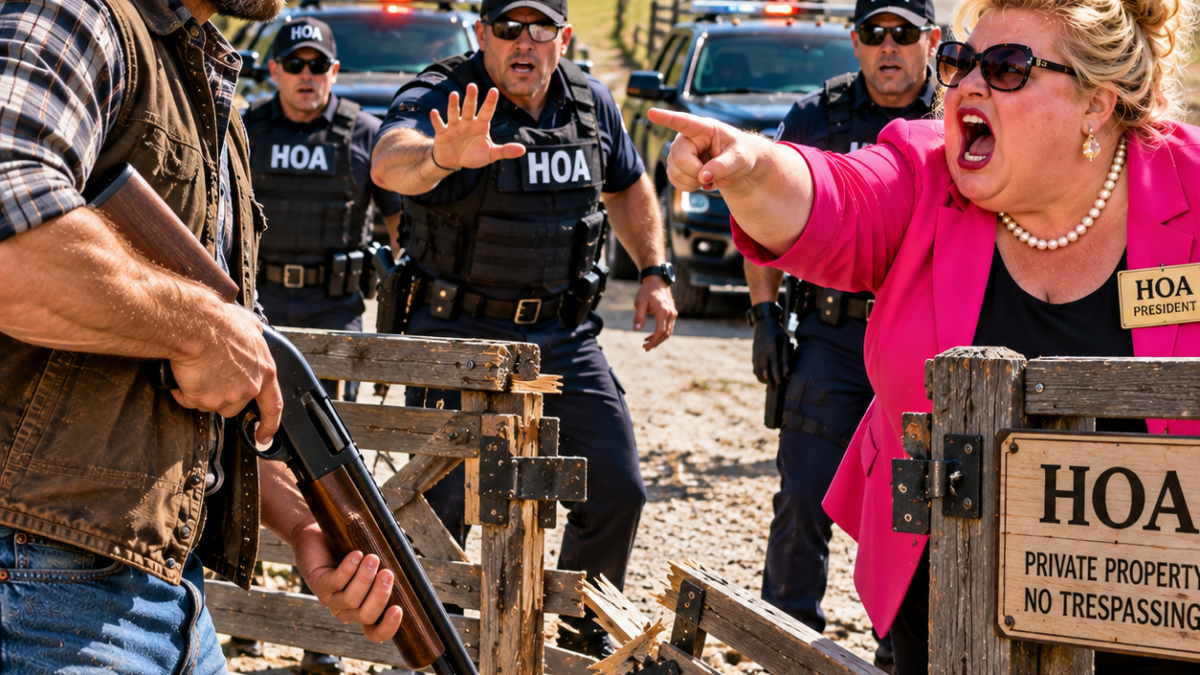
Gerald stepped out with a megaphone.
I called 911.
“My name is Albert Anderson. I’m at 4723 Saguaro Ridge Drive. An HOA crew is outside my property. They previously gave written notice that they intended to enter and dismantle my gate without a court order. I have an earlier case number.”
The dispatcher asked if I was safe.
“Yes.”
“Are there weapons present?”
“I have a legally owned firearm inside my home. I am not threatening anyone. I’m requesting deputies.”
She told me units were on the way and advised me to avoid confrontation.
Then Gerald raised the megaphone.
“Mr. Anderson, pursuant to HOA enforcement authority, you are ordered to open the gate.”
My phone recorded the dispatcher hearing him.
“You have sixty seconds.”
A man approached with bolt cutters.
Another carried a pry bar.
My stomach turned.
I stayed inside.
I shouted through the closed screen:
“You do not have permission to enter my property. Law enforcement has been called.”
Gerald answered through the megaphone.
“You were given proper notice.”
“Leave.”
“Failure to comply will result in forced access.”
“Leave my property.”
The crew hesitated.
Gerald lowered the megaphone.
“Continue.”
The first cutter closed around the lock.
Metal snapped.
I heard Elena’s gate cry against itself.
Something inside me nearly broke with it.
The men pushed.
One hinge twisted.
The sunburst buckled sideways.
The flatbed truck rolled forward.
My property line disappeared beneath its front tires.
The dispatcher’s voice came from my phone.
“Sir, units are close. Stay calm.”
I looked at the shotgun.
Then at the truck.
Then at the broken gate.
My father’s voice came back.
Respect what it can do.
I picked it up.
Kept the muzzle down.
Opened the front door.
Stepped onto the porch.
Every head turned.
Gerald froze.
The truck stopped.
I stayed near my front door, well back from the gate.
“My property,” I said. “No court order. No permission. Deputies are coming. Leave.”
Gerald’s eyes went to the shotgun.
Then to my face.
A smile appeared.
Not fear.
Opportunity.
He lifted his phone.
“Are you threatening us with a firearm?”
“No.”
“You are standing there armed.”
“I’m standing at my home. The weapon is pointed at the ground. I have called law enforcement. Leave.”
He held the phone higher.
“This is exactly the kind of dangerous behavior we warned residents about.”
The younger man with bolt cutters stopped moving.
“Gerald…”
“Keep going.”
Nobody moved.
Gerald shouted:
“He’s bluffing. Continue.”
The flatbed driver eased forward another few feet.
I did not raise the shotgun.
“Stop the vehicle.”
Gerald walked through the broken gate.
He had finally crossed the line himself.
“You’ve lost, Anderson.”
“No.”
“You should have removed the gate when I told you.”
“The sheriff is coming.”
“I don’t care.”
That sentence was still hanging in the desert air when we heard the sirens.
Faint.
Then louder.
Gerald looked over his shoulder.
The crew did too.
Two sheriff’s cruisers turned onto the street with lights flashing.
Everything changed at once.
The flatbed stopped.
Tools lowered.
Gerald’s face emptied.
The first deputy stepped out with a hand near his holster.
“Everyone stay where you are. Put the tools down. Homeowner, set the firearm down and step away from it.”
I did exactly that.
No argument.
No speech.
I placed it on the porch floor and stepped back with my hands visible.
Another deputy moved toward the crew.
“Tools down.”
Metal hit gravel.
Bolt cutters.
Pry bars.
A wrench.
Gerald tried to speak.
“Deputy, I’m Gerald Gomez, president of—”
“Hold on.”
The sergeant arrived moments later.
Ray Delgado.
I recognized his voice from the phone.
He took in the gate.
The truck.
The crew.
The tools.
Me.
The shotgun on the porch.
Then he started with the question that mattered.
“Who owns this property?”
“I do.”
Gerald interrupted.
“It is within Saguaro Ridge and subject to HOA enforcement.”
Delgado looked at him.
“I asked who owns it.”
“Mr. Anderson does, but—”
“Do you have a court order authorizing entry?”
“Our covenants allow—”
“Court order.”
Gerald’s jaw tightened.
“No.”
“Consent from the homeowner?”
“He was properly notified.”
“That’s not consent.”
Delgado turned toward me.
“You called before they entered?”
“Yes.”
“You told them not to enter?”
“Several times. The dispatcher heard it.”
Gerald pointed toward the porch.
“He threatened us with a shotgun.”
“I never pointed it at anyone.”
“You brought it outside!”
Delgado raised a hand.
“Everybody stop.”
He looked at me.
“Cameras?”
“Four.”
“Audio?”
“Front two.”
“Save everything.”
“It’s backed up automatically.”
He almost smiled.
“Of course it is.”
Software engineer.
Then Gerald made the mistake that ended his morning.
He couldn’t stand silence.
People like him often can’t.
They interpret silence as a vacuum authority must fill.
“This is ridiculous,” he said. “I’ve been president of this association for six years. Mr. Anderson has ignored repeated lawful enforcement. I personally authorized this action because somebody had to uphold standards.”
Delgado stared at him.
“You personally authorized forced entry?”
“Yes.”
“Without a court order?”
“We don’t need one for enforcement.”
“Who told you that?”
“I know the governing documents.”
The younger worker looked at Gerald.
“You said there was legal approval.”
Gerald snapped:
“There is.”
“From a judge?” the worker asked.
Gerald didn’t answer.
I went inside only after a deputy accompanied me.
I pulled up the camera footage.
The first clip showed the vehicles arriving.
Second:
Gerald’s megaphone ultimatum.
Third:
My repeated refusal.
Fourth:
The bolt cutters breaking the lock.
Then the side camera.
Gerald standing near the flatbed before they entered, phone against his ear.
His voice was faint but clear.
“Just go in. He won’t do anything. I’ll take responsibility.”
Delgado paused the video.
The room went quiet.
He looked toward the window where Gerald stood beside another deputy.
“Well.”
That one word contained an entire legal education.
Investigators separated everybody.
Statements.
Names.
Company information.
Who brought tools.
Who gave instructions.
Who believed what authority existed.
The workers’ confidence evaporated quickly.
Tony Breslin, the crew supervisor, kept repeating:
“He told us it was authorized.”
Delgado asked:
“Did you ask to see an order?”
“No.”
“Did you verify ownership?”
“No.”
“Did you hear the homeowner tell you to leave?”
Tony closed his eyes.
“Yes.”
“Then why did you continue?”
“Gerald said HOA rules overrode it.”
The words sounded embarrassing once spoken aloud.
By 8:20, Gerald was in the back seat of a sheriff’s cruiser.
He had not been convicted.
He had not been sentenced.
But he was being detained and ultimately booked in connection with the unlawful entry and property damage while investigators sorted out charges.
Tony and the others were released after statements, subject to further investigation.
Some would later cooperate.
I stood at the end of the driveway after the vehicles left.
The gate hung crooked.
One hinge ripped loose.
Sunburst bent.
The lock lay in the dirt.
I picked it up.
The metal fit in my palm.
Three months earlier, that gate had been the first thing I created after Elena died.
Gerald saw an architectural violation.
I saw the first proof that grief had not permanently emptied me.
That distinction was why the damage hurt so much.
My phone rang.
Lily.
I answered.
“Dad?”
Her voice shook.
“It’s over.”
“Are you okay?”
“Yes.”
“Are you sure?”
“I’m sure.”
“Did you…”
She couldn’t finish.
“No.”
I knew what she meant.
“No shots. Nobody hurt.”
She started crying.
So did I.
“Come home, sweetheart.”
Rosa drove her back.
The moment Lily saw the gate, she stopped in the driveway.
“Oh.”
Just that.
She walked toward the bent sunburst.
Touched it.
Then looked at me.
“I said I hated it.”
“You were angry.”
“I didn’t mean it.”
“I know.”
She pressed her forehead against my chest.
“I’m sorry.”
I held her.
“For what?”
“If I hadn’t complained—”
“This is not your fault.”
She looked up.
“I wanted you to take it down.”
“That doesn’t put bolt cutters in anybody’s hands.”
That was the last time I let her carry even an ounce of that guilt.
Two days later, Detective Maria Santos arrived.
She spent three hours at my dining table.
Every notice.
Every email.
The architectural approval.
Gerald’s visit.
Patrol logs.
Irrigation invoice.
Waste-service complaint.
Community-wide email.
Scheduled removal notice.
911 call.
Camera footage.
By the time she reached the final folder, she leaned back.
“You built all this yourself?”
“I’m an engineer.”
“I can tell.”
“Is that an insult?”
“Today it’s a compliment.”
She flipped through the documents again.
“Most victims bring us a story.”
“I brought both.”
“You brought a story with indexes.”
“That too.”
Her expression became serious.
“Mr. Anderson, I need you to understand something.”
“What?”
“The shotgun complicates the event.”
My stomach tightened.
“I know.”
“The footage helps. The dispatcher helps. Your compliance when deputies arrived helps. But any firearm at a confrontation increases risk.”
“I know.”
“If something like this ever happens again, stay inside unless you have no reasonable alternative.”
“I will.”
She watched me.
“You understand I’m not criticizing your fear.”
“I do.”
“I’m telling you because everybody was lucky.”
That landed.
Lucky.
Not heroic.
Not tough.
Lucky.
I thought about Gerald walking through the gate while I held my father’s shotgun.
One bad movement.
One frightened worker.
One deputy arriving at the wrong visual angle.
The story could have ended differently.
I nodded.
“I understand.”
Maria Santos closed the folder.
“Good.”
Then she added:
“Now let’s talk about Mr. Gomez.”
The investigation widened almost immediately.
Not because of the gate.
Because once deputies started asking about Gerald’s history, names appeared.
The Ewins.
The Crawfords.
Another family who had moved away two years earlier.
Kelly Reyes gave a statement.
Meredith Sloan gave one eventually too.
So did former board members.
The picture that emerged was not a criminal mastermind.
It was something more ordinary.
And in some ways more disturbing.
Gerald had spent years converting administrative authority into personal authority.
The Ewins grew vegetables in raised beds behind their fence.
Allowed under the original rules.
Gerald decided the structures were unsightly.
Warnings.
Fines.
Patrol visits.
Complaint letters.
Fourteen months later, they sold.
The Crawfords installed rooftop solar.
Protected by state law from unreasonable restrictions.
Gerald fought anyway.
Architectural objections.
Placement demands.
Letters.
Attorney expenses.
They spent nearly two years defending something they had a legal right to own.
Eventually, they moved too.
Another family challenged Gerald over desert landscaping.
Their trash collection suddenly became inconsistent.
Their guest-parking permits were repeatedly denied.
Small things.
Deniable things.
Nothing individually dramatic.
Together, exhausting.
Gerald’s strategy had rarely required winning in court.
He won by making daily life expensive.
Socially.
Emotionally.
Financially.
I recognized the pattern because I had lived it for three months.
Detective Santos called me one afternoon.
“Your gate wasn’t the beginning.”
“I know.”
“It might be the first time he physically crossed the line.”
“That you can prove.”
“Yes.”
“What happens now?”
“County attorney reviews.”
“Charges?”
“Don’t get ahead of it.”
“I’m asking.”
“Potential criminal trespass and criminal damage counts. Maybe conspiracy theories depending on evidence and how conduct is charged. We build what facts support.”
“Gerald?”
“Same answer.”
I hated that answer.
Because it was correct.
Meanwhile, Saguaro Ridge began imploding.
Someone posted Gerald’s arrest record from that morning.
Someone else posted my original architectural approval.
Then Meredith publicly confirmed the approval had never been revoked through a legitimate architectural process.
The community message board exploded.
WHY DID WE RECEIVE AN EMAIL SAYING IT WAS ILLEGAL?
WHO AUTHORIZED THE REMOVAL?
DID THE BOARD VOTE?
WHY WAS A PRIVATE CREW SENT TO HIS HOUSE?
WHO PAID FOR THAT TRUCK?
Gerald’s allies initially defended him.
“This is one side.”
“Albert threatened volunteers with a firearm.”
“The board was enforcing rules.”
Then the camera footage became part of public court filings.
Not every second.
Enough.
The lock cutting.
The truck entering.
My warnings.
Gerald saying:
“I’ll take responsibility.”
Support collapsed.
Kelly circulated a petition demanding a special election.
Thirty-seven signatures the first weekend.
Then eighty-three.
Then more than half the community.
The remaining board scheduled an emergency meeting.
They invited me.
I declined.
David asked why.
“You could stand in front of everybody and explain exactly what happened.”
“They have the video.”
“They should hear from you.”
“No.”
“You don’t want an apology?”
“From two hundred people at once?”
He smiled.
“Fair.”
“My fight is with Gerald and the board decisions that enabled him. If they want to rebuild, they need to do it without turning me into another strongman.”
David studied me.
“That’s surprisingly mature.”
“I’m offended.”
The civil case came next.
Gate replacement.
Landscape damage.
Documented service disruption losses.
Emotional distress claims.
Potential punitive damages depending on facts.
David filed against Gerald individually and included claims against the association based on its role and oversight.
We did not sue every neighbor.
We did not try to destroy the HOA.
That distinction mattered.
The first settlement offer arrived three weeks later.
Eighty thousand dollars.
No admission.
Confidentiality.
Mutual release.
David read the terms over the phone.
“You should think about it.”
“I have.”
“You have had six seconds.”
“No.”
“Albert.”
“I don’t want confidentiality.”
“That clause can sometimes be negotiated.”
“I want the written facts public.”
“Money is guaranteed. Trial isn’t.”
“I know.”
“Civil cases can take years.”
“I know.”
“Juries are unpredictable.”
“I know.”
“You’re becoming annoying.”
“Bill me.”
“I already do.”
I stood in the garage looking at the bent section of gate Jorge had temporarily braced against the wall.
“Elena built her life around telling people the truth without making a show of it. I’m not signing something that lets the HOA pretend nothing happened.”
David was quiet.
Then:
“I’ll reject it.”
That evening Lily found me on the porch.
“Was that the lawyer?”
“Yes.”
“Settlement?”
“Yes.”
“How much?”
“Enough.”
“You said no?”
“Yes.”
She sat beside me.
“Mom would call that stubborn.”
“She married me.”
“She also complained about you constantly.”
“Selective memory is part of grief.”
Lily smiled.
Then she became serious.
“The prom committee emailed me.”
“And?”
“They want me back.”
“Do you want to go back?”
She thought about it.
“No.”
That surprised me.
“Why?”
“I spent months begging people to like me who dropped me the second their parents told them our family was a problem.”
“That’s a little harsh.”
“It’s accurate.”
“You can forgive people without trusting them immediately.”
“I know.”
She looked toward the broken gate.
“I’m going to prom.”
“With?”
“Maya.”
“Friend Maya?”
“Yes.”
“As friends?”
“Dad.”
“I’m clarifying logistics.”
“You’re terrible.”
Elena would have laughed.
Lily’s healing did not happen because Gerald was arrested.
It happened in small repairs.
Maya came over again.
One teacher apologized.
The classmate who started the surveillance rumor sent a text:
My dad was repeating what Gerald told him. I’m sorry.
Lily did not answer for two days.
Then she wrote:
Thank you for apologizing.
Nothing more.
Enough.
She began sleeping with her curtains open again.
Stopped checking the street every time a car slowed.
One afternoon I caught her photographing the saguaros.
“For what?”
“Documentation.”
I stared.
She smiled.
“In case anybody says the irrigation thing didn’t happen.”
“You’re turning into me.”
“That’s upsetting.”
The county attorney eventually filed charges arising from the gate incident.
The case was narrower than neighborhood gossip wanted.
That was appropriate.
Gerald faced criminal exposure tied to trespass and property damage, along with liability theories related to ordering the crew onto my property.
Tony Breslin cooperated.
The other workers gave statements confirming Gerald told them the action was lawful.
One worker admitted he questioned the lack of court paperwork.
Gerald had responded:
“HOA enforcement doesn’t need judges.”
That line did not age well.
Then Detective Santos found another piece.
An email Gerald sent the night before the forced removal.
To the board.
Subject:
FINAL ENFORCEMENT.
He wrote:
Anderson will likely attempt intimidation. Crew has been instructed to proceed regardless. We must demonstrate that resident resistance does not override board authority.
Demonstrate.
That word mattered.
The gate removal wasn’t simply about compliance.
Gerald wanted an example.
He needed the neighborhood to watch me lose.
Instead, everybody watched him get arrested.
Six months later, I sat in a Pima County courtroom.
Gerald looked smaller without the HOA polo.
Dark suit.
Silver hair less perfect.
His attorney had spent months challenging the state’s interpretation.
Eventually, Gerald accepted a plea agreement rather than risk trial.
The judge reviewed the facts.
Forced entry.
Property damage.
Prior written dispute.
Lack of court authorization.
Recorded instruction.
Gerald’s admission at the scene.
The final sentence did not look like the revenge fantasies neighbors had invented.
No dramatic decade in prison.
No judge screaming.
Two years of supervised probation.
Two hundred hours of community service.
Restitution obligations tied to criminally documented loss.
A long prohibition from serving in HOA leadership as part of the broader resolution and association settlement.
Gerald stood still.
The judge asked if he understood.
“Yes, Your Honor.”
“Anything you wish to say?”
His attorney leaned toward him.
Gerald shook his head.
“No.”
The man who once couldn’t tolerate five seconds of silence had finally learned when not to fill it.
Outside the courtroom, Tony approached me.
Baseball cap in both hands.
“Mr. Anderson.”
“Tony.”
“I know sorry doesn’t fix the gate.”
“No.”
“Gerald said it was legal.”
“I know.”
“I believed him.”
“I know.”
“I shouldn’t have.”
That was the first thing he said that mattered.
I looked at him.
“Why did you?”
He frowned.
“What?”
“Believe him.”
“He was HOA president.”
“That’s a title.”
“He had paperwork.”
“Did you read it?”
“No.”
“He had a court order?”
“No.”
“Did you hear me tell you to leave?”
Tony looked down.
“Yes.”
I waited.
Finally:
“I should’ve stopped.”
“Yes.”
He nodded.
“I will next time.”
“Ask questions next time.”
He looked at me.
“That’s all?”
“That’s plenty.”
We shook hands.
He left.
I never saw him again.
The civil case continued.
The HOA insurer watched the criminal resolution carefully.
Two weeks before trial, a new offer arrived.
One hundred twenty thousand dollars.
Full legal fees.
Formal written apology.
Board acknowledgment that the entry and gate destruction had not been lawfully authorized.
No confidentiality requirement.
David placed the papers in front of me.
“This is different.”
I read every page.
“Gerald signs?”
“His portion, yes.”
“Board?”
“Remaining directors.”
“Public record?”
“The filed dismissal and related documents will reflect resolution. The apology itself is not hidden by NDA.”
“Legal fees fully covered?”
“Yes.”
“Gate?”
“Separate replacement cost included in calculations.”
I looked at him.
“What do you think?”
“I think trials are risky.”
“That is the most lawyer answer possible.”
“I worked hard on it.”
I signed.
Not because I had stopped caring about principle.
Because the principle was finally in the document.
Unauthorized.
Unlawful entry.
Damage.
Responsibility.
No gag order.
Accountability did not require a jury to say the same words louder.
The HOA held a special election.
Gerald’s remaining loyalists lost.
Kelly Reyes won a board seat.
Meredith Sloan returned to architectural review after residents asked her to.
The new board’s first months were ugly.
People distrust government most right after discovering government lied to them.
Even tiny government.
Meetings lasted hours.
Every enforcement action was challenged.
Every expense questioned.
Every rule reopened.
Kelly called me one night.
“You ruined us.”
“Good evening to you too.”
“Do you know how long we argued about trash cans?”
“No.”
“Two hours.”
“That seems excessive.”
“Half the room thinks any rule is tyranny now.”
“And the other half?”
“Wants Gerald back because meetings used to be shorter.”
I laughed.
She didn’t.
“This is your fault.”
“You wanted democracy.”
“I was young.”
“You’re forty-six.”
“Exactly.”
The new rules eventually settled.
Written notice.
Meaningful opportunity to appeal.
No physical entry for enforcement without lawful authority.
Major architectural reversals required documented reasons and board review.
Conflict disclosures.
Clear records.
Independent legal consultation before serious property actions.
None of it was revolutionary.
That was the point.
A healthy system is usually boring.
Gerald had made HOA leadership exciting because everything flowed through him.
Excitement is often a terrible design principle for governance.
The hardest part was rebuilding the gate.
Jorge came to the house a week after the civil settlement.
He stood in the driveway looking at the bent frame.
“They really did this?”
“Yes.”
He touched the sunburst.
“Idiots.”
“I was hoping for a more technical assessment.”
“That is technical.”
He inspected each joint.
“We can repair some.”
“Some?”
“Main frame twisted.”
I looked down.
“Can you make it exactly the same?”
Jorge looked at me.
“Do you want exactly?”
“Yes.”
“Why?”
I frowned.
“Because it was Elena’s.”
“No.”
He shook his head.
“It was yours.”
“She inspired it.”
“You designed it.”
“Same difference.”
“Not same.”
Jorge had known Elena casually.
She brought lemonade when he installed the original.
He pointed toward the house.
“She died.”
“Yes.”
“You made gate after.”
“Yes.”
“Then gate is part of what came after.”
I didn’t like hearing that.
He continued.
“You keep trying to freeze grief, metal breaks.”
“I came here for welding, not therapy.”
“Therapy costs more.”
I laughed despite myself.
He said:
“I rebuild same design. But new gate should have something from now too.”
“What?”
“Your choice.”
I thought about it for several days.
Then Lily solved it.
She was sketching at the kitchen table.
“What if the rays are slightly longer?”
“No.”
“Dad.”
“Your mother said six.”
“I know.”
“You don’t argue with a dead woman about design.”
“She’d appreciate the argument.”
Maybe.
We kept six rays.
But Jorge added a small inscription on the back where the street couldn’t see it.
Three words.
STILL STANDING HERE.
Not “Stand Your Ground.”
Not a threat.
Not a challenge.
A fact.
The gate went up in late June.
Same dark iron.
Same sunburst.
New hinges.
Stronger posts.
I stood where I had stood the first time years earlier.
My hand touched the warm metal.
Lily walked up beside me.
“You crying?”
“No.”
“Your face is wet.”
“Desert humidity.”
“We live in Tucson.”
“Exactly. Very dangerous.”
She leaned her shoulder against mine.
“Mom would like it.”
“You think?”
“She’d complain the inscription is dramatic.”
“Definitely.”
“And then secretly love it.”
We stood there until Jorge’s truck disappeared.
Lily graduated the next month.
Bright Arizona morning.
Cap crooked because she refused to let me fix it.
I sat between Rosa and Maya’s mother while names were called.
When Lily crossed the stage, I expected to think about the HOA.
I didn’t.
I thought about Elena.
The day Lily was born.
Elena exhausted, furious, laughing.
“Look what we made.”
Now that baby walked across a stage in heels, collected a diploma, and smiled into a crowd without fear.
Afterward, she ran toward me.
“Did you cry?”
“No.”
“Rosa has video.”
“Fabricated.”
“You’re impossible.”
She had been accepted to the University of Arizona.
Close enough to come home.
Far enough to build a life that didn’t revolve around mine.
The night before she left for orientation, we sat on the porch.
The gate stood at the end of the driveway.
Repaired saguaros beyond it.
“Dad?”
“Yeah?”
“Can I tell you something?”
“That usually means I won’t like it.”
“I’m glad you didn’t take the gate down.”
I looked at her.
“You weren’t at the time.”
“I was scared.”
“So was I.”
“I thought giving them what they wanted would make everything normal.”
“So did I.”
“What changed?”
I thought about it.
“They showed us normal wasn’t what they wanted.”
She nodded.
“They wanted you to admit they were right.”
“More or less.”
She stared at the gate.
“I learned something.”
“Dangerous.”
“Standing up for yourself isn’t the same as looking for a fight.”
I smiled.
“That sounds suspiciously mature.”
“And backup cameras are always good.”
“There she is.”
She laughed.
That sound did more for me than any settlement.
The summer barbecue happened two weeks later.
The first one under the new board.
Kelly insisted I come.
I tried to refuse.
“You sued us,” she said.
“Exactly why I shouldn’t attend.”
“You sued the association.”
“I live in the association.”
“Then technically I sued myself.”
“See? Community healing.”
She hung up before I could argue.
Eight families came to my house instead of using the clubhouse.
People brought food.
Children ran across the gravel.
Someone put folding chairs under mesquite trees.
The Ewins drove down from Phoenix.
I had never met them.
Mrs. Ewin was in her sixties.
She walked straight toward me and hugged me before introducing herself.
“Thank you.”
I stood awkwardly.
“For what?”
“For finishing something we couldn’t.”
I looked at her husband.
He nodded.
She glanced toward the gate.
“We had raised gardens.”
“I heard.”
“Tomatoes.”
“Gerald hated tomatoes?”
“He hated losing.”
That sounded right.
“What happened?”
Mrs. Ewin looked toward the children.
“After fourteen months, I couldn’t sleep.”
Her husband said:
“Every envelope felt like a threat.”
She added:
“Our son stopped visiting because every time he parked overnight, Gerald found something wrong with his truck.”
They sold.
Lost money.
Moved.
She looked at me.
“I used to think leaving meant he won.”
“Maybe it meant you survived.”
Her eyes filled.
“That’s kind.”
“It’s also true.”
Not everybody can fight every battle.
That was something I understood better after watching Lily suffer.
If Gerald had pushed another month before the gate incident, maybe I would have moved.
Maybe I would have chosen my daughter over the house.
That wouldn’t make me weak.
It would make me a father.
The Ewins had made the decision they needed.
Justice should never require victims to prove courage by destroying themselves.
After the barbecue ended, I sat alone on the porch.
The gate’s sunburst held the last orange light.
I thought about the morning it broke.
The shotgun.
Sirens.
Gerald.
For months, people told the story as if the weapon had been the turning point.
It wasn’t.
The cameras were.
The 911 call was.
The approval letter was.
The witnesses were.
The paper trail was.
The decision not to fire was.
That last one mattered most to me.
Detective Santos had been right.
Everyone got lucky.
I eventually returned my father’s shotgun to the safe.
Weeks passed without me checking it.
Then months.
That felt like healing.
I didn’t want the symbol of that morning to become a gun.
I wanted it to remain the gate.
One destroyed.
One rebuilt.
The distinction between them was the whole story.
A year later, I received a letter.
No HOA logo.
No attorney letterhead.
Plain envelope.
Gerald Gomez.
I almost threw it away.
Then opened it.
Albert,
I have been advised not to contact you, so I understand if this letter is unwelcome. My attorney confirmed I may send one written apology through counsel.
What I did was wrong.
I convinced myself that maintaining standards justified decisions that should never have been mine alone. When you challenged me, I treated it as disrespect rather than disagreement. I escalated because I thought backing down would make me look weak.
I damaged your property. I frightened your daughter. I involved other residents and employees in something they should never have been asked to do.
I am sorry.
Gerald.
I read it twice.
Then once more.
Lily was home from college that weekend.
She found me at the kitchen table.
“What’s that?”
“Gerald.”
Her face changed.
“What does he want?”
“Nothing.”
“That’s suspicious.”
“He apologized.”
She stared.
“Like, apologized apologized?”
“Seems so.”
“Do you believe him?”
“I don’t know.”
She sat down.
“Does it matter?”
I looked at the letter.
“No.”
She nodded.
“Then why do you look weird?”
“Because I spent a year imagining what I wanted him to understand.”
“And?”
“He seems to understand some of it.”
“Does that make you feel better?”
I thought.
“A little.”
Lily took the letter.
Read it.
Then put it down.
“He mentioned me.”
“Yes.”
“He should.”
“Yes.”
She looked at me.
“You gonna answer?”
“No.”
“Why?”
“I don’t have anything useful to say.”
She nodded.
“That’s probably healthy.”
“College has ruined you.”
She smiled.
I placed the letter in the same file as the original violation notice.
Not because the apology erased anything.
Because records should contain endings too.
Years passed.
Saguaro Ridge became ordinary.
Kelly served two board terms and refused a third.
Meredith chaired architectural review for one year, then quit because she said arguing about exterior paint was bad for her blood pressure.
The board made mistakes.
Residents complained.
People accused them of incompetence.
Sometimes they were incompetent.
That was fine.
Incompetence can be corrected.
Unquestioned authority is harder.
Lily graduated from college four years later.
Computer science.
To my horror.
“I blame genetics,” she said.
“Your mother was a biologist.”
“Then I blame trauma.”
She took a job in Tempe.
On moving day, she stood beside the gate with a cardboard box in her arms.
“Take care of it.”
“The house?”
“The gate.”
“Absolutely not. You called it stupid.”
“I was seventeen.”
“You said you hated it.”
“I was emotionally compromised.”
“I have witnesses.”
She put the box down and hugged me.
Then whispered:
“It feels like Mom.”
That got me.
I held her longer than necessary.
“Call me.”
“I will.”
“Every day.”
“No.”
“Three times a day.”
“No.”
“Once.”
“Maybe.”
She drove away.
I stood by the gate until her car disappeared.
The house became quiet again.
Different from after Elena died.
Not empty.
Just mine.
I had spent years thinking peace meant nobody disturbing you.
That was not what I learned.
Peace is knowing disturbance does not own you.
Gerald disturbed everything.
My home.
My daughter.
My grief.
My sense of safety.
The answer wasn’t building higher walls.
It was restoring proportion.
One patrol SUV stopped feeling like an invading army.
One HOA envelope became paperwork again.
A slowing car no longer sent me toward the window.
A knock at night stopped accelerating my pulse.
Healing happened so gradually I noticed only after it had already happened.
On the fifth anniversary of the gate incident, Jorge visited.
He was retiring.
“Hands hurt,” he said.
“You’re getting old.”
“So are you.”
“Unnecessary.”
He walked to the gate.
Touched the inscription.
STILL STANDING HERE.
“Good words.”
“Lily chose them.”
“Smart daughter.”
“She gets it from Elena.”
“And software engineering?”
“Unclear genetic defect.”
He laughed.
Then looked at the sunburst.
“You know what’s funny?”
“What?”
“First gate was prettier.”
I stared.
“You waited five years to say that?”
“Customer was emotional.”
“You are terrible businessman.”
“Retired businessman.”
He pointed at the top curve.
“Original had softer line.”
“Can you fix it?”
“No.”
“Why?”
“I’m retired.”
“I hate you.”
He smiled.
“Good gate.”
We sat on the porch.
I told him about Gerald’s apology.
Jorge listened.
Then shrugged.
“You accept?”
“I didn’t respond.”
“That was not question.”
“What do you mean?”
“You accept for yourself?”
I looked toward the gate.
“I think so.”
“Good.”
“You’re suddenly a philosopher too?”
“No. Old.”
Apparently age is a credential people use whenever they say something profound.
Jorge left before sunset.
I made coffee.
Sat in the chair Elena used to use.
The desert turned copper.
Saguaro shadows stretched across the road.
A coyote called somewhere beyond the wash.
I looked at the gate.
For years, I had thought of it as a memorial to Elena.
Then as a battleground.
Then evidence.
Then settlement property.
Then victory.
Eventually it became what it had been designed to be.
A gate.
That was the best thing that happened to it.
Objects should be allowed to stop carrying our wars.
The following spring, the HOA sent an architectural notice.
I laughed before opening it.
Not a violation.
A proposed community-wide update.
Residents were invited to comment on allowing greater variety in entry gates.
I read it twice.
Then started laughing harder.
Kelly happened to call.
“What?”
“You people finally legalized individuality.”
“What are you talking about?”
“The gate proposal.”
“Oh.”
“Gerald would explode.”
“Don’t summon him.”
“Who wrote it?”
“A new couple on Mesa Vista wants a custom gate.”
“What design?”
“Moon and stars.”
I leaned back.
“Tell them eight rays are too many.”
“What?”
“Nothing.”
At the public meeting, I went for the first time in years.
Not because I cared about the rule.
Because Lily happened to be visiting and thought it would be funny.
A young homeowner presented drawings.
The board asked questions.
Materials.
Height.
Lighting.
No one threatened them.
No one said community standards with religious intensity.
People debated whether the design matched desert architecture.
One resident hated it.
Another loved it.
A vote was taken.
Approved.
The couple smiled.
Lily elbowed me.
“Look at that.”
“What?”
“Civilization.”
“Barely.”
On the way out, an older resident stopped me.
“You’re Anderson.”
“Yes.”
“The gate guy.”
“I have a name.”
He laughed.
“I moved in last year. People told me the story.”
“People exaggerate.”
“They said you stood off seven HOA cops with a shotgun.”
I closed my eyes.
“There were no HOA cops.”
“That’s what I thought.”
“They were private enforcement workers.”
“So you didn’t have the shotgun?”
“I had an inherited firearm at my home during a forced entry. Deputies arrived. Nobody fired anything.”
His expression showed mild disappointment.
“That version’s less exciting.”
“It’s more accurate.”
Lily said:
“Dad’s very boring about accuracy.”
“I like your daughter.”
“She’s for sale.”
We left.
In the parking lot, Lily laughed.
“Seven HOA cops.”
“Internet storytelling is a disease.”
“You realize nobody is ever going to tell it the boring way.”
“They should.”
“Dad.”
“What?”
“You came onto the porch holding Grandpa’s shotgun while a truck drove through a gate Mom inspired.”
“When you say it like that…”
“It’s dramatic.”
“I hate this family.”
She linked her arm through mine.
“No you don’t.”
No.
I didn’t.
That night, Lily and I sat on the porch.
She had brought old photos from storage.
Elena at twenty-five.
Elena pregnant.
Lily at five wearing fairy wings.
Our old Phoenix kitchen.
Then one photograph I had forgotten.
Elena sitting at the dining table during chemotherapy.
My first gate sketch in front of her.
She was pointing at it with a pen.
I stared.
“Where did you find this?”
“Mom’s old phone backup.”
I zoomed in.
The sketch.
Eight rays.
Elena had crossed out two.
Six remained.
I laughed.
“What?”
“She really did critique the rays.”
“You thought I made that up?”
“No. I just forgot anybody photographed it.”
Lily looked toward the gate.
“Same design.”
“Mostly.”
“Does that make you sad?”
I studied the photograph.
Elena’s hair was thin.
Face tired.
Eyes alive.
“No.”
That surprised me.
For years, every photograph from her illness came with an ache.
Now I could see more than cancer.
I could see Elena making fun of me.
Working.
Still participating in the world.
Still herself.
“Put that one in a frame,” I said.
Lily smiled.
“I already did.”
She pulled a small frame from the box.
Of course she had.
We put it on the mantel.
Not beside the shotgun.
That stayed locked away.
Beside Elena’s favorite ceramic bowl and Lily’s graduation photo.
A life.
Not a case file.
Sometimes I still think about that 6:47 morning.
Not the way people tell it.
Not as the day I “stood down the HOA.”
I remember the sound first.
Metal tearing.
Then fear.
The knowledge that several bad decisions had converged in my driveway.
Gerald’s pride.
My anger.
A frightened work crew.
A firearm.
Incoming deputies who did not yet know who was who.
Any one mistake could have turned a property dispute into tragedy.
That matters.
The satisfying part of the story is not that I had a shotgun.
It’s that nobody used one.
The satisfying part is that cameras kept talking after everybody’s memory became self-serving.
That the approval letter survived.
That Lily came home.
That Gerald faced consequences.
That former residents finally got believed.
That the gate was rebuilt.
That the system changed.
The weapon was not the victory.
Restraint was.
I didn’t understand that immediately.
I do now.
Years after Gerald disappeared from my daily life, another HOA president knocked on my door.
Kelly had long since left the board.
The new president was Marcus Lee.
Accountant.
Forties.
Nervous personality.
He stood on the porch holding a folder.
“Albert, do you have a minute?”
I looked at the folder.
“That depends. Is my gate illegal again?”
His face went pale.
I laughed.
“Sorry.”
“People warned me never to joke about your gate.”
“Smart people.”
He handed me the folder.
“We’re updating emergency procedures.”
“Okay.”
“I wanted you to review the section about contractor access.”
“Why me?”
He looked at me as if that was obvious.
I read it.
No forced entry for covenant enforcement absent lawful authority.
Emergency exceptions narrowly defined for immediate safety hazards and government orders.
Required legal review.
Owner notice.
Board vote.
Documentation.
I handed it back.
“This seems reasonable.”
“Anything missing?”
“Common sense.”
“We can’t put that in bylaws.”
“Then we’re doomed.”
He smiled.
At the sidewalk, he stopped.
“My wife asked me something.”
“What?”
“She said if this happened again, would you do the same thing?”
I looked toward the gate.
“No.”
Marcus looked surprised.
“No?”
“I’d stay inside and wait for deputies.”
He nodded.
“Probably wise.”
“Wisdom usually arrives after the interesting part.”
He left.
I stood on the porch.
That answer had taken years to become true.
At the time, stepping outside felt necessary.
Looking back, I could see other choices.
Maturity sometimes means losing affection for your own dramatic moments.
The final piece of the story arrived from Detective Santos.
She retired.
Sent me an email before leaving.
Subject:
ONE LAST FILE.
Attached was a scanned photograph from the original case.
The broken gate at sunrise.
Gerald in the background beside a cruiser.
Me sitting on the porch steps after Lily returned.
No shotgun.
No deputies in dramatic poses.
Just me.
Head down.
Holding the broken lock.
I stared at that photograph longer than I expected.
The man in it looked old.
Not physically.
Emotionally.
He had spent eighteen months surviving his wife’s death.
Then three months defending a gate.
He believed holding onto one object might hold together everything else.
I wanted to tell him:
You’ll be okay.
Lily will be okay.
The gate will return.
You will eventually stop checking the street.
You will stop replaying Gerald’s voice.
You will use the porch for coffee again.
You will laugh about this.
Not soon.
But eventually.
I printed the photograph.
Then did something I didn’t expect.
I put it in the same drawer as the old violation notices.
Not on the wall.
Some things belong in archives.
Not living rooms.
That evening, I walked down the driveway.
The repaired gate opened smoothly.
I stepped outside.
Turned.
Looked back at the house.
Elena’s house.
Lily’s house.
Mine.
No patrol SUV.
No convoy.
No men in white polos.
Just desert light.
I closed the gate.
The sunburst aligned in the center.
Behind it, hidden from the street, were the words Jorge added years earlier.
STILL STANDING HERE.
I touched them once.
Then walked back toward the porch.
The coffee waiting there had gone cold.
As usual.
I drank it anyway.
Above the mountains, the sky shifted from gold to violet.
The house behind me was quiet.
Not the fearful quiet of that night before the forced entry.
Not the hollow quiet after Elena died.
Ordinary quiet.
The kind I had moved to Arizona hoping to find.
It had taken longer than I expected.
Cost more than I wanted.
And taught me things I would rather have learned another way.
But Lily was safe.
The gate was standing.
The neighborhood had learned to question authority instead of worshiping it.
Gerald Gomez had become a name in an old folder instead of a presence in our lives.
And Elena’s sun still rose in iron at the end of my driveway every morning.
That was enough.
More than enough.
I turned off the porch light.
Locked the door from habit, not fear.
And went inside.
[END OF STORY]








