PART 2: HOA “Cops” Tried to Break Into My Truck—Then Called 911 on the County Sheriff
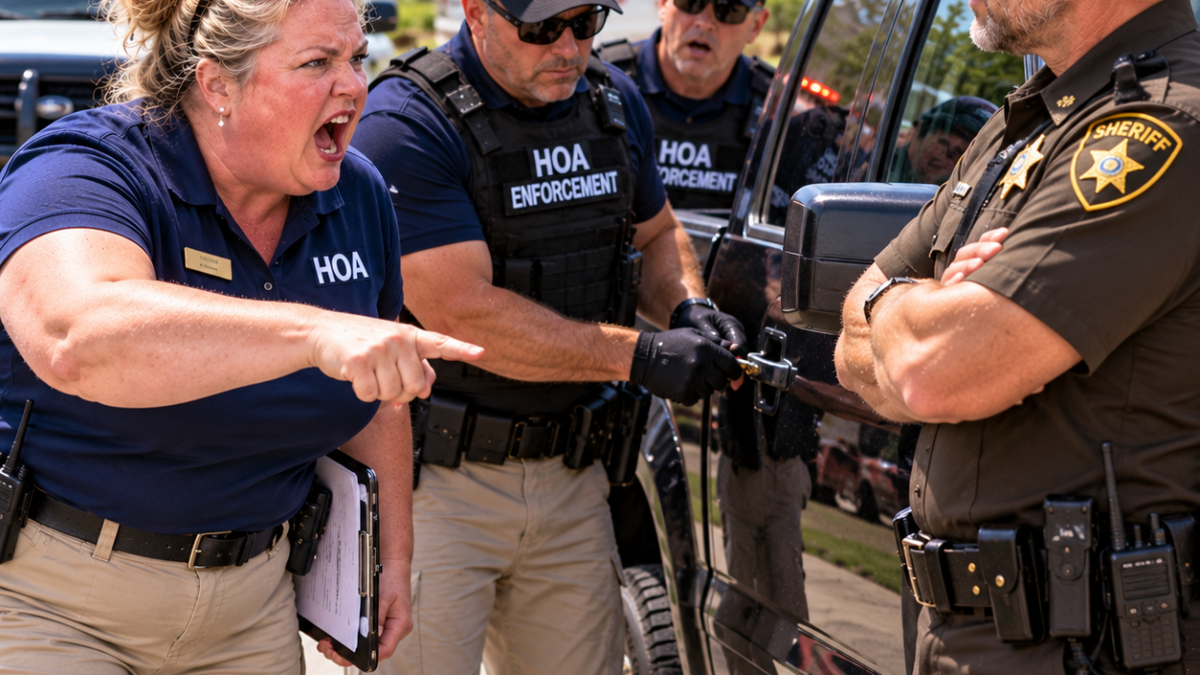
PART 2
The first siren reached Pinewood twelve minutes later.
I knew the sound before the patrol car turned onto my street.
County unit.
Not city police.
Summit County Sheriff’s Office.
My office.
I remained behind the living-room blinds as two marked cruisers came around the curve.
Unit Fourteen.
Unit Twenty-Two.
Deputies Jake Torres and Judy Mendoza.
Two people I trusted.
Two people who had sat in briefing with me less than forty-eight hours earlier.
Rick Dutton straightened immediately.
That change fascinated me.
Seconds earlier, he had been sitting in the HOA patrol SUV looking frustrated.
Now he stepped out, squared his shoulders, adjusted his uniform, and became Officer Dutton in his own mind.
The younger security guard remained beside the passenger door.
He looked increasingly uncomfortable.
Torres and Mendoza approached with professional caution.
Nothing drawn.
Hands visible.
Eyes moving.
The way trained deputies enter a scene where the caller’s description might not match reality.
Rick met them halfway up my driveway.
He pointed toward my F-150.
I couldn’t hear every word, but I didn’t need to.
The dashcam would catch most of it.
And Torres had already done what any competent deputy would do.
He ran the license plate.
Which meant he knew exactly who owned the truck.
I watched his expression from fifty feet away.
Almost nothing changed.
That was why I trusted him.
He didn’t grin.
Didn’t look toward the house and call my name.
Didn’t ruin the scene.
He listened.
Rick gestured dramatically.
Mendoza took notes.
The younger guard shifted from one foot to the other.
Then a silver Mercedes appeared at the end of the street.
Of course.
Barbara Walker.
She parked behind the patrol cars and stepped out wearing a cream-colored blazer, pearl earrings, and heels that made no sense at seven in the morning.
She carried a folder.
The same kind of folder she always carried when she wanted paperwork to look like authority.
Barbara joined Rick.
Then handed something to Torres.
I finally stood.
Straightened my shirt.
Walked to the front door.
The morning air was cold enough to wake every part of me that coffee hadn’t reached.
I stepped onto the porch.
Rick saw me first.
His explanation stopped mid-sentence.
Torres turned.
Recognition passed across his face.
Then disappeared.
Professional.
“Sir,” he said, “are you the owner of this residence and the Ford F-150?”
“Yes.”
“Name?”
“Ethan King.”
Rick cut in.
“This is exactly what I was explaining. Mr. King has been refusing HOA compliance requests for weeks.”
Torres looked at him.
“What does that have to do with the 911 call?”
Rick hesitated.
Barbara answered.
“This morning our security personnel observed suspicious activity involving the vehicle.”
“What kind of activity?” Mendoza asked.
Rick pointed toward my truck.
“The door appeared tampered with.”
For a second, I genuinely wondered whether he had forgotten who had done the tampering.
Mendoza looked at the window frame.
Fresh marks.
Then at the lockout tool still clipped to Rick’s belt.
“What kind of tampering?”
Rick shifted.
“We approached to conduct a routine vehicle verification.”
“Routine according to whom?”
“The HOA.”
Torres’s voice remained neutral.
“Did the vehicle owner give you permission?”
Barbara stepped in.
“Pinewood security has broad authority to inspect vehicles that threaten community safety.”
I walked down the porch steps.
“No, they don’t.”
Barbara turned toward me.
“You’ve been uncooperative since the day you arrived.”
“Being uncooperative isn’t illegal.”
“You threatened Mr. Dutton.”
Torres looked at me.
“Did you?”
“No.”
Barbara opened her folder.
“He reported that you told him he would regret approaching your vehicle.”
I looked at Rick.
“When?”
His jaw tightened.
“This morning.”
I nodded slowly.
“That’s interesting.”
Rick said nothing.
“I haven’t spoken to you this morning.”
Barbara’s face changed slightly.
Not much.
Enough.
I continued.
“I was inside my house while Mr. Dutton spent approximately fifteen minutes attempting to open my locked truck with the tool currently hanging from his belt.”
Nobody spoke.
Rick went pale.
Barbara recovered first.
“That’s absurd.”
I pointed toward the windshield.
“My dashcam says otherwise.”
Torres looked at the camera.
“Is it recording continuously?”
“Motion activated. Cloud backed up.”
“Any exterior cameras?”
“Three.”
Barbara stared at me.
Rick’s younger guard looked like he wanted the pavement to swallow him.
I continued.
“The cameras show Mr. Dutton inserting a lockout tool into my driver’s door multiple times.”
Rick opened his mouth.
I raised one hand.
“They also show him kicking my tire and striking the driver’s door.”
I pointed to the dent.
Torres walked over.
Looked.
Mendoza followed.
“Fresh?” she asked.
“About twenty minutes.”
Then I added the part Barbara didn’t know I had heard.
“The audio also captured Mr. Dutton calling Mrs. Walker after he failed to gain entry.”
Barbara’s face lost color.
“He suggested calling law enforcement and reporting my truck as suspicious so deputies would come here.”
“That’s a lie.”
She said it too quickly.
I looked at her.
“You haven’t watched the footage.”
Silence.
That was the problem with denying evidence before you know what it contains.
Torres returned.
“Mr. King, can you confirm registration?”
“I can.”
He already knew.
But he needed the record.
That mattered.
I reached into my pocket.
Both Barbara and Rick reacted.
Not dramatically.
A small involuntary flinch.
I withdrew a leather credential case.
Opened it.
The badge caught the early sunlight.
SHERIFF.
SUMMIT COUNTY.
Ethan King.
For three seconds, nobody said anything.
Barbara stared.
Rick stared harder.
The younger guard whispered:
“Oh, no.”
Torres kept his face professionally blank.
Mendoza was less successful.
One corner of her mouth moved.
I closed the badge case.
“Deputy Torres, Deputy Mendoza, I’m the registered owner of the vehicle, and I’m requesting a formal report regarding attempted unauthorized entry and property damage.”
Rick took half a step backward.
Barbara found her voice.
“You’re the sheriff?”
“Yes.”
“You deliberately concealed that.”
“From my neighbors?”
Her mouth opened.
I continued.
“I’m allowed to live in my own house without announcing my occupation.”
“This is entrapment.”
“No.”
My voice stayed calm.
“I did not ask Mr. Dutton to come onto my property.”
I pointed toward the truck.
“I did not give him the lockout tool.”
Another pause.
“I did not tell him to damage my vehicle.”
I looked at Barbara.
“And I did not tell you to call 911.”
The younger guard suddenly raised both hands.
“I told Rick we should leave.”
Rick turned.
“Shut up, Tyler.”
Torres immediately looked at the young man.
“Your name is Tyler?”
“Tyler Reeves.”
“How long have you worked for Pinewood security?”
“Six months.”
“Were you involved in trying to enter the truck?”
“No.”
Rick snapped:
“He was lookout.”
Tyler’s face changed.
“Rick!”
Interesting.
People start rewriting alliances very quickly when consequences become real.
Mendoza separated them.
“Mr. Reeves, come over here.”
Tyler complied.
Torres remained with Rick.
“Mr. Dutton, I need you to remove the lockout tool from your belt slowly and place it on the ground.”
Rick stared at me.
“This is private security equipment.”
“Put it on the ground.”
“I’m authorized to possess it.”
“I didn’t say you weren’t.”
Torres’s tone sharpened slightly.
“I said place it on the ground.”
Rick obeyed.
Barbara stepped toward Torres.
“I need to call our attorney.”
“You’re free to call counsel.”
“Then this conversation is over.”
Torres looked at her.
“You called 911.”
That stopped her.
“We’re investigating the report you requested.”
Barbara’s confidence slipped.
“I called because Mr. King’s vehicle was suspicious.”
“What made it suspicious?”
“The HOA has issued multiple violations.”
“That doesn’t make a vehicle stolen.”
“It’s noncompliant.”
“Noncompliant with what?”
“Our community standards.”
Mendoza looked at her.
“Is community aesthetics a criminal offense in Pinewood?”
A neighbor laughed from somewhere behind us.
That was when I noticed people were emerging from their houses.
Curtains had opened.
Phones appeared.
Helen Marsh stood three houses down with one hand over her mouth.
The woman who had warned me about the “master key.”
The woman whose late husband had spent thirty years with Denver Police.
Barbara noticed the crowd.
She became more defensive.
“This is a private community.”
I almost felt sorry for her.
Almost.
Private community had become her answer to everything.
As if privately owned streets created private criminal law.
Torres asked me for the footage.
I pulled out my phone.
Opened the secure cloud account.
The first clip showed the HOA SUV arriving at 6:42.
Rick and Tyler exited.
Rick scanned the street.
Then approached my truck.
Torres watched.
No expression.
Rick removed the slim metal tool.
Inserted it between the window and weather stripping.
Worked it downward.
Adjusted.
Tried again.
The video was painfully clear.
Tyler stood several feet away.
He kept looking around.
Then came the audio.
“Rick, maybe we should—”
“Shut up.”
Another attempt.
Then frustration.
Rick pulled the tool out.
Kicked my tire.
Once.
Again.
Hit the door.
The dent appeared in real time.
Mendoza exhaled through her nose.
“That’s pretty clear.”
Rick’s face had gone gray.
Torres continued the clip.
Rick’s phone call.
“Barbara, yeah, it’s me.”
Pause.
“The lock won’t open.”
Another pause.
“Call the cops.”
Barbara’s face tightened.
“Tell them the vehicle looks suspicious.”
Then:
“Whatever gets them here.”
The clip ended.
Nobody needed to explain anything.
Tyler stared at the ground.
Helen began walking toward us.
Barbara pointed at me.
“You recorded private conversations.”
“The audio came from a camera on my property capturing activity around my vehicle.”
I didn’t argue law with her.
That could happen later.
The important point was simpler.
She and Rick had created the evidence.
Torres spoke with Mendoza privately.
Then he returned.
“Mr. Dutton, at this point, I’m placing you under detention while we investigate attempted unauthorized vehicle entry and property damage.”
Rick looked at me.
“You can’t order your own deputies to arrest me.”
“I haven’t.”
Torres answered before I could.
“The sheriff hasn’t ordered me to do anything.”
He looked straight at Rick.
“I’m responding to evidence at the scene.”
I appreciated that.
Conflict matters.
Procedure matters more when the victim happens to be the sheriff.
I stepped back.
Let my deputies work.
Mendoza spoke with Barbara separately.
Tyler sat on the curb.
Rick kept looking toward me as though expecting some final reveal that would rescue him.
There wasn’t one.
Then Barbara made things worse.
“You people need to understand who I know.”
Mendoza’s head lifted.
Barbara continued.
“I have relationships with county officials.”
I closed my eyes briefly.
If I had been her attorney, I might have physically put a hand over her mouth.
She kept going.
“I know the commissioner. I know people in the district attorney’s office.”
Mendoza touched her body camera.
Ensuring it was active.
“Mrs. Walker, nobody is preventing you from contacting an attorney.”
“This entire thing is political.”
I stepped closer.
“Barbara.”
She turned toward me.
“Stop talking.”
Her eyes burned.
“You set this up.”
“No.”
“You knew.”
“I knew Rick was circling my property.”
“You deliberately let him.”
“I didn’t invite him.”
“That’s entrapment.”
“No.”
I kept my voice low.
“You sent violation notices.”
“You sent patrols.”
“You came onto my property.”
“You called 911.”
Every sentence belonged to her.
“None of those decisions required me to do anything except stay home.”
She looked around.
Neighbors watching.
Deputies documenting.
Her security chief beside a patrol car.
Then Helen Marsh stepped forward.
“She’s been doing this for years.”
Barbara turned.
“Helen, don’t.”
Helen stopped near the edge of my driveway.
Her hands trembled.
Her voice didn’t.
“The Peterson family.”
Barbara’s face tightened.
“Helen.”
“They complained about the HOA fees.”
Several neighbors exchanged looks.
“A week later, Rick started showing up around their car.”
Rick snapped:
“That’s not true.”
Helen pointed at him.
“I saw you.”
That silenced him.
“Small things disappeared.”
“Sunglasses.”
“Cash.”
“Garage remote.”
Barbara shook her head.
“You don’t know what you’re talking about.”
“My husband knew.”
Helen’s voice broke slightly.
“He spent thirty years as a police officer.”
She looked at me.
“He was already sick by then.”
Tears filled her eyes.
“He told me what they were doing wasn’t right.”
She turned toward Barbara.
“We were too tired to fight you.”
The neighborhood became completely quiet.
Helen continued.
“The Petersons sold their house three months later.”
Barbara said nothing.
“They left because you made living here miserable.”
A man across the street lowered his phone.
A woman whispered:
“I remember them.”
Then something happened I hadn’t expected.
Rick began talking.
Not to confess.
Not initially.
To defend himself.
“The master-key policy wasn’t mine.”
Barbara’s head snapped toward him.
“Rick.”
“It was already in place.”
“Stop.”
He looked at Torres.
“She told me security had inspection authority.”
Barbara stepped forward.
“Rick, shut your mouth.”
That was not advice from counsel.
Torres raised one hand.
“Mrs. Walker.”
Rick kept going.
“You said problem residents needed pressure.”
Barbara’s face went white.
“Stop talking.”
“The Petersons—”
“Rick!”
“You told me to go through their car.”
Helen made a small sound.
Rick looked toward her.
“I didn’t take anything expensive.”
The sentence landed harder than if he had shouted.
Helen stared.
Rick realized what he had said.
Too late.
Torres stepped closer.
“Mr. Dutton, I’m going to advise you to stop making statements until you’ve spoken with counsel.”
Rick’s mouth closed.
Barbara looked at him with pure fury.
For years, they had worked as a system.
Now fear had turned them against each other in under thirty minutes.
That was not justice yet.
But it was the beginning of truth.
Tyler Reeves stood.
“I’ll cooperate.”
Mendoza looked at him.
“With what?”
“Everything.”
Rick stared.
“Tyler.”
“I’ve seen him use the tool before.”
“Shut up.”
Tyler’s voice got louder.
“I’ve seen him open cars.”
Barbara turned away.
“I didn’t take anything.”
Tyler swallowed.
“But Rick did.”
“Whose?”
“I don’t know all the names.”
He looked at Helen.
“I heard about the Petersons.”
Her eyes closed.
Torres separated Tyler from everyone else.
That was the moment I knew the morning had become bigger than my truck.
My badge reveal would make the neighborhood gossip.
The footage would become evidence in my case.
But Helen’s warning had been right.
This wasn’t the first time.
Barbara and Rick had not suddenly decided to behave this way because I bought a house.
They had a system.
And systems leave records.
I called Undersheriff Bill Hawkins.
He answered on the second ring.
“Morning, Sheriff.”
“Bill.”
“Something wrong?”
“You remember the chatter you heard about Pinewood?”
Pause.
“Yes.”
“We’re going to need an independent supervisor.”
His tone changed instantly.
“What happened?”
“I’m the victim.”
Another pause.
“That sounds bad.”
“HOA security attempted to access my personal vehicle. Property damage. Possible false report.”
“You’re kidding.”
“No.”
“Your house?”
“Yes.”
“I’ll send Captain Mercer to take command.”
“Good.”
“And Ethan?”
“Yes?”
“Stay out of his way.”
“I planned to.”
“You always plan to.”
“I’m hanging up now.”
Captain David Mercer arrived forty minutes later.
Older than me by six years.
No-nonsense.
Had spent most of his career investigating the kind of cases nobody found exciting until the evidence reached court.
I briefed him once.
Then removed myself from operational decisions.
“That means removed,” Mercer said.
“I know.”
“You don’t interview witnesses.”
“I know.”
“You don’t touch evidence.”
“I know.”
“You don’t call the DA personally.”
“I know.”
Mercer stared.
“You hate this.”
“Deeply.”
“Good.”
I went inside.
Made fresh coffee.
Sat at the kitchen table.
And listened to other people investigate something happening on my property.
It was torture.
Emily called before eight.
“Dad.”
“Morning.”
“Why are there videos of police cars outside your house already?”
I closed my eyes.
Pinewood social media worked quickly.
“Long morning.”
“Are you okay?”
“Yes.”
“Did the HOA do something?”
“Yes.”
“What?”
“Rick tried to get into the truck.”
Silence.
“You were home?”
“Yes.”
“And?”
“He called 911.”
Another silence.
Then Emily laughed.
Not because it was funny.
Because the absurdity needed somewhere to go.
“He called your own department?”
“Yes.”
“On you?”
“Yes.”
“Does he know now?”
“Yes.”
“Oh my God.”
“Language.”
“I’m twenty-one.”
“My rules remain.”
“Dad, you cannot seriously sheriff me right now.”
“I can sheriff everyone.”
She laughed harder.
Then stopped.
“Are you actually okay?”
That was different.
“I’m fine.”
“Mom would say you’re lying.”
“Your mother said that about everything.”
“She was usually right.”
That hurt in the good way.
A reminder.
A connection.
“Come home Friday,” I said.
“I was already planning to.”
“I’ll explain everything.”
“Promise?”
“Promise.”
By noon, Pinewood’s neighborhood forum had transformed into an uncontrolled courtroom.
Pictures of Barbara near the patrol car.
Rick being questioned.
My sheriff badge.
Comments.
Questions.
Rumors.
Somebody had posted:
OUR NEW NEIGHBOR IS THE COUNTY SHERIFF???
Another:
BARBARA CALLED 911 ON THE SHERIFF?
Then:
WHAT DID RICK DO TO THE TRUCK?
I stayed offline.
Evidence does worse when everyone narrates it before investigators finish.
Helen gave a formal statement.
Then another resident came forward.
Then another.
The first was a man named Daniel Peterson.
The same Peterson family Helen mentioned.
They no longer lived in Pinewood.
Mercer tracked them down that afternoon.
Daniel agreed to speak.
I did not attend.
Bill later summarized only what I was permitted to know as victim-sheriff, not investigator.
The Petersons had questioned a special HOA assessment four years earlier.
After that, violation notices increased.
Parking.
Fence color.
Trash containers.
Guest rules.
Then small things disappeared from their unlocked vehicle.
Sunglasses.
Cash.
A garage remote.
Nothing worth a major investigation individually.
Enough to make them feel watched.
Daniel suspected Rick.
Couldn’t prove it.
They sold.
Took a significant loss.
Moved forty miles away.
Another former resident described nearly identical treatment.
Then another.
The pattern expanded.
Rick had worn the lockout tool openly for years because nobody believed they had the right to question what a man in a uniform was doing with it.
That bothered me more than anything.
Not the tool.
The theater.
Barbara had built a private enforcement system around appearance.
Uniform.
Patrol SUV.
Badge-shaped emblem.
Radios.
Forms.
Violation codes.
Residents saw the costume and filled in the legal authority themselves.
The first search warrant related to Pinewood security was executed three days later.
I stayed far away.
The office contained records.
Towing requests.
Vehicle photographs.
Security logs.
Lists of “priority compliance residents.”
That phrase appeared repeatedly.
Priority compliance.
It sounded administrative.
Harmless.
Until you compared the names.
People who had questioned Barbara.
People who challenged fees.
People who appealed fines.
People who requested financial records.
Same addresses.
The office also contained a spreadsheet tracking vehicle access incidents.
Not all unlawful.
Private security sometimes legitimately assists residents locked out of their own cars.
The problem was consent.
Several entries had no resident authorization.
One simply read:
PETERSON — ACCESS CHECK.
Another:
MILLER — COMPLIANCE.
Another:
KING — PENDING.
Mine.
There it was.
A planned entry before Saturday morning even happened.
Helen had been right.
The “master key” was never a master key.
It was just a set of lockout tools and residents too intimidated to ask why HOA security was using them.
Barbara’s financial records became the next problem.
Again, I stayed out of the investigation.
But the new interim board began reviewing its own accounts.
A retired accountant named Kelly Chen volunteered.
She had lived in Pinewood twelve years and apparently had never attended a full board meeting.
Until now.
The first community meeting after the arrests filled the clubhouse beyond capacity.
I almost didn’t go.
Mercer told me not to discuss the criminal case.
“I know.”
“You keep saying that.”
“Everyone enjoys telling me what I know.”
“Because you’re terrible at behaving like a civilian.”
“I am the sheriff.”
“Tonight you’re a homeowner.”
That sentence followed me into the meeting.
Homeowner.
Not sheriff.
Barbara was absent.
Rick too.
The remaining board members sat at the front looking as though they had been asked to explain a plane crash they had only recently discovered they were flying.
Vice President Charles Weller opened.
“I think we owe the community transparency.”
Helen immediately said:
“That would be new.”
A few people laughed.
Tension broke.
Charles accepted it.
“You’re right.”
That mattered.
No defensive speech.
No accusation.
Just:
“You’re right.”
Then residents started talking.
A woman named Patricia stood.
I recognized her instantly.
Tennis whites.
The woman who had confronted Emily in my driveway.
She looked toward me.
Then away.
“My husband and I supported Barbara.”
Her voice was quiet.
“We believed she protected property values.”
Someone muttered:
“She protected her own power.”
Patricia nodded.
“Yes.”
She took a breath.
“I repeated things about Mr. King that I never verified.”
Now she looked at me.
“I confronted his daughter.”
Emily wasn’t there.
Still, the apology mattered.
“I was wrong.”
I nodded once.
Nothing else.
She sat down.
Helen spoke next.
She told the Peterson story publicly.
Then another neighbor talked about towing threats.
Another described being fined for a vehicle that violated no written rule.
A young couple said Rick entered their backyard to photograph a shed without permission.
A retired teacher described being told security could inspect cars “whenever necessary.”
Different incidents.
Same assumption.
Authority without boundaries.
Kelly Chen presented preliminary financial concerns.
Pinewood security had cost the HOA significantly more than most residents realized.
Uniforms.
Vehicle leases.
Equipment.
Towing retainers.
“Compliance consulting.”
That phrase got a laugh.
Then Kelly showed one vendor.
Mountain Community Enforcement LLC.
Owned by Rick’s cousin.
Several thousand dollars paid for unspecified training and equipment.
Not automatically criminal.
But undisclosed.
Questionable.
Worth investigating.
Barbara had approved the invoices.
Residents began demanding a full audit.
The vote was nearly unanimous.
Then somebody asked:
“What happens to security?”
Charles looked around.
“I think we suspend the program.”
A man shouted:
“Dissolve it.”
Applause.
Charles held up both hands.
“Legally, we need to review contracts.”
“Review fast,” Helen said.
More applause.
I sat in the back.
Said nothing.
That was their decision.
It had to be.
If I stood there as sheriff and told them what kind of security they could have, nothing had really changed.
Power would simply move from Barbara to me.
Pinewood had to learn self-government.
Afterward, Patricia approached.
“I’m sorry.”
“You already said that.”
“Not enough.”
I waited.
“My husband and I spent years believing Barbara because she sounded confident.”
“That happens.”
“She told us you were hostile.”
“I can be.”
A faint smile.
“She said your truck lowered property values.”
“I’m emotionally attached to the truck.”
“I can tell.”
She looked embarrassed.
“Emily was right.”
“About?”
“Telling me to read the covenants.”
“She enjoys being right.”
“She gets that from you?”
“No. Her mother.”
That was the first time I spoke about Elena to a Pinewood neighbor.
Something softened.
Patricia smiled.
Then left.
The criminal case progressed over the next several weeks.
Rick cooperated after initially denying everything.
The evidence was too strong.
Dashcam.
Exterior cameras.
His call with Barbara.
Security logs.
Former residents.
Tyler.
He admitted accessing several residents’ vehicles without clear permission.
He claimed Barbara directed “compliance pressure.”
Barbara denied ordering theft.
Some allegations couldn’t be proved beyond a reasonable doubt.
That distinction mattered.
A person can be suspicious without being convicted of every suspicion.
Investigators focused on what the evidence actually supported.
Attempted unauthorized access to my truck.
Property damage.
False statements connected to the 911 call.
Prior vehicle tampering supported by records and corroborating testimony.
Barbara’s role in directing enforcement and the false report.
Her attorney tried to frame the event as a misunderstanding caused by unclear HOA powers.
That argument weakened when prosecutors produced emails.
One from Barbara to Rick:
KING TRUCK — HANDLE BEFORE BOARD MEETING.
Another:
IF STANDARD ACCESS FAILS, DOCUMENT AND ESCALATE.
And then:
WE NEED A POLICE BASIS IF HE REFUSES.
Not a direct command to commit a crime.
But context.
Combined with the recorded phone call, the picture was hard to explain innocently.
I testified at a preliminary hearing.
It felt strange being on the witness side after years of sitting with investigators.
The prosecutor asked:
“When did you first disclose to the defendants that you were Summit County sheriff?”
“On the morning deputies responded to my residence.”
“Why not earlier?”
“Because my profession was irrelevant to whether HOA rules allowed someone to enter my vehicle.”
Barbara’s attorney stood.
“But you knew disclosing your position would stop the harassment.”
“Probably.”
“So you intentionally allowed it to continue.”
“I documented it.”
“You could have prevented escalation.”
“I repeatedly told them the truck was lawfully parked and they lacked authority.”
“But you concealed your official role.”
“I was under no obligation to introduce myself to my neighbors as sheriff.”
The attorney approached.
“You wanted to catch them.”
“I wanted them to stop.”
“You installed cameras.”
“I installed cameras after repeated patrols and warnings.”
“You anticipated someone might touch your truck.”
“Yes.”
“You wanted that.”
“No.”
The distinction mattered.
I leaned slightly toward the microphone.
“I would have preferred to drink my coffee and never see Mr. Dutton enter my driveway.”
The judge looked toward the attorney.
“Move on.”
Tyler testified next.
Twenty-three years old.
Six months working HOA security.
He looked nervous enough to be ill.
He admitted standing lookout.
Admitted knowing Rick intended to access the truck.
Admitted telling him to stop only after the effort was already underway.
The prosecutor asked:
“Why did you participate?”
“I thought it was allowed.”
“Because?”
“Rick said the HOA had authority.”
“Did you verify that?”
“No.”
“Why not?”
Tyler looked down.
“Because he wore the uniform longer than me.”
The courtroom went quiet.
There it was again.
Appearance replacing verification.
Helen testified.
Her voice was steadier than I expected.
She described the Petersons.
Her husband’s concerns.
Watching Rick patrol residents as though he were law enforcement.
When Barbara’s attorney suggested Helen disliked Barbara personally, Helen responded:
“I didn’t dislike her enough.”
Even the judge almost smiled.
The cases were eventually resolved without a full trial.
Rick accepted responsibility for the principal conduct that prosecutors could prove.
Probation.
Community service.
Restitution for my truck and other verified property damage.
And a prohibition against working in certain licensed security roles.
Barbara fought longer.
Two attorneys.
Multiple motions.
Then reality caught up.
She accepted a negotiated resolution tied to the false report and her role in directing improper enforcement.
Probation.
Fine.
Community service.
Restitution where applicable.
And restrictions preventing her from holding HOA leadership in Pinewood and, under the civil settlement, other association positions for a defined period.
Some residents wanted more.
Prison.
Public humiliation.
A harsher ending.
I didn’t.
I had spent my career watching families on both sides of a courtroom.
Punishment has a purpose.
So does proportionality.
Barbara and Rick needed consequences.
The community needed protection.
Victims needed acknowledgment.
I didn’t need their lives destroyed to feel whole.
The HOA’s civil review was almost more important.
Kelly Chen’s independent audit found years of weak controls.
Not every questionable expense was theft.
Some were incompetence.
Some favoritism.
Some sloppy documentation.
Some conflicts of interest.
The security arrangement was the clearest structural failure.
Barbara had allowed an enforcement arm to grow with almost no independent oversight.
Rick reported through her.
Complaints about Rick went to Barbara.
Appeals from security enforcement went to the same leadership approving security budgets.
The system contained no meaningful brake.
So Pinewood dismantled it.
The HOA patrol vehicles were sold.
The uniforms disappeared.
The towing contract was terminated.
The lockout tools were surrendered as part of the investigation.
Pinewood hired a licensed outside company for limited common-area patrols.
No pseudo-police badges.
No blue-red light bars.
No resident vehicle inspections.
No entering private yards without consent.
Any actual crime went to actual law enforcement.
A revolutionary concept.
Kelly ran for HOA president.
She won.
Not because people wanted another strong ruler.
Because she promised something boring.
Published budgets.
Open meetings.
Term limits.
Documented votes.
Independent audits.
Clear appeal procedures.
She called me three months later.
“We want you on the board.”
“No.”
“You didn’t even let me finish.”
“I know the question.”
“Maybe I was going to ask you to cater meetings.”
“Also no.”
She laughed.
“Seriously, Ethan.”
“So am I.”
“You could help.”
“I can help without holding office.”
“Why don’t you want it?”
I looked out my window toward the mountains.
“Because Pinewood doesn’t need the sheriff sitting at the board table.”
“You’re also a homeowner.”
“Yes.”
“But?”
“But you need residents willing to challenge leadership without wondering whether disagreeing with me means disagreeing with law enforcement.”
Kelly was quiet.
“That’s annoyingly reasonable.”
“I practice.”
“We’ll send you agendas anyway.”
“I can survive that.”
Emily came home the Friday after the plea agreements.
She brought two bags of laundry and three law-school brochures.
Same ritual.
Different year.
We sat on the porch.
My truck was parked where it had always been.
The driver’s door had been repaired.
You couldn’t see the dent anymore.
Emily could.
Not physically.
Emotionally.
She looked at the truck.
“You could have shown them your badge on day one.”
“Yes.”
“And avoided all of this.”
“Maybe.”
She sipped wine.
“You really think they would’ve kept doing it to other people?”
“Yes.”
“Even after learning the sheriff lived here?”
“They would have become careful around me.”
I looked toward Helen’s house.
“That isn’t the same as becoming lawful.”
Emily considered that.
“So you let them show everyone who they were.”
“I let them make their own decisions.”
“That sounds like a lawyer answer.”
“You’re applying to law school. Get used to it.”
She smiled.
Then became quiet.
“Mom would have hated Barbara.”
I laughed.
“Your mother would have invited her inside.”
“What?”
“Elena could destroy somebody politely over tea.”
Emily laughed with her mother’s laugh.
I had forgotten how much I missed that sound.
“She’d ask Barbara questions until Barbara contradicted herself.”
“Exactly.”
“And then say something nice at the end so Barbara wouldn’t realize she lost.”
“Exactly.”
Emily looked toward the mountains.
“I miss her.”
“Me too.”
There it was.
The thing underneath everything.
I had moved to Pinewood because the old house was too full of Elena.
Every kitchen cabinet.
Every photograph.
Every empty side of the bed.
I thought changing neighborhoods would change grief.
It didn’t.
Grief packed better than I did.
It followed.
The HOA conflict became noise.
Something to focus on.
Something concrete.
Rules.
Evidence.
Bad actors.
Problems that could actually be solved.
Cancer hadn’t given me that.
No arrest.
No report.
No culprit.
Nothing to fix.
Maybe that was part of why I had been so patient with Barbara.
A solvable problem almost felt like relief.
Emily seemed to read something on my face.
“You didn’t move here just for the mountain view.”
“No.”
“I know.”
She reached across the table.
Held my hand.
For a minute, neither of us spoke.
Then she said:
“You can stop solving things sometimes.”
“I’m the sheriff.”
“You’re also my dad.”
“That sounds less prestigious.”
“It pays worse.”
I smiled.
“Your mother would agree.”
The next day, Helen came by carrying a bottle of wine.
Apparently Pinewood’s official conflict-resolution process had become alcohol.
She sat on my porch.
“The Petersons called.”
I looked at her.
“How?”
“They saw the news coverage.”
“What did they say?”
“They’re considering moving back to Summit County.”
“Pinewood?”
“Maybe.”
She smiled.
“They asked if Barbara was really gone.”
“She is.”
Helen looked toward the mountains.
“My husband would have liked you.”
“I’m sorry I never met him.”
“He was stubborn.”
“We would’ve gotten along.”
“No.”
She laughed.
“You would’ve argued constantly.”
“That also counts.”
Her smile faded.
“I keep thinking about the Petersons.”
“What about them?”
“Why didn’t I speak sooner?”
I knew that question.
Every witness eventually asks a version of it.
“Because you were scared.”
“That feels cowardly.”
“Fear isn’t cowardice.”
“Staying silent?”
I considered.
“Sometimes silence has consequences.”
She nodded.
I continued.
“But guilt is useful only if it changes what you do next.”
Helen looked at me.
“That sounds rehearsed.”
“Twenty-two years.”
She raised her glass.
“To what we do next.”
I tapped mine against it.
Spring came early.
Pinewood looked different without the patrol SUV.
Not dramatically.
The same streets.
Same houses.
Same perfectly maintained landscaping.
But people stood outside longer.
Neighbors talked at mailboxes.
Kids left bicycles near driveways without somebody photographing them.
The absence of surveillance changed behavior almost immediately.
Not because everyone had been breaking rules.
Because people stopped feeling watched.
Patricia—the woman who confronted Emily—left a basket of muffins on my porch.
Attached note:
Sheriff King,
I repeated claims I had not verified and involved your daughter in a conflict that had nothing to do with her.
I’m sorry.
—Patricia Lane
I read it.
Then ate a muffin.
Emily asked whether I replied.
“No.”
“Dad.”
“What?”
“She apologized.”
“I accepted the muffin.”
“That is not communication.”
“It’s carbohydrated forgiveness.”
She stared at me.
“Law school cannot come soon enough.”
I eventually wrote Patricia a note.
Thank you. We’re good.
Nothing more.
Some apologies improve when nobody examines them too closely.
The community began hosting monthly gatherings.
Barbara’s version of Pinewood had loved formal events.
Committee luncheons.
Property-value seminars.
Security presentations.
The new board organized barbecues.
Children ran everywhere.
No agenda.
No podium.
I attended the first for forty-five minutes.
Emily timed me.
“Forty-six.”
“Traffic.”
“You walked.”
“Pedestrian traffic.”
She laughed.
Kelly Chen handed me a plate.
“See? Community.”
“I already regret coming.”
“Potato salad?”
“Fine.”
While we ate, a man I didn’t know approached.
“Sheriff?”
“Ethan is fine here.”
“Michael Grant.”
We shook hands.
“My wife and I almost moved last year.”
“Because of Barbara?”
“Because of Rick.”
He looked toward the common area.
“My son had friends over. Three cars.”
“Violation?”
“Apparently.”
“Rick showed up.”
Michael’s face tightened.
“He walked into our garage without knocking.”
“Did you report it?”
“To Barbara.”
“And?”
“She said security had inspection rights.”
He laughed bitterly.
“I believed her.”
“Why?”
“She was president.”
Another version of the same sentence.
Title mistaken for authority.
“I wish I’d challenged it.”
“You’re challenging it now.”
“How?”
“By telling me.”
He nodded slowly.
Maybe that was enough.
One story at a time.
The HOA eventually mailed every household a summary of reforms.
No hidden language.
No threats.
Just:
Resident Property Rights.
Board Authority Limits.
Security Scope.
Financial Transparency.
Appeals.
Conflict-of-interest disclosures.
Kelly asked me to review the section on law enforcement.
I made one change.
Original:
HOA security personnel shall not impersonate law enforcement.
I added:
HOA representatives shall not imply governmental authority they do not possess.
Kelly read it.
“Too legal?”
“No.”
“Too obvious?”
I shook my head.
“Apparently not.”
My badge went back into the nightstand most evenings.
That was where I wanted it.
Visible when necessary.
Irrelevant when not.
That had been my intention from the day I moved to Pinewood.
A sheriff is still a citizen when he takes out the trash.
Still a neighbor when he shovels snow.
Still a father when his daughter visits.
Still a widower when the house goes quiet.
I didn’t want people treating me differently because of the badge.
After Barbara, that desire mattered more.
Authority should not determine whether somebody respects your boundaries.
Rick should not have needed to know I was sheriff before leaving my truck alone.
Barbara should not have needed to know the county deputies worked for my office before telling the truth on a 911 call.
That became the lesson everyone wanted to reduce to a punch line.
HOA cops called 911 on the sheriff.
Funny.
Viral.
Satisfying.
But the badge wasn’t what proved them wrong.
The camera did.
The covenants did.
Helen did.
Tyler did.
The former residents did.
Their own records did.
My occupation only made the irony better.
Months after sentencing, I saw Rick once.
I was driving east on the county highway.
A roadside cleanup crew worked near the shoulder.
Orange safety vests.
Trash bags.
Community service.
Rick stood among them.
He saw my F-150 approaching.
Recognition was immediate.
I didn’t slow.
Didn’t wave.
Didn’t stare.
He lowered his eyes and kept working.
For a second, I thought about the day he stood at my door wearing that navy uniform.
Chest out.
Hand near his lockout tool.
“We’ll be monitoring the situation.”
The uniform was gone now.
So was the authority he imagined came with it.
But I didn’t feel triumphant.
A man losing a job and reputation isn’t entertainment when you’ve spent your career watching consequences reach spouses, children, parents.
Rick earned his consequences.
That didn’t mean I had to enjoy them.
Barbara sold her house four months later.
Moved to Arizona, according to neighborhood gossip.
Kelly asked whether I wanted to know where.
“No.”
“Not curious?”
“No.”
“You’re lying.”
“A little.”
But I never searched.
Closure sometimes requires refusing one more piece of information.
Pinewood became quieter after she left.
The real kind of quiet.
Not enforced silence.
No security SUV slowing outside your driveway.
No camera appearing when you challenged a rule.
No neighbor lowering their voice because Barbara might hear.
I started spending mornings on the porch again.
Same coffee.
Same mountains.
Same truck.
One morning Helen walked past.
“No curfew?” she asked.
“Wrong neighborhood.”
“Just checking.”
A few minutes later, Patricia jogged by.
She waved.
I waved back.
Then a teenager drove past in a battered old Jeep.
Different-colored fender.
Duct tape near one taillight.
The kind of vehicle Barbara would have declared a collapse of civilization.
Nobody cared.
I smiled into my coffee.
Emily received her first law-school acceptance letter in April.
She drove home instead of calling.
I heard her car.
Opened the door.
She stood on the porch holding the envelope.
Eyes wet.
“Well?”
She handed it to me.
Accepted.
I read it.
Then again.
“Dad?”
“I’m checking for errors.”
“There are no errors.”
“Could be administrative.”
She started laughing and crying at the same time.
I hugged her.
For a second, I felt Elena there.
Not literally.
Memory doesn’t work like that.
But some moments create space for the people you lost.
Emily whispered:
“Mom should be here.”
“I know.”
“She’d be so happy.”
“She is in every part of you that got you here.”
Emily pulled back.
“That was almost poetic.”
“Don’t tell anyone.”
We opened one of Elena’s favorite bottles of wine.
Sat on the porch.
My truck in the driveway.
The mountains turning orange.
Emily looked toward it.
“You’re never selling that thing, are you?”
“No.”
“It’s twelve years old.”
“Classic.”
“It is not classic.”
“It survived attempted HOA burglary.”
“That does add value.”
“Exactly.”
She shook her head.
Then saw the repaired door.
“You can’t even see the dent.”
“I can.”
“Of course you can.”
I could.
Not because the body shop failed.
Because memory keeps its own damage maps.
I knew where Rick hit it.
Same way I knew where Elena’s hospital bed had stood in our old house even years after it was removed.
Some marks stop existing physically before they stop existing in you.
Eventually, even those soften.
The dent became a story.
Not an open wound.
A year after the incident, Kelly invited me to Pinewood’s annual meeting.
“Not as board candidate.”
“Good.”
“As guest.”
“Why?”
“You’ll see.”
I went.
The clubhouse was full.
No tension.
No whispers.
Kelly opened with finances.
Actual numbers.
Projected expenses.
Independent audit.
Reserve account.
Residents asked hard questions.
Nobody got punished.
Then she announced something.
Pinewood was adopting a resident bill of rights.
Not legally dramatic.
Mostly a concise explanation of protections already found in law, covenants, and revised bylaws.
Right to inspect association records.
Right to appeal fines.
Right to privacy on private property.
Right to transparent notice.
Right to know whether security personnel were private contractors or sworn officers.
That last one mattered.
Kelly asked me to speak.
I stood.
Walked to the microphone.
Looked at the room.
A year earlier, many of those same people had avoided me at the mailbox.
Now they looked back without fear.
I had prepared nothing.
So I said the truth.
“Good rules won’t save Pinewood.”
A few surprised faces.
“People who respect limits will.”
Kelly nodded.
“Barbara had rules.”
I continued.
“So did Rick.”
“They cited them constantly.”
The room stayed quiet.
“The problem wasn’t that Pinewood lacked enough language on paper.”
I looked toward the new rights document.
“The problem was that nobody holding power wanted rules applied to themselves.”
Helen smiled.
“So keep this.”
I held up the document.
“But more importantly, keep asking questions.”
I stepped away.
Shortest HOA speech in recorded history.
Afterward, Kelly said:
“That was four minutes.”
“I’m efficient.”
“I had twenty-five reserved.”
“You should thank me.”
“I’ll add your unused time to next year.”
“Then I’m never coming back.”
She laughed.
The following summer, the Petersons visited.
Helen brought them to my house.
Daniel Peterson looked older than I expected.
His wife, Laura, seemed nervous.
We sat on the porch.
Daniel looked at my F-150.
“That’s the famous truck.”
“Unfortunately.”
He smiled.
“Rick used the same tool on mine.”
The sentence landed quietly.
“Did you see him?”
“Once.”
“Why didn’t you report it?”
Daniel looked at Laura.
Then back at me.
“We thought nobody would believe us.”
Helen lowered her eyes.
Daniel continued.
“Rick wore the uniform.”
“Barbara backed him.”
“Everybody liked Barbara.”
Laura spoke for the first time.
“She made us feel like we were the problem.”
I knew that pattern.
“So we left.”
Daniel looked toward the street.
“We lost almost eighty thousand on the sale.”
“I’m sorry.”
He shrugged.
“We survived.”
“Are you moving back?”
Helen immediately said:
“Yes.”
Daniel laughed.
“We’re thinking about Summit County.”
“Maybe not Pinewood.”
Laura smiled.
“We like the mountains.”
I looked at Helen.
“She recruited you.”
“She’s relentless.”
Helen raised both hands.
“I’m restoring the community.”
“You’re becoming Barbara.”
Her mouth fell open.
Then she threw a napkin at me.
That evening stayed with me.
Not because the Petersons returned.
Because they were finally able to tell the story to people who believed them.
Validation doesn’t restore money.
Doesn’t reverse four lost years.
But it gives pain a place to land.
That matters.
Pinewood’s new security contractor lasted exactly six months before Kelly reduced the contract.
Why?
Nothing happened.
No major incidents.
No resident demand for patrol presence.
Turned out Pinewood didn’t need a private army.
It needed functioning streetlights and neighbors willing to call the actual sheriff’s office when something real happened.
The community saved money.
Kelly put it into road maintenance.
Barbara would have hated that.
No uniforms.
No flashing lights.
Just asphalt.
Beautifully boring asphalt.
I started sleeping better.
Not because the case ended.
Because home felt like home.
For the first three months, every vehicle slowing near my house made me look through the window.
Every cream envelope in the mailbox irritated me before I opened it.
Eventually, that faded.
One morning I found a cream envelope with the Pinewood logo.
My stomach tightened automatically.
Then I laughed at myself.
Inside was an invitation to the summer barbecue.
No violation.
No threat.
No towing notice.
I went.
Stayed an hour.
Progress.
Patricia brought muffins.
Kelly made potato salad.
Helen controlled the wine table like a federal checkpoint.
I told her that.
She pointed at me.
“You of all people do not get to complain about authority.”
“I recognize abuse when I see it.”
“Take your glass.”
“Yes, ma’am.”
Emily came too.
Several neighbors recognized her.
Patricia approached.
“I owe you an apology.”
Emily smiled.
“You already apologized to Dad.”
“I confronted you.”
“Yes.”
“I shouldn’t have.”
“No.”
Patricia looked surprised by the direct answer.
Emily continued.
“But you apologized.”
“I did.”
“And you stopped doing it.”
“Yes.”
“Then we’re okay.”
Patricia’s shoulders relaxed.
My daughter had inherited more of Elena than I could ever teach her.
Grace without weakness.
That night, Emily and I walked home.
“Good barbecue,” she said.
“I survived.”
“You spoke to people voluntarily.”
“Don’t spread it around.”
“Sheriff’s reputation?”
“Exactly.”
She bumped my shoulder.
“Dad?”
“Yes?”
“You happy here now?”
The question caught me.
I looked at the house.
Porch light.
Truck.
Mountains behind it.
Then toward the neighborhood.
People laughing in the common area.
No patrol SUV.
No Barbara.
No Rick.
“Yeah.”
I realized it was true only after saying it.
“I am.”
Emily smiled.
“Good.”
A year earlier, Pinewood had been the place I moved because I was running from grief.
Now it was simply home.
Not because everyone became perfect.
Because we learned each other’s flaws and stayed anyway.
That is a community.
Not identical houses.
Not property values.
Not matching vehicles.
Not spotless lawns.
People willing to let each other exist without turning difference into violation.
The final piece of the old case arrived almost two years after I moved in.
A records clerk sent me a box of original evidence returned after every appeal and retention requirement was satisfied.
My dashcam storage device.
Copies of notices.
Photographs.
And the slim metal lockout tool Rick had used on my truck.
I stared at it.
Ordinary piece of steel.
Nothing sinister.
A locksmith could use it legally.
A tow operator could use it with permission.
In Rick’s hands, without consent, it became something else.
That was the perfect symbol for everything Pinewood had gone through.
Tools are not authority.
Uniforms are not authority.
Titles are not authority.
A tool becomes legitimate because of purpose, permission, and accountability.
Same with power.
I almost kept the lockout tool.
Then changed my mind.
I had no use for it.
I asked the evidence clerk to dispose of it according to policy.
That felt better.
Some reminders belong in the past.
My badge remained.
Of course.
But I looked at it differently after Pinewood.
The day I showed it to Barbara and Rick, everyone treated the reveal as the turning point.
In some ways it was.
Their confidence vanished.
The deputies knew the truth.
The neighborhood saw the irony.
But if my badge had been fake, the attempted entry would still have been wrong.
If I had been an accountant, teacher, mechanic, or retiree, Rick still had no right to damage my truck.
That became the point I repeated whenever somebody told the story.
People loved saying:
“They didn’t know he was the sheriff.”
I always answered:
“They shouldn’t have needed to.”
That was the lesson.
Respect shouldn’t arrive only after discovering the person you’re mistreating has power.
If the law protects only powerful people, it isn’t protection.
It’s hierarchy.
I spent twenty-two years believing good law enforcement was mostly about catching bad people.
Age changed that.
Good law enforcement is also about making ordinary people confident that they don’t need special status to be treated fairly.
Helen shouldn’t have needed a former police husband.
The Petersons shouldn’t have needed a sheriff as a neighbor.
Tyler shouldn’t have needed federal-level consequences to realize a uniform did not erase personal responsibility.
Barbara shouldn’t have needed my badge to learn that HOA president was a volunteer leadership role, not a crown.
One cold autumn morning, I took coffee onto the porch.
Same place I had been sitting when Rick tried the truck door.
Frost covered the grass.
My F-150 sat in the driveway.
Still dark blue.
Still apparently ruining Pinewood’s aesthetics.
A white SUV turned onto the street.
For one second, memory tightened my chest.
Then I saw the logo.
Delivery company.
The driver stopped two houses down.
I laughed quietly at myself.
Helen walked by in a heavy coat.
“You okay, Sheriff?”
“Fine.”
“You’re staring at a delivery truck.”
“Threat assessment.”
“Sure.”
She kept walking.
I looked toward the mountains.
Sunrise touched the snow.
Elena would have liked the view.
I used to think peace was something you found.
A quiet house.
A mountain town.
A neighborhood with gates.
Now I knew better.
Gates don’t create peace.
Rules don’t create peace.
Security patrols certainly don’t create peace just because somebody puts the word SECURITY on a door.
Peace comes from trust.
And trust requires boundaries.
Barbara and Rick misunderstood that completely.
They thought control created safety.
More patrols.
More notices.
More inspections.
More surveillance.
More compliance.
The result was the opposite.
Everybody became afraid of each other.
Afraid to complain.
Afraid to ask questions.
Afraid their neighbor might report them.
Pinewood looked peaceful because nobody wanted to attract attention.
That wasn’t peace.
It was silence.
The neighborhood after Barbara was louder.
Messier.
People argued at meetings.
Kids played outside.
Neighbors criticized budgets.
Someone put up holiday lights two days earlier than the guidelines recommended and civilization somehow survived.
That noise was healthier.
Because nobody was afraid of being punished for participating.
Emily graduated the following spring.
I sat in the audience with an empty seat beside me.
Not officially empty.
Thousands of people filled the arena.
But I felt Elena there anyway.
Emily crossed the stage.
I stood too quickly.
Clapped too loudly.
Probably embarrassed her.
She found me afterward.
“You yelled.”
“I did not.”
“You yelled, ‘That’s my girl.’”
“Could’ve been another father.”
“You stood up.”
“So did other people.”
“You were wearing your dress uniform.”
“Circumstantial.”
She hugged me.
“Mom would’ve loved it.”
“Yes.”
Then she looked at the badge on my uniform.
“Still think people act weird around cops?”
“Absolutely.”
“Then why wear it?”
“Because today I’m here officially.”
“As what?”
I looked at her.
“Proud father.”
She cried.
So did I.
There are some moments authority cannot help you with.
Grief.
Love.
Watching your child become an adult.
All the things that matter most.
That perspective was what Barbara never had.
She thought control was the goal.
Maybe because control feels safer than uncertainty.
But life is mostly uncertainty.
You can’t fine cancer.
You can’t issue a violation notice to grief.
You can’t tow away loneliness.
The only thing you can control is how you treat people when circumstances stop obeying you.
Barbara failed that test.
Rick failed it.
Pinewood nearly did.
Then people changed.
That was the ending I preferred.
Not Barbara leaving.
Not Rick picking up trash beside a highway.
Not seeing my badge reflected in their faces that morning.
The ending was Helen walking without fear.
The Petersons being believed.
Tyler learning that “following orders” wasn’t a moral shield.
Patricia apologizing to my daughter.
Kelly declining to become another Barbara even when people trusted her enough to give her power.
The ending was a truck sitting undisturbed in a private driveway.
Ordinary.
Legal.
Unremarkable.
Two years after Rick tried to break into it, the truck finally needed major transmission work.
Emily laughed when I told her.
“Community standards finally got it.”
“Watch yourself.”
“You could upgrade.”
“Barbara?”
She almost choked laughing.
“Sorry.”
I repaired it.
Of course I did.
Not because the F-150 was precious.
Because it worked.
Because it was mine.
That was enough.
When I picked it up from the mechanic, he handed me the keys.
“Sheriff, you know this thing’s getting old.”
“So am I.”
“The truck may be winning.”
“Then fix me next.”
He laughed.
I drove home.
Pulled into the same driveway.
Turned off the engine.
Sat there for a moment.
The house windows reflected the mountains.
No patrol SUV.
No red notice.
No Barbara standing on the sidewalk.
Just home.
I climbed out.
Helen waved.
I waved back.
Inside, Elena’s photograph remained on the nightstand beside my badge.
I picked it up.
She was smiling in the picture.
Taken five years before she got sick.
Hair moving in the wind.
Eyes almost closed from laughing.
“Quiet neighborhood,” I told her.
The photograph offered no opinion.
“Mostly.”
I put it down.
That night I slept with the window open.
No patrols.
No headlights sweeping the ceiling.
No anxiety.
Just mountain air.
The next morning, I drank coffee on the porch.
Exactly where the story had begun.
The truck sat fifty feet away.
For a while, nothing happened.
Then Kelly walked past with her dog.
“Morning, Ethan.”
“Morning.”
She pointed toward the truck.
“Still noncompliant.”
I narrowed my eyes.
She grinned.
“I’m kidding.”
“Good.”
“Wouldn’t want you calling the sheriff.”
“I hear he’s difficult.”
She laughed and kept walking.
I watched her go.
Then looked toward Pinewood’s entrance.
The old HOA security sign had been removed.
The gate remained.
But underneath PINEWOOD ESTATES, a smaller sign now read:
PRIVATE COMMUNITY — PLEASE RESPECT RESIDENTS AND PROPERTY.
No fake badge.
No threat.
No endless regulations.
Respect residents.
Respect property.
That was really all Barbara and Rick had needed to understand from the beginning.
They didn’t.
So one Saturday morning, Rick Dutton tried to break into a Ford F-150 with a lockout tool.
The lock refused to open.
He damaged the door.
Called Barbara.
Barbara called 911.
And together, they invited the real authorities to the exact driveway where every mistake they had made was already being recorded.
People still tell that part like it was some brilliant trap I designed.
It wasn’t.
I bought a house.
Parked my truck.
Read the rules.
Installed cameras after being harassed.
Then stayed inside while two adults made decisions they were perfectly free not to make.
The only trick was patience.
The only weapon was documentation.
The only surprise was a badge I never should have needed to show.
Barbara thought calling 911 would give her control.
Rick thought a uniform gave him authority.
They were both wrong.
By the time I walked onto that porch and opened my credential case, the case against them wasn’t powerful because I was sheriff.
It was powerful because the truth didn’t depend on my title.
The camera didn’t care who I was.
The damaged truck didn’t care who I was.
The recorded call didn’t care who I was.
Helen’s story didn’t care who I was.
The Petersons’ experience didn’t care who I was.
Facts don’t become more factual when the victim has a badge.
They simply become harder for certain people to ignore.
That is what I remembered most.
Not Barbara’s face.
Not Rick stepping backward.
Not the handcuffs.
The silence after I showed the badge.
For weeks, they had filled Pinewood with their version of authority.
Then, for one second, everyone saw the difference between looking powerful and actually being accountable for how you use power.
That silence didn’t last.
Thank God.
Because Pinewood finally learned to speak again.
And once people started speaking, Barbara Walker’s version of the neighborhood never came back.




