PART 2: HOA Chained My Wife Out of Our 410-Acre Ranch—Then Federal Agents Found the $1.4 Million Lie Behind It
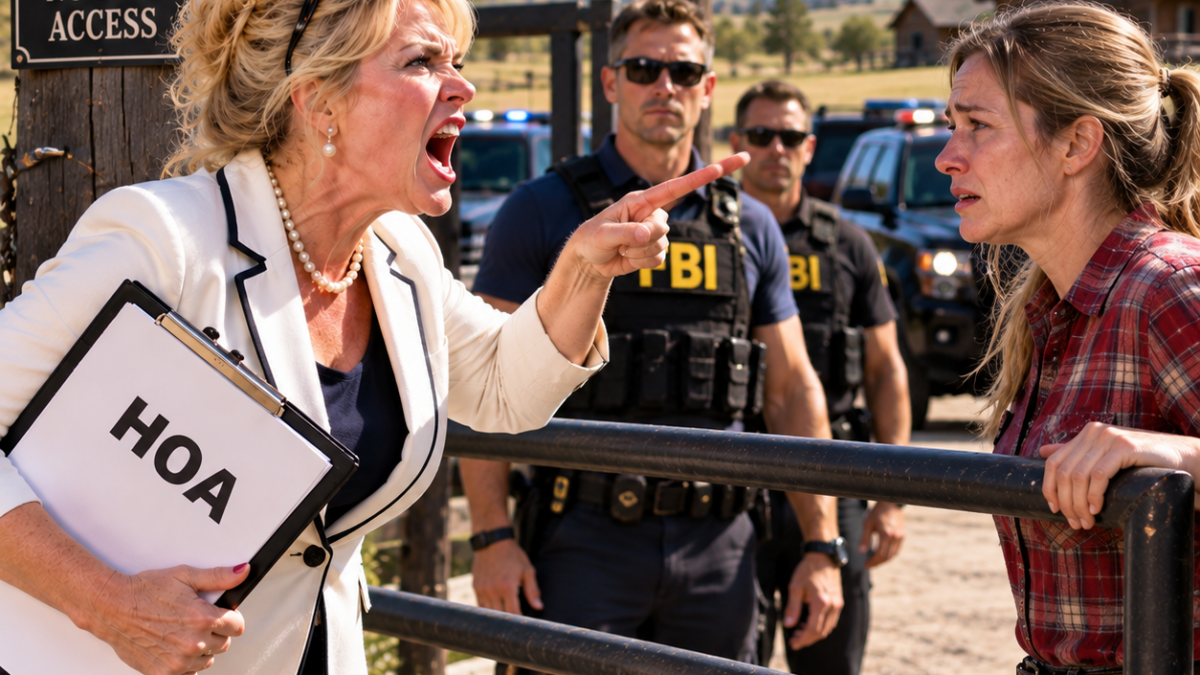
The woman standing at my ranch gate looked me straight in the eye and told me I was no longer allowed onto 410 acres my family had owned for four generations.
Behind her, a private security guard had chained the gate shut while my cattle trucks, my ranch hands, and three hundred hungry animals waited on opposite sides of the fence.
What she still didn’t understand was that the piece of paper she was using to take my land had already traveled somewhere far beyond the HOA clubhouse—and people with federal badges were about to start asking who created it.
I stood beside my pickup with my phone recording while Delaney Pierce sipped coffee like she was watching somebody else’s problem unfold.
It was barely eight in the morning.
The August heat was already rising from the gravel road, carrying the smell of dust, cattle, and dry grass over the fence. My ranch hands stood behind their trucks with lunch coolers at their feet, confused and angry. One of them, Mateo, kept looking past the chained gate toward the cattle pens as if staring hard enough might somehow get him through steel.
Three hundred head were inside.
Water lines had to be checked.
Feed needed moving.
One cow had calved late the previous night and I wanted eyes on her before the sun got higher.
And Delaney had decided none of us were going in.
The security guard blocking the gate was named Kyle Brandt. He wore a dark green vest with the words **WILLOW BEND PROPERTY ENFORCEMENT** stitched across the chest, even though Willow Bend was the gated subdivision next door and my ranch had never been part of it.
I pointed the camera toward him.
“Kyle, I’m asking one more time. Who told you to lock me out?”
He glanced at Delaney.
“My instructions came from association management.”
“You mean her.”
“I’m not getting into that.”
“You are standing at my gate.”
“I know.”
“You replaced my padlock.”
“Yes.”
“With your own chain.”
“Yes.”
“And you are refusing to let the legal owner enter.”
He shifted his weight.
“I was told ownership is disputed.”
I almost laughed.
“By whom?”
Before he answered, Delaney stepped forward.
“Rachel, we’ve already been through this.”
“No, Delaney. You’ve mailed me things. That isn’t the same as being through anything.”
Her lips tightened.
She wore a cream-colored jacket that probably cost more than Kyle’s monthly paycheck and sunglasses pushed neatly into her hair. She looked exactly the way she always looked at HOA meetings—calm, prepared, and completely convinced that the fact she had printed something on letterhead meant everybody else was required to surrender.
“The recorded covenant is controlling,” she said.
“Show me the court order.”
“We don’t need one.”
I raised my phone slightly.
“Say that again.”
Her eyes flicked toward the screen.
Then she smiled.
“The association does not need a court order because its access rights are already recorded.”
“Recording number?”
“You have it.”
“I want you to say it.”
She recited a number from memory.
I let the silence sit between us.
Then I asked, “And until I convince a judge you’re wrong, you believe Willow Bend gets to manage my ranch?”
“That is essentially correct.”
“My cattle too?”
“Don’t be dramatic.”
“My employees?”
“Rachel—”
“My trucks?”
She looked past me toward the men standing in the road.
“You’re making this much more difficult than it needs to be.”
“No. I’m making you say exactly what you’re doing while the camera is running.”
That changed her expression.
Only a little.
But I saw it.
For six weeks, Delaney had hidden behind letters, resolutions, notices, and claims about records I supposedly didn’t understand.
Now she was standing at my gate with a chain she had ordered somebody else to install, and I wanted every word preserved.
She pointed toward the fence.
“This property is subject to an association covenant granting Willow Bend recreational and emergency access. Your obstruction of that access forced the board to take temporary control.”
I looked around.
“No board members here.”
“That’s irrelevant.”
“No sheriff.”
“Also irrelevant.”
“No judge.”
She exhaled sharply.
“You can take this to court.”
“I will.”
“Good.”
She lifted her coffee cup.
“In the meantime, the ranch will be managed as community-controlled open space.”
Even Kyle turned toward her at that.
I stared at Delaney.
“You actually believe you can say that.”
“I believe the documents are clear.”
My phone buzzed.
Tom.
I answered without lowering the camera.
“Where are you?”
he asked.
“Front gate.”
“You inside?”
“No.”
A pause.
“What do you mean, no?”
“She chained us out.”
Tom went silent.
I heard the engine of his truck start in the background.
“I’m coming.”
“Call Ingrid first.”
“I already did.”
“What did she say?”
Another pause.
Then Tom answered in a voice I would remember for years.
“She’s calling the federal easement office.”
Delaney was still watching me.
Still confident.
Still holding her coffee.
She had no idea that the fake covenant in her folder was about to collide with seventy years of land records, a federally protected agricultural easement, and another application she apparently believed nobody in my family would ever discover.
Less than four hours later, two black SUVs would stop outside that same chain.
And when the first federal agent asked Delaney about a $1.4 million grant application filed in her name, the woman who had just declared my ranch “community-controlled open space” would finally stop smiling.
PART 2
Six weeks earlier, Delaney Pierce had been a nuisance.
An exhausting, arrogant, persistent nuisance, but still just that.
Willow Bend had been built along our eastern fence line nine years before the morning she locked me out.
Two hundred twenty homes sat behind decorative stone columns and a black metal gate, their backyards climbing gently toward a ridge with views over our creek bottom.
The Hadley ranch had been there much longer.
My grandfather bought the first section in 1951.
He was twenty-eight years old and newly home from military service when he signed the papers for 160 rough acres nobody particularly wanted.
The creek flooded.
The soil along the ridge was thin.
The road turned to mud every spring.
But he had a theory about land.
“If it feeds you,” he used to say, “it doesn’t have to impress anybody.”
Over the decades, he added acreage when he could.
My father bought the creek bottom in the 1980s.
By the time the land passed into my hands, we had 410 contiguous acres, mostly pasture, hay ground, timber, barns, and enough creek to make cattle possible even through dry summers.
I was raised there.
I learned to ride before I learned long division.
I learned how to pull a calf before I learned how to drive.
My father taught me that a fence was not merely wire.
“A fence is a promise,” he said. “It tells your animals where they belong and everybody else where your responsibility starts.”
I understood that better after Willow Bend arrived.
The developer was polite in the beginning.
They surveyed carefully.
They improved their own drainage.
They built along our boundary without touching our ground.
The houses were nice.
Most of the residents were decent.
Some brought their children over during calving season.
A few bought beef from us every year.
There was friction now and then—complaints about manure smell, tractor noise, dust—but nothing we couldn’t solve with a conversation.
Then Delaney became HOA president.
She had already served on two committees and one term as vice president before winning the top position.
She treated the office the way some people treat a promotion in government.
Suddenly the gate code, the landscaping budget, the architectural review board, and the neighborhood newsletter became instruments of policy.
She liked that word.
Policy.
It made preferences sound inevitable.
She pushed homeowners to replace mailboxes that had been acceptable for years.
She fined a family for leaving children’s bicycles visible beside a garage.
She demanded that backyard sheds facing our ranch be painted approved shades of tan because they affected what she called the “view corridor.”
The ranch itself offended her more than all of those things combined.
Cattle smelled.
Hay equipment ran early.
Stock trailers kicked up dust.
Our fences were practical instead of decorative.
And from several of Willow Bend’s most expensive houses, people could see working farmland rather than a landscaped park.
Delaney started with letters.
The first requested that we move a feed bunk away from the subdivision boundary.
I ignored it.
The second requested that we install privacy screening.
I wrote back:
**The ranch predates Willow Bend. Our property is not subject to Willow Bend HOA rules.**
Then she complained about trucks.
Then flies.
Then “visual clutter.”
Tom read that letter at breakfast.
“Visual clutter?”
“Apparently.”
He looked out the kitchen window toward the tractor.
“Should I tell the cows to dress better?”
I laughed.
At the time, Delaney was irritating enough to joke about.
Two years before the conflict, Tom and I had made the most important legal decision of our lives.
We enrolled the ranch in a federal agricultural conservation easement program.
It took months.
Surveys.
Appraisals.
Environmental reviews.
Title work.
Meetings.
The agreement was simple in principle and enormous in consequence.
We received compensation in exchange for permanently protecting the land as working agricultural ground.
Not until we died.
Forever.
We could sell the ranch someday.
Our children could inherit it.
Another farmer could buy it.
But nobody could carve it into a subdivision.
No future owner could wake up and decide 410 acres of pasture would make a profitable sea of rooftops.
The restriction ran with the land.
Recorded.
Public.
Federal.
Tom worried before we signed.
“You sure?”
We were sitting at the kitchen table.
The same table where Delaney would later offer to buy part of the ranch.
“I’m sure.”
“What if the kids don’t want this?”
“Then they can sell it to someone who does.”
“What if we need money later?”
“That’s why they’re paying us now.”
He smiled.
“You’ve rehearsed this.”
“For six months.”
He looked toward the fields.
“My grandfather would’ve signed it.”
“Mine definitely would.”
So we did.
The federal agency recorded the easement.
The county recorded it.
Our attorney, Ingrid Mercer, kept certified copies.
I kept one in the ranch office and one in a fireproof box at home.
I thought of that agreement as protection against some future developer decades from now.
I never imagined it would matter because of an HOA president living half a mile away.
The first sign that Delaney wanted more than visual improvements came on a Tuesday afternoon.
She arrived unannounced.
I was in the kitchen sorting veterinary invoices when she knocked.
I opened the door.
“Rachel.”
“Delaney.”
“Do you have a few minutes?”
“Depends.”
She smiled.
“I think you’ll want to hear this.”
That should have warned me.
I let her in.
She sat at my kitchen table and placed a leather folder between us.
No small talk.
“The association has been studying recreational access opportunities.”
“To what?”
“The creek.”
I stared at her.
“Our creek?”
“The corridor generally.”
“That means our creek.”
She opened the folder.
Map.
Colored renderings.
Trails.
Trees.
A pavilion.
A small parking area.
And one hundred twenty acres of my ranch shaded pale green.
I looked at her.
“What is this?”
“A proposal.”
“For land I can’t sell.”
“Everything can be structured.”
“No.”
“You haven’t heard the number.”
“It doesn’t matter.”
“Three hundred ninety thousand.”
I laughed.
I tried not to.
But it came out.
Delaney’s expression hardened.
“I’m serious.”
“So am I.”
“That’s a substantial offer.”
“For one hundred twenty acres with reliable water?”
“It’s based on recreational valuation.”
“Then your valuation is terrible.”
She leaned back.
“We aren’t looking for agricultural value.”
“That’s convenient.”
“Rachel, Willow Bend needs accessible green space.”
“Willow Bend has a park.”
“Not natural open space.”
“Then buy some.”
“We’re offering to.”
“No. You’re offering to buy mine.”
She folded her hands.
“Why not at least consider it?”
“Because I legally cannot subdivide it.”
“Easements can be modified.”
“Not because your HOA wants a walking trail.”
“Everything can be modified if the right people agree.”
I looked at her carefully.
“Who told you that?”
“I understand how these programs work.”
“No, you don’t.”
That irritated her.
I stood.
“The land isn’t for sale.”
“You’re refusing without even reviewing—”
“I reviewed the only fact that matters before you walked in.”
I opened the door.
She remained seated for several seconds.
Then she gathered her folder.
At the porch she stopped.
“Rachel.”
“Yes?”
“You and Tom should enjoy the ranch while you still have it.”
My stomach tightened.
“What does that mean?”
She smiled faintly.
“Things change.”
Then she walked to her Range Rover.
I stood on the porch watching her leave.
That night, I told Tom.
He frowned.
“She said that exactly?”
“Enjoy it while you still have it.”
“Ingrid needs to know.”
“It’s probably just intimidation.”
“Still tell Ingrid.”
I did.
Ingrid was quiet after I repeated the sentence.
“Write down the date and time.”
“You think it’s serious?”
“I think people who threaten property ownership after being told no deserve good note-taking.”
Three days later, the first fake document arrived.
Certified mail.
Willow Bend letterhead.
**NOTICE OF RECORDED ACCESS COVENANT**
It claimed that in 2014, during initial subdivision development, our predecessor in title had granted Willow Bend a permanent covenant across the ranch road and creek frontage for recreational and emergency access.
There were three immediate problems.
First, we had owned the ranch in 2014.
Second, neither Tom nor I had signed anything.
Third, the signature on the attached document was supposed to belong to my father.
My father had been dead for nearly four years by the date printed beside it.
I stared at that signature.
My anger became something colder.
Tom came into the office.
“What?”
I handed him the page.
He read.
Then looked at me.
“They forged your dad?”
“That’s what it looks like.”
He read the recording number.
“Could it be some old document?”
“Not with this date.”
We called Ingrid.
She asked us to scan every page.
Twenty minutes later, she called back.
“Do not call Delaney.”
“I want to.”
“I know.”
“This has Dad’s name on it.”
“I know.”
“She notarized a dead man’s signature.”
“Rachel.”
I went silent.
Ingrid continued.
“Stay calm.”
“Easy for you to say.”
“No. It isn’t. But listen carefully. A forged property document sent through the mail is not an HOA argument.”
I looked at Tom.
“And because your ranch is subject to a federal conservation easement, any attempt to alter property rights can trigger additional review.”
“What do we do?”
“Document.”
I almost laughed bitterly.
“That’s everyone’s favorite word lately.”
“For a reason.”
She told us not to pay fines.
Not to sign acknowledgments.
Not to destroy envelopes.
Not to alter anything.
She would verify the recording number.
The next morning she called.
“The number is real.”
My chest tightened.
“For our property?”
“No.”
I exhaled.
“What is it?”
“A drainage agreement.”
“Where?”
“Different farm. Different owner. Different parcel. Twelve miles away.”
Tom shook his head.
“So they just copied a number?”
“Looks that way.”
“That’s insane.”
Ingrid said:
“Insane people can still cause expensive problems.”
Delaney escalated anyway.
Surveyors showed up in the creek meadow.
Our ranch hand Mateo found bright orange stakes crossing a hay field.
He called me.
“Boss, you send surveyors?”
“No.”
“Then Willow Bend did.”
I drove down.
The crew supervisor produced an HOA work order.
I showed him our deed.
He apologized.
Then left.
Mateo pulled every stake.
By afternoon, Delaney emailed an $800 fine to him personally for “tampering with association survey markers.”
Then she fined us $1,500 for “employee interference.”
Mateo brought me the notice.
“Can she fine me?”
“No.”
“You sure?”
“Yes.”
“I don’t live there.”
“Exactly.”
He smiled.
“Can I frame it?”
“Absolutely.”
A sign appeared two days later beside our ranch road.
**WILLOW BEND EMERGENCY ACCESS ROUTE**
Tom pulled it out.
Delaney put another up.
We removed that one too.
Then she called a community meeting.
A Willow Bend resident named Karen Hollis called me afterward.
“You should know what she’s saying.”
“What?”
“That you’re blocking fire department access.”
I closed my eyes.
“Seriously?”
“She says if there’s a wildfire, your gate could cost lives.”
“Karen, the fire department has our access code.”
“I know.”
“The chief has my cell number.”
“I know.”
“He’s driven onto this ranch.”
“I know.”
Apparently, Delaney did not.
Or did not care.
The county fire chief attended her next meeting.
When Delaney said our ranch owners had denied emergency access, Chief Warren stood from the back.
“I need to correct that.”
People turned.
Delaney looked irritated.
“Chief, we’ll take questions—”
“This isn’t a question.”
He spoke calmly.
“I have never been denied emergency access to Hadley Ranch.”
Silence.
“Our department has an agreement with the Hadleys. We’ve used their roads in wildfire drills. We’ve filled tanker trucks from their creek with permission.”
Delaney smiled tightly.
“Thank you for clarifying historical practice.”
Historical practice.
She clicked to the next slide.
That was her talent.
Never acknowledge defeat.
Move past it quickly enough that the room followed.
The pressure still worked.
My cattle buyer, Jack Sorenson, called.
“Rachel, I need to ask you something.”
“What?”
“I heard Willow Bend has a claim on the ranch.”
“No.”
“There’s litigation?”
“Not yet.”
“Access dispute?”
“Fake documents.”
He went quiet.
“I have sixty-four thousand tied to the fall contract.”
“I know.”
“My bank is nervous.”
My chest tightened.
“Jack.”
“I’m not canceling.”
“What are you doing?”
“Pausing until title is clear.”
The call ended politely.
Then I sat at the desk and cried.
Not because I thought Delaney would win.
Because being right had already started costing us.
Tom found me twenty minutes later.
He knelt beside my chair.
“What happened?”
“Jack paused the contract.”
He stared.
“How much?”
“Sixty-four.”
His jaw tightened.
“We’re okay.”
“For now.”
“We’re okay.”
That night he lay beside me doing arithmetic in the dark.
I knew because every few minutes he sighed.
Feed.
Payroll.
Fuel.
Veterinary costs.
Loan payments.
He finally said:
“What if this goes six months?”
“It won’t.”
“You don’t know that.”
“No.”
Silence.
Then:
“I want to drive to her house.”
“Don’t.”
“I know.”
“Tom.”
“I know.”
He rolled onto his back.
“I hate that she can mail lies and we have to spend money proving they aren’t true.”
“So do I.”
“That’s backwards.”
“Yes.”
“I want her to pay for every hour.”
I took his hand.
“First we protect the ranch.”
Then came the chain.
I had left before dawn to inspect a water line on the south pasture.
When I returned, our old brass padlock was gone.
Heavy chain.
New lock.
Sign.
**ASSOCIATION CONTROLLED OPEN SPACE**
For a moment, I thought somebody was playing a joke.
Then Kyle stepped from a small SUV.
“Morning, ma’am.”
I stopped my truck.
“Open the gate.”
“I can’t.”
“Who are you?”
“Willow Bend Property Enforcement.”
“That isn’t an answer.”
“Kyle Brandt.”
“Who told you to chain my gate?”
“I have orders.”
“From Delaney Pierce?”
He didn’t answer.
My cattle truck came up behind me.
Then Mateo’s pickup.
Then Luis.
Then Ben.
The men climbed out.
Kyle looked nervous.
He should have.
Not because any of us threatened him.
Because the absurdity was becoming visible.
One private guard.
One chain.
Four generations of ownership on the other side.
Mateo said:
“Boss?”
“Don’t touch anything.”
“What about the cows?”
“I know.”
We needed access.
But breaking the chain ourselves would hand Delaney exactly the image she wanted.
Aggressive rancher.
Confrontation.
Property dispute.
I started recording.
Then Delaney arrived.
Coffee.
Tailored jacket.
No urgency at all.
That was when the opening of this story happened.
I asked her whether she had a court order.
She said no.
I made her repeat it.
Then she announced on camera that the HOA would manage the ranch until a judge settled ownership.
I called Tom.
Tom called Ingrid.
And Ingrid made the phone call that changed everything.
She contacted the regional office of the federal agency administering our agricultural conservation easement.
Within an hour, they confirmed what we already knew.
No modification.
No access transfer.
No recreational covenant.
No request.
No approval.
Nothing.
Then the agency lawyer asked a question.
“Do you have video of the HOA president claiming control?”
“Yes.”
“Send it.”
“Do you have the mailed covenant?”
“Yes.”
“Send that.”
“Any other correspondence?”
“A lot.”
“Send everything.”
Then she said:
“Do not discuss this further with the association until we call you back.”
The tone changed everything.
This wasn’t Ingrid advising caution anymore.
A federal office was preserving evidence.
At 9:37, my phone buzzed.
Unknown number.
Text.
**Rachel, this is Melissa at county records. I probably shouldn’t be texting, but Willow Bend filed something two days ago connected to your parcel. You need to come see the attachment.**
I showed Ingrid.
She said:
“Go.”
I drove to the courthouse while Tom stayed near the ranch gate.
Melissa met me at a public terminal.
She looked uncomfortable.
“I didn’t access anything private.”
“I know.”
“This is public.”
“I know.”
She pulled up the filing.
Grant application.
Federal Rural Open Space Program.
Applicant:
**Willow Bend Homeowners Association**
Requested amount:
**$1,400,000**
Project:
**Willow Bend Community Reserve**
My mouth went dry.
I scrolled.
Community park.
Trailhead.
Creek restoration.
Habitat enhancement.
Educational space.
Then property control.
The application listed all 410 acres.
Not 120.
All of it.
**Association-controlled land secured by recorded covenant.**
I sat down.
Melissa said quietly:
“There’s more.”
Attachment.
Fake covenant.
Another attachment.
**LETTER OF LANDOWNER SUPPORT**
Signed:
**Tom Hadley**
I knew my husband’s signature.
This wasn’t it.
The date was even worse.
The letter was supposedly signed one week before Delaney ever came to our kitchen.
I called Tom.
“Did you ever write a federal grant letter for Willow Bend?”
“What?”
“Answer.”
“No.”
“You sure?”
“Rachel.”
“I know. I had to ask.”
“What did she do?”
“She forged you.”
Silence.
Then:
“I’m coming.”
“No. Stay at the gate.”
“Rachel—”
“Stay there.”
I called Ingrid.
She met me at the courthouse.
Read the application.
Read Tom’s letter.
Read the covenant.
Then sat beside me.
“This changes the case.”
“I figured.”
“No.”
She looked at me.
“I need you to understand.”
I waited.
“A fake HOA letter is one thing. A forged document recorded or represented locally is serious.”
She tapped the grant application.
“But submitting false ownership documents and a forged support letter to obtain $1.4 million from a federal program…”
She exhaled.
“This is no longer primarily a property dispute.”
“What is it?”
“Potential federal fraud.”
I stared toward the courthouse windows.
“Because of the grant.”
“Yes.”
“And the easement.”
“Yes.”
“What happens now?”
“I send this to the agency.”
“Then?”
“They decide.”
“Federal agents?”
“Possibly.”
I laughed once.
Not from humor.
“How does somebody go from complaining about cattle smell to federal fraud?”
Ingrid looked at the papers.
“One rationalization at a time.”
At 11:50, the first black SUV came down our ranch road.
I was back at the gate.
Delaney was still there.
That amazed me.
She had apparently decided physically occupying the entrance made her claim stronger.
Kyle looked increasingly unhappy.
The sheriff had not arrived yet.
Delaney saw the first SUV.
Then the second.
Then a county sheriff’s cruiser.
She smiled.
Actually smiled.
“Finally.”
I said nothing.
The vehicles stopped.
Three people got out of the first SUV.
A woman in a dark field jacket.
A man wearing an FBI windbreaker.
And an attorney I recognized from a video call during our easement enrollment.
The woman approached me first.
“Mrs. Hadley?”
“Yes.”
“Special Agent Naomi Cortez, Office of Inspector General.”
She showed credentials.
“Are you okay?”
I glanced toward the chain.
“I’m angry.”
“That wasn’t exactly my question.”
I almost smiled.
“I’m okay.”
She nodded.
Then turned.
“Ms. Pierce?”
Delaney stepped forward.
“I’m Delaney Pierce, president of Willow Bend. I’m very glad you’re here because this situation has become unnecessarily disruptive.”
Agent Cortez looked at her for a moment.
“I’m here regarding a grant application.”
The smile on Delaney’s face cracked.
Not vanished.
Cracked.
“A grant?”
“Federal Rural Open Space Program.”
“Oh.”
“You submitted an application for approximately $1.4 million?”
“Yes.”
“For the Willow Bend Community Reserve?”
“Correct.”
“Does that application identify Hadley Ranch as association-controlled land?”
Delaney recovered slightly.
“The association has recorded access and management rights.”
“What recording number?”
Delaney recited it immediately.
Cortez opened her folder.
Read the number.
Then looked at her.
“This recording number belongs to a drainage agreement concerning the Bellamy Farm parcel.”
Silence.
“That’s twelve miles from here,” Cortez added.
Delaney blinked.
“There may be a clerical mistake.”
“Possible.”
Cortez’s tone remained neutral.
“Who prepared the covenant attached to the application?”
“I’d have to check.”
“Who submitted the application?”
“Our office.”
“Whose login?”
“The association account.”
“Who has access?”
“Myself and management.”
The FBI agent took notes.
Then another truck approached.
Tom.
He stopped behind my pickup and came toward us.
Cortez looked at her folder.
“Mr. Hadley?”
“Yes.”
“Did you provide a landowner support letter for Willow Bend’s grant application?”
“No.”
“Have you ever signed a letter supporting transfer or recreational management of the ranch?”
“No.”
“Have you ever authorized Willow Bend to represent that it controls this property?”
“No.”
Delaney said:
“This is being oversimplified.”
Tom turned toward her.
“You forged my name.”
“I did no such thing.”
“Then who did?”
“I don’t know what document you’re referring to.”
Cortez removed a copy.
“This one.”
Tom barely looked.
“Not mine.”
“Signature?”
“Not mine.”
“Language?”
“Never seen it.”
Cortez turned back to Delaney.
“Who typed this letter?”
“I don’t recall.”
“Who uploaded it?”
“I would have to review.”
“Who has the grant portal password?”
A pause.
Delaney glanced toward the FBI agent.
“Only I do.”
Nobody spoke.
The chain moved slightly in the breeze.
Cortez looked at it.
Then at me.
Then back at Delaney.
“Why are the Hadleys locked out of the property?”
“Temporary protective measure.”
“Protecting what?”
“Association rights pending judicial clarification.”
“Do you have a court order?”
Delaney’s confidence returned.
“The recorded covenant gives us access authority.”
Cortez nodded.
“Who authorized physically excluding the titled owners?”
“The board.”
The agency attorney spoke for the first time.
“Can we see the minutes?”
Delaney looked at him.
“Excuse me?”
“The board minutes authorizing this action.”
“I don’t have them with me.”
“Date of vote?”
“I’d need to check.”
“Motion number?”
Nothing.
“Was counsel present?”
Delaney’s jaw tightened.
“This feels unnecessarily adversarial.”
The sheriff had been listening.
Wade Rutledge had the weathered expression of a man who had spent thirty years dealing with people who made simple situations difficult.
He stepped toward Kyle.
“Son.”
Kyle looked relieved someone was speaking to him.
“Sir?”
“You got a court order telling you to keep these folks off their ranch?”
“No, sir.”
“You got a sheriff’s writ?”
“No.”
“Eviction order?”
“No.”
“Then move away from the gate.”
Kyle raised both hands.
“I was hired yesterday.”
“I believe you.”
He stepped back immediately.
Delaney snapped:
“Kyle, stay at your post.”
Kyle looked at her.
Then at Cortez.
Then at the FBI agent.
Then at Sheriff Rutledge.
“No, ma’am.”
I almost felt sorry for him.
The sheriff nodded to his deputy.
“Cut it.”
Bolt cutters.
One bite.
Metal snapped.
The chain dropped into the dirt.
I cannot describe what that sound did to me.
It was just steel hitting gravel.
But my shoulders loosened for the first time all day.
Mateo picked up his cooler.
Luis climbed into the feed truck.
Ben opened the gate.
Our vehicles rolled through.
Slowly.
No celebration.
No honking.
Just work returning to where it belonged.
Delaney watched.
Then she said:
“You are interfering with an association property claim.”
Cortez turned.
“Ms. Pierce.”
Delaney looked at her.
“I understand you believe this is a misunderstanding.”
“It is.”
“I also understand the application represented this ranch as association-controlled property.”
“We have rights.”
“It included a covenant using an unrelated recording number.”
“Clerical issue.”
“A landowner support letter Mr. Hadley denies signing.”
“I don’t know who prepared that attachment.”
“Your portal credentials submitted it.”
Delaney stopped speaking.
Cortez continued.
“And on the same morning federal reviewers were scheduled to begin preliminary site verification, the legal owners were physically prevented from entering.”
Delaney’s face changed.
“Scheduled?”
Cortez watched her.
“Yes.”
Nobody in Willow Bend had known.
Neither had Delaney.
That detail frightened her more than the SUVs.
The grant process had moved far enough that federal personnel were preparing to verify the land.
She had apparently intended the ranch to look association-controlled when they came.
Sign.
Security.
Chain.
Survey stakes.
Maybe she thought appearance could become evidence.
Instead, it became evidence of something else.
Delaney said nothing more.
The agents did not arrest her at the gate.
People sometimes imagine federal investigations as instant spectacles.
They’re usually paperwork first.
Questions.
Preservation notices.
Subpoenas.
Search warrants.
Financial records.
They want cases that survive after everyone stops being angry.
Cortez asked for every letter.
Every envelope.
Every HOA notice.
Every photograph.
Every recording.
Ingrid already had most of it organized.
The next morning, federal investigators served preservation demands.
Then warrants followed.
Willow Bend’s computers were examined.
Delaney’s laptop became the center of the case.
The metadata on the fake covenant showed it had been created two days after she sat at my kitchen table.
Two days after I told her the easement made a sale impossible.
Investigators recovered an email to a freelance designer.
Delaney had written:
**Can you make the recording stamp look closer to county format? Current version looks too digital.**
The designer responded:
**I thought this was for a presentation mockup. I won’t create government seals.**
Delaney replied:
**It’s only illustrative.**
She used another version anyway.
Then came the notary message.
Delaney texted a retired notary she knew.
**Hypothetically, can a seal be applied to an older signature date if everyone agrees the document reflects prior intent?**
The woman replied:
**No. Absolutely not. Don’t do that.**
She saved the conversation.
Investigators found it.
Tom read the printed exchange in Ingrid’s office.
“Prior intent?”
His voice was flat.
“She invented my intent before even meeting with us.”
I looked at him.
His anger frightened me more when it was quiet.
“The letter was dated before she came here.”
“I know.”
“She built the paperwork first.”
“I know.”
“She never came to negotiate.”
That realization landed hard.
The $390,000 offer had not been a genuine beginning.
It had been a box she expected us to step into voluntarily.
When we didn’t, she already had another path.
Claim rights.
Create documents.
Build pressure.
Control access.
Make the federal application look legitimate.
The money trail was worse.
Almost $118,000 from Willow Bend’s reserve fund.
Security company.
Survey contractor.
Outside consultant.
Administrative expenses.
Grant-development work.
No valid board approval for the bulk of it.
Then investigators looked at the consultant.
Company registered to Delaney’s sister.
The invoices used vague descriptions:
**Community Resource Strategy**
**Open Space Acquisition Support**
**Stakeholder Alignment**
That last phrase made Tom laugh bitterly.
“Stakeholder alignment?”
“They chained us out.”
“Apparently that’s alignment.”
The board treasurer was Phil Gaskin.
Quiet man.
Accountant.
He had served five years and rarely said more than necessary.
Investigators interviewed him.
Then he called Ingrid.
“I need to tell the board what happened.”
The emergency meeting was scheduled Friday.
Tom and I debated whether to attend.
“I don’t want to see her,” I said.
“We should hear the numbers.”
“Ingrid will tell us.”
“Rachel.”
I looked at him.
“This affected the whole neighborhood.”
“So?”
“They need to see us.”
“Why?”
“Because she’s spent six weeks turning us into villains.”
I hated that he was right.
We went.
The clubhouse was full.
Residents stood around the walls.
People who had waved to us for years avoided eye contact.
Others came up quietly and apologized before the meeting even began.
Delaney arrived carrying a prepared speech.
She sat in the president’s chair.
Tapped the microphone.
“Before we begin, I want to address the campaign of misinformation—”
Phil stood.
He did not raise his voice.
“Before you do, I’d like to read the expenditures.”
Delaney stared at him.
“Phil, financial reports are later.”
“No.”
The room went quiet.
He opened a binder.
“August 4. Twenty-two thousand six hundred dollars to Meadowland Strategic Consulting.”
Delaney said:
“Authorized planning expense.”
Phil continued.
“August 11. Fourteen thousand to Brandt Property Security.”
Kyle’s company.
“August 18. Twenty-seven thousand four hundred to Horizon Survey Group.”
Murmurs.
“August 22. Eighteen thousand nine hundred additional payment to Meadowland Strategic Consulting.”
Delaney interrupted.
“These expenditures supported a board-approved strategic initiative.”
Phil looked at her.
“What board vote?”
She said nothing.
He continued.
“Total unauthorized or unsupported commitments identified so far: approximately one hundred eighteen thousand dollars.”
The clubhouse erupted.
A homeowner shouted:
“From reserves?”
Phil nodded.
Another:
“For the park?”
“Yes.”
Someone else:
“On land we don’t own?”
Phil looked toward Tom and me.
Then back at the audience.
“Yes.”
Delaney stood.
“The association has enforceable rights to that land.”
A man near the front yelled:
“Federal agents were there!”
“This is an ongoing legal question.”
I heard myself speak before deciding to.
“No.”
Everyone turned.
I stood.
“Our deed isn’t an ongoing legal question.”
Delaney looked at me.
“The covenant—”
“Uses a recording number from another farm.”
Murmurs.
“Our easement is real.”
I continued.
“Recorded. Federal. Public.”
Delaney said:
“Rachel, this isn’t the appropriate forum.”
I almost laughed.
“You called meetings to tell these people I blocked firefighters.”
“That was based on information—”
“The fire chief corrected you.”
“You’re angry.”
“Yes.”
That answer surprised her.
I stepped into the aisle.
“I am very angry.”
The room was silent.
“But I don’t want your homeowners paying for my anger.”
Delaney’s face tightened.
I looked at the residents.
“This ranch is not yours.”
Some people looked down.
“It wasn’t yours before Delaney became president. It isn’t yours now. We have never refused legitimate emergency access. We have never threatened Willow Bend. We have never tried to interfere with your homes.”
I turned toward Delaney.
“You came to my kitchen and asked me to sell land I legally couldn’t subdivide. I said no. Three days later, you mailed me a covenant bearing my dead father’s name.”
A woman gasped.
Delaney said:
“That’s under investigation.”
“Yes.”
I nodded.
“It is.”
She sat back.
Phil resumed.
Then he produced the consultant ownership record.
“Meadowland Strategic Consulting is registered to Delaney’s sister.”
That ended whatever political protection she had left.
Even the board members who had defended her looked stunned.
Delaney stood.
“That relationship was disclosed.”
Phil asked:
“Where?”
She hesitated.
“To relevant leadership.”
“I’m treasurer.”
Nothing.
“You never disclosed it to me.”
A board member said:
“Not to me either.”
Another:
“Or me.”
One by one.
No.
No.
No.
Then came the motion.
Remove Delaney Pierce as president and suspend all board authority immediately.
Nine votes.
Zero against.
Delaney did not vote.
She stood before the count finished.
“I have spent five years protecting this community.”
Nobody answered.
“You will regret allowing outside agencies to dictate local affairs.”
A resident shouted:
“You applied for federal money!”
That drew bitter laughter.
Delaney’s face hardened.
She picked up her folder.
Walked out.
No applause.
That felt right.
The story wasn’t over.
The federal grant application was formally withdrawn.
Flagged.
The conservation agency reaffirmed our easement status in writing.
Willow Bend signed an acknowledgment that it possessed no ownership interest, recreational covenant, easement, management authority, or other right over the ranch.
Ingrid read the draft.
“Too broad?”
I asked.
“No.”
“Good.”
Tom looked at me.
“Frame it?”
“Absolutely.”
Then came settlement discussions.
People around us expected revenge.
Some ranch neighbors said we should sue Willow Bend into bankruptcy.
A cattleman at the feed store told Tom:
“Take their clubhouse.”
Tom came home and repeated it.
I laughed for the first time in weeks.
“What would we do with a clubhouse?”
“Hay storage.”
“Pool might be useful.”
“For cattle?”
“Don’t give yourself ideas.”
Ingrid was less amused.
“You do have significant civil claims.”
“We know.”
“Lost contract income.”
“Yes.”
“Legal costs.”
“Yes.”
“Gate damage.”
“Yes.”
“Business disruption.”
“Yes.”
“Possible reputational damages.”
I looked at Tom.
Then said:
“We don’t want homeowners punished for Delaney.”
Ingrid leaned back.
“That’s not entirely avoidable. The HOA is an entity.”
“I know.”
“But?”
“We want our actual losses.”
Tom added:
“And we want permanent written protection.”
“Meaning?”
“No HOA claim. No invented access. No future board pretending the ranch is some community amenity.”
Ingrid nodded.
“And the forged documents withdrawn.”
“Yes.”
The interim board offered $86,000.
Legal fees.
Lost income linked to the paused cattle contract.
Gate repair.
Other documented costs.
They issued a formal apology.
More importantly, they signed language so clear no future president could pretend confusion.
Tom read the acknowledgment twice.
Then handed it to me.
“Good?”
I looked at one line:
**Willow Bend Homeowners Association acknowledges that it possesses no right, title, easement, covenant, license, management authority, recreational interest, or other property claim in Hadley Ranch or any portion thereof.**
“Yes.”
“Good enough?”
“Yes.”
We signed.
Some people thought that was too easy.
They wanted us to make Willow Bend suffer.
But Willow Bend included Karen Hollis, who warned us about Delaney’s meeting.
It included families whose kids visited the ranch.
It included retirees living on fixed incomes.
It included people who had trusted the wrong president.
They would still deal with higher costs because of Delaney’s actions.
I didn’t need to add spite.
The criminal case was different.
That belonged to prosecutors.
Delaney was charged with wire fraud, making false statements to a federal agency, and forgery-related conduct.
Her defense argued she had become overenthusiastic about a legitimate community project.
That word reached me through Ingrid.
Enthusiastic.
Tom almost choked.
“She forged my name enthusiastically?”
“Apparently.”
“She locked us out enthusiastically?”
“Very energetic woman.”
We laughed.
Dark humor helps when anger has nowhere useful to go.
The prosecutor had stronger evidence than adjectives.
My gate video.
Delaney saying no court order was necessary.
The false recording number.
The grant portal logs.
The forged support letter.
The document metadata.
The county-style stamp email.
The notary text.
The sister’s consulting company.
The reserve payments.
Her lawyer reportedly tried to frame the forged covenant as an unfinished draft mistakenly uploaded.
Then prosecutors showed when it was created.
After I refused to sell.
Then the email requesting a more authentic county appearance.
The explanation collapsed.
Delaney eventually accepted a plea agreement instead of facing a jury.
Prison time.
Restitution.
And a lifetime ban from serving on an association board.
When Ingrid told us, Tom sat quietly.
Then said:
“Prison.”
“Yes.”
He looked out our kitchen window.
“I wanted consequences.”
“So did I.”
“Didn’t think it’d feel like this.”
“Like what?”
He searched for the word.
“Heavy.”
I understood.
For months, Delaney had been the villain in every conversation.
It was easy to reduce her to that.
Then prison became real.
A human being would lose years.
I did not believe the sentence was unjust.
She had fabricated property rights, sought $1.4 million using false documents, spent other people’s money, and physically excluded us from protected farmland.
But justice does not always feel joyful.
Sometimes it feels necessary.
Necessary and sad can exist together.
Spring came.
That’s how ranch life teaches you perspective.
Court dates matter.
Calves do not care.
Federal investigations matter.
Hay still has to be planted.
Lawsuits matter.
A broken fence after a storm matters immediately.
The creek rose with spring rain.
Cows dropped calves in fresh grass.
Mateo joked that the youngest heifer had better legal judgment than the old HOA board.
Tom replaced the front gate hardware.
Same kind of brass padlock we used before.
Nothing fancy.
I ordered a new sign.
It read:
**HADLEY RANCH**
**PRIVATE PROPERTY**
**PROTECTED AGRICULTURAL EASEMENT**
Tom held it against the fence.
“Too aggressive?”
“No.”
“Could add FEDERALLY PROTECTED in red.”
“Absolutely not.”
“Maybe an eagle?”
“Tom.”
“Fine.”
We mounted it.
One morning, I stood beside the gate drinking coffee.
A dark SUV approached.
For half a second, my stomach tightened.
Old reflex.
Then the window lowered.
Naomi Cortez.
“Morning.”
I smiled.
“Agent Cortez.”
“Passing through.”
“Checking for rogue HOAs?”
“Always.”
She pointed toward the new padlock.
“Gate working?”
“So far.”
“Nobody asked you to leave?”
“Not today.”
She laughed.
“That’s the idea.”
Tom came from the barn.
Cortez waved.
He called:
“Need a grant application?”
She laughed louder.
“I’ll pass.”
Then she drove toward the highway.
Tom stood beside me.
“Nice woman.”
“She helped save the ranch.”
“No.”
I looked at him.
“She helped protect it.”
“Difference?”
“Yes.”
He looked across the pasture.
“The ranch didn’t need saving from a real ownership claim.”
He tugged the new padlock.
“It needed somebody to make the records matter.”
That was true.
Delaney never really understood what she had picked a fight with.
She saw cattle.
Dust.
An old ranch house.
Fences.
Three ranch hands.
A family business.
To her, we looked small compared with a 220-home association.
She had a boardroom.
Budget.
Lawyer-looking letters.
Management software.
Contractors.
Security.
She assumed that made her institutionally powerful.
What she never saw was everything behind us.
Seventy years of deeds.
Surveys.
Tax records.
Title files.
My grandfather’s purchases.
My father’s creek-bottom deed.
The conservation easement.
County records.
Federal obligations.
Documents that did not care whether an HOA president considered our cattle unattractive.
Paper can look weak until somebody reads it.
A chain can look powerful until somebody asks who authorized it.
That became the lesson I carried forward.
The new Willow Bend board changed too.
Phil became interim president.
He hated it.
That was probably healthy.
At his first meeting, he proposed new controls.
No expenditure above $5,000 without board vote.
No related-party vendor without full written disclosure.
No land-use claim without independent title review.
No filing with any government agency without counsel review.
All meeting minutes published after approval.
It sounded painfully obvious.
Most rules written after disasters do.
Phil came to see us.
He stood awkwardly on the porch.
“I owe you an apology.”
“You weren’t Delaney.”
“I signed some checks.”
“You trusted the coding.”
“I should’ve looked deeper.”
“Probably.”
He smiled faintly.
“I appreciate you not making that easier.”
“What?”
“Forgiving me immediately.”
I laughed.
“I’m still annoyed.”
“Fair.”
He looked toward the fields.
“I never understood the easement.”
“Most people don’t.”
“Can I ask?”
“Sure.”
We spent thirty minutes talking about how it worked.
At the end, he said:
“So even you can’t build houses here.”
“Correct.”
“Your kids can’t.”
“Correct.”
“A buyer can’t.”
“Correct.”
“Then Delaney’s plan was impossible from the beginning.”
“Yes.”
He stared.
“She spent one hundred eighteen thousand dollars trying to acquire land that couldn’t become what she wanted.”
“That’s one way to say it.”
“Why didn’t she call the federal office?”
“Because they would’ve told her no.”
Phil understood.
That was the darkest part.
This wasn’t ignorance.
At some point, Delaney knew the real answer would stop her.
So she created another answer.
People sometimes think fraud begins with greed.
Sometimes it begins with entitlement.
The belief that your goal is so reasonable that facts opposing it become unfair.
Delaney believed Willow Bend deserved a park.
Then believed our land was the best location.
Then believed our refusal was selfish.
Then believed the easement was bureaucracy.
Then believed documents could be adjusted to match what should happen.
By the time she forged the grant package, the lie probably felt like correcting reality.
That is dangerous.
Months after the case ended, Karen Hollis invited me to speak at a Willow Bend meeting.
“No.”
I didn’t even hesitate.
“Rachel.”
“No.”
“Please.”
“About what?”
“The easement.”
“Why?”
“People want to understand what happened.”
“They can read the settlement.”
“That’s not the same.”
I sighed.
Tom smiled from across the kitchen.
“You should go.”
“You go.”
“They asked you.”
“Because you hide.”
“Correct.”
I eventually agreed.
The clubhouse felt different without Delaney at the front.
No oversized president’s chair.
No dramatic gavel.
Phil sat behind a folding table with the other board members.
About ninety residents attended.
I stood.
“I am not here to explain the criminal case.”
Everyone nodded.
“I am not here to argue about Delaney.”
More nods.
“I’ll explain the ranch.”
I showed them a simple map.
Boundary.
Creek.
Willow Bend.
The easement.
Someone asked:
“Why would you voluntarily restrict your own property forever?”
Good question.
“Because land can be worth more than its highest development price.”
A man frowned.
“How?”
“My grandfather bought it to farm.”
I looked around.
“My father expanded it to farm. We farm it. Somebody after us will farm it.”
“That doesn’t maximize value.”
“Depends what you value.”
The room went quiet.
A woman asked:
“Were we ever allowed to walk along the creek?”
“No.”
“Delaney said we had old access rights.”
“There were none.”
“What about emergency access?”
“Fire department had permission.”
“From you?”
“Yes.”
“Not the HOA?”
“No.”
Another resident raised a hand.
“If someone had just asked you about a trail?”
I smiled.
“They did.”
A few people laughed.
“No, I mean before the plan.”
I understood.
“Maybe we could have talked about limited community events or something that didn’t violate the easement.”
“So you weren’t against us?”
That question hurt more than I expected.
“No.”
I paused.
“I was against losing my land.”
The room became very still.
A woman near the back wiped her eyes.
Later she introduced herself.
Emily.
Her house backed onto our pasture.
“My daughter loves watching your calves.”
“She’s welcome to come over during calving season if she calls first.”
Emily smiled.
“Delaney told us you hated the neighborhood.”
“I barely knew most of you.”
“She said you wanted to put a trucking depot along the fence.”
I laughed.
“Tom owns five trucks. That’s hardly a depot.”
“She made you sound…”
“Like what?”
Emily looked embarrassed.
“Dangerous.”
That word stayed with me.
I had been the dangerous person because I said no.
That’s how power stories work.
The person resisting becomes the obstruction.
The one insisting on control becomes the visionary.
Until documents surface.
After the meeting, relationships improved.
Not overnight.
Some residents still blamed us for costs.
Some avoided us.
That’s fine.
You do not need every neighbor to love you.
You need boundaries people respect.
Karen organized a ranch tour for Willow Bend children.
I agreed on one condition.
No HOA branding.
She laughed.
“Traumatized?”
“Deeply.”
Thirty children came.
Mateo showed them cattle handling.
Tom explained hay equipment.
I showed them the creek and talked about conservation.
One little boy asked:
“Is this the creek Mrs. Pierce tried to steal?”
His mother turned red.
I nearly dropped my coffee.
Tom walked away because he was laughing too hard.
I crouched.
“That’s a complicated way to say it.”
“So yes?”
“Ask your mother.”
She mouthed:
**Sorry.**
I smiled.
That day did more to repair our relationship with Willow Bend than any settlement.
Kids do not care about property law.
They care about calves.
Mud.
Tractors.
One girl named Sophie stood beside a newborn calf for twenty minutes.
Before leaving, she told me:
“I thought ranches smelled worse.”
“Thank you?”
She nodded seriously.
“My dad says they smell terrible.”
“Tell your dad he’s banned.”
Her eyes widened.
I smiled.
“I’m joking.”
She laughed.
Normal.
That was what Delaney almost destroyed.
Not just ownership.
Neighborliness.
She turned every interaction into territory.
Every boundary into a contest.
Every disagreement into disloyalty.
Once she was gone, the ranch and subdivision discovered something simple.
We could exist beside each other.
Spring became summer.
Jack Sorenson resumed the cattle contract.
He called first.
“Rachel, I owe you.”
“You paused a business deal because title looked disputed.”
“I should’ve trusted you.”
“No.”
I appreciated the sentiment, but business is business.
“You should protect your money.”
“You angry?”
“I was.”
“Fair.”
He reinstated the $64,000 agreement.
That check mattered.
Not because we were on the edge of bankruptcy.
Because it closed a circle.
Delaney tried to make our property legally uncertain.
She understood uncertainty can damage a business before any court decides anything.
Restoring certainty restored value.
Ingrid later explained that reputational damage was one reason our civil settlement included lost-income compensation.
“It wasn’t just the chain.”
“I know.”
“The forged documents contaminated commercial trust.”
“That sounds dramatic.”
“Legal language often describes obvious things badly.”
I smiled.
“You’re retiring someday, right?”
“Never.”
“That frightens me.”
She was the one who eventually handed me a certified copy of Delaney’s plea paperwork.
I did not read all of it.
Tom did.
I asked why.
“Closure.”
“Did it work?”
“No.”
He set it down.
“What would?”
“I don’t know.”
Maybe closure is another word people use because they want events to end cleanly.
Life isn’t that tidy.
Delaney’s conviction didn’t erase the morning I stood outside my own gate.
The settlement didn’t make my father’s forged signature less offensive.
The agents arriving did not undo the nights Tom lay awake calculating payroll.
But time diluted those things.
New memories covered them.
A good calving season.
A record hay crop.
The children visiting.
Tom repairing the barn roof and nearly falling through because he refused to wait for Mateo.
Me yelling at him.
Him claiming he “had it under control.”
Marriage.
Work.
Ordinary life.
One day I opened the ranch office drawer and found the old fake covenant.
Ingrid had returned the copy after the case.
My father’s forged signature stared up at me.
For months, that page had made me furious.
That day, it looked pathetic.
Cheap paper.
Bad imitation of a county stamp.
A lie that once cost us sleep.
I took it outside.
Tom was repairing a gate hinge.
“What is that?”
“Delaney’s covenant.”
“Burn it.”
I almost did.
Then stopped.
“No.”
“Why?”
“Keeping it.”
“For what?”
I thought about my grandfather’s files.
Deeds.
Receipts.
Surveys.
Every generation keeps papers because the next one might need them.
“History.”
Tom shook his head.
“You’re becoming your father.”
“Thank you.”
“That wasn’t entirely a compliment.”
I put the fake covenant in a folder with the real easement.
Not because they had equal value.
Because the contrast mattered.
One was created to manufacture authority.
The other created real legal obligations through open process, review, signatures, recording, and consent.
They looked similar at a glance.
Paper.
Stamps.
Formal language.
That is why fraud works.
Appearance.
But truth has something forgery does not.
A trail.
People.
Dates.
Records in independent places.
Delaney could fabricate our signature.
She could not rewrite seventy years everywhere.
County courthouse.
Federal office.
Surveyor records.
Tax maps.
Historical deeds.
Agency files.
Bank records.
Our copies.
Her lie required every real document to disappear.
They didn’t.
Records are patient.
My father used to keep old receipts for fence posts.
I teased him.
“Why do you need a receipt from 1987?”
“Because the day you throw it away, somebody asks.”
I laughed then.
I don’t anymore.
A year after the chain, we held a small family dinner at the ranch.
My sister came.
Our two grown children drove in.
Tom’s brother brought his family.
After dinner, we walked toward the creek.
My daughter, Lucy, asked:
“Would you ever have sold the 120 acres if there wasn’t an easement?”
“No.”
“That fast?”
“Yes.”
“Why?”
I looked toward the water.
“Because some things are worth more to you than somebody else can offer.”
“That’s sentimental.”
“I’m old.”
“You’re not old.”
“Tell my knees.”
She smiled.
Then became serious.
“Were you scared?”
“During the HOA thing?”
“Yes.”
I thought about lying.
Parents do that even when children are adults.
“No.”
Then corrected myself.
“Yes.”
“Of losing the ranch?”
“Not exactly.”
I knew the deed was ours.
The easement was real.
What frightened me was how much damage somebody could do while wrong.
“Being right isn’t armor,” I said.
Lucy frowned.
“What does that mean?”
“You can be legally right and still lose money.”
I looked toward Tom.
“Still lose sleep. Still have contracts paused. Still have someone chain your gate. Still need lawyers.”
“So what protects you?”
“People willing to enforce what’s true.”
She nodded.
“And records.”
I smiled.
“And records.”
We reached the creek.
Sunlight moved through the cottonwoods.
For a moment, I imagined Delaney’s proposed park.
Trail signs.
Pavilion.
Parking lot.
Maybe beautiful.
That was the dangerous part.
Her idea itself wasn’t evil.
A community park can be good.
Creek restoration can be good.
Walking trails can be good.
The problem was believing good intentions gave her rights over someone else’s property.
A worthy goal does not erase consent.
That principle matters far beyond ranches.
The next Willow Bend president understood it.
Phil once called me.
“Rachel, community wants to host a charity walk.”
“On Willow Bend roads?”
“Yes.”
“Then why are you calling me?”
“They’d like to include half a mile along your boundary road.”
I waited.
“You’re asking?”
“Yes.”
“That’s new.”
“I thought you’d appreciate it.”
“I do.”
We discussed insurance.
Timing.
Cattle movement.
They signed a simple one-day permission agreement.
The event happened.
Nobody stole anything.
Nobody called federal agents.
Two hundred people walked along the ranch edge.
Raised money for the county food bank.
At the end, Phil handed me a thank-you card.
I said:
“See how easy that was?”
He smiled.
“Painfully.”
“What?”
“Asking permission.”
I laughed.
“That the lesson?”
“Apparently.”
That charity walk became annual.
Every year, the HOA requests permission.
Every year, we say yes if ranch operations allow it.
That may be my favorite outcome.
Not because it proves I won.
Because it proves boundaries and generosity can coexist.
Delaney behaved as if respecting ownership would prevent community benefit.
It didn’t.
Her refusal to respect ownership was the obstacle.
One year, Naomi Cortez returned for the walk.
No badge visible.
Jeans.
Running shoes.
I recognized her near the registration table.
“Checking federal compliance?”
“Deep undercover.”
“You paid the entry fee?”
“Always follow the money.”
We laughed.
She walked beside me for the first mile.
“How’s everything?”
“Quiet.”
“Best outcome.”
“Do you ever think about Delaney?”
Cortez was careful.
“Cases stay with you.”
“I mean personally.”
She considered.
“I think about decisions.”
“What decisions?”
“The point where someone still has a chance to stop.”
I looked at her.
She continued.
“Most fraud cases have dozens of exits.”
“Meaning?”
“Delaney could’ve stopped after you refused the sale.”
“Yes.”
“After Ingrid challenged the covenant.”
“Yes.”
“Before the grant submission.”
“Yes.”
“Before using your husband’s letter.”
“Yes.”
“Before chaining the gate.”
I nodded.
“She kept choosing the next step.”
“Exactly.”
Cortez looked toward walkers ahead.
“People imagine criminals wake up one day and decide to commit a federal offense.”
“Usually not?”
“Sometimes.”
She smiled slightly.
“But often they decide to solve one inconvenience dishonestly. Then another lie becomes necessary to support the first.”
One rationalization at a time.
Ingrid had said almost the same thing.
Cortez added:
“What always interests me is the exit they didn’t take.”
That stayed with me.
Delaney had exits everywhere.
She could have accepted no.
She could have called the easement office.
She could have asked the board attorney.
She could have withdrawn the grant.
She could have admitted the recording number was wrong.
She could have removed the chain herself.
Instead, each warning felt like a challenge to her authority.
So she doubled down.
Arrogance is often less about believing you cannot lose than being unable to tolerate admitting you were wrong.
The ranch kept teaching quieter lessons.
A calf gets through a fence?
Fix the fence.
Water line breaks?
Repair it.
Hay gets rained on?
You lose quality and move on.
Agriculture does not reward pretending.
You cannot convince a drought that the board voted for rain.
You cannot intimidate a cow into being pregnant.
Reality wins quickly.
Maybe that was why Delaney and I never understood each other.
Her world was language.
Resolutions.
Presentations.
Committees.
If enough people approved a statement, it acquired power.
On a ranch, the fence either holds or it doesn’t.
The pump works or it doesn’t.
The deed says what it says.
Years later, the brass padlock Tom installed after the incident finally rusted.
He held it up.
“Historic artifact.”
“Throw it away.”
“This lock symbolizes justice.”
“It symbolizes corrosion.”
“Could mount it in the office.”
“Absolutely not.”
He replaced it.
Another ordinary brass lock.
I liked that.
The original chain Delaney installed ended up in evidence storage for a long time.
When it was released, Sheriff Rutledge asked whether we wanted it.
“No.”
Tom said yes at the same time.
I turned.
“What are you going to do with it?”
“Art.”
“No.”
“Fence decoration.”
“No.”
“Paperweight.”
“It weighs forty pounds.”
“Very committed paper.”
Eventually, he hung one short cut section in the barn.
Under it he mounted a little sign:
**NOT A DEED**
I pretended to hate it.
I didn’t.
Visitors ask about it.
Tom tells the story badly.
He exaggerates.
According to him, twenty federal SUVs arrived.
There were two.
According to him, Delaney tried to order Agent Cortez off the ranch.
She did not.
According to him, the sheriff personally threw the chain into a ditch.
Also false.
I correct him.
He says:
“Your version needs more action.”
“My version is what happened.”
“That’s your problem.”
Maybe.
But after living through a fight built on manufactured facts, accuracy became sacred.
The true story is dramatic enough.
An HOA president wanted ranch land.
She was told no.
She created a false covenant.
She forged a landowner support letter.
She applied for $1.4 million in federal money.
She spent almost $118,000 of association funds without proper approval.
She hired security and locked the actual owners out.
Then federal agents arrived because the documents she used had crossed federal lines.
Nothing needs embellishment.
Her own choices supplied the drama.
The final time I saw Delaney in person was years after the conflict began.
Not at court.
Not at the HOA.
A gas station.
I was filling my truck.
A woman at the next pump turned.
Delaney.
For a second, both of us froze.
She looked older.
So did I.
Life does that.
She said:
“Rachel.”
“Delaney.”
We stood there surrounded by fuel pumps and normal people buying coffee.
No lawyers.
No agents.
No chain.
She looked toward my truck.
“How’s the ranch?”
“Good.”
She nodded.
“I heard Willow Bend still does that charity walk.”
“Yes.”
“Ironic.”
“Why?”
She almost smiled.
“You let them use the land.”
“With permission.”
The smile disappeared.
There it was.
The entire story in two words.
With permission.
She looked away.
“I did want something good for the community.”
“I believe you.”
She looked surprised.
“You do?”
“Yes.”
“You never acted like it.”
“Your goal wasn’t the problem.”
Her jaw tightened.
“You still think I’m some kind of monster.”
“No.”
That surprised her more.
“I think you convinced yourself the goal justified things you knew were wrong.”
She looked down.
“Easy for you to say.”
“No.”
I capped the fuel tank.
“It wasn’t easy to watch someone use my dead father’s name.”
Her face went pale.
I regretted nothing about saying it.
She whispered:
“I never meant for it to get that far.”
“But it did.”
“I know.”
For the first time in all the years I had known her, she sounded less defensive than tired.
I could have said more.
About the contract.
The nights without sleep.
Tom’s forged signature.
The money.
The gate.
Prison.
But none of it needed repeating.
She already knew.
I opened my truck door.
“Take care, Delaney.”
She nodded.
“You too.”
I drove away.
No triumph.
No final insult.
Just finished.
That mattered to me.
Revenge stories often end with the other person destroyed and the hero smiling.
Real life is less clean.
Delaney paid heavily.
Prison.
Restitution.
Loss of reputation.
No future association board service.
Her sister’s consulting company disappeared.
Willow Bend rebuilt its reserves slowly.
We recovered our losses.
The ranch remained ours.
Were those consequences satisfying?
Yes.
I would be lying if I said watching the chain cut did not satisfy me.
Or seeing the false claim collapse.
Or hearing that prosecutors had the stamp email.
There are moments when justice feels good.
But the deepest satisfaction came later.
When the ranch became boring again.
Cattle.
Hay.
Mud.
Bills.
Calves.
Tom leaving tools somewhere and swearing I moved them.
Mateo calling me at dawn because a cow was through the west fence.
Jack complaining about market prices.
The creek running full in spring.
Our daughter bringing grandchildren to see the horses.
That’s what Delaney almost took.
Not acreage.
Continuity.
A family life connected to land.
One autumn evening, I sat on the porch with Tom.
The sun dropped behind Willow Bend.
Lights came on in the houses along the ridge.
From a distance, the subdivision looked peaceful.
Tom handed me coffee.
“You know what I thought when I saw that chain?”
“What?”
“I thought I was going to jail.”
I laughed.
“For what?”
“Because I wanted to drive through it.”
“You would’ve damaged the bumper.”
“Worth it.”
“No.”
He smiled.
“Probably.”
We watched cattle move toward water.
Then he said:
“You kept me from doing something stupid.”
“You called Ingrid before driving over.”
“That too.”
“She kept both of us from doing something stupid.”
“Lawyers ruin all the fun.”
Silence.
Then:
“You ever regret the easement?”
“No.”
“Not once?”
“No.”
He nodded.
“Me neither.”
The federal protection had become part of the story, but I did not value the easement because it helped defeat Delaney.
I valued it because decades after Tom and I are gone, someone else will stand on this porch and look over open ground.
Maybe our children.
Maybe not.
Ownership changes.
Stewardship continues.
That’s why I still tell young landowners to understand every document they sign.
Not fear paperwork.
Understand it.
A deed is not magic.
An easement isn’t magic.
A federal program isn’t magic.
They work because institutions, records, and people agree to enforce them.
The same is true of fraudulent paper.
It can create tremendous harm when nobody checks.
The answer is not distrust of documents.
The answer is verification.
Where is it recorded?
Who signed?
When?
What parcel?
What authority?
What independent record confirms it?
Delaney’s fake covenant looked official until someone asked those questions.
Then it collapsed almost immediately.
The recording number belonged to another farm.
The signer was dead on the stated date.
The notary trail didn’t exist.
The metadata showed creation years later.
The federal agency had no modification record.
Tom denied his support letter.
The grant account led back to Delaney.
The money led to her sister.
The chain led to her instructions.
A lie can look complicated.
Truth often simplifies it.
Years after everything ended, Willow Bend replaced its entry monument.
Phil called before construction.
I laughed when I saw his name.
“What did you do?”
“Nothing.”
“Yet.”
“We need a temporary staging area near your east boundary.”
“And?”
“Can we lease half an acre for six weeks?”
I smiled.
“Look at you.”
“What?”
“Asking.”
He groaned.
“We will never live this down.”
“Probably not.”
We signed a short lease.
Fair price.
Clear boundaries.
Construction finished.
They restored the grass.
Nobody went to prison.
Again, astonishing what permission can accomplish.
The community changed leadership several times.
Each incoming president received an orientation binder.
One section was titled:
**ADJACENT PROPERTY LIMITATIONS**
Tom wanted to know if we were named.
I didn’t.
“Probably.”
“Think there’s a picture of us?”
“Why would there be?”
“Cautionary tale.”
“We didn’t do anything.”
“Exactly.”
The ranch became locally famous for a while.
I hated that.
Reporters called after Delaney’s plea.
I declined most interviews.
One asked:
“Do you consider this a victory over HOA overreach?”
I said:
“I consider it a property records case.”
He sounded disappointed.
Another asked:
“What was going through your mind when federal agents arrived?”
“Mostly that the cattle needed feeding.”
That quote made the article.
It was true.
Drama belongs to spectators.
People living inside it still have chores.
The cattle did not know Agent Cortez.
They knew breakfast was late.
Mateo reminded me of that after the chain was cut.
He came back to the gate around noon.
“Boss.”
“What?”
“We’re two hours behind.”
Federal agents were interviewing Delaney thirty yards away.
I looked at him.
“You’re worried about schedule?”
“Cows don’t care about fraud.”
I laughed so hard I nearly cried.
He was right.
Maybe that’s why ranching saved me from becoming consumed by anger.
There was always something more immediate.
Fence.
Feed.
Weather.
Life.
One winter, a heavy ice storm brought down part of the east fence near Willow Bend.
Before we even knew, three residents came out with flashlights to help keep cattle away from the gap.
Karen called.
“We’ve got cows looking at our backyards.”
“I’ll be there.”
When I arrived, Phil and two teenagers were standing in sleet, waving arms at cattle.
Years earlier, Delaney had portrayed us as enemies.
Now neighborhood kids were helping hold our herd while Mateo repaired wire.
No contracts.
No HOA resolution.
Just neighbors.
I stood beside Karen afterward.
“Remember when Delaney said the ranch threatened community safety?”
Karen laughed.
“She also said your cows lowered property values.”
“Did they?”
“My house sold for forty percent more than we paid.”
“Tell the cows.”
“They’ll demand commission.”
That was the ending Delaney could never have imagined.
Not my revenge.
Reconciliation.
Not weakness.
Not surrender.
Boundaries respected enough that generosity became safe again.
The ranch is still 410 acres.
The creek still runs through it.
The easement still sits in county and federal records.
The sign remains on the gate.
**HADLEY RANCH — PRIVATE PROPERTY — PROTECTED AGRICULTURAL EASEMENT**
The brass lock has been replaced several times.
Tom’s ridiculous **NOT A DEED** chain hangs in the barn.
Every once in a while, a visitor asks why.
He begins:
“Once upon a time, an HOA president thought she could buy the ranch for peanuts…”
I interrupt.
“That’s not how it started.”
He says:
“Fine. You tell it.”
So I do.
I tell them about my grandfather.
My father.
The easement.
The kitchen offer.
The fake covenant.
The survey stakes.
The contract that almost vanished.
The morning at the gate.
The agents.
The federal grant.
The board meeting.
I make one point every time.
Delaney did not lose because federal agents were more intimidating than she was.
She lost because she had nothing real beneath her claims.
Her power depended on people reacting before they checked.
The moment everybody checked, it evaporated.
She said the HOA had a covenant.
Records said no.
She said my family had agreed.
Our signatures said no.
She said the board authorized the lockout.
Minutes said no.
She said the ranch supported the grant.
We said no.
She said the association controlled the land.
The deed said no.
She said the federal program would fund her vision.
Federal investigators asked why the application was built on forged documents.
Every layer of confidence peeled away until only the facts remained.
That is why I never describe the story as the day federal agents saved our ranch.
The ranch was ours before the SUVs arrived.
The ranch was ours while the chain hung there.
The ranch was ours when Delaney stood beside the gate declaring it community-controlled space.
Her words never changed ownership.
The agents simply enforced the difference between saying something and proving it.
The final lesson came from my father, though he had been gone years before any of this happened.
I found it in one of his old notebooks while cleaning the ranch office.
Most pages were cattle numbers.
Feed costs.
Rainfall.
Veterinary notes.
On one page, years earlier, he had written a line after some forgotten fence dispute:
**Don’t waste time arguing with somebody about where the line is when the survey is in the drawer.**
I sat there reading it.
Then laughed.
Tom came in.
“What?”
I handed him the notebook.
He read the line.
“Your dad would’ve loved Ingrid.”
“He would’ve complained about her bill.”
“Also true.”
I framed that page.
Not the federal order.
Not Delaney’s plea.
Not the settlement.
That notebook page.
It hangs in the ranch office now.
Whenever somebody asks why, I tell them:
Because power likes arguments.
Records like answers.
Delaney had arrived at my gate with a chain, a guard, a sign, an HOA title, and complete certainty that she could make reality wait until a judge caught up.
She believed that if she acted quickly enough, looked official enough, and scared us badly enough, control would become ownership.
Instead, she created the clearest evidence against herself.
I still remember that morning.
The heat.
The cattle calling from inside.
Mateo’s cooler sitting in the dust.
Kyle looking increasingly nervous.
Delaney lifting her coffee while telling me the association would manage my ranch.
And my phone recording every word.
For a few hours, the chain seemed powerful.
It stopped trucks.
Stopped employees.
Stopped me.
But it never changed the deed.
It never changed the easement.
It never changed seventy years of records.
And when the federal SUVs finally came down that road, they weren’t bringing new ownership with them.
They were bringing questions.
Questions Delaney could not answer.
Who created the covenant?
Why did the recording number belong to another farm?
Who forged Tom’s letter?
Why did only she hold the grant password?
Why was her sister’s company being paid?
Where was the board vote?
Why were the legal owners locked outside federally protected farmland?
A chain can stop a truck.
A title can frighten a homeowner.
A polished letter can fool people who don’t check.
But none of those things can make a lie true.
Only the records can tell you what was real.
And our records had been sitting quietly in courthouse drawers, federal files, old cabinets, and family folders for decades.
Waiting.
Patiently.
For somebody to finally read them.








