PART 2: HOA Called My Ranch “White Trash”—So I Put Their Court-Ordered Apology on a Billboard Facing Every Million-Dollar Home
PART 2
The first SUV hit the ranch road hard enough to throw gravel against the cattle guard.
Then came the second.
Third.
By the time I reached the south rise above the main yard, nine black vehicles were rolling toward the barns in a staggered formation, throwing a wall of dust into the early morning light.
I didn’t run toward them.
That would have been the reaction Victoria expected from a rancher watching armed strangers invade his land.
Instead, I stopped behind a windbreak of cottonwoods and checked my phone.
5:46 a.m.
One message waited.
EVANS: WARRANTS SIGNED. TEAM IN POSITION. DO NOT ENGAGE UNTIL DIRECTED.
I read it twice.
Then I looked toward the yard.
Victoria Hargrove had chosen the worst morning of her life to become brave.
The SUVs stopped.
Doors opened.
Men in black tactical uniforms poured out.
No sheriff stars.
No federal markings.
No state patches.
Private security.
Expensive private security.
Several carried less-lethal launchers.
A few had holstered sidearms.
Their chief, Derek Sloan, had once spent twelve years contracting overseas before discovering that wealthy suburban boards paid remarkably well for men willing to pretend bylaws carried the force of law.
I already knew most of that from the investigation.
What I didn’t know was exactly how far he would go for Victoria.
I was about to find out.
Ray walked out of the main barn before I could call him.
He was sixty-one years old, six feet three, gray-bearded, and had managed cattle operations longer than some Sterling Heights residents had been alive.
Four ranch hands were repairing fence near the loading pens.
Sloan’s men surrounded them first.
“What the hell?” one of my workers, Eli Barnes, shouted.
“Hands where we can see them!”
“We’re fixing a fence!”
“On your knees!”
Ray stopped dead.
Two security men moved toward him.
He raised his hands just enough to show he wasn’t reaching for anything.
“Who’s in charge?”
“I am.”
Victoria’s voice carried across the yard.
She stepped out of the seventh SUV.
She wore a fitted navy jacket, white slacks, and shoes that had no business being anywhere near cattle manure.
Even from the hill, I could see the satisfaction on her face.
Ray walked toward her.
One guard blocked him.
Ray looked at the man.
“Move.”
The guard actually did.
Not because Ray threatened him.
Because some men carry authority without costumes.
Victoria crossed her arms.
“This property is now under emergency administrative control.”
Ray stared at her.
“Say that again.”
She opened a leather folio.
“The Sterling Heights executive board voted last night to authorize emergency intervention due to repeated health, safety, environmental, and boundary violations.”
Ray looked at the detained workers.
Two were already zip-tied.
“Where’s your warrant?”
“This is not a criminal matter.”
“Then why are armed men restraining my crew?”
“We have authority under the community protection provisions.”
Ray almost smiled.
“Your community ends at the fence.”
Victoria’s jaw tightened.
“That boundary is disputed.”
“No, it isn’t.”
“We have survey evidence.”
“You have survey stakes your people moved at two in the morning.”
That changed her face.
Just a flicker.
But Ray saw it.
“What evidence?”
Ray said nothing.
Victoria stepped closer.
“You people have been given every opportunity to cooperate.”
“You people?”
“Your employer has acted like some cowboy squatting outside civilization.”
Ray looked toward the timber fence.
“You mean the man whose family owned this ground before your neighborhood was a golf course?”
Victoria ignored him.
She pulled out a sheet embossed with Sterling Heights’ crest.
Ray did not touch it.
“What’s that?”
“Emergency Community Protection Order.”
“Signed by which judge?”
“The board has authority—”
“Which judge?”
Victoria’s voice sharpened.
“This is association action.”
“Which means no judge.”
“We do not require a judge to enforce our covenants.”
“You require something better than a homeowner vote before kidnapping my employees.”
Sloan stepped between them.
“Watch your language.”
Ray looked at him.
“You restrained them.”
“They’re being temporarily detained.”
“Against their will.”
“For safety.”
“That’s kidnapping with nicer vocabulary.”
Sloan’s hand moved toward his belt.
Ray didn’t flinch.
Victoria did what she always did when someone refused to fear her.
She escalated.
“Restrain him.”
Ray looked at his watch.
5:53.
Then at Victoria.
“I’d rethink that.”
She laughed.
“Is that a threat?”
“Advice.”
“Detain him.”
Two men grabbed Ray.
He did not resist.
They pulled his arms behind him and cinched a plastic restraint around his wrists.
Ray looked directly at Victoria.
“You’re going to remember this morning for the rest of your life.”
Victoria smiled.
“I believe I will.”
She turned toward the yard.
“Confiscate all phones. Secure the office. I want every document related to the access corridor.”
Sloan hesitated.
That mattered.
He knew what they were doing had crossed a line.
Victoria noticed.
“Did you hear me?”
“Yes.”
“Then do it.”
Three security contractors headed toward the ranch office.
One carried a cordless rotary hammer.
Ray watched them.
“You planning to drill the lock?”
Victoria looked pleased with herself.
“If your employer had cooperated fourteen months ago, none of this would be necessary.”
Ray’s voice stayed calm.
“He told you the land wasn’t for sale.”
“Everything is for sale.”
“That’s where you went wrong.”
Victoria turned away.
From the hill, I watched one security man force the ranch-office lock.
My phone vibrated again.
EVANS: HOLD.
That was the hardest command I had ever received on my own property.
My people were restrained.
An illegal crew was entering my office.
Victoria was walking through my yard as if she had conquered something.
Every instinct told me to move.
But fourteen months of discipline mattered more than fourteen seconds of anger.
I stayed behind the trees.
Because this stopped being merely my fight months ago.
The first time Victoria called my ranch “white trash,” I thought she was just arrogant.
The second month, I knew she was corrupt.
By month six, federal financial investigators knew she was part of something much larger.
And by sunrise that morning, a federal judge had signed warrants for Victoria, Sloan, two Sterling Heights board members, three executives at Calder Ridge Development, and four connected shell companies.
I hadn’t built that case alone.
In fact, officially, I had taken myself out of the center of it.
That distinction would become important later.
My name is Cole Mercer.
At the time, I was a supervisory deputy United States marshal assigned to a regional fugitive and organized-crime task force.
My family ranch was not government property.
It was mine.
Which was precisely why, after the investigation developed into something touching my land and my personal interests, I formally disclosed the conflict and stepped away from case management.
Director Amanda Evans took command.
Financial Crimes handled the money.
The U.S. Attorney’s Office reviewed the evidence.
Other investigators obtained the warrants.
My role became witness, victim, property owner, and evidence custodian.
Victoria never understood any of that.
To her, I was a man in dirty boots standing between her and millions of dollars.
Fourteen months earlier, Calder Ridge Development had discovered the valley behind my ranch.
The valley was breathtaking.
Pine ridges.
Seasonal creek.
Open meadow.
Mountain view.
The kind of place developers describe using words like exclusive, elevated, and legacy.
Their plan called for eighty-seven luxury homes.
Private club.
Spa.
Equestrian center.
A residents-only lodge.
The sales value was projected in the billions.
One problem.
Access.
The eastern side was protected woodland.
The north ridge was too steep for construction traffic.
The southern approach crossed wetlands.
The practical road had to come through my ranch.
Specifically, through a sixty-eight-foot-wide corridor from County Road 16 across my western pasture.
Calder Ridge approached me directly once.
Their representative was polite.
The number was extraordinary.
I said no.
He asked why.
“My family uses that land.”
“We can relocate your cattle access.”
“No.”
“We can build you a new road.”
“No.”
“We can double the offer.”
“No.”
He closed the folder.
“Is there a number?”
“No.”
The representative accepted that.
Victoria did not.
What I learned later was that Calder Ridge had already cultivated Sterling Heights as a political ally.
If the new development went through, Sterling Heights’ private road network would connect to the expanded luxury corridor.
Property values would rise.
Amenities could be shared.
And Victoria had been promised something else.
Money.
Not openly.
Not initially.
Consulting agreements.
Infrastructure grants.
Future advisory compensation.
A position on a development-services company.
Nothing that said BRIBE across the top.
Corruption rarely has helpful labels.
Victoria believed she could deliver my land.
The first offer she brought personally was larger than Calder Ridge’s.
That should have been my first clue.
She wasn’t negotiating like an HOA president.
She was negotiating like someone whose personal future depended on the answer.
When I refused, she remained seated at my kitchen table.
“You understand what this could do for your family?”
“My family wants the ranch.”
“Children?”
“One daughter.”
“Does she plan to run cattle?”
“No.”
“Then what exactly are you preserving?”
I looked at her.
“My right to say no.”
That irritated her more than any insult could have.
Some people understand disagreement.
People like Victoria understand resistance only as disrespect.
She stood.
“At least think about it.”
“I already did.”
When she reached the door, she looked over the yard.
My father’s old tractor sat beside the machine shed.
Paint faded.
One rear tire newer than the other.
The cedar fence leaned slightly around the north turn.
Our barn roof was clean but weathered.
This wasn’t curated countryside.
It was a working ranch.
Victoria adjusted her sunglasses.
“I suppose this kind of place has sentimental appeal.”
I said nothing.
Then she delivered the sentence that eventually made the billboard inevitable.
“From Sterling Heights, though, the whole thing looks white trash.”
Ray was standing twenty feet away.
He heard every word.
So did the door camera.
I stepped outside.
Victoria looked back.
“You should leave.”
“I didn’t mean—”
“Yes, you did.”
“It was an observation.”
“It was your last one from my porch.”
That should have ended our relationship.
Instead, it began the war.
The first complaint reached the county three weeks later.
Agricultural dust.
Inspector came.
Looked around.
Closed the complaint.
Then livestock odor.
Another inspector.
No violation.
Noise.
No violation.
Chemical runoff.
Tests clear.
Drainage.
Compliant.
Unpermitted commercial operation.
Baseless.
Each complaint consumed time.
Time from county staff.
Time from me.
Time from Ray.
Time from employees who had actual work to perform.
Then Sterling Heights security began idling along my west boundary at night.
High beams toward the calving barn.
Spotlights across the pasture.
One truck stayed from midnight until four in the morning.
I walked out once.
The guard rolled down the window.
“Security patrol.”
“You’re on my shoulder.”
“We’re monitoring HOA property.”
“This isn’t HOA property.”
“We were told the boundary is under review.”
“Who told you?”
“Management.”
I photographed his plate.
He drove away.
The next night, two trucks came.
I stopped confronting them.
Instead, cameras went up.
Not obvious cameras.
Game-camera housings.
Fence-post units.
Thermal coverage.
High-resolution systems concealed inside ordinary ranch infrastructure.
Everything aimed only where I had lawful authority to record.
The cameras captured a Sterling Heights maintenance crew moving a survey stake.
Then another.
Then a security supervisor measuring from the new stake as if the altered line were legitimate.
We hired an independent surveyor.
He restored the monument.
Three nights later, it moved again.
Ray brought me coffee in the office.
“How long?”
“As long as necessary.”
“We could get an injunction.”
“Yes.”
“Why don’t we?”
I looked at the screen.
A guard stood near our fence photographing our barn.
“Because I want to know what she’s really doing.”
“You think this is bigger than the road?”
“Yes.”
“What?”
“I don’t know yet.”
That was true.
At that point, I had evidence of harassment.
Maybe attempted coercion.
Maybe trespass.
Not a criminal enterprise.
Then came the letters.
STERLING HEIGHTS PROPERTY ASSOCIATION NOTICE OF VIOLATION.
I laughed the first time.
My ranch was never part of Sterling Heights.
Their covenants did not bind me.
The first letter demanded $500 for “visual degradation.”
The second demanded $1,250 for agricultural dust.
The third $2,000 for “unauthorized livestock proximity.”
Ray read that one twice.
“What does unauthorized cow proximity mean?”
“I think Bessie crossed an invisible aesthetic boundary.”
“We should apologize.”
“We’ll speak to her.”
Then the letters became more sophisticated.
Legal language.
Threats.
Notary stamps.
Certified mail.
Claims of assessment authority.
Claims of easements that did not exist.
One letter referenced a supposed historical access instrument recorded in 1998.
I pulled the county records.
No such easement.
The recording number belonged to a plumbing lien on a property twenty miles away.
That changed things.
Someone wasn’t merely bluffing.
Someone was fabricating documents.
I made a call.
Not to the sheriff.
To Evans.
She listened.
Then said, “Send me copies.”
Two weeks later, she called back.
“Cole.”
Her tone told me everything.
“What?”
“The notary.”
“Fake?”
“Looks that way.”
“How bad?”
“We found the same stamp on another document connected to a commercial acquisition case.”
“Calder Ridge?”
Silence.
That meant I had guessed correctly.
“Cole, from this point on, you document and preserve. Nothing more.”
“It’s my land.”
“That’s why.”
I knew the rule.
I hated the rule.
But I respected it.
I recused.
Then the case expanded beyond anything I expected.
Sterling Heights employed outside corporate counsel named David Kellerman.
David was fifty-four.
Harvard Law.
Twenty-eight years in corporate governance.
Not a crusader.
Not a whistleblower by personality.
The kind of man who billed in six-minute increments and believed the world worked best when everyone read contracts before signing them.
Victoria made the mistake of hiding bad documents badly.
David noticed vendor payments to companies he did not recognize.
Then transfers.
Then altered minutes.
Then approvals attributed to committees that had never met.
At first he thought bookkeeping was sloppy.
Then he found the digital directory.
He later described the moment under oath.
A folder on the association server labeled ARCHIVED LAND MATTERS.
Inside were topographic maps of my ranch.
Edited deed scans.
Draft easements.
Fake notary seals.
Property-line overlays.
And communications with Calder Ridge.
David did not confront Victoria.
He copied metadata.
Preserved logs.
Contacted federal investigators through counsel.
That was when suspicion became a real case.
The financial trail exposed shell entities.
Consulting payments.
Offshore transfers.
Money routed through a development subcontractor.
Sterling Heights “infrastructure grants” paid into accounts controlled by entities connected to Victoria.
The board wasn’t just overreaching.
Parts of its leadership had become a delivery mechanism for private corruption.
My access corridor was one asset in a much bigger machine.
By the time Victoria invaded the ranch, the government had enough evidence for indictments.
What we did not yet have was one clean piece connecting her personally to a planned physical seizure of the land.
We suspected she had paid machinery operators to participate.
We had one cooperating witness.
But corroboration matters.
That was why the folder waited on Ray’s desk.
It wasn’t classified, despite what Victoria would later claim I had “entrapped” her into stealing.
It was controlled evidence.
A monitored decoy.
The outside label read:
CALDER RIDGE ACCESS CORRIDOR — ACQUISITION LEDGER.
Inside was a photograph.
Victoria.
At my west boundary.
Handing an envelope to a heavy-equipment operator.
The operator had already begun cooperating.
Behind the photograph was his sworn statement.
The goal wasn’t to trick Victoria into committing theft.
The goal was simpler.
If she illegally entered the office and took the folder, that action would document both knowledge and intent in real time.
Evans had argued against leaving it visible.
“What if she ignores it?”
“Then she ignores it.”
“What if one of Sloan’s men takes it?”
“Then that’s what happens.”
“You are not baiting a suspect.”
“No.”
“You are documenting what she chooses.”
“Yes.”
She approved it.
Barely.
Now, at 6:02 that morning, Victoria walked into the office.
I watched through a secure feed.
One of Sloan’s men had drilled out the lock.
Victoria entered alone.
She opened drawers.
Cabinets.
Files.
Then she saw the folder.
Stopped.
Picked it up.
Read the label.
Looked toward the door.
Then opened it.
Her face changed.
Not fear.
Greed.
Recognition.
She shoved the folder into her leather bag.
My phone vibrated.
EVANS: GO.
I walked back toward the ranch road.
Then the sound came.
Engines.
Not nine.
More.
Federal vehicles emerged from two staging points.
SUVs.
Armored response units.
Marked support vehicles farther back.
They entered fast but controlled.
No dramatic ramming.
No reckless chaos.
Professional containment.
Sloan saw them first.
I watched his entire body change.
A man can pretend to be law enforcement around civilians.
He cannot pretend around people who do it for real.
“Hands!”
Sloan raised his immediately.
“Everybody lower weapons!”
His men looked at him.
“NOW!”
Rifles and launchers went to the dirt.
Victoria turned.
“What are you doing?”
Sloan looked at her like he wanted to murder her with his eyes.
“Shut up.”
She stepped backward.
“You work for me.”
“Not anymore.”
Agents moved through the yard.
Identification clear.
Commands precise.
Workers still zip-tied were separated from security personnel.
Medical team moved in.
Ray stayed kneeling.
He looked toward the road.
Then saw me.
For the first time that morning, he smiled.
I was wearing my duty vest over a dark shirt.
U.S. MARSHALS across the chest.
Victoria followed his gaze.
Then saw me.
I wish I could tell you her face transformed dramatically.
It didn’t.
At first she simply looked confused.
Like the scene refused to fit inside her understanding of the world.
She looked at my vest.
Then my face.
Then my vest again.
“You?”
I stopped about ten feet away.
“Morning, Victoria.”
“What is this?”
“Federal warrants are being executed.”
“On who?”
Evans approached from behind me.
“Victoria Hargrove?”
Victoria ignored her.
She kept looking at me.
“You’re a marshal?”
“Yes.”
“You own this ranch.”
“Yes.”
“You’re law enforcement?”
“Yes.”
Her breathing changed.
“This is a conflict.”
“I recused months ago.”
“You did this.”
“No.”
“You set me up!”
Evans stepped between us.
“Ms. Hargrove, you need to listen carefully.”
Victoria pointed at me.
“He’s retaliating over land!”
Evans held up the warrant packet.
“These warrants were reviewed and signed by a federal judge based on evidence developed independently of Deputy Mercer’s personal dispute.”
Victoria looked around.
Agents were separating Sloan’s men.
Ray’s restraints had been cut.
One ranch hand rubbed red marks around his wrists.
Another accepted water.
Victoria’s composure started cracking.
“This is ridiculous.”
Evans said, “Where did you get authority to detain these workers?”
“The board issued an emergency order.”
“A homeowners association?”
“Sterling Heights has broad enforcement powers.”
“Over this ranch?”
“The boundary is disputed.”
“No,” I said.
Evans gave me a look.
Stay out.
I did.
She continued.
“Do you have a court order?”
Victoria lifted her chin.
“We were acting under emergency authority.”
“From what statute?”
“I’ll have my attorney explain.”
“That would be wise.”
Sloan interrupted.
“There is no statute.”
Victoria turned toward him.
“What?”
His hands were still visible.
He looked exhausted.
“There’s no warrant. No court order. She told us Sterling Heights counsel approved the operation.”
“I never said counsel approved it.”
Sloan stared at her.
“Yes, you did.”
“You’re lying.”
“So are you.”
Evans looked toward another agent.
“Document that.”
Victoria’s face went pale.
Then Evans noticed the leather bag.
“Ms. Hargrove, place the bag on the ground.”
Victoria clutched it tighter.
“This is private property.”
“Place it on the ground.”
“No.”
Evans’s voice stayed even.
“You were observed entering the ranch administrative office after the lock was forcibly defeated.”
“I was conducting an inspection.”
“You removed something from the office.”
“No.”
Every camera had it.
I said nothing.
Evans continued.
“We have video.”
Victoria stopped.
“You need to place the bag down.”
Her fingers loosened.
The bag dropped.
An agent wearing gloves opened it.
Wallet.
Phone.
Cosmetics.
Association papers.
Then the folder.
CALDER RIDGE ACCESS CORRIDOR — ACQUISITION LEDGER.
Victoria stared at it.
“That’s not mine.”
“We know.”
“I was securing it.”
“From where?”
“The office.”
“Which you had no legal authority to enter.”
“I believed it was relevant to the boundary.”
The agent opened the folder.
Removed the photograph.
Victoria handing the envelope to the equipment operator.
Her eyes locked onto it.
All color left her face.
Behind it came the affidavit.
Evans read the witness’s name aloud.
Victoria whispered, “He lied.”
The machinery operator sat fifty yards away in the cab of an excavator Victoria’s team had brought to destroy my fence.
He had agreed to cooperate three weeks earlier.
Evans looked toward him.
“He’ll have an opportunity to testify.”
Victoria took one step back.
Then another.
“This is entrapment.”
I finally spoke.
“No one asked you to break into my office.”
“You left it there.”
“Yes.”
“You wanted me to take it.”
“I wanted you to leave my property alone.”
“You knew!”
“I knew you had choices.”
Her eyes filled with fury.
“You smug son of a—”
Evans cut her off.
“Victoria Hargrove, you are under arrest.”
That sentence changed the yard.
Not loudly.
Quietly.
The private guards looked at one another.
My workers stopped rubbing their wrists.
Ray lowered his head for a second.
Fourteen months of pressure became four words.
You are under arrest.
Victoria began talking immediately.
People who have controlled every conversation for years often believe enough words can stop consequences.
“This is political.”
Handcuffs.
“I know the county executive.”
Click.
“I know the governor.”
Second cuff.
“Calder Ridge has federal lobbyists.”
Evans checked the fit.
“My lawyers will destroy this case.”
Nobody answered.
Victoria looked at me.
“You’ll lose the ranch over this.”
That almost made me laugh.
“No.”
“You think these people care about you?”
She nodded toward the agents.
“You’re a useful cowboy with a badge.”
Ray stepped forward.
“Ma’am?”
Victoria glared at him.
Ray pointed toward the cedar fence.
“You insulted that thing for fourteen months.”
“What?”
“Thought you should look at it while you still can.”
An agent escorted her toward the vehicle.
Her designer slacks were covered in ranch dust.
She kept trying to turn around.
Nobody let her.
Sloan asked for counsel.
Good decision.
Several contractors immediately began cooperating.
Even before Victoria’s vehicle left, another operation had started at Sterling Heights headquarters.
Search warrants were executed on offices.
Computers preserved.
Phones seized.
Financial records imaged.
Server logs copied.
Safes opened.
David Kellerman, the association attorney, met investigators there through his lawyer.
He directed them toward the encrypted directory.
They found things even he had never seen.
The original kickback agreements.
Internal Calder Ridge projections showing my access corridor labeled CRITICAL ACQUISITION.
Draft plans for escalating pressure.
Fake easement documents.
Instructions for moving property monuments.
Lists of county officials Victoria believed could be influenced.
Most damaging were messages between her and Calder Ridge CEO Grant Vale.
One read:
MERCER IS STUBBORN BUT FINANCIALLY BEATABLE. KEEP THE PRESSURE CONSTANT.
Another:
SECURITY PRESENCE IS WORKING. NEXT STEP IS ADMINISTRATIVE CONTROL OF THE CORRIDOR.
Another:
ONCE WE HAVE PHYSICAL POSSESSION, HE WILL HAVE TO LITIGATE TO GET IT BACK. THAT DELAY IS OUR LEVERAGE.
The arrogance was extraordinary.
They weren’t trying to prove ownership.
They were trying to create possession, then use the cost of litigation as a weapon.
That strategy works against people without money.
Against elderly landowners.
Small farmers.
Families who cannot afford years of court fights.
Victoria assumed I was one of them.
That assumption became central to understanding everything she did.
My anger about the “white trash” insult had faded months earlier.
Now I understood what the phrase revealed.
It wasn’t about my fence.
It told me how she categorized people.
People with money mattered.
People without it could be pushed.
People with titles commanded.
People without titles obeyed.
Land became valuable only when wealthy people wanted it.
Work became ugly if it happened where luxury homeowners could see it.
She never hated the ranch because it looked bad.
She hated that something she considered beneath her controlled something she wanted.
That was why the billboard later mattered.
But we were a long way from that morning.
The criminal case detonated through Redstone County.
Local media arrived by noon.
Helicopters by afternoon.
By evening, television stations had video of Victoria leaving federal court in ankle restraints.
I gave no interview.
Neither did Ray.
One reporter caught him outside the feed store two days later.
“Mr. Dawson, were you frightened when private security detained you?”
Ray looked at him.
“Yes.”
That surprised the reporter.
Ray continued.
“Only fools aren’t frightened when armed people with no legal authority show up.”
“Did you think Mr. Mercer would rescue you?”
“Cole didn’t rescue anybody.”
“What do you mean?”
“The law showed up.”
That line ran on the evening news.
I told him he was becoming poetic.
He denied it.
Then came the defense strategy.
Victoria hired three attorneys.
Calder Ridge hired more.
Their argument was obvious.
Vindictive federal officer uses government power to settle personal property dispute.
It was exactly why Evans had insisted on my recusal.
In court, prosecutors introduced my written conflict disclosure.
Date.
Signature.
Assignment transfer.
Independent supervisory chain.
Separate warrant affidavits.
Grand jury material developed without my investigative control.
Then they played surveillance video.
Victoria’s people moving survey stakes.
Private security entering my land.
Workers restrained.
Office lock drilled.
Victoria taking the folder.
The court also heard Sloan.
He had taken a plea.
Not out of courage.
Self-preservation.
But testimony does not become useless because the witness has selfish motives.
You test it.
Corroborate it.
Sloan described meetings where Victoria demanded “maximum pressure.”
He testified that she repeatedly told him local law enforcement “would not interfere.”
He admitted his team had no statutory power to detain anyone.
Then came the machinery operator.
His testimony was worse.
Victoria had paid him to be available with an excavator.
The initial instruction was to remove the fence.
If confronted, he had been told security would “handle the ranchers.”
He handed prosecutors the envelope from the photograph.
Recorded serial numbers matched money withdrawn from one of the connected accounts.
Calder Ridge’s CEO held out for another month.
Then investigators found his personal offshore account.
He cooperated.
That ended any chance Victoria had of presenting herself as an overzealous HOA president.
This was not community governance gone too far.
It was corruption.
Property coercion.
Fraud.
Private force used as leverage.
The indictment charged multiple defendants under a range of federal and state statutes appropriate to their individual conduct.
Some counts survived.
Some were negotiated.
Some were dismissed as part of plea agreements.
Real cases are messier than stories.
But the central evidence remained.
Victoria had accepted undisclosed benefits tied to obtaining my land.
She had used Sterling Heights resources to pressure me.
She had participated in false documentation.
She had directed private security into an operation they had no lawful authority to conduct.
And she had physically removed evidence from a locked office during that incursion.
Her board collapsed.
Two directors resigned immediately and cooperated.
A third claimed ignorance.
Records showed he had voted on payments.
His lawyer changed strategy.
Sterling Heights residents were furious.
That part mattered.
Many had never known what Victoria was doing in their name.
They had complained about ranch dust.
Some had repeated her language.
Some had applauded tougher enforcement.
But very few understood that association dues had been used in a coercion scheme benefiting people around their president.
At the first emergency Sterling Heights meeting after her arrest, residents filled the clubhouse.
No champagne.
No celebration.
Mostly embarrassment.
One man stood and said, “We let her convince us every neighbor outside our gate was an enemy.”
A woman answered, “Some of us liked what she said.”
Silence.
Then she continued.
“I did.”
That took more courage than pretending innocence.
She looked toward the back of the room.
“I complained about the ranch.”
I was sitting there with my lawyer.
“I said the fence looked terrible. I said the equipment lowered our values.”
She faced me.
“I’m sorry.”
I nodded.
Not forgiveness yet.
Acknowledgment.
The interim board president, Martin Hale, asked to meet privately afterward.
He was a retired cardiologist.
Thin.
Soft-spoken.
Embarrassed by almost everything Victoria had done.
“We need to repair this relationship.”
“You need to stay off my property.”
“Yes.”
“You need to recognize the recorded boundary.”
“Yes.”
“No security patrols along my fence.”
“Agreed.”
“No HOA notices.”
“Obviously.”
I raised an eyebrow.
He corrected himself.
“Agreed.”
“And Sterling Heights needs independent counsel.”
“We’ve already hired one.”
“Good.”
He looked uncomfortable.
“There is something else.”
“What?”
“The language.”
“What language?”
He looked down.
“White trash.”
I said nothing.
“We found emails.”
I waited.
“Victoria used that phrase repeatedly. Not only about your ranch.”
That hit differently.
An insult said once in anger can be dismissed as ugliness.
Repeated in writing becomes evidence of worldview.
Martin continued.
“She called your workers names.”
My jaw tightened.
“She referred to the ranch as a ‘poverty strip.’”
I stared at him.
“And several residents repeated those phrases in association correspondence.”
“Who?”
He gave me a folder.
“I think your attorney should review it.”
I did.
The emails were disgusting.
WHITE TRASH VIEW.
RUST-BELT COWBOYS.
TRAILER-FARM AESTHETIC.
One board member wrote:
WE NEED TO CLEAN UP WHAT THE RESIDENTS SEE FROM THE WEST RIDGE.
Another:
THE RANCH MAKES OUR SIDE LOOK CHEAP.
Victoria responded:
I’M WORKING ON REMOVING THE PROBLEM PERMANENTLY.
That sentence became central in the civil case.
The criminal prosecution addressed crimes.
Civil court addressed damage.
Defamation.
Trespass.
Conversion.
Property interference.
Business losses.
Emotional distress claims by workers.
Claims relating to detention.
The litigation lasted longer than the arrests.
Almost eighteen months.
My employees each had their own counsel.
Good.
I did not want their injuries folded into my dispute as though they were supporting characters.
Eli had nightmares after the raid.
He hated admitting that.
Twenty-seven years old.
Strong.
Funny.
The kind of man who believed fear was something other people experienced.
One night I found him sitting on the tailgate after everyone left.
“You okay?”
“Yeah.”
“No.”
He looked at the dirt.
“I keep hearing the zip tie.”
I sat beside him.
“You know the sound?”
“I know.”
He rubbed his wrist.
“They pointed that launcher at my chest.”
“I saw.”
“I couldn’t do anything.”
“You were restrained.”
“I mean before.”
“You were surrounded by armed men.”
“I felt useless.”
I waited.
He said, “I work here. I should protect the place.”
“That wasn’t your job.”
“Felt like it.”
“Eli.”
He looked at me.
“You going home alive was your job.”
His eyes reddened.
“I froze.”
“You complied.”
“Same thing.”
“No.”
I turned toward him.
“Freezing is your body locking you out. You heard commands. You made choices. You didn’t create an excuse for an armed idiot to hurt you.”
He said nothing.
“You did exactly what I would have wanted.”
“Seriously?”
“Yes.”
“That doesn’t make me weak?”
“No.”
He nodded.
We sat another ten minutes.
That conversation mattered more to me than watching Victoria get arrested.
Revenge stories make consequences look clean.
They aren’t.
Bad people can be punished and still leave damage behind.
Ray’s wrists healed.
Eli eventually stopped having nightmares.
Another worker, Mateo, refused to return for almost two months.
We paid him anyway.
When he came back, nobody made a big deal.
Ray handed him a fence stretcher.
“North line.”
Mateo nodded.
Went to work.
That was how ranch people often welcomed someone home.
No speech.
Just a job waiting.
The civil settlement negotiations became brutal.
Sterling Heights’ insurers argued over exclusions.
Calder Ridge’s lawyers blamed Victoria.
Victoria blamed the developer.
The developer blamed private security.
Security blamed the board.
Everybody discovered morality once money became personal.
My lawyer, Rachel Kim, was better than all of them.
She had the emotional range of a steel gate during negotiations.
One mediator asked what I wanted.
“Boundary security.”
“Financially?”
“My damages.”
“Punitive?”
“If supported.”
“Public statement?”
“Yes.”
That surprised everyone.
Rachel looked at me.
We had discussed it.
The defendants assumed I wanted secrecy in exchange for money.
I wanted the opposite.
If Sterling Heights paid damages and issued a private apology, five years later residents could pretend nothing happened.
Victoria had publicly degraded the ranch.
The association had distributed complaints.
Its security had entered my land in front of workers.
Its actions had become public because it chose public force.
The correction should be public too.
The settlement eventually included substantial damages across multiple claimants.
I won’t pretend the money meant nothing.
It mattered.
Damage had costs.
Legal fees were enormous.
Security upgrades cost money.
Workers deserved compensation.
Business interruptions mattered.
But the clause I cared about most was the formal acknowledgment.
Sterling Heights agreed to issue a public statement recognizing:
My ranch was not subject to Sterling Heights covenants.
Its agents had no lawful authority to enter or enforce association rules on my property.
Statements disparaging the ranch and its workers had been improper.
Boundary interference had occurred.
The association regretted its role in conduct that led to the civil dispute.
Lawyers softened every word.
That’s what lawyers do.
Victoria’s personal settlement language was stronger.
She had called the ranch “white trash.”
That phrase was documented.
She was required to retract it.
Rachel asked what I intended to do with the apology.
“Frame it?”
“No.”
“Website?”
“No.”
“Newspaper?”
“Too temporary.”
She stared at me.
“What are you thinking?”
I opened a property map.
The west boundary between the ranch and Sterling Heights ran along a slight rise.
Fifteen luxury homes had direct balcony views toward my pasture.
For years, Victoria had argued the timber fence damaged their view.
I pointed at the rise.
Rachel stared.
“No.”
“Yes.”
“You cannot be serious.”
“Very.”
“A billboard?”
“A legal agricultural-adjacent billboard structure entirely on my parcel.”
“That sentence sounds rehearsed.”
“I checked county code.”
She closed her eyes.
“Of course you did.”
“Setback compliant.”
“Cole.”
“Height compliant.”
“Cole.”
“Lighting limited.”
“Please tell me you’re not planning some vulgar attack.”
“No.”
“What does it say?”
“The truth.”
She read the settlement language again.
Then looked at the map.
A slow smile appeared.
“I hate how much I like this.”
Ray liked it immediately.
When I showed him the engineering drawings, he slapped the table.
“How big?”
“Thirty-six feet wide.”
“Bigger.”
“No.”
“Forty-eight.”
“No.”
“Coward.”
The structure required permits.
We applied for every one.
Public notice.
Engineering review.
Wind-load calculation.
Electrical plan.
Lighting specification.
There would be no hypocrisy.
Victoria had weaponized fake procedure.
I would obey real procedure obsessively.
Sterling Heights objected.
Naturally.
Their attorney filed a comment arguing the billboard would harm aesthetics.
Rachel called me laughing.
“You’re not going to believe this.”
“What?”
“They used aesthetic harm.”
I almost dropped the phone.
“That’s perfect.”
“It’s legally irrelevant if the county approves it.”
“Still perfect.”
At the zoning hearing, Sterling Heights residents appeared.
Some opposed.
Some supported.
One man said, “We shouldn’t have to look at their legal dispute forever.”
An elderly woman beside him stood.
“Our former president made them look at our arrogance for fourteen months.”
Another resident said, “This is punishment.”
I answered when my turn came.
“No.”
Everyone looked toward me.
“Punishment came from the court.”
I pointed at the rendering.
“This is documentation.”
The board approved the permit.
Installation began three weeks later.
Ray supervised like we were building a launch tower.
Heavy steel columns.
Concrete footings.
Cross-bracing.
Solar lighting.
Weatherproof panel.
No flashing lights.
No profanity.
No personal insults.
Just text.
The header:
A MESSAGE FROM STERLING HEIGHTS PROPERTY ASSOCIATION.
Below it, excerpts from the settlement acknowledgment.
Then, centered near the bottom in larger letters:
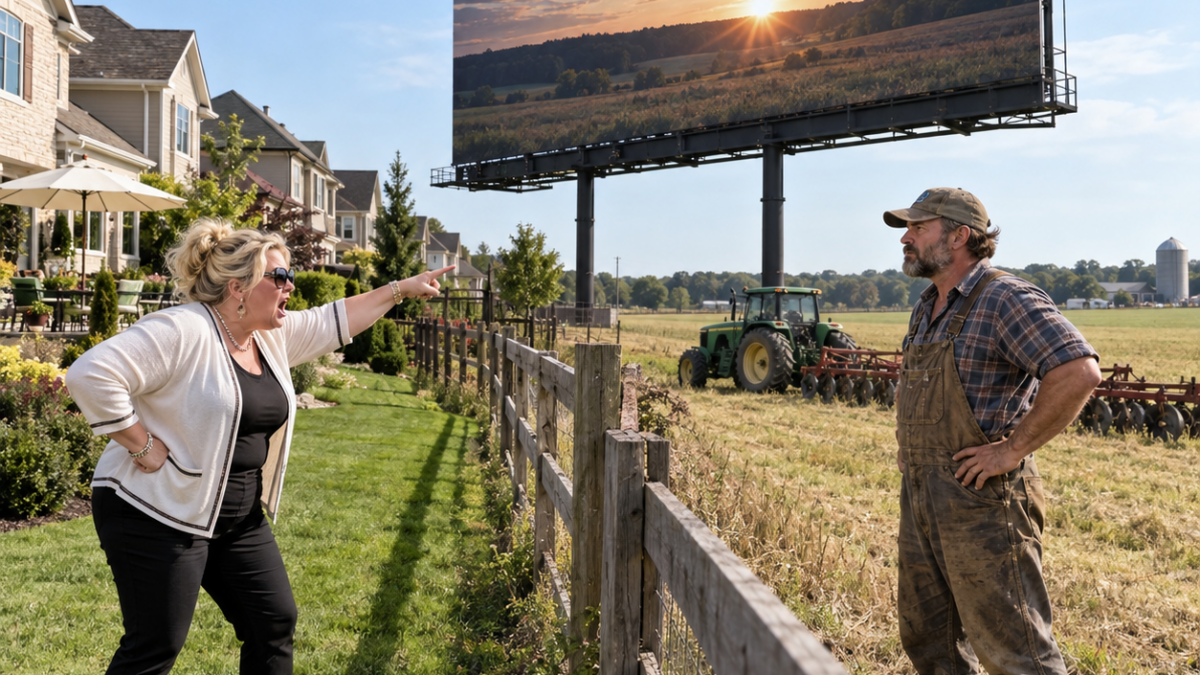
THE MERCER RANCH IS PRIVATE AGRICULTURAL PROPERTY AND IS NOT SUBJECT TO STERLING HEIGHTS HOA CONTROL.
And beneath that:
FORMAL RETRACTION: PRIOR STATEMENTS DESCRIBING THE RANCH AND ITS WORKERS AS “WHITE TRASH” WERE FALSE, INAPPROPRIATE, AND WITHDRAWN.
At the bottom:
BOUNDARIES MATTER. SO DOES RESPECT.
Rachel objected to the last line.
“Not settlement language.”
“It’s my line.”
“Then smaller.”
“Fine.”
Installation day drew a crowd.
Mostly ranch workers.
A few neighbors.
Media somehow heard.
I told reporters no comment.
Ray wore a brand-new pearl-snap shirt.
“Why are you dressed up?”
“History.”
“You own six shirts.”
“This is the good one.”
The crane lifted the panel.
Slowly.
Steel cables tightened.
The sign rose above the old fence line.
From Sterling Heights, balconies filled.
People came outside holding phones.
Some angry.
Some laughing.
Some embarrassed.
Martin Hale, the interim HOA president, stood across the boundary.
When the billboard locked into place, he walked over.
“You really did it.”
“You signed the settlement.”
“I didn’t expect architecture.”
“I’m a rancher.”
“You’re a federal marshal.”
“Multidisciplinary.”
He read the text.
Then sighed.
“You know half the neighborhood is going to hate this.”
“Probably.”
“The other half thinks we deserve it.”
“Do you?”
He looked at the sign.
Then toward the luxury homes behind him.
“I think we deserve to remember.”
That answer surprised me.
I shook his hand.
The lights came on at sunset.
Soft solar spots.
Not glaring.
Just enough.
From Victoria’s former balcony, the apology was perfectly readable.
That was deliberate.
She no longer lived there.
Her house had been sold to pay debts and legal obligations.
A family from Denver bought it.
They had nothing to do with her.
I almost changed the angle because of that.
The new homeowner, a man named Aaron Patel, stopped by while construction was underway.
“Is that going to face our house?”
“Yes.”
He read the rendering.
Then laughed.
“My wife says leave it.”
“You sure?”
“She thinks it’s the most expensive neighborhood history lesson in America.”
“I can angle it slightly south.”
“No.”
He smiled.
“We bought the house knowing what happened. Victoria made the mess.”
That mattered.
I never wanted revenge against innocent residents.
The billboard targeted nobody.
It displayed a court-recognized correction.
Still, the symbolism was impossible to miss.
The “eyesore” Victoria wanted removed had become something far more visible than the fence.
The first night, Ray and I stood near the loading pen after dark.
The billboard glowed.
He handed me coffee.
“Worth it?”
I looked toward Sterling Heights.
“Ask me in a year.”
“You’re keeping it that long?”
“Permit allows longer.”
He smiled.
“Good.”
“Don’t enjoy this too much.”
“I was zip-tied by men hired by a woman who called us white trash.”
“Fair.”
Ray took a drink.
“You know what I like?”
“What?”
“She wanted a clean view.”
I laughed.
Months passed.
The criminal cases resolved.
Victoria received a substantial federal sentence after plea negotiations and sentencing proceedings.
Calder Ridge executives faced their own consequences.
Financial penalties.
Prison time for some.
Cooperation agreements for others.
The development project died.
Without the access corridor, financing collapsed.
Investors withdrew.
The valley stayed open.
That mattered more than anything.
Not because development is evil.
It isn’t.
People need homes.
Communities grow.
But no project deserves land acquired through threats.
My daughter, Hannah, came home that Christmas.
She was thirty-one.
Architect in Seattle.
She stood at the west pasture staring at the billboard.
“You built that?”
“County-approved.”
“Dad.”
“What?”
“It looks like a legal notice designed by a cattle ranch.”
“That was the goal.”
She laughed.
Then became quiet.
“You could have sold.”
“I know.”
“It was a lot of money.”
“I know.”
“You ever regret it?”
“No.”
“Not even a little?”
“No.”
She looked toward the valley.
“I used to think you were keeping this place because of Grandpa.”
“Partly.”
“And because you hate change.”
“I do not hate change.”
“You still have a fax machine.”
“It works.”
She ignored me.
“I thought you were holding onto history.”
I waited.
“But maybe you were protecting choice.”
That hit me.
“What do you mean?”
She pointed toward Sterling Heights.
“They got to choose what happened on their land.”
Then toward ours.
“So did you.”
I nodded.
“That’s pretty much it.”
She smiled.
“You should put that on the billboard.”
“No room.”
For years, I had wondered whether keeping the ranch made sense if Hannah didn’t want it.
She loved the land but not cattle.
That was fine.
Parents can destroy children by turning inheritance into obligation.
That Christmas, she surprised me.
“I don’t want to run cows.”
“I know.”
“But I don’t want to sell the ranch either.”
I looked at her.
“What do you want?”
“Conservation lease on the north section. Maybe regenerative grazing partnership. Keep the working acreage.”
“That sounds expensive.”
“I’m an architect.”
“That means yes.”
She laughed.
“I want to help.”
For the first time since my father died, I could imagine the ranch surviving without becoming a museum to the past.
Not frozen.
Adapted.
Still ours.
The billboard became strangely famous.
People drove past to see it.
I hated that.
Ray loved it.
Someone made stickers.
I shut that down immediately.
“Why?” Ray complained.
“Because we are not merchandising litigation.”
“Missed opportunity.”
One afternoon, a group of Sterling Heights teenagers walked down the public road and asked if they could photograph the sign.
“From the shoulder.”
“Can we stand by the fence?”
“No.”
One girl read the text.
“Did their president really say that?”
“Yes.”
“That’s awful.”
“Yes.”
“Were you poor?”
I smiled.
“Compared to Sterling Heights?”
She nodded.
“Then probably.”
She looked confused.
I continued.
“Money had nothing to do with whether the ranch deserved respect.”
She read the sign again.
“Oh.”
Sometimes revenge teaches nothing.
Sometimes humiliation just creates another enemy.
I didn’t want the billboard to say LOOK WHO WON.
I wanted it to say THIS HAPPENED.
There is a difference.
Years later, when Victoria’s name rarely appeared in the news anymore, the billboard remained.
The steel weathered.
Letters stayed clear.
Sterling Heights changed too.
New board.
Independent audits.
Security contract dissolved.
Board meetings livestreamed.
Conflict-of-interest policy.
No president could approve major spending alone.
Residents created a boundary committee with neighboring properties.
Martin Hale served two terms, then refused a third.
“Power should get bored of you before you get addicted to it,” he told me.
Good rule.
He and I eventually became friends.
Not close.
But enough that he attended one of our fall cattle drives.
He lasted forty minutes.
Then complained about dust.
I looked at him.
He immediately raised both hands.
“Not filing anything.”
Ray nearly fell off his horse laughing.
Eli married a local schoolteacher.
Mateo became assistant foreman.
Sloan finished his sentence, disappeared from the private-security world, and sent one letter of apology to the workers.
Eli threw his away.
Mateo kept his.
Neither choice was wrong.
David Kellerman, the attorney who exposed the internal files, entered private practice.
He refused every HOA client afterward.
“Life’s too short,” he told me once.
Evans retired.
At her retirement dinner, she cornered me near the bar.
“The billboard is still up?”
“Yes.”
“You’re petty.”
“It’s educational.”
“You’re petty with permits.”
“Highest form of petty.”
She laughed.
Then her expression softened.
“You did well.”
“On the case?”
“Not reacting.”
I knew what she meant.
The hardest part had never been the warrants.
Or the raid.
Or court.
It had been those fourteen months.
Watching men move my boundary markers.
Reading lies about my family land.
Hearing Victoria call the ranch trash.
Watching my workers deal with spotlights.
Knowing I could confront her and choosing evidence instead.
Patience is often mistaken for weakness because its strength is invisible.
Victoria made that mistake repeatedly.
The final time I saw her was years later.
Not in person.
A letter arrived through counsel.
Her sentence was nearing completion.
The letter was not required.
Not part of settlement terms.
She had written it herself.
Rachel called.
“You want me to screen it?”
“No.”
I read it in my office.
Victoria did not ask forgiveness.
I respected that more than a fake apology.
She wrote that prison had given her “too much time to understand the difference between authority and ownership.”
She admitted she had begun seeing the ranch as an obstacle rather than another person’s home.
She admitted the money mattered.
Status mattered.
Winning mattered.
Then one paragraph stopped me.
I thought your refusal was an insult because I had become accustomed to people saying yes when I applied enough pressure. I mistook compliance for respect. I mistook wealth for worth. Worst of all, I believed anyone who lived differently from me had less to lose.
I read that paragraph again.
Then the next.
You did not destroy me. I kept waiting to hate you enough to believe that. I destroyed myself while you documented it.
I sat there a long time.
Ray entered.
“What’s that?”
“Victoria.”
He froze.
“What does she want?”
“Nothing.”
“Apology?”
“Sort of.”
He held out his hand.
I gave him the letter.
He read silently.
Then handed it back.
“Huh.”
“That’s it?”
“What do you want me to say?”
“I don’t know.”
Ray looked toward the west window.
The billboard stood beyond the pasture.
“She finally learned to read the sign.”
I smiled.
“Maybe.”
“You writing back?”
“No.”
“Why?”
“She didn’t ask a question.”
Ray nodded.
That was that.
I filed the letter.
Not as evidence.
Just paper.
The following spring, the billboard needed maintenance.
One solar light failed.
Paint on the lower support chipped.
I drove out with Mateo.
He climbed the ladder.
“Ever taking this thing down?”
“Probably.”
“When?”
“When it stops mattering.”
He tightened a bracket.
“That sounds philosophical.”
“I’m getting old.”
“Ray says you were born old.”
“Ray says many things.”
We finished near sunset.
Sterling Heights windows began glowing across the ridge.
Behind us, calves called for their mothers.
Wind moved through the grass.
The billboard lights switched on automatically.
Mateo stood beside me.
“I hated this place for a while.”
“The ranch?”
“After that morning.”
I looked at him.
“Every time I came through the gate, I remembered being on my knees.”
I waited.
“Then one day I didn’t.”
“When?”
He shrugged.
“Don’t know.”
That’s healing.
Often no ceremony.
One day the memory is the first thing you feel.
Then someday it isn’t.
He nodded toward the billboard.
“I think the sign helped.”
“How?”
“Made it feel like we didn’t just pretend nothing happened.”
I hadn’t considered that.
Maybe monuments aren’t for enemies.
Maybe sometimes they’re for the people who survived.
My father used to say fences only work when both sides agree what they mean.
He meant cattle.
But he was right about more.
A boundary is not an insult.
“No” is not aggression.
Someone else refusing you does not create a right to pressure them until their answer changes.
Victoria never understood that until everything she built disappeared.
I understood it because the ranch taught me.
Cattle test fences.
Weather breaks posts.
Creeks move.
Neighbors disagree.
You repair.
Survey.
Talk.
Sometimes litigate.
But you don’t get to move the line in the dark because you dislike where it is.
That was the entire story.
Not rich people versus ranchers.
Not HOA versus farmer.
Not even federal marshal versus corrupt president.
It was one person believing another person’s boundary became negotiable simply because she wanted something badly enough.
Everything else grew from that.
The forged paperwork.
Security intimidation.
Bribes.
Fake fines.
Moved survey stakes.
The armed raid.
All of it began with an inability to accept one ordinary word.
No.
Years after the case, Sterling Heights invited me to speak at an annual meeting.
I declined twice.
Martin called.
“Come.”
“Why?”
“New residents don’t know the history.”
“They have a billboard.”
“Cole.”
“What?”
“You don’t have to be difficult professionally and personally.”
“Apparently I do.”
He convinced me.
I wore jeans.
Clean ones.
The clubhouse looked nothing like the night Victoria had dominated it.
Open doors.
Financial reports on screens.
Residents asking actual questions.
Nobody banging a gavel.
Martin introduced me.
“This is our neighbor Cole Mercer.”
Not marshal.
Not ranch owner.
Neighbor.
I liked that.
I stood at the front.
“I was told you wanted history.”
A few people laughed.
Someone asked about the billboard.
“Is it really court language?”
“Mostly.”
“Did Victoria really call your ranch white trash?”
“Yes.”
An older woman winced.
A younger man asked, “Why didn’t you take it down after she went to prison?”
I thought before answering.
“Because the problem was never just Victoria.”
The room became quiet.
“She had help.”
Some people looked uncomfortable.
“Not all criminal help. Ordinary help.”
I pointed toward the windows facing my ranch.
“People complained because a working farm wasn’t pretty enough.”
Nobody spoke.
“People accepted security patrols near my land because they thought they were protecting property values.”
A woman lowered her eyes.
“People believed the HOA’s importance made its preferences more legitimate than my ownership.”
I paused.
“Victoria took those attitudes farther than almost anyone imagined. But corruption grows easier when arrogance already has somewhere to live.”
That landed harder than I expected.
“So the sign stays because it isn’t only an apology.”
“What is it?” someone asked.
“A reminder.”
“Of her?”
“Of us.”
That surprised them.
“Me included.”
A man frowned.
“What did you do?”
“I enjoyed winning more than I should have for a while.”
A few people smiled.
“I wanted that sign to hurt.”
Honesty matters.
“Then I realized hurting innocent residents wasn’t justice.”
“So why keep it?”
“Because eventually it stopped being about humiliation.”
I looked toward the ranch.
“It became history.”
Afterward, a woman approached.
She was the resident who years earlier apologized for complaining about our fence.
Her name was Laura Bennett.
“I hated that billboard for the first year.”
“I remember.”
“Then my grandson asked what it meant.”
“What did you tell him?”
“That adults can become bullies too.”
I smiled.
“Good answer.”
“He asked if rich people were bad.”
“What did you say?”
“That money just makes some mistakes bigger.”
Better answer.
She hugged me.
That would have shocked Victoria more than the arrest.
A Sterling Heights resident hugging the ranch owner she once considered an eyesore.
Not every ending needs enemies forever.
Eventually, Hannah returned home part-time.
She converted an old equipment office into a design studio.
The north pasture entered a conservation grazing program.
We installed better irrigation.
Repaired the barn roof.
Replaced my father’s old tractor.
Ray called the new one “unnecessarily fancy.”
Then refused to let anyone else drive it.
The ranch changed.
But it remained a ranch.
One morning Hannah stood beside me near the billboard.
“It looks old.”
“So do I.”
“I meant the sign.”
“Careful.”
“Maybe it’s time.”
“To remove it?”
She nodded.
I looked toward Sterling Heights.
The current board had nothing to do with Victoria.
Most residents hadn’t lived there during the case.
Children who once photographed the sign were adults.
The apology had been visible for years.
Maybe history had done its work.
“What would replace it?” I asked.
Hannah smiled.
“I have an idea.”
That should have frightened me.
She showed me a design.
Same steel frame.
Smaller panel.
No legal paragraphs.
No names.
Just a photograph of the valley at sunrise.
And words:
PRIVATE LAND. WORKING LAND. SHARED HORIZON.
RESPECT THE LINE. RESPECT THE NEIGHBOR.
I stared at it.
“No white-trash reference?”
“No.”
“No settlement language?”
“No.”
“No Victoria?”
“No.”
“Ray will hate it.”
“Ray thinks subtlety is communist.”
“Fair.”
We put it to no HOA vote.
Because it wasn’t their land.
We did, however, invite Martin over.
He looked at Hannah’s design.
“You’re taking down the apology?”
“Thinking about it.”
He smiled.
“Never thought I’d say this.”
“What?”
“I’ll miss it.”
“Stockholm syndrome.”
“Probably.”
We replaced the panel that fall.
The original went into storage.
Not destroyed.
History should be preserved even after you stop displaying it.
When the crane lowered the old sign, several ranch employees watched.
So did a handful of Sterling Heights residents.
Ray stood with his arms crossed.
“Too soon.”
“It’s been nine years.”
“Exactly.”
Mateo laughed.
The new panel rose.
Smaller.
Cleaner.
The image of the valley glowed in afternoon sunlight.
RESPECT THE LINE. RESPECT THE NEIGHBOR.
Ray read it.
“Huh.”
“Good huh?”
“Needs bigger letters.”
Of course.
That evening, Hannah and I sat on the porch where Victoria had once insulted the ranch.
The cedar fence was gone in several sections now.
Replaced by steel pipe fencing where cattle pressure required it.
Not because Sterling Heights demanded it.
Because we chose it.
That distinction meant everything.
“You know what Grandpa would’ve said?” Hannah asked.
“What?”
“He’d think the billboard was ridiculous.”
“Yes.”
“And then tell everyone at the diner about it for the rest of his life.”
Absolutely.
The valley remained undeveloped.
At night it was dark except for moonlight.
Coyotes moved through the ridge.
Cattle settled near the creek.
Sterling Heights houses shimmered on the opposite slope.
Two different ways of living.
Neither required destroying the other.
I thought about Victoria’s first offer.
Millions.
Then the insult.
White trash.
Then fourteen months of pressure.
Then her standing in my yard with federal agents surrounding her.
For years, people told the story as if the arrest were the punch line.
It wasn’t.
The billboard wasn’t either.
The real answer to Victoria came before all of it.
She told me my land was ugly.
I kept it.
She told me I was standing in the way of progress.
I kept it.
She told me money should change my answer.
I kept it.
She tried embarrassment.
Threats.
Paperwork.
Private security.
Fake authority.
I kept saying no.
That was the answer.
The giant billboard only made it easier to read.
And maybe that was why it became so satisfying.
Victoria had spent fourteen months believing that power meant making other people move.
In the end, the fence stayed where the survey said it belonged.
The ranch stayed with my family.
The valley stayed open.
My workers kept their jobs.
Sterling Heights learned to be a neighbor instead of a kingdom.
And the woman who once looked across my cedar fence and called everything on my side “white trash” eventually had to watch her own association admit—in writing, under court order, in letters big enough to read from every luxury balcony—that the problem had never been my ranch.
It had been the way they treated the people who lived on it.