PART 2: HOA Called Game Wardens on Me for Hunting My Own 214 Acres—Then Their “Private Preserve” Map Started Falling Apart
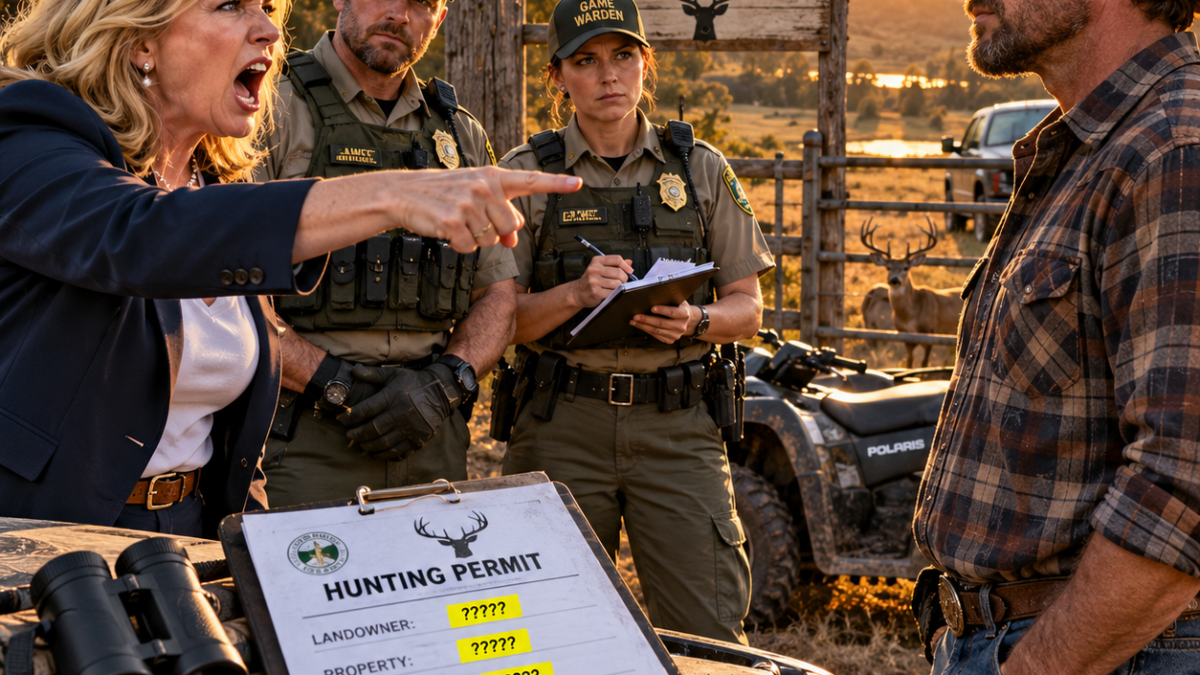
PART 2
Cole led us north from the new preserve sign.
The first thing we found was another blue stake.
Then another.
Then another.
They weren’t following my legal boundary.
They were twenty, thirty, sometimes nearly forty yards inside it.
I knew that ground well enough to recognize individual trees. One white oak beside the third stake still carried faded red paint my father had applied decades earlier when he marked a selective timber cut.
Vivien followed several steps behind us.
“This is ridiculous,” she said. “Those are management markers.”
I looked back.
“Management of what?”
“The conservation area.”
“My woods?”
“The land Pine Hollow maintains.”
Mara turned.
“Ms. Ror, until we establish otherwise, please stop describing disputed land as association property.”
Vivien’s expression hardened.
“I have documentation.”
“Good,” Mara said. “We’ll review it.”
The trail appeared about fifty yards farther in.
It was new.
Very new.
Young maple stems had been cut close to the soil. Hazel branches were still pale where saw blades had passed through them. Wood chips covered the ground.
The trail was nearly six feet wide.
Wide enough for two adults to walk comfortably side by side.
I stopped.
“What the hell is this?”
Mara looked at me.
“You haven’t seen it?”
“No.”
Vivien spoke from behind us.
“It’s a pedestrian conservation route.”
I turned around.
“You cut a trail through my timber?”
“Pine Hollow’s contractor improved an existing path.”
“There wasn’t a path here.”
“There was informal access.”
“For who?”
“Residents.”
“Residents didn’t have permission.”
Vivien gave me the same expression she’d worn during every HOA meeting where she wanted the room to believe I was being unreasonable.
“Mr. Beckett, your position on every community issue is that because your father bought the property decades ago, nothing around you can ever change.”
“My position is that you can’t change who owns it.”
Mara raised one hand.
“Let’s keep moving.”
Twenty yards farther along the trail, Cole stopped beside a birch.
A black cellular camera was strapped to the trunk at chest height.
He read the small inventory label.
“PH-TRAIL-07.”
Pine Hollow.
I walked closer.
The camera faced the new trail.
It wasn’t angled toward houses.
It wasn’t some neighbor’s wildlife camera accidentally hanging over the line.
It had been installed to monitor traffic inside my property.
“That’s association equipment,” Vivien said.
“No kidding.”
“It’s for trail safety.”
“On my tree.”
She didn’t answer.
The second camera overlooked a wooden bench set on two concrete blocks.
The third was near my father’s wildlife pond.
That stopped me harder than anything else.
Dad dug that pond in 1994.
A drought had dried two shallow wet areas on the eastern tract, and he spent weeks working an old excavator after sunset, shaping the basin by hand because he wanted spring runoff to hold there.
He planted willow around the edge.
Left dead snags standing because woodpeckers used them.
Fought invasive brush for three winters.
Now a professionally built bench sat less than ten feet from the bank.
A laminated sign beside it said:
HERON WALK
PINE HOLLOW PRIVATE PRESERVE
I stared at it.
For several seconds, I couldn’t speak.
Mara noticed.
“Something important about this location?”
“My father built this pond.”
Vivien sighed.
“Nobody is damaging the pond.”
I looked at her.
“That’s not the point.”
“Then what is?”
“You put a bench beside something my father built, gave it a marketing name, and told strangers it belonged to them.”
“Nobody told anyone they owned the pond.”
“Then why does the sign say Pine Hollow?”
“We manage the trail.”
“No. You invaded it.”
Cole had moved to another sign.
“This one has a map.”
We gathered around.
The map showed three named routes.
Cedar Loop.
Heron Walk.
Ridge View.
The lines extended well beyond the actual Pine Hollow common area.
Ridge View reached almost three-quarters of a mile west.
Toward my stand.
My legal hunting stand.
The same stand Vivien had called game wardens about that morning.
Mara photographed the map.
Then the bench.
Then each camera.
Her tone stayed even.
She did not announce arrests.
She did not accuse Vivien of fraud.
She opened a new incident entry and began documenting.
That’s one thing people misunderstand about real enforcement.
The useful officer is often the one who says the least before the evidence is complete.
Mara separated what she could verify from what she couldn’t.
She could verify my license.
My tag.
The season.
My location.
My shooting direction.
The backstop.
The parcel monument.
She could verify that Vivien’s original complaint placed me on Pine Hollow property when I wasn’t.
She could verify association equipment sat on land recorded to me.
What she could not yet tell me was why.
Or who had ordered it.
Or what Pine Hollow believed gave them the right.
Vivien attempted to leave.
Mara stopped her.
“Before you go, I need the document you referenced earlier.”
Vivien removed a folded map from a plastic sleeve.
Most of Beckett Woods had been shaded green.
Across the eastern 172 acres, a label read:
PINE HOLLOW PRIVATE PRESERVE.
Mara studied it.
“Recorded?”
“It’s the association’s official conservation plan.”
“That’s not what I asked.”
“It reflects our access corridor.”
“Do you have the recorded access agreement?”
“Not physically with me.”
“What is it called?”
“The conservation corridor agreement.”
“Recorded instrument number?”
Vivien hesitated.
“Our management company can provide it.”
Mara handed the map to Cole.
“Take a photograph.”
Vivien stiffened.
“I’d prefer you not reproduce proprietary association materials.”
Cole looked at her.
“You gave this to us as evidence supporting your complaint.”
Vivien said nothing.
By the time we finished walking the area, we’d found fourteen blue stakes, three cameras, four directional signs, two benches, and nearly nine hundred feet of fresh trail.
And that was only what we could inspect that morning.
Lydia Harrow answered my call before the second ring.
“Are the wardens still there?”
“Yes.”
“Any citation?”
“No.”
“Any issue with the hunt?”
“Mara says it appears lawful.”
“Good. Don’t remove anything.”
“They put a camera at Dad’s pond.”
“I heard you.”
“I want it gone.”
“I know.”
“You sound very calm about somebody cutting trails through my land.”
“I’m calm because one of us needs to be.”
I looked toward Vivien.
She was standing outside the line Mara had directed her to.
“What do I do?”
“Photograph everything. Let the officers finish. Then we send one written demand. Do not tear down signs. Do not destroy cameras. Do not drag benches into the subdivision.”
“Even though they’re mine to remove?”
“Probably. But I want them gone in a way nobody can later describe as vandalism, harassment, or interference with evidence.”
That wasn’t what my anger wanted.
It was exactly what I needed.
Mara completed her report.
Cole inspected the harvested buck and verified the tag.
Then Mara handed me a written incident number.
“Based on what we’ve observed, we’re not identifying a hunting violation.”
Vivien spoke from beyond the boundary.
“So you’re allowing a man to discharge a rifle beside a residential trail?”
Mara faced her.
“We have not established that your residents have lawful access to this trail.”
“We maintain it.”
“Maintenance and ownership aren’t the same thing.”
Vivien looked at me.
“This isn’t over.”
I picked up my rifle.
“I didn’t start it.”
She turned and walked toward Pine Hollow with the two residents behind her.
By noon, I had a full photographic inventory.
At 1:15 p.m., Pine Hollow’s management company emailed the entire subdivision.
A resident forwarded it to me.
The subject line read:
ARMED INCIDENT IN THE PRESERVE.
The message stated that an individual had discharged a rifle near a community walking route and that Pine Hollow was cooperating with state authorities to secure the area.
It did not say the state had found no hunting violation.
It did not say the walking trail was on my parcel.
It did not say Vivien had been ordered back across the property line.
The final sentence was the one that bothered me most.
Residents were instructed to avoid the eastern preserve trails until further notice.
Not proposed trails.
Not disputed trails.
The preserve trails.
The HOA wasn’t describing something it hoped to build.
It was describing an existing amenity.
I went to Pine Hollow’s website.
The homepage showed a smiling family walking under autumn maples.
The photograph could have been taken in a thousand Midwestern woods.
Underneath it were the words:
LIVE BESIDE 172 ACRES OF PRIVATE PROTECTED WOODLAND.
Another page listed amenities.
Clubhouse.
Fishing pond.
Children’s play area.
More than four miles of resident-only nature trails.
I stared at that number.
Pine Hollow owned eighteen acres of actual common land.
It physically could not contain four miles of woodland trails without folding them like shoelaces.
I saved everything.
Downloaded the page.
Printed the brochure.
Recorded the date and time.
Then I searched the eleven homes being marketed in Pine Hollow’s final phase.
Nine listings mentioned private preserve access.
Six displayed the same green map Vivien had handed Mara.
One virtual tour began at the clubhouse.
A sales agent walked along Pine Hollow’s real half-mile trail.
Then the video continued.
Across my boundary.
Past my trees.
Along the new route.
The narrator said, “Beyond the community loop, residents enjoy permanently protected woodland reserved for Pine Hollow.”
I leaned closer.
The camera turned.
My father’s pond filled the screen.
A woman walking beside it pointed toward the willows.
“Families love the wildlife observation area.”
I paused the video.
My father’s pond had become a sales feature.
I watched the segment again.
Then a third time.
Anger became something colder.
Lydia arrived at four carrying a scanner, evidence bags, and a legal pad.
She watched the virtual tour once.
Then she leaned back.
“This isn’t just an HOA boundary fight.”
“What is it?”
“Potential disclosure problem. Maybe insurance. Maybe title. We don’t know yet.”
“They’re selling houses using my property.”
“They’re selling an amenity they appear not to own.”
“That’s the same thing.”
“Emotionally, yes. Legally, we state only what we can prove.”
She started drafting.
The first notice went to Pine Hollow’s board and management company.
It revoked any claimed or implied permission to enter Beckett Woods.
It demanded preservation of emails, work orders, maps, installation records, trail contracts, photographs, and communications concerning the preserve.
It offered supervised access to remove association equipment after a full inventory.
The second went to Northstar Residential Partners, the subdivision developer whose logo appeared on the listings.
The third went to the title company named in Pine Hollow’s online buyer guide.
I read the letters.
“You didn’t call anyone a liar.”
“No.”
“Even Vivien?”
“Not yet.”
“Why?”
“Because accusations make people defensive. Questions make them search files.”
The next morning, I received a certified envelope from Pine Hollow.
The letter had been prepared before hunting season opened.
Vivien had signed it.
It ordered me to stop discharging firearms within the Pine Hollow Conservation Corridor, remove hunting stands from the protected area, and recognize the association’s established access rights.
Attached was a document from 1996.
For about thirty seconds, I thought we’d finally found something important.
The title read:
DRAINAGE INSPECTION LICENSE.
Lydia read it with me.
It involved the southeast corner of what later became Beckett Woods.
The former owner had granted Pine Hollow’s predecessor a narrow right to inspect and clear a stormwater channel serving the future subdivision.
Then the limitations began.
Twelve-foot strip.
Three hundred ten feet long.
Seventy-two hours written notice except during active flooding.
Routine inspection no more than twice annually.
No transfer to residents.
No public access.
No recreational use.
No ownership interest.
I looked at Lydia.
“This is their preserve agreement?”
“If this is what she’s relying on, it’s not close.”
The advertised trail didn’t even follow the drainage strip.
It crossed it at almost a right angle.
Then continued nearly a mile into my forest.
Vivien hadn’t forged my father’s signature.
She hadn’t manufactured a deed.
What she’d done was more ordinary.
She had taken a narrow maintenance permission and stretched its language until “inspection access” became “conservation corridor.”
Then “corridor” became “preserve.”
Then “preserve” became a resident amenity.
By the time I complained, the vocabulary had already traveled farther than the paperwork ever had.
On Tuesday morning, surveyor Grant Hollis met me at the property.
Grant had marked the eastern boundary when I thinned a maple stand four years earlier.
He trusted monuments more than opinions.
Over most of the day, he recovered seven original control points and tied them to the legal description.
Then he mapped everything Pine Hollow had installed.
The results were embarrassing for the HOA.
The closest preserve sign was thirty-eight yards inside my parcel.
The farthest camera was six hundred twelve yards inside.
One bench was less than ten feet from Dad’s pond.
The advertised trail overlapped the legitimate drainage license for only fourteen feet.
Fourteen feet.
Then it left the corridor and wandered through land Pine Hollow had no recorded recreational right to use.
Grant handed me his preliminary field sketch.
“Their green map isn’t a survey.”
“They call it a conservation plan.”
He shrugged.
“A restaurant menu is also a plan. Doesn’t tell you who owns the building.”
Wednesday morning, I received a call from Evelyn Shaw, senior counsel for Lake States Title.
She had eleven Pine Hollow closings scheduled over the next five weeks.
“Mr. Beckett, are you the fee owner of parcel 7214B?”
“Yes.”
“Have you granted Pine Hollow Estates recreational access across that parcel?”
“No.”
“Northstar Residential?”
“No.”
“Individual homeowners?”
“No.”
“Any conservation easement?”
“No.”
“Any resident trail license?”
“No.”
She paused.
“Would you sign a sworn owner statement confirming that?”
“Send it to Lydia.”
“One more question.”
“Go ahead.”
“Our current title commitments don’t insure an access right across your parcel. The preserve appears in marketing and community disclosure materials, not in the recorded land records.”
That was the first confirmation from an outsider with nothing emotionally invested in the dispute.
Pine Hollow’s preserve existed on paper.
Just not the kind of paper that transferred property rights.
Lake States did not cancel the eleven sales.
It took a narrower step.
Any closing package that described Beckett Woods as a guaranteed resident amenity was paused until corrected disclosures were issued.
Buyers could still purchase homes.
But they could no longer be told their purchase included recreational rights across my parcel unless somebody produced an actual legal instrument.
By Thursday, Northstar had a problem.
Not an argument.
A contract problem.
The regional director, Paul Rener, called before lunch.
“We’d like to resolve what appears to be a misunderstanding.”
“Whose misunderstanding?”
“The boundaries of the preserve may have been communicated imprecisely.”
“Your video walks past my father’s pond.”
“I haven’t personally reviewed that footage.”
“You should.”
“We’d like to meet.”
“Lydia will respond after your company preserves its records.”
His tone cooled slightly.
“Mr. Beckett, there are families whose homes are being delayed.”
“I didn’t put my property in their contracts.”
“We’re not suggesting you did.”
“Good.”
Two hours later, Vivien called me directly.
“You are interfering with eleven families’ home purchases.”
“You sent people onto my land.”
“Nobody is taking your ownership.”
“You cut trails, installed cameras, removed signs, and called game wardens when I used it.”
“We are talking about limited recreational access.”
“Show me the agreement.”
“You know there’s an existing corridor.”
“The drainage license?”
Silence.
I continued.
“Three hundred ten feet. Twelve feet wide. Twice a year. No recreational use. No resident transfer.”
She didn’t answer.
For the first time since I’d met her, Vivien seemed to have no prepared sentence.
Finally she said, “This can still be handled privately.”
“It was private until you used it to sell houses.”
She ended the call.
Then homeowners started contacting me.
Some were furious.
One called me selfish.
Another said hunting beside families was barbaric.
Three apologized for entering the woods.
Then Hannah Price emailed.
She was a nurse.
She and her husband were under contract on one of the final-phase houses.
They had a six-year-old daughter.
Their sales agent had personally walked them through my forest in September.
“He showed us the pond,” Hannah wrote. “He told my daughter Pine Hollow residents helped protect nesting cranes there. Were we trespassing?”
I sat with that question for a while.
Then I answered.
“You didn’t know. The people leading you should have.”
An hour later, Hannah sent twelve photographs.
One showed her daughter standing beside Dad’s pond.
Another showed a temporary Northstar sign.
YOUR PRIVATE PRESERVE.
Then I opened the most important photograph.
Vivien stood beneath that banner speaking to a group of prospective buyers.
The date stamp was six months earlier.
This hadn’t begun the night before deer season.
It hadn’t even begun when the trails appeared.
Pine Hollow had been marketing the preserve since spring.
Friday morning, Grant and I went to the county planning archive.
The clerk rolled out Pine Hollow’s original approved subdivision plan across a large table.
Near the southeast edge, a heavy dashed line separated the development from the neighboring parcel.
Inside that neighboring parcel were four words.
NOT A PART OF PINE HOLLOW.
I stared at them.
Grant pulled Vivien’s green preserve map from his folder.
We placed it beside the county original.
The road curves matched.
The pond outline matched.
The contour marks matched.
The lot lines matched.
It was the same source drawing.
Except the customer version had been cropped just inside the heavy boundary.
Those four words were gone.
NOT A PART OF PINE HOLLOW.
Gone.
The 172 acres beyond the line had been shaded translucent green.
I felt something settle in me.
Until then, part of the dispute could still be explained as sloppy management.
Old assumptions.
Bad surveying.
A narrow drainage license expanded through ignorance.
But this map hadn’t simply overlooked the warning.
The warning had been removed.
Lydia sent both versions to Northstar, Lake States Title, Pine Hollow’s board, and the HOA’s insurance carrier.
Her email contained one question.
Who authorized the change?
The first answer came from Brett Sutter.
He owned Sutter Grounds and Trail, the company that maintained Pine Hollow’s common areas.
His labels were on the benches.
His crew had installed the cameras.
Brett asked to meet at my north gate.
He arrived in a brown work truck with a folder.
He looked exhausted.
“Vivien told us Pine Hollow controlled the eastern woods.”
“What did she give you?”
“A map. And the drainage license.”
Lydia stood beside me.
“Did you read the license?”
“Not fully.”
“Who laid out the trail?”
“Blue stakes were already placed. We followed them.”
“By who?”
“Vivien marked the initial route with a committee volunteer.”
Brett opened his folder.
Six work orders.
Brush clearing.
Trail surfacing.
Camera installation.
Benches.
Directional signs.
A planned observation platform near Dad’s pond.
Every one approved by Vivien as HOA president.
Then Brett pulled out another work order.
REMOVE PRIVATE PROPERTY SIGNAGE FROM DESIGNATED PRESERVE ROUTES.
My throat tightened.
“Where are my signs?”
“In the maintenance shed.”
“How many?”
“Nine.”
“I counted five missing.”
“Four came from farther north.”
“Why weren’t they thrown away?”
Brett looked uncomfortable.
“One of my guys said destroying them felt wrong.”
“Removing them didn’t?”
He accepted the question.
“No. We should’ve verified the ownership.”
That answer mattered.
He wasn’t pretending a bad instruction had erased his responsibility.
Lydia arranged a documented return.
We did not raid the shed.
The management company photographed the nine signs, logged them, and delivered them to Lydia’s office.
The screw holes matched my posts.
Two still carried strips of old red boundary paint.
Then Brett produced an email thread.
In one message, he warned Vivien that the landowner’s posted signs conflicted with the preserve map.
Her reply was short.
REMOVE THEM BEFORE THE FINAL PHASE TOURS BEGIN.
I read it twice.
She had been told the signs contradicted her map.
Her solution wasn’t to verify the map.
It was to remove the signs.
The insurance company found another problem.
Pine Hollow’s liability policy contained a schedule of common and managed areas.
Earlier that year, someone had added:
172-ACRE WOODLAND TRAIL SYSTEM.
The carrier had requested proof of ownership, lease, or management authority.
Vivien responded with a Pine Hollow board resolution declaring the acreage a “community-controlled conservation asset.”
No deed.
No parcel grant.
No signature from me.
No recorded easement.
Just a resolution the HOA had written about itself.
After reviewing Lydia’s packet, the carrier issued a reservation of rights.
Pine Hollow was directed to stop representing the forest as insured common property until the access question was resolved.
The insurer wasn’t deciding ownership.
It was deciding whether the HOA had accurately described the risk it wanted covered.
Then Northstar’s design archive produced the email that made the four missing words even harder to explain.
A junior designer named Celia Marsh had sent two versions of the preserve map.
The first still showed the legal boundary.
And the words:
NOT A PART OF PINE HOLLOW.
Her email said:
“We cannot present the Beckett parcel as a resident amenity without a recorded easement or owner license. Please confirm legal.”
Vivien responded twenty-three minutes later.
“Remove the legal note from the customer version. Access will be resolved before final closings.”
Paul Rener had been copied.
He never answered.
Northstar’s attorney contacted Lydia that afternoon.
They offered me $40,000 for a fifteen-year recreational access license.
They would restore damaged brush.
Limit residents to daylight hours.
Carry insurance.
I rejected it.
They came back at $75,000 with a narrower trail.
I rejected that too.
Lydia looked at me across her desk.
“Are you sure money isn’t the issue?”
“It’s not.”
“Good. I needed you to say it out loud.”
“The trail crosses winter deer cover. It goes past Dad’s pond. It puts residents inside forestry operations. And if I grant the license, I can’t safely hunt half the eastern tract when people might be wandering through it.”
“So your position is use, not price.”
“Exactly.”
Pine Hollow wasn’t offering to rent a path.
They were asking me to reorganize how I managed 214 acres around a promise they had already made to strangers.
Vivien responded with another escalation.
A Saturday “Preserve Safety Walk.”
The HOA email invited residents to meet at the clubhouse at nine.
The stated purpose was to demonstrate Pine Hollow’s continuous management of the preserve.
Lydia read the email.
“She’s trying to create use after written revocation.”
“Can she?”
“She can try.”
“What do we do?”
“We make the boundary impossible to misunderstand.”
Grant returned Friday.
He placed temporary witness posts along the surveyed property line.
Each had orange ribbon and a small notice identifying Beckett parcel 7214B.
I chained the two private trail entrances.
Posted Lydia’s written no-entry notice.
Then we contacted the county sheriff.
We asked for a civil standby.
Not arrests.
Most Pine Hollow residents had been given false information.
Turning them into enemies would have been unfair and stupid.
Saturday morning, forty-three people gathered behind Vivien.
Some carried coffee.
Several had children.
Most wore orange vests because the HOA told them to.
They weren’t an invading force.
They were neighbors following instructions from someone they believed had authority.
I stood on my side of the line with Lydia, Grant, and Deputy Aaron Bell.
Mara Ellison came too because the proposed route entered the active hunting area from her earlier report.
Vivien stopped at the chain.
She turned so the group could hear her.
“Mr. Beckett has blocked an established community trail.”
Grant unfolded his survey on the hood of my truck.
“The recorded property boundary is here.”
He pointed.
“The Pine Hollow trail is over there.”
Vivien held up the drainage license.
“We have longstanding corridor rights.”
Lydia pointed toward the orange stakes.
“Your drainage corridor extends east-west for three hundred ten feet. Your advertised trail runs north and west for miles. They overlap for fourteen feet.”
A resident raised his hand.
“Why doesn’t the green map match these stakes?”
Vivien answered immediately.
“Because Mr. Beckett commissioned a private survey.”
Grant didn’t take the bait.
“I recovered the monuments referenced in the recorded legal descriptions. Pine Hollow is free to hire another licensed surveyor to verify my work.”
Mara stepped forward.
She spoke to the residents.
“The conservation department has not designated Beckett Woods as Pine Hollow property. We investigated last week’s hunting complaint and found Mr. Beckett in compliance based on the facts observed.”
The crowd changed.
Not dramatically.
But visibly.
A father took his daughter’s hand.
Two people removed their orange vests.
Someone near the back said, “We were told this was HOA land.”
Hannah Price stepped forward.
“We were told access was permanent.”
Vivien turned toward her.
“It will be once the paperwork is completed.”
Lydia’s voice was quiet.
“Then it isn’t permanent now.”
Nobody moved.
That sentence did what pages of legal language hadn’t.
For months, Vivien had spoken about access as a present fact.
Now, in front of forty-three residents, she admitted the right still needed paperwork.
People started turning around.
Deputy Bell didn’t order anyone to leave.
He didn’t need to.
Parents led children back toward the clubhouse.
Residents asked Vivien questions.
Not me.
Vivien remained by the chain until nearly everyone had gone.
Then she looked at me.
“You are humiliating this community.”
“I didn’t invite them here.”
“You could end this with one signature.”
“You could’ve asked for one before cutting the trail.”
She looked toward my forest.
“Do you understand what’s at risk?”
“My land.”
“Eleven closings. Families’ deposits. A major reserve contribution.”
Lydia turned.
“What reserve contribution?”
Vivien’s jaw tightened.
“Ask Northstar.”
Then she walked away.
Monday morning, Evelyn Shaw at Lake States Title sent Lydia the document.
FINAL PHASE AMENITY COMPLETION AGREEMENT.
Under the agreement, Northstar would pay Pine Hollow $18,000 for each of the eleven final homes.
Total:
$198,000.
The payment depended on listed amenities being completed and available by December 15.
One listed amenity was:
PINE HOLLOW PRIVATE PRESERVE TRAIL SYSTEM.
I sat in Lydia’s office reading it.
“That’s why she kept pushing.”
“Partly,” Lydia said.
“The HOA budgeted this?”
“We’re checking.”
Independent counsel for Pine Hollow produced the meeting minutes.
The board’s treasurer, Denise Carver, had asked whether Pine Hollow already had legal rights to the preserve acreage.
Vivien answered yes.
She told the board only a “routine owner acknowledgment” remained.
No such acknowledgment existed.
No draft had ever been sent to me.
But the HOA budget already anticipated the $198,000.
Some of it was committed to clubhouse roof work and pond dredging.
Now Vivien’s behavior made more psychological sense.
That didn’t make it acceptable.
It made it more dangerous.
She hadn’t simply wanted a prettier brochure.
She had allowed an entire budget to depend on an amenity she did not control.
Every week that passed made admitting the mistake more expensive.
Then Northstar’s land-acquisition archive produced the oldest document in the chain.
Six years earlier, when Pine Hollow was being planned, Northstar had tried to buy the eastern 172 acres from my father.
Their first offer was $310,000.
Dad refused.
Northstar increased it once.
He refused again.
The subdivision was redesigned to remain entirely on land Northstar already owned.
The file contained an internal memorandum.
Paul Rener’s signature appeared at the bottom.
So did Vivien’s.
She had been consulting on sales at the time.
The memorandum stated:
BECKETT PARCEL EXCLUDED.
NO ACCESS OR AMENITY RIGHTS ACQUIRED.
ALL MARKETING MUST REMAIN WITHIN APPROVED PLAT.
I read Vivien’s signature twice.
She had known.
Before Pine Hollow built its first finished house.
Before the preserve signs.
Before the trails.
Before my no-trespassing signs disappeared.
Before she called game wardens.
She had known the forest had been offered for sale.
She knew Northstar failed to buy it.
She knew the approved subdivision excluded it.
And years later, when a designer warned that the land couldn’t be shown as a community amenity, Vivien told her to remove the legal note.
At that point, the dispute no longer depended on whether a homeowner found me believable.
The project files answered the question.
Lake States scheduled a joint disclosure conference.
It wasn’t a criminal hearing.
It wasn’t an HOA trial.
It existed because eleven buyers had been given documents promising a property right that title records did not show.
Evelyn Shaw chaired the meeting.
Lydia sat beside me.
Grant attended with the survey.
Across the table were Paul Rener, Northstar’s attorney, Vivien, Denise Carver, Pine Hollow’s independent counsel, and an insurance representative.
Hannah and two other buyers attended as affected parties.
Evelyn opened with one question.
“Does any recorded instrument grant Pine Hollow residents recreational access across parcel 7214B?”
Nobody answered.
She repeated it.
“Does anyone here possess such an instrument?”
Northstar’s attorney said, “No.”
Pine Hollow’s independent counsel said, “Not that we’ve located.”
Vivien leaned forward.
“The association has the 1996 corridor license.”
Grant placed the recorded exhibit on the screen.
A thin rectangle appeared near the subdivision.
Then he overlaid the Pine Hollow trail.
The blue line crossed the licensed strip briefly.
Then disappeared deep into my property.
“Overlap is approximately fourteen feet,” he said. “After that, the recreational trail has no relationship to the drainage license.”
Vivien looked toward Paul.
Paul didn’t speak.
Lydia presented Brett Sutter’s work orders.
Trail cutting.
Camera installation.
Benches.
Signs.
The order directing removal of private-property signage.
Then Vivien’s email:
REMOVE THEM BEFORE THE FINAL PHASE TOURS BEGIN.
The insurance representative presented Pine Hollow’s board resolution declaring my forest a community-controlled conservation asset.
Then Evelyn placed two maps side by side.
The county original.
And the customer version.
On the original, the boundary was heavy and unmistakable.
Inside my land were the words:
NOT A PART OF PINE HOLLOW.
On the customer version, those four words were gone.
The boundary had disappeared under green shading.
Vivien leaned toward the screen.
“The customer map was conceptual.”
Evelyn looked at her.
“It was included in contractual community disclosures.”
“It was never intended to serve as a survey.”
“Buyers were nevertheless asked to rely on it when evaluating amenities.”
“We expected access to be finalized.”
Lydia slid another document across the table.
The six-year-old acquisition memorandum.
Vivien looked down.
Her own signature was at the bottom.
NO ACCESS OR AMENITY RIGHTS ACQUIRED.
For several seconds, no one spoke.
The ventilation system hummed above us.
Paul Rener finally broke the silence.
“Northstar should have stopped the preserve marketing when legal confirmation didn’t arrive.”
Vivien looked at him.
He continued.
“We didn’t.”
It wasn’t heroic.
It wasn’t dramatic.
It was simply the first completely honest sentence I’d heard from Northstar.
Vivien wasn’t finished.
“Residents have used the property openly.”
Pine Hollow’s own attorney turned toward her.
“The documented trail use appears recent.”
“There has been access for years.”
“Informal access isn’t the same as a recorded recreational right.”
“The association maintained the area.”
“Maintenance doesn’t make the advertisement accurate.”
Vivien’s voice tightened.
“There are legal doctrines concerning longstanding use.”
The attorney remained calm.
“Those theories would require facts and possibly a court determination. We cannot market disputed rights as settled ownership.”
Hannah leaned forward.
She had been quiet for most of the meeting.
Then she asked the question that finally emptied Vivien’s argument.
“If the trail already belonged to Pine Hollow, why did you need Mr. Beckett’s signature before our closings?”
Vivien looked toward Paul.
Paul looked at the amenity agreement.
Nobody answered.
The meeting lasted almost four hours.
By the end, nobody had a theatrical victory.
We had a framework.
Northstar agreed to provide corrected disclosures to every current buyer and any existing homeowner who had received preserve marketing.
Buyers could proceed, renegotiate, or exercise whatever rights their contracts allowed after reviewing the corrections with their own advisers.
Northstar agreed to make the entire $198,000 reserve contribution without requiring access across Beckett Woods.
A substitute trail and native landscaping project would be built completely inside Pine Hollow’s legitimate common property.
The HOA agreed to remove every camera, bench, stake, directional sign, and trail improvement from my land under Grant’s supervision.
They would pay documented restoration costs.
Survey costs.
And my reasonable legal expenses associated with the dispute.
Most importantly, Pine Hollow agreed not to advertise, insure, license, or claim recreational access across my parcel without a future written agreement executed by me and properly documented.
I did not grant one.
The hunting complaint followed its own process.
Mara had already documented the incident.
The conservation department had no basis to cite me for the hunt.
The sheriff’s office documented the boundary notices and later trespass concerns.
I wasn’t promised an arrest.
Nobody dragged Vivien from her house.
There was no squad-car scene designed for satisfaction.
Real consequences tend to arrive in envelopes, minutes, canceled authority, increased insurance scrutiny, legal bills, and people refusing to believe you without documentation anymore.
Pine Hollow’s board requested Vivien’s resignation after the disclosure conference.
She submitted it the following morning.
No packed clubhouse.
No applause.
No shouting.
Her name simply disappeared from the association letterhead.
Independent counsel took control of the property records.
Denise Carver became interim president long enough to stabilize the finances.
The board hired an outside property-management consultant to review every common-area claim and easement listed in Pine Hollow’s records.
For the first time since I’d known the association, its maps began matching its deeds.
Restoration started in early December.
Brett Sutter’s crew returned.
This time, they came through my north gate with written permission.
Grant’s field map stayed on the dashboard of Brett’s truck.
Every worker signed in.
They removed the cellular cameras first.
Then the directional signs.
The benches came out carefully so they wouldn’t damage the pond bank.
On the straight trail sections, workers loosened compacted soil.
They scattered native leaf litter.
Placed fallen limbs across the former path.
Replanted hazel and young maple where brush had been cut.
Brett personally reinstalled all nine of my no-trespassing signs.
We stood together beside the pond when he finished.
He tightened the final screw.
“Wish I’d checked this six months ago.”
“So do I.”
“I honestly thought the HOA controlled it.”
“I believe you.”
He looked surprised.
“Doesn’t excuse it.”
“No.”
He nodded.
“Fair.”
At Pine Hollow’s southeast corner, Northstar built a short overlook entirely within the subdivision’s eighteen acres.
Residents could see the marsh and the upper canopy of Beckett Woods without entering it.
The substitute walking path was shorter.
Less impressive on a brochure.
But it was real.
Hannah and her husband completed their purchase.
A week after they moved in, she emailed me.
Her daughter still talked about the pond.
“Would you ever let us visit once, if you’re there?” she asked.
I stared at the message for a while.
After months of fighting to close the boundary, opening it voluntarily felt strange.
Then I thought about Dad.
He had been territorial about the woods in the practical sense.
He posted it.
Managed it.
Protected it.
But he wasn’t mean about it.
If a neighbor asked to cross during mushroom season, Dad usually said yes.
If a kid wanted to see the pond, he’d walk them down himself.
What he hated was assumption.
I wrote Hannah back.
“Saturday morning. Nine o’clock. Meet me at the north gate.”
It was cold enough that our breath showed when they arrived.
Her daughter wore purple boots and carried a little spiral notebook.
She counted woodpecker holes.
Asked why I left dead trees standing.
Asked whether deer slept in the same place every night.
At the pond, she stared at a fallen branch half-submerged near the bank.
“Why don’t you clean that out?”
“Because clean isn’t always healthy.”
She frowned.
I pointed toward the water.
“Frogs hide around it. Small fish use the shade. Insects live in the wood. Sometimes what looks messy to us is somebody else’s home.”
She wrote that down.
My father would have liked her.
The following spring, I made another decision.
I created a one-day educational access license for the county elementary forestry program.
It required advance scheduling.
Adult supervision.
A specific route.
No general public access.
No standing rights.
Each visit expired automatically at the end of the day.
Pine Hollow received no special privilege.
Some people thought I was being too generous after what happened.
I didn’t.
Property rights meant the decision was mine.
If I closed Beckett Woods forever simply because Vivien had tried to take control of it, she would still be influencing how I used the land.
I wasn’t interested in giving her that either.
Summer covered most of the old trail scars.
Young hazel pushed through disturbed soil.
Leaf litter hid the worst cuts.
The bench marks beside Dad’s pond faded.
One of the cellular cameras became mine as part of the equipment return.
I repositioned it toward the water.
That fall it captured a doe drinking at dawn.
Then a black bear.
Then three raccoons fighting over something just outside the frame.
By the next deer season, the woods looked almost normal again.
Opening morning came cold and gray.
At 6:12, I sat in the same western stand.
The Pine Hollow lights were faint through seven hundred yards of timber behind me.
Ahead, the limestone ridge slowly appeared in the dawn.
My rifle rested across my knees.
License and tag were in the same waterproof pouch.
So was Mara’s old incident number, though I doubted I’d need it.
The new Pine Hollow board had mailed residents a plain boundary map before hunting season.
No green marketing layer.
No “private preserve.”
No imaginary trail.
Just lot lines.
Common land.
And Beckett Woods clearly labeled private property.
Nobody came through the eastern trees.
No blue stakes.
No HOA utility cart.
No scarlet rain shell beneath my stand.
I found myself thinking about the morning a year earlier.
Vivien pointing at my rifle.
Calling me an armed trespasser.
Telling game wardens I had fired inside Pine Hollow.
For months, the story had seemed to be about hunting.
It wasn’t.
The rifle had simply given her a reason to force the ownership issue in front of authorities.
The real conflict began long before opening morning.
It began when someone looked at 172 acres of woods Pine Hollow didn’t own and realized those acres made the subdivision more valuable if buyers believed they belonged to the community.
Then words started changing.
Drainage access became corridor access.
Corridor became conservation land.
Conservation land became preserve.
Preserve became permanent resident amenity.
Then the four inconvenient words disappeared from the map.
NOT A PART OF PINE HOLLOW.
By the time Vivien called state officers on me, she had repeated the rewritten version so many times that half the neighborhood believed my own hunting stand sat inside her preserve.
That was why the original map mattered.
It didn’t shout.
It didn’t threaten.
It didn’t need confidence.
It simply existed.
Four words printed years before the subdivision sold its first home.
Four words that told the truth before anyone had money riding on a different version.
As daylight strengthened, I looked across the same woods my father had assembled parcel by parcel.
He’d never owned them all at once in the beginning.
First eighty acres.
Then another tract.
Then another.
Years of repair work.
Timber money.
Saved checks.
Deals made at kitchen tables.
He’d once told me that buying land was the easy part.
“Knowing what you’re responsible for after you buy it,” he’d said, “that’s ownership.”
At the time, I thought he meant taxes and fences.
Now I understood more.
It meant knowing your boundary.
Respecting the neighbor’s boundary.
Managing wildlife.
Keeping roads safe.
Posting land when necessary.
Giving permission when you choose.
And saying no when somebody mistakes your silence for consent.
A legal buck appeared at the base of the ridge shortly after sunrise.
I watched him through the scope.
The lane was clear.
Backstop solid.
No people.
No movement behind him.
I waited.
He stepped behind brush.
Then continued north before I ever touched the trigger.
I lowered the rifle.
A year earlier, that would have frustrated me.
That morning, it didn’t.
The woods were quiet.
Not the tense quiet of a dispute.
Not the silence after somebody calls police.
Just ordinary November quiet.
A woodpecker struck somewhere behind me.
Wind moved through dry oak leaves.
Far to the southeast, beyond the actual boundary, a car door shut inside Pine Hollow.
Nothing crossed the line.
Nobody mistook the absence of confrontation for permission.
And for the first time since a blue preserve sign appeared beneath my stand, Beckett Woods felt like my father’s forest again.
At 6:12 on opening morning, HOA President Vivien Ror stood beneath my deer stand with one hand wrapped around her phone and the other pointed straight at my rifle.
“That’s him,” she told the two conservation wardens coming through the trees. “He already fired. He refuses to leave Pine Hollow property.”
I opened the rifle’s action, removed the remaining cartridge, and set the weapon against an oak where both officers could see it.
Twenty-six minutes earlier, I had legally harvested a buck on land my family had owned for decades.
Now I was being accused of trespassing on it.
My name is Nolan Beckett. I was fifty-four that November, and Beckett Woods covered 214 acres of hardwood ridges, cedar lowlands, old logging roads, and marshy drainage in north-central Wisconsin.
My father bought the first eighty acres in 1979 with money he earned repairing logging equipment. Whenever timber prices dropped and a neighboring owner wanted out, he bought another parcel.
By the time the property came to me, it stretched nearly a mile from the county road to the southeast marsh.
Pine Hollow Estates bordered one corner.
The subdivision owned eighteen acres of legitimate common land.
It did not own my forest.
Yet Vivien stood beneath my hunting stand as though she’d been waiting months for officers to arrive and prove otherwise.
The first warden introduced herself as Mara Ellison. Her partner, Cole Maddox, remained several steps to the side with a clear view of everyone’s hands.
Their caution didn’t bother me.
They had received a call about an armed man near a residential development.
I handed Mara my hunting license, tag, and laminated survey card.
“One shot?” she asked.
“Yes.”
“Direction?”
“West.”
“Backstop?”
“Limestone ridge.”
“Nearest occupied home?”
“More than seven hundred yards behind me, opposite the shooting direction.”
Vivien interrupted.
“He was inside the Pine Hollow Private Preserve.”
Mara looked at her.
“We’ll establish that.”
Vivien pointed behind me.
I turned.
A new blue sign stood among the trees.
PINE HOLLOW PRIVATE PRESERVE
RESIDENT ACCESS ONLY
The soil around the posts was freshly disturbed.
“That wasn’t there yesterday,” I said.
Vivien folded her arms.
“The association clarified the preserve boundary.”
“You cannot clarify my property line overnight.”
Her face hardened.
“You’ve been warned repeatedly about hunting near our residents.”
“I’ve been warned repeatedly by people who don’t own this land.”
Cole walked east with my survey card and GPS unit.
Ten minutes later he called out.
“Found the monument.”
He crouched beneath a maple, brushed wet leaves away, and uncovered an original iron boundary pin.
Mara checked the coordinates.
Then she looked at Vivien.
“Ma’am, you told dispatch Mr. Beckett was inside the subdivision.”
“He is.”
“No.”
Vivien blinked.
“What?”
Mara pointed toward the boundary.
“The recorded parcel data and physical monument agree. Mr. Beckett is standing on his property.”
Then she checked the screen again.
“You’re approximately ninety-three yards inside it.”
For the first time that morning, Vivien seemed unsure what expression to use.
“That can’t be right.”
“It is.”
Behind her stood the blue preserve sign.
Cole walked toward it.
He examined the fresh soil.
Then he looked farther north.
“Nolan, did you authorize any of these markers?”
“What markers?”
He pointed.
Another blue stake stood between two young maples.
Then another.
“No.”
Cole looked at Mara.
“We should walk this.”
The first stake led us to a trail I had never seen.
Young maple and hazel had been cut.
Fresh wood chips covered the soil.
The trail was nearly six feet wide.
“What the hell is this?”
Vivien answered before either warden could.
“A conservation path.”
“Through my timber?”
“Pine Hollow improved an existing route.”
“There wasn’t an existing route.”
“There was informal community use.”
“Without permission.”
She looked at Mara.
“Mr. Beckett has always been hostile to compatible community management.”
“My land isn’t yours to manage.”
Twenty yards farther in, Cole stopped beside a birch.
A cellular trail camera was strapped to the trunk.
He read the inventory sticker.
“Pine Hollow.”
The camera faced the newly cut trail.
A second one overlooked a wooden bench.
The third was beside my father’s wildlife pond.
That one stopped me cold.
Dad had dug that pond in 1994 after a dry summer destroyed two shallow wet spots. He’d spent weeks shaping the basin, planting willow around the bank, and leaving dead snags for cavity-nesting birds.
Now a polished wooden bench sat ten feet from the water.
Beside it stood another blue sign.
HERON WALK
PINE HOLLOW PRIVATE PRESERVE
I stared at the words.
Vivien sighed.
“No one damaged the pond.”
“You put a bench beside something my father built and told residents it belonged to their community.”
“We never claimed ownership of the pond.”
“Then why does your sign say Pine Hollow?”
She didn’t answer.
Near the bench, Cole found a trail map.
Three routes had been named.
Cedar Loop.
Heron Walk.
Ridge View.
Ridge View extended almost three-quarters of a mile into my land.
It ended near my hunting stand.
Suddenly Vivien’s game-warden call looked very different.
If Pine Hollow had been sending residents down that trail, then my legal hunting activity created a problem for the amenity she was claiming.
Mara photographed everything.
She did not accuse anyone of a crime.
She simply documented.
The trail.
The cameras.
The signs.
The benches.
The survey monument.
Vivien eventually handed her a printed map showing most of Beckett Woods shaded green.
“Pine Hollow Private Preserve” was printed across 172 acres of my land.
Mara studied it.
“Is this recorded with the county?”
“It’s our official conservation plan.”
“That wasn’t my question.”
“Our access is based on an existing corridor agreement.”
“Do you have that agreement?”
“Not with me.”
“Recorded instrument number?”
Vivien paused.
“Our management office has the documentation.”
By noon, we had counted fourteen blue stakes, three cameras, four signs, two benches, and almost nine hundred feet of newly cleared trail.
Mara finished reviewing my hunting activity and gave me an incident number.
“We’re not identifying a hunting violation,” she said.
Vivien immediately objected.
“He fired beside a residential trail.”
Mara turned toward her.
“We have not established that Pine Hollow residents have a lawful right to use this trail.”
The buck remained where it had fallen until the officers finished.
Afterward, Cole helped verify the tag.
Vivien had called the state expecting them to remove me.
Instead, she was the one directed back across the property line.
That should have ended the confrontation.
It didn’t.
At 1:15 that afternoon, Pine Hollow’s management company emailed all residents.
A homeowner forwarded the message to me.
The subject line said:
ARMED INCIDENT IN THE PRESERVE.
According to the email, an individual had discharged a rifle near a community walking route and Pine Hollow was working with state authorities to secure the area.
It did not mention that the wardens found no hunting violation.
It did not mention that the trail was on my land.
It did not mention Vivien had been found ninety-three yards inside my parcel.
The final sentence told residents to avoid “eastern preserve trails” until further notice.
That wording bothered me.
They weren’t describing a future proposal.
They were talking as though the preserve already existed.
I opened Pine Hollow’s website.
The homepage showed a smiling family walking under autumn maples.
Below the image:
LIVE BESIDE 172 ACRES OF PRIVATE PROTECTED WOODLAND.
Another page advertised more than four miles of resident-only nature trails.
That was impossible on Pine Hollow’s eighteen acres of actual common land.
Then I searched listings for the eleven homes in the final development phase.
Nine mentioned private preserve access.
Six used the same green map Vivien had shown the wardens.
One virtual home tour began at the clubhouse, followed Pine Hollow’s real walking loop, then continued straight into my forest.
The camera passed my father’s pond.
The narrator called it a “protected wildlife area maintained for Pine Hollow residents.”
I watched that section twice.
Then I called my attorney, Lydia Harrow.
She arrived that afternoon.
“This isn’t just a boundary disagreement anymore,” she said after seeing the website.
“What is it?”
“Possibly a sales-disclosure issue. Possibly an insurance issue. Definitely something that needs records.”
She sent preservation notices to the HOA, the developer, and the title company handling the final-phase homes.
The next morning, Pine Hollow sent me a certified letter.
It ordered me to stop hunting within the “Pine Hollow Conservation Corridor.”
Attached was a 1996 document titled:
DRAINAGE INSPECTION LICENSE.
At first glance, it sounded useful to Vivien.
Then Lydia read the details.
The license allowed the subdivision’s predecessor to enter a twelve-foot-wide strip for three hundred ten feet to inspect a drainage channel.
Entry normally required seventy-two hours’ notice.
Routine visits were limited to twice each year.
Then came the most important language.
No recreational access.
No transfer to residents.
No public right.
No ownership interest.
The advertised trail crossed that drainage strip for only a few yards.
Then it continued nearly a mile through Beckett Woods.
Vivien had taken a narrow maintenance right and expanded it into something it had never been.
Inspection access became a corridor.
The corridor became a conservation area.
The conservation area became a private preserve.
A few days later, surveyor Grant Hollis came out.
He recovered seven original monuments and mapped every HOA installation we could find.
The nearest blue sign stood thirty-eight yards inside my property.
The farthest camera stood more than six hundred yards inside.
One bench sat less than ten feet from Dad’s pond.
Grant looked at Vivien’s green map.
“This isn’t a survey.”
“She calls it a conservation plan.”
“A menu is also a plan. Doesn’t tell you who owns the restaurant.”
Then the title company called.
Evelyn Shaw, senior counsel for Lake States Title, had eleven Pine Hollow closings scheduled.
“Have you granted Pine Hollow Estates recreational access across parcel 7214B?” she asked.
“No.”
“Northstar Residential?”
“No.”
“Any homeowner group?”
“No.”
“Any conservation license?”
“No.”
She paused.
“Our title commitments don’t insure any recreational access across your parcel. The preserve appears in the community disclosures, but not the land records.”
Lake States paused any closing package that guaranteed preserve access until corrected disclosures could be issued.
Suddenly this was no longer just Nolan Beckett arguing with an HOA president.
Eleven home sales were affected.
Northstar Residential’s regional director, Paul Rener, called me.
“We’d like to resolve what appears to be a misunderstanding.”
“Whose?”
“The preserve boundaries may have been communicated imprecisely.”
“Your sales video walks past my father’s pond.”
He paused.
“I haven’t personally reviewed that footage.”
“You should.”
Two hours later, Vivien called.
“You’re interfering with eleven families’ homes.”
“I didn’t put my land in their contracts.”
“Nobody wants your property.”
“You cut trails through it.”
“We’re talking about limited recreational access.”
“Show me the agreement.”
“The drainage corridor—”
“Three hundred ten feet. Twice a year. No recreation.”
Silence.
Then she said, “This can still be handled privately.”
“It was private before you used it to sell houses.”
Homeowners began emailing me.
One message came from Hannah Price, a nurse buying a final-phase house with her husband and six-year-old daughter.
Their sales agent had personally walked them through my woods.
“He showed my daughter the pond and told her residents helped protect nesting cranes there,” she wrote. “Were we trespassing?”
I answered carefully.
“You did not know. The people leading you should have.”
Hannah sent photographs from the sales tour.
One showed her daughter beside the pond.
Another showed a temporary Northstar banner.
YOUR PRIVATE PRESERVE.
Then I saw Vivien.
She was standing beneath the banner talking to prospective buyers.
The photograph was six months old.
This wasn’t something she invented the night before hunting season.
The preserve had been marketed since spring.
The biggest discovery came at the county planning archive.
Grant and I requested Pine Hollow’s original approved subdivision plat.
A clerk rolled the sheet across a wide table.
The southeast boundary was marked by a heavy dashed line.
Inside my predecessor’s parcel were four words large enough to see immediately.
NOT A PART OF PINE HOLLOW.
I stared at them.
Grant placed Vivien’s green preserve map beside the county original.
The roads matched.
The lot lines matched.
The pond matched.
The contours matched.
Same base map.
But the customer version had been cropped just inside the property line.
Those four words were gone.
The entire 172-acre tract had been shaded green.
Someone had not simply misunderstood a boundary.
Someone had removed the warning.
Lydia sent both maps to Northstar, Pine Hollow, the title company, and the HOA’s insurer.
Her question was simple.
Who authorized this change?
The answer arrived in pieces.
First came Brett Sutter, owner of the contractor that maintained Pine Hollow’s grounds.
He met us at my north gate carrying a folder.
“Vivien told us Pine Hollow controlled the eastern woods,” he said.
“What did she give you?”
“The map and drainage license.”
“Did you read the license?”
“Not until your attorney contacted us.”
“Who marked the trail?”
“Blue stakes were already there.”
He opened the folder.
Six work orders.
Trail clearing.
Bench installation.
Camera installation.
Signs.
Planned observation platform.
Every one approved through Vivien.
Then Brett showed me another order.
REMOVE PRIVATE PROPERTY SIGNAGE FROM DESIGNATED PRESERVE ROUTES.
I felt my jaw tighten.
“Where are my signs?”
“In Pine Hollow’s maintenance shed.”
“How many?”
“Nine.”
I had only noticed five missing.
Brett looked uncomfortable.
“One of my guys didn’t want to throw them away.”
“Why?”
“He thought destroying landowner signs felt wrong.”
“But removing them didn’t?”
Brett nodded slowly.
“We should’ve verified the property first.”
His honesty mattered.
He also provided an email where he had warned Vivien that my posted signs conflicted with her preserve map.
Vivien’s reply was eight words.
Remove them before the final phase tours begin.
The insurer found another problem.
Pine Hollow had added “172-acre woodland trail system” to its insured common areas.
When the insurance company requested proof of ownership or management rights, Vivien sent a board resolution declaring my forest a “community-controlled conservation asset.”
A resolution Pine Hollow had written about itself.
No deed.
No license from me.
No easement.
Then Northstar found its design archive.
A junior designer named Celia Marsh had sent Vivien an early version of the preserve map.
The county boundary and the words NOT A PART OF PINE HOLLOW were still visible.
Celia’s message said they could not market Beckett Woods as a resident amenity without a recorded easement or owner license.
Vivien answered twenty-three minutes later.
Remove the legal note from the customer version. Access will be resolved before final closings.
Paul Rener had been copied.
He never responded.
Northstar immediately offered me money.
First $40,000 for a fifteen-year access license.
Then $75,000 for a narrower route.
I rejected both.
Lydia asked why.
“The amount isn’t the issue.”
“What is?”
“They want residents crossing winter deer habitat, forestry work zones, and Dad’s pond. And I’d have to stop hunting across most of the eastern tract whenever people might be there.”
“So they aren’t buying a trail.”
“No. They’re asking me to redesign how I use 214 acres around their sales promise.”
Vivien escalated again.
She announced a Saturday “Preserve Safety Walk.”
Forty-three Pine Hollow residents gathered behind her at the clubhouse.
Some carried coffee.
Several brought children.
I didn’t see enemies walking toward me.
I saw people who had been told by their HOA that the woods belonged to them.
Lydia arranged for Deputy Aaron Bell to attend.
Mara came because the trail entered my hunting area.
Grant placed temporary witness posts along the real boundary.
I chained the two private entrances.
Vivien stopped in front of the chain.
She raised her voice.
“Mr. Beckett has blocked an established community trail.”
Grant unfolded the survey.
“The established property boundary is here.”
Vivien held up the drainage license.
“Pine Hollow has maintained this corridor for years.”
Lydia pointed to the survey.
“The drainage corridor runs for three hundred ten feet. Your advertised trail extends nearly four miles. They are not the same thing.”
A resident asked why Pine Hollow’s green map didn’t match the survey stakes.
Vivien answered quickly.
“Because Mr. Beckett commissioned a private survey.”
Grant remained calm.
“I recovered the monuments referenced in the recorded legal description. Pine Hollow can hire another licensed surveyor if it wants verification.”
Then Mara spoke.
“The conservation department investigated last week’s hunting complaint. We found Mr. Beckett in compliance. Beckett Woods has not been designated as Pine Hollow property.”
The crowd became quiet.
Hannah stood near the back.
“We were told the preserve access was permanent.”
Vivien answered, “It will be once the paperwork is completed.”
Lydia looked at her.
“Then it is not permanent now.”
That single sentence cracked months of careful language.
Residents began turning back.
Nobody ordered them to.
Vivien remained near the chain.
“You’re humiliating the entire community,” she told me.
“I didn’t bring them here.”
“You could fix this with one signature.”
“You could have asked for that signature before cutting the first trail.”
She looked toward the woods.
“Do you understand what’s at stake? Eleven home closings. Buyer deposits. A major reserve contribution.”
Lydia heard it.
“What reserve contribution?”
Vivien’s expression changed.
“Ask Northstar.”
The next document explained almost everything.
Northstar had promised Pine Hollow $18,000 for each of the eleven final homes.
A total of $198,000.
The payment depended on listed amenities being completed by December 15.
One of those amenities was:
PINE HOLLOW PRIVATE PRESERVE TRAIL SYSTEM.
Pine Hollow’s budget already expected the money.
Part of it was committed to clubhouse roof repairs and pond dredging.
Now Vivien’s desperation made sense.
She had allowed the HOA to build a budget around an amenity it didn’t own.
If the preserve disappeared, almost $200,000 was at risk.
Then we found something even older.
Six years earlier, when Pine Hollow was first planned, Northstar had offered my father $310,000 for the eastern 172 acres.
He refused.
Northstar increased the offer.
Dad refused again.
The subdivision was redesigned to remain entirely on its own property.
The acquisition file contained a memorandum signed by Paul Rener.
And acknowledged by Vivien, who was working in development sales at the time.
BECKETT PARCEL EXCLUDED.
NO ACCESS OR AMENITY RIGHTS ACQUIRED.
ALL MARKETING MUST REMAIN WITHIN APPROVED PLAT.
I stared at Vivien’s signature.
She had known before Pine Hollow’s first house was finished.
She knew my father refused to sell.
She knew the subdivision had been redesigned around our land.
She knew the forest was excluded.
Years later, she had taken the same county map, removed four words, shaded my property green, and helped market it as a resident preserve.
Lake States Title called a joint disclosure conference.
Eleven buyers had received documents promising rights that did not exist in title records.
Evelyn opened the meeting with one question.
“Does any recorded instrument grant Pine Hollow residents recreational access across parcel 7214B?”
Nobody said yes.
Vivien mentioned the drainage license.
Grant displayed it beside the trail survey.
The routes overlapped for fourteen feet.
Then the Pine Hollow trail wandered deep into my woods.
Lydia presented the removed property signs and Vivien’s instruction to remove them before buyer tours.
The insurer presented the board resolution Vivien had submitted instead of ownership proof.
Then Evelyn placed the two maps on the screen.
The original.
And the customer version.
On one:
NOT A PART OF PINE HOLLOW.
On the other:
Green shading.
No warning.
Vivien leaned forward.
“The customer map was conceptual.”
“It was distributed with community disclosures,” Evelyn replied.
“It was never supposed to function as a legal survey.”
“Buyers were asked to rely on it when evaluating amenities.”
“We expected access to be finalized.”
Lydia placed the six-year-old acquisition memorandum in front of Vivien.
“You signed this.”
Vivien looked down.
NO ACCESS OR AMENITY RIGHTS ACQUIRED.
The room became silent.
Paul Rener eventually spoke.
“Northstar should have stopped marketing the preserve when legal confirmation didn’t arrive.”
Vivien tried one last argument.
“Residents have openly used the trails.”
Pine Hollow’s own independent attorney corrected her.
“The documented recreational use is recent. No court has recognized a permanent access right, and the owner’s signs were removed during that period.”
Then Hannah asked the question that ended it.
“If the trail already belonged to Pine Hollow, why did you need Mr. Beckett’s signature before our closings?”
Vivien did not answer.
The settlement took hours.
Northstar agreed to correct every disclosure.
The full $198,000 reserve contribution would be paid without tying it to access across my property.
A substitute trail would be built entirely inside Pine Hollow’s actual common area.
Every bench, camera, sign, stake, and trail improvement would be removed from Beckett Woods.
The HOA would pay restoration, survey expenses, and documented legal costs.
Pine Hollow was prohibited from advertising or claiming access over my parcel without a future written agreement signed by me.
I signed no such agreement.
The board asked Vivien to resign.
She submitted her resignation the next morning.
No dramatic confrontation.
No applause.
Her name simply disappeared from the HOA letterhead.
In December, Brett’s crew returned under my written permission.
They removed the benches and cameras.
They loosened compacted trail soil.
Spread leaf litter.
Replanted hazel.
Placed fallen branches across straight trail sections.
Brett personally reinstalled my nine property signs.
At the pond he tightened the final screw.
“I should’ve verified this myself.”
“Yes.”
“I believed her.”
“I know.”
“That doesn’t excuse me.”
“No.”
He nodded.
Sometimes accountability is nothing more dramatic than a person finally refusing to hide behind somebody else’s instructions.
Pine Hollow built a smaller overlook on its own land.
Residents could see the marsh and treetops without crossing the boundary.
Hannah and her family completed their purchase.
Later, she asked whether her daughter could visit my father’s pond once.
I said yes.
We walked there together on a cold Saturday morning.
The little girl carried a notebook.
She counted woodpecker holes and asked why I left dead trees standing.
At the pond, she pointed toward a fallen branch in the water.
“Why don’t you clean that out?”
“Because animals use it.”
“But it looks messy.”
“Healthy woods usually do.”
She wrote that down.
Dad would have liked her.
The following spring, I created a one-day educational access license for a local forestry class.
Scheduled.
Supervised.
Defined route.
No permanent rights.
Some people thought I was too generous after everything Pine Hollow had done.
I didn’t.
Vivien’s mistake was believing access and ownership were the same thing.
I wasn’t going to make the opposite mistake and believe protecting ownership meant never allowing anyone in.
Permission matters because it can be given.
And because it can be refused.
By the next deer season, young hazel was growing through the old trail.
The blue signs were gone.
My camera beside Dad’s pond faced wildlife again.
At 6:12 on opening morning, I sat in the same western stand.
Pine Hollow’s lights glowed faintly through hundreds of yards of timber behind me.
Ahead, the limestone ridge slowly brightened.
The new HOA board had mailed every resident a plain property map.
No green shading.
No preserve language.
Just the actual line.
I thought about Vivien standing beneath my stand one year earlier, telling wardens I was armed on Pine Hollow property.
She had almost sounded convincing.
That was the strangest part.
Confidence can make a false boundary feel real for a while.
So can brochures.
Board resolutions.
Signs.
Trails.
Benches.
Even families walking somewhere because someone in authority told them they belonged there.
But land doesn’t respond to confidence.
A recorded line does not move because a marketing department needs more green space.
My father understood that long before I did.
He assembled Beckett Woods one parcel at a time.
Repair work.
Timber money.
Saved checks.
Years of patience.
He never believed ownership meant shutting everyone out.
He believed it meant deciding for yourself when someone came in.
That morning, the woods were quiet.
No HOA utility cart moved through the eastern trees.
No residents appeared beneath my stand.
No blue preserve sign stood in the soil.
A legal buck eventually moved along the limestone ridge.
I watched him through the scope.
The lane was safe.
The backstop was clear.
Then he stepped behind brush and disappeared before I took the shot.
I lowered the rifle.
A year earlier, I would have been frustrated.
That morning, I only listened.
Wind moved through dry oak leaves.
A woodpecker tapped somewhere behind me.
Far beyond the true boundary, a car door closed inside Pine Hollow.
Nothing crossed into Beckett Woods.
Nobody confused silence with permission.
And after everything that had happened, the forest finally felt like my father’s land again.








