PART 2: HOA Called 911 While I Was Moving Into My Own House—Then Tried to Take Control of Land They Never Owned
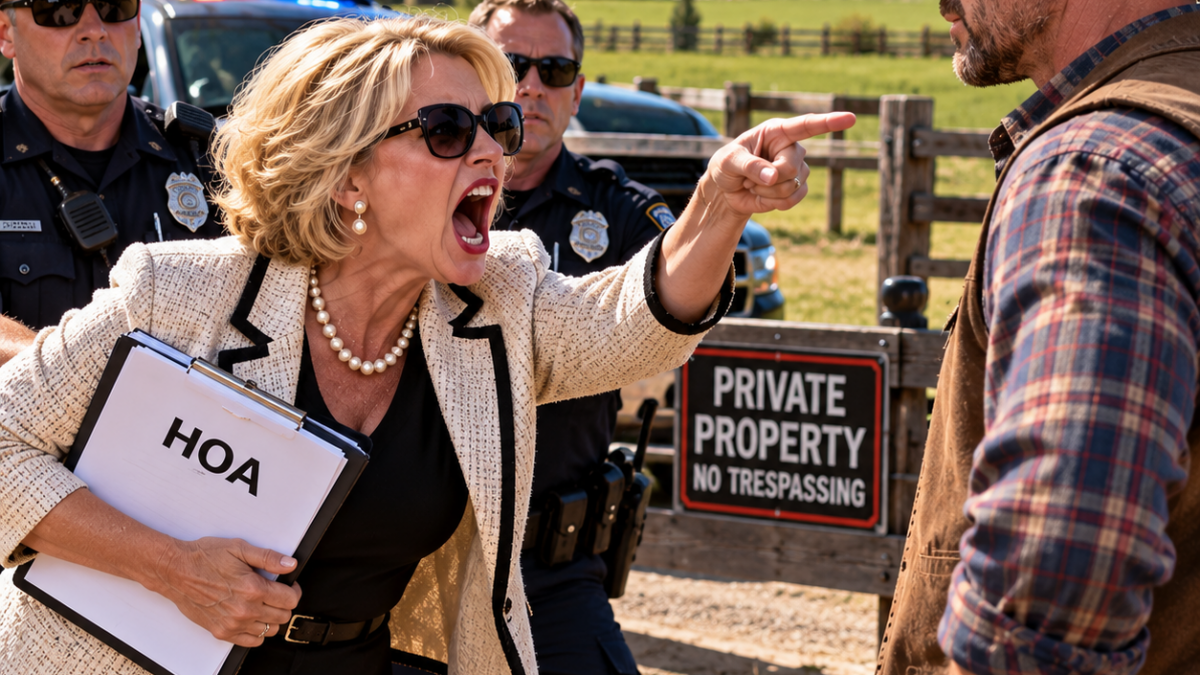
I had owned my new house for less than twenty minutes when the president of the neighborhood HOA planted herself in front of my U-Haul, told me I was moving in “illegally,” and announced that she had already called 911 to have the situation handled. When I calmly explained that my property was not part of her HOA at all, she looked at me as if I had challenged something far more important to her than a rulebook, and the two police officers who arrived were about to discover just how far she was willing to push a stranger on his own land. What I didn’t understand yet was that the argument in my driveway wasn’t really about a moving truck, because hidden behind those laminated rules was a system that had kept an entire neighborhood quiet for years.
My name is Celas Broadley, and that morning I wanted exactly three things: get the furniture inside, return the U-Haul before the late fee kicked in, and finally sleep in a house that belonged to me.
The place was a tired ranch-style fixer-upper at the end of a quiet Georgia cul-de-sac, with faded shutters, an avocado-green kitchen, and enough old wallpaper to qualify as an archaeological site. I loved it anyway. The roof was solid, the lot was bigger than most of the surrounding yards, and after years of renting, I finally had a deed with my name on it.
I had barely lowered the truck ramp when a golf cart came buzzing around the corner.
The woman driving it braked beside my driveway, climbed out, and marched toward me carrying a clipboard.
Bleach-blonde hair. Rhinestone visor. Yoga pants. An expression that suggested somebody had parked a garbage truck in her living room.
“Are you the new owner?”
“I am.”
She held out one hand, but not to shake mine.
“Deborah Callaway. President of the Oakbrush Heights Homeowners Association.”
“Celas Broadley.”
“You should have notified the board fourteen days before your move-in date.”
I glanced behind me at the U-Haul.
“I’m sorry?”
“Fourteen days’ notice is mandatory.”
She pulled a laminated sheet from her clipboard and tapped one paragraph with a manicured fingernail.
“Moving vehicles also cannot remain overnight, and this truck exceeds our permitted dimensions.”
I thought she was joking.
She wasn’t.
“Deborah, I’m moving into my house. Unless there’s a rule requiring me to carry a couch here on my back, I’m going to need the truck.”
Her mouth tightened.
“I’ve already contacted the police.”
I stared at her.
“You called the police because I’m unloading furniture?”
“You are violating community standards.”
“You called 911?”
“They’ll determine how this should be handled.”
I laughed once, mostly because I couldn’t believe the conversation was real.
“Lady, I haven’t even taken the plastic off my couch.”
“That attitude is exactly why we enforce rules immediately.”
Then she started listing my other supposed violations.
No move-in authorization.
Oversized vehicle.
Unapproved dumpster scheduled for later that week.
Exterior shutters that would require a color application if I intended to repaint them.
I finally held up my hand.
“There’s a problem with all of that.”
Her eyebrows rose.
“My property isn’t in your HOA.”
She actually smiled.
Not warmly.
Pityingly.
“This is a deed-restricted community, Mr. Broadley.”
“My parcel is exempt.”
“Impossible.”
“I checked with the county before closing. I checked with the title company. This house predates the HOA formation and sits on a split parcel.”
Her smile disappeared.
“That’s not correct.”
“It is.”
“You signed HOA documents when you purchased.”
“No, Deborah. I didn’t.”
Her fingers tightened around the clipboard.
Before she could answer, a police cruiser turned into the cul-de-sac.
Then another.
Two officers stepped out.
The first looked at me, then at Deborah, then at the moving truck.
“Everything okay here?”
“I’m moving into my house,” I said.
Deborah stepped between us.
“He’s violating neighborhood restrictions. He failed to notify the board, brought in an unauthorized commercial vehicle, and refuses to comply with our architectural standards.”
The officer blinked.
“Ma’am, that’s not a police matter.”
“He’s trespassing against community regulations.”
“That’s not what trespassing means.”
I went to the cab, opened the glove compartment, and retrieved the closing folder.
“Here’s my deed.”
The officer read the parcel description.
His partner leaned over.
Then the first officer looked at Deborah.
“Ma’am, based on what he’s showing us, this property appears separate from the association parcel.”
Her face flushed.
“That cannot be right.”
“If you disagree, you’ll need to address it through civil channels. We don’t enforce HOA bylaws.”
Deborah pointed toward my house.
“He’s going to destroy property values.”
I looked at the boxes stacked inside my truck.
“I haven’t even unpacked my coffee maker.”
The second officer almost smiled.
Deborah didn’t.
She stepped onto my driveway again.
“This isn’t finished.”
I met her eyes.
“Actually, this part is. You’re standing on property you don’t control, so I’m asking you to leave.”
For several seconds, she didn’t move.
Then she backed toward her golf cart, staring at me with a look I wouldn’t understand until much later.
She wasn’t embarrassed.
She was furious that someone had told her no.
And as the officers drove away, I watched Deborah disappear around the corner and realized my first day in Oakbrush Heights had just become the beginning of something much bigger.
PART 2
I stood in the driveway for another few seconds after her golf cart disappeared, listening to the engine fade behind the neat row of houses.
Then I looked at the U-Haul.
Half my life was still inside it.
A sofa wrapped in plastic.
My bed frame.
Boxes marked KITCHEN, TOOLS, OFFICE, and DO NOT DROP, which naturally contained the most fragile things I owned.
I shook my head, climbed onto the truck, and went back to work.
For the rest of the afternoon, I tried to convince myself Deborah Callaway had simply been an overzealous neighbor with too much free time and a laminated rule sheet.
By sunset, I’d almost succeeded.
Then an elderly man walking a little brown dog stopped near the edge of my driveway.
He didn’t step onto the property.
That detail would become important to me later.
“New owner?”
“That’s me.”
He glanced in the direction Deborah had gone.
“She already introduce herself?”
I laughed.
“That obvious?”
The man smiled without much humor.
“I’m Walter Marshall. My wife and I live three houses over.”
“Celas.”
He shook my hand.
“You’re going to want cameras.”
The way he said it erased my smile.
“Why?”
Walter looked down the street before answering.
“Because Deborah doesn’t like losing.”
Then he tugged gently on the dog’s leash and continued walking.
I watched him go.
That night, surrounded by unopened boxes, I ate takeout on the living-room floor and replayed the morning in my head.
There had been something strange about Deborah’s certainty.
Not merely confidence.
Ownership.
She hadn’t behaved like a woman asking a new neighbor to follow community rules.
She had behaved like someone discovering a piece of property had escaped her control.
I told myself I was reading too much into it.
Two days later, the first envelope appeared under my door.
—
I was ankle-deep in drywall dust when I saw it.
I’d spent the morning tearing out an ugly section of kitchen paneling and had finally opened my first can of paint when I noticed a white envelope lying inside the front entrance.
No stamp.
No return address.
No name.
Just an envelope.
I wiped my hands and opened it.
Inside was a single sheet of printer paper.
The message was written in capital letters.
**YOUR ACTIVITIES HAVE BEEN NOTED.**
Below that:
**MODIFY EXTERIOR STRUCTURES IMMEDIATELY OR FACE ENFORCEMENT.**
I read it twice.
Then I walked outside.
The only thing remotely resembling an exterior modification was the temporary construction dumpster I’d rented for demolition debris.
It sat entirely inside my driveway.
Somebody had attached a bright orange sticker to its side.
**VIOLATION — UNAUTHORIZED CONSTRUCTION DEBRIS**
Across the top was a heading:
**OAKBRUSH HEIGHTS COMMUNITY STANDARDS COMMITTEE**
There was no county seal.
No municipal code.
No legal citation.
Just the HOA logo.
And, for reasons I still don’t understand, the words appeared to be printed in Comic Sans.
I peeled it off.
Then I laughed.
That was probably the last moment I found any of it funny.
I went to a hardware store that afternoon and bought four security cameras.
One above the front door.
One facing the driveway.
One covering the backyard.
One aimed at the street.
I spent most of the evening connecting them to a storage system in the spare bedroom.
At 7:14 the next morning, the driveway camera sent an alert.
I opened the feed.
There was Deborah.
Beside her stood a broad man in khaki shorts and a polo shirt carrying a clipboard.
They stopped beside my dumpster.
Deborah pulled an orange sticker from a roll, slapped it onto the metal, stepped backward, and photographed it.
The man wrote something down.
Neither of them knocked.
Neither asked permission to enter the property.
They simply walked onto my driveway as though it belonged to them.
I downloaded the recording.
Then I drove straight to the county zoning office.
A clerk named Mrs. Ellis listened to my explanation, typed my parcel number into her computer, and studied the screen.
Then she looked at me.
“Mr. Broadley, your property isn’t subject to the Oakbrush Heights HOA.”
“That’s what I thought.”
“This parcel was created under the original subdivision before the association was formed. It was specifically excluded when the later HOA boundaries were recorded.”
“So they have zero authority here?”
“As far as HOA covenant enforcement on this parcel? Correct.”
“Would you put that in writing?”
She smiled.
“You’re not the first person who’s asked me that question.”
Five minutes later, I had a county letter printed on official letterhead confirming the status of my property.
I made ten copies.
One went into my closing folder.
One went into the safe.
One went to my attorney’s contact file.
And one went into Deborah Callaway’s mailbox.
I didn’t write a note.
I figured the county seal said enough.
It didn’t.
Forty-eight hours later, the retaliation began.
—
The first thing was a white sedan.
It appeared across the end of my driveway around ten at night, parked just far enough into the entrance that I could technically squeeze my truck past it if I climbed onto the grass.
I checked my cameras.
The driver had parked, walked away, and disappeared toward another street.
The plate came back to an address two blocks over.
The next morning, I knocked on the door.
A teenage boy answered.
“Hi. Is your mom home?”
He looked nervous.
“No.”
“That’s her white sedan parked near my driveway?”
He nodded.
“Could you ask her to move it?”
He hesitated.
Then he said something strange.
“She said you owe her friend an apology.”
“Which friend?”
He shrugged.
“Mrs. Callaway.”
Of course.
I kept my voice even.
“Tell your mother I’m asking politely once. The car needs to be moved.”
When I returned home, it was gone within twenty minutes.
In its place was a sign planted in my front yard.
**NON-COMPLIANT PROPERTY SUBJECT TO REVIEW**
I pulled it out and threw it away.
The following morning, the same sign was back.
This time it had been zip-tied to my maple tree.
I checked the overnight recording.
The man who had accompanied Deborah to the dumpster arrived shortly after midnight.
He stepped onto my lawn carrying a hammer, pounded the sign into the soil, photographed it, then tied it to the tree.
That afternoon, I called the police.
Officer Rafael Gutierrez arrived alone.
He looked young enough that I almost expected him to ask for permission to stay out past curfew, but the moment he watched the footage, his expression changed.
“You know this guy?”
“Never met him.”
“Any reason he’d be on your property after midnight?”
“He works with the HOA president.”
Gutierrez watched the recording again.
“Did you give him permission to enter?”
“No.”
“Then you’ve got a trespass issue. Depending on the pattern, possibly harassment.”
He looked at me.
“You want to pursue charges?”
I considered it.
Part of me wanted to say yes.
Another part worried that would turn a ridiculous neighborhood dispute into something much uglier.
“Not yet.”
Gutierrez nodded.
“I’ll document the incident.”
“I want a paper trail.”
“That’s smart.”
He handed me his card.
“If it escalates, call.”
It escalated.
Fast.
—
The following week, I ordered reclaimed timber beams for the living-room ceiling.
They weren’t cheap.
The supplier scheduled delivery for Thursday morning.
At 9:40, the truck driver called me.
“You Celas?”
“Yeah.”
“I can’t get into your street.”
I walked outside.
Two golf carts were parked sideways across the entrance to the cul-de-sac.
One belonged to Deborah.
The other was driven by the same man I’d recorded trespassing.
I walked toward them.
“What are you doing?”
Deborah stayed seated.
“Emergency HOA maintenance.”
“What emergency?”
“Community drainage inspection.”
I looked around.
No drainage crew.
No workers.
No equipment.
Just two golf carts.
Behind them, the delivery truck idled in the road.
“You’re blocking a commercial delivery to my property.”
“Your commercial delivery was not approved.”
“My property isn’t in your HOA.”
“The street is.”
“It’s a public county road.”
Her jaw tightened.
The delivery driver leaned on his horn.
Deborah didn’t move.
I pulled out my phone.
“I’ll call the sheriff.”
“Go ahead.”
Something about her confidence stopped me for half a second.
Then I understood.
She wanted another confrontation.
Another scene.
Another opportunity to make me look unstable.
I remembered Gutierrez’s warning.
So I didn’t argue.
I recorded the golf carts, the license plates, the blocked truck, and the time.
Then I told the driver to leave.
He did.
The supplier charged me a rescheduling fee.
I filed another report.
That evening, sitting at my kitchen table, I started thinking differently.
Until then, I had been reacting.
Deborah did something.
I documented it.
She escalated.
I reported it.
It was time to stop playing defense.
So I started digging.
—
Oakbrush Heights wasn’t a massive community.
A little over two hundred homes.
Large enough to collect serious money.
Small enough that most residents probably never looked closely at where it went.
The HOA published annual financial summaries on an old website.
I downloaded five years.
Dues had increased gradually.
Nothing shocking enough to cause outrage.
Five percent here.
Eight percent there.
A special landscaping assessment one year.
A “community enhancement contribution” the next.
Then I noticed the landscaping expenses.
Oakbrush Heights was spending almost twice what comparable communities were paying for similar work.
The contractor was listed as Evergreen Estates Solutions.
I searched the company registration.
The registered agent was Reggie Callaway.
Same last name.
A few more clicks answered the obvious question.
Reggie Callaway was Deborah’s adult son.
I sat back in my chair.
That alone didn’t prove a crime.
Family businesses could legitimately provide services.
But I searched the HOA’s meeting minutes for disclosure of the relationship.
Nothing.
I searched vendor bidding records.
Nothing.
I compared Evergreen’s invoices with local landscaping rates.
The difference was substantial.
So I printed everything.
Then I knocked on Walter Marshall’s door.
His wife, Edith, answered.
Walter was behind her.
When I explained what I’d found, Edith’s face changed.
“Come inside.”
Their living room was neat and old-fashioned, with family photographs covering one wall.
Edith brought sweet tea.
Walter brought a folder.
It was filled with HOA notices.
Mailbox paint.
Decorative edging.
A small garden statue.
An exterior light fixture.
One fine after another.
Edith picked up one letter.
“They fined us two hundred dollars for repainting the mailbox.”
“What was wrong with the color?”
She gave a sad little laugh.
“Nothing. We used the same color that had been on it for twenty years.”
“Why did Deborah say it was wrong?”
“She said the approved shade had changed.”
“Did they show you the new standard?”
“No.”
Her voice weakened.
“They threatened additional fees if we appealed.”
Walter’s hands tightened around his glass.
“My wife cried for a week.”
I looked at Edith.
She seemed embarrassed by that.
She shouldn’t have been.
“Would you talk to an attorney?”
Walter answered immediately.
“Yes.”
Edith looked toward him.
Then she nodded.
“Anything that keeps her from doing this to somebody else.”
That conversation changed my approach.
I had believed Deborah was targeting me because my property was outside her authority.
Now I began wondering how many people inside her authority had been too intimidated to challenge her.
—
Over the next five days, I went door to door.
I didn’t accuse Deborah of stealing.
I didn’t tell people what to think.
I showed them the county letter establishing my exemption and asked whether they’d experienced unusual fines or assessments.
Most people were cautious.
A few closed the door immediately.
Some whispered as if Deborah might be hiding in their azaleas.
But others invited me inside.
One family had paid $350 because their child’s basketball hoop was supposedly six inches too close to the curb.
Another resident had been fined for leaving a trash bin visible for forty-three minutes after the approved collection window.
A retired nurse named Colette had received repeated complaints over “excessive doorbell noise.”
I thought she’d misread the notice.
She hadn’t.
“What does excessive doorbell noise even mean?” I asked.
“I asked the same thing.”
“What did they say?”
“That multiple visitors created a nuisance pattern.”
“Were you throwing parties?”
“My sister was dying of cancer. Family was coming by.”
I stopped writing.
Colette looked at the papers in her lap.
“She died last year.”
“I’m sorry.”
“So am I.”
Her eyes hardened.
“But I’m more angry now than I was then.”
By the end of the week, I had twenty-three written statements.
I called Maya Reynolds.
Maya and I had met years earlier during a business dispute involving a contractor.
She was a civil attorney who had handled property and HOA cases across Georgia.
I emailed her the county letter.
The videos.
The financial statements.
The Callaway family business records.
The homeowners’ complaints.
Two days later, she was sitting in my half-renovated living room with a laptop balanced on a moving box.
She worked silently for nearly an hour.
Finally, she looked at me.
“Celas.”
“What?”
“You realize this isn’t about your moving truck anymore.”
“I figured that out.”
“No. I mean this could be much bigger.”
She turned the laptop toward me.
“If HOA money was directed to businesses controlled by board members or their relatives without disclosure, bidding, or authorization, there may be breach-of-fiduciary-duty claims. Depending on how money moved and how records were represented, there could be fraud issues.”
“What about the fake violation notices?”
“We’ll deal with those separately.”
“And Deborah?”
Maya leaned back.
“She made a mistake.”
“Which one?”
“She picked a fight with the one house in Oakbrush Heights that she couldn’t legally control.”
I smiled.
“That’s not the mistake.”
“No?”
“The mistake was making me curious.”
Maya laughed.
“Now you’re thinking like a plaintiff.”
—
The cease-and-desist arrived three days later.
A man in a gray blazer knocked once, handed me a thick envelope, and walked away before I could ask his name.
The paper inside looked expensive.
Gold embossed logo.
Heavy stock.
Formal language.
Except it wasn’t from a law firm.
It came directly from the Oakbrush Heights board.
It accused me of:
**DEFAMING THE INTEGRITY OF THE ASSOCIATION.**
**DISRUPTING COMMUNITY HARMONY.**
**INTERFERING WITH HOA OPERATIONS.**
And my favorite:
**CREATING AN ENVIRONMENT OF DISTRUST.**
Maya read that one twice.
Then she laughed.
“They’re accusing you of creating distrust?”
“Apparently.”
“That’s adorable.”
She tossed the letter onto my dining table.
“Don’t respond.”
“Why?”
“Because they’re fishing.”
“For what?”
“A threat. An angry email. Something they can circulate saying you’re unstable.”
Right then, one of my camera alerts sounded.
A vehicle had passed the house for the third time in fifteen minutes.
White pickup.
Dark windows.
No front plate.
It slowed outside my property.
Then continued.
Maya watched through the window.
“You’ve seen that truck before?”
“No.”
She looked at me.
“Do not confront it.”
“I wasn’t going to.”
“Good.”
The pickup returned again.
This time, it stopped for several seconds.
Then drove away.
That night, around 2:00 a.m., I heard tires crunching gravel.
I got out of bed but didn’t go outside.
I checked the cameras.
A black SUV was idling near the driveway.
The headlights went dark.
The vehicle remained there for almost a minute.
Then it rolled away.
I barely slept.
At sunrise, I went outside.
Something was attached to the fence beside my driveway.
At first, I couldn’t understand what I was looking at.
Then I realized.
A dead squirrel had been nailed to a wooden post.
I stood completely still.
The anger came first.
Hot.
Immediate.
Then something colder replaced it.
This wasn’t someone sticking a childish sign in my grass.
This was meant to frighten me.
I photographed everything without touching it.
Then I reviewed the camera footage.
The SUV had stopped just beyond the clearest angle.
A hooded figure moved briefly at the edge of the image.
Not enough for identification.
I called Maya.
She arrived within forty minutes.
One look at the fence and she stopped.
“Don’t touch anything.”
“I haven’t.”
“You call Gutierrez?”
“I was thinking bigger.”
She looked at me.
“So am I.”
We gathered copies of the videos, financial records, harassment reports, and vendor filings.
That afternoon, we went directly to the county prosecutor’s office.
We spent nearly two hours explaining what had happened.
At 4:37 p.m., my phone rang.
An investigator told me they were opening a preliminary inquiry.
I stood in my driveway after that call, looking toward Deborah’s house.
For weeks, she had behaved like Oakbrush Heights belonged to her.
The streets.
The homes.
The people.
Even me.
But now someone outside her little kingdom was looking at the books.
And money leaves better footprints than golf carts.
—
Maya became obsessed with the financial reports.
My dining room turned into an evidence room.
Invoices on one side.
HOA disclosures on another.
County records in the middle.
One evening, she found a four-month gap.
“March through June,” she said.
I looked up from a stack of violation notices.
“What about them?”
“No itemized operating expenses.”
“Nothing?”
“Not publicly reported.”
She tapped the screen.
“But the bank summary shows almost twenty thousand dollars paid to a vendor during that period.”
“Which vendor?”
“Crescent Ridge Solutions.”
I searched the company.
Registered address: post-office box.
Registered owner: Anley Keteridge.
I stared at the name.
“She’s vice president of the HOA.”
“Exactly.”
“Maybe it’s legitimate work.”
“Maybe.”
Maya smiled thinly.
“Let’s ask.”
The following afternoon, we drove six streets over.
Anley’s house was one of the largest in Oakbrush Heights.
Four-car garage.
Wraparound porch.
Perfect landscaping.
She answered the door wearing a navy pantsuit.
When she saw me, her expression hardened.
“What do you want?”
Maya stepped forward.
“My name is Maya Reynolds. I represent Mr. Broadley.”
Anley’s eyes moved to her.
“I know who you are.”
“Good. That saves time.”
Maya held up several documents.
“Crescent Ridge Solutions received substantial payments from the HOA while you were serving as vice president.”
Anley didn’t answer.
“Your name appears on the corporate registration.”
Still nothing.
“We’ve found no disclosure to homeowners that the vendor was owned by a sitting board member.”
Anley crossed her arms.
“I don’t know what you think you’ve found.”
“I think I’ve found an undisclosed conflict of interest.”
“You’re mistaken.”
“I’ve already requested additional records.”
For the first time, Anley’s expression changed.
Just slightly.
Maya noticed.
“So here’s free advice,” Maya continued. “If Deborah Callaway tells you to take the fall for everything, think carefully before you do.”
Anley stepped backward.
“I’m not answering any more questions without counsel.”
“That would be wise.”
The door slammed.
We walked back toward the car.
I looked at Maya.
“Think she’ll talk?”
“Eventually.”
“How can you tell?”
“Because innocent people usually deny facts. Scared people ask who else knows.”
Anley hadn’t asked.
But her face had.
—
That evening, two more residents visited.
Rangett, an IT professional who lived near the clubhouse.
And Colette, the retired nurse.
Rangett had received eleven fines in two years.
Lawn edging.
Trash placement.
A satellite dish installed by the previous owner.
A garage door allegedly left open for thirty-one minutes.
He brought copies of everything.
Colette brought her notices too.
Maya spread them across the table.
“This enforcement pattern matters.”
“Why?” I asked.
“Because if the board used selective fines as a revenue stream, or targeted certain residents to raise money, these records can help establish that.”
Rangett leaned forward.
“You think that’s what happened?”
Maya looked at him.
“I think we need the books.”
Rangett rubbed his chin.
“I used to help with the HOA website.”
“When?”
“Three years ago.”
“Do you still have anything?”
“Backups, maybe.”
Maya and I exchanged a look.
“What kind of backups?” she asked.
“Public reports. Board minutes. Files they uploaded for residents.”
“Don’t access anything you’re not authorized to access now.”
“I wouldn’t.”
“But if you lawfully kept copies from when you were authorized?”
He nodded.
“I’ll check.”
The next morning, he brought us a hard drive.
It contained old meeting packets and financial summaries that had later disappeared from the HOA website.
One packet referenced a “vendor restructuring initiative.”
Another mentioned “consolidated authority for executive disbursements.”
Maya read the phrase twice.
“Who talks like this?”
“People trying to make bad ideas sound boring.”
We kept digging.
Then the break came.
A former treasurer called Maya.
Her name was Louise.
She had resigned three months earlier.
She asked to meet somewhere private.
—
We met Louise at a small coffee shop thirty minutes outside Oakbrush Heights.
She looked exhausted.
She sat with both hands around a cup she never drank.
“I should have come forward earlier.”
Maya kept her voice gentle.
“Why didn’t you?”
Louise looked toward the window.
“Because Deborah ruins people.”
I felt a chill despite the warm room.
“What do you mean?”
“She doesn’t threaten you directly. She finds pressure points.”
“Like what?”
“She’ll fine you. Question your landscaping. Delay approvals. Turn neighbors against you. If you’re on the board, she makes sure everyone thinks you’re incompetent.”
Louise swallowed.
“When I challenged the vendor payments, she accused me of mishandling the accounts.”
“Were you?” Maya asked.
“No.”
“What happened?”
“They voted to remove some of my access.”
“So you resigned?”
“I resigned before they could blame me for whatever they were doing.”
She reached into her bag and removed a small portable drive.
“But I kept copies.”
Maya didn’t touch it immediately.
“Copies of what?”
“Spreadsheets. Payment schedules. Vendor reimbursements.”
“Did you have authorization to possess them?”
“They were records I lawfully maintained as treasurer.”
Maya nodded.
“Then we’ll make a forensic copy and preserve the original.”
Louise pushed the drive across the table.
“I don’t want it anymore.”
“Why now?”
She looked at me.
“Because I saw the flyer about your property.”
I waited.
Louise continued.
“Deborah mentioned you in meetings before you ever moved in.”
My chair seemed to tighten around me.
“What?”
“She knew the house had sold.”
“How?”
“I don’t know.”
“What did she say?”
“That the exempt parcel was ‘a governance defect’ that needed to be corrected.”
Maya stopped writing.
“Those exact words?”
Louise nodded.
“She wanted the property brought under HOA control.”
“When?”
“Months ago.”
I stared at her.
Before I’d loaded the U-Haul.
Before Deborah marched into my driveway.
Before she called 911.
She already knew my house wasn’t part of the HOA.
The argument on move-in day hadn’t been a misunderstanding.
It had been pressure.
Maya leaned forward.
“Louise, is there anything in those records showing money paid to Crescent Ridge Solutions?”
“Yes.”
“Evergreen Estates?”
“Yes.”
“Other companies?”
Louise nodded slowly.
“Several.”
“What companies?”
“Premier Landscaping. Shaded Path Consultants. Northwood Infrastructure.”
I wrote down each name.
“Are they real?”
“I never saw employees. Never saw work orders.”
Maya’s voice became very quiet.
“How much money are we talking about?”
Louise looked at her.
“Enough that I stopped sleeping.”
—
We spent the next twelve hours reviewing spreadsheets.
Crescent Ridge received repeated “maintenance reimbursements.”
Evergreen received landscaping payments that exceeded visible work.
Premier Landscaping shared a mailing address with a business associate of Deborah’s family.
Shaded Path Consultants appeared to have no meaningful public business footprint.
Northwood Infrastructure received money for projects several residents said had never occurred.
Fine revenue entered HOA accounts.
Then portions moved through vendors.
The patterns weren’t enough for us to declare criminal guilt.
But they were enough for investigators to ask serious questions.
Maya contacted the prosecutor’s office.
Louise gave a formal statement.
Financial investigators subpoenaed records.
Then the notices arrived.
Deborah Callaway.
Anley Keteridge.
Charles Finlay.
Two additional board members.
The neighborhood changed overnight.
People gathered in driveways whispering.
Deborah’s golf cart remained under her carport.
The HOA website disappeared.
The community email list went silent.
Three days passed without a violation notice appearing anywhere.
On the fourth morning, I saw Deborah standing in her driveway with a man wearing a blue suit.
He was furious.
Even from across the street, I could see him jabbing a finger toward her.
She shook her head repeatedly.
He handed her a folder.
She refused it.
He pushed it against her chest.
Then walked away.
I didn’t know who he was.
But for the first time since I’d moved in, Deborah looked frightened.
That afternoon, Officer Gutierrez knocked on my door.
He wasn’t alone.
The woman beside him showed identification.
“Detective Claire Henley. White Collar Crimes.”
I invited them inside.
Henley looked around at the binders covering my dining room.
“Busy?”
“You could say that.”
She almost smiled.
“We’ve reviewed the evidence your attorney supplied, as well as records obtained independently.”
I glanced at Maya.
“What happens now?”
“The investigation is moving forward.”
“With what?”
“Potential fraud offenses, tax issues, false financial representations, and other matters depending on the audit.”
Gutierrez leaned against the doorway.
“They picked the wrong guy to annoy with a moving truck.”
Henley gave him a look.
He straightened.
“Sorry.”
I laughed.
It was the first real laugh I’d had in weeks.
Then Henley became serious again.
“We’ll likely need your testimony regarding the harassment incidents and the representations made about your property.”
“Whatever you need.”
“One more thing.”
She looked toward my front window.
“If anyone associated with this investigation approaches you aggressively, do not engage.”
“Why?”
“Because financial investigations make people nervous.”
That night, another unmarked car pulled up outside Deborah’s house.
Two men in suits walked to the door.
Deborah answered.
They handed her papers.
She didn’t yell.
Didn’t wave a clipboard.
Didn’t threaten anybody.
She simply took the documents and closed the door.
Maya and I watched from my porch.
“You happy?” she asked.
“Not yet.”
“Why?”
“Because she hasn’t answered for what she did to the people here.”
Maya nodded.
“Good.”
“Good?”
“You started this because she came after you.”
She looked down the quiet street.
“Now you’re staying because she came after everybody else.”
—
The neighborhood slowly began talking.
Not gossiping.
Talking.
That distinction mattered.
People who had spent years believing their fines were isolated discovered the same language had appeared in dozens of notices.
“Failure to maintain community harmony.”
“Nonconforming aesthetic impact.”
“Administrative processing fee.”
“Expedited compliance contribution.”
The phrases sounded official.
The underlying charges often made no sense.
A young couple showed me a $175 fine for leaving a baby stroller visible on their porch.
A widower had paid $300 after hanging holiday lights two days before the approved decorating period.
A military family had been threatened with additional enforcement over a small flag display.
One homeowner showed us a receipt for a cash payment described as an “expedited architectural review contribution.”
Maya stared at it.
“Did you receive an architectural approval?”
“No.”
“Was an application processed?”
“No.”
“What were you paying for?”
“The board representative said it would keep my fence request from being delayed.”
“Who took the cash?”
The homeowner named an HOA volunteer.
More people came forward.
Soon my dining room looked less like a renovation project and more like a legal command center.
Folders.
Statements.
Scanned receipts.
Printed emails.
A portable printer sat on the floor humming almost continuously.
One Thursday afternoon, I slid a stack of affidavits toward Maya.
“These people were told cash payments were community donations.”
She read three statements.
Then she looked at me.
“If the documentation confirms these were mandatory payments disguised as voluntary contributions, the board has another serious problem.”
Before she could say more, someone knocked.
Slowly.
Three times.
I checked the camera.
An older man stood outside holding a worn leather folder.
I opened the door.
“You Celas?”
“Yeah.”
“Name’s Arnold Mercer.”
He looked past me into the house.
“You the one collecting old HOA documents?”
“Depends what you’ve got.”
He held up the folder.
“History.”
—
Arnold had served on the architectural committee more than a decade earlier.
Back then, he said, Oakbrush Heights had operated differently.
Residents rotated through committees.
Meetings were crowded.
Budgets were debated.
Board members argued, sometimes loudly, but nobody treated the organization like private property.
Then Deborah became more involved.
“At first, she was useful,” Arnold said.
“Useful how?”
“Organized. Persistent. Never forgot anything.”
He smiled bitterly.
“Those qualities aren’t always virtues.”
He opened the folder.
Inside were architectural approvals, meeting notes, old violation notices, and a petition.
The petition was signed by thirty-one residents.
It objected to a proposal that would have given Deborah broad administrative access to association funds without additional approval.
The petition had been submitted years earlier.
Arnold pointed to a handwritten note.
**NO ACTION — EXECUTIVE DISCRETION.**
Maya read it.
“Who wrote this?”
“Charles Finlay.”
The board member who had lawyered up immediately after the subpoenas.
Maya turned another page.
There were emails warning about inadequate financial controls.
Requests for dual signatures on certain payments.
Concerns over vendor relationships.
The warnings had been ignored.
“This matters,” Maya said.
Arnold looked uncomfortable.
“I should’ve pushed harder.”
“You raised concerns.”
“I stopped after they shut us down.”
His eyes lowered.
“I had a wife who was sick. I didn’t want trouble.”
I thought about Colette’s sister.
The Marshalls.
Louise.
Everyone had a reason to stay quiet.
That was the genius of Deborah’s system.
No single act looked big enough to risk your peace over.
A mailbox fine.
A delayed approval.
A threatening letter.
A parking complaint.
A rumor.
A nuisance inspection.
But stacked together, they created something stronger than rules.
Fear.
Arnold stood to leave.
At the door, he turned.
“Just make sure she can’t come back.”
“We’ll do what the evidence allows.”
He shook his head.
“You’re nicer than me.”
“No.”
I looked toward the street.
“I’m just learning that revenge works better when you can file it with the court.”
Arnold laughed.
“Your neighbors are going to like you.”
—
The grand jury review moved faster after Louise and Arnold provided records.
Then investigators uncovered something none of us expected.
The HOA’s security spending.
Oakbrush Heights had contracted with a private security vendor for what residents believed was routine patrol work and clubhouse monitoring.
The invoices included equipment installation.
Maya called me late one afternoon.
“Get over to the clubhouse.”
“Why?”
“Don’t ask. Just come.”
When I arrived, a sheriff’s vehicle was parked outside.
Detective Henley stood near the entrance with two technicians.
Rangett was there too.
His face was pale.
“What happened?”
Henley answered.
“We’re executing a warrant related to surveillance equipment.”
“Surveillance?”
She led us into a meeting room.
One technician had removed a decorative air vent.
Behind it was a tiny microphone.
I stared at it.
“You’ve got to be kidding me.”
Rangett shook his head.
“That wasn’t there when I maintained the network.”
Another device had been found inside a wall fixture in a reserved meeting room.
The search expanded.
More equipment appeared.
The HOA’s justification to the security contractor referred to “monitoring compliance with board protocols.”
Maya looked at Henley.
“Did residents consent to audio recording?”
“That’s one of the issues we’re investigating.”
Then a deputy emerged from the hallway.
“Detective.”
Henley walked over.
He spoke quietly.
Her expression changed immediately.
She looked toward Maya.
“We found another device.”
“Where?”
Henley hesitated.
“Near the daycare room.”
No one spoke.
There were lines people crossed because they believed nobody could stop them.
Then there were lines that transformed arrogance into something much darker.
I thought about Deborah calling 911 because I dared move furniture into my own house.
I thought about her filming my dumpster.
The midnight signs.
The blocked delivery.
The dead animal on my fence.
But this wasn’t about me anymore.
This was people listening to private conversations.
Possibly parents.
Possibly children.
The room felt smaller.
Maya closed her notebook.
“She’s done.”
Henley looked at her.
“If the evidence proves what it appears to prove, that’s now a question for the prosecutor and the court.”
Maya nodded.
But she didn’t take the words back.
Neither did I.
—
Just after dawn two days later, the sound of car doors pulled me from sleep.
I checked the front camera.
Sheriff’s vehicles were stopping outside Deborah Callaway’s house.
I dressed quickly and stepped onto my porch.
Doors opened up and down the street.
Walter and Edith Marshall appeared on their lawn holding hands.
Colette stood barefoot at the end of her driveway.
Rangett came outside wearing sweatpants and an old college sweatshirt.
Nobody crossed the street.
Nobody celebrated.
We watched.
Deputies approached Deborah’s house.
A detective knocked.
Several seconds later, the door opened.
Deborah stepped outside wearing a robe.
Even from a distance, I could hear her voice.
“What is this?”
The lead investigator showed her paperwork.
She read the first page.
Her head snapped upward.
“You’re making a mistake.”
The deputy remained calm.
“We have a warrant, ma’am.”
“I have done nothing wrong.”
Another officer moved toward the door.
Deborah raised her voice.
“I was protecting this neighborhood!”
Those words carried down the street.
Protecting.
I wondered how many times she’d used that word to justify everything.
The fines.
The cameras.
The money.
The intimidation.
The microphones.
The deputy placed her under arrest in connection with the investigation.
When he guided her toward the cruiser, Deborah finally saw me.
Our eyes met across the road.
For a brief second, I remembered the first morning.
Her standing in my driveway.
Her laminated rules.
Her absolute certainty that two police officers would force me to obey her.
Now officers were escorting her away.
I could have smiled.
I didn’t.
She stopped near the cruiser.
“This is because of you!” she shouted.
One deputy tried to keep her moving.
Deborah twisted toward me.
“You came here looking for trouble!”
I stepped to the edge of my property.
“No, Deborah.”
She stared.
“I came here with a couch.”
Someone behind me laughed.
Even one of the deputies looked down for a second.
Deborah’s face twisted.
“I built this community!”
Walter Marshall spoke from his yard.
“No.”
His voice wasn’t loud.
But everyone heard it.
“You bullied it.”
Deborah stared at him.
Then Edith stepped forward.
“You made us afraid of our own mailbox.”
Colette crossed her arms.
“You fined me while my sister was dying.”
Another neighbor called out.
“You took our money.”
Then another.
“And lied to us.”
The accusations came from every direction.
Not screaming.
Not a mob.
People simply saying what had happened to them.
For the first time since I’d met Deborah, she had no clipboard big enough to silence the street.
The cruiser door closed.
A hollow thud.
The vehicle pulled away.
And Oakbrush Heights exhaled.
—
An emergency homeowner meeting was scheduled under independent oversight.
For the first time in years, residents attended without Deborah sitting at the front of the room.
Maya helped advise residents’ counsel on procedural safeguards.
A temporary oversight committee was selected according to the governing documents and applicable legal requirements.
Five residents agreed to serve.
Tilda Monroe, a retired IRS analyst, became chair.
Jerome Parker, a city planner, handled infrastructure questions.
Rangett agreed to advise on technology, but refused to hold financial authority.
“I’ve seen enough passwords for one lifetime,” he said.
The first meeting lasted four hours.
Nobody complained.
Tilda stood at the front with a thick binder.
“Every contract is being reviewed.”
She paused.
“Every account.”
Another page.
“Every vendor.”
Another.
“Every fine we can legally reexamine.”
The room erupted in applause.
She raised one hand.
“Don’t applaud yet. This is going to be messy.”
Walter spoke from the second row.
“Messy is fine. Secret is the problem.”
That earned louder applause.
Jerome announced that the private security agreement would be terminated as permitted and replaced, if needed, through an open procurement process.
No more informal patrol intimidation.
No more board members using security as personal muscle.
Maya leaned toward me.
“You realize you started all this because of a U-Haul?”
“I still haven’t forgiven them for the rescheduling fee on my beams.”
She smiled.
“We’ll put that in the history books.”
—
The forensic audit took months.
That was the part nobody tells you about justice.
The dramatic moments happen quickly.
The arrest.
The warrant.
The courtroom.
But rebuilding after corruption is slow.
Painfully slow.
Investigators followed payments.
Accountants reconstructed missing months.
Attorneys separated bad governance from potential criminal conduct.
Homeowners filed restitution claims.
Some disputed fines were reversed.
Others required additional review.
Vendor contracts were examined.
Several former board members cooperated.
Others fought everything.
Anley Keteridge hired counsel almost immediately.
Eventually, according to court filings, she acknowledged financial irregularities involving Crescent Ridge and cooperated in parts of the investigation.
Charles Finlay contested allegations for months before reaching his own legal resolution.
Another board participant who had left the state was located and questioned.
Deborah fought longest.
Even after her arrest, she insisted the spending had been authorized.
She claimed aggressive enforcement preserved property values.
She described undisclosed payments as administrative shortcuts.
She said the surveillance system was designed for “security and governance protection.”
Then prosecutors introduced records.
Emails.
Payments.
Vendor ownership documents.
Old warnings.
Louise’s spreadsheets.
Arnold’s petition.
The microphones.
The money told a different story.
So did the residents.
—
I testified about the day I moved in.
The courtroom felt strangely ordinary.
No dramatic music.
No crowd gasping every thirty seconds.
Just fluorescent lights, wooden benches, attorneys shuffling paper.
The prosecutor asked me to describe my first interaction with Deborah.
“She approached while I was unloading.”
“What did she tell you?”
“That I’d violated HOA rules by moving in without fourteen days’ notice.”
“Was your property subject to those rules?”
“No.”
“Did she know that?”
Maya had prepared me for that question.
“I can’t testify to what was in her mind.”
The prosecutor nodded.
“What did you later learn?”
“That the board had discussed my exempt parcel before I purchased the property.”
Louise’s records supported that point.
Then came the 911 call.
The fake notices.
The trespassing.
The blocked delivery.
The threatening object on my fence.
The prosecutor played security footage.
Deborah’s attorney stood for cross-examination.
He was calm.
Professional.
Much better at control than Deborah had ever been.
“Mr. Broadley, you disliked my client almost immediately, didn’t you?”
“I disliked having police called because I was moving into my house.”
A few people in the gallery shifted.
“You were sarcastic with her.”
“I probably was.”
“You told her to leave your property.”
“Yes.”
“You began investigating the association shortly afterward.”
“Yes.”
“So this became personal.”
I looked at Deborah.
Then back at the attorney.
“It became personal when someone entered my yard at night and left threats. It became something bigger when I learned neighbors had been treated the same way.”
He walked closer.
“You wanted revenge.”
The word hung there.
I thought about it.
Then I answered truthfully.
“At first? Absolutely.”
That wasn’t the answer he expected.
His eyebrows lifted.
“You admit that?”
“Yes.”
The prosecutor looked at me carefully.
I continued before the defense attorney could capitalize.
“I wanted her embarrassed. I wanted her to understand what it felt like to have somebody push into your life and act like they owned it.”
“Then your investigation was retaliation.”
“No.”
I looked toward Walter and Edith.
Colette.
Louise.
Rangett.
Arnold.
“Because somewhere along the way, I stopped caring whether Deborah was embarrassed.”
The courtroom was silent.
“What did you care about?” the attorney asked.
“That she couldn’t keep doing it.”
He stared at me.
I stared back.
He returned to his table.
No further questions.
—
The criminal and civil matters eventually produced consequences for multiple people.
Deborah faced convictions arising from financial misconduct, unlawful surveillance, and the conspiracy proved by prosecutors.
The precise sentence wasn’t the theatrical hundred-year punishment some residents fantasized about.
Real courts rarely work that way.
But it was real.
Prison time.
Restitution.
Financial penalties.
Loss of authority.
A record that no laminated rule sheet could erase.
Anley and other participants faced consequences based on their individual conduct and cooperation.
Certain vendors were dissolved or barred from further business with the association.
The HOA’s finances were placed under strict controls during the transition.
Homeowners received reimbursements where funds could be recovered and claims verified.
The Marshalls got their mailbox money back.
Edith brought the restitution letter to my house.
She cried.
Not because of the amount.
Two hundred dollars wasn’t going to change their retirement.
But she held that check as if someone had finally written down, officially, that she hadn’t been crazy.
“They made me feel stupid,” she said.
“You weren’t.”
“I know that now.”
Walter put his arm around her.
She looked toward my renovated kitchen.
“You finally changed that awful green.”
“I did.”
“Good. It was criminal.”
Walter laughed.
I pointed at her.
“Careful. Deborah used to fine people for opinions like that.”
Edith smiled.
“Then it’s a good thing she’s not president anymore.”
—
Oakbrush Heights held its first truly open forum in more than a decade.
No attendance requirement.
No fines.
No threats.
Just folding chairs, coffee, and a microphone.
The clubhouse felt different.
I knew that sounded ridiculous.
Buildings don’t change because a board changes.
But people do.
Before, residents had entered that room carefully, watching who sat beside whom.
Now people argued openly.
Some wanted stronger landscaping standards.
Others wanted almost none.
One man believed trash cans should still be hidden.
A woman in the back shouted, “Then don’t look at mine.”
Everyone laughed.
Tilda tapped the microphone.
“We’re going to disagree. That’s allowed.”
That sentence received applause.
Not thunderous applause.
Something better.
Relieved applause.
Residents adopted stronger financial transparency rules.
Contracts above specified thresholds required competitive review.
Related-party transactions required disclosure.
Meeting minutes had to be made available.
Major expenditures required additional oversight.
The community also reviewed which restrictions were actually necessary and which existed only because previous leaders liked control.
Some rules stayed.
The swimming pool still needed safety standards.
Shared spaces still required maintenance.
Drainage couldn’t simply be ignored because “freedom.”
But enforcement became predictable.
Appeals became real.
People could ask questions without fearing retaliation.
When my turn came to speak, I almost declined.
Then Walter pushed me gently toward the microphone.
I stood in front of everyone.
For a second, I remembered my first morning.
Deborah shouting about property values while police officers explained that moving furniture wasn’t a crime.
I looked around the room.
“I moved here because I wanted a cheap house I could fix.”
People laughed.
“I had no idea I’d end up helping fix the street too.”
More laughter.
Then I saw Edith.
Colette.
Louise.
People whose stories had become part of mine.
My throat tightened unexpectedly.
“So I’ll just say this. I didn’t do this alone.”
The room quieted.
“I had cameras. Maya had legal knowledge. Louise had records. Arnold kept old documents. Rangett had backups. The Marshalls were brave enough to talk when they had every reason to stay quiet.”
I looked toward Maya.
“And a whole lot of people eventually decided being scared was more exhausting than speaking.”
I stepped away from the microphone.
The applause that followed wasn’t huge.
It didn’t need to be.
It was honest.
—
Months later, life became boring again.
Beautifully boring.
I finished the ceiling beams.
Repainted the shutters without submitting a color sample to anyone.
The color was dark blue.
Walter said it looked good.
Edith said it looked too serious.
Colette said she didn’t care because it wasn’t her house.
That answer became my favorite.
I rebuilt the kitchen cabinets.
Repaired the porch.
Hung the television I had originally intended to mount on my first night.
It took me eleven months.
Maya came by the evening I finally finished.
She stood in the doorway staring at the television.
“That’s it?”
“What?”
“The television.”
“Yeah.”
“You started a neighborhood uprising before hanging your TV?”
“I’ve been busy.”
She sat on the porch steps with a glass of water.
I joined her.
Across the street, children rode bicycles.
A man washed his truck.
Someone’s sprinklers clicked on.
No golf cart patrol.
No stranger photographing my driveway.
No envelopes under the door.
Maya looked down the street.
“You know you’re going to be part of every HOA horror story conversation in this county for the next twenty years.”
“Great.”
“You could write a book.”
“No.”
“Podcast?”
“No.”
“Community reform consultant?”
“Absolutely not.”
She smiled.
“What are you going to do?”
I thought about it.
“Finish the guest bathroom.”
She laughed.
“That might actually be harder.”
—
The next spring, Oakbrush Heights held a neighborhood cookout.
Walter insisted I attend.
Tilda organized food tables.
Jerome borrowed speakers from the city recreation department.
Rangett created a sign-up sheet that collected absolutely no unnecessary personal data, a detail he announced proudly at least four times.
Colette brought peach cobbler.
Edith brought potato salad.
Maya arrived late carrying store-bought cookies.
“You’re a lawyer,” I told her. “You couldn’t afford real food?”
“I bill by the hour, not by the casserole.”
Near sunset, I noticed a U-Haul turning into the cul-de-sac.
For a second, the sight hit me strangely.
The truck stopped at a house near the corner.
A young couple climbed out.
They looked exhausted.
Two children jumped from the cab.
The father lowered the loading ramp.
I smiled.
Walter followed my gaze.
“You thinking what I’m thinking?”
“If you say fourteen-day notice, I’m pushing you into the potato salad.”
He laughed.
Then a golf cart approached the U-Haul.
I felt my shoulders tense automatically.
Old reflex.
Tilda was driving.
She stopped beside the new family.
I watched her get out.
For half a second, I could almost see Deborah again.
Clipboard.
Rules.
Police threats.
Then Tilda opened the rear compartment of the cart.
She pulled out a cooler.
Handed the new family bottled water.
Jerome followed behind carrying a printed neighborhood information sheet.
Not a violation notice.
Phone numbers.
Trash schedule.
Pool hours.
Emergency contacts.
An invitation to the cookout.
The father looked relieved.
His little girl pointed toward the tables.
A few minutes later, the whole family walked over.
Tilda introduced them.
No interrogation.
No approval form.
No threats.
Just neighbors.
Maya stood beside me.
“You okay?”
“Yeah.”
“You got quiet.”
I nodded toward the U-Haul.
“Just thinking.”
“Dangerous hobby.”
I ignored her.
The moving truck sat exactly where mine had sat.
Same kind of ramp.
Same stacks of boxes.
Same exhausted look on the new owner’s face.
But nobody had called 911.
Nobody demanded paperwork.
Nobody told him he was destroying the neighborhood before he’d even unpacked.
Walter handed him a plate.
Colette offered his kids cobbler.
Edith immediately began explaining which grocery store had the best meat prices.
I stood there watching and felt something inside me finally loosen.
For months, I’d thought the satisfying ending would be Deborah in handcuffs.
Then I thought it would be the conviction.
Then restitution.
Then the first free meeting.
I had been wrong every time.
This was the ending.
A family moving into its home without fear.
—
Later that evening, after everyone had gone home, I walked back toward my house.
The dark-blue shutters looked almost black under the porch light.
My truck was parked in the driveway.
No warning stickers.
No signs.
No golf carts waiting across the street.
I unlocked the front door.
Inside, the living room was finished.
The reclaimed beams stretched across the ceiling—the same beams Deborah’s people had once blocked from being delivered.
I’d kept the invoice for the failed delivery.
Not because I still needed it for evidence.
Because it made me laugh.
I framed the original orange “VIOLATION” sticker too.
Maya had called that petty.
I called it interior decoration.
It hung in the hallway beside the county letter confirming my house had never belonged to the HOA.
Visitors always asked about it.
Sometimes I told the whole story.
Sometimes I just said, “Long move-in day.”
I stepped into the kitchen and poured a glass of water.
Through the window, I could see Walter walking his little brown dog.
He raised one hand.
I waved back.
A year earlier, that same man had stood at the edge of my driveway and warned me to buy cameras.
Now he walked slowly down the center of the cul-de-sac without checking over his shoulder.
That mattered more than I could explain.
I went onto the porch.
The neighborhood was quiet.
Not the old quiet.
Not the silence of people watching through curtains.
This was ordinary quiet.
A garage door closing.
Someone laughing behind an open window.
Sprinklers clicking.
A dog barking once and settling down.
People living.
I leaned against the porch column and remembered Deborah standing where I was looking now.
“You’ll bring down the value of the whole street.”
I had barely owned the place twenty minutes.
She’d looked at a moving truck and seen rebellion.
She’d looked at a deed she couldn’t control and seen a threat.
And she had been right about one thing.
My arrival did change Oakbrush Heights.
Just not the way she expected.
I hadn’t lowered its value.
I hadn’t destroyed community standards.
I hadn’t arrived planning to challenge anyone.
I simply refused to hand a stranger authority she didn’t legally have.
That refusal exposed a fake violation.
The fake violation exposed a pattern.
The pattern led to money.
The money led to witnesses.
The witnesses led to records.
And eventually, the people who had spent years whispering behind closed doors walked into the open and discovered something Deborah had worked very hard to make them forget.
A neighborhood isn’t owned by whoever carries the clipboard.
I looked through the living-room window at my television.
Finally mounted.
Straight.
Working.
It still made me laugh that the entire mess had started before I could hang the stupid thing.
Then I noticed headlights coming around the corner.
A delivery van.
It slowed beside my driveway.
The driver stepped out carrying a box.
“Celas Broadley?”
“That’s me.”
He walked onto the porch and handed it over.
I signed.
He glanced toward the framed orange sticker visible through the doorway.
“What’s that?”
I looked at it.
Then back at him.
“First decoration I ever got from the neighborhood.”
He shrugged.
“Nice.”
I laughed.
“Yeah. I’ve grown attached to it.”
The driver left.
I carried the package inside.
Before closing the door, I looked once more down the street.
No one was taking pictures.
No one was writing down license plates.
No one was measuring grass.
The homes were different now.
Different porch lights.
Different flower beds.
Different opinions.
Not everything matched.
That was the point.
I switched off the porch light.
The last thing I saw before the door closed was my dark-blue shutter beside the window—the exact color I had chosen without asking anybody’s permission.
For the first time since the day that U-Haul rolled into Oakbrush Heights, the house didn’t feel like territory I had defended.
It simply felt like home.
[END OF STORY]








