PART 2: HOA Buried the Drainage Channel Protecting 146 Homes for a $92K Stone Entrance—Then the Storm Shifted Toward Us
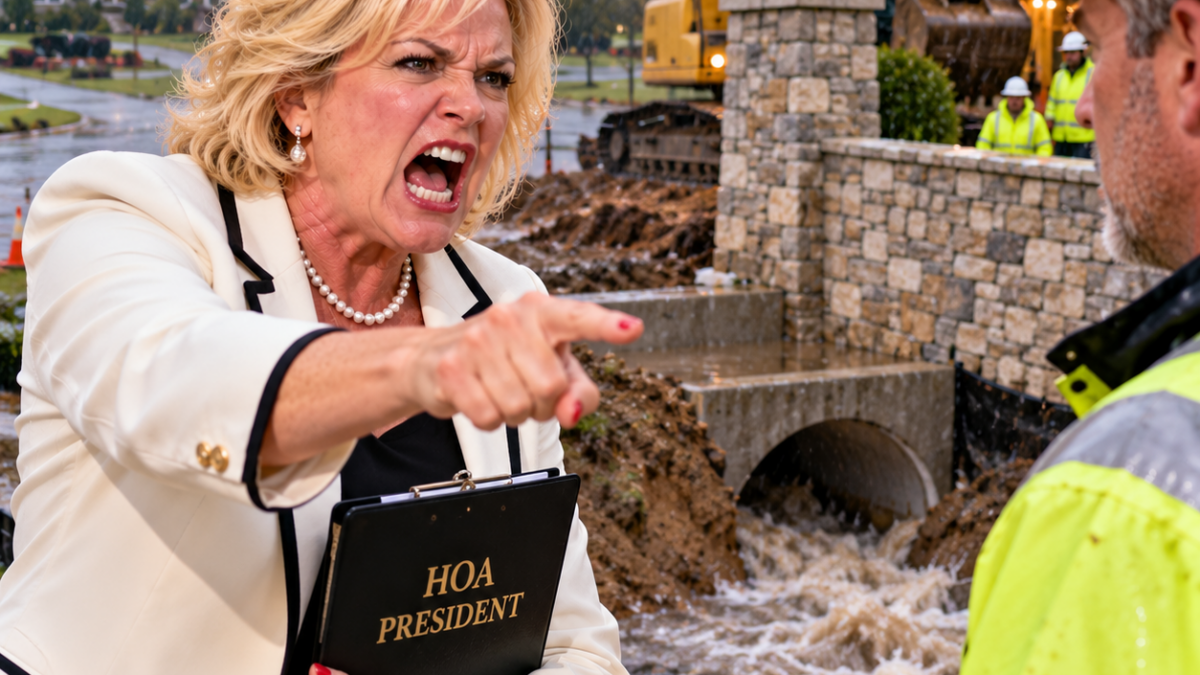
PART 2
The foreman’s name was Daniel Price.
I knew his company by reputation.
Price Landscape Construction had been operating in the county for nearly twenty years, and unlike some companies that survived by changing names every time a lawsuit arrived, Daniel’s firm survived by avoiding stupid work.
He was in his mid-forties, broad through the shoulders, sunburned across the back of his neck, and visibly unhappy to discover that a project he thought involved decorative grading might actually involve a live stormwater system.
He looked at the rolled plan in Clare’s hand.
“My sheet identifies this depression as abandoned agricultural drainage.”
“It is,” Clare said.
Daniel pointed toward the buried headwall.
“That is a thirty-six-inch concrete pipe.”
“So?”
“Abandoned farm ditches don’t usually come with reinforced concrete headwalls and a pipe under a subdivision boulevard.”
“It’s legacy infrastructure.”
“Legacy means old. It doesn’t mean inactive.”
Clare’s voice sharpened.
“Continue within the limits of your contract.”
Daniel didn’t move.
“Show me the civil sheet.”
“The stamped sheet is with management.”
“Call them.”
“Mr. Reed is not a party to this contract.”
Daniel glanced at me, then back at her.
“Neither is four inches of rain, but it’ll show up anyway.”
That was when my weather alert updated.
The remnants of Tropical Storm Helena had shifted west.
Our county had moved into the four-to-six-inch rainfall band, beginning in roughly forty-eight hours.
I walked toward the subdivision side of the road.
There, beneath the fresh clay, I could hear water.
Not much.
A hollow drip.
A slow trickle inside the pipe.
The pond was nowhere near emergency elevation yet.
But the route was live.
I checked my watch.
5:54 p.m.
Concrete was scheduled for seven the next morning.
The HOA had already compacted two truckloads of clay over the outlet.
If they poured a continuous reinforced footing across the alignment, removing the fill would become harder, slower, and much more expensive.
I returned to Daniel.
“Can you hold the site?”
He nodded.
“Nobody from my crew restarts until somebody gives me written drainage approval.”
Clare stepped toward him.
“You have a signed contract.”
“I also have insurance.”
“That’s not an answer.”
“It’s the answer that keeps my company alive.”
Then she looked at me.
“You understand that interference with a board-approved project exposes you to damages.”
“I’m not stopping your entrance.”
“You just did.”
“I’m stopping you from burying a recorded overflow path on my property.”
“You are not the county.”
“No.”
I pulled out my phone.
“But the county has email.”
I photographed the fill from four angles.
Then the pipe location.
Then the property corner.
Then Daniel’s equipment.
I took out the survey level I kept in my truck and recorded the approximate elevation of the headwall, the fresh clay, and the road shoulder.
Not because my field shots would replace a county survey.
Because if somebody added more fill overnight, I wanted a record of where the site had been when I first objected.
Clare watched me.
“You love this, don’t you?”
I looked at her.
“Love what?”
“Getting to be the expert.”
That annoyed me more than I expected.
Maybe because it wasn’t entirely wrong.
Engineers can be insufferable when we recognize a system other people don’t.
But water doesn’t care whether the engineer is arrogant.
It cares about elevation.
“I would love to be wrong.”
She laughed.
“No, you wouldn’t.”
“I absolutely would. Because if I’m wrong, your wall gets built and I go home.”
“And if you’re right?”
“Then 146 households are about to need their emergency overflow back.”
Her expression flattened.
“No one authorized you to frighten residents.”
“I haven’t spoken to one.”
“You already called the contractor.”
“The contractor was filling my property.”
“My project.”
“My land.”
She turned away.
That conversation told me something.
Clare was no longer trying to understand the drainage.
She was thinking about control.
Schedule.
Appearance.
Liability.
Who would be blamed.
I sent a written stop-work notice before leaving the lane.
To Clare.
Daniel.
The management company.
Every board member whose email address appeared in the latest public meeting packet.
I attached the recorded plat sheet I already had on my computer.
I cited the easement.
I asked for the stamped civil approval authorizing abandonment or relocation of the emergency overflow.
Daniel replied first.
PRICE LANDSCAPE WILL NOT RESUME EARTHWORK IN THE DISPUTED CORRIDOR UNTIL WRITTEN DRAINAGE AUTHORITY IS PROVIDED.
Four minutes later, Clare replied.
Mr. Price’s delay is a private contract matter. Your interference is causing financial damages to Brier Glenn. Any flooding caused by your refusal to cooperate with the approved entrance project will be your responsibility.
I read that final sentence twice.
Any flooding caused by your refusal.
That wasn’t engineering language.
That was blame preparation.
I printed it.
Then I walked to the old equipment shed behind my house.
The building had become my home office after I left full-time consulting work.
Dad’s workbench was still against the north wall.
So was his green metal file box.
He stored everything.
Fence receipts from 1984.
Pecan invoices.
Old soil reports.
Handwritten notes about cattle vaccines.
The kind of paperwork children tease their parents for keeping until the day one yellowed page suddenly matters.
Near the bottom, beneath an old Brier Glenn mowing invoice, I found a folded subdivision drainage exhibit.
Sheet C17.
2004.
I laid it across the drafting table.
There it was.
Retention pond.
Normal outlet.
Emergency spillway.
Thirty-six-inch crossing.
My twenty-foot swale.
A note beside it:
MAINTAIN UNOBSTRUCTED AT DESIGN GRADE. NO STRUCTURES OR FILL WITHIN OVERFLOW CORRIDOR.
Dad’s initials were written beside the note.
MR.
He used to initial everything important.
Not because he imagined litigation.
Because he believed memory was unreliable.
I sat down.
For a moment, I was nineteen again, standing beside him in the workshop after the 1998 flood.
Mud had dried halfway up one door.
Twenty-three pecan trees lay dead in the lower field.
Dad was holding a shovel.
“You know what the worst part is?” he asked me.
“The trees?”
“No.”
“The workshop?”
“No.”
He pointed upstream.
“I knew that haul road was there.”
I remembered that sentence for decades.
Dad had seen the timber company block the drainage cut.
He assumed they understood what they were doing.
Then the storm came.
Water did what water does.
It found the obstruction and rose.
Afterward, Dad became obsessive about drainage.
Not paranoid.
Precise.
If a ditch existed, he wanted to know where it went.
If someone moved dirt, he wanted to know what elevation changed.
When Brier Glenn’s developer arrived years later asking to use our lower pasture as part of its emergency overflow system, Dad made them put everything in writing.
That green file box was his distrust of memory turned into paper.
I took C17 home.
But I knew something else.
My copy was evidence.
It wasn’t independent proof.
A twenty-year-old drawing from my father’s file could be called outdated.
Superseded.
Incomplete.
So at eight the next morning, I was standing outside the county stormwater office when the doors opened.
Elena Ortiz met me ten minutes later.
She was the senior stormwater engineer.
We had crossed paths professionally on two commercial projects.
She didn’t owe me anything.
That was important.
I didn’t want a favor.
I wanted the county’s own file.
I gave her the subdivision name.
Parcel number.
Entrance permit number.
Photographs.
She studied the buried headwall.
“Is this Brier Glenn’s only public access?”
“Yes.”
“And you’re saying this pipe is the emergency discharge?”
“According to the recorded plan.”
She turned to her computer.
The archive opened slowly.
Then the original subdivision set appeared.
Clean copy of C17.
Same note.
Same overflow corridor.
Same headwall.
Same pipe.
Elena opened the stormwater operation agreement.
Then a 2019 inspection report.
There was the concrete headwall.
Unburied.
Grass channel open.
Photographed by Brier Glenn’s own management contractor.
“So they inspected this five years ago,” I said.
“Apparently.”
“Any abandonment approval?”
“Not seeing one.”
She pulled the current entrance permit.
Stone walls.
Lighting.
Ornamental grading.
Landscaping.
At the bottom was a bold note.
NO MODIFICATION TO EXISTING STORMWATER POND OUTLET, PIPE CROSSING, OR EMERGENCY OVERFLOW IS AUTHORIZED UNDER THIS PERMIT.
Elena looked at me.
“That’s clear.”
“Any revised hydrology?”
“No.”
“Replacement spillway?”
“No.”
“Drainage amendment?”
“No.”
“County approval to fill my swale?”
“No.”
There it was.
The first independent proof.
The dispute changed shape.
It was no longer Marcus Reed versus Brier Glenn.
A permitted entrance project had crossed beyond the permit that authorized it.
Elena issued a temporary stop-work notice.
“Field inspection at eleven.”
“Concrete was scheduled this morning.”
Her eyes narrowed.
“Was?”
“Daniel Price stopped his crew.”
“Good.”
I drove back.
Daniel’s excavator was idle.
His crew was gone.
But the southern footing had been poured.
Thirty-eight feet.
Reinforced.
Right across the pipe alignment.
A separate concrete subcontractor had arrived before seven.
They worked from the Brier Glenn side and followed the landscape dimensions.
They had never seen C17.
The footing didn’t crush the pipe.
That almost made it worse.
If it had crushed the pipe, everyone would recognize the problem immediately.
Instead, it locked the clay in place above the outlet.
A repair that might have taken a loader and two hours the evening before now required saw cutting, demolition, and careful excavation around a live drainage structure.
Clare stood behind the orange county notice when Elena arrived.
This time she wore a red rain shell.
Same color.
Different weather.
Same confidence.
“This is a private easement dispute,” she told Elena. “Brier Glenn has drainage rights across Mr. Reed’s property.”
Elena held out her hand.
“Show me the approved detail allowing fill in the overflow corridor.”
Clare gave her the entrance permit.
Elena opened it.
Read the exclusion paragraph.
Handed it back.
“This permit specifically excludes the work that was done here.”
“The swale is obsolete.”
“According to whom?”
“The pond has an outlet on the south side. It has handled every storm since I moved here.”
Elena looked at her.
“Normal outlet and emergency overflow are not interchangeable terms.”
Clare crossed her arms.
“Are you saying one grass ditch is protecting an entire subdivision?”
“No.”
Elena’s tone stayed calm.
“I’m saying your pond was designed with multiple discharge conditions. Removing one without analysis changes how the system behaves.”
“Forecasts change.”
“Concrete elevations don’t.”
That line stayed with me.
Elena measured everything.
Buried headwall.
Top of fill.
Road crown.
Road edge.
Pond overflow lip.
We opened two inspection boxes near the normal outlet.
That’s when the second problem appeared.
The normal discharge pipe was partially restricted.
Sediment.
Roots.
Accumulated debris.
Not blocked.
Not failed.
But Elena estimated the open area had been reduced by nearly forty percent.
A maintenance crew should have cleared it in spring.
They hadn’t.
Clare looked at me as if I had somehow arranged the sediment.
“Does that mean the outlet is unsafe?”
“No,” Elena said.
“It means it carries less water before pond elevation rises. Which makes the emergency path more important.”
At the pond, the staff gauge showed eleven inches above typical summer level from rain earlier in the week.
The ground was already wet.
The updated forecast called for roughly four and a half inches locally, with heavier pockets possible.
Elena entered elevations into her tablet.
She did not run a theatrical worst-case scenario.
She ran a conservative check based on the original design assumptions and current conditions.
We waited beside the pond.
Clare paced.
Daniel arrived halfway through.
Tom Alvarez, Brier Glenn’s vice president, showed up next.
He was a retired insurance adjuster.
I knew him only by sight.
Elena finally looked up.
“If forecast rainfall materializes near current guidance, the pond reaches the blocked emergency elevation roughly three hours after the heaviest rainfall band begins.”
Tom asked, “Then what?”
“With the swale blocked, water continues rising.”
“How high?”
“Approximately twenty additional inches before the next available low point becomes effective.”
He looked toward Brier Glenn Boulevard.
“The road?”
“Yes.”
“What happens there?”
“Water crosses both lanes.”
Clare interrupted.
“How deep?”
“Depends on rainfall intensity, timing, upstream inflow, and actual performance of the normal outlet.”
“That isn’t an answer.”
“It’s the honest answer.”
Elena enlarged a map.
“The gate controls and entrance electrical equipment sit near the low road section. Water crossing there could disable access. Twenty-seven homes along Juniper Court also approach the modeled backup elevation.”
Tom went pale.
“All 146 homes use this road.”
“Yes.”
“No second exit.”
“No.”
Clare looked toward the pond.
For the first time since I had met her, she stopped looking at the entrance rendering.
Elena checked the time.
11:51 a.m.
“You have until four.”
Clare turned.
“For what?”
“Restore the existing overflow or submit an engineered temporary bypass with equivalent capacity.”
“What about pumps?”
“Possible.”
“How many?”
“A licensed engineer needs to size them.”
“We can rent pumps.”
“You’ll need required flow capacity, backup power, fuel, round-the-clock operators, intake protection, and a safe discharge point.”
“Can you approve that?”
“If a stamped temporary design reaches me by four.”
Daniel looked toward the footing.
“Removing this is cheaper.”
Clare ignored him.
For months, the stone entrance had been her signature project.
Now the cheapest solution was cutting it apart in front of everyone.
At 12:17, Brier Glenn sent a community-wide email.
Tom forwarded it to me.
An adjacent landowner has challenged the entrance project and prompted county intervention forty-eight hours before a tropical weather event. Construction delays may create temporary drainage complications.
I read it twice.
It was impressive.
Not because it contained an outright lie in every sentence.
Because it reversed the sequence.
The blocked swale became a “drainage complication” created by construction delay.
My complaint became the event that happened first.
Nothing said:
We filled the emergency overflow.
Nothing said:
The county permit excluded that work.
Nothing said:
The stone footing now locked the fill in place.
By one o’clock, three residents had driven slowly past my mailbox.
One stopped.
A man in a pickup rolled down his window.
“You Marcus Reed?”
“Yes.”
“You trying to close our entrance?”
“No.”
“That’s what the email says.”
“No, it says my complaint delayed construction.”
“What’s the difference?”
“The entrance project blocked your emergency drainage route.”
He stared at me.
“So all our houses are going to flood?”
“No.”
That answer surprised him.
I walked closer.
“Don’t let anybody tell you that either.”
“What is going to happen?”
“If the forecast holds and the overflow stays blocked, the entrance road becomes the next low point. Some homes near the pond also have increased risk.”
“And you know this how?”
“I design stormwater systems.”
He looked toward my office.
“Convenient.”
“County engineer confirmed it this morning.”
That changed his expression.
“Why didn’t the HOA say that?”
“You’d have to ask them.”
I did not argue with anyone else at the road.
Instead, I made a one-page diagram.
Retention pond.
Normal outlet.
Emergency overflow.
Brier Glenn Boulevard.
My swale.
Blocked location.
Direction of flow.
Simple arrows.
No dramatic flood shading.
No giant red warning labels.
I attached:
County stop-work notice.
Current permit exclusion.
Recorded C17 detail.
Then emailed it to Clare, the management company, and every board member.
At the bottom:
The safest and least expensive immediate action is to restore the existing emergency overflow before significant rainfall begins.
At 1:36, Tom Alvarez called.
“Marcus?”
“Yes.”
“Clare told us drainage coordination was completed in June.”
“Did she show you C17?”
Silence.
“What is C17?”
That question explained everything.
A $92,000 entrance project had reached excavation and concrete without the vice president seeing the sheet that controlled the ground beneath it.
“Call an emergency meeting.”
“I already requested one.”
“When?”
“Three.”
“Clare agreed?”
“Four of five directors requested it in writing. She doesn’t have to.”
Before I left my office, Daniel emailed.
Subject:
PROJECT RFI / DRAINAGE DEPRESSION.
“I went back through my bid file,” he wrote.
Two attachments.
The first was a request for information from six weeks earlier.
Daniel’s estimator had visited the site.
He noticed the shallow channel.
Concrete headwall.
Pipe.
The RFI said:
PLEASE PROVIDE CIVIL AUTHORIZATION AND OUTLET DISPOSITION BEFORE FILL PLACEMENT IN DRAINAGE DEPRESSION.
The response came from Clare.
FEATURE CONFIRMED ABANDONED BY OWNER. PROCEED PER LANDSCAPE PLAN. HOA ACCEPTS RESPONSIBILITY FOR ADDED FILL AND SCHEDULE.
Electronic signature:
CLARE WHITMORE
PRESIDENT, BRIER GLENN ESTATES HOA
I read it slowly.
Abandoned by owner.
I was the owner.
No one had asked me.
The second attachment was worse.
Email from the landscape architect.
Three days before Clare told the board coordination was complete.
His language was plain.
Our scope does not include abandonment or redesign of existing stormwater facilities. Existing overflow corridor should remain undisturbed. Any modification requires civil engineering and county review.
I printed five copies.
Outside, the first outer rainband arrived at 2:20.
Twelve minutes.
Not heavy.
Enough.
When I checked the entrance, water had begun collecting behind the buried headwall.
A dark wet line showed at the base of the new footing.
I marked the elevation with orange paint.
Photographed the time.
Then drove uphill.
Nearly sixty residents had already gathered in the clubhouse.
Rain ticked against tall windows.
Behind the board table, the retention pond looked harmless.
Two geese stood near the bank.
That is one of the problems with water infrastructure.
Danger rarely announces itself visually at the moment people need to act.
A pond can look peaceful while its available storage is shrinking.
Clare sat at the center.
Tom beside her.
Treasurer Evelyn Park.
Two other directors.
Daniel stood near the back.
Elena arrived just before three.
Clare opened with a prepared statement.
“The county has overreacted to incomplete information supplied by a neighboring property owner with a professional conflict of interest.”
People turned toward me.
I stayed seated.
She continued.
“The board approved this improvement through its normal process. No single individual should be permitted to hold an entire community hostage to his interpretation of an old drainage feature.”
Tom leaned toward the microphone.
“Marcus should explain what the feature does.”
Clare looked at him.
“We have counsel—”
“Four directors voted to hear him.”
That was the first visible crack in her authority.
I stood beside the portable screen.
I showed one diagram.
Not five.
No equations.
“The roofs and streets drain here.”
I pointed to the pond.
“Ordinary storms leave through this controlled outlet.”
South side.
“When that outlet can’t discharge water as fast as the pond receives it, the water level rises.”
I pointed west.
“This is the emergency overflow.”
Then the pipe.
Then my swale.
“The entrance fill blocks it.”
A woman in the second row raised her hand.
“Are you saying all our houses flood?”
“No.”
I let the answer sit.
“The immediate risk is the entrance road and the lowest homes near the pond. But all 146 houses depend on the entrance road for ambulances, fire trucks, and evacuation.”
Clare leaned into her microphone.
“So claims that the entire neighborhood is in danger are exaggerated.”
Elena spoke from the back.
“No.”
Everyone turned.
“Mr. Reed just gave you a more accurate risk statement than the project file.”
Clare’s face tightened.
Elena continued.
“Your project file contains no drainage analysis at all.”
Silence.
Tom looked at Clare.
“You told the board drainage coordination was complete.”
“We relied on licensed professionals.”
“Which professional approved closing the overflow?”
“Our design team coordinated the work.”
“Name the engineer.”
Clare’s eyes moved toward Daniel.
Daniel stepped away from the wall.
“My company requested civil approval.”
Clare turned sharply.
Daniel held up the RFI.
“We were told the feature was abandoned.”
He looked at me.
“By the owner.”
Murmuring spread through the room.
I handed copies forward.
Tom read Clare’s signed response.
Evelyn reached the architect’s email.
Her eyes stopped on the date.
Then she read it again.
“Clare.”
“What?”
“This email is dated June twelfth.”
“Yes.”
“You told us drainage coordination was complete June fifteenth.”
“It was an early caution.”
“The architect says not to disturb the overflow.”
“It was resolved during coordination.”
Tom asked quietly.
“Resolved by whom?”
No answer.
“Which civil engineer?”
Clare picked up her pen.
“We are not going to litigate engineering scope in a clubhouse.”
Daniel said, “My crew needs an answer now.”
At 3:42, Elena’s phone alerted.
She checked the county weather desk update.
“The heaviest rain is now expected after midnight.”
“How much earlier?” Tom asked.
“Approximately six hours earlier than the morning guidance.”
Clare looked at the clock.
“Your four o’clock deadline is unreasonable.”
“The storm moved.”
“That is not our fault.”
“No.”
Elena’s expression remained flat.
“But the fill is your responsibility.”
Tom straightened.
“I have a motion.”
Clare turned.
“Tom—”
“I move that Brier Glenn immediately authorize removal of all fill and any portion of the new footing necessary to restore the recorded emergency overflow under county supervision.”
A man in the audience whispered.
“You’re tearing down the entrance?”
Tom continued.
“Safety takes priority over the construction schedule.”
Clare shook her head.
“This is reckless.”
Evelyn said, “What’s reckless is having no civil approval.”
The vote happened.
Tom.
Yes.
Evelyn.
Yes.
Director Sam Patel.
Yes.
Director Louise Garner.
Yes.
Clare.
No.
Months of planning.
Architectural renderings.
Stone selections.
Lighting samples.
A ribbon-cutting schedule.
Four votes ended the argument in less than forty seconds.
Daniel looked at Elena.
“Mark my limits.”
She stood.
“Get your machine.”
We went down to the entrance in steady rain.
Work lights came out.
Elena set grade stakes.
Daniel called his crew back.
A concrete saw arrived.
I stayed on my side of the property line unless Elena asked me to identify the original swale grade.
Nobody guessed.
Nobody dug blindly.
The crew exposed the pipe crown with hand tools.
Saw-cut the new reinforced footing at two points.
Attached lifting straps.
At 6:32, the excavator raised the center section.
Stone forms shook.
Clare stood under the clubhouse awning watching.
She didn’t come closer.
The slab section weighed several tons.
It swung away.
Then the crew removed clay in shallow layers.
At 7:14, the bucket cleared the concrete mouth.
Water immediately moved.
Not a dramatic wall.
No movie-style eruption.
A dark stream.
Then wider.
Then steady.
It crossed the old grass line.
Spread shallow.
Exactly where C17 said it would.
Fifteen minutes later, the standing water behind the headwall was gone.
Daniel climbed down from the excavator.
He looked along the channel.
“Your father really kept this grade?”
“For years.”
“It doesn’t look like much.”
“It isn’t supposed to.”
That was the entire point.
Clare had looked at a mostly dry depression and seen wasted space.
Daniel looked at moving water and finally saw infrastructure.
Rain intensified after midnight.
I stayed awake in the equipment shed.
Elena’s field crew had installed temporary gauge markers.
They sent photos every hour.
12:15.
Pond rising.
1:12.
Normal outlet at practical capacity.
1:46.
Emergency elevation approaching.
2:40.
Water crossed the spillway.
The restored swale activated.
I drove out in rain hard enough that my headlights reflected off sheets of water.
From a safe position near my house, I watched the system work.
Water passed under Brier Glenn Boulevard.
Through the exposed headwall.
Across my lower pasture.
Then toward Cedar Branch.
It wasn’t deep.
Maybe several inches across most of the channel.
Wide.
Slow enough not to scour badly.
Exactly what a good overflow should be.
Spread water.
Lower velocity.
Keep it away from structures.
At 3:05, my daughter called.
She lived in Atlanta.
“Dad?”
“I’m fine.”
“I saw the weather.”
“Road’s okay.”
“You’re outside, aren’t you?”
“Technically.”
“Get inside.”
“I’m watching the overflow.”
She sighed.
“Granddad would be out there too.”
“That doesn’t make it smart.”
“No. It makes it genetic.”
That made me laugh.
She had grown up with the same ditch.
As a child, she jumped across it.
Called it the trench.
She had no idea until college that it was part of a recorded drainage system.
Most infrastructure works that way.
Children turn it into play until adults block it.
At 4:30, water was still moving.
Brier Glenn Boulevard remained dry.
Gate controls stayed powered.
No emergency vehicle needed access that night.
But if one had, it could have passed.
Around dawn, the heaviest rain moved east.
I walked the swale after sunrise.
Rubber boots.
Rain jacket.
Coffee in a travel mug.
The temporary excavation was rough.
Flow had carried loose clay into the lower pasture.
Seven young pecans near the construction limit were damaged by equipment.
Thirty feet of fence needed rebuilding.
Real losses.
Repairable ones.
Behind me, 146 households still had a road.
I stood in the rain and thought about Dad.
Twenty-three pecan trees lost in 1998.
Mud in his workshop.
His green file box.
His initials beside C17.
He had spent years explaining that drainage isn’t something you notice when it works.
That morning, the entire neighborhood had watched his “ditch” do exactly what he always said it would.
Four days later, the county issued preliminary findings.
The entrance permit itself had been valid.
The walls.
Lighting.
Landscaping.
All allowed.
The failure was not that Brier Glenn tried to improve its entrance.
The failure was that work exceeded the permit after written warnings that drainage review was required.
The county listed corrections.
Remove all remaining fill from the overflow corridor.
Restore design grade.
Repair the headwall.
Clear and inspect the normal outlet.
Submit a revised entrance design preserving both discharge routes.
Brier Glenn hired an independent engineering firm to review the project.
That review did something important.
It separated board action from Clare’s action.
The board had approved an entrance subject to permits and engineering coordination.
The board had never voted to abandon my drainage swale.
Never voted to fill the overflow.
Never approved a revised hydrology study.
Never authorized Clare to represent that I had abandoned anything.
She had treated the conditions attached to the board approval as paperwork she could catch up later.
Costs accumulated.
Emergency demolition.
Saw cutting.
Excavation.
Engineering.
Drainage restoration.
Fence repair.
Pecan replacement.
Headwall work.
Redesign.
Just over sixty-eight thousand dollars beyond what the original project had planned.
The concrete subcontractor’s insurer paid part.
Brier Glenn’s contingency paid most of the rest initially while claims were sorted out.
No one lost a house.
No one went bankrupt.
No one went to jail.
There was no million-dollar judgment.
What Brier Glenn got was something more believable.
A very expensive invoice explaining the cost of confidence without verification.
The next regular board meeting filled the clubhouse again.
Clare attended as president.
Probably for the last time, though nobody had said that officially.
Tom presented the independent review.
Clare defended herself.
“I acted to protect property values and keep a board-approved project on schedule.”
I believed her.
That was the uncomfortable part.
She hadn’t buried the swale because she wanted Juniper Court underwater.
She didn’t hate the residents.
She didn’t secretly want ambulances trapped behind floodwater.
She genuinely believed the danger was theoretical.
The entrance deadline was real.
The home tour was real.
The magazine photographs were scheduled.
Four listings depended partly on the project looking finished.
The dry ditch looked ugly.
I looked difficult.
Every shortcut seemed small.
Call the swale abandoned.
Use the landscape sheet instead of the drainage sheet.
Treat the permit exclusion as something that could be coordinated later.
Tell the contractor the owner had agreed.
Tell the board the review was complete.
Every small step made the next one easier.
Then Daniel asked for drainage approval.
Admitting the truth then would expose every earlier shortcut.
So she signed one more instruction.
Proceed.
The storm supplied the deadline she had been pretending did not exist.
Tom made the motion.
Remove Clare Whitmore as board president.
Vote.
Four to one.
She voted against her own removal.
The bylaws allowed it.
That tiny detail became neighborhood gossip for weeks.
I didn’t find it funny.
Mostly, I watched her face after the vote.
Shock first.
Then anger.
Then something closer to humiliation.
She gathered her papers slowly.
No red blazer.
No speech.
Tom became interim president.
His first call to me came the next morning.
“I’m not calling to apologize.”
“That’s refreshing.”
“I want you, Elena, Daniel, and me to walk every restoration limit before another machine arrives.”
I paused.
“No assumptions?”
“None.”
“That’s more useful than an apology.”
We met two days later.
Elena marked the corridor.
Daniel measured.
Tom photographed each boundary.
I brought C17.
No one argued.
The HOA replaced the seven damaged pecans.
Rebuilt the fence.
Repaired the headwall.
Permanent markers went at both edges of the overflow corridor.
Galvanized posts.
Blue plates.
EMERGENCY DRAINAGE PATH
KEEP CLEAR
They were not attractive.
Nobody asked them to be.
The entrance monument moved twenty-seven feet north.
One wall became shorter.
The crepe myrtle bed shifted.
Bronze lettering remained.
Uplights remained.
From the road, anyone who did not know the story would assume the final design had always been intended.
Then Daniel found a use for the demolished stone.
Erosion protection.
Not inside the flow line.
Along the restored headwall margins.
Elena approved a modest stone apron.
The pieces of Clare’s monument ended up protecting the drainage structure she tried to bury.
Dad would have loved that.
I could hear him.
“About time the pretty rocks did some work.”
Clare stayed in Brier Glenn.
That surprised some people.
She owned a house there.
Losing a board position doesn’t erase your address.
For several months, she attended meetings from the last row.
Residents watched her more than they watched the board.
That eventually faded.
Communities are good at moving on because daily life demands it.
Trash pickup still happens.
Pool keys get lost.
Roof shingles blow off.
Children leave bicycles in the wrong places.
The world cannot remain an emergency meeting forever.
But the records remained.
The county report.
Daniel’s RFI.
Clare’s signed response.
The architect’s warning.
Board minutes.
Permit exclusion.
C17.
Those didn’t fade with neighborhood attention.
One afternoon, Clare came to my property line.
I was repairing drip irrigation around the new pecans.
She did not cross.
“Marcus.”
I turned.
“Clare.”
For several seconds, neither of us spoke.
Then she said, “You got what you wanted.”
I sat the wrench down.
“No.”
“You got the wall moved.”
“Yes.”
“You got me removed.”
“I didn’t make that motion.”
“You handed them everything they needed.”
“That is different.”
She laughed quietly.
“Of course you’d say that.”
I walked closer but stopped on my side.
“What do you think I wanted?”
“To be right.”
That answer hit harder than I expected.
Maybe because a small part of me understood it.
I had spent a career being paid to notice failures before other people did.
Being right can become its own drug.
So I answered carefully.
“I wanted the swale reopened.”
“And after that?”
“The headwall repaired.”
“After that?”
“The board to understand what happened.”
“And me?”
I looked toward Brier Glenn.
“I wanted you to stop being able to order work you didn’t have authority to order.”
Her eyes tightened.
“That sounds like revenge.”
“No. Revenge would be wanting your house to flood.”
She looked away.
“People think I lied.”
“You told Daniel the owner confirmed abandonment.”
“I believed the feature was obsolete.”
“That isn’t what the sentence said.”
“I was told—”
“By who?”
She stopped.
That was always the question she couldn’t answer.
Who?
Which engineer?
Which county reviewer?
Which owner?
Which stamped plan?
Her decisions rested on confidence without a person willing to own the technical conclusion.
“I had four homes going to market,” she said finally.
“I know.”
“The entrance mattered.”
“To your listings.”
“To everyone’s values.”
“Both.”
She looked at me sharply.
I continued.
“It can be both. You can believe you were helping the community and still benefit professionally.”
She said nothing.
“The problem wasn’t that you cared about the entrance.”
“Then what was it?”
“You treated every person who slowed the project as an obstacle.”
Her face changed.
Just slightly.
“Daniel asked for approval.”
I counted on my fingers.
“The architect warned you. I warned you. The permit excluded drainage work. You never had a civil sheet.”
“I thought they were being overly cautious.”
“That’s what drainage engineers are paid for.”
She almost smiled.
Almost.
Then she said, “I didn’t think the storm would come.”
“That’s the problem.”
“I knew storms happen.”
“No. You thought this one probably wouldn’t happen before the ribbon cutting.”
Her eyes dropped.
That was as close to agreement as we got.
When she left, I didn’t feel victorious.
I felt tired.
Justice is often less exciting up close than people imagine.
Sometimes it is simply somebody standing beside the line they crossed and realizing the line was always there.
October brought cooler mornings.
New grass rooted inside the restored swale.
The HOA contractor mowed it carefully.
No one called it an abandoned ditch anymore.
At final inspection, Elena checked the grade.
Daniel inspected his repairs.
Tom photographed the blue markers for the HOA maintenance file.
Then he handed me an envelope.
“What’s this?”
“Board correction.”
Inside was a letter sent to every Brier Glenn household.
It stated:
I had warned the association before construction.
The overflow corridor had been obstructed without required drainage approval.
The county required immediate restoration.
My cooperation during emergency correction helped protect community access during Tropical Storm Helena.
No dramatic apology.
No accusation.
Just a correction.
I folded it.
That afternoon, I opened Dad’s green file box.
Put the letter behind C17.
For years, I had thought the most important thing Dad left was the land.
Eighteen acres.
Pecans.
Pasture.
House.
Workshop.
I was wrong.
The more useful inheritance was his habit of documenting what the land needed.
He had been a farmer.
Not an engineer.
He didn’t use words like hydraulic grade line.
Tailwater.
Emergency spillway.
Design storm.
He used simpler language.
“Water needs somewhere to go.”
He understood the principle before I learned the equations.
Winter passed.
The new entrance became ordinary.
People drove past without slowing.
Stone wall.
Bronze letters.
Crepe myrtles.
Nobody pointed out the missing symmetry.
Nobody mourned the wall that had been moved.
The subdivision continued.
One of Clare’s four listings sold.
Two were withdrawn.
The fourth sold months later.
The real-estate magazine photographed the completed entrance the following spring.
The picture appeared online.
You could see the stone wall.
Landscaping.
Bronze lettering.
You could not see the emergency drainage swale just outside the frame.
That amused me.
Infrastructure was invisible again.
Exactly as it should be when it works.
The following summer, Brier Glenn hired a new management company.
Tom asked whether I would join an annual drainage walk.
“I’m not in your HOA.”
“You don’t have to join anything.”
“Then why?”
“Because half the infrastructure touches your land.”
Fair.
So every June, someone from management, one board member, and I walked the route.
Pond.
Normal outlet.
Spillway.
Pipe crossing.
Headwall.
Swale.
Cedar Branch.
We took photographs.
Cleared debris.
Recorded maintenance.
The first year, Tom came.
The second year, Evelyn.
The third year, a new board member named Sean who had bought his house after the whole dispute.
He stood beside the blue marker.
“What happened here?”
Tom looked at me.
“You want the long version?”
Sean laughed.
“No.”
Tom pointed toward the swale.
“Previous board buried it for landscaping.”
Sean looked at the pipe.
“Why?”
“Because it was dry.”
Sean frowned.
“That seems like exactly when drainage would be dry.”
I liked him immediately.
The normal outlet received proper maintenance after that.
Sediment removed.
Roots cleared.
Inspection logs posted.
The irony was that Clare’s mistake probably left Brier Glenn with a better-maintained stormwater system than it had before.
That did not justify what she did.
Consequences can still produce improvements.
My daughter visited one weekend in May.
We walked the lower pasture.
She stopped beside one of the replacement pecans.
“Which ones did the excavator kill?”
“Seven.”
“This one?”
“Replacement.”
She looked uphill.
“You still mad?”
“Yes.”
“Still?”
“I didn’t say every day.”
She smiled.
“Granddad could hold a grudge for decades.”
“He called it memory.”
“He called everything memory when he wanted to stay angry.”
Fair.
We reached the swale.
Grass had filled in completely.
She stepped across it.
“Hard to believe this caused all that.”
“It didn’t.”
“What?”
“Clare caused all that.”
She laughed.
“You know what I mean.”
“The ditch didn’t create the problem. Blocking it did.”
She gave me the look adult children give parents when a lecture has begun.
“Engineer answer.”
“Accurate answer.”
She pointed to the blue marker.
“I like this.”
“You like ugly galvanized posts?”
“I like that nobody can pretend they didn’t know.”
That was true.
The year after Helena, another tropical system brought heavy rain.
Not as much.
Three inches overnight.
I woke around two.
Old habit.
Put on boots.
Walked outside.
The normal outlet handled most of it.
Emergency swale never activated.
I stood there anyway.
Listening.
Water dripping from pecan leaves.
Frogs.
Distant road noise.
No drama.
I thought about calling Tom.
Then decided not to.
The system didn’t need an audience every time it worked.
That was another lesson.
After the crisis, I received requests from other property owners asking me to look at HOA drainage disputes.
I declined most.
I was an engineer, not an anti-HOA crusader.
Sometimes the HOA was wrong.
Sometimes the owner was.
Sometimes both sides had half a map and twice the confidence.
One man called because his association wouldn’t let him fill a low spot beside his driveway.
He expected me to tell him the board was ridiculous.
I looked at the plat.
“Don’t fill it.”
He was offended.
“It’s my land.”
“It’s also a drainage easement.”
“You’re supposed to be on my side.”
“I’m on the water’s side.”
He hung up.
I laughed afterward.
Maybe that was the only side I had ever been on.
Years passed.
Tom eventually moved.
Evelyn resigned from the board.
Daniel’s company continued doing Brier Glenn landscaping work.
That surprised some residents.
He had been the contractor during the mistake.
But he had also stopped his own crew the moment he discovered the drainage conflict.
Then returned during the emergency and repaired what needed to be repaired.
Accountability does not require pretending everyone had equal responsibility.
Daniel had relied on bad information.
Then acted correctly when better information arrived.
Clare had received better information repeatedly and kept pushing.
Those are different things.
One evening, Daniel stopped by my office.
He was bidding another project nearby.
“I still use your entrance job in safety meetings.”
“My entrance job?”
“Brier Glenn’s.”
“What do you tell them?”
“If the dirt has a pipe in it, don’t let anybody call it landscaping until somebody proves it.”
“Pretty technical.”
“My crews remember it.”
He looked toward the green file box on the shelf.
“You still got the old plan?”
“Yes.”
“Your dad kept that?”
“Yes.”
“Smart man.”
“He would have enjoyed you cutting up that stone wall.”
Daniel laughed.
“I enjoyed that more than I should have.”
“Careful. Clare may hear you.”
“She doesn’t hire me anymore.”
“Understandable.”
Then he became serious.
“I should’ve caught the pipe sooner.”
“You did.”
“After fill.”
“Before your footing.”
“Concrete guy beat me to it.”
“You stopped when the information changed.”
He nodded.
“That doesn’t always feel like enough.”
I understood exactly what he meant.
Engineers, contractors, farmers—anyone responsible for physical things eventually carries a list of decisions that could have been made earlier.
The goal isn’t perfection.
The goal is noticing the next warning sooner.
The stone apron around the headwall weathered nicely.
Lichens appeared.
Grass softened the edges.
By the fourth year, no one looking at it would guess the stone came from the entrance wall that almost blocked it.
That remained my favorite detail.
Clare wanted stone to hide drainage.
The stone ended up protecting drainage.
I never told her that.
Maybe she knew.
Maybe not.
She stopped attending board meetings after about eight months.
I saw her occasionally driving out.
Then one year, a FOR SALE sign appeared at her house.
Another broker’s name.
She sold in spring.
Before moving, she mailed me a short note.
No return address beyond her name.
Marcus,
I still disagree with some of what was said about my intentions. But I understand now that I treated a technical warning as an obstacle to a schedule. I should not have represented the drainage feature as abandoned without written approval. I hope the repairs continue to work.
Clare
I read it once.
Then again.
I did not show it to the board.
It wasn’t theirs.
I placed it in the green file box.
Not beside C17.
Farther back.
Near the project correspondence.
A record.
Nothing more.
Dad would have kept it too.
Years after the original storm, Elena Ortiz retired from the county.
At her retirement reception, I told her something I had never said.
“You probably saved Brier Glenn more trouble than anybody.”
She shook her head.
“The original engineer did.”
“He wasn’t there.”
“He put the elevation on paper.”
She pointed at me.
“Your father kept the route open.”
Then toward Daniel across the room.
“He stopped the equipment.”
“Tom called the meeting.”
“Exactly.”
She smiled.
“Systems work because more than one person does their job.”
That was the best description of the whole story.
The failure had also happened because more than one safeguard was ignored.
The architect warned.
Ignored.
I warned.
Dismissed.
The permit excluded drainage work.
Worked around.
Daniel requested approval.
Given a false conclusion.
Board thought coordination was complete.
It wasn’t.
No single magical document saved Brier Glenn.
Not even C17.
What saved them was the documents finally being read together before the rain arrived.
That matters.
Stories like this often make justice look like one dramatic reveal.
A secret map.
A smoking-gun email.
A heroic official.
Real life is messier.
Clare’s signed response mattered.
So did the permit.
So did the county archive.
So did Daniel’s RFI.
So did Elena’s elevations.
So did the weather forecast.
So did four board members willing to reverse a project they had already approved.
The truth became difficult to ignore because every independent piece pointed in the same direction.
The swale was real.
It was active.
It was protected.
And it needed to be open before the storm.
The heaviest rain that night ultimately measured just under five inches at the nearest county gauge.
Close to forecast.
Not record-breaking.
Not biblical.
That fact mattered too.
Brier Glenn didn’t survive some once-in-a-century apocalypse.
It faced the kind of heavy tropical rainfall its system had been designed to manage.
The emergency overflow activated because the designers expected ordinary infrastructure to have limits.
That is what safety factors and overflow routes are for.
Not extraordinary imagination.
Ordinary failure.
Clogged outlet.
Wet soil.
One big storm.
A little less capacity than expected.
Everything working together until it doesn’t.
If we had left the swale buried, maybe the road would have flooded exactly as Elena modeled.
Maybe the rainfall would have shifted two miles and nothing would have happened.
Maybe water would have stopped an inch below the pavement.
We will never know.
That uncertainty is not an argument for Clare.
It is the reason we design emergency systems in the first place.
You do not remove the spare route because the last twenty storms did not need it.
You maintain it because the twenty-first might.
Dad understood that without software.
By the time I was sixty, the replacement pecans had grown enough that I had to prune their lower branches.
The blue markers still stood.
One had faded.
I replaced it.
The HOA reimbursed the cost without argument.
That made me smile.
Twenty years earlier, I would never have imagined a neighborhood association voluntarily paying thirty-eight dollars for a drainage marker on my land.
History changes priorities.
One late summer afternoon, thunder built west of us.
Nothing major.
A typical Georgia storm.
I was closing the equipment shed when a young couple walked down from Brier Glenn.
They had recently bought a house on Juniper Court.
“Mr. Reed?”
“Yes?”
“We’re the Carsons.”
I recognized the name from an HOA email.
“What can I do for you?”
“The seller mentioned something about drainage behind the entrance.”
I pointed.
“See the blue posts?”
“Yes.”
“That’s your overflow corridor.”
They looked confused.
“On your property?”
“Partly.”
“So our pond drains through your field?”
“When it needs emergency capacity.”
The husband looked toward the subdivision.
“Why would you agree to that?”
“My father did.”
“Doesn’t it flood your pasture?”
“Yes.”
He looked surprised.
“And that’s okay?”
“That part of the pasture is supposed to flood before your road does.”
The wife looked at the pecan trees.
“So you take our water.”
I smiled.
“Gravity takes your water. I just don’t stand in the way.”
They laughed.
Then I showed them the route.
They had lived in Brier Glenn six months and never knew it existed.
That was fine.
The system didn’t need gratitude.
It needed clearance.
The storm passed with less than an inch.
No emergency flow.
The Carsons went home.
I sat on my porch.
From there, I could see the top of Brier Glenn’s stone entrance through the trees.
It looked good.
I could admit that.
Clare had been right about one thing.
The old wooden sign looked tired.
The finished stone monument improved the entrance.
But it worked because the second design respected what was already there.
That difference was everything.
Development doesn’t have to fight infrastructure.
Beauty doesn’t have to defeat function.
Most problems begin when someone insists the visible thing is more important than the invisible one.
At dusk, headlights moved through the entrance.
One car.
Then another.
Then an ambulance.
No siren.
Probably routine transport.
It passed through without slowing.
I watched until its taillights disappeared uphill.
Years earlier, Elena’s model had shown that same road under moving water if the stormwater rose high enough behind the blocked swale.
Maybe no ambulance would have needed it that night.
But “maybe” is not how you design emergency access.
I thought of Clare’s old words.
Forecasts change.
Elena’s answer came back.
Concrete elevations don’t.
Neither does water’s need for somewhere lower to go.
Dad never saw the stone entrance.
He died before Clare moved into Brier Glenn.
Sometimes I wonder what he would have said watching the whole dispute unfold.
He would have disliked the meetings.
Hated the emails.
Distrusted every rendering.
He would have stood beside the swale with a shovel and asked why adults needed ninety pages of paperwork to understand that you shouldn’t fill the low spot where the water goes.
Then he would have gone into his workshop and found the old plan.
That was his contradiction.
Suspicious of bureaucracy.
Obsessed with documentation.
Maybe he understood something I didn’t until later.
Paper does not replace common sense.
It preserves common sense after the people who had it are gone.
C17 did not create the drainage route.
The land did.
The engineers measured it.
Dad protected it.
The county recorded it.
The paper simply prevented someone twenty years later from pretending the route had never mattered.
That is why the green file box still sits beneath my workbench.
I added one more folder after the final restoration.
BRIER GLENN — ENTRANCE / OVERFLOW.
Inside:
Original plat.
C17.
Permit.
Stop-work notice.
Daniel’s RFI.
Architect email.
Clare’s response.
Board correction.
Final restoration survey.
Clare’s note.
Not because I expect another fight.
Because memory gets cleaner with time.
Too clean.
Years from now, someone may say:
There was a storm.
There was a misunderstanding.
They redesigned the entrance.
That version would leave out the important part.
There were warnings.
Specific ones.
Before the fill.
Before concrete.
Before rain.
People had choices.
That is where responsibility lives.
The storm did not make Clare’s decision wrong.
It revealed why the decision had been wrong before the first cloud arrived.
That distinction matters to me.
Water did not punish her.
The board did not remove her because a tropical system happened to exist.
She lost authority because she used authority without the checks that made it legitimate.
That was the consequence.
Not prison.
Not bankruptcy.
Not some fantasy lawsuit.
Loss of trust.
Loss of control.
Loss of the title she had used to push past everyone who told her to slow down.
Years later, the subdivision’s annual maintenance walk became so ordinary that board members sometimes complained about having to attend.
I loved that.
Boring maintenance is a successful ending.
One June morning, a new HOA president named Claire Robinson arrived fifteen minutes late carrying coffee.
“No relation to Clare,” she said immediately.
“I wasn’t going to ask.”
“Everyone asks.”
We walked to the pond.
Normal outlet clear.
Spillway clear.
Crossing clear.
Swale mowed.
Markers visible.
She took the required photographs.
“Anything else?”
I looked around.
“No.”
“That’s it?”
“That’s the goal.”
She laughed.
“I expected engineering drama.”
“You inherited the part after the drama.”
She checked the box on her form.
SYSTEM FUNCTIONAL.
Three words.
Almost nothing.
Exactly what twenty years of argument had been trying to protect.
That afternoon, rain fell.
Ordinary summer thunderstorm.
The swale stayed mostly dry.
A thin ribbon of water ran through the pipe and disappeared into grass.
I stood by the fence.
Not because anything was wrong.
Because sometimes I still liked seeing the route open.
The stone apron held.
The blue posts stood.
Pecans moved in the wind.
Behind them, Brier Glenn’s rooftops rose through the pines.
146 homes.
Families who would never know my father.
Most would never read C17.
They didn’t need to.
They only needed the next board president not to bury it.
I walked back toward the house.
At the porch, I turned once.
The channel was barely visible.
Just a shallow line in green grass.
Clare had once called it an abandoned ditch because it looked empty.
Dad called it a promise.
He had the better word.
Because the point of that swale was never the water already inside it.
The point was the water that might need it later.
And when Tropical Storm Helena finally arrived, the promise held.
[END OF STORY]








