PART 2: HOA Buried My Flood Channel for 48 Parking Spaces—Then Blamed Me When the Cars Went Under
PART 2
The first person from Brier Glen who came to ask me directly was Rachel Kim.
She showed up at my gate the next morning still wearing navy scrubs and a hospital badge clipped to her shirt.
She looked exhausted.
Night shift.
She lived in the lowest row of Brier Glen houses, the row closest to the upstream end of the channel.
“I’m not here to argue,” she said.
“That puts you ahead of three people who called me last night.”
She gave a tired smile.
“Diane said you want a lease payment.”
I opened the gate.
“Come inside.”
I took her to the workshop and handed her the letter Ben had sent the HOA.
She read it.
Then read it again.
She searched the second page.
“There isn’t a number.”
“No.”
“You aren’t asking for money.”
“I’m asking them to stop construction.”
Rachel looked toward the valley.
“But residents already voted for the lot.”
“What exactly did you vote for?”
“Forty-eight spaces behind the clubhouse. Improved drainage. Safer street access.”
“Did anybody mention the parking would cross private property?”
“No.”
“Did anybody mention replacing an open channel with two eighteen-inch pipes?”
She shook her head.
“Diane said it was an unfinished ditch the original developer should’ve enclosed years ago.”
I led her toward the fence.
The land sloped gently from two ridges toward the channel.
On a dry day, the whole landscape looked harmless.
Grass.
Maples.
A few scattered cedars.
The Brier Glen houses.
Then the river south of us.
I pointed uphill.
“Everything from that side drains this direction.”
Then west.
“And that ridge.”
Then down the channel.
“This carries it to the river.”
Rachel looked at her house.
Her basement windows sat only a few feet above grade.
“If they block it?”
“The water stacks upstream.”
“How far?”
“That’s what a drainage evaluation is supposed to calculate before construction.”
She stared at the fresh stone.
“Diane said the pipes improve drainage.”
“Pipes can improve drainage when they’re sized correctly, installed correctly, and fed correctly.”
“And these?”
“Nobody has shown me a calculation.”
She looked uncomfortable.
“I voted for the parking.”
“You voted for what they showed you.”
That afternoon, Luis Ortega arrived with his survey crew.
He recovered the original property monuments.
One near the service lane.
Another farther south.
Then a third by the old retaining wall.
By four o’clock, the line was obvious.
The proposed parking area sat partly inside my parcel.
Not inches.
Not a surveyor arguing about old iron pins.
The subdivision boundary lay farther uphill.
Luis drove new stakes.
Bright orange caps.
Diane arrived before his crew finished.
One stake stood directly in the route where her drawing showed cars turning into the new lot.
She pointed at it.
“That needs to move.”
Luis looked at her.
“No.”
“Vehicles will hit it.”
“Then vehicles shouldn’t be here.”
“It’s in the circulation area.”
“It marks the property line.”
Diane folded her arms.
“Our project documents show access through this corridor.”
“Then have your surveyor call me.”
She turned toward me.
“You’re intentionally interfering with construction.”
“I hired a surveyor to identify my boundary.”
“You knew where the project was going.”
“I also know where my land goes.”
Luis handed her a copy of the survey exhibit.
She didn’t look at it.
She called Wes.
By evening, one of Luis’s stakes was gone.
I found the disturbed hole.
Photographed it.
Called Luis.
“I’m sorry,” I told him.
“You didn’t pull it.”
“No.”
“Then don’t apologize.”
The next morning, another load of stone covered the spot where the stake had been.
I had one old camera beneath the workshop eave looking across the valley.
After that, I installed another camera aimed at the downstream outlet.
Not because I expected a flood in the next few days.
Because I had worked thirty years around water.
When somebody covers drainage with pavement, the important evidence is often the part nobody can see afterward.
That night Diane invited me to a meeting at the clubhouse.
Ben came with me.
She had a one-page agreement waiting.
“Let’s stop wasting money on attorneys.”
“That sounds promising,” Ben said.
Diane ignored his tone.
She offered a small annual payment for use of the strip.
The amount didn’t matter.
What mattered was paragraph four.
It described me as the approving landowner.
Then said I accepted the proposed underground drainage arrangement.
Ben tapped the page.
“My client has not approved the drainage arrangement.”
Diane looked at me.
“Then tell us what would make you comfortable.”
“An engineering drainage evaluation.”
Wes shifted in his chair.
“County authorization.”
Diane’s jaw tightened.
“And the parking lot off my land unless I agree otherwise.”
“We cannot restart the entire project.”
“You haven’t legally started it.”
“We open Friday.”
“The election is Sunday.”
The room went quiet.
Diane looked at me.
“You think this is about my election?”
“I think you’re treating the opening date like an engineering standard.”
She pushed the agreement toward me again.
“Residents have already been promised these spaces.”
“Then tell them the truth.”
“What truth?”
“The drainage needs review.”
Her expression hardened.
“And then they can vote for someone who promises to finish it?”
There it was.
Every delay had become political.
Not hydraulic.
Not legal.
Political.
Diane increased the payment.
I declined again.
Ben asked for a copy of the agreement.
Diane withdrew it.
“You’re not taking an unsigned proposal.”
Ben opened his notebook.
“That’s fine.”
He wrote down each material term while she watched.
Outside, work lights illuminated fresh parking arrows.
They were painting spaces over a drainage system nobody had proved would work.
The following morning, Diane sent another message to residents.
According to her, I had rejected a “good-faith compensation offer” and was demanding unreasonable concessions.
Rachel showed it to me.
“She’s making it sound like you want more money.”
“I refused all of it.”
“Can I tell people that?”
“Yes.”
Rachel hesitated.
“There’s something else.”
“What?”
“When we voted on the project, we only got two pages.”
“Two pages of what?”
“Summary. Budget. Parking layout. Timeline. It said engineering and approvals were handled.”
“Can you get the full contractor proposal?”
“I can request it.”
“Do that.”
Before Rachel got the file, the weather gave us a preview.
Wednesday afternoon, a short shower moved across the hills.
Nothing serious.
Maybe twenty minutes of moderate rain.
I went down to the channel.
Brown water came off the slope.
Normally it would spread across the broad bed and continue south.
Now it reached the new inlet.
Stopped.
Pooled.
The two pipes sat slightly above the remaining bed.
Loose construction soil gathered against the lip.
Water had to climb before it could enter.
Rachel came down carrying an umbrella she wasn’t using effectively.
She stared.
“This is after twenty minutes?”
“Yes.”
Water crept toward the nearest fresh parking stripe.
Wes appeared with a shovel.
He scraped sediment away from one pipe entrance.
The pool dropped.
“A little construction sediment,” he said.
I looked at him.
“What happens during six hours of rain?”
He kept scraping.
“Once everything’s stabilized—”
“What about leaves?”
Silence.
“Branches?”
He looked toward the slope.
“Debris happens in any system.”
“Yes.”
“Then maintenance handles it.”
“Who maintains an inlet under parked cars during a storm?”
Diane arrived carrying the sign announcing Friday’s grand opening.
She called to Wes:
“Is the drainage issue corrected?”
Wes stood.
“The entrance is clear.”
Diane looked at Rachel.
“There. It’s handled.”
That sentence would come back later.
I sent photographs to the county.
Time.
Rain duration.
Observed depth.
Inlet condition.
Then Rachel received the full proposal.
Six pages.
She came into my workshop carrying both versions.
Two-page resident summary.
Six-page contractor proposal.
She spread them across the bench.
“Page five.”
I read it.
Under **PRECONSTRUCTION CONDITIONS**:
**1. Confirm landowner authorization.**
**2. Obtain drainage evaluation demonstrating adequate conveyance.**
**3. Secure all applicable county and local approvals.**
None had been completed.
None appeared in the resident summary.
Rachel sat down.
“I raised my hand to approve this.”
“You approved two pages.”
“I should’ve asked for the rest.”
“You asked now.”
Then she noticed a notebook beneath my old drawings.
My father’s maintenance book.
He had kept records of the channel before I took over the farm.
Cleaning dates.
Storm notes.
Debris.
Repairs.
One sketch showed three small rectangles near the upstream side.
Old houses.
Those houses were now Rachel’s row.
Next to them, my father had written:
**KEEP WATER BELOW THESE PORCHES.**
Rachel ran her finger beneath the sentence.
“That’s my row.”
“Yes.”
“How old is this?”
“Late eighties.”
“He knew.”
“He watched water.”
That was the thing Diane did not understand.
A drainage channel doesn’t become useless because it looks empty most of the year.
Its value appears only when you desperately need the empty space.
Rachel called the HOA secretary.
She asked when the full six-page proposal had been delivered.
The answer mattered.
Thursday morning, County Engineer Beth Nolan arrived.
By then nearly 220 feet of the old channel had been filled or buried beneath pavement.
Beth examined the upstream inlets.
Walked the new retaining edge.
Looked at the downstream outlet.
Then asked Wes:
“Capacity calculation?”
He brought her the parking layout.
She left it rolled up.
“Drainage evaluation.”
“We’re finalizing supporting materials.”
“You built before the evaluation?”
“The association believed existing information was sufficient.”
Beth looked at Diane.
“Who prepared the hydraulic analysis?”
Diane said:
“We retained a qualified contractor.”
Beth looked back at Wes.
“Did you prepare it?”
Wes shook his head.
“No.”
“Who did?”
Nobody answered.
Beth issued a halt on further construction pending review.
She requested the supporting records.
Asked that the parking area remain clear.
Ben was also preparing court papers over the occupation of my land.
I offered the HOA access for an engineered removal plan.
Diane refused.
She said everyone should wait for the county review.
That sounded reasonable.
Until Friday noon.
She opened the parking lot.
Her resident notice described the county concerns as “administrative documentation items currently being resolved.”
It ended:
**THE NEW VISITOR LOT IS OPEN FOR USE.**
Rachel forwarded Beth’s written clarification to residents.
**No drainage approval has been issued.**
Some cars reached the entrance.
Stopped.
Turned around.
Others drove in.
I understood why.
Street parking had been a real problem.
The forty-eight new spaces solved something residents experienced every day.
The flood channel protected them from something that wasn’t happening.
Yet.
By Friday evening, every space was nearly full.
Then the forecast changed.
Saturday:
Sustained heavy rain.
Slow-moving storm.
High runoff potential.
Beth called me early.
“Owen, we’re coordinating with emergency management.”
“I saw the forecast.”
“We want vehicles cleared from that lot.”
“I agree.”
“And residents in the lowest row alerted.”
“I’ll contact whoever I can.”
I called the HOA.
The treasurer answered.
“Diane’s handling communication.”
“Tell Diane to move the cars.”
“I’ll pass it on.”
“Before the rain.”
Rachel and I printed a simple map.
Hills.
Channel.
Filled section.
River.
Then we went door to door.
No dramatic engineering diagrams.
Just geography.
At one house, a man carrying grocery bags listened for ten seconds.
“The lot is the HOA’s responsibility.”
“The water won’t care.”
He frowned.
“You really think those cars are going underwater?”
“I think they shouldn’t be there while we find out.”
He moved both family cars.
Mrs. Porter lived three doors down from Rachel.
She used a walker.
Portable oxygen.
Rachel helped her pack medications.
At another house, a resident showed me Diane’s newest message.
It accused Rachel and me of frightening homeowners into abandoning “an amenity they had paid for.”
He looked at me.
“What do you get if we leave?”
“An empty parking lot before the rain.”
“No, I mean what are you getting out of all this?”
“Nothing.”
“Diane says your lawyer wants money.”
“My lawyer wants construction off my land.”
He watched me.
Then looked at the map.
Finally:
“I’ll move it.”
By late afternoon, seventeen vehicles were gone.
Thirty-one stayed.
I put warning boards near the lot entrance.
Sent the board another written notice.
Then returned to my workshop.
My house sat high enough that I wasn’t worried about it.
The workshop was lower.
Close to the channel bank.
I began lifting tools.
Boxes.
Portable motors.
Drawings.
Everything I could put on shelving.
The roof leaked in two spots.
The money I had saved for repair had gone to Luis’s emergency survey.
I remember standing inside the workshop listening to the first drops hit that bad roof and thinking there was something absurd about paying three thousand dollars to prove a boundary that had already existed for generations.
Across the valley, Diane’s election sign remained beside the clubhouse.
The rain strengthened around six-thirty.
By seven, runoff reached the new inlets.
This time, it didn’t make a shallow pool.
A branch floated down.
Turned sideways.
Wedged across one opening.
Grass and leaves accumulated around it.
The second inlet caught sediment.
Water rose.
I watched through the camera.
Within minutes, the new parking edge disappeared behind brown water.
I called Beth.
Sent the live view.
“Stay on high ground,” she said.
Emergency alerts began going out.
Move uphill.
Avoid the low road.
Rachel called.
“The drain beside my driveway is backing up.”
“Can you get to the upper street?”
“Yes.”
“Get Mrs. Porter.”
“She’s packed.”
“Take her now.”
Then something hit my workshop door.
Timber.
Water was already spreading across the threshold.
I went inside.
A shallow layer covered the floor.
I lifted another toolbox.
The floor jack remained.
Too heavy.
My portable pump remained on the concrete.
I started toward it.
Phone rang.
Rachel.
“Mrs. Porter can’t make the slope.”
“What happened?”
“Her walker keeps sinking. I have her oxygen, but I can’t carry both.”
I looked at the pump.
Then at the uphill door.
“Stay there.”
I left the workshop.
That choice cost me equipment.
I would make it again.
Mrs. Porter was halfway between her house and the upper road.
Rachel had one arm around her.
Walker tilted.
Oxygen cylinder dragging.
Rain running off both of them.
I took the cylinder.
“Come on.”
Mrs. Porter looked at me.
“My cat.”
Rachel held up the carrier.
“Already got her.”
“Then why are we standing here?”
A rescue crew arrived on the high road.
The commander recognized me.
“You own the farm lane?”
“Yes.”
“Can we use it for access?”
“Yes.”
My service lane ran above the channel on firmer ground.
I opened the steel gate.
Secured it against the fence.
Put cones along the soft shoulder.
No culvert.
No drainage crossing.
No connection with the blocked channel.
Just a farm access gate on a road.
That distinction would become very important in about two hours.
Below us, water reached the northern edge of the parking lot.
One white stripe vanished.
Then another.
A man in slippers came running downhill pressing his key fob.
Across the water, an SUV flashed.
“I can still open the door!”
A firefighter stopped him.
“You cannot see the pavement.”
“It’s right there.”
“You cannot see what’s between here and there.”
The man took another step.
The firefighter caught his arm.
“Your car is not worth you.”
He stopped.
Behind him, more residents gathered on the high road.
People who had accused Rachel and me of fearmongering now stared toward roofs and taillights.
Rachel reached the rescue vehicle with Mrs. Porter.
I carried the oxygen bottle.
A rescuer helped Mrs. Porter into the truck.
She kept one hand on the cat carrier.
By ten, water crossed the low neighborhood road.
Emergency crews began clearing several houses.
Basement window wells filled.
Garage doors disappeared halfway.
The remaining cars shifted.
One sedan lifted.
Its rear end swung sideways until the nose pressed against another vehicle.
An alarm sounded.
Then died.
Wes stood beside a loader on high ground.
He approached the incident commander.
“We can cut the fill.”
The commander shook his head.
“Not until people are accounted for.”
“We open a path, water drops.”
“Or you release a wall of water downstream while crews are working.”
Wes stopped arguing.
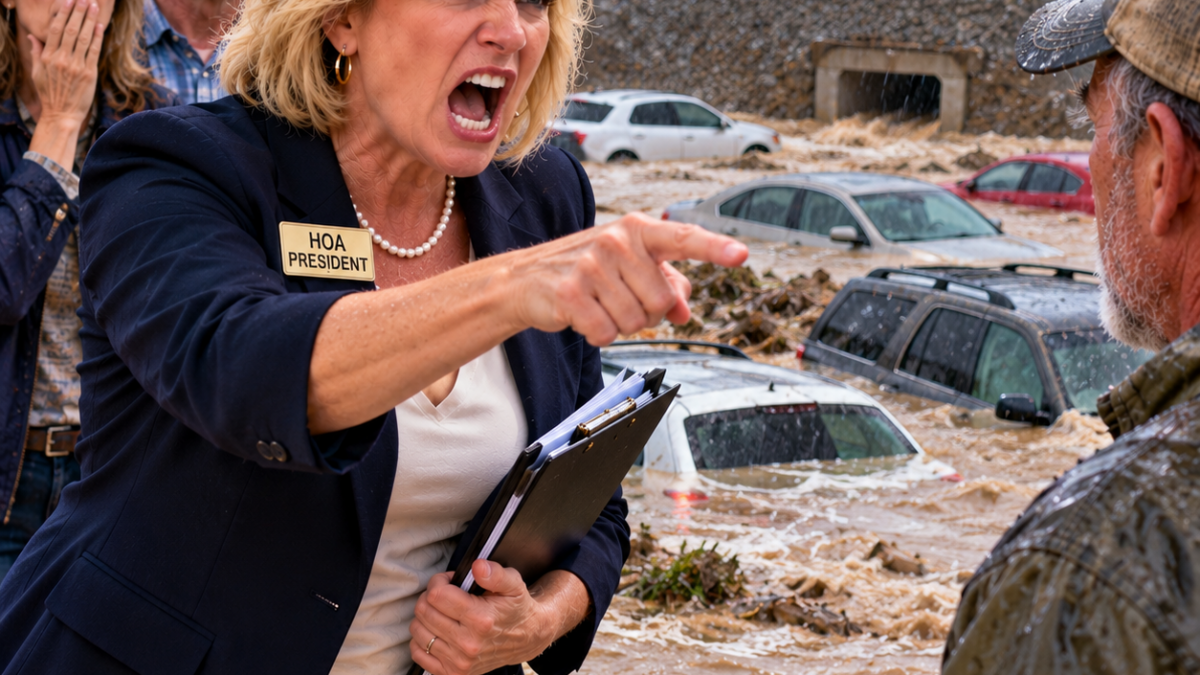
That was when Diane arrived.
Not with boots.
Not with a shovel.
With her phone.
She pushed past two residents and pointed at me.
“Arrest him.”
The deputy nearest her looked confused.
“What?”
“He closed the floodgate.”
I stared at her.
“What floodgate?”
She shoved her phone toward him.
Video.
Fourteen seconds.
It showed me beside my farm gate earlier that evening.
Closing it after a delivery truck passed.
Because of the camera angle, the drainage channel lay below the frame.
You could not see the river.
Could not see the parking lot.
Could not see the channel.
Just me.
A steel gate.
Rain.
Diane spoke loudly enough for everyone around us.
“He wanted money. We refused. Now look.”
The deputy replayed the clip.
Then looked at me.
“Mr. Hale, when was this recorded?”
His radio interrupted.
Water entering another basement.
He left to respond.
When he returned, I explained.
“That gate controls the farm service lane. It does not cross the channel.”
“You have recordings?”
“Yes.”
“Survey?”
“Yes.”
“Construction correspondence?”
“Yes.”
“Preserve everything.”
“I already have.”
He turned to Diane.
“You preserve the original video too.”
“Are you arresting him?”
“No.”
“He deliberately obstructed drainage.”
“I’m documenting your allegation.”
The rescue commander called for the lane.
The deputy pointed toward me.
“Keep that access open.”
That was the entire exchange.
No dramatic announcement.
No deputy standing on a truck declaring me innocent.
No crowd suddenly apologizing.
Diane’s video spread faster than the truth.
Before midnight, residents were sharing it.
Caption:
**PROOF OWEN HALE CLOSED THE FLOODGATE AFTER HOA REFUSED HIS MONEY DEMANDS**
Rachel showed me the messages.
One homeowner wrote:
**My basement is filling because this man wanted leverage. Make him pay.**
I recognized the name.
I had knocked on his door that morning.
A firefighter called me.
“We need another vehicle through your lane.”
I put the phone away.
The internet could wait.
The driver couldn’t.
Rain eased after midnight.
The water did not disappear.
Thirty-one vehicles had remained when the storm started.
Several stood in water up to their windows.
Smaller cars were nearly submerged.
Mud filled garages.
Basements.
Storage rooms.
The workshop floor on my farm was covered in silt.
My portable pump was ruined.
Floor jack full of muddy water.
A drawer of precision tools sat underwater.
My house remained dry.
At first light, I photographed everything.
Then called Ben.
“They think I caused it.”
“Don’t argue online.”
“Diane posted the gate video.”
“Send me the original recordings.”
“She’s telling everyone I closed a floodgate.”
“Do not chase every lie.”
“Easy for you to say.”
“It isn’t. But investigators can verify geography.”
I looked toward the submerged lot.
“People don’t care about geography right now.”
“They will.”
That morning, I turned over the camera files.
County staff documented the service gate.
Channel.
Parking fill.
Downstream outlet.
They synchronized time references.
Preserved the relevant footage.
The gate was physically obvious in daylight.
It sat beside and above the drainage course.
It did not dam anything.
But a daytime photograph of a boring farm gate never traveled through the neighborhood as quickly as Diane’s fourteen-second accusation.
That afternoon, I went to buy cleaning supplies.
A Brier Glen resident approached me near the hardware-store entrance.
“Your lawyer tell you to open the gate after the flood?”
“No.”
“That’s what people are saying.”
“The gate was never across the drainage channel.”
“Then why did Diane have video?”
“Because farm gates open and close.”
He shook his head.
“That sounds like something a lawyer told you to say.”
I bought bleach.
Gloves.
Oil.
Brushes.
Then went home and cleaned mud from tools.
You learn a lot about anger while washing silt out of a wrench someone accused you of using to flood their home.
Rachel’s basement took water too.
Not catastrophic.
Enough to ruin drywall and storage.
She missed work helping with cleanup.
Still, she came down to check on me.
“The board secretary found the email.”
“What email?”
“The full proposal.”
I stopped scrubbing.
“The six-page one?”
“Yes.”
“She wants investigators to have it.”
“Good.”
“She wants residents to see it at the meeting.”
I looked at her.
“What exactly does the email say?”
Rachel glanced toward the parking lot.
“Diane isn’t going to be able to call page five an oversight.”
Ben spent the next few weeks doing something much less dramatic than arguing on social media.
He organized evidence.
Not chronologically at first.
By question.
**WHO OWNED THE LAND?**
Recorded deed.
Subdivision plat.
Luis’s survey.
Boundary monuments.
Photographs of removed stake.
**WHAT WAS AUTHORIZED?**
County driveway permit.
No channel authorization.
No parking authorization on my parcel.
No drainage design approval.
**WHAT WARNINGS EXISTED?**
Demand letter.
Survey.
Wednesday pooling photographs.
Beth’s inspection.
Stop-work direction.
Heavy-rain warning.
Vehicle-removal request.
**WHAT CAUSED THE FLOOD?**
Camera footage.
Inlet blockage.
Outlet footage.
Rain data.
Engineering reconstruction later.
**DID I CLOSE A FLOODGATE?**
Wide-angle service-lane recording.
Survey geometry.
Rescue-crew use of lane.
Deputy follow-up.
One afternoon Ben spread the whole sequence across his conference table.
“People don’t need to trust you.”
“Comforting.”
“They don’t need to trust Diane either.”
“Better.”
“They need to be able to follow what happened.”
Three weeks after the flood, Brier Glen held an emergency membership meeting.
The regular election had been postponed because of evacuation and cleanup.
Now residents wanted documents before anyone voted.
The clubhouse was full.
Some people still wouldn’t look at me.
Others nodded.
Diane sat at the front beneath the same campaign photograph that promised she would deliver the parking lot before the election.
She began with the storm.
“No board could have predicted the severity of this event.”
Rachel stood from the second row.
“Then why did county staff warn us before it arrived?”
Diane kept her expression controlled.
“Preliminary concerns were under review. There are also unresolved questions about interference by the adjoining property owner.”
Several heads turned toward me.
Ben stood.
“We have provided the relevant recordings to investigators. With the membership’s permission, I can show the same materials here.”
People in the back called:
“Show it.”
“Play everything.”
Diane objected.
“This is pending litigation.”
The treasurer looked at her.
“These are association records and evidence already provided to county staff.”
The screen turned on.
First:
Diane’s fourteen-second clip.
People recognized it.
Me.
Gate.
Rain.
Then Ben played the wider camera angle.
My service lane.
The bank.
The channel below.
The parking fill farther east.
Water already pooling behind it.
The gate nowhere near the channel.
Then the next segment.
Me securing the same gate open against the fence.
Rescue truck coming through.
Rachel supporting Mrs. Porter.
Me carrying the oxygen cylinder.
A resident near the screen leaned forward.
“That gate isn’t across the drainage.”
“No,” Ben said.
“Then what did he close?”
“His farm road.”
Diane interrupted.
“In an emergency, closing any access point can complicate drainage and response.”
Rachel turned.
“You called it the floodgate.”
“I was working from information available at the time.”
“You wrote the caption.”
Silence.
Ben showed the downstream camera.
Water continued moving toward the river south of the obstruction.
Meanwhile, upstream water climbed.
Then county photographs.
Gate.
Channel.
Outlet.
Same survey.
The deputy’s written follow-up stated investigators found no flood-control gate at the location Diane identified.
That did not by itself prove exactly how much the parking fill worsened flooding.
Engineering would determine that.
But it destroyed her accusation that I had shut a drainage structure.
Diane said:
“The video was circulated during an extremely confusing emergency.”
Rachel stared at her.
“You weren’t confused when you typed ‘He wanted money. We refused.’”
Several residents murmured.
Ben moved on.
County approval.
He put the sheet Diane had waved at me six days before the flood on the screen.
The permit number.
Approved work.
Driveway connection inside Brier Glen.
Then the approved drawing.
It ended at the subdivision boundary.
Nothing on my parcel.
Nothing about forty-eight spaces.
Nothing about burying the channel.
Nothing about two eighteen-inch pipes.
Then Luis’s survey.
Bright line.
Parking lot crossing it.
“Did Brier Glen have a recorded easement allowing construction on Mr. Hale’s property?”
“No,” Diane said.
“Did you obtain a lease?”
“We attempted a compromise.”
“What compromise?”
“An annual payment.”
Rachel stood again.
“Then why tell us Owen was demanding money?”
Diane looked toward her.
“He rejected compensation and imposed conditions.”
“He refused the money you offered.”
“He demanded expensive engineering.”
“I demanded the engineering your contractor required.”
Ben put the six-page proposal on screen.
Page five enlarged.
**CONFIRM LANDOWNER AUTHORIZATION.**
**OBTAIN DRAINAGE EVALUATION.**
**SECURE APPLICABLE APPROVALS.**
A few residents began talking at once.
The board secretary raised her hand.
“I have the original email chain.”
The room quieted.
She read the email that accompanied Wes’s full proposal.
Then Diane’s reply.
**Distribute the two-page summary. The remaining items can be resolved during construction.**
The date was before residents voted.
Diane said:
“That referred to administrative details.”
The secretary looked at her.
“Landowner authorization was an administrative detail?”
No answer.
“A drainage evaluation was an administrative detail?”
Diane adjusted papers.
“The board relied on the contractor’s expertise.”
Wes sat near the back with his lawyer.
His lawyer stood.
“My client’s written proposal expressly identified drainage evaluation as a condition preceding construction.”
Every head turned.
Diane’s face went pale.
That was when the room understood page five.
Residents had voted on two pages saying the engineering questions were handled.
The contractor’s actual proposal said the opposite.
The treasurer put our warning letter on the screen.
Then the survey.
Then the photographs from Wednesday’s tiny rain event.
Then Beth’s county inspection notice.
All existed before Diane opened the lot Friday.
A man in the second row stood slowly.
His sedan had spent most of the flood underwater.
He looked at Diane.
“When you told us Friday the lot was safe to use, did you already have all of these?”
Diane began:
“The concerns were being reviewed—”
“That wasn’t my question.”
He pointed at the screen.
“Did you have them?”
Diane glanced toward the treasurer.
The treasurer answered.
“Yes.”
The man sat down.
Rachel walked to the front.
She placed two photographs on the table.
First:
Wednesday’s small brown pool at the pipe inlet.
Second:
Her basement after the flood.
“We watched the warning happen.”
Her voice cracked slightly.
“You told us it was fixed.”
Diane tried to end discussion.
“We need to address certain matters with counsel privately.”
Nobody moved.
The membership eventually initiated a replacement election under Brier Glen’s governing procedures.
Diane lost.
Not by one vote.
Not narrowly.
Residents had stopped arguing over whether the storm was severe.
Everyone agreed it was.
They were voting on whether leadership had told them the truth before it arrived.
The new board released the complete project file.
Cooperated with county investigators.
Cooperated with insurance carriers.
Cooperated with the engineers performing the flood reconstruction.
That engineering report took time.
Survey crews measured water marks.
Rainfall records were reviewed.
Catchment area.
Slopes.
Surface conditions.
Channel geometry.
Pipe capacity.
Inlet losses.
Debris.
Retaining fill.
Observed elevations.
Engineers reconstructed the storm.
Their conclusion was careful.
The rainfall was severe.
It supplied the water.
But the parking fill and restrictive pipe arrangement materially caused upstream impoundment.
The original open channel would have carried the reconstructed runoff at substantially lower upstream water levels.
In simpler language:
I didn’t create the rain.
The parking lot gave it nowhere to go.
That finding did not make every insurance claim simple.
Cars had different policies.
Homes had different coverage.
Flood exclusions.
Deductibles.
Association liability.
Contractor liability.
People spent months arguing over money.
Some owners received insurance payments quickly.
Others pursued uncovered losses.
Some were angry at the HOA.
Some at the contractor.
A few stayed angry with me even after the gate accusation collapsed.
That last part bothered me more than I expected.
You can show someone a survey, a video, and an engineering report.
Sometimes resentment survives because admitting you blamed the wrong person costs pride.
I stopped trying to change every mind.
My claim took months too.
Ben did not ask for a fantasy number.
We documented.
Survey cost.
Attorney fees where recoverable.
Damage to my workshop.
Pump.
Floor jack.
Precision tools.
Erosion.
Unauthorized land occupation.
Restoration.
Removal of pavement.
Channel reconstruction.
Boundary acknowledgement.
The settlement required Brier Glen to remove the unauthorized parking area from my parcel.
Professionally restore the drainage course.
Repair my documented losses.
Reimburse specified costs.
Record acknowledgement of the property boundary.
Most importantly, the restoration was engineered.
Nobody arrived with a backhoe and guessed.
The first morning demolition began, I stood beside Luis.
The operator broke the pavement at the northern edge.
Chunk by chunk.
Asphalt went into trucks.
Then gravel.
Fill.
When the machine reached Luis’s marked boundary, the operator stopped.
He shut down.
Climbed out.
Waited for the supervising engineer to confirm the line.
I looked at Luis.
He smiled.
“Different crew.”
“Different board.”
“Different instructions.”
Months earlier, another machine had buried a survey stake because it was in the way.
This operator refused to move one bucket until the boundary was checked.
That difference meant more to me than an apology.
They removed the two eighteen-inch pipes.
Excavated fill.
Reestablished the broad channel section.
Stabilized banks.
Installed erosion-control material.
Verified the downstream outlet.
Brier Glen created replacement parking entirely within its own property.
Fewer spaces.
Better grading.
Proper drainage.
Nobody’s yard stolen.
Nobody’s flood path buried.
Rachel came down during the first steady rain after restoration.
Not a storm.
Just several hours of October rain.
We stood beneath umbrellas near the bank.
Water came off the hills.
Entered the channel.
Spread across the broad bottom.
A small branch floated downstream.
For a second it turned sideways.
Then rotated.
Passed.
No narrow pipe entrance.
No debris dam.
The water continued toward the river.
Rachel watched it.
Her basement windows remained dry.
“That’s it?”
“What?”
“It just goes through.”
“That’s the idea.”
She looked at me.
“Why did you keep helping us?”
I knew what she meant.
During the flood.
Mrs. Porter.
The rescue lane.
Families.
People who had believed Diane.
“Your neighbors didn’t bury my channel.”
“Some of them accused you.”
“They were scared.”
“Some never apologized.”
“I know.”
Rachel watched another branch move downstream.
“Doesn’t that make you angry?”
“Of course.”
“Then why help?”
“Because being angry at somebody doesn’t make drowning them reasonable.”
She laughed once.
Then grew quiet.
“My basement was full of water because of a project I voted for.”
“You voted for the project they described.”
“I should have asked for the other pages.”
“You did ask.”
“Too late.”
“Not too late to matter.”
She looked toward her row of houses.
My father’s old notebook came back to me.
**Keep the water below these porches.**
For decades, nobody celebrated that channel.
No ribbon cutting.
No campaign photograph.
No forty-eight painted spaces.
Just grass.
Mud.
Occasional cleanup.
It protected people precisely by staying empty enough to hold water when the hills sent it.
That is difficult to sell politically.
People love visible improvements.
A new clubhouse.
Parking.
Pool.
Signs.
Drainage usually looks like unused land until the day everyone wants it back.
My workshop roof was finally repaired.
The settlement replaced damaged equipment.
I cleaned and saved some of the old tools anyway.
The floor jack never worked right again.
I kept it for a while out of stubbornness, then threw it out.
Behind my father’s maintenance map, I placed the engineered restoration drawings.
On his old sketch of the three porches, I wrote the date the channel reopened.
The following spring, I cleared branches.
Rachel arrived wearing work gloves.
“Did I invite you?”
“No.”
“Then why are you here?”
“Community service.”
“Court ordered?”
She smiled.
“Self-imposed.”
Two more Brier Glen residents came down.
Then four.
The man whose sedan had gone underwater showed up with a chainsaw.
He looked embarrassed.
“Where do you want this?”
I pointed at a fallen limb.
“Cut it small enough one person can move it.”
He started the saw.
After an hour, he shut it down.
“I owe you something.”
“You owe me nothing.”
“I wrote that post.”
I remembered.
*Make him pay.*
“I know.”
“I deleted it.”
“Water probably didn’t notice.”
He laughed nervously.
“I’m serious.”
“So am I.”
He looked toward the restored channel.
“I thought Diane had proof.”
“She had fourteen seconds.”
“I didn’t ask what happened in the fifteen seconds before it.”
“Most people don’t.”
He looked down.
“I’m sorry.”
“Thank you.”
No speech.
No dramatic handshake.
We went back to moving branches.
That was enough.
Diane did not disappear into some cinematic punishment.
She lost the presidency.
That mattered.
The complete file became part of the association record.
The engineering report became part of insurance and civil proceedings.
Claims followed their own paths.
Her decisions were examined in those processes.
I did not spend my retirement tracking every consequence.
There is a point where accountability stops being your job.
The channel was restored.
My boundary was recorded clearly.
My workshop repaired.
Those were my responsibilities.
One afternoon, months later, Diane drove past while I was replacing a fence board.
She slowed.
Then stopped.
I expected an argument.
She rolled down her window.
“You got what you wanted.”
I set down the drill.
“What did I want?”
“The lot is gone.”
“The channel is back.”
“Same thing.”
“No.”
She looked toward the houses.
“Do you know how much the association spent because you refused to compromise?”
I stared at her.
“You offered me money to sign a document saying I approved work that was already underway.”
“You could have prevented litigation.”
“You could have stopped the excavator.”
Her jaw tightened.
“Residents wanted parking.”
“Residents wanted safe parking.”
She looked away.
“You enjoyed making me look dishonest.”
That surprised me.
“No.”
“You brought everything into that meeting.”
“Your board did.”
“You knew what would happen.”
“I knew people would see the documents.”
“That’s the same thing.”
“No, Diane.”
I stepped closer to the fence.
“You made yourself look dishonest when you cut page five out of what residents saw.”
She stared straight ahead.
“The project would never have passed if we waited for every condition.”
“That was the point of the conditions.”
Silence.
Then she said something I had not expected.
“I thought we could fix the engineering after it was open.”
There it was.
The logic behind everything.
Open first.
Fix later.
Promises first.
Verification later.
Parking stripes first.
Drainage calculation later.
Rain doesn’t respect that sequence.
I said:
“You can change a campaign deadline.”
She looked toward me.
“You can move an election.”
Then toward the channel.
“You can’t renegotiate with runoff after it starts.”
She drove away.
That was the last real conversation we had.
Brier Glen eventually added parking farther uphill.
Thirty-two spaces instead of forty-eight.
A little farther from the clubhouse.
Residents complained for a few months.
Then they adapted.
People do.
That became another lesson.
Urgent promises often stop being urgent after somebody survives the deadline.
Diane had treated Friday’s opening like the neighborhood could not continue without it.
Years later, nobody talks about losing sixteen spaces.
They remember the cars underwater.
The new board changed project procedures.
Full contractor proposals went to members for major capital votes.
No summaries with omitted conditions.
Independent survey verification for projects near outside parcels.
Drainage review required before work in mapped flow paths.
County approvals verified directly with the issuing department.
Not from a photocopy on a construction table.
Rachel joined the drainage committee.
I teased her about it.
“You voted for one parking lot and got a second career.”
“Better hours than nursing.”
“That’s a lie.”
“Much less blood.”
“Usually.”
During the next heavy storm, she texted me.
**Channel moving well.**
I walked down anyway.
Old habits.
Water filled maybe a third of the available depth.
Moved fast.
Branches.
Leaves.
Foam.
Then south.
Exactly where it belonged.
The Brier Glen low row stayed dry.
Rachel stood on her porch with coffee.
She raised the cup when she saw me.
No emergency vehicles.
No floating cars.
No accusations.
No social-media clips.
Just water passing through empty space.
I thought of how difficult it had been to convince anyone that empty space had value.
The parking lot had looked useful every day.
The channel looked useful maybe five days a year.
But those five days were the reason the land had been left open in the first place.
My father understood that.
He had never called himself an engineer.
He simply watched.
Storm after storm.
Where water entered.
Where it slowed.
Where branches collected.
He cleared the channel because three porches depended on it.
I had spent my career using computer models and rainfall curves to formalize what men like him had learned by paying attention.
Water has no political preference.
No awareness of HOA elections.
It does not care who promised forty-eight spaces.
It does not care whether a project summary is two pages or six.
It follows elevation.
Capacity.
Resistance.
Gravity.
That honesty is why I liked working with it.
People are harder.
The following spring, I found one of the original boundary stakes during cleanup.
Bent.
Orange cap missing.
The stake Diane told Luis to move because cars might hit it.
It had been buried under stone.
I cleaned it.
Straightened it as much as I could.
Then mounted it inside my workshop beside a copy of page five.
I didn’t keep Diane’s fourteen-second video.
That clip had already received enough attention.
Instead, I framed the page residents had never been shown.
Three conditions.
Landowner authorization.
Drainage evaluation.
Applicable approvals.
Underneath, I added one line from my father’s notebook:
**KEEP THE WATER BELOW THESE PORCHES.**
Visitors sometimes ask why I keep those together.
Because one represented modern procedure.
The other represented old experience.
They said the same thing in different language.
Think before you block the water.
A few years later, Mrs. Porter died peacefully at ninety-one.
Rachel called me after the funeral.
Her daughter had found something while clearing the house.
A photograph taken the morning after the flood.
Mrs. Porter sat inside the rescue truck.
Oxygen tubing under her nose.
Cat carrier on her lap.
Behind her, through the open vehicle door, I was visible carrying somebody else’s bag up the lane.
On the back Mrs. Porter had written:
**Owen helped us after they said he caused it.**
I sat at my kitchen table holding that photograph longer than I expected.
Rachel asked:
“Do you want it?”
“Yes.”
I put it in the workshop.
Not beside the survey.
Not beside page five.
Beside my father’s notebook.
That photograph mattered differently.
Engineering reports proved the parking fill caused upstream impoundment.
Videos proved my gate did not block the channel.
The survey proved ownership.
But Mrs. Porter’s handwriting reminded me who I wanted to be while all of those arguments were happening.
It is easy to defend a principle when doing so costs only the other side.
It gets harder when the people affected include neighbors who believed something false about you.
I could have closed my farm lane.
Legally, I probably had several arguments for limiting access that night.
I didn’t.
Because emergency crews needed firm ground.
That choice did not make the HOA right.
Helping Brier Glen did not surrender my property.
Those things can coexist.
You can protect your boundary and still open a gate for a rescue truck.
You can fight the board and still carry a neighbor’s oxygen cylinder.
You can demand accountability without hoping families lose everything.
People often mistake restraint for weakness.
Diane did.
She interpreted every attempt to resolve the dispute carefully as evidence that I would eventually sign whatever paper made her project legal after the fact.
She was wrong.
I wasn’t trying to destroy Brier Glen.
That was precisely why I kept telling them not to bury the channel.
One Sunday afternoon, years after the flood, I walked the entire restored drainage route.
From the upper inlet near Rachel’s row.
Past the place where forty-eight cars once stood.
Along my boundary.
Down to the river.
The grass had grown thick again.
Unless you knew the history, nothing looked dramatic.
A broad depression.
Wildflowers.
A little exposed stone.
At the old parking location, I could still find tiny pieces of asphalt mixed into the soil.
Evidence of something that no longer belonged there.
The subdivision sat uphill.
Children played in a backyard.
Someone grilled near the clubhouse.
Cars were parked in the new lot.
Farther away.
Inside the boundary.
Nobody looked inconvenienced.
I stopped where the original inlet had been.
That was where Wednesday’s little pool first formed.
Where Rachel and I watched brown water creep toward fresh paint.
That small pool had been the warning.
Nothing spectacular.
No submerged vehicles.
No rescue crews.
No basements filling.
Just water saying:
*I cannot get through fast enough.*
Wes saw it.
I saw it.
Rachel saw it.
Diane saw it.
Then the project opened anyway.
That might be the most important part of the story.
Disasters usually send small warnings first.
A puddle.
A missing document.
A survey stake in the wrong place.
A condition on page five.
A county engineer asking for calculations nobody has.
The warning rarely looks dramatic enough to compete with a ribbon cutting.
That is why people ignore it.
On the anniversary of the flood, Rachel came to my workshop.
She carried coffee.
“Going down to clear the channel?”
“Tomorrow.”
“Why not today?”
“Because I’m sixty-four now and I make my own schedule.”
She handed me a cup.
“You were fifty-nine when this started.”
“Thank you for reminding me.”
“Five years.”
“Seems longer.”
She looked at the framed page five.
“Diane’s clip still exists online somewhere.”
“Probably.”
“Does that bother you?”
“Not anymore.”
“Why?”
I pointed to the restoration drawing.
Then the survey.
Then Mrs. Porter’s photograph.
“Because the longer record exists too.”
She smiled.
“The full record gets its turn.”
“Eventually.”
We sat in the workshop doorway.
The new roof no longer leaked.
Outside, clouds were building over the hills.
Nothing severe.
Ordinary summer storm.
A few minutes later, rain started.
We could hear it on the metal roof.
I looked toward the channel.
Rachel noticed.
“You’re going to check it.”
“Yes.”
“You know it works.”
“Yes.”
“So why?”
“Because water doesn’t read engineering reports.”
She laughed.
We walked down anyway.
Runoff arrived.
Spread into the restored channel.
Moved past us.
South.
Toward the river.
No pavement.
No eighteen-inch choke points.
No floating cars.
No campaign signs.
Just gravity doing exactly what it had always intended to do.
Rachel stood beside me in the rain.
“I used to look at this and see wasted land.”
“And now?”
“A place for water.”
That may have been the best summary anyone ever gave it.
I looked toward her row.
Dry basement windows.
Then toward the river.
My father had understood.
The channel didn’t need to look useful every day.
It needed to be available on the day nothing else could replace it.
The rain strengthened.
Water rose a few inches.
Then continued downstream.
Exactly where it belonged.
And after years of lawsuits, meetings, insurance claims, accusations, engineering reports, ruined cars, muddy tools, and one fourteen-second video that almost turned an entire neighborhood against me, the truth was still simpler than Diane had ever allowed it to be.
She buried a flood channel because she wanted forty-eight parking spaces before an election.
Then when the water returned to reclaim the space it had always used, she blamed the man who had warned her.
The cars went under.
The lie lasted a few weeks.
The channel came back.
And this time, nobody buried page five.
[END OF STORY]








