PART 2: HOA Bulldozed My Mountain Home Over $7,000 in “Fines”—They Had No Idea the Homeowner Was the Governor
PART 2
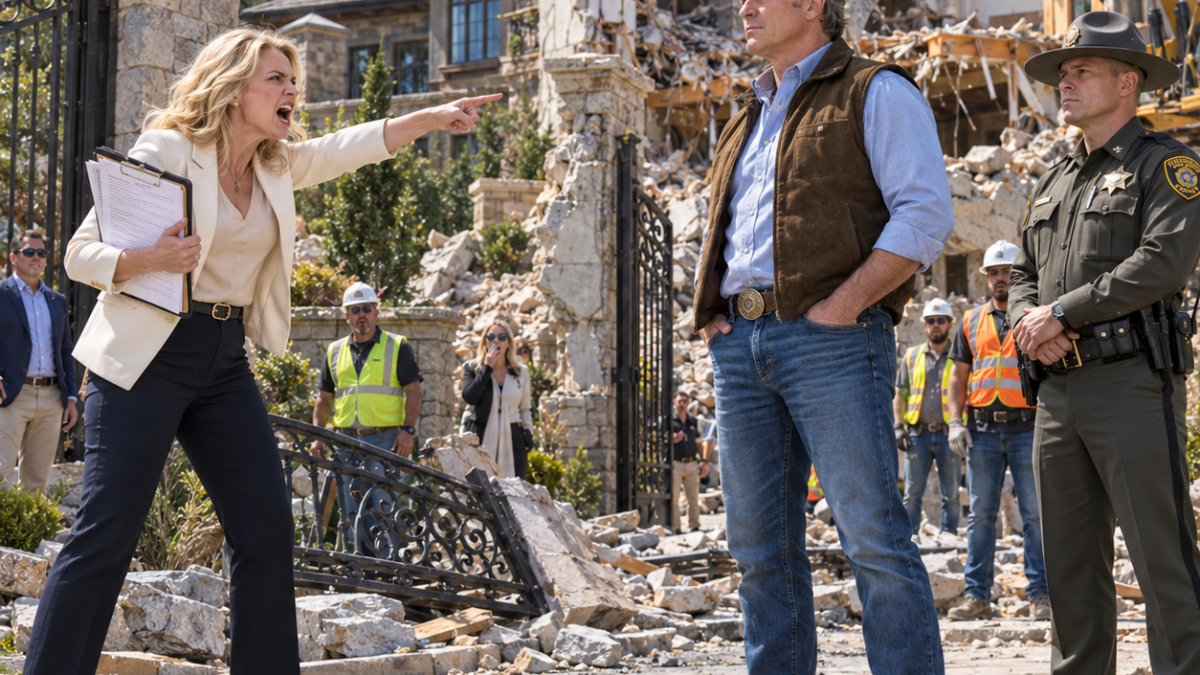
Amber didn’t turn around immediately.
That told me more than an argument would have.
She kept one hand on the Lexus door and stared through the windshield as if some answer might appear on the dashboard.
Finally she looked over her shoulder.
“I don’t know what you’re holding.”
“You were just standing ten feet away when I picked it up.”
“Then perhaps you should ask the contractor.”
“I asked you.”
“I don’t prepare permits.”
“Who does?”
“The association retains vendors for compliance work.”
“Name one.”
Her jaw flexed.
“Benjamin, I’m not doing an interrogation in the middle of the road.”
“Then answer one question and I’ll stop.”
She stared at me.
“Did you know the demolition company told the county this was an accessory structure?”
“No.”
Too fast.
I held her eyes.
She added, “Not that I recall.”
There it was.
The correction people make when they realize their first answer might be tested later.
I folded the orange paper carefully and slipped it into my jacket pocket.
Amber opened the driver’s door.
“Talk to counsel.”
“I will.”
“Good.”
“And the sheriff.”
Her hand stopped.
For maybe half a second, the color left her face.
Then she laughed.
“Over HOA enforcement?”
“Over somebody destroying a house using paperwork that appears to describe a shed.”
“The sheriff has better things to do.”
“We’ll let him decide.”
She climbed into the Lexus.
Before closing the door, she leaned toward me.
“You really should learn when to let things go.”
Then she drove away.
I stood in the road watching white taillights disappear between the pines.
That sentence stayed with me.
Not because it frightened me.
Because it sounded less like arrogance than warning.
My phone had been vibrating in my pocket for several minutes.
I finally looked.
Six missed calls.
Two from my chief of staff.
One from state security.
Three from my sister, Elaine.
I called my chief of staff first.
Martin Hale answered before the first full ring.
“Tell me you’re alive.”
“I’m alive.”
“Your protective detail lost contact when you went through the pass.”
“I told them I was taking the weekend off.”
“You told them you wanted distance. You did not tell them to ignore protocol.”
“I know.”
“Where are you?”
I looked at the wreckage.
“My house.”
A pause.
“What happened?”
“It’s gone.”
Another pause.
Longer.
“What does ‘gone’ mean?”
“Bulldozed.”
Martin didn’t say anything.
I heard papers moving at the other end.
Then his voice changed into the tone he used during emergencies.
“Was there a fire?”
“No.”
“Storm?”
“No.”
“Gas explosion?”
“No.”
“Benjamin.”
“The HOA demolished it.”
Silence.
Then:
“The homeowners association demolished the governor’s residence?”
“Private residence. Don’t say it like that.”
“How would you like me to say it?”
“They apparently classified it as an accessory storage structure and hired somebody to level it over unpaid fines.”
Martin swore.
He almost never swore.
“Do not call anybody from a state agency.”
“I was about to call the sheriff.”
“County sheriff?”
“Yes.”
“Fine. Private citizen reporting suspected property destruction. Do that.”
“I know.”
“And do not call the attorney general yourself.”
“I wasn’t going to.”
“You were thinking about it.”
“I was.”
“Don’t.”
I rubbed my forehead.
“Martin, somebody demolished my house.”
“And you’re still governor.”
That landed.
He continued.
“If any investigation touches an organization in your own neighborhood, you recuse immediately from executive involvement. No calls to regulators. No favors. No one gets to claim you used state power to settle a personal feud.”
“I know the ethics rules.”
“Then act like you wrote them.”
I looked at the broken fireplace.
“You always this comforting?”
“That’s why you pay me.”
“My salary pays you.”
“The taxpayers pay both of us. Which is another reason you don’t touch this.”
He was right.
I hated that he was right.
“I’ll contact outside counsel.”
“Good.”
“And the sheriff.”
“Good.”
“Can I be angry?”
“As a citizen? Extremely.”
“Generous.”
“Benjamin.”
“Yeah?”
“Get out of the rubble until somebody confirms it’s safe.”
I looked down.
There were exposed nails everywhere.
Broken utility lines had been capped near the foundation.
The ground smelled of diesel, sawdust, and something sharper I couldn’t identify.
“I’ll call you later.”
“Your detail is ten minutes away.”
“I don’t need—”
“Not negotiable.”
He hung up.
I called Sheriff Rick Callahan.
Rick and I had known each other before I entered politics.
He was the kind of county sheriff who still answered his own phone unless he was physically wrestling someone.
“Callahan.”
“Rick.”
“Governor.”
“Benjamin today.”
“That usually means trouble.”
“I need you at Silver Ridge.”
“What happened?”
“Somebody demolished my house.”
Silence.
Then a chair scraped.
“Say that again.”
“House is gone.”
“Fire?”
“No.”
“Who demolished it?”
“The HOA says they did.”
Rick was quiet for two seconds.
“I’ll be there in twenty.”
He arrived in fourteen.
No lights.
No siren.
Just a dusty county SUV that pulled beside my Bronco.
He climbed out wearing khaki uniform pants and a heavy jacket.
His first reaction was exactly what mine had been.
He stopped.
Looked at the foundation.
Looked at me.
Looked back.
“That’s not a house.”
“Excellent police work.”
He ignored me.
“I mean there isn’t a damn house.”
“I noticed.”
Rick stepped carefully onto the lot.
“What happened?”
I handed him the permit fragment.
He read it.
“Accessory storage building.”
“That was apparently me.”
“Cute.”
He crouched beside the foundation and looked toward the road.
“Anyone move anything since you arrived?”
“I picked up that paper and one picture frame.”
“Anybody else?”
“Amber Bellington was here.”
“HOA president.”
“You know her?”
“Everybody knows Amber.”
“That sounded enthusiastic.”
Rick stood.
“She once filed a complaint because one of my patrol units idled too long near the pool entrance.”
“That tracks.”
“Did she admit they ordered demolition?”
“Yes.”
“Record it?”
“No.”
“Witness?”
“No.”
He grimaced.
“Don’t worry. We’ll get documents.”
I pointed to what remained of the stone fireplace.
“My belongings were inside.”
“How much?”
“Furniture, clothes, some personal records.”
“Anything irreplaceable?”
The question hit harder than I expected.
I looked down at the broken photograph still in my hand.
“My father’s stuff.”
Rick’s expression softened.
“I’m sorry.”
My father had died twelve years earlier.
He’d never been impressed by political office.
When I won my first statewide election, he called and said, “Congratulations. Your mother wants to know whether you still plan to fix her porch rail.”
The Silver Ridge house had been the last major thing we built together.
I designed most of it.
He helped with the wraparound porch and the stone fireplace.
We argued about every measurement.
Every railing angle.
Every piece of reclaimed timber.
He complained that I used too many screws.
I told him he was too cheap to buy enough.
After he died, I kept his old framing square hanging above the workbench in the garage.
Now the garage was under six feet of debris.
Rick watched me staring.
“Benjamin.”
“Yeah?”
“Don’t start digging yourself.”
“I wasn’t.”
“You absolutely were.”
I stepped back.
He called the county building department from the scene.
That conversation became interesting quickly.
Rick put it on speaker.
County inspector Melissa Grant answered.
“Building services.”
“Melissa, Callahan. Did your office approve a demolition at Lot 17, Silver Ridge?”
Keyboard clicks.
“Give me a second.”
More clicking.
“Lot 17… I have a removal authorization for an accessory structure.”
“What kind?”
“Storage outbuilding. Unoccupied. Under nine hundred square feet.”
Rick looked at me.
My house had been more than four thousand square feet.
“Applicant?”
“Silver Ridge Community Association through a contractor.”
“Contractor name?”
More keyboard clicks.
“Mountain Crest Site Services.”
Rick wrote it down.
“Inspection before demolition?”
“No.”
“Why not?”
“For detached non-residential structures under a certain category, photographic certification can qualify.”
“Who provided photos?”
“Contractor.”
“Can you send the application package?”
There was a pause.
“Sheriff, is there an issue?”
Rick looked at my foundation.
“Melissa, the ‘outbuilding’ was an occupied three-bedroom residence.”
Silence.
“What?”
“Primary residence.”
“That can’t be right.”
“I’m standing where it used to be.”
I heard her breathing.
Then:
“Don’t touch anything. I’m locking the file right now.”
Rick almost smiled.
“I wasn’t planning to edit county records.”
“You know what I mean.”
“Send it to my office and preserve the submission metadata.”
“I will.”
She disconnected.
Rick slid his phone into his pocket.
“Well.”
“Still think it’s an HOA argument?”
“No.”
The next person I called was my private attorney, Nora Whitcomb.
Nora specialized in property litigation before eventually becoming the person who told me “no” more often than my own cabinet did.
She drove up from the city that evening.
By then county deputies had placed temporary evidence tape around the most disturbed areas.
A building inspector had arrived.
So had my protective detail, which meant residents were beginning to realize the quiet bearded man at Lot 17 might not be exactly who they thought he was.
A black state security SUV tends to ruin anonymity.
Mrs. Calder from across the road stood on her porch staring at me.
When one of the agents called me “Governor” within earshot, her coffee cup nearly slipped from her hand.
I pretended not to notice.
Nora did.
“You kept your office secret from your HOA?”
“I didn’t keep it secret.”
“They didn’t know.”
“That’s different.”
“How?”
“I didn’t introduce myself with a campaign biography.”
Nora looked at the wreckage.
“I suspect they’ll remember you now.”
We went to the lodge down the mountain because I had nowhere else to sleep.
That sentence bothered me.
Governor or not, I was homeless.
Temporarily, comfortably, with resources most people don’t have.
I knew that.
But losing a home is less about where you sleep that night than the sudden knowledge that a place containing your routines and memories has ceased to exist.
At the lodge, I sat at a small wooden table while Nora reviewed the HOA violation notices I’d saved digitally.
“You paid none of these?”
“No.”
“Why?”
“Because most weren’t valid.”
“Did you formally appeal?”
“Every one.”
She looked at me.
“You actually kept copies.”
“I used to be a prosecutor. Paper makes me happy.”
“Disturbing.”
The fines had started eighteen months earlier.
Deck extension.
Except the deck was part of the originally permitted structure.
Fence violation.
Except the section they cited predated the HOA amendment they relied on.
Exterior flag violation.
A sunflower flag I’d hung because my mother gave it to me.
Landscaping penalties.
Late fees.
Administrative review charges.
“Seven thousand isn’t even close to lien-and-demolition territory,” Nora said.
“I know.”
“Did they record a lien?”
“I searched. Nothing valid.”
“Foreclosure action?”
“No.”
“Judgment?”
“No.”
“Court order?”
“No.”
“Then they don’t have anything that comes close to legal authority to destroy a residence.”
I leaned back.
“So what’s our first move?”
“Nothing dramatic.”
“That is disappointing.”
“We send preservation letters to the HOA, every board member, the contractor, county building services and any insurer involved.”
“Then?”
“We let Rick investigate criminal conduct.”
“And civil?”
“I file tomorrow.”
“You’re enjoying this.”
“I enjoy people who create excellent evidence against themselves.”
She tapped the orange permit fragment.
“Someone called a mansion a shed.”
“Accessory storage building.”
“Even better.”
At 9:40 that night, Rick called.
“I have something.”
“What?”
“Mountain Crest Site Services isn’t what I’d call a thriving enterprise.”
“Meaning?”
“Business registration six months ago.”
“Owner?”
“A man named Joel Vance.”
I sat forward.
“Vance.”
“Yes.”
“Todd Vance is HOA treasurer.”
“Joel is his brother-in-law.”
There it was.
First connection.
Rick continued.
“Company address is a mailbox rental. No heavy-equipment registrations. No demolition license under that name.”
“Then who actually tore down the house?”
“Subcontractor.”
“Who?”
“Still finding out.”
“How was Mountain Crest paid?”
“Working on it.”
“Rick—”
“I know. Follow the money.”
He knew me too well.
“Anything else?”
“County application says debris removal and site leveling for future community landscape stabilization.”
I stared at the wall.
“Future community what?”
“Landscape stabilization.”
“My property isn’t community land.”
“I checked.”
I got up and walked to the lodge window.
Snow had started falling lightly in the parking lot.
“Why would they describe my lot as community land?”
“That is one of several questions.”
“Did they submit ownership documentation?”
“A parcel map.”
“My parcel map?”
“Looks altered.”
I closed my eyes.
“Send it to Nora.”
“Already did.”
I hung up.
Nora was in the adjoining room.
I called.
She answered, “If this is about the altered parcel map, yes.”
“You got it already?”
“Rick likes me better.”
“Everybody likes you better.”
“Correct.”
“How altered?”
“The line around Lot 17 appears redrawn to combine your home site with an HOA-controlled greenbelt strip.”
“That’s insane.”
“It’s also amateur.”
“Can it be traced?”
“The PDF metadata may help.”
I sat on the edge of the bed.
“Nora.”
“Yes?”
“This wasn’t about fines.”
“No.”
That was the first time I said it out loud.
The fines were theater.
Paper justification.
A story Amber expected everyone to accept once the building was gone.
The real question was why.
I barely slept.
At seven the next morning, Martin Hale arrived with coffee and the expression of a man prepared to prevent me from committing ethics violations before breakfast.
“I spoke with the ethics counsel,” he said.
“I didn’t ask you to.”
“You were asleep.”
“I wasn’t.”
“Then you were lying horizontally with your eyes closed.”
“Fine.”
He handed me coffee.
“Here’s the line. You may report crimes, pursue private civil remedies, cooperate as a witness, and receive normal services available to any resident.”
“Reasonable.”
“You may not direct state investigative resources involving your personal matter.”
“I know.”
“You may not instruct the attorney general to open anything.”
“I know.”
“You may not use executive orders to freeze HOA accounts.”
“I wasn’t planning to.”
Martin stared at me.
“I know that face.”
“I had briefly imagined it.”
“No.”
“That’s why I have you.”
“Your public schedule begins again Monday.”
“I want the weekend.”
“You have it.”
“And if this expands beyond my house?”
“Then the attorney general makes independent decisions. You recuse publicly.”
“Fine.”
He watched me.
“You don’t sound fine.”
“My house is a pile of lumber.”
“I know.”
“And Amber stood there like she’d removed an abandoned shed.”
“I know.”
“And somebody altered the parcel map.”
Martin’s eyes narrowed.
“That is new.”
“Yes.”
He sat down.
“Then your personal grievance may overlap with something bigger.”
“Exactly.”
“Which makes recusal more important.”
I hated him again.
By noon, Rick had enough to obtain records voluntarily from the HOA’s bank after the new interim secretary agreed to cooperate, while Nora secured a temporary civil injunction preventing the association from altering, transferring, encumbering, or disposing of anything tied to Lot 17.
No gubernatorial power.
No dramatic executive decree.
Just a judge.
Paperwork.
The rule of law.
It felt slower than anger.
It was also harder to attack later.
The HOA called an emergency board meeting that afternoon.
Closed session.
Amber apparently thought she could keep residents out.
Nora disagreed.
Silver Ridge’s governing documents required owner access for portions involving assessments, enforcement policy, and expenditure approvals unless privileged legal advice was being discussed.
The board’s attorney advised them to open the meeting.
Amber refused.
Nora filed an emergency motion.
A district judge issued a narrow order preserving homeowner inspection rights and requiring records relevant to the challenged demolition to be produced.
So by 2:15, I was sitting at the back of the pool house with twelve neighbors while Amber Bellington tried to pretend she wasn’t furious.
I wore jeans.
Windbreaker.
No suit.
No podium.
My security detail remained outside.
I wanted no one to confuse this with a campaign event.
Cheryl Evans, the secretary, kept looking at me.
She knew now.
Everybody did.
A local news station had picked up the story after a resident posted video of state security vehicles near my demolished house.
GOVERNOR’S PRIVATE MOUNTAIN HOME LEVELED IN HOA DISPUTE.
Not the headline I wanted.
Amber began the meeting by reading from prepared notes.
“The Silver Ridge Homeowners Association denies wrongdoing and maintains that all enforcement actions were taken pursuant to governing covenants and legal advice.”
Nora leaned toward me.
“Ask for the legal opinion later.”
I nodded.
Amber continued.
“Recent sensational coverage has omitted the homeowner’s repeated noncompliance.”
A resident named Hank Miller raised his hand.
“Did you tear his house down?”
Amber frowned.
“We are not taking questions yet.”
Hank crossed his arms.
“I think that’s the only question anybody has.”
A few people murmured agreement.
Amber ignored him.
I stood.
“Then I’ll make this simple.”
She looked at me.
“I’d prefer counsel speak for you.”
“I own property here. I can speak.”
“You’ve already used your political office to intimidate this board.”
Nora whispered, “Careful.”
I kept my voice flat.
“No state agency is here. No executive action has been taken. My lawyer obtained the same court process available to any property owner.”
Amber smiled thinly.
“Convenient.”
“Show me the demolition authority.”
“We have records.”
“Show them.”
“This isn’t discovery.”
“The court order requires production.”
Todd Vance shifted in his seat.
He was sweating.
I noticed immediately.
Amber did too.
She shot him a look.
I continued.
“You assessed more than seven thousand dollars in fines. Where are the certified notices?”
Cheryl looked down.
“Where is the recorded lien?”
No answer.
“Where is the foreclosure judgment?”
Silence.
“Where is the demolition permit identifying my actual residence?”
Todd rubbed the back of his neck.
Amber said, “The contractor handled permits.”
“Your contractor is Todd’s brother-in-law.”
The room changed.
Hank sat forward.
Mrs. Calder whispered, “What?”
Todd snapped, “That’s irrelevant.”
“Is it true?”
He looked at Amber.
Wrong move.
Everybody saw it.
Amber said, “Silver Ridge regularly retains local vendors.”
“Mountain Crest formed six months ago.”
Todd pushed his chair back.
“This is harassment.”
Nora stood.
“No. It is a document question under a court-ordered records inspection.”
Amber looked toward the door.
For the first time, I understood something.
She wanted to leave.
Not angry leave.
Escape leave.
Then Sheriff Callahan entered.
Two deputies behind him.
No handcuffs visible.
Rick stopped near the wall.
“I need access to the board’s financial records relating to Mountain Crest Site Services.”
Amber straightened.
“Do you have a warrant?”
Rick held up folded papers.
“Yes.”
Silence.
Todd’s chair scraped backward.
Rick looked at him.
“Don’t go anywhere yet.”
Todd sat.
Amber’s mouth opened.
Closed.
Cheryl looked between them.
“I don’t understand,” she whispered.
Rick handed the warrant to the board’s attorney.
The attorney read quickly and turned pale.
Nora nudged me.
“Watch Cheryl.”
I did.
She wasn’t pretending.
Either she was a spectacular actor or she genuinely didn’t know what was coming.
One deputy placed a bank statement on the table.
Rick pointed to a payment.
“Forty-eight thousand dollars to Mountain Crest Site Services.”
Todd said nothing.
Amber said, “Approved site remediation.”
Rick looked at me.
Then back at her.
“For demolishing Governor Powers’s residence?”
“For enforcement-related remediation.”
“Payment description says landscape leveling.”
Amber’s eyes flicked toward Todd.
Rick put down another page.
“Mountain Crest withdrew thirty-four thousand dollars in cash over four days.”
Todd swallowed.
Rick asked, “Where did it go?”
“I don’t manage their banking.”
“Your brother-in-law does.”
“So?”
“His statement says you instructed him how to invoice the HOA.”
Todd’s face drained.
Amber turned sharply.
“What statement?”
That was when Todd broke.
Not fully.
Just enough.
“You said this would be covered.”
Amber stared.
Rick didn’t say a word.
People under pressure hate silence.
Todd filled it.
“You said the legal fund would handle any complaints.”
“Stop talking,” Amber hissed.
“You told me it was already cleared.”
“I’m telling you to stop.”
Cheryl whispered, “Amber?”
Amber ignored her.
Todd stood.
“I’m not taking this by myself.”
The room became absolutely still.
He pointed at Amber.
“She filled out the disbursement request.”
Amber’s eyes widened.
“You signed it.”
“You told me it was park maintenance.”
“You knew.”
“I knew you wanted Powers’s lot cleared. I did not know you falsified a demolition application.”
Hank said, “Cleared for what?”
Nobody answered.
That question mattered.
Cleared for what?
Before Rick could ask again, Cheryl pushed a folder away from herself.
“I signed the payment authorization.”
She looked sick.
“Amber told me it was grading work on the common slope.”
Rick asked, “Did you read the invoice?”
“No.”
“Why not?”
“Because she said it was routine.”
Amber snapped, “Everyone signed. Don’t pretend you weren’t involved.”
Cheryl looked at her.
Something broke in her expression.
“I trusted you.”
Amber laughed bitterly.
“Oh, don’t be dramatic.”
Wrong thing to say.
Cheryl stood.
“No. I want my own attorney.”
She left the table.
Rick let her go after confirming how to reach her.
He then turned to Amber and Todd.
“At this stage, I’m asking both of you to come to the office for formal interviews.”
Amber folded her arms.
“Am I under arrest?”
“Not yet.”
“Then I’m leaving.”
Rick nodded.
“You can.”
She grabbed her purse.
At the door, she turned toward me.
This time no smug smile.
“You’ve ruined this community.”
I looked around at the stunned residents.
“No, Amber. I think we’re finally finding out who did.”
She walked out.
Rick did not arrest anyone that afternoon.
That was more realistic than the crowd wanted.
Evidence first.
Interviews.
Bank records.
Contracts.
Digital metadata.
The law moves slower than applause.
Three days later, it moved.
I was standing in what used to be my kitchen with a forensic team when a fire investigator named Darnell Hayes crouched beside a blackened floor beam.
“Governor.”
“Benjamin.”
He glanced up.
“Okay, Benjamin. Come look at this without stepping inside the flags.”
I walked closer.
Darnell held a small evidence vial.
“Chemical residue.”
“From equipment?”
“Don’t think so.”
“What kind?”
“Industrial solvent. Lab will confirm.”
“Why is it in my floor?”
“That is what I’m trying to figure out.”
I looked around.
Some sections of wood were darker than the demolition alone explained.
I had assumed it was oil from heavy machinery.
Darnell pointed to three areas.
“Same residue here, here, and near the garage wall.”
“Before demolition?”
“Likely.”
“Why?”
He stood.
“If someone wanted the remaining structure or debris compromised, accelerant could help. But I am not calling this attempted arson until the lab says what we have.”
“Could it have burned?”
“Yes.”
“Was there a fire?”
“Small localized scorching. Maybe ignition that didn’t fully take before equipment came through.”
I stared at him.
“They tried to burn it?”
“I said maybe.”
He gave me a hard look.
“Don’t turn my maybe into a press conference.”
“I won’t.”
“Good.”
I stepped away.
My father’s fireplace stood twenty feet away.
Half gone.
For the first time, anger stopped feeling hot.
It became precise.
Somebody had not merely hired a backhoe.
Somebody wanted the house erased.
A black sedan pulled up behind the evidence vehicles.
A woman stepped out carrying a tablet.
Navy slacks.
Dark coat.
Tortoiseshell glasses.
“Governor Powers?”
“Yes.”
“Lena Brooks. Special investigator retained by the Attorney General’s office.”
I looked toward my security agent.
He nodded.
Martin had warned me this was coming.
“I’ve filed my recusal.”
“I know.”
“Then I assume you’re not here for instructions.”
A faint smile.
“That would be a very short meeting.”
“I like you already.”
She looked at the wreckage.
“Sheriff Callahan’s financial evidence triggered a broader review.”
“How broad?”
“Silver Ridge.”
“Because of one demolition payment?”
“Because Mountain Crest wasn’t the first unusual vendor.”
She opened her tablet.
A map appeared.
Silver Ridge lots.
Some highlighted red.
“What are those?”
“Properties acquired through foreclosure, tax sale, or distress transactions in the last sixteen months.”
“There are a lot.”
“Seventeen.”
I looked closer.
“Why are they highlighted?”
“Because companies connected to HOA officers or related parties purchased eleven.”
My eyes lifted.
“What?”
“Eleven properties ended up with entities tied directly or indirectly to Amber Bellington, Todd Vance, their relatives, or a Denver consulting group.”
I took the tablet.
The pattern was obvious once you saw it.
Properties around the edge of the ridge.
Not random.
Contiguous.
Like pieces of a puzzle.
“They’re assembling land.”
“That is our working theory.”
“How?”
“In several cases, owners fell behind after aggressive fines or special assessments.”
“Foreclosures?”
“Some association liens. Some tax distress worsened by association debt. Some voluntary sales under pressure.”
“How much money moved through the HOA?”
“We’ve identified roughly a quarter million dollars in questionable transfers so far.”
I handed back the tablet.
“For personal use?”
“Some.”
“What else?”
“Acquisition costs.”
I stared across the valley.
Silver Ridge had some of the best undeveloped mountain frontage in the region.
Developers had been sniffing around for years.
Residents always resisted.
Too steep.
Too much traffic.
Too much forest removal.
The HOA publicly opposed every proposal.
“What developer?”
Lena turned the screen.
Kepler Ridge Development Partners.
I knew the name.
Byron Kepler.
Private equity money.
High-end resort projects.
Golf communities.
Luxury rentals.
“Kepler has a standing agreement?”
“We found a draft purchase framework.”
“For what?”
“Once affiliated buyers control seventy-five percent of designated acreage, Kepler’s group acquires the consolidated ridge.”
I looked at her.
“My lot is in the middle.”
“Exactly.”
The demolition suddenly made sense in a way I hated.
My property wasn’t merely valuable.
It blocked continuity.
A road corridor on one side.
Utility access on the other.
Without Lot 17, their development map looked like a broken chain.
“They weren’t punishing me.”
“Probably not primarily.”
“They needed the land.”
“Yes.”
I laughed once.
Low.
Disbelieving.
“All this because I didn’t sell?”
“Did they approach you?”
“Twice.”
That surprised her.
“When?”
“Last year. Anonymous buyer through a broker. Then again four months ago.”
“Price?”
“First offer was twelve percent above appraisal. Second almost thirty.”
“You refused?”
“Yes.”
“Why?”
I looked at the fireplace.
“My father built half that house with me.”
Lena nodded.
“That may explain escalation.”
A dark SUV arrived behind her.
Two investigators stepped out.
One handed Lena a folder.
She read.
“What?”
She looked at me.
“The actual demolition subcontractor has been identified.”
“Who?”
“Independent equipment operator. Says Mountain Crest hired him for ‘abandoned residence clearance.’”
“Abandoned residence.”
“Yes.”
“So Mountain Crest knew it was a house.”
“Apparently.”
“Payment?”
“Cash.”
“How much?”
“Twenty-two thousand.”
“Mountain Crest billed forty-eight.”
“Yes.”
“Todd kept the difference?”
“We’re following it.”
One investigator added, “The operator says he was instructed to complete the job in one day and crush the foundation corners enough that rebuilding on the existing footprint would require new engineering.”
I stared at him.
“Who gave that instruction?”
“Joel Vance says Amber did.”
Lena closed the folder.
“That gives us more than an HOA violation.”
“When do you arrest them?”
She looked directly at me.
“When prosecutors believe probable cause is ready and evidence is secured.”
“I know.”
“You asked like a homeowner.”
“I am one.”
“I know.”
She softened slightly.
“And for what it’s worth, I’m sorry about your house.”
That evening I called my sister.
Elaine answered, “You finally remembered you have family.”
“I’ve been busy.”
“I watched a helicopter shot of your demolished house on television.”
“Apparently everybody did.”
“Dad’s workbench?”
“Gone.”
Silence.
“His tools?”
“Some may be recoverable.”
“The framing square?”
“I haven’t found it.”
She didn’t speak for a while.
Then:
“You know he hated Amber.”
I laughed.
“He met her once.”
“Enough.”
Dad had come up two summers before he died.
Amber was still just a board member then.
She’d walked over to complain that his pickup blocked six inches of a common shoulder.
Dad listened.
Moved the truck.
Then spent the rest of the weekend calling her “Her Majesty.”
Elaine remembered.
So did I.
“You going to rebuild?”
“Eventually.”
“Same house?”
“I don’t know.”
“Ben.”
“Yeah?”
“Don’t rebuild it for him.”
I frowned.
“What?”
“Dad.”
“I didn’t say—”
“You don’t have to. That house became a museum after he died.”
“That isn’t fair.”
“It is a little.”
I stood by the lodge window.
“You barely visited.”
“Because every time I did, you acted like moving a chair would disturb a sacred site.”
I felt anger flare.
Then embarrassment because she wasn’t entirely wrong.
Elaine continued.
“You loved that place. I know. But losing it doesn’t mean losing him.”
“Easy to say from four hundred miles away.”
She went quiet.
I regretted it immediately.
“Sorry.”
“It’s okay.”
“No, it wasn’t.”
She sighed.
“Just don’t let Amber decide what the next house means too.”
That sentence stayed with me.
The next morning Sheriff Callahan arrested Todd Vance.
Fraud-related charges.
Criminal misrepresentation.
Conspiracy allegations connected to the demolition payment.
Amber was arrested several hours later after investigators seized records from her home under warrant.
The news footage showed her leaving through a side entrance, hands cuffed in front.
I turned off the television.
Martin looked at me.
“Thought you’d want to see it.”
“No.”
“Why?”
“Because this isn’t a campaign ad.”
He nodded.
Good answer.
Cheryl Evans came in with a lawyer before anyone arrested her.
She cooperated.
Turned over personal emails.
Saved text messages.
Copies of financial approvals.
She admitted signing disbursements without adequate review.
She also produced something that cracked the case open further.
A thumb drive.
Todd had given it to her months earlier “for backup.”
He’d forgotten about it.
Encrypted board recordings.
Private meeting audio.
Nobody listened immediately.
The state lab imaged the device.
Investigators obtained authorization.
Then Lena called me.
I was stacking firewood behind the temporary rental cabin I’d taken near my old property.
“We cracked the audio.”
“What is it?”
“Off-the-books board conversations.”
“About my house?”
“One recording is three days before demolition.”
I stopped moving.
“Can I hear it?”
“You’re a victim and likely witness. Prosecutors approved a controlled playback.”
“Play it.”
A pause.
Then static.
Todd’s voice first.
“We can’t wait for another lien cycle.”
Amber answered.
“He won’t pay. That’s the point.”
Cheryl’s voice.
“What if he takes us to court?”
Amber:
“By the time he reacts, the structure is gone and the parcel is classified for remediation.”
Todd:
“He’s still governor.”
Amber laughed.
Not loud.
Cold.
“He’s governor in the capital. Up here he’s one homeowner who never attends meetings.”
My grip tightened around the phone.
Then:
“We need a clean break. Remove the structure, clear the footprint, and get the transfer paperwork moving.”
Todd asked, “Permits?”
Amber:
“Ghost the demolition under accessory removal. Joel already knows.”
Cheryl said, “That sounds illegal.”
Amber replied:
“It sounds administrative.”
The recording stopped.
I stood in the snow for several seconds.
“Lena.”
“I’m here.”
“She knew who I was.”
“Yes.”
That surprised me more than anything.
Amber had known.
All along.
“Then why did she act like she didn’t?”
“Maybe she assumed acknowledging it would weaken her position.”
“No. She said I thought I was special.”
“You are a public figure.”
“I thought she genuinely didn’t recognize me.”
“She did.”
That changed the memory of every interaction.
The clipboard.
The fines.
The smile in the rubble.
She had known I was governor and still counted on me doing nothing because using public power would create an ethics scandal.
She had weaponized my restraint.
Lena continued.
“There is another recording.”
“Play it.”
A man’s voice I didn’t recognize.
Older.
Measured.
Amber said, “Once Powers is cleared, we’re at seventy-two.”
The man answered, “You need seventy-five.”
“We’ll get Miller and the Calder parcel.”
My chest tightened.
Hank Miller.
Mrs. Calder.
The man said, “Kepler doesn’t release the commission until the acreage threshold is clean.”
Amber:
“I know the agreement.”
“Then stop making noise with fines.”
“I need pressure.”
“You need signatures.”
Amber’s tone sharpened.
“I’ll get both.”
The audio ended.
“Who was the man?”
“Byron Kepler.”
I walked inside and shut the door.
“How much was Amber getting?”
“Five percent of the development-side acquisition fee, plus a promised advisory position.”
“Personal?”
“Yes.”
“How much money?”
“Potentially seven figures if the full project closed.”
I sat down.
“So she bulldozed my house because I blocked her payday.”
“That’s what the evidence is beginning to show.”
“Beginning?”
“We still prove each step.”
I smiled despite myself.
“You sound like Martin.”
“Good man.”
“You’ve met him?”
“He called specifically to tell me the governor is not to receive special investigative access.”
I laughed.
“That sounds exactly like Martin.”
The Kepler connection pushed the case across state lines.
Federal investigators joined.
Not because I asked.
Because money had moved through entities in multiple jurisdictions and the alleged land-acquisition scheme involved interstate communications and financing.
That distinction mattered.
I stayed away.
Mostly.
Being governor while your private property becomes evidence in a major corruption case is an exercise in controlled frustration.
Every instinct from my prosecutor days wanted documents.
Interviews.
Timelines.
Instead I received the same victim updates prosecutors were legally permitted to provide.
Nothing more.
I also made the recusal public.
At a press conference, a reporter shouted:
“Governor, are you using state resources against your HOA?”
I stood behind the podium.
“No.”
“Your attorney general is investigating.”
“Independently.”
“Did you request it?”
“No.”
“Did you discuss the case with the attorney general?”
“Only through counsel on matters related to my victim status and recusal.”
“Will you fire anyone if charges aren’t filed?”
“No.”
“Do you believe Amber Bellington targeted you politically?”
“I don’t know her motive beyond what investigators and courts ultimately establish.”
“Are you angry?”
That question stopped me.
“Yes.”
The room got quiet.
“I came home and found my private residence demolished. Of course I’m angry. That’s exactly why I should not control the investigation.”
That clip ran everywhere.
I was glad I’d said it.
Not because it helped politically.
Because it was true.
Weeks passed.
Then the residents began coming forward.
Not reporters.
Not activists.
Neighbors.
Hank Miller knocked on the cabin door one night.
He was seventy-two, broad-shouldered, retired from the fire service.
He carried a cardboard box.
“What is that?”
“My wife’s garden.”
I stared.
He opened the box.
Photographs.
Violation notices.
Survey printouts.
“My wife died three years ago,” he said. “Last thing she planted was a row of blue spruce and a little stone garden behind our place.”
I remembered it.
Amber had cited him repeatedly for “unapproved landscape modification.”
“What happened?”
“They fined me. I fought. Then they claimed part of the garden crossed into association green space.”
“Did it?”
“No.”
“How do you know?”
“Surveyor.”
He handed me the report.
“Why didn’t you sue?”
“Because my lawyer wanted ten thousand up front, my pension isn’t magic, and I was tired.”
His voice broke on the last word.
He looked away.
“They bulldozed it last summer.”
I didn’t know what to say.
Hank closed the box.
“Lena says the parcel line they used was altered.”
Same pattern.
Pressure.
Fines.
Boundary.
Acquisition.
“I’ll testify,” Hank said.
“You don’t need my permission.”
“I know.”
He looked toward where my mansion had stood.
“I came to tell you I will.”
Mrs. Calder came next.
Then a teacher named Rebecca Sloan.
A young couple named Matt and Julie Harmon.
An older widower who had lost a cabin lot after a lien proceeding built on disputed fees.
Not every case was criminal.
Some fines were legitimate.
Some homeowners had genuinely ignored covenants.
That mattered.
We couldn’t become a mob declaring every unpopular rule fraudulent.
But enough cases followed the pattern.
Target parcels.
Escalating assessments.
Cheap acquisitions.
Related buyers.
Then silence.
Lena’s team built a map.
Red dots.
Yellow lines.
Corporate names.
Family connections.
Byron Kepler sat at the center like a spider.
The federal warrant came on a Tuesday morning.
Kepler was arrested at a private airfield outside Aspen.
I learned from the news like everyone else.
He had two burner phones.
Financial records.
A flash drive containing contact lists connected to HOA officials in multiple states.
No suitcase except a carry-on.
That detail told me enough.
He wasn’t going skiing.
The Silver Ridge case became only one branch of a much larger investigation.
Kepler’s firm had explored or executed similar distressed-property aggregation strategies elsewhere.
Some legal.
Some allegedly not.
The hard part was separating aggressive investment from fraud.
Federal prosecutors did it transaction by transaction.
One forged document.
One undisclosed kickback.
One shell company.
One manipulated association action.
It took months.
Meanwhile, Silver Ridge still had to exist.
Snow still needed plowing.
The road still needed repairs.
Shared wells still required maintenance.
People wanted the HOA abolished immediately.
I understood.
But anger doesn’t plow roads.
So residents petitioned for court-supervised interim governance.
A provisional council took over essential functions while litigation determined which HOA powers, records and obligations survived.
Hank joined.
So did Rebecca.
A retired bookkeeper named Martha Cho.
A small-business owner named Dev Patel.
I declined.
“Why?” Hank asked.
“Because I’m already governor.”
“So?”
“So one badly supervised governing body in my life is enough.”
He laughed.
I sat in the back at meetings.
That became important.
At first people kept looking at me whenever a decision came up.
Road budget?
They looked at me.
Attorney selection?
Me.
Snow contract?
Me.
Finally I stood.
“Stop.”
Everyone went quiet.
“You don’t need me to tell you what to do.”
Someone said, “You’re the governor.”
“Yes. Which is irrelevant to choosing a snowplow vendor.”
A few people laughed.
I continued.
“The entire problem here started because people let one office become more powerful than it was supposed to be.”
No one laughed then.
“Don’t replace Amber with me.”
Hank nodded slowly.
Then turned to the room.
“Fine. Snowplows.”
They chose one without my help.
I was absurdly proud.
My civil case proceeded alongside the criminal investigation.
Nora sued for property destruction, conversion of personal property, improper enforcement, fraud-related damages, and other claims supported by the evidence.
Insurance carriers fought about coverage.
The HOA’s insurer argued intentional misconduct might fall outside parts of the policy.
Contractor insurers pointed at Mountain Crest.
Mountain Crest barely existed.
Joel Vance claimed he was manipulated by Todd.
Todd claimed Amber controlled everything.
Amber claimed the board approved enforcement.
Everybody discovered that conspiracy feels very cooperative until the invoices arrive.
Cheryl cooperated early.
That saved her from the worst exposure.
It didn’t erase her responsibility.
She had signed things without reading them.
Approved money without asking.
Allowed Amber to dominate meetings.
At one interview she told prosecutors, “I thought not knowing made me less responsible.”
Nora told me that line later.
“What did they say?”
“That sometimes not knowing is exactly the negligence.”
I thought about the residents.
How many of us had done the same thing on a smaller scale?
Paid dues.
Ignored meetings.
Trusted the people who liked power enough to volunteer for it.
Not criminal.
But convenient.
The first major court hearing involving my property drew more media than I wanted.
Amber sat at the defense table.
I hadn’t seen her in person since the pool house.
She looked smaller.
Not physically.
Without a clipboard, podium, and board authority, the performance was gone.
Her lawyer argued that the demolition resulted from administrative error compounded by contractor misconduct.
Nora stood.
“Administrative error does not explain an altered parcel map.”
The judge looked at opposing counsel.
“Response?”
“The provenance of that map is disputed.”
Nora handed up metadata evidence.
The file had been created on a computer assigned to the HOA office.
Last edited under Amber’s user account.
Opposing counsel argued shared credentials.
Nora produced email.
Amber to Todd:
Use revised parcel layer for Powers enforcement file. Do not circulate original.
The courtroom went silent.
Amber leaned toward her lawyer.
He whispered something.
Nora continued.
“The defendant also claims she believed the structure qualified for accessory demolition.”
She displayed county tax records.
Primary residence.
Occupancy certificate.
Utility records.
Insurance declaration.
Then Amber’s own HOA database.
LOT 17 PRIMARY RESIDENCE.
Same address.
Same house.
Same photo.
Nora turned toward the judge.
“Every system available to the defendant identified this as a residence except the permit application used to destroy it.”
The judge looked over his glasses.
“That is a substantial inconsistency.”
Amber’s lawyer said, “We contest intent.”
“Then contest it at trial.”
The civil court granted additional protective relief and allowed the fraud claims to proceed.
Outside, reporters rushed us.
I kept walking.
One shouted:
“Governor, do you want Amber imprisoned?”
I stopped.
Nora grabbed my sleeve.
I turned.
“That decision belongs to prosecutors, a jury, and a judge.”
“Do you forgive her?”
I almost laughed.
“I’m trying to find my father’s framing square.”
Then I left.
That line became a headline.
I hated that too.
But the framing square mattered.
A forensic cleanup crew eventually found it.
Bent.
Blackened.
Under the collapsed garage wall.
Hank brought it to me in a plastic evidence bag after investigators released it.
“Thought you might want this.”
I held the bag.
The metal square was warped at one end.
My father’s initials—BP Sr.—were still scratched into the side.
I sat down on a stack of lumber.
For several minutes I couldn’t speak.
Hank sat beside me.
“Mine had an old Estwing hammer,” he said.
“Your dad?”
“My wife.”
I looked at him.
“She could build?”
“Better than me.”
He smiled.
“Mean with a hammer.”
We sat there quietly.
The mountain wind moved through the pines.
No speeches.
No politics.
Just two men holding onto objects that made no financial sense and meant everything.
That was when I decided not to rebuild the mansion.
Not the same one.
Elaine had been right.
The old house had become a shrine.
I had kept rooms almost exactly as Dad remembered them.
Never changed the porch rail he preferred.
Never replaced the ugly stone hearth because we’d fought about it.
Losing the house hurt.
But rebuilding an exact copy would mean letting Amber dictate my relationship with the past just as surely as if I’d walked away forever.
So I called Hank.
“I want smaller.”
“How much smaller?”
“Half.”
“You’re governor. People will gossip.”
“They already do.”
“Good point.”
“Deep porch.”
“Yes.”
“Wide windows toward the valley.”
“Obviously.”
“Workshop.”
He smiled.
“Now we’re talking.”
“No imported marble.”
“Thank God.”
“And I want Dad’s fireplace stones reused if they’re structurally sound.”
Hank nodded.
“That we can do.”
Construction became a community project almost by accident.
I intended to hire professionals.
I did.
Permits.
Engineering.
Licensed trades.
But neighbors kept showing up.
Dev spent Saturdays helping with trim.
Rebecca painted.
Hank coordinated volunteer work that didn’t require licensing.
Mrs. Calder brought coffee.
Elaine drove up and spent two days arguing about kitchen cabinets.
For the first time since I’d owned the property, the house wasn’t a retreat from Silver Ridge.
It was part of Silver Ridge.
That mattered.
The criminal case kept growing.
Todd agreed to cooperate.
He gave investigators details of meetings with Kepler representatives.
He admitted approving transfers.
Admitted his brother-in-law’s shell contractor existed mainly to receive money.
Admitted knowing the demolition permit description was false.
He tried to shift most blame to Amber.
Some of it worked.
Some didn’t.
Cheryl testified too.
Then prosecutors found another audio file.
This one became the centerpiece.
Amber and Kepler.
Clear voices.
Amber: “Powers won’t sell.”
Kepler: “Then lien him.”
Amber: “Not enough time.”
Kepler: “You said the board was controllable.”
Amber: “It is.”
Kepler: “Then make the property distressed.”
Silence.
Amber: “He’s not exactly vulnerable.”
Kepler laughed.
“Everybody is vulnerable somewhere.”
Amber: “He won’t use the office over a private dispute.”
Kepler: “Exactly.”
I listened from a prosecution conference room as a victim-witness.
My stomach turned.
That had been the strategy.
Not ignorance of who I was.
Knowledge.
They believed my public office would restrain me more than protect me.
And they were right about one part.
I wouldn’t use it.
What they miscalculated was something simpler.
They thought lawful process was weakness.
It wasn’t.
It was slower.
That’s all.
Federal indictments followed against Kepler and others tied to the broader scheme.
Amber faced state and federal exposure depending on the conduct charged.
The lawyers argued jurisdiction.
Counts shifted.
Some allegations were narrowed.
Others strengthened.
Real cases are messy.
The headlines kept simplifying them.
“HOA LAND GRAB.”
“GOVERNOR HOME DEMOLITION SCANDAL.”
“PRIVATE EQUITY PLOT.”
People wanted one villain.
There were several.
People wanted one motive.
There were many.
Money.
Ambition.
Fear.
Greed.
Convenience.
Cowardice.
Amber wanted status and the development commission.
Todd wanted money.
Joel wanted easy cash.
Kepler wanted acreage.
Cheryl wanted to stay in Amber’s good graces and stopped asking questions.
Residents wanted peace and looked away.
Even I wanted privacy so badly that I ignored the pattern of escalating HOA behavior around me.
No single explanation was satisfying.
Truth rarely is.
The legislature responded.
This part required more care than anything.
I could not ethically turn my personal grievance into a revenge bill.
So I asked the lieutenant governor and bipartisan housing committee leadership to handle the policy process while I recused from drafting measures specifically tied to my case.
The committee held public hearings.
Not about Amber.
About HOA governance statewide.
Homeowners testified.
So did association managers.
Attorneys.
Developers.
Insurers.
Some HOA leaders warned against overcorrection.
They were right to.
Most associations aren’t criminal enterprises.
Many are volunteers trying to keep roofs repaired and roads plowed.
The final reforms focused on transparency.
Independent financial audits above certain thresholds.
Clear notice standards before liens.
Conflict-of-interest disclosures.
Stronger protections around owner records.
Restrictions on self-dealing vendors.
A state ombudsman’s office for association disputes.
Criminal penalties remained tied to actual fraud, theft, forgery and property crimes—not merely unpopular board decisions.
The bill passed with broad support.
I signed it publicly.
But I did not mention Amber’s name.
A reporter asked why.
“Because laws should survive the story that inspired them.”
That answer felt right.
Silver Ridge’s provisional council eventually voted to restructure the association completely.
The old board was gone.
Old fines underwent review.
Legitimate ones stayed.
Fraudulent or unsupported charges were reversed.
That distinction mattered to Hank, who surprised me by arguing for it.
“If we wipe everything,” he said, “then we’re doing what Amber did. Making the answer fit what we want.”
Rebecca nodded.
“So the Wilsons still owe for the fence?”
Hank shrugged.
“They built it twelve feet into common trail land after three warnings.”
Mr. Wilson shouted from the back, “Traitor.”
Everybody laughed.
Even Wilson.
Normal.
That word kept returning.
Normal meetings.
Normal arguments.
Normal budgets.
No fear.
The developer deal collapsed.
Kepler’s firm entered legal and financial chaos as investors fled.
Related assets were frozen where courts found legal grounds.
Foreclosed properties linked to fraudulent conduct became part of restitution litigation.
Some former residents returned.
Some didn’t.
You can’t restore years by reversing a deed.
Hank’s garden parcel was corrected.
He replanted.
Not the same plants.
“Why not recreate it?” I asked.
He looked at me like I should know better.
“Because Linda planted the first one.”
His wife.
“This one’s mine.”
I smiled.
“Good answer.”
Mrs. Calder kept her property after investigators found she had been next on the pressure list.
That shook her.
She brought the anonymous purchase offer she’d received months earlier.
Same brokerage network.
Same pattern.
“They were coming for me?”
“Yes.”
She sat at my kitchen table in the temporary cabin.
“I thought Amber just hated my dogs.”
“She may have also hated your dogs.”
That made her laugh through tears.
I learned that humor and grief can share a chair.
The Kepler trial came almost a year after my house was destroyed.
Federal court.
Security everywhere.
Reporters lined up before dawn.
I testified only to what I knew.
Purchase offers.
Refusal.
HOA pressure.
Demolition.
My recusal.
The later discovery of the records shown to me through the investigation.
Prosecutors did not turn me into the center of the case.
Good.
Silver Ridge was one example.
Others mattered too.
A couple from another state described losing investment property through manipulated assessments.
A retired woman testified about forged consent records.
A former association manager described kickback demands.
Then Todd took the stand.
He looked twenty years older.
The prosecutor asked:
“Why was Governor Powers’s home demolished?”
Todd swallowed.
“Because the property was needed for the development map.”
“Were the unpaid fines the real reason?”
“No.”
“Did Mr. Powers owe some fines?”
“Some were disputed. Some were created or increased to pressure him.”
“Did the HOA possess legal authority to demolish his residence?”
“No.”
“Did you know that?”
“Yes.”
The courtroom stayed still.
“Why proceed?”
Todd looked toward Kepler.
“Because we thought he’d settle.”
“Why?”
“He was governor.”
The prosecutor paused.
“How did that make him easier to target?”
Todd’s answer was almost a whisper.
“Amber said he’d be afraid to look like he was using his office for himself.”
I stared at the table.
There it was again.
Restraint mistaken for weakness.
The prosecutor asked:
“And if he sued privately?”
Todd said, “We were supposed to delay until the land transfers closed.”
“Then?”
“Kepler said the project would have enough lawyers to bury everybody.”
Kepler’s attorney objected to hearsay in parts.
The judge handled it.
Some answers stayed.
Some didn’t.
The case didn’t depend on one sentence anyway.
There were bank transfers.
Emails.
Audio.
Altered parcel maps.
Shell companies.
Purchase frameworks.
Invoices.
Tax records.
The boring evidence.
The strongest kind.
Amber eventually entered a plea on certain counts and agreed to cooperate regarding Kepler’s wider network.
People called her a coward.
I didn’t.
I called her late.
Justice isn’t purer because a defendant refuses to cooperate.
If her testimony helped restore property to other victims, I wanted prosecutors to use it.
Her sentencing happened months later.
I attended quietly.
She spoke.
Her lawyer described financial pressure.
Ambition.
A dysfunctional board culture.
Manipulation by Kepler.
All partly true.
Then Amber stood.
She looked at me.
“I knew who you were from the beginning.”
I nodded once.
“I convinced myself that made this safer.”
The judge asked, “Safer?”
Amber swallowed.
“I thought he would protect his reputation. I thought he would settle privately rather than draw attention.”
She looked toward me again.
“I thought public office made him easier to corner.”
I didn’t feel triumphant.
Just tired.
She continued.
“And after the first bad decision, every next decision became about hiding the last one.”
That may have been the most truthful sentence she ever said.
The court imposed the sentence.
Restitution obligations.
Prohibitions.
Supervision.
Consequences appropriate to the charges and plea.
Todd faced his own.
Cheryl avoided incarceration under a cooperation agreement but received financial and governance restrictions.
Joel lost his business and faced criminal and civil consequences.
None of them walked away untouched.
None of them disappeared into a cinematic prison door either.
Life continued.
Messily.
Kepler fought longer.
Men like him usually do.
His defense called the acquisitions aggressive but lawful distressed-property investing.
Prosecutors showed the difference between buying distressed land and creating distress through fraud.
The jury deliberated less than two days.
Guilty on multiple federal counts.
The judge later imposed a lengthy prison sentence.
His firm was dismantled through bankruptcy, litigation, investor withdrawal and asset proceedings.
Restitution funds received portions of recoverable assets.
Not every victim was made whole.
But many got more than they expected.
The week after Kepler’s conviction, Lena Brooks came to Silver Ridge.
No tablet this time.
No folder.
She stood on my new porch while snow gathered along the railing.
“You’re done with me,” she said.
“That sounds harsh.”
“Casework is winding down.”
“I thought investigators never say goodbye.”
“We prefer ‘no further questions.’”
I handed her coffee.
She looked at the new house.
“Smaller.”
“Half.”
“Better?”
I thought about it.
“Yes.”
“You sure?”
“No.”
She smiled.
“Better answer.”
We looked toward the valley.
Below us, roofs were scattered through the trees.
No giant development.
No resort towers.
Just Silver Ridge.
Lena asked, “Do you ever wish you’d sold?”
“The first offer?”
“Yes.”
I pictured the old house.
Dad.
The fireplace.
The framing square.
Amber beside her Lexus.
Hank’s garden.
Mrs. Calder.
“No.”
“Even after all this?”
“If I’d sold because I wanted to, maybe.”
“But not because they forced you.”
“Exactly.”
She nodded.
“That’s what half these cases are about.”
“What?”
“People confusing opportunity with entitlement.”
We finished our coffee.
Then she left.
By winter, the new house was complete.
Deep porch.
Wide windows.
Workshop out back.
Reclaimed stones from Dad’s fireplace formed a smaller hearth.
Not all survived.
Enough did.
I hung his bent framing square above the workbench.
Elaine visited for Thanksgiving.
She walked through the front door, looked around, and said:
“Better.”
I laughed.
“You haven’t seen the bedrooms.”
“Still better.”
“Why?”
She walked to the fireplace.
Touched one of the old stones.
“Because it looks like you live here.”
That hurt in a good way.
Later we sat outside with coffee.
Snow on the pines.
She looked toward the road.
“Any sunflowers?”
I went inside and returned with Mom’s old flag.
Yellow flower.
Green stem.
Nothing political about it except apparently everything.
Elaine laughed.
“You’re really hanging it?”
“Absolutely.”
“HOA approval?”
“The new rules don’t prohibit it.”
She handed me a screwdriver.
“Then do it properly.”
I mounted the bracket on the porch column.
The flag caught the wind.
For one second I could hear Amber again.
Political imagery against HOA decorum.
It felt like another lifetime.
The new council held its meetings in the community center.
Open agenda.
Online records.
No private wine-club votes.
No surprise assessments.
Residents still complained.
Of course they did.
Hank accused Dev of buying the cheapest snowplow contract in the county.
Dev accused Hank of thinking every road needed to be cleared like an airport runway.
Mrs. Calder wanted stricter dog rules until everyone reminded her she owned four dogs.
Rebecca once spent forty minutes moderating an argument about mailbox posts.
I sat in the back trying not to laugh.
That was governance.
Annoying.
Slow.
Public.
Boring.
Beautiful.
At one meeting a ten-year-old boy named Tyler rode his bike up after school.
He waited until everyone left.
Then walked over carrying a folded piece of paper.
“You Governor Powers?”
“Depends who’s asking.”
He looked nervous.
“Tyler.”
“Then yes.”
He handed me the paper.
I unfolded it.
A hand-drawn map of Silver Ridge.
Houses.
Trails.
Creek.
Community center.
My new house marked with a little yellow square.
In the corner he’d written:
THANKS FOR SAVING OUR MOUNTAIN.
I looked at him.
“Your mom put you up to this?”
“No.”
“Teacher?”
“No.”
“Then thank you.”
He shrugged the way children do when adults get emotional.
“Okay.”
Then he ran back to his bike.
I took the map home.
Pinned it above Dad’s framing square.
For a long time I stood in the workshop looking at those two objects.
One bent piece of steel.
One piece of notebook paper covered in crayon.
Before all of this, I thought Silver Ridge was where I went to get away from responsibility.
Away from cameras.
Away from politics.
Away from people asking me to solve something.
I had built the old mansion almost like a wall.
A beautiful one.
But still a wall.
Amber destroyed it because she wanted the land.
What came after forced me to know the people around me.
Hank.
Rebecca.
Dev.
Mrs. Calder.
Tyler.
Even Cheryl, in all her weakness and regret.
The loss didn’t become good.
I refuse to tell myself that.
Some things don’t need to become blessings to have meaning.
I would rather have Dad’s original porch.
His undamaged tools.
The photograph Amber’s demolition crew shattered.
I would rather none of it happened.
But it did.
And we built afterward.
A year after I first drove onto the rubble, I came home late from the capital.
No convoy.
Just one security vehicle hanging far enough back to let me pretend I was alone.
Snow had started.
The porch lights were on.
Sunflower flag folded against the column in the cold.
I parked.
Got out.
For a moment I stayed beside the Bronco.
The mountain was quiet.
Then I heard hammering.
One strike.
Pause.
Another.
I walked toward the workshop.
Hank was inside.
“What are you doing?”
He looked guilty.
“Your shelf was crooked.”
“It was not.”
“Governor, I fought fires thirty-two years. I know crooked.”
“You broke into my workshop to insult carpentry?”
“Door was unlocked.”
“That sounds familiar.”
He froze.
I stared at him.
Then we both laughed.
“Too soon?” he asked.
“A little.”
He handed me the hammer.
“Finish it.”
I drove the last nail.
Hank stepped back.
Above us hung Tyler’s map and Dad’s framing square.
The new shelf was, annoyingly, straighter.
“You staying up here this weekend?” he asked.
“Yes.”
“Council meeting Saturday.”
“I know.”
“You coming?”
“Depends.”
“Mailbox debate.”
“I have urgent state business.”
“Coward.”
He left.
I turned off the workshop light and walked toward the house.
Halfway there, I stopped at the edge of the porch.
From that spot, I could still see part of the old foundation line beneath the snow.
We had left a small section untouched.
Not as a memorial.
Just history.
Proof that something else had stood there before.
Amber once told me I wasn’t above the rules just because I thought I was special.
She had meant it as an insult.
She had also been right.
I wasn’t above the rules.
Neither was she.
Neither was Todd.
Neither was Kepler.
Not the governor.
Not the HOA president.
Not the private-equity executive with a jet waiting on the runway.
The rules only mean anything when they reach everybody.
I stepped onto the porch.
Warm light spilled through the windows.
The sunflower flag shifted once in the mountain wind.
Inside, Dad’s reclaimed fireplace stones held a steady fire.
And above my workbench, a child’s hand-drawn map still showed every road, every trail, every home on Silver Ridge exactly where it belonged.
[END OF STORY]








