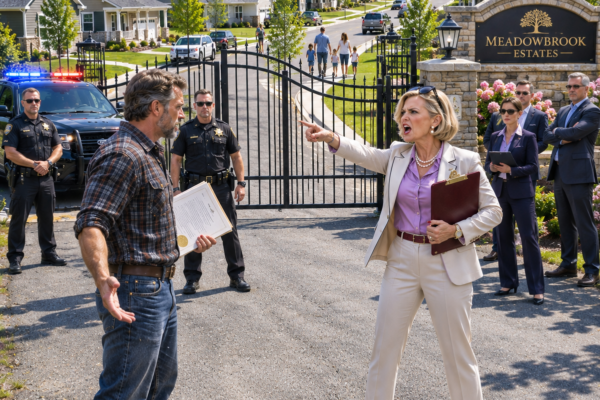
PART 2: HOA Bulldozed My Late Wife’s Garden and Billed Me $9,452—They Never Checked Who They Were Threatening

The woman who bulldozed my late wife’s garden stood in the mud where her roses had bloomed and handed me a bill for $7,452.
She thought grief had made me weak enough to scare, fine, and silence.
What she did not understand was that I had spent most of my life learning what happens when powerful people mistake patience for surrender.
Karen Miller, president of the Oak Haven Estates Homeowners Association, held her clipboard against her chest like a badge.
Behind her, a compact Bobcat idled on my lawn, its tracks carving black wounds through the grass. Diesel fumes hung in the cool afternoon air.
But I was staring at the place where Eleanor’s garden had been.
For twenty years, my wife had built that garden one season at a time. Heritage roses climbed a white trellis near the porch. Purple irises came from bulbs her grandmother had carried across an ocean. Heirloom tomatoes grew beside a low stone border she had laid herself. Wildflowers spilled into the paths because Eleanor believed gardens should look alive, not obedient.
Now the trellis was broken in the mud.
Roots had been ripped out and left exposed.
The peace rose she had nursed through drought and frost lay twisted beside shredded stems.
Six months earlier, I had buried Eleanor after forty-five years of marriage.
During her last year, when cancer had taken most of her strength, she would sit by the kitchen window and watch that garden.
“Promise me you won’t make it too neat after I’m gone,” she had whispered once.
Standing there now, I heard those words as clearly as if she were beside me.
“You destroyed my wife’s garden,” I said.
Karen gave me a practiced smile.
“We remediated a non-compliant landscape feature, Arthur.”
I looked at her.
She flipped a page on her clipboard.
“Bylaw Seventeen, subsection C. Unauthorized plant varieties, excessive growth, nonuniform floral placement, and failure to respond to prior notices.”
“I never received any notices.”
“They were sent.”
“To where?”
“Your registered address.”
“This is my registered address.”
Her smile tightened.
“Well, regardless, the violation existed.”
I looked past her at the churned earth.
“How much do I owe?”
“Seven thousand four hundred fifty-two dollars for remediation, equipment, labor, disposal, and administrative costs. The fines are separate.”
“The fines.”
“Yes. Continued noncompliance carries additional penalties.”
“There is nothing left to comply with.”
“That is why remediation was necessary.”
I had spent thirty years as an Army JAG officer before moving to the bench. I had heard arrogant witnesses, dishonest executives, and frightened defendants say astonishing things under pressure.
But I had never heard anyone describe destroying a dead woman’s garden with such certainty.
Karen pointed toward the tire tracks.
“You’ll need the lawn restored to community standards within fourteen days.”
I almost laughed because the alternative was saying something I would regret.
“So your contractor destroys my lawn, and I repair it?”
“The HOA is not responsible for consequences resulting from enforcement.”
“Who hired the contractor?”
“The association.”
“Who approved it?”
“The board.”
“Was there a hearing?”
Her eyes narrowed.
“Arthur, I understand you’re emotional.”
That word did it.
Not grieving.
Not a man standing over the last living thing his wife had touched.
Emotional.
I stepped closer without raising my voice.
“Do not mistake calm for consent, Mrs. Miller.”
Her expression hardened.
“If the amount is not paid within thirty days, the association can pursue collection remedies.”
“What remedies?”
“A lien.”
The word landed softly.
That was Karen’s mistake.
She thought the threat would frighten me.
Instead, it gave me something grief had denied me for months.
Focus.
I took the invoice from her hand.
“Send me everything in writing.”
Her smile returned.
“With pleasure.”
She turned toward the Bobcat.
I stood alone as the machine rolled away.
Then I went inside, walked straight to my study, unlocked the bottom drawer of my desk, and pulled out the HOA documents Eleanor and I had signed when we bought the house.
I placed Karen’s invoice beside them.
Before I read a single line, I made myself one promise.
I would not fight her the way she expected.
I would fight her by the rules.
Every rule.
Especially the ones she had broken.
PART 2
I stayed in my study until almost two in the morning.
The house had never felt so quiet.
For six months, I had been learning the peculiar geography of widowhood. There were places in my own home I avoided because they still seemed to belong to Eleanor.
Her chair beside the kitchen window.
The hook where her gardening hat still hung.
The ceramic mug with a cracked handle she refused to throw away.
The bottom drawer in the guest-room dresser where she kept seed packets organized in envelopes with dates written in her neat handwriting.
That night, however, grief had been joined by something colder.
Purpose.
The original Oak Haven covenants were thirty-two pages long.
I remembered signing them when Eleanor and I bought our house. I had read every page then because lawyers are irritating people to buy property with. Eleanor had teased me for it.
“Arthur, normal people do not annotate HOA covenants on a Saturday night.”
“Normal people discover surprises later.”
She had laughed and kissed the top of my head.
“You were eighty years old when I married you.”
“I was twenty-six.”
“My point stands.”
The memory made me stop reading.
For several seconds I simply sat there with my hand resting on the page.
Then I continued.
The original documents were exactly as I remembered.
The HOA existed to maintain the private roads, storm drains, entrance sign, and small common park. There were basic architectural restrictions meant to prevent commercial structures and dangerous neglect.
Nothing about approved roses.
Nothing about geometrically precise flower beds.
Nothing about beige mailboxes.
Nothing about basketball hoops.
Karen’s packet, on the other hand, was almost ninety pages thick.
It had been revised repeatedly over the years.
Bylaw Seventeen occupied six pages.
I read every word twice.
Then I found the first crack.
Any owner accused of violating landscaping standards was entitled to written notice and a hearing before the board no fewer than thirty days before corrective action could be authorized.
I read it a third time.
Thirty days.
Karen had claimed three notices had been sent, but even if those notices existed, no hearing had been scheduled.
No vote had been held in my presence.
No opportunity to appeal had been offered.
And the language concerning forced entry onto private property was even more restrictive.
The association could enter a lot without an owner’s consent only to address an immediate threat to health, safety, drainage, or common infrastructure.
Eleanor’s roses had not been threatening anybody.
I reached for a yellow legal pad.
At the top I wrote:
THORNE PROPERTY — HOA ACTION
Then beneath it:
No hearing.
No proof of notice.
No emergency.
No recorded authorization.
Unauthorized entry.
Destruction of personal property.
I stared at the list.
A lawyer sees conflict differently from most people.
Anger asks, How do I hurt the person who hurt me?
Law asks, What happened, what can be proved, what rule controls, and what remedy follows?
That distinction had kept me out of trouble for most of my life.
It was about to become Karen Miller’s worst problem.
At eight the next morning, I went outside with a camera.
The Bobcat tracks were still clear.
I photographed everything.
Wide shots.
Close-ups.
The broken trellis.
The root ball of the peace rose.
The crushed stone border.
The tire tracks crossing from the street onto my lot.
The place where the contractor had driven over an irrigation line and cracked it.
I even photographed the clumps of wet soil stuck to the curb.
Then I found something Karen probably assumed was meaningless.
A work tag.
It was half buried beneath a pile of leaves.
PRESTIGE PROPERTY MAINTENANCE LLC.
Below the name was a job number.
I took four photographs of it before touching it.
Then I sealed it in a plastic evidence sleeve left over from an old military legal kit I had never bothered to throw away.
By nine thirty, I was standing in the county records office.
I knew the clerk at the front desk by sight.
Donna Reeves had worked there for at least fifteen years.
She peered at me over reading glasses.
“Arthur? Haven’t seen you down here in a while.”
“Retirement was supposed to keep me away from public records.”
She smiled.
“And how’s that working?”
“Poorly.”
Her smile faded slightly.
“I heard about Eleanor. I’m so sorry.”
“Thank you.”
There was a pause.
Then she glanced at the notebook in my hand.
“What are you hunting?”
“Everything filed by Oak Haven Estates Homeowners Association for the last fifteen years.”
Her eyebrows rose.
“That sounds healthy.”
“I’ve had worse hobbies.”
Two hours later, I had a stack of copies in front of me.
Annual reports.
Amendments.
Meeting minutes.
Lien filings.
Corporate registrations.
Vendor contracts referenced in financial disclosures.
The pattern appeared slowly.
Karen had joined the architectural committee eleven years earlier.
Nine years earlier, she became HOA president.
After that, amendments began appearing almost annually.
Fence color.
Mailbox design.
Portable recreational equipment.
Outdoor furniture.
Garden borders.
Visible trash containers.
Window trim.
Holiday decorations.
Then came Bylaw Seventeen.
The meeting approving it had been held on a Tuesday evening in February.
Sixty-five homes belonged to Oak Haven.
Seven owners attended.
Karen and two board members had constituted the required board quorum.
The amendment passed four votes to three.
I sat back.
Technically possible.
Politically disgraceful.
But not yet the strongest part.
I kept reading.
Prestige Property Maintenance first appeared eight years earlier.
Before Prestige, the association had used three local vendors.
After Prestige, nearly everything went to one company.
Landscaping.
Snow removal.
Tree trimming.
“Violation remediation.”
The amounts grew year after year.
I searched the state corporation database.
Prestige Property Maintenance LLC.
Registered agent: Frank Miller.
Managing member: Frank Miller.
Address: one county over.
I stared at the screen.
Miller.
Common name.
Could be coincidence.
I searched further.
A local wedding announcement from fourteen years earlier listed a Frank Miller as brother of Thomas Miller.
Thomas Miller was Karen’s husband.
I leaned back in my chair.
There it was.
Not proof of wrongdoing.
But enough to ask questions.
I printed the corporate filing.
Then I requested the HOA’s financial disclosures.
For the next six hours, I built a spreadsheet by hand.
Year.
Vendor.
Amount.
Contract purpose.
Approving officer.
Prestige had received more than $310,000 from Oak Haven over eight years.
Several invoices were remarkably round.
$8,000.
$12,500.
$15,000.
One payment for storm debris removal was made during a month when county weather records showed no significant storm.
Another invoice listed “emergency drainage remediation” on a section of property that belonged to the county, not the HOA.
And on three separate years, the association reported assessment increases because maintenance costs had supposedly risen unexpectedly.
I felt my jaw tighten.
This was no longer about Eleanor’s garden.
Not entirely.
I drove home near sunset.
A certified envelope was waiting in my mailbox.
Oak Haven Estates Homeowners Association.
I carried it inside and opened it at the dining room table.
The total was now $9,452.
The original $7,452 “remediation charge.”
Five hundred dollars for unauthorized flora.
One thousand dollars for negligent landscape maintenance.
Five hundred dollars for failure to comply with notices.
Interest would begin accruing in thirty days.
Below that was one sentence:
Failure to satisfy the outstanding balance may result in lien proceedings against the property.
I read the sentence twice.
Then my phone rang.
My daughter Sarah.
I almost did not answer.
Sarah had inherited Eleanor’s ability to hear lies in my voice.
“Hi, sweetheart.”
“You sound strange.”
“Good afternoon to you too.”
“Dad.”
“I’m fine.”
“You always say ‘I’m fine’ when you are definitely not fine.”
I looked toward the dark kitchen window.
“Something happened to your mother’s garden.”
Silence.
Then, “What do you mean?”
I told her.
Not dramatically.
I did not need to.
By the time I finished, her breathing had changed.
“They destroyed it?”
“Yes.”
“All of it?”
“Most of it.”
“Mom’s roses?”
“Yes.”
“The jasmine trellis?”
“Yes.”
Sarah went quiet.
When she spoke again, her voice broke.
“That was hers.”
“I know.”
“Why would anyone do that?”
“Apparently it lacked geometric precision.”
“Dad.”
“I’m not joking.”
She swore.
Eleanor would have scolded her.
I almost smiled.
Then Sarah asked the question I knew was coming.
“What are you going to do?”
“Handle it.”
“That answer worries me.”
“I’m not going to do anything foolish.”
“You were a military lawyer for thirty years. Your version of ‘nothing foolish’ can be terrifying.”
“I’m gathering documents.”
Another silence.
Then she said, “Good.”
I looked down at the certified letter.
“That sounded very much like your mother.”
“I’ll take that as a compliment.”
“You should.”
“Dad?”
“Yes?”
“Don’t let them turn this into something ugly enough that you lose what Mom loved about that place.”
That stopped me.
I looked toward the kitchen.
Toward Eleanor’s empty chair.
“I won’t.”
“Promise?”
“I promise.”
After we hung up, I took the legal pad where I had written THORNE PROPERTY — HOA ACTION.
I crossed it out.
Underneath, I wrote:
OAK HAVEN.
Because Sarah was right.
If this became only revenge, Karen would still have taken something from me.
I needed to know whether I was the exception or merely the latest victim.
The next morning, I took a walk.
I started with Martha Gable.
Martha was eighty-seven and had lived in Oak Haven longer than Karen.
Her little brick ranch sat at the corner of Willow Lane. She kept petunias beside the porch and ceramic birds along the walkway.
Her mailbox was beige.
That bothered me because I remembered it being blue.
Periwinkle, Eleanor had called it.
Martha was trimming dead blooms when I approached.
“Arthur.”
“Morning, Martha.”
She squeezed my hand.
“I’ve been meaning to come by. I heard about Eleanor’s garden.”
“News travels fast.”
“Karen travels faster.”
I glanced toward the mailbox.
“Wasn’t that blue?”
Martha stopped trimming.
For a moment her face changed.
“Yes.”
“What happened?”
She looked toward the street before answering, as if Karen might materialize from behind a hedge.
“I was told blue created aesthetic disharmony.”
“Those exact words?”
“I still have the letter.”
Five minutes later, we were sitting at her kitchen table.
She placed the notice in front of me.
AESTHETIC DISHARMONY.
Fine: $200.
Additional penalty: $50 per week.
Martha’s hands trembled.
“I went to the meeting to appeal. Karen said there was nothing to discuss.”
“No hearing?”
“She said the board had already decided.”
“Did anyone vote in front of you?”
“No.”
“Did you receive notice of a hearing?”
“No.”
“Did you pay?”
Her eyes lowered.
“I’m on Social Security, Arthur. Two hundred dollars isn’t nothing to me, but a lawyer costs more.”
I nodded.
“So my grandson painted it beige.”
Her mouth tightened.
“I cried afterward. Isn’t that ridiculous? An old woman crying over a mailbox.”
“No.”
She looked up.
“No?”
“No. You weren’t crying over paint. You were crying because somebody made you feel like your own home did not belong to you.”
Her eyes filled.
“Yes.”
I told her what happened to my garden.
Then I showed her the bylaw provision requiring notice and a hearing.
She stared at it.
“She broke her own rule?”
“It appears so.”
A slow change came over Martha’s face.
Fear did not disappear.
It was joined by anger.
“What are you going to do?”
“I’m still deciding. But I may need a statement from you.”
“You mean court?”
“Possibly.”
Martha sat straighter.
“My hands shake when I’m nervous.”
“So do plenty of good witnesses.”
“I don’t want her coming after me.”
“I understand.”
She looked toward the beige mailbox through the window.
Then back at me.
“No.”
I waited.
She shook her head.
“I’m tired of saying that.”
“Saying what?”
“That I’m afraid of what Karen will do.”
She pushed the violation letter toward me.
“Make a copy.”
My next stop was Carlos Rodriguez.
I already knew part of his story.
Two years earlier, his son David had received a basketball hoop for his tenth birthday.
Three months later, it disappeared.
Carlos was in his garage when I walked up.
He had spent twenty-two years as a firefighter and looked capable of carrying a refrigerator down a flight of stairs by himself.
“Arthur.”
“Carlos.”
His smile faded.
“I heard about the garden.”
“So did Martha.”
“Everybody heard.”
“Karen?”
He laughed without humor.
“She told Barb that enforcement had finally been completed on the ‘jungle property.’”
I felt something cold move through me.
I ignored it.
“Can I ask you about David’s basketball hoop?”
Carlos looked toward the house.
“Sure.”
“It was portable, wasn’t it?”
“Three-hundred-pound base filled with water. Wheels on the front. We offered to roll it into the garage every night.”
“What rule did she cite?”
He disappeared into the house and returned with a folder.
“Permanent recreational structure.”
I read it.
“This rule governs sheds, detached garages, and gazebos.”
“Exactly what I told her.”
“What happened?”
“Five hundred dollars. Then another five hundred. Then legal fees.”
“How much total?”
“One thousand eighty.”
“And the hoop?”
“Sold it online for a hundred fifty bucks.”
His voice changed.
“David thought it was his fault.”
“What?”
“He heard Karen arguing with me one afternoon. She said the neighborhood looked trashy because people refused to control their children’s junk.”
Carlos clenched his jaw.
“He was ten.”
I closed the folder.
“Would you be willing to document this under oath?”
He studied me.
“Why?”
“Because what happened to me may not be isolated.”
I showed him the Prestige corporate filing.
“Frank Miller,” he read.
“Karen’s brother-in-law.”
His eyes lifted.
“No.”
“Yes.”
Carlos read it again.
“You think she’s been paying her own family with our dues?”
“I think the relationship should have been disclosed and independently reviewed. I haven’t found evidence that happened.”
His face darkened.
“What do you need?”
“Copies of every notice. Proof of payment. And eventually, courage.”
He laughed once.
“That last part free?”
“Unfortunately not.”
“How much?”
“You may have to stand up in a room while Karen Miller tries to humiliate you.”
He nodded.
“Cheap enough.”
Within a week, there were twelve of us.
Then eighteen.
Stories came faster than I could organize them.
A retired teacher fined because her birdbath was “visually disruptive.”
A young nurse ordered to repaint cream-colored window trim because Karen insisted the approved white had a specific manufacturer code.
A family threatened with penalties for growing vegetables beside their garage.
An elderly veteran ordered to remove a flagpole because it was eighteen inches taller than Karen preferred.
A widower fined for leaving garbage cans visible for twenty-seven minutes beyond the permitted collection window.
Not every complaint was legally significant.
Not every rule was invalid.
HOAs can enforce legitimate covenants when they act properly.
That distinction mattered to me.
I did not want a rebellion based on the theory that no rules should exist.
I wanted accountability for rules enforced arbitrarily, without procedure, and possibly for personal gain.
So I documented.
Dates.
Notices.
Payments.
Witnesses.
Board minutes.
Photographs.
By the end of the second week, my dining room looked like a litigation command center.
Sarah came to visit on Saturday.
She stopped in the doorway.
“Dad.”
“What?”
“You have evidence boxes in the dining room.”
“They’re alphabetized.”
“That was not the concerning part.”
She walked toward the kitchen window.
For the first time since arriving, she could see the destroyed garden.
Her face collapsed.
I reached her before she began crying.
She pressed both hands over her mouth.
“Oh, Mom.”
I held my daughter while she cried against my shoulder.
I had done surprisingly little crying since Eleanor died.
Grief had settled in me differently.
It had become weight.
A quiet pressure behind the ribs.
But when Sarah knelt in the mud and picked up a piece of the broken jasmine trellis, something inside me gave way.
“She painted this,” Sarah whispered.
“I know.”
“She hated that shade of white.”
“Too blue, she said.”
Sarah laughed through tears.
“She repainted it three times.”
We stood there a long time.
Finally, she looked at me.
“Are you doing this for Mom?”
“Partly.”
“Are you doing it because you’re angry?”
“Yes.”
“At least you admit it.”
I looked at the ruined earth.
“But I don’t want anger making the decisions.”
Sarah squeezed my arm.
“Then what does?”
“The evidence.”
She smiled faintly.
“There he is.”
That Monday, I called Benjamin Carter.
Ben had appeared before me twice when I was on the Superior Court.
He was young, aggressive, exceptionally prepared, and irritating in exactly the way a good litigator should be.
He had recently left a large firm to open his own practice.
When his receptionist heard my name, Ben came on the line within thirty seconds.
“Justice Thorne?”
“Ben.”
“This is unexpected.”
“I need a lawyer.”
There was a pause.
“For you?”
“Yes.”
“Is this a hypothetical judicial ethics question?”
“No.”
“Criminal?”
“No.”
“Divorce?”
“My wife died six months ago, Ben.”
Another pause.
“I’m sorry. That was idiotic.”
“It was.”
“Okay. I deserved that.”
“It’s an HOA dispute.”
Silence.
Then he laughed.
I let him.
When he finished, I said, “Are you done?”
“Yes, sir.”
“They bulldozed Eleanor’s garden.”
The laughter disappeared.
“Your wife’s garden?”
“Yes.”
“They entered your property?”
“Yes.”
“And destroyed it?”
“Yes.”
“And billed you.”
“How did you know that part?”
“Because HOA stories are always insane.”
“Come to my house at seven.”
Ben arrived at six forty-five carrying a legal pad and the expression of a man expecting an eccentric dispute over lawn edging.
I placed three binders on the dining table.
His expression changed.
“What is this?”
“The first binder covers my property. The second covers other homeowners. The third covers the association’s vendor relationships.”
He sat.
Two hours later, he was still reading.
When he reached Prestige Property Maintenance, he looked at me.
“Brother-in-law?”
“Yes.”
“Undisclosed?”
“As far as I can determine.”
“Competitive bids?”
“None I found.”
“Payments?”
“More than three hundred thousand over eight years.”
He whistled softly.
Then he read several homeowner statements.
“This isn’t a garden case.”
“No.”
“This could become a derivative action, possibly a class matter depending on the claims and state rules. There’s breach of fiduciary duty. Maybe unjust enrichment. Potential fraud if the invoices are false.”
“Agreed.”
He tapped my folder.
“And your garden itself is a very clean trespass and property-damage claim.”
“Agreed.”
“Emotional distress will be harder.”
“I know.”
He looked toward the kitchen.
“Was the garden really your wife’s memorial?”
“Yes.”
He closed the folder.
“Then I’d plead it carefully.”
We spent another hour discussing conflicts.
I made one thing explicit.
“My judicial office does not touch this case.”
“Obviously.”
“No calls to anyone because of who I am. No favors. No pressure. If this goes to court, I’m Arthur Thorne, homeowner and plaintiff.”
Ben nodded.
“And because you’re a sitting Supreme Court justice, we assume everything we do will eventually be scrutinized.”
“Correct.”
He smiled.
“I like difficult clients.”
“You haven’t billed me yet.”
The next afternoon, Ben called.
“I found something.”
“What?”
“The HOA filed a notice for a special meeting next Thursday.”
“I haven’t received it.”
“You will.”
“What’s the agenda?”
“Lien authorization against Lot Thirty-Four.”
My property.
Karen was escalating.
“Perfect,” I said.
Ben was silent.
“Most clients do not say ‘perfect’ when someone threatens their house.”
“She wants a public forum.”
“Arthur.”
“Yes?”
“I recognize that tone.”
“What tone?”
“The tone you used before destroying my expert witness three years ago.”
“He survived.”
“Professionally?”
“Debatable.”
Ben sighed.
“What are you planning?”
“Nothing improper.”
“That is not the reassuring phrase you think it is.”
The notice arrived the next morning.
SPECIAL MEETING.
Agenda Item One:
Authorization of lien proceedings against Lot 34 for unpaid assessments, fines, remediation costs, interest, and administrative charges.
Karen had made a strategic mistake.
She could have continued sending letters.
She could have quietly sent the matter to collections.
Instead, she wanted spectacle.
She wanted the neighborhood to watch me lose.
Vanity had created the venue I needed.
I invited Martha, Carlos, and several others to my house.
We sat around the dining table.
“I am not asking anyone to shout,” I told them.
Carlos raised a hand.
“What if shouting feels natural?”
“Suppress your nature.”
Martha laughed.
I continued.
“Facts are stronger than insults. Karen expects anger. If you give her anger, she can call you disruptive. Give her dates. Amounts. Documents.”
I handed each person a single sheet.
At the bottom was the same sentence:
This board has exercised authority without the procedures required by its own governing documents, and I am requesting a complete review of every fine and enforcement action issued during Karen Miller’s presidency.
Carlos read it.
“Less dramatic than what I had in mind.”
“Good.”
“What did you have in mind?”
“Nothing suitable for minutes.”
On the night of the meeting, the Oak Haven clubhouse was packed.
Normally eight people attended.
That evening, forty-eight folding chairs were filled.
People stood along the back wall.
Karen sat behind a plastic table with Gerald Finney, the board treasurer, and Barbara Croft, the vice president.
Karen wore a floral pantsuit and a smile I had seen on prosecutors who believed a conviction was already guaranteed.
She banged the gavel.
“Meeting will come to order.”
The room quieted.
For twenty minutes she raced through routine matters.
Then she placed both hands on the table.
“We now move to the serious matter of Lot Thirty-Four.”
Her eyes found me.
“Mr. Thorne has refused repeated opportunities to resolve substantial violations.”
I said nothing.
Karen continued.
“The association incurred costs because Mr. Thorne failed to maintain his property according to established community standards. He has refused to reimburse those costs and has refused to pay assessed penalties.”
Murmurs moved across the room.
She raised her voice.
“The balance is nine thousand four hundred fifty-two dollars, excluding additional legal expenses. The board therefore recommends authorization to record a lien against the property.”
She looked at me.
“Would you like to explain your refusal?”
“Later.”
That surprised her.
She looked around.
“Fine. Is there any homeowner comment relevant to enforcement before the vote?”
Martha stood.
Karen frowned.
“Martha, this matter concerns Lot Thirty-Four.”
“It concerns enforcement.”
“You have two minutes.”
Martha unfolded her paper.
“My name is Martha Gable. I live at twelve Willow Lane. Last year, I was fined two hundred dollars because my mailbox was periwinkle blue.”
A few people laughed.
Karen snapped, “This is not a comedy.”
Martha’s hands trembled.
She kept reading.
“I requested an appeal. I was not provided a formal hearing. I paid because I was afraid additional fines would threaten my home.”
Karen reached for the gavel.
Martha’s voice strengthened.
“This board has exercised authority without the procedures required by its own governing documents, and I am requesting a complete review of every fine and enforcement action issued during Karen Miller’s presidency.”
She sat.
There was silence.
Then Carlos stood.
“Carlos Rodriguez. Forty-five Oak Drive.”
Karen’s face changed.
“My family paid one thousand eighty dollars after the board classified my ten-year-old son’s portable basketball hoop as a permanent structure. I requested reconsideration. No formal hearing was held.”
“Carlos, you agreed to pay.”
“I paid because you threatened a lien.”
“You were in violation.”
“Then show me where the rule says basketball hoop.”
Karen slammed the gavel.
“You are out of order.”
Carlos looked at me.
I shook my head slightly.
He returned to his statement.
“This board has exercised authority without the procedures required by its own governing documents—”
Karen struck the gavel again.
“That is enough.”
Then another homeowner stood.
Then another.
Birdbath.
Window trim.
Vegetable garden.
Flagpole.
Trash cans.
Each person spoke calmly.
Karen grew redder.
Barbara whispered to her.
Gerald stared at the tabletop.
Finally Karen stood.
“This is obviously a coordinated attack.”
I rose.
“No.”
She turned toward me.
“This is coordinated documentation.”
The room became still.
I walked toward the front carrying a binder.
Karen folded her arms.
“Well, Mr. Thorne, since you seem to have organized tonight’s entertainment, perhaps you would like to explain why the rules should not apply to you.”
“The rules should apply to everyone.”
“Exactly.”
“Including you.”
Her face froze.
I opened the binder.
“Bylaw Seventeen, subsection C. That is what you relied upon when you authorized entry onto my property?”
“Yes.”
“And when Prestige Property Maintenance destroyed my garden?”
“Remediated.”
Several people groaned.
I continued.
“Please show me where Bylaw Seventeen permits the association to enter private property and destroy landscaping without first providing a hearing.”
Karen blinked.
“The notices—”
“I didn’t ask about notices.”
She stared at me.
“Show me the provision.”
“I don’t have to conduct a legal debate with you.”
“No. But you are asking these homeowners to authorize a lien based on your claim that you acted legally. I think the foundation matters.”
I turned a page.
“Section Nine, paragraph Four. Before corrective action, the owner must receive no fewer than thirty days’ written notice of a hearing before the board.”
Karen said nothing.
“No hearing occurred.”
“The board discussed your property.”
“When?”
“A board session.”
“Date?”
“I’d have to look.”
“Minutes?”
“Not every discussion requires minutes.”
“A vote authorizing entry onto my property?”
Gerald shifted.
I looked at him.
“Mr. Finney, did you vote to bulldoze my wife’s garden?”
Gerald’s face went pale.
“I—Karen said it was an enforcement matter.”
“So no vote?”
“I don’t remember a formal vote.”
Barbara spoke.
“We trusted the president to handle ordinary violations.”
I nodded.
“Thank you.”
Karen snapped, “Stop interrogating my board.”
“Your board?”
A murmur rolled through the room.
Karen realized the mistake.
“Our board.”
I closed that section of the binder.
“Fine. Let’s discuss the invoice.”
I held up the $7,452 charge.
“The association says Prestige Property Maintenance performed this work.”
“Yes.”
“How was Prestige selected?”
“Competitive pricing.”
“Where are the competing bids?”
“I don’t carry eight years of records in my purse.”
“Of course.”
I pulled out the corporate filing.
“So let’s simplify it.”
Karen’s eyes moved to the paper.
“Prestige Property Maintenance LLC is owned by Frank Miller.”
Her face changed.
Several homeowners looked at one another.
I continued.
“Is Frank your brother-in-law?”
“That is irrelevant.”
Carlos said from the back, “That sounds pretty relevant.”
Karen hit the gavel.
I kept my eyes on her.
“Is he?”
She hesitated.
“Yes.”
The room erupted.
Karen shouted over the noise.
“There is nothing illegal about hiring someone you know.”
“Correct.”
That answer confused her.
I continued.
“Hiring a relative is not automatically unlawful. Concealing a financial conflict, participating in decisions that benefit that relative, paying above-market rates, or approving false invoices can create much more serious problems.”
Her face went white.
“Are you accusing me of fraud?”
“I am saying the records require independent review.”
“You are slandering me.”
“No. I am reading public documents.”
She pointed at me.
“You have been trying to destroy this association from the day we enforced the rules against you.”
“Karen, until you bulldozed Eleanor’s garden, I attended three HOA meetings in twenty years.”
A few people laughed.
She did not.
I removed one more document.
“There’s another issue.”
“What now?”
“The lien vote.”
She glared.
“Your own bylaws require a majority of homeowners present at a properly noticed meeting for this type of enforcement lien.”
“We have a quorum.”
“Yes.”
I turned toward the room.
“Then perhaps before anyone votes, every owner should understand precisely what they are being asked to ratify.”
I described the destroyed garden.
The lack of hearing.
The absence of a recorded board vote.
The contractor relationship.
Then I stopped.
Karen folded her arms.
“Are you finished?”
“Almost.”
At the back of the room, the door opened.
Ben Carter entered carrying three thick envelopes.
Karen looked at him.
“And who are you?”
“My attorney.”
She laughed.
It was exactly the reaction I expected.
“Arthur, hiring some young lawyer does not change the covenants.”
“No.”
I looked at Ben.
“But evidence does.”
Ben walked to the table.
Before he reached it, Karen raised a hand.
“Wait.”
Something in her expression told me she finally sensed the ground shifting.
“Who exactly are you, Arthur?”
The question surprised me.
“We have lived three streets apart for eleven years,” I said.
“I know that.”
“Then why ask?”
“Because you keep talking like you’re in a courtroom.”
Carlos made a noise that sounded suspiciously like a laugh.
I glanced toward him, then back to Karen.
“For thirty years I served as an Army Judge Advocate.”
Her posture changed slightly.
“After retiring from the Army, I became a state trial judge.”
The room went quiet.
Karen stared.
I continued.
“For the past decade, I served on the Superior Court.”
No one moved.
“And three weeks ago, I was sworn in as an associate justice of our state Supreme Court.”
Martha whispered, “Oh, my Lord.”
Carlos leaned back and mouthed something I was grateful I could not hear clearly.
Karen looked as though the room had tilted beneath her.
“You’re a Supreme Court justice?”
“Yes.”
“Why didn’t you tell me?”
“I never imagined my neighbors needed my résumé.”
“You deliberately hid that.”
“No. You never asked.”
The gavel slipped from her fingers and hit the table.
I stepped closer.
“My job does not make me above your rules.”
I let the words settle.
“But neither does your office make you above them.”
I nodded to Ben.
He placed an envelope before Karen.
Another before Gerald.
Another before Barbara.
“My name is Benjamin Carter,” he said. “I represent Arthur Thorne and several other homeowners concerning claims arising from HOA enforcement practices and financial governance.”
Karen stared at the envelope.
“You can’t serve me here.”
Ben remained calm.
“This is not formal service. It is a courtesy copy of a complaint scheduled for filing tomorrow morning.”
Her eyes widened.
“A complaint?”
“Claims include trespass, property damage, breach of contract, breach of fiduciary duty, and requests for declaratory and injunctive relief.”
Gerald opened his copy.
His hands began shaking.
Barbara leaned toward him.
Karen did not touch hers.
Ben continued.
“We will also request a forensic accounting of transactions involving Prestige Property Maintenance and related entities.”
“Get out,” Karen said.
Nobody moved.
She shouted, “I said get out!”
I looked around the room.
“This building belongs to the association, Karen.”
Her voice cracked.
“I am president.”
Martha spoke from the second row.
“For now.”
That was when the room changed.
It wasn’t cheering.
It wasn’t an angry mob.
It was quieter than that.
People who had spent years lowering their voices around Karen simply stopped being afraid.
One by one, homeowners began asking questions.
“Where are the financial statements?”
“Why didn’t we know Frank was your relative?”
“Who approved his contract?”
“How much has Prestige been paid?”
“Why were our dues increased last year?”
Karen tried the gavel.
Nobody listened.
Gerald pushed back his chair.
“I need to speak with counsel.”
Karen turned on him.
“Sit down.”
“No.”
It was the first word Gerald had spoken loudly all evening.
Karen stared.
He picked up the complaint.
“I said I need a lawyer.”
He walked out.
Barbara followed three minutes later.
Karen remained behind the table alone.
I should tell you that I felt triumphant.
Part of me did.
I had spent weeks preparing for that moment.
But when I looked at Karen, I did not see victory.
I saw a frightened woman standing inside the consequences of choices she had believed would never be questioned.
And strangely, my anger cooled.
Not disappeared.
Cooled.
Justice is not the same thing as humiliation.
I gathered my binder.
Karen looked at me.
“This is because of your wife.”
“Yes.”
“You’re using all this power because you’re upset about flowers.”
I stopped.
“No.”
I turned toward her.
“I’m doing this because you destroyed something you had no right to touch, then discovered you had been doing variations of the same thing to people who did not know how to fight you.”
Her eyes were wet now, though whether from fury or fear I could not tell.
“You could have just paid the fine.”
I stared at her.
“That sentence is the reason we’re here.”
The complaint was filed the following morning.
Ben named me, Martha, Carlos, and several others as plaintiffs.
He did not overreach.
That mattered.
Some claims applied to everyone.
Others applied only to individual homeowners.
The garden claim was mine.
The improper fines belonged to those who paid them.
The financial claims focused on the board’s duties to the association.
The request for an accounting covered Prestige.
We also asked the court to suspend any lien action against my house until the legality of the underlying charges was determined.
By noon, the local newspaper called.
I declined an interview.
By three, a television station called.
I declined again.
At five, Ben called me.
“You tipped somebody off.”
“No.”
“You sure?”
“Yes.”
“Because a reporter just read half our complaint back to me.”
“Court filings are public.”
“Apparently reporters have learned that.”
The next morning, Oak Haven was on the front page.
The headline was less restrained than I would have preferred:
SUPREME COURT JUSTICE SUES OWN HOA AFTER MEMORIAL GARDEN BULLDOZED
Sarah texted me a photograph of the article.
Underneath she wrote:
Mom would be horrified by the picture they used of you.
I looked at it.
She was right.
I appeared to be smelling something unpleasant.
I replied:
Your mother said that was my normal face.
Sarah:
She was correct.
The publicity changed everything.
Karen issued a statement calling the lawsuit “a personal retaliation campaign by a powerful homeowner angry that community standards applied equally to him.”
That was predictable.
Then Barbara gave a television interview.
That was not.
She stood outside her house and said the board had relied on Karen’s representations concerning vendor selection and enforcement.
“I did not know Frank Miller had a financial relationship with the president beyond being a relative,” Barbara said.
Gerald resigned that afternoon.
His attorney contacted Ben the next morning.
Gerald wanted to cooperate.
According to him, Karen had controlled nearly every operational decision.
She prepared meeting agendas.
She communicated with contractors.
She presented invoices as routine expenses.
Most board votes occurred in batches.
“Approve monthly expenditures as presented.”
Gerald admitted he had been lazy.
“I trusted her,” he told Ben during a recorded interview.
That did not absolve him.
But it mattered.
Then we received an email from someone I did not know.
Her name was Linda Park.
She had served as HOA treasurer six years earlier.
I remembered her vaguely.
Her message contained one sentence:
You need to look at invoice numbering.
Ben called me immediately.
“What does that mean?”
“I don’t know.”
We met Linda at a coffee shop.
She was in her early sixties, nervous and precise.
She brought a flash drive.
“I kept copies,” she said.
“Of what?”
“Financial reports.”
“Why?”
“Because Karen asked me to alter one.”
Ben and I exchanged a glance.
Linda continued.
“Six years ago, Prestige submitted two invoices with consecutive numbers. One was for Oak Haven. The next supposedly belonged to another client, but Karen accidentally attached both to an email.”
“What was wrong with that?”
“The work descriptions were nearly identical. Same hours. Same equipment. Same week. Different properties.”
“Double billing?”
“That’s what I suspected.”
“What did you do?”
“I asked Frank.”
“And?”
“He said clerical error.”
“Karen?”
“She told me it was corrected and instructed me to remove the duplicate from the monthly packet.”
“Did you?”
“Yes.”
She looked ashamed.
“I should have done more.”
“What happened after that?”
“The next election, Karen supported someone else for treasurer. I lost.”
Ben leaned forward.
“Why come forward now?”
Linda looked at me.
“Because of the garden.”
I said nothing.
She continued.
“My husband died three years ago. If someone destroyed the workshop he built behind our house and called it remediation, I don’t know what I would do.”
She slid the flash drive toward us.
“I may have been cowardly then. I don’t want to be now.”
The files changed the case.
Not because they proved a crime immediately.
They showed discrepancies.
Duplicate invoice numbers.
Work orders that did not correspond with board minutes.
Charges significantly higher than comparable local vendors.
Payments approved unusually quickly.
One invoice was especially interesting.
$18,600 for “emergency tree hazard abatement.”
The supposed work date was a Wednesday.
The county permit office had no record of tree removal at any common property that month.
Carlos remembered it.
“Eighteen thousand dollars?”
“Yes.”
“Nobody removed trees.”
“You’re certain?”
“I live across from the common park. My fire station is five minutes away. If somebody had a crew out there removing eighteen grand worth of trees, I would remember.”
The court granted our temporary request blocking the lien.
Karen could no longer threaten my house while the dispute was pending.
Then the association’s insurance carrier entered the picture.
Their lawyers were considerably less emotional than Karen.
They requested mediation.
Ben brought the proposal to me.
“They’ll rescind your fines.”
“No.”
“Wait. They’ll also pay for the garden restoration.”
“No.”
“Arthur.”
“I heard you.”
“They’re willing to refund some fines to other homeowners.”
“Some?”
“Those they cannot document procedurally.”
“Which is nearly all of them.”
Ben rubbed his forehead.
“Insurance lawyers negotiate for a living.”
“So do you.”
“Unfortunately, my client has the personality of a granite monument.”
“I’m flexible.”
“You just said no twice before I finished speaking.”
I leaned back.
“What about the accounting?”
“They’re offering an independent review.”
“Chosen by whom?”
“The insurer.”
“No.”
“Removal of Karen?”
“Not offered.”
“Then we have nothing to discuss.”
Ben stared at me.
“Do you want justice or do you want revenge?”
It was the question Sarah had been circling from the beginning.
I answered carefully.
“I want a process that cannot be undone the moment everyone becomes tired.”
Ben waited.
“I don’t care whether Karen apologizes to me. I care whether this system changes.”
He nodded.
“That answer I can work with.”
Discovery began.
And discovery is where arrogance goes to die.
People lie comfortably when nobody can demand documents.
They become less comfortable when every email, payment, invoice, text message, and bank record can be requested.
Prestige produced records reluctantly.
Frank Miller appeared for deposition wearing an expensive watch and the expression of a man who had been assured everything was a misunderstanding.
Ben questioned him.
I did not attend.
That was deliberate.
I did not want my judicial position hanging over a witness.
Ben called me afterward.
“He’s lying.”
“That is your professional assessment?”
“It is my extremely professional assessment.”
“About what?”
“Everything.”
“What specifically?”
“He claims Karen never participated in contract negotiations.”
“Documents?”
“We have emails from her.”
“He claims prices were market rate.”
“Comparable bids?”
“None.”
“He claims every invoice corresponds to completed work.”
“Does it?”
“Carlos is helping us verify locations. Several do not.”
“What about my garden?”
Ben went quiet.
“What?”
“The invoice.”
“Yes?”
“You were charged $7,452.”
“I’m familiar.”
“Prestige’s internal work order shows actual labor and equipment cost of $1,180.”
I said nothing.
Ben continued.
“The HOA invoice was padded with administrative categories.”
“How much went to Prestige?”
“Full amount.”
“For six hours with a Bobcat?”
“Apparently.”
My hand tightened around the telephone.
There are moments when anger feels hot.
That was not one.
That anger was cold enough to make my fingertips numb.
They had destroyed Eleanor’s garden.
Then marked up the destruction by more than six thousand dollars.
“Arthur?”
“I’m here.”
“There’s more.”
“Go ahead.”
“An email from Frank to Karen.”
I closed my eyes.
“What does it say?”
Ben read it.
Keep the remediation pricing consistent. They always pay when lien language goes out.
I opened my eyes.
“Plural?”
“Yes.”
“They.”
“Yes.”
It was a business model.
That realization hurt differently from the garden.
Karen had not merely become obsessed with rules.
Enforcement generated revenue.
Revenue went to Prestige.
Prestige had a family connection to Karen.
The more violations Karen found, the more “remediation” Frank performed.
The more residents feared liens, the more they paid without challenging invoices.
Ben found another email.
Karen had written:
Martha will fold. Fixed income. Push the weekly penalty.
I had to sit down.
Martha.
Eighty-seven years old.
Two hundred dollars had frightened her enough to paint over the mailbox she loved.
Karen knew exactly why.
That evening, I walked to Martha’s house.
Her mailbox was still beige.
She was watching television.
When she opened the door, she smiled.
“Arthur. Come in.”
“I need to tell you something.”
She listened while I explained the email.
When I finished, Martha did not speak for several seconds.
Then she asked, “She wrote that?”
“Yes.”
“Fixed income?”
“Yes.”
“She knew.”
“Yes.”
Martha walked to her kitchen.
I followed.
She put both hands on the counter.
“I thought maybe I was stupid.”
“You weren’t.”
“I thought she scared me because I was old and didn’t understand things anymore.”
“Martha.”
“She knew two hundred dollars mattered to me.”
“Yes.”
She turned around.
“Then don’t settle.”
It surprised me.
“Martha—”
“Don’t.”
Her eyes were wet.
“I don’t care about my two hundred dollars.”
“You should.”
“I care that the next widow doesn’t get a letter designed by someone who knows exactly how frightened she’ll be.”
I nodded.
“All right.”
The financial records kept coming.
Then Frank made his mistake.
He blamed Karen.
His attorney apparently decided cooperation was safer than loyalty.
Frank amended portions of his testimony.
He admitted Karen had recommended Prestige before any bidding process.
He admitted she approved change orders directly.
He admitted invoices sometimes contained “management cushions.”
Ben asked what that meant.
Frank eventually answered.
Extra charges.
“Who received the benefit?”
Frank resisted.
Then bank records arrived.
Several payments from Prestige had gone to an account jointly controlled by Karen and her husband.
Karen said they were repayments of personal loans.
Ben requested loan documents.
None were produced.
The state attorney general’s office opened an investigation.
That part did not come from me.
Once financial irregularities appeared in public filings and litigation records, the matter took on a life of its own.
I was relieved.
I wanted independent eyes on everything.
Karen’s deposition lasted two days.
Ben would later tell me it was one of the strangest experiences of his career.
She admitted knowing Frank was her brother-in-law.
She denied believing disclosure was required.
She admitted recommending Prestige.
She claimed Gerald and Barbara approved everything.
She admitted sending the email about Martha.
She said “Martha will fold” meant Martha was reasonable.
Ben asked why she mentioned fixed income.
Karen said she was being sympathetic.
Then came my garden.
Ben placed photographs in front of her.
“Do you recognize this?”
“Yes.”
“What is it?”
“Lot Thirty-Four after remediation.”
“Before remediation.”
He showed her a photograph Sarah had taken the previous spring.
Roses.
Irises.
Jasmine.
Stone paths.
Butterflies.
Eleanor was visible in the background, seated beneath her hat.
Karen looked away.
“Did you consider this property dangerous?”
“No.”
“Did it threaten drainage?”
“No.”
“Common infrastructure?”
“No.”
“Public safety?”
“No.”
“Did you provide Mr. Thorne a hearing?”
“We sent notices.”
“That was not my question.”
“No.”
“Did the board conduct a recorded vote authorizing entry?”
“It was within my enforcement discretion.”
“Where is that discretion stated?”
Karen’s attorney objected.
She answered anyway.
“The president has authority.”
“Unlimited authority?”
“No.”
“Authority to enter private property without consent?”
“In cases of violation.”
“Show me the provision.”
She could not.
Then Ben showed her the Prestige work order.
Actual estimated cost: $1,180.
Amount billed: $7,452.
“Why?”
“You would have to ask Frank.”
“Did you approve this invoice?”
“Yes.”
“Did you review it?”
“I trusted the vendor.”
“Your brother-in-law.”
“Yes.”
“Did you receive money from Prestige within sixty days after this payment?”
Her attorney told her not to answer until the question was clarified.
Ben clarified it.
Eventually she said yes.
“Loan repayment?”
“Yes.”
“Show us the loan agreement.”
“I don’t have one.”
“Promissory note?”
“No.”
“Bank transfer proving the original loan?”
“I’d have to look.”
There was none.
Three weeks later, the insurance company proposed settlement again.
This time, it was serious.
My property damages.
Full reimbursement of every plaintiff’s documented fines.
Legal fees.
A substantial additional payment.
Independent audit.
Karen’s resignation.
Barbara’s resignation.
New election.
Rewritten bylaws.
Ben read the offer aloud.
Then looked at me.
“This is everything.”
“Not quite.”
He groaned.
“Arthur.”
“What happens to homeowners who aren’t named plaintiffs?”
“The audit can identify them.”
“Can.”
“Yes.”
“I want shall.”
He wrote it down.
“What else?”
“Every improperly imposed fine refunded automatically, with interest.”
“Fine.”
“All enforcement files reviewed.”
“Fine.”
“Conflict-of-interest rules.”
“Fine.”
“Independent bids for major contracts.”
“Arthur, I agree.”
“And the judgment?”
He stopped writing.
“What judgment?”
“I want the court to enter findings on the undisputed claims.”
“The insurer wants confidentiality.”
“No.”
“You understand they will pay more for confidentiality.”
“I’m not selling silence.”
He leaned back.
“They may refuse.”
“Then we continue.”
“Why is a public ruling so important?”
“Because private money fixes private injuries. A public ruling tells every future board member where the line is.”
Ben stared at me.
Then smiled reluctantly.
“You really were unbearable on the bench, weren’t you?”
“So I was told.”
The defense eventually abandoned the confidentiality demand.
Too much evidence was already public.
Then Karen’s attorney attempted one final tactic.
He requested a meeting.
Not lawyer to lawyer.
Karen wanted to speak to me personally.
Ben advised against it.
Sarah advised against it more strongly.
Martha said, “Hear her.”
So I agreed under one condition.
Ben would be present.
We met in a conference room at his office.
Karen arrived without the floral suits.
Gray slacks.
Navy jacket.
No clipboard.
No gavel.
For the first time since I had known her, she looked ordinary.
She sat across from me.
For a long moment neither of us spoke.
Finally she said, “I’m sorry about Eleanor.”
I felt my body go rigid.
“Don’t.”
Her face tightened.
“I mean it.”
“You never knew her.”
“I knew who she was.”
“No. You knew which lot she lived on.”
Karen lowered her eyes.
“I shouldn’t have authorized the removal.”
“No.”
“I thought you were ignoring me.”
“I never received your notices.”
“They were sent.”
“Karen.”
She stopped.
Ben watched silently.
I continued.
“What do you want from me?”
She swallowed.
“I want this to end.”
“It can.”
“Your demands will bankrupt me.”
“That is between you, your attorney, the association, the insurer, and ultimately the court.”
“You know I could go to prison.”
“That is between you and the state.”
Her eyes flashed.
“You’re enjoying this.”
“No.”
“Don’t lie.”
“I’m not.”
“You expect me to believe you don’t enjoy watching me lose everything after what happened to your wife?”
I thought about it.
There had been nights when imagining Karen’s downfall gave me satisfaction.
That was true.
But sitting across from her, I felt mostly tired.
“I wanted you stopped.”
“You destroyed my reputation.”
“You did that before I knew your name was on an invoice.”
She flinched.
“My husband barely speaks to me.”
“I’m sorry for him.”
“My friends won’t answer.”
I said nothing.
“My house may have to be sold.”
Still nothing.
Then Karen’s voice broke.
“All because of some flowers.”
I looked at her for a long time.
And there it was.
The reason no apology from her could matter.
She still did not understand.
I leaned forward.
“It was never some flowers.”
She looked at me.
“My wife spent twenty years in that garden.”
My voice remained quiet.
“When our daughter left for college, Eleanor planted tomatoes because the house felt too empty. When her mother died, she transplanted her irises so she would have something living to remember her by. When cancer took her strength, she sat at the window and watched those roses open.”
Karen’s expression changed.
“She knew she was dying. I didn’t want to accept it, but she knew.”
I paused.
“She asked me to keep the garden imperfect after she was gone because she hated anything that looked controlled.”
Ben looked down.
I continued.
“Six months after I buried her, you sent machinery onto my land without a hearing, without a lawful vote, without speaking to me, and you destroyed it.”
Karen’s eyes filled.
“And then you marked up the cost and mailed me the bill.”
She wiped one cheek.
“I didn’t know what it meant to you.”
“That is exactly the point.”
She looked confused.
“You didn’t have to know.”
I sat back.
“It was mine.”
The room went silent.
“You did not need to approve of it. You did not need to understand it. You only needed enough humility to recognize the boundary between your authority and another human being’s home.”
Karen began crying.
Not loudly.
I felt no triumph.
Only sadness.
She left fifteen minutes later.
The civil case moved toward summary judgment.
By then, many material facts were no longer seriously disputed.
The association had entered my property.
The required hearing had not occurred.
No formal recorded vote authorizing destruction had been produced.
Prestige had billed $7,452.
Frank was related to Karen.
The relationship had not been properly disclosed in association records.
Financial irregularities existed.
Several homeowners had been fined without documented hearings required by the governing documents.
The judge assigned to the case was Evelyn Matthews.
I had known Evelyn professionally for years, though not closely.
Because of my judicial position, the case attracted unusual scrutiny.
She disclosed every potential professional contact.
Neither side objected.
I did not speak to her outside court.
On the morning of the hearing, I sat at the plaintiff’s table beside Ben.
It felt strange.
For years I had worn the robe.
Now I waited for someone else to enter wearing one.
Martha sat behind us.
Carlos and Maria were beside her.
Sarah had flown in the night before.
She squeezed my shoulder before court began.
“You okay?”
“Yes.”
“You’re doing the face.”
“What face?”
“The one Mom said meant someone was about to regret paperwork.”
I almost laughed.
The bailiff called the court to order.
Judge Matthews entered.
Everyone rose.
For nearly three hours, lawyers argued.
Not theatrically.
No television-style shouting.
Real litigation is usually quieter.
Documents.
Standards.
Statutes.
Language.
Questions.
The defense argued that the association possessed broad discretionary authority to enforce community standards.
Ben agreed that it possessed authority.
Then he added the sentence that defined the entire case.
“Authority is not immunity from procedure.”
Judge Matthews looked at him.
“Explain.”
“An association may enforce valid covenants. It may not invent procedures after the fact, ignore its own hearing requirements, enter private property outside the scope of its authority, destroy property, and then convert its unlawful action into a debt merely by printing an invoice.”
That was Ben at his best.
Karen’s attorney argued that any procedural failures were technical.
Judge Matthews interrupted.
“Counsel, entering a person’s land with machinery and destroying landscaping is not a technical event.”
The attorney pivoted.
He argued that my damages were exaggerated because plants can be replaced.
Ben stood.
“With respect, the plaintiffs are not asking the court to assign monetary value to grief. The property valuation is supported by experts. The emotional context is relevant to intent and punitive claims, not a claim that human memory can be purchased at a nursery.”
I looked at him.
He did not look back.
He knew he had landed it.
Then came the financial issues.
Judge Matthews’s tone sharpened.
“Are you seriously asking this court to conclude that eight years of undisclosed contracting with the president’s close relative creates no fiduciary concern?”
The defense attorney answered carefully.
“We dispute the characterization that it was undisclosed.”
“Show me the disclosure.”
He searched his papers.
“There were homeowners who knew.”
“That is not what I asked.”
Silence.
“Show me a recorded disclosure to the board and membership.”
They could not.
The ruling came two weeks later.
Ben called at seven twelve in the morning.
“Arthur.”
“I’m awake.”
“You won.”
I sat on the edge of my bed.
“All of it?”
“Read your email.”
“Tell me.”
He took a breath.
“The court invalidated the lien charges against you. Trespass and property-damage liability established. The court ruled the HOA failed to follow mandatory hearing procedures for multiple enforcement actions.”
I closed my eyes.
“Martha?”
“Her fine is included in the restitution review.”
“Carlos?”
“Yes.”
“The others?”
“Every enforcement action during the review period must be audited. Improper fines refunded with interest.”
I let out a breath I had apparently been holding for months.
“Bylaw Seventeen?”
“Invalidated in part as applied and suspended pending redrafting.”
“The board?”
“Independent receiver appointed temporarily.”
I stood.
“And Karen?”
“Personal liability issues on the intentional conduct and financial claims proceed separately, but the findings are devastating.”
I walked toward the kitchen.
Sunlight was coming through the window.
For one irrational second, I expected Eleanor to be there.
She wasn’t.
Ben was still talking.
“Arthur?”
“I’m here.”
“There’s language you’re going to want to read.”
“What language?”
“The judge wrote that community governance depends on delegated authority exercised within defined limits, and that private associations cannot transform procedural shortcuts into property rights merely through repetition.”
I smiled.
“That sounds like Evelyn.”
“There’s also a line about your garden.”
I waited.
Ben read it.
“The power to regulate landscaping did not include the power to erase a homeowner’s property first and ask legal questions later.”
I sat at the kitchen table.
For months I had imagined victory as something loud.
It wasn’t.
It was the sound of morning birds outside a kitchen window.
It was sunlight crossing an empty chair.
It was knowing the machine that had rolled across Eleanor’s garden would not roll across somebody else’s because one person with a clipboard decided it should.
The receiver took control of the HOA the following week.
His name was Samuel Briggs, a retired city manager with silver hair, heavy glasses, and absolutely no interest in neighborhood drama.
At his first community meeting, he said, “My job is boring administration. I intend to keep it boring.”
Everyone applauded.
He looked genuinely disappointed by the applause.
The forensic audit began.
It found more than we expected.
Prestige had received approximately $247,000 in payments that auditors classified as unsupported, inflated, duplicated, or inadequately documented.
Not every dollar was necessarily stolen.
But enough transactions lacked legitimate explanation that the attorney general’s investigation accelerated.
Frank reached an agreement first.
He admitted participating in false invoicing.
He agreed to restitution.
And he agreed to testify.
Against Karen.
The criminal case was separate from mine.
I stayed away from it.
No calls.
No meetings with prosecutors beyond what any victim or witness would provide.
My office had nothing to do with it.
Months later, Karen pleaded guilty to felony fraud-related charges arising from the financial scheme.
The judge sentenced her to eighteen months in state custody, followed by supervision and restitution obligations.
I did not attend sentencing.
People were surprised.
Carlos asked why.
“Don’t you want to see it end?”
“It already ended for me.”
He looked puzzled.
I pointed toward the garden.
Or what was becoming a garden again.
That part had taken longer.
For weeks after the civil ruling, the ground remained bare.
I would stand at the window with coffee and tell myself I would begin the next morning.
Then the next morning came.
And I couldn’t.
Winning the case had not brought Eleanor back.
It had not restored the twenty-year-old roots.
It had not repaired the trellis she painted three times because the first two whites were wrong.
Law is powerful.
But law has boundaries too.
A court can award money.
It can stop misconduct.
It can order restitution.
It cannot recreate a Tuesday afternoon twenty years ago when your wife planted her first rose while your daughter complained about being forced to carry mulch.
One October morning, I finally took a shovel outside.
The air was cool.
Leaves had begun changing along Willow Lane.
I pushed the blade into the dirt.
The first shovelful was harder than I expected.
Not physically.
Emotionally.
I dug again.
And again.
I had been working perhaps twenty minutes when I heard footsteps.
Carlos stood at the edge of the yard wearing work gloves.
“Morning, Justice.”
“Don’t call me that.”
“Morning, Justice.”
“What do you want?”
“To save your elderly back.”
“I’m perfectly capable.”
He looked at the tiny patch I had cleared.
“Sure.”
He picked up a second shovel.
Ten minutes later, Martha arrived carrying a thermos.
“I brought coffee.”
“You shouldn’t be carrying that all this way.”
“I live six houses down, Arthur, not in Canada.”
Carlos laughed.
Then Maria arrived with David.
David was fourteen now.
He carried lumber.
“What’s that?”
“New trellis.”
I stared at him.
Carlos shrugged.
“He built most of it.”
David looked embarrassed.
“My dad helped.”
“Barely,” Carlos said.
By noon, there were twelve people in my yard.
The retired teacher brought compost.
Linda Park brought bulbs.
A young couple from the next street brought two rosebushes.
Gerald Finney came too.
That surprised everyone.
He stood at the edge of the driveway holding a bag of soil.
Carlos’s body stiffened.
Gerald looked at me.
“I understand if you don’t want me here.”
I studied him.
Gerald had escaped the worst consequences because he cooperated early and because the evidence showed negligence more than personal enrichment.
But he had been on the board.
He had looked away.
“You should have asked more questions,” I said.
“I know.”
“You signed approvals.”
“I know.”
“You let Karen make people believe the board had considered things you barely read.”
His face flushed.
“I know.”
I looked at the bag in his hands.
“What is that?”
“Rose soil.”
“You know anything about roses?”
“Absolutely nothing.”
“Good.”
I took the bag.
“Neither do most of us.”
He stayed.
That afternoon, Martha’s grandson appeared.
He had a paint can.
I knew the color before he opened it.
Periwinkle blue.
Martha stood beside her mailbox while he painted.
Half the neighborhood gathered to watch.
Samuel Briggs, our temporary receiver, happened to drive past.
He slowed.
Looked at the mailbox.
Looked at us.
Then rolled down his window.
“Is that color structurally dangerous?”
Martha smiled.
“Extremely.”
“Carry on.”
The laughter could probably be heard three streets away.
A week later, Carlos installed a new basketball hoop.
This one was taller than the old one.
David invited half the neighborhood’s children to play.
The sound of basketballs hitting pavement carried through Oak Haven until sunset.
Nobody complained.
New bylaws were drafted over the winter.
They were shorter.
Clearer.
Enforcement required notice.
Hearings had to be recorded.
Conflicts of interest had to be disclosed.
Large contracts required competing bids.
Board members with family interests had to recuse themselves.
Fines were capped.
Forced entry onto private lots was limited to genuine emergencies or properly authorized circumstances.
And landscaping rules?
They occupied three paragraphs.
Maintain property.
Control dangerous invasive growth.
Do not obstruct public rights-of-way.
That was basically it.
At the first democratic election after the receivership, more than fifty homeowners voted.
Martha nominated Carlos for president.
Carlos looked horrified.
“No.”
Everybody laughed.
He eventually agreed to serve as vice president.
Linda Park became treasurer.
The president was a quiet civil engineer named Rebecca Shaw, whose first campaign promise was that she had no desire to know what color anybody’s mailbox was.
She won overwhelmingly.
I refused nomination to anything.
I had had enough governance for one lifetime.
Spring came late that year.
The new garden changed slowly.
I did not try to recreate Eleanor’s exactly.
At first that felt like betrayal.
Then Sarah came to visit.
She walked through the new beds.
The trellis David built stood near the porch.
Martha’s irises grew along one side.
Carlos and Maria had given me a climbing rose.
Linda donated lavender.
Somebody left tomato seedlings on my porch without a note.
Sarah stood beside me.
“It’s different.”
“I know.”
For a moment, I expected sadness.
Instead she smiled.
“Mom would like that.”
“You think?”
“She hated replicas.”
I laughed.
“That she did.”
Sarah crouched beside the rose.
“What kind is this?”
“No idea.”
“You’re becoming a terrible gardener.”
“Your mother handled plant identification.”
“So what do you handle?”
“Litigation.”
“Very useful for tomatoes.”
We spent the morning planting.
At noon, Sarah disappeared into the house.
She returned carrying a small envelope.
“What’s that?”
“I found it in Mom’s seed drawer.”
My throat tightened.
On the front, in Eleanor’s handwriting, were three words.
FOR NEXT SPRING.
I stared at it.
Sarah opened the envelope carefully.
Inside were seeds.
Black-eyed Susans.
Eleanor loved them because they reseeded wherever they pleased.
I sat down on the garden wall.
For several seconds I could not speak.
Sarah sat beside me.
“She bought these before she died.”
“Yes.”
“You okay?”
“No.”
She took my hand.
That time I cried.
Not the quiet tears I had managed at the funeral.
Not the private moments in the car.
I cried until breathing hurt.
Sarah held on to me.
When it passed, I looked at the packet again.
“Where should we plant them?”
She smiled through her own tears.
“Somewhere geometrically imprecise.”
Eleanor would have loved that.
We scattered them near the path.
Not in rows.
Not evenly.
Not according to any approved species list.
We simply tossed them into the soil and let them decide where to grow.
By May, green shoots appeared.
By June, the roses opened.
In July, the Black-eyed Susans exploded across the edge of the path in a glorious mess of yellow.
One warm evening, I sat in Eleanor’s old chair by the window.
Children were playing basketball down the street.
Martha’s periwinkle mailbox glowed in the sunset.
A couple walked past and stopped to admire the flowers.
The garden was not Eleanor’s garden anymore.
That truth had hurt for a long time.
Now I understood it did not need to be.
The old garden had carried our marriage.
The new one carried what happened after.
Loss.
Anger.
Courage.
Neighbors who stopped being strangers.
People who learned that rules deserve respect only when the people enforcing them respect boundaries too.
A few months later, I drove past Karen’s old house.
A SOLD sign stood in the yard.
She had been forced to sell as the civil judgments, restitution obligations, and legal expenses mounted.
The plastic-looking lawn was still perfectly green.
For a moment, I thought about stopping.
I didn’t.
Her punishment was never supposed to become my hobby.
I drove home.
Carlos was standing in my driveway.
“Justice!”
“I have asked you repeatedly not to call me that.”
“I know.”
“What do you want?”
“Emergency.”
My stomach tightened.
“What happened?”
He pointed toward the garden.
A basketball had landed in the Black-eyed Susans.
David stood frozen twenty feet away.
Carlos crossed his arms.
“Unauthorized recreational object in a floral zone.”
I looked at David.
He looked terrified for approximately two seconds before I saw him fighting a smile.
I picked up the ball.
Carlos said, “Should we call the HOA president?”
“Absolutely.”
Rebecca Shaw was walking her dog across the street.
I shouted, “Rebecca.”
She stopped.
“Yes?”
I held up the basketball.
“Violation.”
She looked at the flowers.
Then at David.
Then at me.
“Looks serious.”
“What is the penalty?”
Rebecca thought about it.
“Probably one jump shot.”
David laughed.
I tossed him the ball.
He caught it.
“Try not to crush the roses.”
“Yes, sir.”
He ran toward the driveway.
Carlos stayed beside me.
For a while, neither of us spoke.
Then he looked at the garden.
“Eleanor would’ve liked this.”
I swallowed.
“Yes.”
“I wish I’d known her better.”
“So do I.”
He rested a hand on my shoulder.
“You know what’s weird?”
“Many things about you.”
“I’m serious.”
“That would be the weird part.”
He ignored me.
“If Karen hadn’t done what she did, half these neighbors would still barely know each other.”
I looked down the street.
Martha was outside talking to Rebecca.
Gerald was helping Linda move something into her garage.
Children were playing beneath the basketball hoop.
Someone had put a ridiculous ceramic frog beside the entrance to the common park.
Under Karen, it would have generated three violation letters.
Now it wore a tiny sun hat.
“You’re right,” I said.
Carlos smiled.
“Don’t let that become public knowledge.”
We stood there until the sun lowered behind the houses.
For years, I had believed justice was something delivered in courtrooms.
A judgment.
An order.
A sentence.
A ruling backed by law.
I still believed in all of that.
I had devoted my life to it.
But Eleanor’s garden taught me something I had missed.
Sometimes justice is a blue mailbox.
Sometimes it is a boy getting his basketball hoop back.
Sometimes it is an eighty-seven-year-old widow realizing she was never foolish for being afraid.
Sometimes it is a community learning that silence is not peace.
And sometimes justice is standing in the exact place where someone tried to erase what mattered to you and watching new roots take hold.
I never thanked Karen for what happened.
I never would.
Some wounds do not become gifts just because something good eventually grows around them.
She chose greed.
She chose arrogance.
She chose to use fear against people she thought could not answer back.
The consequences belonged to her.
But what happened afterward belonged to us.
That distinction mattered.
On the first anniversary of the day Eleanor’s garden was destroyed, I woke before sunrise.
I made coffee.
Then I walked outside.
The air smelled of wet earth.
A light rain had fallen overnight.
Water clung to the roses.
The Black-eyed Susans leaned into the walkway exactly where they were not supposed to be.
I could almost hear Eleanor laughing.
I walked to the new trellis.
The jasmine had finally begun climbing it.
Near the base, Sarah and I had placed a small stone.
Nothing dramatic.
No title.
No mention of the lawsuit.
No reference to Karen.
Just five words.
FOR ELEANOR.
LET IT GROW WILD.
I touched the stone.
“I kept my promise,” I whispered.
Behind me, a basketball bounced somewhere down the street.
A dog barked.
A garage door opened.
Oak Haven was waking up.
Not a kingdom.
Not a battlefield.
Not sixty-five frightened households waiting for the next violation letter.
A neighborhood.
I stood there another minute.
Then I noticed a Black-eyed Susan growing several feet outside the border.
Technically, it was exactly the sort of thing Karen would once have called noncompliant.
I bent down.
For one foolish second, old habit made me reach toward it as though I should move it back into place.
Then I stopped.
I straightened.
And I left it exactly where it had chosen to grow.