PART 2: HOA Bulldozed My Grandfather’s Maple Grove for Their Mountain View—Then a 1948 Survey Took 12 Feet of Their Backyard
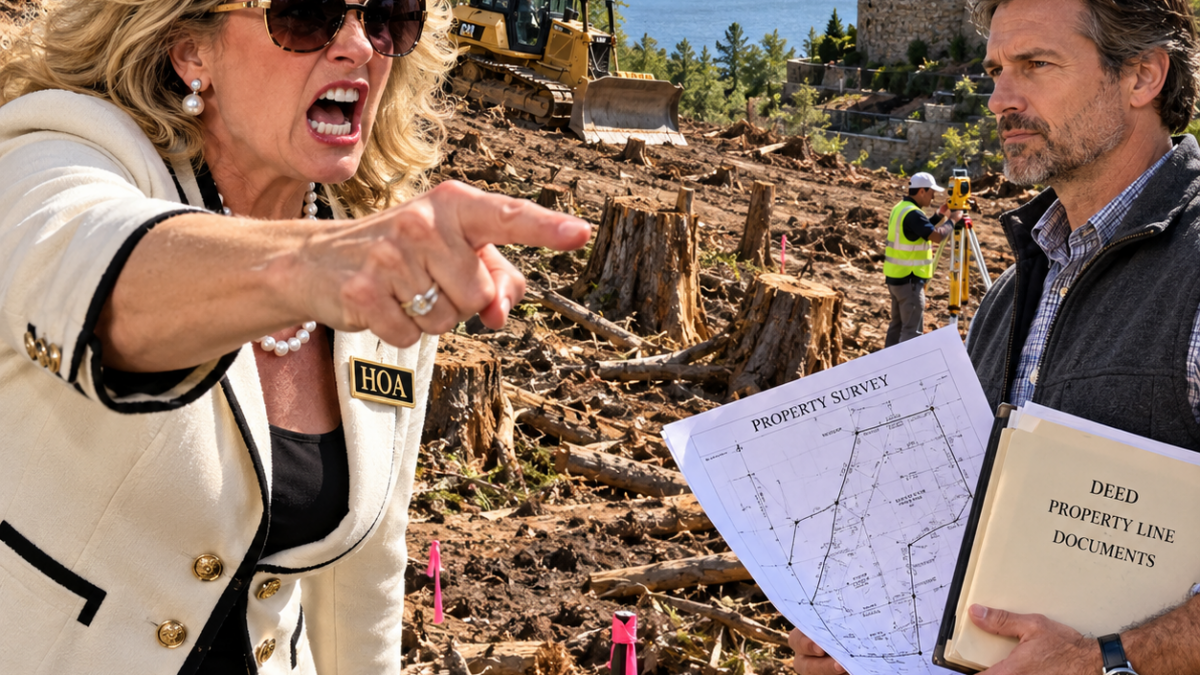
PART 2
Sarah reached the property twenty minutes later.
I heard her car before I saw it.
She pulled off the road, stopped too fast, and got out without closing the driver’s door.
For a few seconds, she stood frozen.
She had seen those trees almost as long as she had known me.
Our first date had technically been at a movie theater, but our first afternoon together—the one both of us actually remembered—had happened beneath the maples.
Cheap sandwiches.
Two Cokes.
A blanket my mother never got back.
We had carved J + S into the bark of the largest tree.
Teenagers always believe permanence is something you can make with a pocketknife.
Sarah covered her mouth.
“Oh, Jack.”
I stopped taking photographs.
She walked slowly toward the stumps.
I watched her find the tree.
Or what remained of it.
The section where our initials had been was gone.
Probably fed into a chipper.
She ran her fingertips across the fresh wood.
“Leo doesn’t know yet?”
“No.”
She looked toward the house.
“He’s at school?”
“For another hour.”
Her eyes filled.
“What are we going to tell him?”
That question hurt more than Karen’s invoice.
Leo was nine.
He knew the grove as Grandpa’s Maples even though my grandfather had died years before Leo was born.
I had told him stories.
How Grandpa drilled the taps.
How he boiled sap.
How he made syrup so dark and strong that my grandmother claimed it could wake the dead.
Last winter, Leo and I bought ten new metal taps.
We planned to use them when the weather turned cold.
They were still sitting unopened on a shelf in my barn.
I looked toward the road.
“I don’t know yet.”
Sarah wiped her eyes.
Then she noticed the tire ruts.
“What did they drive through here?”
“Skid steer, probably. Logging truck.”
“Did they damage the common strip too?”
“Yes.”
She crouched beside a dark stain.
“That oil?”
“Hydraulic fluid or diesel.”
“You photographing it?”
“Yes.”
“Everything?”
“Yes.”
She looked at me.
Something passed between us.
Fifteen years in the Army Corps of Engineers had taught me how to turn stress into procedure.
Sarah had spent enough years married to me to recognize the moment.
Her expression changed.
Grief remained.
But beneath it appeared resolve.
“Okay, Sergeant.”
I almost smiled.
She only called me that when she thought I was turning our kitchen into a tactical operations center.
“What’s the mission?”
“Evidence.”
“Good.”
She pulled out her phone.
“Tell me where to start.”
We documented everything.
Not emotionally.
Systematically.
I photographed each stump beside a numbered marker.
Sarah created a written list.
Tree One through Tree Ten.
Approximate diameter.
Condition of the surrounding ground.
Damage from machinery.
Photographs from multiple angles.
She took video from the road showing exactly how the equipment had crossed into our property.
We measured the tracks.
Photographed the damaged curb.
The boxwoods crushed at the edge of the Summit Ridge common strip.
A bent drainage grate.
The fuel stain.
An abandoned plastic bottle with the tree company’s logo on it.
Then I pulled up old family photographs.
There was Grandpa beneath the maples.
My father hanging a swing.
Me at eight years old covered in mud.
Sarah and me beneath the grove.
Leo sitting on my shoulders under a red-orange canopy three Octobers earlier.
Proof of condition.
Proof of history.
Proof of size.
Proof they had been healthy.
By six that evening, the tragedy had become a case file.
That did not make it hurt less.
But it gave the hurt somewhere to go.
Leo came home shortly before dark.
He noticed immediately.
A nine-year-old doesn’t need survey documents to understand when ten trees have disappeared.
He stood at the edge of the meadow.
“Dad?”
I walked beside him.
“Where are Grandpa’s trees?”
I had rehearsed possible explanations.
None survived his face.
“Someone cut them down.”
His eyes widened.
“Why?”
Sarah stood behind us.
I knelt.
“Some people thought they had the right to.”
“But they didn’t?”
“No.”
“Can we put them back?”
That broke me.
Adults understand finality.
Children still believe broken things should have a reverse button.
“No, buddy.”
He stared at the stumps.
“All of them?”
“All of them.”
His lower lip tightened.
Then he asked the question I still remember more clearly than Karen’s words.
“Did they know Grandpa planted them?”
“No.”
“Would it have mattered?”
I looked toward Karen’s house on the ridge.
“I don’t know.”
Leo kicked at the dirt.
“That’s stupid.”
“Yes.”
He looked at me.
“Are we going to do something?”
“Yes.”
“What?”
I put a hand on his shoulder.
“I’m going to figure out exactly what they did.”
That night, after Leo went to bed, the dining room became our command post.
I brought out my grandfather’s original property file.
Deeds.
Tax maps.
Old correspondence.
And the 1948 survey.
The paper smelled like age.
Blue lines.
Handwritten bearings.
Distances measured from iron pins and landmarks that no longer existed.
I placed it beside the modern Summit Ridge plat.
One fact was immediate.
The maple stand sat nowhere near the questionable access strip.
It was deep inside my deeded property.
Roughly fifty feet.
“Look.”
Sarah leaned over.
“Not even close.”
“No.”
“Then how could she possibly think the HOA had jurisdiction?”
“She probably doesn’t.”
Sarah looked at me.
That was the darker possibility.
We downloaded Summit Ridge’s bylaws.
One hundred fifty pages.
Dense.
Repetitive.
Full of broad language.
I started at the section Karen quoted.
Section Seven.
Article C.
View Obstructions and Aesthetic Harmony.
The language was vague enough to be dangerous.
The Architectural Review Committee could require mitigation of landscape features that “unreasonably impaired designated premium views or materially reduced aesthetic value.”
“Designated by who?” Sarah asked.
“Good question.”
I searched.
No definition.
No official map of premium views.
No criteria.
Nothing.
Then I read Article D.
I sat upright.
“What?”
Sarah asked.
“Procedure.”
Any action taken under Article C required thirty days’ written notice.
Opportunity for homeowner response.
Formal hearing.
Board vote.
Written decision.
Meeting minutes distributed to members within seven days.
Sarah leaned back.
“She did none of that.”
“None.”
“What about emergency removal?”
I searched again.
Emergency action existed.
But it applied to immediate threats to life, safety, or common property.
Downed trees blocking emergency routes.
Gas leaks.
Unstable structures.
Electrical hazards.
Not ten living maples standing upright on private land.
Sarah said softly, “She knew.”
“We don’t know that yet.”
“Jack.”
“I know what it looks like.”
“Then say it.”
I looked at the stump photographs.
“She probably knew.”
Sarah crossed her arms.
“And did it anyway.”
I found the date of the quarterly property valuation circulated to homeowners.
The day before the tree removal.
Karen’s property sat on one of the highest lots.
A clear Blue Ridge view was a selling feature worth real money.
Sarah followed my eyes.
“Oh.”
“What?”
“She did it for her view.”
“Maybe.”
“Jack.”
“I need evidence.”
“You always need evidence.”
“That’s why we still own a house.”
She gave me the look.
Then smiled despite herself.
“Call Marcus.”
Marcus Thorne had served as a JAG attorney attached to our brigade years earlier.
We became friends because I was good at getting engineering units into complicated places and Marcus was good at getting soldiers out of complicated paperwork.
After leaving service, he opened a property and contract practice.
He answered at 7:04 the next morning.
“You alive?”
“Mostly.”
“Sarah finally leave you?”
“Not yet.”
“Then why are you calling before coffee?”
“HOA bulldozed ten of my grandfather’s maples.”
Silence.
Real silence.
Then:
“Repeat that.”
I did.
Private land.
No notice.
No hearing.
No vote I knew about.
Emergency claim.
View obstruction.
$4,850 bill.
$500 stump fine.
When I finished, Marcus said:
“You’re joking about the stump fine.”
“I wish.”
“They cut the trees.”
“Yes.”
“Then fined you because the stumps are ugly.”
“Yes.”
“Jack.”
“I know.”
“Send me everything.”
I emailed the photographs.
Survey.
Bylaws.
Karen’s invoice.
Old tree photos.
Marcus called back that afternoon.
His tone was different.
Professional now.
“First, stop thinking of this as an HOA argument.”
“Okay.”
“This is potentially trespass, conversion, property destruction, unauthorized entry, possibly statutory tree damages depending on how state law applies and what facts we prove.”
“How bad for them?”
“Potentially very.”
“What do we do first?”
“Certified arborist.”
“I already called one.”
“Good.”
“Surveyor too?”
“Eventually.”
He paused.
“But the existing survey already establishes those trees were deep inside your property?”
“Yes.”
“Then start there.”
The arborist arrived two days later.
Dr. Elaine Porter.
She spent three hours examining stumps.
Growth rings.
Rot.
Disease indicators.
Root condition.
Photographs.
Her conclusion was simple.
The maples had been mature, healthy sugar maples with no obvious evidence of imminent failure.
The largest were irreplaceable at comparable maturity in any practical sense.
She produced an estimated replacement and landscape value of roughly sixty-five thousand dollars for all ten, depending on valuation methodology.
That figure did not include land restoration.
Fuel contamination.
Ruts.
Stump grinding.
Or sentimental value, which courts rarely price the way families do.
Marcus drafted the demand.
It was beautiful.
Not because it was dramatic.
Because it was cold.
Fact One.
The trees were on my deeded property.
Fact Two.
The HOA had no recorded ownership or easement over that portion.
Fact Three.
No required notice was issued.
Fact Four.
No hearing was held.
Fact Five.
No emergency existed according to professional arborist review.
Fact Six.
The HOA had caused direct physical damage through its contractor.
Demand:
$65,000 tree loss.
$10,000 preliminary remediation.
Rescission of the $4,850 invoice.
Rescission of the $500 fine.
Written apology.
Preservation of all records regarding authorization, contracting, payment, and board deliberation.
Marcus also demanded Karen’s resignation.
“That’s ambitious.”
I told him.
“That part isn’t damages.”
“It’s leverage.”
“I don’t want leverage.”
“What do you want?”
I looked at the stumps through the kitchen window.
“Accountability.”
Marcus sighed.
“Everybody says that right before they discover accountability is negotiated.”
Still, we sent it.
Certified mail.
Copies to every board member.
Not just Karen.
That mattered.
If the board knew now, nobody could later pretend they didn’t.
Two weeks passed.
No answer.
The silence irritated me more every day.
Then the Summit Ridge envelope arrived.
Gold embossed logo.
Heavy paper.
Karen liked heavy paper.
I opened it.
Claim denied.
The board supposedly found the removal appropriate.
Trees characterized as nuisance vegetation and potential fire risk.
Removal described as protecting community aesthetics and property values.
No apology.
No compensation.
Then I found the second page.
$4,850 emergency removal fee.
Still due.
And below it:
$500 landscape maintenance violation: unsightly stumps.
I laughed.
Sarah looked up from the couch.
“What?”
I handed it to her.
She read.
Then stared at me.
“She actually did it.”
“Yes.”
“She fined us for the stumps.”
“Yes.”
“The stumps created because she cut down the trees.”
“Yes.”
Sarah laughed too.
Not because it was funny.
Because reality had stepped beyond normal emotional categories.
I scanned everything to Marcus.
His email came five minutes later.
DO NOT RESPOND YET. SHE IS WRITING OUR EXHIBITS FOR US.
He called immediately after.
“She says the board reviewed your complaint?”
“Yes.”
“Then we find out who voted.”
“How?”
“Members.”
That weekend, I started walking Summit Ridge.
I knew many residents casually.
Waves.
Mailbox conversations.
Occasional barbecue.
But I had never been involved in HOA politics.
My first visit was Arthur Pendleton.
Retired history professor.
White beard.
Always wore collared shirts even while gardening.
He had lived in the area before Summit Ridge existed.
When I told him about the maples, he closed his eyes.
“I heard machinery.”
“You didn’t know?”
“I assumed you were clearing something.”
He looked toward the ridge.
“Those trees were magnificent.”
I showed him the invoice.
His eyebrows rose.
“She billed you.”
“Apparently.”
Arthur handed it back carefully.
“I should not be surprised.”
He invited me inside.
His living room looked like a small university library.
Maps.
Books.
Framed historical photographs.
He poured iced tea.
Then told me Summit Ridge’s history.
Before Karen, the HOA mostly maintained the entrance, common landscaping, snow contracts, road issues.
Karen joined the Architectural Review Committee.
Then chaired it.
Then became president.
Rules multiplied.
Mailbox colors.
Approved plants.
Door paint.
View language.
“She wrote that clause.”
Arthur said.
“Section Seven?”
“Yes.”
“Was it properly adopted?”
Arthur smiled without humor.
“That depends which version of history you prefer.”
He went to a filing cabinet.
Pulled out a folder.
Meeting minutes.
Emails.
Original developer plat.
“I was on the board.”
“I didn’t know.”
“I resigned.”
“Why?”
“Her.”
He showed me meeting notes from the summer when the premium-view rule supposedly passed.
Arthur had objected.
He believed the language was too vague.
No official premium-view map existed.
No definition of obstruction.
No compensation procedure for affected owners.
“It was nonsense.”
He said.
“She pushed it because houses on the ridge wanted vegetation below them controlled.”
“Her house.”
“One of them.”
Then Arthur showed me the original development plan.
No designated premium views.
Nothing.
The phrase didn’t exist in the recorded development documents.
Karen had effectively invented the category later.
Arthur leaned forward.
“What she did to you is not enforcement.”
“No.”
“It’s theft.”
That was the first neighbor to say it plainly.
He agreed to help.
My next visit was Tom Miller.
No relation to Karen.
Two children.
Basketball hoop in the driveway.
Or rather, used to be.
The HOA had fined him five hundred dollars because the portable hoop was visible from the street.
“It’s in the garage now.”
He told me.
“Kids hate it.”
“Why not appeal?”
He looked toward Karen’s house.
“Because I have a job.”
I understood.
Fighting bureaucracy is expensive even when no money changes hands.
Time.
Stress.
Attention.
Karen’s real weapon was friction.
Make surrender easier than resistance.
I showed him my stump fine.
Tom’s eyes widened.
“She charged you after cutting them?”
“Yes.”
“That’s insane.”
“Did you receive board minutes approving the removal?”
“No.”
“Any notice?”
“No.”
“Any email mentioning my trees before they were cut?”
He thought.
“Nothing.”
I asked whether he would sign a statement saying that, as a homeowner in good standing, he had received no distributed board minutes relating to approval of the removal.
He hesitated.
“My wife works with some of these people.”
“I understand.”
“She has to see Karen at school events.”
“I understand.”
“What if this goes nowhere?”
“Then don’t sign.”
He looked surprised.
“I’m not asking anyone to risk their peace for my case unless they choose to.”
I packed the paper.
Tom stopped me.
“Leave it.”
“You sure?”
“No.”
He smiled weakly.
“But leave it.”
Yellow.
Not yet green.
Then Mrs. Gable.
Eighty-two.
Widow.
Immaculate house.
Karen had been sending her weekly letters about the shade of her front door.
“Eggshell.”
Mrs. Gable told me.
“She says it’s oyster.”
I looked at the door.
Beige.
Some kind of beige.
“I honestly cannot tell the difference.”
“Neither can I!”
She nearly shouted.
Then lowered her voice.
“Sorry.”
She showed me the notices.
Threat of fines.
Threat of lien.
Over paint.
I showed her my invoice.
She read it.
Her hands stopped trembling.
“She did this?”
“Yes.”
“She cut your trees and charged you?”
“Yes.”
Mrs. Gable’s posture changed.
Fear left.
Anger arrived.
“That woman is a menace.”
“Would you be willing to tell the board what happened to you?”
“I’ll tell the whole neighborhood.”
Green.
The pattern spread.
Garden hose fines.
Tree-house dispute.
Political sign complaints.
Mailbox issues.
Decorations.
Window treatments visible from outside.
Most residents paid.
Moved.
Removed.
Repainted.
Apologized.
Not because Karen was always legally right.
Because Karen was exhausting.
After two weeks, I had twenty-four interviews.
Twelve written statements.
Six more potential witnesses.
Arthur gave me old records.
We mapped alliances.
Karen’s reliable board bloc included Barry Jones and Linda Croft.
Both lived on the upper ridge.
Both benefited from the newly opened mountain view.
Treasurer David Chun was different.
Quiet.
Accountant.
Rarely argued.
The fifth board member attended inconsistently.
Karen effectively needed only Barry and Linda most of the time.
Marcus reviewed everything.
“This has become bigger than damages.”
“I know.”
“Recall.”
“That’s what Arthur said.”
“The bylaws?”
“Twenty-five percent petition.”
“How many houses?”
“One hundred twenty.”
“Thirty signatures.”
“We can get thirty.”
“Probably.”
Marcus tapped Karen’s bill.
“But recall works better if we prove self-interest.”
“Her view.”
“That’s motive.”
“What do you want?”
“Money trail.”
That meant records.
As a person with rights tied to the maintenance agreement and affected association action, Marcus crafted our request carefully.
Treasurer records.
Vendor contracts.
Reserve expenditures.
Meeting minutes.
Payment approvals.
We served David Chun directly.
Nine business days later, David responded.
Professional.
Polite.
Records available for inspection.
Two-hour window.
Karen would attend.
Of course she would.
Marcus trained me before I went.
“You are not there to confront her.”
“I know.”
“You’re not there to mention Frank.”
“Who’s Frank?”
“Exactly.”
“I don’t know any Frank.”
“Good.”
“Can I breathe?”
“Minimally.”
I arrived with a portable scanner.
Laptop.
Notebook.
Karen sat behind the HOA office desk.
David stood beside two boxes.
“Mr. Sterling.”
Karen said.
“You have two hours.”
“Thank you.”
“No records may leave.”
“I’ll scan them.”
Her mouth tightened.
“The rules say inspect.”
Marcus had anticipated that.
I handed her the relevant policy allowing reasonable copying at the member’s cost unless specifically restricted.
“I brought my own equipment.”
She looked annoyed.
David said quietly:
“He can copy them.”
Karen glared at him.
Then leaned back.
“Fine.”
I scanned.
Ledger.
Invoices.
Contracts.
Reserve records.
Check images.
For ninety minutes, nothing explosive.
Landscaping.
Insurance.
Road maintenance.
Legal fees.
Snow contract.
Printing.
Then I found Appalachian Tree and Land Clearing LLC.
$4,850.
Emergency service.
My property address.
Paid the day after removal.
From reserves.
I scanned.
Then checked the bylaws.
Expenditure above $1,000 required board authorization and two signatures.
The check had two.
Karen Miller.
David Chun.
Except David’s signature looked wrong.
I had seen his signature on the access appointment email.
Neat.
Controlled.
This one looked like someone trying to draw a signature quickly.
I scanned the front.
Back.
Invoice.
Vendor form.
Then my eyes stopped at the company information.
Approved vendor date:
Three weeks before my trees were cut.
Registered business address:
P.O. box.
Owner:
Frank Miller.
My heart rate changed.
I took out my phone.
Public business registry.
Appalachian Tree and Land Clearing LLC.
Registered agent:
Franklin Miller.
Address linked to the same household as Karen.
Her husband.
I kept my face neutral.
The room suddenly felt very quiet.
Karen asked:
“Something interesting?”
I didn’t look up.
“Just finishing the vendor section.”
“Your time is almost over.”
“Understood.”
I scanned one final page.
Packed everything.
Thanked David.
Nodded to Karen.
Walked outside.
Only when I reached my truck did I breathe normally.
I called Marcus.
“Frank Miller.”
“What?”
“Tree company owner.”
Silence.
“Karen’s husband?”
“Yes.”
“Payment?”
“Reserve fund.”
“Vote?”
“Nothing in the records I saw.”
“Check?”
“Two signatures.”
“David?”
“Second signature looks wrong.”
Marcus stopped joking.
“Do not call it forged yet.”
“I know.”
“We need David.”
“I know.”
“But Jack?”
“Yeah?”
“This just became very serious.”
Arthur and I examined old meeting records next.
That is when we found something even stranger.
The minutes adopting the premium-view rule listed Arthur as present.
Arthur stared at the page.
“That’s impossible.”
“Why?”
“I had resigned by then.”
He went to his office.
Returned with airline paperwork.
Conference in Boston.
Hotel receipt.
Credit-card statement.
“You weren’t even in North Carolina.”
“No.”
Yet the minutes listed him as present.
And voting yes.
“That isn’t sloppy recordkeeping.”
Arthur said.
“No.”
“That’s fabricated.”
I photographed everything.
Marcus reviewed it.
Now we had:
Unauthorized destruction.
Personal benefit.
Family-connected vendor.
Reserve expenditure.
Questionable second signature.
Potentially fabricated historical minutes.
Pattern of selective enforcement.
Enough to force the entire neighborhood to pay attention.
We started the recall petition.
Tom Miller signed first.
He looked at the state business filing linking Frank to the tree company.
“She paid her husband with our reserve money?”
“That’s what the records show.”
“And then billed you?”
“Yes.”
Tom signed so hard the pen almost tore the page.
Mrs. Gable collected five signatures herself.
Arthur collected eight.
Families who had been yellow turned green.
Thirty required.
We got forty-five.
The annual meeting was three weeks away.
Perfect stage.
Marcus wanted a presentation.
“Not a legal brief.”
he told me.
“People remember stories.”
“I hate PowerPoint.”
“Everybody hates PowerPoint.”
“So?”
“Make one good enough to justify its existence.”
We built five sections.
First:
The grove before.
A fall photograph.
Red leaves.
Golden light.
Leo standing beneath the trees.
Second:
After.
Mud.
Stumps.
Ruts.
Third:
Authority.
Survey showing the trees fifty feet inside my property.
Bylaws requiring notice, hearing, vote.
No notice.
No hearing.
No distributed minutes.
Fourth:
Pattern.
Resident stories.
Door paint.
Basketball hoop.
Tree house.
Fifth:
Money.
Appalachian Tree and Land Clearing.
Frank Miller.
$4,850 reserve payment.
Then the signature question.
But we needed David Chun.
Marcus and I met him at a coffee shop.
David arrived looking exhausted.
He knew.
People always know when documents are beginning to talk.
Marcus slid the check copy across the table.
David stared.
“What is this?”
“You tell us.”
He studied the signatures.
His face lost color.
“That’s not mine.”
“Certain?”
“I don’t sign like that.”
He reached for another document in his bag.
Produced a legitimate HOA check copy.
Neat signature.
No resemblance.
“I never approved this.”
I watched him.
“Did Karen tell you about the tree removal?”
“Afterward.”
“What exactly?”
“She said emergency landscaping.”
“Did you authorize reserve funds?”
“No.”
“Did the board vote?”
“Not that I attended.”
Marcus leaned forward.
“David, somebody used your name to move association money.”
David’s hands shook.
“She has the checkbook.”
“Will you say publicly that the signature isn’t yours?”
Fear appeared.
“What happens to me?”
“That depends on whether you help conceal it.”
Marcus didn’t soften the sentence.
David swallowed.
“I didn’t know.”
“Then tell the truth.”
David looked at me.
“I’m sorry about your trees.”
“Thank you.”
“I should have paid attention.”
“So should a lot of people.”
He looked down.
“I’ll say it.”
The annual meeting was packed.
Karen began like nothing was wrong.
Property values.
Landscaping.
Community standards.
Then she actually praised the removal.
“A significant view obstruction affecting premium lots has been successfully abated.”
I watched Sarah’s hand tighten around mine.
She leaned close.
“Don’t.”
“I’m not.”
“You made the face.”
“What face?”
“The Afghanistan briefing face.”
I relaxed my jaw.
Treasurer report came next.
David stood.
His paper shook.
“Before I summarize finances, I need to report an unauthorized reserve expenditure.”
Karen turned.
“David.”
He continued.
“Check number 4811 in the amount of $4,850 was issued for tree removal.”
The room murmured.
“I did not authorize this payment.”
Karen’s face changed.
“David, this is not on the agenda.”
“My signature appears on the check.”
Silence.
“It is not my signature.”
Absolute silence.
Karen stood.
“That is an internal accounting issue.”
“No.”
David’s voice strengthened.
“Someone signed my name.”
That was my cue.
I stood.
Karen pointed.
“You sit down.”
Arthur spoke.
“The recall petition is on tonight’s agenda.”
Karen looked at him.
“This is not your meeting.”
“No.”
Arthur smiled.
“It’s theirs.”
He gestured toward the homeowners.
Applause started.
Karen sat.
Barely.
I walked to the front.
Clicked the remote.
My grandfather’s maples filled the screen.
No words for five seconds.
Then:
“Those trees stood for more than seventy years.”
Next slide.
Stumps.
Gasps.
“On October twelfth, a contractor hired by this association entered my private property without my permission and removed all ten.”
I showed the survey.
“The trees were roughly fifty feet inside my boundary.”
Bylaws.
“Article Seven requires thirty days’ notice.”
None.
“Hearing.”
None.
“Board vote.”
No evidence.
“Distributed minutes.”
None.
Karen interrupted.
“It was an emergency.”
I displayed Elaine Porter’s arborist report.
“Certified arborist found no evidence these trees presented an imminent hazard.”
“You hired her!”
“Yes.”
“She’s biased.”
“Then where is your arborist report?”
Silence.
“Where is your fire-risk assessment?”
Nothing.
“Where is the emergency declaration?”
Nothing.
I clicked.
Meeting minutes adopting the view rule.
Arthur listed present.
Then his Boston travel documentation.
Arthur stood.
“I was seven hundred miles away.”
People began talking.
Karen’s face reddened.
“That was an administrative error.”
“An administrative error recorded a former board member as present and voting?”
She had no answer.
Next slide.
Appalachian Tree and Land Clearing.
Owner:
Frank Miller.
Somebody shouted:
“Your husband?”
Karen stood.
“That was the best available contractor.”
“Bid records?”
I asked.
“It was emergency work!”
“How many bids?”
“Emergency actions do not require—”
“So none?”
She slammed her hand down.
“This is harassment.”
I clicked again.
$4,850 check.
Two signatures.
I enlarged David’s.
Then displayed his legitimate signature beside it.
The difference was obvious.
People stopped talking.
I turned.
“David.”
He stood.
“Is that your signature?”
“No.”
Karen shouted:
“Sit down!”
David looked at her.
“No.”
The entire room shifted.
Years of obedience ended in one syllable.
No.
Arthur rose.
“I move for immediate recall of Karen Miller as president and director for gross misconduct, self-dealing, unauthorized expenditure of reserve funds, falsification of association records, and abuse of authority.”
Tom Miller:
“Second.”
Karen grabbed the gavel.
“This motion is out of order.”
Marcus stood from the back.
“No.”
Karen turned.
“And who are you?”
“Marcus Thorne. Counsel for Mr. Sterling.”
The room murmured.
“The recall petition was properly submitted. Notice was given. The item appears on the published agenda.”
He held up the bylaws.
“The vote proceeds.”
“You do not represent this association.”
“I don’t need to.”
Karen looked at Barry.
Then Linda.
Barry looked down.
Linda whispered:
“I’m not getting involved.”
Karen realized she had no army left.
Ballots were distributed.
It was nearly unanimous.
Karen lost.
She sat frozen while Arthur announced the result.
For the first time since I had known her, she looked small.
Not physically.
Socially.
Power had always made her seem larger than the room.
Without it, she was just a furious homeowner sitting behind a folding table.
She grabbed her purse.
“You’ll all regret this.”
Mrs. Gable, of all people, answered.
“No, dear.”
Karen stopped.
Mrs. Gable’s voice was calm.
“I think we’ve regretted enough already.”
Karen left.
The door slammed.
Nobody cheered immediately.
Then somebody exhaled loudly.
Laughter started.
Then applause.
Arthur became interim president.
Tom vice president.
Helen Brooks, a retired CPA, became treasurer.
David agreed to stay temporarily as an adviser during the transition.
The first motion Arthur made:
“Summit Ridge formally rescinds the $4,850 abatement invoice and the $500 stump violation issued to Jack and Sarah Sterling.”
Unanimous.
Second:
“Summit Ridge formally acknowledges that the association lacked proper authority and procedure to remove the Sterling maple stand.”
Unanimous.
Third:
“Independent investigation of the reserve payment and contracting practices.”
Unanimous.
I should have felt victorious.
I did.
But only partly.
Because when I drove home that night, the maples were still gone.
That is the problem with some kinds of justice.
It can punish.
It can compensate.
It cannot reverse time.
The forensic audit took six weeks.
It got uglier.
Frank Miller’s tree company was not the only connected vendor.
Landscaping.
Snow removal.
Printing.
Minor repair work.
Contracts directed to friends.
Family.
Associates.
Some overpriced.
Some poorly documented.
Roughly thirty thousand dollars in questioned expenditures over several years.
Karen and Frank retained counsel.
Negotiations began.
The association demanded repayment.
I pursued my property claim separately.
Karen’s lawyer initially insisted the HOA, not Karen personally, was responsible for the tree removal.
Marcus disagreed.
“She acted outside authorized procedure and personally orchestrated the vendor arrangement.”
The lawyers fought.
Insurance entered.
So did the association’s counsel.
Eventually, settlement.
My claim:
$75,000.
Trees.
Land damage.
Remediation.
Related costs.
The association accepted responsibility for restoration while preserving claims against Karen and Frank.
Karen and Frank repaid substantial misdirected association funds as part of their own settlement.
Karen resigned from every remaining Summit Ridge role and agreed not to seek another association position there.
No triumphant courtroom speech.
No judge slamming a gavel.
Most civil wars end in conference rooms.
Checks.
Signatures.
Release language.
Still, the result mattered.
Sarah and I received the funds.
The HOA got money back.
Records were corrected.
Karen’s reign ended.
Yet every morning, I saw the empty meadow.
The mountain view remained open.
Karen’s house sat above us.
Her deck had a perfect line toward the Blue Ridge.
Exactly what she wanted.
One evening I stood outside after sunset.
Sarah joined me.
“Still bothering you.”
“Yes.”
“She’s gone.”
“I know.”
“We won.”
“I know.”
“Then what?”
I looked toward the ridge.
“It doesn’t feel restored.”
“No.”
“The land still feels violated.”
Sarah leaned against me.
“You can plant again.”
“I will.”
“But?”
I stared at the slope.
Then remembered Grandpa.
Not a dramatic memory.
Just his voice.
He used to complain about the boundary.
“They stole ten feet from me.”
He said it so many times that everyone in the family treated it as one of Grandpa’s stories.
Like his claims about seeing a panther in 1962.
Or the tractor he swore he repaired with a spoon.
Except Grandpa had worked as a surveyor’s assistant when he was young.
He understood lines.
Pins.
Bearings.
Monuments.
“They moved the marker.”
he used to say.
“When they started developing the hill.”
I told Sarah.
She went still.
“You think he was serious?”
“I always thought he was being Grandpa.”
“But?”
“I have the 1948 plat.”
She smiled slowly.
“Oh no.”
“What?”
“You have that look.”
“What look?”
“The look you had right before you read one hundred fifty pages of HOA rules.”
The next morning, I called Marcus.
“No.”
That was his first response.
“I haven’t told you the question.”
“You won.”
“Maybe.”
“No.”
“My grandfather said the boundary was wrong.”
Silence.
“That’s worse.”
“How?”
“You’ve discovered another mission.”
“I want a survey.”
Marcus sighed.
“Jack, boundary disputes are miserable.”
“I’m not disputing anything yet.”
“You’re calling a lawyer about a seventy-eight-year-old plat.”
“Correct.”
“That is the opening sentence of a boundary dispute.”
Still, he gave me a name.
Evans Geodetic & Historical Survey.
The company specialized in older deeds and boundary reconstruction.
Not cheap.
Good.
After everything that happened, I wanted accuracy, not bargains.
Mr. Evans arrived with two technicians.
They studied the 1948 plat.
Modern survey.
Deeds.
Development records.
They searched for original iron pins.
One technician used detection equipment along the lower boundary.
Hours passed.
Then he found metal.
Deep.
Old iron.
Not modern rebar.
A second original pin appeared two days later.
That gave them a baseline.
The crew returned with high-grade GNSS equipment.
Total station.
Historical deed chain.
County control points.
For three days they measured.
Calculated.
Returned.
Measured again.
I asked Mr. Evans nothing.
I didn’t want hope contaminating reality.
On the fourth afternoon, he called.
“Mr. Sterling?”
“Yeah?”
“Can you come up the hill?”
I walked toward the border.
He stood beside an orange flag.
Karen’s backyard lay beyond him.
Or what everyone thought was Karen’s backyard.
Mr. Evans pointed.
“We have a discrepancy.”
“How much?”
“At the lower end, small.”
He looked upslope.
“Widening substantially.”
We walked.
Orange flags formed a line.
Not where the Summit Ridge fence markers assumed.
Higher.
Inside the landscaped edge.
“How far?”
I asked.
“At this location?”
He checked.
“Approximately twelve feet.”
I stopped.
Twelve feet.
“What does that mean?”
“It means, based on the original deed calls, recovered monuments, and our retracement, this is the stronger boundary.”
I looked upslope.
The line passed through Karen’s rose garden.
Then clipped the outer edge of her flagstone patio.
My mouth went dry.
“You’re certain?”
“I don’t use that word casually.”
He smiled slightly.
“We’re confident enough to certify it.”
I looked back toward my grandfather’s land.
All those years.
Grandpa pointing up the hill.
“They moved the markers.”
Maybe nobody maliciously moved anything.
Maybe the development survey started from a bad monument.
Maybe records drifted.
Maybe it was simple error.
But the result was the same.
The modern line was wrong.
Marcus was less excited than I expected.
“Do not touch anything.”
“I know.”
“No fence.”
“I know.”
“No moving plants.”
“I know.”
“No midnight bulldozer revenge.”
I laughed.
“I’m not Karen.”
“Exactly.”
Quiet-title action.
Formal legal process.
Karen received service.
Her reaction reached me through her lawyer.
Adverse possession.
Reliance.
Longstanding occupancy.
Equitable arguments.
Marcus handled it.
The court appointed review.
Survey evidence submitted.
Historical plat.
Recovered pins.
Development records.
No dramatic one-hour decision.
Months.
Motions.
Technical testimony.
Expert reports.
Waiting.
That was the hardest part.
The boundary existed physically.
But until title was settled, the line remained contested.
Finally, judgment.
The certified survey prevailed.
The court recognized the corrected boundary.
A wedge of land roughly four hundred feet long.
Narrow at one end.
About twelve feet at its widest.
Mine.
Legally.
The ground Karen thought supported her rose garden and part of her patio edge was part of my parcel.
When Marcus called, I sat down.
“You won.”
I looked toward the ridge.
“No.”
“Jack.”
“I know.”
He laughed.
“This is the only client I’ve ever had who becomes less excited after each victory.”
“What happens now?”
“You can enforce your boundary.”
That phrase stayed with me.
Enforce your boundary.
Karen had spent years pretending boundaries were things she could redraw with authority.
Now the actual one had arrived.
Survey flags were installed.
Not at night.
Professionally.
Legally.
But by the time Karen opened her curtains the next morning, the line she had believed in for decades no longer existed.
Orange markers crossed her lawn.
Through the roses.
Beside the patio.
The property line had, from her perspective, disappeared overnight.
I hired a fence contractor.
Cedar privacy.
Tall.
But I checked local zoning.
Maximum permitted height along that portion was not whatever fantasy number I wanted.
We designed it to the lawful limit and obtained every permit necessary.
After Karen’s behavior, I refused to give her even one legitimate procedural argument.
The foreman met me at 7:30.
We walked the certified line.
He pointed toward the roses.
“You understand this crosses landscaping?”
“Yes.”
“Patio corner?”
“The survey shows the patio encroaches slightly.”
“Removing it?”
“Only what is legally required for the fence footing. Carefully.”
He nodded.
“Good.”
I hired a landscaper too.
Any roses on my side would be professionally transplanted.
Not destroyed.
That difference mattered.
The post-hole machine started.
Karen came outside before the second hole.
Bathrobe.
Slippers.
Face already furious.
“What the hell are you doing?”
I walked toward the line.
“Morning.”
“Stop them!”
The foreman looked at me.
I held up one hand.
He shut down the auger.
Karen marched forward.
“Get this equipment out of my yard.”
I held out the certified survey and court order.
“This isn’t your yard.”
She froze.
“What?”
“The boundary case is final.”
She snatched the papers.
Her eyes moved quickly.
“You cannot be serious.”
“I am.”
“My garden is here.”
“Part of it crossed the actual line.”
“You planned this.”
“No.”
“You did all of this to punish me.”
“The survey existed before either of us was born.”
“You’re stealing my property.”
“No.”
I looked toward the stumps downhill.
“I’m enforcing the property line.”
Her eyes followed mine.
For a moment, neither of us spoke.
Then she understood.
The mountain view.
That was the cruel symmetry.
She had destroyed my trees because she believed her view mattered more than my boundary.
Now the real boundary cut directly through the ground from which she enjoyed that view.
She lowered the papers.
“You already took seventy-five thousand dollars.”
“I was compensated for trees you removed.”
“That should have ended it.”
“This boundary has nothing to do with the settlement.”
“You could leave it open.”
“I could.”
“Then why the fence?”
I thought about the honest answer.
Not the angry answer.
Privacy.
Security.
Restoration.
Not wanting her house looming over the land she had violated.
“I don’t trust you to respect an invisible boundary.”
That hurt her more than any insult could have.
Her face tightened.
“You’re vindictive.”
“Maybe you believe that.”
“You’re doing this because of the trees.”
“The trees are why I checked the records.”
I pointed at the orange flags.
“The records are why this line is here.”
She looked at the workers.
“How high?”
“Legal height.”
Her eyes widened.
“You’ll block the mountains.”
I said nothing.
There are moments when silence does more than any speech.
Karen looked toward the view.
Then back at me.
“Please.”
That word shocked me.
I had never heard it from her.
Not because I enjoyed hearing it.
Because it showed how quickly power changes when consequences arrive.
She tried again.
“Jack, please.”
I thought about Grandpa’s maples.
Leo asking whether we could put them back.
Sarah standing beside the stump where our initials used to be.
Mrs. Gable’s shaking hands over beige paint.
Tom hiding a basketball hoop.
David Chun realizing someone used his signature.
Karen had received every opportunity to stop.
Notice.
Demand letter.
Recall.
Settlement.
Boundary lawsuit.
She had fought every inch.
Now she wanted mercy at the only moment mercy benefited her.
But mercy did not require surrendering my boundary.
“I’m not tearing your house down.”
I said.
“I’m not cutting your trees.”
“I’m not sending equipment onto land you own.”
“I’m building a lawful fence on land that belongs to me.”
Her mouth trembled.
“You know what this does to my property value.”
I almost laughed.
The greater good.
Premium views.
Property values.
The vocabulary that had justified my loss had returned to ask for protection.
“I know.”
I said.
Karen looked at me for another moment.
Then turned.
Walked back toward her house.
No screaming.
No threats.
No gavel.
The fence went up over two days.
Straight.
Cedar.
Clean.
The roses on my side were relocated to a garden near Sarah’s workshop.
The patio encroachment was professionally trimmed back only as required.
No unnecessary destruction.
When the final board went in, Karen’s mountain view from the lower portion of her patio disappeared.
From her back door, cedar filled part of the horizon.
I expected triumph.
Instead, I felt quiet.
Sarah stood beside me that evening.
“Well?”
“Well what?”
“You’ve been imagining this fence for months.”
“I imagined feeling better.”
“Do you?”
I looked downhill.
At the stumps.
“Not yet.”
She took my hand.
“Then finish the job.”
She was right.
Boundaries stop damage.
They do not restore what damage removed.
The next phase was the only part that mattered in the end.
We ground the stumps.
All ten.
Removed contaminated soil.
Brought in clean topsoil.
Regraded the machinery scars.
Repaired drainage.
Reseeded the meadow.
Then I called a native-tree nursery.
“I need sugar maples.”
“How many?”
I looked at the empty grove.
“One hundred.”
The woman paused.
“One hundred?”
“Yes.”
“What size?”
“Small.”
“How small?”
“Something a kid can help plant.”
Leo came home from school the day the saplings arrived.
Rows of young maples stood beside the barn.
Thin trunks.
Small root balls.
Barely taller than him.
He stopped.
“What are those?”
“Your trees.”
His eyes widened.
“All of them?”
“One hundred.”
“We only had ten.”
“I know.”
“That’s ten times more.”
“I also know.”
He grinned.
“Mom says you overdo things.”
“She says many things.”
Sarah called from the porch.
“I heard that.”
We started planting Saturday morning.
I showed Leo how to make the holes wide, not unnecessarily deep.
How to loosen roots.
How to position the flare.
Backfill.
Water.
Mulch without piling it against the trunk.
He took the job seriously.
“Will these get as big as Grandpa’s?”
“Some.”
“When?”
“Long time.”
“How long?”
“Probably when you’re older than me.”
He frowned.
“That’s forever.”
“It feels that way.”
We planted.
One.
Two.
Five.
Ten.
Twenty.
Neighbors started arriving.
Arthur came with gloves.
Tom brought his children.
Mrs. Gable arrived carrying lemonade.
David Chun showed up quietly.
“I thought you might need help.”
I handed him a shovel.
By noon, twenty people were planting maples.
No HOA order.
No fine.
No committee.
Just neighbors.
Karen did not come.
I didn’t expect her.
By late afternoon, sixty trees were in.
The next day, all one hundred.
Leo stood beside the final sapling.
Mud on his jeans.
Face streaked with dirt.
He looked toward the cedar fence.
“Dad?”
“Yeah?”
“Will the trees get taller than the fence?”
“Eventually.”
“Will they block that lady’s view?”
Everyone nearby became very quiet.
Sarah watched me.
I crouched beside Leo.
“That isn’t why we planted them.”
“But will they?”
“Probably.”
He waited.
I smiled.
“But that’s not our job to worry about.”
“What is?”
I pointed at the sapling.
“Keeping this alive.”
He considered that.
Then nodded.
“Okay.”
Children understand boundaries better than adults sometimes.
Our concern was the tree on our side.
Our soil.
Our water.
Our responsibility.
The rest belonged to someone else.
Summit Ridge changed under Arthur.
Not overnight.
Culture takes longer than boards.
But the ridiculous letters stopped.
View-obstruction language was rewritten.
Then largely removed.
Rules requiring real notice and hearings were strengthened.
Conflict-of-interest disclosures became mandatory.
Family-connected contracts required competitive bids and independent approval.
Reserve withdrawals needed documented votes.
Meeting recordings became available.
Minutes had to identify who actually attended.
Mrs. Gable painted her front door blue.
Not beige.
Blue.
She invited half the neighborhood to watch.
Arthur stood on the sidewalk with lemonade.
Tom rolled his children’s basketball hoop back onto the driveway.
The community survived.
Property values did not collapse.
Mountains did not disappear.
Civilization continued.
Karen listed her home the following year.
I saw the sign from the road.
I felt nothing dramatic.
Not joy.
Not sadness.
Closure rarely arrives with music.
Sometimes it looks like a real-estate sign.
The listing photographs carefully avoided showing the cedar fence.
Marcus sent me the online listing.
“Mountain retreat with partial seasonal views.”
I laughed so hard Sarah thought something was wrong.
“Partial?”
She read it.
“That’s generous.”
“I didn’t write it.”
“I know.”
The house sold.
Not at the premium Karen once imagined.
But it sold.
A family from Charlotte moved in.
The new owner introduced himself.
Evan.
He walked to the fence.
“I think part of the patio used to extend farther.”
“It did.”
“Boundary issue?”
“Yes.”
He nodded.
“I read the survey.”
That alone made me like him.
“No problem on my end.”
he said.
“Fence looks good.”
“Thank you.”
Then he added:
“We’re thinking about planting dogwoods on our side.”
“Sounds nice.”
No argument.
No territorial war.
Just two landowners discussing trees.
That was what normal felt like.
Years passed.
The maple grove changed slowly.
The first year, they looked fragile.
The second, stronger.
The fifth, some were taller than Leo.
By then, Leo no longer needed help carrying mulch.
He complained more.
Teenagers are proof that nature has a sense of humor.
One February morning, he came into the kitchen.
“Dad.”
“Yeah?”
“Is it cold enough?”
“For what?”
“The syrup.”
I looked outside.
Below freezing overnight.
Warmer during the day.
The old pattern Grandpa taught me.
I smiled.
“Get the taps.”
We tapped twelve of the strongest young maples.
Not much sap.
Enough.
Leo checked the buckets like they contained gold.
We boiled it outside.
Steam rose.
Sarah brought coffee.
The syrup reduced slowly.
Darkened.
Thickened.
When we finally poured it into a small bottle, we had maybe enough for one family breakfast.
Leo held it up.
“All that work for this?”
“That’s maple syrup.”
“Grandpa did this?”
“Every year.”
“Why?”
“Because he liked it.”
Leo stared at the bottle.
“People used to have more time.”
Sarah laughed.
The next morning, we made pancakes.
Leo poured too much syrup.
I told him Grandpa would haunt him.
He said Grandpa should have planted more trees.
“Careful.”
I told him.
“We did.”
That was when I realized restoration had finally happened.
Not because the new maples looked like the old ones.
They didn’t.
Not because Karen had lost her view.
That stopped mattering years earlier.
Not because the settlement check cleared.
Money never recreated the grove.
Restoration happened when Leo made syrup from trees he had planted himself.
A memory had replaced the wound.
One evening, Arthur and I walked the meadow.
He had become slower.
Cane now.
Still sharp.
The maples had begun forming a young canopy.
“You know what I admire?”
he asked.
“What?”
“You could have planted Leyland cypress along the boundary.”
“Why?”
“Fast-growing wall. Pure spite.”
I laughed.
“I considered nothing of the kind.”
“You’re a terrible liar.”
We stopped near the fence.
The cedar had weathered silver.
Beyond it, Evan’s dogwoods were blooming.
Arthur touched one maple trunk.
“Karen thought a view was something you could own.”
I looked toward the mountains visible between the young branches.
“Views change.”
“Exactly.”
He smiled.
“Boundaries matter more.”
I thought about that.
Physical boundaries.
Legal boundaries.
Human boundaries.
Karen’s real mistake was not simply cutting trees.
She believed another person’s boundary became flexible whenever her desire was strong enough.
She wanted a view.
So my trees became her obstruction.
She wanted control.
So bylaws became whatever she said.
She wanted a contractor.
So her husband became an emergency vendor.
She wanted money moved.
So another person’s signature became inconvenient.
She wanted records to support her version.
So the minutes changed.
Once someone decides boundaries exist only for other people, abuse becomes remarkably easy.
The fence was never really my revenge.
For a while, I told myself it was.
That made the story satisfying.
She cut my trees.
I blocked her view.
Balance restored.
But that wasn’t the deeper truth.
The fence mattered because she had proven that an invisible line wasn’t enough.
I needed something visible.
Solid.
Undeniable.
A boundary she could not reinterpret.
By then, Karen was gone.
Yet the fence remained.
Not as punishment.
As clarity.
I eventually had a small brass plaque made.
Not on the Karen side.
My side.
Near the grove.
It read:
STERLING MAPLE STAND
ORIGINAL GROVE PLANTED 1954
REPLANTED WITH LEO, 2027
Nothing about the HOA.
Nothing about the lawsuit.
Nothing about Karen.
Sarah noticed.
“You left out the dramatic part.”
“That’s not the part I want remembered.”
She smiled.
“Growth?”
“Yeah.”
“Very mature.”
“Don’t ruin it.”
The 1948 survey now hangs in my woodworking shop.
Framed behind UV glass.
Beside it is the modern certified retracement.
Two maps.
Nearly eighty years apart.
Lines.
Bearings.
Distances.
Paper saved a piece of land.
But sometimes I look at them and think the paper was never the point either.
My grandfather knew that land.
He walked it.
Worked it.
Marked it.
Remembered it.
When later documents drifted, he kept insisting.
“They moved the markers.”
Nobody listened.
Decades later, those old pins were still underground.
Quiet.
Rusting.
Waiting.
That image means something to me.
Truth can disappear beneath years of assumptions.
People build lawns over it.
Gardens.
Patios.
Rules.
Certainty.
Then one day somebody digs deep enough and finds the original marker still sitting where it always was.
Karen built her authority on assumptions.
That the board belonged to her.
That residents would remain silent.
That premium homeowners mattered more.
That paperwork could turn trespass into enforcement.
That her property line was unquestionable.
One by one, every assumption hit something buried deeper.
Actual bylaws.
Actual records.
Actual ownership.
Actual votes.
Actual people.
Actual iron pins.
She bulldozed my maple stand to improve her view.
In doing so, she forced me to examine a boundary nobody had questioned for decades.
That boundary cost her twelve feet of backyard.
But the irony is not the part I treasure now.
The trees are.
One hundred of them.
Some survived better than others.
A few died during a dry summer.
We replaced them.
Storm took three.
Replanted.
Deer damaged several.
Protected them.
That is the thing about restoration.
It requires more patience than revenge.
Revenge feels immediate.
A meeting.
A vote.
A fence going up.
A stunned face.
Restoration asks you to water saplings for years when nobody is watching.
To replace what dies.
To keep tending.
To accept that you may not live long enough to see the final result.
My grandfather planted trees whose shade became mine.
I planted trees whose greatest years will belong to Leo.
That feels right.
On the tenth anniversary of the replanting, we had a gathering.
Not official.
Just family and neighbors.
Arthur was gone by then.
He passed peacefully two winters earlier.
Mrs. Gable came with her granddaughter.
Tom’s children were in college.
David Chun arrived with his wife.
Marcus drove up from Charlotte and complained that I still owed him for “the most entertaining property case of his career.”
“You billed me.”
I reminded him.
“Emotionally.”
he said.
We put a small stone beneath one of the strongest maples for Arthur.
Nothing elaborate.
ARTHUR PENDLETON
HE KEPT THE RECORDS
Marcus laughed when he read it.
“That is the most Arthur memorial possible.”
“He would hate anything sentimental.”
“He’d correct the punctuation.”
Probably.
Leo was nineteen.
Taller than me.
He stood beside the maple we had planted last.
The same one from the photograph where he was nine and covered in mud.
Now the trunk was thick enough that he could barely wrap both hands around it.
“You remember asking if they’d block Karen’s view?”
I said.
He groaned.
“Dad.”
“What?”
“I was nine.”
“You asked.”
“I remember.”
“And?”
He looked at the canopy.
“They do.”
“Some.”
He smiled.
“Not our concern.”
I laughed.
Exactly.
Sarah joined us.
She slipped her arm through mine.
“I think Grandpa would like this.”
I looked through the leaves toward the mountains.
The view wasn’t gone.
Trees don’t erase mountains.
They frame them.
Filter them.
Change with the seasons.
The old grove had done the same.
Karen saw those trees as obstruction.
I saw them now as perspective.
There is a difference.
A person obsessed with an unobstructed view eventually starts treating anything between themselves and what they want as disposable.
Trees.
Rules.
Neighbors.
Boundaries.
People.
But life is mostly what stands between you and the horizon.
Family.
History.
Responsibilities.
Other people’s rights.
You don’t improve the view by bulldozing all of it.
You learn where your land ends.
Where someone else’s begins.
And you take care of what is yours.
That night, after everybody left, I walked to the fence.
The cedar was old now.
Silver-gray.
Still straight.
Evan had sold his house years earlier.
Another family lived there.
We got along fine.
They could see parts of the mountains through their own landscaping.
Nobody complained about my maples.
Summit Ridge had changed.
New bylaws.
New board.
New people.
Karen’s name almost never came up.
That was probably the best ending she could have received.
Not hatred.
Irrelevance.
I placed my hand on the fence.
Then looked across the grove.
Moonlight caught the leaves.
Ten trees had been taken.
One hundred had gone into the ground.
The math felt satisfying, even if life doesn’t really work that way.
You cannot multiply away a loss.
My grandfather’s original trees were still gone.
Our carved initials were gone.
The exact shade they cast was gone.
Some things never return.
But loss does not get the final word unless you stop planting.
That is what Karen never understood.
She thought destruction was power because destruction is immediate.
Machines arrive.
Trees fall.
A view opens.
Everyone notices.
Growth is quieter.
A shovel.
A sapling.
Water.
Years.
Nobody applauds.
Then one morning the thing someone tried to erase is back in another form, stronger because more people helped plant it.
I sometimes wonder what Karen would think if she drove past now.
Maybe she would hate the grove.
Maybe she would see those hundred maples as one final insult.
Maybe she would still believe I did everything to punish her.
She would be wrong.
The punishment ended the day she lost her office.
The rest was restoration.
The survey restored my land.
The fence restored my privacy.
The settlement restored some financial value.
The new board restored trust.
The saplings restored hope.
And Leo tapping those trees for syrup restored something no court could order.
Continuity.
Karen bulldozed my grandfather’s maple stand because she believed her view was worth more than my history.
For a while, I wanted revenge badly enough to imagine her staring at a wall forever.
I got the fence.
I got the twelve feet.
I got the judgment.
I got the money.
I got every satisfying piece of the ending I thought I wanted.
But none of those things became the part I remembered most.
I remember Leo carrying the first sapling.
I remember Sarah’s muddy hands.
I remember Mrs. Gable pouring lemonade for neighbors digging holes.
I remember David Chun planting a tree after finally finding the courage to tell the truth.
I remember Arthur standing beneath the young grove and saying boundaries matter more than views.
And I remember my grandfather’s words.
A man who spends enough time watching things get destroyed ought to put something back in the ground.
So that is what we did.
Karen wanted a better view.
She got one for a little while.
Then the law corrected the line she believed belonged to her.
A fence rose where certainty used to be.
And on my side of it, a hundred maples began reaching toward the sky.
Years later, when the afternoon sun comes through those leaves and the mountains appear in blue fragments between the branches, I understand something I couldn’t understand when I stood among the stumps.
My grandfather’s grove had never only been ten trees.
It was a promise.
Plant something you may never fully enjoy.
Protect what was entrusted to you.
Know where your boundaries are.
Respect the ones that belong to others.
And when somebody destroys something worth preserving, do not spend the rest of your life staring at the damage.
Build again.
Plant again.
Grow again.
That is how I finally erased Karen’s property line from my mind.
Not with a court order.
Not with orange flags.
Not even with the cedar fence.
I erased it by filling my side of the boundary with something more important than revenge.
Life.
And from where I stand now, beneath the maples my son and I planted together, the view has never been better.








