PART 2: HOA Bulldozed My Backup Boiler House for a Christmas Tree—Then Christmas Eve Went Dark and 36 Homes Started Freezing
PART 2
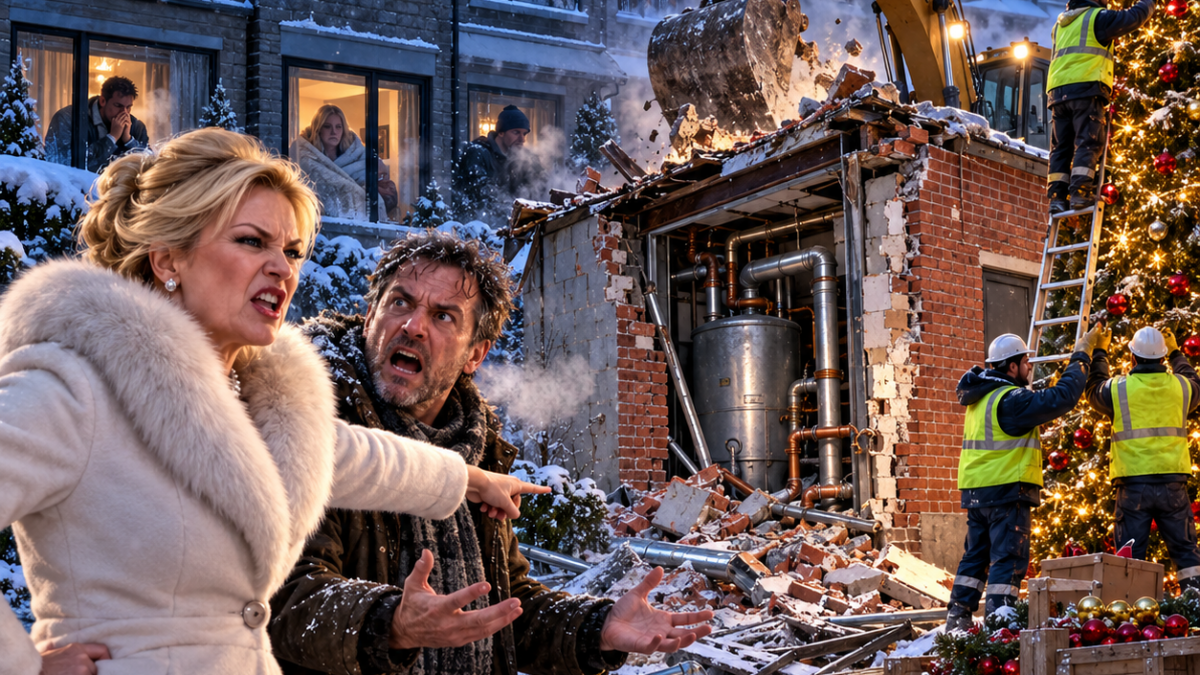
The message clearly stated that I had not authorized demolition and that the boiler house remained private property.
Rick read the printed copy over Greer’s shoulder.
“I was told the owner released the site.”
“Who told you?” I asked.
He hesitated.
Then looked at Audrey.
“Everything came through the project office,” she said.
Greer wrote that down.
When he finished, Audrey asked, “Can the holiday crew at least continue setting up?”
Greer gave her a flat look.
“I’m here because somebody demolished part of a privately claimed building. I’m not approving your Christmas event.”
She turned toward me.
“Are you really going to make children stare at rubble because you’re upset about scrap machinery?”
I looked at Ruth’s broken star.
“You demolished the room where those children’s gifts were wrapped.”
Her expression shifted for half a second.
Then she checked her phone.
That was Audrey’s strength.
She could turn almost any problem into scheduling.
People might be upset.
Contractors might ask questions.
A wall might be lying in the snow.
But there was always an event, a deadline, or a board objective waiting for everyone to move past whatever had just happened.
The demolition crew packed its equipment.
The tree crew stayed.
They eventually moved the tree thirty feet east and began preparing another base.
I called Leah.
“How bad?”
“One boiler’s down. Main header looks crushed. Front room is open. Controls damaged.”
“Do not let anyone remove anything.”
“The police stopped the job.”
“Good. Preserve the work order. Photograph every piece before weather or cleanup changes the site.”
“She keeps claiming the plant is obsolete.”
“Then the technical records will answer that.”
After I hung up, I found Mrs. Palmer standing near the lane.
She held a round cookie tin against her coat.
She had lost her husband, George, in August.
Two nights earlier, she had sat with me in the wrapping room while we sorted gifts.
She spent most of that evening telling me how strange Christmas felt without him.
At one point she’d admitted she still intended to set his place at dinner.
“I know it’s foolish,” she’d said.
“No, it isn’t.”
Now she stared at the demolished building.
“I thought I’d missed wrapping today.”
“You didn’t.”
She saw the broken star.
“Oh, Elias.”
She set down the cookie tin and removed one glove.
With her bare hand, she brushed dust from the cedar.
Ruth had carved six points.
Five remained.
“Can it be fixed?”
“I don’t know.”
Mrs. Palmer looked at the exposed front room.
“Ruth would’ve been furious.”
I almost smiled.
“She would’ve made Audrey sweep every brick herself.”
“That sounds more like her.”
For the first time since arriving, my anger loosened enough for grief to get underneath it.
The boiler building had always meant two different things to me.
The back room was pipes, gauges, pumps, burners, valves, maintenance logs.
The front room belonged to Ruth.
She had started wrapping gifts there because our house was too small to hide boxes from grandchildren and neighbors.
Over time, the room became a quiet neighborhood operation.
People donated coats.
Toys.
Groceries.
Sometimes money.
Ruth never advertised it.
She hated the phrase charity drive.
“People aren’t projects,” she’d tell me. “We’re just helping somebody have a decent week.”
After cancer took her, I kept the room going because closing it felt too much like losing her twice.
That morning I’d been delivering the final holiday boxes to the county collection center when Frank called.
Less than one hour away.
That was all Audrey needed.
By late afternoon, Denise Alvarez arrived.
She was a licensed heating contractor who had inspected the plant on December 10.
She walked directly past Audrey’s Christmas setup and into the safe edge of the damaged building.
“What was operating before demolition?”
“Both boilers available. Number Two had lower efficiency but passed standby. Pumps tested. Generator exercised under load.”
“Any open defects?”
“Minor valve seepage on the west branch. Scheduled for January.”
She pulled on gloves.
“Let’s see what still exists.”
The generator shed stood twenty yards behind the boiler house and hadn’t been touched.
That was one piece of good news.
The independent generator could still provide electricity.
But after twenty minutes inside the wreckage, Denise stepped back.
“The generator isn’t our problem.”
“I know.”
“Boiler One is physically displaced. Control cabinet is destroyed. Header is crushed. We don’t energize anything in here until the piping is exposed and inspected.”
“Can it be repaired?”
“Eventually.”
She looked at me.
“But not as emergency standby tonight.”
Audrey had remained nearby.
“What exactly does that mean?”
Denise turned.
“It means this plant is unavailable.”
Audrey nodded as if Denise had confirmed her position.
“So it was obsolete.”
“No.”
Denise’s voice stayed even.
“It means demolition made it unavailable.”
Audrey’s face stiffened.
Denise continued.
“Now I need to see the replacement emergency system.”
Audrey looked toward the property manager.
“He has the records.”
That was the same answer we’d been hearing for weeks.
The dispute hadn’t started that morning.
Three weeks earlier, Audrey had appeared at my workshop carrying a glossy drawing.
CHRISTMAS COURT.
A thirty-foot decorated tree.
Benches.
Fire bowls.
Holiday market stalls.
A small wrapping pavilion.
The design extended directly across my boiler service lot.
“This could become the center of Bell Haven,” she’d said.
“It’s my service yard.”
“The old plant is being retired.”
“After emergency acceptance.”
“We are weeks away from Christmas.”
“That doesn’t change the agreement.”
Audrey placed another rendering on my workbench.
Near the old building was a bench with a bronze plaque.
IN MEMORY OF RUTH WARD
A NEIGHBOR WHO MADE CHRISTMAS WARMER
I stared at it.
“You designed a memorial for my wife before asking whether you could demolish her wrapping room?”
“I was trying to honor her.”
“Then don’t use her name to pressure me.”
Her cheeks colored.
“I thought you’d appreciate the gesture.”
“I’d appreciate the backup acceptance report.”
At the next HOA meeting, Audrey displayed photographs of the new electric heaters running inside homes.
She treated warm rooms as proof the transition was complete.
Martin Cho, the board treasurer, raised the question I kept asking.
“What happens during a power outage?”
“The supplier is handling emergency capability,” Audrey said.
“Is the generator installed?”
“The project is substantially complete.”
Martin looked at me.
I slid my December 10 inspection report toward him.
“Old plant remains functional standby.”
Audrey sighed.
“You’re creating unnecessary alarm.”
“No. I’m asking for the test.”
She turned toward the board.
“Every month this drags on, Bell Haven pays legacy service expenses.”
That was true.
Keeping the plant available cost money.
Fuel reserve.
Inspections.
Maintenance.
Insurance.
But the transition agreement existed precisely because saving those costs before the replacement system was complete created a risk.
I handed Martin a copy of the agreement.
That should have been enough.
It wasn’t.
Two days before the demolition, Leah sent a written demand instructing the association not to enter, alter, dismantle, or interfere with my building.
I also called the demolition company named on the project sheet Audrey had circulated.
Their office manager checked the schedule.
“We don’t have a job at that address.”
“You gave Bell Haven an estimate?”
“Yes.”
“Are you doing the work?”
“No current booking.”
That answer bothered me.
The excavator that eventually arrived belonged to another company.
Now Leah wanted to know why.
That evening, Denise contacted Bell Haven’s property manager for the emergency system acceptance documents.
He sent her the same certificate Audrey had shown at the demolition.
Denise called me.
“Individual heaters.”
“That’s what I said.”
“No emergency generator acceptance.”
“No transfer-switch test?”
“Nothing.”
“Battery system?”
“Nothing.”
“Fuel?”
“The new system is supposed to use a dedicated standby generator.”
“Delivery record?”
“Not here.”
Outside my workshop, freezing rain began appearing in the forecast.
I opened an old blue equipment case.
The paint was scratched.
Across the lid was a fading label.
WINTER OPERATIONS.
Ruth once asked why I kept the thing after retirement.
“Because it still works.”
She laughed.
“So do you. Doesn’t mean I need you taking up half the garage.”
I’d almost painted the case.
She stopped me.
“Leave it. Makes you look mysterious.”
Now I pulled out Bell Haven’s distribution drawings and spread them across my bench.
Denise pointed toward the demolished header.
“We should find a mobile boiler before we need one.”
“Agreed.”
We started calling suppliers.
One large rental unit was committed to a hospital project.
Another supplier had a smaller trailer-mounted boiler available.
It wasn’t large enough for thirty-six homes.
But having eight or ten heated houses was better than having none if the grid went down.
“We don’t even know where we can connect it,” Denise said.
The original plans showed service points.
The demolition had changed the reality underground.
At eight that night, Martin arrived carrying payment records.
He looked pale.
“I found the emergency generator purchase order.”
“Good.”
“And the deposit.”
“Delivery?”
He set the pages on my bench.
“No.”
“Installation?”
“No.”
“Commissioning test?”
“No.”
“Acceptance?”
“No.”
He rubbed his forehead.
“I’ve got the supplier’s after-hours number.”
We called.
It took nearly two hours to reach someone authorized to discuss Bell Haven’s order.
At 10:40, Martin’s phone rang.
He put it on speaker.
The supplier representative confirmed the model.
Purchase order valid.
Deposit received.
Delivery scheduled.
Martin asked, “When?”
“January eighth.”
The room went silent.
“January eighth?” he repeated.
“Yes, sir.”
“Is there any equipment presently installed at Bell Haven?”
“No.”
“Temporary unit?”
“Not through us.”
“Transfer system?”
“Site prep hasn’t been completed.”
Martin sat down.
There was no replacement backup.
The paperwork Audrey had been waving around proved only that residents had their daily electric heaters.
Those heaters worked.
Nobody disputed that.
But the emergency system was a purchase order sitting in somebody else’s calendar.
Outside, somebody switched on the Christmas tree.
Colored lights reflected across the snow.
Martin stared through the window.
“There’s nothing here.”
“No,” Denise said.
“There was.”
Nobody said the next part.
The excavator had destroyed it.
Christmas Eve morning arrived under freezing rain.
Ice coated balcony rails.
Cars.
Tree branches.
Utility lines.
The town postponed an outdoor concert.
Audrey responded by moving the Christmas Court ceremony two hours earlier.
At 3:17 p.m., she called me.
“Your message to residents is creating panic.”
My message had been simple.
The old backup plant was unavailable because of demolition.
The replacement backup system had not been installed.
Residents should monitor weather alerts and prepare for possible outages.
“Did you read the generator supplier’s confirmation?” I asked.
“We have.”
“Then you know delivery is January eighth.”
“We’re working through options.”
“Authorize the emergency rental.”
“That requires board approval.”
“So did destroying my building.”
Silence.
Then her tone softened.
“Elias, we need to stop fighting.”
“I’m not fighting.”
“I can compensate you for the salvage value of the machinery.”
“My boiler wasn’t salvage.”
“We can rebuild the memorial room.”
“It’s my building.”
“And we can put Ruth’s bench exactly where you want.”
I leaned against the workbench.
“What do you want?”
“A written acknowledgment that the clearance was a misunderstanding.”
“No.”
“Withdraw your formal objection and we can resolve compensation privately.”
“Authorize emergency heating first.”
“Those are separate issues.”
“They became the same issue when you demolished the backup.”
Her voice hardened.
“You’re trying to make the association fund equipment it does not need.”
“Then why did you order a generator?”
“We did.”
“For January eighth.”
She hung up.
Martin had already circulated the supplier confirmation to the board.
He requested emergency spending authority.
The property manager sent residents information for the town warming center.
Audrey called that “overly precautionary.”
I called Denise.
“What about the smaller rental?”
“Still available.”
“Send it.”
“Board paying?”
“Not yet.”
“Supplier needs commitment.”
“Put it on me.”
“Elias.”
“If the board approves later, fine.”
“You could be taking a large bill.”
“I know.”
“Say it again.”
“I know.”
She paused.
“I’ll call them.”
At 5:42 p.m., I was standing in the workshop when the overhead lights flickered.
Once.
Twice.
Then everything went black.
Across Court Lane, thirty-six townhouse units went dark almost simultaneously.
For a few seconds, Christmas Court remained black too.
Then the thirty-foot tree came alive again.
Red.
Gold.
Blue.
White.
Its event crew had a portable generator.
The tree glowed in the middle of a powerless neighborhood.
A perfect Christmas decoration surrounded by thirty-six homes whose heating systems had just shut off.
My phone began ringing.
Property manager.
Then Martin.
Then Frank.
Then Denise.
The utility website showed an outage.
No restoration estimate.
Freezing rain continued.
The temperature was dropping.
Residents started coming outside carrying phones and coats.
Children gathered beneath the tree because it was the brightest place in the neighborhood.
Then an HOA message appeared.
Audrey had sent it.
**Emergency heating is being restored throughout Bell Haven Court. Please remain calm.**
I stared at the words.
She hadn’t spoken to me.
She hadn’t spoken to Denise.
The mobile boiler wasn’t even there yet.
The property manager called.
“People are asking how long until their radiators warm up.”
“Tell them we don’t have an operating temporary system.”
“But Audrey said—”
“Correct it.”
“Are you sure?”
“Absolutely.”
Denise sent him the same instruction in writing.
Audrey had turned a possibility into another promise.
Frank came across the lane with his daughter Rachel and granddaughter Lily.
Lily’s paper snowflakes were still folded inside Frank’s coat.
“Should we wait here?” Frank asked.
“No.”
“The boiler’s coming.”
“A boiler is coming. We don’t know how many homes it can safely serve.”
Rachel looked at the dark townhouse behind them.
“What should we do?”
“Follow the town emergency guidance. If you have somewhere warm to go, go.”
Frank stared toward the demolished plant.
For the first time, the way he looked at the rubble changed.
Until then, it had been an old building destroyed in a property dispute.
Now he understood what the pipes had been for.
The fire captain arrived and coordinated with the property manager.
The school warming center had backup power.
Families without nearby relatives were offered transportation.
People with infants, elderly residents, or medical concerns received priority assistance.
Nobody was told to wait in a cold house for equipment that had not been tested.
Then someone asked about Mrs. Palmer.
She hadn’t come outside.
I walked over with the captain.
Her house was already getting cold.
She sat at the dining table wearing a sweater and coat.
Two places were set.
One plate in front of her.
The other across from her.
George’s chair.
Beside his plate was a small wrapped package.
“I told you I was setting his place,” she said.
I sat down opposite her.
“You did.”
“They’re telling everyone to leave.”
“For now.”
“I’d rather stay.”
“I know.”
“It’s Christmas Eve.”
“I know.”
“I’ve already left enough behind this year.”
That landed harder than she knew.
After Ruth died, I spent my first Christmas keeping the boiler room open late because I didn’t want to return to an empty house.
I wrapped gifts until midnight.
Then sat alone beside the old boilers listening for Ruth’s footsteps in the front room.
Grief can make a cold room feel familiar.
That doesn’t make the room safe.
I looked at Mrs. Palmer.
“Denise can’t promise heat tonight.”
She lowered her eyes.
“Could you?”
“No.”
“Then I suppose that’s the answer.”
The captain contacted her niece.
We helped Mrs. Palmer pack a bag.
Before leaving, she picked up the wrapped box beside George’s photograph.
Then stopped.
“No.”
She set it down again.
“Leave that here.”
“You sure?”
“I bought it for him in July.”
Her hands trembled.
“It was supposed to be Christmas socks.”
I didn’t know what to say.
She looked at me.
“Will you keep it safe?”
“Yes.”
I took the gift to my workshop.
I placed it beside Ruth’s broken star.
At nine o’clock, headlights appeared through the freezing rain.
The mobile boiler arrived.
Ben Foster stepped from the service truck behind it.
He and Denise immediately began inspecting possible connection points.
No speeches.
No promises.
No ceremony.
Just measurements.
Valves.
Pipe diameters.
Pump head.
Electrical load.
Pressure ratings.
The rental was too small for all thirty-six homes.
Best case, we could establish a limited circuit.
The obvious connection point was near the demolished header.
Ben and Denise exposed enough piping to test it.
The pressure dropped almost immediately.
“Stop,” Denise said.
Ben shut the test.
A damaged branch line beneath the rubble was leaking.
The excavator hadn’t only crushed what we could see.
It had compromised piping underground.
Martin stood beside us rubbing his hands.
“Can you isolate it?”
“Maybe,” Denise said.
“How long?”
“I don’t answer that until I know.”
“We have thirty-six cold houses.”
“And we’ll have thirty-six bigger problems if we pressurize broken pipe.”
He nodded.
He wasn’t arguing.
He was scared.
I pulled old maintenance photographs from the blue winter-operations case.
The distribution map showed three rows.
West.
North.
South.
Twelve addresses each.
One photo caught my attention.
A service connection near the west row.
Years earlier, we’d installed it so that section could be isolated during maintenance.
I pointed.
“This.”
Denise studied the image.
“Still present?”
“At the December inspection.”
“Could damage between there and the demolished plant be isolated?”
“Possibly.”
Ben looked at me.
“Possibly isn’t enough.”
“I know.”
Denise pointed toward the lane.
“We locate it.”
The access point was buried under snow beside the west row.
Crew members cleared it.
Ben inspected the connection.
Denise traced isolation valves against my records.
Then they pressure-tested the section.
We waited.
The gauge held.
Denise watched for another full minute.
“Again.”
Second test.
Held.
The smaller rental could safely supply eight houses through the intact section.
Only eight.
Martin studied the address list.
“What if we divide the output among more?”
Ben shook his head.
“Then none may maintain temperature.”
“Sixteen houses at half?”
“No.”
“Could we just keep them above freezing?”
Denise answered.
“Not reliably under current conditions.”
Martin looked miserable.
“We have twenty-eight households displaced.”
“Yes.”
“Can we choose which eight?”
“No.”
I pointed at the distribution map.
“This circuit physically reaches these eight.”
Audrey’s mother’s house was in the north row.
Mrs. Palmer’s was in the south.
Neither would receive temporary heat.
That mattered later.
Because nobody could claim I had used the emergency to punish Audrey.
Physics chose the houses.
Not me.
The property manager sent the eight addresses to residents.
The fire captain coordinated returning households only after interior temperatures and systems were checked.
Some families in the heated houses offered spare rooms to neighbors.
Others stayed away.
Nobody was pressured.
Just after midnight, Frank stood in his living room while his radiator began slowly warming.
Lily pulled the paper snowflakes from her grandfather’s coat.
“Can we hang them here?”
Frank looked at me.
“Here tonight,” he said. “We’ll find them somewhere else tomorrow.”
Lily taped one above the radiator.
Ben was looking through my old maintenance photographs.
He pointed to a handwritten notation.
“Where did you learn that marking system?”
“Work.”
“What kind?”
“Winter operations.”
“Where?”
“Different places.”
He studied the blue case.
Then smiled.
“Antarctica?”
I looked at him.
“My old supervisor worked with an Elias Ward at a research station. Heating systems.”
Martin looked up.
“You did winter deployments in Antarctica?”
“A few.”
“You kept a research station heated through winter?”
“I was part of teams that did.”
“Why didn’t you tell us at the board meeting?”
I almost laughed.
“What would that have changed?”
“Audrey kept talking like you were some old boiler owner protecting his business.”
“I was an old boiler owner protecting a backup.”
“You had thirty years of cold-weather systems experience.”
“And none of that proved Bell Haven’s replacement generator was installed.”
Ben nodded.
“Fair.”
My past mattered because it helped me understand the old system.
It didn’t make me infallible.
Years earlier, I’d made my own mistake during a winter assignment.
I accepted an assurance that an auxiliary pump had passed testing.
It hadn’t.
We caught the problem before anyone was endangered, but the correction required a miserable night of emergency work.
I remembered that whenever someone said, “It should be fine.”
Should was not a test result.
Audrey arrived at the temporary equipment area after one in the morning.
Ice had collected on her red coat.
“My mother’s at my brother’s,” she said.
“I heard.”
“Her house is freezing.”
“I know.”
“You found a connection here.”
“For eight west-row homes.”
“Find one for the north row.”
“We need larger equipment and usable piping.”
“You know this system.”
“That doesn’t change pipe size.”
Her face tightened.
Then she pulled a folded document from her coat.
“Let’s stop doing this.”
“What is it?”
“Joint statement.”
I didn’t take it.
She opened it.
**Miscommunication regarding scheduled demolition. Unexpected severe weather. Both parties cooperating to restore service and move forward.**
I looked at her.
“You still want me to say I approved demolition.”
“It doesn’t say that.”
“It says miscommunication.”
“There was one.”
“No. I told you no.”
“The association believed the system was redundant.”
“I told you it wasn’t.”
“We relied on project information.”
“The supplier told you the generator arrives January eighth.”
“That information came later.”
“Before the outage.”
She folded the paper halfway.
“You can tell residents we’re working together.”
“Authorize emergency rental expenses.”
“That is happening.”
“It should have happened before the power failed.”
“My mother’s cold too, Elias.”
“Then help Denise. Help the property manager. Approve equipment. Stop writing statements.”
She stared at me.
“Your mother will receive the same help as every other resident.”
I pointed toward the paper.
“This doesn’t change the heating plan.”
She put it back in her coat.
Minutes later, Martin received enough written board approvals to authorize emergency expenditures.
At four in the morning, Ben’s supplier found a larger mobile boiler at a commercial facility.
It wasn’t ready to move.
A licensed crew had to disconnect it.
Road conditions were deteriorating.
Transport required a treated route.
Christmas afternoon was the earliest realistic arrival.
Denise told residents to plan for another night away.
She didn’t tell them Christmas afternoon was a promise.
She called it an estimate.
Christmas morning was quieter than any Bell Haven Christmas I remembered.
Eight households had heat.
Twenty-eight did not.
The Christmas Court event crew shut down its generator and began packing speakers, extension cords, and decorative equipment.
The giant tree remained standing.
Unlit now.
I walked into what remained of Ruth’s front room.
Snow had blown across the floor.
The long wrapping table was still there.
One leg had snapped.
Wet wrapping paper had frozen to the concrete.
I ran my hand over the tabletop.
Ruth had scratched it constantly with scissors.
She never used cutting mats.
I complained every year.
“It’s a work table,” she’d say.
“It was my work table.”
“Now it’s useful.”
I dragged it carefully out of the rubble.
Then Martin called.
“We have water at Palmer’s.”
I drove over.
A domestic water line in an enclosed rear service space had frozen and split.
The house had been empty since Mrs. Palmer went to her niece.
A restoration crew isolated the water.
The damage was limited, but not minor.
I photographed it.
Then called Mrs. Palmer.
I didn’t want her receiving unexplained pictures.
“Is the house terrible?” she asked.
“No.”
“That means yes.”
“No. It means there’s water damage in the rear service area.”
She exhaled.
“George always worried about that pipe.”
“We’ve isolated it.”
“Can it be fixed?”
“Yes.”
She went quiet.
Then asked, “Is the little gift all right?”
I looked toward my workshop across the lane.
“Yes.”
“Ruth’s star?”
“Still with me.”
“Then we’ve saved the important things for today.”
Two more empty units developed plumbing problems before the larger boiler arrived.
None were catastrophic.
All cost money.
All displaced people longer.
Every report became another piece of a growing record.
At six Christmas evening, the larger mobile boiler finally came down Court Lane behind a service truck.
Residents heard about it and started calling.
Denise shut down the rumor immediately.
“Arrival is not restoration.”
The unit still needed to be connected.
Damaged piping had to be isolated.
Pump capacity checked.
Electrical supply confirmed.
One section failed its first test.
That row stayed cold while technicians found the problem.
Ben slept inside his truck for ninety minutes between shifts.
Denise worked from one address list after another.
I supplied every old maintenance record I had.
The blue winter-operations case sat open on a folding table.
By the morning of December 26, all three rows had verified temporary heat.
Not assumed.
Not “should be working.”
Verified.
Thirty-six addresses checked.
Some homeowners couldn’t return because plumbing repairs were still underway.
Others came back immediately.
Mrs. Palmer remained with her niece.
The grid itself returned later that afternoon.
The new individual electric systems restarted.
Ironically, they worked exactly as designed.
That had never been the failure.
The failure was the missing backup.
People were safe.
Heat was restored.
Now came the question we’d postponed while dealing with the emergency.
Why had a demolition contractor been told I authorized destruction of my building?
Leah arranged for an independent mechanical engineer to inspect the site before cleanup.
He compared Denise’s December 10 inspection photographs with the demolition damage.
His report established one fact that became crucial later.
The old plant had not failed during the freezing-rain outage.
It was unavailable because it had been demolished before the outage.
That did not mean every damaged pipe in Bell Haven could automatically be blamed on Audrey.
Leah was strict about that.
“If a resident had a preexisting plumbing problem, we don’t attach it to the demolition.”
“Agreed.”
“If somebody booked a hotel before the outage, we don’t claim it.”
“Agreed.”
“If a repair cost is inflated, we challenge it ourselves.”
“Why?”
She looked at me over her glasses.
“Because if records are going to carry this case, they have to carry the truth, not just our side of it.”
Residents were asked to preserve receipts.
Hotel bills.
Plumbing invoices.
Emergency transportation costs.
Dates.
Insurance correspondence.
I documented my machinery.
Temporary heating rental.
Emergency labor.
Structural damage.
Ruth’s table was harder.
I took it to an old cabinetmaker named Alan Sutter.
He examined the broken leg.
“Want me to refinish the top?”
“No.”
“You sure? It’s rough.”
“Leave the scratches.”
He looked at me.
“Wife’s?”
“Yes.”
“I’ll match the leg and leave the life on top.”
That was exactly what I wanted.
While claims were being documented, Audrey sent the board her first formal explanation.
She said she had relied on contractors and project staff who represented the old plant as redundant and available for clearance.
That statement could have been partly true.
Until Leah obtained the contractor correspondence.
The demolition foreman, Rick Dalton, gave her his work order.
His company’s job description was simple.
**Demolish disconnected former boiler structure. Site released by owner through Bell Haven HOA.**
Rick had not been hired to evaluate heating redundancy.
He had been told that evaluation was complete.
So Leah contacted the demolition company originally listed on Audrey’s project sheet.
The one I had called two days before the demolition.
Their estimator provided the email chain.
The first message was dated December 20.
He had visited Bell Haven.
He had seen the boiler building.
His email to Audrey said:
**Equipment appears potentially active. Before scheduling demolition, we require confirmation of full disconnection and written authorization from property owner Elias Ward.**
My name.
My contact information.
Clear request.
Audrey responded:
**The Bell Haven board has approved clearance as part of the heating modernization and holiday court project. Can board authorization satisfy your requirement?**
The estimator answered:
**No. We require the property owner’s written release and confirmation from the heating contractor that the plant is disconnected.**
The company never scheduled demolition.
Then came the next email.
December 21.
Different contractor.
Rick’s company.
Different description.
**Plant disconnected. Owner release confirmed through association. Immediate clearance required before holiday installation.**
Audrey had supplied that description.
I stared at the two exchanges side by side.
For days, I’d wondered if this had been an escalating chain of misunderstandings.
Maybe Audrey genuinely believed the transition was complete.
Maybe a manager told her something inaccurate.
Maybe a contractor assumed ownership.
Maybe one bad decision triggered another.
The first demolition company’s email destroyed that comforting possibility.
Somebody had asked the correct question.
Do you have the owner’s permission?
The answer was no.
So Audrey found another company.
Bell Haven called a special members meeting.
Not a holiday gathering.
Not an informal board discussion.
A documented meeting with records distributed in advance.
The clubhouse was full.
Audrey sat at the front.
Martin ran the meeting.
Leah attended beside me.
Mrs. Palmer came with her niece.
Frank sat with Rachel and Lily.
Audrey’s mother sat in the rear.
I noticed her once.
Then deliberately stopped looking.
Whatever Audrey had done, her mother had spent Christmas Eve displaced like everyone else.
She wasn’t evidence.
She wasn’t leverage.
She was an older woman whose house got cold.
Martin began with the transition agreement.
Then Denise’s December 10 inspection.
Then the generator purchase order.
Then the January 8 delivery confirmation.
Then demolition photographs.
Audrey spoke when invited.
“The weather event was severe and unusual.”
Martin nodded.
“Yes.”
“Bell Haven’s new heating systems had been professionally installed and were functioning.”
“Yes.”
“The outage affected a wide region.”
“Yes.”
She looked around the room.
“No board officer caused the weather.”
Nobody argued.
That was true.
She continued.
“The decision to clear the obsolete plant was made in good faith based on the modernization project.”
Martin looked toward Leah.
Leah stood.
“Which demolition contractor are you referring to?”
Audrey frowned.
“The contractor performed work based on professional documentation.”
“The first contractor or the second?”
“Vendors manage their own scheduling.”
Leah put the December 20 email on the screen.
The room read it.
**Equipment appears potentially active.**
**Written authorization from property owner required.**
Leah displayed Audrey’s response.
Then the contractor’s refusal.
No owner authorization.
No demolition.
Audrey shifted in her chair.
“We believed the service transition agreement satisfied the ownership concern.”
Leah displayed the transition agreement.
“Show us the clause transferring ownership of Mr. Ward’s building to Bell Haven.”
Audrey didn’t answer.
“Show us the clause authorizing demolition.”
“That’s an overly narrow interpretation.”
“Then show us the broader clause.”
“The board voted.”
Martin opened the meeting minutes.
The approved motion appeared.
**Proceed with Christmas Court site planning only after verification that legacy emergency heating is no longer required and written owner authorization is obtained for removal of private structure.**
Frank leaned forward.
“So the board didn’t approve demolition.”
“We approved the project,” Audrey said.
“After conditions.”
“The conditions were believed satisfied.”
“By who?”
“The project office.”
“Who is the project office?”
Audrey looked at the property manager.
He shook his head.
“We did not certify owner release.”
The room became quiet.
Leah displayed the December 21 booking sent to Rick’s company.
**Plant disconnected. Owner release confirmed through association.**
Audrey’s name was on the email.
Frank stood.
“You told us Elias was holding up Christmas because he wanted more service fees.”
Audrey started to answer.
Frank pointed toward the screen.
“The first contractor asked for the same thing he asked for.”
“That’s not accurate.”
“Yes, it is.”
“He wanted proof the backup was complete. So did the contractor.”
She tried to return to the modernization.
Frank wouldn’t let her.
“Why was he the problem?”
For the first time, Audrey looked down at her prepared statement.
Mrs. Palmer stood next.
She carried the small wrapped gift I’d kept in my workshop.
Her house was being dried out.
Part of the rear wall was open for repairs.
She didn’t raise her voice.
“I know the storm wasn’t your fault.”
Audrey looked at her.
“I know.”
“But we had a backup before you removed it.”
“The new system—”
Mrs. Palmer shook her head.
“We had one.”
Audrey stopped.
“And you told us we had another one.”
Mrs. Palmer looked down at the package in her hands.
“I bought these for George before he died.”
Nobody knew what was inside except me.
She continued.
“When my house went cold, Elias kept this safe because I couldn’t stand to take it with me.”
Her voice trembled once.
Then steadied.
“I don’t understand boilers.”
A few people gave quiet, sad laughs.
“I don’t understand generators. I understand what you told us. You told us everything was ready.”
Audrey’s mother lowered her head.
Mrs. Palmer put the gift back into her bag and sat down.
Nobody needed her to say more.
Martin asked whether I wanted to speak.
I hadn’t prepared a speech.
I brought Ruth’s repaired star.
Alan had replaced the missing point.
The new cedar was lighter than the old wood.
He asked if I wanted it stained to match.
I told him no.
I placed the star on the front table.
“You could replace an old heating system.”
I looked toward the transition documents on the screen.
“You probably should.”
Several people nodded.
“The old plant cost money. It was inefficient. The new heaters are simpler for individual homes. I supported that project.”
Audrey looked at me.
“But replacement has two parts.”
I pointed toward the generator purchase order.
“You install the new thing.”
Then toward the January eighth delivery date.
“And you finish installing the new thing.”
No one spoke.
“You can propose a Christmas plaza.”
I looked toward the photographs of the demolition.
“You still need permission to use my property.”
Then I touched Ruth’s star.
“Helping people after a bad decision doesn’t erase the decision.”
I looked at Audrey.
“It gives you a chance to start answering for it.”
The membership vote came later that evening.
Audrey was removed from the board.
There was no applause.
Martin explicitly asked residents not to turn it into a spectacle.
An interim board authorized an independent accounting review and formal negotiation of all claims.
That meeting settled the association’s internal question of leadership.
The financial and legal process took much longer.
Insurance companies reviewed coverage.
Contractors submitted records.
Engineers priced restoration.
Households documented displacement and damage.
Leah challenged claims that couldn’t be tied to the outage or demolition.
That surprised some residents.
One man asked why my attorney was questioning a hotel bill when we were all on the same side.
Leah answered him.
“We aren’t on a side. We’re documenting losses.”
One plumbing charge had been scheduled before the outage.
It was removed.
Another household claimed food spoilage, but records showed they’d already been away for the holiday.
Removed.
A structural estimate on my building included improvements beyond restoration.
Reduced.
Every correction strengthened the final package.
The documented total eventually reached $275,300.
That included building restoration, emergency mobile boiler costs, agreed household repairs, temporary lodging, plumbing damage, and associated response expenses.
It wasn’t a number invented at an angry meeting.
Every part had an invoice, report, estimate, or negotiated basis.
The settlement determined how those costs would be distributed among insurance coverage, association obligations, contractor responsibilities, and Audrey’s personal contribution.
Audrey agreed to contribute $30,000 personally.
That mattered.
Not because it paid everything.
It didn’t.
But the final agreement did not allow the person who bypassed the first contractor’s warning to hide entirely behind collective HOA funds.
The association still had responsibilities.
So did insurers.
So did contractors.
Reality rarely gives all the consequences to one villain and lets everybody else walk away.
Rick’s company had been misled about owner consent.
It also could have verified the ownership notice attached to the building.
The management company had not authorized demolition.
It had still allowed Audrey to push the project farther than its controls should have permitted.
The board had required verification.
It had not followed up hard enough when Audrey claimed the verification existed.
And I had trusted letters and warnings to stop machinery instead of physically checking the site that morning before leaving.
Leah hated when I blamed myself for that.
“You had no obligation to stand guard over your property because someone might ignore written notice.”
“I could’ve stayed.”
“You could also have slept inside the boiler room with a lawn chair for three weeks.”
“I knew Audrey was pushing.”
“You notified the contractor you knew about.”
“She hired another.”
“Exactly.”
That was the point.
I hadn’t failed because I didn’t predict someone would change contractors after being told no.
But the whole experience changed how Bell Haven handled transitions.
No more “substantially complete.”
No more “supplier is handling it.”
The new board required actual acceptance records.
Serial numbers.
Delivery confirmation.
Load tests.
Written commissioning.
Named responsible contractors.
Dates.
Signatures.
If a backup system wasn’t physically present and tested, nobody was allowed to announce that the backup was ready.
My own property restoration became part of that new approach.
I didn’t rebuild the old plant exactly as it had been.
That would’ve made no sense.
The individual electric systems were now permanent primary heating.
The replacement generator finally arrived after New Year’s.
It was installed properly.
Transfer equipment was tested.
But the board and I agreed that Bell Haven still needed a resilient secondary heating strategy beyond trusting one electrical generator.
My restored building received a modern standby arrangement.
Smaller.
Cleaner.
More efficient.
Capable of emergency circulation through the existing radiator network.
Not designed for normal daily service.
Designed for the exact situation everyone had finally understood.
A professionally reviewed backup.
The front room was rebuilt too.
That part wasn’t required for heating.
I paid for some improvements myself.
New windows.
Better insulation.
Shelving.
A wider work surface.
But Ruth’s old table went back in the center.
Same scratches.
New leg.
I installed her repaired star above the door.
The mismatched point stayed lighter.
I could have stained it.
I didn’t.
Mrs. Palmer’s house was repaired.
Her rear service space received additional insulation around vulnerable piping.
The other damaged homes were restored.
Families returned.
The emergency rental contractors were paid.
Ben eventually called me weeks later.
“I’m sending you something.”
“What?”
“A picture.”
My phone chimed.
It was his old supervisor standing beside me at an Antarctic research station almost twenty years earlier.
Both of us younger.
Both wearing enough cold-weather gear to double our size.
“You really weren’t going to tell anybody?” he asked.
“About what?”
“That.”
“We were discussing Bell Haven’s generator.”
“You could’ve won the board argument in thirty seconds.”
“No.”
“Come on.”
“If I told them I’d worked Antarctica, Audrey would’ve said I was showing off.”
“She would’ve.”
“And the generator still would’ve been in a warehouse until January eighth.”
Ben laughed.
“Fair point.”
Technical experience mattered.
Documentation mattered more.
That became one of the strangest lessons from the whole mess.
Audrey had looked persuasive because she carried folders.
She had certificates.
Dates.
Contractors.
Board language.
The problem wasn’t that she lacked paperwork.
It was that she used the wrong paperwork to answer the wrong questions.
Electric heaters operating?
Yes.
Generator delivered?
No.
Backup accepted?
No.
Owner approved demolition?
No.
Board conditions satisfied?
No.
A document can be perfectly authentic and still prove something entirely different from what the person holding it claims.
The following November, Bell Haven’s board invited me to a system review.
I almost declined.
Martin called.
“We need somebody difficult.”
“That’s flattering.”
“I mean somebody who asks annoying questions before things go wrong.”
“Still flattering.”
Denise attended.
The new generator supplier attended.
Property manager.
Electrician.
Fire captain.
This time, when somebody said the emergency arrangement was ready, Denise made them prove it.
Grid power was simulated off.
Transfer sequence tested.
Generator accepted load.
Heating systems tested.
Secondary arrangement verified.
Communications documented.
Fuel supply confirmed.
Then Martin signed the acceptance report.
He looked across the table.
“Happy?”
“Not yet.”
He groaned.
“What now?”
“Show me the maintenance schedule.”
Denise laughed.
“That is exactly why we invited him.”
December arrived.
Snow returned.
Bell Haven decorated more quietly that year.
Nobody proposed Christmas Court on my land.
The thirty-foot tree stood in the actual common courtyard.
Smaller market stalls surrounded it.
No memorial bench.
I was grateful for that.
Ruth deserved to be remembered by people who knew her, not used as decoration on a plan she never approved.
Three days before Christmas, Frank knocked on the rebuilt front-room door.
Lily stood beside him carrying a box.
“What’ve you got?”
She opened it.
Paper snowflakes.
The same style she’d made the previous year.
Some survived.
Most were new.
“Grandpa said this is where they’re supposed to go.”
Frank shrugged.
“Apparently I’m not in charge.”
“You never were.”
Rachel came behind them carrying two bags of wrapping paper.
Mrs. Palmer arrived ten minutes later with cookies.
Martin came carrying six rolls of tape and his daughter, Emma.
Denise brought tags.
The room filled quickly.
For three years after Ruth died, I’d kept that room open almost by force.
I was afraid that if I stopped the tradition even once, nobody would restart it.
That year, I didn’t organize much of anything.
People just came.
Lily saw the star above the door.
She pointed at the lighter piece of cedar.
“Why is one point different?”
“It broke.”
“Last Christmas?”
“Yes.”
“Why didn’t you paint it?”
I looked at Frank.
He smiled.
“That’s what I asked.”
Emma stood beneath it.
“You can tell it was fixed.”
“That’s the idea.”
She thought about that.
“Can I hang another snowflake next to it?”
“Go ahead.”
I held the ladder.
She climbed two steps.
Frank held the bottom.
She taped a paper snowflake beneath Ruth’s repaired star.
Outside, the community Christmas tree came on.
Warm white lights this time.
Nothing extravagant.
Through the new front windows, I could see families gathering in the courtyard.
Somebody carried hot chocolate.
Kids ran between benches.
The tree stood exactly where the association owned the ground beneath it.
Inside, wrapping paper covered Ruth’s table.
Mrs. Palmer sat in the chair beside me eating one of her own cookies.
“You know,” she said, “George hated these.”
“The cookies?”
“Dry as dust, he’d say.”
I took another bite.
“He wasn’t wrong.”
She elbowed me.
Then laughed harder than I’d heard her laugh in more than a year.
I looked around the room.
The heater hummed.
Not the emergency boiler.
Just the ordinary building heat.
In the mechanical room behind us, status lights on the new standby system glowed green.
Quiet.
Ready.
Nobody was talking about it.
That was the point.
Backup systems are boring when life is going well.
Nobody gathers around them for photographs.
No children ask to hang ornaments from pumps.
No real-estate listing promises a beautiful view of emergency piping.
You maintain them anyway.
Because somewhere between December twenty-third and December twenty-sixth, Bell Haven learned the difference between something being unnecessary and something not being needed yet.
Audrey eventually sent me a signed apology as required under the civil settlement.
It acknowledged that I had not authorized demolition.
It acknowledged that my building was private property.
It acknowledged that the emergency transition had not been complete when demolition occurred.
I kept the letter.
I didn’t frame it.
I didn’t post it in the clubhouse.
I put it in the same file as the settlement, contractor correspondence, generator acceptance report, and emergency invoices.
Boring documents.
Ruth used to tease me for saving everything.
“If civilization collapses,” she’d say, “you’ll still have the receipt.”
Maybe.
But that winter, dated documents mattered.
The December 10 inspection.
The transition agreement.
The first contractor’s refusal.
The supplier’s January 8 delivery confirmation.
The demolition work order.
The outage log.
The mobile boiler tests.
The emergency restoration records.
None of them shouted.
Together, they told the story accurately enough that nobody could permanently rewrite it.
Audrey had wanted a Christmas plaza.
There was nothing wrong with that.
She wanted families outside together.
Nothing wrong with that either.
She wanted the old brick building gone because it was ugly.
I even understood that.
The boiler house was ugly.
One wall had mismatched brick from a 1998 repair.
The metal door was faded brown.
Pipes ran where architects wouldn’t have wanted them.
But wanting an improvement did not make the obstacle hers to destroy.
And believing something had been replaced did not make the replacement complete.
That was the decision she never slowed down long enough to accept.
Christmas deadlines made everything feel urgent.
The tree had to arrive.
The event had to open.
The plaza had to look finished.
The old building had to disappear.
Each deadline became an argument for skipping the question that mattered.
Was Bell Haven ready without it?
The answer existed before the excavator started.
No.
The replacement generator was weeks away.
The first demolition company noticed the risk.
The transition agreement warned about it.
I warned about it.
Denise’s inspection showed it.
Audrey didn’t lack information.
She lacked patience with information that interfered with the result she wanted.
Months later, I walked past the courtyard tree with Martin.
He looked toward my rebuilt front room.
“You ever wish you’d just sold the building to us?”
“Sometimes.”
He laughed.
“Seriously?”
“On maintenance days.”
“Would you now?”
“Maybe someday.”
“What changed?”
“You finally learned to ask.”
He nodded.
“That expensive, huh?”
“Two hundred seventy-five thousand three hundred dollars expensive.”
He winced.
“I deserved that.”
We kept walking.
Bell Haven’s modern heating system was better than the old one.
I never disputed that.
Residents controlled their own temperatures.
Energy use dropped.
Maintenance became simpler.
The emergency generator worked.
The standby boiler arrangement became smaller and more efficient.
Progress wasn’t the villain.
Audrey’s mistake wasn’t modernization.
It was treating unfinished modernization as completed modernization because Christmas looked better without an old boiler house in the photograph.
That distinction mattered to me.
I didn’t want the neighborhood remembering the story as “old man fights new technology and gets proven right by storm.”
That wasn’t what happened.
I wanted the new system.
I helped plan the transition.
I wanted the old boiler plant retired.
Eventually.
After the replacement was complete.
The strongest safety decisions aren’t usually dramatic.
They’re sentences like:
Not yet.
Show me the test.
Verify the valve.
Wait for the report.
Confirm the generator.
Those words can sound obstructive when everyone else wants to move forward.
Until the night the lights go out.
The winter after reconstruction, Bell Haven lost power again.
Not Christmas.
February.
Heavy snow broke a line west of town.
At 2:08 a.m., my phone woke me.
I saw the outage alert.
Then another message.
**Bell Haven backup generator started successfully.**
I got dressed anyway.
Old habits.
By the time I reached the service lane, the townhouses still had heat.
The emergency generator was carrying the new electrical systems.
The standby boiler remained available but wasn’t needed.
Martin came outside wearing a coat over his pajamas.
“You know the system automatically alerts us.”
“I know.”
“You don’t have to come here.”
“I know.”
He looked at me.
“You’re going to keep doing this forever, aren’t you?”
“Probably.”
He laughed.
Then his phone chimed.
Another status confirmation.
All thirty-six homes within safe temperature range.
No evacuation.
No mobile boiler.
No families standing beneath a Christmas tree asking where to sleep.
We stood there for a minute.
The wind pushed snow across the lane.
The rebuilt boiler house sat quiet.
Inside, Ruth’s front room was dark.
The repaired star hung above the door.
Martin looked at the building.
“Backup didn’t even have to run.”
“No.”
“Still glad it’s there?”
I put my hands into my coat pockets.
“That’s usually when I’m happiest with backup.”
Power returned before dawn.
Most residents slept through the outage.
That was exactly the result we’d spent all that money trying to create.
No drama.
No heroic repair.
No children relocated.
No frozen pipes.
No promises.
Just equipment doing what somebody had actually tested it to do.
The following Christmas, Mrs. Palmer brought another tin of cookies.
Lily brought more snowflakes.
Emma climbed the ladder herself.
Frank complained about tape disappearing.
Martin’s daughter wrapped a gift so badly that Ruth would have quietly redone it after she left.
I didn’t.
I left it crooked.
Ruth had never been interested in perfection either.
She was interested in people.
I sometimes wondered what she would’ve said if she’d been standing there the morning the excavator arrived.
Probably nothing polite.
Then she would have checked on every displaced family, made coffee for Denise, brought sandwiches to Ben, bullied Martin into sleeping, and found some way to make Audrey’s mother feel welcome without pretending her daughter hadn’t caused the mess.
Ruth was better at holding two truths at once.
A person could do something terrible without every person connected to them becoming the enemy.
A neighborhood could fail badly and still deserve to recover.
A building could be practical machinery and an emotional place at the same time.
A broken star could be repaired without hiding the new wood.
I learned to leave the mismatched point visible.
The first year after the demolition, I thought of it as damage.
By the second, it looked different.
Not pretty.
Not symmetrical.
Just honest.
Every December, when people enter the wrapping room, they see five old cedar points and one lighter replacement.
Children ask about it.
I tell them the truth.
“It broke.”
Then they ask the obvious second question.
“What happened?”
“We fixed it.”
That answer is enough.
Outside, the Bell Haven tree still stands each Christmas in the common courtyard.
Nobody demolished a private building for it.
Nobody needs to.
The plaza is smaller than Audrey’s rendering.
The sight line isn’t perfect.
From certain angles, you can see the roof of my boiler building behind the decorations.
I’m fine with that.
A community does not become warmer by hiding every ugly thing that keeps it functioning.
Sometimes the pipes behind the wall matter more than the lights on the tree.
Sometimes the person asking for one more test isn’t trying to ruin the celebration.
And sometimes the most important system in the neighborhood is the one everyone hopes they never need.
On quiet winter nights, I still walk through the mechanical room before locking the front door.
I check the pressure.
Backup controls.
Generator status.
Valve positions.
Then I turn off the wrapping-room lights.
Ruth’s star disappears into the dark above the door.
Across the lane, thirty-six townhouses glow through the snow.
The families inside rarely think about the old radiators anymore.
They shouldn’t have to.
Their new systems work.
Their emergency system works too.
And if Christmas Eve ever goes dark again, nobody will need to argue beneath a tree about whether the backup actually exists.
We’ll already know.
Because this time, somebody waited for the test.








