PART 2: HOA Bulldozed My Backup Boiler House for a Christmas Tree—Hours Later, 36 Families Learned What It Had Been Protecting
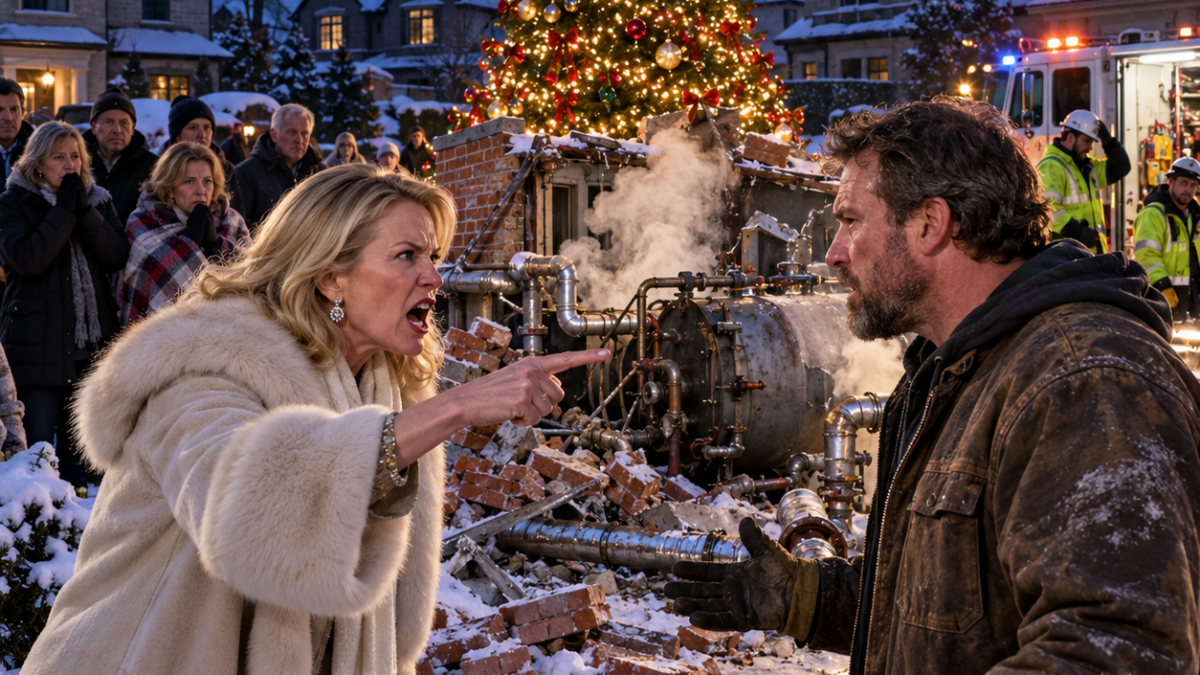
PART 2
“Enough that I need you here.”
Denise Alvarez did not waste time asking who had started the fight.
That was one of the reasons I trusted her.
She had spent more than twenty years working on hydronic systems around northern Michigan, and she understood that a broken heating system did not care which side of a property dispute sounded more reasonable.
“What’s still standing?” she asked.
“Generator shed.”
“Main boilers?”
“One’s on its side. I can’t see the other clearly.”
“Primary header?”
“Under rubble.”
There was a pause.
“Don’t let anybody move anything until it’s documented.”
“The officer just arrived.”
“Good. I’m on my way.”
I hung up.
The police officer introduced himself as Officer Matt Harlan.
He spoke first with Audrey.
Then the foreman.
Then me.
I showed him my deed, the ownership notice on the building, the transition agreement, and the written objection my attorney had sent two days earlier.
Audrey kept describing the conflict as a disagreement with a former heating-service provider.
That wording irritated me almost as much as the excavator.
I had not been merely Bell Haven’s “provider.”
The plant was mine.
The building was mine.
The lot was mine.
Bell Haven paid under an operating agreement because its original development had connected thirty-six townhouses to a heating system that already existed.
The new electric conversion was supposed to end that relationship cleanly.
Instead, Audrey had treated “we no longer want to use your boiler every day” as if it meant “we now own the boiler house.”
Officer Harlan looked at the transition agreement.
“This says standby remains until replacement emergency arrangement is accepted.”
“Yes.”
He looked at Audrey.
“Has that happened?”
“The modernization contractor issued completion.”
“For the backup system?”
“For the project.”
“That isn’t exactly what I asked.”
I almost smiled.
Audrey didn’t.
She handed him the same completion certificate.
He read the scope.
Then looked at the demolition foreman.
“What authorization did you receive?”
The foreman produced his work order.
“Emergency clearance.”
“Owner approval?”
“We were told the site was released.”
“By who?”
He looked toward Audrey.
She said, “Everything went through the project office.”
Officer Harlan wrote that down.
Then he told the demolition crew no further work would happen while ownership and authorization were being checked.
Audrey immediately asked whether the Christmas tree installation could continue.
He stared at her.
“I’m here because a building has been partially demolished. I’m not approving a holiday event.”
“This tree has been scheduled for months.”
“That sounds like a planning issue.”
I turned away before my face gave me trouble.
Leah Bennett, my attorney, answered on the second ring.
She had been expecting something.
Not this.
“Tell me exactly what happened.”
I did.
She listened without interrupting until I reached the crushed header.
“Preserve the work order.”
“I photographed it.”
“Good.”
“Police have stopped demolition.”
“Good.”
“Anything else?”
“Do not agree to removal of rubble, boilers, controls, pipe, or demolition equipment until everything relevant is documented.”
I looked toward the tree crew.
“What about the Christmas installation?”
“Not your problem.”
“Audrey is telling people I’m ruining Christmas.”
“Then let her.”
“That’s your legal advice?”
“My legal advice is not to let emotional framing trick you into giving away evidence.”
That was why I paid Leah.
She could take an infuriating situation and reduce it to the next useful action.
As I ended the call, Audrey approached.
Children had begun gathering near one of the townhouse sidewalks.
Some carried ornaments.
Others were watching the huge tree lying horizontally on its transport trailer.
“This could have been handled privately,” she said.
“You brought an excavator onto my property.”
“You’re going to make children watch adults fight over scrap metal.”
I looked at Ruth’s damaged star in my hand.
“You demolished the room where they wrapped presents.”
Her eyes moved to the star.
She knew about Ruth.
Everybody in Bell Haven did.
For fifteen years, Ruth had used the front room of the boiler building as a quiet Christmas operation.
Long table.
Rolls of wrapping paper.
Tape.
Boxes donated by residents and local businesses.
Nothing official.
Nothing branded.
If a family had a bad year, somebody would leave a list.
Ruth would make sure something appeared under their tree without making them feel like a charity case.
After she died three years earlier, I kept the room open.
I was not as good at it.
Ruth could turn six donated toys, three grocery cards, and somebody’s slightly dented bicycle into a plan.
I mostly followed labels.
But I kept the tradition alive because losing Ruth had already erased enough December rituals from my life.
That morning, I had been delivering the final wrapped boxes to a county collection site when Frank called me.
Less than an hour away.
That was how long Audrey needed.
Mrs. Palmer came down Court Lane carrying a tin of cookies.
She had wrapped a scarf around her gray hair and wore old winter boots.
Her husband had died in August.
Two days before the demolition, she had sat with me at Ruth’s wrapping table for almost three hours.
Mostly she talked.
About setting her husband’s place at Christmas dinner even though she knew how strange that sounded.
About buying him wool socks in October before he got sick.
About not knowing what to do with the gift afterward.
Now she stopped in front of the wreckage.
“I thought I’d missed the wrapping.”
“You didn’t.”
She looked at the missing roof.
Then at the star in my hand.
“Oh, Elias.”
I did not trust myself to answer.
Mrs. Palmer removed one glove.
She brushed concrete dust from the painted wood.
Ruth had cut that star in our garage nearly twenty years earlier.
It was not symmetrical.
One point had always been slightly longer than the others.
Now a different point was broken completely.
Mrs. Palmer touched the splintered edge.
“You’ll fix it.”
“I’ll try.”
She gave me a look Ruth used to give me whenever I tried pretending uncertainty was modesty.
“You’ll fix it.”
Audrey stood farther down the lane talking into her phone.
The demolition crew began packing up.
The tree crew waited beside the trailer while an event coordinator walked around with a clipboard, apparently trying to decide whether a thirty-foot evergreen could be relocated around a wrecked heating plant.
The contrast became almost absurd.
Broken boilers.
Police photographs.
Christmas music coming from somebody’s porch speaker.
And a banner promising a warmer welcome.
Denise arrived before dark.
She pulled on insulated gloves and headed straight for the exposed machinery.
No speeches.
No anger.
“What’s under this wall?”
“Primary supply and return.”
“Generator feed?”
“Separate shed.”
“Good.”
She crouched near the exposed pipes.
The generator building had survived because it sat far enough away from the main boiler house to avoid the excavator.
That meant pumps and controls might still have power.
But electricity alone did not create heat.
A generator could not replace boilers crushed beneath masonry.
After twenty minutes, Denise stood.
She took out orange marking tape.
“This plant is unavailable.”
Audrey, still nearby, heard her.
“Permanently?”
“I didn’t say that.”
“Could it operate tonight?”
“No.”
Audrey folded her arms.
“Well, the homes have new systems.”
Denise looked at her.
“Then let’s see the emergency backup acceptance.”
Audrey’s expression tightened.
“We’ve already been through that.”
“Not with me.”
She opened the folder.
Denise read the completion certificate.
Then handed it back.
“This covers the individual heaters.”
“The contractor completed the modernization.”
“Where’s the backup power?”
“The supplier handled that.”
“What supplier?”
“The equipment vendor.”
“What equipment?”
Audrey did not answer.
Denise looked at me.
“Who’s the property manager?”
I gave her his number.
She called immediately.
That evening, I went back to my workshop.
The old building had always had two functions.
The rear two-thirds were boilers, controls, pumps, and pipe.
The front room was Christmas paper, folding chairs, storage cabinets, and Ruth’s long table.
Now both purposes had been buried under the same rubble.
I placed Ruth’s star on the workbench beside an old blue metal equipment case.
The faded stencil on the lid read:
WINTER OPERATIONS
I had nearly painted over it years earlier.
Ruth stopped me.
“Leave it.”
“Why?”
“Because you earned the scratches.”
The case came from another part of my life.
Long before Bell Haven’s HOA existed, I had worked seasonal winter operations at research facilities, including deployments to Antarctica.
Heating there was not comfort.
It was survival.
You learned quickly that redundancy mattered only if it had actually been tested.
A pump in a crate was not a pump in service.
A generator on a purchase order was not a generator carrying load.
A backup plan that existed only in a meeting was not a backup plan.
I opened the case.
Inside were old maps, a pressure gauge, notebooks, and some of the habits I had never lost.
Denise arrived twenty minutes later.
She brought the Bell Haven distribution map.
We spread it across the bench.
Three rows.
Twelve homes each.
Thirty-six total.
The demolished plant connected to all three through buried mains.
“What exactly did the excavator hit?” she asked.
I marked the visible damage.
“That’s what we can see.”
“And underground?”
“Unknown.”
She pointed at the west row.
“Any old service connections?”
“Possibly.”
“Emergency rental?”
“Start calling now.”
We did.
One mobile boiler large enough to serve the development was committed to a hospital project.
Another company had a smaller unit available.
It could not serve thirty-six homes.
But it might serve part of the system if we had a sound connection.
That “if” became the center of the night.
At eight, Martin Cho knocked on my workshop door.
He was Bell Haven’s treasurer.
Quiet man.
Accountant.
The kind of person who read footnotes at board meetings while everybody else argued about landscaping.
He carried a laptop and a folder.
“I pulled the project payments.”
“Find the backup?”
“I found money for one.”
He showed us a purchase order.
Backup generator package.
Deposit paid.
Vendor confirmed.
I looked for the commissioning record.
Nothing.
Delivery receipt.
Nothing.
Installation.
Nothing.
Acceptance test.
Nothing.
“Maybe accounting doesn’t have the installation paperwork,” Martin said.
“Could be.”
Denise nodded.
“Call the supplier.”
Martin found an emergency number.
While he waited, Audrey emailed residents.
Frank forwarded it to me.
CHRISTMAS COURT WILL OPEN AS SCHEDULED.
My objection, she wrote, involved a former service provider seeking to preserve unnecessary heating fees.
I read the line twice.
Then forwarded Frank my written demolition objection.
His reply came quickly.
She told my daughter you had already agreed to clear the building.
I typed:
I did not.
Denise prepared a short technical statement.
The old plant was unavailable due to demolition damage.
Readiness of Bell Haven’s replacement emergency heating arrangement had not been verified.
No drama.
No accusations.
Only status.
Audrey answered residents with a photograph of one of the new electric heaters warming a living room.
THE NEW SYSTEMS WORK.
They did.
That was never the disputed point.
The question was what happened if electrical power disappeared.
At 10:40, Martin’s phone rang.
He listened.
Asked the supplier to repeat something.
Then:
“Email that to me.”
He hung up.
“What?”
Martin stared at the phone.
“Delivery is January eighth.”
I thought I misunderstood.
“What delivery?”
“The backup generator package.”
Denise leaned forward.
“Installation?”
“After delivery.”
“So nothing is installed?”
Martin’s face went pale.
“No.”
Outside, through my workshop window, I could see workers testing Christmas tree lights.
White bulbs climbed thirty feet into the dark.
Bell Haven had electricity.
For the moment.
And the system meant to protect thirty-six homes when that electricity disappeared was still sitting somewhere else on a supplier’s schedule.
By Christmas Eve morning, freezing rain coated Court Lane.
Tree branches sagged.
Railings shone.
The town postponed its outdoor concert.
Audrey moved the Christmas Court ceremony forward by two hours.
At 3:17 that afternoon, she called me.
“Your emails are alarming residents.”
“They should know the backup isn’t installed.”
“The supplier has a schedule.”
“January eighth.”
“We’re working through the transition.”
“You destroyed the transition system.”
Silence.
Then her voice became softer.
“I’m trying to resolve this.”
“How?”
“The association can compensate you for the remaining salvage value.”
“That isn’t the issue.”
“We’ll install Ruth’s memorial bench.”
I looked through the workshop window at her broken star.
“I never asked for a memorial bench.”
“It would honor what she did.”
“She already had a room.”
Audrey exhaled.
“This doesn’t have to become a lawsuit.”
“What are you offering?”
“A joint statement. The clearance resulted from a misunderstanding regarding the transition timeline. Both parties will cooperate going forward. You withdraw your objection to the Christmas Court project.”
“And the heat?”
“The new systems are functioning.”
“Authorize the emergency boiler rental.”
“That requires board approval.”
“So did destroying my building.”
She ended the call.
Five minutes later, I called Denise.
“What’s the status on the small unit?”
“Technician available.”
“Send it.”
“Board approval?”
“I’ll cover the initial rental.”
“Elias—”
“The weather is getting worse.”
“You understand this may not connect.”
“I understand.”
“I need you to say it.”
“It might not work.”
“Good. Then we proceed on facts.”
The supplier dispatched the mobile boiler.
Martin simultaneously sent the generator vendor’s January delivery confirmation to every board member and requested emergency approval for temporary heating costs.
The property manager circulated information about the town school warming center.
Audrey called that step “precautionary.”
At 5:42, precaution became necessity.
My workshop lights flickered.
Once.
Twice.
Then everything went black.
Across Court Lane, every townhouse window went dark.
All thirty-six.
The Christmas tree stayed lit.
For one strange second, it looked miraculous.
Then I remembered the event company had brought its own small generator.
That machine could power strings of LED lights and a sound system.
It could not heat thirty-six homes.
My phone started ringing before I reached the door.
The temperature outside was already falling.
Residents stepped onto porches holding phones.
Some had flashlights.
Children clustered behind windows.
The Christmas tree glowed in the center of it all.
Audrey sent an association message within minutes.
EMERGENCY HEAT IS BEING RESTORED THROUGHOUT BELL HAVEN COURT.
I stared at the sentence.
She had no basis for it.
The mobile boiler had not even arrived.
The property manager called me.
“I’ve got residents asking when heat comes back.”
“Tell them a temporary unit is on the way.”
“So heat is coming?”
“We don’t know how much capacity we’ll have.”
“How many houses?”
“Unknown until Denise tests the connection.”
I could hear people talking behind him.
“Can I say eight?”
“No.”
“Twelve?”
“No.”
“What do I tell them?”
“Tell them exactly what I told you.”
Denise sent the same correction in writing.
Temporary equipment is en route. Capacity and usable connection remain unverified. Residents should not rely on restoration until individual addresses are confirmed.
Audrey had turned an attempt into a promise.
Again.
Frank crossed the lane with his daughter and granddaughter.
The little girl still had her paper snowflakes.
“Should we wait here?” Frank asked.
“No.”
“Boiler’s coming.”
“A boiler is coming. That is not the same as your house getting heat.”
His daughter looked worried.
“What should we do?”
“Follow the town’s emergency guidance. If you have somewhere warm outside the outage area, go.”
Frank looked toward the demolished building.
For the first time since the fight began, I saw him fully understand what had been lost.
Not an ugly old brick structure.
Time.
Redundancy.
Options.
The fire department arrived to coordinate with the property manager.
Captain Marcy Nolan organized transportation to the school warming center.
Families with relatives nearby left in private vehicles.
The manager maintained a list of residents needing help.
Nobody treated the situation like a catastrophe movie.
There were no screaming crowds.
Just people realizing, one address at a time, that their Christmas Eve plans had changed.
Then Captain Nolan asked:
“Mrs. Palmer accounted for?”
The property manager checked.
“She’s still home.”
I knew why.
Her dining table had been set for two when I visited earlier that week.
One plate for herself.
One where her husband would have sat.
I walked over with the captain.
Mrs. Palmer opened the door wearing two sweaters.
Her house was already noticeably cooler.
“You need to leave.”
“I’ll wait until they fix it.”
“Denise can’t promise tonight.”
She looked past me toward the table.
“I’ve already left enough things behind this year.”
I understood that sentence too well.
After Ruth died, I spent my first Christmas in the boiler room long after there was any reason to stay.
I kept expecting the front door to open.
Expected her to complain that I had wrapped something badly.
Expected footsteps that never came.
Understanding Mrs. Palmer did not change the temperature.
I sat across from the empty place setting.
“Your husband wouldn’t ask you to prove anything by sitting in a cold house.”
She looked down.
“He hated being fussed over.”
“So did Ruth.”
That got half a smile.
Captain Nolan helped her pack.
Medication.
Night clothes.
Toiletries.
Mrs. Palmer picked up a small wrapped box beside her husband’s photograph.
Then stopped.
“Would you keep this?”
“What is it?”
“Something I bought him.”
I took it.
“I’ll put it in the workshop.”
“Beside Ruth’s star?”
I nodded.
She handed it to me.
At nine, headlights appeared at the entrance to Court Lane.
The mobile boiler arrived on a flatbed.
Ben Foster, the supplier’s technician, climbed down looking as tired as everybody else.
Denise took control.
“First connection point?”
I led them toward the demolished plant.
Portable lights illuminated the rubble.
Ben examined the exposed header.
We isolated what we could.
Then ran the pressure test.
The gauge climbed.
Held for a moment.
Then dropped.
Denise did not hesitate.
“Shut it down.”
A damaged buried branch was leaking beneath the demolished connection.
No temporary boiler could safely pressurize that section.
Martin rubbed his face.
“So that’s it?”
“For this connection,” Denise said.
“Can you patch it?”
“Not tonight without excavation and assessment.”
“Another connection?”
I stared at the distribution map.
Then at the maintenance photographs I had brought from the workshop.
There had been one.
Years earlier, the west row had needed independent service.
A connection point was installed near the lane so that twelve homes could be isolated.
I pulled out an old photograph.
“There.”
Ben leaned closer.
“That still exists?”
“It did at the last inspection.”
Denise took the photo.
“Then we locate it.”
Martin said, “And use it?”
She looked at him.
“We locate it, inspect it, isolate damaged sections, pressure test it, and then decide whether we can use it.”
The distinction mattered.
Hope was not a test result.
Snow had begun mixing with the freezing rain.
We found the service point under a cover near the west row.
Ben cleaned it.
Denise inspected the valves.
One isolation valve fought us.
Another moved.
We checked downstream configuration.
Then pressure-tested.
I watched the gauge.
It climbed.
Held.
One minute.
Two.
Five.
Denise finally nodded.
“This section is sound.”
Martin almost smiled.
“How many?”
Ben checked the rental capacity.
“Eight houses.”
“There are twelve in this row.”
“Eight at safe load.”
“What if we reduce output?”
“No.”
“Spread it across twelve?”
Denise shook her head.
“You’d create weak, unreliable heat everywhere.”
“Something is better than nothing.”
“Not if the system can’t maintain safe temperature.”
Martin fell quiet.
The remaining four west-row homes and all twenty-four homes in the other two rows would stay cold.
Twenty-eight households displaced.
I checked the address list.
Audrey’s mother lived in the north row.
Mrs. Palmer’s home was in the south.
Neither would receive heat from the first mobile unit.
That mattered because I did not want anyone later suggesting we had chosen favorites.
We had not.
Eight homes sat behind the intact service connection.
The equipment could safely heat eight.
That was the answer.
I called the property manager.
He wrote down every address.
Captain Nolan coordinated with residents.
Some returning households offered couches and spare rooms.
Others stayed at the school.
The technicians completed the connection.
Shortly after midnight, Denise verified temperature at the first home.
Then the second.
Then all eight.
Frank stood near a radiator while warm water moved through it.
He placed his hand above the metal.
His granddaughter took the paper snowflakes from her coat pocket.
“Where do these go now?”
Frank looked at me.
“Here tonight.”
Then he pointed toward the wall.
“We’ll find another place later.”
Ben studied one of my maintenance photographs.
He pointed at an old notation.
“You worked winter ops?”
I glanced at him.
“Yes.”
“Where?”
“Several places.”
He read another handwritten code.
“South?”
“Antarctica.”
His eyebrows went up.
“My old supervisor worked research-station systems.”
“Who?”
He gave me a name.
I knew him.
Ben laughed.
“I’ve heard your name.”
Martin looked up.
“Elias, you spent winters in Antarctica keeping stations heated?”
“A few deployments.”
“Why didn’t you tell the board that?”
“Because it wasn’t relevant.”
Martin stared at me.
“How was that not relevant?”
“They needed an acceptance report.”
“But your experience—”
“My résumé could not tell them whether their generator was installed.”
Ben smiled once.
Then returned to the connection.
That was the part I wished more people understood.
Expertise matters.
But expertise is not permission to skip verification.
I had made that mistake once myself.
Years earlier, at a remote winter facility, somebody assured me an auxiliary pump had been tested after maintenance.
I accepted the assurance.
It failed when we needed it.
We caught the problem before anyone was hurt, but correcting it cost us a brutal night of work.
I remembered that night when Martin asked us to spread the mobile boiler across too many houses.
Wanting a system to perform was not evidence that it would.
Audrey arrived after the eight homes were verified.
Ice had stiffened the shoulders of her red coat.
“My mother’s with my brother.”
“Good.”
“Her house is still cold.”
“I know.”
“You found another connection.”
“One connection.”
“Can’t you find one for the north row?”
“We need more equipment and verified piping.”
She stepped into my workshop and closed the door behind her.
Mrs. Palmer’s wrapped gift sat beside Ruth’s star.
Audrey noticed both.
Then she took a folded sheet of paper from her bag.
“Joint statement.”
I did not reach for it.
“What does it say?”
“Miscommunication regarding the demolition. Unexpected weather. Both parties cooperating to restore service.”
“Did you authorize the demolition?”
“The board authorized clearance.”
“That is not what I asked.”
“We are past that.”
“No. You are trying to write us past it.”
She pushed the paper toward me.
“If you sign, residents see that we’re working together.”
“Authorize the rental.”
“Martin is handling that.”
“Give Denise full access to the association’s records and approve emergency equipment.”
“I’m trying to keep the board unified.”
“Your mother will receive exactly the same help as everyone else. This paper won’t change that.”
“You could stop making this adversarial.”
I looked at her.
“I didn’t bring the excavator.”
For several seconds, neither of us spoke.
Then she folded the statement again.
Minutes after she left, Martin received enough written approvals from other board members to authorize emergency expenditures.
The board had finally done what it should have done before the outage.
At four in the morning, the supplier found a larger mobile boiler at a commercial site.
It had to be disconnected by a qualified crew.
Transported through worsening road conditions.
Then connected and tested at Bell Haven.
Christmas afternoon was the earliest realistic estimate.
Denise told the property manager:
“Plan for another full night away.”
No promises.
No countdowns.
Nobody was told to sit in a cold house waiting for a hopeful truck.
Christmas morning arrived quietly.
Eight households had heat.
Twenty-eight had relocated or were still arranging somewhere warm to stay.
The event company shut down the Christmas tree lights.
They packed the speakers.
Removed temporary fencing.
The giant tree remained standing near the demolition rubble, but the celebration around it had disappeared.
I climbed carefully into what remained of the front room.
Ruth’s wrapping table was pinned beneath broken trim and plaster.
I worked it free.
One leg had snapped.
Frozen wrapping paper lay in a puddle beneath it.
I carried the table into my workshop.
Set it beside the star.
Then Martin called.
“Water problem at Palmer’s.”
I drove over.
A domestic water line had frozen and split inside an enclosed rear service space.
The restoration company isolated the supply.
Mrs. Palmer was safe at her niece’s house.
Her home was not.
I took photographs for insurance documentation.
Then called her before sending them.
“There’s water damage.”
“How bad?”
“Contained to the rear service area so far.”
She was quiet.
Then:
“Is the little gift okay?”
I looked toward my workshop.
“Yes.”
“Still beside the star?”
“Yes.”
“Thank you.”
She hung up.
Two more homes developed plumbing problems before the larger mobile boiler arrived.
That was when the outage stopped being merely inconvenient.
Hotels.
Relatives’ houses.
Frozen plumbing.
Restoration crews.
Missed Christmas dinners.
Children sleeping on couches.
None of that meant every loss was legally caused by Audrey.
Leah would later insist we separate damage carefully.
But the practical reality was undeniable.
The backup Bell Haven had possessed on Monday had been destroyed before the storm.
The replacement they had been told existed would not arrive until January.
At six Christmas evening, the larger mobile boiler finally came down Court Lane.
Its arrival did not restore heat.
Another lesson people dislike.
Equipment arriving is not equipment operating.
The crew set it.
Made connections.
Tested isolation points.
One section failed.
They stopped.
Corrected it.
Tested again.
Ben slept sitting upright in his truck for ninety minutes between shifts.
Denise worked through addresses one row at a time.
I pulled original maintenance records from the blue winter-operations case.
We matched old diagrams to current piping.
No one guessed.
By the morning of December twenty-sixth, all three rows had verified temporary heat.
Thirty-six addresses.
Some homes still could not be occupied because of water damage.
Others were ready.
The electric utility restored full grid power that afternoon.
The property manager updated his list one final time.
All homes had normal electric heat.
Temporary emergency heat was operating.
The crisis had passed.
We had protected people.
Now came the slower question.
Why had it happened?
Leah arranged for an independent mechanical engineer to inspect the demolished site before more rubble moved.
He compared Denise’s December tenth inspection photographs to the destroyed machinery.
He traced the surviving mains.
Examined the generator.
Reviewed the transition agreement.
His report made one distinction absolutely clear.
The old plant had not failed during the storm.
It had been functional before demolition.
Demolition made it unavailable.
That did not automatically mean every hotel bill, frozen pipe, or Christmas disruption was recoverable from the HOA.
Leah said that repeatedly.
“Evidence cuts both ways.”
“Meaning?”
“If a resident claims a pipe burst because of the outage but records show the leak started before Monday, we don’t include it.”
“They’re on our side.”
“There are no sides in documentation.”
I looked at her.
She almost smiled.
“You want records to defeat Audrey because they’re accurate?”
“Yes.”
“Then you accept them when they defeat an exaggerated claim too.”
She was right.
Residents were asked to preserve lodging receipts.
Repair reports.
Temperature logs where available.
Insurance records.
Dates they left.
Dates they returned.
I documented my damaged equipment separately.
The boilers.
Controls.
Headers.
Building.
Ruth’s front room.
Ruth’s table was different.
You could price a table.
You could not price the December evenings she had spent sitting beside it.
So I found a cabinetmaker who understood what I wanted.
“Repair the leg.”
“Refinish the top?”
“No.”
“It’s pretty scratched.”
“I know.”
“Some of these stains won’t come out.”
“Good.”
He looked at me.
“You want it repaired, not made new.”
“Exactly.”
Audrey’s first formal explanation to the board was simple.
She had relied on professionals.
The old plant was redundant.
The project team had considered the site available for clearance.
The severe weather was unexpected.
The demolition contractor had handled its own procedures.
On paper, that explanation almost worked.
Then the demolition foreman gave Leah his work order.
The building was described as:
Disconnected.
Redundant.
Owner released.
The foreman’s company had not been retained to evaluate whether Bell Haven had emergency heat.
They had been told those questions were already settled.
Leah asked who gave them that information.
The company preserved the booking correspondence.
Then she contacted the demolition contractor named on Audrey’s original Christmas Court project sheet.
The company that had not arrived.
Their estimator found the file.
He spoke with Leah.
Then provided the full correspondence.
She called me afterward.
Her voice was unusually flat.
“What?”
“I have something.”
“That sounds good.”
“It means we can test Audrey’s explanation.”
“Tell me.”
“Not yet.”
I hated when attorneys said that.
“I need the complete exchange verified.”
“When?”
“Soon.”
I forced myself not to press.
A few days later, Martin scheduled a special members meeting.
Residents received the key verified documents before attending.
Not rumors.
Not social-media screenshots.
The meeting would answer three questions.
What had the board authorized?
What had actually happened?
And what would Bell Haven do now?
The clubhouse was full.
Audrey sat at the front.
She had no red coat this time.
Dark sweater.
Hair pulled back.
She looked tired.
I did not enjoy that.
People assume that once someone has harmed you, watching them struggle feels clean.
It rarely does.
Audrey began with a prepared statement.
She talked about modernization.
Safety.
A deteriorating building.
Severe weather.
Her responsibility to improve Bell Haven.
She said the demolition proceeded on professional advice.
Martin waited until she finished.
“Which demolition contractor?”
Audrey frowned.
“The contractor retained for Christmas Court.”
“The first company or the second?”
A few residents looked at one another.
Audrey shifted.
“Vendors handle scheduling through the project office.”
Leah stood.
“Let’s start with the first company.”
The projector came on.
December twentieth.
The estimator had visited my property.
His written message said the equipment appeared to remain connected.
He required proof of disconnection.
He required written authorization from the property owner before demolition.
My name.
Phone number.
Property address.
All in the email.
The room went quiet.
Leah displayed Audrey’s response.
Could the company proceed based on HOA board clearance?
The estimator answered:
No.
Owner authorization still required.
The contractor did not schedule demolition.
Then came December twenty-first.
A booking request to a different company.
Same building.
Different description.
Plant disconnected.
Owner release confirmed through association.
The room changed.
You could feel it.
Until that moment, some residents still believed the demolition might have been a rushed misunderstanding.
But the first contractor had asked the correct question.
Permission?
The answer was no.
Then another contractor received a version of the facts that erased the problem.
Leah looked at Audrey.
“Who supplied the owner-release description?”
Audrey’s lips tightened.
“The association’s project office coordinated the work.”
“The booking came from your account.”
“I believed the termination of service meant the property was being released.”
“Where does the service agreement transfer ownership of Mr. Ward’s building?”
Audrey looked toward association counsel.
He did not answer for her.
She tried another path.
“The board voted to clear the site after modernization.”
Martin opened the meeting minutes.
He read the actual motion.
Clearance could proceed after verification that replacement emergency service had been accepted and after obtaining owner authorization.
Conditions.
Not permission.
The board had never voted that it owned my building.
It had voted that demolition could happen after two things were proven.
Neither had been.
Frank stood from the second row.
“You told us Elias was holding this up because he wanted another service payment.”
Audrey looked at him.
“The modernization dispute had become unnecessarily—”
“He asked for exactly what the contractor asked for.”
She stopped.
Frank pointed toward the projected email.
“Authorization.”
Then toward the backup records.
“And the replacement system.”
His voice shook.
“Why was he the problem?”
Audrey looked down at her written statement.
No one shouted.
That made the room harder.
Mrs. Palmer rose slowly.
Her service room was still being dried out.
She carried the small wrapped gift she had left with me.
She walked to the microphone.
“I know you didn’t cause the storm.”
Audrey looked up.
Mrs. Palmer continued.
“I know power lines fail.”
No one moved.
“But we had a backup before you took it away.”
Audrey opened her mouth.
Mrs. Palmer raised one hand.
“And you told us we had another one.”
She placed the wrapped gift on the podium for a moment.
“My husband died in August.”
Her voice remained steady.
“I bought these socks before he got sick.”
She almost laughed.
“Wool socks. He complained about cold feet every winter.”
Audrey looked at the gift.
Mrs. Palmer picked it back up.
“When the heat went out, I didn’t want to leave my house because I had already spent months learning how empty rooms feel.”
The room was completely silent.
“Elias did not make me leave. The fire captain did not make me leave. They explained what they knew and what they didn’t know.”
She looked at Audrey.
“That mattered.”
Then she returned to her chair.
Nobody needed another speech.
Martin asked whether I wanted to speak.
I had not planned much.
I carried Ruth’s repaired star to the front.
The missing point had been replaced with a slightly different piece of wood.
The stain did not match perfectly.
I liked it that way.
I placed it on the table.
“You can replace a heating system,” I said.
“You can modernize equipment.”
I looked at the board.
“But you still have to finish the replacement before destroying what it replaces.”
Then I looked toward the projected contractor email.
“You can propose a Christmas plaza.”
I paused.
“You still need permission to use someone else’s property.”
Audrey looked at me.
For the first time in weeks, neither of us was trying to interrupt the other.
I continued.
“Helping neighbors after a bad decision doesn’t erase the decision.”
Martin nodded once.
“It gives you a chance to start answering for it.”
I returned to my seat.
The members voted to remove Audrey from the board.
Not unanimously.
But decisively.
An interim board authorized an independent financial and project review.
It also directed counsel to begin formal resolution of the property damage and household claims.
Audrey gathered her papers after the vote.
Nobody applauded.
I was glad.
The evening did not feel like a victory celebration.
It felt like a community finally reading its own records.
The civil process lasted months.
Insurance adjusters inspected the boiler equipment.
Restoration contractors priced the building.
Residents submitted documented losses.
Some claims were rejected.
One household tried to attribute a repair to the outage even though the invoice predated the storm.
Leah caught it.
“Remove it.”
The homeowner complained.
Leah did not care.
“If we inflate one item, we make every legitimate item easier to attack.”
That became the standard.
Emergency heating costs.
Temporary relocation.
Verified plumbing damage.
Professional engineering.
Demolition damage.
Building reconstruction.
Legal costs where recoverable.
Every number needed support.
The final documented package came to $275,300.
Not a number shouted at Audrey under the Christmas tree.
Invoices.
Estimates.
Receipts.
Negotiated claims.
Coverage was divided.
Contractor insurers handled portions.
The association had remaining obligations.
Audrey agreed to contribute $30,000 personally as part of the settlement structure.
The rest was allocated through coverage decisions and the HOA’s documented responsibility.
Residents received written explanations so they could see exactly what had been resolved.
No mystery assessment appeared.
No fictional million-dollar punishment.
Just costs tied to actual damage.
My property restoration included a rebuilt boiler structure and a modern standby arrangement.
Not an antique copy of what had existed before.
If we were rebuilding, we were rebuilding correctly.
Denise reviewed the design.
Independent engineers tested it.
The association’s replacement emergency setup was finally delivered, installed, commissioned, and accepted.
This time nobody published the word “complete” until the acceptance records existed.
Mrs. Palmer’s service room was repaired.
The emergency rental companies were paid.
Ruth’s front room was rebuilt.
And Audrey sent me a signed acknowledgment stating clearly that I had not authorized demolition.
I put it in the settlement file.
I did not frame it.
The first time I entered the rebuilt front room alone, I stood in the doorway longer than I intended.
The proportions were almost the same.
Long wall.
Two windows.
Storage cabinets.
New flooring.
But new rooms are strange when they are built to replace old memories.
They look too clean.
Ruth’s table returned from the cabinetmaker a week later.
The repaired leg was slightly darker than the other three.
The top still carried tape marks.
Knife scratches.
A round stain from Frank’s coffee in 2017.
I ran my hand over all of them.
The cabinetmaker said:
“I could still refinish this.”
“No.”
“You sure?”
“Yes.”
He smiled.
“I thought so.”
I put the table in the center of the room.
Then mounted the repaired star above the door.
I stepped back.
It leaned slightly.
Ruth would have complained.
Then fixed it herself while telling me I had no eye for level.
I left it leaning for three days.
On the fourth, I straightened it.
Audrey disappeared from community life for a while.
She did not move away.
Her mother still lived in Bell Haven.
Sometimes I saw Audrey’s car.
Sometimes I saw her at the grocery store.
Neither of us sought the other out.
One afternoon, several months after the settlement, she came to the rebuilt plant.
I was outside with Denise checking an isolation valve.
Audrey waited until Denise walked away.
“Can we talk?”
I wiped my hands.
“Okay.”
She looked at the brickwork.
“It looks better.”
“Different.”
“Yes.”
There was a long silence.
Then:
“I believed the old plant was holding the neighborhood back.”
“I know.”
“I believed the backup delivery was farther along.”
“You were sent the schedule.”
“I know.”
“I sent it again.”
“I know.”
Her eyes moved toward the front-room window.
“I wanted Christmas Court finished.”
“That I also know.”
“The board had spent money.”
“That doesn’t create ownership.”
“I understand that now.”
I waited.
She took a breath.
“I kept thinking if we could just finish the project, everything else would become easier.”
That was probably the most honest thing she ever said to me.
Not that she thought demolition was legally justified.
Not that the contractor tricked her.
Not that the storm was impossible to anticipate.
She wanted the visible outcome badly enough that every obstacle began looking temporary.
A building.
A signature.
A missing acceptance test.
My refusal.
All things to get around.
“I’m sorry about Ruth’s room,” she said.
I looked through the glass at the table.
“You never knew Ruth well.”
“No.”
“She would’ve argued with you.”
Audrey almost smiled.
“I believe that.”
“She also would’ve fed your mother during the outage.”
Her smile disappeared.
“I know.”
That was all.
She left.
I did not forgive her in some dramatic instant.
I also did not spend the rest of my life rehearsing arguments for someone who had already lost the authority to repeat the mistake.
By summer, Bell Haven had a new board.
Martin became interim president before eventually refusing to run for a full term.
“I’m an accountant,” he told me. “I like numbers more than neighbors.”
“Neighbors contain numbers.”
“Not the useful kind.”
The new board adopted several rules.
No capital project could be labeled complete until required acceptance records were on file.
Demolition involving property not owned by the HOA required verified written authorization.
Emergency systems required periodic documented tests.
Vendor scopes had to match actual board votes.
Those procedures sounded boring.
Good.
Safety often sounds boring right up until the night you need it.
Denise helped create a winter-readiness checklist.
Generator fuel.
Transfer testing.
Boiler startup.
Isolation valves.
Emergency contact list.
Mobile equipment connection points.
No assumptions.
The first annual test attracted more residents than I expected.
Frank stood with his granddaughter near the rebuilt plant.
She covered her ears when the standby generator started.
“Too loud!”
Frank laughed.
“You want loud or cold?”
She considered.
“Loud.”
Correct answer.
Mrs. Palmer came by in October.
She carried the little gift.
Still wrapped.
“You never opened it?”
“No.”
“What will you do with it?”
She sat at Ruth’s table.
“I think I’m finally going to.”
I made coffee.
She unwrapped the paper slowly.
Inside were dark gray wool socks.
Exactly as she had told the board.
She held them in her lap.
“He hated these.”
“You said his feet were always cold.”
“He also hated admitting he was cold.”
“That sounds familiar.”
She smiled.
Then touched the repaired table.
“Do you ever think we’re strange for keeping things?”
“Yes.”
“Does it bother you?”
“No.”
She folded the socks again.
“I might donate them.”
“That seems reasonable.”
“Or wear them.”
“Also reasonable.”
She looked toward Ruth’s star.
“Maybe I’ll decide later.”
That seemed even more reasonable.
When December returned, Bell Haven did not build Christmas Court on my service lot.
The tree went in the actual common courtyard.
A place the HOA owned.
No excavators.
No property dispute.
No wrecked pipes beneath it.
The new board asked if I wanted the wrapping room included in the neighborhood holiday schedule.
I said no.
Martin looked surprised.
“You don’t want people here?”
“I want people here.”
“Then why no schedule?”
“Ruth never had a schedule.”
He thought about it.
“That’s annoyingly sentimental.”
“She would hate you saying that.”
“She isn’t here.”
“That never stopped her before.”
We agreed the room would simply be open.
People could come.
Bring paper.
Bring presents.
Wrap what needed wrapping.
Leave what needed leaving.
No banner.
No ceremony.
No dedication.
The first person through the door that December was Frank.
His granddaughter followed carrying the same paper snowflakes she had made the year before.
She had saved them.
Several were bent.
One had torn.
She held them out.
“Can these go back?”
I looked toward the ceiling.
“Anywhere you want.”
Frank brought tape.
Mrs. Palmer brought cookies.
Martin arrived carrying six rolls of wrapping paper, three kinds of ribbon, and absolutely no understanding of what matched.
His daughter came with him.
The room filled.
Not all at once.
Gradually.
The way Ruth’s Christmas evenings used to.
Someone turned on a small radio.
Children sat under the table.
Adults argued about tape dispensers.
Frank wrapped a box so badly his granddaughter unwrapped it and started again.
I stood on a ladder while Martin’s daughter held Ruth’s star.
She looked at the repaired point.
“This one is different.”
“It broke.”
“You made a new piece?”
“Yes.”
“Why doesn’t it match?”
“I didn’t want it to.”
She frowned.
“Why?”
I thought about the boiler house.
The storm.
The evacuation list.
The mobile units.
Mrs. Palmer’s frozen pipe.
Audrey’s emails.
The contractor asking for authorization.
All the things that happened because someone tried to make reality match a Christmas deadline.
Then I looked down at the little girl.
“Because fixing something isn’t the same as pretending it was never broken.”
She considered that.
Then held the star higher.
“Can I hang it?”
I steadied the ladder.
“Go ahead.”
She hooked it above the door.
Outside, through the front windows, I could see Bell Haven’s Christmas tree glowing in the common courtyard.
Inside, Ruth’s old table was covered in paper.
Frank’s granddaughter taped her snowflakes along the wall.
Mrs. Palmer placed a tin of cookies beside the coffee maker.
Martin was trying to wrap something shaped like a basketball.
And every few minutes the door opened again.
For three years after Ruth died, I had kept that room open because I could not bear the thought of losing one more thing she had started.
I had thought preservation meant holding it exactly where she left it.
Same table.
Same star.
Same building.
Same routine.
I understood it differently now.
The old boiler house had been demolished.
The star had broken.
The table had broken.
Christmas had broken for thirty-six families in a way nobody had planned.
We repaired what could be repaired.
We replaced what had to be replaced.
And we kept the parts worth carrying forward.
Near nine that night, Frank came beside me.
“Heat test passed last month.”
“I know.”
“Generator too.”
“I know.”
He grinned.
“Just making sure.”
“That’s the correct habit.”
His granddaughter called from across the room.
“Grandpa, your tape is stuck to your sweater.”
He looked down.
A three-foot strip of tape ran from his elbow almost to his waist.
Mrs. Palmer laughed harder than I had heard her laugh in more than a year.
Frank tried pulling the tape free and made it worse.
The room erupted.
I looked up at Ruth’s repaired star.
One point still did not match.
I hoped it never would.
Outside, snow had started falling.
The Christmas tree lights reflected off the rebuilt boiler house windows.
Behind the front room, the standby system sat quiet, tested, documented, and ready.
No one had to believe me that it worked.
There were records.
There were test results.
There were signatures from people who had actually witnessed it.
And inside the room, thirty-six households no longer needed my old boiler every day.
That had always been the goal.
The difference was that this time, nobody had confused moving forward with erasing what still mattered.
[END OF STORY]








