PART 2: HOA Bulldozed My 30-Year Windbreak for a Better View—Then the County Ordered Something They Never Saw Coming
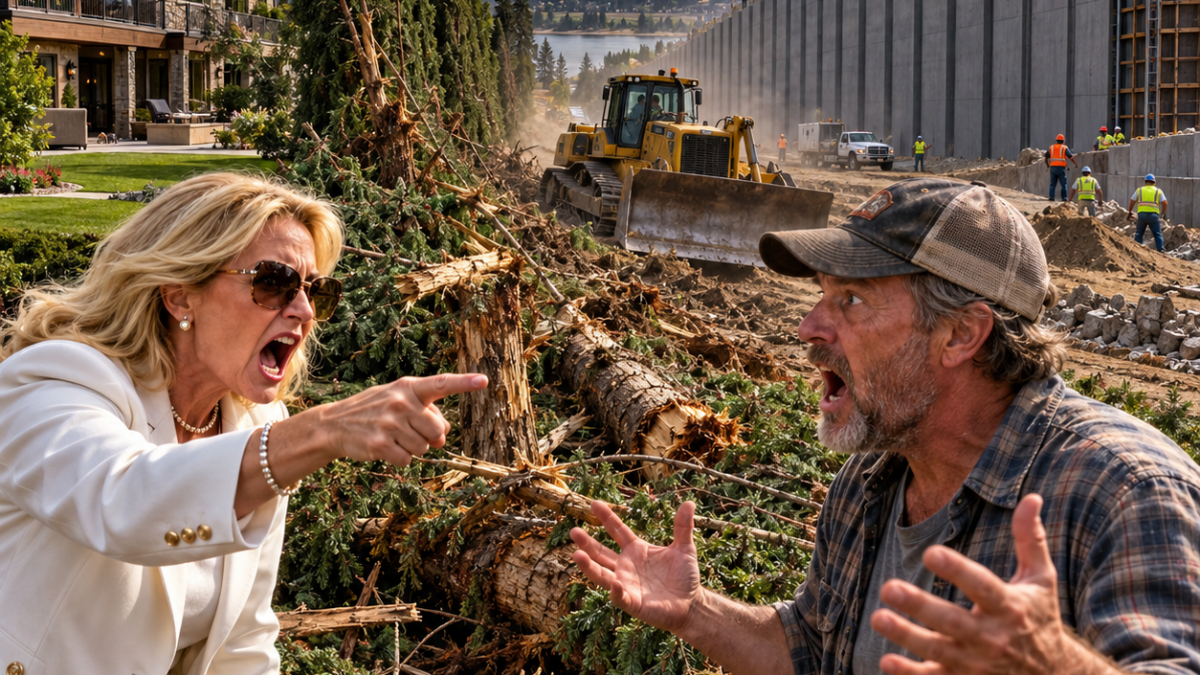
PART 2
My name is Caleb Monroe.
I was fifty-two that fall, and Monroe Valley Nursery covered forty-four acres outside Wenatchee in central Washington.
My father bought the first eighteen acres in 1989.
He started with bare-root fruit trees, one used tractor, and a greenhouse framed from salvaged irrigation pipe.
By the time I took over, we operated six commercial greenhouses, two propagation houses, a refrigerated storage building, and a loading yard that supplied orchardists, landscapers, and garden centers across three counties.
It was agricultural land.
Real agricultural land.
That meant machinery.
Fans.
Forklifts.
Trucks.
Lights during early shipping hours.
Dust during dry weather.
None of that bothered anyone when Dad bought the place because there was almost nobody uphill from us.
High Mesa Estates arrived later.
The developer purchased the western ridge in 2007 and built ninety-two homes across three curved streets.
The eight most expensive houses sat nearest my boundary.
They were elevated enough to look over the valley toward the Columbia River.
They could not see across our loading yard because Dad’s green wall stood between us.
That had not happened by accident.
When High Mesa went through subdivision review, the county required an agricultural compatibility buffer.
The developer placed sixty feet of buffer land on the HOA side and negotiated a separate preservation agreement with Dad.
High Mesa could enter a narrow strip of our property twice each year, by appointment, to help prune, irrigate, and replace vegetation along the berm.
In exchange, the association shared part of the maintenance cost because Dad’s berm satisfied the subdivision’s required visual and acoustical screening.
The agreement was straightforward.
Maintain.
Preserve.
Replace.
It also contained language Helena apparently preferred not to read.
No material grading.
No soil removal.
No reduction in height.
No clearing without written consent from the Monroe property owner and approval from the county planning director.
Every High Mesa deed also included an agricultural activity notice.
Buyers were warned that Monroe Valley Nursery existed.
The notice mentioned noise.
Dust.
Lighting.
Equipment.
Early deliveries.
Agricultural odors.
It even referenced the berm as the mitigation measure separating those normal activities from the neighborhood.
For fifteen years, nobody cared much about those documents.
Good agreements are often invisible when the system they created keeps working.
Then Helena Price became HOA president.
I had met her about eighteen months before the excavation.
Helena was forty-nine and worked in luxury real estate.
She was competent.
That mattered.
She had renegotiated High Mesa’s pool contract.
Recovered delinquent assessments.
Forced the original developer to repair a failing retaining wall near the entrance.
Residents trusted her because she got things done.
That was probably why nobody questioned her when she began calling Dad’s berm “overgrown landscaping.”
The first time she approached me, she came to my office carrying a glossy rendering.
“Look at what the ridge could be.”
The photograph had been digitally altered.
My berm was gone.
The nursery below had been softened into vague green shapes.
Beyond it, the Columbia River glowed orange beneath a perfect sunset.
“That’s not what the ridge could be,” I said.
She smiled.
“What do you mean?”
“That’s what it looks like when somebody deletes my business with software.”
She ignored that.
“The HOA is willing to regrade the berm and install low native landscaping.”
“No.”
“You haven’t heard the offer.”
“You’re asking to remove the windbreak protecting six greenhouses. The number after that doesn’t change the answer.”
She opened a folder.
Yellow highlighting marked a section of the preservation agreement.
HIGH MESA MAY ENTER THE MAINTENANCE AREA TO PRUNE, IRRIGATE, REPLACE, AND MAINTAIN BUFFER VEGETATION.
“You see?” she said. “Recorded access.”
“Keep reading.”
She did not.
Instead she offered twenty-five thousand dollars and a decorative privacy fence.
“Who wants the view badly enough to pay for it?”
“The community.”
That answer bothered me even then.
Later, I learned why.
Helena had listing agreements on three of the eight ridge homes nearest the berm.
All three owners planned to sell before the fall luxury home tour.
Her marketing drafts used almost identical language.
UNOBSTRUCTED RIVER PANORAMA.
I didn’t know that part yet.
I only knew she was persistent.
I rejected her proposal by email.
The berm is located on Monroe property, remains active agricultural infrastructure, and may not be materially graded or cleared under the preservation agreement.
The property manager responded the next morning.
Received. No work will be scheduled pending document review.
Helena sent another email eighteen minutes later.
The board does not agree with your interpretation of its maintenance rights.
That was the last message I received.
Seven weeks later, the excavator arrived.
By the time Dale shut down his machine, almost the entire berm had been reduced close to natural grade.
Hundreds of cubic yards of soil were gone.
Mature trees had been hauled away.
My drip irrigation line was severed in three places.
I walked the work area slowly, taking pictures.
Helena followed.
“The board approved sixty-eight thousand dollars for restoration.”
“Restoration?”
“The old planting had become overgrown.”
“You removed nine feet of soil.”
“We restored the original grade.”
“My father built that grade thirty years ago.”
“Exactly. It wasn’t natural.”
I stopped.
“Neither is your subdivision.”
Her mouth tightened.
I pointed toward the exposed greenhouses.
“You understand what the canyon wind does here?”
“Your structures should meet code.”
“They do.”
“Then there shouldn’t be a problem.”
That was the sentence I remembered forty-eight hours later.
There shouldn’t be a problem.
My foreman, Luis Herrera, and I spent the next thirty-six hours trying to make that true.
We called every equipment rental yard within fifty miles.
Concrete blocks arrived first.
We placed them along the exposed sides of the propagation houses.
Then we drove steel posts and stretched temporary wind fabric.
We added diagonal bracing to Greenhouse Four because it had the largest western face.
My daughter Emily drove in from Yakima with two employees from her landscaping company.
She had grown up at the nursery.
When she saw the flattened berm, she got out of her truck and stood completely still.
Then she walked into the debris.
She picked up a broken irrigation emitter.
“Did Helena know Grandpa built this?”
“Yes.”
Emily looked at the ruined line.
“Did she know why?”
“Yes.”
She nodded.
“Tell me where you need the next post.”
We worked through Thursday night.
Friday afternoon, the warning remained in effect.
Gusts could reach fifty-eight miles per hour.
The wind arrived after midnight.
At first, it sounded like a distant truck.
Then the greenhouse panels began rattling.
By two in the morning, Luis and I were moving between structures with headlamps.
A gust hit Greenhouse Four hard enough to bow the western wall inward.
The new bracing held.
Another gust came.
Something snapped overhead.
Six polycarbonate panels tore free.
One disappeared into darkness.
Another struck the gravel lane and shattered.
At 3:12, three racks of grafted cherry stock overturned.
The young trees hit the floor in tangled rows.
At 3:40, wind drove sand and dry soil through the gap where Dad’s berm had stood.
Tender foliage on nearly eighteen hundred trees was damaged.
We moved what we could.
It was not enough.
By sunrise, my preliminary direct loss was almost thirty-nine thousand dollars.
I was standing on a ladder securing the last loose greenhouse panel when my phone buzzed.
4:16 A.M.
HIGH MESA NOISE COMPLAINT.
I stared at it.
Then another arrived.
4:29 A.M.
EXCESSIVE INDUSTRIAL NOISE / LIGHTING.
Luis read over my shoulder.
“Are they serious?”
At nine, Helena emailed a formal demand.
Monroe Valley Nursery is creating newly intensified industrial noise, lighting, and truck traffic incompatible with nearby residences.
Nothing had intensified.
The only thing that changed was that Helena removed what had screened it.
I forwarded the message to my attorney, Megan Sloan.
She called ten minutes later.
“Did she really bulldoze the buffer and then complain about what the buffer blocked?”
“All four hundred eighty feet.”
Silence.
“Megan?”
“I’m deciding which part of that sentence annoys me most.”
“What do you need?”
“Deed. Preservation agreement. Current survey if you have one. Contractor information. Photographs from before and after.”
“I photographed the berm seven weeks ago when she approached me.”
“Perfect.”
“I also have the county file number from the original subdivision approval.”
There was another pause.
“Even better.”
Monday morning, surveyor Noah Kim arrived.
He located the original iron monuments and reset six missing lath markers.
The excavation crossed onto Monroe property from end to end.
Not by inches.
Between fourteen and twenty-four feet.
The deepest encroachment was near the middle.
No disputed corner.
No uncertain fence line.
No old creek bed.
Four hundred eighty feet of excavation entirely east of the recorded boundary.
Noah finished his field work and looked toward High Mesa.
“Who set the orange stakes?”
“HOA contractor said the client provided them.”
“Those stakes aren’t close.”
“How far off?”
“At this end? Twenty-one feet.”
I looked at the bare earth.
“So there was never a boundary question.”
“There may have been a question.”
He capped his marker.
“The monuments answer it.”
That afternoon, Megan obtained the certified subdivision file.
We spread it across her conference table.
Final plat.
Agricultural activity notice.
Acoustical study.
Compatibility plan.
Then she found Condition 17.
She read it silently first.
Then again.
“What?”
She slid the page toward me.
The existing Monroe earth berm and established vegetation shall serve as High Mesa Estates’ required agricultural visual and acoustical mitigation.
I kept reading.
If the existing mitigation was materially reduced, removed, or became unavailable, High Mesa was required to construct an engineered barrier within its own sixty-foot buffer.
The replacement had to meet or exceed the performance levels established in the subdivision’s original acoustical study.
I looked at Megan.
“What does that mean?”
“It means your father’s berm was allowed to satisfy their condition.”
“I know.”
“And once they destroyed it, the county requirement didn’t disappear.”
She tapped Condition 17.
“It transferred back to High Mesa.”
I read the paragraph again.
“She didn’t remove my obligation.”
Megan smiled without humor.
“No.”
“She activated theirs.”
“Exactly.”
Two days later, county planning director Priya Shaw visited with an environmental planner and an acoustical engineer.
Helena appeared before they had finished unloading equipment.
Red blazer.
Folder.
Different copy of the glossy landscape rendering.
“The HOA restored the original grade,” she told Priya. “Mr. Monroe is attempting to turn a landscaping disagreement into a business expansion issue.”
Priya looked toward my greenhouse roofs.
“Was the berm present when High Mesa was approved?”
“A version of it.”
“Was it materially lowered last week?”
“It was maintained.”
The acoustical engineer looked at his field notes.
“By approximately nine feet.”
Helena stopped talking.
Priya held out her hand.
“May I see the plan you’re relying on?”
Helena gave her the rendering.
Priya checked the lower corner.
“This was prepared three years after subdivision approval.”
“It reflects the current landscape concept.”
“No county approval stamp.”
“It was developed for community planning.”
“It doesn’t show the Monroe boundary.”
Helena’s jaw tightened.
Priya returned it.
“This is not the controlling document.”
For four hours, the engineer measured sound at the nearest High Mesa patios.
We ran the nursery normally.
A forklift moved pallets.
Greenhouse fans cycled.
A delivery truck backed to the loading building.
Nothing special.
Nothing staged.
With Dad’s berm gone, mechanical sound traveled uphill without interruption.
The engineer never suggested the nursery had become illegal.
Our agricultural use predated High Mesa.
Our permits were current.
Our equipment remained within the standards applying to our property.
His report addressed something else.
High Mesa no longer possessed the mitigation feature required by its own approval.
Three days later, the county issued the HOA a formal notice of noncompliance.
Twenty-one days to submit an engineered restoration plan.
Until compliance was restored, the county paused review of High Mesa’s proposed $4.8 million clubhouse and pool expansion.
That project had been the centerpiece of Helena’s reelection campaign.
She called me that evening.
“Withdraw your complaint.”
“I didn’t issue the notice.”
“You invited the county.”
“After your contractor excavated my property.”
“We can rebuild a smaller landscaped mound.”
“Submit it to Priya.”
“You know what the engineer is proposing?”
“I’ve seen the preliminary section.”
“Twenty-two feet.”
There it was.
The number.
Because High Mesa’s closest homes sat uphill and mature vegetation would take years to regrow, replacing the original screening performance with an immediate engineered structure required a barrier ranging from eighteen feet at the south end to twenty-two feet at the highest portion.
On High Mesa property.
Behind it, the county wanted a rebuilt earth transition and new evergreen planting.
Helena’s voice sharpened.
“Do you understand what a twenty-two-foot wall will do to property values?”
I looked through my office window at Greenhouse Four.
Plastic temporarily covered the missing panels.
“I spent two nights trying to keep my buildings from coming apart.”
“So you’re enjoying this.”
“I’d rather have my father’s berm.”
She hung up.
Forty-eight hours later, High Mesa filed a nuisance complaint against my nursery.
They wanted deliveries prohibited before seven.
Greenhouse fans limited during morning and evening hours.
Western loading operations restricted.
New screening installed on my side before we could resume normal use.
It was clever.
If Helena could redefine my nursery as the violation, High Mesa might argue its replacement obligation should be reduced.
Twelve residents submitted statements describing newly unbearable noise and lighting.
The dates on those statements helped me more than Helena.
County compliance officer Maria Chen arrived during a normal shipping morning.
She reviewed eleven years of aerial imagery.
Delivery logs.
Equipment records.
Agricultural permits.
Truck counts.
Nothing had changed.
The loading yard sat where it always sat.
The refrigeration building had not moved.
The fans had not been upgraded.
Truck traffic that month was actually slightly lower than the same month the previous year.
Then Maria pulled High Mesa’s own agricultural activity disclosure.
Every homeowner had been warned.
Fans.
Forklifts.
Trucks.
Lights.
Dust.
Ordinary agricultural activity.
Her final finding was short.
No material expansion of Monroe Valley Nursery operations was observed. Recent increase in perceived impact corresponds with removal of the required compatibility buffer.
I read that sentence twice.
Helena had asked the county to document me as the new problem.
Instead, the county documented her excavation as the only new condition.
Megan added Maria’s finding beside Noah’s survey and Condition 17.
Then Helena made the mistake that began turning her own neighborhood against her.
She emailed all ninety-two homeowners.
Subject:
MONROE INDUSTRIAL EXPANSION THREATENS HIGH MESA.
The message claimed I had intensified commercial operations, demanded an unreasonable twenty-two-foot wall, and deliberately interfered with the clubhouse improvement.
Carol Jennings, a High Mesa homeowner and non-officer director, forwarded the email to me.
Her message contained one question.
Didn’t the HOA remove the berm?
I replied:
Yes.
Carol responded:
That part is missing.
It was missing because Helena still believed she controlled the order in which people learned things.
Megan changed that.
She sent a formal preservation letter to High Mesa, the property manager, and the contractor.
Then she submitted my documented property-damage claim.
Broken irrigation.
Emergency wind protection.
Greenhouse panels.
Damaged plant stock.
Survey costs.
Engineering.
Legal fees.
The request triggered document preservation.
Board minutes.
Internal email.
Contractor bids.
Maps.
Insurance notices.
Maintenance agreements.
Everything.
The first records made Helena look careless.
The later records made carelessness impossible.
Six weeks before demolition, High Mesa’s property manager had emailed Helena and treasurer Gordon Wells.
Survey layer places majority of existing berm within Monroe parcel. Maintenance agreement appears limited to vegetation care. Recommend owner consent and legal review before grading.
Gordon replied:
Agreed. Do not sign grading contract yet.
Helena answered:
We are not grading private property. We are restoring a community buffer under recorded rights.
Two days later, High Mesa’s regular attorney sent an opinion.
The maintenance agreement does not authorize material soil removal. Written Monroe consent and county approval should be obtained before altering berm elevation.
I read that message at Megan’s office.
“She had this before she hired the excavator.”
“Yes.”
“She knew.”
“She was advised.”
“She never sent this to the contractor.”
“Apparently not.”
Then came the signed work order.
Sixty-eight thousand dollars.
Authorized by Helena Price.
The scope left no ambiguity.
REMOVE EXISTING VEGETATION.
LOWER APPROXIMATELY 480 LINEAR FEET OF BERM TO NATURAL GRADE.
HAUL EXCESS SOIL.
INSTALL LOW NATIVE PLANTING TO MAINTAIN OPEN VIEW CORRIDOR.
Below that was an email from the contractor’s project manager.
Please confirm High Mesa owns or controls all soil within proposed excavation limits.
Helena’s answer contained fourteen words.
Confirmed under maintenance agreement. Proceed before October tour. Board schedule cannot move.
I sat back.
“October tour.”
Megan looked at me.
“You remember asking who wanted the view?”
“Yes.”
“We may have an answer.”
She pulled three public real-estate listings.
All three belonged to homes along the ridge.
Listing broker:
HELENA PRICE.
Combined asking price: slightly over $4.2 million.
Each listing used versions of the same language.
EXPANDED PANORAMIC RIVER VIEW.
UNOBSTRUCTED VALLEY AND RIVER SIGHTLINE.
One marketing draft was even more direct.
RECENT COMMUNITY LANDSCAPE IMPROVEMENTS OPEN THE EASTERN PANORAMA.
I looked at Megan.
“She was selling three homes.”
“Yes.”
“With HOA money creating the view.”
“That question will interest the board.”
Then we found another attachment.
The contractor had received a “boundary exhibit.”
It showed the HOA’s sixty-foot buffer and my berm as one wide green zone labeled:
HIGH MESA BUFFER AREA.
The real survey line was missing.
Not moved.
Missing.
The graphic had been created for the board presentation.
Megan placed it beside Noah Kim’s certified survey.
“This is not subtle.”
The emergency HOA meeting was scheduled for Thursday.
Helena wanted executive session.
Gordon refused.
More than sixty residents attended.
Emily came with me.
We sat near the back.
I had no interest in standing at a microphone and yelling about what happened.
The documents could do that better.
Helena began with a prepared statement.
“High Mesa is facing an aggressive claim by a neighboring commercial operator attempting to exploit an ordinary landscaping decision.”
Gordon interrupted.
“Was the berm on his property?”
She looked at him.
“The maintenance area crossed both parcels.”
“That wasn’t my question.”
The room quieted.
Gordon projected Noah’s survey.
Six red boundary points appeared.
Every section of excavation sat on my side.
“Was the berm on his property?”
Helena hesitated.
“Predominantly.”
“All of it?” Noah said from the side wall.
Helena turned.
I hadn’t known Gordon invited him.
“You were hired by Mr. Monroe.”
“Yes.”
Noah pointed toward the screen.
“The iron monuments were not.”
A few residents shifted in their seats.
Gordon displayed the preservation agreement.
First, the maintenance right Helena had repeatedly quoted.
Then the paragraph beneath it.
NO MATERIAL GRADING.
NO SOIL REMOVAL.
NO REDUCTION IN HEIGHT.
Carol raised her hand.
“Were we given that section before voting to approve sixty-eight thousand dollars?”
Helena answered quickly.
“The entire agreement was available in the board packet.”
Carol looked at Gordon.
“Did the packet include legal advice?”
Nobody spoke.
Gordon changed slides.
The attorney’s warning appeared.
DO NOT AUTHORIZE MATERIAL SOIL REMOVAL WITHOUT MONROE CONSENT AND COUNTY APPROVAL.
Then Helena’s contractor authorization.
PROCEED BEFORE OCTOBER TOUR.
The room didn’t explode.
Nobody gasped.
People simply stopped looking at me.
They started looking at Helena.
The HOA’s insurance representative spoke next.
The carrier had not yet determined full coverage.
Work undertaken after written questions regarding ownership and authority created coverage issues.
The contractor’s insurer had accepted potential responsibility for certain physical damage, but High Mesa could still face uncovered engineering, legal, and restoration expenses.
A man near the front raised his hand.
“What was so important about the October tour?”
Megan stood.
She handed Gordon copies of Helena’s three listings.
He projected them.
Her name appeared on every page.
A woman in the second row read one aloud.
“Unobstructed river panorama.”
Another resident said, “She’s our president and the listing broker?”
Carol read the line from the third listing.
“Recent community landscape improvements open the eastern panorama.”
She looked at Helena.
“That sounds connected.”
Helena pushed back her chair.
“My listings have nothing to do with the board’s landscaping decision.”
“Three houses you represent benefited directly from the view,” Gordon said.
“The entire neighborhood benefited.”
“Using HOA money.”
“To improve community values.”
“On land we didn’t own.”
For the first time that night, Helena raised her voice.
“And he gets to run trucks at four in the morning!”
I stood.
Every face turned toward me.
“My first truck arrived before sunrise when I was sixteen.”
I pointed toward the agricultural disclosure on the screen.
“Your subdivision was approved knowing this nursery existed. My father agreed to preserve the berm because the county knew agriculture and luxury homes needed a buffer.”
I looked at Helena.
“You didn’t expose a new problem.”
The room was completely silent.
“You removed the solution.”
Priya Shaw was sitting near the side table.
Helena pointed at her.
“Tell them the county is demanding a twenty-two-foot wall.”
Priya remained calm.
“The county requires High Mesa to restore the mitigation performance contained in its recorded subdivision approval.”
“So you are demanding a wall.”
“The engineered barrier is the immediate option because mature evergreen screening cannot be recreated overnight.”
Helena looked around the room.
“Ninety-two families are being punished because one neighboring operator refuses to compromise.”
Priya shook her head.
“The required buffer existed until High Mesa removed it.”
That sentence ended the argument.
Not because Helena stopped speaking.
She did not.
But because everyone finally understood the sequence.
I had not invented the twenty-two-foot wall.
The county had not created the requirement after the dispute.
The condition had existed since High Mesa was approved.
Dad’s berm had been the reason nobody ever had to build the wall.
Helena destroyed the thing that kept the condition satisfied.
Forty-three minutes later, Gordon returned from executive session.
Two motions.
The first removed Helena as HOA president.
Vote: four to one.
She temporarily remained a director because the bylaws required a separate member process to remove the seat itself.
The second motion authorized immediate negotiations with me, the contractor, insurers, and county planning.
Gordon became interim president.
He stood at the microphone.
Nobody clapped.
He didn’t look proud.
“We need to fix what we broke.”
Those words mattered more to me than Helena’s removal.
The settlement took three months.
It wasn’t dramatic.
There was no giant courtroom award.
No one lost a mansion overnight.
No ninety-two families were bankrupted for something most of them never knew was happening.
The contractor’s insurer paid part of my irrigation damage.
Emergency wind protection.
Greenhouse repairs.
Documented plant losses.
High Mesa covered the remaining documented property damage, survey expenses, engineering costs, legal fees, and its share of permanent restoration.
The HOA also recorded a formal acknowledgement.
High Mesa held no ownership interest in Monroe property.
No grading right.
No view easement.
No authority to reduce berm height.
Permanent boundary monuments went in at both ends.
Three intermediate markers were added along the maintenance path.
No decorative maps.
No green bands.
No interpretation.
Just coordinates.
The restoration had three major pieces.
First, my berm was rebuilt to its original nine-foot profile.
Compacted engineered fill.
Proper slope.
Drainage.
Protected irrigation.
Second, staggered rows of evergreen trees went in.
Young trees.
Too small to replace what we lost immediately.
That was why the third component mattered.
The permanent acoustical barrier.
High Mesa had to build it entirely inside its own sixty-foot buffer.
Eighteen feet high at the southern section.
Rising with the slope.
Twenty-two feet at the highest point.
Dark bronze acoustical panels separated by stone columns and landscaping.
It did not look like a prison.
It looked expensive.
And it blocked every river view Helena had promised.
The irony was impossible to miss.
Her sixty-eight-thousand-dollar project removed a nine-foot berm because she wanted more view.
That removal triggered construction of a permanent barrier more than twice as high.
The county refused to resume review of High Mesa’s $4.8 million clubhouse and pool project until the rebuilt berm profile, barrier foundations, and first sections passed inspection.
Helena’s sellers were furious.
Two cancelled their listing agreements.
The third hired another broker.
The phrase “unobstructed river panorama” disappeared from the new listing.
At the next annual HOA election, Helena lost her remaining board seat.
I didn’t attend.
I was at the nursery with Emily and Luis unloading replacement evergreens.
Near the north end of the old berm, we found something beneath a debris pile.
One surviving juniper root ball.
Most of the trunk had been crushed.
Only one branch remained green.
I kicked dirt away from the roots.
“Probably not worth saving.”
Emily looked at me.
“Economically?”
“Yes.”
She smiled.
“That wasn’t my question.”
Dad would have liked that answer.
We moved the juniper beside the nursery office, away from the strongest wind.
It looked terrible.
One-sided.
Bent.
Half dead.
We watered it anyway.
That winter was colder than expected.
I assumed the tree would die.
It didn’t.
The following spring, Gordon came down from High Mesa carrying a folder.
He stopped at the new boundary marker.
I was repairing an irrigation valve.
“Caleb?”
I looked up.
He stayed where he was.
“Permission to come in?”
That made me smile.
I opened the maintenance gate.
He handed me the county’s final compliance letter.
High Mesa’s agricultural compatibility condition had been restored.
The clubhouse review could resume.
Attached behind the letter was the HOA’s recorded acknowledgement of my property line.
“Permanent?” I asked.
Gordon looked toward the metal survey marker.
“The property line always was.”
He shook his head.
“The board’s understanding finally caught up.”
We walked toward the rebuilt berm.
The new evergreens barely reached my shoulder.
Behind them, on High Mesa’s side, the bronze barrier rose above the grade.
Gordon looked up.
“People still complain about that wall.”
“People complained about my berm.”
“Not anymore.”
I looked at the barrier.
That was the part Helena never understood.
Dad’s berm hadn’t stolen anything from High Mesa.
It had given both properties privacy.
From the houses uphill, residents didn’t see forklifts loading pallets before sunrise.
They didn’t see truck headlights.
They didn’t see exhaust fans.
They didn’t hear every refrigeration compressor cycling.
And down at the nursery, we didn’t have ninety-two houses looking directly into a working agricultural yard.
The berm also broke the canyon wind before it hit both properties.
Everybody had benefited.
Nobody noticed because successful infrastructure tends to disappear into ordinary life.
Helena saw an obstruction.
Dad saw protection.
The county called it mitigation.
Eventually, High Mesa residents learned all three descriptions were talking about the same pile of dirt and trees.
Two years passed.
The replacement evergreens gained several feet.
Their branches began overlapping.
The young trees still didn’t have the density Dad’s original planting had developed over thirty years.
But they were getting there.
The surviving juniper beside the office grew too.
Never evenly.
One side remained thin where the excavator damaged it.
Emily wanted to shape it.
I told her not to.
“It looks crooked.”
“It survived.”
“That’s not the same as looking good.”
“Your grandfather didn’t care whether things looked good.”
She smiled.
“He cared whether they worked.”
Exactly.
On windy nights, I still walk the greenhouse line.
Old habits.
I listen for loose panels.
Check latches.
Watch the trees.
Now the air hits the rebuilt berm before reaching us.
The young evergreens take some force.
The bronze acoustic wall above High Mesa’s side catches what the trees cannot yet absorb.
Inside Greenhouse Four, you can hear the wind.
But the panels no longer bow the way they did that night after Helena removed the berm.
One evening, I was standing near the loading yard when a delivery truck arrived before sunrise.
Its headlights swept across the west side.
Years earlier, those lights would have climbed the exposed slope directly into High Mesa windows.
Now they disappeared behind the berm and wall.
The driver climbed down.
“New fence?”
“Something like that.”
He looked upward.
“Tall.”
“County wanted the noise controlled.”
“Works?”
I listened.
The refrigeration unit hummed behind me.
From the ridge, almost nothing would reach the patios.
“Yeah,” I said. “It works.”
That was enough.
A few months later, Carol Jennings came down with Gordon for the scheduled vegetation inspection.
Unlike Helena, they made appointments.
They stopped at the property line.
I let them through.
Carol stood beside one of the replacement pines.
“This is about six feet now.”
“Six-two.”
“You measure them?”
“Emily does.”
Carol looked toward the wall.
“I used to hate that thing.”
“What changed?”
“I stopped thinking of it as punishment.”
She brushed dirt from her glove.
“For years, we thought your berm existed because you didn’t want us seeing the river.”
“That story was easier.”
“I know.”
“What do people say now?”
“That Helena destroyed a working buffer and activated a worse one.”
I shook my head.
“Not worse.”
“For our view?”
“Yes.”
She laughed.
“Fair.”
Then she looked toward the greenhouse roofs.
“I never realized how much activity was down here.”
“That was the point.”
For thirty years, Dad’s work had hidden the very thing High Mesa later complained about when it disappeared.
That remained the cleanest explanation of the whole dispute.
Helena didn’t expose a nuisance.
She exposed the reason mitigation existed.
High Mesa eventually completed the clubhouse renovation.
Not the original version.
Costs had climbed after delays, so they scaled back some decorative features.
The pool remained.
The roof was repaired.
The reserve fund stabilized.
Life went on.
Property values didn’t collapse because eight houses lost part of a river view.
Families still bought homes there.
Children still rode bicycles along the ridge.
People still held summer parties.
The wall slowly became part of the neighborhood.
New owners sometimes assumed it had always been there.
That amused me more than it should have.
One afternoon, a couple who had recently purchased a home on the ridge walked down during an HOA buffer inspection.
The husband pointed toward the wall.
“Do you know why they built that so high?”
Gordon looked at me.
I looked at him.
Neither of us answered immediately.
Finally Gordon said, “Because we used to have a shorter solution.”
The man looked confused.
His wife pointed toward the rebuilt berm.
“This?”
“Yes.”
“What happened to the original?”
Gordon sighed.
“We removed it.”
“Why?”
“For the view.”
The woman looked up at the twenty-two-foot barrier.
Then toward the river she could no longer see from that angle.
“That seems backward.”
I had to turn away so she wouldn’t see me smile.
Near the nursery office, the old juniper survived another winter.
Then another.
It never became beautiful.
Its trunk had a scar along one side where the excavator teeth damaged the bark.
One branch grew almost horizontally before turning upward.
Every spring, Emily threatened to prune it.
Every spring, I refused.
Eventually she stopped asking.
One Sunday morning, we stood beside it drinking coffee.
“You know Grandpa would’ve cut half that thing off.”
“No.”
“He absolutely would.”
“He would’ve complained for two hours first.”
“That part I believe.”
She touched the scar.
“Do you ever wish you’d taken Helena’s twenty-five thousand the first time?”
“No.”
“Not even after the greenhouse damage?”
“No.”
She studied me.
“What if she’d offered enough?”
I thought about that.
“Money wasn’t the issue.”
“Everything has a price.”
“The nursery does.”
She raised an eyebrow.
“The land does.”
I continued.
“The greenhouse equipment does. Trees do. Labor does.”
“The berm?”
“The berm could be rebuilt. We proved that.”
“So?”
I looked toward the ridge.
“What she wanted me to sell wasn’t dirt.”
Emily waited.
“She wanted me to agree that the thing Dad built no longer mattered because somebody uphill preferred the view without it.”
Emily nodded slowly.
“That would’ve bothered you forever.”
“Yes.”
She smiled.
“You’re getting sentimental.”
“Don’t tell anybody.”
The rebuilt windbreak is taller now.
The trees have begun filling gaps between the bronze columns.
In another decade, parts of the wall may disappear behind vegetation.
Maybe twenty years from now, residents will look down toward the valley and see nothing but evergreen tops.
They may forget why the barrier was built.
That’s fine.
They don’t need to remember Helena.
They just need the buffer to work.
I still keep copies of everything in a cabinet in the nursery office.
Dad’s original berm drawings.
The preservation agreement.
Noah’s survey.
Condition 17.
Helena’s emails.
The contractor’s work order.
Maria Chen’s finding.
The county compliance letter.
Not because I expect another fight.
Because one lesson from the entire mess stayed with me.
Physical things disappear faster than people think.
A machine erased thirty years of work in hours.
Paperwork was what proved the work had a purpose.
Helena believed the excavator would create a new reality before anyone could stop her.
For a few days, it almost did.
The berm was gone.
The view was open.
The houses could see the river.
Then the wind came.
The noise complaints came.
The county opened its old files.
And a paragraph written fifteen years earlier reminded everyone why the berm had existed in the first place.
Helena spent sixty-eight thousand dollars trying to lower a nine-foot barrier.
High Mesa eventually spent far more restoring the land, repairing damage, hiring engineers, settling claims, and constructing a barrier that reached twenty-two feet.
I didn’t design that consequence.
I didn’t ask the county for revenge.
I never told Priya how tall the replacement should be.
I only insisted that the same documents Helena tried to use against me be read from beginning to end.
That was enough.
On certain evenings, when the light is right, I can stand beside Greenhouse Four and see the tops of the High Mesa houses above the young trees.
I cannot see their patios.
They cannot see my loading yard.
The river beyond them is still there.
It never disappeared.
They simply lost one angle on it.
And every time the canyon wind rises, hits the rebuilt berm, breaks through the new evergreens, and dies against the tall bronze barrier before reaching my greenhouse walls, I think about the difference between a view and a protection.
One is easy to sell.
The other usually becomes valuable only after someone destroys it.
The excavator bucket came down through the last ten feet of the windbreak my father had spent nearly thirty years building just as I turned into our nursery, and before I could even shut off my truck, nine feet of compacted earth collapsed beneath the steel teeth while a row of mature junipers rolled into the dirt with their roots exposed.
Standing beside the machine in a red blazer and white hard hat, the HOA president filmed the demolition on her phone as if she were documenting a successful landscaping project instead of destroying the barrier that protected six greenhouses, thousands of young trees, and a working agricultural business that had been there long before her subdivision existed.
What she apparently did not know was that buried inside her own neighborhood’s county approval was a condition written years earlier specifically for the day that barrier disappeared—and once the county read it, the “better view” she had promised ninety-two homeowners was about to become the least of her problems.
I stopped my truck across the access lane and jumped out.
“Kill the engine!”
The excavator operator looked toward Helena Price.
She lowered her phone.
“You’re interrupting authorized HOA maintenance, Caleb.”
“That berm is on my property.”
“The association has maintenance rights.”
I looked past her at the flattened earth.
For nearly three decades, a nine-foot ridge had stretched 480 feet along the western side of Monroe Valley Nursery. My father built it after a 1996 windstorm peeled half the roof from Greenhouse Two and scattered irrigation pots across the county road.
He shaped the ridge from compacted soil, planted staggered rows of juniper and pine across the top, then spent years replacing weak trees until the windbreak became dense enough to break the canyon gusts before they hit our greenhouses.
Dad called it the green wall.
Helena called it landscaping.
Behind the new opening, luxury homes on High Mesa Ridge suddenly had the river view she had been promising them.
My phone buzzed.
NATIONAL WEATHER SERVICE HIGH WIND WARNING.
GUSTS TO 58 MPH BEGINNING TOMORROW NIGHT.
I looked toward six greenhouse roofs now completely exposed to the western canyon.
Then back at Helena.
“You know what this berm does.”
“It blocks views.”
“It blocks wind.”
She crossed her arms.
“It also hides your loading yard.”
“That’s because your subdivision was built next to a nursery.”
The operator climbed down from the excavator.
His name, I later learned, was Dale.
I pointed toward the orange stakes marking the work area.
“Who set those?”
“The client.”
“Licensed surveyor?”
He looked toward Helena.
She answered.
“The buffer has always been maintained as one continuous HOA landscape feature.”
“That wasn’t my question.”
Water suddenly bubbled through the fresh dirt.
The excavator had torn the main irrigation line.
Within seconds, a muddy stream ran toward Helena’s shoes.
Dale looked down.
“We need to isolate that.”
Helena frowned.
“The HOA is your client.”
“And the water is on his property.”
That was the first crack.
I shut the western irrigation valve, then photographed everything—the machines, license plates, broken tubing, orange stakes, stumps, tracks, exposed soil.
When I finished, Helena was standing where the berm had been, staring across the nursery.
Without the screening, she could see everything.
Two forklifts moved pallets of young trees.
A refrigerated truck idled beside the storage building.
Greenhouse exhaust fans turned against the afternoon heat.
Her expression tightened.
“You need to screen this.”
I stared at her.
“I did.”
The wind alert sounded again on both our phones.
Helena ignored hers.
I didn’t.
“Who approved this work?”
“The board.”
“What exactly did they approve?”
“Restoration of the valley view.”
“On my property?”
She lifted her chin.
“Within the HOA maintenance corridor.”
I walked toward the nearest orange stake.
It stood well inside land my family had owned since 1989.
“You crossed the boundary.”
“We disagree.”
“I don’t.”
She gave me a flat smile.
“That’s what attorneys are for.”
Then she turned toward Dale.
“Finish the south end.”
He didn’t move.
“My office told me to shut down until property control is confirmed.”
Helena’s face hardened.
I looked at the destruction again.
Almost the entire 480-foot berm was gone.
Thirty-year-old trees lay in piles.
The irrigation system was shredded.
And forty-eight hours from then, nearly sixty-mile-an-hour canyon winds were expected to hit six commercial greenhouses that had not faced those winds directly in almost three decades.
I thought Helena had simply destroyed something that belonged to me.
I had no idea yet that by removing it, she had activated a requirement buried in High Mesa’s original subdivision approval—a requirement that would force her own neighborhood to replace what she destroyed on their side of the property line.
[END OF FACEBOOK OPENING]
[FULL STORY CONTINUATION]
My name is Caleb Monroe.
I was fifty-two that fall, and Monroe Valley Nursery covered forty-four acres outside Wenatchee in central Washington.
My father bought the first eighteen acres in 1989.
He started with bare-root fruit trees, one used tractor, and a greenhouse framed from salvaged irrigation pipe. He used to joke that half the nursery had been built from things other people were finished with.
The tractor smoked.
The first greenhouse leaked.
Our irrigation pump needed a hammer strike on cold mornings before it would start.
But Dad kept adding.
One growing row.
Then another.
A second greenhouse.
Cold storage.
Propagation benches.
By the time I took over, we operated six commercial greenhouses, two smaller propagation houses, refrigerated storage, a potting building, and a loading yard that supplied orchardists, landscapers, and garden centers across three counties.
It was agricultural land.
Real agricultural land.
That meant machinery.
Fans.
Forklifts.
Delivery trucks.
Lighting during early shipping hours.
Dust during dry months.
Mud when irrigation lines failed.
During spring shipping season, trucks sometimes arrived before sunrise because a driver needed to cross the mountains before afternoon traffic.
During summer, exhaust fans ran whenever greenhouse temperatures climbed.
During fall, forklifts moved pallets of young trees from growing rows into refrigerated storage.
None of that had surprised the county.
None of it had surprised Dad.
And none of it had surprised anyone before High Mesa existed.
The subdivision came later.
Developers bought the slope west of us in 2007.
Ninety-two homes climbed the ridge along three curved streets. The eight most expensive houses sat nearest my boundary, high enough to see across the valley toward the Columbia River.
They could not see our loading yard.
They could not see most of the greenhouse roofs.
And from many of those patios, they could not see much of the river either.
Dad’s green wall stood between us.
That had not happened accidentally.
When High Mesa went through subdivision review, county planners knew they were approving luxury housing directly beside an existing agricultural business.
The developer was required to create what the planning file called an agricultural compatibility buffer.
Sixty feet of that buffer sat on High Mesa land.
Then the developer negotiated a separate preservation agreement with Dad.
High Mesa could enter a narrow strip of our property twice each year, by appointment, to prune, irrigate, and replace vegetation.
In exchange, the future HOA would share part of the maintenance cost because Dad’s berm served as part of the subdivision’s required noise and visual mitigation.
The agreement was not complicated.
Maintain.
Preserve.
Replace.
It also contained language Helena apparently decided did not apply to her.
No material grading.
No soil removal.
No reduction in height.
No clearing without written consent from the Monroe property owner and approval from the county planning director.
Every High Mesa deed also carried an agricultural activity notice.
Buyers were warned that neighboring agricultural property might create dust, noise, odors, lighting, equipment movement, and early-morning traffic.
Nobody had been tricked.
For fifteen years, those documents stayed where good agreements often stay.
In filing cabinets.
Unnoticed.
Because the system they described worked.
Then Helena Price became HOA president.
The easiest version of this story would make her an obvious villain from the beginning.
She wasn’t.
That was part of why the situation became so dangerous.
Helena was effective.
She collected old assessments other boards had ignored.
She renegotiated the pool-maintenance contract and saved High Mesa several thousand dollars a year.
When the original developer tried to delay repairs to a retaining wall near the entrance, Helena kept pushing until they paid.
Residents trusted her because she got results.
The first time she came to my office, she didn’t arrive with an excavator.
She carried a glossy landscape rendering.
“Look at what the ridge could be.”
The photograph had been digitally altered.
Dad’s berm was gone.
The nursery below had been softened into vague green shapes, as if six commercial greenhouses and a loading yard could be erased by changing the opacity in a computer program.
Beyond them, the Columbia River caught the evening sun.
“That’s not what the ridge could be,” I told her.
She smiled.
“What do you mean?”
“That’s what it looks like when somebody deletes my business with software.”
She brushed that aside.
“The HOA is willing to regrade the berm and install low native landscaping.”
“No.”
“You haven’t heard the offer.”
“You’re asking to remove the windbreak protecting six greenhouses. The number after that doesn’t change the answer.”
She opened a folder.
A yellow highlight ran beneath part of the preservation agreement.
HIGH MESA MAY ENTER THE MAINTENANCE AREA TO PRUNE, IRRIGATE, REPLACE, AND MAINTAIN BUFFER VEGETATION.
“You see?” she said. “The association has recorded maintenance access.”
“Keep reading.”
Her eyes stayed on me.
“I have.”
“No, you stopped exactly where you wanted to.”
She closed the folder.
“We’ll pay you twenty-five thousand dollars.”
“For what?”
“Cooperation. Plus a decorative privacy fence along the property line.”
“Who wants this view badly enough to spend HOA money getting it?”
“The community.”
That answer bothered me at the time.
Later, I learned why.
Helena had listing agreements on three of the eight ridge homes nearest the berm.
All three owners planned to sell before the fall luxury-home tour.
Draft marketing language for those listings used almost the same phrase.
Unobstructed river panorama.
At the time, I didn’t know that.
I only knew she was persistent.
I rejected the proposal by email.
The berm is located on Monroe property, remains functional agricultural infrastructure, and may not be materially graded or cleared under the preservation agreement.
The High Mesa property manager replied the next morning.
Received. No work will be scheduled pending document review.
Helena sent a separate response eighteen minutes later.
The board does not agree with your interpretation of its maintenance rights.
Then silence.
Seven weeks later, the excavator showed up.
By the time Dale shut the machine down, almost the entire berm had been cut nearly to natural grade.
Hundreds of cubic yards of earth were gone.
Junipers and pines Dad had planted with his own hands lay piled beside the temporary access lane.
The irrigation system was severed in three places.
I walked the destruction with my phone camera running.
Helena followed.
“The board approved sixty-eight thousand dollars for restoration.”
I stopped.
“Restoration?”
“The buffer had become overgrown.”
“You removed nine feet of dirt.”
“We restored the natural grade.”
“My father built that grade thirty years ago.”
“Exactly. It wasn’t natural.”
I looked toward High Mesa.
“Neither is your subdivision.”
Her jaw tightened.
I pointed toward the newly exposed greenhouses.
“You understand what the western canyon wind does here?”
“Your structures should meet code.”
“They do.”
“Then there shouldn’t be a problem.”
Forty-eight hours later, I remembered every syllable of that sentence.
There shouldn’t be a problem.
My foreman, Luis Herrera, had worked at Monroe Valley for seventeen years.
The moment he saw the flattened berm, he didn’t waste time asking who was responsible.
He looked at the weather alert.
Then at Greenhouse Four.
Then at me.
“We need steel.”
“I know.”
“And blocks.”
“I know.”
“And more wind fabric than we have.”
“I know.”
He pulled out his phone.
“I’ll start calling.”
We contacted every rental yard and material supplier within fifty miles.
Concrete blocks arrived first.
We positioned them along the exposed sides of the propagation houses.
Then we drove steel posts and stretched temporary wind fabric.
We added cross braces inside Greenhouse Four.
The work looked ugly.
I did not care.
My daughter Emily arrived from Yakima that evening with two employees from her landscaping company.
She had grown up at the nursery.
When she was six, Dad used to put her in an empty plastic tree pot and pull her along the loading lane with a rope.
When she was twelve, she could repair half the drip emitters in a growing block faster than most seasonal employees.
She parked beside the destroyed berm and got out.
For almost a full minute, she said nothing.
Then she stepped into the debris and picked up a broken irrigation emitter.
“Did she know Grandpa built this?”
“Yes.”
“Did she know why?”
“Yes.”
Emily nodded.
“Tell me where you need the next post.”
We worked late Thursday.
Friday afternoon, the wind warning remained in place.
Gusts approaching fifty-eight miles per hour.
The sky over the western canyon developed that hard, clear look it sometimes gets before a strong downslope event.
Luis stood beside me near Greenhouse Four.
“You remember ninety-six?”
“I was there.”
“I wasn’t.”
“Lucky you.”
Dad had built the berm because of the 1996 storm.
That night, before the berm existed, wind peeled roofing away in sheets.
Dad spent months repairing structures.
He said afterward that he would never again let the western canyon have a clean run at the nursery.
For almost thirty years, it hadn’t.
Now Helena had given it one.
The wind arrived after midnight.
At first, it sounded distant.
A low constant pressure around the building corners.
Then the first strong gust hit Greenhouse Four.
Polycarbonate panels flexed.
The steel frame groaned.
Luis and I were outside in headlamps checking the temporary fabric when another gust landed.
The new cross bracing held.
A third gust came harder.
Something snapped overhead.
“Down!”
We both ducked.
A panel tore loose and sailed over the lane.
Another twisted against its fasteners, broke free, and shattered on gravel.
Inside the greenhouse, air pressure changed instantly.
Plants trembled on the benches.
We got the emergency covering over part of the opening, but the next gust pushed through before we could finish.
At 3:12 a.m., three racks of grafted cherry stock overturned.
Hundreds of young trees collapsed together.
Luis swore and went toward them.
“Leave them!”
“We can save—”
“Not while that roof is moving.”
He stopped.
The hardest thing in agriculture is knowing when not to save something.
Plants represent money.
But they also represent time.
A grafted tree isn’t replaced by buying another object off a shelf.
Someone grew the rootstock.
Someone grafted the cultivar.
Someone watered it.
Trained it.
Moved it.
Waited.
You can lose eighteen months in ten seconds.
At 3:40, loose soil from the destroyed berm began sandblasting the western growing rows.
Tender leaves on nearly eighteen hundred young trees took direct damage.
By dawn, I already knew the loss would be significant.
I was standing on a ladder securing the last loose greenhouse panel when my phone buzzed.
4:16 A.M.
HIGH MESA NOISE COMPLAINT.
I stared at the notification.
Another arrived thirteen minutes later.
EXCESSIVE INDUSTRIAL NOISE AND LIGHTING.
Luis read it over my shoulder.
“You’re kidding.”
At nine, Helena emailed a formal demand.
Monroe Valley Nursery is creating newly intensified industrial noise, lighting, and truck activity incompatible with nearby residences.
Nothing about the nursery had intensified.
The only thing that changed was the barrier Helena removed.
I sent the email to my attorney, Megan Sloan.
She called ten minutes later.
“Did she really remove the buffer and then file a complaint about what the buffer used to block?”
“All four hundred eighty feet.”
Megan went quiet.
“Megan?”
“I’m deciding which part of that sentence I hate most.”
“What do you need?”
“Deed. Preservation agreement. Survey. Contractor information. Photos before the work.”
“I took pictures seven weeks ago when she brought the rendering.”
“Good.”
“I also have the county file number from the original High Mesa subdivision approval.”
Another pause.
“Caleb.”
“What?”
“That might matter more than anything.”
On Monday, licensed surveyor Noah Kim arrived.
He had surveyed agricultural parcels around Wenatchee for more than twenty years.
He found the original iron monuments and reset six missing lath markers.
The excavation crossed onto Monroe property from end to end.
Not by inches.
Fourteen feet at the shallowest encroachment.
Twenty-four at the deepest.
No disputed corner.
No uncertain curve.
No ancient fence that had wandered.
Four hundred eighty feet of excavation east of the actual property line.
Noah stood beside one of Helena’s orange stakes.
“Who placed this?”
“The contractor says High Mesa did.”
He measured again.
“This one is twenty-one feet inside Monroe.”
“So they weren’t even close.”
“They may have believed something different.”
“Does that matter?”
“In my business, belief doesn’t move iron.”
He tapped the survey pin with his boot.
“The monument wins.”
That afternoon, Megan obtained High Mesa’s certified subdivision file.
We spread the documents across her conference table.
Final plat.
Agricultural notice.
Acoustical study.
Compatibility plan.
Traffic conditions.
Landscape notes.
Then she found Condition 17.
She read it once silently.
Then again.
“What?”
She slid the sheet toward me.
The existing Monroe earth berm and established vegetation shall serve as High Mesa Estates’ required agricultural visual and acoustical mitigation.
I kept reading.
If the existing mitigation was materially reduced, removed, or became unavailable, High Mesa had to construct engineered visual and acoustical screening entirely within its own sixty-foot buffer.
That replacement had to meet the performance levels established in the original acoustical report.
I looked at Megan.
“So Dad’s berm satisfied their condition.”
“Yes.”
“And when Helena removed it…”
“She didn’t eliminate the condition.”
Megan tapped the page.
“She activated the replacement requirement.”
I sat back.
For several seconds, neither of us spoke.
Then I said, “She thinks she opened a view.”
Megan folded her arms.
“She may have opened a construction project.”
Two days later, county planning director Priya Shaw arrived with an environmental planner and an acoustical engineer.
Helena reached the site before they had finished unloading their instruments.
Same red blazer.
Different copy of the landscape rendering.
She walked directly to Priya.
“The HOA restored the original grade. Mr. Monroe is trying to turn a landscaping disagreement into leverage against High Mesa.”
Priya looked at the bare ground.
“Was the berm present when High Mesa received final approval?”
“A version of it.”
“Was it materially lowered?”
“It was maintained.”
The acoustical engineer looked at his field measurement.
“Approximately nine vertical feet were removed through this section.”
Helena said nothing.
Priya held out her hand.
“May I see the plan you’re using?”
Helena handed her the glossy rendering.
Priya examined the corner.
“This was prepared three years after final subdivision approval.”
“It reflects the updated community landscape concept.”
“There’s no county approval stamp.”
“It was developed for HOA planning.”
“It doesn’t identify the Monroe boundary.”
Helena’s expression tightened.
Priya returned it.
“This is not the controlling document.”
For four hours, the acoustical engineer measured sound at the nearest High Mesa patios.
I told Luis to operate normally.
Not quieter.
Not louder.
Normally.
A forklift moved a pallet of orchard trees.
Exhaust fans cycled.
A delivery truck backed toward refrigerated storage.
Its warning alarm beeped.
The engine shut off.
Before the berm came down, much of that noise had hit soil, vegetation, and elevation before reaching High Mesa.
Now it traveled directly uphill.
The engineer was careful.
He never claimed Monroe Valley Nursery had suddenly become illegal.
Our use predated High Mesa.
Our permits were current.
Equipment levels remained acceptable for the agricultural parcel.
His concern was the subdivision.
High Mesa no longer had the mitigation feature required under its own approval.
Three days later, the county issued a notice of noncompliance.
High Mesa had twenty-one days to submit an engineered restoration plan.
Until the condition was cured, county review of its proposed $4.8 million clubhouse and pool expansion was paused.
That project had been Helena’s centerpiece for reelection.
She called me that evening.
“Withdraw the complaint.”
“I didn’t issue the county notice.”
“You initiated this.”
“Your contractor excavated my property.”
“We can rebuild a smaller landscaped mound.”
“Submit it to Priya.”
“You know what their engineer is proposing?”
“I’ve seen the preliminary profile.”
“Twenty-two feet.”
It was the first time she said the number aloud.
The nearest High Mesa homes sat uphill from my parcel.
The mature vegetation that once softened sound was gone and would take years to regrow.
According to the engineer, the immediate replacement system needed an acoustical barrier eighteen feet high at the south end and rising to twenty-two feet at the highest section.
Behind that, the county wanted earth shaping and evergreen planting.
All of it on High Mesa property.
Helena’s breathing changed.
“Do you understand what a twenty-two-foot structure will do to those homes?”
“Yes.”
“You sound pleased.”
I looked across Greenhouse Four.
Temporary material covered the missing panels.
“I spent two nights trying to keep this place from coming apart.”
“That isn’t an answer.”
“My answer is I would rather have Dad’s berm back.”
She hung up.
Forty-eight hours later, High Mesa filed a nuisance complaint against the nursery.
They requested restrictions on deliveries before seven in the morning.
Limits on greenhouse fan operation.
Restrictions on western loading.
New screening installed by me before normal operations could continue.
It was a smart strategy.
If Helena could convince the county the nursery had become the violation, she could shift part of High Mesa’s problem onto me.
Twelve homeowners submitted statements describing lights, fans, trucks, and machinery that had suddenly become unbearable.
The dates made her case weaker.
County compliance officer Maria Chen arrived during a normal shipping morning.
She reviewed operating records.
Eleven years of aerial photographs.
Truck counts.
Delivery schedules.
Fan specifications.
Agricultural permits.
The loading bay had not moved.
Greenhouse equipment had not changed.
Average truck traffic that month was slightly lower than the same month a year earlier.
Then Maria pulled the agricultural activity disclosure recorded against High Mesa deeds.
Each owner had received notice.
Fans.
Forklifts.
Trucks.
Lights.
Dust.
Agricultural activity.
The disclosure specifically referenced the buffer.
Her final written finding fit on one page.
No material expansion of Monroe Valley Nursery operations was observed. Recent change in perceived impact corresponds with removal of the required compatibility buffer.
Megan read the sentence aloud.
“She tried to make your nursery the new condition.”
“And?”
“The county just documented that her excavation is the new condition.”
We now had three independent records saying essentially the same thing.
Noah’s survey said the boundary had not moved.
Maria’s investigation said the nursery had not changed.
Condition 17 said the buffer requirement had always existed.
Then Helena made the mistake that started breaking her control over High Mesa.
She emailed all ninety-two homeowners.
Subject:
MONROE INDUSTRIAL EXPANSION THREATENS HIGH MESA.
She claimed I had intensified business operations.
She claimed I was demanding a twenty-two-foot wall.
She claimed I had interfered with the clubhouse project.
Carol Jennings, a homeowner and non-officer board director, forwarded the message to me.
One question.
Didn’t the HOA remove the berm?
I answered.
Yes.
Her reply came quickly.
That part is missing.
Helena was still trying to control sequence.
If residents heard about the wall first, they might blame me.
If they learned about the excavation first, the wall became a consequence.
Megan understood that.
She sent a formal document-preservation notice to High Mesa, the property manager, and the contractor.
Then she submitted my property-damage claim.
Irrigation.
Temporary wind protection.
Greenhouse repairs.
Lost plant stock.
Surveying.
Engineering.
Legal expenses.
The preservation notice opened High Mesa’s records.
The first documents made Helena look careless.
The later documents made carelessness impossible.
Six weeks before demolition, High Mesa’s property manager had emailed Helena and treasurer Gordon Wells.
Survey layer places majority of existing berm within Monroe parcel. Maintenance agreement appears limited to vegetation care. Recommend owner consent and legal review before grading.
Gordon replied:
Agreed. Do not sign grading contract yet.
Helena answered:
We are not grading private property. We are restoring a community buffer under recorded rights.
Two days later, High Mesa’s regular attorney sent an opinion.
The maintenance agreement does not authorize material soil removal. Written Monroe consent and county approval should be obtained before altering berm elevation.
I looked up from the email.
“She had legal advice.”
“Yes.”
“She had it before the work order.”
“Yes.”
“She ignored it.”
Megan leaned back.
“Keep reading.”
Helena never forwarded that warning to the contractor.
Instead, she signed the sixty-eight-thousand-dollar work order herself.
The scope was explicit.
REMOVE EXISTING VEGETATION.
LOWER APPROXIMATELY 480 LINEAR FEET OF BERM TO NATURAL GRADE.
HAUL EXCESS SOIL.
INSTALL LOW NATIVE PLANTING TO MAINTAIN OPEN VIEW CORRIDOR.
Below it was an email from the contractor’s project manager.
Please confirm High Mesa owns or controls all soil within proposed excavation limits.
Helena’s response:
Confirmed under maintenance agreement. Proceed before October tour. Board schedule cannot move.
I read it again.
“October tour.”
Megan pulled out three pages.
Public real-estate listings.
Helena’s name was on all three.
Three ridge homes.
Combined asking price a little over $4.2 million.
Each listing promised some version of the same thing.
Expanded panoramic river views.
Unobstructed eastern panorama.
One draft included:
Recent community landscape improvements open the eastern sightline.
I looked at Megan.
“She was listing the homes that benefited.”
“Yes.”
“With association money creating the view.”
“Yes.”
“And residents were told this was for everyone.”
“We’ll let the board decide what that means.”
Then came the boundary exhibit sent to the contractor.
Instead of Noah’s precise line, the graphic showed a wide green band covering both High Mesa’s sixty-foot buffer and Dad’s berm.
Across it were the words:
HIGH MESA BUFFER AREA.
No legal boundary appeared.
Megan placed the image beside Noah’s survey.
“This is not subtle.”
The High Mesa board called an emergency meeting.
Helena wanted the entire session closed.
Gordon insisted the county violation and financial exposure affected every owner.
More than sixty residents attended.
Emily came with me.
We sat near the back.
On the table in front of us were two clear evidence bags.
One contained broken irrigation fittings from the berm.
The other held soil and root samples my insurer had requested.
Helena opened with a prepared statement.
“High Mesa is facing an aggressive claim from a neighboring commercial operator attempting to exploit an ordinary landscaping decision.”
Gordon interrupted.
“Was the berm on his property?”
She looked irritated.
“The maintenance area crossed both parcels.”
“That wasn’t my question.”
The room grew quiet.
Gordon projected Noah’s certified survey.
Six red points showed the legal boundary.
The excavation sat east of all of them.
“Was the berm on Monroe property?”
Helena hesitated.
“Predominantly.”
“All of it,” Noah said from the side wall.
Helena turned.
Gordon had invited him without telling me.
“You were hired by Mr. Monroe.”
“Yes.”
Noah pointed to the screen.
“The original iron monuments were not.”
A few residents shifted in their chairs.
Next came the preservation agreement.
Gordon highlighted the maintenance language Helena had quoted publicly.
Then he highlighted the next paragraph.
No material grading.
No soil removal.
No reduction in height.
Carol raised her hand.
“Was that section included when we approved the sixty-eight thousand dollars?”
Helena responded immediately.
“The full agreement was available in the board packet.”
Carol looked toward Gordon.
“What about counsel’s warning?”
Nobody answered.
Gordon changed slides.
The attorney’s email filled the screen.
DO NOT AUTHORIZE MATERIAL SOIL REMOVAL WITHOUT MONROE CONSENT AND COUNTY APPROVAL.
Then Helena’s work authorization.
PROCEED BEFORE OCTOBER TOUR.
The atmosphere changed.
No shouting.
No dramatic gasp.
People simply stopped staring at me.
They looked at Helena.
The HOA’s insurance representative stood.
He explained that the carrier was still reviewing coverage because the work proceeded after written concerns about ownership and authority.
The contractor’s insurance company had accepted possible responsibility for certain direct physical damage.
But High Mesa could face uncovered legal, engineering, and restoration expenses.
A resident near the front raised his hand.
“Why was this October tour so important?”
Megan stood.
She handed Gordon the three listing sheets.
He projected them.
Helena’s name was visible at the bottom of each.
The first promised an unobstructed river panorama.
The second described expanded eastern views.
The third used the line about recent community landscape improvements opening the panorama.
Carol turned toward Helena.
“You represented all three sellers?”
“My private business has nothing to do with my board service.”
Gordon spoke calmly.
“Those properties directly benefited from the work.”
“The entire community benefited.”
“Using HOA funds.”
“To improve community value.”
“On property the community didn’t own.”
Helena pushed her chair backward.
Her voice rose.
“And he gets to operate trucks at four in the morning!”
I stood.
I had intended not to speak.
That changed.
“My first truck arrived before sunrise when I was sixteen years old.”
The room went quiet.
“High Mesa was approved knowing this nursery existed. Every one of your deeds contains an agricultural notice because the county knew you were moving next to a working business.”
I looked toward Helena.
“My father preserved that berm so these two properties could coexist.”
I pointed toward Condition 17 on the screen.
“You didn’t expose a new nuisance.”
I paused.
“You removed the solution.”
Priya Shaw from county planning sat along one wall.
Helena turned toward her.
“Tell them about the twenty-two-foot wall.”
Priya did not react to the accusation in her voice.
“The county requires High Mesa to restore the mitigation performance contained in its subdivision approval.”
“So yes. A wall.”
“The engineered acoustical barrier is the immediate option because mature screening cannot be recreated instantly.”
Helena looked around the room.
“Ninety-two families are being punished because one neighboring owner refuses to compromise.”
Priya shook her head.
“The required buffer existed until High Mesa removed it.”
That sentence changed the meeting.
The wall wasn’t my revenge.
It wasn’t something Megan invented.
It wasn’t a new county rule.
It had always been the fallback condition.
Dad’s berm was the reason High Mesa never needed it.
Helena had bulldozed the only thing preventing it.
The board entered executive session.
We waited forty-three minutes.
When Gordon returned, he looked exhausted.
Two motions.
First, Helena was removed as president by a vote of four to one.
She remained a director temporarily because High Mesa bylaws required a separate member process to remove an elected seat.
Second, Gordon was authorized to negotiate immediately with me, the contractor, insurers, and the county.
He became interim president.
Nobody cheered.
Gordon looked around the room.
“We need to fix what we broke.”
That mattered more than Helena losing her title.
The following morning, he called me.
“Can we meet at the property line?”
“Which side?”
A pause.
Then he laughed once.
“Fair question.”
We met at Noah’s new marker.
Gordon stayed on the High Mesa side.
No lawyers.
No board entourage.
Just a folder.
“I owe you an apology.”
“You didn’t run the excavator.”
“I voted for the sixty-eight-thousand-dollar project.”
“Did you know it crossed the line?”
“I knew the documents were unclear enough that counsel said wait.”
“That’s different.”
“Not enough.”
He looked toward the greenhouses.
“I believed Helena when she said this was maintenance.”
“You also told her not to sign the contract.”
“I should have checked that she didn’t.”
I appreciated that answer.
Leadership often fails in quieter ways than the obvious bad decision.
Somebody assumes another person will follow the rule.
Nobody verifies.
A machine arrives.
The settlement took three months.
There was no fantasy check.
No instant court victory.
No ninety-two families suddenly forced into bankruptcy.
I didn’t want that.
Most High Mesa residents had never approved trespassing onto my land because Helena’s board packet had not shown them the whole picture.
The contractor’s insurer covered part of the irrigation damage.
Temporary wind protection.
Greenhouse panels.
Documented plant losses.
High Mesa paid remaining verified losses.
Survey expenses.
Engineering.
Legal costs.
Its share of restoring the buffer.
The association also recorded a formal acknowledgement.
High Mesa held no ownership interest in Monroe land.
No grading right.
No view easement.
No authority to reduce berm elevation.
Permanent boundary monuments went in at the north and south ends.
Three intermediate markers were installed along the maintenance route.
The first time I saw them, I stood there longer than necessary.
Dad had known where the boundary was.
I had known.
The old monuments had known.
But after what happened, I wanted anyone walking that line to see the answer without opening a file.
The restoration plan contained three major components.
First, the earth berm on my land would be rebuilt to its original nine-foot profile using compacted engineered fill.
That required more than dumping dirt.
The geotechnical consultant specified lifts.
Moisture.
Compaction.
Slope.
Drainage.
I watched the first loads arrive.
For days, trucks reversed into the nursery.
Each alarm beep made me think of the excavator.
Emily noticed.
“You okay?”
“Fine.”
“You hate that sound now.”
“I always hated backup alarms.”
“No, you didn’t.”
She knew me too well.
The machines shaped the ridge gradually.
Three feet.
Five.
Seven.
Nine.
For the first time since Helena’s demolition, Greenhouse Four began disappearing behind earth again.
The second part was vegetation.
Rows of evergreen trees planted in a staggered pattern.
Juniper.
Pine.
Native species selected for wind tolerance and long-term screening.
They looked ridiculously small against the rebuilt berm.
Dad’s old trees had taken three decades to become what they were.
These barely reached my shoulder.
The third component was the one High Mesa residents hated.
The permanent acoustical barrier.
Entirely on their sixty-foot buffer.
Eighteen feet at the south end.
Rising with the slope.
Twenty-two feet at the highest section.
Dark bronze panels interrupted by stone columns.
Landscaping along the neighborhood side.
It didn’t look like a prison wall.
The architects made sure of that.
It still blocked every river view Helena had promised.
The irony became impossible to ignore.
She had spent sixty-eight thousand dollars removing a nine-foot berm.
That decision triggered construction of a barrier more than twice as high.
County planning refused to restart review of High Mesa’s $4.8 million clubhouse and pool expansion until the rebuilt berm profile, barrier foundations, and first wall sections passed inspection.
The delay angered residents.
Some directed that anger at Helena.
Some at the old board.
A few still blamed me.
One afternoon, a man from High Mesa named Brian Keller came down to the gate.
I recognized him from the meeting.
He owned one of the houses near the ridge.
“You Caleb?”
“Yes.”
He pointed toward the concrete wall foundations being poured uphill.
“Twenty-two feet?”
“At the high section.”
He shook his head.
“My wife and I bought because of that river.”
“I understand.”
“Do you?”
“Yes.”
“Easy for you to say. You didn’t lose the view.”
I looked toward the rebuilt dirt ridge.
“I lost something my father spent thirty years building.”
“That can grow back.”
“So can your understanding of what you bought next to.”
His face hardened.
For a second, I regretted saying it that sharply.
Then he exhaled.
“I didn’t know about Condition 17.”
“I believe you.”
“Helena made it sound like you demanded the wall.”
“I never asked for twenty-two feet.”
“You could tell the county you’ll accept less.”
“That condition doesn’t belong to me.”
“What does that mean?”
“It means High Mesa made an agreement with the county before you bought your house. Dad’s berm allowed them to satisfy it. Your HOA removed the berm. The county decides what restores compliance.”
Brian stared toward the nursery.
A forklift crossed the loading yard.
He watched it.
“So that’s what we’d see every day.”
“Without screening.”
“And hear?”
“Yes.”
He looked back toward the wall foundation.
“I still hate the wall.”
“You’re allowed to.”
He nodded.
Then left.
Two weeks later, he emailed me.
One sentence.
I still hate the wall, but I finally read my deed notice.
That was more progress than most arguments achieve.
Helena’s three real-estate listings did not survive the controversy intact.
Two sellers cancelled their agreements with her.
The third hired another broker and removed the phrase unobstructed river panorama.
High Mesa scheduled a membership vote on Helena’s remaining board position.
I was invited.
I didn’t go.
That night, Emily and Luis were helping me unload the first replacement evergreens.
I preferred being there.
Near the north end of the destroyed berm, Luis found a root ball beneath a pile of debris.
“Caleb.”
I walked over.
Most of the trunk had been crushed.
Roots were torn.
One branch remained green.
A juniper Dad planted decades earlier.
Emily crouched beside it.
“Can we save it?”
“Probably not economically.”
She looked up.
“That wasn’t the question.”
I laughed.
“No.”
“What?”
“That sounded exactly like your grandfather.”
We moved the damaged juniper beside the nursery office.
Protected from the strongest wind.
Emily pruned only dead material.
We watered it.
I expected it to fail before winter.
It didn’t.
High Mesa voted Helena off the board that evening.
I heard about it the next morning.
No satisfaction arrived.
Not the kind I expected.
Maybe because by then I understood how many people had been hurt by one decision.
My greenhouse damage.
The HOA’s legal bills.
The contractor’s insurance claim.
Delayed clubhouse review.
Homeowners losing views.
Residents arguing with neighbors.
Employees working through a windstorm because somebody wanted a luxury listing photograph.
Removing Helena did not put Dad’s trees back.
It only stopped her from making the next decision.
Winter arrived early.
Snow collected on the unfinished portions of the rebuilt berm.
The new wall foundations stood dark against the slope.
I checked the salvaged juniper every morning.
Some needles browned.
The one surviving branch stayed green.
In January, Emily called me from beside it.
“You owe me twenty bucks.”
“For what?”
“You said this thing was dead.”
“I said probably.”
“Coward.”
“You never bet me.”
“I would’ve.”
The following spring, Gordon came down carrying a folder.
He stopped at the new boundary monument rather than walking through.
“Permission to come in?”
I smiled.
I opened the gate.
He handed me the county’s final compliance letter.
High Mesa’s agricultural compatibility condition had been restored.
The clubhouse project could resume.
Attached to the letter was the recorded acknowledgement of Monroe property rights.
“Permanent?” I asked.
Gordon glanced at the boundary monument.
“The line always was.”
He smiled faintly.
“The board’s understanding finally caught up.”
We walked toward the rebuilt berm.
Young evergreens stood in staggered rows.
Behind them, the bronze acoustical wall rose on High Mesa’s property.
Gordon stopped.
“People still complain about that thing.”
“People complained about the berm.”
“Not anymore.”
I looked up.
That was the irony Helena never understood.
Dad’s berm hadn’t stolen a view.
It had created privacy.
From High Mesa, people didn’t see forklifts before sunrise.
They didn’t watch trucks backing toward refrigerated storage.
They didn’t stare at greenhouse exhaust fans.
From the nursery, we didn’t have ninety-two houses looking directly into a working agricultural yard.
The berm softened mechanical sound.
Blocked headlights.
Reduced dust.
And broke canyon wind before it reached both properties.
Everybody benefited.
Almost nobody noticed because successful infrastructure disappears into ordinary life.
Helena saw obstruction.
Dad saw protection.
The county saw mitigation.
Eventually, High Mesa residents understood they had all been looking at the same thing.
A few months later, Carol Jennings joined Gordon for the scheduled vegetation inspection.
They called first.
They stopped at the boundary.
I opened the gate.
Carol stood beside a new pine.
“This one is six feet.”
“Six-two.”
“You measure them?”
“Emily does.”
She looked toward the bronze wall.
“I used to hate that thing.”
“What changed?”
“I stopped thinking the county built it to punish us.”
“What do you think now?”
“I think we had a nine-foot solution and our board removed it.”
I nodded.
“That’s closer.”
She laughed.
“Still hate losing the river.”
“You can hate two things at the same time.”
She looked across the nursery.
A forklift crossed the lane carrying stacked fruit trees.
“I never knew how much happened down here.”
“That was the point.”
For decades, Dad’s berm had hidden the very operation High Mesa complained about once Helena removed it.
She hadn’t revealed a new problem.
She revealed the success of the old solution.
High Mesa eventually restarted its clubhouse project.
Costs had increased during the delay.
The association scaled back some decorative features.
The pool stayed.
The failing roof was repaired.
Reserve funding slowly stabilized.
The neighborhood didn’t collapse.
Property values didn’t disappear.
People still wanted to live on the ridge.
Children rode bikes past the wall.
Residents held barbecues.
New buyers arrived.
The barrier gradually became part of the landscape.
One afternoon, Gordon brought a couple down during a required buffer orientation.
They had recently purchased a High Mesa home.
The husband pointed toward the wall.
“Why did they build this so tall?”
Gordon looked at me.
I looked back at him.
Finally he said, “Because we used to have a shorter solution.”
The man looked confused.
His wife pointed toward the rebuilt berm.
“This?”
“Yes.”
“What happened to the old one?”
Gordon exhaled.
“We removed it.”
“Why?”
“For the view.”
The woman looked at the twenty-two-foot barrier.
Then toward the river she could no longer see through that section.
“That seems backward.”
I had to look away.
Near the nursery office, Dad’s damaged juniper survived another winter.
Then another.
It never became symmetrical.
One side remained thin.
A scar ran down the trunk where machinery had crushed bark.
Emily kept threatening to prune it into shape.
I kept refusing.
“You know Grandpa would’ve cut that ugly branch.”
“No.”
“He absolutely would.”
“He would’ve complained first.”
“True.”
“He’d leave it.”
“Why?”
“Because it works.”
She smiled.
“That sounds more like him.”
On Sunday mornings, Emily and I sometimes drank coffee beside that tree before starting work.
One morning she asked, “Do you ever wish you had taken Helena’s first offer?”
“The twenty-five thousand?”
“Yes.”
“No.”
“What if she offered fifty?”
“No.”
“A hundred?”
I looked at her.
“Are you negotiating for a dead HOA president?”
“She’s not dead.”
“Good point.”
Emily waited.
“Everything has a price, Dad.”
“The land has a price.”
“The nursery?”
“Probably.”
“The greenhouses?”
“Yes.”
“The berm?”
“It can be rebuilt. We proved that.”
“So what didn’t have a price?”
I looked toward the ridge.
“What she wanted wasn’t dirt.”
Emily waited.
“She wanted me to agree that something Dad spent thirty years maintaining no longer mattered because people uphill wanted to see past it.”
She nodded.
“You would’ve hated yourself.”
“Yes.”
That answer felt more accurate than any discussion about money.
Two years after the excavation, the replacement trees had added several feet.
Their branches began overlapping.
The berm no longer looked new.
Wind deposited fine soil between trunks.
Needles collected.
Grass returned.
The acoustical wall remained visible above parts of the planting, but less of it every year.
In another decade, much of the bronze may disappear behind vegetation.
Maybe twenty years from now, High Mesa residents will see evergreen tops and forget why the wall exists.
That’s fine.
They don’t need to remember Helena.
They need the buffer to work.
The surviving juniper beside the office filled out on one side.
Not beautifully.
But enough.
I kept copies of the entire case in one cabinet.
Dad’s original maintenance notes.
The preservation agreement.
Condition 17.
Noah’s survey.
Maria’s compliance finding.
Helena’s contractor authorization.
The county restoration letter.
Not because I expected another fight.
Because machinery taught me something paperwork never had.
Physical reality can disappear quickly.
Thirty years of trees and earth vanished in hours.
For several days, Helena’s version became visible.
The berm was gone.
The view opened.
High Mesa could see the river.
Then the canyon wind arrived.
The greenhouse panels failed.
Noise traveled uphill.
County planners opened an old file.
And a paragraph written fifteen years earlier reminded everyone why the green wall had existed.
Helena spent sixty-eight thousand dollars trying to create a better view.
The consequence cost far more.
Surveying.
Engineering.
Legal fees.
Insurance claims.
Greenhouse repair.
Buffer restoration.
Wall construction.
Clubhouse delay.
Lost listings.
Lost trust.
But I never thought the money was the most important part.
One fall night, almost three years after the demolition, another wind warning came across my phone.
Gusts above fifty miles per hour.
Luis was working late.
He walked into my office.
“You staying?”
“Until the first gusts.”
He grinned.
“Old man.”
“You’re older than me.”
“Not emotionally.”
We walked the greenhouse line.
The rebuilt berm stood dark against the western sky.
Evergreens moved in the rising wind.
Above them, the top edge of the acoustic wall was barely visible.
The first strong gust arrived.
Branches bent.
Wind hit the berm.
Broke upward.
Some force passed through the trees.
The wall caught what remained.
Greenhouse Four rattled lightly.
Nothing bowed.
Nothing snapped.
Luis listened.
“You hear that?”
“Yes.”
“Almost nothing.”
We stood there another minute.
Three years earlier, I had spent that kind of night trying to keep panels from becoming airborne.
Now the system worked again.
Not exactly as Dad built it.
But close enough to make the same promise.
Protection before appearance.
Function before view.
High Mesa can no longer see the Columbia River through that section.
They also cannot see our truck headlights.
Forklifts.
Fans.
Loading yard.
And we no longer feel ninety-two homes looking directly down into our workday.
They have exactly what their original approval promised.
A buffer.
Sometimes I walk past the surviving juniper near the office and think about Helena standing beside the excavator with her phone raised.
For a few hours, she got exactly what she wanted.
The ridge disappeared.
The houses saw the river.
The photograph probably looked beautiful.
Then everything the berm had been quietly doing became visible precisely because it was gone.
The wind.
The noise.
The lights.
The agricultural activity.
The county condition.
The property boundary.
The legal restrictions.
Every hidden function emerged at once.
Helena thought she was removing an obstruction.
What she actually removed was a working agreement between two incompatible uses of land.
My father understood that thirty years earlier.
He never cared whether the berm was attractive.
Some of the junipers leaned.
Pines grew unevenly.
Sections washed out and had to be rebuilt.
Once, when I was younger, I suggested trimming the top so it would look cleaner from the road.
Dad stared at me.
“Does the wind care?”
“No.”
“Then why do you?”
That was him.
He cared whether something worked.
On the last Saturday of that third autumn, Emily arrived early.
She found me beside the old juniper.
“What are you doing?”
“Nothing.”
“That’s suspicious.”
I pointed toward the rebuilt berm.
Wind moved through the new trees.
Beyond them, only the top few feet of the bronze wall showed.
“You know,” she said, “in another ten years the wall might disappear completely.”
“Behind the trees.”
“Yeah.”
“Good.”
She looked at me.
“Then High Mesa gets its green wall back.”
I nodded.
“Just twenty-two feet taller behind it.”
Emily laughed.
I did too.
And that was probably the first time the whole thing felt finished.
Not when Helena lost her presidency.
Not when the county issued its order.
Not when the wall went up.
Not when the settlement documents were signed.
It felt finished when the new trees finally started doing the same quiet job Dad’s old ones had done.
The river is still there.
High Mesa residents can see it from other angles.
From upper floors.
From their entrance road.
From several sections of the ridge.
What they lost was one unobstructed view across land they never owned.
What they gained was something they had once possessed without appreciating.
Privacy.
Noise control.
Wind protection.
A clear boundary.
And a written understanding that nobody on either side would again mistake maintenance rights for ownership.
I didn’t design Helena’s consequence.
I didn’t tell the county to build a twenty-two-foot wall.
I didn’t ask homeowners to remove her.
I only insisted that the documents be read from beginning to end.
That was enough.
Every time a hard western wind rises, crosses the canyon, and breaks against the rebuilt berm before reaching my greenhouses, I still think about that first conversation with Helena.
She looked at my father’s windbreak and saw something blocking a profitable view.
Dad looked at the same nine feet of earth and saw what it was protecting.
In the end, the county documents agreed with him.
And High Mesa got its view blocked not because I wanted revenge, but because their own president destroyed the shorter wall that had quietly protected all of us for almost thirty years.
[END OF STORY]








