PART 2: HOA Bulldozed My 200-Foot Firebreak for 11 Luxury Homes—Then Black Ridge Caught Fire
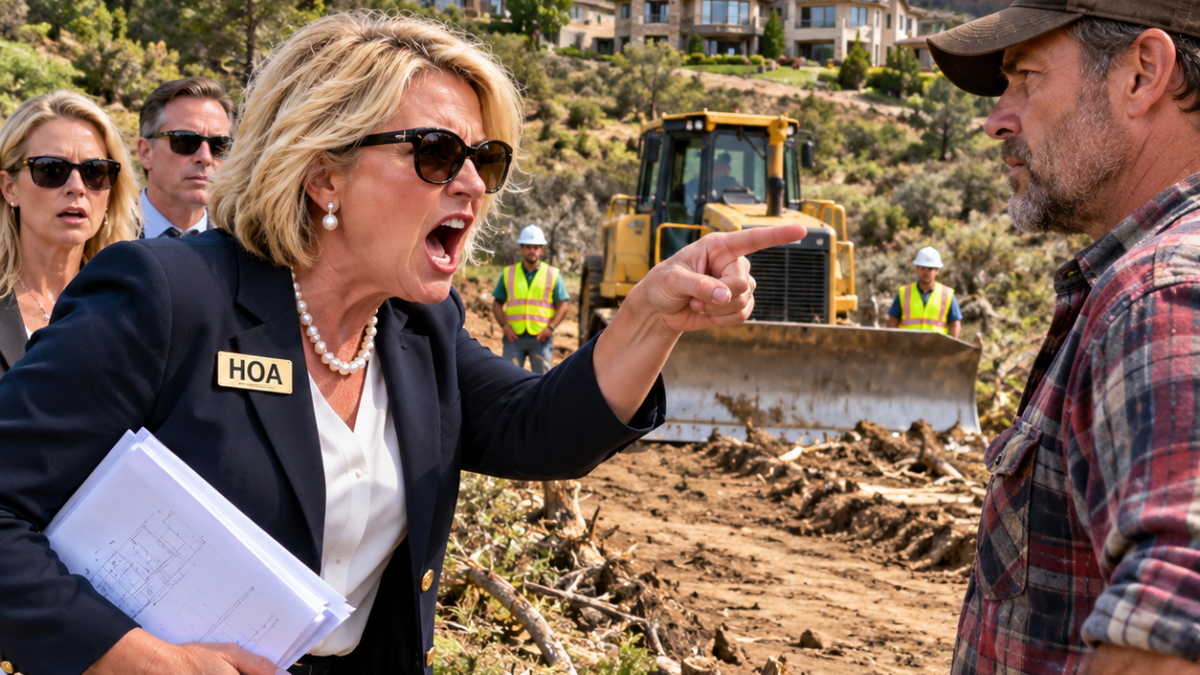
PART 2
I was at the county records office forty minutes later.
Nora had already pulled an old microfilm reel from storage.
The room smelled like dust, warm plastic, and old paper.
Nobody had needed that machine in years.
“Before digitization,” she told me, “oversized exhibits were sometimes filmed separately.”
“And the online index?”
“Sometimes incomplete.”
“Sometimes?”
She gave me a look.
“You’ve worked for government.”
“Fair.”
She loaded the reel.
Plat.
Utility map.
Drainage exhibit.
Another plat.
Then the screen went dark.
A black rectangle filled the monitor.
Across the top were three pale words.
**EXHIBIT F — FIRE CORRIDOR.**
I stopped breathing for a second.
“Back up.”
Nora did.
The map showed all eighteen acres.
Average width: roughly two hundred feet.
The maintenance lane: twenty feet.
The boundaries matched the old posts my family had repainted every spring.
At the bottom was the same recording stamp as the covenant.
Beside it:
**Restrictions run with the land.**
I leaned closer.
“Can you certify this?”
“I already started.”
I laughed once.
Not because anything was funny.
Because for three weeks I had been watching bulldozers move across land while people treated my memory like nostalgia.
Now the land had its own witness.
A county record.
—
I delivered certified copies to county inspector Daniel Ruiz and Crown Pine that afternoon.
Daniel called me ten minutes later.
“This changes the review.”
“How much?”
“Enough that I’m issuing a stop-work order on portions of the overlapping lots.”
“All eleven?”
“Seven clearly cross the mapped corridor. Four appear outside the core boundary on first review.”
“Those four still depend on access and fuel spacing.”
“I know.”
“Then stop all of them.”
“I can’t do that yet.”
I hated the answer.
But I understood it.
Daniel could stop what the evidence directly supported.
He could not shut down a multi-million-dollar project because I told him the rest was dangerous.
Evidence had to catch up.
That distinction would matter again later.
The stop-work order covered portions of seven lots.
Four foundation crews kept working.
Vanessa called an emergency board meeting.
To my surprise, she invited me.
The Crown Pine clubhouse conference room was packed.
Owners.
Developers.
Sales staff.
Contractors.
Lawyers.
I brought the certified Exhibit F.
Vanessa stood beneath a rendering of the completed luxury expansion.
Eleven stone houses glowed against a green slope.
No firebreak.
No emergency lane.
No empty space.
“Mr. Mercer has located an old planning exhibit,” she began. “That does not automatically mean a fifty-year-old mitigation concept prevents the community from adopting modern safety standards.”
I placed the exhibit beside the current site plan.
“You didn’t adopt the corridor.”
I pointed to the overlay.
“You built on it.”
Her attorney stood.
“Modern homes use ignition-resistant roofing, residential sprinklers, hydrants, treated siding, and updated vegetation plans.”
He wasn’t wrong.
That made the argument more dangerous.
Modern construction can perform better than old construction.
But houses were only part of the problem.
The new plan filled the corridor with fences, landscaping, accessory buildings, narrow private drives, ornamental evergreens, and people.
Places firefighters once expected to be empty would now contain bedrooms.
Vanessa turned toward the board.
“We are not ignoring science.”
She looked directly at me.
“We are replacing Ethan’s science with current science.”
Then she unveiled her strongest move.
Crown Pine had asked the county to modify the original covenant.
Attached to the request was a six-page wildfire consultant summary.
The name on top stopped me.
**Dr. Karen Mitchell.**
Karen was respected.
Careful.
I had cited her work.
If she truly believed the corridor could disappear, I had a problem.
The board voted to support Crown Pine’s modification request.
For the first time since finding Exhibit F, I drove home wondering whether I might actually be wrong.
—
The next morning, Crown Pine’s attorney invited me to a private meeting at the resort.
Vanessa sat at a polished table.
No HOA nameplate.
No residents.
No board members.
A purchase agreement waited in front of her.
“What’s this?”
“A practical solution.”
Crown Pine offered \$1.8 million for the twelve acres my family still owned.
Almost twice the county assessment.
The agreement required me to release every right connected to the old covenant.
Withdraw my objections within forty-eight hours.
And keep the terms confidential.
I turned to the signature page.
The buyer was not Crown Pine Development.
It was a newly created LLC.
Same business address.
No obvious connection to the HOA.
“Why use another company?”
“Tax planning.”
“Or you don’t want residents seeing Crown Pine buy the parcel that holds enforcement rights.”
Her face did not move.
“You’re assigning sinister motives to a normal transaction.”
Maybe.
The price was real.
I could have taken it.
Sold the ranch.
Walked away.
Never argued about firebreaks or road widths again.
Vanessa slid a pen toward me.
“You said you didn’t want control. This lets you leave with more than the property is worth.”
“The money is for the covenant.”
“The money is for your land.”
“Then remove the release.”
She looked at me.
“You know we can’t.”
Exactly.
The deadline was forty-eight hours.
One day before Karen Mitchell’s consultant summary reached the county review panel.
The offer was not about my house.
It was about my signature.
The old covenant required written approval from the owner of my retained parcel.
County modification alone did not give Vanessa everything she wanted.
I closed the folder.
“No.”
She leaned back.
“That is a substantial offer.”
“I know.”
“You won’t get another.”
“I know.”
“Then don’t tell residents we gave you no reasonable exit.”
That sentence followed me all the way home.
To Vanessa, the firebreak was a problem with a price.
To me, it was a promise with a purpose.
—
Three days later, Karen Mitchell called me.
“I need you to know something before the county meeting.”
“What?”
“I did not write the conclusion Crown Pine submitted.”
I stood up from my kitchen table.
“The report has your name.”
“They hired me eighteen months ago.”
“You evaluated the site?”
“Yes.”
“Did you recommend eliminating the corridor?”
“No.”
She emailed me the full document while we spoke.
Forty-three pages.
The six-page Crown Pine summary pulled pieces from different sections.
Karen had recommended selective thinning.
In two areas where paved roads provided separation, she said portions of the low-fuel area might be narrowed under strict conditions.
She did not recommend placing eleven homes across the corridor.
One sentence was especially clear.
**Avoid continuous combustible connections between native forest fuels and residential structures.**
Crown Pine’s plan did the opposite.
Cedar screens.
Ornamental pines.
Wood fences.
Pergolas.
Guest structures.
Dense landscaping.
“Did they receive this version?” I asked.
“Yes.”
“Proof?”
“I have the transmittal email and invoice.”
“When?”
“Before the luxury-phase application.”
Karen sent both to Daniel Ruiz.
The county expanded the stop-work order to all eleven lots while the modification request was reviewed.
I thought construction would finally stop.
I underestimated Vanessa again.
—
Four mornings later, I heard equipment on the slope before sunrise.
Landscapers.
Not concrete crews.
Not framers.
Crown Pine claimed it was routine site stabilization.
By noon, rows of six-foot cedar and ornamental pine appeared along future lot lines.
Mulch buried old corridor markers.
Decorative stone covered others.
They weren’t pouring foundations.
They were changing the ground anyway.
That evening, the landscaping supervisor came to my lower gate.
His name was Caleb Ross.
Forty-seven.
Broad shoulders.
Sun-darkened skin.
He kept glancing at the security camera.
“They moved the planting schedule ahead.”
“Who?”
He looked toward the lens.
“I can’t answer that while I’m still under contract.”
“Then tell Daniel.”
“And if the county decides it’s technically permitted?”
I said nothing.
“Vanessa makes one call and every big landscape contractor in this valley knows I’m difficult.”
I understood.
Courage sounds simple when you’re spending somebody else’s paycheck.
He gave me one thing.
“A change-order number.”
I wrote it down.
“Why?”
“You’ll know later.”
Then he left.
—
The county scheduled a formal hearing for September.
Crown Pine appealed the stop-work order.
Vanessa told residents delays were costing more than \$80,000 a week.
Buyers threatened to walk.
Contractors filed delay claims.
Then the emails started reaching me.
**YOU’RE DESTROYING OUR PROPERTY VALUES.**
**MOVE BACK TO YOUR FARM AND LET PEOPLE LIVE.**
Someone called my father’s firebreak “Ethan’s dirt museum.”
At the grocery store, a Crown Pine resident stopped me beside the dairy case.
“Why should one man control eighteen acres he doesn’t even own?”
That question bothered me because it was fair.
“I don’t own the corridor.”
“Then why are you stopping construction?”
“I’m trying to enforce a recorded restriction attached to the land.”
“So you control it.”
“No.”
He crossed his arms.
“Sounds like control.”
I pointed toward the milk in his cart.
“If your neighbor owns property subject to a utility easement, the power company doesn’t own his yard.”
“That’s different.”
“Only because you’re used to it.”
The firebreak was an obligation.
Obligations are invisible.
That makes them easy to call worthless until somebody removes them.
—
The September hearing produced a compromise I hated.
Five lots could resume limited foundation work outside the clearest mapped centerline.
No occupancy would be issued until the dispute was resolved.
Vanessa called it a victory.
Construction accelerated.
Over ten months, stone walls rose.
Pools appeared.
Privacy fences connected properties.
Ornamental pines filled the rear setbacks.
The golf-cart path wound through the former firebreak.
An independent reviewer recommended keeping at least 160 feet of low-fuel separation and widening emergency access.
Crown Pine appealed again.
Then a new county administrator approved a revised mitigation arrangement relying heavily on modern roofs, residential sprinklers, hydrants, and annual vegetation inspections.
The private covenant, however, was never extinguished.
That issue drifted into civil litigation.
The legal gray area was enough.
Five premium houses received conditional occupancy.
Then six more.
By the second summer, all eleven were occupied.
That is where Laura Bennett entered the story.
—
Laura was forty-four.
Widow.
Her sixteen-year-old son Mason lived with her.
So did her seventy-two-year-old mother, Evelyn.
They bought Lot Eight.
Laura told me later that she had trusted the phrase:
**Professionally engineered for wildfire conditions.**
She assumed somebody more qualified than her had checked the details.
Most buyers do.
Mason was the one who noticed the difference.
He flew a small drone from approved public areas.
Mostly photography.
Weather.
Landscape.
Black Ridge in different seasons.
He had old aerials saved from before their move.
One afternoon, he overlaid old and current images using the clubhouse roof, ridgeline, and boulevard as fixed reference points.
The before image showed a wide pale band beneath the forest.
The after image showed houses, fences, landscaping, pools, pergolas, and trees.
The empty strip had almost vanished.
Laura called after her insurance company asked for exact defensible-space measurements.
Her closing documents referred to a wildfire engineering attachment she could not find.
She requested it from Crown Pine.
Management sent her a two-page seasonal guide.
Clean gutters.
Register for alerts.
Trim shrubs.
She brought it to my house.
“Is this what we were supposed to receive?”
“No.”
“How do you know?”
“This is homeowner preparation guidance.”
I tapped Mason’s overlay.
“It says nothing about why your house was allowed inside the original corridor.”
Laura stared at the images.
“Did they know?”
“Karen’s email proves Crown Pine received her full report.”
“That isn’t what I asked.”
She was right.
Knowing the report existed did not prove what buyers had been told.
Laura began organizing her own closing documents.
Early brochure.
Later brochure.
Hazard disclosure.
Insurance questionnaire.
Landscape plan.
Purchase agreement.
She found something subtle.
The earliest marketing drawing showed a broad strip of low vegetation behind the premium homes.
Later brochures replaced it with a walking trail labeled:
**MANAGED GREEN SPACE.**
The houses did not move.
The risk description did.
Crown Pine had not merely built across the firebreak.
They had renamed what remained until new buyers did not know what had disappeared.
—
The first two fire seasons were quiet.
Vanessa loved that.
“Evidence,” she called it.
Property values climbed.
Luxury magazines photographed the forest edge.
The clubhouse hosted wine dinners.
Private tours.
Real-estate events.
Nothing burned.
That became Vanessa’s strongest argument.
And the one I feared most.
Prevention has terrible public relations.
When mitigation works, the result looks like nothing.
No dramatic photograph.
No viral video.
No grateful crowd.
Just open land.
Unused roads.
Trimmed vegetation.
A gate nobody needed today.
Crown Pine looked beautiful.
Therefore, people assumed it was safe.
—
Then Laura’s insurance company declined to renew her policy without certified defensible-space measurements.
Sixty days.
Two other premium owners got similar notices.
Management blamed the statewide insurance market.
That was partly true.
They offered referrals to surplus-lines carriers.
Premiums nearly tripled.
Laura attended the next HOA meeting holding her nonrenewal letter.
Vanessa chaired from the front.
“Your brochure said the upper section exceeded current wildfire standards.”
“We complied with applicable approvals.”
“Will you certify that statement in writing for my insurer?”
“No responsible HOA guarantees a private underwriting decision.”
“I didn’t ask you to guarantee their decision.”
Laura held up the brochure.
“I asked you to repeat your own claim.”
The room became quiet.
Vanessa moved to the next agenda item.
That refusal accomplished more than months of my complaints.
Residents might ignore an old covenant.
They understood insurance.
Three owners requested Karen’s full report.
Management sent them the same six-page summary.
They forwarded it to Karen.
Karen replied:
**This summary is incomplete and was not approved by me as a stand-alone risk assessment.**
Now I wasn’t the only problem Vanessa needed to explain.
—
Caleb Ross showed up at my house the following spring carrying a waterproof document case.
Crown Pine had terminated his landscaping company.
“Why?”
“I refused to plant another cedar row across a marked engine turnaround.”
He put the case on my table.
Daily logs.
Photographs.
Invoices.
And the change order number he had given me months earlier.
The instruction was blunt.
**RECOVER ALL UNUSED BUFFER LAND FOR PREMIUM VISUAL SCREENING AFTER FINAL LANDSCAPE INSPECTION.**
Vanessa’s signature was at the bottom.
The date mattered.
Nine days after Karen’s full report reached Crown Pine.
Three days after the first county landscaping inspection.
The extra combustible planting had been added after review.
Caleb had photographs too.
Emergency-lane markers moved inward.
Then masonry built where they had been.
The original lane was twenty feet.
At one bend, it had been narrowed to eleven feet six inches.
A pickup could pass.
A landscaping truck could pass.
Two fire engines meeting there could not.
Daniel Ruiz reopened the county review.
A joint inspection was scheduled for late August.
Vanessa responded by scheduling Crown Pine’s biggest luxury sales event on the same weekend.
Brokers.
Investors.
Prospective buyers.
She called the inspection routine.
Six days before it, lightning struck west of Black Ridge.
—
The initial report was three acres.
Several miles away.
Most residents barely noticed the smoke.
I noticed the drainage.
The fire was below a steep channel aligned with forecast east winds.
If it climbed that route, it could reach the ridge faster than a flat map suggested.
Once it crossed the crest, slope, wind, and dry fuels all pointed toward Crown Pine.
I sent coordinates to county fire command.
Historic maps.
Current photographs.
Mason’s latest drone overlay.
Chief Aaron Walker called twenty minutes later.
“How current are these images?”
“Twelve days.”
“The pre-plan shows open ground behind the upper homes.”
“It’s gone.”
“How gone?”
“Eleven houses. Wood fencing. Cedar screens. Ornamental pines. Pools. Guest structures.”
“And access?”
“One bend is eleven and a half feet.”
Pause.
“That’s verified?”
“Caleb has measurements and photographs.”
Aaron did not argue.
He sent a division supervisor to inspect before the fire reached the ridge.
That inspection found something worse.
The secondary emergency gate was locked electronically.
The fire-department access code in the county database did not work.
Security could not reach the property manager who had changed it.
The manual override box was empty.
At the same time, Crown Pine Boulevard was filling with catering vehicles, luxury display cars, golf carts, and sales-event traffic.
Aaron ordered deputies to cut the chain behind the electronic gate.
Caleb moved two maintenance trailers constricting the approach.
I led the supervisor to the old turnaround, partly hidden by cedar screening and decorative masonry.
He measured the bend.
“Eleven-six.”
Vanessa arrived in a golf cart.
Red blazer.
White event clothes.
“You cannot destroy private security equipment without authorization.”
The supervisor held up the cut chain.
“Ma’am, this is a recorded emergency lane.”
He dropped the chain beside the post.
“That is the authorization.”
Vanessa had no immediate answer.
It was the first time I had ever seen that happen.
—
By noon, the fire exceeded nine hundred acres.
Aircraft slowed one flank.
Wind pushed the head toward the drainage below Black Ridge.
Aaron recommended voluntary evacuation of Crown Pine’s upper section while both roads were clear.
Laura packed immediately.
Medication.
Identification.
Insurance papers.
Laptop.
Mason grabbed his drone archive and two external drives.
Laura called older neighbors.
Vanessa did not tell residents to stay.
She was too careful for that.
Instead, Crown Pine sent a message:
**The scheduled event will continue while management monitors conditions in coordination with local authorities.**
They were not coordinating.
They were receiving alerts.
That difference sounds small until people are deciding whether to leave.
At 1:30, smoke thickened above the western crest.
At 2:10, ash began falling near the tennis courts.
At 2:23, Aaron ordered mandatory evacuation of the upper section.
Deputies took control of both entrances.
Guests abandoned wine glasses beside sales displays.
Catering crews loaded what they could.
Two golf carts blocked an intersection until a maintenance worker pushed them onto the grass.
Vanessa remained in the clubhouse.
A deputy walked inside.
“One minute.”
“These files contain private buyer information.”
“This building contains somebody delaying an evacuation.”
He pointed at her.
“That person is you.”
She left.
Because Laura and several neighbors had gone early, the premium section emptied faster.
Because Caleb had opened the secondary lane, traffic split before the boulevard clogged.
Because Aaron acted before flames were visible, engines entered while civilians still moved out.
That sequence saved time.
Time was the one resource the firebreak had always been designed to buy.
—
By evening, every resident was accounted for.
Then Black Ridge lit up.
From the county command area, I watched orange become a continuous glow along the crest.
Embers crossed ahead of the main front.
The upper forest brightened.
Disappeared in smoke.
Brightened again farther downhill.
Aaron shifted the main defensive line toward the broad boulevard.
Hydrants.
Pavement.
Turning space.
Older county plans expected crews to work farther uphill inside the open corridor.
That position no longer existed.
The first ornamental pine ignited behind Lot Three.
Then the cedar privacy screen.
Then a wooden fence.
Fire moved into a pergola beside a pool house.
On the next property, shrubs carried flame toward a deck.
The premium lots looked separate on marketing plans.
Under fire, the landscaping connected them.
I had imagined that possibility for three years.
Usually at night.
Usually while hoping I was overreacting.
Watching it happen gave me no satisfaction.
None.
Being right about a fire is one of the worst kinds of being right.
Engines could not protect every backyard.
Crews used intersections.
Driveways.
Masonry walls.
They removed burning fence sections.
Protected attic vents.
Held the lower boulevard.
Garages burned.
Pool houses burned.
Four rear decks failed.
Embers entered two attics before crews stopped deeper spread.
Cars parked beside combustible fencing were destroyed.
Others only yards away survived behind open pavement.
Then Vanessa’s own showcase property ignited.
Its detached guest house went first.
Fire crossed the cedar screen.
Destroyed the pool shelter.
Reached the rear wing.
Crews held the front masonry section from the driveway.
The clubhouse suffered heavy damage along its upper side after ornamental landscaping carried fire into attached exterior features.
At three in the morning, the wind eased.
By sunrise, the main front had passed.
Thirty-seven homes had been threatened.
The worst connected damage sat in and immediately below the eleven premium lots.
No resident died.
No firefighter had to abandon a defensive position to rescue someone who waited too long.
That mattered more than every argument before it.
—
Residents were still barred from returning when Vanessa spoke to reporters.
She called the fire unprecedented.
Said no community design could reasonably prevent damage from an event of that intensity.
Part of that was true.
Lightning started the wildfire miles away.
Crown Pine did not create the storm.
The firebreak would not have created magical immunity.
No honest wildfire engineer would claim otherwise.
But fire leaves evidence too.
Mason waited until aerial restrictions were lifted.
He did not fly during active suppression.
Instead, he gave investigators his dated pre-fire archive.
Once officials conducted authorized aerial documentation, they compared post-fire imagery with his overlays.
The pattern was hard to ignore.
The most connected damage followed the band where dense landscaping, fences, accessory structures, and homes had replaced open low-fuel space.
The preliminary assessment used careful language.
It did not say Crown Pine caused the wildfire.
It did not say every damaged structure would have survived with the full firebreak.
It said removal of low-fuel separation and addition of continuous combustible features materially reduced defensive space, complicated engine access, and contributed to spread within the upper development.
That was enough.
Karen gave investigators her complete forty-three-page report.
Caleb gave them the change order.
Laura provided marketing materials and disclosures.
Mason supplied visual history.
I supplied the covenant, maintenance records, GPS images, and old hazard maps.
Six evidence trails pointed toward the same decisions.
Then investigators found the document Vanessa had tried hardest to avoid.
—
Water from suppression operations had damaged several clubhouse records.
While sorting project files, an investigator found a red folder labeled:
**MITIGATION REVISION.**
Inside was an internal title-company exception notice.
Three years old.
The notice identified the original fire-mitigation and emergency-access covenant by recording number.
It warned that Exhibit F appeared missing from the digital file.
And recommended a manual archive search before any premium-lot closing.
Across the top, someone had written in blue ink:
**DO NOT DELAY SALES. COUNTY REVISION WILL SUPERSEDE.**
Beside it were two initials.
**V.C.**
Vanessa had not simply relied on the same incomplete digital title record that confused everyone else.
She had been told the record was incomplete.
Before the first premium lot closed.
Before my spring confrontation.
Before she asked me to produce Exhibit F.
That was the part that stayed with me.
She had looked me in the eye and said:
“If the covenant still controls, the title company would have found it.”
The title company had tried.
Somebody told them not to wait.
—
The county froze Crown Pine’s next development phase.
Fire officials documented the failed gate code.
Empty override box.
Narrow access bend.
Lost turnaround space.
Building officials reviewed conditional occupancy approvals.
Insurance investigators compared risk representations at closing with actual site conditions.
Laura and eight other owners filed a civil action.
Not against me.
Not against neighbors who had purchased in good faith.
Against Crown Pine Development, the developer-controlled HOA, and parties involved in the disclosures and mitigation changes.
They focused on documents.
The covenant.
Karen’s report.
The altered summary.
The post-inspection planting.
The emergency lane.
Marketing representations.
The title exception.
Vanessa tried one final defense at a special board meeting.
The clubhouse could not host it.
Residents gathered in a temporary conference facility lower in the development.
Vanessa sat at the front.
No red blazer this time.
She looked exhausted.
She argued that the project had been approved by professionals.
And that part was not entirely false.
Permits existed.
Inspections occurred.
Modern roofs were installed.
Sprinklers existed.
Hydrants existed.
The county had approved a revised mitigation agreement.
Her defense sounded stronger because it contained true facts.
Then Karen Mitchell asked to speak.
Vanessa looked at her.
Karen placed the full report on the table.
“You hired me to identify wildfire risk.”
“Yes.”
“You did not hire me to make the risk disappear.”
Vanessa’s attorney started to object.
Karen continued.
“I specifically warned against continuous combustible connections between the forest and residential structures.”
She opened the report.
“My recommendation was removed from the submitted executive summary.”
Caleb stood next.
He placed the change order beside it.
“You ordered additional screening after the landscape inspection.”
Vanessa looked at him.
“Those were routine field adjustments.”
“Across marked buffer land?”
“Privacy screening was part of the approved aesthetic.”
Caleb opened his photographs.
“Then why were the emergency markers moved first?”
The room shifted.
Laura stood.
She held the title-company exception notice.
“And why were we sold homes after your own title process warned that the property record was incomplete?”
Vanessa looked toward Crown Pine Development’s attorney.
He did not answer for her.
Laura’s voice shook.
“My mother slept in my car during the evacuation.”
“Laura—”
“My son spent three years photographing a safety feature we were never told existed.”
Vanessa lowered her eyes.
“I did not start that fire.”
“No,” Laura said.
“You didn’t.”
She placed the notice down.
“But you sold us a story about the land.”
That was quieter than anger.
And more damaging.
—
Independent homeowner representatives voted to remove Vanessa as HOA president.
Crown Pine Development terminated her operational role the following week.
Her removal did not rebuild a house.
It did not restore insurance.
It did not erase the fire.
But it ended her control over resident communications and reconstruction decisions.
The lawsuits and claims took eleven months.
Title analysis.
Engineering review.
Insurance disputes.
Mediation.
Temporary housing.
Appraisals.
Reconstruction estimates.
That slow timeline frustrated people.
Real consequences often do.
The old covenant mattered because it ran with the land.
The premium parcels had been sold subject to a restriction the digital title process failed to display completely.
The revised county mitigation arrangement had changed public approval conditions.
It had not privately released my family’s covenant.
Eventually, the title insurer, developer, HOA insurers, affected owners, and my family reached a combined settlement structure.
Seven parcels occupying the core restored corridor were repurchased by the developer.
Four partially affected owners received options.
Relocation.
Or reconstruction under stricter setbacks.
Temporary housing and documented uninsured losses were addressed.
Structures that could not remain in the restored corridor were removed.
County officials did not declare the entire hillside unbuildable.
They required a safer plan based on the post-fire review.
That distinction mattered.
The goal was not punishment through empty lots.
The goal was restoring function.
—
This time, we did not rely on a poorly indexed three-page covenant.
The developer.
County.
Affected owners.
Title insurer.
And my family executed a new permanent conservation and emergency-access easement.
Every map attached.
Every exhibit indexed.
Every boundary marked.
The restored corridor averaged about 220 feet.
Wider than before in some places.
Low-growing vegetation.
Two engine turnouts.
Twenty-four-foot all-weather access lane.
Permanent markers.
Inspection schedule.
No mansion.
No guest house.
No privacy fence.
No pool shelter.
No continuous ornamental tree row inside it.
The burned cedar screens came out.
Combustible fencing was broken into safer sections lower on the slope.
Hydrant access improved.
The emergency gate received a system that could actually be opened.
And every year, firefighters tested it.
Not on a spreadsheet.
Physically.
—
Laura stayed in Crown Pine.
So did Mason and Evelyn.
They moved to a rebuilt home below the boulevard.
Laura received compensation for relocation and the change in property value.
She eventually joined an owner-elected safety committee.
At the first meeting she said:
“If anybody calls this a task force, it better have an actual task and a deadline.”
I liked her immediately after that.
Mason kept flying his drone during authorized monitoring periods.
His photographs changed.
Before the fire, he documented disappearance.
Afterward, he documented maintenance.
Vegetation height.
Access width.
Marker locations.
Contractor encroachment.
He once sent me a photograph with one sentence:
**Nothing changed this month.**
I replied:
**Perfect.**
Caleb joined a mitigation contractor specializing in defensible-space restoration.
Karen worked with the county to change its hazard-area checklist.
Future reviews had to identify complete consultant reports.
Not selected summaries.
Not isolated conclusions.
The whole report.
I refused an HOA board seat.
Ellen Park tried to convince me.
“No.”
“You could help.”
“I am helping.”
“From outside.”
“Best possible location.”
She laughed.
I agreed to assist with annual inspections and evacuation drills.
That was enough.
—
One year after the Black Ridge fire, I returned to the overlook.
The eleven premium homes were gone from the core strip.
Some foundations had been removed.
Others lay beyond the restored line.
Low grasses covered the open slope.
Permanent markers stood where orange construction stakes once appeared.
A broad access road crossed the corridor.
From a luxury-development perspective, it looked unfinished.
From a firefighter’s perspective, it made sense.
I remembered Vanessa standing on that same slope years earlier.
Red blazer.
My map in her hands.
**Empty land has no value.**
At the time, the sentence angered me.
A year after the fire, it mostly made me tired.
She had not been stupid.
That mattered.
Vanessa understood finance.
Marketing.
Development.
Deadlines.
Buyer expectations.
She understood how expensive land looked on a balance sheet.
What she failed to respect was value that did not produce square footage.
Distance.
Access.
Time.
Separation.
Options.
Firefighters need room.
Families need time.
Roads need width.
A fire needs something that does not burn as easily as the thing it just crossed.
Those benefits rarely appear in glossy brochures.
—
I did not celebrate Vanessa losing her job.
I did not celebrate burned guest houses.
Or displaced families.
Or insurance fights.
If your warning becomes meaningful only after people suffer, you have not won.
The only useful victory was what changed after.
The dangerous lots disappeared.
Buyers were compensated.
The corridor returned.
Emergency access widened.
Every resident survived.
That was what mattered.
—
The following September, Crown Pine held its annual evacuation drill.
No catering trucks.
No sales event.
No wine glasses.
Just residents and fire crews.
Chief Aaron Walker stood beside the secondary gate with a stopwatch.
Security entered the fire code.
The gate opened.
Fire engine through.
Second engine behind it.
No contact with the wall.
No need to cut chains.
At the turnaround, both apparatus had room to reposition.
Aaron looked at me.
“Better?”
“Much.”
“That almost sounded positive.”
“Don’t get used to it.”
Mason launched his drone from the approved monitoring location.
It climbed above the corridor.
On his tablet, the restored strip looked enormous.
Two hundred twenty feet of nothing impressive.
Grass.
Road.
Space.
Laura stood beside me.
“I used to think my lot backed up to unused land.”
“I know.”
“They sold that as a benefit.”
“I know.”
She watched the engines below.
“Now I understand why it was supposed to stay unused.”
I looked toward Black Ridge.
“That doesn’t mean nobody can ever touch it.”
“What does it mean?”
“It means every change has to preserve what the space is supposed to do.”
She nodded.
Then Evelyn, her mother, walked over carrying a folding chair.
“You two planning to stand here philosophizing all afternoon?”
Laura laughed.
“I’m learning.”
Evelyn opened the chair.
“I’m seventy-three. Learn sitting down.”
That ended the philosophy.
—
Later that day, Mason showed me a new overlay.
Before construction.
Peak luxury phase.
Post-fire restoration.
Three images.
Same ridgeline.
Same boulevard.
Same mountain.
The middle image looked the richest.
Eleven expensive houses.
Pools.
Perfect landscaping.
Trees.
Fences.
The final image looked simpler.
Open land.
Access road.
Low vegetation.
“Which one looks safer?” he asked.
“You know the answer.”
“I know.”
“Then why ask?”
He zoomed in.
“Because the safe one looks like less.”
That stopped me.
“Yes.”
“People think more stuff means more value.”
“Usually.”
He studied the screen.
“So how do you sell empty land?”
I thought about Vanessa.
The brochures.
The title exception.
The fire.
Then I pointed toward the open corridor.
“You don’t sell it as empty.”
“What do you call it?”
“Space doing its job.”
He smiled.
“That’s terrible marketing.”
“It is.”
He saved the file anyway.
—
The next summer brought another dry east-wind event.
No major wildfire.
Just red-flag conditions.
Crown Pine closed the upper trail.
Security tested the emergency gate.
The HOA reminded residents not to park inside the turnaround.
Mason sent a drone image showing the corridor clear.
Laura texted:
**Insurer renewed without an argument this year.**
I sent back:
**That might be the best review Crown Pine has received.**
She responded with a laughing face.
I stood at the edge of my family’s twelve acres that evening.
The original boundary post my father repainted every year was still there.
Faded.
Slightly crooked.
Beside it stood a new metal marker with coordinates, easement references, and emergency-contact information.
Old system.
New system.
Same purpose.
My father had believed documents mattered.
But he also believed people remembered.
That was where he was wrong.
People leave.
People forget.
Boards change.
Files migrate.
Scans lose pages.
Developers rename things.
A promise tied to land has to survive people who no longer remember why it was made.
The new easement would.
Not because paper is magical.
Because this time the paper matched the ground.
Markers.
Road.
Turnouts.
Vegetation.
Inspections.
Gate access.
A future board would have a harder time pretending the safety corridor was just dead grass.
—
One afternoon, Nora Feld—the archivist who found Exhibit F—came up to see it.
She had never visited Crown Pine before.
I drove her to the overlook.
She looked across the restored corridor.
“That missing page caused all this?”
“No.”
She raised an eyebrow.
“It caused some of it.”
“The missing page made the argument harder.”
“What caused the rest?”
“People deciding absence meant permission.”
She looked down at the open land.
“And the microfilm?”
“Helped stop them from rewriting the past.”
Nora smiled.
“I’d like that on a records-office poster.”
“Probably too dramatic.”
“You haven’t seen our budget meetings.”
We walked to one of the permanent markers.
She ran her finger across the engraved recording number.
“The original reel is being conserved.”
“Good.”
“Digital copy has three backups now.”
“Better.”
She looked pleased.
“Archivists enjoy revenge in very boring forms.”
“That may be my favorite kind.”
—
I still think about Vanessa’s sentence.
**Empty land has no value.**
Maybe that was the whole dispute compressed into five words.
Developers are trained to see potential.
Square footage.
Views.
Lots.
Revenue.
That isn’t inherently evil.
Communities need homes.
Roads.
Water systems.
Parks.
Places to live.
The danger begins when potential is treated as the only form of value.
A drainage corridor can look empty.
A firebreak can look empty.
An emergency lane can look unused.
A setback can look wasted.
So can the space between a forest and a bedroom.
Until the day everyone needs it.
—
On the second anniversary of the fire, Mason sent me one final photograph.
Black Ridge at sunset.
The restored corridor ran pale beneath the dark timber.
No smoke.
No flames.
No engines.
No evacuation.
Just distance.
He wrote:
**Not much happening up there.**
I looked at the photograph for a long time.
Then typed back:
**That’s the point.**
I saved the image beside the old Exhibit F scan.
One showed what people had promised decades earlier.
The other showed that promise visible on the ground again.
The most important pieces of the Crown Pine story were never dramatic by themselves.
A missing microfilm exhibit.
A consultant’s uncut report.
A teenager’s drone archive.
A landscaper’s change order.
A title-company warning.
A locked gate that failed when firefighters needed it.
Ordinary pieces of evidence.
Saved by ordinary people.
And on clear evenings, when the sun drops behind Black Ridge, the restored firebreak looks almost empty again.
Exactly the way it is supposed to.
[END OF STORY]








