PART 2: HOA Bulldozed My $2 Million Rescue Airstrip for a Golf Course—Then a Federal Survey Exposed the Lie They Buried
PART 2
“Which map?” I asked.
Elias didn’t answer immediately.
I could hear papers shifting on his desk, followed by the faint clatter of a keyboard.
“Graham, do you remember the preliminary survey Northstar Leisure submitted last spring?”
“The golf course people?”
“That’s them.”
“I remember telling them I wasn’t selling.”
“Well, I’m looking at their original proposal now, and there’s something I want to compare with whatever Lenora handed you.”
“What’s that?”
“The ownership boundaries.”
I looked toward the broken northwest gate.
“How soon can you get here?”
“I’ll meet you at the county records office tomorrow morning. But listen carefully. Until then, photograph everything, preserve the original documents, and don’t confront that woman again.”
I agreed.
Then I hung up and stood beside the wreckage of my airplane.
The mountain wind had picked up, carrying the smell of disturbed earth and diesel fuel across the apron.
For the first time since arriving, I allowed myself to look closely at what remained of the Beaver.
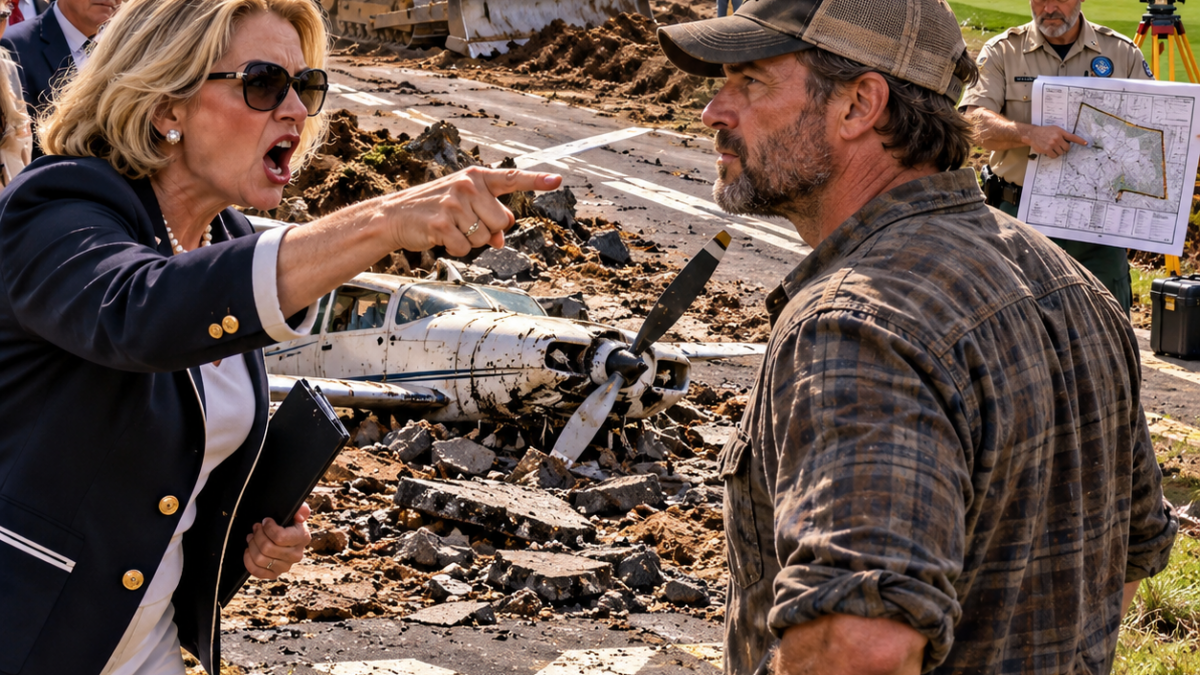
The cockpit windows were shattered. The left wing had folded beneath the bulldozer’s weight. The nose was twisted sideways, and one of the propeller blades had snapped near its root.
I’d bought that aircraft as a barely airworthy machine from an aging bush pilot who was retiring in Idaho.
Most people had thought I was crazy.
The restoration had nearly broken me financially. I’d worked summers maintaining remote landing strips, flown supply contracts whenever they were available, and spent winters rebuilding the airplane one system at a time.
When the engine finally started after the restoration, I’d stood beside the propeller with tears in my eyes.
It wasn’t simply an airplane.
It represented nine years of my life.
And someone had destroyed it because a golf course developer didn’t like where it sat.
I took another photograph.
Then I called the sheriff.
Deputy Nolan Briggs arrived about forty minutes later.
He parked his cruiser outside the damaged hangar and climbed out slowly, surveying the torn fence, uprooted runway lights, and bulldozer tracks.
“Good Lord, Graham.”
“That’s about what I said.”
He walked toward the Beaver.
“Anybody hurt?”
“Nobody was here when they came through.”
“Thank God for that.”
He crouched beside the broken landing gear.
“Who did this?”
I handed him Lenora’s packet.
“Silver Pine Estates. Their president says the county authorized an emergency cleanup.”
Nolan read the first page.
Then he turned to the second.
His forehead tightened.
“That’s a pretty broad demolition order.”
“Especially considering the county doesn’t own the runway.”
He looked up.
“Explain.”
“The northwest corridor belongs to the United States Forest Service. My private property begins at the southeast boundary monument. The hangar, apron, workshop, and access road belong to me.”
Nolan turned toward the torn perimeter fence.
“So they crossed federal property before entering yours?”
“Yes.”
“And you’re certain about the ownership?”
“I’ve maintained this place under a federal agreement for twenty-two years.”
That caught his attention.
“What kind of agreement?”
“Emergency aviation support. Fire operations, mountain rescue, medical deliveries, equipment staging. The Forest Service owns the runway corridor. I maintain the surface and provide access through my property.”
He looked again at the wreckage.
“Did Lenora know that?”
“That’s what I’d like to find out.”
Nolan photographed the scene, called his supervisor, and contacted the county code-enforcement department to verify the alleged authorization.
He also instructed me not to move the aircraft or disturb the fuel-stained soil until the fire department had inspected it.
“There’s something else,” I told him.
I pointed toward the fallen Forest Service sign.
“When I got here, that sign was facedown.”
“Could the machinery have knocked it over?”
“Sure. But look at the posts.”
He walked over.
The metal mounting bracket had been bent backward. Fresh scrape marks ran along its surface.
I showed him the photograph I’d taken before touching anything.
Then I remembered the camera.
“Nolan, I might have something better.”
“What?”
“A trail camera under the hangar eave.”
He followed me around the building.
The camera had survived because it was tucked behind a support beam well above the bulldozer’s reach.
I removed the memory card.
We went inside my workshop, where one of the computers still worked.
The first relevant recording began at 6:12 that morning.
A pair of work trucks approached the northwest gate.
Warren Pike stepped out with a folded document in his hand.
Lenora arrived behind him in her SUV.
They examined the gate.
A worker pointed toward the federal warning sign.
Lenora walked over, looked at it, and then turned it facedown.
Seconds later, she waved toward the bulldozer.
The machine advanced.
I watched the recording twice.
Nolan remained silent.
Finally, he said, “Make me a copy of that.”
I did.
Then he asked me something I hadn’t considered.
“Does the Forest Service know their runway is gone?”
I looked toward the wreckage.
“They’re about to.”
The Forest Service sent two people that afternoon: an engineering technician and a law-enforcement officer.
They didn’t arrive with sirens or dramatic speeches.
They arrived with cameras, measuring equipment, temporary barriers, and the grim expressions of people discovering that a critical piece of infrastructure had been destroyed without authorization.
The engineering technician walked nearly the full length of the 4,180-foot runway.
He documented the gouges in the gravel, destroyed electrical cabinets, damaged lighting circuits, and trenches cut across the compacted surface.
By late afternoon, Black Ridge was officially closed.
Regional wildfire dispatchers were notified.
Emergency aviation units were instructed to use alternate facilities.
Watching the temporary closure barriers go up made the situation feel worse than seeing my airplane crushed.
The Beaver belonged to me.
I could grieve it, insure it, and eventually replace it.
But the runway belonged to everyone who might someday need it.
Black Ridge wasn’t a busy commercial airport.
Most days, the only sounds were wind, birds, and my occasional maintenance vehicle moving along the gravel.
During wildfire season, that changed.
Aircraft staged equipment there. Rescue teams transferred personnel. Medical supplies moved through the mountains when washed-out roads and early snowstorms made ground transportation painfully slow.
The site existed because some places in Montana cannot be reached quickly by truck.
That evening, the consequence became immediate.
A search-and-rescue team requested an equipment drop for an injured climber north of Granite Pass.
Under normal conditions, Black Ridge would have served as a staging point.
Instead, the responding aircraft had to operate from an airport eighty-seven miles away.
The mission went forward, but the crew needed additional transfer time and a fuel stop.
I listened to the radio traffic from my workshop.
No one died.
The climber was eventually reached.
But I’d flown enough rescue missions to know that an extra hour could become the difference between a difficult rescue and a recovery operation.
That night, I sat alone at my workbench.
A little brass identification plate from the original Beaver lay in front of me.
I’d removed it during the restoration and kept it in a drawer.
For years, I’d thought the greatest threat to Black Ridge would be weather, funding cuts, or a catastrophic mechanical failure.
I’d never imagined a homeowners association would simply erase the runway with a bulldozer.
Silver Pine Estates had been built on the eastern ridge long after Black Ridge was established.
Its 214 homes sat behind decorative stone entrance signs, landscaped roads, and an elaborate clubhouse.
I had nothing against the residents.
Most were decent people.
Some volunteered during wildfire season. Others donated supplies to rescue crews. A retired paramedic named Howard Ellis occasionally brought coffee to the hangar when the weather turned ugly.
But I was not a member of their association.
Neither was my land.
The subdivision’s recorded declaration covered its residential lots, clubhouse, internal roads, and approximately sixty-eight acres of common property.
It didn’t include my twenty-six-acre parcel.
And it certainly didn’t include the federal runway.
For years, that distinction had been accepted without argument.
Then Northstar Leisure announced plans for a golf course and resort.
The proposed development promised eighteen holes, walking trails, a lodge, and luxury cottages overlooking the mountains.
Silver Pine’s directors immediately began promoting it as an opportunity to increase property values.
Some homeowners loved the idea.
Others worried about traffic, water use, construction noise, and the costs of expanding association infrastructure.
Lenora Whitlock became its loudest champion.
She described the project as Silver Pine’s future.
At the time, I hadn’t understood why she seemed personally offended whenever I refused to sell.
The first time we spoke about the land, she came to my hangar carrying a glossy resort brochure.
“Graham, I think you should consider the bigger picture.”
I was replacing a runway light fixture.
“What’s the bigger picture?”
“The entire community would benefit from developing this western corridor.”
“The runway isn’t available for development.”
“Everything is negotiable.”
“Not everything.”
She looked toward the hangar.
“Northstar could make your life considerably easier.”
“I like my life.”
“Do you like struggling to maintain an outdated facility nobody uses?”
I put down my wrench.
“That facility supported two medical transports last month.”
She waved the statement away.
“There are airports elsewhere.”
“Not close enough when the roads are blocked.”
Her expression hardened.
“You’re being unnecessarily difficult.”
“And you’re asking me to sell land I need for my business.”
“We’re prepared to discuss generous compensation.”
“I’m not.”
She left without shaking my hand.
I assumed that was the end of it.
I was wrong.
The next morning, I met Elias Ford at the county records office.
Elias was sixty-one, with weathered hands, a thick gray beard, and the stubborn patience of a man who had spent thirty-one years explaining property lines to people who didn’t want to hear the answers.
He carried a battered leather folder and a field notebook filled with precise handwriting.
“Show me what she gave you,” he said.
I spread Lenora’s papers across the table.
He examined the first page.
“Interesting.”
“What?”
“This county notice is real.”
My stomach tightened.
“Are you saying she had authorization?”
“No. I’m saying the first page came from an actual county case.”
He turned it over.
“The question is what happened after that.”
We requested the official county file.
A clerk returned with a digital copy.
Four months earlier, code enforcement had opened a complaint about an abandoned maintenance shed near the northwest portion of the airstrip.
The notice asked the responsible property owner to respond within twenty days.
It did not authorize demolition.
It didn’t mention aircraft, runway lighting, fuel equipment, or federal aviation facilities.
Then Elias compared the county’s document with Lenora’s packet.
The county seal on the first page matched.
The case number matched.
But the second page was entirely different.
Lenora’s version transformed a request for a response into an order authorizing removal of the aviation facility.
Someone had added language describing the runway as abandoned private property.
Someone had also changed the parcel identification.
Elias placed the documents side by side.
“See that?”
I leaned closer.
“The numbers?”
“The first page gives the correct case reference. The added page uses a legal description that doesn’t belong to this complaint.”
“Could it be clerical?”
He looked at me over his glasses.
“Clerical errors don’t normally give a homeowners association authority to bulldoze a federal runway.”
He opened his own survey records.
Next came the map.
At first glance, Lenora’s exhibit looked professional.
It contained neat property lines, parcel shading, road labels, and a proposed recreational development boundary.
But something was missing.
The official county map identified the runway corridor as:
UNITED STATES OF AMERICA — FOREST SERVICE AVIATION TRACT 14.
Lenora’s exhibit showed the same corridor shaded pale green.
The color matched Silver Pine’s common land.
The federal ownership label had vanished.
I leaned back.
“They just colored over it?”
“That’s what it appears.”
Elias enlarged the image.
A faint rectangular edge remained beneath the green overlay.
He pointed to the subdivision boundary.
“They’ve also extended this line across the county road.”
“That’s impossible.”
“Legally, yes. Graphically, they did it.”
He traced the southeast end of the runway.
“And your hangar is labeled as an unauthorized storage structure.”
I stared at the screen.
For years, the ownership boundaries had been perfectly clear.
Now someone had created a different reality on paper.
“How does something like this get approved?” I asked.
“It doesn’t become lawful because somebody prints it. But if people rely on it without checking, a lot of damage can happen before anyone catches up.”
Elias opened another folder.
“There’s something else you should see.”
It was a federal land-exchange inquiry.
Six months before the demolition, Silver Pine Estates had formally requested the Forest Service consider exchanging the thirty-one-acre runway corridor for eighteen acres of hillside common land.
The request carried Lenora’s signature.
My chest tightened.
“She applied to acquire the runway?”
“Yes.”
“What happened?”
“The agency refused.”
He handed me the response.
It explained that Black Ridge remained necessary for wildfire support, emergency rescue, and aviation staging.
It warned that construction, grading, and unauthorized vehicle access within the corridor were prohibited.
The final page included a delivery receipt.
Signed by Lenora Whitlock.
I stared at the signature.
“She knew.”
Elias nodded.
“She was told in writing.”
I thought of the fallen sign.
The bulldozer.
The invoice.
The way she’d smiled when I asked who owned the runway.
Suddenly, her confidence made more sense.
She hadn’t necessarily believed the altered map was accurate.
She’d needed other people to believe it long enough to get the work done.
I took the documents to Naomi Calder that afternoon.
Naomi was a land-use attorney based about an hour from Pine Hollow.
She represented ranch owners, utility operators, and small municipalities in property disputes.
I’d hired her once before to review a maintenance contract.
She remembered me.
“Graham, you look terrible.”
“I’ve had better weeks.”
I laid the photographs across her desk.
She examined the crushed airplane first.
Then the official survey.
Then Lenora’s packet.
Finally, she removed her glasses.
“Tell me you haven’t signed anything.”
“I haven’t.”
“Good.”
She read the invoice.
“One hundred eighty-six thousand dollars?”
“Apparently, that’s what I owe them for destroying my property.”
She didn’t smile.
“Did they make any settlement offer?”
“Not yet.”
“They will.”
“How can you be so sure?”
“Because people who create this kind of situation usually need the victim to sign something before the documents are examined too closely.”
She pointed toward the altered map.
“This isn’t just a question of whether they trespassed. We need to determine who produced this map, who distributed it, who knew it was false, and whether anyone relied on it to issue instructions.”
“And the federal land?”
“That will be handled by the appropriate federal authorities. Your private damages are separate.”
She organized the photographs into two piles.
One covered federal property.
The other covered my hangar, aircraft, apron, tools, and business losses.
“Ownership matters,” she said. “We don’t want anyone confusing your losses with the government’s.”
I nodded.
For the first time since the demolition, someone was separating the disaster into problems that could actually be addressed.
Then Naomi asked a question I hadn’t considered.
“Why did Northstar need your land?”
“They wanted the service road beside my hangar.”
“Anything else?”
“Utilities, I think.”
“Let’s find out exactly what your refusal was costing them.”
The answer was considerably more complicated than I expected.
Northstar’s original golf course design had preserved the runway.
It curved around the western edge of Black Ridge and used a narrow hillside for three holes.
The plan required retaining walls, additional grading, and a more expensive utility layout.
But it respected existing ownership.
The revised design was different.
Two fairways crossed the federal runway corridor.
The ninth green sat beside my hangar.
A proposed service road ran through 8.7 acres of my private land.
That acreage mattered because it provided the most practical connection between the planned clubhouse and County Route 6.
It also contained my access road, fuel apron, and the route emergency crews used when they needed to reach the hangar.
If I sold it, the remaining portion of my property would be harder to operate as an aviation facility.
I’d explained that to Northstar repeatedly.
They’d acted as though I was being unreasonable.
Naomi obtained the development plans and commissioned an independent appraisal.
The estimated value of the acreage, including severance damage to my remaining property, fell between $740,000 and $860,000.
Northstar’s internal acquisition budget had allowed only $180,000.
I stared at the numbers.
“They weren’t even close.”
“No,” Naomi said. “And they knew the parcel was important.”
She showed me the cost comparison between the two resort designs.
The version crossing the runway reduced infrastructure costs by approximately $2.1 million.
It also allowed twenty-four additional resort cottages.
I sat quietly, absorbing the implications.
There were millions of dollars attached to the decision to remove Black Ridge.
My airplane had been standing in the middle of someone’s development budget.
And the $186,000 invoice looked increasingly like a pressure tactic rather than a genuine attempt to recover demolition expenses.
Special Agent Rosalyn Barrett arrived at Black Ridge later that week.
She worked with Forest Service Law Enforcement and Investigations.
I’d expected someone stern and impatient.
Instead, she was methodical.
She asked me to describe everything in the order I had experienced it.
We began at the northwest gate.
I showed her where the perimeter fence had been torn down.
Then we walked to the damaged runway lights.
She photographed the electrical cabinets, measured the disturbed gravel, and examined the bent federal sign.
When we reached my hangar, she stopped beside the Beaver.
“This aircraft was privately owned?”
“Yes.”
“Was it used during government operations?”
“When requested. I was paid per flight.”
“Was it included in your runway maintenance contract?”
“No.”
She wrote that down.
Then she asked about the camera footage.
I gave her a copy.
She explained how the investigators would preserve the original files and compare them with contractor records.
“Do you think they’re going to arrest Lenora?” I asked.
“I’m not going to predict that.”
“But she had the rejection letter.”
“We’ll evaluate what she knew, what she did, and what the available evidence supports.”
I appreciated that answer more than I expected.
After several days of listening to Lenora make absolute declarations about what was legal, it was reassuring to speak with someone who understood that conclusions required evidence.
Before leaving, Barrett asked whether I’d received any additional demands from the association.
“Just the demolition invoice.”
“Preserve every communication.”
“I will.”
She looked toward the runway.
“And don’t assume this will be resolved quickly.”
I followed her gaze.
The demolished gravel stretched between the ridges.
“I wasn’t expecting it to be.”
Lenora’s next letter arrived two days later.
Naomi had been right.
This time, the HOA offered to waive the entire $186,000 charge.
All I had to do was transfer the 8.7 acres beside my hangar, release Silver Pine and its contractors from liability, and agree to support a renewed federal land-exchange proposal.
The offer expired in forty-eight hours.
I read the document three times.
They had destroyed my airplane, shut down an emergency runway, and attempted to bill me for the demolition.
Now they were offering to forgive that invented debt if I surrendered my land and signed away my claims.
I called Naomi.
“You predicted this.”
“What does the release say?”
I read the relevant paragraph aloud.
She interrupted me.
“Stop there.”
“What?”
“Read the sentence about authorized site preparation again.”
I did.
The agreement required me to acknowledge that the demolition had been undertaken as an authorized safety and redevelopment activity.
Naomi was silent for a moment.
Then she said, “That’s the sentence they want.”
“More than the property?”
“The property is valuable. But your signature on that statement would give them something else to argue about when the investigation reaches the authorization documents.”
I looked out my window toward the empty runway.
“So what do we do?”
“We preserve it. We don’t negotiate against a forty-eight-hour clock they invented.”
“Should I tell Lenora I’m refusing?”
“No. I’ll handle the response.”
That afternoon, Naomi sent preservation notices to Silver Pine Estates, Northstar Leisure, Warren Pike’s excavation company, the county, and the firms involved in producing the disputed maps.
The notices required relevant records to be preserved, including emails, contracts, design revisions, work orders, payment records, and electronic files.
Lenora’s next move told me the pressure was beginning to work.
She called an emergency HOA meeting.
And this time, someone inside Silver Pine started asking questions.
I didn’t attend the meeting.
I wasn’t a resident, and I had no intention of turning a clubhouse gathering into another shouting match.
But a week later, I learned exactly what had happened.
Marissa Vance, Silver Pine’s vice president, had served on the board for four years.
She wasn’t one of Lenora’s loudest supporters, but she had voted for several preliminary project resolutions.
Like many residents, she’d believed the golf course could benefit the community if the land issues were resolved lawfully.
She had not approved bulldozing Black Ridge.
At the emergency meeting, Lenora stood beside a large rendering of the resort and told more than a hundred homeowners that the association had successfully removed a dangerous, abandoned aviation facility.
She repeated the claim that county officials had authorized the work.
She accused me of refusing reasonable negotiations and suggested that my aircraft had created a fuel hazard near residential property.
Then she displayed Northstar’s projections.
An eighteen-hole golf course.
A resort lodge.
Walking trails.
A new western entrance.
Potential increases in nearby property values.
According to the presentation Marissa later described, some homeowners applauded.
Others wanted to know when construction would start.
Marissa raised her hand.
“Did Northstar acquire the runway property?”
Lenora shifted to the next slide.
“The property was subject to abatement.”
“That wasn’t my question.”
“Title work is proceeding.”
“Then did Graham sell the acreage beside his hangar?”
Lenora reportedly paused.
“The development team has identified a path to clear title.”
Marissa asked a third question.
“Do we actually control the land shown on this map?”
Lenora replied that the board should focus on protecting the community’s investment.
I would later read those answers in Marissa’s written statement.
They were remarkable for what they avoided.
After the meeting, Marissa reviewed the association’s development records.
She found a cooperation agreement between Silver Pine and Northstar.
Under its terms, Northstar would pay the association $3.8 million once the necessary land interests and approvals had been secured.
The payment would support road improvements, clubhouse debt reduction, and recreation reserves.
That agreement had been disclosed to the board.
But an index of project documents referred to another contract.
A consulting schedule.
The company named in that entry was Whitlock Community Strategies.
Marissa couldn’t find the actual agreement in the paper file.
So she searched the association’s digital archive.
And she found it.
My phone rang after eight o’clock two evenings later.
The caller introduced herself as Marissa Vance.
I recognized the name immediately.
“You’re Silver Pine’s vice president.”
“Yes.”
“Did Lenora send you?”
“No.”
I waited.
Marissa spoke quietly.
“Mr. Beckett, I think there’s something you need to know about Northstar’s agreement with the association.”
“What agreement?”
“Not the one paying the HOA.”
I sat forward.
“What other agreement?”
She hesitated.
“Can we meet somewhere private?”
I looked toward the hangar windows.
“Why not at my office?”
“Because I don’t want anyone on the board accusing me of entering your property without authorization.”
Despite everything, I nearly laughed.
At least one person in Silver Pine still understood the concept of property rights.
We agreed to meet at a grocery-store parking lot in Pine Hollow.
Naomi joined us by phone.
Marissa arrived carrying a plain folder.
She looked exhausted.
“I’m not here to ask you to forgive the board,” she said.
“I wasn’t planning to.”
“I know.”
She handed me a copy of the agreement.
Across the top was the name Whitlock Community Strategies.
The business address matched Lenora’s home.
The agreement provided for a $425,000 success fee.
Payment depended on several project milestones, including removal of runway restrictions, acquisition of my acreage, and final county review of the cross-runway golf course plan.
I read it slowly.
“Four hundred twenty-five thousand dollars?”
Marissa nodded.
“Personally?”
“Through her consulting company.”
I looked at Naomi’s name on the phone screen.
She asked Marissa, “Was this disclosed to the board?”
“No.”
“Did Lenora participate in votes concerning the development?”
“Every major one.”
“Did she sign HOA agreements connected to the project?”
“Yes.”
I examined the signature page.
Lenora Whitlock.
There it was again.
Another piece of paper connecting her personal interests to the land beneath my destroyed airplane.
“How did you find this?” I asked.
“The board’s digital archive. Someone had indexed it but never placed a copy in the physical binder.”
“Have you given it to investigators?”
“Not yet. I wanted to understand what I was looking at.”
Naomi answered carefully.
“The agreement itself doesn’t automatically establish criminal conduct. But it raises serious questions about disclosure and conflicts of interest.”
Marissa nodded.
“There’s also an email.”
She produced another page.
Two weeks before the demolition, Northstar’s project manager had written to Lenora asking for confirmation that ownership issues had been resolved before work began on the aviation tract.
Lenora’s reply was short.
Local abatement will remove the operational conflict. Title cleanup will follow.
I read those two sentences several times.
My stomach tightened.
She hadn’t written that she owned the runway.
She hadn’t written that the Forest Service had approved the project.
She’d written that the operating runway would be removed first.
And ownership would be addressed afterward.
“Marissa,” I said quietly, “does Northstar know about this?”
“I don’t know.”
“Does the rest of your board?”
“Not yet.”
“Then you’d better make sure your attorney gets a copy.”
She looked down at her hands.
“I’m afraid they’ll blame me for destroying the project.”
I thought about the wrecked Beaver.
The closed runway.
The injured climber whose rescue aircraft had been forced to use another field.
“Maybe they will,” I said. “But that doesn’t make the documents disappear.”
She looked up.
“I know.”
And for the first time that night, her voice sounded steady.
Marissa confronted Lenora at a scheduled board work session.
I know what happened because Marissa later gave a detailed account, and parts of the exchange were preserved in meeting records.
Four directors were present.
Marissa placed the consulting agreement on the table.
“What is Whitlock Community Strategies?”
Lenora acknowledged that she’d formed the company before becoming HOA president.
Marissa asked why Northstar had promised it $425,000.
Lenora replied that no payment would be made unless the development reached the required milestones.
That wasn’t an explanation of why the agreement had been concealed.
Marissa pressed her.
“Did the board approve your personal contract?”
“My private business is separate from association affairs.”
“You voted on the project.”
“Because the project benefits the homeowners.”
“You ordered demolition on land the project needed.”
Lenora reportedly lowered her voice.
“The county authorized the work.”
Marissa placed the genuine county notice beside the altered one.
“Which document authorized it?”
The room went quiet.
Lenora said the county file was incomplete.
Marissa asked why the copy provided by county staff contained no demolition authorization.
Lenora accused her of undermining the association.
Then she left.
Within minutes, she emailed the board warning that the authentic county notice was an incomplete draft and should not be distributed outside legal counsel.
There was one problem.
The county had already confirmed that it was the complete official record.
Marissa sent the documents to the association’s independent counsel.
Then she contacted Agent Barrett.
Whatever Lenora had expected from the board, she hadn’t expected her own vice president to preserve the paperwork.
Warren Pike became the next important witness.
I had been angry with Warren from the moment I saw the bulldozer.
He was the contractor who had physically destroyed the runway.
His crew had torn out the lighting, broken the fence, and pushed my airplane across the apron.
Whatever Lenora had told him, he had been standing in front of a federal sign.
He should have stopped.
Several days after Marissa’s disclosure, Warren requested a meeting with Naomi.
His attorney attended.
So did a Forest Service investigator.
I was not part of the interview, but Naomi later explained what his records established.
The original excavation contract was worth $75,000.
Not $186,000.
Lenora’s invoice to me had added $111,000 described as administrative recovery and project-delay expenses.
Warren brought the work packet he’d been given.
It contained the altered property exhibit and the questionable county authorization.
He also produced a video recorded by one of his employees.
The footage showed the crew arriving at the northwest gate.
A worker pointed toward the federal sign and questioned whether they should proceed.
Lenora referred to the map and insisted that the county had cleared the entire aviation parcel.
Then the work began.
The most painful part concerned my airplane.
Warren’s crew had discovered it inside the hangar.
They knew it was an aircraft.
They knew it belonged to someone.
And instead of stopping, they asked what to do.
According to the recording, Lenora instructed them to move it onto the cleared area.
The loader pushed the Beaver.
Its float caught against the hangar threshold.
The first impact damaged the landing gear.
Warren stopped.
He called Lenora.
Phone records showed they spoke for approximately six minutes.
Afterward, work resumed.
The damaged airplane was dragged across the apron.
The bulldozer turned.
Its blade and tracks crushed the wing.
Hearing Naomi describe that sequence made my hands shake.
I’d imagined the destruction as one careless collision.
Instead, there had been several opportunities to stop.
The equipment operator noticed a problem.
The aircraft was damaged.
The contractor called the person in charge.
And the operation continued.
“What did Warren say about that?” I asked.
“He acknowledged that he should have verified the authorization.”
“That’s it?”
“He has legal exposure of his own, Graham. Cooperation doesn’t erase what he did.”
I stood and walked toward the window.
The hangar was visible from Naomi’s office only in photographs, but I could see it clearly in my mind.
The open doorway.
The Beaver rolling out under its own power.
The sound of its engine settling into a steady idle.
Then I pictured a loader pushing it sideways across concrete.
“Did he apologize?”
Naomi hesitated.
“Yes.”
I looked back.
“Good.”
“Does that help?”
“No.”
She didn’t argue.
The county planning commission eventually scheduled a public hearing.
The immediate question was whether Northstar’s golf course application could remain active.
The commission wasn’t deciding criminal responsibility.
It wasn’t awarding compensation.
It had to determine whether the proposed development rested on accurate boundaries, valid grading documents, and legally supportable site control.
That might sound like a narrow issue.
But by then, Lenora’s entire plan depended on the altered map surviving scrutiny.
For weeks, she’d relied on confusion.
Different copies of documents.
Unverified references to county authority.
Promises about future land exchanges.
Statements that ownership was being finalized.
At the hearing, all the relevant records would be compared in public.
Naomi spent several evenings preparing me.
“Your job isn’t to prosecute Lenora,” she said.
“Then what is my job?”
“Explain what you own, what you maintain, how the site operates, and what happened when you returned.”
“What if she lies?”
“Let the documents address that.”
I wasn’t sure I could remain calm.
Every time I thought about Lenora telling a room full of homeowners that Black Ridge was abandoned, I remembered the injured climber’s delayed equipment transfer.
Every time I pictured her smiling beside the bulldozer, I thought of the nine years I’d spent rebuilding the Beaver.
Naomi understood.
“Anger doesn’t make your evidence stronger,” she told me. “And staying calm doesn’t mean you’re forgiving anyone.”
I wrote that down.
I would need it.
The hearing room was full twenty minutes before the commission called the case.
Silver Pine residents occupied two rows.
Several Forest Service employees sat near the aisle.
Northstar had brought its regional counsel, a civil engineer, and a representative from its title company.
Warren wasn’t there.
His attorney attended instead.
I sat beside Naomi.
Elias occupied the chair behind us, holding a thick folder of recorded plats and survey documents.
Marissa sat several rows away.
She looked as though she hadn’t slept.
Then Lenora entered.
She wore the same scarlet coat she’d worn the day of the demolition.
For reasons I still can’t explain, that coat made me angrier than anything else in the room.
I remembered it moving through the dust while my airplane lay crushed in the dirt.
She placed a thick binder on the table.
Her attorney leaned toward her.
They exchanged a few words.
Then he shifted his chair away.
The commission chair opened the hearing and explained its limited purpose.
Northstar’s attorney spoke first.
He acknowledged that the company was no longer defending a development plan that crossed Black Ridge.
However, because the existing application remained formally before the county, a decision was still required.
I glanced toward Lenora.
She remained motionless.
Then the attorney made a distinction that mattered.
Northstar’s original submission had described the federal runway as a proposed acquisition.
The later revision submitted through Silver Pine described it as HOA-controlled open space.
Northstar’s attorney stated that the company had not authorized that language.
Lenora leaned toward her microphone.
“The revised description reflected the community’s long-standing management and recreational understanding of the western property.”
The planner asked a simple question.
“Does Silver Pine Estates possess a recorded deed to that tract?”
Lenora explained that the association had managed nearby areas for years.
The planner repeated the question.
“Do you possess a deed?”
“We have historical use and cooperative expectations.”
The commission chair leaned forward.
“Mrs. Whitlock, that’s not the question.”
For the first time since I’d met her, Lenora appeared unable to control the conversation by changing its direction.
She finally answered.
“No, not a recorded deed in the association’s name.”
The words hung in the room.
Naomi made a small note on her pad.
I kept my eyes on the table.
Because Elias was next.
Elias approached the display screen carrying the calm confidence of a man who trusted measurements more than opinions.
He introduced the official survey.
The first image showed the three relevant ownership areas.
The federal runway corridor extended northwest to southeast between the ridges.
It was approximately three hundred feet wide and encompassed just over thirty-one acres.
My private parcel wrapped around its southeast end.
Silver Pine Estates began east of the county road.
Elias traced the boundaries with a pointer.
“The recorded federal tract is separate from Mr. Beckett’s private acreage. Neither tract is part of the Silver Pine Estates declaration.”
He highlighted my hangar.
“This structure stands on Mr. Beckett’s private parcel. The federal corridor ends approximately forty-six feet north of its wall.”
Then he displayed Lenora’s map beside the official one.
The difference was immediate.
Her exhibit had removed the federal tract designation.
It extended Silver Pine’s ownership shading across the county road.
And it labeled my hangar as an unauthorized storage structure.
A homeowner behind me whispered, “Wait. That’s his hangar?”
Another answered, “I thought the HOA owned that whole area.”
That was exactly the misunderstanding Lenora had cultivated.
Elias enlarged the original map.
“The federal acquisition was recorded in 1968. The relevant corner certificates remain in the county records. The boundaries do not change because a development exhibit displays different colors.”
Lenora’s attorney asked whether old survey measurements could be affected by modern coordinate systems.
Elias acknowledged that surveys could require retracement and technical adjustment.
Then he explained that the physical monuments and recorded instruments supported the ownership boundaries shown on the official map.
The issue wasn’t a minor coordinate discrepancy.
The altered exhibit assigned land to a different owner.
The commission chair asked whether any recorded conveyance supported that change.
Elias answered no.
Next, a Forest Service realty officer authenticated the federal acquisition records and cooperative use agreements.
Black Ridge remained an active aviation site.
It had been available for wildfire support, medical transport, emergency staging, and other authorized missions.
The agency had not approved a land exchange.
It had not authorized demolition.
It had not transferred the runway to Silver Pine.
The courtroom-like tension in the hearing room deepened.
Then the county planner displayed the nuisance documents.
One screen showed the authentic notice.
The other showed the packet Warren’s crew had received.
The first was a request for a response concerning a maintenance shed.
The second added sweeping demolition authority covering the runway, fencing, lighting, fuel equipment, and other improvements.
The added page contained a copied county seal.
It also referenced a file number connected to a drainage complaint in another subdivision.
One commissioner removed his glasses.
“Mrs. Whitlock, who assembled this packet?”
Lenora looked toward her attorney.
He leaned forward.
“My client understands that volunteers assisted in compiling materials from several project files.”
The commissioner stared at the screen.
“Who directed those volunteers?”
Lenora said she believed the packet reflected the county’s approval.
The planner replied that the county’s official records contained no such approval.
Lenora insisted there had been communications between staff and project representatives.
The planner asked for copies.
She had none.
I looked toward Naomi.
She gave me a slight shake of her head.
Don’t react.
Let the record speak.
Then Naomi introduced the Forest Service rejection letter.
She didn’t do it theatrically.
She asked the realty officer to identify the correspondence.
He confirmed that Silver Pine had requested a land exchange involving the runway corridor.
The request was denied because Black Ridge remained operationally necessary.
The letter specifically warned against unauthorized construction, grading, and private vehicle access.
The delivery receipt showed Lenora had received it.
Naomi addressed her.
“Mrs. Whitlock, were you aware that the Forest Service rejected the proposed exchange?”
Lenora looked down at the binder.
“I understood their response to be preliminary.”
“Did it grant permission to clear the runway?”
“No.”
“Did it identify the tract as federal property?”
“Yes.”
“Did it warn against unauthorized grading?”
Lenora hesitated.
“That was my understanding of their position at the time.”
Naomi waited.
Then she asked, “Why did the later development exhibit identify that same tract as association-controlled land?”
Lenora said she believed negotiations would continue.
She explained that the community had invested significant time and money into the resort project.
She argued that maintaining a rarely used aviation facility was an inefficient use of valuable land.
And then she said something that, strangely, I believed was sincere.
“The community shouldn’t lose an opportunity this important because of an outdated facility and one neighboring owner’s refusal to cooperate.”
There it was.
Her entire attitude reduced to a single sentence.
The runway was inconvenient.
My ownership was inconvenient.
Federal restrictions were inconvenient.
And she believed the economic promise of the resort should outweigh all three.
Naomi didn’t argue about whether the golf course was desirable.
She asked one more question.
“Did anyone from the Forest Service give you written authorization to demolish Black Ridge?”
Lenora’s answer was almost inaudible.
“No.”
When my turn came, I walked to the microphone carrying only a few pages.
I had considered making a speech.
For several nights, I’d imagined telling the room what it felt like to find my airplane crushed.
I wanted to describe every hour I’d spent rebuilding it.
I wanted every homeowner who had applauded Lenora to understand what their president had done in their name.
But as I sat down, I remembered Naomi’s advice.
Explain the operation.
Explain the loss.
Let the documents do their work.
“My name is Graham Beckett,” I began. “I own the private parcel at the southeast end of Black Ridge and maintain the adjacent federal runway under a recorded agreement.”
I described the maintenance work.
Surface inspections.
Lighting tests.
Snow removal.
Fuel and access coordination.
I explained that the Forest Service owned the runway corridor and that my business supplied maintenance and aviation support services under separate arrangements.
Then I described the morning of the demolition.
I’d left to deliver medical equipment to a ranger station.
When I returned, the runway was destroyed.
The lights had been torn out.
The perimeter fence was down.
My hangar was damaged.
And my airplane had been crushed.
I placed one photograph on the screen.
For a moment, nobody spoke.
The image showed the Beaver half-buried beneath a mound of dirt.
Its wing was bent upward.
The left float was flattened.
A bulldozer stood beside it.
I heard someone behind me whisper, “Oh my God.”
I didn’t turn around.
“This wasn’t an abandoned airplane,” I said. “It was an operating aircraft used for transport and emergency support.”
I showed the delivery record from that morning.
Then I showed the dispatch information documenting the use of an alternate airport after Black Ridge closed.
I explained that the runway’s loss had forced responding crews to operate from eighty-seven miles away.
“I’m grateful nobody was injured during the demolition,” I said. “I’m also grateful the emergency missions affected afterward were completed. But Black Ridge existed so crews wouldn’t have to lose time when mountain access became difficult.”
I looked toward the commissioners.
“I’m not asking you to decide a criminal case. I’m asking you to recognize that the application relied on land Silver Pine did not own, and that the demolition damaged a working aviation facility.”
I paused.
Then I said the sentence I’d been carrying around for days.
“They destroyed an airplane and an emergency runway, then sent me a bill for the work.”
The room went very still.
I sat down.
Naomi placed her hand briefly on the folder between us.
“You did fine,” she whispered.
For the first time in weeks, I believed her.
Marissa was the final witness.
She approached the microphone holding the consulting agreement and several board records.
Her hand shook as she adjusted the stand.
Lenora watched her with an expression I couldn’t read.
Marissa explained the two Northstar proposals.
The original design preserved Black Ridge but cost more to construct.
The revised plan crossed the runway, reduced infrastructure costs by approximately $2.1 million, and allowed additional resort cottages.
She identified the $3.8 million payment Northstar had agreed to make to Silver Pine once the necessary land rights and approvals were secured.
Then she explained that the board had never been shown the separate consulting agreement with Whitlock Community Strategies.
The planner displayed it on the screen.
$425,000 SUCCESS FEE.
I heard chairs shifting behind me.
One homeowner whispered, “Is that going to her?”
Marissa confirmed that the company shared Lenora’s home address.
She identified Lenora’s signature.
Then she described the payment conditions.
Removal of the runway restriction.
Control of my private acreage.
Final review of the cross-runway golf course design.
A commissioner asked, “Did Mrs. Whitlock disclose this financial interest before participating in board decisions?”
“No,” Marissa answered.
“Did she recuse herself?”
“No.”
“Was the consulting agreement reviewed by independent association counsel?”
“Not to my knowledge.”
Lenora leaned toward her microphone.
“This is being mischaracterized.”
The chair allowed her to respond.
She argued that the agreement compensated her for consulting work expected after her HOA term ended.
She said the payments were contingent and that she had not received the money.
Northstar’s attorney then made a statement.
According to him, the agreement had been negotiated by a former development manager without the company’s required conflict review.
That manager had been placed on leave.
Lenora objected that Northstar was distancing itself from commitments it had willingly made.
The attorney declined to debate her.
He simply repeated that the company’s current position was that the agreement had not passed its conflict-review process.
I looked at Marissa.
She sat with her hands folded tightly in her lap.
A woman who had once believed the project could benefit the subdivision had just helped expose the financial arrangement behind its most aggressive advocate.
No one could have mistaken what that cost her.
The commission deliberated for thirty-seven minutes.
I know because I kept checking the clock.
The longer they were gone, the more uneasy I became.
Naomi remained calm.
Elias studied his notes.
Several Silver Pine residents approached Marissa and spoke quietly with her.
Others avoided her completely.
Lenora remained beside her attorney.
She didn’t look toward me.
When the commissioners returned, everyone stood and then sat again.
The chair began reading the decision.
The application failed to demonstrate legal control of the property shown in the proposed cross-runway development.
Material boundary and grading exhibits were unreliable.
The commission unanimously rejected the existing cross-runway application.
Any future proposal would require verified title documents, updated surveys, appropriate agency consultation, and a new public review.
The altered county packet would be referred to the county attorney.
That was it.
No dramatic speech.
No courtroom applause.
Just an official decision based on the documents.
But I looked at the map on the screen and felt something loosen in my chest.
For weeks, Lenora had acted as though authority belonged to whoever spoke most confidently.
Now the county record said otherwise.
The land was still where it had always been.
The ownership boundaries had never moved.
Only the story told about them had changed.
Outside the hearing room, reporters surrounded Lenora.
I heard her tell one of them that excessive bureaucracy had destroyed an opportunity for local jobs and economic growth.
Another asked whether she would apologize for the demolished airstrip.
She said the project had been undertaken with the community’s best interests in mind.
I kept walking.
A reporter approached me.
“Mr. Beckett, do you have a response?”
I stopped.
“Black Ridge wasn’t abandoned. It was operational. The records establish who owns it.”
“Do you want Lenora Whitlock prosecuted?”
“That’s a question for investigators and prosecutors.”
“Will you ever consider selling your land?”
“No.”
I started toward my truck.
Then the reporter asked one final question.
“Do you think the residents of Silver Pine are responsible for what happened?”
I looked back toward the building.
Some of those residents had believed their president.
Some had asked questions.
Some had said nothing until the consequences became impossible to ignore.
“I think the people who made the decisions need to answer for them,” I said. “And I think the residents deserve to know exactly how those decisions were made.”
That was all I wanted to say.
The next morning, I received a call from Marissa.
“There’s been an emergency board meeting.”
“What happened?”
“We suspended Lenora’s authority.”
I sat down.
“Are you serious?”
“Independent counsel told us to preserve the records, notify our insurer, and stop project spending until the situation is reviewed.”
“And Lenora?”
“She refuses to resign.”
“Of course she does.”
Marissa sounded tired.
“The homeowners are starting the removal procedure under the bylaws.”
I looked across the empty runway.
For the first time, Lenora was fighting to retain control of something she actually had once been elected to manage.
The removal vote took place twelve days later.
More than eighty percent of eligible Silver Pine owners participated.
Lenora lost by an overwhelming margin.
The result didn’t restore my airplane.
It didn’t repair the runway.
But it ended her ability to use the association’s authority to pursue the development.
The new board hired independent counsel and ordered a review of the project’s finances.
Its first audit identified a $75,000 payment approved for demolition work.
Lenora had classified it as an emergency safety expense.
The board records contained no independent engineering declaration of an emergency.
There were no minutes authorizing destruction of a federal aviation tract.
The larger $186,000 demand against me included charges beyond the contractor’s original invoice.
Those additional charges had never been paid to the contractor.
The board withdrew the demand entirely.
Then it issued a written acknowledgment that neither Black Ridge nor my private parcel had ever belonged to Silver Pine Estates or fallen under its recorded declaration.
Naomi called me when the document arrived.
“You’re going to want a copy of this.”
“Why?”
“Because the acknowledgment matters beyond the current dispute. It helps establish a clear record for the future.”
She forwarded it.
I printed the letter and placed it in the same folder as my deed, survey, and federal maintenance agreement.
I wasn’t particularly interested in the apology attached to it.
Apologies could be rewritten.
Memories could change.
But a formal acknowledgment of the ownership boundaries would remain useful long after the people involved had moved away.
The legal consequences unfolded more slowly.
Agent Barrett’s team continued reviewing the records.
Investigators obtained electronic communications, server histories, contractor messages, financial documents, and archived versions of the development plans.
The altered map had been exported from Lenora’s account.
A print-shop receipt connected the questionable county document to the period when she supplied Warren with his demolition packet.
Recovered messages also showed that she understood the Forest Service had rejected the proposed land exchange.
One message discussed proceeding before the agencies could respond.
Another suggested that once the runway surface was destroyed, rebuilding it would be costly enough to encourage negotiations.
When Naomi explained those findings, I sat without speaking.
I had spent weeks wondering whether Lenora had acted through arrogance, carelessness, or deliberate manipulation.
The records increasingly pointed toward a calculated strategy.
Remove the operating runway.
Make restoration expensive.
Use the resulting pressure to obtain the land.
And collect the payment tied to the development milestones.
I thought about the morning she’d handed me the invoice.
The confidence in her voice.
The way she’d told me construction would resume Monday.
She’d expected me to accept that the situation was already settled.
Instead, every document she’d relied on was being examined.
Warren’s situation also became more serious.
His cooperation helped investigators establish how the demolition had happened.
But it didn’t excuse the decisions made by his crew.
He had accepted an authorization packet without verifying its scope.
He had allowed work to proceed after workers encountered federal markers.
And he had continued after an aircraft was damaged.
The state contractor board suspended his license.
His company and insurer became involved in civil claims concerning the destruction and restoration.
I eventually saw Warren once more.
It happened outside a meeting with the insurers and attorneys.
He stood near his truck, looking considerably older than he had on demolition morning.
“Graham.”
I stopped.
He removed his cap.
“I wanted to tell you I’m sorry.”
I didn’t answer.
He looked toward the ground.
“I should’ve stopped when we reached that sign.”
“Yes, you should have.”
“I thought the paperwork was legitimate.”
“What did you think when you saw my airplane?”
He swallowed.
“I knew we needed to stop and verify what we were doing.”
“But you didn’t.”
“No.”
The admission was quiet.
There was no excuse attached to it.
For a moment, I saw the man beneath the contractor’s decisions.
Someone trying to earn a living.
Someone who had trusted the wrong person.
Someone who had also ignored warnings because stopping the work would have been inconvenient and expensive.
“I’m not going to tell you it’s okay,” I said.
“I know.”
“You can’t undo what happened.”
“I know that, too.”
I walked away.
I didn’t feel triumphant.
I felt tired.
But I was glad he’d finally said the one thing Lenora never seemed willing to admit.
He should have stopped.
Northstar Leisure also began distancing itself from the project.
The company terminated the manager involved in Lenora’s undisclosed consulting arrangement.
It withdrew development plans that relied on the Black Ridge corridor.
Its replacement concept stayed west of the county road.
That meant fewer resort cottages.
A smaller golf practice area.
And the expensive retaining walls the original engineers had planned.
The new design wasn’t as profitable as the cross-runway version.
But it no longer required pretending that someone else’s property belonged to the association.
Northstar also contributed to a settlement rather than continue defending the disputed application.
The insurance negotiations were complicated.
There were separate claims involving federal infrastructure, my aircraft, the hangar, tools, business interruption, and the costs of restoring the site.
The preliminary federal runway and equipment losses exceeded $2 million.
My private losses added hundreds of thousands more.
No single party had the resources to cover everything immediately.
The eventual financial arrangements involved several sources, including contractor insurance, Northstar’s settlement contribution, applicable HOA insurance, Lenora’s restitution obligations, and my aircraft coverage.
I didn’t receive an enormous windfall.
That was never the point.
The money had to go toward rebuilding what had been destroyed.
Months after the public hearing, federal prosecutors brought charges against Lenora in connection with the destruction of federal property, false documents, and the concealed payment arrangement.
I was notified as the case developed.
I spoke with investigators when they needed clarification about maintenance contracts, property boundaries, or operational records.
I provided records and photographs.
I answered questions about the airplane.
I explained what the runway had been used for.
Then I let the case proceed.
Eventually, Lenora entered a negotiated plea.
As part of that process, she admitted using altered ownership materials after receiving written notice that Silver Pine did not control the federal runway.
The court imposed restitution, a substantial financial penalty, and a federal prison term.
A separate civil agreement restricted her future involvement in association management and homeowner funds.
I attended the sentencing.
I hadn’t been sure I wanted to.
Naomi told me I didn’t have to sit in the courtroom to prove anything.
But after thinking about it, I decided to go.
Not because I wanted to watch Lenora suffer.
Because I’d watched her dismiss every warning, every boundary, and every person who stood in the way of her development plans.
I wanted to hear her acknowledge what she’d done.
When she spoke, she didn’t deliver some dramatic confession.
She referred to mistakes in judgment.
She acknowledged using documents she knew did not accurately reflect ownership.
She described the pressure surrounding the resort proposal and the financial expectations attached to it.
I listened.
I didn’t know whether she truly understood the damage she’d caused.
I still don’t.
But the court record no longer depended on her preferred version of events.
When the proceeding ended, I left without approaching her.
Outside, Naomi asked whether I felt better.
I considered the question.
“Not exactly.”
She nodded.
“That’s normal.”
“I thought I’d feel something bigger.”
“Like what?”
“Relief. Satisfaction. I don’t know.”
She looked toward the parking lot.
“Sometimes the consequences arrive long after the injury. They’re important, but they don’t erase what happened.”
I knew she was right.
My airplane was still gone.
Black Ridge was still closed.
And the work of rebuilding had barely begun.
Restoring the runway took fourteen months.
Fourteen months of surveying, engineering reviews, soil testing, drainage work, construction schedules, and inspections.
The original gravel base had been damaged so badly in some areas that crews had to remove material and rebuild the compacted layers.
Drainage channels were redesigned.
Electrical systems were replaced.
New breakaway runway lights were installed.
The access gate was rebuilt with improved security.
Survey monuments were reset in concrete.
Additional signs identified the federal aviation tract, my private property, and the cooperative-use boundaries.
One afternoon, I stood beside Elias while a crew finished installing a new marker.
He examined the monument.
“That ought to last.”
I looked at the freshly poured concrete.
“Unless somebody decides to move it.”
Elias smiled.
“Somebody can move a sign. Somebody can destroy a fence. But changing a recorded boundary is a different matter.”
He leaned against his truck.
“People think surveying is just measuring land. Most of the time, it’s preserving evidence of where rights begin and end.”
I looked down the runway.
For months, I’d hated the sight of the torn gravel.
Now fresh compacted layers stretched between the ridges.
It wasn’t exactly the same runway.
The revised standards, drainage requirements, and security improvements had changed its appearance.
But I didn’t want an exact replica.
I wanted a safe, functioning airstrip that would be difficult for anyone to misrepresent again.
The hardest part of reconstruction had nothing to do with gravel.
It was deciding what to do about the Beaver.
The insurance assessment confirmed what I already feared.
The original aircraft couldn’t be repaired safely at a reasonable cost.
The structural damage was too extensive.
I spent an afternoon removing the few parts that could be kept.
One was a bent section of wing spar.
I’d handled that piece during the restoration years earlier.
Back then, it had been straight, clean, and ready to become part of a flying airplane again.
Now it was twisted.
I carried it into the workshop and placed it on a shelf.
For several minutes, I stood there remembering the first time I’d flown the Beaver after completing the restoration.
The engine had run smoothly.
The aircraft had lifted from Black Ridge just after sunrise.
I’d climbed above the ridgeline and looked down at the runway shrinking beneath me.
I remembered feeling that nine years of work had finally become something real.
Losing the airplane hurt in a way I couldn’t explain to people who thought of aircraft as interchangeable machines.
But rescue missions couldn’t wait forever.
Eventually, insurance and settlement funds allowed me to purchase another used de Havilland Beaver from an operator in Idaho.
It had different paint.
More hours on the airframe.
A history of work that belonged to other pilots.
The first time I saw it, I didn’t feel the immediate affection I’d felt for the old airplane.
I inspected the maintenance records.
Checked the fittings.
Reviewed the engine history.
Spent two weekends examining details I’d learned to distrust during restoration work.
Only after that did I accept it.
On the flight back to Montana, I found myself reaching for controls in the same familiar sequence I’d used for years.
The airplane responded differently.
But it responded.
For the first time in months, I was flying toward Black Ridge with something other than bad news waiting on the ground.
Silver Pine changed during those fourteen months, too.
Its new board amended the association’s bylaws.
Major expenditures involving property questions now required independent title verification.
Emergency spending beyond specified limits required appropriate professional confirmation.
Directors had to disclose outside compensation connected to association business.
Contracts and meeting packets became accessible to owners before votes rather than afterward.
The changes wouldn’t guarantee that another bad decision could never happen.
No set of bylaws could do that.
But they made it harder for one persuasive person to turn private ambition into an official association project without scrutiny.
Marissa stayed on the board long enough to help reconstruct the records and implement the reforms.
Then she resigned.
Some residents criticized her for not questioning Lenora sooner.
Others thanked her for preserving the documents and testifying.
I understood both reactions.
She had supported portions of the development project.
She had been in a position to ask questions earlier.
But when the evidence emerged, she hadn’t hidden it.
And she hadn’t allowed fear of embarrassment to decide what happened next.
Before leaving the board, she visited my workshop.
The hangar had been rebuilt by then.
The new Beaver stood inside.
She stopped near the doorway.
“That’s the replacement?”
“Yes.”
“It’s beautiful.”
“It’ll do the job.”
She looked toward the bent wing spar on the shelf.
“Was that from the original?”
I nodded.
She studied it for a moment.
“I wish we’d listened earlier.”
I didn’t know what to say.
She looked at me.
“Do you hate everyone at Silver Pine?”
“No.”
“Sometimes I think you should.”
I shook my head.
“Most of your neighbors didn’t drive a bulldozer through my hangar.”
“They believed Lenora.”
“Some did. Some asked questions. Some didn’t know what was happening.”
She looked toward the runway.
“I should have asked better questions.”
“Maybe.”
She turned back.
“That’s fair.”
We stood quietly for a moment.
Then she asked whether I intended to join the association’s new advisory committee.
I almost smiled.
“No, Marissa.”
“I didn’t think so.”
“My land is staying outside Silver Pine.”
“I understand.”
That was the first conversation we’d had in which the boundary between our properties didn’t feel like an argument.
It simply existed.
A few weeks before the runway reopened, I received an unusual request.
More than sixty Silver Pine residents wanted to help replace trees damaged during the demolition.
Warren’s crew had torn out part of the windbreak near the eastern edge of the runway.
The residents had contacted the Forest Service to ask where planting would be permitted.
They weren’t asking to enter the operating safety area.
They weren’t proposing a new recreational trail.
They simply wanted to restore a section of damaged landscape outside the aviation corridor.
I considered saying no.
Part of me still associated the name Silver Pine with Lenora’s red coat and that ridiculous invoice.
But the request came from people who hadn’t personally approved the demolition.
Several had opposed it once they learned what happened.
Others had helped raise money for emergency equipment while Black Ridge was unavailable.
So I agreed to join them.
On a cold Saturday morning, trucks began arriving along County Route 6.
Families unloaded young pines, shovels, gloves, and buckets.
A few children carried small watering cans.
Howard Ellis, the retired paramedic, brought coffee.
I recognized him immediately.
“Thought you could use a hand,” he said.
“Looks like I got sixty.”
He smiled.
“More than you asked for?”
“Considerably.”
We worked through the morning.
The ground was stubborn in places.
Several people had to take turns digging through compacted soil.
Children carried small trees to the marked planting locations.
Forest Service staff checked spacing and confirmed that everyone remained outside the safety zone.
Nobody asked to move the boundary.
Nobody suggested the newly planted trees should become association property.
They were simply repairing something that had been damaged.
At one point, I found myself working beside a man named David Mercer, who lived near the subdivision entrance.
He was about my age.
We’d spoken only a few times before.
“My wife voted for Lenora,” he admitted.
I continued digging.
“Okay.”
“I didn’t vote in that election.”
“Okay.”
He stopped.
“We thought the golf course would be good for property values.”
“I can understand that.”
“We didn’t realize they were taking your land.”
I drove the shovel into the soil.
“That’s why title records matter.”
He nodded.
Then he said, “I’m sorry we didn’t look closer.”
I looked at him.
There wasn’t anything rehearsed in his expression.
No demand that I forgive the association.
No attempt to defend what happened.
Just a man admitting that he should have asked more questions before accepting a convenient story.
“Help me get this tree straight,” I said.
He stepped forward.
Together, we filled the hole.
Three days later, Black Ridge was ready for its first official flight.
The reopening didn’t involve a ribbon-cutting ceremony.
There were no speeches about community unity or economic development.
The runway had passed its required inspections.
The communications and lighting systems were operational.
The revised access procedures were in place.
And the mountain weather had already given us a reason to use it.
A late-season storm had blocked the highway north of Pine Hollow.
A district fire crew needed a portable pump, medical supplies, and additional equipment moved across the pass before nightfall.
The request came through the usual operational channels.
I checked the weather.
Reviewed the load.
Completed the aircraft inspection.
Then I began carrying equipment from the workshop to the Beaver.
The familiar routine settled my nerves.
Straps.
Weight distribution.
Fuel.
Weather.
Engine condition.
Flight plan.
Everything checked and checked again.
Agent Barrett stood near the new federal sign.
Naomi and Elias watched from the apron.
Several Silver Pine residents had gathered behind the fence they’d helped install.
Howard raised a hand as I passed.
Marissa stood a little farther back.
For a moment, I looked toward the northwest end of the runway.
Fourteen months earlier, a bulldozer had crossed that ground.
The fence had been torn open.
The warning sign had been pushed facedown.
The runway surface had been ripped apart because someone believed ownership could be changed by destroying the evidence of its use.
Now the gravel lay smooth and compacted beneath the mountain light.
The signs stood upright.
The boundaries were clearly marked.
The hangar was rebuilt.
And a new Beaver waited for its first mission from Black Ridge.
I climbed into the cockpit.
The seat felt different.
The instrument panel was arranged slightly differently from the old aircraft.
But the essential sounds were familiar.
I moved through the checklist.
Then I started the engine.
The propeller turned.
The engine caught.
Its steady rhythm filled the air.
I looked through the windshield toward the runway.
For a brief moment, I pictured my old Beaver in exactly the same place.
The aircraft I’d spent nine years rebuilding.
The one that had carried medical kits, radio equipment, and rescue personnel into remote mountain country.
The one Lenora’s contractor had crushed because a golf course needed a cleaner layout.
I allowed myself that memory.
Then I released the brakes.
The Beaver rolled forward.
I taxied past the new sign marking the private and federal property boundary.
Agent Barrett raised her hand.
I returned the gesture.
At the runway threshold, I stopped and completed the final checks.
Beyond the northwestern ridge, storm clouds gathered over the mountains.
Somewhere beyond them, a crew was expecting supplies before nightfall.
That was why Black Ridge existed.
Not to increase nearby property values.
Not to support a resort.
Not to satisfy a development company’s financial projections.
It existed because sometimes the roads weren’t enough.
I advanced the throttle.
The engine rose into a deep, steady roar.
The airplane gathered speed over the compacted gravel.
The runway lights slipped past the windows.
Then the wheels lifted from the ground.
For a few seconds, the valley spread beneath me.
I saw the rebuilt hangar.
The planted windbreak.
The county road.
The homes of Silver Pine Estates on the eastern ridge.
And the long, narrow strip of federal land running between the mountains.
Fourteen months earlier, someone had tried to make that strip disappear by erasing it from a map.
But the acquisition records had remained.
The survey monuments had remained.
The signed rejection letter had remained.
The camera footage, contractor records, and electronic files had remained.
And eventually, the people willing to tell the truth had made those records impossible to ignore.
I banked north.
The runway disappeared behind the ridge.
Ahead of me, the mountains opened toward the pass, where another crew was depending on the supplies secured in my cabin.
I checked my heading and continued climbing.
The airplane was different.
The hangar was different.
The runway had been rebuilt.
But the reason I flew hadn’t changed.
I was finally back where I belonged, carrying help toward people who needed it.
And beneath me, Black Ridge was once again doing what it had always been meant to do.
It was a way through when there was no other way.
[END OF STORY]








