PART 2: HOA Bulldozed a 320-Foot Fire Road Across My Land—Then the Fire Marshal Asked One Question They Couldn’t Answer
PART 2
Mason Reed stood beside the bulldozer with one hand resting on the track.
He was broad-shouldered, probably somewhere in his forties, with mud already worked into both knees of his pants. He had the look of a man who’d spent enough years around heavy equipment to understand that property disputes were rarely improved by keeping the blade moving.
He took out his phone.
“Give me a minute.”
Celeste stepped closer.
“Your company has a mobilization deadline.”
Mason didn’t look at her.
“My company also has insurance.”
He dialed.
Celeste’s jaw tightened.
Mason walked a few yards away and spoke quietly with somebody I assumed was his project manager.
I kept recording.
I photographed everything separately too.
The machine number.
The contractor logo.
The white pickup.
The missing gate.
The broken lock.
Every visible tire track.
The piles of gravel.
The orange utility flags running near the northern boundary.
The sign.
And especially the stones.
Some had been pushed twenty feet from where they’d sat the day before.
A few were buried halfway in the ditch.
One broad sandstone piece had fresh yellow paint from the dozer blade scraped across one edge.
I knew that stone.
My father had once made me carry it from the creek because I’d tried to substitute a smaller one.
“You want that wall to stand when you’re older than me?” he’d asked.
At ten years old, I didn’t care.
At fifty-six, I did.
Mason finished the call.
“We’re pausing until ownership is confirmed.”
Celeste turned toward him sharply.
“The association has already confirmed the corridor.”
“My office wants documentation.”
“You received it.”
“Then they’ll verify it.”
“We are under a schedule.”
Mason looked at the bulldozer.
Then at the wall.
“Schedule isn’t the conversation my insurer is having right now.”
He climbed back into the machine.
But instead of continuing south, he reversed carefully until the dozer was back on Timber Ridge’s side of what remained of the stone wall.
Celeste watched him.
Then she turned to me.
“You are obstructing an emergency route serving one hundred and twelve homes.”
I pointed toward the ditch.
“You built a road through my gate before breakfast.”
“This route is part of the clubhouse safety plan.”
“Then you should’ve figured out whether you owned it before sending a bulldozer.”
“Public safety does not wait for personal disputes.”
I felt my temper rise.
But I had worked around machinery and contracts too long to give her what she wanted.
So I kept my voice level.
“Do not lecture me about public safety while your contractor is standing on land you can’t prove you have permission to use.”
“Our attorney will contact you.”
“Good.”
She turned.
I added one more thing.
“Until somebody produces a recorded vehicle easement, nobody comes back through that wall.”
Celeste stopped.
Looked over one shoulder.
“The county has already reviewed the route.”
“That isn’t what I said.”
She walked uphill without answering.
That was my introduction to Timber Ridge’s second entrance.
The first entrance sat on the opposite side of the ridge.
It climbed from State Route 28 in a narrow switchback that was perfectly adequate for ordinary neighborhood traffic.
Cars.
Deliveries.
Trash trucks.
School buses.
Emergency responders could reach the subdivision too.
The problem wasn’t that Timber Ridge had no entrance.
The problem was the clubhouse.
For years, the HOA had talked about building one near the top of the ridge.
Not a small room with folding chairs.
A $3.2 million facility.
Event hall.
Pool.
Commercial kitchen.
Parking for more than a hundred vehicles.
The project had been sold as the thing that would “complete” Timber Ridge.
Residents had approved special assessments.
A construction loan had been arranged.
Architectural renderings were already posted near the main entrance.
Then the county fire review complicated everything.
For a project of that size and occupancy, the county wanted a second approved route capable of supporting emergency apparatus.
Timber Ridge had another potential route on its east side.
It crossed a vacant parcel and could connect back toward the public road system.
But the terrain there was ugly.
Steep.
Two retaining walls.
A wider culvert.
More pavement.
More money.
My side was easier.
On paper.
Start at Timber Ridge’s western cul-de-sac.
Cross approximately 320 feet of my north field.
Connect to the gravel lane serving my cabinet shop.
Follow that lane south.
Cross Laurel Branch.
Then reach Old Mill Road.
Straight line.
Cheap earthwork.
Existing driveway.
Existing bridge.
Existing outlet.
From forty thousand feet, it probably looked brilliant.
From ground level, every part of it belonged to me.
My shop foreman, Eli Grant, arrived around seven.
Eli was twenty-eight and had worked with me for six years.
He could match white oak grain across a bank of cabinet doors so cleanly that customers sometimes thought we used veneer.
He parked beside the damaged wall and stared.
Then he looked at me.
“You sell them a road?”
“Apparently I forgot.”
He walked toward the cut.
“That’s ours.”
“Very observant.”
“I’m serious.”
“So am I.”
He looked at the bulldozer tracks.
“What happens to the delivery?”
That brought me back to the job I was actually supposed to be doing.
Our white oak shipment was arriving at nine.
A large truck could reach the shop from Old Mill Road.
But the bulldozer had crossed our turning apron and left a ridge of loose stone nearly a foot high where the new cut tied into the shop lane.
The lumber trailer wouldn’t make the turn safely.
So instead of assembling cabinetry, Eli and I spent the next two hours with my tractor repairing enough of the apron to get a forty-foot trailer around it.
I photographed the condition before we touched anything.
Logged the time.
Two men.
Two hours.
Tractor fuel.
Lost shop production.
Not because I was planning revenge.
Because I had spent enough years in business to know that “this cost me time” means nothing later unless you can show how much.
The lumber truck arrived just after nine.
The driver climbed down and looked at the disturbed gravel.
“You having road work done?”
“No.”
He looked again.
“That’s a pretty big ‘no.’”
“Long story.”
We guided him through.
His rear trailer wheels missed the edge of the new cut by maybe six inches.
At 10:30, my email chimed.
**SUBJECT: EMERGENCY ACCESS INTERFERENCE**
Timber Ridge’s management company stated that authorized work had begun within an existing recorded access and utility corridor.
It demanded that I:
— avoid the construction area,
— remove no stakes or signs,
— interfere with no contractors,
— and provide uninterrupted passage.
Then came the threat.
Any delay to the clubhouse project, the email said, could expose me to substantial costs.
I read the attachment.
One page.
Red line.
Timber Ridge cul-de-sac.
Across my property.
Down toward Old Mill Road.
Beside the red line:
**EXISTING ACCESS CORRIDOR**
I enlarged the page.
There was no deed book reference.
No recording number.
No signature.
No surveyor seal.
Nothing showing ownership.
Then I saw a faded label underneath the red line.
**APPALACHIAN ELECTRIC COMPANY — 10′ UTILITY EASEMENT**
I knew that easement.
I’d known it my whole adult life.
A single overhead line ran along part of the north boundary before turning back toward Timber Ridge.
Appalachian Electric had a ten-foot strip for poles, inspection, repair, and replacement.
They could enter when necessary.
They had done it several times over the years.
That easement did not belong to Timber Ridge.
It didn’t authorize vehicle traffic for HOA residents.
It didn’t connect to Old Mill Road.
And it sure as hell wasn’t eighteen feet wide.
I wrote back with five questions.
**1. Who owns the claimed vehicle access right?**
**2. What is the recording number for the alleged vehicle easement?**
**3. Who approved use of my parcel for HOA roadway construction?**
**4. What permit document certifies my bridge for emergency apparatus?**
**5. Who authorized removal of my gate and stone wall?**
I sent the email.
No answer.
At noon I drove to the county register of deeds.
The clerk helped me pull certified copies.
My deed.
My father’s 1979 purchase record.
Recorded easements.
Final Timber Ridge subdivision plat.
The answer was exactly what I expected.
My boundary sat where the stone wall had sat.
The 1989 easement belonged to Appalachian Electric and its successors.
The language was narrow.
Electrical equipment.
Inspection.
Maintenance.
Replacement.
Nothing about HOA vehicle access.
Nothing about Timber Ridge residents.
Nothing connecting Timber Ridge’s western cul-de-sac to Old Mill Road.
The subdivision plat was even clearer.
The western cul-de-sac ended at a heavy termination line twenty-two feet before my old wall.
No road continued through it.
No emergency access corridor.
No HOA easement.
Nothing.
I sat in my truck in the county parking lot with the documents on the passenger seat.
I should have felt relieved.
Instead I felt worse.
Because this wasn’t a simple misunderstanding over the width of an easement.
Somebody had taken a real utility corridor and drawn a new function onto it.
I still didn’t know who.
More importantly, I didn’t know what Timber Ridge had represented to the county.
That afternoon I submitted a public-records request for the clubhouse project.
Site plans.
Fire review.
Access revisions.
Permit comments.
Correspondence about the secondary entrance.
Then I called Nora Ellis.
Nora was a Knoxville property attorney who had helped one of my lumber suppliers resolve an industrial access dispute.
She came to my shop that evening.
The first thing she looked at wasn’t the deed.
It was the damage.
She walked to the wall.
Studied the bulldozer tracks.
Photographed the gate.
Looked at the gravel.
Then she said:
“Fresh damage tells the story faster than old paper.”
I handed her the deed packet.
She smiled faintly.
“The paper tells us whether they had any right to cause it.”
We sat inside the shop with the documents spread across my assembly table.
She read quietly.
Then pointed to the electric easement.
“Ten feet.”
“Correct.”
“Specific utility holder.”
“Correct.”
“No vehicle rights.”
“Not that I can find.”
“Timber Ridge’s red route isn’t even centered on this.”
“Correct.”
“And their email calls it existing.”
“Yes.”
Nora leaned back.
“Don’t respond emotionally.”
“I haven’t.”
“You will want to.”
“Already do.”
“Don’t.”
She sent preservation notices to Timber Ridge, the management company, and Carter Siteworks.
Plans.
Emails.
Work orders.
Surveys.
Field instructions.
Photographs.
Machine location data.
Permit correspondence.
She didn’t accuse anyone of theft.
Didn’t threaten arrests.
Didn’t demand millions.
She simply stated that access rights were disputed, no permission had been granted, entry had caused property damage, and all relevant records had to be preserved.
That afternoon Carter Siteworks removed its equipment completely from the cul-de-sac.
Timber Ridge left the sign.
The next morning, I found three orange cones across my shop driveway where the bulldozed route met it.
Each had a laminated card.
**FIRE LANE — NO PARKING**
Eli picked one up.
“Can they declare your driveway a fire lane?”
“They can print a card.”
He laughed.
I moved the cones onto the disturbed section.
Didn’t destroy them.
Didn’t hide them.
Photographed the placement.
Logged the time.
By then, residents had begun walking the new cut.
A couple with dogs.
A teenager on a mountain bike.
Nobody was hostile.
They’d been told the HOA had opened an emergency route.
So I installed temporary farm fencing across the breach.
I left Appalachian Electric’s existing utility access available through its normal gate.
Beside the temporary fence I posted one sign.
**PRIVATE PROPERTY**
**VEHICLE EASEMENT DISPUTED**
**UTILITY ACCESS UNCHANGED**
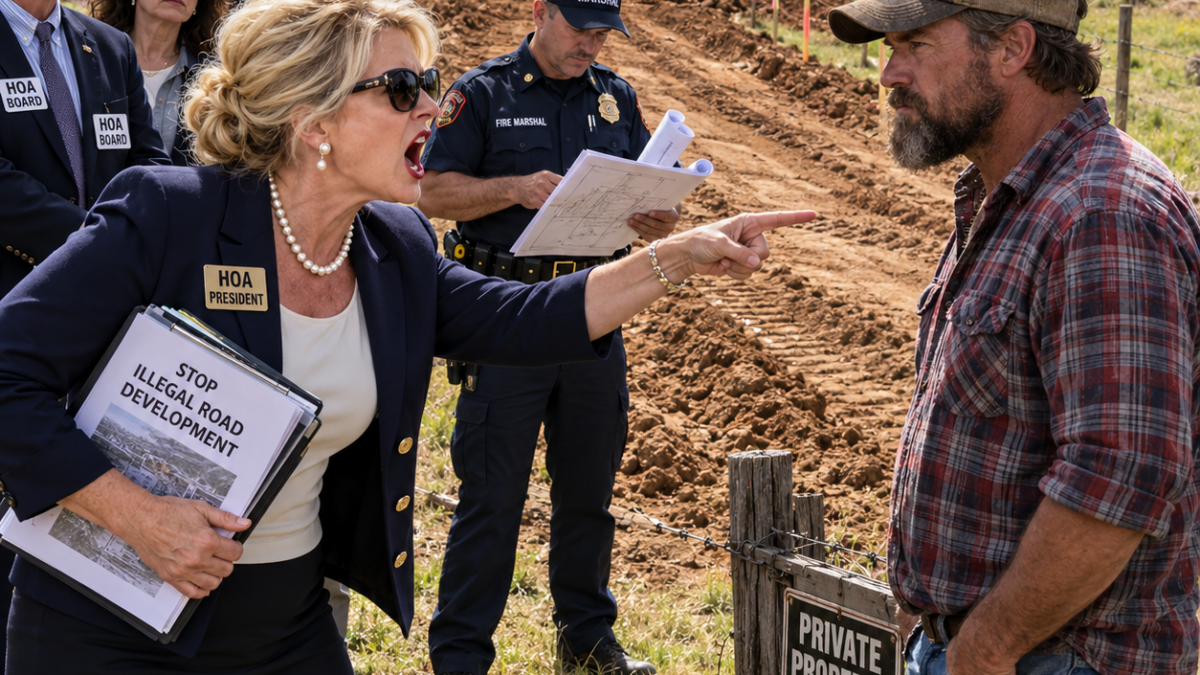
Celeste arrived forty minutes later.
Same scarlet jacket.
Black binder this time.
“Remove that fence.”
“Show me the vehicle easement.”
“The fire access approval is part of the county plan.”
“Then show me the county plan.”
“You requested it. You’ll receive it.”
“So you don’t have it with you.”
Her mouth tightened.
“Mr. Mercer, one hundred and twelve homes sit on that ridge. Timber Ridge has one entrance. If wildfire blocks it, families need another route.”
That was the first thing she said that day that wasn’t ridiculous.
Mountain roads do fail.
Trees fall.
Brush fires move.
Ice storms close switchbacks.
I’d helped Timber Ridge residents clear storm debris from their main entrance twice over the years.
I wasn’t against safety.
“I support a real emergency plan.”
“Then support this one.”
“This one goes through land you don’t own.”
“It uses an existing corridor.”
“No. It uses an electric easement as cover for an eighteen-foot road.”
“The county approved the alignment.”
“You keep saying approved. Approved based on what rights?”
She changed direction.
“Your bridge and drive have supported trucks for years.”
“My trucks.”
“So they’re adequate.”
“For what?”
“Evacuation.”
“Your email says emergency apparatus access.”
A brief pause.
“Emergency access includes multiple uses.”
I watched her.
That answer stayed with me.
She no longer wanted to say fire engines.
She wanted the safety language without the engineering question.
Before she left, she placed an envelope on my fence post.
“Timber Ridge is prepared to resolve this.”
I opened it after she drove away.
Forty thousand dollars.
Permanent non-exclusive emergency access easement.
At first glance, respectable.
Then I read the rights.
Residents.
Guests.
Contractors.
Emergency vehicles.
Maintenance equipment.
Any future community service approved by the board.
This wasn’t an emergency exit.
It was a second HOA entrance wearing a red safety vest.
Then came the bridge clause.
I would maintain the bridge structurally available unless Timber Ridge elected to repair or replace it.
The agreement also required me to release all claims tied to the demolished wall, gate, business interruption, and prior entry.
Offer expired in seventy-two hours.
I sent it to Nora.
My phone rang three minutes later.
“Do not sign this.”
“I wasn’t planning to.”
“Good. I prefer clients who save me the dramatic speech.”
“Forty thousand sounded better before page four.”
“It usually does.”
“What do you see?”
“Permanent traffic rights. Broad users. Future board discretion. Bridge obligations. Release of everything they’ve already done.”
“So they bulldozed first and offered later.”
“That’s certainly one way to describe the chronology.”
She paused.
“They may be trying to convert an unauthorized condition into a negotiated one before the permit issue gets worse.”
“What permit issue?”
“We’ll see when the county gives us the file.”
That evening, Timber Ridge emailed all one hundred and twelve households.
The subject line said:
**EMERGENCY EVACUATION ROUTE OBSTRUCTED**
The message described a neighboring commercial operator who had blocked the community’s approved emergency route days before fall fire season.
Commercial operator.
That was me.
A man building cabinets on property my family had owned since before half the board members moved to Tennessee.
The email did not mention the $40,000 offer.
Did not mention that the road crossed private property.
Did not mention the bulldozer.
Did not mention that nobody had shown me a recorded vehicle right.
The next morning, my largest client called.
Her voice was cautious.
“Daniel, is there some legal issue with access to your shop?”
I went still.
“Who told you that?”
“Someone from Timber Ridge contacted our design office.”
I closed my eyes.
“What did they say?”
“That access could be restricted by a pending court order.”
There was no court order.
Not even a filed case.
“Your installation is not at risk.”
“Our flooring contractor starts after you. I can’t lose the week.”
“You won’t.”
I said it confidently.
Then looked out toward the damaged turning apron.
That was when Celeste finally found the part of me she could hurt quickly.
My business.
Custom cabinetry runs on trust.
People pay deposits months in advance.
Architects coordinate schedules.
Floor crews.
Painters.
Electricians.
Stone installers.
A boundary fight doesn’t interest them.
Delivery does.
I hung up.
Eli was standing near the assembly bench.
“What?”
“They called the client.”
His face changed.
“Who?”
“Timber Ridge.”
“You’re kidding.”
“No.”
He stared toward the north field.
“That’s low.”
“We’re delivering Tuesday.”
“How?”
“Smaller trucks.”
“That’ll cost us.”
“Yes.”
“So?”
“So we spend the money.”
He nodded immediately.
That was Eli.
No speech.
Just solve the next thing.
We rented a smaller truck.
Split the load.
Scheduled two trips.
Logged the additional cost.
The cabinet shop kept moving.
That afternoon, Leah Brooks arrived.
Licensed surveyor.
Robotic total station.
Two tripods.
No patience for drama.
I gave her the deed and subdivision plat.
Didn’t tell her what I wanted the answer to be.
“Show me the boundary and the new road.”
She spent most of the afternoon working.
One iron pin was under fresh gravel.
Another remained near an old white oak.
She tied both into county control points.
Measured the cul-de-sac.
Shot the centerline.
By late afternoon, the results were undeniable.
The graded road entered my parcel at the wall.
Ran approximately 320 feet.
Stayed between seventeen and twenty-one feet inside my boundary for much of the route.
Then joined my shop lane.
The electric easement hugged the northern edge.
The road didn’t.
More than half of the graded surface was outside even that ten-foot utility strip.
Leah drove two temporary stakes at the actual line.
Blue ribbon fluttered from both.
Celeste’s red line and the land had officially stopped agreeing.
The county records arrived the next morning.
I printed everything.
Four fire-access revisions.
The first two were the eastern route.
Vacant parcel.
Retaining walls.
Culvert.
Nearly six hundred feet of pavement.
County comments.
Turning radius.
Apparatus load.
Then the third revision.
The eastern route disappeared.
My land replaced it.
Red line from the western cul-de-sac.
Across my north field.
Down my shop lane.
Across Laurel Branch.
To Old Mill Road.
Label:
**EXISTING SECONDARY EMERGENCY APPARATUS ACCESS**
I stared at the word existing.
There was nothing existing about it except my driveway.
Buried behind the plan was a resubmittal letter from Brent Cole’s engineering firm.
That was where the real story began to show itself.
Eastern alternative preliminary construction:
**$418,000**
Not including land acquisition.
Schedule impact:
Approximately five months.
Western route through my land:
**$87,000 construction allowance**
Beside an acquisition line.
Then another note.
Timber Ridge’s construction loan commitment would expire in nineteen days unless permit conditions were completed and the foundation contract authorized.
I sat in my office holding the page.
There it was.
Pressure.
The board had sold a $3.2 million clubhouse.
Collected special assessments.
Committed money.
Borrowed around a schedule.
The legitimate route was expensive.
My property made the problem cheap.
But only if one word could be treated as true.
Existing.
If the road was already theirs, no acquisition delay.
No $418,000 retaining-wall route.
No five-month setback.
No new land negotiations.
Just bulldozer.
Gravel.
Done.
Another document made me sit back.
A certification page signed by Celeste Ward.
The association certified that it possessed or would possess all property rights necessary for the access improvements before construction.
Important wording.
The county had not certified Timber Ridge owned my route.
Timber Ridge had represented that it either had or would obtain what it needed.
Then construction started before that happened.
Nora called as I was reading.
“Found the certification?”
“Yes.”
“Don’t overread it.”
“She signed it.”
“Yes.”
“Saying they’ll have rights before construction.”
“They didn’t.”
“That is more relevant.”
Then I saw another comment.
Fire Marshal’s office.
**VERIFY BRIDGE CAPACITY AND ALL-WEATHER SURFACE PRIOR TO FINAL APPROVAL.**
I searched the project file.
No bridge report.
No structural letter.
No load calculation.
Nothing.
I walked outside.
Followed the new cut to my shop lane.
Then down toward Laurel Branch.
The bridge had been there twenty-three years.
Dad and I built it together.
Pressure-treated timber beams on concrete abutments.
I’d replaced the decking twice.
Inspected it every spring.
A small metal plate on the near post read:
**MAXIMUM GROSS VEHICLE WEIGHT — 6 TONS**
Six tons.
Fine for my pickup.
Fine for the shop van.
Fine for smaller delivery trucks when loaded carefully.
Not fine for a modern fire engine.
A pumper can weigh many times that before water and equipment.
Timber Ridge had labeled this an emergency apparatus route over a bridge nobody from the HOA had inspected.
I photographed everything.
Plate.
Deck.
Beams.
Abutments.
Approach.
Then remembered the trail camera.
One camera watched deer near the north field.
I pulled the card.
Two weeks before the bulldozer arrived, Carter Siteworks had been there.
Mason Reed.
Celeste.
Same rolled plan.
They measured the opening.
At one point, Mason walked down my shop lane.
Seven minutes later, he returned and pointed back toward the bridge.
No audio.
But they had seen it.
Nora sent the images to Carter Siteworks with one question.
**Did your company evaluate the bridge?**
Mason called me directly.
“We didn’t.”
“Your scope ended before it?”
“At the tie-in.”
“Did you tell Timber Ridge there was a posted weight limit?”
“I told them the downstream route needed structural verification.”
“Celeste?”
“Yes.”
“What did she say?”
“Association engineer handling it.”
“Written?”
“There should be a preconstruction clarification.”
Nora obtained it from Carter’s insurer that afternoon.
Two questions from contractor to client:
**Confirm owner authorization for all offsite work.**
**Confirm structural approval of existing bridge.**
Celeste’s response:
**Access has been cleared by the association. Bridge documentation to follow under separate cover. Proceed to maintain schedule.**
I read it three times.
The most important words weren’t “proceed.”
They were “under separate cover.”
She knew the bridge required proof.
She treated proof as something that could arrive after the bulldozer.
Nora forwarded the package to the county permit office.
No accusation of fraud.
No theatrics.
Just facts.
Access rights disputed.
Constructed road deviates from utility easement.
Bridge posted at six tons.
Owner has granted no vehicle easement.
County assigned Fire Marshal Tom Alvarez.
He arrived Monday morning in a white county vehicle.
Late forties.
Work boots.
No polished presentation.
He parked near Laurel Branch and spent nearly ten minutes looking at the bridge before asking a single question.
Celeste arrived with the property manager.
Brent Cole, Timber Ridge’s civil engineer, came too.
Nora stood beside me.
Leah reset her survey equipment near the north field.
Tom pointed up the shop lane.
“That’s the proposed secondary route?”
Brent answered.
“The route shown on the latest exhibit.”
“What is the bridge’s evaluated apparatus capacity?”
Brent paused.
“We’re still confirming the existing structure.”
Tom looked at the six-ton plate.
“The permit comment requesting capacity confirmation was issued six weeks ago.”
Celeste stepped in.
“The bridge is not essential to resident evacuation. Passenger vehicles can cross.”
Tom opened the plan set on his hood.
“This doesn’t identify a resident-only evacuation trail.”
He tapped the sheet.
“It identifies secondary emergency apparatus access.”
Nobody spoke.
He looked at Celeste.
“Those are not interchangeable for this review.”
She recovered quickly.
“Then the route can be upgraded. Timber Ridge is prepared to make whatever improvements are required.”
Nora asked quietly:
“On property it owns?”
Celeste looked toward Leah’s blue ribbons.
“The association has a recorded corridor.”
Leah handed Tom a reduced survey.
“The only recorded corridor I located is a ten-foot electrical easement held by Appalachian Electric. The graded road is approximately eighteen feet wide and lies mostly south of it.”
Tom turned to Brent.
“Did your firm review title?”
“We relied on the client’s access certification.”
Then Tom looked at Celeste.
“Recording reference?”
She opened her binder.
Flipped one page.
Another.
A third.
Closed it.
“Our attorney is compiling the chain.”
Tom nodded.
“Until that chain is produced, this route cannot be credited toward the clubhouse access requirement.”
For the first time since the bulldozer arrived, Celeste lost her calm.
“The construction is already financed.”
Tom didn’t change expression.
“The foundation contract starts next week.”
“That is not an apparatus capacity calculation.”
Silence.
He photographed the bridge plate.
The damaged wall.
The cul-de-sac ending.
Leah’s stakes.
Then he took a measuring wheel and walked the entire 320 feet.
At the cul-de-sac, he stopped.
Looked at the plan.
Walked the curve.
Measured again.
Then called Brent over.
The county’s design fire engine couldn’t make the proposed turn without swinging another twelve feet into my field.
The plan showed a wider bulb.
The bulb didn’t exist on the ground.
Building it would require removing two mature white oaks and another section of my father’s wall.
The route failed three different ways.
No demonstrated vehicle easement.
No approved bridge capacity.
No compliant turning geometry within the disturbed area.
Tom issued a field correction notice that afternoon.
It did not call Celeste a criminal.
It didn’t accuse Timber Ridge of stealing land.
It simply said the secondary access could not be accepted pending proof of property rights, structural capacity, and compliant geometry.
Work stopped.
And the clubhouse permit went back to incomplete.
That was when the fight stopped being about me versus an HOA.
Now it was Timber Ridge versus its own paperwork.
Celeste had one move left.
An emergency membership meeting.
The clubhouse didn’t exist yet, so they held it in a heated sales tent near the proposed building pad.
Residents packed the room.
More chairs had to be brought in.
On one wall stood a polished rendering of the future clubhouse.
Pool.
Stone entrance.
Event hall.
Everything residents had been promised.
Celeste stood beneath it with a microphone.
She framed the dispute exactly as I expected.
Public safety.
Wildfire risk.
One entrance.
A neighboring landowner blocking an approved evacuation route.
She said Timber Ridge had offered fair compensation.
Said delays could cost residents hundreds of thousands.
Said the road occupied a historical corridor.
Then she invited me to speak.
I think she expected anger.
I understand why.
Anger would have been useful to her.
An angry man yelling about his father’s wall is emotional.
A calm man holding public records is more difficult.
Nora and I brought four enlarged exhibits.
I put the first on an easel.
Timber Ridge subdivision plat.
Bold termination at my property line.
Second.
Leah’s survey.
Three hundred twenty feet of graded road inside my parcel.
Third.
Photograph of the bridge plate beside the county plan.
**6 TONS**
versus
**EMERGENCY APPARATUS ACCESS**
Fourth.
Carter Siteworks’ preconstruction clarification.
**Confirm owner authorization.**
**Confirm bridge approval.**
I looked around the room.
“Your board did not build a functioning fire road and then discover a paperwork problem.”
People went quiet.
“They built across land they did not control toward a bridge they had not evaluated, on a curve the county’s own design engine cannot make.”
A man in the second row raised his hand.
“Were we told the easement was already secured?”
Celeste looked toward the board treasurer.
Kevin Dorsey sat near the aisle.
He shifted in his chair.
“The budget packet described the route as existing.”
Murmuring.
Another resident asked:
“How much have we already paid?”
Kevin answered.
“Each household paid a fifty-two-hundred-dollar special assessment toward design, site preparation, and loan reserves.”
Someone behind me said:
“That’s over half a million dollars.”
Kevin nodded.
“More than half a million is committed.”
Celeste took the microphone.
“This community voted for the clubhouse. Large construction projects encounter complications.”
Kevin stood.
“Did the board vote to enter Mercer’s property before the easement was signed?”
The tent went quiet.
Celeste looked at him.
“Emergency access fell within my authority as president.”
Nora spoke from beside the easel.
“Then why did the easement offer require Mr. Mercer to release claims for work that had already occurred?”
Celeste turned toward her.
“The proposal was a good-faith effort to resolve uncertainty.”
I said:
“Your construction email said access was cleared.”
Silence again.
Not uncertain.
Cleared.
A resident near the back asked:
“Can we see the title report?”
The property manager stood.
“We do not currently have a completed title report identifying Timber Ridge as the vehicle easement holder.”
That changed the room.
You could feel it.
Until then, residents had been told a stubborn business owner was obstructing safety.
Now they understood their board had committed assessment money, a construction loan, and a clubhouse schedule to a route it did not yet own.
Kevin asked that every legal opinion supporting the claimed corridor be provided to the board.
Celeste said counsel was reviewing.
A woman near the front asked:
“Why did construction start before that?”
No one gave her a clean answer.
The meeting ended without a vote to sue me.
The next morning, Timber Ridge’s construction lender suspended the first clubhouse draw until the access condition was resolved.
Carter Siteworks issued formal notice of extra costs.
And refused to return to the route without written proof of entry rights.
The association’s insurer opened a claim.
Wall.
Gate.
Driveway damage.
Survey costs.
Business interruption.
Celeste’s seventy-two-hour $40,000 offer expired.
Nobody mentioned it again.
Then the board had to face the problem it had tried to avoid.
What could Timber Ridge actually build using land it owned?
Three options.
Buy the vacant eastern parcel and construct the retaining walls.
Redesign the clubhouse into a smaller pavilion that didn’t trigger the same project-specific access requirement.
Abandon the project and return whatever special assessment remained uncommitted.
The full clubhouse had only looked cheapest because my land had been priced at zero.
Once the budget had to include property rights, structural bridge work, legal exposure, road redesign, and the possibility of rebuilding the crossing, enthusiasm faded quickly.
At one meeting, someone reportedly asked why Timber Ridge should spend hundreds of thousands more to preserve a commercial kitchen residents might use six times a year.
That question would have been heresy six months earlier.
Now it sounded practical.
The board eventually chose the smaller pavilion.
Existing paved area near the main entrance.
Fewer seats.
No commercial kitchen.
No second pool.
No secondary apparatus route across my land.
County reviewed it.
Approved it.
Fire Marshal signed off after the new design met the applicable conditions.
No one’s safety vanished because Timber Ridge stopped using my field.
That mattered to me.
Because Celeste had spent weeks implying that defending my boundary meant risking families.
It didn’t.
The board had confused its preferred project with public safety.
Those aren’t the same thing.
The insurance claim moved faster once the clubhouse redesign eliminated the access fight.
Timber Ridge’s carrier paid verified restoration costs.
Stone wall.
Gate.
Turning apron.
Compacted topsoil.
Survey.
Extra delivery expense.
Carter Siteworks removed every yard of gravel south of my boundary.
I watched the first dump truck leave.
Then the second.
Then the third.
The road disappeared one load at a time.
There was something deeply satisfying about that.
The same material that had arrived under the assumption my property was already available was being hauled back out because the documents said otherwise.
Appalachian Electric came too.
Their representative walked the utility easement.
Confirmed the poles.
Confirmed access.
Confirmed nothing about restoration interfered with their ten-foot strip.
Their rights remained.
Exactly as they always had.
Leah set permanent stone-faced boundary monuments at both ends of the repaired wall.
Nora recorded a survey affidavit and restoration agreement so some future board couldn’t discover the old red line in a file twenty years later and decide to try again.
I asked why the recording mattered.
“Because institutional memory is short.”
She pointed toward the rebuilt boundary.
“Recorded memory is better.”
That was Nora.
Always less poetic than useful.
The wall took longer.
Insurance would’ve paid a masonry crew to rebuild it with mortar.
I declined that portion.
My father hadn’t used mortar.
I wasn’t going to turn his wall into a modern landscape feature because an HOA bulldozer knocked it down.
In March, my daughter Hannah came home from Chattanooga.
She was twenty-four and worked for a landscape architecture firm.
As a child, she’d spent hours on the shop steps drawing houses while my father sorted stone nearby.
Eli joined us.
Three of us.
Same kind of work Dad and I had done decades before.
We laid the foundation stones wide.
Broad faces outward.
Weight leaning gently toward the hill.
No mortar.
Some pieces had fresh scratches from the bulldozer.
Hannah held one long sandstone slab.
“This one was beside the old gate.”
“How can you tell?”
She turned it.
A shallow chisel mark crossed one edge.
I stared.
Then laughed.
My father had carved that mark because when I was a kid I kept putting the stone in the wrong place.
I had forgotten.
Hannah hadn’t.
“Granddad said you were stubborn.”
“He wasn’t wrong.”
“He said you’d deny it.”
“He wasn’t wrong about that either.”
We set the stone at the base of the new gate post.
I stood up slowly.
My back complained.
For a minute I couldn’t say anything.
Not because a rock is sacred.
Because memory hides in ordinary things.
A chisel line.
A scratched stone.
A place your father once stood.
Celeste had looked at that wall and seen an obstacle between a cul-de-sac and a cheaper fire road.
I saw three summers of my father’s life.
Both views could exist.
Only one came with ownership.
The replacement gate was heavier.
Powder-coated steel.
Nothing decorative.
Beside it, I mounted a small metal plaque.
Not a threat.
Not an HOA joke.
Just the recording reference for Leah’s boundary survey.
Anyone with a contractor packet could find it.
I wanted the next person handed a red line on an exhibit to have somewhere easy to verify what the ground actually meant.
My cabinet job went out on Tuesday.
Two rented trucks.
Exactly like I promised.
Eli and I left early.
Forty minutes early, actually.
The client walked through twelve rooms that afternoon.
White oak.
Flat-panel doors.
Hand-matched grain.
Built-ins.
Mudroom.
Kitchen.
Primary suite.
She ran one hand across the island panels.
“Beautiful.”
“Thank you.”
She never mentioned Timber Ridge.
That mattered more than beating Celeste at any meeting.
My business survived because while the lawyers did legal work, Eli and I kept doing cabinet work.
That was important to me.
Property disputes can become an identity if you let them.
Every conversation.
Every dinner.
Every thought.
The wall.
The road.
The HOA.
The fire marshal.
I refused to let that happen.
At six in the morning, we built cabinets.
At lunch, I answered Nora.
At four, I checked survey photos.
Then I went back to work.
Eli once said:
“You know the funniest part?”
“What?”
“They think they’re fighting a guy with fourteen acres.”
“What are they actually fighting?”
“A guy who keeps receipts.”
I laughed.
He wasn’t wrong.
Celeste did not run for HOA president in the winter election.
No recall spectacle.
No police.
No dramatic removal.
Residents simply wanted another direction.
She sent me one final letter.
Three pages.
Most of it defended her motives.
She said she had acted to protect Timber Ridge.
Said the board faced extraordinary schedule pressure.
Said the county’s safety requirements were serious.
Said a more cooperative property owner might have prevented hundreds of thousands in community losses.
I read that sentence twice.
A more cooperative property owner.
Then folded the letter.
Didn’t answer.
Because she still hadn’t understood the difference.
Cooperation is voluntary.
Ownership is not a personality test.
I could have sold the easement.
Could have negotiated one.
Might even have considered a truly limited resident evacuation agreement under the right engineering conditions.
What I would not do was reward bulldozing first and negotiation second.
Public safety was never the problem.
The problem was treating public safety as a phrase powerful enough to erase engineering, ownership, consent, and process.
A real emergency route has to work when everything else fails.
It can’t depend on fake assumptions.
It can’t rely on a bridge nobody has rated.
It can’t turn on a curve the fire engine can’t make.
And it shouldn’t begin with a bulldozer crossing land nobody has permission to use.
Months later, Fire Marshal Tom Alvarez stopped by while another county crew was nearby.
I happened to be outside.
He looked toward the restored field.
“Hard to tell where the road was.”
“That’s the goal.”
“Bridge still six tons?”
“Still six.”
He smiled.
“Good.”
I asked him:
“Would they ever have gotten final approval using that bridge?”
“Not without structural evaluation and probably significant work.”
“What kind?”
“Depends on load analysis. Could’ve required strengthening. Could’ve required replacement. Approaches might’ve changed too.”
“And the curve?”
“Would’ve required more land.”
“So the $87,000 route wasn’t $87,000.”
He gave me a look.
“Preliminary numbers are good at being preliminary.”
I laughed.
Then asked:
“Did you think I was blocking safety?”
“No.”
“That isn’t what Timber Ridge told residents.”
“My job wasn’t deciding who was morally right.”
“What was it?”
“Can the required apparatus physically use the route? Is the route legally available for the project? Does the geometry comply?”
He looked toward Laurel Branch.
“Paper that says emergency doesn’t make a bridge stronger.”
That was probably the best summary of the entire dispute.
The road had looked complete enough to residents.
Gravel.
Sign.
Connection.
But a road isn’t a fire road because a board calls it one.
It has to carry the truck.
It has to fit the truck.
It has to be available when the truck needs it.
Timber Ridge had skipped all three.
Later that summer, the smaller pavilion opened.
I could see part of the roof through the trees from the north field.
Families used it.
Birthday parties.
Association meetings.
Small events.
The main entrance handled traffic.
Fire crews had approved access.
Nobody died because the commercial kitchen disappeared.
Nobody’s safety collapsed because the pool plan changed.
The world went on.
That was maybe the most satisfying rebuttal to Celeste’s argument.
Reality.
She had framed the choice as:
My road or community safety.
Reality chose:
Different building.
Approved roads.
Same safety.
No trespass.
The field recovered slowly.
Carter Siteworks stripped the gravel.
Regraded.
Replaced compacted topsoil.
We seeded.
First rain made mud.
Second rain made more mud.
By fall, grass covered most of it.
The sharp dozer lines softened.
My shop trucks used the same turning apron they’d always used.
The white oaks at the curve still stood.
That mattered.
The county plan had shown a turning bulb where those trees were.
If Celeste’s road had continued, both would’ve come down.
One was older than I was.
The other had been large enough to shade my father’s truck when I was a teenager.
I started noticing how often development language turns living things into labels.
Tree removal.
Clearing.
Sight distance.
Turning radius.
All necessary sometimes.
But labels hide cost.
Those two oaks were not just obstacles on a plan.
Neither was the wall.
Neither was the bridge.
Neither was my property.
One Sunday, Hannah came back.
We walked the north boundary.
She looked at the survey plaque.
“Very subtle.”
“That’s the idea.”
“Anybody from Timber Ridge complained?”
“Not to me.”
“Good.”
We reached the rebuilt gate.
She ran her hand over the stone with Granddad’s chisel mark.
“You think he’d be mad?”
“About the wall?”
“The road.”
I thought about it.
“No.”
“Really?”
“He would’ve fixed the wall first.”
She laughed.
“Sounds like you.”
“Unfortunately.”
Then I said:
“He would’ve been mad about somebody assuming he didn’t matter.”
That was closer.
My father was a quiet man.
Not political.
Not litigious.
He didn’t distrust neighbors.
But he believed deeply in asking before you used something belonging to someone else.
Tools.
Truck.
Land.
Time.
“Borrowing without asking has another name,” he’d say.
He would’ve understood the whole dispute in one sentence.
The board didn’t ask.
Years passed.
Most new Timber Ridge residents never knew the story.
The pavilion became normal.
The road scar disappeared.
Celeste moved somewhere else eventually.
The damaged stones weathered.
The gate got rain spots.
The survey plaque stayed.
Occasionally a utility crew came through.
They used Appalachian Electric’s easement.
Called first.
Opened the proper gate.
Worked.
Left.
No conflict.
That itself proved something.
The utility easement had never been the problem.
Rights can overlap private property without becoming abuse.
Appalachian Electric had a defined right for a defined purpose.
They used it for that purpose.
Timber Ridge tried to turn the same line into something else.
That’s where things broke.
One afternoon, a young electric-line foreman stopped beside the plaque.
“What’s this recording number?”
“Boundary survey.”
“Something happen here?”
“Once.”
He grinned.
“HOA?”
I looked at him.
“How’d you guess?”
He laughed.
Then I told him the short version.
“They tried to use your easement?”
“They tried to use the electric easement as a road.”
He stared.
“That’s creative.”
“That word came up.”
He shook his head.
“Glad somebody stopped them.”
“Fire Marshal helped.”
“Bridge problem?”
I pointed downhill.
“Six tons.”
His eyebrows went up.
“They wanted engines over that?”
“On paper.”
He laughed once.
“Paper’s strong.”
“Bridge wasn’t.”
That became our joke.
But the lesson stayed serious.
Timber Ridge didn’t fail because one villain woke up and decided to steal my land.
The failure developed through pressure.
A popular clubhouse.
A budget.
A loan deadline.
A permit requirement.
An expensive legal alternative.
Then a cheaper line on a map.
Somewhere, the word existing appeared.
Someone relied on it.
Then someone certified rights would exist.
Then a contractor asked whether authorization was secured.
Then the answer became:
**Access has been cleared.**
Each step made the next easier.
By the time the dozer arrived, multiple people were relying on an assumption nobody had properly verified.
That’s why process matters.
If Carter Siteworks had required the recorded easement before mobilization, the wall would’ve remained standing.
If Timber Ridge’s engineer had required title before labeling the route existing, the wall would’ve remained standing.
If the board had asked what “existing” meant, the wall would’ve remained standing.
If Celeste had waited for the bridge report, the wall would’ve remained standing.
Many opportunities.
One bulldozer.
That is how expensive mistakes happen.
Not always through conspiracy.
Often through confidence.
The difference between my situation and some HOA stories is that Celeste’s pressure was understandable.
She had one hundred and twelve households expecting a clubhouse.
Hundreds of thousands in assessments.
A lender.
A construction timeline.
A county reviewer.
Residents who’d already voted.
Every delay became political.
Every cost increase became personal.
The east route threatened the whole pitch.
If the clubhouse suddenly cost another half million, somebody would ask why.
If it opened five months late, somebody would ask why.
My field seemed like a solution.
But pressure doesn’t convert convenience into ownership.
That was the point she never accepted.
I understood her problem.
I didn’t accept her solution.
Those are different things.
Several residents eventually apologized to me.
One man stopped at the gate while I was replacing a hinge.
“We believed your road was already part of the development.”
“I know.”
“The email made it sound like you closed a fire exit.”
“I know.”
“I’m sorry.”
“You didn’t send the bulldozer.”
“No, but I repeated some things I shouldn’t have.”
That mattered.
Another resident said:
“I voted for Celeste because she gets things done.”
I smiled.
“She does.”
He laughed awkwardly.
“Too much?”
“Sometimes how something gets done is the whole question.”
He nodded.
That was enough.
I never wanted Timber Ridge residents as enemies.
They were neighbors.
I bought lumber from one.
Eli’s cousin lived there.
People walked dogs near my property.
Our problem was governance.
Not geography.
After Celeste left, the new board approached me about emergency planning.
The president called first.
“I want to be clear—we are not asking for a road.”
“That is an excellent opening sentence.”
He laughed.
“We want to know whether there are circumstances where residents could cross on foot during a catastrophic evacuation.”
“That is a different conversation.”
“We know.”
We met.
Fire officials participated.
No permanent road.
No apparatus route.
No broad HOA easement.
The plan focused on true emergency contingency.
Specific triggers.
Law enforcement or fire command.
Pedestrian evacuation if primary roads failed.
Temporary use.
No general vehicle access.
I agreed to a limited emergency protocol.
Some people couldn’t believe it.
“After everything?”
Especially after everything.
Because the difference was consent.
Defined use.
Defined trigger.
Defined authority.
No bulldozer.
No clubhouse budget hiding behind fire safety.
A real emergency plan.
If a wildfire trapped families and fire command needed people across my field, I wasn’t going to stand at the gate arguing about property law.
That’s not who I am.
What I refused was transforming that human instinct into a permanent HOA traffic right.
The new board understood.
Celeste never did.
The agreement actually strengthened my belief that I had been right to resist.
Because once people stopped pretending my land was already theirs, cooperation became possible.
That pattern repeated later.
Timber Ridge needed Appalachian Electric to replace a pole near the boundary.
Utility called.
We coordinated.
Done.
County wanted access to inspect Laurel Branch after flooding.
They called.
Done.
A resident’s dog got through the fence.
She asked.
We found it.
Done.
Boundaries didn’t make me hostile.
They made yes meaningful.
That’s what people misunderstand.
If no means nothing, yes isn’t consent.
It’s compliance.
My business grew after the incident.
Eli became production manager.
I stepped back from some day-to-day work.
Hannah designed a landscape plan around the shop using native plantings.
She left the wall alone.
“Smart,” I told her.
“I know the owner.”
The white oak job that had nearly been disrupted led to two referrals.
The client later sent photographs after the house was finished.
The cabinetry glowed warm under recessed lighting.
No one looking at those photos would know that eleven days before delivery, Eli and I had been moving gravel because an HOA bulldozer cut across our turning apron.
That pleased me.
The road dispute did not become the most important thing I built that year.
The cabinets did.
The wall did.
The business did.
Property defense matters.
But so does refusing to let a fight consume the life you’re defending.
Nora once told me:
“Clients often win the property and lose six months of themselves.”
I asked:
“Did I?”
“Some.”
She wasn’t wrong.
I spent hours on records.
Emails.
Survey meetings.
Insurance documentation.
Public filings.
Board meetings.
Restoration.
That time doesn’t come back.
No settlement truly pays for it.
That’s why the best victory is preventing the dispute before it starts.
The survey plaque isn’t there to gloat.
It’s there so the next contractor doesn’t need a lawyer to find the answer.
Recorded reference.
Boundary.
Done.
Clarity is cheaper than conflict.
On the anniversary of Dad’s death one year, I sat by the wall after work.
The chiseled stone was near my foot.
I remembered being ten.
Sweaty.
Angry.
Carrying sandstone.
“Why can’t we use the little one?” I had asked.
“Because the little one doesn’t belong there.”
“It fits.”
“Not the same thing.”
That memory made me laugh.
I don’t know whether he actually intended a life lesson.
Probably not.
He was talking about a wall.
But forty-six years later, the sentence still worked.
It fits.
Not the same thing as it belongs.
Timber Ridge’s road fit.
Geographically.
Financially.
Schedule-wise.
It connected two points beautifully.
That did not mean it belonged there.
The east route was harder.
The smaller pavilion was less glamorous.
Those facts didn’t transform my field into common property.
This became the lesson I told younger contractors who came through my shop.
One superintendent asked me:
“What would’ve protected Carter best?”
“Demand title support before offsite work.”
“We rely on client representations all the time.”
“Then document them.”
“They did.”
“Which is why their insurer wasn’t carrying the whole problem.”
He nodded.
“Still cost them.”
“Yes.”
“But you don’t blame Mason?”
“Not for inventing the route.”
“His crew still crossed.”
“Correct.”
Two truths.
That was another thing the dispute taught me.
Responsibility isn’t binary.
Celeste made decisions.
Management transmitted them.
Engineer relied on client certifications.
Contractor mobilized.
Operator moved dirt.
Insurers sorted shares.
Each role mattered.
It is easier emotionally to say:
One bad person.
One victim.
Reality was more complicated.
But Celeste held the most important decision point.
She had the information.
Contractor asked for owner authorization.
Contractor asked for bridge approval.
Her response was proceed.
Schedule first.
Proof later.
That was the hinge.
Everything after followed.
The county eventually closed the original clubhouse permit file when Timber Ridge abandoned the design.
I requested the final record.
Mostly administrative.
But I kept it.
One line said the secondary route was withdrawn from consideration.
Simple.
No dramatic statement.
No apology.
Just withdrawn.
Three hundred twenty feet of conflict reduced to one administrative note.
I filed it beside the survey.
Then went outside.
Grass had nearly erased the road cut.
If you didn’t know where to look, you’d miss it.
That’s what restoration should do.
Not turn damage into a permanent monument.
Return function.
Return ordinary life.
The wall looked older again after a few seasons.
New stones weathered.
Bulldozer scratches dulled.
Moss returned in places.
The gate squeaked when humidity rose.
I could oil it.
Usually didn’t.
Dad would’ve complained.
One autumn morning, I saw two deer step through the north field where the road had been.
They crossed between the white oaks.
Stopped.
Looked toward Timber Ridge.
Then disappeared downhill.
No gravel.
No sign.
No cones.
No “Fire Lane.”
Just field.
I stood there longer than necessary.
That was the ending I wanted.
Not an empty clubhouse foundation.
Not broke neighbors.
Not Celeste publicly destroyed.
Land back to land.
The smaller pavilion worked.
Residents were safe.
My business worked.
The wall stood.
That was enough.
Maybe more than enough.
I occasionally think about the $40,000 offer.
What if I’d signed?
Timber Ridge would have had its second entrance.
Then they’d probably have discovered the bridge issue.
Maybe demanded upgrades.
Agreement gave them broad rights.
My land would carry residents.
Guests.
Contractors.
Maintenance.
Future community services.
Traffic.
Snow.
Drainage.
Security.
Then future boards.
Future disputes.
All for $40,000 and a release of damage they’d already caused.
Not a bargain.
A transfer.
And once concrete, gravel, and routine traffic exist, people forget the agreement started as “emergency.”
Uses expand.
Temporary becomes normal.
Normal becomes expected.
Expected becomes “historical.”
Twenty years later, somebody would tell Hannah:
“This route has always served Timber Ridge.”
That’s how assumptions become facts socially even when paperwork says otherwise.
I stopped that cycle before it started.
That’s worth more than $40,000.
When I eventually updated my estate plan, I included the access documents.
Nora insisted.
“Future owners need the history.”
“Hannah knows it.”
“People die.”
“You really know how to brighten a meeting.”
“It’s a gift.”
We added survey references.
Restoration agreement.
Utility easement.
Emergency pedestrian protocol.
Nothing complicated.
Just clear.
Because land lasts longer than arguments.
A future board shouldn’t depend on someone remembering my name.
The record should answer without me.
One summer, Timber Ridge’s new president invited me to the pavilion anniversary barbecue.
I almost declined.
Then went.
Not as a political gesture.
Eli’s family was attending.
Hannah was in town.
Residents grilled burgers.
Kids ran around.
The pavilion was pleasant.
Smaller than Celeste’s rendering.
Still useful.
A resident pointed toward the trees.
“Your shop’s over there?”
“Yep.”
“Hard to believe they wanted a road through it.”
“Through the field.”
“Would’ve been convenient.”
I laughed.
“That’s what started the whole thing.”
He smiled.
Then became serious.
“I guess we ended up fine.”
“Exactly.”
That was perhaps the strongest revenge of all.
Timber Ridge ended up fine.
Which meant all the fear used against me had been exaggerated.
No road across my field?
Clubhouse dream dies.
Safety at risk.
Property values suffer.
Residents lose everything.
None of that happened.
They adapted.
Organizations often call one option “necessary” when they really mean “preferred.”
My field was preferred.
Not necessary.
The smaller pavilion proved it.
Fire Marshal Tom once said the same idea differently.
“Safety code tells you the condition you must achieve. It doesn’t usually tell you which neighbor has to donate land to achieve it.”
I remembered that.
Timber Ridge had a requirement.
Second compliant access for that clubhouse design.
Options existed.
Buy land.
Build expensive infrastructure.
Change the building.
They selected a fourth option.
Pretend the access already existed.
That’s what failed.
If I had been less organized, maybe it would’ve worked longer.
If the utility easement label had been cropped cleanly.
If Mason hadn’t paused.
If Carter hadn’t documented the questions.
If the trail camera hadn’t caught the bridge walk.
If Leah hadn’t surveyed.
If the six-ton plate were missing.
If the county file were harder to obtain.
If my client canceled and I panicked.
Lots of small things.
But ownership shouldn’t depend on being lucky.
That’s why the recorded documents mattered most.
Everything else told the story.
The deed told the right.
Years later, I replaced the little metal six-ton plate on the bridge because the old one rusted.
Same rating.
Same location.
A friend asked:
“You going to put a bigger one on now?”
“No.”
“Why not upgrade?”
“For my use, it works.”
“What if you ever need a big fire engine?”
“Then we solve that problem properly.”
That was the lesson.
Properly.
Engineering.
Rights.
Cost.
Decision.
Then construction.
Not construction first.
Everything else later.
I think Celeste believed construction would force reality to catch up.
Once the road existed, I’d negotiate.
Once residents believed it was theirs, pressure would rise.
Once the clubhouse loan depended on it, compromise would seem responsible.
She nearly succeeded in changing the psychological situation.
That’s why the bulldozer arrived before the easement offer.
A road on paper can be disputed.
A road on the ground feels inevitable.
Gravel has political weight.
So does a sign.
So do people walking on it.
That was why I fenced the opening immediately.
Not to endanger anyone.
To stop unauthorized use from becoming ordinary.
Usage creates expectations.
Expectations create stories.
Stories become:
We’ve always used this.
We never had a problem before.
Why are you closing it now?
No.
The line had to remain clear.
Temporary damage.
Not permanent permission.
One December morning, a Timber Ridge delivery driver missed the main entrance and reached my gate.
He looked at the plaque.
Called the number on his manifest.
Then asked me:
“Does this go through to Timber Ridge?”
“No.”
“My map says old emergency road.”
I laughed.
“Your map needs updating.”
He backed out.
That bothered me enough to contact the mapping provider.
Some construction routing data had apparently captured the temporary cut.
Within weeks, it was corrected.
Another small example.
Once a road exists even briefly, data remembers.
That’s why restoration needs to include records, not just dirt.
Nora loved that story.
“See?”
“You lawyers enjoy being right too much.”
“It’s one of the few benefits.”
She was right again.
The physical cut disappeared before some digital traces did.
We cleaned those too.
I became almost obsessive about one phrase:
**existing conditions**
Because that’s where the first deception hid.
What exists?
A utility line.
A private driveway.
A bridge.
A wall.
A field.
Those were existing.
A Timber Ridge vehicle corridor was not.
Calling something existing doesn’t make it so.
A label is not a right.
A colored line is not an easement.
A permit assumption is not title.
A safety goal is not consent.
And a bulldozer is not a legal argument.
Those became my four rules.
Eli added a fifth.
“Never trust anyone in a scarlet jacket before coffee.”
I told him that one was less universal.
He disagreed.
By the time I turned sixty, I worked fewer hours.
Eli bought into the cabinet company.
Hannah visited more.
The north field stayed open.
Sometimes I could hear music from Timber Ridge’s pavilion during weekend events.
It never bothered me.
Families laughing on the ridge were not the enemy.
The wrong line on a plan had been the problem.
One evening, live music carried across the trees.
I sat near the gate with coffee.
The repaired wall caught the last sunlight.
The chisel-marked stone was still visible.
I thought about Dad.
Then about the morning of the bulldozer.
How fast everything had happened.
Blade.
Stone.
Gravel.
Sign.
Authority.
How certain Celeste had sounded.
**This is a permitted emergency access improvement.**
She wasn’t entirely lying.
There was a permit process.
There was an emergency-access requirement.
There was a project.
The lie was inside the gap.
Whose land?
Which right?
Which bridge?
Which vehicle?
Those details destroyed the certainty.
That’s often where truth lives.
Not in the broad statement.
In the specifics.
A fire road sounds noble.
Then you ask:
Who owns it?
Can the engine turn?
Can the bridge hold?
Is the surface all-weather?
Where’s the recording number?
Suddenly the moral slogan has to become engineering.
I prefer engineering.
It has measurements.
The final financial impact to Timber Ridge was not small.
Insurance deductible.
Contractor remobilization.
Design fees.
Permit revisions.
Pavilion redesign.
Some lost project costs.
Restoration.
Legal review.
The residents felt it.
I didn’t enjoy that.
Some were retirees.
Some had young families.
They trusted their board.
But hiding the cost of bad decisions doesn’t help anyone.
If an HOA board knows residents will absorb every mistake without questioning how it happened, there is little incentive to improve.
The election changed that.
New board members asked more questions.
Title reports became normal for access projects.
Outside-property assumptions were verified earlier.
Fire review began sooner.
Project budgets included contingency.
That’s useful accountability.
Not humiliation.
Systems improved.
A few residents remained angry at me.
One wrote that I had destroyed the community’s dream over “a strip of unused field.”
I read it.
Then looked at my property.
Unused field.
Interesting phrase.
Land doesn’t need to be covered with a building to have value.
Open land drains water.
Grows grass.
Holds trees.
Protects privacy.
Provides access for my business.
Carries memory.
Future options.
And, most importantly, belongs to someone.
Calling it unused is often how people prepare themselves to use it without asking.
I didn’t reply.
No point.
People either understand ownership or they don’t.
My field didn’t need a defense based on productivity.
It was mine.
That was enough.
Still, I made use of it.
Hannah designed a native meadow strip along the restored area.
Pollinator grasses.
Black-eyed Susans.
Mountain mint.
Goldenrod.
By the second summer, butterflies covered it.
The bulldozed line became the brightest part of the field.
That wasn’t planned revenge.
But I enjoyed it.
One Timber Ridge resident walking near the boundary once said:
“Pretty.”
“Thanks.”
“Wasn’t that where the road was?”
“Yep.”
She smiled.
“Better now.”
“Much.”
I think Dad would’ve liked that.
Stone wall.
Flowers.
Open field.
No unnecessary pavement.
The bridge remained wood.
The cabinet shop kept making things intended to last.
That became my emotional ending long before the legal files closed.
Build what belongs.
Remove what doesn’t.
My father knew that with stone.
I learned it with roads.
When people ask whether I would’ve sold Timber Ridge an easement if they had approached me before construction, I tell them the truth.
Maybe.
Not the one Celeste offered.
Not broad resident and contractor access.
Not unlimited future board uses.
Not a fire apparatus route over a six-ton bridge.
But a narrow, properly engineered agreement?
Maybe.
Price would have reflected the burden.
Traffic controls.
Maintenance.
Bridge replacement.
Insurance.
Liability.
Drainage.
Termination.
Emergency use.
Those are negotiable.
That’s what makes the story frustrating.
Timber Ridge may have had a path to something acceptable.
But instead of negotiating while I had full choice, they tried to create the road first and ask me to legalize it afterward.
That destroys trust.
Once somebody sends a bulldozer through your father’s wall, negotiations become different.
Not impossible.
Different.
Consent works best before demolition.
Another rule worth recording.
The county later updated some internal review practices too.
Applicants using offsite access had to provide clearer property-right documentation earlier in the process.
Tom never claimed my case alone caused that.
I didn’t need credit.
If one reviewer somewhere asked for a deed before approving a red line because of what happened, good.
That’s enough.
One morning a contractor I didn’t recognize stopped at my gate.
He had a rolled plan.
For one second my stomach tightened.
Then he said:
“Appalachian Electric. Pole inspection.”
I laughed.
“What?”
“Nothing.”
He showed me the work order.
Correct easement.
Correct company.
Correct location.
“Go ahead.”
He looked at the plaque.
“You get a lot of trouble here?”
“Not anymore.”
He drove in.
Completed the work.
Left.
Nothing happened.
That was perfect.
A healthy property relationship is boring.
Defined right.
Defined purpose.
Defined access.
No emergency meeting.
No fire marshal.
No lawyers.
I had come full circle.
The easement Timber Ridge once abused as an argument was functioning exactly as intended.
And it didn’t threaten me at all.
Because it stayed what it was.
A utility easement.
Not a road.
Several years after Celeste left, I found one of Timber Ridge’s old “Emergency Access” signs in my barn.
Eli had apparently saved it from the cleanup.
I carried it into the shop.
“Why is this here?”
He grinned.
“Souvenir.”
“I thought everything got removed.”
“Everything important did.”
The sign was bent.
Mud-stained.
**EMERGENCY ACCESS — TIMBER RIDGE RESIDENTS ONLY**
I considered throwing it away.
Then Hannah visited and saw it.
“You keeping that?”
“No.”
“You should.”
“Why?”
“Hang it in the office.”
“Absolutely not.”
She laughed.
In the end, I cut the sign up and used part of the aluminum as a template for shop work.
That felt appropriate.
Turn something presumptuous into something useful.
The words disappeared under pencil marks and sawdust.
Much better.
By then, even the legal language felt less sharp.
Settlement.
Affidavit.
Permit correction.
All finished.
The field was green.
The wall stood.
The gate opened when I wanted.
The bridge carried exactly what it was designed to carry.
Timber Ridge had its pavilion.
And fire crews could reach it through approved infrastructure.
Safety won.
Property won.
Those things had never actually been enemies.
Only Celeste’s shortcut made them appear that way.
The last conversation I ever had with Tom Alvarez happened at a county fundraiser.
He recognized me.
“Still no fire road?”
“Still no fire road.”
“Good bridge?”
“Excellent bridge.”
“For six tons.”
“Exactly six.”
He laughed.
Then asked:
“You ever think about replacing it?”
“Eventually.”
“For apparatus?”
“For whatever I need.”
He nodded.
“That is usually how private property works.”
Simple sentence.
But it captured the whole fight.
What do I need?
What do I choose?
What do I authorize?
Timber Ridge tried to replace those questions with:
What does our project need?
That’s not the same authority.
On another spring weekend, Hannah and I walked Laurel Branch.
She found the place where Dad had pulled sandstone.
Most stones were moss-covered.
The creek moved around them.
She said:
“You think the wall lasts another forty years?”
“If somebody doesn’t bulldoze it.”
She laughed.
“Seriously.”
“Probably.”
“No mortar.”
“That’s why.”
She looked skeptical.
“Dad said the weight does the work.”
“Granddad.”
“Same difference.”
“No.”
She smiled.
I picked up a small sandstone piece.
Heavy for its size.
Exactly the kind I carried as a boy.
For a moment, I could hear Dad:
Broad face outward.
Don’t cheat the base.
Set it once.
Set it right.
I put the stone down.
We walked back toward the field.
The pavilion roof was visible through the trees.
Cars moved along Timber Ridge’s main road.
Everything peaceful.
No one needed my field to be paved.
No one needed the wall removed.
No one needed a fire truck over my bridge.
All of that urgency had evaporated once the board changed its plan.
That’s what stays with me.
How permanent pressure feels while you’re inside it.
Loan expires in nineteen days.
Concrete schedule.
Permit deadline.
Special assessment.
Residents angry.
Clubhouse promised.
Everything must happen now.
Then time passes.
Different design.
Different board.
Different outcome.
And the thing people said was impossible becomes ordinary.
Timber Ridge could survive without my land.
It did.
That should have been obvious.
But sometimes urgency shrinks the imagination.
People stop seeing alternatives.
They see only resistance.
That’s why strong process matters most when everyone says there’s no time.
Especially then.
If someone tells you:
We don’t have time to verify ownership.
That’s when ownership matters most.
No time for engineering.
That’s when engineering matters most.
No time to inspect the bridge.
That’s when bridge capacity matters most.
No time to negotiate.
That’s when bulldozers should stay parked.
Those rules sound slow.
They’re faster than litigation.
Faster than reconstruction.
Faster than redesign.
Faster than losing a construction loan draw.
Timber Ridge learned that with money.
I learned it with stone.
The north field eventually became my favorite view on the property.
Not because of the dispute.
Because it survived it.
On summer mornings, fog sits low between the oaks.
Grass holds dew.
The wall casts a thin shadow.
The survey plaque catches light if you’re close enough.
Nothing else gives the history away.
Sometimes I stand there before opening the shop.
I think about 6:14 a.m.
Yellow bulldozer.
Broken gate.
Celeste’s scarlet jacket.
Mason’s face when he realized the paperwork might not support the blade.
I remember the anger.
Then I look at the field.
Gone.
The scar is gone.
That’s what winning should look like eventually.
Not a battlefield preserved forever.
A place returned to normal.
There is one thing I never repaired completely.
One of the damaged sandstone blocks still carries a deep scrape of yellow paint.
Most faded.
A narrow streak remains inside the gouge.
That stone sits near the new gate.
I could turn it around.
Hide the mark.
I don’t.
Not because I want resentment on display.
Because it reminds me of the sequence.
Damage first.
Questions later.
Never again.
The plaque beside it holds the survey recording number.
One is memory.
One is proof.
Together, enough.
I was asked once whether I consider Celeste evil.
No.
That answer disappoints people.
She was ambitious.
Confident.
Under pressure.
Too willing to treat assumptions as settled facts.
Too willing to use safety language as leverage.
Too willing to tell a contractor to proceed while critical documentation was still “to follow.”
Those qualities can cause enormous harm without requiring cartoon villainy.
That’s why governance matters.
Good systems assume decent people can still make bad decisions.
They require verification before irreversible action.
Celeste’s system didn’t.
The new board’s does.
That’s progress.
If she had hated me personally, the story would have been simpler.
She didn’t.
I was a line item.
A route.
A cheaper alignment.
That’s almost more dangerous.
When people reduce landowners to obstacles on plans, respect disappears without anyone feeling cruel.
The drawing showed a red line.
Not my father’s wall.
Not my delivery apron.
Not my bridge.
Not my white oaks.
Not my shop.
Just line.
That’s why site visits matter.
Survey matters.
Title matters.
Human context matters.
A red line is never only a line once a bulldozer follows it.
One winter, snow covered the boundary.
The wall looked almost white.
The field blended with Timber Ridge’s landscaping.
For a few hours, you couldn’t visually tell where one property ended and the other began.
The survey still knew.
The deed still knew.
Ownership doesn’t disappear because the ground looks continuous.
That thought made me smile.
Celeste had treated visual continuity like legal continuity.
Road.
Driveway.
Old utility strip.
Everything connected on a map.
Therefore access.
No.
Boundaries can be invisible and still real.
So can rights.
So can limits.
When the snow melted, the wall reappeared.
As it always did.
The shop changed hands gradually.
Eli bought more equity.
I kept enough to remain involved without living there twelve hours a day.
One afternoon he brought me a project packet from a commercial client.
“Look at this.”
“What?”
“Site access.”
The client wanted temporary staging over adjacent property.
Packet included signed license.
Survey exhibit.
Insurance.
Restoration terms.
Exact dates.
I looked at Eli.
“Beautiful.”
He laughed.
“You’re damaged.”
“I’m educated.”
“Same thing.”
Maybe.
But clarity is beautiful after chaos.
The first time I drove past Timber Ridge’s pavilion at night, lights glowed through the windows.
Families inside.
Cars parked.
Nothing extravagant.
It looked useful.
I felt no bitterness.
If anything, relief.
They ended up with something aligned to the infrastructure they actually had.
That’s good planning.
The original clubhouse would’ve been larger.
More impressive.
More expensive.
And dependent on a road that wasn’t theirs.
Sometimes a smaller thing that works is better than a bigger thing supported by assumptions.
Cabinetmaking teaches the same lesson.
You can force a warped board into a cabinet.
Then spend years watching the joint fail.
Or you choose material that belongs in the structure.
Fit matters.
Ownership matters.
Foundation matters.
Dad knew that.
Tom knew that.
Eventually Timber Ridge learned it.
The final official paper I received from the HOA years later was mundane.
Notice of drainage maintenance near the northern boundary.
It clearly stated:
**Work confined to Timber Ridge common property and Appalachian Electric easement as separately authorized. No access onto Mercer parcel requested.**
I laughed when I read it.
Then replied:
“Received. Thank you.”
That was it.
No lawyer.
No surveyor.
No bulldozer.
No fire marshal.
A good system made conflict unnecessary.
That is a far better ending than revenge alone.
Still, if people want revenge, I understand why they see it in what happened.
Celeste wanted a $87,000 shortcut instead of a $418,000 alternative.
Her shortcut triggered redesign, insurance claims, legal review, contractor costs, lender delay, restoration, new surveys, and political consequences.
She wanted to save months.
She lost the project she was trying to protect.
She wanted me to appear unreasonable.
The public records made the board’s process the issue instead.
She called my refusal dangerous.
The fire marshal showed the route itself wasn’t ready for a fire engine.
She said the corridor was existing.
The deeds showed it wasn’t.
She said the bridge could serve access.
The six-ton plate asked a harder question.
She said the county had approved the plan.
The county said approval depended on rights and capacity Timber Ridge had promised to secure.
Every shortcut came back.
That is consequence.
But the most satisfying result wasn’t watching her lose.
It was watching the truth become simple.
My boundary.
My bridge.
My road.
Their pavilion.
Their entrance.
Everyone safe.
Nothing stolen.
The day we finished the wall, Hannah stood back and took a photograph.
The new gate centered between stone posts.
Old white oak behind it.
Blue sky.
No gravel road.
She sent me the picture later.
I saved it.
Not in the legal folder.
Family folder.
That distinction mattered.
For months, every picture of the north field had been evidence.
Now one could just be a photograph again.
That’s restoration.
Nora once asked what document I’d keep if I could keep only one.
The deed?
Survey?
Fire Marshal correction?
Carter email?
I said:
“Hannah’s picture.”
She shook her head.
“Legally useless.”
“Exactly.”
The law had already done its job.
I didn’t need to live inside it forever.
Today, if you stand at the north wall, there’s almost no evidence a 320-foot road ever crossed that field.
Grass.
Native flowers.
White oaks.
Stone.
Shop lane farther south.
The bridge over Laurel Branch.
Up on the ridge, Timber Ridge’s pavilion sits where the subdivision can actually support it.
Fire crews reach it from the approved entrance.
Residents gather there.
My gate stays closed unless I open it.
Appalachian Electric uses its easement when needed.
Everything has a place.
That’s what my father meant all those years ago with a piece of sandstone.
**It fits** is not the same as **it belongs**.
Timber Ridge’s road fit beautifully on a drawing.
Straight from cul-de-sac to my driveway.
Cheap compared with retaining walls.
Perfect for the construction schedule.
Almost elegant.
But it never belonged there.
And when the Fire Marshal finally stood beside my six-ton bridge with their permit set open on the hood of his truck, all the confident language fell away.
He didn’t care about the clubhouse rendering.
He didn’t care about Celeste’s deadline.
He didn’t care that the HOA had already spent money.
He asked what emergency planning should have asked before the first stone in my father’s wall was touched:
**Can the fire engine actually use this route, and do you have the legal right to put it here?**
Timber Ridge could prove neither.
The bulldozer had already answered the wrong question.
The documents answered the right one.
And in the end, they removed every yard of gravel, rebuilt what they broke, redesigned what they wanted, and left my land exactly where it had been since 1979.
Mine.








