PART 2: HOA Bulldozed 320 Feet Through My Family Land Without Permission—Then Their “Emergency Road” Story Started Cracking
The bulldozer crossed my property line at exactly 7:14 that morning, crushed the iron gate my father had hung in 1987, and shoved through the stone wall my grandfather had built by hand before I could even get my boots on.
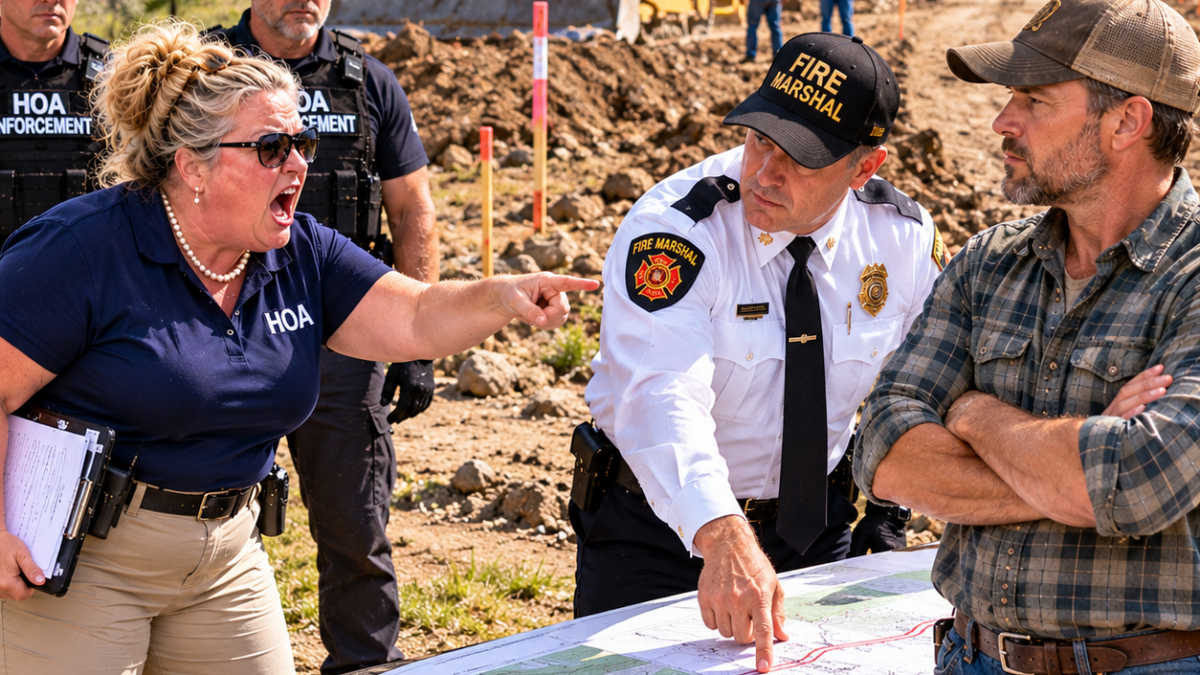
Twenty minutes later, HOA president Renata Cole stepped out of a black SUV, pointed toward the fresh scar running across my land, and told me the board had voted to take whatever ground it needed for “emergency access.”
She thought those two words were powerful enough to erase my deed, my survey, and sixty years of family history, but there was one question nobody on her board had bothered to ask before sending heavy equipment onto my property.
I had owned forty acres along Route 12 for three years.
It wasn’t fancy land.
Pine, scrub oak, a rocky ridge, and enough open ground that I could stand behind my house at dusk and see the last orange light settle over the valley.
The northern boundary ran beside Oak Ridge Estates, a large HOA development whose clubhouse sat on the opposite ridge.
I wasn’t part of their association.
Never had been.
My deed said so.
My survey said so.
The county records said so.
That distinction had never mattered much until the previous summer, when a wildfire scare trapped hundreds of Oak Ridge residents behind a single winding access road for nearly two hours.
Nobody was hurt, but fear has a long memory.
Renata turned that fear into a campaign.
At an HOA meeting I later obtained video from, she stood in front of nearly two hundred homeowners and promised a second emergency route.
People applauded.
What she didn’t say was that the shortest route ran straight across my land.
In March, I received a vague letter mentioning “potential easement discussions.”
I called.
No one returned the call.
In June, pink survey flags appeared between my pines.
The county surveyor’s office told me they hadn’t placed them.
I drove to the HOA office.
Renata met me in the lobby wearing the same polished smile she used at community meetings.
“You’re surveying my property.”
“We’re evaluating emergency options.”
“Do you have an easement?”
“The board has emergency authority.”
“Show me the ordinance.”
“Our attorney will follow up.”
He never did.
Instead, August brought a certified letter.
Construction would begin in thirty days.
No recorded easement.
No purchase offer.
No legal description.
Just a construction date.
That was when I hired Susan Kang, a property attorney who had handled land disputes for two decades.
She read the letter once.
“They don’t have an easement.”
“I know.”
“They know too.”
That bothered me more.
Susan sent a cease-and-desist.
Renata’s written response contained four words.
SEE YOU IN COURT.
I assumed that meant she would file something.
She didn’t.
She sent bulldozers.
By the time I reached the end of my driveway that Tuesday morning, almost sixty feet of stone wall had become rubble.
The dozer had already cut a raw strip through the trees.
I stepped in front of Renata’s SUV.
“Stop the equipment.”
She looked toward the construction crew.
“Emergency access.”
“This is private property.”
“The board approved it.”
I unrolled my survey across the hood of my truck.
“This line is my boundary.”
Renata barely looked down.
“The community needs another evacuation route.”
“Then buy an easement.”
“We don’t need your permission when public safety is involved.”
That was the sentence I remembered later.
Not because it was convincing.
Because she said it so confidently.
I told her I had called the sheriff.
“Good,” she said. “The county knows what we’re doing.”
Deputy Holt arrived less than an hour later.
He walked the boundary with his GPS, compared it to my recorded survey, and then faced Renata.
“This road is crossing privately deeded property.”
Renata handed him a board resolution.
He read it twice.
“Where’s the recorded easement?”
“The resolution grants emergency access.”
“A board resolution doesn’t transfer somebody else’s land.”
For the first time, Renata stopped smiling.
The deputy documented the damage, photographed the broken gate, marked GPS coordinates, and recorded everyone’s names.
But the ownership dispute itself was headed toward civil court, and Renata knew it.
That evening, my son Sam sat at my kitchen table scrolling through county fire regulations while I stared at photographs of the shattered wall.
Then he stopped.
“Dad.”
“What?”
“If Renata keeps calling this an emergency access road…”
He turned the laptop toward me.
“…why doesn’t anything she built look like one?”
PART 2
I leaned toward the screen.
Sam had highlighted several sections of county fire-access standards.
Required width.
Turning clearance.
Load-bearing requirements.
Maximum grade.
Drainage.
Surface stabilization.
Approval procedures.
Inspection requirements.
The more I read, the less the dirt scar outside my house looked like anything meant for emergency vehicles.
It looked like exactly what it was.
A bulldozer had driven through my property and carved the cheapest possible path across a ridge.
I looked at Sam.
“Where did you get this?”
“County website.”
“You sure it’s current?”
“Updated four months ago.”
I read it again.
Twenty feet minimum clear width for the type of emergency apparatus access Renata claimed she was building.
Her road looked barely wide enough for one pickup truck.
Sam tapped another paragraph.
“And this.”
Grade restrictions.
I knew enough about the ridge to understand that the northern descent was steep.
Very steep.
“Did they survey the grade?”
Sam shrugged.
“They put stakes out.”
“That isn’t what I asked.”
He closed the laptop halfway.
“Call the fire marshal.”
I looked toward the dark windows.
Beyond them, through the trees, I could just make out the raw pale strip where earth had been disturbed.
For months I had been asking the wrong question.
Did the HOA have a right to cross my property?
Susan was handling that.
The answer looked increasingly like no.
But Renata had justified everything with one phrase.
Emergency access.
If that phrase was true, the road had to function as one.
Not rhetorically.
Not politically.
Physically.
A fire engine had to be able to use it.
I called Susan first.
She answered at 8:12 the next morning.
“Please tell me nobody is bulldozing anything else.”
“Not yet.”
“That is not comforting.”
“Sam found something.”
“What?”
“Fire-access standards.”
Pause.
“What about them?”
“I don’t think the road qualifies.”
Longer pause.
Then her voice changed.
“Have you called the fire marshal?”
“Not yet.”
“Call before you do anything else.”
“You think it matters?”
“I think Renata’s entire defense is necessity.”
Susan spoke more slowly.
“If the thing she built cannot perform the emergency function she claims justified taking your land, that matters a lot.”
I found the county fire marshal’s number.
The receptionist transferred me to Dean Alvarez.
I expected bureaucracy.
A callback.
A form.
Maybe an appointment the following week.
Instead, Dean listened quietly while I explained.
“Where exactly is this?”
I gave him the parcel number and location.
“What HOA?”
“Oak Ridge Estates.”
Silence.
“Mr. Alvarez?”
“I’m here.”
“Something wrong?”
“We don’t have an approved emergency-access project for Oak Ridge.”
I sat up straighter.
“Maybe it was filed under another name.”
“Possible.”
Keys clicked in the background.
Then:
“No.”
“What does that mean?”
“It means if they are constructing a dedicated emergency apparatus route, my office should have been involved before earthwork started.”
“They didn’t contact you?”
“Not that I can find.”
I looked through the kitchen window.
The dirt strip seemed different now.
Not merely intrusive.
Suspicious.
“Can you come out?”
Dean answered:
“This afternoon.”
He arrived in a county vehicle at 2:07.
No flashing lights.
No dramatic entrance.
Just a white pickup with the fire marshal’s office seal on the door.
Dean was in his mid-fifties, lean, sun-darkened, and economical with words.
He shook my hand.
“You the owner?”
“Yes.”
“Show me the original boundary.”
I took him to the survey marker.
He looked at my deed map.
Then at the fresh cut.
“How long?”
“Roughly three hundred twenty feet across my parcel.”
“Who cleared it?”
“HOA contractor.”
“Permit number?”
“None that I have.”
Dean didn’t respond.
He pulled a measuring wheel from his truck.
Then a digital level.
Then a notebook.
Sam came from the house.
“This is my son.”
Dean nodded.
“Stay behind me on the slope.”
We walked.
The first hundred feet passed through what used to be scrub oak.
The contractor had removed vegetation and pushed loose soil downhill.
No retaining structure.
No drainage ditch.
No compacted base.
Dean stopped.
Measured.
“Eleven feet, four inches.”
He wrote it down.
Continued.
At the steeper section, he placed the level.
His mouth tightened.
“Seventeen point two.”
“What’s allowed?”
“For what they’re claiming? Not this without significant engineering.”
We kept walking.
At the narrowest bend, mature pines remained on both sides.
Dean paced it.
A large apparatus could not make the turn without backing.
Behind us, Sam quietly said:
“You’ve got to be kidding.”
Dean looked at him.
“I wish I was.”
At the far end, the road stopped at the HOA boundary.
There was no properly constructed tie-in.
No stabilized apron.
No turnaround.
Just disturbed earth ending beside an internal HOA service lane.
Dean stared at it for several seconds.
I finally asked:
“Could a fire engine use this?”
He looked back along the slope.
“Not safely.”
That answer hit harder than I expected.
I thought about the wildfire scare.
Cars trapped.
Smoke over the ridge.
Two hundred frightened homeowners applauding Renata because she promised them another way out.
“Then what did they build?”
Dean looked at me.
“I don’t know yet.”
“You think it was never about safety?”
“I didn’t say that.”
His caution reminded me why professionals matter.
He pointed back toward my house.
“I’m saying this is not an approved fire apparatus access road in its current condition.”
“Could it become one?”
“With engineering, widening, grading, drainage, stabilization, proper connections, and permitting.”
“How much?”
He shrugged.
“More than what I’m looking at.”
Then he asked something that changed the direction of the whole dispute.
“Do you have their plans?”
“No.”
“Board resolution?”
“Yes.”
“Get me everything.”
Susan subpoenaed nothing at that point.
She didn’t need to.
Dean formally requested project documents through the county’s regulatory process.
The HOA had to produce whatever it had used to justify construction.
Renata responded quickly.
Too quickly.
A site plan arrived the next morning.
Susan forwarded me a copy.
The plan looked professional.
Title block.
Engineering-style lines.
Emergency access route.
Twenty-two-foot graded width.
Maximum slope under twelve percent.
Compacted surface.
Drainage details.
Connection to Oak Ridge internal road.
I stared at it.
That was not what sat outside my house.
Not even close.
Sam came behind me.
“That says twenty-two feet.”
“I know.”
“Ours is eleven.”
“I know.”
“Dad…”
“I know.”
We drove out together.
Held the plan.
Compared it to reality.
Every contradiction became visible.
The document showed a broad approach.
Reality narrowed around trees.
The document showed controlled grade.
Reality dropped sharply.
The document showed drainage.
Reality had none.
The document showed engineered transitions.
Reality was a bulldozer cut.
Susan joined us by video call.
I turned the camera toward the road.
She went silent.
“That plan was submitted as built?”
“I think so.”
“No.”
“What?”
“It may have been submitted as proposed.”
“Does that help them?”
“Not if they represented it to officials as the basis for emergency construction and then built something materially different.”
Sam said:
“Could the contractor have just messed up?”
Susan nodded.
“Absolutely.”
That possibility mattered.
Renata might be reckless.
The contractor might be incompetent.
Neither fact automatically meant fraud.
We needed evidence.
Dean returned two days later with another inspector.
They measured independently.
Photographed.
Documented.
Then Dean issued a stop-work order.
Not because he had resolved my property rights.
Because the road, as represented, lacked required approvals and did not meet the emergency-access standards claimed for it.
A bright notice appeared on the contractor barricade.
STOP WORK.
The bulldozer disappeared that afternoon.
For the first time since 7:14 Tuesday morning, the land became quiet.
I stood where my grandfather’s wall had been.
Broken stones lay everywhere.
Some were old enough that lichen covered half their faces.
Grandpa built that wall after buying the original parcel.
He hauled stones from the creek bed in a wheelbarrow.
My mother used to say he knew every rock.
Dad repaired sections over the years.
Sam had helped me repoint part of it the summer before.
Now sixty feet lay in piles.
Sam came beside me.
“We’ll rebuild it.”
I nodded.
But my throat tightened.
“It won’t be the same.”
“No.”
He picked up a flat gray stone.
Turned it over.
“We’ll use the same rocks.”
That helped more than he knew.
The stop-work notice changed the HOA’s tone immediately.
Renata sent an email to residents that evening.
TEMPORARY COUNTY DELAY ON CRITICAL FIRE-SAFETY PROJECT.
She blamed “technical permitting questions.”
No mention of private land.
No mention of eleven-foot width.
No mention of the broken wall.
No mention that construction had begun without approval from the very fire officials supposedly requiring it.
Susan forwarded me the email.
“She’s setting the narrative.”
“I noticed.”
“Do nothing publicly.”
“You sure?”
“Yes.”
“She’s telling two hundred people the county is delaying their safety.”
“And we have documents.”
“Wouldn’t it help to correct her?”
“Not yet.”
I hated that answer.
Sam did too.
“They’re going to think Dad blocked an emergency road.”
Susan looked at both of us through the laptop screen.
“They probably will.”
“Great.”
“But court cases aren’t decided by neighborhood apps.”
She leaned closer.
“Renata wants you angry.”
“Why?”
“Because angry landowner versus frightened community is a story she can sell.”
“And the real story?”
“Unrecorded easement. Cease-and-desist ignored. Unpermitted construction. Material discrepancy between plan and road.”
She paused.
“Stay boring.”
I laughed despite myself.
“Stay boring?”
“The law loves boring people with good records.”
So I stayed boring.
For four days.
Then somebody painted FIRE SAFETY BEFORE GREED on a plywood sheet near my driveway.
No camera caught who did it.
I photographed it.
Removed it.
Filed it.
At the grocery store, an Oak Ridge resident confronted me.
“Are you the guy blocking the evacuation road?”
I had never met him.
“I’m the guy whose property was bulldozed without an easement.”
He frowned.
“That isn’t what we were told.”
“I figured.”
“Renata said you’re demanding half a million dollars.”
I almost laughed.
“Nobody has offered me anything.”
His expression changed.
“She said negotiations failed because you wanted an outrageous price.”
“No negotiation happened.”
He stood there holding a gallon of milk.
For a moment, neither of us spoke.
Then:
“Seriously?”
“Seriously.”
He looked embarrassed.
“Sorry.”
“It’s not your fault.”
“No, but…”
He shook his head.
“We were stuck during the fire.”
“I know.”
“My wife had our granddaughter in the car.”
“I understand why people want another road.”
“Then why oppose it?”
“I don’t oppose a legal, safe road.”
He stared.
I continued.
“I oppose somebody taking my land and building an unsafe one.”
That conversation became the sentence I repeated for months.
I was not against emergency access.
That distinction mattered.
Renata’s biggest advantage was making the issue binary.
Safety or selfish landowner.
Evacuation or property rights.
Good community or hostile neighbor.
Reality was more complicated.
A safe route could exist.
But it required engineering.
Permits.
Compensation.
A recorded easement.
Agreement.
None of those things were impossible.
Renata had simply decided they were inconvenient.
The next break came from money.
Sam found the first clue.
Oak Ridge received county-administered wildfire mitigation funds, which meant certain expenditures tied to emergency planning were subject to disclosure.
Through public records, we obtained contractor payment summaries.
Sam opened the spreadsheet at my kitchen table.
“Dad.”
I had learned to hate that tone.
“What?”
“Look.”
The approved project budget was far below what Dean estimated a code-compliant road of that terrain would normally cost.
Not proof of theft.
Not proof of fraud.
But odd.
There were line items for grading.
Drainage.
Compaction.
Surveying.
Emergency signage.
Yet some work plainly hadn’t been performed.
Susan reviewed the invoices.
“Who is the contractor?”
“Cole Ridge Excavation.”
She looked up.
“Cole?”
Sam and I exchanged glances.
I searched the corporation.
Owner:
Daniel Cole.
Renata’s brother-in-law.
I leaned back.
“Of course.”
Susan held up a finger.
“Conflict of interest is not automatically illegal.”
“Still looks terrible.”
“Yes.”
“Did she disclose it?”
“That is the question.”
HOA board minutes contained no obvious disclosure.
Again, suspicious.
Not yet proof.
Susan requested board procurement records.
Bids.
Conflict statements.
Vote minutes.
Contract approval.
The HOA’s attorney resisted.
Then produced partial documents.
Three bids supposedly existed.
Cole Ridge was lowest.
One competitor denied ever submitting a bid when Susan contacted them.
The second business address belonged to a dissolved company.
Now things started moving faster.
Dean’s office had questions about the plans.
Susan had questions about procurement.
Residents had questions about money.
Renata answered none of them.
Instead, she called an emergency HOA meeting.
I wasn’t invited.
Carol Benson attended.
I didn’t know Carol yet.
Retired schoolteacher.
Board member for four years.
She came to my house the next morning.
Silver hair.
Blue cardigan.
Face pale.
“Are you Mr. Hayes?”
That was the first time she called me by name.
“Yes.”
“I’m Carol Benson.”
“I know.”
“I’m on the Oak Ridge board.”
I said nothing.
She looked at the broken wall.
“Oh my God.”
That reaction told me she had never seen it.
“You didn’t know?”
“Not like this.”
“Did you vote for the road?”
Carol closed her eyes.
“I thought I did.”
That was an odd answer.
“What does that mean?”
She held out a folder.
Inside was a copy of the board resolution Renata had shown Deputy Holt.
Five signature lines.
Renata.
Treasurer.
Secretary.
Carol Benson.
Thomas Reed.
Carol pointed at hers.
“That is not my signature.”
I felt everything around me go still.
“You’re sure?”
She looked offended.
“I taught fourth grade for thirty-two years.”
“What does that have to do with—”
“I signed report cards, permission slips, union forms, school contracts, grant paperwork, and birthday cards for three decades.”
She tapped the page.
“I know my own signature.”
The mark looked neat.
Too neat.
She continued.
“I never attended the vote she says happened.”
“Why?”
“My sister was having surgery in Tucson.”
“Were you remote?”
“No.”
“Did you authorize a proxy?”
“No.”
My mouth went dry.
“What about Thomas Reed?”
Carol’s expression tightened.
“He says his signature isn’t his either.”
I called Susan.
She arrived forty minutes later.
Carol repeated everything.
Susan did not react dramatically.
Good lawyers rarely do.
She asked:
“Do you have examples of your genuine signature?”
“Hundreds.”
“Board records?”
“Yes.”
“Do you consent to a forensic comparison?”
Carol nodded.
“I want my name off that document.”
Susan looked at me.
“Now we have a different problem.”
Different indeed.
Up to that point, Renata could claim legal misunderstanding.
Emergency authority.
Bad advice.
Contractor error.
Even gross negligence.
Forged signatures changed the character of everything.
Susan retained a forensic document examiner.
Genuine signatures collected from multiple dates.
Board forms.
Bank authorizations.
Meeting minutes.
Carol.
Thomas.
The examiner did not finish overnight.
Meanwhile, Thomas Reed came forward.
Sixty-seven.
Retired insurance adjuster.
He looked furious.
“I asked Renata not to move forward until we had an easement.”
“When?”
“April.”
“You have that in writing?”
He pulled out his phone.
Email.
RENATA — WE CANNOT START CONSTRUCTION ACROSS THE HAYES PARCEL WITHOUT A RECORDED EASEMENT OR COURT ORDER. PLEASE DO NOT AUTHORIZE SITE WORK UNTIL COUNSEL CONFIRMS RIGHTS.
Her response:
NOTED.
That one word became very important later.
Thomas continued.
“She told us negotiations were underway.”
“They weren’t.”
“I know that now.”
“She told residents I demanded half a million.”
Thomas looked sick.
“She told us you refused every offer.”
“There were no offers.”
He sat at my table.
For a while, he just stared at his hands.
“I applauded her at that wildfire meeting.”
“So did everyone.”
“My wife was stuck in that evacuation.”
“I understand.”
“No.”
He looked at me.
“You don’t.”
His voice cracked.
“I thought she was solving something that terrified us.”
That was the first moment I stopped seeing the HOA as one thing.
Renata was not two hundred homeowners.
Some residents wanted safety.
Some board members trusted bad information.
Some were negligent.
Some asked questions.
Renata had used their fear.
That made what she did worse.
Not better.
The document examiner’s report arrived eight days later.
Carol’s signature showed signs consistent with tracing or reproduction.
Thomas’s too.
Not a casual difference.
Not ordinary variation.
The signatures were not authentically written by them.
Susan called Deputy Holt.
Dean Alvarez.
Then the county prosecutor’s office.
The civil land dispute now contained potential criminal evidence.
Forgery.
False submission.
Possibly fraud depending on how the document had been used.
Deputy Holt returned to my property.
Same calm manner.
He photographed the road again.
Collected copies.
Reviewed his first report.
“You remember when she handed me this?”
“The resolution?”
“Yes.”
“She stood right there.”
He pointed near my old gate.
“Said the board had authority.”
I nodded.
“You still have body-camera footage?”
“Yes.”
That mattered.
Renata had not merely possessed the resolution.
She had presented it to a deputy as proof of authority.
Dean’s office also confirmed that the site plan submitted after his inquiry differed materially from what had been built.
That alone didn’t establish Renata created the plan.
Investigators would determine responsibility.
But the pieces were no longer isolated.
False board authority.
No easement.
Unpermitted construction.
Unsafe road.
Related contractor.
Questionable bidding.
Potentially forged signatures.
The county prosecutor opened a formal investigation.
That news hit Oak Ridge before anyone officially announced it.
Neighborhood groups exploded.
Carol called an emergency board meeting.
This time, Renata did not control the agenda.
I attended because Carol invited me.
The clubhouse was full.
Nearly two hundred people.
Some angry at me.
Some angry at Renata.
Most confused.
Renata sat at the front in her signature red blazer.
Perfectly composed.
When I entered, whispers followed.
I took a chair in the back.
No speech prepared.
No slideshow.
Just documents in Susan’s folder.
Carol opened the meeting.
“We need to address the emergency access project.”
Renata immediately interrupted.
“This discussion is premature.”
Carol looked at her.
“No.”
One word.
Firm.
Renata stared.
Carol continued.
“Several serious discrepancies have been brought to the board.”
Renata leaned toward her microphone.
“Legal counsel has advised—”
“Our counsel is here.”
Everyone looked toward a man seated near the side wall.
The HOA attorney stood.
“I advised the board to suspend further project activity pending investigation.”
The room changed.
Renata’s face did not.
“Which we have done.”
Carol responded:
“The county stopped it.”
A few people murmured.
Then Thomas spoke.
“My signature on the project resolution was not mine.”
Silence.
Renata turned.
“Thomas—”
He placed the document on the table.
“I did not sign this.”
Carol added:
“Neither did I.”
The room went completely still.
Renata’s composure finally cracked.
“That document was assembled by staff.”
“What staff?” Carol asked.
“Our administrative contractor.”
“Name them.”
Renata hesitated.
That hesitation mattered.
Residents started whispering.
Carol held up the forensic report.
“An examiner has concluded both signatures are inconsistent with genuine signatures and show evidence of reproduction.”
Renata’s chair scraped slightly.
“This is becoming defamatory.”
Susan leaned toward me.
“Don’t react.”
I hadn’t moved.
Renata looked toward the room.
“This community faced a life-threatening evacuation failure last summer.”
She was going back to fear.
“You asked me for a solution.”
Several residents nodded unconsciously.
“We acted because delay could cost lives.”
Then she pointed toward me.
“One landowner has obstructed a project intended to protect two hundred families.”
That angered me.
Susan touched my forearm.
Wait.
Carol answered instead.
“The fire marshal says the road could not safely carry emergency apparatus.”
Gasps.
Renata stared at her.
Carol continued.
“It is eleven feet wide in sections.”
“Required width is significantly greater.”
“The grade exceeds allowable design conditions.”
“No permit was obtained.”
“The submitted plan does not match the road.”
That destroyed Renata’s safety argument more effectively than anything I could have said.
A man near the front stood.
“My wife sat in traffic during that fire.”
His voice shook.
“We trusted you.”
Renata replied:
“And I tried to protect you.”
“With a road fire trucks can’t use?”
Another resident shouted:
“Where did the emergency money go?”
Carol raised her hand.
“Please.”
Someone else:
“Why did your brother-in-law get the contract?”
Now the room erupted.
Renata looked around.
Faces that once applauded.
Now questions.
Not hatred.
Worse for someone like her.
Doubt.
She tried to regain control.
“The contractor relationship was disclosed.”
Thomas said:
“Show us where.”
No answer.
“Our procurement process—”
“Where are the bids?”
Carol asked.
Renata’s voice sharpened.
“This is an active legal matter.”
The crowd reacted loudly.
Carol waited until they quieted.
Then she said:
“I move that Renata Cole be suspended from all board authority pending completion of the county investigation and independent financial review.”
Second.
Immediate.
Renata stood.
“You cannot do this.”
Carol looked at her.
“Yes, we can.”
“You don’t have cause.”
Thomas pushed the resolution toward her.
“This is cause enough to investigate.”
Vote.
Unanimous among eligible remaining board members.
Renata stared at each of them.
Then at me.
For a moment, I saw something beneath the confidence.
Not remorse.
Fear.
Losing control terrified her.
She gathered her purse.
“This community will regret turning on the only person willing to protect it.”
Then walked out.
Nobody followed.
The applause that came afterward made me uncomfortable.
This was not over.
Suspension wasn’t conviction.
Suspicion wasn’t proof.
Susan stood beside me.
“You okay?”
“No.”
“Good answer.”
“I thought I’d feel better.”
“You will when the wall is back.”
She knew me well.
The county investigation lasted months.
That part would make a terrible viral video.
Interviews.
Emails.
Bank statements.
Contract documents.
Digital metadata.
Signature analysis.
Procurement records.
Meeting calendars.
Boring.
Necessary.
Investigators concluded Renata had knowingly used a board resolution containing forged signatures to create the appearance of authorization.
The financial review showed the related contractor had received preferential treatment.
Not every suspicious dollar became a criminal allegation.
Some spending was legitimate.
Some was badly managed.
Some invoices reflected real work.
But the approval process had been manipulated.
Renata eventually faced charges tied to forgery and falsified project authorization.
Her defense argued she had acted under emergency pressure.
Her attorney emphasized the wildfire evacuation.
That was true context.
Fear had been real.
The need for a second route was real.
The road remained wrong.
At the same time, the fire marshal’s office completed enforcement proceedings against the HOA for beginning unpermitted construction and creating a route that failed the standards cited to justify it.
The association received substantial civil penalties.
Residents were furious.
Not at me anymore.
Mostly at the board structure that allowed one president to authorize so much without meaningful review.
Carol came to my house after the citations became final.
She stood beside the rubble.
“I’m sorry.”
“You didn’t push the bulldozer.”
“I was on the board.”
“You didn’t sign the resolution.”
“I also didn’t pay enough attention before that.”
That honesty mattered.
“What happens now?”
She looked toward the ridge.
“We still need emergency access.”
I nodded.
“I know.”
“You’d consider it?”
That surprised her.
“Consider what?”
“A real easement.”
I looked at the scar.
“My lawyer would handle it.”
“Of course.”
“Fire marshal approves design first.”
“Yes.”
“Independent engineer.”
“Yes.”
“Fair-market compensation.”
“Yes.”
“Recorded easement.”
“Yes.”
“Wall restored.”
Carol looked at the broken stones.
“Whether you agree or not, the wall gets restored.”
That was the first sentence from an HOA officer I trusted.
A judge eventually ordered the association to restore the damaged portion of my property at its expense, including the gate, wall, disturbed grading, and vegetation impacts, unless we negotiated an approved permanent easement for a new route.
Renata later entered a guilty plea to a forgery-related charge as part of a negotiated resolution.
Probation.
Restitution obligations.
And under separate association and civil terms, no return to leadership.
I did not celebrate.
Sam wanted to.
“Come on, Dad.”
“What?”
“She bulldozed the gate.”
“I remember.”
“She forged signatures.”
“I remember.”
“She called you greedy.”
“I definitely remember.”
“And you’re not even smiling?”
I looked toward the kitchen window.
“What do you want me to do?”
“I don’t know.”
“Victory dance?”
He laughed.
“Maybe a little.”
I smiled.
That satisfied him.
The bigger question remained.
Emergency access.
Oak Ridge still had one narrow road.
Another wildfire would not care that Renata lied.
Residents still needed a safer second route.
Dean Alvarez said it plainly during a joint meeting.
“The bad process does not eliminate the real hazard.”
That sentence guided everything afterward.
Carol became interim HOA president.
Her first act was not punishing anyone.
It was hiring an independent civil engineer.
Second:
Commissioning an evacuation study.
Third:
Contacting Susan with a formal easement proposal.
Real negotiation.
Actual maps.
Actual numbers.
The engineer surveyed multiple routes.
Mine was still the most practical.
I hated that.
Sam noticed.
“You wanted them to find another one.”
“Yes.”
“Why?”
I looked at the old wall.
“Because I don’t want Renata to be right about anything.”
Sam smiled sadly.
“She wasn’t right.”
“The route is still here.”
“The route wasn’t the problem.”
That landed.
He continued.
“Taking it was.”
My son had become annoyingly wise.
The new engineering design barely resembled Renata’s road.
Twenty-four-foot improved width.
Engineered base.
Proper drainage.
Controlled grades.
Turn clearances.
Emergency gate hardware.
Vegetation management.
Fire-department access.
Recorded easement corridor.
The route shifted several feet to reduce impact on mature trees and align closer to the property edge.
Dean reviewed revisions.
Rejected the first.
Approved the second with changes.
A geotechnical engineer reviewed soil.
County planning reviewed land disturbance.
Nothing moved until permits were issued.
That process took months.
Exactly the process Renata had tried to skip.
Then came money.
Independent appraisal.
Value of permanent easement.
Construction impacts.
Restoration.
Temporary access.
Attorney fees.
Susan negotiated.
The HOA’s new attorney negotiated.
They made an offer.
I rejected it.
They increased it.
I countered.
Eventually, we reached fair-market terms.
Not revenge money.
Not half a million.
Reasonable compensation for a permanent property burden.
The association recorded the easement properly.
Every signature real.
Carol signed at closing.
I signed.
Susan notarized.
I looked at the final document.
“Funny.”
“What?”
Susan asked.
“All Renata had to do was this.”
Susan gave me a look.
“This took eight months.”
“So?”
“She wanted eight days.”
That was the whole story.
Shortcuts.
Renata believed urgency made procedure optional.
But emergency planning is exactly where procedure matters most.
Because roads have to work during emergencies.
Because fire engines are heavy.
Because slopes matter.
Because people’s lives depend on measurements being real.
Construction began the following spring.
I was nervous the morning the equipment arrived.
Same sound.
Diesel engines.
Tracks.
Backup alarms.
For a moment, I was back at 7:14 watching my gate fold.
Sam stood beside me.
“You okay?”
“Yes.”
“Liar.”
“Little bit.”
This time, the project superintendent walked up before crossing the property line.
“Mr. Hayes?”
“Yes.”
He held out a folder.
“Permit set.”
I almost laughed.
“Imagine that.”
He smiled.
“We’ll stay inside the marked easement corridor.”
“Good.”
“Any problem, call me directly.”
“Good.”
“Fire marshal inspection at three milestones.”
Even better.
The old illegal cut was partially restored.
Some areas were regraded.
Vegetation replanted.
The approved route hugged the boundary.
Proper base.
Drainage swales.
Compaction.
Wider turning area.
Every stage inspected.
Dean came out several times.
On final inspection, he drove the route with fire-department personnel.
A full-size apparatus followed.
Slowly.
Safely.
At the steepest point, it maintained control.
At the bend, it cleared.
At the connection, no backing required.
Dean stepped out.
“Now that is an emergency road.”
I looked at him.
“Could’ve said that before they destroyed my wall.”
He smiled.
“I wasn’t invited.”
Fair.
The wall reconstruction happened last.
I insisted they use original stone wherever possible.
The contractor complained.
“It’ll take longer.”
“I know.”
“New stone would be easier.”
“I know.”
“Cost more to hand reset these.”
“I know.”
The HOA paid.
Not because I wanted to punish residents.
Because restoration meant restoration.
Sam spent weekends with me sorting stones.
Flat ones.
Corner pieces.
Capstones.
We found marks from Grandpa’s old tools on several.
One stone had my initials scratched into it.
I was nine when I did that.
I had forgotten.
Sam held it up.
“You vandalized Grandpa’s wall.”
“I improved it.”
“HOA violation.”
“Get off my land.”
He laughed.
We placed that stone near the new gate.
The iron gate could not be saved.
Too twisted.
A blacksmith fabricated a replacement using the original design.
Heavy iron.
Same proportions.
He incorporated two undamaged decorative pieces from Dad’s 1987 gate.
The morning we hung it, Sam supported one side while I set the hinge pin.
“Higher.”
“I am higher.”
“No, your side.”
“That would’ve been useful information.”
We argued.
Dad would have enjoyed it.
When the gate finally swung freely, Sam stepped back.
“Looks right.”
I touched one of the old iron pieces.
“Yeah.”
It did.
Six months after the new road opened, another wildfire started west of Oak Ridge.
Smaller than the previous scare.
But smoke moved fast.
The county ordered a precautionary evacuation.
I stood near my driveway when the emergency gate opened.
Cars began using the secondary route.
Controlled flow.
Police directing traffic.
Then came an ambulance.
Then a fire engine traveling the opposite direction toward the subdivision.
It moved across the easement smoothly.
No scraping.
No hesitation.
No dangerous slope.
I watched that engine disappear toward Oak Ridge.
For a strange moment, I thought about Renata.
The need she had used as a weapon had always been real.
That was what made the story complicated.
If she had invented the wildfire risk entirely, hating her would have been easy.
But residents had needed another route.
She simply decided that a good objective excused any method.
That belief caused the damage.
Not the idea of emergency access itself.
Carol drove through during the evacuation.
She rolled down the window.
“Looks like it works.”
“It better.”
She smiled.
“Thank you.”
“For what?”
“For saying yes after everything.”
I looked at the line of cars.
“I didn’t say yes to what Renata did.”
“I know.”
“I said yes to this.”
She nodded.
“That’s what I mean.”
Traffic continued.
Families.
Pets.
Golf carts on trailers.
People who had once been trapped on one road now had another.
The easement check sat in my bank account.
The deed sat recorded at the county.
The road met code.
The wall stood.
The gate worked.
That was the difference between taking and negotiating.
Between authority and entitlement.
Between urgency and recklessness.
Renata disappeared from Oak Ridge life after sentencing.
She sold her house the following year.
I heard that from Carol.
I didn’t ask where she went.
People assumed I hated her.
I did for a while.
Especially when I looked at the wall rubble.
But hatred gets tiring.
Eventually, Renata became less important than what her actions changed.
Oak Ridge rewrote its governance rules.
Large capital projects required independent review.
Conflict disclosures became mandatory.
Board signatures were verified electronically.
Emergency spending had limits.
Property acquisitions required legal counsel and recorded documents before construction.
Procurement required real competitive bids.
Residents received access to project budgets.
Carol hated some of the new paperwork.
She told me so.
“This is miserable.”
“You’re welcome.”
“You caused half of it.”
“Renata caused all of it.”
“Fair.”
The HOA also created an emergency planning committee with the fire marshal’s office.
Actual drills.
Evacuation maps.
Communication systems.
Not speeches.
Planning.
Sam joined one drill as a volunteer.
He came home laughing.
“What?”
“They made Renata’s old road example number one.”
“For what?”
“Why emergency routes require inspection.”
I almost felt bad for her.
Almost.
Deputy Holt stopped by one afternoon months later.
He was driving Route 12 and noticed the rebuilt wall.
He pulled in.
“Looks good.”
“Better than rubble.”
He walked to the gate.
“This original?”
“Replacement.”
“Could’ve fooled me.”
“Some old pieces reused.”
He nodded.
Then looked toward the new road.
“Heard the fire department signed off.”
“Everything signed off.”
He smiled.
“Funny how much smoother things go with actual paperwork.”
“I’ve heard rumors.”
We stood quietly.
I remembered his first visit.
Renata waving the board resolution.
Deputy Holt telling her it wasn’t an easement.
At the time, I was frustrated he couldn’t simply solve everything on the spot.
Now I understood why his report mattered more.
GPS.
Photos.
Dates.
Statements.
Renata presenting the resolution.
That boring report became one of the earliest independent records of what happened.
“Thanks,” I said.
“For what?”
“Documenting it.”
“Job.”
“Still.”
He nodded.
“Glad it worked out.”
“Mostly.”
He drove away.
Susan Kang remained my attorney for exactly as long as needed.
At our final meeting, she closed the file.
Literally.
Thick folder.
Tabs.
Photos.
Surveys.
Fire reports.
Court orders.
Easement.
Settlement.
She pushed it toward me.
“Keep this forever.”
“I was hoping to burn it.”
“Do not burn legal records.”
“Joke.”
“I don’t trust you.”
I opened the folder.
First photograph:
The bulldozer.
Broken wall.
Renata in the background wearing red.
Last document:
Recorded easement.
Signed.
Notarized.
County stamp.
“Quite a difference.”
Susan leaned back.
“You know what almost bothers me most?”
“What?”
“They could have gotten nearly everything they wanted legally.”
I nodded.
“A road.”
“Yes.”
“Probably across the same general corridor.”
“Yes.”
“Instead they spent more.”
“Much more.”
“Got fined.”
“Yes.”
“Paid lawyers.”
“Yes.”
“Restored the wall.”
“Yes.”
“Paid me.”
“Yes.”
“Paid you.”
She smiled.
“Yes.”
“All because Renata couldn’t ask.”
Susan shook her head.
“She could ask.”
“She couldn’t accept that you had the right to say no.”
That was more accurate.
Renata had approached the problem as if property ownership were an obstacle to be overcome rather than a right to negotiate with.
The final cost to the association was several times higher than doing it properly from the beginning.
Fire-code penalties.
Legal fees.
Restoration.
Engineering redesign.
Contract termination issues.
Easement compensation.
New construction.
Insurance complications.
Nobody won financially.
That was why I disliked people calling it revenge.
Revenge suggests I wanted Oak Ridge harmed.
I didn’t.
The residents paid dues.
Many had trusted their president.
I wanted Renata held accountable.
I wanted my land restored.
I wanted the road, if it existed, to be safe.
That was enough.
A year after the first bulldozer crossed the line, Sam and I stood near the rebuilt gate on a cool morning.
He had brought coffee.
“7:14.”
“What?”
He checked his phone.
“Exactly one year.”
I looked at the road.
“Really?”
“Yep.”
We stood where the old dozer blade hit.
The stone wall looked almost unchanged from before.
Almost.
If you knew where to look, new mortar showed slightly lighter.
Several stones sat differently.
Trees along the original illegal cut were still young replacements.
Scars.
But healing ones.
Sam handed me coffee.
“Regret anything?”
“Hiring you as free labor.”
“Funny.”
I thought.
“I regret not taking the March letter more seriously.”
“You called them.”
“I could’ve hired Susan earlier.”
“You couldn’t know they’d bulldoze.”
“I saw the stakes.”
“You called the county.”
“I could have put up barriers.”
“They pushed over an iron gate.”
“True.”
Sam looked at me.
“You’re doing that thing.”
“What thing?”
“Trying to find the version where you controlled everything.”
I hated when he sounded like Susan.
“What should I do instead?”
“Admit someone else made a bad choice.”
I looked at the wall.
He was right.
Renata decided.
Contractor acted.
Board oversight failed.
None of that became my fault because it happened on my land.
I took a sip.
“Your mother teach you this?”
“You.”
“Impossible.”
“Mostly Mom.”
“Thought so.”
We laughed.
A few minutes later, an Oak Ridge homeowner drove up the emergency road in a golf cart.
I raised my hand.
He stopped.
“This is emergency access only.”
He looked embarrassed.
“Sorry.”
“Gate should be locked.”
“Carol gave us codes for drills.”
“Drill today?”
“No.”
I stared.
He turned the cart around.
Sam laughed so hard he nearly spilled coffee.
“Dad.”
“What?”
“You’ve become HOA enforcement.”
“Leave.”
“Need to see my registration?”
“Get off my land.”
The humor helped.
The emergency gate later received an access-control system linked to fire services.
No recreational traffic.
Another small problem solved with a proper system.
The story spread beyond Oak Ridge.
County planners used the project during training.
Fire officials cited it when explaining why private access agreements and engineering review matter.
Susan gave a continuing-education presentation about emergency easements.
She removed names.
I still recognized every detail.
Sam sent me the flyer.
YOU’RE FAMOUS.
I replied:
DELETE MY NUMBER.
He called immediately.
Years passed.
The wall aged again.
New mortar darkened.
Replacement shrubs grew.
The road remained.
So did the recorded easement.
Sometimes I walked it.
Not because I loved having a road on my property.
I didn’t.
But I liked knowing the thing was honest.
Every foot accounted for.
Every right written.
Every obligation recorded.
The HOA maintained surface and drainage.
I retained defined property rights outside the corridor.
Emergency services controlled the gate.
Simple.
Clear.
Boring.
Susan would approve.
Carol eventually retired from the board.
At her final meeting, Oak Ridge residents presented her with a plaque.
She called me afterward.
“They gave me a plaque.”
“Throw it away.”
“I’m serious.”
“So am I.”
“You’re terrible.”
“What does it say?”
She read:
FOR RESTORING TRUST THROUGH TRANSPARENCY.
“That’s nice.”
“I cried.”
“I won’t tell anyone.”
“You just did.”
Carol paused.
“I wish I had challenged Renata sooner.”
“We all wish things earlier.”
“She was persuasive.”
“She had a real problem to point at.”
“The fire risk.”
“Yes.”
Carol sighed.
“That’s why people followed.”
I thought about that.
Bad leadership is easiest to recognize when the goal is obviously bad.
Harder when the goal sounds righteous.
Safety.
Security.
Children.
Property values.
Community.
Emergency access.
Words with emotional force.
Sometimes the most dangerous shortcut is attached to a good cause.
Because questioning the method gets framed as questioning the cause.
I opposed taking my land without permission.
Renata said I opposed safety.
I questioned the road design.
She said I endangered families.
I demanded paperwork.
She called it obstruction.
That framing nearly worked.
Until the fire marshal measured eleven feet.
Numbers are difficult to intimidate.
Eleven feet did not become twenty-two because Renata spoke confidently.
A seventeen-percent slope did not flatten because a board voted.
A forged signature did not become genuine because the community was afraid of wildfire.
My deed did not disappear because somebody called my land an emergency corridor.
Facts stayed where they were.
Eventually, everybody else had to come back to them.
One afternoon, I found the original survey tube in my office.
The same survey I unrolled on my truck hood while Renata ignored it.
Paper wrinkled.
One corner stained with mud.
I almost threw it away.
Then changed my mind.
Framed a copy instead.
Sam saw it.
“You framed a survey?”
“Yes.”
“People usually frame photographs.”
“This saved us.”
“Fire marshal saved us.”
“Survey started it.”
“Susan.”
“Also.”
“Deputy Holt.”
“Fine.”
“Carol.”
“Enough.”
“Me.”
I looked at him.
“You found the fire code.”
He smiled.
“There it is.”
I pointed at the frame.
“Happy?”
“Yes.”
“Leave.”
He didn’t.
That night, we grilled outside.
From the patio, you could see part of the emergency road where it disappeared behind pines.
A fire department vehicle passed during a scheduled inspection.
Slow.
Controlled.
Legal.
I watched until it disappeared.
Sam noticed.
“You still check every time.”
“Probably always will.”
“Bother you?”
“Less.”
That was true.
At first, the road represented violation.
Then conflict.
Then compromise.
Eventually, it became infrastructure.
Useful.
Necessary.
Paid for.
Agreed to.
That transformation mattered.
The same physical concept could be either theft or cooperation depending on how people reached it.
That was the heart of the whole thing.
Not whether Oak Ridge deserved emergency access.
They did.
Not whether my property was sacred beyond negotiation.
It wasn’t.
Everything can be discussed.
The problem was consent.
Process.
Safety.
Truth.
Renata decided those were obstacles.
They were actually the foundation.
Without them, her road failed physically, legally, financially, and politically.
With them, nearly the same goal succeeded.
A few years later, another wildfire came closer.
Closer than anyone liked.
Smoke turned the sunset orange.
Evacuation order issued at 5:40 p.m.
This time, I watched from the ridge.
Oak Ridge’s primary road carried outbound traffic.
The secondary route across my easement opened.
Cars moved steadily.
No two-hour jam.
No panic.
A county fire engine entered using the secondary lane.
Behind it came a brush truck.
Everything worked.
Sam stood beside me.
“This is what she wanted.”
I looked at him.
“This is what everyone wanted.”
“Difference?”
“This one works.”
He nodded.
Then:
“And you agreed.”
“And they paid.”
He laughed.
“Never forget the money.”
“Property rights, son.”
“Sure.”
We watched a family drive through.
Two children in the back.
Dog between them.
The mother waved.
I waved back.
That was the moment I finally stopped thinking of the road as Renata’s road.
It wasn’t.
It belonged to an agreement made after she was gone.
An engineer designed it.
Fire officials approved it.
Lawyers recorded it.
Residents paid for it.
I consented to it.
That difference gave me peace.
The evacuation ended safely.
Fire contained.
No homes lost.
The next morning, Carol called even though she no longer lived in Oak Ridge.
“I heard the road was used.”
“Yes.”
“How’d it do?”
“Exactly what it was designed to do.”
She became quiet.
Then:
“Good.”
I could hear emotion in her voice.
“Carol?”
“I just keep thinking what could’ve happened if the original road had been used in a real fire.”
I had thought about it too.
Eleven feet.
Steep grade.
Loose soil.
No drainage.
Fire engine trying to climb while residents evacuated the other direction.
We got lucky.
That was the part Renata never seemed to understand.
By skipping safety review in the name of safety, she had created another hazard.
Irony doesn’t make consequences less serious.
After the call, I walked to the wall.
Touched one stone.
The one with my childhood initials.
Still there.
The wall was never historically significant.
No plaque.
No official designation.
Just stones Grandpa stacked because he needed a boundary.
Dad maintained it.
I inherited it.
Then Sam helped rebuild it.
Four generations represented by one unnecessary wall.
I used to think the story was about protecting land.
Later, I understood it was about protecting boundaries in a broader sense.
A boundary is not always a refusal.
Sometimes it is the place where negotiation begins.
My property line said:
You cannot simply take this.
The fire code said:
You cannot simply call this road safe.
Board rules said:
You cannot simply invent approval.
Law said:
You cannot simply forge consent.
Each boundary forced a conversation Renata wanted to skip.
And every conversation she skipped came back harder later.
I never saw her again.
Once, years after she sold her house, somebody told me she had moved to another county.
I changed the subject.
I did not need updates on Renata.
Her chapter had ended.
My land remained.
Oak Ridge remained.
The road remained.
That was enough.
On the fifth anniversary of the bulldozer morning, Sam came over.
7:14 a.m.
Coffee again.
“You’re turning this into a tradition.”
“You’re old. Traditions are good for you.”
“Careful.”
We stood beside the gate.
The iron had weathered slightly.
Stone wall looked natural now.
Replacement vegetation had nearly hidden the scars.
Sam pointed toward the road.
“You know what I remember?”
“What?”
“You sitting at the kitchen table staring at the wall photos.”
“I remember.”
“I thought you were going to sue them into extinction.”
“I considered it.”
“You were furious.”
“Yes.”
“What stopped you?”
I thought about Susan.
Dean.
Carol.
Residents trapped during the wildfire.
The fire truck using the finished road.
“Figuring out what I actually wanted.”
Sam waited.
“I wanted my property respected.”
“Yes.”
“I wanted Renata stopped.”
“Obviously.”
“I wanted the wall restored.”
He nodded.
“But I didn’t want two hundred families trapped on one road.”
Sam smiled.
“So the revenge was letting them build it anyway?”
“No.”
I looked at him.
“The revenge was making them do it right.”
He laughed.
“That sounds like Susan.”
“Don’t tell her.”
We finished our coffee.
At 7:29, the emergency gate remained closed.
At 7:30, birds started making more noise than necessary.
At 7:32, a pickup passed on Route 12.
Nothing happened.
No bulldozer.
No shouting.
No red blazer.
Just morning.
That quiet felt better than any courtroom victory.
Because the first time heavy equipment entered my land, someone had decided I did not deserve a choice.
Years later, the road that remained existed because everybody involved had choices.
The HOA chose to negotiate.
I chose to grant an easement.
Engineers chose the safest design.
Fire officials chose whether to approve it.
Residents chose leadership that respected limits.
The law did what good law is supposed to do.
Not erase conflict.
Give conflict a structure that keeps one powerful person from deciding everyone else’s rights are inconvenient.
I looked once more at Grandpa’s wall.
Every old stone reset.
Dad’s ironwork preserved in the new gate.
Sam beside me.
Beyond it, the properly built emergency road curved along the boundary and disappeared toward the ridge.
Renata Cole had once stood on that exact ground and told me the board’s vote meant she didn’t need my permission.
In the end, the road taught Oak Ridge the opposite.
Safety required permission.
Engineering required verification.
Authority required limits.
And a line on a survey was not an obstacle to bulldoze through.
It was where the conversation should have started.
[END OF STORY]





