PART 2: HOA Built a $900,000 Pavilion on My Pasture—Then Its Own Invoice Exposed Everything
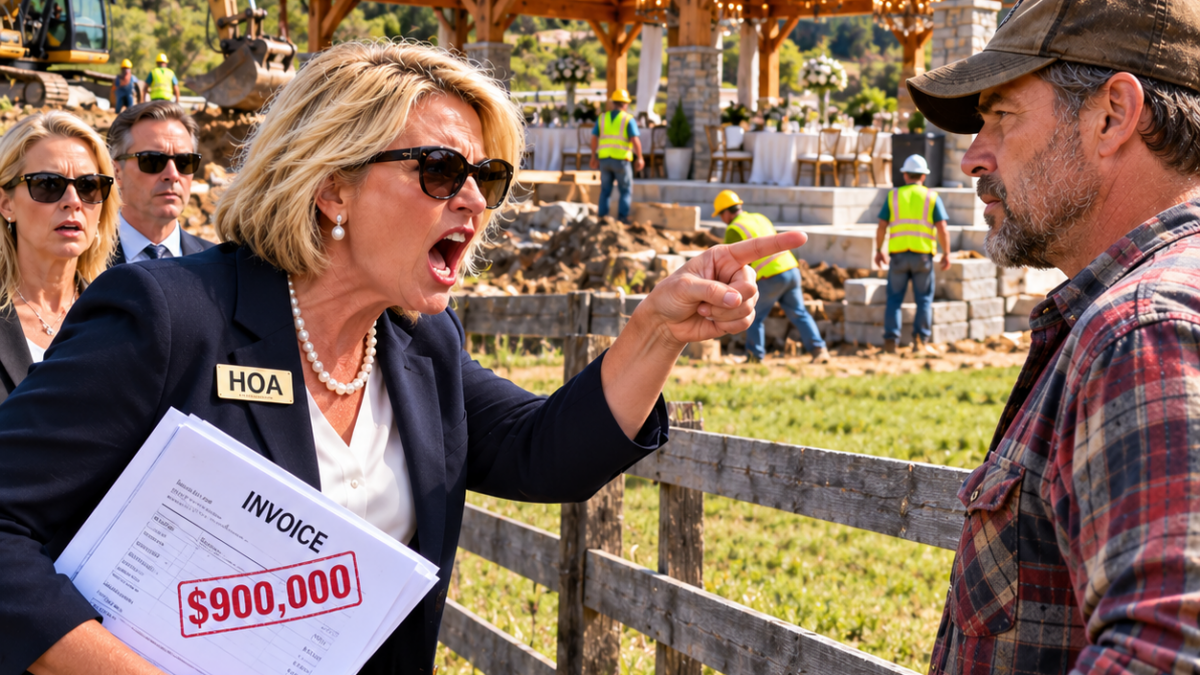
PART 2
We met the next morning at a diner twenty miles south of Willow Crest.
Susan arrived without a purse, without a briefcase, without anything that looked official.
Just a manila envelope tucked beneath her arm.
She slid into the booth opposite me and kept the envelope pressed against her side until the waitress finished pouring coffee.
Only after we were alone did she put it on the table.
“I’m not supposed to have these outside the association office.”
“Then why bring them?”
“Because Rebecca told us the property problem happened after the contracts were signed.”
“And you don’t believe her.”
Susan pushed the envelope toward me.
“I know she’s lying.”
I opened it.
The first page was an invoice from Stonebridge Outdoor Construction.
Date: January 14.
That stopped me immediately.
I had found the first survey stakes in April.
The board meeting Rebecca claimed authorized the pavilion happened in late February.
Yet Stonebridge was billing Willow Crest in January.
The invoice included mobilization, preliminary grading, site verification, engineering coordination, and something called owner-access preparation.
Susan had marked one line with yellow highlighter.
**CLIENT AUTHORIZATION: PROCEED ON COLE PARCEL FOLLOWING PRESIDENT’S CONFIRMATION OF OWNER RELEASE.**
I read it once.
Then again.
“Owner release?”
“That’s what I noticed.”
“There wasn’t one.”
“I know.”
“No, Susan. There wasn’t even a conversation.”
She stared into her coffee.
“The board was told there was.”
I looked up.
“What exactly were you told?”
“That you had accepted a land payment in principle.”
“How much?”
“One hundred eighty-five thousand.”
I laughed once.
Short.
Sharp.
Susan looked uncomfortable.
“Sorry.”
“It’s not funny.”
“No.”
“It’s just remarkable how much money I apparently accepted without ever hearing about it.”
She reached back into the envelope.
“Then you should see this.”
A budget sheet.
Willow Crest Community Pavilion.
Land acquisition allowance: $185,000.
Approved project ceiling: $912,000.
A handwritten note sat beside the land line.
**Cole parcel — closing pending.**
Initials: R.S.
Rebecca Sloan.
I put the sheet down.
“When did the board vote?”
“February twenty-sixth.”
“This invoice is January fourteenth.”
“Yes.”
“So Rebecca had already authorized work.”
“Yes.”
“Before the vote.”
“Yes.”
“And she told Stonebridge I had released the property.”
“Yes.”
I looked through the diner window.
Cars moved along the highway.
Ordinary morning.
Nothing about the world outside suggested that my name was buried inside nearly a million dollars of decisions I had never made.
“Why did you start looking?”
Susan pressed both hands around her coffee cup.
“Because the money stopped making sense.”
“What does that mean?”
“The board approved a total budget. That part was real. But the categories kept changing. Every time I asked about the land payment, Rebecca said closing was being handled privately.”
“By whom?”
“She wouldn’t tell me.”
“No lawyer?”
“Not one she named.”
“Title company?”
“No.”
“Broker?”
“No.”
“Did you ask why?”
“Several times.”
“And?”
“She said I was treasurer, not acquisition counsel.”
I almost smiled.
“That sounds like Rebecca.”
Susan didn’t.
“She also told me not to contact you.”
That got my attention.
“Why?”
“She said negotiations were delicate and you were threatening to withdraw if too many people got involved.”
“I didn’t know negotiations existed.”
“I understand that now.”
She took out one more page.
A Stonebridge preconstruction note.
**LAND TRANSFER ANTICIPATED WITHIN 30 DAYS. NO OWNER CONTACT REQUIRED. ALL COMMUNICATION THROUGH HOA PRESIDENT / FRONT RANGE COMMUNITY SOLUTIONS.**
I tapped the final name.
“What is Front Range Community Solutions?”
“I was hoping you knew.”
“I’ve never heard of it.”
Susan looked toward the front of the diner before lowering her voice.
“They’ve already been paid more than one hundred thousand dollars.”
That was the first moment the dispute stopped feeling like a simple land grab.
Rebecca hadn’t just built too far across a boundary.
Money was moving through the project in ways even the HOA treasurer couldn’t explain.
And somewhere inside those payments, somebody had apparently invented a sale of my land.
—
Claire read every page that afternoon.
She laid the invoice beside the recorded easement.
Then the budget worksheet.
Then the preconstruction memo.
She went silent for almost a minute.
Finally I said, “That bad?”
“It’s useful.”
“That wasn’t my question.”
She looked at me.
“Nathan, the fake easement alone lets us attack their claimed property right.”
“Assuming it’s fake.”
“You’re saying you didn’t sign it.”
“I didn’t.”
“And the notary commission doesn’t match the date.”
“Right.”
“But this invoice does something different.”
“What?”
“It helps establish sequence.”
She tapped January 14.
“Rebecca was telling contractors you had released the parcel before the board officially approved the project and before construction became visible.”
“Meaning?”
“Meaning this wasn’t a last-minute misunderstanding after somebody misread a map.”
She tapped the budget line.
“Somebody planned around obtaining your land.”
“Without obtaining it.”
“Yes.”
“And then built anyway.”
“Yes.”
I leaned back.
“Does that make it fraud?”
Claire shook her head.
“I’m your property attorney, not the prosecutor. We don’t label crimes because a document looks ugly.”
“Then what do we do?”
“Follow the money.”
She paused.
“Preferably without touching it ourselves.”
That mattered.
Susan was treasurer.
She had legitimate authority to request HOA financial records.
I didn’t.
Claire told her not to become my investigator.
Instead, Susan made a formal request as a board officer.
Complete pavilion ledger.
Vendor contracts.
Land acquisition files.
Payment approvals.
Conflict disclosures.
Rebecca replied the same afternoon.
**Due to pending litigation, detailed pavilion financial records are temporarily restricted.**
Susan forwarded the email to Claire.
Claire read it.
Then smiled.
“What?”
“Rebecca just told the treasurer she can’t see the books.”
“That’s not normal?”
“No.”
“What happens now?”
“Now Susan asks again.”
This time she copied every director.
Two joined her.
One was Michael Trent, the vice president.
The other was Patricia Long, an older retired accountant who rarely spoke during meetings but apparently read every budget page.
Rebecca could no longer dismiss it as one treasurer being difficult.
Three directors wanted records.
The bylaws required access.
Two days later, management released a partial ledger.
Susan called me that evening.
“They changed the budget.”
“What?”
“The version they gave us today doesn’t show land acquisition.”
“What does it show?”
“Development coordination and preconstruction services.”
“How much?”
“One hundred eighty-five thousand.”
Same money.
Different name.
Vendor:
**Front Range Community Solutions LLC.**
Claire searched the Colorado business registry while I sat across from her desk.
“Registered agent,” she said.
She stopped.
“What?”
“Daniel Sloan.”
“Relative?”
“Same address as Rebecca’s emergency contact in the HOA corporate filing.”
“Brother?”
Claire kept reading.
“Yes.”
Rebecca’s younger brother.
Front Range had been formed sixteen months earlier.
No public project portfolio.
No engineering license attached.
No brokerage registration.
No law office.
No obvious specialty that explained why it deserved almost two hundred thousand dollars on a pavilion project.
The invoices were vague.
**Property coordination.**
**Acquisition support.**
**Entitlement services.**
**Negotiation consulting.**
**Owner-relations management.**
I pointed at the last one.
“I’m the owner.”
“Yes.”
“I’ve never spoken to Daniel Sloan.”
“I know.”
“So what owner relations did he manage?”
“That is an excellent question.”
We added it to the list.
—
The next week was the most frustrating part of the early fight.
The pavilion kept growing.
Stone veneer climbed the columns.
Electricians installed exterior lighting.
A masonry crew built the fireplace.
Landscapers planted ornamental grasses across the edge of my pasture.
Every morning I saw another permanent thing appear.
Claire warned me repeatedly.
“Do not interfere physically.”
“I know.”
“Do not move equipment.”
“I know.”
“Do not shut off temporary utilities.”
“They crossed my land.”
“I know.”
“Do not lock contractors inside.”
“I wasn’t planning to.”
She gave me a look.
“You’re thinking about something.”
“I’m thinking about cattle.”
“No.”
“They belong there.”
“Nathan.”
“I said thinking.”
The truth was I was angrier than I admitted.
My grandfather had grazed cattle on that ground.
My father had repaired fence in that ground.
I had spread seed there after drought.
Now workers were laying irrigation lines through it while Rebecca sent out glossy updates describing “Willow Crest’s new community meadow.”
Community meadow.
My pasture had acquired a marketing department.
One morning I found a small bronze plaque temporarily mounted near the future entrance.
**FOUNDERS PAVILION**
**A GIFT TO FUTURE GENERATIONS OF WILLOW CREST**
I stared at it until Stonebridge’s superintendent approached.
His name was Aaron Mills.
He was in his early forties, compact, sunburned, and already looked tired of me.
“You need something?”
“Who ordered the plaque?”
“Client.”
“Which client?”
“Willow Crest.”
“That land isn’t theirs.”
Aaron sighed.
“Mr. Cole, I’m not getting into ownership.”
“You’re building on it.”
“I build where the contract documents tell me.”
“You ever look at the county parcel map?”
“I’m not a surveyor.”
“Neither is Rebecca.”
He rubbed his forehead.
“We have signed client authorization.”
“From the HOA.”
“Yes.”
“Not from the landowner.”
His eyes shifted toward the pavilion.
For the first time, his certainty softened.
“We were told the landowner release was complete.”
“By whom?”
“I’m not discussing internal project correspondence.”
“That’s fine.”
I pointed to the pasture.
“But now you know I dispute it.”
“I know there’s litigation.”
“That wasn’t my question.”
He studied me.
Then said, “Have your attorney contact ours.”
It sounded evasive.
At the time, I took it as hostility.
Later I learned Aaron had already started asking questions internally.
—
Rebecca answered our court filing by going on offense.
Willow Crest sent me a demand letter claiming my objections had caused $74,000 in delay damages.
The letter accused me of interfering with community property, harassing contractors, flying unauthorized drones over HOA residents, and threatening to “remove installed improvements.”
I had never flown a drone.
That part was almost funny.
Claire called the HOA’s attorney, Gerald Pike.
He had represented Willow Crest for years.
“Gerald,” she said on speakerphone, “where did you get the drone allegation?”
There was a pause.
“I’ll review that.”
“And the alleged recreational easement?”
“It is recorded.”
“Have you verified execution?”
“It carries notarization.”
“Have you verified the notary?”
Another pause.
Claire emailed the state record showing Dennis Ward’s commission expiration.
Thirty minutes later, Gerald called back.
“Where did your client obtain this information?”
“The Secretary of State website.”
“I mean regarding the signature.”
“My client knows whether he signed something.”
“That remains disputed.”
“No, Gerald. Your client disputes him. That is different.”
He went quiet.
Claire continued.
“Have you spoken to Dennis Ward?”
“No.”
“We’re trying.”
“I’ll discuss it with the association.”
By evening, Gerald withdrew the demand letter.
Not the HOA’s underlying property claim.
Not the easement.
Just the threats based on delay damages and supposed drone activity.
Rebecca emailed residents the next morning.
**Counsel has streamlined litigation strategy. The pavilion remains fully authorized and on schedule.**
I read the email at breakfast.
Fully authorized.
Every time one authorization fell apart, Rebecca used the same phrase.
It had become less a legal statement than a spell.
—
The emergency injunction hearing happened twelve days later.
By then, the pavilion was nearly weather-tight.
Our surveyor, Lucas Grant, testified first.
He used the original subdivision plat.
My deed.
The recorded drainage easement.
Three surviving monuments.
GPS control points.
And current construction coordinates.
The pavilion’s closest structural point sat 127 feet west of the Willow Crest property line.
Parking extended even farther.
The only legitimate HOA right on my land was a fifteen-foot drainage easement along the eastern fence.
Willow Crest’s attorney cross-examined him.
“Isn’t it true the recreational easement changes that?”
“If valid.”
“And you are not a handwriting expert.”
“No.”
“So your survey does not determine whether the association has rights.”
“It determines where those rights would have to come from.”
I liked that answer.
Then Claire called me.
“Mr. Cole, did you grant Willow Crest a recreational easement?”
“No.”
“Did you sign this document?”
“No.”
“Did you receive $185,000?”
“No.”
“Any amount?”
“No.”
“Did you enter a purchase contract?”
“No.”
“Option agreement?”
“No.”
“Letter of intent?”
“No.”
“Verbal agreement?”
“No.”
Willow Crest’s lawyer stood.
“Objection. Repetitive.”
The judge looked over his glasses.
“Given the claim that this land was released by Mr. Cole, I consider the absence of any transaction relevant.”
Claire continued.
“Did Rebecca Sloan ever make you an offer before construction began?”
“No.”
“Did Daniel Sloan?”
“No.”
“Anyone from Front Range Community Solutions?”
“I had never heard the name until Susan Bell showed me the invoice.”
Rebecca shifted in her chair.
I noticed.
Claire did too.
Then she introduced the January invoice.
Willow Crest objected.
The judge admitted it for limited purposes.
The line appeared on the courtroom monitor.
**PROCEED ON COLE PARCEL FOLLOWING PRESIDENT’S CONFIRMATION OF OWNER RELEASE.**
Claire asked:
“Had you released your property on January fourteenth?”
“No.”
The judge issued a temporary injunction.
No grand opening.
No public use.
No further construction except weatherproofing, safety work, and preservation.
No new landscaping.
No expansion.
The court would later decide ownership and the validity of the easement.
Rebecca walked outside and immediately spoke to a local reporter.
“The judge simply preserved the project while technical title questions are resolved.”
I stood thirty feet away listening.
Claire leaned toward me.
“Don’t.”
“I’m not doing anything.”
“You’re making the face.”
“What face?”
“The face where you explain property law to a television camera.”
“I would be excellent.”
“You would be discoverable.”
I kept walking.
—
The injunction did something Rebecca hadn’t expected.
It gave Stonebridge a reason to protect itself.
Aaron Mills called Claire three days later.
His company had nearly $700,000 tied up in the project.
If the land rights were defective, Stonebridge did not want to become the party accused of knowingly building after notice.
Aaron produced the original project file.
The first thing Claire showed me was a meeting memo dated January 9.
Five days before the invoice Susan found.
Attendees included Rebecca.
Daniel Sloan.
Aaron.
The architect.
Willow Crest’s property manager.
Landscape contractor.
One sentence:
**President Sloan confirmed landowner agreement complete; deed transfer expected within 30 days.**
Another:
**No contractor contact with Nathan Cole required. All owner communication through Front Range Community Solutions.**
I pointed at it.
“They specifically told them not to call me.”
“Yes.”
“That’s why nobody ever knocked on my door.”
“Yes.”
Aaron had also preserved an email he sent after checking the county parcel viewer.
**Rebecca, county system still reflects Cole ownership. Please confirm title status before mobilization.**
Rebecca replied:
**Closing documents are being handled privately. Proceed based on HOA authorization. Parcel viewer will update after recording.**
The easement was recorded eleven months before construction.
But the supposed land transfer never happened.
That distinction was important.
Rebecca had allowed Stonebridge to believe something bigger than an easement was coming.
A deed.
Actual transfer.
That explained the land acquisition budget.
The project had been built around a purchase that existed only inside Rebecca’s representations.
—
Then we finally found Dennis Ward.
Claire located him through an old professional association listing.
He was seventy-one.
Living outside Cheyenne.
Semi-retired.
When she emailed him the recreational easement, he called within fifteen minutes.
“I didn’t notarize this.”
“How certain are you?”
“My commission had expired.”
“We know.”
“That’s not the main problem.”
“What is?”
“That isn’t my stamp.”
He still had records.
Years earlier, Dennis had used a rectangular ink stamp.
The disputed easement showed a round seal that matched an older stamp he lost four years before.
He had filed an incident report.
Where had he lost it?
Front Range Title Services.
A company Willow Crest had used during previous common-property transactions.
Dennis also had specimen signatures.
The signature on the easement appeared nearly identical to one he used on a legitimate closing four years earlier.
Same angle.
Same pressure pattern.
Same shortened D.
Claire asked him directly.
“Could you have forgotten notarizing Nathan Cole?”
“I’ve never met Nathan Cole.”
That affidavit was devastating.
My signature wasn’t mine.
Dennis’s signature wasn’t his.
The stamp came from an old seal reported missing.
The date fell after his commission expired.
Claire sent the information to the county sheriff’s economic-crimes unit.
I remember asking her:
“Does this finally stop Rebecca?”
“No.”
“Why not?”
“Because people who have committed themselves this deeply usually don’t wake up because one more document looks bad.”
She was right.
—
Inside Willow Crest, residents were finally beginning to notice the project wasn’t what they had been told.
The pavilion assessment had been unpopular from the start.
Owners of larger homes paid more.
Some had written checks over $9,000.
Rebecca had sold the project as a permanent increase in property value.
She promised weddings.
Community concerts.
Holiday events.
Yoga mornings.
Charity dinners.
A premium amenity that would distinguish Willow Crest from competing developments.
Then the pavilion sat behind temporary fencing under court order.
Homeowners started asking what they had bought.
Susan organized a special board meeting.
Rebecca tried to cancel it.
Three directors overruled her.
I was invited as the adjoining landowner.
Claire came with me.
The clubhouse conference room was full before we arrived.
Rebecca stood at the podium wearing a deep red blazer.
That color became impossible for me to separate from conflict.
She opened with a prepared statement.
“Willow Crest remains confident in the legal foundation of the pavilion project. Recent litigation has introduced technical complications, but the board acted in good faith based on professional advice.”
Susan raised her hand.
“I want the full financial ledger presented.”
Rebecca didn’t look at her.
“We have legal matters on the agenda first.”
“The ledger is the legal matter.”
“Some invoices are privileged.”
From the side table, Gerald Pike shifted in his chair.
Susan turned toward him.
“Are vendor invoices privileged?”
Every resident looked at him.
Gerald adjusted his glasses.
“Not categorically.”
Rebecca’s face tightened.
Susan connected her laptop to the projector.
First slide.
Original budget.
**LAND ACQUISITION — $185,000.**
Second slide.
Revised budget.
**DEVELOPMENT COORDINATION — $185,000.**
Third slide.
Front Range Community Solutions invoices.
Total paid: $172,500.
A man near the front raised his hand.
“Who is Front Range?”
Susan displayed the state registration.
Daniel Sloan.
Rebecca’s brother.
The room changed instantly.
Not loudly.
That was what I remember.
No shouting.
Just chairs shifting.
People sitting straighter.
Rebecca stepped forward.
“My brother’s company has extensive real estate experience.”
Susan asked, “Was the relationship disclosed?”
“The executive committee was aware.”
Michael Trent looked up.
“I wasn’t.”
Rebecca stared at him.
“Michael.”
“You told me Front Range was an acquisition consultant.”
“It was.”
“You didn’t tell me Daniel owned it.”
“That information was available.”
“Where?”
“In public records.”
Michael gave a short laugh.
“We’re supposed to investigate every vendor ourselves?”
Rebecca’s voice sharpened.
“You signed the project approval.”
“I signed based on your representations.”
Rebecca turned back to Susan.
“This meeting is becoming accusatory.”
Susan changed slides.
Stonebridge’s invoice appeared.
**OWNER RELEASE CONFIRMED.**
A resident said, “Was it?”
Rebecca answered quickly.
“The transaction was substantially complete.”
I stood.
“No.”
Every head turned.
I continued.
“There was no transaction.”
Rebecca looked at me.
“We were in an ongoing acquisition process.”
“No.”
“You had been aware of our interest for months.”
“That is not acquisition.”
“You refused a reasonable community arrangement.”
“You never offered one.”
Rebecca stepped away from the podium.
“That is simply false.”
“Then show me the offer.”
Silence.
“Show me an email.”
Nothing.
“A letter.”
Nothing.
“A text.”
Nothing.
“A purchase agreement.”
Nothing.
Susan opened another page.
Stonebridge’s January 9 meeting memo.
**LANDOWNER AGREEMENT COMPLETE.**
Aaron Mills stood at the back.
I hadn’t seen him come in.
Rebecca noticed him at the same time.
He said, “That is what we were told.”
She stared.
Aaron continued.
“We specifically asked why the county still showed Mr. Cole as owner.”
“That was a title timing issue.”
“You told us the deed transfer would record.”
“The project documentation evolved.”
“You told us not to contact him.”
Her lawyer leaned toward her.
She ignored him.
Aaron held up the original project binder.
“We would not have mobilized if we knew there was no owner agreement.”
That was when Michael Trent stood.
“I need to say something.”
Rebecca turned toward him.
“Michael, this is not the time.”
“That’s exactly why it is.”
He walked to the microphone.
“When we voted in February, Rebecca told us Nathan had agreed to sell the property for one hundred eighty-five thousand dollars.”
A woman in the second row said, “What?”
Michael continued.
“She said the documents were being finalized.”
Rebecca shook her head.
“I said we had a path to acquisition.”
“No.”
Michael’s voice became firmer.
“You said he had agreed.”
“I don’t remember using that word.”
“I do.”
“You approved the budget.”
“Because you said we owned the land once closing finished.”
“You’re trying to rewrite your role.”
Michael looked down.
For several seconds he said nothing.
Then:
“I should have asked to see the agreement.”
That silence mattered.
He wasn’t pretending he had been perfect.
He had voted.
He had trusted.
And now he was admitting that trust had not been enough.
“That’s on me,” he said. “But I never saw Nathan’s signature.”
Rebecca’s face went still.
The room had finally crossed a line.
This was no longer Nathan Cole versus the HOA president.
It was the HOA asking whether its president had lied to it.
—
Susan made a motion to suspend Rebecca as president pending an independent audit.
Rebecca’s attorney requested a short recess.
The board declined.
The bylaws allowed officers to be suspended by board vote.
Michael voted yes.
Susan voted yes.
Patricia voted yes.
One director abstained.
Rebecca lost the presidency that night.
Not her homeowner rights.
Not her right to defend herself.
Not even her board seat immediately.
But she lost control over the association’s communications, vendor payments, and legal instructions.
She closed her binder slowly.
Then looked at me.
“You think this makes the pavilion yours?”
“It sits on my property.”
“You’re going to tear down something these families paid for?”
“I haven’t decided.”
“You want revenge.”
“No.”
“That’s what this is.”
“No.”
“What do you want, Nathan?”
I looked around the room.
Residents.
Susan.
Michael.
Aaron.
Gerald.
People who had all been told different versions of the same project.
“I want decisions about my land to start with asking me.”
Rebecca picked up her folder.
“You could have been part of this.”
“You never gave me that choice.”
She left without answering.
—
The independent audit lasted seven weeks.
Those seven weeks produced more records than I expected.
The pavilion itself had cost real money.
Stonebridge had performed real work.
Steel.
Stone.
Concrete.
Mechanical systems.
Electrical.
Restrooms.
Site drainage.
Lighting.
Landscaping.
Parking.
The base contract and valid change orders brought construction close to $900,000.
Most contractors had done what they were hired to do.
That was important.
It would have been easy to tell the story as if every person involved had been dishonest.
They weren’t.
Some were simply working from false assumptions created above them.
The real financial problem was Front Range.
$172,500 paid.
Auditors could substantiate less than $31,000 in actual services.
Some invoices duplicated tasks already billed by the architect.
Some duplicated legal work.
Others claimed property negotiations that never happened.
One entry caught my attention.
**Owner conference — 3.5 hours.**
Date: March 4.
I checked my calendar.
I had been in Nebraska that entire week helping my daughter move.
Another entry:
**Cole transaction revision — 5 hours.**
No transaction existed.
Another:
**Seller objection resolution.**
That one almost made me laugh.
Claire didn’t.
“Every false billing entry makes the pattern easier to explain.”
Investigators traced more than $80,000 from Front Range into personal accounts tied to Daniel Sloan.
Another portion paid expenses on a vacation property Rebecca and Daniel co-owned near Steamboat Springs.
Rebecca later said she had no control over her brother’s company finances.
Then auditors found an email.
Rebecca to Daniel.
**Once Nathan signs, land cost converts cleanly into consulting. Board sees one completed project, not two fights.**
The date was February 3.
Weeks after Stonebridge had already been told my owner release existed.
I stared at the sentence.
“Once Nathan signs.”
Claire nodded.
“She knew you hadn’t.”
“That’s before the board vote.”
“Yes.”
“So she planned to get me later.”
“Appears that way.”
“She built first.”
“Yes.”
“And expected the money already spent to force me to agree.”
Claire folded her arms.
“That would be my inference.”
It was the same logic I had seen in other land fights.
Create enough momentum that stopping becomes more painful than surrendering.
Steel columns become leverage.
Concrete becomes leverage.
Special assessments become leverage.
Then the property owner gets told:
Look how much everyone has already spent.
Be reasonable.
Rebecca had turned the pavilion into a bargaining weapon before she ever asked me to bargain.
—
The sheriff’s investigation found something else.
A genuine signature of mine.
Years earlier, Willow Crest had repaired a culvert near the shared fence.
I signed a temporary access acknowledgment.
One page.
Routine.
No land transfer.
That document had passed through a title office later used by Front Range.
The fake recreational easement signature contained the same unusual loop in my N.
Same break in the C.
Same spacing.
A document examiner concluded the signature had likely been digitally derived from that earlier form.
Metadata from the disputed easement file led to a laptop assigned to Daniel Sloan.
That did not answer every question.
Who created the final file?
Who instructed whom?
Who knew what at what exact moment?
Investigators handled those issues.
Several months later, the district attorney announced charges against Daniel involving forged instruments and financial misconduct.
Rebecca faced separate allegations connected to false records and conspiracy.
Both pleaded not guilty initially.
I did not celebrate.
By then I understood how long real cases take.
Arraignments.
Motions.
Evidence disputes.
Negotiations.
Nothing about it looked like television.
And none of it answered the question I cared about most.
What happens to my pasture?
—
The civil title hearing answered that first.
By then Willow Crest had hired independent counsel.
Gerald Pike had withdrawn from representing Rebecca personally and remained available only for limited association matters until the new board replaced him.
Claire presented the chain cleanly.
My deed.
Subdivision boundary.
Drainage easement.
Lucas Grant’s survey.
Dennis Ward’s affidavit.
State notary records.
Stonebridge correspondence.
The fake easement.
Signature analysis.
The judge turned to Willow Crest’s new attorney.
“Does the association continue to claim Mr. Cole executed the recreational easement?”
“No, Your Honor.”
“Does it claim ownership of the pavilion parcel?”
“No.”
That was almost anticlimactic.
Months of conflict.
Hundreds of pages.
A building worth nearly a million dollars.
And ownership came down to two noes.
The court declared the recreational easement void.
A corrective instrument would be recorded.
Willow Crest’s lawful right remained limited to the fifteen-foot drainage corridor.
Then the judge asked the practical question.
“What remedy does Mr. Cole seek regarding the structure?”
Claire looked at me.
We had discussed this.
I still didn’t know.
Removal was legally possible.
Demolition.
Restoration.
Damages.
Potentially enormous cost.
I asked for time.
The judge gave the parties sixty days to negotiate.
That surprised Willow Crest.
It surprised me too.
—
Residents approached differently after that.
No more demand letters.
No more “community property.”
Susan asked whether six homeowners could meet me without attorneys for one hour.
Claire said:
“You can listen. Don’t sign anything.”
We met inside the closed pavilion.
That was my first time walking through the finished building.
Stone fireplace.
Heavy timber trusses.
Industrial kitchen.
Large sliding glass walls.
Concrete polished smooth.
Expensive.
Beautiful, in a way.
Also surreal.
One homeowner, David Carson, stood near the fireplace.
“My wife and I paid eighty-seven hundred dollars toward this.”
“I know.”
“We were told the land purchase was part of the budget.”
“I know.”
“You could make us tear it down.”
“Yes.”
He nodded.
No argument.
“Would you consider something else?”
That question was more difficult than every threat Rebecca made.
Because David hadn’t forged my signature.
Neither had the woman beside him.
Or the retired couple who told me they had used retirement savings for the assessment.
They had trusted their board.
Badly.
But genuinely.
Another woman said, “I understand this is your land. I’m not asking you to give it away.”
“What are you asking?”
“Whether there’s a legal way for the pavilion to remain.”
I looked around.
The roof beams.
Fireplace.
Kitchen.
Windows looking west over my pasture.
For months, I had imagined excavators removing it.
Some days that thought felt satisfying.
Now, standing inside, it mostly felt wasteful.
—
I talked to my daughter Emily that night.
She was thirty-one and had spent enough childhood weekends repairing fence with me to understand the land.
“You want my permission to not be angry?”
“No.”
“Sounds like it.”
“I could make them tear it down.”
“Do you want to?”
“I thought I did.”
“And now?”
“I don’t know.”
She was quiet.
Then asked:
“What would Grandpa do?”
“That’s unfair.”
“Why?”
“Because he’d make me feel guilty from the grave.”
She laughed.
“He hated waste.”
“He also hated people crossing his fence.”
“Yes.”
“He once chased a utility crew half a mile.”
“They cut through without calling.”
“Exactly.”
“So?”
I looked toward the pavilion lights in the distance.
“He would make them admit whose land it was.”
“And after?”
I knew the answer before I said it.
“He’d charge rent.”
Emily laughed so hard she had to put the phone down.
That was when the idea stopped sounding ridiculous.
—
Claire hated my first lease draft.
“You wrote this?”
“Yes.”
“You are not allowed to become your own lawyer.”
“I’m not.”
“You wrote ‘No foolishness’ as a condition.”
“It’s clear.”
“It is not legally clear.”
“You know what it means.”
“I am professionally obligated to hate this.”
She rewrote it.
Fifteen-year ground lease.
No automatic renewal.
Annual rent adjusted on a defined schedule.
Strict legal description.
No expansion beyond the footprint.
No additional pavement without written permission.
No overnight commercial operations.
No transfer or sublease without consent.
HOA responsible for insurance.
Maintenance.
Utilities.
Property damage.
Drainage.
Event operations.
And one clause I insisted on personally.
The pavilion could not be described in public filings, marketing, or signage as land owned by Willow Crest.
The entrance sign had to say:
**COLE MEADOW PAVILION**
**OPERATED BY WILLOW CREST UNDER LEASE**
Claire read that twice.
“That’s not necessary.”
“Yes, it is.”
“For legal protection?”
“For memory.”
She looked at me.
Then left it in.
—
Willow Crest residents voted on the lease.
Eighty-three percent approved.
A small group wanted demolition because they believed keeping the pavilion rewarded Rebecca’s misconduct.
I understood the argument.
Another group wanted the HOA to buy the land outright.
I refused.
Lease only.
Ownership stayed with me.
The association’s insurer, Stonebridge’s insurer where applicable, and other responsible parties funded my legal expenses, survey costs, restoration work outside the lease, and documented pasture damage.
The oversized parking area came out.
Nearly half the decorative landscaping was removed.
Irrigation beyond the lease boundary was abandoned.
Fence returned along the western side.
Grass seed went down where construction trailers had sat.
The pavilion remained.
That was the compromise.
Not forgiveness.
Not surrender.
A legal relationship created after consent instead of before it.
—
Susan became interim president.
For exactly four months.
Then she refused nomination.
“I have seen the underside of this chair.”
Michael asked if she would reconsider.
“No.”
“You’re good at it.”
“That is not the same as enjoying it.”
Residents elected Gloria Evans, a retired middle-school principal.
Her first board meeting lasted forty-three minutes.
Willow Crest residents treated that like a civic miracle.
Gloria’s priorities were painfully boring.
Competitive bids above a threshold.
Dual authorization on large payments.
Mandatory disclosure of family relationships with vendors.
Full treasurer access.
Annual independent audits for three years.
No property-based project could enter construction until counsel verified a recorded deed, lease, or easement.
No verbal assurances.
No “closing pending.”
No “owner release confirmed” without a document.
She asked me to review the property-verification policy.
I made one suggestion.
Add the landowner’s direct contact information to the contractor packet.
Gloria stared at me.
“Meaning somebody should call the person whose property they’re building on.”
“Radical concept.”
She added it.
—
Front Range Community Solutions dissolved.
Daniel’s case continued.
Rebecca resigned from the board permanently before homeowners could vote on removing her as a director.
She remained in Willow Crest for several months.
I saw her once near my fence the following spring.
She parked on the HOA side and walked over.
I was replacing a hinge.
“Nathan.”
“Rebecca.”
She looked toward the pavilion.
“They kept it.”
“Yes.”
“You leased it.”
“Yes.”
“That surprised me.”
“Me too.”
She folded her arms.
“You could have had it demolished.”
“Yes.”
“Why didn’t you?”
“My grandfather hated waste.”
She gave a thin smile.
“So sentiment saved the HOA nine hundred thousand dollars.”
“No.”
“What did?”
“The residents weren’t the ones who signed my name.”
Her expression changed.
“I never signed your name.”
“I didn’t say you did.”
“Daniel says—”
I raised a hand.
“Rebecca, I’m not discussing your case.”
She went quiet.
That was something I had learned from Claire.
Don’t use private confrontations to relitigate matters still moving through court.
Rebecca looked back toward Willow Crest.
“The pavilion was good for the community.”
“Maybe.”
“It raised property values.”
“Probably.”
“People wanted it.”
“Yes.”
“You agree with all of that.”
“Yes.”
“Then why did you fight me?”
I put the wrench down.
“Because wanting something useful doesn’t make the land underneath it yours.”
She shook her head.
“You always reduce everything to ownership.”
“No.”
“To property lines.”
“No.”
“Then what?”
“Permission.”
She looked at me.
I continued.
“You could have asked.”
“You would have said no.”
“Maybe.”
“And then?”
“Then you build somewhere else.”
“That site was inferior.”
“That doesn’t make mine available.”
Her mouth tightened.
For years Rebecca had been good at turning convenience into necessity.
That day there was no board.
No podium.
No attorney.
No residents.
Just the fence.
The pavilion.
And the original problem.
She wanted the best site.
I owned it.
That fact had never stopped being true.
She finally said, “You’ve made your point.”
“No.”
I picked up the wrench.
“The deed made it before either of us got here.”
She walked away.
That was the last conversation we had.
—
The first official event after the lease took effect was a county 4-H fundraiser.
That might have been the best possible ending to Rebecca’s original luxury-amenity vision.
Instead of wine glasses and string lights, the pavilion had folding tables, crockpots, hay bales, teenagers, goats, rabbits, and one extremely angry sheep.
Susan found me near the fence.
“You realize this building has an outdoor kitchen that cost more than my first house.”
“Yes.”
“And they’re serving chili from slow cookers.”
“Yes.”
“Rebecca might actually feel physical pain.”
“Be charitable.”
A boy lost control of the angry sheep.
Three adults chased it around a stone column.
I pointed.
“My grandfather would have approved.”
Susan laughed.
“You talk about him like he’s still inspecting everything.”
“Feels that way.”
Later, after most families left, I walked the edge of the lease.
Fence.
Grass.
Pasture.
The pavilion lights glowed behind me.
For the first time, the building didn’t look entirely like something stolen.
It looked like something I had chosen to permit.
The structure had not changed.
The consent had.
That difference was invisible from the road.
But it changed everything for me.
—
A year after the suspension meeting, Gloria asked me to attend the HOA’s annual financial presentation.
“I’m not a member.”
“I know.”
“Then why?”
“Susan is presenting the pavilion audit.”
“I already read it.”
“She wants residents to see the original invoice.”
“That sounds like an HOA matter.”
“Nathan.”
“What?”
“Come for five minutes.”
I went.
Susan stood at the same podium Rebecca used.
No drama.
No red blazer.
Just spreadsheets.
Original authorization.
Base contract.
Change orders.
Landscaping.
Utilities.
Front Range charges.
Insurance recoveries.
Settlement expenses.
Then she put the January invoice on screen.
**PROCEED ON COLE PARCEL FOLLOWING PRESIDENT’S CONFIRMATION OF OWNER RELEASE.**
The room stayed silent.
Susan pointed at the date.
“This predates the board vote.”
Next slide.
**LAND ACQUISITION — $185,000.**
Next.
**DEVELOPMENT COORDINATION — $185,000.**
Next.
Front Range payments.
Then she said something simple.
“This is why we now require verification before money is committed.”
No speech about betrayal.
No applause.
No theatrical lesson.
Just process.
That felt right.
Rebecca had spent months trying to overwhelm the dispute with confidence.
The invoice outlived all of it.
A vendor record nobody expected residents to read.
One sentence.
Owner release confirmed.
Except the owner had never released anything.
—
After the meeting, an older man approached me.
His name was Frank Delaney.
“I owe you an apology.”
“For what?”
“I thought you were trying to extort the association.”
“Why?”
“Rebecca said you wanted a million dollars for two acres.”
“She never offered me anything.”
“I know.”
He looked embarrassed.
“I repeated it.”
“To who?”
“My neighbors.”
“That happens.”
“No, I mean I was loud about it.”
I shrugged.
“You believed what your board told you.”
“That doesn’t make it okay.”
I looked toward the pavilion.
“No. But you’re correcting it now.”
Frank smiled slightly.
“You know what bothers me?”
“What?”
“I wanted you to be the bad guy.”
“Why?”
“Because then the assessment still made sense.”
That was more honest than I expected.
If I were greedy, Willow Crest could still be the victim.
If the land dispute were a technicality, residents could still believe the project had been handled competently.
The real answer was harder.
They had paid for a building before anyone secured the ground underneath it.
Then some of their money had gone to a related vendor doing work that could barely be documented.
People don’t like learning they were fooled.
Sometimes anger looks for the nearest person offering the information.
“I understand,” I said.
Frank nodded.
Then he walked away.
That conversation stayed with me.
Evidence changes facts first.
People take longer.
—
The criminal cases moved slowly.
Daniel eventually entered a plea tied to falsified property documents and improper financial transactions.
Rebecca’s case resolved separately through a plea involving records and fiduciary misconduct.
I did not attend sentencing.
Claire asked if I wanted to submit a victim-impact statement.
I wrote one page.
No insults.
No demands for theatrical punishment.
I described the pasture.
The construction.
The forged easement.
The legal costs.
And the strange feeling of watching people build something permanent while telling me that my objection was the temporary problem.
I ended with one sentence:
**The damage was not only that they used my land without permission; it was that they created enough concrete, money, and expectation to make permission seem inconvenient afterward.**
Claire read it.
“That’s good.”
“It’s accurate.”
“Same thing, sometimes.”
The court ordered restitution through the applicable proceedings.
The HOA pursued its own claims against Front Range and responsible individuals.
None of that gave residents every dollar back.
Insurance rarely makes complicated misconduct disappear cleanly.
Some legal costs remained.
Some assessment money was gone.
But Willow Crest stayed solvent.
That mattered.
I had no interest in bankrupting my neighbors to prove I owned a pasture.
—
Over the next two years, the pavilion became ordinary.
That was probably its best transformation.
Wedding.
Graduation party.
Christmas market.
Retirement dinner.
A blood drive.
Two memorial services.
Three 4-H events.
One awkward HOA election forum Gloria regretted approving.
People started calling it Cole Meadow without thinking about why.
The lease payment arrived every January.
Susan, even after leaving the board, insisted the treasurer send me a package containing the payment record, insurance certificate, inspection report, and event calendar.
I once called Gloria.
“You know you don’t have to send me forty pages.”
“Yes, we do.”
“The lease requires seven.”
“We know.”
“Then why forty?”
“Trauma.”
Fair.
—
My daughter Emily eventually moved back to Colorado.
One Saturday she helped me repair fence along the lease boundary.
She looked at the pavilion.
“You really okay with it?”
“Most days.”
“And the other days?”
“I remember the orange stakes.”
She hammered a staple.
“Do you still have them?”
“The stakes?”
“Yes.”
“In the barn.”
“Why?”
“I don’t know.”
“That means yes, you know.”
She knew me too well.
I had kept three.
Cheap orange survey stakes.
Nothing special.
One still carried the faded spray-painted lot number.
They represented the first visible sign that someone else had made a decision about my land.
Emily said, “You should throw them away.”
“Maybe.”
“You won.”
“I don’t like that word.”
“Fine. You prevailed.”
“Law-school word.”
“You paid enough lawyers. You’ve earned one.”
We kept working.
Later I did throw two stakes away.
I kept one.
Not as a trophy.
As a reminder.
The first sign of a large problem often looks small enough to ignore.
—
A few years later, Willow Crest asked to renew early.
The board wanted certainty before budgeting for maintenance.
Gloria had stepped down by then.
The new president was a software engineer named Kevin Moss.
He arrived at my kitchen table with the lease, survey, insurance certificate, proposed rent increase, and a map.
Before sitting down, he said:
“I checked the parcel line myself.”
I laughed.
“Already doing better.”
He smiled.
“We’d like a ten-year extension.”
“Why not fifteen?”
“Our reserve study only models ten.”
“Reasonable.”
He pointed at the map.
“No footprint change.”
“Good.”
“No parking expansion.”
“Good.”
“One request.”
“What?”
“Can we replace the grass strip on the east side with permeable pavers?”
“Why?”
“Wheelchair access.”
That was a good reason.
“Send me the drainage plan.”
He blinked.
“That’s it?”
“If it drains properly.”
“We prepared one.”
He pulled it out.
That moment meant more to me than Kevin probably understood.
No assumptions.
No urgency.
No “community need” presented as authority.
Request.
Plan.
Permission.
A normal transaction.
The thing that should have happened from the beginning.
—
By then the old bronze “Founders Pavilion” plaque had disappeared into HOA storage.
Gloria once offered it to me.
“You want this?”
“No.”
“It has historical significance.”
“It has Rebecca’s version of history.”
“So?”
“Keep it in the records room.”
She did.
The replacement sign remained:
**COLE MEADOW PAVILION**
**OPERATED BY WILLOW CREST UNDER LEASE**
Some residents thought my name on the sign was vanity.
Frank Delaney told me so one afternoon.
“I’m defending you,” he said.
“Against what?”
“New people think you named it after yourself.”
“I did.”
“That’s not helping.”
I laughed.
“Tell them it’s a boundary marker.”
He pointed at the sign.
“That is not what a boundary marker looks like.”
“It works.”
The truth was I didn’t need credit.
I needed clarity.
Anyone entering could read the relationship in eight words.
Operated by Willow Crest.
Under lease.
Not owned.
Not assumed.
Not acquired through “substantial completion.”
Under lease.
Words matter most when people are tempted to forget what they mean.
—
The old pasture changed too.
After construction damage was repaired, I stopped grazing cattle there as heavily.
Part of that was practical.
Too many events.
Too many children who believed every animal wanted to be touched.
I converted several acres to hay and pollinator grass.
The pavilion sat along the edge rather than in the middle of working livestock.
Somehow that made the arrangement easier.
One summer evening, I walked past during a wedding.
Music drifted across the field.
I could see people dancing under the timber roof.
A bride stood near the stone fireplace laughing with an older man who I assumed was her father.
For a moment I thought about demolition again.
Not because I wanted it.
Because I remembered how close we came.
Had I insisted, that entire building might have become dumpsters, crushed stone, and legal invoices.
Would that have been wrong?
No.
It was my right.
But rights give choices.
They don’t always dictate which choice is best.
Rebecca’s mistake had been treating her preferred outcome as if it erased my choice.
My decision to keep the pavilion only had meaning because demolition remained available.
Consent cannot exist if refusal is not allowed.
—
The one thing I never changed was the western fence.
Stonebridge had suggested replacing it with decorative black steel so the pavilion looked more integrated with the meadow.
I said no.
The old post-and-wire fence remained.
Not pretty.
Not dangerous.
Just obvious.
Willow Crest on one side.
Cole property beyond.
Kevin once asked:
“Why do you care about that fence so much?”
“Because people understand fences.”
“We have a survey.”
“Most people don’t read surveys.”
“We have the lease.”
“Most people don’t read leases.”
“They read fences?”
“Even children read fences.”
He looked at it.
“Fair.”
We replaced several rotten posts.
Same style.
Same line.
—
My father died years before any of this happened.
Sometimes I wondered what he would have thought.
He was more suspicious than I am.
And I’m not exactly trusting.
He kept deeds in a steel box.
Receipts in labeled envelopes.
Surveys rolled inside PVC tubes.
When I was young, I thought it bordered on obsession.
“Who are you saving all this for?” I asked once.
He looked at me.
“You.”
I laughed at the time.
He didn’t.
Years later, when Claire needed the original drainage easement, I opened his steel box.
There it was.
Stamped.
Folded.
Dry.
He had preserved the exact document Rebecca’s argument depended on everyone forgetting.
That taught me something I didn’t understand as a teenager.
Documentation is not pessimism.
Sometimes it is respect for future people who won’t remember the conversation.
—
On the fifth anniversary of the lease, Willow Crest held a community dinner.
They invited me.
I almost skipped it.
Then Emily said she wanted to go.
So we walked over.
Frank handed me a beer.
Susan hugged Emily.
Kevin complained about reserve funding.
Gloria criticized the dessert table.
Normal neighborhood things.
At one point Susan pulled me aside.
“You know I almost didn’t call you.”
“With the invoice?”
She nodded.
“Why?”
“I thought maybe I was misunderstanding it.”
“You weren’t.”
“I know that now.”
“What changed your mind?”
She looked toward the pavilion roof.
“The date.”
“January fourteenth?”
“Yes.”
“The board vote was February.”
“I kept thinking if Rebecca was telling the truth, there had to be an explanation for why the contractor was already billing the land.”
“And there wasn’t.”
“Not one that made sense.”
She smiled faintly.
“I sat with that invoice for three days.”
“Three?”
“I brought it home twice.”
“You risked getting in trouble.”
“I know.”
“Why do it?”
She thought before answering.
“Because I was treasurer.”
That was all.
Not heroism.
Not revenge.
Job description.
She was responsible for the money.
The money didn’t make sense.
So she asked.
That simple act changed everything.
—
The invoice itself eventually went into Willow Crest’s permanent records archive.
Not hidden.
Not sealed.
Residents could inspect it.
Kevin had it scanned at high resolution.
I joked that Susan should frame the original.
She said:
“No chance. It stays in the records box where it belongs.”
She was right.
Evidence is most useful when it stops being personal property and becomes institutional memory.
—
One fall afternoon, I found a new HOA board member standing beside the pavilion sign.
Young guy.
Maybe thirty-five.
He introduced himself as Jason.
“We’re talking about expanding the playground.”
“Okay.”
“Not onto your side.”
“Good opening.”
He laughed nervously.
“We checked.”
“Even better.”
He unfolded a map.
The playground expansion ended six feet from the lease line.
“We wanted to make sure this doesn’t affect your access.”
“It doesn’t.”
“Could you sign a note confirming you reviewed it?”
I looked at him.
“You want my written acknowledgment before construction?”
“That’s the idea.”
I signed.
He left.
I stood there smiling like an idiot.
Not because the playground mattered.
Because somewhere inside Willow Crest, the institutional reflex had changed.
Ask first.
Document second.
Build third.
In that order.
—
The pavilion aged.
Stone darkened slightly.
Timber weathered.
A roof panel needed replacement after hail.
The kitchen refrigerator died during a graduation party.
A water line froze one January because someone forgot to drain an exterior sink.
Normal building problems.
Every time the HOA repaired something, I got notice because the lease required it.
Sometimes the paperwork felt excessive.
I never complained too much.
Nobody had ever been harmed by Willow Crest sending me too much documentation.
—
Rebecca’s old house sold to a couple from Kansas City.
They had no idea about the history when they moved in.
Months later, the husband introduced himself at the fence.
“You’re Nathan Cole?”
“Yes.”
“Apparently our house came with stories.”
“That happens.”
He nodded toward the pavilion.
“My wife thought you were some developer.”
“No.”
“Then somebody told us the HOA built that on your land.”
“They did.”
“And you let them keep it.”
“Eventually.”
He shook his head.
“I’d have made them tear it down.”
“Maybe.”
“No, definitely.”
I smiled.
“You say that because it’s finished.”
“What do you mean?”
“You don’t know what you’d choose after watching a hundred neighbors realize they paid for someone else’s decision.”
He considered that.
“Still might tear it down.”
“Fair.”
There was no one correct emotional response.
The law gave me the right.
The compromise gave me peace.
Both could be true.
—
I finally threw away the last orange survey stake ten years after the original fight.
Emily found it behind the barn.
“You kept one.”
“I forgot.”
“You absolutely did not forget.”
She held it up.
The orange paint was faded almost white.
Lot marker scribble barely visible.
“What are you going to do with it?”
I took it.
For years, that stake had felt important.
Now it looked like what it was.
Cheap pine.
Paint.
A piece of temporary construction material.
I snapped it over my knee.
Emily raised an eyebrow.
“Dramatic.”
“A little.”
We tossed it into the burn pile.
That evening, I almost regretted it.
Then I realized I didn’t need the stake anymore.
The boundary was surveyed.
The lease recorded.
The sign visible.
The institutional rules changed.
Memory no longer depended on one piece of wood sitting behind my barn.
That felt better.
—
The pavilion lease renewal came due when I was sixty-six.
Willow Crest asked for another ten years.
This time Emily joined the negotiation because the ranch would eventually pass to her.
Kevin had moved.
The new HOA president was a woman named Jasmine Lee.
She arrived with counsel, survey, insurance records, rent proposal, maintenance plan, and a written acknowledgment that Willow Crest claimed no ownership interest in the underlying land.
Emily read the packet.
Then looked at me.
“They really learned.”
“Expensively.”
Jasmine laughed.
“We have a policy named after you.”
I frowned.
“What?”
“Informally.”
“I don’t want a policy named after me.”
“It’s called the Cole Check.”
“That’s terrible.”
Emily loved it.
“What does it require?”
Jasmine explained.
Before any HOA project crosses or depends on land outside a recorded common parcel, management must verify ownership, obtain written consent, and have counsel confirm the instrument before the board spends construction money.
Emily looked delighted.
“They turned you into procedure.”
“My worst nightmare.”
Jasmine smiled.
“Better than a lawsuit.”
Fair.
—
We signed the extension.
No drama.
No threats.
No disputed signatures.
Three originals.
One for Willow Crest.
One for me.
One for Emily’s records.
Claire had retired by then.
Her younger partner handled the review.
When I told Claire about the renewal, she said:
“Did you read it before signing?”
“I’m offended.”
“That was not an answer.”
“Yes.”
“All exhibits attached?”
“Yes.”
“Survey current?”
“Yes.”
“Insurance?”
“Yes.”
“Then maybe I can die happy.”
“Please don’t.”
“I’m retired, Nathan. I’m being theatrical.”
“You always were.”
—
That summer, Willow Crest hosted another 4-H event.
Different children.
Different animals.
Same pavilion.
A goat escaped and ran into my pasture.
I helped a twelve-year-old girl catch it near the fence.
She looked up at the sign.
“Is this your pavilion?”
“No.”
“It says Cole.”
“I own the land.”
“So it is yours.”
“The building belongs to the HOA.”
She frowned.
“Then whose place is it?”
I thought about answering with property law.
Instead I said:
“They use it. I let it stay here.”
She considered that.
“So both?”
“Something like that.”
She nodded as if this arrangement made more sense than most adults ever found it.
Then the goat pulled her toward the parking lot.
Conversation over.
—
That evening, I sat on the tailgate of my truck after the event ended.
The pavilion stood quiet.
Grass moved beyond the fence.
The sun dropped behind the foothills.
I remembered the first day.
Rebecca’s rendering on my hood.
The orange stakes.
The fake easement.
Her certainty.
“We’ve already committed substantial funds.”
As if spending money created ownership.
As if momentum could replace permission.
As if a nearly completed building made the past irrelevant.
The strange thing was that the pavilion eventually became useful.
People loved it.
That fact never made Rebecca right.
A good outcome does not retroactively legalize a bad process.
But a bad process does not require every future decision to remain angry forever.
I had needed years to understand that distinction.
—
The original invoice is still the document I think about most.
Not the forged easement.
Not the judge’s order.
Not the audit.
Not even the criminal case.
The invoice.
Because it was ordinary.
That was what made it powerful.
Accounting department.
Date.
Vendor.
Amount.
Authorization line.
**PROCEED ON COLE PARCEL FOLLOWING PRESIDENT’S CONFIRMATION OF OWNER RELEASE.**
The entire scheme was sitting there before anyone knew it was a scheme.
Rebecca had told Stonebridge the owner release existed.
The board later believed I had agreed to sell.
Money labeled for land acquisition moved into consulting.
Construction advanced.
Then reality had to be reshaped around the spending.
That invoice wasn’t dramatic when it was created.
It became dramatic because Susan read it.
—
Sometimes I wonder what would have happened if she hadn’t.
We still had the survey.
The fake easement had obvious weaknesses.
Dennis eventually would have been found.
Claire probably would have won the title case.
But the invoice exposed motive and timing.
Without it, Rebecca might have continued telling residents the project began in good faith and only later encountered a technical dispute.
The January date destroyed that story.
The contractor had been told my permission existed before anyone could show a real document.
That fact opened the financial records.
The financial records opened Front Range.
Front Range led to Daniel.
The invoices led to the audit.
The audit led to the email.
Each document pulled another loose thread.
Not because I was smarter than Rebecca.
Not because I had more money.
Not because the court instantly recognized a villain.
Because records accumulated.
One fact.
Then another.
Then another.
Eventually there were too many for confidence to cover.
—
Years after everything ended, Susan and I met for coffee.
Same diner where she had first brought me the envelope.
She was retired by then.
We sat in almost the same booth.
She looked around.
“I hated this place for years.”
“Why?”
“I thought someone from Willow Crest would see me.”
“Nobody did.”
“I know.”
The waitress poured coffee.
Susan smiled.
“You remember how nervous I was?”
“You barely touched the envelope until she left.”
“I thought Rebecca would sue me.”
“She probably considered it.”
“She did.”
“What stopped her?”
“My lawyer.”
We both laughed.
Susan looked toward the window.
“Do you know the funny part?”
“What?”
“I nearly threw the invoice away.”
I stopped smiling.
“What?”
“It was a duplicate.”
“Of what?”
“Stonebridge had already submitted a revised invoice with corrected coding. The first one was sitting in an old project folder.”
“That authorization line wasn’t on the revised version.”
“No.”
I stared at her.
“So the copy you brought me was almost discarded.”
“Yes.”
“How close?”
“I had it in the shredding box.”
I leaned back.
“You never told me that.”
“I didn’t think it mattered.”
“It matters to me.”
She smiled.
“That’s why I’m telling you now.”
For a moment neither of us spoke.
A $900,000 building.
A fake easement.
A related-party vendor.
Court orders.
Board removal.
Criminal charges.
Years of litigation.
And the document that opened the entire thing had once been sitting in a shredding box.
Susan took a sip of coffee.
“Good thing I’m nosy.”
“No.”
“What?”
“Good thing you were treasurer.”
She laughed.
“Same thing.”
—
On my seventieth birthday, Emily gave me a framed copy of something.
I thought it would be the ranch deed.
Instead, it was the current Willow Crest policy titled:
**EXTERNAL PROPERTY VERIFICATION REQUIREMENT.**
At the bottom, in smaller text:
**Informally known as the Cole Check.**
I stared at her.
“You did this to annoy me.”
“Yes.”
“It’s going in a closet.”
“No.”
“It absolutely is.”
She had already hung it in the barn office.
Underneath she placed a tiny brass plate:
**ASK FIRST.**
I tried not to laugh.
Failed.
—
The pavilion remains on the east pasture.
Not because the HOA took the land.
Not because the forged easement worked.
Not because spending $900,000 made removal unfair.
It remains because after the lies were exposed, after ownership was established, after residents understood what happened, I chose to let it stay under terms everyone could read.
That is a very different thing.
Some evenings I still walk the fence.
The old drainage ditch runs along the Willow Crest boundary.
Fifteen feet.
Exactly where the original easement says.
Beyond it stands the pavilion.
Farther west, the pasture opens toward the foothills.
No confusion.
No imagined community property.
No “closing pending.”
Just a recorded lease.
A visible fence.
And a sign.
I stop sometimes and read it even though I know every word.
**COLE MEADOW PAVILION**
**OPERATED BY WILLOW CREST UNDER LEASE**
The first sign Rebecca installed said the pavilion belonged to Willow Crest.
That sign lasted a few months.
This one has lasted years.
Not because it is prettier.
Because this time the words match the land.
And after everything that happened, that is enough for me.
[END OF STORY]








