PART 2: HOA Built a 9-Foot Wall Over My Family’s Drainage Easement—At 2:07 A.M., the First Storm Exposed What They Hid Behind It
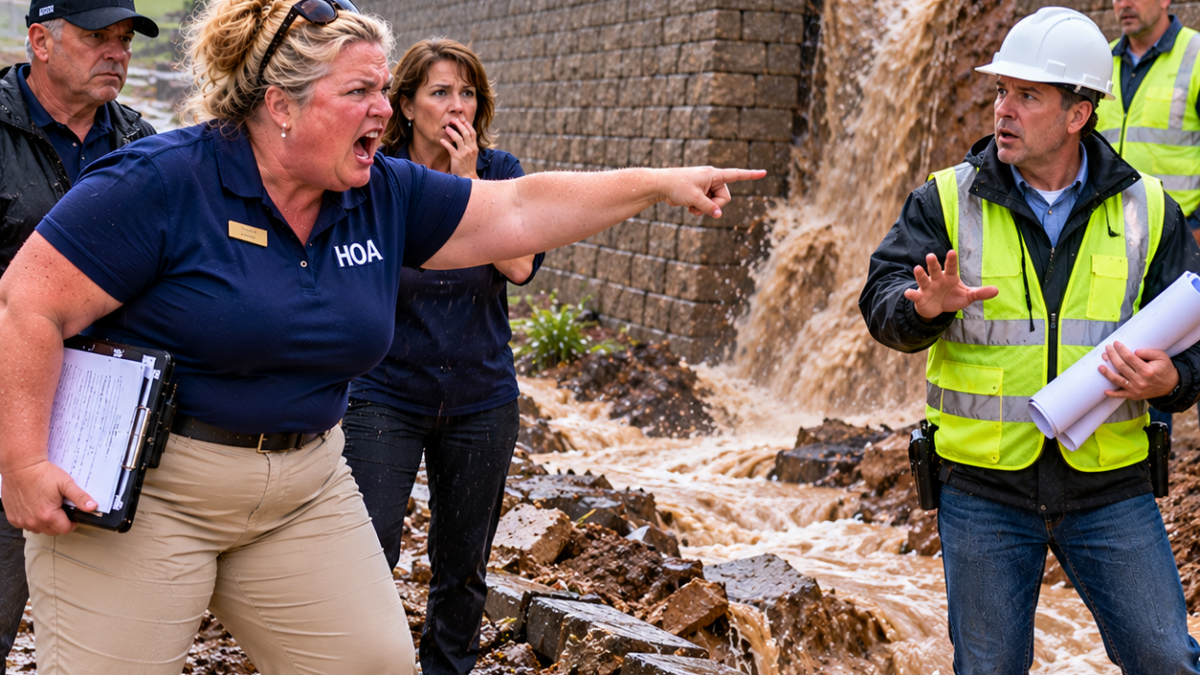
At 2:07 in the morning, I woke to a sound deeper than thunder—the slow grinding crack of nine feet of concrete beginning to bow toward my neighbor’s house while rain hammered the roof and muddy water climbed behind the wall the HOA had built across my drainage easement.
Three weeks earlier, HOA president Renata Colby had smiled across a boardroom table and told me the wall was “professionally engineered,” even though her crew had buried the swale my father dug by hand, sealed the drainage holes with mortar, and planted survey stakes fourteen inches inside my property line.
By the time I saw the first brown stream squeeze through a concrete seam that stormy night, I knew the wall itself was only half the problem, because somewhere between the permit that never existed, the engineer’s stamp that looked wrong, and the money our board had spent, somebody had hidden something far more dangerous than bad construction.
My name is Ron Tilman, and I had lived in Cedar Ridge Estates long enough to know where water went when the sky opened.
Our house sat near the top of a gentle slope. Behind my backyard, the ground dipped into a natural drainage swale my father cut deeper in the late 1980s, back when the development was still mostly empty lots and scrub. He never called it engineering. He called it common sense.
“Water always wins,” he used to tell me. “Your job is to give it somewhere safe to go.”
For decades, that shallow channel carried runoff around my lot and downhill toward a county drainage line without hurting anyone.
Then the HOA announced a retaining wall.
The notice came on a Monday.
One paragraph.
No map.
No drawings.
No contractor information.
CONSTRUCTION BEGINS FRIDAY.
At the next board meeting, I stood and asked, “Where are the engineering plans?”
Renata Colby sat beneath the Cedar Ridge logo wearing a red blazer and the patient smile she used when someone challenged her.
“It’s handled, Ron.”
“By who?”
“A licensed professional.”
“Can homeowners see the plans?”
Her smile tightened.
“Not everything requires your approval.”
Beside her, our treasurer, Douglas Pratt, stared at his papers.
He never looked at me.
The next morning, orange stakes appeared behind my fence.
I measured them once.
Then again.
Fourteen inches inside my surveyed property line.
When I confronted the foreman, Marty Zeller, he barely glanced at the tape measure.
“Take it up with the HOA, buddy.”
That night I searched my garage until I found an old blueprint from 1987.
There it was.
A recorded drainage easement running exactly beneath the proposed wall.
I sent Renata a certified letter with a copy.
No response.
Instead, her crew started excavating at six the next morning while I was at work.
By the time I got home, the wall was already rising.
Nine feet of concrete.
My father’s swale was gone beneath it.
I walked the base with a flashlight and saw clay packed directly behind the structure.
No gravel drainage layer.
No visible drain pipe.
Then I noticed the small openings near the bottom.
Weep holes.
Several workers were filling them with mortar.
“Why are you sealing those?”
One shrugged.
“President wants it clean.”
Clean.
I stared at the wet gray mortar.
Those holes existed so water pressure could escape.
I called the county.
Inspector Linda Ashby pulled the property record while I waited.
“A wall this tall should have a permit and stamped engineering,” she said.
“Should?”
Keyboard clicks.
Then silence.
“Mr. Tilman, I don’t see any permit.”
She scheduled an inspection for Thursday.
Four days away.
My weather app showed the heaviest storm system of the season arriving Thursday night.
And the next afternoon, Renata slid a stamped engineering sheet across her desk and told me I could stop worrying.
I photographed the stamp.
Then I called the engineer whose name was printed beneath it.
The moment Caleb Boer answered and heard my address, he went completely quiet.
“Mr. Tilman,” he finally said, “I designed a four-foot wall with full drainage.”
I looked through the HOA office window toward the nine-foot concrete structure towering behind my house.
Caleb’s next words made my hand tighten around the phone.
“I never approved the wall you’re describing—and I never stamped that sheet.”
PART 2
For several seconds, neither of us spoke.
I could hear office noise behind Caleb on the phone—someone closing a file cabinet, a printer running, a distant voice—but all I could see was the engineering sheet lying on Renata’s desk behind the glass.
His name.
His license number.
His professional seal.
And, if he was telling the truth, none of it belonged on that document.
“Are you sure?” I asked.
Caleb gave a short, humorless breath.
“Mr. Tilman, engineers tend to remember nine-foot retaining walls.”
“I’m looking at your seal.”
“Take another picture.”
“I already did.”
“Clear enough to read the revision block?”
I zoomed in.
“Yes.”
“What date?”
I told him.
Another silence.
“That drawing number belongs to a preliminary concept my office prepared almost eight months ago.”
“For Cedar Ridge?”
“Yes.”
“What was it?”
“A four-foot landscape retaining structure near the Phase Three common area. Full gravel drainage zone, perforated pipe, proper outlet, engineered footing. Nothing remotely like what you’ve described.”
I looked again at the paper.
Someone had changed the height.
Changed the dimensions.
Moved the alignment.
But the title block still carried Caleb’s firm.
“You’re telling me somebody took your drawing and modified it.”
“I’m telling you I did not issue that plan.”
“What about the stamp?”
“If the image you sent me is accurate, somebody reproduced my seal.”
My mouth went dry.
“Can you put that in writing?”
“I can tell you after I inspect the site.”
“When?”
“Friday morning.”
I looked at the storm forecast on my phone.
“Friday may be too late.”
“Why?”
I told him about the weather.
Caleb stopped me halfway through.
“You said the weep holes are sealed?”
“Yes.”
“How many?”
“I counted twelve openings. At least ten are mortared.”
“What’s behind the wall?”
“Orange clay.”
“No gravel?”
“None that I can see.”
“Drain pipe?”
“I haven’t seen one.”
“What happens uphill?”
I described the slope.
The roofs.
Driveways.
Two streets draining toward our back boundary.
Then I mentioned Dad’s swale.
Caleb’s voice sharpened.
“They buried an existing drainage channel?”
“Yes.”
“Recorded?”
“I have the easement drawing.”
“Ron, listen carefully.”
It was the first time he used my first name.
“Do not stand downhill of that wall during heavy rain.”
“I have a house downhill of it.”
“Whose?”
“Mine is slightly off-line. Hazel Dunning’s is lower.”
“How much lower?”
“Maybe twelve feet.”
“And how far away?”
“About seventy yards.”
Caleb went quiet again.
Then he said:
“Warn her.”
I left the HOA office without saying another word to Renata.
She called after me.
“Ron?”
I kept walking.
“Ron, are we done here?”
No.
We weren’t even close.
I went straight to Hazel Dunning’s house.
Hazel was seventy-three, widowed, and small enough that the groceries she carried every Tuesday always looked too heavy for her.
She had lived below us for almost twenty years.
Her late husband, Frank, used to help Dad clear leaves from the swale every fall.
When she opened the door, she looked surprised.
“Ron?”
“I need to show you something.”
I explained the wall.
The drainage easement.
The missing permit.
The sealed openings.
Caleb’s phone call.
Hazel listened without interrupting.
Then she glanced toward the slope behind her house.
“How worried should I be?”
That question hurt because I didn’t know how to answer honestly without frightening her.
“Enough that I don’t want you sleeping in the basement Thursday night.”
“My bedroom is upstairs.”
“Good.”
“What about leaving?”
“If the storm forecast gets worse, yes.”
She folded her arms.
“Does the HOA know?”
“They know I’m complaining.”
“That’s not what I asked.”
“No.”
I looked toward the hill.
“I don’t think they understand what they built.”
Hazel studied me.
“Or they do.”
I didn’t answer.
That afternoon, I went door to door.
Most people were polite.
Almost none were interested.
At the first house, a man named Eric listened for less than a minute.
“Renata said the wall prevents erosion.”
“That’s what worries me. It blocks the drainage channel.”
“I’m sure engineers know more than we do.”
“The engineer says he didn’t approve it.”
Eric’s expression shifted, but not enough.
“You and Renata have been fighting for years.”
“We’ve disagreed.”
“Exactly.”
He closed the conversation with a shrug.
At the next house, a woman said:
“I really don’t want to get involved in HOA drama.”
“Water doesn’t care about HOA politics.”
She gave me an uncomfortable smile.
“I’m sure it’ll be fine.”
At another, a homeowner asked whether I was trying to stop the wall because it crossed fourteen inches of my property.
“I’m trying to stop it because it’s nine feet tall with no drainage.”
“So this is a property-line dispute.”
“No.”
“It sounds like one.”
By the fifth door, I stopped trying to persuade people.
Fear sounds different when it comes from someone else.
To me, the wall was a loaded problem.
To them, I was the guy who had spent two weeks arguing with the board.
On my way home, Renata was waiting near the sidewalk.
Red blazer.
Arms crossed.
Perfect posture.
“You need to stop.”
“Stop what?”
“Scaring residents.”
“I’m warning people downhill.”
“About a permitted structure.”
“It isn’t permitted.”
Her expression changed for half a second.
Then smoothed out.
“You’ve spoken to the county?”
“Yes.”
“You had no reason to involve outside enforcement.”
“It’s a nine-foot wall.”
“It’s HOA property.”
“Part of it is fourteen inches inside my lot.”
She waved that away.
“We can correct minor alignment issues later.”
“Your engineer says he didn’t approve the plan.”
That landed.
Renata’s face didn’t collapse.
She was too controlled for that.
But her right hand tightened around her phone.
“Caleb Boer?”
“Yes.”
“He’s mistaken.”
“He knows his own design.”
“Marty has documentation.”
“The document carrying Caleb’s seal?”
“Yes.”
“He says it’s not his.”
For the first time, Renata looked past me toward the construction site.
Then back.
“You really enjoy creating problems, don’t you?”
I stared at her.
“Renata, that wall may fail.”
Her mouth tightened.
“Do you hear yourself?”
“Yes.”
“Every project becomes a catastrophe when you’re involved.”
“I’ve never opposed a construction project here.”
“You opposed the fence upgrade.”
“I asked why it cost twice the estimate.”
“You opposed the pool renovation.”
“I asked why there was no competitive bid.”
“You challenged the landscaping contract.”
“Your cousin owned the company.”
She stepped closer.
“This is exactly what I mean.”
“No.”
I lowered my voice.
“This is exactly what I mean.”
Rain began ticking lightly against the leaves.
Not the storm yet.
Just the edge of a smaller front.
I pointed toward the wall.
“Open the weep holes.”
“No.”
“At least until it’s inspected.”
“The project is complete.”
“No, Renata. It’s dangerous.”
Her eyes hardened.
“That wall will outlast you.”
I looked at her.
Then at the nine-foot slab behind us.
“That wall won’t last one good rain.”
She laughed.
I didn’t.
By Thursday afternoon, the weather service had upgraded the storm warning.
Torrential rainfall.
Flash-flood potential.
High runoff.
Laura stood beside me in the kitchen reading the alert.
My wife had been more patient with this entire mess than I deserved.
For three weeks, she had listened to me talk about surveys, drains, permits, concrete, and board minutes as if those things were normal dinner conversation.
Now she looked genuinely afraid.
“Call the county again.”
“I already did.”
“Call again.”
I called Linda Ashby.
She answered after three transfers.
“Ron.”
“You remember the wall?”
“I do.”
“Storm starts tonight.”
“I know.”
“Are you still coming?”
Silence.
That silence told me before she did.
“We had two emergency inspections come in and one inspector is out sick.”
“Linda.”
“I’m sorry.”
“When?”
“Early next week.”
I walked to the window.
“Next week may be too late.”
“I understand.”
“Do you?”
My voice sharpened.
Laura touched my arm.
I forced myself to calm down.
“Sorry.”
Linda sighed.
“No, you’re right.”
“Can you issue anything remotely?”
“Not without inspection.”
“I have photographs.”
“I know.”
“An engineer says his seal was used without permission.”
“I need that in writing.”
“He’s coming tomorrow.”
“Good.”
“The wall may not be there tomorrow.”
Linda became quiet.
Then:
“Do you believe there is immediate danger to an occupied structure?”
“Yes.”
“Call emergency management if conditions deteriorate. Call 911 if there is active failure.”
“That’s it?”
“For tonight, yes.”
Government sometimes moves exactly as fast as the law allows.
Rainwater does not.
Laura and I filled sandbags.
We placed them along the lower side of our yard and at Hazel’s basement entrance.
Hazel refused to leave.
I tried.
“Come stay with us.”
“I’ll be fine upstairs.”
“Hazel.”
“Ron, if the wall breaks, your house is closer.”
“Not directly in the path.”
“So I should abandon mine and come to yours?”
“Yes.”
She smiled.
“No.”
I pointed at her.
“You are impossible.”
“So was Frank.”
“Frank would be in my kitchen already.”
“No. Frank would be standing under that wall with a flashlight.”
She had me there.
I finally convinced her to pack a bag and keep it by the door.
Then I mounted a small security camera to the rear fence.
Laura watched.
“What exactly are we recording?”
“Everything.”
“You think somebody will come back?”
“No.”
“Then why?”
“Because when this is over, somebody is going to claim we imagined it.”
I aimed the camera at the wall.
Wide angle.
Entire base.
Several blocked weep holes.
Part of Dad’s old swale.
Timestamp synchronized.
Cloud backup enabled.
Then we waited.
Rain started around ten.
At first, ordinary.
Steady.
The kind of rain Dad would have welcomed in July.
By eleven, it was pounding.
At midnight, the gutter overflowed despite being clean.
I turned off the television because neither Laura nor I was watching.
We stood at the rear window.
Water gathered uphill behind the wall.
A dark lake forming where no lake had ever existed.
“Can you see how deep?”
Laura asked.
“No.”
Lightning flashed.
For one second, the water surface reflected silver.
Higher than I expected.
Much higher.
At 12:36, I called Renata.
Voicemail.
“Renata, this is Ron. Water is pooling behind the wall. Call me immediately.”
I called the HOA emergency number.
Recording.
“If this is a life-threatening emergency, call 911.”
Then music.
I hung up.
At 1:10, the wall began sweating.
Thin dark lines appeared down the concrete seams.
Not running water yet.
Moisture under pressure.
At 1:23, I put on boots and rain gear.
Laura blocked the door.
“No.”
“I’m going to look.”
“From where?”
“The fence.”
“Ron.”
“I won’t go near the wall.”
“Promise.”
“I promise.”
Outside, rain hit hard enough to hurt my face.
I stayed well back.
My flashlight beam caught one unsealed pipe near the far end.
It was spitting muddy water.
Hard.
The other openings were silent.
Sealed.
Behind nine feet of concrete, water was accumulating faster than one small outlet could release it.
I went inside.
Called Hazel.
She answered.
“I’m awake.”
“Stay upstairs.”
“I am.”
“Shoes on.”
“Yes.”
“Bag ready?”
“Yes, Dad.”
Even then she could joke.
At 1:40, the single open drain pipe began shooting water almost horizontally.
Laura saw it.
“Is that normal?”
“No.”
At 1:52, I heard the first sound.
Not a crack.
A low vibration.
Like a truck idling somewhere underground.
I put my palm against the window frame.
It was trembling.
“Laura.”
She saw my face.
“What?”
“Get your coat.”
At 2:01, I called 911.
“I have a nine-foot retaining wall under hydrostatic pressure above an occupied house. I believe failure may be imminent.”
The dispatcher asked for the address.
I gave Hazel’s too.
“We have units moving.”
At 2:05, the rain intensified.
Then 2:07.
The sound was impossible to mistake.
A deep grinding crack.
Concrete does not scream.
It groans.
A long, low complaint from something carrying more weight than it was designed to hold.
The center section bowed outward.
Laura grabbed my arm.
“Ron.”
Another crack.
Then the soil behind the wall moved.
Not fast at first.
The upper edge tilted.
Water appeared along the top.
Brown.
Foaming.
For half a second, the entire hillside seemed to hesitate.
Then one section folded outward.
The sound became a roar.
Water.
Mud.
Rock.
Broken concrete.
Everything came down together.
“Hazel.”
I was out the door before Laura could answer.
I crossed our side fence at the low section.
Water hit my boots.
Then my shins.
I stayed away from the main flow, cutting diagonally across the higher side of the yard.
I do not remember deciding where to step.
I remember Hazel’s porch light.
I remember pounding on her front door.
“Hazel!”
Nothing.
“HAZEL!”
The door opened.
She stood in a nightgown with her coat half on.
“What—”
“We’re leaving.”
“I have my—”
“Now.”
Brown water was already flowing around the side of her house.
I took her bag.
She stepped off the porch and nearly lost her footing.
I caught her.
The water reached my knees at the low point of the lawn.
I put an arm around her and kept moving.
Behind us came another heavy crash.
Not the house.
More wall.
Hazel turned.
“Don’t look.”
“Is my house—”
“We don’t know yet.”
Sheriff’s lights appeared through the rain.
Deputies met us near my driveway.
Laura came running with blankets.
Hazel was shaking.
We got her onto our porch.
Her hands were ice cold.
“I’m fine,” she kept saying.
She wasn’t.
Neither was I.
An ambulance checked her.
No serious injury.
Shock.
Cold.
Fear.
Her basement was not as lucky.
Water found the lowest window openings.
Within minutes, it filled several feet.
Mud entered the first floor through the rear.
The house remained standing.
That was what mattered at two in the morning.
Everything else was property.
Replaceable.
Hazel wasn’t.
By three-thirty, emergency crews had blocked the rear yards.
Nobody approached the remaining wall sections.
Rain continued.
Laura sat with Hazel in our kitchen.
I stood under the porch roof watching lights move across what used to be our back boundary.
That was when I made myself a promise.
Not revenge.
Not yet.
Clarity.
Whoever had made those decisions would have to explain them.
Every decision.
Every document.
Every dollar.
Morning revealed what darkness had hidden.
Mud covered three yards.
Two wall sections had failed completely.
Another leaned outward.
Chunks of concrete lay half buried in orange clay.
Dad’s old swale had reappeared in places where runoff tore through the fill.
Hazel’s backyard looked like a shallow riverbed.
Caleb Boer arrived at 6:52.
He wore rubber boots and carried a clipboard.
No dramatic reaction.
He simply stared.
Then began walking.
I followed from a safe distance.
He crouched beside a broken section.
Scraped mud away.
Shook his head.
“What?”
“No drainage aggregate.”
“I told you.”
“I know.”
He moved to another section.
“No continuous perforated pipe.”
Then another.
“Footing is undersized.”
He looked at exposed reinforcing steel.
“This is wrong too.”
“How wrong?”
“For a wall this height and loading? Very.”
He pointed.
“Look at the rebar.”
“What about it?”
“Insufficient tie-in.”
We walked farther.
He stopped where Dad’s swale had been buried.
“This channel should have been maintained or rerouted through an engineered drainage system.”
“Instead they buried it.”
“Yes.”
“What happens when you bury a drainage swale behind a wall with sealed weep holes?”
Caleb looked toward Hazel’s house.
“What you saw last night.”
I swallowed.
“Was the storm extraordinary?”
“Probably.”
“Would a properly designed wall have survived?”
He thought before answering.
“No competent engineer promises that any structure survives every imaginable event.”
Fair.
“But this failure mechanism is exactly what drainage design is meant to prevent.”
He wrote more notes.
“The storm exposed deficiencies. It didn’t create them.”
That sentence stayed with me.
At 7:20, Renata arrived.
Red blazer.
Of course.
The rain had stopped but everything was mud.
She stepped out of her SUV and nearly ruined one heel immediately.
“What happened?”
I stared at her.
Caleb looked up.
Renata spread both hands.
“My God.”
I walked toward her.
“Don’t.”
“What?”
“Don’t act surprised.”
Her face hardened.
“This was a historic storm.”
“You were warned.”
“We relied on professionals.”
“You sealed the drainage.”
“I did no such thing.”
“Your crew did.”
“Contractors make field decisions.”
“You showed me a stamped plan yesterday.”
“I did.”
I pointed toward Caleb.
“Here’s your engineer.”
Renata looked at him.
Caleb walked over.
“Ms. Colby.”
“Caleb, thank God.”
She sounded relieved.
“You can explain that this was a weather event.”
“No.”
Her expression stopped.
Caleb held up the plan I had photographed.
“This is not my issued design.”
“I don’t understand.”
“My seal appears here.”
“Yes.”
“I did not apply it.”
Renata’s eyes shifted toward me.
Then back.
“That’s impossible.”
“No.”
Caleb’s voice stayed calm.
“My office designed a four-foot wall months ago.”
“This drawing was altered.”
“I did not authorize a nine-foot structure.”
“I did not approve removal of the drainage swale.”
“I did not approve sealed weep openings.”
Renata’s face lost color.
“Marty assured me everything was approved.”
A truck arrived behind her.
As if summoned.
Marty Zeller stepped out.
Work boots.
Rain jacket.
Face already tense.
He looked at the destroyed wall.
Then Renata.
Then Caleb.
“What happened?”
Renata turned on him immediately.
“You tell me.”
Marty stared.
“What?”
“You told me the plans were approved.”
“They were.”
Caleb stepped forward.
“By whom?”
Marty looked at him.
“Who are you?”
“Caleb Boer.”
That changed his face.
“The engineer whose seal is on your drawing.”
Marty said nothing.
Caleb held out the page.
“You built this?”
Marty glanced toward Renata.
She snapped:
“Answer him.”
That was a mistake.
Marty’s expression went from defensive to angry.
“You want answers now?”
“Marty—”
“You told me to do it fast.”
Renata’s jaw tightened.
“Be careful.”
“No.”
He pointed toward the broken wall.
“I told you this thing needed drainage.”
“You were paid to build according to plans.”
“What plans?”
“The engineered—”
“What engineered plans?”
His voice rose.
Neighbors were beginning to gather at the property line.
Deputies nearby turned toward us.
Marty kept going.
“You gave me a sheet and told me the height changed.”
“You said the engineer approved it.”
“I told you the cost would go up.”
Renata lowered her voice.
“This is not the place.”
Marty laughed.
“You didn’t care about place when you called me every day asking when it would be finished.”
Douglas Pratt arrived next.
Treasurer.
He stepped out of his sedan.
Saw the crowd.
Stopped.
Marty saw him.
“There.”
Douglas froze.
Marty pointed.
“Ask Doug.”
Renata said:
“Marty, stop.”
He didn’t.
“He paid me forty-eight grand and told me that was the full construction budget.”
Douglas’s face turned gray.
“That’s not—”
“Don’t.”
Marty took a step toward him.
“I said nine feet needed engineering.”
“I said drainage would cost more.”
“I said the clay had to come out.”
“You told me there was no more money.”
Renata raised her voice.
“Enough.”
Everybody went quiet.
Marty looked at her.
Then at the wreckage.
“No.”
His voice dropped.
“You want to blame me for this?”
He pointed toward Hazel’s mud-covered house.
“You told me to finish before the annual meeting.”
“You told me to cover the ugly outlets.”
“You said residents didn’t want to see pipes.”
One of the workers standing near the truck muttered:
“She did.”
Renata turned toward him.
“What?”
The worker immediately looked down.
But everyone heard him.
Then Linda Ashby arrived.
County vehicle.
Red inspection tags in hand.
She stepped out, took one look, and her entire demeanor changed.
“Everybody away from the remaining wall.”
She moved quickly.
Tape.
Photographs.
Measurements.
Caleb walked with her.
I gave her the easement blueprint.
The photographs.
The certified-letter receipt.
The video showing workers sealing the weep holes.
She watched the clip twice on my phone.
Then looked at Renata.
“Who authorized construction?”
Renata answered:
“The HOA board.”
“Permit number?”
“I’ll have to get that from management.”
“There is no permit number.”
Renata’s mouth tightened.
Linda continued.
“Who supplied the stamped engineering?”
“Our contractor.”
Marty shouted from behind us:
“No, you did.”
Linda turned.
“Sir, your name?”
“Marty Zeller.”
“Contractor?”
“Yes.”
“Don’t leave.”
Marty laughed bitterly.
“Wasn’t planning to.”
Linda placed a bright red notice on an intact section.
UNSAFE STRUCTURE — STOP WORK — DO NOT ENTER.
Then she came to me.
“Mr. Tilman.”
“Yes.”
“I need you to preserve everything.”
“I am.”
“Original photographs.”
“Yes.”
“Video.”
“Yes.”
“HOA correspondence.”
“Yes.”
“Property documents.”
“Yes.”
She lowered her voice.
“And request the full HOA financial ledger.”
I looked toward Douglas.
He was standing alone near his car.
“Why?”
“Because something about this project doesn’t add up.”
“How?”
“The declared scope, the wall height, the lack of permit, and what the contractor is saying about budget.”
She handed my phone back.
“Request it today.”
I did.
Before lunch.
Certified email.
Certified mail.
Formal owner-records request.
Contracts.
Invoices.
Reserve-fund expenditures.
Engineering fees.
Contractor payments.
Board approvals.
Change orders.
Everything tied to the retaining-wall project.
Renata responded within three hours.
She denied the request.
Her email said the records contained “confidential vendor information.”
Owen Prescott laughed when I forwarded it.
Owen was a property attorney recommended by Laura’s brother.
He had spent twenty-three years handling construction disputes and community-association litigation.
“That’s not a magic phrase.”
“What?”
“Confidential vendor information.”
“She can withhold it?”
“Some things can be redacted depending on state law and governing documents.”
“But not everything?”
“Not even close.”
I sent him the entire file.
By evening, he had written a formal demand.
Renata responded through HOA counsel.
Their position changed.
Records would be produced “within the legally required period.”
Better.
Hazel spent two nights with us.
Her insurance company brought in a restoration crew.
The basement was a mess.
Family photographs had been stored on a shelf high enough to survive.
Frank’s old tools had not.
Hazel cried over a rusted toolbox.
Not because of the tools.
Because Frank had used them.
I understood.
Dad’s swale felt the same way to me.
Objects and places absorb people.
Losing them can feel like losing the person again.
“I should have left earlier,” Hazel said.
“No.”
“You warned me.”
“You were upstairs.”
“I was stubborn.”
“Yes.”
She smiled through tears.
“So were you.”
“True.”
Then she looked toward the hill.
“Are you going to sue them?”
“Yes.”
No hesitation.
“Good.”
I expected anger.
What I didn’t expect was guilt.
For days, I kept thinking:
I knew.
I had the blueprint.
I saw the sealed holes.
I called the county.
I warned people.
Yet the wall still failed.
Laura caught me standing outside at midnight staring at the ruins.
“You couldn’t have stopped it.”
“I could’ve hired somebody sooner.”
“Doing what?”
“Emergency injunction.”
“Before the storm?”
“Maybe.”
“Ron.”
“I knew it was wrong.”
“You did everything a homeowner could reasonably do.”
“I told Hazel it might fail.”
“And then you got her out.”
“After it failed.”
Laura stepped in front of me.
“Stop.”
I looked at her.
“You are trying to make Renata’s decisions your responsibility.”
I didn’t answer.
“Did you fake the engineering?”
“No.”
“Did you build the wall?”
“No.”
“Did you bury the swale?”
“No.”
“Did you seal the drainage openings?”
“No.”
“Then stop looking for the version of this where you could have controlled everything.”
That sounded uncomfortably like Dad.
I went inside.
Two days later, Douglas Pratt knocked on our door.
Saturday.
7:18 p.m.
He looked terrible.
No jacket.
Untucked shirt.
Hands shaking.
Laura answered.
Then called me.
“Ron.”
Douglas stood on the porch holding a thumb drive.
“Can we talk?”
I almost told him to call Owen.
Instead:
“Laura stays.”
He nodded.
We sat at the kitchen table.
Douglas stared at the drive.
“I should have stopped her.”
I said nothing.
“The reserve account had two hundred twelve thousand dollars allocated for retaining-wall and drainage improvements.”
I leaned forward.
“How much?”
“Two-twelve.”
“Marty says he got forty-eight.”
Douglas nodded.
“Where’s the rest?”
His eyes filled with something I couldn’t immediately read.
Fear.
Shame.
Maybe both.
“Clubhouse.”
“What?”
“Renovation.”
Laura stared at him.
“The clubhouse renovation finished six months ago.”
“Not all of it.”
Douglas looked at me.
“Renata wanted a private members lounge.”
I almost laughed.
Not because it was funny.
Because it was so small.
Hazel’s basement full of mud.
A nine-foot wall in pieces.
A forged engineering seal.
And somewhere in the middle:
A private lounge.
“She called it an executive hospitality room.”
“Of course she did.”
“New bar.”
“Furniture.”
“Sound system.”
“Wine storage.”
Laura said:
“You used drainage reserves for a bar?”
Douglas flinched.
“Renata moved the money.”
“You were treasurer.”
“I signed transfers.”
“Then you moved it too.”
He looked down.
“Yes.”
That answer earned him a fraction of respect.
At least he didn’t hide behind language.
“How much?”
“One hundred forty thousand.”
My chair creaked as I leaned back.
“What was the remaining wall budget?”
“Seventy-two thousand originally.”
“Marty received forty-eight.”
“Yes.”
“Where did the other twenty-four go?”
“Engineering.”
“Permit fees.”
“Survey.”
I stared.
“There was no permit.”
“I know.”
“Caleb says he wasn’t paid for this design.”
“I know.”
“Then where is the twenty-four?”
Douglas swallowed.
“Some was moved too.”
“To the lounge?”
He nodded.
“Why are you telling me?”
“Because Hazel could have died.”
The kitchen went quiet.
Douglas’s voice shook.
“I told myself it was accounting.”
“Temporary transfers.”
“Renata said membership revenue would replenish the reserve.”
“She said the wall could be built cheaper.”
“She said Marty knew what he was doing.”
He stared at the table.
“I wanted to believe her.”
“What’s on the drive?”
“Ledger exports.”
“Bank statements.”
“Board emails.”
“Payment authorizations.”
“Did you obtain them legally?”
He looked up.
“I’m treasurer.”
“Are they association records?”
“Yes.”
“Did you steal anything?”
“No.”
“Did you alter anything?”
“No.”
“Then why not give them to the board?”
“Renata controls the board.”
“Not forever.”
He slid the drive toward me.
“I’m resigning Monday.”
I did not touch it.
“Take that to my attorney.”
Douglas looked confused.
“I thought—”
“I’m not putting an unknown thumb drive into my computer.”
For the first time, Laura almost smiled.
Software security had been drilled into us by our son for years.
I wrote Owen’s address.
“Give it to him.”
Douglas took the note.
At the door, I stopped him.
“Doug.”
He turned.
“Why didn’t you look at me at that first meeting?”
He knew exactly what I meant.
“Because you asked where the engineering plans were.”
“And?”
“I knew there weren’t any current ones.”
That hurt more than I expected.
“So you knew.”
“I knew the process was wrong.”
“Not that the wall would fail.”
“No.”
“But you knew enough to be afraid of the question.”
His eyes dropped.
“Yes.”
He left.
Owen called me Sunday afternoon.
“The drive is legitimate enough to get very interesting.”
“What did you find?”
“First, your treasurer is either cooperating or building a very sophisticated lie.”
“Which?”
“Documents currently favor cooperating.”
“Money?”
“Yes.”
The reserve account showed transfers.
One hundred forty thousand moved into a capital-improvement subaccount.
From there, significant payments went toward clubhouse upgrades.
Invoices included custom cabinetry.
Bar equipment.
Furniture.
Audio.
Wine refrigerator.
Decorative lighting.
None of which had anything to do with drainage.
“What about the wall?”
“Forty-eight thousand to Zeller Construction.”
“Engineering?”
“There’s an invoice.”
“To Caleb?”
“No.”
“To a consulting company.”
“What company?”
“CR Design Services.”
“Who owns it?”
“Working on that.”
Owen paused.
“More concerning is the board authorization.”
“What about it?”
“The minutes don’t match the ledger dates.”
“Meaning?”
“Money moved before the board vote that supposedly approved the transfer.”
That suggested the vote had been used retroactively to justify the transfer.
Not yet proof.
But another crack.
Monday morning, Renata called an emergency HOA meeting.
The email arrived at 8:02.
COMMUNITY SAFETY AND FALSE ALLEGATIONS.
I read it twice.
Laura read over my shoulder.
“She’s going after you.”
“Looks that way.”
The message accused “certain residents” of spreading misinformation about the wall failure.
It claimed unauthorized alterations to drainage patterns may have contributed.
There it was.
The counterattack.
Renata had moved from denying risk to suggesting sabotage.
By noon, I received a letter from the HOA attorney demanding that I preserve evidence and stop making “defamatory statements.”
I called Owen.
“Should I be worried?”
“Yes.”
“About what?”
“Everything enough to behave carefully.”
“Helpful.”
“Do not post online.”
“I haven’t.”
“Do not accuse anyone publicly of forgery.”
“I haven’t.”
“Do not call the reserve transfer theft.”
“I haven’t.”
“Do not contact Renata directly.”
“Happy to comply.”
“Bring your evidence to the meeting.”
“All of it?”
“Copies.”
“What about Douglas?”
“He has his own counsel now.”
That surprised me.
“Is he cooperating officially?”
“Looks like it.”
The emergency meeting drew more people than any Cedar Ridge meeting I had ever seen.
Every chair taken.
Residents standing along walls.
Hazel attended with a cane despite my objections.
Her daughter drove her.
Linda Ashby sat near the back as an observer.
Caleb came.
Owen sat beside me.
Renata entered last.
Red blazer.
If she owned another color, I had never seen it.
Douglas’s seat at the board table was empty.
Renata called the meeting to order.
She began with the storm.
“An unprecedented weather event.”
Then contractors.
“Unexpected construction deficiencies.”
Then rumors.
“Dangerous misinformation.”
Finally:
“Possible interference with drainage by an individual homeowner.”
People turned toward me.
Exactly what she wanted.
Owen whispered:
“Don’t react.”
Renata continued.
“Before this community rushes to judgment, we should ask why one resident spent weeks attempting to stop a wall designed to protect common property.”
A man behind me muttered:
“Here we go.”
Renata held up a photo.
My old 1987 blueprint.
She had somehow obtained a copy from my certified letter.
“This outdated drawing is being used to claim a drainage easement that predates later community improvements.”
Owen wrote something on his legal pad.
She continued.
“Furthermore, Mr. Tilman installed private equipment near the wall immediately before the storm.”
The camera.
“She means my security camera,” I whispered.
Owen nodded.
Renata looked directly at me.
“Would you like to explain why?”
I stood.
“My attorney advised me to present evidence.”
Renata smiled.
“This is an HOA meeting, not a courtroom.”
“Then it should be easier.”
A few people laughed.
Her smile disappeared.
I connected my laptop to the projector.
First slide.
1987 drainage blueprint.
Recorded easement information.
Then county property map.
Then current property survey.
Orange-stake photographs showing fourteen-inch encroachment.
I kept my voice calm.
“The wall crossed my property and covered the recorded drainage corridor.”
Next slide.
Certified letter.
Delivery confirmation.
“Renata received this before major construction.”
Renata interrupted.
“I receive hundreds of documents.”
Owen stood.
“Please let him finish.”
She stared.
Then sat.
Next.
Photos of the wall during construction.
No gravel.
No pipe.
Clay.
Then the video.
Workers sealing weep holes with mortar.
Timestamp.
Clear.
One worker saying:
“Madame president wanted it to look clean.”
The room changed.
Renata leaned toward her microphone.
“That worker is not authorized to speak for the board.”
I clicked pause.
“I’m not claiming he is.”
Then Caleb stood.
Owen had coordinated this.
Caleb introduced himself.
Licensed professional engineer.
His firm.
His original role.
He displayed his real four-foot design.
Drainage aggregate.
Perforated pipe.
Outlet.
Proper footing.
Then the nine-foot sheet Renata had given me.
“This drawing was altered.”
Nobody moved.
“My professional seal was reproduced without my authorization.”
Renata interrupted.
“I was given that by the contractor.”
Marty Zeller stood from the back.
“No, you weren’t.”
Every head turned.
Marty walked forward.
He looked exhausted.
But determined.
“You emailed it to me.”
Renata’s face tightened.
“Do you have proof?”
“Yes.”
That was the moment her confidence first truly broke.
Not collapse.
A flicker.
Marty held up printed emails.
Owen had copies.
One contained an attachment.
The modified engineering sheet.
Sender:
Renata Colby.
Subject:
FINAL WALL PLAN — USE THIS VERSION.
Renata looked toward the HOA attorney.
He leaned over.
Whispered.
She ignored him.
“Marty, you understood your responsibility as contractor.”
“I told you the design changed.”
“And you built it anyway.”
“Yes.”
He said it.
No excuse.
“I did.”
People shifted.
Marty continued.
“And I’ll answer for that.”
Then he pointed at her.
“But I told you it needed drainage.”
“I told Doug.”
“I told both of you the forty-eight-grand budget was too low.”
Renata looked toward the empty treasurer’s chair.
“Douglas Pratt has resigned.”
“No.”
A voice came from the side door.
Douglas walked in.
The room went silent again.
He had an attorney with him.
Douglas stood near the wall.
“I resigned as treasurer this morning.”
Renata’s face hardened.
“You have no authority to participate in this meeting.”
“I’m a homeowner.”
That got a few murmurs.
Douglas looked at the residents.
“The reserve account contained two hundred twelve thousand dollars allocated to retaining-wall and drainage improvements.”
A woman near the front said:
“What?”
Douglas continued.
“I approved transfers totaling approximately one hundred forty thousand into the clubhouse renovation budget at President Colby’s direction.”
The room erupted.
Renata struck her gavel.
“Order!”
Nobody listened.
“ORDER!”
Douglas raised his voice.
“The wall contractor received forty-eight thousand.”
Someone shouted:
“Where’s the rest?”
“Clubhouse.”
Another voice:
“The bar?”
Douglas nodded.
“The private lounge.”
People started shouting.
My stomach turned.
Not because I hadn’t heard it.
Because seeing a room realize its money had been moved was different.
Renata stood.
“These transfers were temporary and fully authorized.”
Douglas looked at her.
“No.”
She froze.
“We never had a valid vote before the first transfer.”
Renata’s attorney stood.
“Douglas, you should stop speaking.”
His own attorney touched his arm.
Douglas nodded.
“I’ll stop.”
Then sat.
Renata turned toward me.
“This has nothing to do with the wall failure.”
I looked at her.
“It has everything to do with why the wall was built for forty-eight thousand dollars.”
“Your accusation is reckless.”
I clicked one final video.
The storm.
1:40 a.m.
Single open pipe spitting water.
Sealed holes silent.
Then 2:07.
The wall bending.
Failure.
I stopped the video before Hazel’s rescue.
I didn’t need to show that.
I turned toward the room.
“That wall did not fail because I sabotaged drainage.”
My voice shook despite everything.
“The drainage was sealed before the rain started.”
I looked at Renata.
“And everybody here just watched who ordered the work.”
No one spoke.
Hazel stood.
Her daughter tried to stop her.
Hazel waved her off.
“I lost my basement.”
The room became completely still.
“My husband’s tools are gone.”
Renata’s face shifted.
Hazel continued.
“I nearly stayed downstairs because I didn’t understand how fast the water was coming.”
She looked at me.
“Ron got me out.”
Then back at Renata.
“You told us he was causing trouble.”
No response.
“You told us that wall protected us.”
Renata lowered her eyes.
Hazel’s voice cracked.
“It almost buried my house in mud.”
That was the strongest accusation of the night.
Because Hazel did not shout.
She didn’t need to.
The board moved into executive session.
Residents refused to leave.
Owen and I waited in the hallway.
Linda Ashby approached.
“I’ll need copies.”
“You can have them.”
“Sheriff’s investigators too.”
“Everything.”
Caleb joined us.
“The state engineering board has opened a complaint regarding misuse of my seal.”
Owen said:
“Good.”
Caleb looked at me.
“I’m sorry.”
“For what?”
“My name was on it.”
“You didn’t put it there.”
“I still hate seeing it.”
I understood.
Forty minutes later, the board returned.
Renata was not with them.
Vice president Sheila Monroe took the microphone.
Her hands trembled.
“The board has voted four to one to remove Renata Colby from presidential duties pending an independent investigation and membership action under our bylaws.”
Applause started.
Hazel did not clap.
Neither did I.
Sheila continued.
“We are retaining independent counsel and a forensic accountant.”
“Construction and reserve-fund records will be provided to authorities.”
“The wall project will remain under county control.”
A man shouted:
“What about Renata?”
Sheila looked toward the side room.
“Ms. Colby has left the building.”
Of course she had.
The following morning, investigators arrived at the HOA office.
The county focused on permitting and construction.
The state engineering board focused on Caleb’s seal.
The sheriff’s office reviewed potential document falsification and financial conduct.
I learned much of what followed through Owen, public filings, and later testimony.
I did not have access to every investigative detail.
That mattered.
Rumors spread faster than facts.
One rumor said Renata had stolen $140,000 personally.
Not proven.
The records showed funds diverted into clubhouse improvements approved through questionable procedures.
That was serious enough.
There was no reason to invent more.
Another rumor said Marty had bribed Douglas.
Again, not established.
What the evidence did show was a rushed, underfunded project where warnings were ignored.
Then investigators found the altered engineering file.
Computer metadata traced a version of the modified plan to an HOA-owned laptop assigned to the president’s office.
Created two days before it was sent to Marty.
The seal image had been copied from Caleb’s earlier legitimate preliminary drawing.
Revision text had been changed.
Wall height changed.
Drainage details removed.
The digital history was not subtle once experts examined it.
Renata’s first interview reportedly lasted less than an hour.
When investigators asked how Caleb’s seal ended up on the altered plan, she stopped answering substantive questions and requested counsel.
That was her right.
And, frankly, the smart choice.
But it ended her public claim that everything was merely a contractor misunderstanding.
The financial review took longer.
Clubhouse invoices.
Reserve transfers.
Vendor contracts.
Authorization dates.
Emails.
Douglas cooperated.
His cooperation did not erase his responsibility.
He had signed transfers he knew had not gone through the proper process.
But his records helped explain how the wall budget collapsed from more than two hundred thousand dollars in reserves to a forty-eight-thousand-dollar rush job.
Renata’s motive turned out to be less dramatic than people expected.
No secret mansion.
No offshore account.
No hidden luxury car.
Control.
Reputation.
She had promised residents two visible accomplishments before the annual election:
The Phase Three retaining wall.
And a redesigned clubhouse.
She wanted both completed.
The proper engineered wall would have consumed most of the reserve.
The lounge renovation was already underway.
Stopping it would mean admitting the board had overcommitted.
So the wall became the thing to cheapen.
At first, according to emails later disclosed, Renata proposed shortening it.
Then reducing drainage scope.
Then using Marty because his company could start immediately.
Caleb’s original design no longer fit the expanded nine-foot concept, but instead of paying for a new structural design, someone altered the old sheet.
Marty should have refused.
He didn’t.
Douglas should have blocked payment.
He didn’t.
Renata should have stopped the entire thing.
She pushed harder.
No single decision caused everything.
That made the story more disturbing.
Disasters are often built one compromise at a time.
Four-foot engineered wall becomes nine.
Proper drainage becomes “we’ll add it later.”
Gravel becomes clay.
Open weep holes become “ugly.”
Permit becomes “we’ll file afterward.”
Engineering becomes a reused seal.
Recorded drainage easement becomes “Ron is being difficult.”
Every shortcut made the next shortcut easier.
Until rain arrived.
Water does not negotiate with shortcuts.
Hazel’s insurance claim became a battle.
Her carrier initially argued the HOA contractor bore primary responsibility.
The HOA insurer argued extraordinary rainfall.
The contractor’s insurer pointed at the altered plans.
For three weeks, Hazel lived with her daughter while lawyers argued about whose policy should pay first.
That made me angrier than anything.
I called Owen.
“Can we do something?”
“For Hazel?”
“Yes.”
“Her attorney is handling coverage.”
“She doesn’t have an attorney.”
“She does now.”
“What?”
“I gave her a referral.”
“Without telling me?”
“You pay me to solve problems.”
“I thought I paid you to send invoices.”
“Also that.”
Hazel eventually received emergency living expenses.
Restoration began.
The basement was stripped to studs.
Mud removed.
Electrical checked.
Foundation inspected.
Frank’s tools were mostly lost.
One day I found Hazel sitting on our porch holding an old screwdriver.
Rusty.
Bent.
“Found this in the yard.”
“Frank’s?”
She nodded.
She smiled.
“One thing.”
I sat beside her.
“Laura says you’re moving back next week.”
“If the inspector clears it.”
“You sure?”
“Ron.”
“Yes?”
“If I leave because that woman scared me out of my home, I’ll be angry every day.”
Fair.
“You need anything?”
“Yes.”
“What?”
“Stop asking me that.”
I laughed.
She elbowed me.
The HOA scheduled a membership recall vote.
Renata fought it.
She sent a twenty-two-page letter to homeowners.
I read all of it.
She blamed contractor negligence.
Unexpected rainfall.
County delays.
A politically motivated campaign by a small group of homeowners.
Me.
Especially me.
She claimed I had opposed community improvements for years.
True in the sense that I had asked questions.
False in the sense she meant it.
She wrote:
Mr. Tilman’s hostility toward the board created an environment in which routine project management became impossible.
I read that sentence to Laura.
“Impressive.”
“What?”
“I apparently control construction budgets through hostility.”
Laura took the letter.
“This is sad.”
“Sad?”
“She still thinks if she can tell the story better, the facts change.”
That was exactly it.
The recall meeting drew 186 homeowners.
Renata spoke first.
She was composed.
No red blazer this time.
Navy.
Maybe someone advised her.
She apologized for “communication failures.”
Not the wall.
Not the altered drawing.
Not the reserve transfers.
Communication.
Then she said:
“Leadership requires difficult decisions.”
Someone behind me whispered:
“Here comes the speech.”
Renata continued.
“I made decisions under time and budget pressure.”
“That does not mean I intended harm.”
That part, I believed.
I did not think Renata wanted Hazel’s house flooded.
Intent mattered morally.
Consequences still mattered.
She looked toward me.
“I regret that this dispute became personal.”
I nearly laughed.
Owen touched my arm.
Don’t.
The membership voted by written ballot.
Seventy-eight percent favored removal.
Renata Colby was no longer HOA president.
She left through a side door.
No dramatic confrontation.
No yelling.
No crowd surrounding her.
Just a door closing.
Sometimes power ends quietly.
Douglas resigned permanently.
Marty’s contractor license faced administrative review.
The engineering-board investigation referred the seal issue to appropriate authorities.
The county imposed substantial penalties and corrective orders related to unpermitted construction and unsafe work.
Criminal investigators continued evaluating responsibility for the altered engineering document.
Eventually, Renata entered into a legal resolution involving a document-related offense connected to the altered engineering approval.
The exact legal wording mattered to her lawyer.
What mattered to me was simpler:
She could no longer pretend the stamped sheet had appeared by accident.
Douglas avoided the most serious outcome because he cooperated early, provided records, and accepted responsibility for improper financial approvals.
He paid restitution to the association under a civil settlement and was barred by the HOA from financial office.
Marty accepted sanctions related to construction violations.
He also contributed through insurance and settlement to the reconstruction costs.
Nobody escaped consequences.
Nobody received a cartoonishly perfect punishment either.
Real accountability is messier.
The civil case involving my property lasted almost eight months.
Fourteen inches of encroachment.
Destruction of the drainage easement.
Property damage.
Emergency mitigation.
Attorney fees.
Loss of use.
The HOA’s insurer wanted to settle.
Owen wanted complete restoration first.
“So we wait?”
“Yes.”
“They offered money.”
“Money doesn’t move water.”
I stared at him.
“That sounds like something Dad would say.”
“Your father was smarter than most lawyers.”
True.
The court issued an order requiring the drainage easement to be fully restored and any replacement retaining structure to comply with engineering and county requirements.
The HOA had to fund the work.
This time, everything happened differently.
Public plans.
Stamped originals.
Permit number.
Geotechnical review.
Drainage calculations.
Independent inspections.
No construction started until approvals were complete.
Caleb was offered the redesign.
He surprised me by accepting.
“Why?” I asked.
“Because my name was used on the failure.”
“You don’t have to prove anything.”
“I know.”
“Then?”
He looked at Dad’s old blueprint.
“I want to build the wall that should have been here.”
The new design did not simply replace Renata’s wall.
It respected the drainage easement.
Dad’s swale was re-established.
Some sections were reshaped and lined with stone to reduce erosion, but the path remained essentially where it had always been.
The wall moved fully onto HOA common property.
Nine feet in the tallest section, but properly designed.
Reinforced footing.
Engineered rebar.
Drainage fabric.
Thick gravel zone.
Continuous perforated pipe.
Multiple outlets.
Open weep holes.
Actual outlets.
Every one visible.
Laura joked:
“Renata would hate them.”
“Ugly?”
“Beautiful.”
Hazel agreed.
“I want extra holes.”
Caleb laughed.
“That isn’t how engineering works.”
“After last time, I want a wall made entirely of holes.”
The construction crew was different.
County inspector came at foundation.
Rebar.
Backfill.
Drain installation.
Final.
Linda Ashby attended more inspections than required.
I teased her.
“Staff shortage over?”
She rolled her eyes.
“I’m never hearing the end of that, am I?”
“No.”
“Fair.”
She watched gravel go in behind the wall.
“Happy?”
“Getting there.”
The settlement resolved soon afterward.
My portion totaled $148,000 after the categories were negotiated.
People later assumed I walked away richer.
They never saw the legal bills.
Survey costs.
Emergency work.
Landscaping restoration.
Property disruption.
Time away from work.
Stress.
Money is a poor substitute for being able to sleep during rain.
Still, the settlement mattered.
It was accountability translated into something practical.
Hazel’s repairs were separately covered through insurance and settlement arrangements.
But I gave her part of mine anyway.
She refused the first check.
Absolutely refused.
“Ron, no.”
“You lost things insurance doesn’t value.”
“So did you.”
“My house didn’t flood.”
“You already saved me.”
“This isn’t payment.”
“Then what?”
I had no good answer.
Finally:
“Frank helped Dad clear that swale every fall.”
Her face changed.
“Yes.”
“This is family business.”
She took the check.
Not all of it.
We compromised.
Hazel used part of the money to rebuild her garden and replace the basement workshop area with shelves displaying some of Frank’s surviving tools.
The rusty screwdriver went on the wall.
She labeled it:
THE ONE THAT CAME BACK.
Cedar Ridge changed after the wall.
Not overnight.
At first, meetings were unbearable.
Everyone demanded documents.
Every invoice became suspicious.
Every contractor was interrogated.
The new board sometimes looked exhausted.
I understood.
Trust, once broken, overcorrects.
Sheila Monroe became interim president.
Her first meeting lasted four and a half hours.
At hour three, she looked at me and said:
“Ron, you started this.”
“I asked for engineering plans.”
“Same thing.”
People laughed.
That mattered.
Laughter had been missing for months.
The board adopted new rules.
Projects above a defined threshold required competitive bidding.
Engineering documents had to be verified directly with the design professional.
No digital seal accepted without confirmation.
Reserve transfers required recorded votes.
Conflicts had to be disclosed.
Large construction plans were posted for homeowner review.
Drainage easements were mapped.
Not glamorous.
Not dramatic.
Exactly what responsible governance looks like.
Douglas attended one meeting months later.
He sat in the last row.
I almost didn’t recognize him.
Afterward, he approached.
“I owe you an apology.”
“You owe Hazel one more.”
“I already apologized.”
“Good.”
He looked toward the new wall.
“I should’ve said something that first night.”
“When I asked about the plans?”
“Yes.”
“Why didn’t you?”
He took a long time.
“Because once you admit one thing is wrong, you have to ask how many other things you’ve ignored.”
That was honest.
“What are you doing now?”
“Nothing with money.”
“Smart.”
He smiled weakly.
“I volunteer at the library.”
“Can you move their reserve fund into a bar?”
He laughed.
Then stopped.
“Too soon?”
“A little.”
I shook his hand anyway.
Marty came by once.
That surprised me more.
He stood near the road in a work truck.
“I wanted to see the rebuild.”
“Why?”
“Because I should have built it right.”
I didn’t invite him onto the property.
We talked through the fence.
“You could have walked away.”
“I know.”
“Why didn’t you?”
He looked at the new gravel drainage layer.
“Forty-eight grand was a big job for me.”
“Not big enough for what they wanted.”
“No.”
“I had payroll.”
“Equipment payments.”
“I told myself I’d figure it out.”
He shook his head.
“Then every day made it harder to stop.”
Same pattern.
One compromise.
Then another.
“Are you still contracting?”
“Smaller jobs.”
“Any nine-foot walls?”
“Never again.”
Good.
The rebuilt wall was finished six weeks before autumn storm season.
Caleb walked the entire length with me.
He pointed out every drainage element.
“Water enters the gravel zone.”
“Pressure drops.”
“Pipe collects flow.”
“Outlets carry it into the swale.”
“Weep holes handle incidental moisture.”
I looked at him.
“You know I’m going to stare at this thing every time it rains.”
“I’d be disappointed if you didn’t.”
He handed me a folder.
Final stamped plans.
Inspection certificates.
Permit closure.
Photographs of hidden work before backfill.
Everything Renata should have shown me the first time.
I kept two copies.
One in the house.
One digital.
Dad would have approved.
The first heavy rain after reconstruction arrived on a Tuesday afternoon.
Nothing dramatic.
I went outside anyway.
Laura stood under the porch roof.
“You know it’s just rain.”
“Research.”
“Obsessive research.”
“Engineering observation.”
“You sell insurance, Ron.”
“Details.”
Water flowed through the outlets.
Clean.
Steady.
The swale carried it away.
No pooling.
No groaning concrete.
Hazel came out holding an umbrella.
“Still there?”
“The wall?”
“Both of us.”
“Apparently.”
She waved.
I waved back.
Then winter came.
Spring.
Summer.
Life moved.
The legal cases ended one by one.
News stories stopped.
Renata sold her house the following year.
I heard she moved across the state.
I did not ask where.
People expected me to care.
I didn’t.
That surprised me.
For months, I imagined I wanted to see her embarrassed.
Removed.
Punished.
Then those things happened, and none of them felt as satisfying as watching Hazel plant tomatoes again.
That taught me something about revenge.
The best part is rarely watching someone fall.
It’s watching what they damaged stand back up.
Hazel’s house.
My yard.
Dad’s swale.
The neighborhood’s trust.
The right wall.
The next annual meeting took place almost exactly one year after the collapse.
Sheila opened with the budget.
No secrets.
Every reserve category projected on screen.
Drainage fund.
Road fund.
Pool.
Clubhouse.
Someone joked:
“How much for the wine fridge?”
The room groaned.
Sheila laughed.
“Zero.”
Good answer.
Then she invited me to speak.
I declined.
She asked again.
“No.”
“Why?”
“I said everything last year.”
Hazel shouted from the second row:
“He never stops talking at home.”
Laura laughed harder than anyone.
I finally stood.
Not at the podium.
Just from my seat.
“I have one request.”
Sheila waited.
“Keep the weep holes open.”
That became a neighborhood joke.
People would pass me on walks.
“Ron, checked the weep holes?”
Yes.
I always had.
Dad would have loved it.
He died before Renata ever became president.
Sometimes I was grateful.
He would have been furious seeing the swale buried.
That ditch had been his work.
Not sophisticated.
No stamped plans.
But he understood gravity.
When I was a kid, he took me outside during a storm and showed me water flowing.
“See that?”
“Yes.”
“Water’s lazy.”
I laughed.
“How can water be lazy?”
“It always takes the easiest way.”
He pointed at the swale.
“So give it one.”
Decades later, an HOA president spent hundreds of thousands of dollars learning what Dad knew with a shovel.
Six months after the original collapse, the weather service issued another major storm warning.
Not identical.
Heavy enough.
The kind of forecast that would once have kept me awake all night.
I came home early.
Checked the drains.
Checked the swale.
Checked Hazel.
She rolled her eyes.
“I have emergency cookies.”
“What?”
“In case we have to evacuate.”
“That’s not emergency equipment.”
“At my age it is.”
Laura made coffee.
Rain began after dark.
By eleven, it was heavy.
I stayed awake.
Not because I doubted Caleb.
Because memory is physical.
At 1:30, a hard band of rain hit.
The sound pulled me out of bed.
Same hour.
Same darkness.
For one instant, I was back at the window watching concrete sweat.
Laura woke.
“Ron?”
“I’m fine.”
“You’re standing.”
“I’m checking.”
“Of course you are.”
I went downstairs.
Turned on the back light.
The new wall stood in the rain.
Water emerged from every intended outlet.
Not violently.
Steadily.
Clear at first.
Then slightly cloudy.
Into the channel.
Along Dad’s swale.
Away from Hazel.
I opened the back door.
Laura came behind me with two mugs.
“Coffee?”
“At two in the morning?”
“You were going to stay up anyway.”
Fair.
We stood under the deck roof.
Rain hammered the yard.
But this time, the sound was only rain.
No groan.
No crack.
No roar.
Just water moving where it had been given permission to move.
At 2:07, I checked the clock.
Exactly.
I laughed.
Laura looked at me.
“What?”
“Nothing.”
“You’re weird.”
“Yes.”
Across the slope, Hazel’s porch light came on.
Her door opened.
She stepped outside under an umbrella.
Even from that distance, I knew she was looking at the wall.
She saw us.
Raised one hand.
I raised mine.
A minute later, my phone buzzed.
Hazel.
I answered.
“You watching?”
“Yes.”
“Looks good.”
“Looks good.”
“You going to sleep?”
“Eventually.”
She paused.
“Frank would’ve liked those holes.”
I laughed.
“Dad too.”
“Goodnight, Ron.”
“Goodnight.”
I put the phone down.
Laura leaned against me.
The rain continued.
That was supposed to be the ending.
For a long time, I thought it was.
Then, almost a year later, Sheila asked if I would join a new drainage committee.
I said no.
She asked again.
No.
Hazel nominated me publicly.
Traitor.
I accepted on one condition.
“I am not chairing anything.”
Sheila agreed.
Then made me chair at the first meeting.
HOA politics never really changes.
But this committee was different.
We mapped every drainage easement in Cedar Ridge.
Some dated back decades.
Some residents had built sheds over them.
One had planted hedges directly in a runoff channel.
A patio blocked another.
Nothing malicious.
Just years of people forgetting that water systems can be invisible until storms remind you.
We fixed them gradually.
No fines first.
Education.
Maps.
Letters.
Voluntary corrections.
Then formal enforcement when necessary.
One homeowner became angry.
“You’re telling me what to do with my yard.”
I looked at him.
“Yes.”
He blinked.
Then I added:
“Because your patio is directing runoff toward your neighbor’s foundation.”
“That’s different.”
“Exactly.”
I understood Renata a little better then.
Not her dishonesty.
Never that.
But the temptation of authority.
Once people put you in charge of a community problem, it becomes easy to think urgency makes you smarter than process.
I remembered her words:
Not everything needs your approval.
Technically true.
The HOA did not need my approval for every common-area project.
But somebody needed approval.
County.
Engineer.
Board.
Property owner where necessary.
Process isn’t there to make leaders feel powerful.
It exists to slow power down long enough for somebody to ask the question everyone else missed.
Where does the water go?
That question would have prevented everything.
The committee became surprisingly effective.
Caleb volunteered once a year for drainage education.
Linda Ashby attended a meeting and survived forty-seven homeowner questions.
She later texted:
NEVER INVITE ME AGAIN.
I replied:
NEXT MONTH?
She did not respond.
Hazel became unofficial cookie director.
Laura refused all titles.
Smartest person in Cedar Ridge.
Years passed.
The new wall weathered.
Concrete lightened.
Plants grew around it.
The open weep holes stopped looking ugly because nobody remembered why anyone thought they should be hidden.
Children rode bicycles along the common path.
New families moved in.
Most never heard the whole story.
One young couple bought a house below Hazel.
At a neighborhood picnic, the husband pointed toward the wall.
“Why does everyone joke about drainage?”
Hazel looked at me.
I looked at her.
“You tell it.”
“No.”
“You’re better.”
“You were there.”
“So were you.”
The man looked confused.
“What happened?”
Hazel smiled.
“The old board learned that concrete isn’t waterproof when stupidity is behind it.”
I nearly spit out my drink.
“That is not technically accurate.”
“Better story.”
Fair.
The $148,000 settlement became less important with time.
I used part to restore our yard.
Part for legal costs.
Part went to Hazel.
The rest stayed in savings.
I never bought anything dramatic.
No new truck.
No vacation house.
No giant revenge purchase.
For a while, I considered replacing Dad’s old garden shed.
Then decided against it.
The shed leaned.
Door stuck.
Roof looked terrible.
But Dad built it.
Not everything needs improvement.
Sometimes the imperfect thing that has survived is better than the beautiful thing built wrong.
Renata’s clubhouse lounge eventually reopened as a normal community room.
The private bar was removed.
Wine refrigerator sold.
Furniture reused.
The room became a place for tutoring, board meetings, birthday parties, and once, unfortunately, my drainage committee.
Hazel attended that meeting.
She sat where Renata once sat.
Red blazer?
No.
Purple sweater.
Much better.
Douglas never returned to HOA leadership.
But one afternoon, I saw him at the clubhouse setting up chairs for a blood drive.
We nodded.
No awkward conversation.
That was enough.
Marty left contracting entirely a few years later.
I heard he went to work for a commercial concrete company where somebody else handled engineering.
Probably wise.
Caleb’s business recovered from the seal incident.
The state board cleared him of wrongdoing and formally documented that his professional credentials had been used without authorization.
That mattered to him.
His reputation had been dragged into something he didn’t create.
When the official letter arrived, he sent me a copy.
At the bottom he wrote:
NOW CAN I STOP THINKING ABOUT YOUR WALL?
I replied:
NO.
He sent back one word.
BLOCKED.
We still exchange Christmas cards.
Linda Ashby eventually became chief building inspector.
I like to believe Cedar Ridge prepared her for anything.
She once told me:
“Your wall changed our intake system.”
“How?”
“Any complaint involving retaining walls over four feet now gets an automatic permit cross-check.”
“Because of us?”
“Because none of us wants another 2:07 a.m.”
Good.
The most important change, though, happened quietly.
People started asking questions without feeling like troublemakers.
Board meeting:
“Can we see the bids?”
“Yes.”
“Is there a permit?”
“Here.”
“Who designed it?”
“Name and license.”
“Any conflict?”
“Disclosed.”
“Reserve impact?”
“On the screen.”
Questions became normal.
Renata had treated questions as disloyalty.
The new board treated them as maintenance.
That difference probably saved more money than any insurance settlement.
It certainly saved trust.
On the fifth anniversary of the collapse, Hazel invited us to dinner.
She was seventy-eight now.
Still stubborn.
Still in the same house.
Her rebuilt basement was warmer than before.
Frank’s surviving tools hung on one wall.
The rusty screwdriver remained centered.
Laura brought dessert.
Caleb drove in from across town.
Linda came late.
Sheila brought wine.
We had become an odd little group assembled by a failed wall.
After dinner, Hazel raised a glass.
“Five years.”
“To what?” I asked.
“Not dying.”
Everyone laughed.
Then she looked at me.
“Seriously.”
The room quieted.
“If Ron hadn’t knocked on my door…”
“Hazel.”
“No.”
Her voice softened.
“I know you don’t like this part.”
She reached across the table.
“But I’m still here.”
My throat tightened.
“So thank you.”
I squeezed her hand.
“You would’ve done the same.”
“Maybe.”
She smiled.
“But you did.”
After dinner, we walked outside.
The wall was visible beneath landscape lights.
Caleb pointed toward an outlet.
“Still flowing correctly.”
“It hasn’t rained in twelve days.”
“Condensation.”
“Engineer show-off.”
“Homeowner nuisance.”
Laura sighed.
“Five years and you’re both still talking about drainage.”
Hazel answered:
“That’s why we’re alive.”
We all looked at her.
She shrugged.
“Too much?”
“A little,” I said.
She smiled.
We walked back toward the house.
Before going inside, I looked once toward Dad’s swale.
Barely visible in darkness.
Still there.
That was the part I cared about most.
Not because it was beautiful.
It wasn’t.
It was a shallow channel lined with grass and stone.
But it connected generations.
Dad dug it.
Frank maintained it with him.
I nearly lost it.
Hazel depended on it.
Caleb redesigned around it.
And now new homeowners barely noticed it because it simply worked.
Infrastructure is like trust that way.
When it works, nobody applauds.
When someone blocks it, everybody learns why it mattered.
A decade after the wall failure, Cedar Ridge replaced the community entrance sign.
The board invited residents to suggest phrases for the small panel underneath.
Most suggestions were terrible.
WELCOME HOME.
LIVE. LAUGH. CEDAR RIDGE.
COMMUNITY STARTS HERE.
Hazel submitted:
KEEP THE WEEP HOLES OPEN.
It received seventeen votes.
Mine included.
The board chose no slogan.
Cowards.
Hazel made a small wooden sign anyway and hung it in her garden.
I can see it from our yard.
Every heavy storm, she texts me a photograph of it.
Usually followed by:
STILL OPEN.
I send back:
STILL NOSY.
Life goes on.
That may be the real ending.
Not the recall vote.
Not the investigation.
Not the settlement.
Not the wall being rebuilt.
Those were conclusions to a dispute.
The ending is what remains after everybody stops paying attention.
Hazel remains in her house.
Laura still rolls her eyes when I inspect drains.
The HOA still argues about budgets.
Caleb still designs structures.
Linda still issues permits.
The wall still stands.
Dad’s swale still carries water.
And when storms roll over Cedar Ridge, I no longer wake at every sound.
Most nights.
There are exceptions.
Rain still takes me back to 2:07 sometimes.
That deep crack.
The roar.
Hazel’s door opening.
Mud around my knees.
Memory doesn’t obey engineering standards.
You can’t redirect it completely.
You can only give it somewhere safe to go.
Maybe Dad understood that too.
The last time I stood outside during a major storm, I didn’t bring a flashlight.
Didn’t inspect every seam.
Didn’t call anybody.
I made coffee.
Walked onto the covered deck.
Rain fell across the yard.
The new wall stood dark and quiet.
Water appeared from the first weep hole.
Then the second.
Then another.
Not dramatic.
Thin streams.
Exactly as designed.
They gathered in the restored drainage channel.
Ran along Dad’s old path.
Curved behind our yard.
Passed safely beyond Hazel’s garden.
She was outside beneath her porch roof.
Older now.
Silver hair.
Coffee mug in one hand.
She lifted it toward me.
I lifted mine.
Between us, the water kept moving.
No concrete cracked.
No alarm sounded.
No one had to run through mud.
The thing Renata once wanted hidden—the ugly little outlets that interrupted her perfect wall—were the very things making the wall safe.
I watched clear water pour from them and thought about the photograph of workers sealing those openings years ago.
All for appearance.
All because someone wanted a clean line.
There was probably no better symbol for the whole disaster.
Renata had tried to make the problem invisible.
The missing permit.
The altered plan.
The diverted reserve money.
Dad’s easement.
The drainage.
The questions.
Seal everything.
Smooth it over.
Make it look clean.
Then the rain came.
Pressure built.
And everything hidden demanded a way out.
Water found one.
So did the truth.
I finished my coffee while the storm moved east.
Hazel waved once more before going inside.
I stayed another minute.
The last thing I heard before closing the door was water running steadily through the swale my father had dug almost forty years earlier.
Exactly where it was supposed to go.
[END OF STORY]





