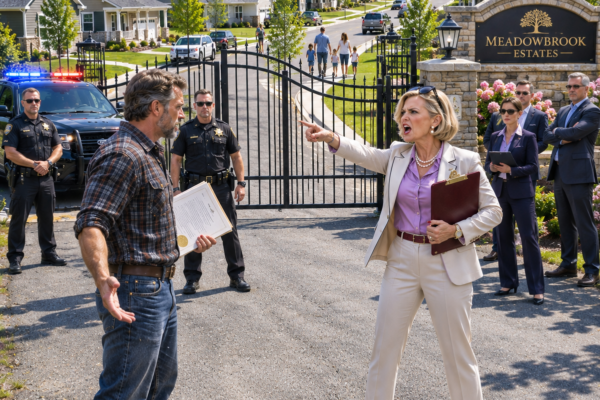
PART 2: HOA Blocked My Driveway With 6 Tons of Concrete—72 Hours Later the Entire Board Was Begging Me Not to Sue
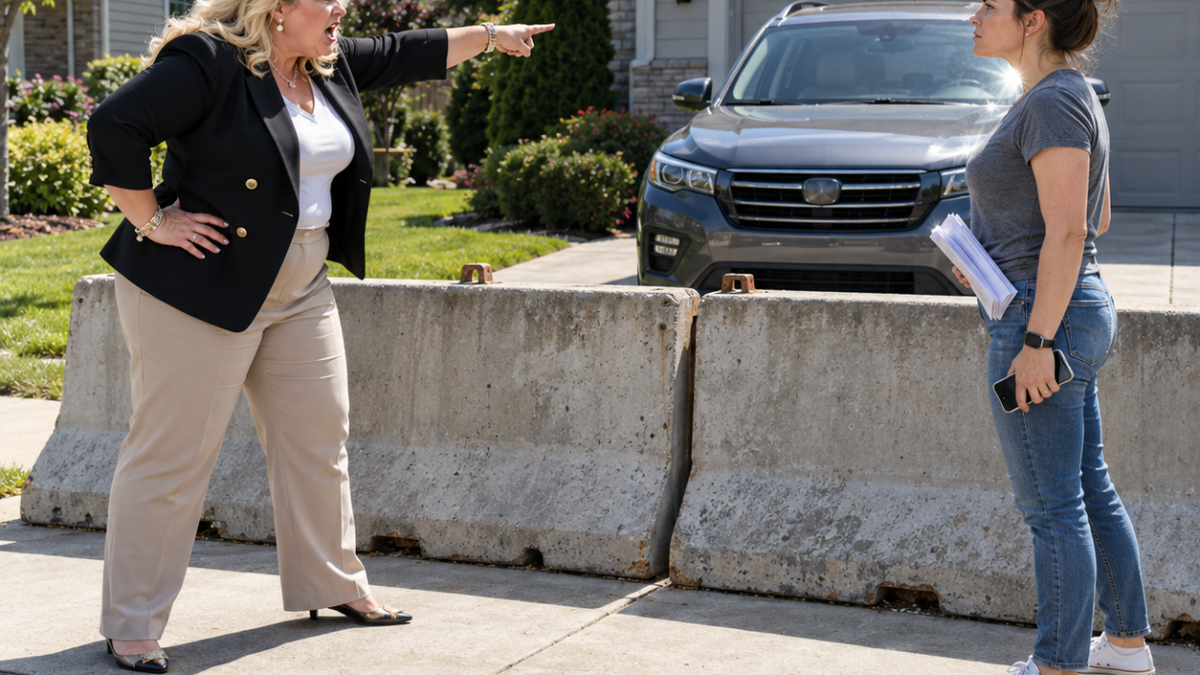
PART 2
I left the county records office carrying three certified documents in a blue folder.
My deed.
The original recorded plat for Oakmont Phase Four.
And a right-of-way map showing exactly where Chandler Court ended and my property began.
I had spent most of my adult life looking at maps that mattered.
Bridges.
Supply corridors.
Access roads.
Drainage plans.
Perimeters.
On deployment, a wrong line could send a convoy into danger.
In civilian life, people looked at property maps and saw boring ink.
I saw terrain.
And Karen Miller had just placed six tons of concrete on the wrong side of a line.
The clerk’s name was Marge.
She was somewhere in her sixties, wore silver-framed glasses, and had watched me compare measurements for nearly forty minutes without interrupting.
When she stamped the last copy, she looked over the top of her glasses.
“Dispute with a neighbor?”
“Homeowners association.”
Marge stopped stamping.
“Oh.”
That one syllable carried the wisdom of a woman who had probably watched thousands of adults ruin their afternoons over fences.
“What are they arguing?”
“They claim my driveway apron belongs to them.”
She glanced at the plat.
“It doesn’t.”
“I noticed.”
She smiled.
“What’d they do?”
I hesitated.
“Put three Jersey barriers across it.”
Her mouth opened.
“Those big highway things?”
“Yes.”
“On your driveway?”
“Yes.”
She took her glasses off.
“Well.”
That was all she said for several seconds.
Then she slid the records toward me.
“I think somebody’s about to have a very bad week.”
I liked Marge.
I called Sarah from the parking lot.
“You find it?”
“Yeah.”
“And?”
“The apron is ours.”
“All of it?”
“All of it.”
There was silence.
Then:
“So Karen illegally blocked our driveway.”
“Yes.”
“With giant concrete blocks.”
“Yes.”
“Can we move them now?”
I looked at the folder.
“Not yet.”
Sarah sighed.
“Of course not.”
“What does that mean?”
“It means I’ve been married to you too long.”
I smiled.
“I want to do this clean.”
“I know.”
“No ambiguity.”
“I know.”
“No chance she can claim we damaged HOA property.”
“I know, Jack.”
“Documented from start to finish.”
She laughed.
“You’re enjoying this now.”
“Not exactly.”
“Liar.”
Maybe a little.
But beneath the satisfaction was something harder.
Karen had frightened Sarah.
That mattered.
My wife had lived through three decades of military uncertainty.
Phone calls in the middle of the night.
Months apart.
Moving boxes.
Orders.
Hospitals.
A roadside bomb outside Ramadi that came close enough to turn one of my men’s boots into shrapnel.
She had never once asked me to leave the Army early.
When I retired, I promised her our next crisis would be something normal.
A broken dishwasher.
A leaking roof.
Maybe an argument over where to spend Thanksgiving.
Standing in front of those barriers that morning, I had seen the old expression return to her face.
The one she wore when there was nothing she could control.
I hated that expression.
Karen had put it there.
So no, I wasn’t going to drag the barriers away with a tractor and call it even.
She wanted rules.
She was going to get rules.
Every last one.
I called Dave Sterling.
Dave and I had served together during my last years in uniform.
He had been JAG.
I had been Corps of Engineers.
Our friendship was built largely around me asking whether something was legal and Dave saying, “That depends how stupid you plan to be.”
After retirement, he opened a property and contract practice in Raleigh.
He answered with, “Please tell me you didn’t buy a boat.”
“Worse.”
“How is anything worse than a boat?”
“HOA.”
Silence.
Then:
“You idiot.”
“I know.”
“What happened?”
“They blockaded my driveway.”
Another silence.
“With what?”
“Jersey barriers.”
“One?”
“Three.”
“How big?”
“Standard two-ton.”
His chair creaked over the phone.
“Say all of that again.”
I did.
I started with the driveway.
My application.
The thirty-day automatic-approval rule.
Karen’s claim that she never got it.
The fines.
The barriers.
The police report.
Then the deed.
When I finished, Dave exhaled slowly.
“Jack.”
“Yeah?”
“I have spent twenty-four years practicing law.”
“Congratulations.”
“I have represented boundary fights involving fences, trees, septic fields, retaining walls, drainage pipes, chicken coops, one gazebo, and a man who built half a swimming pool on somebody else’s lot.”
“That sounds difficult.”
“This is better.”
“Better?”
“This is a lawsuit in a gift box.”
I looked at the county records on the passenger seat.
“So I’m right.”
“On the ownership issue? If those records say what you’re telling me, yes.”
“And the barriers?”
“Potential trespass. Interference with access. Conversion arguments depending on facts. Breach of fiduciary duty if HOA funds were used knowingly outside association authority. Maybe negligence. Maybe more.”
“Police called it civil.”
“Police aren’t your title company.”
“Can I remove them?”
“If they’re on your land, almost certainly. But I know your personality.”
“What does that mean?”
“You’re already planning something elaborate.”
“I want to give them notice.”
Dave laughed.
“Of course you do.”
“Seventy-two hours.”
“That’s oddly specific.”
“Long enough to be reasonable. Short enough to make the point.”
“Send me everything.”
I scanned the records from my phone before I left the parking lot.
By the time I reached Oakmont, Dave had already called back.
“You’re right.”
“I usually am.”
“Don’t ruin this moment.”
I turned onto Chandler Court.
The barriers were visible from half a block away.
My driveway looked like a construction zone.
Karen’s house was three doors down.
Her blinds moved.
I parked my rental at George Henderson’s curb.
George stood in his flower bed tending roses.
He was seventy-one, retired from a printing company, and treated his garden like a private cathedral.
When he saw me climbing out of an Uber, he frowned.
“Truck broken?”
“Driveway.”
He looked toward the barriers.
“Oh.”
He had watched the whole thing.
Everyone had.
“Jack.”
“Yeah?”
“You gonna let that stay?”
“No.”
He nodded.
“Good.”
I had seen an HOA notice on George’s door a month earlier.
It seemed like the right time to ask.
“Can I show you something?”
We walked to his porch.
I laid out the plat map.
George adjusted his glasses.
“So that line means…”
“The barriers are on my property.”
He looked up sharply.
“Karen said that apron belonged to the HOA.”
“She was wrong.”
A smile slowly spread across his face.
Not joy.
Relief.
“You know…”
“What?”
“She fined me two hundred dollars last month.”
“For what?”
“My roses.”
I looked at the garden.
Rows of Queen Elizabeth roses climbed along the side fence.
Pink blossoms.
Perfect.
“What’s wrong with them?”
“Visually aggressive.”
I stared.
George chuckled without humor.
“Apparently the color contrasts too strongly with approved landscaping.”
“Did you have a hearing?”
“A what?”
“Board hearing before the fine.”
“No.”
“Written cure notice?”
“Just the violation.”
“Appeal?”
“She told me appeals had to go through her.”
I felt something inside me shift.
My driveway was no longer the only problem.
“How long has she been doing this?”
George glanced toward Karen’s house.
Then lowered his voice.
“Years.”
“Why doesn’t anyone fight?”
He looked embarrassed.
“People have jobs, Jack.”
That answer was so simple it hurt.
He continued.
“Kids. Mortgages. Aging parents. We tell ourselves two hundred dollars isn’t worth hiring a lawyer.”
“So you pay.”
“So we pay.”
“And she gets stronger.”
George looked at me.
“You really were a colonel?”
“Unfortunately.”
He smiled.
“Then maybe you finally have enough time to be a pain in her ass.”
That was when the mission changed.
By noon, I had spoken to six homeowners.
The Garcias across the street had been fined over their son’s basketball hoop.
No hearing.
Cynthia Palmer had been threatened because her garbage cans remained visible while she was in the emergency room with her mother.
No hearing.
A younger couple named Wesley and Dawn Park had received a $350 “maintenance assessment” after planting lavender along a side walkway.
No hearing.
Everyone had a story.
Everyone assumed theirs was isolated.
That was Karen’s greatest advantage.
Isolation.
She had turned Oakmont into a neighborhood where residents quietly paid fines and assumed everyone else was happily obeying.
By the time Sarah and I ate dinner, I had twelve names in a notebook.
She watched me write.
“You promised not to deploy.”
“I’m eating lasagna.”
“You’re eating lasagna while making a target list.”
“It’s not a target list.”
She leaned over.
“George Henderson. Garcias. Palmer. Parks.”
“Contact list.”
“You used the same tone in Germany when you said ‘transport manifest.’”
I put the pen down.
“You want me to stop?”
Sarah thought.
“No.”
Then she pointed her fork at me.
“But if you turn our dining room into a command center, I get veto power over all acronyms.”
“Fair.”
“And no staying up until three.”
“Unreasonable.”
“Jack.”
“Fine.”
She smiled.
I had missed that smile.
The barriers had rattled her.
The plan gave her back some certainty.
That mattered too.
Dave arrived the next afternoon.
He walked down the sidewalk carrying a leather briefcase.
Stopped at the driveway.
Looked at the concrete.
Then burst out laughing.
I stared at him.
“Glad you’re entertained.”
“I’m sorry.”
He wiped his eyes.
“It’s just so much worse in person.”
Sarah came onto the porch.
“You’re the lawyer?”
Dave straightened.
“David Sterling.”
She shook his hand.
“Please fix my husband before he builds a catapult.”
“I’ve been trying since 2003.”
We sat at the dining table.
Dave reviewed every document.
The original application.
Email timestamps.
Bylaws.
Fine notices.
Photos.
Police report.
Deed.
Plat.
He tapped the property map.
“This is your strongest point.”
“Ownership?”
“Ownership plus notice.”
“What notice?”
“We’re going to tell them exactly what the public record shows. After that, if they refuse to remove the barriers, they cannot plausibly claim innocent mistake.”
He opened his laptop.
“Then we give every director the same information.”
“Not just Karen.”
“Especially not just Karen.”
Sarah sat with us.
“Why?”
Dave looked at her.
“Because boards love hiding behind one person. Later they say, ‘Karen handled enforcement. I didn’t know.’”
“So?”
“So tomorrow every director gets certified notice.”
Sarah smiled.
“You two are enjoying this.”
“No,” Dave and I said at exactly the same time.
That made her laugh.
The letter took three hours.
Dave wrote like a surgeon.
No insults.
No emotion.
Chronology.
Evidence.
Law.
Demand.
We began with the application.
Date submitted.
Second email.
Thirty-day silence.
Work commenced only after automatic approval under Oakmont’s own covenant language.
Then the fine campaign.
Then barrier installation.
Then property ownership.
Dave wrote:
“County-recorded instruments establish conclusively that the area upon which the concrete barriers were placed is contained within Lot 247 and constitutes private property owned by Mr. and Mrs. Mercer.”
I read it.
“Too polite.”
“That’s why I’m the lawyer.”
Then:
“The Association therefore possessed no ownership interest and no enforcement authority authorizing placement of permanent obstructions on that parcel.”
Better.
Then demands.
One.
Remove all barriers at HOA expense within seventy-two hours.
Two.
Restore full vehicular access.
Three.
Rescind all driveway-related fines.
Four.
Reimburse transportation costs caused by the blockade.
Five.
Preserve all board records, communications, invoices, votes, and contractor records associated with the decision.
That fifth one came from Dave.
“Why preserve records?”
“Because people delete things when they become frightened.”
“Good point.”
Then the final paragraph:
“If these demands are not satisfied within seventy-two hours of receipt, our clients are prepared to seek immediate injunctive relief and pursue claims against the Association and responsible directors to the full extent permitted by law.”
I nodded.
“Sharp.”
“Professional.”
“Sharp.”
Sarah read it.
“I like preserve all communications.”
Dave pointed at her.
“You’d have been good at this.”
“She would’ve been terrifying.”
“I married well.”
We sent five copies.
Karen Miller, President.
Stan Gable, Treasurer.
Cynthia Ross, Secretary.
Bob Vance.
Phyllis LaPan.
All certified.
All return receipt.
I also emailed PDFs.
Then I waited.
Military people are often stereotyped as impatient.
In reality, large parts of military life are waiting.
Waiting for aircraft.
Waiting for weather.
Waiting for signatures.
Waiting for somebody higher in the chain of command to decide what everyone already knows.
By Thursday morning, all five directors had received notice.
The seventy-two-hour clock was running.
Nothing happened.
The barriers remained.
Karen did not call.
Stan didn’t call.
No lawyer called.
But the neighborhood changed.
People knew.
Not all details.
Enough.
George gave me a thumbs-up while collecting his mail.
Mrs. Garcia walked over with banana bread.
“I heard your lawyer sent something.”
“Yes.”
“My husband says you’re suing.”
“Not yet.”
“Should you?”
“Depends what they do.”
She looked toward Karen’s house.
“I hope you do.”
That surprised me.
“You’ve paid a lot?”
“Almost eleven hundred in two years.”
“For what?”
She listed them.
Basketball hoop.
Chalk drawings left overnight.
A stroller temporarily on the porch.
Her husband’s pickup facing the wrong direction.
“Why didn’t you challenge them?”
She looked toward the house where her two children were playing.
“Because every letter threatens a lien.”
The word had power.
Lien.
People imagine losing homes.
Mortgages.
Credit.
Years of savings.
Karen understood fear.
I began a private email chain.
Nothing inflammatory.
No rumors.
I wrote:
“I have obtained county records establishing that the HOA installed barriers on private property. I have also found that Oakmont’s enforcement provisions require procedures that may not have been followed in multiple cases. Anyone willing to share past notices may contact me privately.”
Within twelve hours, my inbox filled.
Thirty-one messages.
Photographs.
PDFs.
Scanned letters.
Stories.
Karen had fined one family because their child’s lemonade stand was a “commercial enterprise.”
A widow because her curtains were visible from the street.
A firefighter because his work truck remained overnight after a twenty-four-hour shift.
A teacher because a Little Free Library did not match “community architectural character.”
Every notice bore Karen’s signature.
Many lacked hearing records.
Some cited rules that appeared nowhere in the covenants.
Dave called that evening.
“You’re building a class action without me.”
“I’m collecting.”
“Same disease.”
Then he told me something more interesting.
“Look up Miller Concrete Services.”
“Why?”
“Your neighbor George emailed me the barrier invoice.”
I sat straighter.
“What invoice?”
“Someone on the finance committee forwarded it to him.”
“Who owns the company?”
“I want you to enjoy discovering it.”
I searched the state business registry.
Miller Concrete Services LLC.
Registered agent:
Franklin Miller.
Address:
Same last name.
Different address.
I searched social media.
Franklin Miller appeared in photographs at Christmas beside Karen.
Caption:
MY BABY BROTHER STILL MAKES THE BEST PRIME RIB.
I called Dave.
“Brother.”
“Correct.”
“How much?”
“Five thousand.”
“For three barriers?”
“Emergency security installation.”
“Board vote?”
“That’s where it gets fun.”
I pulled recent board minutes.
No vote.
No $5,000 authorization.
The bylaws required majority board approval for non-budgeted spending above $1,000.
“Stan signed the check,” Dave said.
“Why?”
“According to my source, Karen told him it was pre-approved.”
My anger became cleaner.
The barriers weren’t merely punishment.
Karen had used association funds to hire her brother.
That was the first moment I wondered whether her obsession with enforcement was also financially useful.
Friday morning, residents received an email from Karen.
Subject:
URGENT COMMUNITY MEETING — PROTECTING OAKMONT.
Sarah read it before I did.
“Oh, she’s good.”
“What?”
“She made you sound like you’re trying to invade Poland.”
I opened it.
Karen accused me of launching “hostile litigation.”
She said I refused community standards.
She claimed the barriers protected HOA property.
She warned that my lawsuit could bankrupt Oakmont.
Then she announced an emergency meeting Monday evening.
Proposed special assessment:
$200 per household for legal defense.
I laughed.
Sarah frowned.
“What?”
“She just gave us a room full of witnesses.”
Dave called thirty seconds later.
“I assume you saw it.”
“Yes.”
“She’s either spectacularly confident or spectacularly stupid.”
“Those overlap.”
“Prepare slides.”
“You sound like Maria from the last HOA story.”
“What?”
“Nothing.”
By Friday afternoon, seventy-two hours had elapsed.
No barriers removed.
No reply.
No settlement.
Nothing.
Karen was calling my bluff.
Except I had no bluff.
At 4:01 p.m., I called Mack Donnelly.
Mack had served under me during my final command.
Former Sergeant Major.
Six foot four.
Voice like gravel dragged across steel.
After retirement, he bought part ownership in a heavy-rigging company.
A1 Heavy Lifting.
“Mack.”
“Colonel.”
“Stop calling me that.”
“Never.”
“I need a crane.”
“How big?”
“Enough for three Jersey barriers.”
Silence.
Then:
“Why do you have Jersey barriers?”
“HOA.”
Another silence.
“Say no more.”
“Mack.”
“What?”
“I need permits, traffic control, insurance, everything done properly.”
He sounded offended.
“Who do you think I am?”
“A man who once moved a generator with a tank.”
“That was efficient.”
“That was illegal.”
“No one proved that.”
I closed my eyes.
“Saturday. Seven.”
“We’ll be there.”
“Invoice me normally.”
“No.”
“Mack.”
“I’m not charging you.”
“You’re charging me.”
“I will invoice you one dollar.”
“Mack.”
“Two.”
“It needs to be a legitimate documented damage amount.”
He sighed dramatically.
“You ruin all my fun.”
“Full rate.”
“Fine.”
Then he added:
“Can I bring the big crane?”
“How big?”
“Fifty-ton.”
“Overkill.”
“So yes?”
I knew better than to fight.
Saturday morning, Sarah woke me at 6:40.
“Your army is here.”
I looked through the front window.
Bright yellow crane.
Flatbed.
Support truck.
Six men in reflective vests.
Neighbors were already emerging.
George in slippers.
Garcias with coffee.
Someone across the street filming.
I dressed.
Walked outside.
Mack climbed from the passenger side.
He hugged me hard enough to rearrange ribs.
“Morning, Colonel.”
“Retired.”
“Still ugly.”
“Still insubordinate.”
Then Karen’s front door opened.
She came out wearing a floral robe.
No makeup.
Hair unprepared for battle.
“What is this?”
Her voice carried half the block.
I walked toward her with a document.
“Morning.”
“You cannot move HOA property.”
“They’re on my property.”
“No, they are not.”
I held out the cease-and-desist.
“My attorney has already provided certified county records.”
“I don’t care what your attorney says.”
That line was almost too perfect.
“Then you may want to care what the county says.”
She slapped the paper against her palm.
“I am calling the police.”
“Please do.”
She blinked.
That wasn’t the answer she expected.
I walked back to the driveway.
Mack’s crew set outriggers.
Orange cones.
Spotters.
Rigging inspection.
Everything precise.
No cowboy nonsense.
This was important.
We were not stealing the barriers.
We were removing an unauthorized obstruction from my property and storing it safely pending legal resolution.
I had arranged a bonded impound yard to receive them.
At 7:19, two police cruisers arrived.
Officer Miller from earlier stepped out.
Beside him came Sergeant Daniels, older, gray at the temples.
Karen reached them first.
“He’s stealing HOA property!”
Daniels looked at the crane.
Then at me.
“Mr. Mercer?”
“Yes.”
“You want to explain?”
I handed him the deed.
Plat.
Right-of-way map.
Attorney letter.
Crane work order.
Impound instructions.
Daniels spent five minutes reading.
Karen talked almost continuously beside him.
“This is common area.”
“He’s hostile.”
“He threatened the board.”
“He is trying to intimidate residents with military equipment.”
Mack whispered to me:
“Military equipment?”
“Behave.”
“I’m wearing reflective pants.”
Daniels finally looked toward the barrier location.
He walked with me to the curb.
Compared measurements.
Located a survey pin.
Looked at the map again.
Then turned toward Karen.
“Ma’am.”
She stepped forward confidently.
“Yes?”
“These records show the barriers are on Mr. Mercer’s parcel.”
“That cannot be right.”
“They’re certified county records.”
“Our HOA map says otherwise.”
Daniels shrugged.
“An HOA diagram doesn’t supersede a recorded plat.”
Karen’s mouth opened.
He continued.
“Mr. Mercer appears to have a lawful basis to remove the obstruction.”
“They belong to us!”
“He’s not keeping them. They’re going to an impound facility.”
“I forbid it.”
Daniels’s face changed.
Not angry.
Tired.
“Ma’am, you don’t have police authority.”
“I am HOA president.”
“That is not police authority.”
George coughed loudly to hide a laugh.
Karen heard.
She turned on him.
“Mr. Henderson, your roses remain under compliance review.”
George straightened.
Then something unexpected happened.
He smiled.
“Fine me.”
Karen stared.
George repeated:
“Go ahead.”
For years, the threat would have silenced him.
Now it didn’t.
That was the first wall Karen lost that morning.
The concrete came next.
Mack gave the signal.
The crane’s hook descended.
Crew looped certified slings around the first barrier.
Hydraulics whined.
Then two tons of concrete rose into the air as gently as a suitcase.
Neighbors gasped.
Karen stepped toward the operation.
Daniels moved between her and the crew.
“Ma’am, stay clear.”
“That is association property!”
“For safety, you need to remain behind the cones.”
The first barrier swung over the flatbed.
Lowered.
Released.
George applauded.
Then the Garcias.
Then half the street.
I didn’t encourage it.
But I didn’t stop them either.
Second barrier.
Up.
Across.
Down.
Karen stood rigid.
Her robe moved in the morning breeze.
Cynthia Ross, the board secretary, had come outside now.
She watched from her porch with both hands over her mouth.
Stan Gable arrived in a golf shirt.
He hurried toward Karen.
“What’s happening?”
She snapped:
“He’s stealing the barriers.”
Stan saw the police.
Then the crane.
Then me.
Then the deed in Daniels’s hand.
“Karen.”
“What?”
“You said the apron was common land.”
“It is.”
Daniels answered.
“County documents indicate otherwise.”
Stan went pale.
“How much did we spend on this?”
Karen ignored him.
“Karen.”
“Not now.”
“You said legal reviewed it.”
“Stan, shut up.”
Everyone heard.
Stan stopped.
Something broke behind his eyes.
Trust.
The third barrier rose.
My driveway opened completely.
For the first time in three days, I could see a straight path from my garage to Chandler Court.
It was absurd how emotional that felt.
Concrete.
Ten feet of access.
Nothing important until someone takes it away.
Mack’s crew secured the final barrier.
He handed me the invoice.
Full market rate.
I almost hugged him again.
Instead I signed.
The flatbed pulled away.
The crane followed.
Mack leaned from the cab window.
“Call if you need a bridge moved.”
“I won’t.”
“Your loss.”
Police remained until equipment cleared.
Before leaving, Sergeant Daniels handed Karen a copy of the incident report number.
“You may resolve ownership through counsel.”
She looked at me.
“This isn’t over.”
“No.”
I glanced toward the community clubhouse.
“Monday.”
Then I walked into my garage.
Sarah was standing beside my truck.
The 1972 Ford F-100 was midnight blue.
I had spent fourteen months restoring it.
New brake lines.
Rebuilt transmission.
Original-style bench seat.
Engine rebuilt with Mack in his shop on weekends.
Sarah handed me the keys.
“You’ve been waiting three days.”
“Want to come?”
She smiled.
“Absolutely.”
The V8 turned over.
Deep.
Heavy.
Beautiful.
I backed slowly down the now-open driveway.
George stood at the curb.
Saluted.
I returned it.
The Garcias cheered.
Sarah laughed beside me.
For fifteen minutes, we drove nowhere.
No destination.
Just because we could.
That sounds small.
Freedom often does until it’s blocked.
Monday night, Oakmont’s clubhouse was full before the meeting began.
Normally twenty residents attended.
That night:
One hundred and twelve signed in.
Dave sat beside me in a dark suit.
Sarah on my other side.
George behind us.
The Garcias.
The Parks.
Mrs. Palmer.
People whose names I had learned only because Karen had frightened them.
The board entered together.
Karen first.
Black pantsuit.
Rigid posture.
Stan behind her.
Cynthia.
Bob.
Phyllis.
They looked like people walking into a hearing.
Because in a way, they were.
Karen slammed the gavel.
“This emergency meeting is called to order.”
She did not welcome anyone.
Did not smile.
“The purpose of this meeting is to address a hostile legal attack against Oakmont by one homeowner.”
Murmurs.
She continued.
“Certain individuals have chosen confrontation over cooperation.”
George whispered:
“She means you.”
“I gathered.”
Karen described herself as protecting property values.
She claimed my driveway violated common-area standards.
She called the concrete barriers “temporary protective infrastructure.”
Dave wrote those words on his legal pad.
I leaned toward him.
“What?”
“I want that phrase forever.”
Then Karen made her pitch.
“Oakmont must defend itself.”
She proposed a special legal assessment.
Two hundred dollars per household.
Several residents immediately protested.
“You want us to pay for your barriers?”
“Why?”
“What lawsuit?”
Karen struck the gavel.
“Order!”
Dave stood.
“Point of order.”
Karen’s eyes narrowed.
“You are not a homeowner.”
“No.”
“Then sit down.”
“I represent Jack and Sarah Mercer.”
“You have no standing.”
Dave opened the bylaws.
“Article Three, Section Seven grants members the right to counsel during matters involving enforcement and special assessments directly connected to that enforcement.”
Karen froze.
He continued.
“Your proposed assessment exists solely to fund defense against claims arising from your actions toward my clients. They are entitled to be heard.”
Someone yelled:
“Let Jack speak.”
Another:
“Show us the deed.”
Then:
“Why did we spend five thousand dollars on concrete?”
Karen’s head snapped toward the voice.
That question spread.
Five thousand?
Concrete?
Who got paid?
Stan stared at Karen.
She knew the room was slipping.
“Mr. Mercer may have five minutes.”
I stood.
“Three will do.”
Dave smiled.
We set up a projector.
First slide.
Certified county plat.
No rhetoric.
No dramatic title.
Just a map.
“This is Lot 247.”
I pointed.
“My home.”
Then property line.
“Chandler Court.”
Then right-of-way.
“County road.”
Then the ten-foot strip.
“This is where the barriers were installed.”
I highlighted the location.
“The association stated this area was common property.”
Next slide.
Recorded deed.
“It is not.”
Silence.
I looked toward residents.
“It is private property owned by my wife and me.”
Karen interrupted.
“That interpretation is disputed.”
Dave stood.
“By whom?”
“Our counsel.”
“Name?”
Karen hesitated.
Dave smiled faintly.
“Because I contacted Oakmont’s listed general counsel this afternoon. He stated his office was never asked to review the boundary issue before the barriers were installed.”
The room exploded.
Stan turned toward Karen.
“You told us legal approved it.”
Karen’s face reddened.
“They approved enforcement authority generally.”
“That’s not what you told me.”
She hit the gavel.
“Stan.”
He sat back.
I continued.
Second slide.
Original architectural request.
Email timestamp.
Follow-up timestamp.
Automatic approval clause.
“I followed the process.”
Next slide.
No hearing notice.
No board decision.
No enforcement authority permitting physical blockade.
Then a photograph of six tons of concrete across my driveway.
“This was not in the bylaws.”
I looked directly at the residents.
“The HOA physically obstructed my family’s access to our home based on a claim of ownership contradicted by county records.”
Next slide.
Dave had insisted on this one.
COST TO DATE.
Crane and rigging.
Impound fees.
Uber and rental transportation.
Attorney fees.
Survey consultation.
My number was already more than $9,000.
Residents murmured.
I waited.
“Those are costs created by a decision made in your name and funded with your dues.”
Then the last slide.
MILLER CONCRETE SERVICES LLC.
Registered owner:
Franklin Miller.
Karen’s brother.
Nobody spoke for three seconds.
Then everything happened at once.
“What?”
“Her brother?”
“You paid family?”
“Was there a bid?”
Stan stood.
He wasn’t pale anymore.
He was furious.
“You told me that was the emergency security contractor.”
“It was.”
“You never told me Frank owned it.”
“It was irrelevant.”
“You told me the expenditure was pre-approved.”
“It was an emergency.”
“By who?”
“By me.”
There.
The room heard it.
Stan looked stunned.
“Our bylaws require a board vote above one thousand dollars.”
Karen snapped:
“We didn’t have time.”
“For what?”
She pointed at me.
“To control him!”
The word hung.
Control.
Not protect property.
Not enforce rules.
Control.
Dave slowly closed his briefcase.
He had what he needed.
Then George stood.
“I’d like to speak.”
Karen shook her head.
“No.”
A hundred people looked toward her.
She corrected herself.
“Briefly.”
George walked to the center aisle.
His voice trembled.
“My wife planted the Queen Elizabeth roses beside our house thirty years ago.”
Karen rolled her eyes.
George saw it.
Everyone did.
“Last month, President Miller fined me two hundred dollars because she called them visually aggressive.”
Several residents laughed.
George didn’t.
“My wife died five years ago.”
The laughter stopped.
“Those roses are one of the things I still have from her.”
He looked at Karen.
“You didn’t give me a hearing.”
Karen looked away.
“You threatened a lien.”
“It was a standard notice.”
“You made me afraid to keep my dead wife’s roses.”
No one moved.
Then Mrs. Garcia stood.
“Our basketball hoop.”
Mrs. Palmer stood.
“My garbage cans.”
Wesley Park.
“Our lavender.”
A firefighter named Chris Nolan.
“My work truck.”
One by one.
Stories.
Letters.
Fines.
No hearings.
Karen tried the gavel.
No one cared.
She shouted:
“This is a witch hunt.”
The room quieted.
She pointed at us.
“You are all acting like victims because somebody finally enforced standards.”
That was the wrong sentence.
Mrs. Garcia stared at her.
“We’re homeowners.”
Karen shouted back:
“You’re a mob!”
The room erupted.
“MOB?”
“We pay your dues!”
“This is our association!”
Dave stood.
He didn’t raise his voice.
That made people listen.
“President Miller.”
Karen glared.
“Perhaps you could answer one narrow question.”
“I have nothing to say to you.”
“Why was five thousand dollars in community money paid to your brother’s company without a recorded board vote?”
Silence.
Dave continued.
“An invoice describes emergency installation of concrete barriers as ‘security infrastructure.’”
Karen said:
“It was necessary.”
“Necessary for what?”
“To force compliance.”
Dave nodded.
“So the association paid your relative five thousand dollars to physically block a homeowner’s private property in order to force him to comply with rules the board had not lawfully enforced.”
“That’s your characterization.”
“What’s yours?”
She opened her mouth.
Nothing came.
Stan stood again.
“I need to say something.”
Karen turned.
“Sit down.”
“No.”
That one word changed the room.
Stan Gable had sat beside Karen for four years.
Approved budgets.
Signed checks.
Rarely challenged her.
Now he looked sick with himself.
“I signed that check.”
Karen folded her arms.
“Yes.”
“You told me the board authorization had already been obtained electronically.”
“I said it was approved.”
“By whom?”
“Enough.”
“By whom, Karen?”
She slammed her hand on the table.
“I did this for the board!”
Everyone froze.
Karen realized the sentence was bad.
Then made it worse.
“Someone had to show these people we still had power.”
Stan stared at her.
Cynthia covered her mouth.
Bob looked toward the floor.
Phyllis whispered:
“Oh my God.”
Karen tried to recover.
“That’s not what I meant.”
Too late.
George Henderson stood.
“Sounds pretty clear.”
Then an older man from the back rose.
His name was Harold Davies.
Retired attorney.
He had lived in Oakmont since construction.
“Madam President.”
Karen looked exhausted.
“What?”
“I move under Article Four, Section Five for an immediate vote of no confidence and removal of Karen Miller from the board for gross negligence and malfeasance.”
George shouted:
“Second.”
So did twenty other people.
Karen stood.
“This motion is out of order.”
Davies held up the bylaws.
“No, ma’am.”
“You cannot remove me at an emergency meeting.”
“With quorum, notice, and cause, the membership may remove any director.”
“We don’t have quorum.”
Cynthia looked at the sign-in sheet.
Her voice came quietly.
“Yes, we do.”
Karen stared at her.
Cynthia swallowed.
“One hundred twelve households represented. More by proxy.”
Karen’s face collapsed.
“You traitor.”
Cynthia flinched.
Harold Davies spoke over the rising noise.
“All in favor of removing Karen Miller from the Oakmont board?”
Hands went up.
Almost every hand.
I didn’t raise mine.
Neither did Sarah.
She looked at me.
“Why not?”
“It isn’t my vote to make personal.”
She smiled.
“You’ve grown.”
“Temporary.”
Harold counted opposition.
Two hands.
Karen.
And her friend from the garden committee.
“The motion carries.”
No applause at first.
Silence.
Karen stood behind the table.
No title.
No gavel authority.
Nothing.
She looked toward Stan.
Then Cynthia.
Then me.
“This is your fault.”
I shook my head.
“No.”
“You poisoned them against me.”
“No.”
“You came here looking for trouble.”
“I came here looking for retirement.”
She grabbed her purse.
“You will regret this.”
Dave answered before I could.
“Please make all future communications through counsel.”
Karen’s eyes filled with rage.
Then tears.
For a moment, I saw not a tyrant but a woman who had built her identity around being obeyed.
That didn’t erase what she had done.
But it made the ending less satisfying than I expected.
She pushed through the crowd and left.
The door slammed.
Nobody followed.
The board table looked enormous without her.
Stan sat down.
Then looked toward me.
“Mr. Mercer.”
His voice shook.
“Can we talk?”
Dave stood beside me.
“We’re listening.”
Stan looked at Cynthia, Bob, and Phyllis.
Then back at me.
“We didn’t know.”
I felt my anger rise again.
“You didn’t ask.”
Stan swallowed.
“Karen handled enforcement.”
“You signed checks.”
“I trusted her.”
“You signed a five-thousand-dollar check.”
“She said—”
“I know what she said.”
The room became quiet.
I continued.
“You all had access to the same bylaws I did.”
No answer.
“You all knew homeowners were being fined.”
Cynthia said:
“We didn’t know she skipped hearings.”
“You were secretary.”
Her eyes dropped.
“That’s your job.”
“I know.”
“No.”
My voice stayed calm.
“You know now.”
That landed.
Stan rubbed his forehead.
“What do you want?”
Dave opened his briefcase.
Stan looked terrified.
“We’ll pay the crane.”
“This is not about the crane anymore,” I said.
“Then what?”
“Trust.”
I looked around at the room.
“Every person here gave this board authority to manage common interests.”
Nobody moved.
“You treated that authority like a blank check.”
Stan’s shoulders sagged.
“Are you suing us?”
Dave answered.
“My client is prepared to offer a resolution before litigation.”
Every board member looked at him.
“This is a settlement offer.”
Dave placed one sheet on the table.
“If you reject it, we file tomorrow.”
Stan picked it up.
Condition one:
Independent forensic audit of Oakmont finances covering Karen’s full presidency.
Public results.
Condition two:
Immediate suspension of all violation fines issued without documented due process.
Refund review for improperly assessed amounts.
Condition three:
Dissolution of the current architectural review committee.
Replacement members elected by homeowners.
Condition four:
Full reimbursement of our documented losses.
Crane.
Transportation.
Legal fees.
Survey and records costs.
Condition five:
Formal written apology to Sarah and me, distributed to the entire membership.
Condition six:
Adoption of procedural safeguards.
No physical interference with any owner’s access without court authority or emergency-government order.
No family vendor contracts without disclosure, recusal, competitive bids, and membership notice above specified thresholds.
Condition seven:
The barriers.
Cynthia read that section aloud.
“The barriers will be retrieved from storage at association expense.”
She looked at me.
“Where do they go?”
I smiled for the first time that night.
“Wake County landfill entrance.”
Stan frowned.
“Why?”
“They need a donation.”
Dave looked at me.
“That isn’t technically part of—”
“It is now.”
I continued.
“Oakmont will pay to place a sign beside them.”
George started smiling.
“What sign?”
I looked at him.
“A monument to mismanagement, donated by the former leadership of Oakmont.”
The room broke into laughter.
Even Sarah laughed.
Dave rubbed his forehead.
“I represent a child.”
Stan looked at the conditions.
Then at the residents.
“Can we have until tomorrow?”
Dave shook his head.
“No.”
“Why?”
“You asked for negotiation.”
He glanced at the clock.
“It’s 9:18 p.m. My office opens at nine tomorrow.”
Stan looked at Cynthia.
She nodded.
Bob.
Phyllis.
All nodded.
Stan put the paper down.
“We agree.”
Dave produced full agreements.
“Good.”
People remained while the four directors read every clause.
I wanted that.
Witnesses.
Transparency.
No quiet backroom deal.
No chance for residents to wonder later what had been promised.
At 10:07 p.m., all four signed.
Then something happened I did not expect.
Stan stood.
Turned toward the homeowners.
“I’m sorry.”
No one answered.
He continued.
“I let Karen make decisions because it was easier.”
His voice broke.
“I told myself I was volunteering. That I was busy. That she cared more.”
He looked toward George.
“That doesn’t excuse what happened.”
George nodded.
Not forgiveness.
Acknowledgment.
Cynthia spoke next.
“We should all resign.”
Some residents shouted agreement.
Harold Davies raised a hand.
“Not tonight.”
People quieted.
“We need continuity long enough to conduct an orderly election and preserve records.”
Practical.
Boring.
Correct.
The remaining board agreed to stay temporarily under oversight.
The audit began four days later.
Patricia Lowe, a forensic accountant recommended by Dave, arrived with two assistants.
Within a week, they found what we feared.
Miller Concrete wasn’t the first family deal.
Landscaping purchases had gone to Karen’s cousin.
Holiday decorations came through a company owned by her garden-committee friend.
A “community communication consultant” turned out to be her niece.
Not all contracts were fraudulent.
Some services were performed.
But disclosure was poor.
Competition nonexistent.
Invoices inflated in several cases.
The audit found nearly $48,000 in questionable payments over four years.
Karen had not stolen every dollar personally.
Real life is rarely that simple.
Some money went to relatives.
Some contracts were merely overpriced.
Some expenses were technically legitimate but improperly approved.
The new board pursued recovery where evidence supported it.
Karen received demand letters.
Miller Concrete refunded part of the barrier charge.
Other vendors negotiated settlements.
Oakmont’s insurance became involved.
Attorneys became wealthier.
Progress became slower.
That’s how justice often looks after the dramatic meeting ends.
Paper.
Calls.
Accounting.
But inside the neighborhood, change came faster.
All pending violations were reviewed.
George’s roses:
Dismissed.
Garcia basketball hoop:
Dismissed.
Chris Nolan’s work truck:
Dismissed.
Lavender:
Dismissed.
My flag:
Dismissed.
Garbage cans:
Several dismissed.
Residents began bringing boxes of old notices to the clubhouse.
Some refunds were small.
Fifty dollars.
Seventy-five.
Others exceeded a thousand.
George received $600 back.
He came to our house holding the check.
“Know what I’m buying?”
“No.”
“More roses.”
Sarah hugged him.
“That’s exactly what Eleanor would want.”
George nodded.
His eyes watered.
That spring, he planted another row of Queen Elizabeths along the side fence.
Not because the HOA approved.
Because they were beautiful.
The new architectural committee needed members.
I said no.
At first.
Sarah laughed.
“You’re joining.”
“I’m retired.”
“You just orchestrated a community uprising over driveway concrete.”
“That doesn’t mean I want meetings.”
“It absolutely means you’re getting meetings.”
I resisted for three days.
Then neighbors elected me anyway.
Chairman.
My first meeting lasted forty-seven minutes.
Karen’s meetings had apparently run three hours.
We reviewed the guidelines.
Some rules made sense.
Exterior structural changes.
Drainage.
Fence height near sightlines.
Safety.
Others were absurd.
Approved mulch colors.
Flag measurements.
Basketball-hoop finish.
Number of potted plants visible from sidewalk.
We deleted thirty-seven pages.
Replaced them with nine.
Our standard became:
Safe.
Clean.
Code compliant.
No direct unreasonable interference with neighbors.
That was most of it.
One resident asked whether lavender was permitted.
I said:
“Plant enough for everybody.”
The playground rules changed too.
The Garcias put the basketball hoop back up.
First evening, their son bounced the ball until almost eight.
I was sitting on the porch with Sarah.
Thunk.
Thunk.
Thunk.
She smiled.
“You hear that?”
“Yes.”
“Sounds terrible.”
“Awful.”
“Very disruptive.”
“Extremely.”
Then their little girl yelled:
“Dad! Watch!”
We both laughed.
The barriers became a problem.
Not legally.
Logistically.
The impound yard called.
“Mr. Mercer, you have three enormous concrete blocks here.”
“I’m aware.”
“We’d like them gone.”
Oakmont paid storage.
Then paid transport.
The county landfill manager, a cheerful man named Pete, agreed to accept them as traffic-control barriers.
I told him about the proposed sign.
“You serious?”
“Yes.”
“Can we keep the sign forever?”
“As far as I’m concerned.”
Dave reviewed the wording.
Again.
MONUMENT TO MISMANAGEMENT
DONATED BY THE FORMER LEADERSHIP OF OAKMONT HOA
A REMINDER THAT PROPERTY LINES AND DUE PROCESS MATTER
Dave removed my original phrase:
POWER LOOKS STUPID IN CONCRETE.
“Why?”
“Needlessly inflammatory.”
“It’s true.”
“We’re becoming adults.”
“Disappointing.”
The sign went up.
Local people started taking pictures.
Someone posted it online.
The story traveled.
I refused every interview request.
So did Sarah.
George, however, spoke to a local reporter for twenty-three minutes about roses.
The final broadcast used seven seconds.
“My wife planted them, and nobody gets to tell me they’re aggressive.”
He became a minor legend.
Karen listed her house three months after the vote.
She never attended another community event.
The day the moving truck came, I was polishing the F-100.
She walked toward my driveway.
Alone.
I set the cloth down.
“Jack.”
“Karen.”
She looked older.
Not because three months ages someone dramatically.
Because anger does when you have nowhere to put it.
“You happy?”
“No.”
She laughed bitterly.
“You got everything.”
“Did I?”
“You humiliated me.”
“I showed the deed.”
“You turned the neighborhood against me.”
“They voted.”
“You sued.”
“We settled.”
“You put my brother’s company through an audit.”
“The HOA paid him.”
She looked toward my driveway.
Smooth concrete.
Open.
No barriers.
“I was trying to maintain standards.”
“You blocked my house.”
“You were defiant from the beginning.”
“I sent an application.”
“You challenged me.”
There.
Again.
Not rules.
Challenge.
“That was always the problem, wasn’t it?”
“What?”
“It wasn’t the concrete.”
She folded her arms.
“You came in here acting like you knew better than everyone.”
“I read the bylaws.”
“You were condescending.”
“Probably.”
She blinked.
That answer surprised her.
“I can be condescending.”
“You think?”
“I spent thirty years as a colonel.”
For the first time, she almost smiled.
Then it disappeared.
“I worked hard for this neighborhood.”
“I believe you.”
“You don’t get to say that.”
“Why?”
“Because you destroyed what I built.”
“No.”
I leaned against the truck.
“You built some good things.”
She stared.
“The entrance landscaping. Pool repairs. Neighborhood watch. Holiday drive.”
Her expression changed.
“You know about those?”
“Of course.”
“Then why did everyone act like I was some monster?”
“Because somewhere along the way, being useful became being in charge.”
She looked away.
I continued.
“You stopped hearing no.”
Silence.
“You started treating disagreement like disobedience.”
Her eyes watered.
“People don’t appreciate what it takes.”
“Probably not.”
“They complain, but no one volunteers.”
“That’s true.”
“So I handled things.”
“Until handling things meant putting concrete across someone’s driveway.”
She flinched.
“I was angry.”
“Six tons angry.”
She almost laughed again.
That time, she did.
One small, exhausted sound.
Then she looked at me.
“I shouldn’t have done it.”
“No.”
“I shouldn’t have used Frank.”
“No.”
“I thought if I made an example out of you…”
“You’d regain control.”
She nodded.
“Everyone had started questioning things.”
“That’s what boards are for.”
“I know that now.”
For months, I had imagined an apology.
I expected it to feel satisfying.
It didn’t.
It felt sad.
Karen had hurt people.
That remained true.
But she was also a person who had taken a volunteer position and slowly allowed importance to become identity.
Then identity became entitlement.
Then entitlement became abuse.
Understanding doesn’t erase responsibility.
It just prevents justice from turning into hatred.
She glanced at Sarah through our front window.
“Tell your wife I’m sorry.”
“Tell her yourself.”
Karen hesitated.
Then walked to the porch.
Sarah came out.
I stayed by the truck.
They spoke quietly.
I couldn’t hear everything.
I didn’t try.
At the end, Karen cried.
Sarah hugged her.
Of course she did.
My wife had always been better than me.
When Karen returned toward the street, she stopped.
“I still think that driveway is too bright.”
I smiled.
“I still think your brother overcharged us.”
She nodded.
“Probably.”
Then she left.
Her house sold within a month.
Oakmont elected a new board that fall.
Stan did not run.
Cynthia did.
She asked residents to judge her on whether she had learned from failure.
They did.
She won a seat.
George joined the landscape committee.
Mrs. Garcia joined recreation.
Harold Davies became president for one year on the condition that nobody ask him for two.
Dave refused to attend another HOA meeting.
“You people are exhausting.”
“You billed us.”
“Still exhausting.”
My F-100 became the unofficial mascot of Chandler Court.
Children asked for rides during block parties.
Sarah complained I polished it more than I dusted the house.
Accurate.
The biggest change came at the first community barbecue.
Oakmont had not held one in almost six years.
Too many permit fights.
Too many arguments about common-area rules.
The new board simply reserved the park and told people to bring food.
George brought potato salad.
Garcias brought carne asada.
Cynthia brought cupcakes.
Mack arrived uninvited with brisket.
“How did you know?”
“Colonel, you think news travels slower after retirement?”
He parked beside the playground.
The Garcias’ basketball hoop stood nearby.
Roses bloomed at George’s.
Sarah and I sat under an oak tree.
She leaned against my shoulder.
“This is what I wanted.”
“What?”
“This.”
Kids screamed near the playground.
Someone dropped a plate.
A dog stole a hamburger.
Mack argued with Harold about barbecue sauce.
“Chaos?”
“Community.”
I looked around.
For thirty years, I had lived inside systems built around order.
Rank.
Rules.
Chain of command.
The Army taught me that authority can save lives when it is clearly defined and properly accountable.
Oakmont taught me the opposite lesson.
Authority without accountability becomes personal.
Then arbitrary.
Then dangerous.
Even when the weapon is nothing more dramatic than a clipboard.
Sarah squeezed my hand.
“You know what’s funny?”
“What?”
“You spent thirty years building barriers.”
“Bridges too.”
“And retirement started because somebody built the wrong barrier.”
I laughed.
“Fair.”
“You ever regret buying here?”
I looked toward our house.
Clear driveway.
Blue truck.
Neighbors.
“No.”
“Not even that first morning?”
“Ask me after the crane invoice clears.”
She laughed.
The forensic audit finished six months later.
Final report:
Questionable related-party transactions.
Missing approvals.
Procedural failures.
Inadequate financial controls.
No evidence that every board member intentionally participated.
Important distinction.
Stan had signed things he should have questioned.
Cynthia failed to document.
Bob and Phyllis rarely attended.
Karen made many decisions alone.
Responsibility was not equal.
The new board pursued recovery proportionally.
Frank Miller returned $3,400 connected to the barrier project after mediation.
His company had actually provided the crane and barriers, so some costs were legitimate.
The problem was inflated price, lack of bidding, undisclosed relationship, and improper authorization.
The audit found other recoverable amounts.
Insurance covered part.
Oakmont’s reserve account slowly recovered.
Nobody became rich.
Nobody went to prison.
That disappointed some neighbors.
George summed it up best.
“She lost her kingdom. That’ll do.”
The barriers stayed at the landfill.
One afternoon, a county worker sent me a photograph.
Someone had placed flowers beside the sign.
I had no idea why.
Then I saw the ribbon.
Queen Elizabeth roses.
George.
I called him.
“You put roses beside concrete?”
“Yes.”
“Why?”
“To improve aesthetics.”
I laughed so hard Sarah came from the kitchen to check on me.
George continued.
“Visually aggressive enough?”
“Perfect.”
Life moved on.
That is the part dramatic stories often skip.
Victory eventually becomes Tuesday.
The board meets.
Grass grows.
Kids graduate.
People sell houses.
New people move in who have never heard Karen’s name.
A new family bought her home.
Daniel and Priya Shah.
Two daughters.
One elderly Labrador.
First week, they left their garbage cans at the curb for two days because Priya’s father was in the hospital.
Nobody fined them.
George rolled the cans back for them.
That difference mattered more than any settlement.
One year after the barriers, Sarah and I drove the F-100 to the county fair.
On the way home, she said:
“Turn here.”
“Why?”
“You’ll see.”
She directed me toward the landfill.
The three barriers were still at the entrance.
The sign beside them had faded slightly.
Someone had added a small metal plaque underneath.
Not officially.
Probably George.
It read:
72 HOURS.
I looked at Sarah.
“Did you know about that?”
She smiled.
“No.”
“Liar.”
“Maybe.”
I parked.
We stood beside the barriers.
They seemed smaller now.
That surprised me.
On my driveway, they had looked enormous.
Threatening.
At the landfill, surrounded by earth-moving equipment and scrap material, they were ordinary concrete.
Maybe power works that way too.
Context makes it look larger than it is.
Take away fear.
Take away the title.
Take away the belief that nobody can challenge it.
Sometimes all that remains is a block of concrete.
Sarah ran her hand over the rough surface.
“You were furious.”
“I was.”
“I was scared.”
I looked at her.
“I know.”
“Not about the driveway.”
“What then?”
“You.”
That surprised me.
“You got that look.”
“What look?”
“The one you used to get before deployment.”
I stared at the barriers.
“I’m sorry.”
“You don’t need to apologize.”
“I told you retirement would be different.”
“It was.”
“How?”
“You came home every night.”
That sentence stopped me.
She continued.
“You fought something stupid and local and ridiculous.”
“Accurate.”
“But you came home.”
I took her hand.
For years, I thought protecting Sarah meant eliminating problems before they reached her.
Age taught me better.
Sometimes protection means staying beside someone while the problem exists.
Not turning every conflict into a mission that removes you emotionally.
That lesson took longer than defeating Karen.
When we got back to Oakmont, George was watering roses.
He waved.
Garcia kids played basketball.
A teenager walked a dog.
Ordinary.
Beautifully ordinary.
I pulled the truck into the driveway.
No barriers.
No cones.
No clipboard.
Nothing dramatic.
Sarah climbed out.
“Dinner?”
“Absolutely.”
As I closed the garage, I noticed the first crack beginning near the old driveway seam.
Tiny.
Maybe three inches.
My engineering brain immediately calculated repair options.
Sarah saw me staring.
“No.”
“I didn’t say anything.”
“I know your face.”
“It’s a crack.”
“It’s three inches.”
“If water enters—”
“Jack.”
I looked at her.
“Tomorrow.”
She smiled.
“Growth.”
The next morning I repaired it.
Some habits survive reform.
Years later, people in Oakmont still referred to the incident as the Seventy-Two-Hour War.
I hated the name.
Mack loved it.
He had hats made.
I threatened litigation.
He sent me two.
One Christmas, George gave me a miniature model of a Jersey barrier.
Engraved:
PROPERTY LINE APPRECIATION AWARD.
I put it on my desk.
Not because I was proud of humiliating Karen.
Because it reminded me how everything began.
A line on a map.
A person who assumed authority without checking.
A board that stopped asking questions.
Neighbors who believed they were alone.
And one piece of infrastructure so absurd nobody could pretend the problem was minor anymore.
Karen meant the barriers to demonstrate power.
Instead they exposed its limits.
That was the irony.
If she had simply fined me another two hundred dollars, I might have appealed quietly.
If she had responded to my original application, none of it would have happened.
If she had listened when I sent the certified letter, we might have resolved the driveway in a week.
But power that goes unchallenged develops a strange hunger.
Each victory needs a larger one.
A warning becomes a fine.
A fine becomes a threat.
A threat becomes a barrier.
A barrier becomes a public confrontation.
Then one morning everyone sees how far things have gone.
People often ask what I would have done differently.
Easy.
I would have challenged the first illegitimate fine.
Not angrily.
Not dramatically.
Just firmly.
Because every time I paid to keep the peace, Karen learned the wrong lesson.
She learned that pressure worked.
So did the rest of the board.
Meanwhile, I told myself I was being reasonable.
That is the dangerous space where small abuses grow.
Between not worth fighting and too late to ignore.
The real victory wasn’t making the board beg.
It wasn’t the crane.
It wasn’t the deed.
It wasn’t even removing Karen.
It was changing that space.
Afterward, Oakmont homeowners asked questions early.
Board members explained decisions.
Minutes were published.
Contracts disclosed.
If someone received a violation they thought was wrong, they appealed without feeling like they had declared war.
Sometimes they won.
Sometimes the HOA was right.
That was fine.
Fairness does not mean residents always get what they want.
It means nobody needs personal permission from a self-appointed monarch to be heard.
Harold served one year as president and stepped down exactly as promised.
Maria Garcia succeeded him.
Her first meeting lasted thirty-eight minutes.
At the end, George raised his hand.
“I have a landscaping complaint.”
Maria sighed.
“What?”
“My roses are excessively beautiful.”
Everyone groaned.
He smiled.
“I move that the HOA pay me.”
Motion failed unanimously.
Democracy survived.
Sarah’s favorite part of the whole story came two summers later.
A delivery truck backed into our driveway apron and chipped one corner.
The driver was devastated.
“I’m sorry, sir. Company insurance will cover it.”
I looked at the chip.
About an inch.
Before I could answer, Sarah came outside.
She examined it.
Then looked at me.
“Don’t.”
“I wasn’t—”
“Jack.”
The driver looked confused.
Sarah smiled at him.
“It’s fine.”
I stared at her.
“It is not fine.”
She whispered:
“Do you want another seventy-two-hour war?”
The driver had no idea why she was laughing.
I let the chip stay.
It remains there.
Every time I notice it, I think about control.
Perfection.
Boundaries.
How easy it is to confuse caring for something with needing power over everything that touches it.
Maybe Karen and I had one thing in common after all.
We both liked control.
Difference was, eventually I learned where mine was supposed to stop.
Property lines matter.
So do human ones.
That is the lesson I carried from Chandler Court.
Your authority ends somewhere.
A good leader knows where.
A bad one keeps walking until somebody makes the boundary impossible to ignore.
Karen needed six tons of concrete to learn it.
The rest of us only needed the map.
And seventy-two hours.