PART 2: His Owner Chased Him Into the Street Because He Got Sick—20 Days Later, the Dog Everyone Gave Up On Stood Up
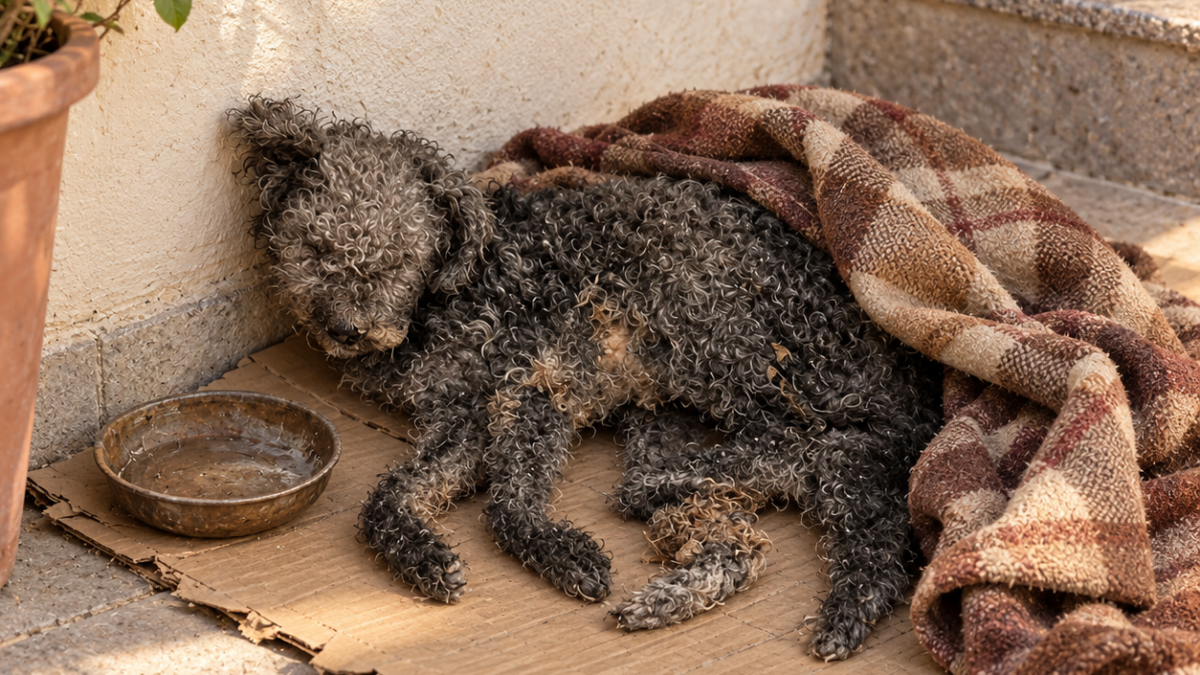
PART 2
The ride to the larger hospital felt endless.
I sat beside Chiquihuite with one hand resting close to his shoulder, afraid to touch him too much because I didn’t know where the pain was worst.
Every bump in the road made me look at his chest.
Still breathing.
That became my entire world.
In.
Out.
In.
Out.
As long as his chest moved, there was something to fight for.
The person driving glanced at me through the mirror.
“How is he?”
“Still with us.”
The words sounded stronger than I felt.
Chiquihuite’s head shifted slightly.
I bent closer.
“Stay with me.”
His good eye opened.
For one second, he looked directly at me.
I had seen injured dogs before.
Fearful dogs.
Abandoned dogs.
But there was something different in that look.
He wasn’t fighting us.
He wasn’t trying to understand where we were taking him.
He seemed simply exhausted.
As if whatever happened next no longer belonged to him.
That frightened me.
Pain can make an animal cry.
Fear can make an animal struggle.
But hopelessness can make them quiet.
I had the terrible feeling that Chiquihuite had reached that silence.
So I kept talking.
Not because I believed he understood every word.
Because I needed him to hear a human voice that wasn’t ordering him away.
“You’re going somewhere better.”
His ear twitched.
“They have more equipment.”
Nothing.
“They’re going to look at your eye.”
His breathing remained shallow.
“And then you’re going to eat.”
I swallowed.
“You hear me? That’s the plan.”
I was making promises as though confidence itself could keep his heart beating.
Maybe it helped me more than him.
We finally arrived.
The hospital staff came out with a stretcher.
The sight of several people approaching caused the first real reaction I had seen from Chiquihuite.
His body tensed.
Not much.
But enough.
I leaned close.
“It’s okay.”
A technician crouched beside us.
“What’s his name?”
The question caught me off guard.
“He didn’t have one.”
She looked at me.
I looked at him.
A name suddenly felt important.
An abandoned dog on a roadside can become a problem.
A case.
A stray.
A dying animal.
A name turns him back into an individual.
“Chiquihuite,” I said.
The technician smiled.
“Okay, Chiquihuite. We’re going to move you.”
That was the first time I heard someone say his name.
His new name.
Not whatever someone might have called him before throwing him away.
This one belonged to the life beginning now.
They carried him inside.
I followed.
The examination revealed what we already knew and more.
Severe weakness.
Dehydration.
Wounds across his nose and face.
Damage around one eye that required careful treatment.
Poor body condition.
Pain.
The veterinary team worked quietly.
I watched hands moving over the same dog who had been ignored beside a road.
A thermometer.
Fluids.
Cleaning.
Medication.
Checking his eye.
Listening to his chest.
Each small procedure felt like a vote.
You matter.
You are worth the supplies.
Worth the time.
Worth the effort.
I kept thinking about the owner who had chased him away because he was sick.
I wish I could tell you I knew exactly what happened.
I don’t.
The information we had came from people who knew he had belonged to someone and had been driven away after becoming weak.
I never saw what happened before that.
I could not prove whether the wounds on his face came from that home, from the street, from another dog, or from several terrible events after he was abandoned.
But I knew one thing.
The person responsible for his care had removed that care precisely when he needed it most.
That alone was enough to make me angry.
The veterinarian came toward me.
“We need to take this one step at a time.”
“Is he going to live?”
A pause.
I hated pauses.
“I can’t promise you that.”
My eyes dropped.
“But he has a chance?”
“Yes.”
One word.
Chance.
That was enough.
“What do you need from me?”
“Patience.”
I almost laughed.
Not because anything was funny.
Because patience felt impossible.
I wanted Chiquihuite to stand now.
Eat now.
Open his eyes fully now.
I wanted someone to undo two weeks of abandonment before nightfall.
Instead, recovery would happen at the speed his damaged body allowed.
Slowly.
The first major battle was food.
Chiquihuite needed strength.
But wanting him to eat did not make eating easy.
The first time I offered him food after he was stabilized, I held a small portion close enough for him to smell it.
His nose moved.
That tiny reaction made my heart jump.
“There you go.”
He opened his mouth.
Took a small bite.
Chewed slowly.
Then stopped.
I waited.
Another bite.
After only a few, exhaustion took over.
His head lowered.
“That’s okay.”
I had to tell myself that.
Three bites seemed pathetic if you compared them with a healthy dog’s meal.
For Chiquihuite, they were work.
Three bites meant he had enough desire to participate.
The next feeding, he ate slightly more.
Then less.
Then more again.
Recovery never moved in the straight line I wanted.
Every good moment made me believe the worst was over.
Every difficult moment convinced me I had celebrated too early.
The veterinary team was more disciplined.
“Look at the overall trend,” one technician told me.
“He ate less today.”
“But more than when he arrived.”
“He’s still not standing.”
“But he’s lifting his head.”
“His eye still looks terrible.”
“And we’re treating it.”
I knew she was right.
I still worried.
His injured eye became an obsession for me.
Every time we cleaned his face, I studied it.
Was the swelling better?
Was he seeing anything?
Would the damage heal?
Would he lose vision?
Nobody gave me guarantees.
So I did what I could.
Medication.
Cleaning.
Protecting the area.
Following every instruction.
Sometimes Chiquihuite pulled his head back slightly when treatment began.
I almost felt relieved.
Resistance meant energy.
“Sorry.”
I cleaned gently.
“You can complain.”
His good eye watched me.
“You’re allowed.”
He never snapped.
Never growled.
Even in pain.
That gentleness broke my heart in a different way.
There are animals whose history teaches them to defend themselves fiercely.
There are others who become so accustomed to enduring discomfort that they simply accept it.
I wondered which Chiquihuite was.
One afternoon, while cleaning the wounds around his muzzle, I stopped and looked at him.
“You know you can tell me no.”
He blinked.
I moved the cloth again.
He remained quiet.
“Yeah.”
I swallowed.
“You never learned that, did you?”
I had to stop for a moment.
Not because he needed the break.
Because I did.
Over the next several days, Chiquihuite began showing us pieces of himself.
His appetite improved first.
A few bites became several.
Then half a small meal.
The first time he finished what we offered, I looked at the empty dish and actually laughed.
“You did that.”
Chiquihuite licked his nose.
“You want more?”
His head lifted.
The technician beside me smiled.
“That’s a very good sign.”
We gave him an appropriate amount.
I sat nearby while he ate.
Watching an abandoned dog eat should not feel like a miracle.
But when you have seen that same dog too weak to raise his head, ordinary acts become sacred.
Eating.
Drinking.
Sleeping without trembling.
Looking toward a voice.
All of it mattered.
Chiquihuite began recognizing us.
At first, every person was simply another figure approaching.
Then he started lifting his head when I entered.
The first time it happened, I thought I imagined it.
“Chiquihuite?”
Head up.
Eyes on me.
I stopped in the doorway.
“Hi.”
His tail did not move.
Not yet.
But he knew me.
That mattered.
I sat beside him.
“You were waiting?”
His head lowered.
“Don’t get sentimental on me now.”
I smiled.
“You have a reputation.”
The next few days created a routine.
Food.
Medication.
Wound care.
Eye treatment.
Rest.
Repeat.
There were no dramatic breakthroughs.
Just tiny improvements.
His breathing seemed stronger.
His posture changed.
He began shifting himself instead of lying in one position.
He started following movement around the room.
One day, sunlight reached his blanket.
Chiquihuite had been resting in the shade.
He slowly adjusted his body until his face lay in the warm patch.
I watched.
Nothing medically significant happened.
No miracle.
But seeing him choose warmth affected me deeply.
He had spent two weeks outside.
Whatever weather came, he endured.
Now he could choose sunlight because it felt good.
I pulled a chair nearby.
He closed his eyes.
I sat with him.
For maybe twenty minutes, neither of us moved.
His face still looked injured.
His body still looked thin.
He still could not stand.
But he was peaceful.
That was new.
I touched the edge of his blanket.
“Better than the road?”
His ear moved.
“I’m taking that as yes.”
I began imagining a future for him.
That was dangerous.
Hope can hurt when an animal is still unstable.
But once you imagine a dog healthy, it becomes almost impossible not to fight toward that image.
I imagined him walking.
Then running.
I imagined his coat filling out.
His eye healing.
I imagined him sleeping on a clean bed.
Playing.
Being annoying.
Stealing food.
Doing normal things.
Then I would look at the dog in front of me and feel the distance between the present and that future.
It seemed enormous.
Day ten.
Still weak.
Day twelve.
More food.
Day fourteen.
Better awareness.
Day sixteen.
Small attempts to reposition his legs.
Every tiny change became a number in my mind.
But standing remained out of reach.
Sometimes we supported him carefully.
His legs shook.
He would lower himself again.
I tried not to show disappointment.
“You tried.”
That was what mattered.
A veterinarian told me, “His body has been through a lot.”
“I know.”
“Muscle weakness doesn’t disappear overnight.”
“I know.”
“You keep saying that.”
“Because I know it here.”
I pointed at my head.
“Not here.”
I touched my chest.
She smiled sympathetically.
“Give him time.”
Time.
Always time.
The twentieth day began like most others.
I did not wake expecting anything extraordinary.
Chiquihuite ate.
His wounds were cleaner.
The injured eye still needed attention, but the overall appearance of his face had changed.
Less swollen.
Less defeated.
He had gained some weight.
Not enough to look healthy yet.
Enough that his body no longer seemed to be disappearing.
I brought him outside to a safe sunny area for a short period.
By then, he enjoyed the warmth.
He was lying on his chest.
Head up.
Watching.
I sat several feet away.
“You’re looking better.”
Chiquihuite stared.
“Don’t act humble. You know.”
I looked away for maybe thirty seconds.
Then I heard movement.
Not unusual.
He sometimes shifted his paws.
I looked back.
Chiquihuite had moved his front legs beneath himself.
I leaned forward.
“What are you doing?”
He pushed.
His chest rose.
His hind legs struggled to find position.
I stopped breathing.
“Easy.”
He pushed again.
For a second, his entire body shook.
I almost moved toward him.
Then I stopped myself.
Unless he began falling dangerously, I wanted him to try.
His legs straightened.
Chiquihuite stood.
Not well.
Not confidently.
But he stood.
My hands covered my mouth.
“Oh my God.”
His legs trembled so violently I thought he might collapse.
Chiquihuite looked toward me.
I crouched.
“You’re standing.”
One step.
His paw moved forward.
Then another.
His back legs shook.
I moved close enough to catch him if necessary without taking the effort away.
“Come on.”
Another tiny step.
Then his body lowered back toward the blanket.
I supported him gently.
He was exhausted.
I was crying.
Not quietly either.
One of the carers came outside.
“What happened?”
“He stood.”
“What?”
“He stood.”
She looked at Chiquihuite.
Then at me.
“By himself?”
I nodded.
“Three or four steps.”
She crouched.
“Oh, buddy.”
Chiquihuite rested.
He had no idea what he had just done to us.
Twenty days earlier, someone had looked at his condition and suggested euthanasia.
Twenty days earlier, Chiquihuite had barely been responsive.
Now his own legs had carried him toward life.
The moment lasted seconds.
The meaning lasted forever.
That evening, I thought about his former owner.
Anger returned.
Someone had decided this dog was no longer worth the effort because he was weak.
Yet with care, food, treatment, and twenty days of patience, he stood.
That became Chiquihuite’s first act of revenge.
Not against a person.
Against the judgment that his life was finished.
He stood.
That was enough.
After Day 20, progress accelerated.
Not magically.
He still had weak days.
But standing was no longer impossible.
The next time, he stayed up longer.
Then several steps.
Then a short supported walk.
His muscles had to relearn their job.
He became tired quickly.
At first, every walk lasted only moments.
We treated those moments like victories.
“Come on, Chiquihuite.”
One step.
“Good.”
Another.
“Good.”
He would pause.
I waited.
Never dragged.
Never forced.
Then he moved again.
Soon he began walking toward food.
That made me laugh.
“Of course.”
One of the carers smiled.
“Food motivation.”
“I don’t care what motivates him.”
Chiquihuite reached the bowl.
A dog who had once been too exhausted to eat was now using his healing legs to find dinner.
Beautiful.
His personality expanded with his strength.
We discovered that Chiquihuite liked people.
Not merely tolerated them.
Liked them.
He leaned toward hands.
Rested his head on knees.
Watched people enter and sometimes tried to follow.
That realization hurt.
Because it confirmed what I had suspected from the beginning.
He had known home life.
Maybe once slept inside.
Maybe once had someone he believed belonged to him.
His trust in people had not been erased despite everything.
I struggled with that.
Part of me wanted him to be suspicious.
It seemed safer.
“How do you still trust us?”
I asked one night.
Chiquihuite rested his head on my lap.
“That makes no sense.”
His eyes closed.
I stroked his neck.
“I’m glad you do.”
He began meeting other rescued dogs.
At first, we were careful.
Given the unknown injuries on his face, we did not know whether other animals frightened him.
The first introduction was quiet.
A calm dog entered at a comfortable distance.
Chiquihuite looked.
Body alert.
The other dog sniffed the ground.
No pressure.
Chiquihuite sniffed too.
Eventually they moved closer.
Nose.
Pause.
Tail movement.
I held my breath.
Then both dogs walked away as though nothing meaningful had happened.
I laughed.
“That’s it?”
The other carer said, “Boring is good.”
She was right.
Boring was wonderful.
The next interactions became easier.
Then one afternoon, a younger dog made a playful movement.
Chiquihuite froze.
The younger dog bounced again.
For a second, I expected Chiquihuite to retreat.
Instead, his tail moved.
Once.
Then again.
He lifted one paw.
The other dog ran a small circle.
And Chiquihuite followed.
Only a few steps.
But faster than walking.
My heart jumped.
“Did he just—”
“Yes.”
The young dog returned.
Chiquihuite’s body loosened.
Then he made the clumsiest little play bow I had ever seen.
I started laughing.
A dog once lying beside the road waiting to die was inviting another dog to play.
That moment mattered almost as much as standing.
Because walking meant his body was returning.
Playing meant his life was.
Pain occupies space.
Fear occupies space.
Hunger occupies space.
An animal trying to survive has little room left for joy.
Chiquihuite was beginning to have extra space.
Enough for curiosity.
Enough for friendship.
Enough for play.
His eye also continued improving.
That remained one of my greatest worries.
We kept treating it.
Cleaning carefully.
Following the veterinary plan.
Watching for changes.
Some days it looked better.
Some days I panicked over redness.
“Is that normal?”
“Yes.”
“Are you sure?”
“Yes.”
“What if—”
“Stop.”
I looked at the veterinarian.
She smiled.
“You’re monitoring him well.”
“I’m terrified.”
“I know.”
“Can he see?”
“He’s responding.”
That word gave me hope.
Over time, the eye looked less frightening.
Chiquihuite began navigating more confidently.
He followed movement.
Turned toward people.
The possibility of severe permanent damage seemed less overwhelming than it had on Day 1.
I found myself taking photographs.
At first, I had avoided them.
The early images were too painful.
But now I wanted records.
Day 20 standing.
Day 24 walking.
Day 30 outside.
Day 35 beside another dog.
Day 40 with a fuller face.
When I compared them, the transformation became undeniable.
The dog in the first photograph seemed ancient.
That was why we initially assumed he was seven or eight years old.
His face looked exhausted in a way age usually explains.
His body seemed worn.
His movements slow.
His eyes heavy.
Then later, after he had gained strength and his wounds began healing, someone questioned the estimate.
“Are we sure he’s that old?”
I looked at him.
“Why?”
“Teeth.”
The veterinary team examined him more carefully.
Body condition can distort age estimates dramatically.
An animal who has lived through illness, hunger, and neglect can look years older than he is.
The updated estimate hit me hard.
Around three years old.
Three.
I stared at the veterinarian.
“Three?”
“That appears much more likely.”
“He’s not seven?”
“No.”
“Not eight?”
“No.”
I looked at Chiquihuite.
He was walking around nearby.
Three.
I had prepared myself emotionally for the story of an older dog discarded after years of service.
The truth felt worse.
He was still young.
Whatever he had experienced had aged him.
At roughly three years old, he should have been in the strongest, most playful stage of his life.
Instead, when I met him, he looked like a senior dog whose body had already surrendered.
I sat beside him.
“You’re a baby.”
Chiquihuite sniffed my hand.
“You’re practically a baby.”
He leaned closer.
That day I cried more than I did when he stood.
Because the new age estimate changed the shape of his past.
If he was only around three, then suffering had occupied an enormous portion of the life he could remember.
I could not change those years.
But suddenly, his future felt larger too.
He was young.
There could be so much more.
Years of warmth.
Years of healthy meals.
Years of beds.
Walks.
Games.
People who stayed.
I decided that day that his future would be his revenge.
Every birthday.
Every meal.
Every ridiculous toy.
Every nap in sunlight.
Every moment somebody touched him gently.
If a person had discarded him because he became weak, then Chiquihuite would answer by becoming strong.
Not for them.
For himself.
The best revenge does not always involve the person who caused the damage.
Sometimes it means the damage does not get the ending.
Chiquihuite continued gaining weight.
His shape changed.
Ribs became less prominent.
His neck filled out.
His coat improved.
People who had seen the first photos sometimes failed to recognize him immediately.
“That’s the same dog?”
“Yes.”
“No way.”
I would smile.
“He worked hard.”
And he had.
Treatment helped.
Food helped.
Veterinary care helped.
But Chiquihuite had to participate.
He had to eat when eating was tiring.
Stand when his legs shook.
Walk when lying down was easier.
Tolerate wound care.
Trust hands.
Sleep.
Heal.
Recovery is work even when the patient cannot understand why.
One morning, he surprised me by running.
Not far.
Maybe ten yards.
But running.
I had let him outside with another dog after we were confident he could safely handle more movement.
The second dog took off.
Chiquihuite watched.
Then something lit up inside him.
He followed.
His gait was awkward.
He did not have full strength yet.
But the speed was unmistakable.
“Chiquihuite!”
He stopped.
Turned.
I laughed.
“Did you just run?”
Tail wag.
He came toward me at a quick walk.
“You absolutely ran.”
I crouched.
He reached me.
I put both hands around his face carefully.
His injuries had healed enough that touching him no longer terrified me.
“Look at you.”
He licked my wrist.
The road flashed through my memory.
Motionless dog.
Eyes closed.
Now this.
I pressed my forehead gently against his.
“You had no idea, did you?”
Tail moved.
“You had no idea what was waiting.”
Maybe none of us did.
As weeks became months, the crisis phase ended.
That was stranger than I expected.
When an animal is critically ill, every hour has purpose.
Medication.
Food.
Monitoring.
Cleaning.
Phone calls.
Appointments.
You move from task to task.
Then recovery reaches a point where the question changes.
Not “Will he survive?”
“What kind of life will he have?”
That was when I realized Chiquihuite needed more than recovery.
He needed home.
Not temporary safety.
Belonging.
A place where nobody measured his worth by whether he was convenient.
A place where sickness would never mean exile.
I had loved him from the beginning.
I told myself that was rescue-worker emotion.
You love the ones in front of you because you have to fight for them.
But as Chiquihuite healed, attachment became impossible to deny.
He recognized my footsteps.
He looked for me.
He slept near wherever I sat.
If I left the room, he sometimes followed.
One evening, I was exhausted.
I sat on the floor.
Chiquihuite walked over and lowered his head onto my lap.
I laughed.
“You know this is backwards.”
He looked up.
“I’m supposed to comfort you.”
His head lowered again.
I stroked him.
Maybe comfort does not move in one direction.
Another rescued dog came over.
Chiquihuite allowed him to lie beside us.
For a long time, I sat there with two dogs pressed against me.
The room was quiet.
No alarms.
No traffic.
No medical emergency.
I suddenly realized how far we had come.
Chiquihuite had entered our lives as a question.
Can he survive?
Now he was an answer.
Yes.
More than survive.
He could belong.
Eventually, the day came when someone asked whether Chiquihuite would be available for adoption.
The question should have made me happy.
That is the goal.
Rescue.
Heal.
Find home.
But my stomach tightened.
“What kind of home?”
“A good one.”
“I know.”
I looked at Chiquihuite.
He was playing awkwardly with another dog.
“What if they get tired of him?”
The person beside me understood immediately.
“He’s healthy now.”
“That’s not what I mean.”
“What do you mean?”
“What if he gets sick again someday?”
Every animal does eventually.
Injury.
Illness.
Old age.
Something.
“What if someone looks at him and decides he’s inconvenient?”
“That could happen with any adoption.”
Exactly.
I hated that.
I looked toward Chiquihuite.
He had already experienced one person deciding his medical needs made him disposable.
I could not stand the idea of him learning that lesson twice.
That night, I barely slept.
Chiquihuite did.
Completely.
Curled on his bed.
He trusted the room.
Trusted tomorrow.
The next morning, he greeted me.
Tail wagging.
I knew.
Some decisions are made emotionally long before we say them aloud.
Chiquihuite had already become home.
We made it official.
No more temporary language.
No more wondering where he would go.
He was staying.
The moment itself was almost comically undramatic.
I crouched beside him.
“Guess what?”
Chiquihuite licked my hand.
“You’re stuck with me.”
Tail wag.
“Forever.”
Another lick.
“That’s the contract.”
He had no idea.
I cried anyway.
The dog who had been chased out of one home for becoming weak now had a home where weakness would never make him unwanted.
That was the promise.
Healthy.
Sick.
Young.
Old.
Easy.
Difficult.
Chiquihuite stayed.
That promise became more important than any dramatic punishment I could imagine for the person who threw him away.
I never wanted Chiquihuite’s new life to remain emotionally connected to that old owner forever.
Hatred can become another chain.
So I stopped building fantasies about confrontation.
What would I say if I met the person?
“You were wrong?”
Chiquihuite’s life said it better.
They believed weakness erased value.
Wrong.
They believed sickness justified abandonment.
Wrong.
They believed throwing him out ended responsibility.
Maybe legally or morally there were questions beyond my control.
But emotionally?
Chiquihuite delivered the only verdict that mattered.
He lived.
Every morning he woke in a safe bed was proof.
Every healthy meal.
Every step.
Every game.
Every time he rolled onto his back because he trusted the room.
Every time a person touched the face that had once been covered in wounds.
Proof.
You were wrong about me.
That became his revenge.
Not rage.
Joy.
He became mischievous too.
That delighted me.
One afternoon, I discovered him with something in his mouth.
“What is that?”
Chiquihuite froze.
I moved closer.
A sock.
“Give me that.”
Tail wag.
“Chiquihuite.”
He moved away.
I stared.
“You couldn’t stand when we met.”
He walked faster.
“And now you’re stealing laundry?”
He broke into a clumsy run.
I started laughing.
Another dog chased him.
Within seconds, my sock had become part of a game.
I should have been annoyed.
Instead, I sat down laughing until tears came.
Healthy dogs create stupid problems.
Wonderful, ridiculous problems.
Mud.
Hair.
Stolen socks.
Food stolen from counters.
Beds occupied without permission.
I wanted all of it.
Chiquihuite deserved ordinary trouble.
Months earlier, I had been measuring life through fluid levels and bites of food.
Now I was negotiating for laundry.
Progress.
His relationship with food changed too.
At first, each bite had been effort.
Later, meals became events.
He recognized preparation sounds.
Bowl.
Cabinet.
Package.
Instant attention.
One day, I was thirty minutes late with dinner.
Chiquihuite appeared in front of me.
Sat.
Stared.
“What?”
Stare.
“You ate this morning.”
Nothing.
“It is not dinner time.”
He glanced toward the kitchen.
I checked the clock.
“Oh.”
Tail wag.
“You knew?”
He stood.
I laughed.
“You’re unbelievable.”
He followed me into the kitchen.
Watching him wait impatiently for dinner became one of my favorite things.
Hunger no longer represented desperation.
It was routine.
Expectation.
Entitlement.
Exactly what I wanted.
You deserve a meal.
You can expect it.
Nobody is taking it away.
His injured eye never became something I forgot.
Even after the worst danger passed, I continued watching.
If he squinted, I panicked.
If anything looked irritated, veterinary check.
People teased me gently.
“You’re overprotective.”
“Yes.”
No argument.
Chiquihuite had nearly lost everything because someone did too little.
If I sometimes did too much, I could live with that.
But over time I learned balance.
He did not need to be treated like a fragile patient forever.
He needed to be a dog.
So we let him explore.
Play.
Get dirty.
Make choices.
One sunny afternoon, he rolled in something foul-smelling.
I stared at him.
“You cannot be serious.”
Chiquihuite looked delighted.
“You survived death for this?”
More rolling.
I covered my face.
“Absolutely disgusting.”
Bath time.
He disagreed.
Strongly.
Not aggressively.
He planted his feet.
I pulled gently.
“No.”
Chiquihuite leaned backward.
“Yes.”
Backward.
“Do not make me emotionally blackmail you with your rescue story.”
The person helping me laughed.
Eventually Chiquihuite entered.
During the bath, he looked betrayed.
I smiled.
“This is what having a family is.”
He tolerated it.
Afterward he ran around like a lunatic.
We laughed.
The broken dog from the road was now furious about shampoo.
Perfect.
The first anniversary of his rescue came unexpectedly.
Someone reminded me of the date.
I looked through the old photographs.
I had not done that in months.
The first one stopped me.
Chiquihuite lying on the road.
Face injured.
Body collapsed.
Eyes closed.
I stared until the image blurred.
Then I looked toward the living room.
Chiquihuite was asleep on the couch.
Yes.
The couch.
Rules had weakened.
His body looked completely different.
Healthy weight.
Cleaner coat.
Relaxed muscles.
His face still carried evidence of what he had survived, but it no longer looked dominated by pain.
I held the phone beside him.
Same dog.
Impossible.
Chiquihuite opened one eye.
“You want to see something?”
No interest.
“This is you.”
He closed his eye.
“You’re very disrespectful of your own inspirational story.”
Nothing.
I laughed.
Good.
I did not want him living as a symbol.
I wanted him sleeping on a couch.
That evening, I cooked something special for the dogs.
Nothing unhealthy.
Just enough to mark the date.
I placed Chiquihuite’s bowl down.
He started eating immediately.
No hesitation.
No weakness.
No exhausted few bites.
I sat on the floor.
A year earlier, I had celebrated every mouthful.
Now I smiled at how quickly dinner disappeared.
When he finished, Chiquihuite looked at me.
“What?”
He licked the bowl.
“No.”
Stare.
“That was extra already.”
Tail wag.
“You are shameless.”
I gave him a small additional treat.
Anniversary rules.
Later, we went outside.
Chiquihuite walked ahead.
He no longer needed support.
No shaking legs.
Another dog invited him to play.
He followed.
Their bodies moved across the grass.
Chiquihuite was not the fastest.
Didn’t matter.
He ran.
That was enough.
I remembered Day 20.
Three shaky steps.
The miracle we had prayed for.
If someone had shown me this scene then, I would not have believed it.
The dog ran past.
I shouted his name.
“Chiquihuite!”
He turned.
Came toward me.
Not because he was scared.
Because he knew his name.
Because it belonged to him.
That did something to me.
His old life had taken many things.
Strength.
Security.
Health.
Maybe trust.
But this life had given him an identity no one could throw away.
Chiquihuite.
Loved.
Wanted.
Home.
He reached me.
I scratched his chest.
“You know something?”
Tail moving.
“You look young now.”
That had become obvious.
Once his health returned, the age estimate made perfect sense.
The exhausted expression lifted.
His movements became playful.
The “old dog” we thought we saved had never been old at all.
Suffering had disguised youth.
Now youth was coming back.
Not literally lost time.
We could not restore the earlier years.
But we could stop losing more.
That mattered.
Over the following year, Chiquihuite continued surprising me.
He became a comfort to newer rescue dogs.
Maybe I was projecting human meaning onto it.
But he seemed especially gentle around weak animals.
When a frightened dog arrived, Chiquihuite did not overwhelm.
He sniffed.
Waited.
Sometimes lay nearby.
One dog refused food around people.
Chiquihuite ate several feet away.
The frightened dog watched.
Eventually tried.
I stood in the doorway.
“Are you teaching?”
Chiquihuite continued eating.
Maybe.
Maybe not.
But I liked imagining he knew.
You can eat here.
Nobody will chase you away.
Another time, a dog recovering from surgery rested in a bed.
Chiquihuite approached.
Sniffed.
Then lay beside the bed.
I stared.
“You’re getting soft.”
His eyes closed.
He stayed there for nearly an hour.
I thought about how he had once needed someone to sit beside him.
Now he could be that calm presence for someone else.
That felt like another kind of justice.
Pain had not made him cruel.
It had not turned gentleness into bitterness.
He remained soft.
That amazed me.
People often use the word resilient carelessly.
Chiquihuite taught me what I think it actually means.
Not pretending nothing happened.
Not becoming untouched.
Resilience means the wound does not get to decide what you become next.
Chiquihuite had every reason to distrust people.
He chose attachment.
Every reason to fear other dogs.
He learned play.
Every reason to stop trying.
He stood.
Every reason to treat the world as temporary.
He learned home.
That is resilience.
There were still difficult medical days.
Rescued animals do not become immune to ordinary illness.
The first time Chiquihuite became sick again after recovering, I panicked.
He skipped breakfast.
My entire body went cold.
“No.”
I checked him.
Quiet.
Not collapsed.
Just off.
Veterinarian.
Immediately.
The visit revealed something manageable.
Nothing like the original crisis.
Medication.
Rest.
Monitoring.
But emotionally, I was back beside the road.
The veterinarian noticed.
“He’s okay.”
“I know.”
“You don’t look like you know.”
“I’m working on it.”
Chiquihuite stood beside me.
Healthy enough to be annoyed about the clinic.
That should have reassured me.
I touched his head.
“This is the part where nobody throws you away.”
The veterinarian looked at me.
I smiled sadly.
“Sorry.”
She understood.
We went home.
I gave medicine.
Chiquihuite slept.
Within days he was normal again.
That small illness became important because it gave us a chance to rewrite the exact moment his first owner had failed.
He became sick.
And nothing changed.
His bed stayed.
His food stayed.
His people stayed.
Nobody opened a door and chased him toward the road.
He needed care.
He received care.
I wish animals understood symbolism as well as humans.
Maybe they understand repetition instead.
Sick.
Still home.
Weak.
Still home.
Needs money.
Still home.
Needs time.
Still home.
That was the lesson I wanted repeated until it became ordinary.
One night during his recovery from that minor illness, Chiquihuite crawled closer to me.
His head rested against my chest.
I whispered, “See?”
His eyes stayed closed.
“You’re still here.”
I stroked his neck.
“That’s how it works now.”
That moment became the real revenge in my mind.
The circumstance that once got him discarded returned.
Illness.
Only the ending changed.
Nobody left him.
The past lost.
People sometimes asked whether we ever found the former owner.
I usually changed the subject.
Not because I had some dramatic secret.
Because Chiquihuite’s story became less interesting when centered on whoever abandoned him.
That person had already taken enough space.
Why give them the ending too?
I wanted the ending to belong to Chiquihuite.
His choices.
His health.
His joy.
The person who threw him away became a footnote.
That was more satisfying than any confrontation.
Imagine believing a dog is worthless because he is sick.
Then imagine that same dog becoming the center of someone else’s home.
That is consequence enough for me.
They lost him.
We got him.
Chiquihuite won.
Years later, people who met him for the first time never guessed the whole story.
“Beautiful dog.”
“Friendly.”
“Sweet.”
“He’s so gentle.”
I always smiled.
“Yes.”
Sometimes I told them more.
Sometimes not.
Chiquihuite did not owe strangers his trauma.
He could simply be beautiful.
Friendly.
Sweet.
Gentle.
One afternoon, a visitor sat on the floor.
Chiquihuite walked over.
Placed his head on her knee.
She scratched his ears.
“He trusts people so much.”
I felt the old ache.
“Yeah.”
“Was he always like this?”
I looked at him.
“In a way.”
I thought about the first days.
Even then, while broken, he had leaned toward my hand.
The gentleness had always been inside him.
Neglect had not created it.
Rescue had not created it.
We had only given it somewhere safe to exist.
That distinction mattered.
We did not make Chiquihuite good.
He had remained good through things that should have made goodness difficult.
We simply stopped punishing him for it.
Another rescue anniversary came.
Then another.
Each one felt less like a memorial and more like a birthday.
His second life.
I bought him a toy.
Chiquihuite destroyed it in ten minutes.
“You ungrateful animal.”
Stuffing everywhere.
Tail wag.
“That cost money.”
He attacked the remaining half.
I laughed.
Best money I spent.
At one point, Chiquihuite became obsessed with sleeping in a patch of sunlight near the window.
Every afternoon, almost the same time.
He would find it.
Circle once.
Lie down.
That image always took me back to the early day when he first chose the sunlight while still unable to stand.
Back then, sunlight meant a small spark of comfort in a body full of pain.
Now it was simply his favorite nap spot.
I loved that transformation.
Not everything needed to remain meaningful.
Healing turns sacred milestones into habits.
First meal becomes dinner.
First steps become walking.
First run becomes play.
First peaceful sunlight becomes an afternoon nap.
That is success.
One day I sat beside him in that sun.
Chiquihuite opened an eye.
“Remember this?”
Nothing.
“Of course you don’t.”
He stretched.
I rested my hand against his shoulder.
“I do.”
There are memories animals should not have to carry.
We can carry them instead.
I could remember the road.
The euthanasia suggestion.
The injured eye.
The three bites.
Day 20.
He could sleep.
That felt fair.
As Chiquihuite grew older—truly older this time—I thought often about our promise.
Healthy.
Sick.
Young.
Old.
Stay.
His muzzle eventually began changing color.
Slowly.
Naturally.
Real age.
Not suffering disguised as age.
The first gray hairs made me emotional.
“Excuse me.”
Chiquihuite looked up.
“You are not allowed.”
More gray appeared over months.
I laughed at myself.
I had once prayed he would live long enough to become old.
Now I complained about evidence that the prayer was working.
What a privilege.
Growing old is a privilege for an animal once left to die young.
Every gray hair became a victory.
Years.
He got years.
That was the life stolen from the ending someone else had chosen.
I once thought justice meant seeing the person who abandoned him understand what they did.
Eventually, I realized justice was watching Chiquihuite age in safety.
They had decided his sick body was disposable at around three years old.
He grew older anyway.
In a bed.
With food.
Veterinary care.
Toys.
Friends.
People who knew exactly how much he mattered.
That is the kind of revenge no one can take back.
I remember one cold morning when Chiquihuite woke stiff.
Nothing serious.
Just older joints.
I helped him up.
He stretched.
Walked slowly toward the kitchen.
“You’re getting old.”
He looked at the bowl.
“Still only interested in breakfast?”
Tail wag.
I prepared his food.
While he ate, I thought about the first meal.
Tiny bites.
Exhaustion.
Now he was older for the correct reason.
Time.
Not starvation.
Not pain.
Time.
I almost cried into the food container.
Chiquihuite finished and looked at me.
“No.”
Stare.
“You already had breakfast.”
Tail wag.
“Some things never change.”
We went outside.
He moved slower than before.
But he moved.
The first steps I once celebrated had become thousands.
Miles.
Walks.
Runs.
Trips across rooms because he heard food.
Journeys from the couch to the sunny window.
All built from those three shaky steps on Day 20.
I sometimes wish I could return to myself on rescue day.
I would tell that terrified version of me:
Yes, he survives.
You will spend too much money.
You will lose sleep.
You will panic over his eye.
You will cry when he eats.
Cry when he stands.
Cry when you discover he is only three.
Cry when he runs.
Eventually you will cry because he has gray hair.
He will steal things.
Get dirty.
Demand dinner.
Take over furniture.
He will become so ordinary that sometimes you forget to be amazed.
And that will be the best part.
You will stop seeing the dog lying on the road every time you look at him.
Eventually, you will simply see Chiquihuite.
That is the ending.
Not forgetting what happened.
Not pretending cruelty did not exist.
Allowing love to become larger than the memory of it.
The last photograph I keep near my desk is not one of the dramatic recovery photos.
It is simple.
Chiquihuite asleep.
Head resting in someone’s lap.
Sunlight across his face.
His once-injured eye relaxed.
Body full and comfortable.
Nothing else happening.
That picture means everything.
A dog who once closed his eyes beside a road because his body had no strength left now closes them because he trusts the hands around him.
Same act.
Completely different meaning.
One is surrender.
The other is peace.
Years after rescue, Chiquihuite still preferred resting close to people.
Sometimes I wondered whether that came from the home he lost.
Maybe closeness had once meant family.
Maybe he never stopped wanting it.
I did not need the answer.
Whenever he leaned into me, I simply let him.
One evening, he put his head against my leg.
I looked down.
“You know something?”
His eye opened.
“The first veterinarian thought you might not make it.”
No reaction.
“The first owner thought you weren’t worth keeping.”
His tail moved.
“Both were wrong.”
I smiled.
“To be fair, the vet was looking at a very sick dog.”
Chiquihuite sighed.
“But the other one?”
I scratched his neck.
“They lost.”
Not because something bad happened to them.
Because Chiquihuite became something they would never get back.
Loved.
Safe.
Irreplaceable.
He slept.
I stayed.
That was the whole victory.
The final lesson Chiquihuite taught me was about value.
People often assign value to animals based on ease.
Healthy.
Young.
Cute.
Obedient.
Cheap to care for.
Convenient.
Chiquihuite had lost those qualities temporarily.
He became weak.
Injured.
Expensive.
Difficult.
And someone decided that meant his value disappeared.
They were wrong.
Value is not health.
Value is not usefulness.
Chiquihuite mattered while lying beside the road exactly as much as he mattered running through grass months later.
The difference was not his worth.
The difference was whether anyone acted like they could see it.
We did.
That is rescue.
Not giving value.
Recognizing the value already there.
One afternoon, long after his recovery, Chiquihuite was outside with the other dogs.
He moved more slowly than the youngest ones.
They raced.
He watched.
Then one dog returned and bounced around him.
Chiquihuite gave chase for a few steps.
Not fast.
Enough.
Everyone laughed.
He stopped in the sunlight.
Tail wagging.
I stared.
The years between the roadside and that moment collapsed.
He had been abandoned for becoming weak.
Now he was allowed to become weak again someday.
Old age would come.
Illness might come.
His body would eventually slow permanently.
And when it did, nobody would chase him away.
That may be the promise I am proudest of.
His first home taught him that love had conditions.
This one didn’t.
Chiquihuite came back inside.
Walked toward his bed.
Circled.
Lay down.
I covered him lightly with a blanket.
He looked at me.
“You’re spoiled.”
Tail moved.
“Completely spoiled.”
I bent down.
Kissed his head.
“That’s your revenge too.”
He closed his eyes.
The abandoned dog became the spoiled dog.
Perfect.
Sometimes the happiest ending is not spectacular.
No courtroom.
No confrontation.
No former owner appearing to beg forgiveness.
Real life rarely gives us those scenes.
Instead, Chiquihuite got something better.
Breakfast tomorrow.
A veterinary appointment when needed.
A warm bed tonight.
Hands that cleaned wounds and later scratched ears.
A name.
Friends.
Age.
Routine.
Belonging.
The freedom to get sick without losing everything.
That was the ending I wanted.
The world once looked at Chiquihuite lying beside a road and kept moving.
Now, inside our home, if he shifts in his sleep, someone notices.
If he refuses food, we notice.
If his eye looks strange, we notice.
If he wants to go outside, we notice.
If he rests his head on our legs, we stop what we are doing.
Not because he is fragile.
Because he matters.
He always did.
On one quiet night, I found him asleep in his favorite place.
I sat down beside him.
Chiquihuite opened his eyes.
For a second, I remembered the dog I first touched.
Eyes barely open.
No strength to resist.
Face wounded.
I placed my hand near his nose.
He leaned into it.
Exactly like he had that first day.
Only now there was no hospital waiting.
No emergency transport.
No question about tomorrow.
I whispered, “You fought so hard.”
Chiquihuite’s eyes closed.
“I hope you know you won.”
Maybe he didn’t understand.
That was okay.
His life understood for him.
He had outlived abandonment.
Outlived the road.
Outlived the moment somebody decided weakness made him worthless.
He had grown strong.
Then older.
Loved every step of the way.
His story was no longer about the person who threw him away.
It belonged to the people who picked him up.
The veterinarians who treated him.
The hands that cleaned his wounds.
The dogs who taught him to play.
And most of all, it belonged to Chiquihuite himself.
The dog who took three tiny bites.
The dog who stood on Day 20.
The dog who learned to run.
The dog we thought was eight but discovered was only three.
The dog who lost a home and gained a family.
That was Chiquihuite.
Not trash.
Not a burden.
Not a sick dog someone no longer wanted.
Family.
And now, whenever he closes his eyes in the sunlight, I no longer see the dog fading away beside the road.
I see a dog resting because he knows he can wake up safely.
There will be food.
There will be care.
There will be people.
There will still be home.
Nobody is chasing him away.
Nobody is deciding he costs too much.
Nobody is asking whether he is worth the trouble.
That question was answered years ago.
Yes.
He was worth every mile.
Every dollar.
Every frightened phone call.
Every bandage.
Every treatment.
Every sleepless night.
Every tear.
Every second.
And the person who once threw him away because he had become weak will never know the greatest version of him.
The playful dog.
The gentle dog.
The dog who learned to trust again.
The dog who became strong enough to run and lucky enough to grow old.
They gave him up at his lowest.
We got to love him through everything that came after.
That was their loss.
And Chiquihuite’s beautiful, hard-earned victory.
He had been thrown away once.
He would never be unwanted again.








