PART 2: His Owner Chained Him Beside a Broken Sofa for Years—Then 40 Days of Freedom Made Max Unrecognizable
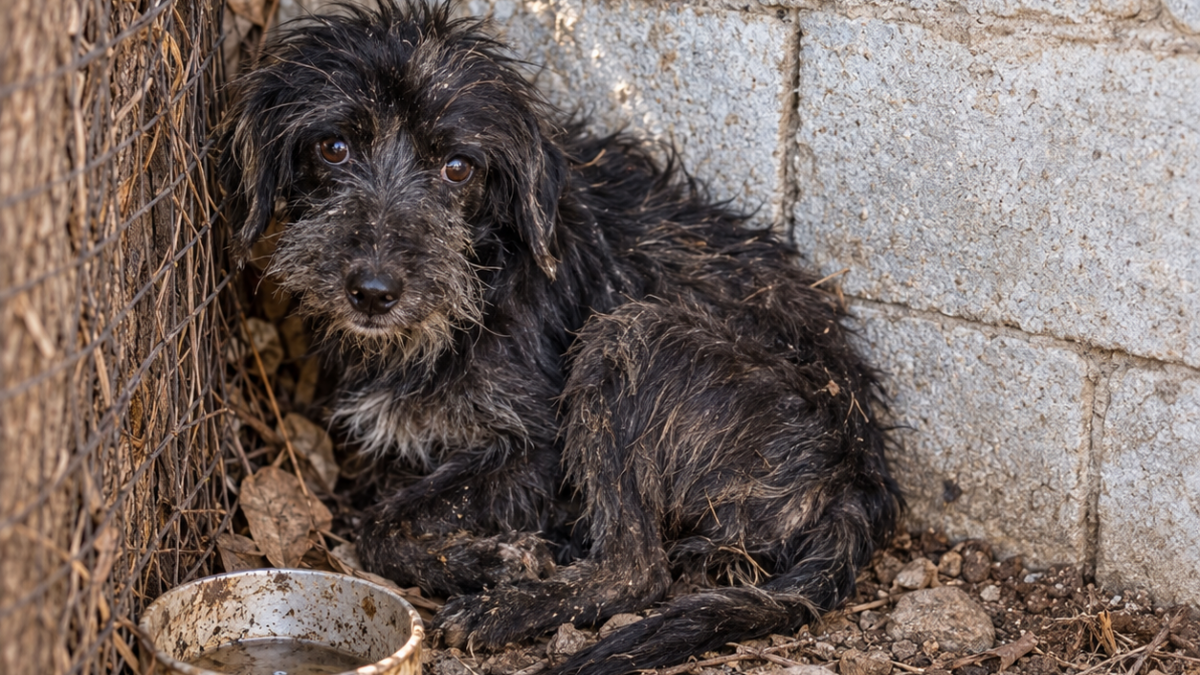
PART 2
The first thing the veterinarian said was, “Don’t touch his ears yet.”
I had been standing beside the examination table with one hand hovering near Max’s head.
I stopped.
“What did you see?”
She leaned closer without touching him.
“Ticks.”
I had seen ticks before.
Every rescuer has.
A tick by itself is unpleasant but ordinary.
This was different.
The veterinarian switched on a brighter examination light.
When she gently lifted the edge of Max’s ear, my stomach tightened.
Large ticks had buried themselves deep into folds of skin.
Not one.
Several.
Some were engorged.
Others were hidden beneath crusted debris and damaged tissue.
“How long does that take?” I asked.
“To get this bad?”
“Yes.”
She looked at me.
“Long enough that someone should have noticed.”
Of course.
That phrase came up repeatedly over the next several hours.
Someone should have noticed.
The mange.
Someone should have noticed.
The secondary skin infection.
Someone should have noticed.
The parasite burden.
Someone should have noticed.
The weight loss.
The constant scratching.
The irritated ears.
The smell of untreated skin disease.
The way he had stopped showing interest in food.
None of this had happened overnight.
Max’s body had been broadcasting distress for months, possibly longer.
The veterinarian ran her hands carefully along his sides.
Max remained completely still.
Not relaxed.
Still.
There is a difference.
A relaxed dog softens into touch.
Max simply tolerated whatever happened.
He did not resist because resistance had apparently never changed anything.
The veterinarian looked at me.
“How did he behave when you took him off the chain?”
“He barely reacted.”
“Fear?”
“Not exactly.”
I struggled to explain it.
“He looked confused.”
She nodded.
“Shutdown.”
That word hurt more than I expected.
“Can dogs do that?”
“Of course.”
She listened to his heart.
“Animals learn from patterns. If nothing they do changes the environment, some stop trying.”
Learned helplessness.
I had heard the term before.
Knowing the phrase did not prepare me for seeing it.
The veterinarian offered Max a small piece of food.
He sniffed it.
Turned his head away.
“When did he eat last?” she asked.
“I don’t know.”
“Did the owner say?”
“No.”
She tried another food.
Same response.
Max was not nauseous enough to vomit.
He simply seemed uninterested.
The veterinarian looked worried.
“He needs blood work.”
We drew samples.
Max never objected.
Not when the needle went in.
Not when his ears were cleaned.
Not when damaged skin was examined.
The kindest dog in the room was also the saddest.
A technician whispered:
“He’s sweet.”
I looked at Max.
“I don’t think he knows he’s allowed to be anything else.”
The lab results made the situation worse.
His liver values were abnormal.
There were signs of significant systemic strain.
His pancreas was struggling.
Parasites had drained nutrients from a body already receiving inconsistent care.
His skin needed aggressive treatment, but because his body was compromised, everything had to be balanced carefully.
The veterinarian placed the results on the counter.
“This dog needs time.”
“Can he recover?”
“Yes.”
The answer came quickly enough to give me hope.
Then she added:
“But we need to be careful.”
“What worries you most?”
“Right now?”
She looked toward Max.
“Honestly?”
“Yes.”
“His lack of interest in anything.”
I frowned.
“More than his liver?”
“The liver can be monitored and treated. The skin can be treated. Ticks can be removed. Mange can be managed.”
She folded her arms.
“But we also need him to participate in staying alive.”
I looked at him.
Max had lowered his head onto the table.
Eyes open.
Watching nothing.
The veterinarian continued.
“If he won’t eat, if he stops responding, if stress overwhelms him, then physical treatment becomes harder.”
I touched his shoulder.
No reaction.
“What do we do?”
“Start with comfort.”
That answer seemed too small.
“Comfort?”
“Food he can tolerate. Warm place. No chain. Medication. Baths. Routine. Let his nervous system learn that something has changed.”
Something has changed.
I repeated those words to Max that night.
We had transferred him to a quiet foster room.
No concrete floor.
No ruined sofa.
No mud.
No chain.
There was a real bed.
Soft blankets.
Water available whenever he wanted it.
Food.
A low lamp.
I sat several feet away.
Max stood in the center of the room.
He did not lie on the bed.
He did not investigate.
He did not sniff the toys we had placed nearby.
He simply stood.
I waited.
Five minutes.
Ten.
Fifteen.
Eventually he walked toward the corner.
He found a piece of cardboard we had used beneath some supplies.
Then he lay down on it.
I covered my mouth.
Of course.
We had given him a bed.
He chose cardboard.
Because cardboard made sense.
I removed the fancy bed from the center of the room and placed it beside the cardboard instead.
“You don’t have to understand everything tonight.”
Max looked at me.
“You can keep the cardboard.”
His eyes closed.
For the first time since I met him, he slept somewhere dry.
### The First Bath
Two days later, Max had his first medicated bath.
I wish I could say he enjoyed being clean.
He hated every second.
Not violently.
He never snapped.
Never growled.
But the moment warm water touched his back, his entire body went rigid.
The veterinary technician supported his chest.
I stayed at his head.
“It’s okay.”
Max stared at the wall.
The water running from his body changed color with dirt.
Medication had to reach skin that had been neglected beneath what little coat remained.
We worked slowly.
His ears had already been treated separately.
The large ticks were removed.
Smaller parasites were being addressed with prescribed medication.
Now the skin needed attention.
When the medicated shampoo touched one inflamed area, Max flinched.
“Sorry.”
I wanted to stop.
The technician shook her head.
“We need to continue.”
“I know.”
“This is helping.”
“I know.”
But rescue care can feel cruel in the moment.
Cleaning wounds hurts.
Treating ears hurts.
Shaving damaged hair can be uncomfortable.
Medicine can sting.
The animal does not understand that pain now prevents worse pain later.
They only know a human is touching a place that already hurts.
That is where trust begins.
Not with affection.
With predictability.
We never surprised Max if we could avoid it.
We showed him towels.
Let him smell bottles.
Touched his shoulder before touching his ears.
Used the same calm voice.
Stopped when we could.
Continued when medically necessary.
After the bath, I wrapped him in a towel.
Max stood stiffly.
I rubbed him gently.
Then something unexpected happened.
He leaned.
Only slightly.
His shoulder pressed against my leg.
I froze.
The technician saw it.
“Don’t move.”
“I’m not.”
Max stayed there.
Maybe he was tired.
Maybe he wanted warmth.
Maybe he had simply lost balance.
But I chose not to analyze it.
For thirty seconds, Max chose contact.
That was enough.
### The Owner Calls
The call came three days after Max entered care.
I recognized the number immediately.
His former owner.
I almost ignored it.
Then I answered.
“Yes?”
“How’s the dog?”
Not Max.
The dog.
“He’s being treated.”
“How bad?”
I stared across the room.
Max was sleeping on his cardboard.
“Very bad.”
Silence.
Then:
“So he’s alive.”
“Yes.”
“Good.”
I waited.
Something in his tone bothered me.
Then he asked:
“What are you going to do with him?”
“Treat him.”
“After that.”
“Find him a safe permanent home.”
Another pause.
“I might want him back.”
I thought I had misheard.
“What?”
“I said I might take him back when he’s better.”
My hand tightened around the phone.
“You surrendered him.”
“I know, but I paid for him before.”
That word again.
Paid.
Money.
Ownership.
Control.
Not once:
Does he hurt?
Did he eat?
Is he frightened?
Can he recover?
Just possession.
I stood.
“You signed him over.”
“I changed my mind.”
“That isn’t how this works.”
“I spent money on that dog.”
My voice became very calm.
“And Max spent years on a chain.”
Silence.
“You said you were going to have him euthanized.”
“I was angry.”
“You said you were tired of dealing with him.”
“He’s mine.”
“No.”
That was the first time I said it with certainty.
“He was yours. You gave him up.”
The man began raising his voice.
I ended the call.
My hands were shaking.
A rescue coordinator handled everything after that.
The surrender documentation was clear.
Max was not going back.
Still, the call revealed something I had not fully understood at the property.
The refusal to release Max had never been about love.
It was about the idea that an animal represented money invested.
Property.
Something another person should not receive without payment.
That made the ruined sofa feel even uglier in my memory.
Years of control disguised as ownership.
The rescue filed a formal welfare report.
We included photographs of the living conditions.
The chain.
The cardboard.
The waterlogged area.
Veterinary findings.
Ticks.
Mange.
Parasite load.
Organ abnormalities.
Whatever happened legally would take its own course.
I wanted Max’s recovery to move faster.
### Learning to Eat Again
The first major battle was food.
Max ate enough to survive.
Barely.
We tried several options under veterinary guidance.
Warm food.
Strong-smelling food.
Small frequent meals.
Hand feeding.
He accepted a few bites.
Then stopped.
I sat with him during meals.
At first, I worried my presence made him anxious.
So I moved farther away.
No change.
I tried leaving the room.
Still little interest.
Then one evening, another foster dog named Toby happened to walk past the doorway.
Max watched him.
Toby walked to his own bowl and started eating enthusiastically.
Max’s ears moved.
That was new.
He watched Toby for almost a minute.
Then looked at his bowl.
He stood.
Walked toward it.
Ate three bites.
I almost cheered.
I controlled myself.
Max ate two more.
Then walked away.
The next morning, I arranged for Toby to eat nearby again.
Max watched.
Then ate.
Dogs teach each other safety in ways humans sometimes cannot.
Toby wasn’t giving a motivational speech.
He was simply demonstrating:
Food arrives.
You eat.
Nothing bad happens.
The third day, Max finished half his meal.
I sent a photograph to the veterinarian.
HALF THE BOWL.
Her reply:
GOOD. DON’T OVERFEED JUST BECAUSE YOU’RE EXCITED.
She knew me too well already.
By the second week, Max began showing anticipation when food arrived.
Not excitement.
But he looked toward the bowl.
That tiny change meant he was beginning to want something.
Wanting was the goal.
Food first.
Then maybe comfort.
Then maybe movement.
Then maybe life.
### The Chain That Wasn’t There
The strangest behavior appeared around the end of the second week.
Max would walk several feet from his bed.
Then stop.
Always around the same distance.
He could go farther.
Nothing blocked him.
But he didn’t.
One morning, I measured roughly with my steps.
The radius was almost exactly what I remembered from his chain.
I felt sick.
The metal was gone.
The limit remained in his mind.
I sat outside that invisible circle.
“Come here.”
Max looked at me.
I placed a piece of food on the floor between us.
He approached.
Stopped.
One paw near the boundary.
I slid the treat closer.
He took it.
The next treat went six inches farther.
He stared.
“You can.”
Nothing.
I waited.
Max looked behind him.
Toward the bed.
Then back at me.
He stretched his neck as far as possible without moving his feet.
Couldn’t reach.
Finally, he lifted one paw.
Placed it forward.
Then another.
He crossed.
Nothing happened.
No chain tightened.
No collar jerked.
The world did not punish him.
He ate the treat.
I cried.
I tried to hide it.
Max sniffed my hand.
I whispered:
“You can go as far as you want.”
Of course he didn’t understand.
Not yet.
We repeated the exercise.
Never forcing.
Food.
Praise.
Other dogs moving freely.
Every day, the invisible boundary became weaker.
One foot.
Three feet.
Across the room.
To the doorway.
Into the hall.
The first time Max walked into another room by himself, I called everyone like he had won an Olympic medal.
“He went into the kitchen!”
Someone replied:
“Congratulations on your dog discovering architecture.”
They were teasing.
But they understood.
For Max, a doorway was territory he had never been allowed to choose.
### Rain
Three weeks after rescue, a storm arrived.
I heard the rain before Max did.
Then his ears lifted.
He stood.
Walked toward the covered outdoor doorway.
Stopped.
The rain became heavier.
Max backed up.
His entire body changed.
Head lower.
Tail tucked.
I realized.
For years, rain meant the ground around his sofa filled with water.
He could not escape.
There had been no dry room waiting.
No person opening a door.
I walked to the entrance.
“Come here.”
Max stayed back.
I stepped outside under the roof.
Rain struck the yard.
Max stared.
I came back in.
Closed the door.
Then sat on the floor.
“You don’t have to stand in it anymore.”
Thunder rolled.
Max flinched.
He looked toward the old piece of cardboard we had kept beside his bed.
Then something remarkable happened.
He walked past it.
Onto the actual bed.
Turned around.
Lay down.
I covered him with a light blanket.
Rain hammered the roof.
Max slept.
That cardboard remained untouched for the rest of the night.
The next morning, I removed it.
Not dramatically.
I simply picked it up and threw it away.
Max watched.
Then returned to the bed.
The old world was getting smaller.
### Day 30
After a month, the veterinarian approved short periods outside for enrichment.
Not exercise in the way people imagine.
Max was physically stronger, but his body still needed care.
His liver values had improved but required monitoring.
His pancreas was more stable.
Parasites were being controlled.
The skin looked dramatically better.
New hair appeared in patches.
The medicated baths continued every two days during the intensive phase, then were adjusted according to veterinary direction.
Physically, he was recovering.
Emotionally, the yard was another universe.
The first time I opened the gate into the enclosed grassy area, Toby ran out.
Max followed him to the doorway.
Stopped.
Grass.
Sky.
Trees.
Open distance.
No chain.
Max stared.
“Come on.”
Toby returned and sniffed him.
Then ran outside again.
Max took one step.
One paw on grass.
Stopped.
Another.
Then all four feet were outside.
I expected him to run.
Nothing.
Max simply stood.
Wind moved through the trees.
He lifted his nose.
A bird crossed overhead.
His eyes followed it.
Leaves moved.
He looked at them.
Someone closed a car door in the distance.
Max flinched.
Then stayed.
The world was too large.
Imagine living your whole life inside a small circle and suddenly being given a horizon.
Freedom can be frightening when captivity is all you understand.
I stayed several feet away.
No leash tension.
No pressure.
Toby explored.
Max watched him.
After five minutes, Max moved.
Three steps.
Stopped.
Sniffed the ground.
Another two.
Then returned to me.
He stood close enough that his side touched my leg.
Not because he had to.
Because he chose the safest thing he knew.
I rubbed his shoulder.
“That’s enough for today.”
We went inside.
The next day, five minutes became ten.
Then fifteen.
Max began sniffing farther from the door.
He followed Toby.
Watched another dog roll in the grass.
One afternoon, Toby started running.
A normal burst of pointless dog energy.
Max watched.
Something changed in his expression.
His front feet shifted.
For half a second, I thought he might join.
He didn’t.
Not yet.
But he wanted to.
That was enough.
### The Report
Around the same time, animal welfare authorities contacted us for follow-up documentation.
The photographs mattered.
So did the veterinarian’s written assessment.
Chronic untreated dermatological disease.
Heavy ectoparasite burden.
Internal parasites.
Nutritional compromise.
Organ stress.
Long-term tethering in inadequate conditions.
The investigator asked:
“How long did the owner say he was chained there?”
“Since puppyhood.”
The investigator stopped writing.
“His entire life?”
“Yes.”
“Shelter?”
“The broken sofa area.”
“Dry shelter?”
“No.”
“Regular exercise?”
“No.”
“Veterinary records?”
The owner had claimed treatment, but documentation was inconsistent and did not match the severity of Max’s current condition.
The investigator sighed.
“I see.”
I wanted something dramatic.
I wanted someone to walk back to that property and make the owner stand beside the broken sofa while every veterinary finding was read aloud.
I wanted consequences that felt equal to years stolen.
Real life does not work that neatly.
The investigation moved through paperwork.
Interviews.
Records.
Photographs.
Statements.
Slow.
Frustrating.
But one thing happened quickly.
The transfer of Max was formally confirmed.
There would be no taking him back.
When the rescue coordinator told me, I sat beside Max.
“You’re free.”
He was chewing slowly on a toy.
“You have no idea what that means.”
Max pulled the toy toward himself.
“But you’re free.”
I think I needed to hear it more than he did.
### Day 40
Day forty began without drama.
That is why I remember it.
No scheduled milestone.
No special event.
I opened the back door.
Toby ran outside.
Two other dogs followed.
Max walked behind them.
Not cautiously.
Walked.
Straight onto the grass.
I froze.
His coat had returned enough that sunlight caught actual fur instead of irritated skin.
Not perfect.
Still thinner in some places.
But soft.
Healthy-looking.
He had gained weight.
His posture had changed.
The dog who used to crouch now carried his head higher.
Toby ran across the yard.
One of the others chased.
Max watched.
Then he ran.
I actually shouted.
“Max!”
He stopped.
Looked at me.
I immediately regretted interrupting.
“Go!”
Toby raced past.
Max lunged after him.
Not fast.
Not graceful.
He had no idea how to coordinate years of unused freedom.
His legs went too wide.
He nearly tripped.
Then recovered.
He ran again.
Five yards.
Ten.
Stopped.
Looked around.
Then ran in a circle.
I laughed so hard I cried.
One of the caregivers came running from inside.
“What happened?”
I pointed.
Max chased Toby.
“He’s running.”
She stared.
For forty days, we had worked toward health.
I had not realized running would feel like revenge.
But it did.
Every stride was an argument against the chain.
The old metal circle had measured Max’s life in feet.
Now he crossed the yard because he wanted to.
No one stopped him.
No one pulled him back.
No chain snapped tight.
He ran until he became tired.
Then, instead of returning to the corner nearest the door, he lay in the middle of the grass.
Middle.
Not against a wall.
Not beside a sofa.
Not in the safest corner.
Right in the open.
Belly down.
Head up.
Sunlight across his back.
I walked toward him.
Max looked at me.
Tail wagged.
Once.
Then again.
I sat beside him.
“You finally figured it out.”
He leaned against my shoulder.
The dog who had spent his life touching people only when they approached him now chose contact.
That was day forty.
The photograph taken that afternoon looked almost impossible beside the rescue-day picture.
On day one:
Patchy coat.
Damaged skin.
Hollow expression.
Chain.
Cardboard.
Broken sofa.
Day forty:
Fur returning.
Head high.
Eyes bright.
Grass beneath him.
No chain.
Same dog.
Different world.
### What Healing Actually Looked Like
People later saw that photograph and assumed Max was finished recovering.
He wasn’t.
Recovery does not end when the before-and-after pictures become impressive.
His medical treatment continued.
Blood work.
Skin checks.
Parasite prevention.
Nutrition.
Monitoring his liver.
Monitoring his pancreas.
Baths adjusted as his skin healed.
He had good days and bad ones.
Sometimes his appetite dipped.
I panicked.
The veterinarian reminded me not every skipped bite meant catastrophe.
Sometimes Max scratched.
I checked immediately for returning disease.
Often it was just an itch.
Emotionally, progress was even less predictable.
One day, he walked confidently through a busy room.
The next, a metal chain sound from outside made him freeze.
A delivery driver dropped something that clattered against concrete.
Max flattened himself to the floor.
I sat beside him.
No touching until he looked at me.
Then a hand on the shoulder.
“Safe.”
That word became part of our routine.
Safe.
At first, Max needed proof every day.
Then every few days.
Then only occasionally.
Other dogs helped more than I could.
Toby became his guide.
If Toby approached a visitor, Max watched.
If Toby slept through thunder, Max noticed.
If Toby investigated a new toy, Max eventually followed.
One evening, I watched Max play tug for the first time.
He took one end of a rope toy.
Toby took the other.
I almost removed it because the rope reminded me of tethering.
Then I stopped.
Max wasn’t afraid.
He pulled.
Toby pulled back.
Max’s front legs spread.
Tail wagging.
He growled.
A playful growl.
The first real growl I had heard from him.
I smiled.
“What?”
Another caregiver looked over.
“He’s growling.”
She laughed.
“That’s good.”
“I know.”
For Max, having enough confidence to demand possession of a toy was progress.
He had started wanting things.
Food.
Grass.
Toys.
Company.
A particular bed.
One specific corner of the couch.
Affection.
Wanting had returned.
### The Sofa
I resisted buying a couch for the dogs.
That probably sounds ridiculous.
But every sofa reminded me of the broken one.
Then someone donated an old but perfectly good couch to the foster space.
I almost refused it.
Another volunteer said:
“Dogs love couches.”
I stared at her.
“You know why this feels strange.”
“I do.”
“Max lived beside one.”
“Exactly.”
I looked at the couch.
Then at Max.
Maybe symbols only keep their meaning if we let them.
We put the couch in the common room.
Toby climbed onto it immediately.
Another dog joined.
Max stood on the floor.
Looked.
Walked away.
Day two, he sniffed it.
Day three, front paws up.
Then down.
Day four, he climbed.
Slowly.
Every muscle cautious.
He stood on the cushion.
Looked around.
Then lay down.
Everyone in the room noticed.
No one spoke.
I took a photograph.
Max on a sofa.
Not chained beside it.
On it.
Soft blanket beneath him.
Other dogs nearby.
That photograph became my favorite.
More than day forty.
More than the first run.
Because the object that had once represented the boundary of his world became furniture.
Nothing more.
Max had taken it back without knowing he was doing so.
### The Former Owner Again
Months after the rescue, the former owner called the organization once more.
This time, the coordinator handled it.
He had heard Max was doing well.
He wanted photographs.
When I was told, my first reaction was anger.
“No.”
The coordinator looked at me.
“He asked how Max looks.”
“He had years to look at him.”
“I know.”
“He could have looked every day.”
“I know.”
“Why should he get pictures now?”
She waited.
My anger slowly cooled.
“What do you think?”
“I think it doesn’t matter.”
“What doesn’t?”
“Whether he sees them.”
She looked toward Max playing outside.
“Max is still free either way.”
That was true.
I agreed to send one photograph through official channels.
Not the worst before photograph.
Not a collage.
No message.
Just Max standing in the yard on day forty.
Healthy coat returning.
Head up.
Nothing else.
The man never replied.
For several days, I wondered what he thought.
Regret?
Embarrassment?
Indifference?
Did he recognize the dog?
Did he understand that Max had needed remarkably ordinary things?
Medical treatment.
Food.
Clean surroundings.
Movement.
Attention.
Care.
Then I realized I did not need the answer.
Max’s recovery did not require his former owner to understand it.
That man had been the center of Max’s life once because he controlled the chain.
He no longer controlled anything.
Not where Max slept.
Not what Max ate.
Not whether Max ran.
Not who touched him.
Not his future.
That was enough.
### The First Real Walk
The first proper walk outside the familiar foster property took months.
We started in a quiet place.
Harness.
Loose leash.
One other calm dog.
I expected Max to pull.
He didn’t.
He walked close to my leg.
Almost touching.
Every few feet he looked up.
I gave him time to sniff.
He barely did.
“Go ahead.”
Nothing.
I pointed toward a patch of grass.
“Smell.”
Max watched me.
Toby sniffed.
Max followed.
Then another patch.
Then a tree.
A mailbox startled him.
A bicycle made him freeze.
A child across the street laughed loudly.
Max moved closer to me.
But he kept walking.
At the end of the block, I turned around.
Max stopped.
He looked ahead.
The street continued.
For most dogs, a meaningless road.
For Max, there was still more world in front of him.
I let him choose.
He took one step forward.
We walked another block.
That became our victory.
Not distance.
Choice.
### Adoption
Eventually, we had to face the question.
Would Max stay with us, or should he be adopted?
By then, people had followed his story.
Interest was high.
That worried me.
Popular rescue animals attract two kinds of adopters.
Wonderful people.
And people who want the story more than the dog.
Max did not need to become someone’s symbol.
He needed routine.
Patience.
Other stable dogs would likely help.
A secure yard.
A family willing to accept that fear could return unpredictably.
Medical follow-up.
No chains.
Ever.
That last requirement was unnecessary to state.
I stated it anyway.
Applications came.
One family wrote:
“We want to show him what love is.”
Sweet.
But vague.
Another said:
“We have a large property. He can live outdoors.”
No.
Another had young children and no experience with fearful dogs.
Not the right match.
Then a couple named Rachel and Ben applied.
They had two dogs.
Both rescues.
One senior.
One younger.
They asked questions I liked.
“What does Max do when frightened?”
“Where does he choose to sleep?”
“How does he signal when he wants space?”
“Does he enjoy being touched everywhere?”
“What medical monitoring will continue?”
“What happens if he never becomes outgoing with strangers?”
I looked at them.
“That last one matters.”
Rachel nodded.
“We don’t need him to become anything.”
Good.
They visited.
Max did not run to them.
Good.
Ben sat on the floor.
Ignored him.
Rachel talked to me.
Max watched.
Twenty minutes later, he approached Ben.
Sniffed his sleeve.
Walked away.
Ben smiled.
“That was more than I expected.”
Good again.
Second visit.
Max stayed closer.
Third.
Rachel brought treats but did not offer them until Max approached.
By the fourth visit, Max rested in the same room with them.
That was when I knew.
And hated knowing.
I had helped Max learn the world.
Now someone else might get the rest of his life.
That is rescue.
You fight to become important to them.
Then sometimes your job is to let someone else become more important.
The night before his adoption, Max slept on the donated couch.
I sat on the floor.
“You’re leaving tomorrow.”
His ear moved.
“They have a yard.”
Nothing.
“Two dogs.”
Tail flick.
“No chains.”
I swallowed.
“Never again.”
Max opened his eyes.
I put my hand against his face.
“You know the worst part?”
He leaned into my palm.
“I’m going to miss you.”
The next morning, Rachel and Ben arrived.
Their dogs waited at home for a gradual introduction.
We packed Max’s medication.
Food.
Bed.
Favorite toy.
Harness.
Medical files.
And, because I couldn’t help myself, the blanket from his couch.
Max walked to their car.
Stopped.
Looked back.
My heart broke.
I knelt.
“It’s okay.”
He returned to me.
Pressed his head into my chest.
I wrapped both arms around him.
For the first time, he was the one initiating almost all of it.
The dog who had once stood motionless when people approached now pushed himself closer.
I whispered:
“Go see how big your life can get.”
He climbed into the car.
I cried before they reached the road.
### The First Night
Rachel sent me an update three hours later.
MAX EXPLORED THE KITCHEN.
Another:
HE FOUND THE COUCH.
Of course.
Then:
HE’S WATCHING THE OTHER DOGS.
That evening, a photograph arrived.
Max lying on the floor beside the senior dog.
His head was up.
Eyes calm.
The next morning:
HE ATE BREAKFAST.
I exhaled.
Three days later:
HE WAGGED WHEN BEN CAME HOME.
One week:
HE WALKED THE FULL LENGTH OF THE YARD BY HIMSELF.
Two weeks:
HE STOLE A SOCK.
I replied:
PERFECT.
Rachel wrote:
PERFECT?
I answered:
TRUST ME.
A dog who steals a sock feels entitled to interact with his environment.
Max had spent years believing the world did not belong to him.
Let him steal one sock.
### The Life He Was Supposed to Have
Months later, I visited.
Max met me at the gate.
For one second, neither of us moved.
Then he ran.
Actually ran.
He reached me and pushed his head against my stomach.
“Hi.”
His tail whipped back and forth.
Rachel laughed.
“He remembers.”
“I would hope so.”
Max led me inside.
Led.
That word mattered.
He walked ahead of me through the home as if giving a tour.
Kitchen.
Living room.
Back door.
Yard.
His world.
He had favorite places now.
A bed near the window.
The corner of the couch.
A patch of sun near the fence.
A shady spot under a tree.
He knew where food was stored.
Which human woke first.
Which dog would play.
Which one preferred to sleep.
His life had geography.
Not a circle measured by chain length.
Rooms.
Paths.
Choices.
Max ran toward Ben when he came outside.
Then returned to me.
He stayed close.
But not from fear.
That difference was visible.
Before, Max stayed close because distance felt dangerous.
Now he moved freely and returned because relationships mattered.
Rachel said:
“He checks where we are.”
“Anxiety?”
“Not anymore.”
She smiled.
“It feels more like he likes knowing.”
That sounded right.
Max finally knew people could belong to him too.
### Accountability
The welfare investigation concluded months later.
The exact legal consequences were less dramatic than many people wanted.
Animal cruelty cases rarely deliver the cinematic ending people imagine.
There was documentation.
There were formal findings.
There were consequences attached to the failure of care and living conditions.
Restrictions and monitoring were pursued through the appropriate process.
The details mattered legally.
Emotionally, they did not satisfy me.
I admitted that to the veterinarian.
“It feels small.”
She nodded.
“Compared with years?”
“Yes.”
“Anything would.”
“What’s the point then?”
She looked through the clinic window.
A dog was outside with a technician.
“The point is a record exists.”
I said nothing.
“The next animal matters too.”
That changed my perspective.
Accountability was not only punishment for Max’s past.
It was also documentation that might affect the future.
Someone had officially looked at that broken sofa.
The chain.
The veterinary findings.
The neglect.
And said:
This was not acceptable.
Max could not understand that.
But I could.
### One Year
On the first anniversary of Max’s rescue, Rachel sent a video.
No caption.
Just video.
Max stood at one end of their yard.
Ben called him.
Max ran.
Full speed.
Not the awkward day-forty run.
A real run.
Long strides.
Ears moving.
Coat full and soft.
He reached Ben, circled him, then ran back toward Rachel.
I watched it again.
And again.
Then I found Max’s first photograph.
Broken sofa.
Chain.
Cardboard.
I put my phone beside the photograph.
Still image on one side.
Running dog on the other.
That was when I finally understood why “revenge” had never been the right word.
Revenge would still make Max’s former owner important.
Justice was something else.
The chain no longer mattered.
The broken sofa no longer mattered.
The man who had controlled Max’s radius no longer mattered.
Max had outgrown all of them.
His life was now too large to fit inside the place where they had tried to keep it.
That was better than revenge.
### The Sofa Comes Back
Two years after rescue, Rachel sent me a strange message.
YOU NEED TO SEE THIS.
The attached picture made me laugh before I could stop myself.
Their old couch had broken.
One side sagged.
A cushion was ripped because one of the dogs had scratched it.
It looked, unfortunately, a little like the sofa from Max’s old life.
And Max was asleep on top of it.
Not beside it.
Not chained near it.
On it.
Upside down.
Belly exposed.
Legs in the air.
Completely unconscious.
I replied:
PLEASE BUY A NEW COUCH.
Rachel answered:
HE LOVES THIS ONE.
Naturally.
They kept it another six months because Max liked sleeping there.
Eventually, they replaced it.
Max watched the furniture movers carry it away.
Rachel told me he seemed annoyed.
I laughed for an entire day.
The symbol had lost all power.
A broken sofa was just a sofa now.
Max could choose another.
### Other Dogs
Max became an unexpected teacher for new foster dogs Rachel and Ben occasionally took in.
I never would have predicted that.
At first, Max relied on dogs like Toby to show him how to live.
Years later, frightened dogs watched Max.
One young female refused to walk through doorways.
Max walked through.
Waited.
She followed.
Another dog was terrified of the yard.
Max went outside.
Lay down.
The other dog eventually joined.
Rachel sent me a photograph of Max sleeping beside a newly rescued dog.
Caption:
HE’S TOBY NOW.
I stared at those words.
She was right.
The student had become the example.
I thought of Toby eating beside him.
Toby crossing invisible boundaries.
Toby running while Max watched.
None of us ever know how far one act of patience travels.
### Growing Older
Time did what it always does.
Max’s muzzle began turning gray.
I hated it.
Rachel sent me a photograph.
I zoomed in.
Called her.
“He’s gray.”
She laughed.
“Yes.”
“No.”
“That’s how aging works.”
“We just rescued him.”
“Six years ago.”
I refused the math.
For so much of Max’s story, time had been the enemy.
Years chained.
Months untreated.
Life passing beside a broken sofa.
Then time became a gift.
One year free.
Three.
Five.
Six.
Every gray hair meant he had lived long enough to get one.
That changed how I saw aging.
Max eventually developed arthritis.
Nothing severe initially.
Medication helped.
Walks became shorter.
Running became occasional.
He still loved the yard.
Still liked the couch.
Still checked where his people were.
His liver remained something veterinarians monitored.
Considering where he had begun, he did remarkably well.
One winter, Rachel called.
“He’s slowing down.”
“I know.”
“No, more.”
I visited.
Max came to the door.
Walked.
Didn’t run.
His tail still moved.
I knelt.
“Hello, old man.”
He leaned his head into my shoulder.
Same gesture.
Different body.
His coat was still beautiful.
That always affected me.
The skin that once looked almost impossible to heal was hidden beneath thick fur.
I ran my hands through it.
“You look good.”
Max sighed.
Rachel smiled.
“He knows.”
Of course.
### The Last Lesson
Max lived far longer than anyone would have predicted the day we found him.
I will not tell you every year was perfect.
That would cheapen the truth.
There were medical problems.
Fear returned sometimes.
Thunderstorms remained difficult.
A metal chain clattering unexpectedly could still make him freeze, even years later.
Healing does not mean erasure.
It means the past stops controlling most of the present.
Max reached that place.
On his final year, walking became difficult.
Rachel and Ben adjusted.
Rugs on slippery floors.
Ramp near the steps.
Shorter walks.
More beds.
Medication.
Regular veterinary checks.
They did everything his first owner had once considered too much trouble.
And they did it without acting heroic.
That was simply what you do when someone belongs to you.
One evening, Rachel sent me a photograph.
Max asleep with his head on Ben’s foot.
Caption:
STILL STAYS CLOSE.
I replied:
BECAUSE HE WANTS TO.
That distinction had become the entire story.
The chain once kept him close.
Love later did.
One was captivity.
The other was choice.
Toward the end, Max began refusing food again.
The symptom terrified me because it brought back the beginning.
But this time was different.
He was an old dog.
His body was tired.
The veterinarian adjusted medication.
For a while, appetite returned.
Then faded.
Good days became less frequent.
Rachel kept a notebook.
Ate.
Walked.
Played briefly.
Slept comfortably.
Hard morning.
Good afternoon.
No dinner.
Enjoyed yard.
Painful night.
Eventually, there were more hard lines than good ones.
They made the decision no loving family wants.
I went to their house.
Max was lying on his favorite bed near the back door.
The yard was visible beyond the glass.
He lifted his head when I entered.
Tail moved.
Weakly.
But it moved.
I sat beside him.
“You know me?”
Max pushed his nose against my hand.
Rachel began crying.
Ben looked away.
I stroked Max’s face.
I remembered the first time I held out my hand beside the broken sofa.
He had stared as if human hands meant nothing.
Now his entire life was built around hands he trusted.
Hands feeding him.
Bathing him.
Clipping his harness.
Rubbing his ears.
Holding him when thunder came.
Helping him stand when age made it difficult.
Hands had changed meaning.
The veterinarian arrived at the house.
No clinic table.
No fear.
Max remained on his bed.
His family surrounded him.
I knelt beside his head.
Rachel said:
“I keep thinking about the chain.”
“So do I.”
“He spent so much time stuck in one place.”
I looked toward the yard.
Then at Max.
“He spent more time free.”
She nodded.
That mattered.
Not enough to erase what happened.
Enough to prevent it from owning his whole life.
The veterinarian gave him a sedative.
Max relaxed.
His head became heavy in my hand.
Ben whispered:
“Good boy.”
Those two words hit me harder than anything else.
Good boy.
The phrase Max may never have heard beside the broken sofa.
Now spoken at the end of a life full of them.
Good boy when he learned to eat.
Good boy when he crossed the room.
Good boy when he walked outside.
Good boy when he ran.
Good boy when he trusted.
Good boy when he stole a sock.
Good boy when he helped other frightened dogs.
Good boy when he got old.
Max’s eyes closed.
Rachel kissed his forehead.
“You can rest.”
The final medication was given.
His breathing slowed.
Then stopped.
No chain.
No wet cardboard.
No broken sofa.
No owner deciding whether his care cost too much.
Just a soft bed.
Three people crying.
A veterinarian who knew his history.
And an open view of the yard where he had once learned to run.
Afterward, I stayed.
Nobody wanted to move immediately.
Eventually, Ben stood.
He walked to a shelf.
Brought back something.
A photograph.
Day forty.
Max standing in grass.
He handed it to me.
“You should have this.”
I shook my head.
“It belongs here.”
“We have copies.”
I took it.
Max’s head was high.
Sunlight across his new coat.
I traced the edge of the photograph with my thumb.
“He had no idea.”
Rachel asked:
“No idea what?”
“How much life was coming.”
### What Remained
Months after Max died, Rachel and Ben fostered another dog.
Of course they did.
An older one.
Terrified.
Had lived outdoors most of his life.
The rescue asked whether they were ready.
Rachel told me:
“I almost said no.”
“What changed your mind?”
She paused.
“Max.”
The new dog would never replace him.
Nobody asked him to.
He had his own history.
His own fears.
But he benefited from everything Max had taught them.
Slow introductions.
Choice.
Routine.
No forced affection.
Let the dog decide how close.
Watch other dogs.
Make food predictable.
Make doors predictable.
Make people predictable.
One life creating safety for another.
That is how Max’s story continued after Max.
Not through fame.
Through practice.
The last time I visited the property where Max had once been chained, the broken sofa was gone.
I had no reason to stop.
But I did.
The corner looked smaller than I remembered.
That shocked me.
Memory had made it enormous.
Because for Max, it had been his whole world.
In reality, it was a few feet.
Dust.
Wall.
Concrete.
Nothing remarkable.
I stood there imagining an adult dog tied in the same radius every day.
Then I thought of day forty.
The run.
The grass.
The couch.
The walks.
The years.
The final bed overlooking the yard.
The corner became small again.
Exactly what it deserved to be.
A tiny piece of a much bigger life.
That was Max’s victory.
Not that his former owner suffered.
Not that people became angry online.
Not even that authorities documented what happened.
His victory was scale.
The world that had once been reduced to chain length expanded until that corner could no longer contain the story.
For years, Max had no choice where to stand.
Later, he chose where to sleep.
Where to walk.
Which dog to follow.
Which person to trust.
When to go outside.
When to come back.
He stayed close until the end.
But never because metal forced him to.
That distinction still makes me emotional.
When people ask which moment of Max’s recovery was most important, they expect me to say day forty.
The running.
Or the first full coat.
Or adoption.
I usually say something smaller.
The first time he walked past the distance of the old chain.
One paw.
Then another.
He crossed an invisible line no one else could see.
That was the beginning.
Everything afterward came from learning that the world would not punish him for taking another step.
Sometimes that is what freedom is.
Not an open gate.
The courage to believe you are allowed to walk through it.
Max eventually did.
Then he kept going.
And by the time his life ended, the dog whose entire world had once been a broken sofa had known grass, couches, toys, other dogs, long walks, warm rooms, thunderstorms faced beside people he trusted, medical care given without resentment, and more affection than he knew what to do with.
The first owner had once complained he had spent too much money on Max.
Years later, I thought about that sentence and almost laughed.
He had measured Max’s worth in money already spent.
The rest of us learned to measure it differently.
One meal finished.
One patch of fur returned.
One foot beyond the invisible chain.
One lap around the yard.
One stolen sock.
One frightened foster dog following him through a doorway.
One gray hair.
One more morning.
One more good day.
None of those things could be priced.
The man who kept Max beside that sofa had controlled the beginning.
He never controlled the ending.
And that is the only revenge Max ever needed.
Someone chained him to one corner of the world.
We opened the gate.
Max did the rest.
The corner where Max had once been chained stayed in my mind long after the broken sofa disappeared.
Not because I wanted to remember it.
Because sometimes the smallest places leave the deepest marks.
A few feet of dirt.
A wall.
A ruined sofa.
A piece of cardboard.
A chain long enough for Max to reach his food, his water, and almost nothing else.
That had once been his entire geography.
Years later, standing in Rachel and Ben’s backyard, I watched another dog sprint across open grass and thought about how strange it was that freedom could become contagious.
The dog’s name was Jasper.
He was the frightened foster Rachel and Ben took in after Max died.
He had spent most of his life outdoors and did not understand doors.
The first week, he refused to cross the threshold into the living room.
Rachel could have pulled him.
She didn’t.
She remembered Max.
So she left the door open.
Sat several feet inside.
Put a blanket near the entrance.
Then waited.
The first night, Jasper slept outside.
The second, beside the doorway.
On the third evening, rain started.
Rachel expected him to retreat beneath the covered patio.
Instead, Jasper stood staring into the house.
Ben was on the couch.
Rachel sat on the floor.
No one called him.
No one reached for him.
The rain became heavier.
Jasper lifted one front paw.
Placed it over the threshold.
Stopped.
Rachel told me later that her entire body wanted to move toward him.
She didn’t.
The second paw followed.
Then the third.
Then the fourth.
Jasper stood inside.
Just inside.
He stayed there nearly a minute.
Then walked back outside.
Rachel cried anyway.
The next night, he entered again.
A week later, he slept beside the couch.
Two months later, he was snoring on it.
When Rachel sent me the photograph, she wrote only:
MAX WOULD HAVE UNDERSTOOD.
She was right.
That was the thing about what Max left behind.
It wasn’t a memorial plaque.
It wasn’t one dramatic rescue video.
It wasn’t even the photographs people shared when they wanted proof that neglected dogs could recover.
It was knowledge.
Patience.
People who had learned not to mistake hesitation for refusal.
Not to mistake fear for stubbornness.
Not to force progress because humans were impatient for a happy ending.
Max had taught us that freedom had to become believable before it could become useful.
For him, an open yard had once been terrifying.
A bed had once been unfamiliar.
Human affection had once meant almost nothing.
He had needed repeated proof.
Again.
Again.
Again.
Food comes back.
People come back.
The door opens.
The chain does not.
Rain ends.
The bed stays dry.
Nobody drags you away.
Nobody punishes you for walking farther.
That repetition had changed Max.
Now it was changing Jasper.
One afternoon, I visited Rachel and Ben while Jasper was still learning the yard.
He followed Ben outside.
Stopped halfway across the grass.
Then looked back at the house.
Rachel smiled.
“That’s Max’s old spot.”
“What?”
She pointed.
“The place where Max used to stop at first.”
I looked.
She was right.
Not the exact same reason.
Not the same history.
But the same uncertainty.
How far am I allowed to go?
Jasper stood there.
Then Ben kept walking without calling him.
Jasper watched.
Took three more steps.
Then another three.
I smiled.
“Don’t praise him yet.”
Rachel laughed.
“I learned.”
“He’ll come back if you make it too important.”
“I know.”
We stood quietly.
Jasper reached the far side of the yard.
Sniffed the fence.
Looked surprised.
Then turned.
He trotted back.
Not because he had been called.
Because he wanted to.
That difference always mattered.
I thought about Max’s final years constantly when I watched dogs like Jasper.
Age had softened him physically but strengthened something else.
Confidence.
He had become the calm dog in the room.
The one frightened animals watched.
The one who could cross a doorway without thinking.
The one who slept through noises that once sent him flat to the floor.
The one who had learned the impossible lesson:
Nothing bad happens every time.
People underestimate how powerful that lesson can be.
Trauma trains the body to predict.
Metal sound means danger.
Rain means discomfort.
A hand means restraint.
Distance means punishment.
Max’s healing had been about changing predictions.
Sometimes slowly enough that nobody noticed until months later.
I remember one storm in his later years.
The rain started hard.
Thunder followed.
For most of his life after rescue, storms remained difficult.
Not always panic.
But tension.
Pacing.
Listening.
Checking doors.
That evening, I was visiting when the first thunder rolled.
I instinctively looked at Max.
He lifted his head from the couch.
Listened.
Then lowered it again.
Rachel and I stared at each other.
Another thunderclap.
Nothing.
Max sighed.
Stayed asleep.
I whispered:
“Did you see that?”
Rachel nodded.
Her eyes filled.
“He didn’t get up.”
“No.”
“He always gets up.”
Not anymore.
That night, rain was just rain.
Years of safety had finally become stronger than years of memory.
That moment might have meant nothing to anyone else.
To us, it felt enormous.
People love dramatic transformations.
Before.
After.
Chain.
Freedom.
But some of the greatest victories happen quietly.
A storm that no longer matters.
A door crossed without hesitation.
A stranger approached without fear.
A bowl eaten completely.
A dog sleeping belly-up.
Those moments rarely go viral.
They should.
Because healing is often made from things so ordinary that no one would notice unless they knew what came before.
After Max died, I found myself thinking more and more about ordinary things.
His empty bed.
The leash that no longer moved.
The water bowl Rachel and Ben eventually put away.
The couch he had claimed.
The worn place in the rug where he liked lying.
Grief attaches itself to routine.
That is why absence can feel so physical.
The first time I visited after Max was gone, I expected the house to feel different.
It did.
Jasper was there by then.
Another dog moved through the kitchen.
Still, my eyes kept finding Max-shaped spaces.
The corner beside the couch.
The back door.
The patch of sunlight near the window.
Rachel noticed.
“I still look too.”
I sat down.
“Every morning?”
“Every morning.”
Ben came in carrying coffee.
“He used to block this hallway.”
Rachel smiled.
“Every day.”
“You complained.”
“I know.”
Ben looked toward the empty hallway.
“I’d give anything to trip over him again.”
That was the cruelty of losing an old dog.
The behaviors you complained about become the things you miss most.
The slow walks.
The barking.
The medication schedule.
The insistence on standing directly where you needed to go.
The way Max used to stare at Ben when dinner was late.
I remembered when Max had once stopped wanting things.
No appetite.
No curiosity.
No expectation.
Years later, he had wanted so much that he became inconvenient.
Dinner on time.
Couch space.
Walks.
Specific blankets.
Certain people.
Specific dogs.
That inconvenience had been proof of recovery.
I told Ben that.
He laughed.
“He definitely recovered then.”
Rachel looked at me.
“You know what I miss?”
“What?”
“The checking.”
I knew immediately.
Max had always checked where his people were.
Not obsessively by the end.
Just occasionally.
Walk into another room.
Look back.
Confirm.
Continue.
Rachel said:
“I keep expecting him to come around the corner and look at me.”
Ben nodded.
“He always had to know.”
I thought about the chain.
Of course he had to know.
For years, people had appeared and disappeared while his world remained fixed.
Later, when freedom came, Max built security around relationships.
Where are you?
Still there?
Good.
Then I can keep going.
That habit never fully disappeared.
Maybe it didn’t need to.
Not every scar requires erasure.
Some become part of how love is expressed.
The first anniversary of Max’s death was harder than the rescue anniversary had ever been.
Rachel invited a few people who had been part of his recovery.
The veterinarian came.
Toby’s former foster family came.
One of the technicians who had helped with Max’s first medicated bath brought a folder of old photographs.
We sat outside.
No ceremony planned.
Just food.
Coffee.
Dogs.
Of course there were dogs.
Jasper walked from person to person collecting affection.
Someone asked:
“Should we say something about Max?”
Everyone looked at everyone else.
No one volunteered.
Finally, Ben stood.
He held a photograph.
Not the chain photograph.
Not day forty.
It was a terrible picture.
Max was halfway off the couch.
One eye closed.
His tongue hanging out.
Everyone laughed.
Ben said:
“This is the Max I want to remember.”
That changed the entire afternoon.
People began telling funny stories.
The time Max stole an entire loaf of bread.
The time he refused to walk past a garden decoration shaped like a duck.
The day he discovered a sprinkler and decided it was a personal enemy.
The first time he slept through a thunderstorm.
The afternoon he sat on Toby because he wanted the warm spot.
The time he escaped a bath by walking three feet away and apparently believing nobody could reach him there.
We laughed until some of us cried.
That was another gift Max gave us after death.
Permission to remember joy instead of only injustice.
For years, his story had begun with suffering.
But he had lived long enough to accumulate better material.
That mattered.
I started telling rescue volunteers the same thing.
“Document recovery.”
They would nod.
“No, I mean all of it.”
The strange sleeping positions.
The first toy destroyed.
The first walk where the dog behaves terribly.
The first time they bark at the mailman.
The first stolen shoe.
The first ordinary problem.
Because those photographs eventually become proof that suffering was not the whole life.
Max’s early pictures were necessary.
They documented neglect.
They showed what long-term tethering and untreated illness had done.
But if those were the only photographs left, people might believe Max had always been a victim.
He hadn’t.
Not by the end.
He had been bossy.
Funny.
Patient.
Fearful sometimes.
Affectionate.
Stubborn.
Gentle.
Old.
Loved.
Whole.
The legal record said one thing.
His life said more.
Years after Max’s case, our rescue received another report about a chained dog.
Different town.
Different owner.
Different circumstances.
I joined the visit.
The dog was younger.
Healthy enough physically.
But chained permanently beside a shed.
Food present.
Water present.
Basic shelter.
The owner didn’t understand why anyone was concerned.
“He’s fed.”
I looked at the chain.
“How often does he leave this area?”
The man shrugged.
“He doesn’t need to.”
“What about walks?”
“He’s a dog.”
“Yes.”
The owner frowned.
“He has everything.”
That sentence brought Max back instantly.
Everything.
People reduce animals’ needs to survival so easily.
Food.
Water.
Not dead.
Therefore fine.
I looked at the dog.
He paced the same path repeatedly.
Dirt worn beneath his feet.
A perfect arc matching the chain.
I had seen that geometry before.
The owner was not Max’s owner.
I reminded myself.
Do not project.
Do not assume.
Explain.
So we talked about movement.
Social needs.
Environmental enrichment.
Medical care.
Weather.
Long-term tethering.
The man listened reluctantly.
Authorities followed up.
The outcome was better than Max’s beginning.
The dog eventually gained proper access to a secure yard.
The owner accepted assistance.
The chain became temporary rather than permanent.
Not perfect.
But improved.
I returned weeks later.
The worn circle in the dirt had started growing over.
Grass where repeated pacing once kept the ground bare.
I stood looking at it.
A volunteer beside me asked:
“You okay?”
“Yes.”
I pointed.
“That’s what change looks like sometimes.”
Not dramatic.
Grass returning where a chain used to decide distance.
I thought Max would have approved.
The rescue eventually created a small education program around long-term tethering and neglect.
We never named it after him officially.
I didn’t want every part of Max’s life turned into branding.
But his case shaped the program.
Photographs were used with permission.
Not the worst ones at first.
Instead, we showed a sequence.
Max beside the sofa.
Max on the first bed.
Max at the doorway.
Max crossing the invisible radius.
Max standing in grass.
Max running.
Max sleeping on a couch.
Max old and gray.
The message was simple:
Meeting minimum survival needs is not the same as giving an animal a life.
People responded to that.
Some defensively.
Some thoughtfully.
One man came up after a community session.
“I keep my dog chained.”
I waited.
“He has a doghouse.”
“Okay.”
“He’s healthy.”
“Okay.”
The man looked uncomfortable.
“I work a lot.”
I didn’t attack him.
“What does he do when you’re home?”
“He gets excited.”
“Does he come inside?”
“No.”
“Walks?”
“Not much.”
He looked at Max’s day-forty photograph.
“I never thought about the distance.”
“What distance?”
“How he only goes where the chain lets him.”
I stayed quiet.
Sometimes silence makes room for realization.
The man came back a month later.
He had built fencing around part of the property.
His dog still spent some time tethered for safety during work, but now had daily yard time and regular walks.
“Different dog,” he told me.
I smiled.
“Same dog.”
He looked confused.
“Different life.”
That phrase became one of the most useful things Max ever taught me.
Same dog.
Different life.
Neglect had not created Max’s true personality.
It had suppressed it.
Once his environment changed, the rest appeared.
That lesson applied to so many animals.
The dog people call lazy may be sick.
The dog people call aggressive may be terrified.
The dog people call untrainable may never have been taught.
The dog people call antisocial may never have had safe social contact.
Context matters.
Max had looked empty.
He wasn’t.
Life was still inside.
It had simply stopped expecting an answer.
I used to wonder what would have happened if we had arrived a year later.
I try not to anymore.
The answer is too easy.
His liver was already damaged.
His pancreas already struggling.
Skin disease widespread.
Parasites severe.
No appetite.
No curiosity.
Time mattered.
Another year might have meant there was no day forty.
No couch.
No Rachel.
No Ben.
No gray muzzle.
No old age.
That thought is why I still get angry when people say:
“He’s survived this long.”
Survival so far is not evidence that suffering can continue safely.
Sometimes it only means the body has not failed yet.
Max had survived beside the sofa.
That did not mean he was okay.
There is a difference between being alive and having a life.
Max taught me to never confuse them again.
On what would have been his tenth rescue anniversary, Rachel and Ben invited me over.
Jasper was older now.
Another foster dog slept near the door.
Rachel brought out a small box.
“What’s that?”
“You’ll see.”
Inside was Max’s old collar from his years with them.
Not the original chain collar.
That had been discarded long ago after documentation.
This was the soft blue collar Rachel bought after adoption.
MAX engraved on a small tag.
I touched it.
“I thought you kept this.”
“We did.”
“Why show me now?”
Ben pointed toward the yard.
Near the fence was a young tree.
I hadn’t noticed it when I arrived.
They had planted it recently.
Beneath it was a simple stone.
No long inscription.
No sad rescue summary.
Just:
MAX
HE WENT FARTHER.
I stared at those words.
He went farther.
I thought about the first invisible boundary.
The treat placed six inches beyond where his chain used to stop.
One paw.
Then another.
He had gone farther.
Into the hallway.
The kitchen.
The yard.
The street.
A new home.
Old age.
Other dogs’ lives.
Other owners’ choices.
Educational programs.
Grass growing where chains had once carved circles.
Farther than any of us understood while sitting beside him during those first baths.
Rachel asked:
“Too sentimental?”
“No.”
I wiped my face.
“It’s perfect.”
We buried nothing beneath the tree.
No ashes.
No collar.
The stone was enough.
Max’s collar stayed in the house.
The tree was not meant to mark where he ended.
It marked what expanded.
That afternoon, Jasper lay in its shade.
Another foster dog joined him.
I laughed.
“Already useful.”
Ben smiled.
“That was the idea.”
Years later, the tree grew large enough to cast real shade.
Dogs rested beneath it.
People sat there.
Nobody who visited without knowing the story would guess why it had been planted.
I liked that.
Not every memory needs explanation.
Sometimes good things can simply exist because pain once taught someone what was missing.
Shade where there had been exposure.
Space where there had been confinement.
Choice where there had been control.
One evening, Rachel sent me a photograph of the tree at sunset.
A dog lay beneath it.
She wrote:
HE’S STILL MAKING THE YARD BETTER.
I saved the photo.
I keep it beside the original picture of Max and the sofa.
I rarely show them together.
But sometimes I look.
One image contains a chain.
The other contains open grass.
That is the whole arc.
Not perfect justice.
Not a courtroom victory big enough to match the harm.
Not revenge in the dramatic sense people often want.
Something quieter.
The chain ended.
The life continued.
And the lessons continued after the life ended.
I used to think the most satisfying part of Max’s story was seeing his fur return.
Then I thought it was running.
Then adoption.
Then old age.
Now I think it was something even simpler.
Choice.
Max learned he could choose.
Where to stand.
Where to sleep.
Whether to approach.
Whether to leave.
Which person to trust.
How far to walk.
When to return.
His first owner had controlled distance with metal.
Rachel and Ben gave him distance and let him decide what to do with it.
And almost every time, Max chose to stay nearby.
That still gets me.
Because staying means something different when leaving is possible.
Love only means what we think it means when there is choice inside it.
The chain kept Max close.
Love brought him back.
Those two things can look similar from far away.
A dog beside a person.
A dog near a house.
A dog sleeping close.
But one is control.
The other is belonging.
Max experienced both.
By the end, he knew the difference.
I did too.
Sometimes I visit the old property in my mind.
I don’t actually go anymore.
There is nothing there for me.
But memory returns.
The broken sofa.
The cardboard.
The chain.
Max sitting still.
That first empty look.
Then I deliberately change the image.
I picture day forty.
Grass.
Sunlight.
Max running badly.
Then later.
A blue collar.
A couch.
Rachel laughing.
Ben calling him.
Max gray around the muzzle.
Max sleeping through rain.
Max beside frightened foster dogs.
Max old and tired but still leaning into hands he trusted.
Then the final bed.
The yard visible.
Good boy.
That is how I keep the beginning from swallowing the rest.
Because cruelty is loud.
It demands attention.
But if we are not careful, we keep centering the person who caused harm long after they have lost control.
Max deserves better than that.
His story is not primarily about a man who chained him.
It is about a dog who discovered distance.
A dog who learned appetite.
A dog who learned grass.
A dog who learned touch.
A dog who learned couches.
A dog who learned other dogs.
A dog who learned that rain could fall while he remained dry.
A dog who learned people could leave and come back.
A dog who learned that age itself could be a privilege.
The gray muzzle was not sad to me anymore.
It was evidence.
Time had finally belonged to him.
Not to the chain.
Not to neglect.
To him.
That is the ending I want people to remember.
Someone reduced Max’s world to a few feet.
For years, metal determined how far he could go.
Then one day, the clip opened.
At first, Max did not know that freedom had happened.
So we showed him.
One meal.
One bath.
One doorway.
One patch of grass.
One run.
One home.
One year.
Then another.
By the end of his life, he no longer needed anyone to explain freedom.
He had lived it.
And long after Max was gone, other dogs crossed doorways because people had learned patience from him.
Other owners shortened chains, built fences, scheduled walks, called veterinarians sooner, and noticed circles worn into dirt.
That was how far Max ultimately went.
Far beyond the broken sofa.
Far beyond the yard.
Far beyond us.
A chain had once measured his life in feet.
His legacy could no longer be measured at all.








