PART 2: His Face Was So Swollen He Could Barely See—Then the Man Behind Me Said, “Don’t Call Him Milo.”
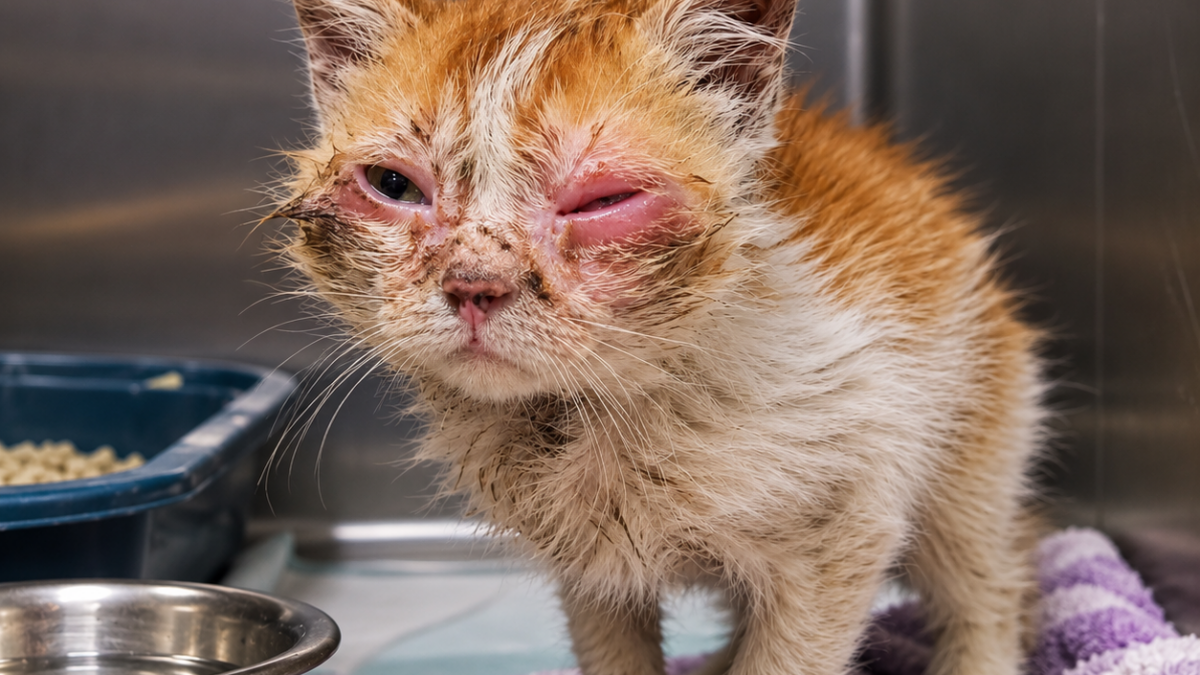
PART 2
I turned so quickly that the kitten shifted inside my arms.
The man standing behind me looked to be in his late fifties. Heavy rain jacket. Gray mustache. Paper coffee cup in one hand.
I had seen him before.
He worked at—or maybe owned—the little convenience store across from the bus stop.
“What did you say?”
His eyes stayed on the kitten.
“Don’t call him Milo.”
“Why?”
The man looked away toward his store.
“I shouldn’t have said anything.”
I stepped forward.
“You know this kitten.”
He said nothing.
“You knew his name.”
Still nothing.
The rain drummed against the pharmacy awning.
I could feel the kitten trembling beneath my jacket.
“What happened to him?”
The man finally looked at me.
“I don’t know.”
“That’s a lie.”
His jaw tightened.
“I saw somebody leave him.”
Every muscle in my body went still.
“When?”
“This morning.”
I stared at him.
“This morning?”
“Around nine.”
It was after five.
The kitten had been sitting there for hours.
In rain.
In pain.
Barely able to see.
“You watched someone leave a sick kitten on the sidewalk and you did nothing?”
His face changed.
“I thought the guy was coming back.”
“For eight hours?”
“I didn’t know it was that bad.”
I looked down at the swollen face inside my jacket.
“He couldn’t even see.”
“I know that now.”
“Who left him?”
The man hesitated.
“His name’s Tyler.”
“Tyler what?”
“I don’t want trouble.”
That sentence made something harden inside me.
“You’re already in it.”
His eyes flashed.
“Excuse me?”
“You knew enough to tell me not to call him Milo. You knew somebody left him. So either you help me now or I call animal control and tell them exactly where I found him and exactly who watched him get dumped.”
He stared at me.
For a second I thought he might walk away.
Then he sighed.
“Tyler Dean.”
“Where does he live?”
“Two blocks over. Above the laundromat.”
“Is he the owner?”
“Sort of.”
“What does ‘sort of’ mean?”
“He has cats.”
“How many?”
“I don’t know.”
“Is Milo one of them?”
The man rubbed his forehead.
“I’ve seen the kitten before.”
“Where?”
“In Tyler’s arms. In the store. A few times.”
I looked at the collar fragment.
“So why did you tell me not to call him Milo?”
His voice dropped.
“Because that’s what Tyler called him before he cut the collar off.”
I stared at him.
“You saw that?”
He nodded once.
“Today?”
“Yes.”
My stomach twisted.
“What exactly did you see?”
The man glanced toward his store again.
“I was opening up. Tyler came across the street carrying a cardboard carrier. He set the kitten down near the bus stop.”
“Then?”
“He took off the collar.”
“Why?”
“I don’t know.”
“You just said he cut it.”
“He did.”
“With what?”
“Pocketknife.”
“Then what?”
“He left.”
“That’s it?”
“Yes.”
“Did he say anything?”
The man closed his eyes briefly.
“He said, ‘Somebody will deal with it.’”
My grip tightened around the towel.
“What’s your name?”
“Frank Delaney.”
“Frank, I need you to remember everything you just told me.”
“Why?”
“Because I’m taking this kitten to the clinic, and then I’m calling animal control.”
Frank looked alarmed.
“You’re involving police?”
“I’m involving whoever needs to be involved.”
He lowered his voice.
“Tyler’s not right.”
“What does that mean?”
“He gets angry.”
“So do I.”
“You don’t understand.”
“Then explain it.”
Frank looked across the street.
There was genuine fear in his face.
Not theatrical fear.
Experience.
“He’s threatened people before.”
“For what?”
“Complaining about the cats.”
I stopped.
“What cats?”
Frank said nothing.
I took a step closer.
“What cats?”
He exhaled.
“He breeds them.”
My stomach dropped.
“What kind?”
“Whatever he can sell.”
The rain suddenly felt colder.
“How many?”
“I told you, I don’t know.”
“Where?”
“Upstairs. Sometimes in the back garage behind the building.”
“Does animal control know?”
“People have called.”
“What happened?”
Frank shrugged.
“He cleans up when they come.”
That sentence followed me all the way to the clinic.
I called ahead.
My coworker, Megan, answered.
“Lakeview Animal Hospital.”
“It’s Emily.”
“You sound weird.”
“I’m bringing in a kitten.”
“Your kitten?”
“No.”
“How bad?”
I looked down.
Milo’s visible eye had closed.
“Bad.”
Dr. James Keller was still at the clinic when I arrived.
He had been my supervising veterinarian for four years, and he had seen me carry in enough injured animals that he didn’t waste time asking why I was off the clock.
He took one look at Milo and said, “Treatment room two.”
Megan brought warmed towels.
I told them what I knew while Dr. Keller examined him.
Temperature low.
Heart rate elevated.
Severely dehydrated.
Underweight.
The facial swelling was warm and painful.
When Dr. Keller gently palpated the jawline, Milo cried.
A real cry this time.
Thin.
Broken.
But louder than before.
“There’s an abscess,” Dr. Keller said.
“Bite?”
“Could be. Could be penetrating trauma. Could be a wound that closed over and infected.”
“Eye?”
“Swelling may be mechanical, but I’m worried about the globe.”
He used fluorescein stain when Milo was stable enough.
No obvious corneal rupture.
That was our first piece of good news.
The second came after X-rays.
No skull fracture.
But there was a small puncture near the jaw and a deep pocket of infection.
“What caused it?” I asked.
Dr. Keller shook his head.
“Could be another animal. Could be wire. Could be anything sharp enough.”
I thought about Frank’s words.
He breeds them.
“How long has this been developing?”
“Not today.”
“Days?”
“Yes.”
“Long enough that somebody would have noticed?”
Dr. Keller looked at me.
“Absolutely.”
That mattered.
We gave fluids.
Antibiotics.
Pain medication.
Warmth.
Milo’s bloodwork showed infection and dehydration but no organ failure.
He was sick.
Very sick.
But not beyond us.
At seven-thirty, animal control officer Carla Ruiz arrived.
I knew her.
Not well.
Enough to recognize the dark green jacket and no-nonsense expression.
“You found him?”
“Yes.”
I gave her the collar fragment in a plastic specimen bag.
She photographed it.
Then Milo.
Then the wounds.
Then she listened while I told her about Frank.
“Did Frank give you permission to use his name?”
“He gave me his name.”
“That wasn’t my question.”
“He was scared.”
Carla nodded.
“That’s common.”
“Common?”
“When people know the person responsible.”
I folded my arms.
“Frank says people have complained about cats at Tyler Dean’s place.”
Her expression changed slightly.
“You know that name?”
“I didn’t say that.”
“You didn’t have to.”
Carla looked toward Dr. Keller.
“I’ll need medical findings in writing.”
“You’ll have them,” he said.
“Microchip?”
Megan had already scanned.
“No chip.”
Carla looked at me.
“What are you planning to do with him?”
“Tonight?”
“Yes.”
“He’s staying here.”
“And after?”
I looked at Milo.
“Foster, if needed.”
Megan laughed softly.
I turned.
“What?”
“You already named him.”
“He came with a name.”
“Sure.”
Carla ignored us.
“I’m going to talk to Frank.”
“Then Tyler?”
“Maybe.”
“Maybe?”
“Emily.”
I knew that tone.
“Evidence first.”
“I hate that phrase.”
“You work in medicine. You live by that phrase.”
She had me there.
Milo’s abscess needed drainage.
Dr. Keller sedated him once his temperature and hydration improved enough.
The amount of infected material that came out made Megan swear under her breath.
I stood beside the table.
His tiny face looked somehow smaller after the swelling reduced.
Still distorted.
Still painful.
But underneath it, I could finally see the kitten.
Orange patch over one ear.
White blaze down his nose.
Pink nose beneath the scratches.
“Hey, Milo.”
His ears moved under sedation.
Dr. Keller looked at me.
“He knows your voice.”
“Or he hates it.”
“Same thing with cats.”
We flushed the abscess and placed a small drain.
His right eye opened slightly after pressure reduced.
The eye itself looked intact.
I could have cried.
Instead I helped tape his IV line.
At nine, Carla called.
“Frank confirmed your story.”
“Good.”
“He also has security cameras.”
I stood straighter.
“Did they catch it?”
“He thinks so.”
“Thinks?”
“The system records over itself every few days. He’s downloading the file now.”
“What about Tyler?”
“We made contact.”
“And?”
“He says the kitten isn’t his.”
I laughed.
Not because it was funny.
“Of course.”
“He says he found the kitten near his building this morning and moved it to the bus stop because he assumed somebody would see it.”
“Did he explain why he cut off the collar?”
“He denies doing that.”
“Frank saw him.”
“Yes.”
“Does Tyler know Frank saw him?”
“Not from me.”
“What else did he say?”
“He says he doesn’t breed cats.”
I closed my eyes.
“Frank says otherwise.”
“We’re checking.”
“How?”
Carla paused.
“Emily, your role is medical witness right now.”
“My role is the person holding the kitten he threw away.”
“And that’s exactly why I need you not to contact him.”
“I wasn’t planning to.”
“Good.”
She knew me well enough to add:
“That means no social media either.”
“I know.”
“Do you?”
“Yes.”
Megan looked at me from across the treatment room.
I pointed at her.
“Don’t.”
“I didn’t say anything.”
“You made a face.”
“You have a posting face.”
“I do not.”
“You absolutely do.”
I put my phone in my pocket.
Milo stayed overnight.
I didn’t.
Not because I wanted to leave.
Because Dr. Keller ordered me home.
“You’ve been here since your shift ended.”
“I can sleep in the break room.”
“No.”
“I’m not asking for pay.”
“Still no.”
I looked toward Milo’s cage.
“He’s stable.”
“Exactly.”
“What if he crashes?”
“Then the overnight doctor will call you.”
“What if—”
“Emily.”
I hated when he used my full professional voice against me.
“Go.”
I went home.
I lasted forty-three minutes before texting Megan.
**How is he?**
She replied:
**Sleeping. Still alive. Stop texting.**
Ten minutes later:
**He ate 2 teaspoons.**
I sat on my kitchen floor and cried.
Two teaspoons.
That was enough.
The next morning, I came in early.
Milo was awake.
Both eyes open now, though the right remained puffy.
He watched me approach.
When I opened the cage, he lifted his head.
“Hey.”
He tried to stand.
His legs shook.
I slid my hand beneath his chest.
He leaned into it.
Then he did the same thing he had done on the sidewalk.
Placed one paw on my hand.
Megan stood behind me.
“Okay, that’s disgusting.”
I looked over my shoulder.
“What?”
“You’re keeping him.”
“I am fostering.”
“Sure.”
“We don’t know ownership status.”
“Sure.”
“Animal control decides.”
“Sure.”
“You’re annoying.”
“Sure.”
Carla arrived at ten.
This time she brought another officer.
Not police.
Humane investigations.
His name was Marcus Webb.
He carried a tablet and a folder.
“That good or bad?” I asked.
Carla said, “Depends whose side you’re on.”
Marcus looked through Milo’s photographs and medical record.
Then he asked Dr. Keller:
“If untreated, where was this headed?”
“Systemic infection. Sepsis. Possible loss of the eye. Death eventually.”
“How long without treatment?”
“I can’t give an exact clock.”
“But urgent?”
“Very.”
“Would an average owner know something was wrong?”
Dr. Keller almost smiled.
“His face was twice normal size.”
Marcus nodded.
Then showed me a still frame from Frank’s security video.
Tyler.
I recognized him from around the neighborhood.
Early thirties.
Lean.
Baseball cap.
Dark hoodie.
Holding a cardboard pet carrier.
Timestamp: 8:42 a.m.
Second frame.
Milo on the sidewalk.
Third frame.
Tyler crouching.
Something red in his hand.
Fourth.
Tyler walking away with empty carrier.
My stomach tightened.
“Got him.”
Marcus said, “Got evidence.”
“Same thing.”
“No.”
He looked at me directly.
“Keep that distinction.”
I hated him for being right.
The video didn’t show the knife clearly.
But it showed enough.
Then Marcus pulled up something else.
A screenshot.
Online marketplace listing.
**ADORABLE ORANGE/WHITE KITTENS—READY NOW—$175**
Photographs.
Five kittens.
One was Milo.
Healthy.
Face normal.
Red collar.
Date: three weeks earlier.
I stared.
“That’s him.”
“Yes.”
“Tyler posted this?”
“Account tied to him.”
Another listing.
Different litter.
Six months earlier.
Another.
Eight months.
Another.
One year.
“How many cats?”
“We’re working on that.”
“Are they still there?”
Marcus didn’t answer.
My voice sharpened.
“Are there still cats in that apartment?”
“We don’t know.”
“Then go look.”
“We are building enough for a warrant.”
“Frank says animal control has been called before.”
Carla looked unhappy.
“We have two prior complaints.”
“What happened?”
“First visit: no access.”
“Second?”
“Tyler allowed an inspection. Four adult cats, all appeared in acceptable condition. No kittens present.”
“When?”
“Two months ago.”
“So he moved them.”
“Possibly.”
The word possibly became another word I hated.
Marcus tapped his tablet.
“We also have a landlord who says Tyler is only allowed two pets.”
“Then why does nobody do anything?”
“Because suspicious is not the same as proven.”
I stepped closer.
“Milo is proven.”
“Yes.”
“That should be enough.”
“For abandonment?”
“Isn’t it?”
“Maybe.”
I almost exploded.
Marcus raised a hand.
“But it may also be enough to connect to a larger pattern.”
That stopped me.
“What pattern?”
He showed me a message someone had sent to animal control after seeing the marketplace listing.
A woman named Sarah Nolan.
**Bought kitten from Tyler Dean four months ago. Kitten developed severe respiratory illness within 48 hours. Seller refused refund and told me ‘they’re cheap, just get another.’**
I stared at the words.
“Where is the kitten?”
“Alive. She paid for treatment.”
“Did she report him?”
“She tried.”
“Then?”
“She was told pet-sale disputes are often civil unless there is clear evidence of cruelty or fraud.”
“And now?”
“Now we have a live animal, medical documentation, video, witness statement, listings, and complaints.”
I looked at Milo.
His little head rested on the towel.
“Good.”
Marcus glanced at me.
“That does not mean we rush.”
“Why not?”
“Because if there are more animals inside, I want one entry that holds up.”
That was the first time his caution made sense to me.
That afternoon, someone came into the clinic asking for Milo.
Tyler Dean.
I knew it before the receptionist said the name.
I was in the treatment room when Jenny from the front desk came back.
“Emily.”
“What?”
“Guy out front says you stole his cat.”
My entire body went cold.
“Tyler?”
She nodded.
Dr. Keller heard.
“Stay here.”
“I’m coming.”
“No.”
“This involves me.”
“It involves the clinic.”
“I found him.”
“And you are not confronting him in our lobby.”
Carla had told me not to contact him.
Technically, I wasn’t contacting him.
He had come to me.
Still.
Dr. Keller had that look.
I stayed.
Mostly.
I stood behind the treatment-room door where I could hear.
Tyler’s voice carried.
“I want the cat.”
Jenny remained calm.
“The animal is under protective veterinary care.”
“That’s my property.”
“Animal control is involved.”
“I don’t care.”
“You’ll need to speak with them.”
“I’m speaking with you.”
Then Dr. Keller:
“You need to lower your voice.”
“Who are you?”
“The veterinarian treating him.”
“You people cut him open without permission?”
“He required emergency treatment.”
“You had no right.”
“Emergency care was necessary to preserve life.”
“I said I want him back.”
“You cannot remove him.”
Silence.
Then Tyler laughed.
“Because the vet tech wants him?”
My skin prickled.
How did he know?
“She found him,” Dr. Keller said.
“She stole him.”
“He was abandoned on a public sidewalk.”
“I did not abandon him.”
“Then animal control can sort that out.”
Tyler’s voice dropped.
“You tell Emily Carter to stay out of my business.”
Dr. Keller went quiet.
That scared me more than shouting.
“How do you know her last name?”
Silence.
Then Tyler said, “Everybody knows everybody around here.”
The front door opened.
Closed.
Jenny came back five seconds later.
“He’s gone.”
I stepped out.
Dr. Keller looked furious.
“Call Carla.”
“I am.”
My hands shook as I dialed.
Tyler knew my name.
Not just Emily.
Carter.
Maybe Frank told him.
Maybe somebody at the market.
Maybe clinic staff accidentally said it.
There were harmless explanations.
My body didn’t care.
Carla arrived within half an hour.
She took the clinic’s lobby camera footage.
Tyler had indeed demanded Milo back.
That mattered because he had told animal control the kitten wasn’t his.
Contradiction.
Finally.
Something clean.
“You hear that?” I said. “He just claimed ownership.”
Carla nodded.
“Yes.”
“After denying it.”
“Yes.”
“So arrest him.”
“No.”
I exhaled sharply.
She held up a hand.
“Emily.”
“What now?”
“He is talking himself into a case. Let him.”
I hated patience.
But she was right.
Tyler made another mistake that night.
He posted online.
A long rambling statement accusing a “local vet employee” of stealing a kitten he had rescued.
He claimed Milo had “a minor swollen cheek.”
He said he had been arranging treatment.
He said I had taken the cat and refused to return him because “some people like playing hero.”
Megan sent me the screenshot.
I started typing a reply.
Deleted it.
Started again.
Deleted it.
Then I sent it to Carla.
She replied:
**Thank you. Do not respond.**
I threw my phone onto the couch.
Five minutes later, Sarah Nolan messaged me.
I didn’t know her.
She had found my profile through mutual neighborhood groups.
**Are you the vet tech who found Milo?**
I stared.
Then remembered Carla.
I screenshotted and sent it.
Carla called.
“You can talk to her if she wants to give you information, but do not lead her.”
“What does that mean?”
“Don’t ask questions that suggest answers.”
“I work in veterinary medicine, Carla, not homicide.”
“You’re emotionally involved.”
“Obviously.”
“Exactly.”
I called Sarah.
Her voice shook.
“I bought a kitten from Tyler.”
“I heard.”
“Did they tell you about Clover?”
“Only that she got sick.”
Sarah took a breath.
“She almost died.”
“What happened?”
“Upper respiratory infection. Parasites. Dehydration. She was eight weeks old, maybe younger.”
“Did Tyler provide vet records?”
“He gave me a paper.”
“What paper?”
“Vaccination record.”
“From what clinic?”
“That’s the thing.”
She paused.
“There wasn’t one.”
“What?”
“It had vaccine stickers, dates, initials. But when my vet called the clinic name written at the top, they said they’d never seen the kitten.”
My stomach tightened.
“Do you still have it?”
“Yes.”
“Tell animal control.”
“I did today.”
“Good.”
“There’s more.”
Of course there was.
“What?”
“When Clover got sick, I messaged Tyler.”
“What did he say?”
“I still have the messages.”
She read one aloud.
**They all get sniffles. If she doesn’t make it, I can give you another from the next batch.**
I closed my eyes.
Another from the next batch.
Replacement inventory.
Not a living animal.
Sarah continued.
“I asked him to pay half the vet bill.”
“And?”
“He blocked me.”
“Did you see the mother cat?”
“Yes.”
“Where?”
“Basement behind his building.”
My eyes opened.
“Basement?”
“He met me in the alley and took me through a garage.”
“How many cats?”
“At least six adults. Maybe more.”
“Condition?”
“I wasn’t paying attention. I was excited.”
She started crying.
“I feel stupid.”
“You’re not.”
“I gave him money.”
“You thought you were buying a healthy kitten.”
“I should’ve known.”
“Sarah.”
She went quiet.
“Stop doing his defense for him.”
That was advice I would later need myself.
Sarah’s screenshots went to Marcus.
So did the fake vaccine paper.
The next day, the landlord allowed investigators access to common basement areas but not Tyler’s private locked storage unit without a warrant.
What they saw outside it helped.
Odor.
Litter waste.
Scratching sounds.
Multiple food bags.
Used cages stacked nearby.
Marcus called me that evening.
“We’re applying.”
“For the warrant?”
“Yes.”
“When?”
“Soon.”
“Can you tell me—”
“No.”
“Marcus.”
“No.”
“You’re becoming my least favorite person.”
“I can live with that.”
The warrant was executed forty-eight hours later.
I found out because Carla called before sunrise.
“Do you want the good news first?”
“Yes.”
“We found the cats.”
“How many?”
“Eleven.”
I sat up in bed.
“Eleven?”
“Seven adults. Four kittens.”
“Condition?”
“Mixed.”
“What does that mean?”
“Some okay. Some not.”
“Any like Milo?”
“One kitten with untreated conjunctivitis. One adult female very thin.”
“Are they out?”
“Yes.”
I exhaled.
“And the bad news?”
“One cat was already dead.”
My chest tightened.
“What?”
“Adult female.”
“Cause?”
“Unknown. Body was in a sealed trash bag in the storage area.”
I closed my eyes.
“Jesus.”
“Emily.”
“What?”
“We also found medical supplies.”
“What kind?”
“Vaccines. Antibiotics. Syringes.”
“Prescription?”
“Some.”
“How?”
“Working on it.”
“Was Tyler there?”
“Yes.”
“Arrested?”
“He was detained. Charges pending.”
I got dressed and drove to the clinic even though I wasn’t scheduled until eight.
Some of the seized cats were being distributed among emergency partner hospitals.
Three came to us.
A gray adult female with ribs showing.
Two kittens.
One had severe eye discharge.
Dr. Keller looked at me.
“Don’t.”
“What?”
“You cannot adopt all of them.”
“I wasn’t going to.”
“You had the thought.”
“No.”
“Your face had the thought.”
We stabilized them.
The adult female had recently been nursing.
That meant some kittens were hers.
Maybe Milo.
DNA would never be necessary legally unless ownership became an issue, but looking at her orange patches, I wondered.
She was sweet.
Terrified.
When I opened the cage, she pressed flat against the back.
No aggression.
Just fear.
“Hey, sweetheart.”
Megan looked at her intake sheet.
“Temporary ID: F-7.”
“No.”
“Don’t name her.”
“I didn’t.”
“You’re thinking.”
“Stop.”
We eventually called her Rosie.
Of course we did.
Within a week, the investigation became bigger than Milo.
The dead cat’s necropsy showed severe untreated uterine infection—pyometra.
Potentially treatable.
Fatal if ignored.
Tyler had apparently kept her after she stopped producing litters.
That detail enraged me more than I expected.
One of the seized antibiotics was veterinary amoxicillin from an old prescription belonging to another animal.
Investigators believed Tyler had been dosing cats himself without veterinary supervision, sometimes using expired medication.
The vaccines were purchased through farm-supply channels where legally available products could be obtained without a clinic.
The fake records were his own creation.
Not sophisticated.
Enough to fool buyers who trusted him.
Then investigators found a notebook.
Breeding dates.
Litter counts.
Sale prices.
Deaths.
One column labeled:
**LOSS**
Under Milo’s litter were five entries.
Four sold or reserved.
One marked:
**face bad—dump**
I stared at the photograph Marcus showed me.
No poetry.
No excuse.
Two words.
Face bad.
Dump.
I had to put my hands flat on the table.
“You okay?”
“No.”
Marcus waited.
“That’s him?”
“We believe so.”
“You believe?”
“Age. color. timing. listing. collar. Frank’s video. Yes.”
I looked at the line again.
**face bad—dump**
“He knew.”
“Yes.”
“He didn’t just panic that morning.”
“No.”
“He wrote it down.”
“Yes.”
“Like inventory.”
Marcus closed the folder.
“That’s why we waited.”
I looked at him.
He didn’t say I told you so.
He didn’t have to.
The stronger case mattered.
Tyler was charged with multiple counts related to animal cruelty, abandonment, falsifying vaccination documentation, and violations connected to his unlicensed animal sales operation.
Some charges were misdemeanors.
Some more serious.
The exact legal language was less dramatic than people expected.
The evidence wasn’t.
He was released pending court with conditions prohibiting possession of animals.
He violated that condition in eleven days.
That was his next mistake.
A neighbor photographed him carrying a cat carrier into a friend’s garage.
Animal control investigated.
Inside were two cats registered to nobody.
Tyler claimed they belonged to the friend.
The friend initially agreed.
Then messages surfaced.
Tyler had written:
**Keep these two till court cools off.**
One was pregnant.
His bond conditions tightened.
His attorney probably hated him.
I know Carla did.
“What is wrong with this man?” I asked.
She sighed.
“He thinks rules are obstacles, not boundaries.”
That explained more than cruelty alone.
Tyler began targeting me online.
Never direct threats at first.
Posts.
Vague comments.
**Some people steal pets for attention.**
**Vet workers think they’re cops now.**
**Funny how rescuers make money off donations while ruining people’s lives.**
I didn’t respond.
That nearly killed me.
Then one evening I came home and found a dead mouse on my doormat.
Could have been a cat.
Could have been coincidence.
I photographed it anyway.
The next night, my downstairs neighbor saw a man in a baseball cap standing near my building.
No proof it was Tyler.
I called police.
Documented.
Changed routines.
Dr. Keller walked me to my car after late shifts.
That made me angry in a new way.
He had hurt animals.
Now he was making me feel unsafe in my own home.
Megan said, “Stay with me for a few days.”
“I’m not leaving my apartment because of him.”
“That’s not winning.”
“I didn’t say it was.”
“It sounds like you think fear means he won.”
I looked at her.
She continued.
“Fear is information. Use it.”
I stayed with her for three nights.
It annoyed me.
It was also sensible.
On the fourth day, Tyler made the mistake that finally turned vague harassment into something concrete.
He came to the clinic parking lot.
I was walking toward my car when he stepped from beside a pickup.
I stopped.
He stayed about fifteen feet away.
“Emily.”
I reached into my pocket and started recording.
“What do you want?”
“You got what you wanted.”
“I didn’t want any of this.”
“You took my animals.”
“I didn’t take them.”
“You started it.”
“You abandoned Milo.”
His jaw tightened.
“That cat was dying.”
“So you left him.”
“I knew somebody would pick him up.”
“That is not care.”
“You made it into something bigger.”
“No. Your notebook did.”
His face changed.
He hadn’t known I knew about the notebook.
“Where did you hear that?”
I said nothing.
He took one step closer.
I stepped back.
“Stay there.”
“I’m not touching you.”
“Good.”
“You think you’re safe because you work at a vet?”
My skin went cold.
“What does that mean?”
“It means people should mind their business.”
“That sounds like a threat.”
“It’s advice.”
Same sentence people always use when they want a threat to wear a suit.
I held up my phone.
“You’re being recorded.”
He stopped.
Then laughed.
“You always this dramatic?”
“No.”
I looked at him.
“Just around men who dump sick kittens and then follow women to parking lots.”
His face hardened.
“Give me Milo.”
“No.”
“He’s mine.”
“You told animal control he wasn’t.”
“I was scared.”
“Then you demanded him back at the clinic.”
“I changed my mind.”
“He’s not property you can change your mind about after nearly killing him.”
Tyler took another step.
A voice behind me said:
“That’s far enough.”
Dr. Keller.
He stood at the clinic door.
Phone in hand.
Tyler looked at him.
Then me.
“You’re going to regret making this public.”
Dr. Keller said, “Leave.”
Tyler pointed at me.
“This isn’t over.”
Then he walked away.
It was over in about thirty seconds.
But thirty seconds changed the criminal case again.
The recording went to police.
The clinic’s parking lot camera captured the approach.
He was charged with violating conditions related to harassment and intimidation.
More importantly, the judge modified release conditions.
No contact.
Stay-away order.
Monitoring.
For the first time since I found Milo, I slept through the night.
Milo, meanwhile, was becoming impossible.
His face healed beautifully.
The drain came out after three days.
Swelling decreased.
His right eye fully reopened.
No permanent vision loss.
He gained weight.
He discovered toys.
Then curtains.
Then the inside of my kitchen cabinets.
I had taken him home as a temporary medical foster.
Temporary lasted two weeks before the rescue coordinator handed me adoption paperwork.
“You know what this is.”
“I’m fostering.”
“You bought him a window hammock.”
“He needed enrichment.”
“You put his name on a ceramic bowl.”
“It was on sale.”
“You refer to your apartment as ‘our place.’”
“That proves nothing.”
She slid the form toward me.
“Sign.”
I signed.
Milo Carter.
Ridiculous.
Perfect.
Rosie, the thin adult female, recovered too.
She was spayed.
Her mammary glands suggested multiple litters over a short period.
A foster family adopted her after three months.
The two kittens went together to a retired couple.
The pregnant female Tyler hid with his friend delivered four kittens safely in foster care.
All were eventually sterilized and adopted.
Eleven living cats came out of that operation.
Then six kittens from the hidden pregnancy.
Seventeen animals whose future changed because one kitten had been dumped where I happened to hear him.
That thought made me uncomfortable.
People kept calling me a hero.
I wasn’t.
I got off a bus.
I heard a sound.
I stopped.
Frank had been there first.
That fact stayed with me.
He had seen Milo left.
Then watched people walk past.
He carried guilt differently.
At first, he avoided me.
Then one morning he came to the clinic with a cardboard box.
I tensed.
“What is that?”
“Blankets.”
“What?”
“For the rescue.”
I looked inside.
New fleece blankets.
Still wrapped.
“Why?”
Frank shrugged.
“I thought you could use them.”
“We can.”
He looked through the lobby window where Milo sat behind reception in a carrier waiting for recheck.
Milo meowed.
Loudly.
Frank’s eyes filled.
“He couldn’t do that before.”
“No.”
“I should’ve picked him up.”
“Yes.”
Frank flinched.
I almost softened it.
Then didn’t.
He deserved truth.
So did I.
He nodded.
“I know.”
After a moment I added, “You also gave us the video.”
“After.”
“Yes.”
“I wish I’d done it before.”
“So do I.”
He looked at me.
“But you did it.”
His shoulders dropped slightly.
That was not forgiveness.
It was proportion.
Frank later installed a small covered water station outside his store for neighborhood strays.
He kept the bowls clean.
Partnered with a rescue to trap and sterilize two feral cats behind the building.
He also testified.
That mattered most.
The court process took almost a year.
Long enough for Milo to become full-grown.
Long enough for the initial public anger to cool.
Long enough for Tyler to start telling people the whole thing was exaggerated.
His defense strategy changed several times.
First, Milo wasn’t his.
Then Milo was his but he had been “temporarily rehomed.”
Then Milo was sick because of an unknown street infection after wandering.
Then the notebook was “just business shorthand.”
Then the fake vaccine papers were “templates.”
Then the cats in the storage room were “rescues.”
Every new story collided with an older one.
The prosecution built the case like a wall.
One piece at a time.
Frank’s video.
The marketplace listings.
Sarah’s messages.
Fake vaccination record.
Medical evidence.
Notebook.
Dead cat necropsy.
Search photographs.
Tyler’s statements.
Clinic video.
Parking-lot recording.
The hidden cats.
His own messages telling a friend to keep animals “till court cools off.”
At trial, Sarah testified before I did.
She brought Clover’s original fake vaccine sheet.
Tyler’s attorney tried to frame her as an angry buyer.
“Your kitten survived, correct?”
“Yes.”
“So Mr. Dean did not sell you a dying animal.”
Sarah looked at him.
“She spent four days in oxygen.”
“But survived.”
“Yes.”
“And you kept her.”
“Yes.”
“So ultimately you received the animal you purchased.”
Sarah’s face changed.
“She wasn’t a toaster.”
The courtroom went silent.
The attorney paused.
Sarah continued before being stopped.
“I didn’t buy a product that arrived scratched. I took home a living kitten who was already sick, and he knew.”
The judge reminded her to answer questions only.
But the line stayed.
Then Frank testified.
That was harder to watch.
The prosecutor asked:
“What did you see on the morning Milo was abandoned?”
Frank described Tyler crossing the street.
The carrier.
The collar.
The knife.
The words:
“Somebody will deal with it.”
“Did you intervene?”
“No.”
“Why not?”
Frank swallowed.
“I was afraid of him.”
“Had he threatened you?”
“Once before.”
“For what?”
“I complained about cats getting into the alley behind my store.”
“What did he say?”
Frank looked toward Tyler.
“He said I should worry about my own windows.”
The prosecutor paused.
“How did you interpret that?”
“As a threat.”
“Did you report it?”
“No.”
“Why?”
“Because I didn’t want trouble.”
“What did you do after Tyler left Milo?”
Frank’s voice dropped.
“Nothing.”
“Did you check on the kitten?”
“No.”
“Did you know he was sick?”
“I could see his face was swollen.”
“Then why did you leave him?”
Frank’s eyes filled.
“Cowardice.”
Nobody moved.
He didn’t make excuses.
The defense tried anyway.
“You disliked my client before this event.”
“I was afraid of him.”
“That doesn’t answer the question.”
“I didn’t know him well enough to like him.”
“You had complained about animals near your store.”
“Yes.”
“You benefited when they were removed.”
Frank looked confused.
“Benefited?”
“Fewer stray animals near your business.”
Frank shook his head.
“I would rather clean cat poop every day than watch another one sit in the rain like that.”
The attorney moved on.
I testified the next morning.
Walking into court felt different from walking into an exam room.
In the clinic, I knew my role.
Vitals.
Restraint.
Medication.
Records.
Court was language.
Memory.
Precision.
The prosecutor showed me the first photograph I took at the bus stop.
Milo’s face.
Swollen.
Wet.
Eyes barely open.
I had not looked at that image in months.
My throat tightened.
“Is this how Milo appeared when you found him?”
“Yes.”
“Could he walk?”
“Barely.”
“Did he attempt to run from you?”
“No.”
“Why was that notable to you?”
“Because frightened kittens normally try to escape. Severe weakness can remove that option.”
“What did he do instead?”
“He put his paw on my hand.”
My voice cracked.
The prosecutor paused.
“What did you do?”
“I picked him up.”
We moved through the medical record.
Temperature.
Weight.
Abscess.
Dehydration.
Pain.
Dr. Keller later handled the professional medical conclusions.
My part was what I saw.
Then the collar.
The defense attorney stood.
“Ms. Carter, you are emotionally attached to Milo.”
“Yes.”
“You adopted him.”
“Yes.”
“You financially benefited from public donations connected to this case?”
“No.”
“Your clinic received payment for his care.”
“Our clinic treated him.”
“Was his bill reduced?”
“Yes, through rescue assistance.”
“So your employer benefited financially.”
“By providing veterinary treatment?”
He frowned.
I knew I sounded sarcastic.
The judge gave me a look.
I corrected myself.
“Yes. The clinic was paid for medical services.”
“You publicly presented yourself as Milo’s rescuer.”
“No.”
“You appeared in a local news segment.”
“The clinic asked me to explain his recovery.”
“You allowed your name to be used.”
“Yes.”
“You gained attention.”
I stared at him.
“If attention was what I wanted, I would have chosen a story that didn’t involve watching a twelve-week-old kitten struggle to breathe.”
He paused.
“Please answer the question.”
“Yes. People saw my name.”
“Thank you.”
Then came the question he thought mattered.
“You cannot personally testify that Mr. Dean caused Milo’s facial injury, correct?”
“No.”
“You did not see him injure the kitten.”
“No.”
“You do not know whether the injury occurred while Milo was in Mr. Dean’s possession.”
“Not personally.”
“So your assumption that Mr. Dean was responsible for Milo’s medical condition is speculation.”
I looked at the prosecutor.
Then the judge.
Then answered carefully.
“I can testify that he left a visibly ill kitten on the sidewalk without arranging care.”
The attorney’s mouth tightened.
“That wasn’t my question.”
“It is what I personally witnessed through the evidence available to me.”
The judge told me to answer directly.
Fine.
“No. I did not see the injury happen.”
The defense seemed satisfied.
Then Dr. Keller testified.
He was better at court than I expected.
Probably because he had spent twenty years explaining difficult truths to people who wanted simpler ones.
The defense asked:
“Could Milo’s abscess have developed from an injury occurring after Mr. Dean last observed him healthy?”
“Yes.”
“Could it have occurred from a bite by another cat?”
“Yes.”
“Could it have developed rapidly?”
“Yes.”
“So Mr. Dean might not have known how serious it was.”
Dr. Keller looked at him.
“The question is not whether he knew the exact bacterial load.”
A few people shifted.
The attorney said, “That wasn’t my question.”
Dr. Keller continued:
“A kitten with facial swelling severe enough to close an eye requires veterinary care regardless of cause.”
“Could a layperson mistake swelling for something minor?”
“Not to that degree.”
“You cannot know what Mr. Dean believed.”
“Correct.”
“Thank you.”
Then the prosecutor stood.
“Doctor, if you saw a kitten in Milo’s condition on a sidewalk, what would you do?”
“Treat it as an emergency.”
“If you owned the kitten?”
“Seek veterinary care.”
“If you could not afford care?”
“Surrender to a shelter, rescue, clinic, humane agency—anything that transfers the animal to someone able to help.”
“Would cutting off identification and leaving the animal beside a bus stop qualify?”
“No.”
That was enough.
The hardest evidence came from Tyler’s notebook.
His attorney fought to minimize it.
“Face bad—dump,” the prosecutor read.
Tyler stared straight ahead.
His attorney argued “dump” meant “remove from breeding stock.”
Then the prosecutor produced the surveillance footage from that exact morning.
Tyler carrying Milo.
Removing the collar.
Leaving him.
The courtroom became quiet.
Then came Sarah’s messages.
**If she doesn’t make it, I can give you another from the next batch.**
Then the hidden-cat message.
**Keep these two till court cools off.**
Every excuse shrank.
The final turn came from someone I had never met.
Tyler’s former girlfriend, Kayla Morgan.
She had refused to cooperate at first.
Then changed her mind shortly before trial.
Her testimony explained the dead female cat.
The breeding cycles.
The garage cages.
The money.
Tyler sold kittens to cover rent and gambling debts.
Not a sophisticated business.
A desperate one.
He bought cheap food.
Skipped routine vet care.
Treated obvious infections himself.
If a kitten became too sick to sell, he gave it away, dumped it, or simply stopped tracking it.
Kayla said:
“He wasn’t trying to torture them.”
The defense latched onto that.
“No?”
“No.”
“Did he enjoy seeing them suffer?”
“Not that I ever saw.”
“Was he cruel to them physically?”
“Not usually.”
“Then why are you here?”
Kayla looked toward Tyler.
“Because not caring whether they suffered was enough.”
The courtroom went still.
That line explained everything.
Not theatrical sadism.
Indifference sharpened by money and entitlement.
The prosecutor asked:
“Did Mr. Dean know Milo was sick?”
“Yes.”
“How?”
“I told him.”
“When?”
“Two days before he dumped him.”
“What did you say?”
“That Milo’s face was swelling and he needed a vet.”
“What did he say?”
Kayla swallowed.
“He said he wasn’t paying three hundred dollars to save a kitten worth one seventy-five.”
No one moved.
There it was.
The price.
The calculation.
The life reduced to a margin.
“Did he attempt to sell Milo after that?”
“Yes.”
“To whom?”
“Two people canceled when they saw his face.”
“What happened next?”
“He said the kitten was useless.”
I looked down at my hands.
The prosecutor asked:
“Did he use the word ‘dump’?”
“Yes.”
Tyler’s attorney objected to repetition.
Overruled.
Kayla continued.
“He said he’d dump him near the bus stop because somebody always picks up animals there.”
Frank shut his eyes.
So did I.
That was the full loop.
Tyler had not abandoned Milo hoping he would die.
Some people thought that made it less bad.
To me, it made the logic colder.
He assumed somebody else would absorb the cost of his decision.
Some stranger’s time.
Some clinic’s treatment.
Some rescue’s money.
Some animal’s pain.
He counted on compassion while refusing to practice any himself.
Tyler was convicted on several of the animal cruelty and abandonment charges, falsification-related counts, and violations tied to the breeding operation.
Not every count stuck.
Real trials are messy.
One charge involving the dead adult cat could not establish enough direct causation for the highest level alleged.
Another document count was reduced.
I learned to accept that justice is not a perfect inventory.
He received jail time, probation, restitution, restrictions on possessing or selling animals, and mandatory mental-health and financial counseling.
His illegal breeding operation was shut down permanently.
The landlord terminated his lease for unauthorized commercial animal activity and property damage.
The friend who hid cats for him received a lesser penalty after cooperating.
Tyler appealed parts of the case.
Some issues dragged on.
But he never got Milo back.
That part was final.
Outside court after sentencing, reporters waited.
I wanted no part of it.
I slipped toward the side exit.
Tyler appeared behind me with two deputies and his attorney.
For one second, our eyes met.
He said my name.
“Emily.”
I stopped.
His attorney looked alarmed.
One deputy said, “Keep moving.”
Tyler ignored him.
“Is he alive?”
The question surprised me.
“Milo?”
“Yes.”
I stared.
“Why do you care?”
His face tightened.
“I asked.”
“He’s alive.”
Tyler swallowed.
“Can he see?”
“Yes.”
“Both eyes?”
“Yes.”
Something moved across his expression.
Relief.
Real relief.
I hated that.
Because I wanted him simple.
I wanted a man who felt nothing.
Instead, here was something more uncomfortable.
A person capable of relief after making choices that almost killed an animal.
I said, “He sleeps on my pillow.”
Tyler looked down.
“He always liked warm places.”
I felt anger rise.
“You knew that?”
He didn’t answer.
“You knew enough to know what he liked.”
The deputy shifted.
Tyler said quietly, “I didn’t think he’d get that bad.”
I stepped closer.
“You saw his face.”
He looked away.
“I thought somebody would pick him up.”
“That was your plan?”
“Yes.”
“Make a stranger care because you decided he wasn’t worth the money?”
His attorney said, “Mr. Dean, don’t engage.”
But Tyler answered.
“I was broke.”
“So was I.”
He looked at me.
“I put his first emergency bill on a credit card.”
Silence.
“I’m not saying that makes me better than you because I had options you didn’t. I’m saying surrender was an option. Calling a rescue was an option. Walking into any clinic and saying, ‘I can’t afford this’ was an option.”
Tyler’s jaw tightened.
“They judge you.”
“Maybe.”
I looked him straight in the face.
“Milo didn’t.”
That landed.
He looked toward the floor.
Then the deputy moved him forward.
I watched him leave.
There was no applause.
No triumphant music.
Just courthouse doors closing behind a man whose own choices had finally become expensive to him.
I thought I would feel victorious.
I didn’t.
I felt tired.
Then I went home.
Milo met me at the door.
He had developed a habit of waiting on the little rug whenever he heard my key.
He sat there with his tail wrapped around his feet.
Face normal.
Eyes bright.
One orange ear tilted.
I dropped my bag.
“Hey.”
He meowed.
Loud.
Demanding.
Completely uninterested in criminal justice.
I picked him up.
He immediately tried to climb onto my shoulder.
“You weigh twelve pounds now.”
He purred.
“Remember when you fit inside my jacket?”
He bit my hair.
“Good talk.”
Life after the case became quieter.
That took adjustment.
For almost a year, every phone call had meant evidence, hearing, clinic, reporter, investigator, witness.
Then suddenly nothing happened.
Milo ate breakfast.
I went to work.
Came home.
Cleaned litter.
Paid bills.
Watched television with twelve pounds of cat across my legs.
Normal became its own luxury.
Milo had one lasting scar.
A narrow hairless line near the right jaw where the drain had been.
You could barely see it unless the light hit him sideways.
His eye remained perfect.
His appetite was absurd.
His trust in humans?
That amazed me most.
He loved visitors.
Loved Dr. Keller.
Loved Megan.
Loved delivery drivers if they brought boxes.
Especially boxes.
He hated rain.
That was the one thing.
Whenever heavy rain hit the windows, Milo became restless.
He would walk room to room.
Meow.
Search.
Eventually find me.
Then climb into my lap.
I never knew whether he remembered the bus stop.
Maybe he remembered cold.
Maybe pressure changes bothered the old scar.
Maybe I assigned human meaning because humans cannot resist turning animal behavior into stories.
It didn’t matter.
I stayed.
Frank changed too.
He testified at Tyler’s sentencing hearing about the impact on the neighborhood.
Afterward, he began volunteering twice a month with a local trap-neuter-return group.
The first time I saw him wearing thick gloves and carrying a humane trap, I laughed.
“What?”
“Nothing.”
He looked suspicious.
“You’re judging.”
“A little.”
“I deserve worse.”
“Probably.”
He nodded.
Then smiled.
Frank never stopped regretting that morning.
I don’t think regret always needs to stop.
Sometimes it just needs to become useful.
Sarah kept Clover.
Clover grew into a sleek gray cat with asthma and a personality Sarah described as “union management.”
Kayla moved away from Tyler and eventually helped investigators on two unrelated backyard-breeding complaints.
Carla received a departmental commendation she pretended not to care about.
Marcus remained insufferably patient.
I told him that at a rescue fundraiser.
“You’re welcome,” he said.
“I was insulting you.”
“I know.”
Rosie’s adoptive family sent Christmas photos.
She became fat.
Not dangerously.
Comfortably.
The kind of round cat who sprawls across furniture as if she has a mortgage.
The first photograph of her sleeping belly-up made me stare for a long time.
Animals who have lived in constant uncertainty don’t sleep like that easily.
Four paws in the air.
Stomach exposed.
Complete trust.
That was recovery in one picture.
The clinic changed too.
Dr. Keller started a small emergency surrender fund.
Nothing huge.
Enough that if someone walked in holding an animal they couldn’t afford to treat, the first conversation did not have to begin with shame.
We called it the Open Door Fund.
Not Milo’s fund.
I didn’t want his name turned into branding.
But his photograph sat behind the front desk.
Healthy Milo.
Not the swollen-face photo.
Underneath:
**Emergency care starts with asking for help.**
No moral.
No accusation.
Just an option Tyler never used.
The first person to benefit was a nineteen-year-old guy named Marcus—not the investigator—who brought in a puppy with a broken leg.
He was crying before he reached the desk.
“I can’t pay.”
Jenny said:
“Okay. Let’s look at what we can do.”
Not:
Then leave.
Not:
You shouldn’t own an animal.
Not:
Why didn’t you save money?
Just:
Let’s look.
The puppy was treated.
The owner paid a little each month.
That mattered to me more than Tyler’s sentence.
Punishment addresses what happened.
Systems determine what happens next time.
Two years after Milo’s rescue, I moved into a small townhouse.
Ground floor.
Big front window.
Milo immediately claimed the sill.
I placed a cat tree beside it.
He ignored the expensive platforms and sat inside the shipping box for three days.
Typical.
Rain started one evening while I unpacked.
Heavy.
Wind-driven.
Milo jumped down from the window.
His ears flattened.
He walked toward me.
I sat on the floor.
“Come here.”
He stopped three feet away.
Then approached.
One paw landed on my hand.
Exactly like the first day.
I froze.
Same gesture.
Different cat.
Not weak.
Not begging.
Just contact.
I curled my fingers around his paw.
“Yeah.”
He blinked.
“I remember too.”
He climbed into my lap.
Outside, buses hissed along wet roads.
For a second, I could hear that original bus pulling away.
The rain.
People walking past.
That almost invisible sound.
I had wondered for a long time why I heard him when others didn’t.
Veterinary training?
Maybe.
Timing?
Probably.
Luck?
Absolutely.
I was not morally superior to every person who walked past.
Some had headphones.
Some didn’t look down.
Some may not have understood what they saw.
Frank saw and froze.
I almost missed Milo too.
That humility mattered.
Rescue stories are dangerous when they divide everyone into saints and monsters.
Real life is crowded with tired people, frightened witnesses, overwhelmed owners, selfish people, decent people who hesitate, cruel decisions made for ordinary reasons, and animals who pay for all of it.
Tyler made deliberate choices.
He deserved consequences.
Frank failed once.
Then told the truth.
Sarah trusted the wrong seller.
Then became a witness.
Kayla stayed quiet too long.
Then helped stop him.
I happened to stop.
Then kept stopping.
Years passed.
Milo became middle-aged.
At five, he developed a habit of stealing bread.
At six, he learned how to open a sliding closet door.
At seven, he was diagnosed with mild dental disease and behaved like I had betrayed him personally by scheduling a cleaning.
At eight, he became lazy.
Not sick.
Philosophically opposed to movement.
Megan, who had become clinic manager by then, called him “a decorative object.”
Milo hissed at her.
“He heard you.”
“Good.”
At nine, one rainy afternoon, a woman came into the clinic carrying a kitten wrapped in a grocery-store sweatshirt.
Swollen face.
Not as severe as Milo had been.
Close enough that my whole body reacted.
“Where did you find him?” I asked.
“Behind my apartment building.”
“Owner?”
“Don’t know.”
“Okay.”
My hands were steady.
That surprised me.
We examined him.
Small abscess.
Good prognosis.
No dramatic crime.
No hidden breeder.
No court.
Just a stray kitten with an infected wound.
Sometimes suffering is not a conspiracy.
Sometimes it is just bad luck.
That case helped me too.
Not every swollen face was Milo.
Not every abandoned-looking animal had a villain behind it.
Trauma can teach vigilance.
It can also teach suspicion.
The difference matters.
Milo died when he was fourteen.
Kidney disease.
Slow.
Manageable for a while.
Then not.
By then his orange patches had faded.
His movements were stiff.
His voice, however, remained offensively loud.
The morning I knew we were near the end, he refused breakfast.
Milo had never refused breakfast in thirteen years.
I put the bowl closer.
Nothing.
He looked at me.
I sat beside him.
“Okay.”
One paw moved onto my hand.
That gesture again.
First day.
New house.
Last morning.
I cried before I called Dr. Keller.
He had semi-retired by then but still came in three days a week.
When he examined Milo, he was quiet.
“What are you thinking?” I asked.
“His kidney values are very poor.”
“Can we hospitalize?”
“Yes.”
“Would it help?”
“Possibly for a little while.”
“How little?”
He looked at Milo.
“Days. Maybe weeks. Hard to promise.”
I swallowed.
“What would you do?”
Dr. Keller did not answer immediately.
That was why I trusted him.
He never pretended hard decisions were simple.
Finally:
“I would ask whether treatment is giving him something he still wants.”
I looked at Milo.
He was tired.
Not scared.
Not fighting.
Just tired.
For most of his life, I had associated saving him with action.
Warm him.
Drain the abscess.
Give fluids.
Find evidence.
Fight ownership.
Adopt.
Treat.
Protect.
That day, saving him required the opposite.
Stopping.
I took him home for one night.
Dr. Keller gave medication to keep him comfortable.
Milo slept on my pillow.
Of course.
At three in the morning, rain started.
Soft.
Not the violent rain from that bus stop.
Milo lifted his head.
Then rested it against my wrist.
I whispered:
“You don’t have to worry about that anymore.”
His eyes closed.
The next afternoon, Dr. Keller came to my townhouse.
Megan came too.
Milo lay in his favorite blanket beside the window.
I fed him a tiny piece of chicken.
He ate it.
Then another.
Good.
The world was allowed one last familiar thing.
I held him against my chest.
“You were so ugly when I found you.”
Megan laughed through tears.
“Emily.”
“He was.”
Milo purred faintly.
“You had this enormous face.”
Dr. Keller prepared the medication.
I stroked the scar near Milo’s jaw.
“You put your paw on my hand.”
He did it again.
Maybe reflex.
Maybe coincidence.
I didn’t care.
His paw rested against my fingers.
I kissed his head.
“I stopped.”
My voice broke.
“And I’m really glad I did.”
The sedative made him sleep.
The final medication stopped his heart quietly.
No bus.
No rain on pavement.
No infection.
No strangers passing.
Just home.
My hand under his paw.
Afterward, I kept the red collar fragment.
I had saved it in an envelope for years as evidence even after the case ended.
Three black letters still visible:
**ILO**
Eventually I had it framed with a photograph of Milo at age six, stretched across my windowsill in sunlight.
People who saw it asked why I kept something connected to the worst day of his life.
I told them it wasn’t.
The worst day was before I got there.
The collar belonged to the day somebody finally stopped.
A year after Milo died, I got off a bus at the same stop.
My car was in the shop again.
Life likes symmetry more than people realize.
The pharmacy was now a coffee shop.
Frank’s convenience store had changed owners after he retired.
The cracked curb had been repaired.
The city had installed a new shelter with a bench.
I stood beneath it while light rain fell.
For a moment, I could see the old scene perfectly.
Tiny orange-and-white body.
Swollen face.
One visible eye.
People walking.
That weak sound.
Then a young woman beside me suddenly said:
“Do you hear that?”
I turned.
“What?”
She pointed toward a hedge near the bus shelter.
A cat.
Adult.
Healthy-looking.
Collar.
Meowing loudly.
I laughed.
“What’s funny?”
“Nothing.”
I crouched.
The cat walked straight toward us.
Tag:
**OLIVER**
Phone number.
We called.
His owner lived three buildings away.
He had slipped out that morning.
Ten minutes later, an elderly man ran through the rain carrying a towel.
“Oliver!”
The cat meowed.
The man picked him up.
“Thank you. Thank you so much.”
The young woman beside me smiled.
“He wasn’t even hurt.”
“No.”
“Good.”
“Yes.”
Very good.
We watched them walk home.
Then she looked at me.
“You’re crying.”
“Rain.”
“We’re under a shelter.”
“Wind.”
She laughed.
I laughed too.
Years earlier, I had thought the important part of Milo’s story was that I saved him.
It wasn’t.
The important part was that somebody finally treated his suffering like it mattered.
That is smaller than heroism.
More ordinary.
And maybe more useful.
You don’t always need to solve everything.
Sometimes you just have to hear the quiet sound.
Look down.
Stop.
And refuse to keep walking.
[END OF STORY]








