PART 2: Her Puppies Were Still Nursing—But the Chain Had Already Grown Into Their Mother’s Neck
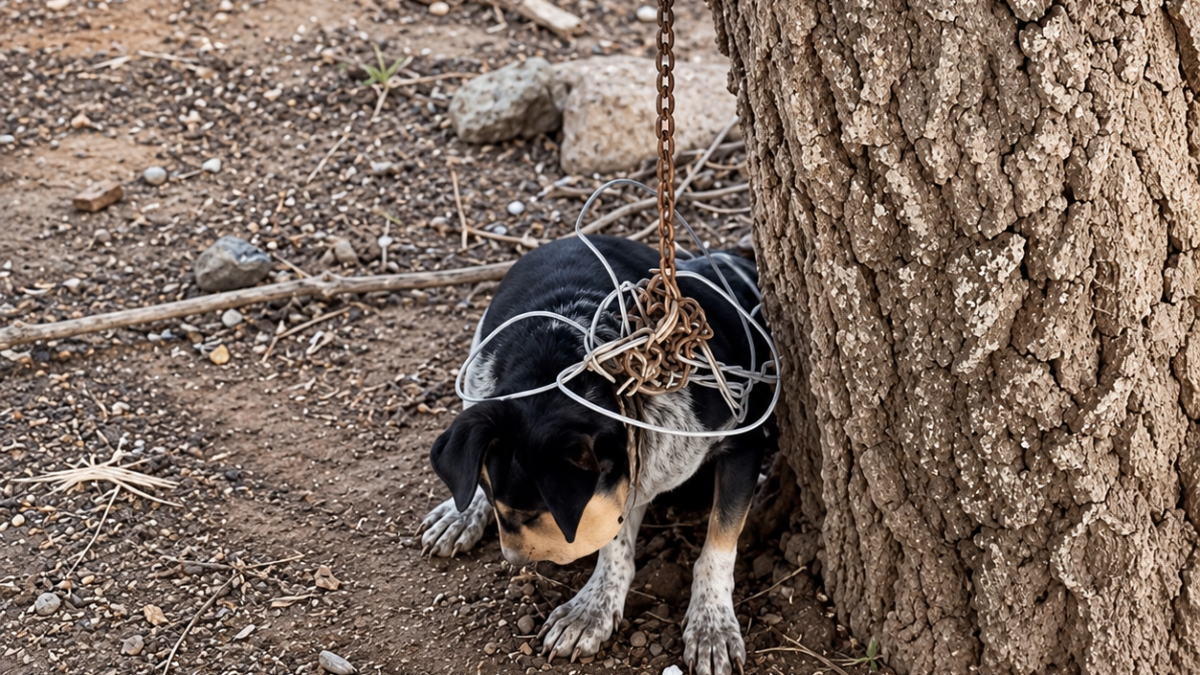
PART 2
I put my hand against her shoulder.
“No, mama. They’re right here.”
Her body kept straining beneath my palm.
The movement was weak, but the intention behind it was not.
She wanted her puppies.
Nothing else mattered to her.
Luis slid the carrier closer.
The instant she could smell them, she stopped fighting.
One of the puppies pushed his tiny nose through the towel.
The mother stretched her muzzle toward him.
Their noses touched through the opening.
Then she relaxed.
Luis looked at me.
“I don’t understand how she’s still alive.”
“Neither do I.”
We lifted the blanket carefully, using it like a stretcher.
Every movement changed the weight of the chain hanging from her neck.
She flinched each time.
I held the loose portion so it would not pull.
“Slow.”
“I am.”
“Slower.”
“Rachel, if I go any slower, we’re moving backward.”
“Then move backward.”
He did not answer.
He knew I was scared.
We both were.
I had dealt with embedded collars before.
Dogs chained outside as puppies, growing while nobody loosened the collar around their neck.
Skin swelling.
Metal disappearing beneath flesh.
Infection.
Scar tissue.
But this was different.
The chain was heavier.
The wound was wider.
And this dog had somehow carried a pregnancy, given birth, and continued feeding six puppies while restrained by it.
When we reached the van, Luis opened the back doors.
I climbed in first.
We set the mother down.
The puppies went beside her.
The moment the carrier door opened, she tried to turn toward them.
“Not yet.”
She stared at me.
“I know.”
One puppy cried.
Her ears twitched.
Luis shut the doors.
“We need to go.”
I sat on the floor beside her.
“You drive.”
He looked at me.
“You sure?”
“I’m not leaving her alone back here.”
Luis started the engine.
The ride to Dr. Harris’s clinic took twenty-three minutes.
I counted every one.
The mother’s breathing became faster halfway there.
Not panting.
Shallow breaths.
I called the clinic.
“She’s tachypneic.”
Dr. Harris answered immediately.
“Gum color?”
I lifted her lip carefully.
“Pale.”
“Very pale?”
“Yes.”
“Any active bleeding?”
“Not that I can see.”
“Keep her warm. We’re ready for you.”
The puppies were in a plastic carrier beside us.
Every few minutes, one would squeak.
Each time, their mother opened her eyes.
By the time we reached the clinic, three technicians were waiting outside.
Dr. Harris came through the door pulling on gloves.
He stopped when he saw her.
I knew that look.
Veterinarians learn not to react dramatically in front of people.
But he was still human.
“What happened to her?”
“Found chained to a tree.”
“How long?”
“No idea.”
He crouched.
The mother raised her head.
He did not touch her immediately.
“Hey, sweetheart.”
She watched him.
“Can we move her?”
“Yes.”
We transferred her onto a wheeled gurney.
“Puppies?” he asked.
“Six.”
“Bring them.”
Inside the treatment room, everything happened quickly.
Temperature.
Blood pressure.
Blood draw.
Ultrasound.
Fluids.
Pain medication.
Dr. Harris cut fur away from the wound.
The more he exposed, the worse it looked.
I stood beside him.
Part of me wanted to look away.
I did not.
The chain ran beneath swollen tissue on the left side of her neck.
On the right, several links were visible but surrounded by infected skin.
There was drainage.
Old blood.
New blood.
Scar tissue.
Dr. Harris touched the area gently.
The dog’s whole body tightened.
He stopped.
“This has been here a long time.”
“How long?”
“I can’t give you an exact number.”
“Weeks?”
“At minimum.”
He looked closer.
“Possibly months.”
Luis went quiet.
I remembered the groove in the tree.
Dr. Harris continued.
“If she delivered recently…”
One of the technicians said, “Puppies look less than a week old.”
“Then she was chained during pregnancy.”
My hand tightened around the edge of the treatment table.
“How can you know?”
“I can’t know with absolute certainty.”
He pointed to the mature scar tissue around one section of embedded chain.
“But this didn’t develop in a few days.”
I looked at her.
She stared toward the puppy carrier.
“She gave birth there.”
“Most likely.”
“Still chained.”
“Yes.”
Luis whispered something I will not repeat.
Dr. Harris did not correct him.
“What about the blood in the milk?” I asked.
He examined her mammary glands.
Several were swollen.
One was hot.
Another had cracked skin.
“Mastitis is possible. Trauma too.”
“Can the puppies nurse?”
“Not until we know what’s going on.”
The moment he said it, one of the puppies started crying.
The mother struggled to rise.
Her blood pressure dropped.
The monitor alarm changed.
“Keep her down.”
A technician adjusted the fluids.
Dr. Harris’s voice sharpened.
“We need to stabilize her before surgery.”
“Surgery now?”
“The chain cannot stay in her neck.”
“What’s the risk?”
He looked at me.
“High.”
“How high?”
“She’s severely anemic. Dehydrated. Malnourished. Infection is likely systemic. Anesthesia is not something I want to give her.”
“But you have to.”
“Yes.”
That was the answer.
No good option.
Only the option least likely to kill her.
I touched her paw.
For the first time, she did not pull away.
“We need a name.”
Luis looked at me.
“Now?”
“The paperwork needs something.”
One technician glanced at the dog.
“She’s a fighter.”
Luis said, “Call her Warrior.”
“No.”
He looked offended.
“Why?”
“It sounds like a truck.”
Dr. Harris kept working.
“You two can argue later.”
I looked at the mother again.
She had lifted her head toward the puppies despite the IV line taped to her leg.
The chain still hung from her neck.
Metal.
Blood.
Dirt.
And those eyes.
Still alert when her babies cried.
“Khaleesi.”
Luis stared.
“Seriously?”
“Yes.”
“Like the queen?”
“Like somebody who’s been through fire.”
Dr. Harris gave me a look.
“Fine. Khaleesi.”
The name stayed.
While they stabilized her, we turned to the puppies.
Six.
Four males.
Two females.
All underweight.
Two mildly dehydrated.
One significantly smaller than the others.
We labeled them with colored collars made from soft hospital material.
Red.
Blue.
Green.
Yellow.
Purple.
Orange.
I hated reducing them to colors.
But naming six newborn puppies while their mother fought for her life felt wrong.
They needed food.
Because Khaleesi’s milk could not be safely used until Dr. Harris evaluated the mastitis, we mixed formula.
I had bottle-fed neonates before.
It is never as easy as people imagine.
Too fast, they aspirate.
Too cold, they stop digesting properly.
Wrong angle, milk enters the airway.
Each puppy needed to be stimulated to eliminate after feeding because they were too young to do it independently.
Luis watched me prepare the first bottle.
“You want help?”
“Yes.”
He hesitated.
“I’ve never done this.”
“You have hands.”
“Large hands.”
“So?”
“These things are the size of baked potatoes.”
“Then don’t squeeze.”
He picked up the blue-collared male.
The puppy squealed.
Luis nearly put him back.
“He hates me.”
“He has no idea who you are.”
“He clearly has opinions.”
“Feed him.”
Twenty minutes later, Luis had formula on his shirt, the puppy asleep against his wrist, and an expression I had seen on grown men only a few times in rescue work.
Complete surrender.
“He drank.”
“Yes.”
“All of it.”
“Yes.”
Luis looked toward Khaleesi.
“We have to save her.”
I did not answer.
Because wanting something does not make it medically possible.
By noon, her temperature had risen.
Her white blood cell count was dangerously abnormal.
Her red blood cells were low enough that Dr. Harris began arranging for a transfusion.
“She needs blood?”
“Yes.”
“Before surgery?”
“If possible.”
The clinic kept donor dogs on a volunteer list.
A technician made phone calls.
Thirty minutes later, a woman arrived with a large black Labrador named Duke.
Duke walked into the clinic wagging his tail, thrilled to see everyone.
He had no idea why he was there.
His owner crouched beside me.
“Is that her?”
I nodded.
She looked at Khaleesi.
Then at the chain.
Her eyes filled.
“How many puppies?”
“Six.”
“Oh God.”
Duke donated blood.
I never met him again.
But I remembered his name.
Rescue stories are full of people and animals who appear briefly, give something essential, and leave without ever knowing what happened afterward.
The transfusion took time.
Khaleesi tolerated it.
Her blood pressure improved.
Not enough to make anyone comfortable.
Enough to attempt surgery.
Dr. Harris came to find me.
“We’re going in.”
I stood.
“Can I see her first?”
“You’re looking at her.”
“I mean before you take her.”
He nodded.
I went to the table.
Khaleesi’s eyes were half closed.
I crouched.
“Hey, girl.”
One ear moved.
“The puppies are okay.”
I did not know whether she understood the words.
But I said them anyway.
“All six.”
Her eyes opened slightly.
“They’re fed. They’re warm.”
I touched her paw.
“You did your part.”
Dr. Harris called from behind me.
“We need her.”
I stood.
As they wheeled her toward surgery, Khaleesi turned her head.
Not toward me.
Toward the puppy room.
Of course she did.
The surgery lasted almost four hours.
We expected two.
The chain had become more deeply incorporated into the tissue than the external wound suggested.
Dr. Harris later explained that removing it required working link by link.
Some sections could be cut.
Others had to be carefully freed from scar tissue and infected tissue.
They cleaned the wound.
Removed dead tissue.
Flushed pockets of infection.
Placed drains.
She needed more blood.
Her blood pressure dropped twice.
Once badly enough that Luis and I heard alarms through the closed doors.
We sat in the waiting area.
Neither of us spoke much.
At one point, Luis stood.
Walked to the vending machine.
Stared at it.
Then returned without buying anything.
“What?” I asked.
“I forgot why I got up.”
We waited.
Three hours.
Three and a half.
Then Dr. Harris came through the doors.
His surgical cap was damp at the edges.
He looked exhausted.
I stood.
“She’s alive.”
My knees nearly gave out.
Luis grabbed the back of a chair.
Dr. Harris held up one hand.
“She is not out of danger.”
I hated the sentence immediately.
“But she survived surgery.”
“Yes.”
“And the chain?”
“Gone.”
All of it.
For the first time in however long she had been tied there, nothing metal circled Khaleesi’s neck.
“What happens now?”
“Now we see whether her body can recover.”
The infection worried him most.
Her organs had been under stress.
The anemia.
Malnutrition.
Possible sepsis.
The mastitis.
The physical trauma from the chain.
Pregnancy.
Birth.
Nursing.
No one problem was necessarily fatal by itself.
Together, they had pushed her body to the edge.
“Can she see the puppies?” I asked.
“Not tonight.”
“She’ll look for them.”
“I know.”
“Can we bring one close?”
“Rachel.”
“I’m not asking to put them in with her.”
He looked at me.
Then sighed.
“When she wakes enough to recognize anything, we’ll bring the carrier where she can smell them.”
That was the best compromise.
Khaleesi woke slowly.
The puppies were fed again.
Then again.
By midnight, I had been awake for almost twenty hours.
Luis tried to send me home.
I refused.
At one in the morning, a technician came out.
“She’s awake.”
I stood so fast the chair scraped backward.
“Can I see her?”
“For two minutes.”
Khaleesi lay inside an intensive-care kennel.
Her neck was covered with bandages.
A drain line exited one side.
Her eyes were open.
She looked drugged.
Confused.
I crouched.
“Hey.”
Her gaze moved toward me.
I reached for the puppy carrier.
The technician brought it closer.
The puppies were sleeping in a pile.
One squeaked.
Khaleesi’s head lifted.
Only an inch.
But it lifted.
Her nostrils moved.
“She knows,” I whispered.
The technician nodded.
Khaleesi tried to stand.
“No.”
I put my hand against the kennel door.
“They’re here.”
She stared at the carrier.
Then slowly lowered her head.
The tension left her body.
That was the first night.
The second was worse.
Her fever increased.
Blood cultures later confirmed a serious bacterial infection.
One mammary gland worsened despite antibiotics.
Her surgical wound remained swollen.
She vomited.
Would not eat.
Every calorie mattered.
Dr. Harris placed a feeding tube temporarily.
The puppies remained on formula.
Khaleesi could hear them.
Every time they cried, she became restless.
That became a problem.
She needed rest.
Her maternal drive would not allow it.
Finally, Dr. Harris let us place one puppy beside her under direct supervision.
The smallest female.
Purple collar.
We set the puppy against Khaleesi’s front leg, away from her mammary glands.
The puppy immediately crawled toward her neck.
Khaleesi froze.
Then smelled her.
Something happened in her face.
I know that sounds ridiculous.
Dogs do not make human expressions.
But anyone who says animals do not show relief has never watched a mother dog believe she lost her litter and then smell one of them alive.
Khaleesi began licking.
Weakly at first.
Then repeatedly.
The puppy squeaked.
Khaleesi licked harder.
“Easy, mama.”
She ignored me.
The puppy rooted toward her belly.
Dr. Harris intercepted.
“No nursing yet.”
Khaleesi looked at him.
“If that dog could swear,” Luis whispered, “he’d be dead.”
I almost laughed.
That mattered.
Laughter felt impossible inside that room.
Yet for a second, there it was.
By day four, Khaleesi ate on her own.
A teaspoon.
Then two.
Soft food.
She kept it down.
Her fever dropped slightly.
Her blood values stabilized.
We allowed the puppies to spend supervised periods beside her after feeding.
They climbed over her legs.
Slept against her chest.
Khaleesi cleaned them.
That seemed to give her more energy than food.
“She’s recovering for them,” Luis said.
Dr. Harris heard him.
“Careful.”
“What?”
“Don’t romanticize physiology.”
Luis looked offended.
“I’m not.”
“She’s on IV antibiotics, fluids, pain control, nutrition support, and had surgery.”
“I know.”
“Those are also reasons she’s alive.”
Luis folded his arms.
“She still wants the puppies.”
“Yes.”
“Then I’m allowed to say they matter.”
Dr. Harris considered.
“Fine.”
That was as close as Luis ever got to winning an argument with him.
We posted one photograph of Khaleesi on the rescue organization’s page.
Not the worst photograph.
I refused to use the most graphic ones publicly.
The image showed her after surgery, bandaged, lying beside the puppy carrier.
The caption explained that a nursing mother had been found chained to a tree with an embedded chain and six newborn puppies.
I expected our regular supporters to respond.
A few hundred people.
Maybe a thousand.
By morning, the post had been shared more than ten thousand times.
Messages came from everywhere.
California.
Texas.
Canada.
England.
Australia.
People I had never heard of.
They asked about Khaleesi.
Not just the puppies.
Her.
How is the mother?
Did she eat?
Is the chain gone?
Can she see her babies?
Does she know she’s safe?
One message came from a woman whose mother had died that week.
I don’t know why, she wrote, but I need this dog to make it.
Another came from a retired Marine.
Please tell whoever is with her tonight that she has people rooting for her.
A third came from a child whose father typed for him.
I saved $18.46 for a video game. Khaleesi can have it.
I read that one twice.
Then gave my phone to Luis.
He read it.
Walked away.
I pretended not to notice.
Donations covered Khaleesi’s growing medical bill.
Then the puppies’ care.
Then other emergency animals at our rescue.
Within a week, thousands of people knew her name.
Khaleesi did not know any of that.
She cared about six things.
Red.
Blue.
Green.
Yellow.
Purple.
Orange.
By the second week, the puppies’ eyes began opening.
We gave them real names.
The smallest female became Hope.
The largest male became Atlas.
Then Finn.
Rosie.
Bear.
And June.
Khaleesi’s infection slowly responded.
Her neck wound remained difficult.
The skin had been damaged too severely for simple closure.
It had to heal gradually.
Bandage changes hurt.
Even with pain control, she trembled.
The first time we changed the dressing after surgery, I held her head.
“Look at me.”
She tried turning toward Dr. Harris.
“Khaleesi.”
Her eyes met mine.
“That’s it.”
He cleaned the wound.
She cried.
A low, broken sound.
I felt tears run down my face.
I hated them.
Not because I was embarrassed.
Because crying did nothing useful.
“Almost done,” Dr. Harris said.
Khaleesi tried to pull away.
I held her gently but firmly.
“I know.”
When it was over, she collapsed against me.
I put both arms around her.
No chain.
Only bandages.
I repeated that in my head.
No chain.
No chain.
No chain.
Three weeks after rescue, Khaleesi walked outside for the first time.
Only fifteen feet.
The sun was warm.
We used a wide chest harness so nothing touched her neck.
At the clinic door, she stopped.
Open space frightened her.
She had spent weeks chained under a tree and then weeks inside treatment rooms.
I stepped outside first.
“Come on.”
She looked behind her.
Toward the puppies.
Luis held their carrier at the doorway.
“They’re here.”
Khaleesi took one step.
Then another.
Grass touched her paws.
She froze.
Sniffed.
The breeze moved through her coat.
For almost a minute, she simply stood.
Then she lowered her nose.
Smelled the grass.
Moved forward.
The harness went slack.
Ten steps.
Fifteen.
She reached a patch of sunlight.
Stopped.
Then lay down.
I sat beside her.
No one spoke.
The puppies slept inside.
Dr. Harris stood in the doorway.
Luis sat on the curb.
Khaleesi closed her eyes in the sun.
For the first time since I had met her, she was outside and nothing connected her to anything.
No tree.
No chain.
No rope.
No fence.
Just a leash I could drop if I needed to.
I loosened my grip anyway.
She slept for eleven minutes.
Then a puppy cried inside.
Her eyes opened immediately.
Luis groaned.
“Motherhood.”
Khaleesi stood.
We went back.
Her recovery should have kept moving in that direction.
It did not.
Around the fourth week, she developed a sudden fever again.
Her appetite disappeared.
Bloodwork showed worsening inflammation.
An ultrasound revealed infection deeper in one mammary gland.
Dr. Harris’s expression frightened me more than the results.
“What?”
“We may need surgery again.”
“For the mastitis?”
“Yes.”
“She’s barely recovered from the first.”
“I know.”
“Can antibiotics handle it?”
“We’ve been using them.”
I knew what that meant.
Not enough.
The second surgery was shorter.
Still dangerous.
They removed badly damaged infected tissue.
Khaleesi survived.
But afterward, she did not rebound as quickly.
She was tired.
Deeply tired.
The puppies were almost old enough to wean.
They no longer depended entirely on her milk.
That helped medically.
Emotionally, Khaleesi did not care.
When they were brought near, she tried to mother them exactly as before.
She cleaned their ears.
Pushed them back when they wandered too far.
Let them sleep across her legs.
Hope remained attached to her.
The smallest puppy would crawl under Khaleesi’s chin every chance she got.
One afternoon, I watched Khaleesi rest her muzzle across Hope’s back.
I took a picture.
That photograph would later be shared more than any other image from the case.
At the time, it was just a mother and her puppy sleeping.
Nothing dramatic.
Those are usually the pictures that hurt most afterward.
At six weeks, the puppies began meeting potential adopters.
People offered to adopt Khaleesi too.
Hundreds.
Some messages came from families with acres of land.
Some from people who had followed her from the first post.
One woman wrote:
I don’t care if she never wants to be touched. She can have a room and a yard and live the rest of her life however she wants.
I saved that message.
I imagined Khaleesi there.
Healthy.
Walking on grass.
Sleeping on a couch.
Gaining weight.
Learning that someone approaching her neck did not mean pain.
I needed that future.
Maybe too much.
Dr. Harris kept warning me.
“Her labs still concern me.”
“She’s eating.”
“Some days.”
“She’s walking.”
“Some days.”
“She’s gaining weight.”
“Slowly.”
“You always find the negative.”
“I’m the veterinarian.”
“Exactly.”
“That is exactly why I find the medical problems.”
I knew he was right.
I hated him for it anyway.
Then Khaleesi stopped getting up.
It happened gradually enough that I could lie to myself for two days.
She’s tired.
She had physical therapy.
The puppies wore her out.
The weather changed.
Then, on a Thursday morning, I opened her kennel and she did not stand.
“Khaleesi.”
Her eyes opened.
Tail moved once.
“Come on.”
Nothing.
I touched her gums.
Pale again.
My chest tightened.
“Luis!”
Dr. Harris arrived within minutes.
Bloodwork.
Ultrasound.
X-rays.
More tests.
The infection had returned in her bloodstream.
Her liver values were worsening.
Kidney function beginning to change.
Sepsis.
Again.
“How?”
I stared at Dr. Harris.
“We treated it.”
“We did.”
“We operated.”
“Yes.”
“We changed antibiotics.”
“Yes.”
“Then why?”
“Because her body came to us after months of damage.”
That sentence broke through my anger.
Months.
Khaleesi had not arrived healthy except for a chain.
The chain was simply the injury we could see.
Malnutrition had weakened her.
Pregnancy had drained her.
Nursing had drained her further.
Chronic infection had been working inside her for who knew how long.
The surgeries had saved her.
They had also demanded more from a body with almost nothing left.
“What do we do?”
“We treat aggressively.”
“So treat.”
“We are.”
“No, I mean whatever.”
He looked at me.
“Rachel.”
“Whatever it costs.”
“This isn’t about cost.”
“Then fix it.”
His face changed.
The room became quiet.
I had crossed a line.
Not because he was offended.
Because I had asked him to promise something he could not give.
“I’m sorry.”
He nodded.
“I know.”
Khaleesi went back into intensive care.
The puppies could not stay with her.
They were seven weeks old.
Old enough to eat independently.
Old enough to survive without her.
Nobody had told Khaleesi.
Hope cried when separated.
Khaleesi heard her from two rooms away.
She tried to stand.
Failed.
I sat beside her.
“They’re okay.”
Her head lifted.
“You did it.”
She looked toward the door.
“They don’t need milk anymore.”
Her ears moved.
“They need you. I know.”
My voice broke.
“But they’re okay.”
The rescue page had grown to nearly eighty thousand followers because of Khaleesi.
When we posted that she was critical again, messages arrived faster than we could read them.
People prayed.
People donated.
People sent blankets.
Drawings.
Letters.
One elementary school mailed six hundred paper hearts.
Each student had written something on one.
Get better, Mama K.
You are brave.
Your puppies love you.
You deserve a home.
We taped some to the clinic wall.
Dr. Harris complained about adhesive residue.
Then I caught him reading them.
One night, I slept on the floor outside Khaleesi’s kennel.
At around three, she woke.
I opened the door.
Sat beside her.
She rested her head on my leg.
Her neck wound had healed enough that most bandages were gone.
The scar was wide.
Pink.
Uneven.
But there was no chain.
I ran my fingers carefully over the fur beside it.
“You know how many people love you?”
Her eyes closed.
“People you’ve never met.”
I laughed quietly.
“Which is probably better. People can be exhausting.”
Her tail moved once.
“Six puppies.”
Another small movement.
“They’re monsters now.”
That was true.
At seven weeks, Atlas had discovered barking.
Finn stole towels.
Rosie climbed out of every enclosure.
Bear chewed electrical cords.
June bullied everyone.
Hope followed Luis everywhere when she could not follow Khaleesi.
“They’re going to be okay.”
Khaleesi breathed slowly.
“You hear me?”
I bent close.
“They’re going to have homes.”
Her eyes opened.
“You don’t have to keep fighting for them.”
The second I said it, I regretted it.
Because what if fighting for them was the only reason she had lasted this long?
Morning came.
Khaleesi ate half a spoonful of food.
That felt like victory.
By noon, she ate another.
Her kidney values stabilized.
Dr. Harris almost smiled.
“Better.”
I held onto that word.
Better.
That evening, we let Hope visit.
Only Hope.
She climbed into the kennel and immediately crawled against Khaleesi’s chest.
Khaleesi lifted her head.
Licked the puppy once.
Twice.
Then rested her muzzle over Hope’s back.
Hope fell asleep.
I took a photograph.
Luis stood behind me.
“She knows.”
“What?”
“That Hope’s okay.”
I wanted to believe him.
The next morning, Khaleesi crashed.
Her blood pressure dropped suddenly.
Temperature fell.
She became unresponsive.
The emergency team worked for nearly forty minutes.
I stood outside the treatment room.
The same place I had stood during her first surgery.
Luis beside me.
Neither of us spoke.
Dr. Harris finally came out.
He did not remove his gloves immediately.
That told me.
“No.”
He looked at me.
“We got her pressure back.”
I breathed.
Then saw his face.
“But?”
“She’s not responding the way she needs to.”
“What does that mean?”
“Her organs are failing.”
“No.”
“Rachel.”
“No.”
“I need you to hear me.”
“I heard you.”
I walked past him.
Khaleesi lay beneath blankets.
Oxygen line.
IVs.
Monitors.
Machines doing more work than her body could.
I touched her paw.
Warm.
Still warm.
“Khaleesi.”
Nothing.
“Hey.”
Her ear moved.
Barely.
I looked at Dr. Harris.
“She heard me.”
“Maybe.”
“She did.”
He did not argue.
“What happens if we keep going?”
“We can continue blood pressure support. More antibiotics. Fluids carefully because of her organ function.”
“Will she recover?”
He was silent.
“Say it.”
“I don’t think so.”
Luis turned away.
I stared at Dr. Harris.
“You said she might die the first day.”
“Yes.”
“She didn’t.”
“No.”
“You said the surgery was dangerous.”
“Yes.”
“She survived.”
“Yes.”
“You said the second surgery—”
“Rachel.”
“She survived that too.”
“Yes.”
“Then don’t tell me what she can’t survive.”
He waited.
Then said softly, “I’m telling you what her body is doing now.”
I hated him.
For approximately thirty seconds.
Then I hated myself for needing him to be wrong.
“What would you do?”
The question every veterinarian hates.
He looked at Khaleesi.
“If she were mine?”
“Yes.”
“I would bring her puppies in.”
My knees weakened.
Luis put a hand on my back.
I shook him off.
Not because I was angry.
Because if he touched me, I was going to collapse.
We brought all six puppies.
Not into the medical kennel at once.
We placed Khaleesi on a padded blanket in a quiet treatment room.
Removed everything that was not essential.
Oxygen remained.
One IV remained.
Dr. Harris gave pain medication.
Then we let the puppies in.
They did what puppies do.
They did not understand death.
They climbed over one another.
Sniffed.
Whined.
Atlas tried chewing the blanket.
June wandered toward the cabinet.
Then Hope found Khaleesi.
She pushed under her chin.
The others followed.
Khaleesi’s eyes opened.
I stopped breathing.
Her head moved.
A fraction.
Her nose touched Hope.
Then Rosie.
She inhaled.
Again.
Her tail moved once against the blanket.
Luis covered his face.
Dr. Harris stepped into the hallway.
I sat beside Khaleesi.
“All six.”
Her eyes moved toward me.
“All six, mama.”
The puppies settled around her.
Not nursing.
Just sleeping.
Warm bodies pressed into hers.
Like the first day beneath that tree.
Except no chain held her there.
No wound was tearing open around metal.
No one was leaving her alone.
I put my hand on her shoulder.
“You did it.”
Her breathing slowed.
“You kept them alive.”
Another breath.
“They’re safe.”
Khaleesi closed her eyes.
“You can stop now.”
Those were the hardest words I had ever spoken to an animal.
Her next breath came slowly.
Then another.
Hope shifted under her chin.
Khaleesi exhaled.
And did not inhale again.
I waited.
Five seconds.
Ten.
Dr. Harris came back inside.
He listened to her heart.
Then removed the stethoscope.
Luis started crying.
Loudly.
I did not.
Not yet.
I kept my hand on Khaleesi.
The puppies slept.
Dr. Harris whispered, “She’s gone.”
I nodded.
No one moved them immediately.
We gave them time.
We gave ourselves time.
When Hope finally woke, she nudged Khaleesi’s muzzle.
Once.
Then again.
Nothing.
Hope whimpered.
That broke me.
I leaned over Khaleesi and cried into the blanket.
I had spent years telling volunteers not to project human emotions onto animals.
Do not assume.
Observe.
Stay grounded.
That day I did not care.
Hope knew something had changed.
Maybe not death.
Maybe only stillness.
Absence.
But she knew.
The other puppies woke gradually.
They wandered.
Played.
Slept again.
Life doing what it always does beside death.
Continuing.
We posted the announcement that night.
I rewrote it eleven times.
Nothing sounded right.
Khaleesi died today surrounded by the six puppies she fought so hard to protect.
That sentence stayed.
I added that she had endured injuries no animal should experience.
That the chain was gone.
That her puppies were safe.
That she had known warmth, gentle hands, good food, sunlight, and freedom before she died.
Then I posted it.
I turned off my phone.
For two hours.
When I turned it back on, there were more than twenty thousand notifications.
By morning, Khaleesi’s story had reached millions of people.
Strangers changed their profile pictures to her photograph.
Artists drew her.
Children sent cards.
People lit candles.
A woman in Chicago organized a small walk in Khaleesi’s memory.
Then another rescue group did the same in Georgia.
Then Texas.
Then Canada.
A veterinary school held a fundraiser.
A group of truck drivers donated thousands to embedded-collar cases.
Someone created a memorial fund in Khaleesi’s name for chained and neglected mother dogs.
Donations came in so quickly that our accountant called me.
“Rachel.”
“What?”
“We have a problem.”
My stomach dropped.
“What happened?”
“We have too much money.”
“That is not a rescue problem.”
“It is when people don’t specify allocation.”
We created the Khaleesi Fund.
Every dollar beyond her medical bills went toward emergency treatment for neglected dogs—especially dogs suffering from embedded collars, chains, severe malnutrition, and pregnancy-related neglect.
In the first year, the fund paid for seventeen emergency surgeries.
Seventeen.
One dog had a wire collar embedded under his skin.
Another had been chained in a yard so long the chain had wrapped around a tree root.
A nursing mother found beneath an abandoned house received treatment for mastitis.
Every time we approved an expense, the paperwork carried the same name.
Khaleesi Fund.
That was how thousands of people honored a dog they had never met.
Not only with tears.
With other dogs going home alive.
Khaleesi’s puppies grew.
That part mattered most to me.
Atlas became enormous.
Almost ninety pounds.
He was adopted by a firefighter named Ben whose two daughters treated him like a brother.
Finn went to a retired couple who owned a small farm.
He discovered ponds and spent every summer filthy.
Rosie went to a veterinary technician.
June was adopted by a teacher.
Bear went to a family with three teenage boys and somehow became the calmest creature in the house.
Hope stayed with Luis.
That surprised nobody.
The puppy who had slept beneath Khaleesi’s chin followed him home after fostering and never left.
Six months after Khaleesi died, we organized a reunion.
All six puppies returned.
Not puppies anymore.
Young dogs.
Big.
Healthy.
Coats shining.
Luis stood beside Hope.
“She has her face.”
I looked.
She did.
Not exactly.
But in the eyes.
Maybe I only wanted to see it.
“That’s dangerous thinking,” I said.
“What?”
“Comparing them too much.”
“You do it too.”
“No.”
“You’ve been staring at her for five minutes.”
I looked away.
Atlas began wrestling Bear.
June stole a toy.
Finn rolled in mud within ten minutes of arriving.
Rosie jumped onto a picnic table.
Khaleesi would have been exhausted.
I sat under a tree watching them.
For the first time since she died, remembering her did not hurt quite as sharply.
Her story had not ended in that treatment room.
I had said she could stop fighting because the puppies were safe.
Now they were running across a field.
Safe.
That was the promise.
A year after her rescue, we returned to the property where she had been found.
The abandoned house had been demolished.
The tree remained.
I had avoided it.
Luis came with me.
So did Hope.
The city had given us permission to install a small marker nearby.
Nothing dramatic.
No graphic description.
It read:
KHALEESI
SHE NEVER STOPPED PROTECTING THEM.
Hope sniffed the tree.
Then walked around it.
I watched carefully.
Did she remember?
Impossible to know.
She had been days old.
Her world then had been smell, warmth, hunger, and her mother.
Hope stopped near the exposed root.
The groove from the chain was still visible in the bark.
My stomach tightened.
Luis touched it.
“Look.”
“I see.”
“That took time.”
“I know.”
The tree had recorded what humans ignored.
Metal rubbing.
Day after day.
Maybe week after week.
The scar in the bark had healed around the damage just as Khaleesi’s skin had tried to heal around the chain.
I hated the comparison.
I stepped back.
Hope sat beside me.
She leaned against my leg.
Luis looked toward the marker.
“You ever wonder who did it?”
Every day.
Authorities had investigated.
The property had changed tenants repeatedly.
Neighbors gave conflicting information.
Some remembered a dog.
Some did not.
One claimed the previous tenant had moved suddenly.
Another said Khaleesi had belonged to a relative.
No witness could prove who had chained her or how long she had been there.
No prosecution followed.
That angered people online.
It angered me too.
For a while.
Then rescue work taught me something I did not like.
Sometimes justice comes in court.
Sometimes it doesn’t come at all.
And sometimes the only thing you can do is make sure cruelty does not get the final word.
I looked at Hope.
“No,” I told Luis.
“Yes, you do.”
“I wonder less now.”
“Why?”
“Because whoever did it already took enough of my time.”
Luis nodded.
Hope got up.
Walked toward the tree.
Then lifted her leg.
Luis stared.
“She’s female.”
“I know.”
“She just peed on the tree.”
“Yes.”
We both laughed.
Harder than the moment deserved.
Maybe exactly as hard as it deserved.
Years passed.
Khaleesi’s story kept circulating.
Every few months, someone would send me the original rescue post.
Have you seen this?
Yes.
I was there.
Sometimes the post had been copied so many times the details were wrong.
Seven puppies.
Ten puppies.
A metal cable instead of chain.
Found in another state.
Saved by a different organization.
Internet stories mutate.
I stopped correcting everything.
What mattered remained true.
A mother dog had been chained to a tree.
The chain became embedded in her neck.
She gave birth.
She continued caring for six puppies while severely injured.
She was rescued.
She fought.
Her puppies survived.
Thousands of strangers helped.
Khaleesi died loved.
And because people remembered her, other dogs received treatment they otherwise might not have gotten.
The fund grew.
At five years, it had helped more than one hundred animals.
We placed a wall inside the rescue facility with small photographs.
Not memorials.
Survivors.
Every dog whose emergency care had been funded in Khaleesi’s name.
One hundred photographs became one hundred and fifty.
Then two hundred.
People would stand in front of the wall and ask:
“Which one is Khaleesi?”
Her photograph was in the center.
Not the chain photo.
Never that.
I chose the image from her first walk outside.
Khaleesi lying in sunlight.
Eyes closed.
No metal around her neck.
When children visited, they usually pointed at her.
“She looks normal.”
“Yes.”
I loved that.
Normal.
Not horror.
Not suffering.
A dog in the sun.
Hope grew old with Luis.
She became a certified therapy dog.
Not because we planned it.
She simply loved people.
Luis began bringing her to hospitals and schools.
Children hugged her.
Veterans sat beside her.
One elderly man who had not spoken much after a stroke reached down and said, “Good dog.”
Luis called me afterward.
“Khaleesi would be proud.”
“You don’t know that.”
“I knew you’d say that.”
“But…”
“But?”
I looked at the picture he had sent.
Hope asleep beside the man’s wheelchair.
“She’d probably lick her ears clean.”
Luis laughed.
When Hope was nine, she developed cancer.
I wish I could say that by then I had become wise enough to handle it calmly.
I had not.
Neither had Luis.
He sat in Dr. Harris’s office—older now, gray in his beard—and stared at the floor.
“Not her.”
Dr. Harris sighed.
“Luis.”
“Not her.”
I had heard myself say the same thing years before.
Not Khaleesi.
Not after everything.
As though survival once should guarantee survival forever.
It does not.
Hope underwent surgery.
Chemotherapy.
She did well for another sixteen months.
Then the cancer returned.
On her final day, Luis brought her to the rescue.
She walked slowly.
The wall of Khaleesi Fund survivors filled the hallway.
Hope stopped beneath her mother’s photograph.
Probably coincidence.
Luis looked at me.
“Don’t.”
“I didn’t say anything.”
“You’re thinking.”
“Unfortunately.”
Hope lay in the sunlight near the window.
Almost the same position Khaleesi had years earlier.
I sat beside her.
“Your mother caused a lot of trouble.”
Hope lifted one ear.
“Thousands of dollars.”
Tail movement.
“Hundreds of dogs.”
Another movement.
Luis sat down.
“She doesn’t care.”
“No.”
“She wants snacks.”
“Exactly like her mother.”
Hope ate three pieces of chicken.
Then fell asleep.
She died at home that night beside Luis.
The next week, he brought me her therapy vest.
“I can’t keep it.”
“You will want it later.”
“No.”
“Yes.”
“I can’t look at it.”
“That’s different.”
He handed it to me anyway.
I kept it in my office for six months.
Then returned it.
He took it.
No argument.
Grief changes weight over time.
The object that is unbearable today becomes precious later.
Khaleesi taught me that too.
I eventually left full-time rescue work.
Not completely.
Nobody ever completely leaves rescue.
People still called.
“I found a dog.”
“There’s a litter under my shed.”
“My neighbor moved and left a cat.”
I learned to say no more often.
Then failed to say no.
Years after Khaleesi, a young volunteer asked why our emergency fund carried the name of a dog who had died.
“Wouldn’t it be happier to name it after a survivor?”
I looked at the wall.
“Khaleesi was a survivor.”
“But she died.”
“So does every survivor eventually.”
The volunteer looked uncomfortable.
I softened my voice.
“Survival doesn’t mean forever.”
“What does it mean?”
“It means what happens after the thing that should have ended you.”
She considered that.
Khaleesi had weeks after the chain.
Not years.
But in those weeks she knew relief.
Food.
Sunlight.
Gentle hands.
Her puppies safe beside her.
For an animal who had known prolonged suffering, that mattered.
And what happened because of her lasted far longer than her body did.
On the tenth anniversary of Khaleesi’s rescue, people asked us to hold a memorial.
I resisted.
I did not want speeches about tragedy.
Then Luis suggested something better.
“No candles.”
“What?”
“No sad ceremony.”
“What do you want?”
“Free collar checks.”
I stared.
He smiled.
We organized a community event.
Veterinarians checked dogs for poorly fitted collars.
Microchips.
Vaccines.
Spay and neuter appointments.
Rescue education.
Resources for people struggling to afford pet food.
We showed owners how quickly growing puppies need collar adjustments.
We talked about tethering dangers.
Hundreds of people came.
At the entrance hung one photograph.
Khaleesi in the sun.
Under it:
IN HER MEMORY, LOOSEN THE CHAIN BEFORE IT BECOMES A WOUND.
By afternoon, twenty-seven dogs had received new properly fitted collars.
Four owners scheduled surgeries they could not otherwise afford.
Three families received food assistance rather than surrendering their pets.
One severely neglected dog was quietly reported by a neighbor after seeing the educational display.
He was removed two days later.
The Khaleesi Fund paid for his treatment.
That night, Luis and I sat outside the rescue center.
Most volunteers had gone.
He handed me coffee.
“You realize she’s still making us work.”
“Typical.”
“Ten years.”
“I know.”
He looked toward the building.
“You think she knew we were helping her?”
I remembered the tree.
The embedded chain.
Khaleesi lifting her head toward crying puppies.
The first surgery.
The first sunlight.
Hope under her chin.
“I think she knew when pain stopped.”
Luis nodded.
“That’s enough.”
“Yes.”
It was.
People often asked which moment from Khaleesi’s rescue stayed with me most.
They expected me to say the chain.
Or the surgery.
Or the puppies nursing while she suffered.
For years, I thought it was the final room.
Six puppies surrounding her.
Khaleesi taking her last breaths.
But as I got older, another memory replaced it.
The first time we took her outside after surgery.
Khaleesi stepped through the clinic door wearing a chest harness.
She smelled grass.
Wind moved across her face.
There was nothing attached to her neck.
She walked fifteen feet.
Lay in the sunlight.
Closed her eyes.
For eleven minutes, she was simply a dog resting in warm grass.
No chain.
No wound.
No rescue story.
No thousands of followers.
No memorial fund.
No tragedy.
Just Khaleesi.
That is the image I keep.
Because the person who chained her to that tree had already taken enough.
I refused to let the chain become the most important thing about her.
Khaleesi was the mother who kept turning toward her babies when she could barely move.
She was the dog who tolerated painful bandage changes and still trusted our hands again.
She was the patient who heard one puppy cry through two walls and tried to stand.
She was the exhausted mother who spent her first moments of freedom checking whether her babies were still beside her.
She was the reason six puppies reached adulthood.
She was the reason strangers gave money to dogs they would never see.
She became the name printed on emergency veterinary invoices for animals born years after she died.
And somewhere, in hundreds of homes, dogs slept safely because a mother they had never met once refused to stop caring for her babies even when caring for them hurt.
That is why thousands of people honored her.
Not because she suffered.
Because of what she kept doing in spite of it.
On the final day I worked at the rescue center, I took Khaleesi’s photograph down from the wall.
Only temporarily.
The frame had cracked.
I replaced it.
Before hanging it back, I sat at my desk with the photograph in my hands.
Khaleesi in the sunlight.
Eyes closed.
I remembered kneeling beside her beneath that tree for the first time.
The chain.
Her puppies.
Blood around their mouths.
Her eyes watching every movement I made.
I had thought I was looking at an animal waiting to die.
I had been wrong.
She had been waiting for someone to help her finish the only job she cared about.
Keep them alive.
We did.
All six.
Then she finally stopped.
I returned the photograph to the center of the wall.
Beneath it, hundreds of other dogs looked back from their own pictures.
I switched off the office lights.
At the doorway, I looked back one last time.
In the dim hall, Khaleesi’s photograph still caught a strip of evening sunlight from the window.
For just a second, it looked exactly like that afternoon outside the clinic.
A tired dog lying in warm grass.
Nothing around her neck.
Nothing holding her.
And no puppies crying because every one of them was finally safe.
[END OF STORY]








