PART 2: Her Puppies Were Crying Just Feet Away—But Someone Had Tied Their Mother So She Couldn’t Reach Them
PART 2
I turned toward the voice.
A man in a dark work jacket stood beneath the back porch roof, holding a ring of keys.
He looked to be in his forties.
His boots were clean.
His jacket was dry.
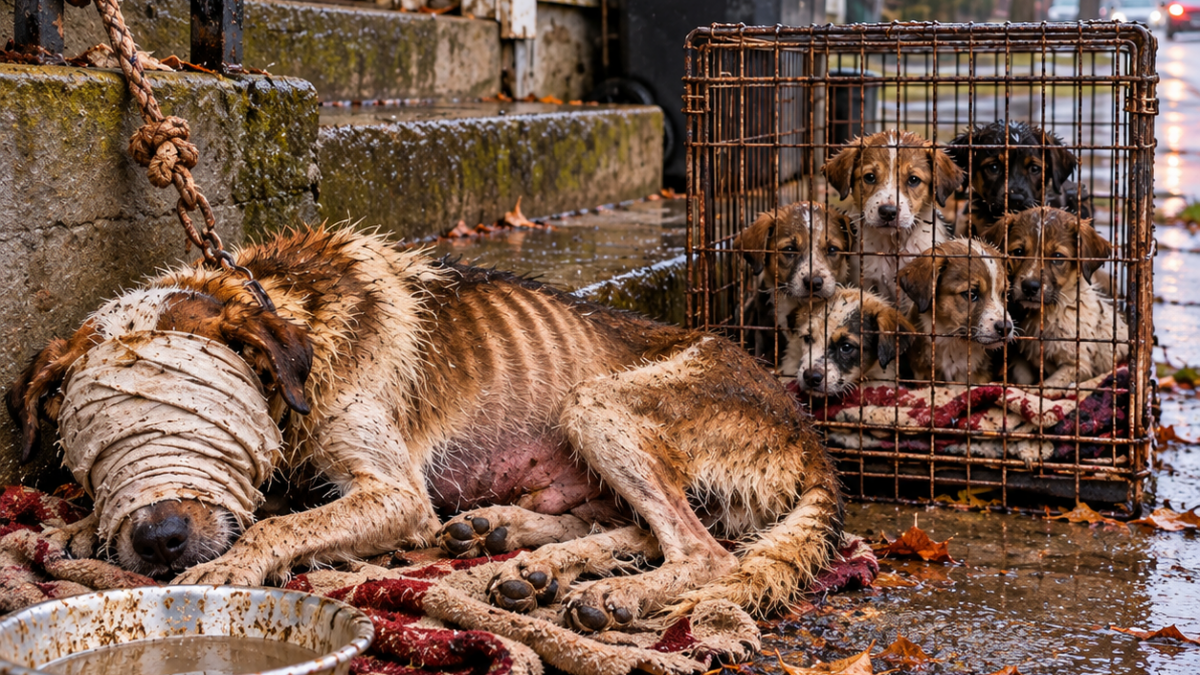
Behind me, the mother dog lay shivering in the mud.
For a moment, the contrast was so sickening that I couldn’t speak.
“I said get away from them.”
The man came down the steps.
Tess stood.
“Are these your dogs?”
“That’s none of your business.”
“Someone reported them in distress.”
He glanced toward the cage.
Then toward the mother.
“They’re fine.”
I stared at him.
“Fine?”
He shrugged.
“They’ve got shelter.”
I looked up at the broken gutter pouring water directly onto the cage.
“Where?”
He followed my gaze.
“It’s a dog cage.”
“That doesn’t make it shelter.”
His expression hardened.
“Lady, I don’t know who you think you are, but you’re trespassing.”
I remained crouched beside the mother.
She had stopped struggling.
Her exhausted eyes followed the man’s movements.
I noticed that.
The way her shoulders tightened when he stepped closer.
The way her head lowered.
“Who tied this cloth around her face?” I asked.
He looked annoyed.
“She wouldn’t shut up.”
Something cold moved through my chest.
“What?”
“She kept barking at night.”
I stared.
“So you covered her face?”
“She could breathe.”
The mother trembled beneath my hand.
I looked toward her puppies.
Four tiny bodies behind wet bars.
Then back at him.
“She’s a mother.”
He rolled his eyes.
“So?”
“Her puppies are crying.”
“They’re always crying.”
“She can’t reach them.”
“That’s the point.”
I stopped breathing.
Tess turned toward me.
I could see the anger in her face.
But I knew what we needed most.
Not an argument.
Not revenge.
Not yet.
We needed to get five suffering animals out of the rain.
I stood slowly.
“My name is Claire. I’m with a local animal rescue. Animal control has been contacted.”
The man gave a short, ugly laugh.
“Congratulations.”
“What’s your name?”
“Derek Kline.”
“Mr. Kline, these dogs need immediate veterinary attention.”
“They’re not going anywhere.”
He stepped toward the cage.
The brown puppy pushed its nose between the bars.
Derek kicked a wet leaf toward it.
“Stupid things.”
The puppy flinched backward.
The mother tried to rise again.
The rope pulled against her collar.
She fell onto her side.
I moved instinctively.
“Stop.”
Derek looked at me.
“Excuse me?”
“Don’t go near them.”
His face changed.
For one frightening second, I thought he might shove me aside.
Then a vehicle pulled into the driveway.
Blue lettering marked the door.
ANIMAL CONTROL.
Derek turned.
And suddenly, he didn’t look nearly as confident.
Officer Lena Brooks stepped out of the vehicle wearing a rain jacket and carrying a clipboard.
She took one look at the yard.
Then she stopped.
Her eyes moved from the cage to the tethered mother.
“Who is responsible for these animals?”
Derek raised his hand.
“I manage the property.”
“That wasn’t my question.”
He frowned.
“The dogs belong here.”
Officer Brooks walked closer.
She saw the cloth.
The rope.
The muddy ground.
The overflowing gutter.
The puppies.
Her expression became serious.
“Who placed the animals in these conditions?”
Derek hesitated.
Then shrugged.
“I was going to move them.”
“When?”
“Later.”
“How long have they been out here?”
“Just overnight.”
Mrs. Alvarez stepped forward.
“That’s not true.”
Everyone turned.
The older woman stood beneath her umbrella, rain dripping from its edges.
“I’ve heard those puppies crying for days.”
Derek glared at her.
“Mind your own business, Rosa.”
She straightened.
“I made it my business when you left them in the rain.”
Officer Brooks raised one hand.
“Everyone, please. One at a time.”
She documented the conditions and contacted her supervisor about the emergency situation.
The mother remained motionless.
The smallest puppy made another thin cry.
I couldn’t stand it anymore.
“Officer, please.”
Brooks looked at me.
I pointed toward the cage.
“That little one is barely moving.”
She approached.
Looked inside.
Then checked the mother.
Her decision came quickly.
“These animals need immediate care.”
Derek stepped forward.
“You can’t take my property.”
Brooks looked directly at him.
“They are living animals in apparent medical distress. We are arranging emergency protective care under the authority available to this department.”
“They’re mine.”
“Then you’ll have an opportunity to provide ownership records and respond through the proper process.”
He opened his mouth.
She continued.
“Right now, we’re addressing their condition.”
For the first time since he came down the steps, Derek said nothing.
We moved quickly.
Officer Brooks photographed the cage, the cloth, the tether, and the surrounding area before anything was disturbed beyond what was necessary for the animals’ safety.
Tess prepared the carriers.
I returned to the mother.
“Hey, sweetheart.”
Her eyes moved toward me.
“We’re getting you out.”
I carefully loosened the wet cloth.
It had been tied behind her head.
The fabric was stiff with dirt.
When I pulled it away, she blinked against the gray daylight.
She looked toward the cage immediately.
Not toward me.
Not toward the house.
Toward her babies.
My throat tightened.
“I know.”
I stroked her cheek.
“We’re getting them.”
Officer Brooks helped free the rope from around the post.
It had twisted so tightly that the mother could barely extend her front leg.
When the pressure was finally released, she tried to stand.
Her legs trembled.
She made it upright for only a moment before sinking back into the mud.
“Don’t make her walk,” Tess said.
I nodded.
We slipped a blanket beneath her.
She weighed less than I expected.
Her hip bones were painfully prominent.
When we lifted her, she turned her head toward the cage.
Her expression changed.
She began whining.
“We’re not leaving them,” I whispered.
But she couldn’t understand.
Not yet.
The cage door was held closed with twisted wire.
Officer Brooks used a tool from her vehicle to remove it.
The first puppy reached toward the opening.
Brown fur.
A tiny white mark on his chest.
Tess lifted him carefully.
“Oh, baby.”
He was cold.
Much too cold.
The second puppy was black with tan markings.
The third was pale gold.
And the fourth—
The fourth barely moved.
I reached toward her.
She was smaller than the others.
Her fur was soaked.
Her head rested against the filthy cardboard.
“Come on, sweetheart.”
I lifted her into my hands.
She didn’t struggle.
Didn’t cry.
For a moment, she didn’t even open her eyes.
My heart dropped.
“Tess.”
She looked at me.
“She’s breathing?”
I held the puppy close enough to see the faint movement of her chest.
There.
A tiny breath.
“Yes.”
I swallowed.
“But she’s very weak.”
Tess opened the carrier.
“Let’s get her warm and to the clinic.”
We placed all four puppies into protected transport equipment, using dry towels and careful warming measures.
The mother could hear them.
She lifted her head.
Then made a soft, desperate sound.
I carried the smallest puppy close enough for her to smell.
“Here.”
Her nose touched the puppy.
She sniffed frantically.
Then tried to lick her face.
I had to turn away.
Because the mother had spent so long unable to reach her babies.
And the first thing she did when one finally came close was try to comfort her.
The veterinary clinic was twenty minutes away.
That afternoon, it felt like a hundred miles.
Rain struck the windshield.
Water rushed along the gutters.
Cars moved slowly through flooded intersections.
Tess sat beside the carriers.
The mother was secured nearby.
Every few minutes, she lifted her head toward the sounds of her puppies.
The smallest one remained dangerously quiet.
“Still breathing?” I asked.
“Yes.”
A minute later, I asked again.
“Tess?”
“She’s breathing, Claire.”
I tightened my grip on the steering wheel.
“I know.”
But I couldn’t stop asking.
Because I had seen how quickly a weak puppy could fade.
I had seen animals rescued only to lose the battle afterward.
And the thought of that little girl dying after we finally opened the cage was almost unbearable.
The mother whined again.
Tess turned toward her.
“They’re here, Mama.”
She lowered her head.
I looked at her in the mirror.
Her eyes were uncovered now.
For the first time, she could see where she was going.
But her expression remained frightened.
She didn’t know what the car meant.
She didn’t know whether the people carrying her babies intended to help them.
She had only known ropes, rain, and separation.
How could she trust us already?
I took a breath.
“Just stay with us.”
And kept driving.
Dr. Hannah Reed met us at the clinic entrance.
She had been warned that we were bringing in a nursing mother and four puppies.
But even she looked stunned when she saw them.
“Oh, my goodness.”
The smallest puppy was taken for immediate assessment.
The others followed.
A technician named Celia carried the mother into another examination room.
The moment they separated her from the puppy carriers, she began struggling.
Not violently.
She was too weak for that.
But she lifted her head and cried.
A heartbreaking, searching sound.
“She needs to see them,” I told Dr. Reed.
The veterinarian nodded.
“We understand. We need to stabilize everyone first.”
I knew she was right.
But the mother didn’t.
She kept looking toward the doorway.
I crouched beside her.
“Your babies are here.”
Her ears moved.
“They’re safe.”
She watched my face.
“We’re going to bring them back.”
Then I made a promise I knew I would have to fight to keep.
“I’m not letting anyone separate you again unless it’s necessary to help you.”
She lowered her head.
And I stayed beside her until the examination began.
The medical findings were worse than we hoped.
The mother was severely underweight.
She was dehydrated.
Her skin showed irritation from the wet tether and dirty conditions.
Her collar had rubbed a painful area around her neck.
Her body temperature needed attention.
And she was exhausted.
Dr. Reed looked at the chart.
“How long was she kept outside?”
“We don’t know.”
“Any reliable history?”
“Almost none.”
The veterinarian nodded.
“We’ll need to monitor her closely.”
I looked toward the mother.
“Can she still feed the puppies?”
“We’ll assess that once she’s stable enough. She may need nutritional support, and the puppies may need supplemental feeding.”
“Are they all going to survive?”
Dr. Reed paused.
“The strongest three look more responsive.”
My stomach tightened.
“And the smallest?”
“She is our greatest concern right now.”
I closed my eyes.
The little golden-brown puppy.
The one I had lifted from the back of the cage.
“What can we do?”
“Right now, let the medical team work.”
I nodded.
But I hated those words.
Because I wanted to do something.
Anything.
I wanted to reach back through time and move the cage beneath a roof.
I wanted to untie the mother before the rope cut into her neck.
I wanted to stand between Derek and the animals.
I wanted to put food and water in front of them days earlier.
But none of that was possible.
We had arrived when we arrived.
Now everything depended on what we did next.
For the first several hours, the clinic was a blur.
Technicians moved between rooms.
The puppies received carefully controlled warming and supportive treatment.
The mother was monitored while her dehydration and nutritional needs were assessed.
The smallest puppy remained under close observation.
I stood in the hallway with Tess.
Neither of us spoke much.
Every time a door opened, I looked up.
Every time a veterinarian passed, I searched their expression.
Finally, Dr. Reed came out.
“The smallest puppy is responding.”
I stopped breathing.
“What?”
“Her temperature is improving.”
I covered my mouth.
“She’s still fragile,” Dr. Reed continued. “We’re not out of danger.”
I nodded.
“I understand.”
But tears were already running down my face.
Tess squeezed my hand.
“She made it through the first part.”
“Yes.”
And for that moment, that was enough.
We named the mother Hazel.
It happened almost accidentally.
Celia had been cleaning the area around her collar.
The dog was lying quietly on a blanket.
Her eyes were soft brown with a warm, hazel-colored ring around each pupil.
Celia looked at her.
“Hello, Hazel.”
I turned.
“Hazel?”
Celia smiled.
“It suits her.”
The dog lifted her head.
Her ears moved.
I repeated it.
“Hazel.”
She looked toward me.
I smiled.
“Well, hello, Hazel.”
The mother leaned slightly toward my hand.
And just like that, she had a name.
Not “the dog behind the house.”
Not “the nursing female.”
Not “the animal from the complaint.”
Hazel.
A living creature whose future was suddenly connected to ours.
The puppies received names over the following days.
The brown one became Maple.
The black-and-tan puppy became Tucker.
The pale golden puppy became Sunny.
And the smallest, the one who had nearly stopped responding in the cage, became Button.
Because she was no bigger than a handful when we found her.
And because every time she moved, Tess said it felt like somebody had pressed a tiny button inside our hearts.
The first reunion happened the following day.
Hazel had stabilized enough for a brief, supervised visit with her puppies.
The medical team prepared a quiet room.
A clean blanket covered the floor.
Hazel rested on a padded bed.
She was still weak.
Her ribs remained visible.
But she had lifted her head when we entered.
Dr. Reed came beside me.
“We’ll keep this short.”
I nodded.
“Whatever is safest.”
Celia brought in the puppies.
The moment Hazel heard them, her ears shot forward.
Then she tried to rise.
“Easy, Mama.”
She looked toward the carrier.
A puppy squeaked.
Hazel made a sound I will never forget.
It began as a whine.
Then became something deeper.
Urgent.
Desperate.
Almost pleading.
Celia carefully placed Maple near her front paws.
Hazel stretched her neck.
Sniffed him.
Then began licking his head.
Maple wriggled toward her.
Hazel’s tail moved against the blanket.
Tucker came next.
Then Sunny.
And finally Button.
The smallest puppy was still weak.
But she was breathing steadily.
She moved her tiny head when Hazel’s nose touched her.
Hazel sniffed her again.
Then licked her face.
Slowly.
Carefully.
Button made a little sound.
Hazel drew her closer.
I covered my mouth.
Tess began crying beside me.
For several moments, nobody spoke.
We simply watched a mother touch her babies after being forced to lie helplessly only a few feet away from them.
Then Hazel lowered her head.
Her puppies rested against her body.
And for the first time since we found her, she looked peaceful.
That should have been the hardest part.
I wanted it to be.
But the next several days reminded me that rescue isn’t always a straight line from suffering to happiness.
Button remained fragile.
One morning, she stopped feeding as well as the others.
Celia noticed immediately.
Dr. Reed examined her.
Her strength had dipped.
She needed closer support.
Hazel became restless when Button was moved for treatment.
She searched the blanket.
Sniffed the space where her smallest puppy had been.
Then looked toward the doorway.
I sat beside her.
“She’s being helped.”
Hazel whined.
“I know.”
She continued watching the door.
I placed my hand beside her.
“She’s coming back.”
Hazel leaned against me.
But she didn’t stop looking.
And I understood something.
The rope was gone.
The cloth was gone.
The cage was gone.
Yet Hazel still feared losing her babies.
The physical barriers had disappeared.
The memory of separation had not.
That evening, Button’s condition improved.
The veterinarian was cautiously encouraged.
I almost cried from relief.
When we brought her back for a supervised reunion, Hazel immediately reached toward her.
She sniffed Button from head to tail.
Then began licking her.
Button pushed her little nose against Hazel’s chest.
Hazel closed her eyes.
Celia whispered, “There you go, Mama.”
I watched the mother settle.
Then I looked at Dr. Reed.
“Do you think she knows how close we came?”
The veterinarian smiled sadly.
“We can’t know exactly what she understands.”
I nodded.
“But she certainly knows when her puppy is near.”
Hazel rested her chin beside Button.
I smiled through tears.
“Yes.”
“She does.”
Meanwhile, animal control was investigating the old house.
Officer Brooks contacted us for veterinary records documenting the animals’ condition.
She also asked about the rope.
The cloth.
The cage.
The lack of dry shelter.
The overturned water bowl.
Every detail mattered.
Mrs. Alvarez provided a statement describing what she had seen.
She said the puppies had been crying for several days.
She had tried putting water near the mother.
She had seen a man arrive in a white pickup.
And she had watched him remove the bowl.
When I heard that detail again, anger rose in my chest.
The dogs had not simply been forgotten.
Someone had apparently interfered with the little help they were receiving.
Officer Brooks asked whether we had preserved the cloth and rope.
We had followed her instructions at the scene.
The items had been documented and secured.
She nodded.
“Good.”
Then she asked something unexpected.
“Did you notice the cameras?”
“What cameras?”
“The house next door.”
I frowned.
Mrs. Alvarez’s house?
Brooks continued.
“Her front camera faces the driveway. There’s another one near her side gate.”
My heart began pounding.
“Does it record the backyard?”
“Part of the access path.”
I stared at her.
“Did you check it?”
“We’re working on obtaining the recordings.”
I looked toward Hazel’s room.
For the first time, I wondered whether we might be able to prove how long those dogs had been suffering.
The footage arrived two days later.
Officer Brooks invited us to review the portions relevant to our rescue report.
Mrs. Alvarez sat beside her.
I stood behind Tess.
The first clip showed Derek’s white pickup entering the driveway.
The timestamp was four days before our rescue.
Rain had already begun falling.
Derek stepped out.
Walked toward the back of the house.
Then returned carrying an empty plastic food container.
The next clip was from the following morning.
Mrs. Alvarez approached the fence with a water bowl.
She placed it near the gate.
A short time later, Derek appeared.
He saw the bowl.
Picked it up.
And threw the water onto the ground.
I felt my stomach turn.
Tess whispered, “He saw them.”
Officer Brooks nodded.
“We’re documenting the timeline.”
The next recording showed Derek carrying something toward the back entrance.
A cage.
My hands became cold.
Then another clip.
He walked past the side camera with a bundle of dirty cloth in one hand.
The footage didn’t show exactly what happened behind the house.
But the timing was unmistakably relevant.
The mother and puppies had not appeared there by accident.
And the claim that they had been left outside for only one night was becoming difficult to believe.
Mrs. Alvarez covered her face.
“I should have done more.”
I turned toward her.
“You called.”
“But I heard them before that.”
“You brought water.”
“He threw it away.”
I crouched beside her chair.
“Rosa.”
She looked at me.
“You didn’t tie that dog.”
Tears filled her eyes.
“You didn’t lock those puppies in the cage.”
She began crying.
I held her hand.
“And because you called, they’re alive.”
For a long moment, she couldn’t speak.
Then she whispered, “Are they really getting better?”
I smiled.
“Yes.”
“All of them?”
I nodded.
“All five.”
The legal process moved slowly.
Derek insisted that the dogs were not his responsibility.
He claimed a former tenant had abandoned them.
Then he argued that he had merely been keeping them contained until someone collected them.
Officer Brooks investigated those claims.
Property records.
Rental agreements.
Witness statements.
Veterinary documentation.
The camera footage.
The ownership question was important because the court would need to establish who had legal responsibility for the animals.
But the medical condition of Hazel and her puppies was not in dispute.
They had been found in distress.
They had needed urgent treatment.
And the conditions behind the house were unsafe.
We continued cooperating with the investigation.
Then we returned to caring for the dogs.
Because whatever happened in court, Hazel and her puppies needed help every day.
Hazel’s recovery was slow.
Her body had been severely depleted.
She needed proper nutrition, rest, and veterinary monitoring.
The collar injury required care.
Her skin needed time to recover from the wet, dirty conditions.
Her coat was dull.
Her muscles were weak.
And she remained anxious whenever she lost sight of her puppies.
We created a predictable routine.
Feeding times.
Rest periods.
Careful examinations.
Supervised time with her litter.
Gentle handling.
Quiet voices.
No unnecessary stress.
At first, Hazel barely ate unless someone sat nearby.
I discovered that by accident.
One afternoon, I placed her bowl down.
She sniffed it.
Then looked at me.
I stepped away.
She didn’t eat.
I returned and sat beside her.
Hazel lowered her head.
Then began eating.
I smiled.
“Is that what you wanted?”
She continued eating.
I stayed until she finished.
Afterward, she rested her chin against my knee.
I laughed softly.
“You’re going to make me sit with you every time, aren’t you?”
Her tail moved.
I smiled.
“Fine.”
And from then on, whenever I could, I ate my lunch beside Hazel.
She had her meal.
I had mine.
Sometimes we sat in silence.
Sometimes I talked to her.
About the weather.
About the puppies.
About things that had happened at the rescue center.
Hazel listened.
Or perhaps she simply enjoyed having someone nearby.
Either way, it became our routine.
The puppies grew stronger.
Maple became the first to investigate everything.
Tucker followed him everywhere.
Sunny preferred sleeping.
And Button—
Button surprised us.
The smallest puppy began gaining weight steadily.
She developed a fierce little personality.
One morning, I found her trying to climb over Maple.
He was twice her size.
She didn’t care.
She pushed.
Slipped.
Tried again.
Then finally scrambled over him.
I laughed.
“Look at you.”
Celia appeared beside me.
“What?”
“Our little girl is causing trouble.”
She watched Button attack Tucker’s ear.
Celia smiled.
“Good.”
I looked at her.
“Good?”
“Yes.”
She pointed toward the puppies.
“That’s what we want.”
I understood.
Button wasn’t struggling to stay warm.
She wasn’t lying motionless in a cage.
She was playing.
Arguing.
Exploring.
Learning.
Being a puppy.
I crouched beside her.
“You’re not allowed to scare us like that again.”
Button bit my shoelace.
I laughed.
“Apparently, you disagree.”
But Hazel still carried fear.
One afternoon, a maintenance worker came into the recovery building.
He wore a dark raincoat.
When the door opened, Hazel looked up.
Her body stiffened.
She lowered her head.
Then moved backward toward her puppies.
I noticed immediately.
“Hazel?”
She didn’t respond.
The worker took another step.
Hazel began trembling.
I raised my hand.
“Could you give us a minute?”
The man stopped.
“Sure.”
He stepped outside.
Hazel remained tense.
I sat beside her.
“Hey.”
She looked at me.
“It’s okay.”
Her breathing was faster.
I placed my hand where she could see it.
I didn’t force contact.
I waited.
Eventually, Hazel sniffed my fingers.
Then moved closer.
Her body relaxed slightly.
I stroked her shoulder.
The worker hadn’t done anything wrong.
He had simply entered wearing clothing that, for some reason, frightened her.
Perhaps it reminded her of someone.
Perhaps the movement surprised her.
We couldn’t know.
But we could respond to what she needed.
Space.
Patience.
Predictability.
And the freedom to approach when she was ready.
That became another important part of her recovery.
As the weeks passed, Hazel began trusting more people.
Celia could clean the healing area around her neck without making her panic.
Tess could approach her bed.
I could lift a puppy briefly for weighing without Hazel immediately becoming distressed.
She still watched carefully.
But the desperation was fading.
One morning, Button wandered toward the edge of the play area.
Hazel lifted her head.
Watched.
Then rested again.
I smiled.
“Look at that.”
Tess turned.
“What?”
“She let Button explore.”
Tess watched the little puppy sniffing a toy.
Hazel remained relaxed.
“She’s learning.”
I nodded.
“She doesn’t have to protect them from everything anymore.”
That realization moved me deeply.
For so long, Hazel had been forced into a terrible contradiction.
She was a mother.
But she couldn’t reach her babies.
She could hear their cries.
But she couldn’t comfort them.
She wanted to protect them.
But a rope held her in place.
Now the rope was gone.
And slowly, she was learning that the world around her puppies could be safe.
They could move.
Play.
Explore.
And return.
Hazel didn’t need to fight every moment.
She could finally rest.
One evening, I stayed late at the rescue center.
Rain had started again.
I stood near the window listening to it strike the roof.
The sound brought me back to the old house.
The broken gutter.
The rusty cage.
The mud.
I felt my chest tighten.
Then I looked toward Hazel.
She was sleeping on a thick blanket.
Her puppies were nearby.
Dry.
Warm.
Fed.
Safe.
The rain continued outside.
But none of them reacted.
Hazel didn’t lift her head.
Didn’t tremble.
Didn’t try to pull against a rope.
She simply slept.
I sat on the floor beside her.
“Do you hear that?”
Her ear moved.
“It’s raining.”
She remained asleep.
I smiled.
“But it can’t reach you here.”
And for the first time, the sound of rain didn’t make me feel helpless.
The investigation took an unexpected turn when a woman named Eleanor Shaw contacted the rescue center.
She was the legal owner of the old house.
And she sounded horrified.
“I just found out what happened on my property.”
I remained quiet.
She continued.
“I didn’t know there were dogs behind that house.”
“Mr. Kline said he managed it.”
“He did.”
Her voice shook.
“I hired him to handle repairs and prepare the property for sale.”
I sat down.
“Did you know he was keeping animals there?”
“No.”
She paused.
“I haven’t been inside that house in almost a year.”
“Why?”
“My mother lived there.”
Her voice softened.
“She passed away.”
I looked toward Hazel’s room.
Eleanor continued.
“I couldn’t bring myself to go back. So I hired someone to handle everything.”
I felt some of my anger shift.
Not disappear.
Just become more precise.
Eleanor had trusted someone with her property.
And Derek had used that access while allowing animals to suffer.
“What do you want to do?” I asked.
She took a breath.
“First, I want to help.”
I remained silent.
“Second, I want to know how this happened.”
I nodded.
“And third…”
Her voice broke.
“I want to see that mother dog.”
Eleanor arrived two days later.
She was in her late sixties.
Silver-haired.
Quietly dressed.
She carried a bag of blankets and several packets of food recommended by the veterinary team.
When she entered Hazel’s room, she stopped.
For a moment, she simply stared.
Hazel was lying beside her puppies.
Her ribs were less visible than before, but she remained thin.
The healing collar injury could still be seen.
Eleanor covered her mouth.
“Oh, my goodness.”
I stood beside her.
“This is Hazel.”
Eleanor’s eyes filled.
“She was behind my mother’s house?”
“Yes.”
“Like that?”
“She was much weaker when we found her.”
Eleanor began crying.
I handed her a tissue.
She sat down slowly.
“My mother loved dogs.”
I looked at her.
“Did she?”
Eleanor nodded.
“She used to leave food out for strays.”
Her voice broke.
“She would have been heartbroken.”
Hazel lifted her head.
She watched Eleanor.
The older woman remained still.
“Hello, sweetheart.”
Hazel’s ears moved.
Eleanor extended one hand.
Not too close.
Just enough for Hazel to see it.
The dog approached slowly.
Sniffed.
Then leaned forward.
Her nose touched Eleanor’s fingers.
Eleanor started crying harder.
“Oh, baby.”
Hazel rested her head against her hand.
I looked away.
Because in that moment, I realized the old house had once belonged to someone who would have opened the door for this dog.
Someone who might have fed her.
Someone who would have understood that a mother and her babies belonged together.
And now her daughter was sitting on the floor, asking Hazel for the forgiveness she wasn’t responsible for needing.
Eleanor cooperated with the investigation.
She provided the property management agreement.
Maintenance records.
Payment information.
Messages exchanged with Derek.
According to those records, Derek had repeatedly claimed the property was secure and ready for prospective buyers.
He had not informed Eleanor about the dogs.
When asked about the deteriorating yard, he had blamed the weather.
When asked about an earlier complaint from a neighbor, he had dismissed it as “nothing important.”
But one message was particularly disturbing.
Eleanor had asked whether there were any obstacles to showing the property.
Derek replied that he had “taken care of the animal problem.”
I stared at that phrase when Officer Brooks later described the evidence.
Taken care of the animal problem.
I thought about Hazel.
The rope.
The cloth.
The cage.
Her puppies.
He had not taken care of them.
He had hidden them.
There was a difference so enormous that it made me sick.
The legal proceedings continued.
Derek was eventually charged with offenses related to animal neglect and the conditions in which the animals were confined, subject to the applicable local law.
He continued denying intentional cruelty.
His attorney argued that the dogs were temporarily contained.
That Derek had not intended to injure them.
That the weather had worsened unexpectedly.
That the mother could breathe through the cloth.
That the cage was designed for animals.
I listened to those arguments with growing disbelief.
A cage can be appropriate under certain conditions.
A rope can be used safely in certain situations.
A cloth can have legitimate uses.
But context matters.
A nursing mother tied too short to reach her puppies.
A cage beneath a broken gutter.
Wet cardboard.
No reliable access to clean water.
No dry shelter.
A mother so underweight she could barely stand.
Puppies so cold that one nearly stopped responding.
Those details could not be erased by calling the confinement temporary.
Meanwhile, Hazel continued recovering.
Her body filled out.
Her coat became healthier.
The injury around her neck healed.
Her appetite improved.
And something wonderful began happening.
She started playing.
It began with a soft toy.
A blue stuffed rabbit someone had donated.
I placed it near her bed.
Hazel sniffed it.
Then ignored it.
The next day, the toy had moved.
I assumed one of the puppies had dragged it.
Then I saw Hazel pick it up.
She held it gently in her mouth.
Looked at me.
And wagged her tail.
I froze.
“Hazel?”
She lowered the toy.
Then picked it up again.
I smiled.
“You want to play?”
She stepped toward me.
I gently reached for the rabbit.
Hazel held on.
I laughed.
“Oh, really?”
She pulled lightly.
I let her win.
She carried the rabbit back to her bed.
Then rested beside it.
Tess came into the room.
“What happened?”
I pointed.
“Hazel just beat me.”
Tess looked at the toy.
Then at Hazel.
She smiled.
“Good girl.”
Hazel wagged her tail.
And I realized something.
For weeks, I had thought of her primarily as a mother.
A mother who had suffered.
A mother who had fought to reach her puppies.
A mother who had nearly lost everything.
But Hazel was more than that.
She was a dog.
A gentle animal who deserved toys.
Walks.
Comfort.
Affection.
A life that belonged to her.
And for the first time, she was beginning to discover it.
The puppies grew stronger every day.
Maple became adventurous.
Tucker was affectionate.
Sunny loved food.
And Button—
Button became a menace.
A tiny, adorable menace.
She stole toys.
Climbed over her siblings.
Barked at objects much larger than herself.
And seemed determined to prove she was the strongest puppy in the room.
One afternoon, I found her dragging a blanket twice her size.
I laughed.
“Where are you taking that?”
Button kept pulling.
Tess appeared behind me.
“She thinks she’s moving out.”
I smiled.
“She’s not old enough.”
Button tugged harder.
Hazel watched from her bed.
Then lowered her head again.
I looked at her.
“Your daughter is impossible.”
Hazel’s tail moved.
“Don’t encourage her.”
As the puppies approached an appropriate age for adoption, we began reviewing potential families.
We weren’t rushing.
Their early experience had been traumatic.
We wanted them healthy.
Well socialized.
Comfortable around people.
And ready for the next stage of their lives.
The veterinary team guided their care.
We introduced them to normal household sounds.
Gentle handling.
Safe toys.
Regular feeding routines.
Short periods away from their mother as developmentally appropriate.
Hazel adjusted better than I expected.
At first, she watched every movement.
Then she began enjoying short periods of rest while the puppies played.
Eventually, she could relax even when one puppy wandered into another supervised area.
She had learned something important.
Separation didn’t always mean abandonment.
Sometimes a puppy went away for a little while.
Then came back.
And someone gentle remained nearby.
One afternoon, a family came to meet Tucker.
There were two parents and a young girl named Lucy.
She was eight.
She had never owned a dog.
When Tucker approached, she crouched carefully.
“Hi.”
Tucker sniffed her hand.
Then climbed into her lap.
Lucy laughed.
“He likes me!”
Her mother smiled.
“He certainly does.”
Lucy looked toward Hazel.
“Is that his mommy?”
“Yes,” I said.
The girl studied her.
“Why does she look sad?”
I glanced at Hazel.
She was resting quietly.
“I don’t think she’s sad right now.”
Lucy looked confused.
“But I heard she was tied up.”
I nodded.
“She was.”
“Why?”
I paused.
Because children ask questions adults sometimes avoid.
“Someone didn’t take proper care of her.”
Lucy frowned.
“That’s mean.”
“Yes.”
She looked toward Tucker.
Then back at Hazel.
“Does she know we’re going to take care of him?”
My throat tightened.
I crouched beside her.
“We’ll make sure she gets time with him before he leaves, and we’ll choose a home that’s ready to love him.”
Lucy nodded seriously.
Then she touched Tucker’s head.
“I’ll be nice to him.”
I smiled.
“That’s exactly what he needs.”
Maple was adopted by a couple who loved outdoor walks.
Sunny found a family with a gentle older dog.
Tucker eventually went home with Lucy.
Each adoption was carefully planned.
Each family understood the responsibility.
And each goodbye made my chest ache.
Because I had watched those puppies go from cold, frightened bundles in a rusty cage to healthy young dogs with their own futures.
But Button remained.
Not because nobody wanted her.
We had received applications.
Good ones.
But something about Hazel and Button’s relationship made us hesitate.
They were still deeply attached.
And Hazel had become especially comfortable when Button rested beside her.
One evening, I sat with Tess outside the recovery room.
“Do you think they should stay together?”
She looked through the window.
Hazel was sleeping.
Button rested against her chest.
“I don’t know.”
I nodded.
“We need what’s best for both.”
“Yes.”
“But look at them.”
Tess smiled.
“I know.”
For a while, neither of us spoke.
Then she said, “Maybe the right family hasn’t arrived yet.”
I looked at Hazel.
Her front paw rested lightly beside Button.
“Maybe.”
The right family arrived in a way none of us expected.
Eleanor Shaw called.
She had been visiting Hazel regularly.
She brought supplies.
Helped with fundraising.
Asked about the puppies.
And spent quiet time sitting beside Hazel.
One afternoon, she asked me to meet her at the old house.
I hesitated.
“Why?”
“There’s something I want to show you.”
I thought about the yard.
The cage.
The rope.
The broken gutter.
I wasn’t sure I wanted to return.
But I agreed.
When I arrived, I barely recognized the place.
The porch had been repaired.
The gutters replaced.
The yard cleaned.
The rusted cage was gone.
The fence had been rebuilt.
New grass covered the muddy patch where Hazel had once lain.
I stood at the gate.
“Eleanor…”
She smiled.
“Come inside.”
The house smelled of fresh paint and clean wood.
Sunlight entered through uncovered windows.
The floors had been repaired.
The kitchen was bright.
A small room near the back had been converted into a comfortable dog area.
Soft beds.
Clean bowls.
A secure door leading to the fenced garden.
I stared.
“What is all this?”
Eleanor looked toward the yard.
“I was going to sell.”
I turned toward her.
“And?”
She took a breath.
“Then I met Hazel.”
I remained quiet.
“My mother spent thirty years in this house.”
Her eyes filled.
“She loved animals. She took care of every stray cat that came near her porch.”
I smiled.
Eleanor continued.
“When I learned what happened here, I couldn’t stand the thought of leaving it that way.”
I looked toward the garden.
The place where the cage had been was now covered with grass.
“I wanted to give the house a different future.”
“What kind?”
She turned toward me.
“A home.”
I looked at her.
“For who?”
She smiled through tears.
“For Hazel.”
My heart stopped.
Eleanor continued.
“And Button, if you think they could be happy here.”
I didn’t answer immediately.
I wanted to say yes.
I wanted to hug her.
I wanted to cry.
But adoption required more than emotion.
Hazel had experienced serious neglect at that property.
Returning could be stressful.
And a good home needed to meet her actual needs, not simply complete a symbolic story.
So we discussed everything.
Eleanor’s living arrangements.
Her experience caring for dogs.
Veterinary costs.
The responsibilities of adopting a mother and a growing puppy.
The security of the yard.
The time she could spend with them.
Backup caregivers.
Training.
Medical records.
And the possibility that Hazel might not feel comfortable returning to the place where she had suffered.
Eleanor listened to every concern.
Then she said something I will never forget.
“I don’t need Hazel to come back here because it makes a beautiful story.”
I looked at her.
“I want her to have a good life. If this house isn’t right for her, I’ll help you find somewhere that is.”
I felt my eyes fill.
Because that was what love looked like.
Not possession.
Not a dramatic gesture.
Choice.
Patience.
And the willingness to put an animal’s welfare ahead of your own feelings.
We arranged gradual visits.
If Hazel showed distress, we would stop.
If she was uncomfortable, we would reconsider.
Eleanor agreed without hesitation.
The first visit happened on a sunny afternoon.
We brought Hazel and Button in secure transport carriers.
The yard was quiet.
No rain.
No shouting.
No cage.
No rope.
I opened Hazel’s carrier carefully.
She stepped out.
Then stopped.
Her ears moved.
She sniffed the air.
I watched her body language closely.
Was she frightened?
Would the old smells upset her?
Would she recognize the place?
We couldn’t know what memories the property might trigger.
But we could observe her behavior.
Hazel stood still for several seconds.
Then lowered her head.
Sniffed the grass.
Took another step.
Button followed.
The puppy began investigating immediately.
She found a leaf.
Attacked it.
Then discovered a small patch of dirt.
Hazel watched her.
Her tail moved slightly.
Eleanor stood near the porch.
She didn’t call.
Didn’t approach.
She simply waited.
Hazel looked toward her.
Then walked a few steps.
Stopped.
Sniffed.
Moved again.
When she reached Eleanor, she pressed her nose against the woman’s hand.
Eleanor knelt.
“Hello, beautiful.”
Hazel leaned closer.
I felt tears filling my eyes.
Eleanor stroked her cheek.
“Welcome.”
Button ran toward them.
Then climbed halfway onto Eleanor’s shoe.
We all laughed.
The yard that had once held a starving mother and four frightened puppies now echoed with laughter.
And for the first time, I allowed myself to imagine Hazel living there safely.
We continued the visits.
Short.
Positive.
Carefully observed.
Hazel gradually became comfortable exploring the garden.
She learned where the water bowl was.
Where the soft beds were.
Which door led into the kitchen.
Button seemed to believe the entire house had been built for her.
She raced through the hallways.
Sniffed every corner.
Discovered the basket of toys.
And immediately stole a stuffed rabbit.
Eleanor laughed.
“Oh, she’s going to be trouble.”
I smiled.
“Absolutely.”
Hazel walked into the room.
She looked at Button.
Then at Eleanor.
Her tail moved.
I watched her settle onto one of the beds.
She stretched out.
Rested her head.
And closed her eyes.
No trembling.
No desperate attempt to escape.
No sign that she wanted to leave.
I looked at Tess.
She nodded.
“She looks comfortable.”
I smiled.
“Yes.”
“She really does.”
The adoption was approved after the usual checks and veterinary planning.
Hazel and Button would remain together.
Eleanor would be their caregiver.
The property was secure.
The house was warm.
And the dogs had responded well during their gradual visits.
The day we brought them home permanently, Eleanor stood in the doorway holding two collars.
One was soft green.
The other pale yellow.
She looked nervous.
“I hope they like them.”
I smiled.
“They won’t care about the color.”
“I know.”
She laughed.
“I’m being ridiculous.”
“No.”
I looked toward Hazel.
“You’re being a new dog mom.”
Eleanor smiled.
Then her eyes filled.
“My mother would have loved this.”
I nodded.
“I think so too.”
We brought Hazel inside.
Button followed.
The puppy immediately ran toward the toy basket.
Hazel walked to the living room.
Looked around.
Then settled onto her bed.
Eleanor knelt beside her.
“Hello, sweetheart.”
Hazel pressed her head into the woman’s hand.
Eleanor began crying.
I turned away.
Because the last time I had stood behind that house, Hazel had been tied to a post in the mud.
Now she was lying on a soft bed inside it.
And the woman who owned the home was crying because she finally had someone to love there again.
The legal proceedings reached their conclusion several months later.
The court reviewed the evidence.
Photographs.
Veterinary records.
Witness statements.
Property management documents.
Messages.
The security footage.
Derek’s explanations.
His attorney argued that he had not intended the animals serious harm.
But the evidence established responsibility for the neglectful conditions.
The court imposed penalties and ordered appropriate consequences, including restrictions on Derek’s future handling of animals and financial obligations associated with the case.
It wasn’t a dramatic movie scene.
Nobody stood up and cheered.
There were no shouted confessions.
No sudden applause.
The judge spoke about responsibility.
About animals depending on humans for food, shelter, and protection.
About the difference between temporarily containing an animal and neglecting its basic needs.
And about the suffering documented by the veterinary team.
I sat beside Tess.
My hands were folded tightly in my lap.
When the hearing ended, I felt something strange.
Not triumph.
Relief.
The law had recognized that what happened behind the old house mattered.
That Hazel and her puppies were not disposable objects.
That someone responsible for their care could not simply ignore their suffering.
And that the conditions in which they had been found deserved consequences.
Outside the courthouse, Derek stood near the steps.
He saw me.
For a moment, I thought he would walk away.
Instead, he approached.
“You happy now?”
I looked at him.
“What?”
“You got what you wanted.”
His face was tight with anger.
I thought about the photographs.
The cage.
The mud.
The rope.
Then I thought about Hazel sleeping inside Eleanor’s renovated house.
Button playing beside her.
Maple.
Tucker.
Sunny.
All safe.
I looked directly at Derek.
“No.”
He frowned.
“Then what do you want?”
I took a breath.
“I wanted you to give them food.”
He stared.
“Water.”
Silence.
“A dry place to sleep.”
His jaw tightened.
“And for that mother to be able to reach her babies.”
He looked away.
I continued.
“None of those things should have required a rescue team, a veterinarian, or a courtroom.”
For a moment, he didn’t answer.
Then he muttered, “They’re just dogs.”
I looked at him.
“No.”
My voice remained calm.
“They were living creatures depending on the people around them.”
He turned away.
And this time, I let him go.
Because I had nothing else to say.
The person who had treated Hazel and her puppies as though they didn’t matter no longer had any control over their lives.
That was enough.
The happiest moment came later.
Eleanor invited us to the house for Hazel’s first adoption anniversary.
I almost laughed when she told me.
“An anniversary party?”
“Yes.”
“For dogs?”
“Of course.”
I smiled.
“What should I bring?”
“Nothing.”
I paused.
“Eleanor—”
“Claire, you’ve already brought me everything.”
Her voice softened.
“Just come.”
The house looked beautiful when we arrived.
Flowers grew beside the porch.
The fence had been painted white.
A clean path led through the garden.
Inside, warm light filled the kitchen.
Photographs covered one wall.
Hazel lying on her bed.
Button sleeping beside her.
The two dogs exploring the yard.
Eleanor laughing while Button stole a dish towel.
And one photograph of Hazel standing on the porch beneath a patch of sunlight.
I stared at it.
The old house.
The same porch.
But no rope.
No cage.
No rain.
Just Hazel.
Standing comfortably in a place where she belonged.
Then I heard barking.
Button came racing around the corner.
She had grown enormously.
No longer the tiny, weak puppy we had lifted from the back of the cage.
She was healthy.
Playful.
Confident.
And completely convinced that every visitor had come to see her.
I crouched.
“Button!”
She jumped toward me.
I laughed.
“Easy!”
Then Hazel appeared.
She walked more slowly.
Her coat was thick and healthy.
Her body had filled out.
Her eyes were bright.
She looked at me.
Stopped.
Then wagged her tail.
I held out my hand.
“Hello, Mama.”
Hazel approached.
Pressed her head against my chest.
And stayed there.
I closed my eyes.
For a moment, I was back in the rain.
The rope.
The cloth.
The puppies crying.
Then I opened my eyes.
Hazel was warm.
Healthy.
Safe.
And standing beside the woman who loved her.
Eleanor served lunch while Hazel and Button rested near the table.
At one point, Button tried to steal bread from a plate.
Eleanor pointed at her.
“No.”
Button stared.
“Absolutely not.”
Hazel watched from her bed.
I laughed.
“She gets that from her mother.”
Eleanor smiled.
“Oh, Hazel is much better behaved.”
As if on cue, Hazel stood and approached the table.
She placed her chin gently against Eleanor’s knee.
Eleanor looked down.
“Oh, don’t start.”
Hazel stared.
Eleanor sighed.
I laughed.
“You’re going to give her something.”
“I’m not.”
Hazel continued staring.
Eleanor smiled.
“Maybe later.”
I shook my head.
“You’re completely under their control.”
She laughed.
“Without question.”
And that laughter filled the room.
The same house that had once echoed with puppies crying behind rusted bars now held the sound of a family enjoying an ordinary afternoon.
After lunch, Eleanor showed me something.
She led me toward the back porch.
A small wooden plaque hung beside the door.
It read:
HAZEL’S HOME — EVERY LIFE DESERVES KINDNESS
I stared.
Eleanor stood beside me.
“I wanted to remember what happened.”
I looked at the words.
“Not the cruelty,” she continued.
I turned toward her.
“The kindness that followed.”
My eyes filled.
She smiled.
“My mother used to say a house isn’t worth much unless someone feels safe inside it.”
I swallowed.
Eleanor looked toward the garden.
“So I thought this was a good way to honor her.”
Hazel was lying in the grass.
Button played nearby.
The sun moved slowly across the yard.
I smiled through tears.
“It is.”
Over the following years, the house became a place people associated with something entirely different.
Not the neglect case.
Not the rusty cage.
Not Derek.
Not the photographs of a starving mother tied in the rain.
People knew it as Eleanor’s home.
The house with the beautiful garden.
The house where Hazel and Button lived.
Sometimes Eleanor volunteered with our rescue organization.
She helped collect blankets.
Prepared supplies.
Donated food.
And occasionally offered her home as a carefully approved temporary refuge for an animal awaiting placement, when she had the capacity to do so.
She never turned it into a crowded shelter.
She understood that Hazel and Button needed peace.
But she had found a way to transform her grief and anger into something useful.
The house had once been a place where animals suffered.
Now it was a place where animals were protected.
That reversal mattered more to me than any punishment Derek received.
The puppies continued thriving in their homes.
Maple became an energetic dog who loved long walks.
Tucker grew into Lucy’s constant companion.
Sunny became inseparable from the older dog in her new family.
And Button remained Hazel’s shadow.
She followed her mother around the garden.
Slept near her.
Stole her toys.
And occasionally pushed her off the softest bed.
Hazel usually tolerated it.
Sometimes she didn’t.
Then the house filled with barking.
Eleanor would laugh.
“Girls!”
And both dogs would look at her with innocent expressions.
I loved those updates.
Because they showed something we had almost lost.
Ordinary life.
The kind of life where the biggest problem of the day is a stolen toy.
Not a freezing cage.
Not hunger.
Not fear.
Not a mother listening helplessly while her babies cry.
One rainy afternoon, I visited again.
The sky was dark.
Water ran along the gutters.
The yard was wet.
But everything was different.
The new gutters carried the water away from the house.
The garden had proper drainage.
The porch was secure.
And Hazel was sleeping inside.
Button lay beside her.
I stood near the window.
Rain struck the glass.
For a moment, I remembered the first day.
The broken gutter pouring directly onto the cage.
The mud.
The overturned water bowl.
The rope cutting into Hazel’s movement.
I felt the old anger rise.
Then Hazel lifted her head.
She saw me.
Her tail moved.
I crouched.
She walked toward me.
Pressed her nose into my hand.
And suddenly, the old memory became smaller.
Because Hazel was here.
Healthy.
Safe.
Loved.
The rain couldn’t reach her anymore.
People sometimes ask me what revenge looked like in Hazel’s story.
They expect something dramatic.
A confrontation.
A public humiliation.
Someone being punished in a way that makes the entire room cheer.
And yes, accountability mattered.
Derek faced consequences.
The evidence was documented.
The court recognized the neglect.
The animals were protected.
But the greatest revenge happened afterward.
It happened when Hazel walked into the same house where she had once been left outside.
It happened when Eleanor opened the door.
When Button ran across the garden.
When food was placed in clean bowls.
When Hazel slept on a soft bed.
When rain struck the roof and no one trembled.
When a mother who had once been tied down could finally move wherever she wanted.
That was the reversal.
Someone had tried to make her life small.
A rope.
A patch of mud.
A few feet of distance she could not cross.
But Hazel’s life became bigger than all of it.
She had a garden.
A home.
A family.
Years.
And love that no longer depended on whether she could produce puppies or remain quiet.
She mattered simply because she existed.
The last time I visited Hazel, she was older.
Her muzzle had begun turning gray.
Her movements were slower.
Button was fully grown.
The two dogs still slept near each other.
Eleanor sat in her favorite chair beside the window.
I brought fresh flowers for the kitchen.
Hazel greeted me at the door.
She wagged her tail.
Then leaned against my legs.
I scratched her ears.
“Hello, beautiful.”
She closed her eyes.
I smiled.
“You remember me?”
Her tail moved again.
I laughed softly.
“I’ll take that as yes.”
We sat together for a while.
Eleanor told me about Button’s latest adventure.
Apparently, she had discovered how to open a cabinet.
Three dish towels had disappeared.
One had been found in the garden.
Another beneath Eleanor’s bed.
The third remained missing.
I laughed.
“She’s a criminal.”
Eleanor smiled.
“A very loved criminal.”
Hazel rested her head against my knee.
I looked down.
Her eyes were relaxed.
Her breathing calm.
Her body warm.
And I thought about the first time I had touched her.
The mud.
The cloth.
The rope.
The way she couldn’t stand.
Then I looked around.
The warm room.
The clean floor.
The photographs.
The soft beds.
The woman who loved her.
I stroked Hazel’s cheek.
“You made it.”
She leaned closer.
I smiled.
“All of you did.”
Later that afternoon, Eleanor opened the back door.
Button raced into the garden.
Hazel followed at her own pace.
The sky was clear.
Sunlight touched the grass.
Button ran toward the far fence.
Then turned and looked back.
Hazel stopped near the middle of the yard.
She watched her daughter.
For a moment, neither moved.
Then Button came running back.
She reached Hazel.
Bumped gently against her shoulder.
And circled around her.
Hazel wagged her tail.
I stood beside Eleanor watching them.
The mother.
The puppy who had nearly stopped responding in the cage.
Together.
Free.
Happy.
I felt tears filling my eyes.
Eleanor noticed.
“You okay?”
I nodded.
“Yeah.”
She looked toward the dogs.
“It’s hard to believe, isn’t it?”
I smiled.
“Sometimes.”
Hazel lowered her nose to the grass.
Button ran toward the porch.
Then back again.
The yard was quiet except for birds and the soft sound of their paws moving across the ground.
And I realized something.
The most painful part of Hazel’s rescue had been the distance.
Only a few feet separated her from her puppies.
A distance small enough for us to cross in two steps.
But impossible for a mother tied to a post.
Now there was no rope.
No cage.
No locked distance.
Button could run to the far end of the garden.
Hazel could follow.
Or rest.
Or return inside.
And when Button came back, Hazel could greet her.
That was what freedom looked like.
Not something grand.
Just the ability to reach someone you love.
I sometimes wonder what would have happened if Mrs. Alvarez hadn’t called.
I try not to.
Because the possibilities are too painful.
The rain might have continued.
The cardboard might have become even wetter.
Hazel might have grown weaker.
Button might not have survived.
But those things didn’t happen.
Because someone noticed.
Someone called.
Someone came.
And a mother who had been treated as though she didn’t matter was finally given the help she deserved.
Mrs. Alvarez never forgot them.
She visited Eleanor occasionally.
Brought treats.
Asked after the puppies.
And every time she saw Hazel, she cried a little.
Eleanor teased her gently.
“Rosa, you’re going to make Hazel think something’s wrong.”
Mrs. Alvarez laughed through tears.
“I can’t help it.”
Hazel would approach.
Rest her head against the older woman’s knee.
And stay there until Rosa stopped crying.
I loved those moments.
Because Hazel had once been helpless while people decided whether she mattered.
Now she was surrounded by people who loved her so deeply that simply seeing her healthy could bring them to tears.
Eventually, the old photographs became part of our rescue center’s records.
The rusty cage.
The broken gutter.
The rope.
The cloth.
The muddy ground.
Hazel’s exhausted eyes.
I rarely looked at them.
But sometimes I did.
Not because I wanted to remember the suffering.
Because I wanted to remember what changed.
One photograph showed Hazel lying beside the post.
Her puppies were barely visible in the cage behind her.
Another, taken much later, showed Hazel and Button standing together in Eleanor’s garden.
The same place.
The same mother.
One surviving daughter beside her.
But an entirely different life.
I placed those photographs side by side.
And I understood the ending more clearly than ever.
Hazel hadn’t needed to become a different dog to deserve love.
She had deserved it when she was wet.
When she was starving.
When she was tied down.
When her face was covered.
When she could hear her puppies crying but couldn’t reach them.
Her worth had never changed.
Only the way people treated her had.
The final image I carry of Hazel is not the one from the rain.
It’s a quiet afternoon.
Sunlight pouring across the garden.
Hazel resting beneath a tree.
Button sleeping beside her.
Eleanor sitting on the porch with a book.
The kitchen door open.
A clean water bowl nearby.
No rope.
No cage.
No fear.
Nothing dramatic happening at all.
Just a family living an ordinary day.
That is the ending Hazel deserved.
Not because she survived something terrible.
Not because her story reached people.
Not because a court recognized what had happened.
But because every living creature deserves the chance to be safe.
To rest.
To eat.
To move freely.
To love.
And to be loved.
When I think about Hazel now, I remember the promise I made beside the old house.
Mrs. Alvarez had grabbed my arm.
“Please don’t leave her.”
And I had answered:
“I won’t.”
At the time, I meant only that I wouldn’t leave Hazel tied in the mud.
I didn’t know the promise would become so much bigger.
We wouldn’t leave her without medical care.
We wouldn’t leave her frightened and alone.
We wouldn’t leave her puppies behind.
We wouldn’t forget her once the emergency ended.
And we wouldn’t allow the people responsible for her neglect to decide the value of her life.
We stayed.
Through the first difficult night.
Through Button’s fragile recovery.
Through the long weeks of feeding and healing.
Through the investigation.
Through the court proceedings.
Through the adoption process.
Until Hazel no longer needed us to save her.
Because she had a home.
A family.
A future.
The last time I walked out of Eleanor’s house, Hazel followed me to the porch.
Button stood beside her.
I knelt.
“Take care of your mama.”
Button licked my hand.
I smiled.
“You too, Hazel.”
Hazel rested her head against my shoulder.
For a moment, I held her.
Then Eleanor called from inside.
“Girls! Dinner!”
Button’s ears lifted.
She turned immediately.
Hazel looked toward the doorway.
Then back at me.
I smiled.
“Go on.”
She wagged her tail.
And walked inside.
No one pulled her.
No one forced her.
No one stopped her from following her daughter.
She simply chose to go home.
I stood on the porch watching until the door closed gently behind them.
Then I looked toward the place where the cage had once stood.
Grass grew there now.
Flowers lined the fence.
A little wooden bench sat beneath the repaired gutter.
The mud was gone.
The rope was gone.
The cage was gone.
And the mother who once lay helpless in the rain was finally living the life she had always deserved.
Someone had treated Hazel as though she didn’t matter.
Someone had tied her down while her puppies cried a few feet away.
Someone had believed that her suffering could remain hidden behind an old house.
But they were wrong.
Hazel mattered.
Her puppies mattered.
And their lives became bigger than the cruelty that nearly destroyed them.
The man who tied her down lost the power to decide her future.
The mother who couldn’t reach her babies finally had a home where no one could keep them apart.
And the old house that once held their suffering became the place where Hazel discovered what love, safety, and freedom truly felt like.
That was her victory.
That was her revenge.
And that was the ending nobody could take away from her.








