PART 2: Her Owner Said, “Take Her Far Away”—Then the Sick Puppy He Gave Up Became the Evidence He Couldn’t Explain
PART 2
The first night after we brought Pobi into care, I barely slept.
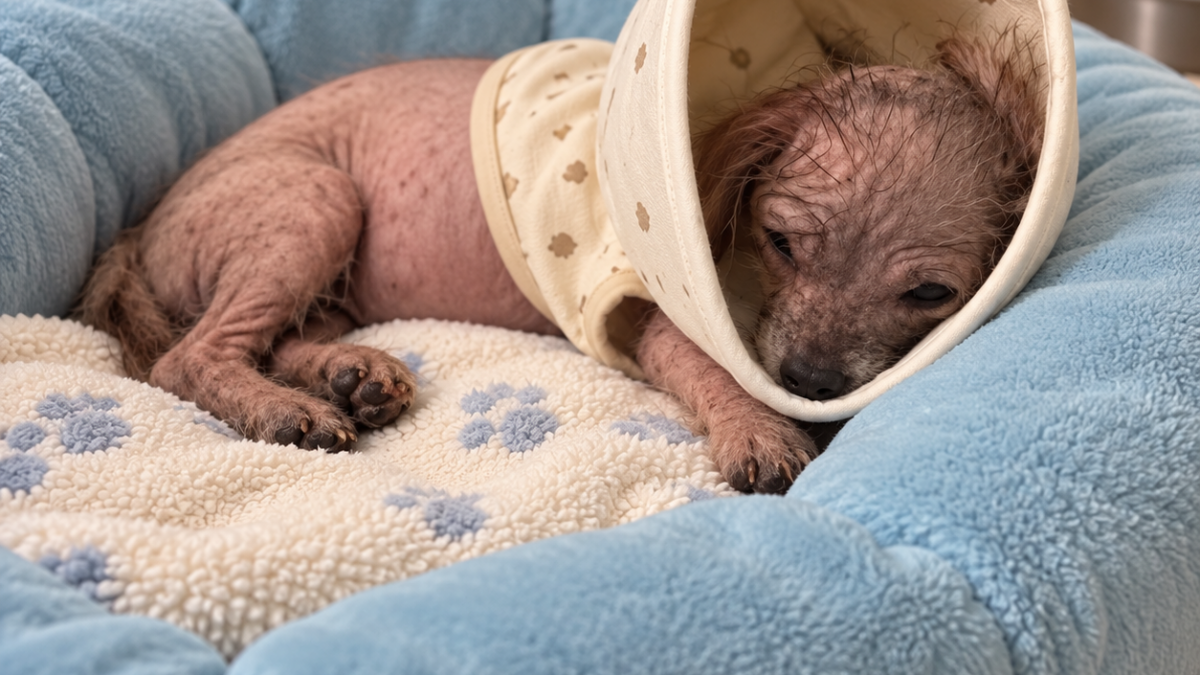
I had set up a small recovery area beside my bedroom because I wanted to be close enough to hear if her breathing changed. The veterinarian had warned us that puppies her age could worsen quickly, especially when they were already dealing with infection, fever, diarrhea, respiratory symptoms, and skin disease at the same time.
Every few minutes, I found myself listening for movement.
Most of the time, there was none.
That frightened me more than crying would have.
Puppies were supposed to protest.
They were supposed to scratch at barriers, whine for attention, investigate every smell, and object loudly when something did not go their way.
Pobi simply slept.
At around two in the morning, I got out of bed and knelt beside her.
Her little shirt had twisted slightly around her body.
I fixed it carefully.
She opened one eye.
“Sorry,” I whispered. “Go back to sleep.”
She did.
Just like that.
No fear.
No curiosity.
No energy.
I checked her temperature again.
Still elevated.
I wrote the number in the notebook the veterinary team had told me to keep.
2:07 a.m. — temperature still high. Drank small amount. Coughed twice. Sleeping.
I stared at the page afterward.
It looked so clinical.
So ordinary.
But each line felt like a negotiation with death.
Still breathing.
Still eating.
Still here.
I rested my hand beside her instead of touching the irritated skin.
“You don’t have to do anything tonight,” I whispered. “Just stay.”
That became my entire goal.
Not recovery.
Not fur.
Not weight gain.
Not playing.
Stay.
Just make it to morning.
She did.
At six-thirty, I woke to a strange sound.
For one panicked second, I thought she was choking.
Then I realized she was licking the empty food dish.
I nearly laughed.
“You’re hungry?”
Pobi kept licking.
I picked up the bowl.
Her head followed it.
That was the first time I saw something other than exhaustion in her face.
Interest.
Food mattered.
I prepared the amount the veterinarian had recommended and placed it down.
She ate slowly at first.
Then faster.
Not much.
But enough.
I wrote another line in the notebook.
6:42 a.m. — ate almost full portion.
I underlined it twice.
That morning, we returned to the clinic.
The veterinarian examined her skin again.
The damaged areas looked ugly after shaving, but now at least we could reach them properly.
“Don’t expect it to look better immediately,” she warned.
“I know.”
“Sometimes it looks worse before it looks better.”
“I know.”
“You’re saying that very confidently for someone who called me at three in the morning because the puppy sneezed.”
I looked at her.
“She sneezed three times.”
The veterinarian smiled.
“She has an upper respiratory issue. Sneezing is expected.”
“What if it gets worse?”
“Then you call.”
“So calling was correct.”
She sighed.
“I can see this is going to be a long few weeks.”
She was right.
The treatment routine became the structure of our days.
Medicine.
Meals.
Cleaning.
Rest.
Baths twice a week.
Monitoring her breathing.
Watching her bowel movements.
Checking hydration.
Washing bedding constantly.
And waiting.
Waiting is one of the hardest parts of animal rescue.
People imagine rescue as action.
You arrive.
You remove the animal.
You rush to a clinic.
You start medication.
But eventually you reach the part where medicine needs time.
The body needs time.
And there is nothing dramatic left to do.
You just keep showing up.
Pobi’s runny nose began improving first.
One afternoon, I realized I had not wiped her nose in several hours.
I stared at her face.
“Where did it go?”
Pobi blinked.
I called another caregiver.
“Come look at her.”
“What’s wrong?”
“Nothing.”
She frowned.
“Then why did you call me?”
“Her nose is clear.”
She stared at me.
Then smiled.
“That’s good.”
“Very good.”
The cough remained.
So did the diarrhea.
Our happiness lasted about five minutes before Pobi coughed again.
I immediately looked at the clock.
The caregiver laughed.
“You are going to memorize every sound this puppy makes.”
“I already have.”
That night, Pobi started coughing harder.
Not dangerously hard, but enough to worry me.
I called the clinic.
They asked questions.
Was she breathing normally afterward?
Yes.
Gums normal color?
Yes.
Still eating?
Yes.
Energy?
Low, but not worse.
Monitor.
Call again if anything changed.
I sat beside her on the floor.
Pobi climbed weakly toward my leg.
I helped her closer.
She rested her chin on my ankle.
“Your job is making me old.”
Her tail did not move.
Not yet.
But she stayed against me.
Several days later, one of the resident dogs finally noticed Pobi properly.
His name was Beto, a calm mixed-breed who had lived with foster dogs before and generally treated new arrivals with patient curiosity.
We introduced them slowly.
Pobi wore one of the small shirts we used to protect her recovering skin.
Beto approached.
Sniffed once.
Pobi froze.
I watched both dogs carefully.
Beto sniffed again.
Then he stepped backward and lowered his front half into a play bow.
I smiled.
“Good boy.”
Pobi stared at him.
Beto bounced sideways.
Pobi’s ears lifted.
Something happened.
A tiny movement.
Her tail.
One wag.
Then another.
I stopped breathing.
“Did you see that?”
The other caregiver whispered, “Yes.”
Beto bounced again.
Pobi took one step toward him.
Then another.
She stumbled.
I started forward instinctively.
“Wait,” the caregiver said.
Pobi corrected herself.
Beto stayed low.
Pobi reached him.
Sniffed his nose.
Then, for the first time since the rescue, she tried to play.
It lasted maybe thirty seconds.
That was all her body could handle.
She became tired and sat down.
But those thirty seconds changed the atmosphere of the house.
Up until then, Pobi had been a patient.
Suddenly, she was a puppy.
I realized how badly I needed to see that.
Not because it meant she was cured.
She wasn’t.
But illness had hidden everything else.
Now personality was beginning to push through.
Over the next few days, Pobi’s interest in the other dogs grew.
We kept everything supervised.
She was still fragile.
She tired quickly.
But the dogs seemed to understand more than I expected.
They didn’t bowl her over.
They sniffed.
Followed.
Occasionally invited her to play.
Beto became especially gentle with her.
Sometimes he simply lay near her bed.
Pobi would crawl toward him and fall asleep with her head against his side.
Every time I saw them like that, I thought about her litter.
I knew almost nothing about the puppies who had died.
How many there were.
What they looked like.
Whether Pobi slept beside them.
Whether they played before they became sick.
We only knew that they were gone.
I couldn’t replace them.
Neither could Beto.
But Pobi no longer had to sleep alone.
That mattered.
The medicated baths continued.
The second bath was easier than the first.
Pobi still trembled at first.
I kept one hand under her chest.
“Easy.”
We worked the medication gently across the affected skin.
Some areas remained angry and red.
Others looked slightly less inflamed.
At the end, I wrapped her in a towel and began massaging her carefully.
Her eyes closed.
I kept going.
Her head became heavier against my wrist.
Within minutes, she fell asleep.
Deeply asleep.
I smiled.
“You really trust people too easily.”
Then I regretted saying it.
Trust had not been her mistake.
The adults around her had failed her.
That distinction mattered.
People sometimes describe abused or neglected animals as naive because they continue seeking affection.
I never liked that.
Pobi wasn’t foolish for wanting care.
Care was what she should have received.
The failure belonged to the person who denied it.
Not the puppy who still hoped for it.
The first weight milestone came almost by accident.
We put Pobi on the scale.
1.65 kilograms.
I stared.
“Again.”
We lifted her off.
Reset the scale.
Put her back.
1.65.
One of the caregivers clapped.
Pobi looked around, confused.
“You gained weight!”
She tried stepping off the scale.
I laughed.
“You don’t care.”
Of course she didn’t.
But we cared.
Because weight meant food was staying in her body.
It meant she was getting enough nutrition to repair skin, fight infection, and grow.
It meant another small piece was moving in the right direction.
I wrote 1.65 kg in the notebook and drew a little star beside it.
I am not embarrassed by that star.
By then, Pobi had also discovered fingers.
Specifically, my fingers.
If I moved them across the blanket, she stalked them.
Slowly at first.
Then she pounced.
Her mouth closed around one finger.
“Hey.”
She chewed gently.
“That belongs to me.”
She chewed again.
“You have toys.”
She ignored the toys.
Apparently my hand was superior.
Sometimes we played for ten minutes.
Then twenty.
Soon Pobi could keep herself occupied for most of an evening.
She rolled around.
Attacked blankets.
Chased the corner of her own shirt.
Tried to steal a slipper.
Every bit of mischief felt miraculous because I remembered the puppy who could barely keep her eyes open.
On day fifteen, she still had problems.
The diarrhea had not completely resolved.
The cough lingered.
We continued medication and monitoring.
But her skin was clearly healing.
More importantly, hair had started growing back.
At first, it looked like pale fuzz.
I ran a fingertip gently over the new growth.
“Look at you.”
Pobi immediately bit my finger.
I laughed.
“Very sentimental moment. Thank you.”
People who had begun following her recovery sent gifts.
A tiny sweater.
Blankets.
Puppy-safe toys.
One stuffed animal was almost as large as Pobi.
She attacked it immediately.
For three minutes.
Then fell asleep on top of it.
A puppy’s body still has rules even when the puppy disagrees.
As Pobi grew stronger, she began resisting rest.
One morning, I prepared to take Beto and another dog outside.
Pobi appeared at the door.
“No.”
Tail wag.
“You are staying.”
She scratched at the floor.
“You have been sick.”
More wagging.
“You still cough.”
Pobi tried squeezing through the opening.
I blocked her.
She looked personally betrayed.
One of the other caregivers laughed.
“What?”
“You wanted energy.”
“Not this much.”
“You begged for this.”
“I did not beg.”
“You celebrated because she barked at your hand.”
“That was different.”
Pobi barked.
The caregiver pointed.
“See?”
I looked at Pobi.
“Short walk.”
Her entire body began moving.
The first walks were tiny.
A few minutes.
Slow.
Controlled.
Pobi treated them like an expedition across an unexplored continent.
Grass was fascinating.
Leaves were suspicious.
A parked bicycle required investigation.
A plastic bag was apparently terrifying for two seconds, then immediately worth attacking.
She wanted to smell everything.
Her legs tired before her curiosity did.
When I picked her up to carry her home, she struggled to get back down.
“No.”
She wriggled.
“You cannot negotiate this.”
More wriggling.
“Your body says nap.”
She disagreed until we reached home.
Then she fell asleep almost instantly.
That became Pobi’s pattern.
Wake.
Believe she could conquer the world.
Overdo everything.
Sleep.
Meanwhile, the investigation was becoming more serious.
The rescue team had reported Pobi’s former owner to the authorities.
The initial story he gave us remained simple.
He had found the litter near a road.
The puppies were already sick.
He had done his best.
The others died.
Pobi survived.
He was tired and wanted her gone.
If that story had been true, it would still have raised questions about why he had not sought professional help sooner.
But then neighbors started talking.
One neighbor remembered an adult female dog living on the property.
Another had seen puppies there.
Someone else remembered the mother looking thin after giving birth.
That did not match the roadside story.
Authorities returned with more questions.
Where exactly had he found the puppies?
What date?
Why had neighbors seen them at the home earlier?
Whose adult female dog had been living there?
Where was she now?
At first, he reportedly insisted people were confused.
Then the timeline shifted.
He had found the mother too.
No, he had been feeding her.
No, she had wandered in.
The explanations multiplied.
Each one made the story weaker.
I learned most of this through the rescue coordinator.
One evening, she called me.
“Are you sitting?”
My stomach dropped.
“Is this about Pobi?”
“No. Pobi is fine.”
I sat anyway.
“What happened?”
“He admitted the mother was his.”
I looked across the room.
Pobi was wrestling with Beto’s tail.
“What?”
“He owned her.”
The coordinator continued.
“She gave birth there.”
The room seemed to become smaller.
“So the roadside story…”
“False.”
I stared at Pobi.
“What happened to the mother?”
A pause.
“She died.”
I closed my eyes.
“And the litter?”
“You already know.”
“Why?”
“We don’t have every detail yet.”
Her voice hardened.
“But he admitted he did not provide the care she needed after she gave birth.”
I said nothing.
“He says things got out of control.”
“Things?”
“Cata…”
“Those were animals.”
“I know.”
“He watched the mother die?”
“We don’t know exactly what he witnessed or when.”
“And then the puppies?”
“We know they died one after another.”
I looked at Pobi.
She had finally succeeded in catching Beto’s tail.
Beto turned, gave her one patient warning, and Pobi immediately released it.
Then she bounced backward and barked.
Alive.
So alive.
The coordinator said my name.
I realized I had stopped listening.
“I’m here.”
“Are you okay?”
“No.”
That was the only honest answer.
After the call, I went into the kitchen.
I gripped the counter.
I wanted to scream.
The words he had used came back.
I’m tired of caring for her.
Take her far away.
Now they sounded even worse.
This wasn’t a man who had stumbled across strangers’ dying puppies and become overwhelmed trying to help.
This was the last surviving puppy from his own dog’s litter.
The mother had died.
The siblings had died.
And when Pobi remained, sick and feverish, he was tired.
I started crying.
Not quietly.
One of the caregivers came in.
She didn’t ask what was wrong.
She already knew the investigation had been moving.
“He admitted it?”
I nodded.
She swore under her breath.
Pobi wandered into the kitchen.
She looked up at us.
Then she sat down.
Her tail tapped the floor.
I crouched.
Pobi immediately climbed against my knees.
I picked her up.
“You were the last one.”
She licked my chin.
That broke me completely.
For several minutes, I held her and cried for animals I had never met.
Her mother.
Her littermates.
The lives they could have had.
The fact that Pobi had almost become another body in the same story.
That night, anger kept me awake.
I imagined confronting him.
Asking him whether the first dead puppy had frightened him.
Or the second.
Whether he watched the mother deteriorate.
Whether he understood infection.
Whether he ever thought of calling someone.
Whether he had looked at Pobi while every other puppy disappeared and realized she might be next.
Then I understood something.
My anger was not Pobi’s job to carry.
She didn’t need me obsessed with punishing someone.
She needed breakfast.
Medication.
Another bath.
A walk.
Training.
The ordinary future we were trying to build.
So the authorities could handle the case.
We would provide records.
Photographs.
Veterinary reports.
Witness accounts.
Our job was Pobi.
But that did not mean we forgot.
The next morning, I added another page to my notebook.
Not medical notes.
A list.
First day: high fever, severe skin damage, runny nose, coughing, diarrhea, exhausted.
Day 15: skin improving, hair returning, playing, stronger appetite.
Then I wrote:
He said take her far away.
And below it:
We did.
That sentence became important to me.
Not in the way he meant.
He wanted Pobi removed from his sight.
We wanted her removed from everything he had allowed her to endure.
Far from untreated skin disease.
Far from isolation.
Far from a place where animals died without adequate intervention.
Far from anyone who saw her need as an inconvenience.
That became our version of revenge.
Not hurting him.
Building a life he no longer had the power to ruin.
Pobi’s coat grew steadily.
The patches that had been almost bare became soft.
Then thicker.
The redness faded.
One morning, I realized I could stroke most of her back without worrying about causing pain.
It felt strange.
For weeks, every touch had been calculated.
Avoid this patch.
Be gentle here.
Medication there.
Now I could simply pet her.
Pobi rolled onto her back.
I rubbed her belly.
Her hind leg kicked slightly.
I laughed.
“You’re becoming a real dog.”
She grabbed my wrist.
“Okay. An annoying dog.”
Her appetite improved almost too much.
Meal time became an event.
If I was thirty seconds late, Pobi behaved as though starvation had returned.
She ran between the bowl and my feet.
“Wait.”
No.
“Pobi, sit.”
She sat.
For half a second.
Then stood.
“Sit.”
Again.
I lowered the bowl.
She launched forward.
I lifted it.
“No.”
She stared at me.
“Being rescued does not exempt you from manners.”
She barked.
“You may file a complaint.”
Beto sat perfectly behind her.
I pointed.
“Look at him.”
Pobi glanced backward.
Beto looked smug.
She sat.
I gave them food.
Within weeks, training became part of our routine.
Sit.
Come.
Wait.
Leave it.
Her performance depended heavily on whether food was involved.
With food, Pobi was brilliant.
Without food, she had philosophical objections to obedience.
She became particularly skilled at pretending not to hear us.
“Pobi.”
Nothing.
“Pobi.”
She examined the wall.
“I know you know your name.”
Beto looked at her.
Pobi suddenly ran toward me.
I rewarded her.
The trainer laughed.
“She’s training you.”
“I’m aware.”
The more normal she became, the more I noticed how early trauma had interrupted her development.
She needed opportunities to explore safely.
To meet people.
To learn dog communication.
To experience ordinary sounds.
Doors.
Traffic.
Vacuum cleaners.
Household activity.
The first time the vacuum started, Pobi ran behind Beto.
Beto did not move.
He had seen the enemy before.
Pobi peeked around him.
The vacuum moved.
She barked.
I turned it off.
“Enough heroism for today.”
By the third exposure, she followed it.
By the fifth, she tried biting it.
Progress.
The resident dogs became her teachers.
Beto taught calm.
Maya, another foster dog, taught boundaries.
Maya was kind but not endlessly patient.
When Pobi climbed on her while she slept, Maya gave one sharp warning.
Pobi froze.
Then backed off.
I watched carefully.
No fight.
No fear.
Communication.
A minute later, Pobi lay beside her instead.
I smiled.
“You finally met someone who doesn’t think everything you do is adorable.”
Pobi ignored me.
At follow-up appointments, the veterinary team began using words we had desperately wanted to hear.
Improving.
Stable.
Healthy weight gain.
Better skin.
Reduced inflammation.
One day, the veterinarian ran both hands through Pobi’s growing coat.
“You’re getting furry.”
I smiled.
“Say it again.”
The veterinarian laughed.
“She’s getting furry.”
Pobi tried chewing the stethoscope.
“Also destructive.”
“That means healthy.”
“Not medically.”
“For me it does.”
The cough gradually faded.
The digestive issues took longer.
Whenever diarrhea returned, my anxiety came back instantly.
What if we were losing progress?
What if another infection was developing?
What if—
The veterinarian would stop me.
“One symptom does not erase three weeks of improvement.”
I had to learn that recovery was not a straight road.
Even after Pobi looked better, bad days could happen.
She could be tired.
She could have an upset stomach.
She could need more treatment.
A setback was not automatically disaster.
That lesson took longer for me than for Pobi.
She lived almost entirely in the present.
Feeling good?
Play.
Feeling tired?
Sleep.
Food arrives?
Eat.
Human sits down?
Climb on human.
She did not compare today to the day we rescued her.
We did that for her.
Sometimes I wondered if that was why animals can recover emotionally in ways that seem astonishing.
Not because they forget everything.
But because they don’t construct their identities around the story the way humans do.
Pobi did not wake thinking:
I am the only surviving puppy.
She woke thinking:
Where is breakfast?
That was healthy.
The investigation continued.
Authorities collected statements.
Veterinary documentation was submitted.
Neighbors gave accounts of the adult dog and the litter.
The rescue team made it clear that the situation had not begun with Pobi.
Her mother’s condition mattered.
The deaths of the puppies mattered.
The shifting story mattered.
Whether the legal outcome would ever feel sufficient was another question.
One rescue volunteer told me:
“People are asking what punishment he’ll get.”
“What did you tell them?”
“That we can’t promise anything.”
I nodded.
That was important.
I did not want to turn Pobi’s story into something dishonest just because people wanted a dramatic villain punished in the final scene.
Real animal welfare cases are messy.
Evidence has limits.
Laws have limits.
Penalties may disappoint people.
The suffering can be enormous while the legal response feels small.
I hated that.
But I hated false endings more.
The truth was enough.
The owner had claimed he found roadside puppies.
Neighbors challenged that account.
Authorities questioned him.
He admitted the mother belonged to him.
He admitted neglect after she gave birth.
The mother died.
The puppies died.
Pobi survived.
Those facts did not need embellishment.
One afternoon, I received a call from the rescue coordinator.
“There may be a formal hearing.”
“For him?”
“Yes.”
My stomach tightened.
“Do you need me?”
“Possibly for documentation about Pobi’s condition.”
“I’ll be there.”
That night, I looked at Pobi sleeping.
I imagined placing the first photographs on a table.
Showing what mange and infection had done.
Explaining her fever.
Her cough.
Her diarrhea.
The amount of care required simply to stabilize one puppy.
Then asking the obvious question.
If timely care could do this for Pobi, what might it have done for the others?
We would never know.
That was the part nobody could undo.
When the authorities finally required the former owner to answer formally for the conditions and the inconsistencies in his account, there was no dramatic courtroom scene.
No shouting.
No movie-style confession.
There were questions.
Documents.
Witness statements.
Veterinary reports.
The photographs were difficult to look at.
His earlier claim about finding the puppies was compared with the accounts from neighbors.
He could not simply repeat the same story anymore.
He acknowledged the mother had been his dog.
He acknowledged the litter had been born under his care.
He acknowledged that he had not obtained proper medical help as their condition deteriorated.
I sat there with my hands clenched together.
I had imagined feeling victorious.
I didn’t.
I felt tired.
Because accountability does not resurrect animals.
It does not put milk back into the mother.
It does not treat infection weeks earlier.
It does not bring Pobi’s siblings into the room.
The legal consequences mattered.
But they were not healing.
When we left, one of the volunteers asked me:
“Do you feel better?”
I thought about it.
“No.”
She nodded.
“Me neither.”
Then I looked at my phone.
There was a photograph from home.
Pobi had stolen Beto’s blanket.
She was lying on it with her mouth open, looking completely pleased with herself.
I started laughing.
The volunteer looked.
“That helps?”
“Yes.”
That helped.
Because there she was.
Still moving forward.
Pobi’s health eventually improved enough that the frequency of clinic visits decreased.
The first time the vet said, “See you in a few weeks instead of next week,” I almost didn’t understand.
“You don’t want to see her?”
“I would love to see her.”
“Then why—”
“Cata.”
I smiled.
“I know.”
“She doesn’t need weekly visits anymore.”
The sentence hit me slowly.
Doesn’t need.
We had spent so long reacting to needs.
Medication.
Baths.
Monitoring.
Now Pobi was requiring less intervention because her body was doing more of the work itself.
That felt enormous.
Her fur thickened enough that strangers no longer immediately saw a medical history.
One afternoon at a small park, a woman stopped.
“What a cute puppy.”
I smiled.
“Thank you.”
“How old?”
We talked briefly.
She never asked about the skin.
She didn’t know.
After she left, I looked down at Pobi.
“You passed.”
Pobi sniffed the grass.
“You just got treated like a normal puppy.”
No interest.
She had already moved on to investigating a stick.
That moment affected me more than I expected.
For the first time, someone had met Pobi without meeting her suffering first.
That was a kind of freedom.
Pobi began taking longer walks.
She loved them.
Too much.
If she saw the leash, she became impossible.
I once tried quietly moving it from one hook to another.
She heard the tiny metal clip.
From another room.
Within seconds, Pobi arrived at full speed.
“How?”
Tail.
“You were asleep.”
Tail.
“We’re not going out.”
Her entire body froze.
Then she looked at me with such betrayal that I laughed.
“Fine. Five minutes.”
She won far too often.
Her energy continued growing.
The other dogs stopped treating her as fragile.
That was another milestone.
At first, their play had been careful.
Then one day Beto ran.
Pobi chased.
They circled the yard.
Pobi slipped.
Rolled.
Jumped back up.
I panicked.
She didn’t.
She kept running.
“Be careful!”
No one listened.
I stood there with my heart in my throat.
One caregiver came beside me.
“She’s okay.”
“She fell.”
“She got up.”
“What if—”
“She’s allowed to be a dog.”
That sentence became hard for me.
Because protecting Pobi had been our entire job.
Now part of loving her meant allowing normal risk.
Running.
Playing.
Exploring.
I had to stop treating her like she might break from ordinary life.
Pobi helped.
She gave me no choice.
She threw herself into living.
People continued sending updates requests and small gifts.
One package contained a beautiful padded bed.
We placed it in the living room.
Pobi sniffed it.
Walked away.
Later that evening, we found her asleep inside the empty shipping box.
I took a picture and sent it to the donor.
They replied:
Of course.
That was Pobi.
Expensive bed?
Box.
Proper toy?
Sock.
Water bowl?
Excellent.
Puddle outside?
Also excellent.
Her personality had become so large that sometimes I forgot how small she had been.
Then I found her original recovery shirt.
It had been washed and stored.
I held it in one hand.
Pobi walked over.
Sniffed.
Then grabbed it.
“No.”
She pulled.
“This is important.”
Pobi pulled harder.
I laughed.
“It represents your recovery.”
She did not care.
Beto joined.
Suddenly both dogs were pulling on the tiny shirt.
“No! Absolutely not.”
I managed to rescue it.
Barely.
The fabric stretched.
I looked at Pobi.
“You almost destroyed history.”
She wagged.
That evening, I placed the shirt beside one early photograph.
Pobi’s body in that image was tiny.
Skin damaged.
Eyes dull.
I compared it with the living creature currently trying to climb onto the couch.
Same dog.
That fact mattered.
Sometimes people said:
“She looks like a different dog.”
They meant it kindly.
But I always wanted to say:
No.
She was always this dog.
You just couldn’t see all of her underneath the illness.
The playful puppy existed inside the feverish one.
The confident dog existed inside the frightened one.
Care did not replace Pobi with a better animal.
Care gave the original Pobi room to emerge.
Months passed.
By then, the legal process had moved beyond our daily lives.
The former owner faced the consequences available under the applicable animal welfare process, and restrictions were pursued to prevent the same situation from simply repeating unnoticed.
Was it enough?
No penalty could feel equal to an adult dog and nearly an entire litter dying.
But something important had changed.
The story was documented.
The neglect was not erased.
He could no longer say he had merely found abandoned puppies beside a road and had done everything possible.
The record said otherwise.
That mattered.
Neighbors who had once hesitated to speak became more willing to report concerns.
One woman contacted us months later.
She said:
“I saw another dog nearby that looked too thin. I don’t know if I’m overreacting.”
We told her:
“Report what you saw.”
She did.
That dog received help before the condition became severe.
When I heard, I thought about Pobi’s mother.
Maybe that was one piece of justice too.
Not revenge against one individual.
A change in what people around him were willing to ignore.
Pobi’s story made silence uncomfortable.
That was powerful.
The next chapter of Pobi’s life should have been adoption.
That was the original idea.
Stabilize her.
Treat her.
Build strength.
Then find a permanent family.
We began receiving inquiries.
Some sounded wonderful.
Some did not.
One person wanted her because they had seen her story and called her “the famous puppy.”
That immediately worried me.
A dog should not be adopted as a souvenir from an emotional story.
Another family asked sensible questions.
Medical history.
Skin recurrence.
Diet.
Behavior with other dogs.
Training needs.
Those were better questions.
But every time we discussed a possible home, Pobi would do something ordinary that made the thought of her leaving feel increasingly absurd.
She slept beside Beto.
She followed me into the kitchen.
She knew the daily routine.
Her toys were everywhere.
One morning, someone asked:
“Where is Pobi?”
I realized I hadn’t seen her in ten minutes.
We searched.
Bedroom.
Yard.
Bathroom.
Kitchen.
My heart rate climbed immediately.
Then we found her.
Inside the laundry basket.
Asleep.
Her head rested on a towel.
I stood there.
“You have no idea what you just did to us.”
Pobi opened one eye.
Closed it.
Another caregiver smiled.
“She belongs here.”
I looked at her.
Neither of us said anything else.
A few weeks later, the conversation became official.
“What do you think about keeping her?”
I tried to sound rational.
“She could have a wonderful home elsewhere.”
“Yes.”
“She likes it here.”
“Yes.”
“She already knows the dogs.”
“Yes.”
“We understand her medical history.”
“Yes.”
“I don’t want to make an emotional decision.”
The caregiver stared.
“You paid money to rescue a feverish nearly hairless puppy and then woke up every two hours for weeks.”
“That was different.”
“How?”
“That was emergency care.”
“And this?”
I looked at Pobi.
She was asleep upside down on the couch.
“This is…”
“Home?”
I sighed.
“Yes.”
There was no dramatic adoption scene.
No giant sign.
No surprise.
We completed the paperwork.
That was it.
Officially, Pobi was staying with the people and dogs who had already become her family.
That night, I sat beside her.
“You know what changed today?”
Pobi chewed a toy.
“Nothing.”
She kept chewing.
“Exactly.”
That was the beauty of it.
The legal status changed.
Her life did not need to.
She already knew where her bed was.
Where meals came from.
Which dog would play.
Which human would enforce naps.
She was home before the paperwork admitted it.
As Pobi grew, her coat became thick and healthy.
You could still find subtle reminders of the past if you knew where to look.
A small area where fur grew differently.
Sensitivity during certain types of handling.
Occasional skin monitoring.
But strangers saw a happy young dog.
That was enough.
Pobi developed an almost ridiculous love of walks.
Rain did not matter.
Cold did not matter.
If the leash appeared, she was ready.
Once I tried telling her:
“Not today.”
She sat beside the door.
I went to the kitchen.
She remained there.
Ten minutes.
Twenty.
Still sitting.
I finally surrendered.
“You are emotionally manipulative.”
Tail wag.
We walked.
Halfway down the street, Pobi discovered mud.
By the time we returned, she was filthy.
I stared at her.
“You had mange. We worked for months to make you clean and healthy.”
She shook muddy water onto my legs.
I closed my eyes.
“This is how you repay me.”
I started laughing.
That evening came another bath.
Not medicated.
Just normal.
Normal.
I loved that word.
At some point, Pobi’s life became boring enough that updates no longer revolved around illness.
She gained weight.
She learned commands.
She played.
She destroyed one shoe.
Then another.
She developed favorite sleeping places.
She preferred one particular blanket.
She learned that one cupboard contained treats.
If anyone walked toward it, Pobi appeared.
Sometimes I watched her and thought about the mother again.
I wondered what she looked like.
Did Pobi inherit her ears?
Her expression?
The way she tilted her head?
We would never know.
That grief never disappeared completely.
But eventually it stopped living at the center of Pobi’s story.
That was important.
She did not exist only as the last survivor of a dead litter.
She became Pobi.
The dog who hated having her nails trimmed.
The dog who stole laundry.
The dog who loved Beto.
The dog who recognized the treat cupboard from another room.
The dog who fell asleep after baths.
The dog who had once been told to go far away and now became impossible to remove from anyone’s lap.
One anniversary of her rescue, we took new photographs.
Not for medical documentation.
Just because.
Pobi sat in the yard.
Her coat shone.
Her eyes were bright.
The original tiny shirt lay beside her for scale.
She tried stealing it.
Naturally.
I held the first-day photograph next to the new one.
The contrast hurt.
In the old image, everything about her body asked for intervention.
In the new one, she looked impatient because I was delaying playtime.
I whispered:
“This is your revenge.”
Someone nearby asked:
“What?”
I shook my head.
“Nothing.”
But I meant it.
People often want justice stories to end with a person receiving pain.
I understand the instinct.
When you see an animal suffer because of human neglect, anger comes naturally.
But Pobi taught me that the most satisfying reversal was not watching someone else fall.
It was watching her rise.
He had considered her a burden.
She became someone’s family.
He was tired of feeding her.
We celebrated every meal.
He wanted her far away.
We worried if she disappeared into another room.
He allowed illness to consume her skin.
We photographed every patch of new fur.
He offered excuses about how her family died.
Pobi survived long enough for those excuses to be questioned.
That was enough.
Years later, the rescue group used Pobi’s case when educating people about early intervention.
Not because she was the worst case anyone had ever seen.
Sadly, she wasn’t.
But because her story showed the cost of waiting.
The mother died.
The siblings died.
The surviving puppy required weeks of treatment.
Maybe some of that loss could have been prevented.
That question should bother people.
It bothered me.
But Pobi’s recovery also showed what timely care could do.
Medication worked.
Nutrition mattered.
Clean conditions mattered.
Monitoring mattered.
Treatment mattered.
Ordinary responsible care mattered.
Sometimes animal rescue stories become so emotional that people imagine salvation requires heroic people doing extraordinary things.
Often, it doesn’t.
Sometimes saving an animal means noticing early.
Making a phone call.
Going to a veterinarian.
Giving the prescribed medication.
Keeping a living space clean.
Feeding properly.
Not giving up because care becomes inconvenient.
The tragedy in Pobi’s first home was not that no miracle existed.
It was that basic responsibility came too late.
One evening, long after Pobi had recovered, I sat on the floor sorting old medical paperwork.
Pobi walked over.
She put one paw directly on the papers.
“Excuse me.”
She sat.
“Pobi.”
Nothing.
“You are sitting on your own medical history.”
Tail wag.
I pulled one sheet out.
The first weight entry.
The high temperature.
The diagnosis.
Mange.
Bacterial infection.
Respiratory symptoms.
Gastrointestinal issues.
I looked at her.
Pobi yawned.
Then she rested her head on my leg.
The papers suddenly felt like documents about another lifetime.
But I kept them.
Not because I wanted to keep Pobi trapped in that past.
Because evidence matters.
Memory matters.
The animals who died deserved not to disappear completely.
And Pobi deserved for the truth of what she survived to remain intact.
I placed the papers back into the folder.
Then Pobi stood.
Walked to the door.
Looked at me.
“No.”
She stared.
“We already walked.”
Stare.
“It is dark.”
Stare.
I laughed.
“Fine.”
I clipped on her leash.
Outside, the air was cool.
Pobi trotted ahead.
Not sick.
Not weak.
Not sleeping through life.
She wanted every smell.
Every tree.
Every dog in the distance.
At one corner, she stopped.
Looked back at me.
Then waited.
I caught up.
“Good girl.”
She continued.
That became the image I carried with me.
Not the house where we found her.
Not the man saying he was tired.
Not even the clinic.
Pobi walking ahead.
Then checking that we were still there.
And we were.
Always.
Years after the rescue, someone asked me whether I thought Pobi remembered her first home.
I didn’t know.
Maybe she remembered smells.
Sounds.
Physical sensations.
Dogs do not tell us exactly how their memories work.
But I knew what she had learned afterward.
Hands could heal.
Food returned every day.
Dogs could become friends instead of disappear.
A bath could end in a warm towel.
A closed door did not mean abandonment.
A person leaving the room came back.
That was the recovery no photograph could fully show.
Fur was visible.
Trust wasn’t.
But trust was the bigger victory.
One afternoon, a visitor reached down toward Pobi.
She leaned into the hand.
No hesitation.
The visitor smiled.
“She’s so trusting.”
I almost cried.
“Yes.”
They had no idea what that meant.
The former owner had once told us to take her as far away as possible.
If he could have seen her then, healthy and leaning into someone’s touch, I wondered what he would think.
Maybe nothing.
Maybe regret.
Maybe embarrassment.
Maybe anger that his story had been exposed.
I stopped caring.
Pobi’s life no longer needed his reaction.
That was freedom too.
The person who harmed or neglected an animal should not remain the emotional center of the animal’s story forever.
Eventually, the center should become the animal.
Pobi.
Her breakfast.
Her friends.
Her stubbornness.
Her walks.
Her naps.
Her ridiculous obsession with slippers.
Her coat.
Her life.
That is where the story deserves to end.
Not with him.
With her.
One rainy afternoon, I found Pobi sleeping between two of the bigger dogs.
Outside, water ran down the windows.
Inside, she was buried beneath a blanket.
Only her nose showed.
I sat nearby.
She opened one eye.
“You comfortable?”
The eye closed again.
I smiled.
I thought about the first time I had seen her.
Tiny.
Feverish.
Damaged skin.
Runny nose.
Barely enough energy to stay awake.
Her mother gone.
Her siblings gone.
An owner saying he wanted her removed.
Now she had more blankets than she needed.
More toys than she used.
Dogs pressed against both sides of her.
People who knew her medication history by heart.
People who would take her to the veterinarian because she sneezed strangely twice.
Maybe we overcorrected.
I was comfortable with that.
The next morning, Pobi woke before me.
I heard her paws outside the bedroom.
Then scratching at the door.
I opened my eyes.
“Five minutes.”
Scratch.
“Pobi.”
Scratch.
I got up.
She ran toward the kitchen.
I prepared breakfast.
She danced beneath my feet.
“Sit.”
She sat.
“Wait.”
She trembled with impatience.
I placed the bowl down.
“Okay.”
She ate.
Then she picked up a toy.
Then she chased Beto.
Then she barked at nothing outside.
Then she dragged a blanket halfway across the room.
A completely ordinary morning.
That was the happy ending.
Not perfection.
Ordinary life.
For Pobi, ordinary life was something people had nearly taken from her before she had even lived two months.
Now she possessed it in abundance.
Food.
Noise.
Play.
Annoyance.
Affection.
Routine.
Security.
Years of tomorrows.
Sometimes I still think about that first sentence.
Take her far away.
If I could answer the man now, I know exactly what I would say.
We did.
We took her far away from the place where her mother received too little help.
Far away from the place where her litter disappeared one puppy at a time.
Far away from untreated infection.
Far away from indifference.
Far away from excuses.
We took her into a clinic.
Then into clean bedding.
Into medicated baths.
Into proper meals.
Into the company of dogs who taught her how to play.
Into arms that noticed every cough.
Into a family that celebrated 1.65 kilograms as though we had won a championship.
Into a life where disappearing for ten minutes caused a household search.
And eventually, into a future where people met her and had no idea she had ever been sick.
That was far enough.
The last time I looked at the little shirt she wore during recovery, I almost put it back into storage.
Then I changed my mind.
I framed it.
Nothing elaborate.
Just the faded shirt beside two photographs.
On the left, Pobi during treatment.
On the right, Pobi healthy, standing between her dog friends with that ridiculous confident expression she developed once she realized the house belonged to her.
Underneath, I wrote only two lines.
He said, “Take her far away.”
So we took her home.
That was the whole story.
Everything else—the investigation, the lies, the anger, the medical records, the baths, the sleepless nights—fit between those two sentences.
Sometimes visitors read the frame.
They become quiet.
Then Pobi usually ruins the emotional moment by appearing with a stolen sock.
I prefer it that way.
Because she is not a tragedy hanging on a wall.
She is alive.
She is loud.
She is demanding.
She wants dinner.
She wants the door opened.
She wants another walk.
And if someone sits down for too long without paying attention to her, she will climb directly into their lap and remind them she exists.
Her mother never got that future.
Neither did her siblings.
I carry that sadness.
But I also carry this:
Pobi did.
The final surviving puppy lived.
She healed.
Her coat returned.
Her fever disappeared.
She gained weight.
She played.
She learned to walk on a leash.
She made friends.
She became family.
And in the end, the man who once wanted her gone became only a small part of a much larger story.
He was the beginning.
He did not get to be the ending.
Pobi did.
And every morning when she races toward the door, ready for another completely ordinary day, she writes that ending again.








