PART 2: Her Mouth Was Taped Shut So She Couldn’t Cry for Help—Then One Rescuer Sat Down Beside Her
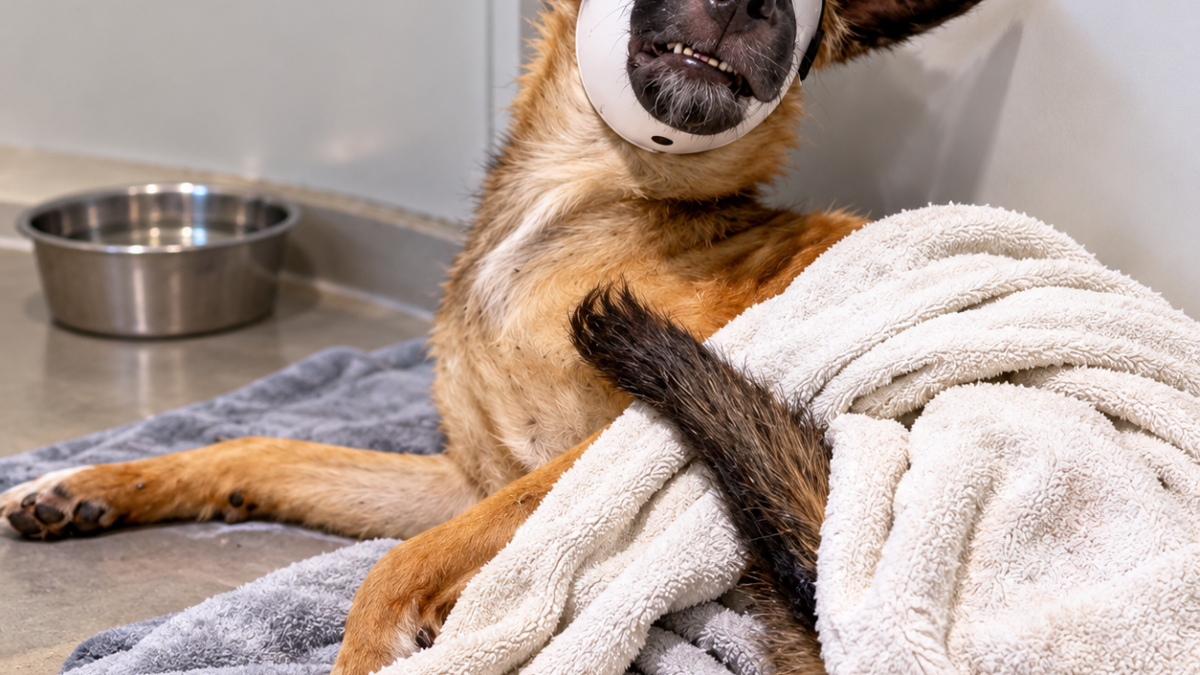
The first time I saw Vitoria, layers of black tape were wrapped so tightly around her muzzle that she physically could not bark, cry, eat normally, or even open her mouth enough to defend herself, yet the moment anyone stepped toward her she still threw her entire exhausted body forward as if she would rather fight another human than risk finding out what our hands might do. The tape had cut into the corners of her mouth and rubbed the skin raw across her snout, but what disturbed me even more was the look in her eyes—she wasn’t waiting for help, because somewhere before we found her, people had apparently taught her that humans were exactly what she needed protection from. I thought removing the tape would be the difficult part, but the first time I sat quietly near her and she refused even a piece of food, I realized someone had taken far more from Vitoria than her voice.
The call reached us through a woman named Helena.
She had seen the dog wandering between parked cars near a busy neighborhood street.
At first, she assumed she was looking at another stray searching for food.
Then the dog turned sideways.
Something looked wrong.
Helena slowed.
The dog stopped too.
Black material covered her muzzle.
Helena moved closer.
That was when she realized it was tape.
Not one strip.
Several.
Wrapped completely around the dog’s snout.
“Oh my God.”
She tried approaching.
The dog lunged.
Helena jumped backward.
“I’m not going to hurt you.”
The dog couldn’t bark.
That silence frightened Helena more than the lunge.
She called local rescuers.
By the time they arrived, the dog had moved behind an abandoned building and wedged herself beneath a metal staircase.
Every attempt to get near her ended the same way.
Teeth pressing uselessly against taped jaws.
Body twisting.
Eyes wide.
Panic.
A rescuer tried a slip lead.
Vitoria threw herself backward.
Another tried guiding her with a blanket.
She slammed against the wall trying to escape.
Nobody wanted to injure her.
But leaving her there wasn’t possible either.
The tape had already cut deeply enough that blood and saliva had dried along the edges.
Eventually they managed to contain her using barriers, a catch pole only long enough to prevent escape, and a transport crate positioned directly in front of her.
The second she entered, the door closed.
Vitoria spun once.
Then flattened herself against the back.
That was how she arrived with us.
I remember Marcinho walking toward the crate.
He had been rescuing animals long enough that very little visibly rattled him.
He stopped anyway.
“That’s tape?”
“Yes.”
“All the way around?”
“Yes.”
He crouched.
Vitoria stared at him.
No growl.
She couldn’t.
Marcinho looked at the raw corners of her mouth.
“Get the vet ready.”
At the clinic, sedation was the safest option.
Trying to cut the tape from an awake, terrified dog could have caused more injury.
Once Vitoria was asleep, the veterinarian began removing layer after layer.
Each piece revealed more damaged skin.
The tape had compressed her muzzle so tightly that the fur beneath it was flattened and moist.
The corners of her lips were ulcerated.
Her skin was inflamed.
When the final strip came away, Vitoria’s mouth opened slightly for the first time.
Everyone in the room went silent.
The veterinarian checked her tongue.
Teeth.
Gums.
Jaw movement.
“She’s lucky.”
I stared at the wounds.
“This is lucky?”
“The tissue is damaged, but I’m not seeing the catastrophic injury I feared.”
Marcinho stood near the table.
“What happens when she wakes?”
The vet looked toward Vitoria.
“We find out how much fear is underneath all this.”
A few hours later, Vitoria opened her eyes.
Marcinho placed a bowl of soft food several feet away.
She smelled it.
Her body tightened.
He backed up.
“Eat.”
She didn’t.
Ten minutes passed.
Then twenty.
Marcinho moved farther away.
Vitoria stared at the food.
Then at him.
And turned her face toward the wall.
Marcinho sat down on the floor.
He did not move closer.
Did not call her.
Did not reach out.
He simply waited.
And for the first time, I understood that getting the tape off Vitoria’s mouth had not actually set her free.
PART 2
Marcinho stayed on the floor.
Ten minutes became twenty.
Vitoria didn’t touch the bowl.
Her nose moved occasionally.
The smell of food clearly reached her.
Hunger was there.
But every time Marcinho shifted his weight, her eyes snapped toward him.
“Maybe leave,” I whispered.
He shook his head.
“She needs to see that I can stay without doing anything.”
“That could take hours.”
“Then it takes hours.”
There was no heroic pose in the way he said it.
No declaration about saving her soul.
He sounded like a man discussing a repair that required patience.
That was one reason animals responded to him.
Marcinho rarely made their fear about his feelings.
Vitoria owed us nothing.
Not affection.
Not gratitude.
Not immediate trust.
We had removed the tape because it needed to come off.
What happened emotionally after that would have to happen on her schedule.
Eventually Marcinho stood.
Vitoria stiffened.
He walked toward the door instead of toward her.
“Good night.”
I looked at him.
“You think she understands that?”
“No.”
He opened the door.
“But I’ll say the same thing tomorrow.”
After everyone left, we checked Vitoria through the camera.
For nearly half an hour, she didn’t move.
Then she lifted her head.
Looked toward the door.
Waited.
Another few minutes.
She stood.
Her legs were thin but steady.
She approached the bowl.
Sniffed.
Backed away.
Approached again.
Then she ate.
Not much.
Four or five bites.
Then she retreated to the corner.
I texted Marcinho.
**She ate.**
He responded almost immediately.
**Good. Don’t push tomorrow.**
That was the beginning.
Not the dramatic removal of the tape.
The first meal no one forced her to take.
The veterinarian examined Vitoria more thoroughly the next morning.
She was underweight but not critically emaciated.
Dehydrated.
Flea-infested.
Several superficial wounds along her legs.
The most serious visible damage remained around her muzzle.
We cleaned the skin carefully.
Applied prescribed treatment.
Started antibiotics because some areas were already infected.
Pain medication helped.
But wound care required handling.
That became our first major problem.
The moment anyone approached Vitoria’s face, she panicked.
Even without the tape restricting her jaw, she did not immediately use her teeth.
Instead, she tried to escape.
Twisted.
Flattened herself.
Backed against walls.
Only when escape disappeared did she snap.
Marcinho stopped one cleaning session before we had finished.
The veterinary technician looked at him.
“We need to clean that side.”
“I know.”
“She’ll get infected.”
“I know.”
“So?”
“We give her a minute.”
“She’s already stressed.”
“That’s why.”
He lowered his hands.
Vitoria pressed herself into the corner.
Her breathing was rapid.
Marcinho turned his body sideways.
No eye contact.
After about two minutes, the breathing slowed.
He placed a piece of chicken on the floor.
She ignored it.
He waited.
Then approached from the side.
One touch.
Stop.
Another.
The technician cleaned the last section quickly.
Done.
Marcinho stepped away.
“She needs to learn there’s an end.”
I understood.
That was something fear often destroys.
When an animal believes distress will continue indefinitely, panic escalates.
Touch.
Pain.
No escape.
More pain.
For Vitoria, we needed a different sequence.
Touch.
Brief discomfort.
Stop.
Distance.
Nothing follows.
Again tomorrow.
Over several days, wound cleaning became less chaotic.
Not easy.
Less chaotic.
Vitoria still watched every hand.
But she began recognizing the tray.
She recognized Marcinho’s voice.
She recognized the end of the procedure.
Then the bowl appeared.
At first, she waited until we left to eat.
Then she ate while we stood outside the kennel.
Several feet away.
Then Marcinho sat inside the room with his back against the opposite wall.
Vitoria stared at him for five minutes.
He looked at the floor.
She moved toward the bowl.
One bite.
Paused.
Looked at him.
Marcinho didn’t move.
Another bite.
Then another.
By the end of the meal, she was eating continuously.
Afterward, she retreated.
That was enough.
The next morning, the bowl was empty before we arrived.
Marcinho smiled.
“Someone got hungry.”
Vitoria watched from her bed.
He placed breakfast down.
Backed away.
She waited.
Less time this time.
That became our measurement.
Not affection.
Latency.
How long before she ate?
How close could a person sit?
How quickly did her breathing normalize after wound care?
How many seconds before she stopped tracking every movement?
Fear became numbers we could observe instead of a dramatic label.
On day six, Marcinho made a mistake.
He moved too quickly.
Nothing terrible.
He simply reached to replace Vitoria’s water while she stood closer than he realized.
His arm passed above her head.
Vitoria exploded.
She snapped.
The sound of teeth closing was loud now that nothing covered her mouth.
Marcinho jerked backward.
The bowl spilled.
Water spread across the floor.
Vitoria retreated instantly.
I ran in.
“Did she get you?”
“No.”
“Let me see.”
“I’m fine.”
There was a shallow scrape on his wrist where a tooth had grazed him.
“You’re bleeding.”
“Barely.”
Vitoria stared from the corner.
Her body looked smaller somehow.
Marcinho looked at her.
Then at me.
“Don’t make a big deal.”
“She almost bit you.”
“She warned me.”
“That was more than a warning.”
“I put my arm over a terrified dog’s head without thinking.”
He grabbed paper towels.
“My mistake.”
That response mattered.
He didn’t punish her.
Didn’t shout.
Didn’t become colder.
He also didn’t pretend snapping was safe.
The next sessions were structured more carefully.
Clear approach.
Predictable hand movement.
No reaching over.
Use barriers if necessary.
Respect distance.
Trust did not mean removing safety.
That is where people sometimes get rescue wrong.
Love alone is not a handling plan.
The dog can be frightened and still dangerous.
Both facts can exist.
We treated Vitoria’s fear seriously without treating her as vicious.
A week after the tape came off, she barked.
Nobody expected it.
Marcinho entered carrying food.
He turned his back to prepare the bowl.
Behind him came one short sound.
Rough.
Almost broken.
He froze.
I was outside the room.
“Was that her?”
Marcinho looked over his shoulder.
Vitoria stood near the back wall.
He moved slightly.
“Vitoria?”
Bark.
Stronger.
Marcinho smiled.
“There you are.”
I started crying.
He looked at me.
“Seriously?”
“She couldn’t bark.”
“She can now.”
“That’s why I’m crying.”
“She’s barking because breakfast is late.”
“I don’t care.”
Vitoria barked again.
It wasn’t beautiful.
Her voice sounded hoarse.
The veterinarian later checked her throat and found no major injury.
Disuse, stress, dehydration, maybe irritation.
Whatever the reason, the sound improved over time.
At first, every bark stopped us.
Then Vitoria discovered barking made people react.
This was unfortunate.
Within two weeks, she used her recovered voice constantly.
Meal late?
Bark.
Someone outside?
Bark.
Marcinho talking to another dog?
Bark.
A bowl placed incorrectly?
Apparently also bark-worthy.
One morning he stood in front of her room.
“You spent all that time unable to bark and now you won’t stop.”
Vitoria barked.
“Exactly.”
I laughed.
Finding her voice became literal.
But trust still lagged far behind.
The muzzle wounds improved.
Scabs fell away.
Inflammation decreased.
New skin formed.
Fur began growing in uneven patches.
The physical evidence of what had happened slowly faded.
The behavioral evidence did not.
If anyone tried placing a slip lead over Vitoria’s head, she panicked.
Harnesses were easier, but only after days of conditioning.
We started with the harness lying several feet away.
Food near it.
Then closer.
No attempt to put it on.
Next day, touch the harness.
Food.
Move it slightly.
Food.
Vitoria watched.
Marcinho sat beside the harness and ignored her.
Eventually she approached.
Sniff.
Retreat.
Approach again.
He placed chicken through the neck opening.
Vitoria stretched forward enough to take it, then backed away before the material touched her.
Again.
Over days, her nose passed farther through.
Eventually the harness rested briefly around her neck.
Marcinho removed it immediately.
No straps fastened.
Next time, longer.
Then one buckle.
Then all.
No force.
The first time she wore it for a full minute, Marcinho unclipped it and said:
“That’s enough.”
I stared.
“We’re not even walking?”
“No.”
“She tolerated it.”
“Exactly. End on success.”
There was always tomorrow.
Eventually tomorrow became the first walk outside.
We chose a quiet enclosed yard.
Vitoria reached the doorway and stopped.
The world beyond seemed enormous.
She had survived on streets before capture, but now the threshold itself carried meaning.
Inside had become predictable.
Outside was not.
Marcinho stepped through.
Didn’t pull.
Vitoria leaned backward.
Harness tight.
He immediately released pressure.
Waited.
She sniffed.
One paw forward.
Then another.
Stopped again.
Marcinho crouched several feet outside.
No calling.
Vitoria looked at him.
Then the grass.
Then back inside.
I thought she would retreat.
Instead, she stepped through.
Four paws outside.
Marcinho didn’t touch her.
They simply stood.
Wind moved the fur along Vitoria’s neck.
Her nose lifted.
The first walk lasted less than five minutes.
Mostly standing.
Sniffing.
Two circles.
Back inside.
That night she slept heavily.
The next day, she reached the door before Marcinho.
Progress.
Over the following weeks, walking became Vitoria’s favorite activity.
At first she stayed several feet away from Marcinho even on leash.
Then closer.
Then one afternoon, something small happened.
They were returning from the yard.
Marcinho stopped near the gate to speak with another rescuer.
Vitoria stood beside him.
Not behind.
Not at the end of the leash.
Beside him.
He continued talking.
Vitoria looked up.
Then sat near his leg.
No one instructed her.
No food.
Nothing.
I saw it from across the courtyard.
I didn’t call attention to it.
That felt important.
Marcinho eventually looked down.
Vitoria remained.
He finished the conversation.
Started walking.
Vitoria stood and followed.
That was the first time I realized she had begun choosing his proximity.
From then on, the change accelerated.
Not suddenly.
But visibly.
When Marcinho arrived, Vitoria stood.
Sometimes barked.
Sometimes moved to the door.
When other people entered, she still watched cautiously.
Marcinho had become different.
A category of one.
That created a new problem.
We did not want trust in one person to become dependence on one person.
So we broadened the circle slowly.
I started feeding her.
Then another female volunteer.
Then a quiet male technician named Paulo.
Nobody rushed touch.
Food first.
Presence.
Walks.
Simple predictable routines.
Vitoria accepted me sooner than Paulo.
Men seemed harder for her.
We didn’t know whether that reflected past experience.
We refused to turn speculation into fact.
We simply worked with the dog in front of us.
Paulo sat outside her space reading his phone.
No approach.
The first week, Vitoria barked at him.
Second week, less.
Third week, she took chicken thrown gently several feet away.
Then closer.
Eventually from his hand.
Paulo celebrated by doing absolutely nothing.
Perfect.
One afternoon Vitoria touched his knee with her nose.
He texted Marcinho:
**I have been approved.**
Marcinho replied:
**Probationary status.**
The messages made me laugh.
Vitoria began playing too.
That development surprised all of us.
For weeks she showed almost no interest in toys.
Then someone left a small rope toy near her bed.
The next morning it had moved.
We checked the camera.
At 2:13 a.m., Vitoria approached.
Sniffed.
Pawed once.
The toy rolled.
She jumped backward.
Then approached again.
Picked it up.
Dropped it.
Picked it up.
Shook it.
For almost three minutes, Vitoria played alone.
I watched the footage repeatedly.
Play requires a certain amount of safety.
A frightened animal can explore.
Eat.
Even seek contact.
But spontaneous play often appears when the nervous system finally has room for something unnecessary.
The next day, Marcinho tossed the toy gently.
Vitoria watched.
No movement.
He picked it up.
Tossed again.
She chased halfway.
Stopped.
Looked embarrassed, if dogs can look embarrassed.
Marcinho smiled.
“No one saw.”
I did.
Within a week, fetch had become one of her games.
Not proper fetch.
Vitoria preferred chasing the toy, picking it up, then taking it somewhere else.
Marcinho called it theft with exercise.
Her physical recovery was nearly complete by then.
The muzzle wounds healed.
A faint scar remained near one corner of her mouth.
Hair covered most of the rest.
She gained weight.
Her coat looked healthier.
The first clear photographs of her transformation circulated among our supporters.
People responded strongly.
Applications began arriving.
That terrified me more than I expected.
Vitoria had improved.
But she was not a simple dog.
She needed patient handling.
No grabbing at her face.
No punishment for fearful reactions.
Slow introductions.
A home willing to continue trust work.
Some applicants were drawn to the story more than the dog.
One wrote:
**I want to show her all humans are good.**
Rejected.
Humans aren’t all good.
Vitoria didn’t need a false lesson.
She needed reliable humans.
Another:
**We have four kids who would love hugging her.**
No.
Another:
**Can she be trained not to be afraid?**
Not the right framing.
We weren’t looking for someone who needed Vitoria to become fearless.
We wanted someone who could live with the possibility that parts of her caution might remain forever.
Then Marcinho became quieter.
I noticed before he said anything.
Every application we reviewed received some objection.
Too busy.
Too many visitors.
Wrong fencing.
Another dog too excitable.
Kids too young.
Travel schedule.
Distance.
I finally said:
“You’re rejecting everyone.”
“I’m rejecting bad fits.”
“Some were good.”
“Not good enough.”
“That family with the retired couple was good.”
“They host grandchildren.”
“Twice a year.”
“It matters.”
“Marcinho.”
He looked at me.
“What?”
“You know what this is.”
“No.”
“Yes.”
He turned back toward the paperwork.
“You want to keep her.”
Silence.
There it was.
He didn’t deny it.
I sat down.
“Do you?”
Marcinho rubbed his jaw.
“I didn’t plan to.”
“That’s not an answer.”
“She follows me.”
“I noticed.”
“She sleeps by the door when I leave.”
“That could become separation anxiety.”
“I know.”
“She trusts you.”
“I know.”
“Do you want her?”
He looked toward the yard.
Vitoria was outside with Paulo.
Walking calmly.
“I don’t know if wanting is the question.”
“What’s the question?”
“Am I the best home?”
That was why Marcinho was good at rescue.
He could love a dog without assuming love automatically made him the right adopter.
He already had dogs.
A demanding schedule.
Rescue calls at terrible hours.
Animals constantly moving through his life.
Vitoria needed stability.
Would Marcinho’s house provide it?
Maybe.
Maybe not.
We treated him like any applicant.
Home assessment.
Resident-dog introductions.
Daily routine.
Backup care.
Financial plan.
Emergency handling.
Marcinho complained.
“You know where I live.”
“Doesn’t matter.”
“I helped write the form.”
“Then you should enjoy it.”
He did not.
The resident dogs were our biggest concern.
Marcinho had three.
Lola, an older mixed breed.
Bento, energetic and annoying.
And Chico, small enough to believe he was responsible for national security.
Vitoria met Lola first.
Parallel walk.
Distance.
Sniffing.
No problem.
Closer.
Fine.
Brief greeting.
Lola walked away.
Vitoria looked relieved.
Bento was harder.
He wanted to play immediately.
Vitoria stiffened.
Marcinho increased distance.
Bento bounced.
Vitoria barked.
Not panic.
Clear boundary.
“Good,” Marcinho said.
I looked at him.
“She barked at your dog.”
“She communicated before escalating.”
Fair.
We worked slower.
By the third meeting, Bento could walk beside her without trying to climb onto her.
Chico hated everyone.
His introduction went strangely well because Vitoria mostly ignored him.
Chico barked.
Vitoria walked away.
Chico considered this victory.
The home trial began.
First night, Vitoria did not settle.
Marcinho had prepared a bed in a quiet room.
She paced.
Door.
Window.
Hallway.
Back to the bed.
When Marcinho moved, she followed.
He called me at midnight.
“You awake?”
“I am now.”
“She won’t sleep.”
“Surprised?”
“No.”
“Then why call?”
“Because I’m tired.”
“Welcome to adoption.”
He hung up on me.
At 12:36 he sent a picture.
Vitoria asleep beside his bed.
Not on the dog bed.
Floor.
Marcinho’s message:
**I have been assigned supervision.**
The second night was easier.
Third, she used the bed.
Then Bento tried stealing it.
Vitoria stood over him.
Barked once.
Bento left.
Marcinho wrote:
**Property law established.**
Over the next two weeks, Vitoria’s routines stabilized.
Morning walk.
Breakfast.
Rest.
Short training.
Marcinho working.
Afternoon yard.
Evening meal.
She began playing with Bento.
Lola continued ignoring everyone.
Chico continued running internal security operations.
There was one serious setback.
A handyman came to repair a window.
Marcinho had forgotten the appointment.
The man entered carrying a large roll of black electrical tape clipped to his belt.
Vitoria saw it.
Her body changed instantly.
Tail tucked.
Head low.
Backed away.
The handyman moved toward the window.
Vitoria barked.
Then lunged from several feet away.
Marcinho intercepted.
“Stop.”
The man froze.
“What?”
“Go outside.”
“I just got here.”
“Please.”
Something in Marcinho’s tone ended the discussion.
The handyman stepped back out.
Marcinho closed the door.
Vitoria stood in the hallway shaking.
He did not approach.
He sat down.
Five feet away.
Waited.
Twenty minutes.
Vitoria remained standing.
Then slowly lay down.
I arrived later.
“What happened?”
Marcinho showed me the tape on the handyman’s belt.
My stomach tightened.
“Black tape?”
“Yes.”
“Do you think she recognized it?”
“I think something about the combination triggered her.”
We could not know exactly.
Visual resemblance.
Smell.
The movement of the roll.
Maybe coincidence.
But the reaction was real.
For several days afterward, Vitoria became more vigilant around unfamiliar objects.
That frightened Marcinho.
“She was doing so well.”
“She still is.”
“She tried to lunge.”
“She recovered.”
“What if I’m wrong?”
“About adopting her?”
“Yes.”
I understood.
A setback after progress can feel like proof that nothing changed.
It isn’t.
The nervous system remembers.
Healing doesn’t delete every association.
We worked with the trigger carefully, under professional guidance.
Not by wrapping tape near her.
Never.
We started with neutral dark objects at safe distance.
No reaction.
Then a closed roll of clean black tape placed far away behind a barrier.
Vitoria noticed.
Stared.
Food offered.
She refused.
Increase distance.
She ate.
That distance became our starting point.
Over many sessions, the object became less meaningful.
No forcing.
No bringing it near her face.
No “show her there’s nothing to fear” nonsense.
Just controlled exposure below panic threshold.
Eventually the tape roll could sit on a shelf while Vitoria ignored it.
That was enough.
She never needed it touching her.
She never needed to “conquer” it.
The adoption trial continued.
Then came the moment that decided it.
Not a dramatic test.
A thunderstorm.
Vitoria hated thunder.
We discovered that when the first heavy storm hit after midnight.
She paced.
Barked.
Tried hiding under a table.
Marcinho sat on the floor near the couch.
Bento slept through it.
Lola sighed.
Chico barked at the sky, apparently prepared to fight weather.
Vitoria circled.
Then walked toward Marcinho.
Stopped.
He stayed still.
Another thunderclap.
Vitoria moved closer.
Then curled against his leg.
No command.
No food.
No leash.
Nothing but choice.
Marcinho texted me a picture the next morning.
Vitoria asleep against him.
Under it:
**I think the trial is over.**
I wrote back:
**Then fill out the paperwork.**
He responded:
**You’re unbearable.**
The adoption became official.
There was no big ceremony.
Marcinho signed at the rescue office.
Vitoria sat beside him.
I slid the final page over.
“You understand this dog has behavioral history?”
He stared at me.
“I met the dog.”
“Answer the question.”
“Yes.”
“Fear-related handling sensitivity?”
“Yes.”
“Possible trigger response around muzzle restraint materials?”
“Yes.”
“Long-term management?”
“Yes.”
“Return policy?”
He frowned.
“No.”
“It’s on the form.”
“I’m not returning her.”
“That is emotionally satisfying but legally not the question.”
He signed.
Vitoria barked.
I looked at her.
“You approve?”
Another bark.
Marcinho laughed.
The dog whose mouth had been wrapped shut was now interrupting adoption paperwork with her opinion.
That felt appropriately disrespectful.
Her life after adoption became ordinary slowly.
That was the best part.
At first, Marcinho sent constant updates because we were still monitoring behavior.
Then fewer.
Then sometimes weeks passed.
Vitoria went on walks.
Slept in doorways.
Stole Bento’s toys.
Ignored Chico’s politics.
Developed an obsession with boiled chicken.
Learned that Marcinho’s truck usually meant adventure.
She hated the vacuum.
Loved grass.
Disliked strangers who leaned over her.
Preferred women on first meetings but became comfortable with familiar men.
She allowed veterinary handling when introduced slowly.
Muzzle exams remained sensitive.
We trained cooperative care.
Vitoria learned a chin-rest behavior.
She would place her chin on a padded towel.
The veterinarian could inspect the outside of her mouth briefly.
If she lifted her chin, examination stopped.
That control transformed appointments.
First two seconds.
Then five.
Eventually enough for routine checks.
No forced restraint unless medically necessary.
The scar at the corner of her mouth faded but never disappeared completely.
Marcinho once asked whether cosmetic treatment might improve it.
The veterinarian stared at him.
“Does it bother her?”
“No.”
“Then leave it.”
He did.
Years passed.
Vitoria became known among volunteers not as “the tape dog” but as Marcinho’s shadow.
If he crossed the yard, she followed.
If he entered the office, she waited outside.
If he left in the truck without her, she watched but no longer panicked.
That last part took time.
In the beginning, separation from Marcinho triggered pacing.
We worked on it exactly as we had worked on everything else.
Short absence.
Return.
No drama.
One minute.
Five.
Ten.
Predictability.
Eventually Vitoria could stay home with the other dogs while Marcinho handled rescue calls.
That mattered.
Trust should expand life, not shrink it.
If Marcinho became the only thing making the world tolerable, she would still be trapped.
A different kind of restraint.
So she learned independence too.
She began choosing other people.
Paulo remained one of her favorites.
When I visited, she greeted me cautiously, then leaned.
She never became the dog who climbed into every lap.
Good.
That wasn’t required.
One winter afternoon, a new volunteer approached her too quickly.
Hand extended over her head.
Vitoria stepped backward.
The volunteer followed.
“Let her smell me.”
I intervened.
“Stop.”
“But she’s backing away.”
“Exactly.”
The volunteer looked confused.
“She’s not growling.”
“She doesn’t have to.”
I called Vitoria.
She came to my side.
The volunteer lowered her hand.
“What did I do wrong?”
“You made her no into a negotiation.”
That became one of the ways Vitoria continued teaching us.
Dogs say no long before biting.
Head turn.
Weight shift.
Lip tension.
Backing away.
Freezing.
Humans often ignore all of it, then call the bite sudden.
Vitoria had been punished by human control in one of the most extreme ways imaginable.
We owed her better listening.
The volunteer tried again later.
Sideways body.
No reach.
Vitoria approached.
Sniffed.
Walked away.
“That’s it?”
“That’s success.”
Months later, the same volunteer could walk Vitoria.
Trust, again, built through repetition.
Marcinho continued rescuing other dogs.
Vitoria watched them come and go.
Some injured.
Some frightened.
Some loud.
She surprised us by being unusually calm around scared dogs.
We did not romanticize it into “she knew.”
Maybe she did.
Maybe not.
But her body language around timid animals was gentle.
No rushing.
No hard staring.
One young dog named Nina arrived terrified of leashes.
Vitoria happened to walk past during one training session.
Nina watched her.
Marcinho continued walking.
Vitoria moved comfortably beside him.
Nina’s posture softened slightly.
The trainer said:
“Bring Vitoria again tomorrow.”
So she became a demo dog occasionally.
Not therapy.
Not magic.
Just another dog showing that a leash could exist without harm.
Marcinho loved that.
“She’s working now.”
“She is walking.”
“That’s employment.”
“Does she get paid?”
“Chicken.”
“Fair.”
The greatest change became visible when Vitoria stopped reacting to Marcinho’s hands near her face.
It happened so gradually we almost missed it.
One evening, she came inside with mud on her muzzle.
Marcinho sat on the porch.
Vitoria approached.
He picked up a damp cloth.
Paused.
Normally he would cue the chin rest.
This time Vitoria stepped forward and placed her chin on his knee before he asked.
Marcinho froze.
Then cleaned one side.
Gentle.
Vitoria stayed.
Other side.
Stayed.
Done.
He put the cloth down.
Vitoria remained with her chin on his knee.
Marcinho called me afterward.
“She let me clean her face.”
“She’s done that before.”
“No.”
His voice changed.
“She asked.”
I understood.
Consent sounds like a big human word.
With animals, it often looks simple.
Approach.
Stay.
Offer a body part.
Move away when finished.
Vitoria had gone from having her mouth forcibly bound closed to voluntarily placing the same vulnerable part of her body into a human’s hands.
No transformation photograph could show what that meant.
Time moved on.
The black fur around Vitoria’s muzzle became gray.
Marcinho became grayer too.
Bento died first.
Cancer.
Vitoria searched his bed for several days.
Then slept in it.
Lola went the following year from age-related decline.
Chico, against all logic, seemed determined to live forever.
The household changed.
Vitoria adjusted.
She had once been the newcomer.
Then the middle dog.
Eventually the old one.
Her joints stiffened.
Walks shortened.
She still followed Marcinho through the yard but stopped accompanying every rescue trip.
He bought an orthopedic bed.
Vitoria ignored it for two weeks.
Then claimed it completely.
“Waste of money for fourteen days.”
I laughed.
“Standard.”
At routine appointments, cooperative handling became even more important because arthritis made forceful restraint uncomfortable.
Vitoria’s chin-rest behavior remained.
Old dog.
Gray muzzle.
Scar nearly hidden.
She would walk into the clinic, sniff the towel, place her chin down.
The same mouth.
The same dog.
Different relationship with human hands.
One year, she needed dental work.
Marcinho became anxious.
Anesthesia at her age carried risk.
The veterinarian reviewed bloodwork.
Heart.
Kidneys.
Benefits.
Risks.
Marcinho sat beside Vitoria in the waiting room.
“Do you remember when I couldn’t even feed you?”
Vitoria stared at the treat bag.
“Apparently not.”
The dental procedure went well.
Two diseased teeth removed.
She woke groggy.
Marcinho entered recovery.
Vitoria lifted her head.
Tail thump.
He sat beside her.
No dramatic reunion.
Just an old pattern.
He arrives.
She recognizes him.
Everything settles.
At home that evening, she ate soft food.
Then barked because the portion was too small.
Marcinho texted:
**Voice fully operational.**
I smiled for a long time.
The voice had become an inside joke by then.
Whenever Vitoria complained, someone said we had worked too hard to restore her barking.
Whenever she interrupted a conversation:
“Remember when we prayed she’d make noise?”
When she barked at delivery drivers:
“Mistakes were made.”
The humor mattered.
Trauma stopped being sacred.
We could laugh around it without laughing at what happened.
That is one sign the past has lost some of its power.
Years after her rescue, Helena—the woman who first stopped on the street—visited.
She had not seen Vitoria in a long time.
Marcinho brought her into the yard.
Vitoria approached slowly.
Helena covered her mouth.
“Oh.”
Gray muzzle now.
Healthy coat.
Confident posture.
Helena crouched but did not reach.
She remembered.
Vitoria sniffed.
Then walked away.
Helena laughed through tears.
“She doesn’t remember me.”
“Maybe not.”
“I thought I’d be sad.”
“Are you?”
“No.”
She watched Vitoria settle near Marcinho.
“I’m relieved.”
“Why?”
“Because the worst day of her life doesn’t have to be important to her forever.”
That sentence stayed.
Helena had once been the most important stranger in Vitoria’s world.
She stopped when everyone else kept walking.
But rescue had succeeded so completely that Vitoria no longer needed to recognize her.
Humans often want gratitude.
Animals owe us none.
Helena understood that.
Before leaving, she asked Marcinho:
“Does she still hate tape?”
He thought.
“We don’t test it unnecessarily.”
“Good answer.”
The trigger had reduced over years.
Black tape could exist in the environment without immediate panic.
But nobody needed to wrap anything around her muzzle ever again.
Healing wasn’t proving she could tolerate the exact form of her past abuse.
Healing was living a life where it was unnecessary.
Vitoria reached old age slowly, then suddenly.
That is how it often feels.
One year she was an adult dog with gray around her mouth.
The next, stairs were harder.
Then the truck became too high.
Marcinho built a ramp.
Vitoria refused it.
Chicken fixed that.
Of course.
Walks changed from miles to blocks.
Then blocks to the end of the street.
She sniffed more than she walked.
Marcinho learned to stop measuring distance.
If a twenty-minute walk covered fifty yards, fine.
Vitoria was collecting smells.
That was enough.
Her hearing declined.
Then vision slightly.
She startled more easily if touched while sleeping.
We adjusted.
Say her name.
Let her wake.
Then touch.
Simple.
Respectful.
She began sleeping deeply beside Marcinho’s chair.
One afternoon I visited and nearly stepped over her before realizing she was there.
“She didn’t wake up.”
Marcinho smiled.
“She sleeps hard now.”
“That would have been impossible before.”
He nodded.
The old Vitoria had monitored every sound.
Every step.
Every hand.
The old-old Vitoria slept through doors opening.
People speaking.
Chico barking at imaginary enemies.
Safety had become boring.
That might have been the greatest outcome of all.
Then came kidney disease.
Early at first.
Manageable.
Diet.
Medication.
Monitoring.
Vitoria continued eating.
Walking.
Barking.
Existing.
A year later, the values worsened.
Fluids helped.
Appetite support helped.
Marcinho adjusted everything.
She had good weeks.
Then harder ones.
We knew the direction.
Nobody said goodbye too early.
Nobody waited too long intentionally.
That balance is difficult.
One evening Marcinho called me.
“She didn’t eat chicken.”
I sat down.
“Nothing?”
“She smelled it.”
“And?”
“Turned away.”
For Vitoria, that mattered.
The veterinarian saw her the next morning.
Kidney disease had progressed.
She was dehydrated despite support.
Nauseated.
Weak.
Treatment could potentially buy some time.
But the likely quality of that time had changed.
Marcinho asked the question people eventually ask.
“Are we helping her or helping me?”
The veterinarian did not answer quickly.
That was why we trusted her.
Finally:
“I think we’re reaching the point where treatment is asking more from her than it gives back.”
Marcinho looked at Vitoria.
She lay on the blanket.
Eyes open.
Quiet.
She no longer tracked every movement.
Not because she was relaxed.
Because she was tired.
He took her home.
One last day.
Vitoria slept in the yard.
Chico lay nearby.
Marcinho sat beside her.
She drank a little water.
Ate one small piece of cheese in the evening.
Barked once when a neighbor’s dog passed.
Marcinho laughed.
“Still on duty.”
The next morning, she could not comfortably stand.
The veterinarian came to the house.
I came too.
Helena was invited.
Paulo stopped by.
Not a crowd.
Just a few people who had occupied different chapters.
Vitoria lay on her orthopedic bed near the open door.
Sunlight crossed her front paws.
Marcinho sat on the floor.
He had done that the first days too.
Sat near her.
Asked nothing.
This time Vitoria’s chin rested on his leg.
Helena sat several feet away.
She didn’t reach.
Old habits of respect.
The veterinarian explained the process.
Marcinho nodded.
Then he looked at Vitoria.
“You know, everyone thinks I saved you.”
His voice shook.
“I mostly just sat there until you stopped trying to kill me.”
I laughed through tears.
Vitoria’s ear moved.
He touched her shoulder.
Not her face.
Waited.
Vitoria shifted slightly.
Then, slowly, placed her chin more firmly on his knee.
Marcinho closed his eyes.
The veterinarian gave the sedative.
Vitoria relaxed.
Her breathing slowed.
For years, hands near her body had eventually become safe.
Now those same hands stayed until she no longer needed them.
Marcinho whispered:
“You have a voice now.”
I looked at him.
He smiled weakly.
“You used it enough.”
The final medication was given.
Vitoria took several slow breaths.
Then stopped.
No tape.
No restraint.
No panic.
Her mouth rested slightly open.
For some reason, that detail broke me.
The first time we saw her, someone had forced her mouth closed so completely she couldn’t make a sound.
At the end of her life, nothing held it shut.
Nothing held her anywhere.
She was simply resting against the person she had once refused to approach.
Marcinho stayed on the floor for a long time.
Eventually Helena stood.
“She chose you.”
Marcinho shook his head.
“No.”
Helena looked confused.
He touched Vitoria’s gray shoulder.
“She learned she could choose.”
That was better.
Weeks later, Marcinho found one of Vitoria’s old harnesses.
He brought it to the rescue.
“Use it.”
It went to another fearful dog.
Not because objects carry magic.
Because equipment can be useful.
The harness fit.
That was enough.
I kept one photograph.
Not the tape.
I hate that photograph.
I understand why people need to see what happened, but it is not the image I choose when I think of Vitoria.
Mine was taken years later.
Marcinho sitting on a curb.
Vitoria beside him.
Loose leash.
Her head turned toward him.
Nothing dramatic.
Her mouth open slightly.
Maybe panting.
Maybe about to bark.
The scar visible only if you knew where to look.
That photograph says more.
The tape showed what someone did to her.
The later photograph showed who she became after they no longer had control.
For years, Vitoria’s rescue was described as the story of a dog whose mouth was taped shut.
True.
But incomplete.
Her life was not defined by silence.
She barked.
A lot.
She complained about meals.
Announced strangers.
Argued with other dogs.
Demanded walks.
Interrupted paperwork.
Recovered her voice so thoroughly that we occasionally wished she would use slightly less of it.
And the man who first sat beside her asking nothing eventually became the person she followed by choice.
That is the part I remember.
Not the moment the tape came off.
The moment, much later, when Marcinho started walking and Vitoria simply stood up and went with him.
No force.
No trap.
No fear.
Just a dog deciding for herself where she wanted to go.
For the first few months after Vitoria came home with Marcinho, none of us trusted the calm.
That sounds strange because calm was exactly what we had worked for.
But when you spend long enough watching an animal expect disaster, the first peaceful weeks can feel temporary, almost fragile.
I kept waiting for some new trigger to reveal itself.
Marcinho did too, although he rarely admitted it.
Every few days I called.
“How is she?”
“Sleeping.”
“Eating?”
“Too much.”
“Any incidents?”
“She stole Bento’s chicken.”
“That’s not an incident.”
“Ask Bento.”
Sometimes I could hear Vitoria barking in the background.
The first few times, that sound still stopped me.
This was the dog who had once wandered through the streets physically unable to bark because somebody had wrapped layer after layer of black tape around her mouth.
Now she barked because Marcinho took too long preparing dinner.
There was something almost absurdly beautiful about that.
“Tell her I said hello.”
Marcinho laughed.
“She doesn’t care.”
He was probably right.
Vitoria had become remarkably uninterested in being anyone’s inspirational story.
She wanted food.
Walks.
Her bed.
Marcinho.
Occasionally a toy stolen from another dog.
That was enough.
The scar around the corner of her mouth healed into a pale uneven line hidden beneath fur.
If you didn’t know where to look, you could miss it.
Marcinho never did.
When he scratched beneath her chin, his fingers naturally avoided that spot at first.
One evening, I noticed.
“You know it’s healed.”
“I know.”
“You can touch there.”
“I know.”
But he still didn’t.
Not because the tissue remained painful.
Because he remembered.
Eventually Vitoria changed that herself.
She approached him while he sat outside.
Marcinho reached down automatically to scratch her chest.
Vitoria shifted.
Then lowered her jaw directly into his palm.
His hand froze.
I was several feet away.
Neither of us moved.
She stayed there.
Her entire muzzle resting across the same human hand she once would have fought desperately to avoid.
Marcinho looked at me.
I shook my head.
Don’t make it a moment.
He understood.
He gently scratched beneath her jaw.
Vitoria closed her eyes.
A few seconds later, she walked away.
That was it.
No music.
No celebration.
No transformation anyone could capture in a before-and-after picture.
Yet I remember it more clearly than the day the tape came off.
Removing the tape changed what Vitoria could do.
Trust changed what she chose to do.
Those were different things.
Her relationship with Marcinho deepened in small ways.
She started sleeping near his bedroom door.
Then inside the room.
Then beside the bed.
He bought her an expensive orthopedic dog bed.
She ignored it.
For three weeks, she slept directly on the floor beside the expensive bed.
Marcinho complained constantly.
“She has no respect for money.”
“She’s a dog.”
“She knows.”
“You bought a dog bed, not financial advice.”
Then one morning he sent me a picture.
Vitoria stretched across the entire orthopedic bed.
Caption:
She waited until the return period expired.
I laughed for several minutes.
The dog who once survived one terrifying day after another had become a household problem.
That was what I wanted.
Not sainthood.
Normality.
Vitoria developed strange preferences.
She loved cardboard boxes but refused to walk over flattened cardboard.
She liked boiled chicken but would spit out carrots hidden inside it.
She hated rain but loved walking through puddles after the rain stopped.
She tolerated the other dogs drinking from her water bowl but became deeply offended if Bento tried using her bed.
One warning bark was usually enough.
Bento learned.
Chico did not.
Chico weighed less than half of what Vitoria did and behaved as if this information were irrelevant.
He challenged her repeatedly.
Vitoria mostly ignored him.
When Chico barked directly into her face, she sometimes looked at Marcinho as if asking why the small dog was still employed.
“Security,” Marcinho would say.
Vitoria would walk away.
Her fear of strangers remained more complicated.
At home, she felt secure.
On walks, unfamiliar people could still make her cautious.
If someone approached quickly, her body stiffened.
If a stranger reached directly toward her face, she backed away.
Sometimes people ignored the signal.
“Dogs love me.”
I learned to dislike that sentence.
One afternoon, a man approached us outside a veterinary clinic.
“Beautiful dog.”
“Thank you.”
He held out his hand.
Vitoria stepped behind Marcinho.
The man leaned forward.
“Come on, girl.”
Marcinho raised one hand.
“Give her space.”
“She’s fine.”
“She’s telling you she isn’t comfortable.”
The man smiled.
“I’ve had dogs my whole life.”
Then he took another step.
Vitoria barked sharply.
The man jumped.
Marcinho moved between them.
“I asked you to stop.”
The man’s expression changed.
“I was just trying to pet her.”
“I know.”
“She almost bit me.”
“No. She backed away twice and then barked when you followed.”
“She’s aggressive.”
Marcinho stared at him.
“No. You ignored her.”
The man walked off shaking his head.
Vitoria watched him go.
Then looked at Marcinho.
Her posture softened almost immediately.
That encounter stayed with me because it showed how easily frightened dogs can be mislabeled.
If Vitoria had bitten after being cornered, most people would have remembered the bite.
Few would remember the two steps backward before it.
The turned head.
The stiff body.
The attempt to leave.
We started using Vitoria’s story during volunteer handling workshops.
Not the graphic part.
The communication part.
I would show a video of her meeting a new person.
“Tell me when she says no.”
People usually waited for the bark.
I paused earlier.
“There.”
“What?”
“Look at her weight.”
Vitoria had shifted backward.
Head turned slightly away.
Mouth closed.
Her eyes tracked the person.
“That’s a no?”
“It’s the beginning of one.”
Then another clip.
She moved closer voluntarily.
Loose body.
Soft eyes.
Tail neutral.
“What about now?”
Someone would say, “She wants contact.”
“Maybe.”
I would pause again.
“She wants proximity. That does not automatically mean she wants to be touched.”
That distinction mattered.
Vitoria had experienced extreme physical control.
Someone had literally taken away her ability to open her mouth.
We wanted every interaction afterward to contain as much choice as possible.
Sometimes choice was tiny.
Which direction to walk.
Whether to approach a visitor.
Whether to stay for petting.
Whether to leave.
Those decisions accumulated.
Her confidence increased because she learned that saying no did not automatically cause humans to push harder.
Around the second year with Marcinho, another problem surfaced.
Fireworks.
The first New Year’s Eve after adoption had been relatively quiet in their neighborhood.
The next year was not.
The first explosion came shortly after dark.
Vitoria jumped.
Second explosion.
She ran toward the hallway.
Third.
She tried forcing herself behind a piece of furniture too small to hide her.
Marcinho called me.
“She’s panicking.”
“Can she hear them from every room?”
“Yes.”
“Is there an interior room?”
“Bathroom.”
“Set it up.”
He closed curtains.
Turned on a fan.
Played steady background noise.
Placed bedding in the bathroom.
Most importantly, he did not drag Vitoria inside.
He opened the door.
Sat near it.
Another explosion shook the windows.
Vitoria ran into the bathroom on her own.
Marcinho followed only after she settled.
He spent midnight sitting on a tile floor beside a dog who refused to leave.
The next morning his back hurt.
Vitoria was fine.
“You know,” he said, “other people celebrated.”
“You sat in a bathroom.”
“Correct.”
“Rescue is glamorous.”
The following year, they planned ahead.
Veterinary guidance.
Safe room prepared before dark.
Exercise earlier in the day.
No last-minute panic.
Vitoria handled it much better.
That became another pattern.
Fear identified.
Environment adjusted.
No need to force bravery.
We stopped treating every fear as an enemy to defeat.
Sometimes management is kindness.
Marcinho once explained it perfectly after someone asked whether Vitoria would ever be “completely normal.”
He frowned.
“What does that mean?”
“You know. No fear.”
Marcinho looked toward Vitoria.
She was sleeping with her head against Bento.
“She’s normal now.”
“But she still has triggers.”
“So do I.”
The person laughed.
Marcinho didn’t.
He meant it.
Normal is not the absence of history.
Normal is being able to live with history without having it control every minute.
Vitoria eventually learned to ride in Marcinho’s truck without crouching on the floor.
At first, she hated vehicles.
The rescue transport had probably been terrifying.
The first few rides after adoption were difficult.
She panted.
Wouldn’t lie down.
Watched every window.
Marcinho started taking her nowhere.
That sounds backward.
It worked.
Instead of long necessary drives, he began opening the truck while it remained parked.
Vitoria could investigate.
Jump in.
Jump out.
No engine.
Next session, engine on.
No movement.
Then around the block.
Then five minutes.
Then a quiet park.
The truck stopped predicting uncertainty.
Eventually it predicted walks.
That changed everything.
One morning Marcinho opened the passenger door.
Vitoria jumped inside before he asked.
He called me immediately.
“She got in.”
“You sound shocked.”
“She got in by herself.”
“Where are you going?”
“I wasn’t going anywhere.”
I laughed.
“Well, now you are.”
They went to the park.
Soon Vitoria recognized the sound of Marcinho picking up the truck keys.
She would run to the door.
The dog once impossible to capture now demanded transportation.
Years moved like that.
Fear becoming routine.
Routine becoming preference.
One afternoon, Marcinho arrived at the rescue without Vitoria.
I noticed immediately.
“Where is she?”
“Home.”
“What happened?”
“Nothing.”
“Why isn’t she here?”
“She doesn’t need to come every time.”
I smiled.
That was progress too.
For a long time, he had taken her whenever possible because she disliked being left.
Gradually, Vitoria learned he returned.
The first absence had been five minutes.
Then fifteen.
Then thirty.
Marcinho used the same phrase every time.
“Back soon.”
No emotional goodbye.
No sneaking out.
He left.
Returned.
Again.
Again.
Again.
Months later, Vitoria barely lifted her head when he picked up keys.
Bento would look toward the door.
Chico barked.
Vitoria stayed on her bed.
“She doesn’t care anymore,” Marcinho complained.
“That was the goal.”
“I expected more appreciation.”
“You taught independence.”
“I regret it.”
He didn’t.
The strongest proof came during a rescue emergency.
Marcinho needed to leave overnight.
For the first time, Vitoria stayed with Paulo.
I expected trouble.
She knew Paulo, but knowing someone was different from sleeping in a house without Marcinho.
Paulo sent an update at nine.
Ate dinner.
Eleven:
Barked at a motorcycle.
Midnight:
Stole Bento’s bed.
The next morning:
All alive. Chico remains unreasonable.
When Marcinho returned, Vitoria greeted him wildly.
Jumping.
Barking.
Circling.
Then five minutes later, she went back to sleep.
No prolonged panic.
No inability to function without him.
That was exactly what we wanted.
Love without collapse.
Connection without dependence becoming another kind of chain.
Around that time, Helena visited again.
She had become involved in community animal welfare work after finding Vitoria.
“I still think about that day,” she told me.
“Which part?”
“Almost leaving.”
I looked at her.
“You almost left?”
“I thought she was just a stray.”
That detail was new.
Helena explained.
She had been walking to a bus stop.
Saw Vitoria across the street.
Thin dog.
Head low.
Nothing unusual in an area where stray animals were common.
She kept going.
Ten steps.
Maybe fifteen.
Then something bothered her.
“I don’t even know what.”
She turned back.
Vitoria shifted her head.
That was when Helena noticed the black tape.
“If she hadn’t turned?”
She stopped.
“I might have left.”
There was no point comforting her with certainty we didn’t have.
Maybe someone else would have stopped.
Maybe not.
“How long do you think she had been walking like that?”
Helena asked.
“We don’t know.”
“I hate that.”
“So do I.”
She stared at Vitoria lying in the yard.
“I used to feel guilty for the fifteen steps.”
“Why?”
“Because I walked past.”
“You turned around.”
“Yes.”
“That’s the important part.”
I meant it.
Rescue doesn’t require people to notice instantly.
It requires them to act when they finally understand.
Helena had acted.
Vitoria was alive because she did.
The identity of whoever taped Vitoria’s mouth was never definitively established.
People speculated.
Someone had seen her near a particular house.
Another claimed she belonged to a man who moved away.
Someone else said she had always been on the street.
Stories contradicted each other.
No reliable evidence connected any specific person to the act.
That frustrated Marcinho more than he admitted.
One night he said:
“I want to know why.”
“What answer would help?”
“I don’t know.”
“Exactly.”
“Maybe she barked too much.”
“Maybe.”
“Maybe someone wanted to stop her biting.”
“Maybe.”
“Maybe cruelty.”
“Maybe.”
He stared at the floor.
“I hate not knowing.”
“So do I.”
But speculation risked turning fiction into certainty.
We refused.
Whoever did it had hurt her.
That was all we could prove.
The rest of Vitoria’s life did not require an explanation from them.
One day, years later, Marcinho surprised me by saying he no longer cared who had done it.
“That’s not true.”
“It is.”
“You used to talk about finding them.”
“I know.”
“What changed?”
He nodded toward Vitoria.
She was sleeping.
“She stopped needing me to be angry.”
That was a good answer.
Our anger had once protected her.
It pushed people to act.
Paid veterinary bills.
Got attention.
Created urgency.
But anger is a terrible permanent home.
Vitoria moved out of hers.
Eventually we had to follow.
Her middle years were probably the happiest.
Strong.
Healthy.
Confident enough.
Not yet old.
She and Bento became close despite their difficult introduction.
They played rough in the yard.
Bento usually started it.
Vitoria usually ended it.
They chased each other around a tree.
One afternoon Vitoria slipped in the mud and rolled completely onto her side.
Bento stopped.
She stood.
Looked at him.
Then attacked.
Not violently.
Pure play.
Marcinho filmed it.
I watched the video repeatedly because of one thing.
The sound.
Vitoria barked throughout the entire chase.
Loud.
Clear.
Completely unnecessary.
No one silenced her.
No one complained.
No one wrapped anything around her face.
She barked because she could.
The same mouth that had once been injured became the source of endless opinions.
When Marcinho took too long opening the gate, Vitoria barked.
When Bento stole a toy, bark.
When food preparation began, bark.
When Paulo arrived, bark.
When the delivery truck stopped, serious bark.
One day I said:
“We should have appreciated the silence.”
Marcinho looked horrified.
“Don’t say that near her.”
Vitoria barked.
We laughed.
Humor became part of healing.
At first, everything about her mouth had felt untouchable.
Sacred.
Too painful to joke about.
Years later, we could laugh about her voice without minimizing what happened.
The past had become integrated instead of constantly raw.
Then Bento got sick.
It happened quickly.
A swelling near his shoulder turned out to be cancer.
Treatment bought months.
Not years.
Vitoria seemed to notice his energy changing.
She stopped initiating rough play.
Walked more slowly beside him.
Again, I avoid claiming she understood cancer.
But she responded to the dog in front of her.
When Bento had a difficult day, Vitoria stayed closer.
When he wanted space, she gave it.
His final week, they slept on separate beds only inches apart.
After Bento died, Vitoria searched.
Door.
Yard.
His bed.
Food area.
For several days she became quieter.
Marcinho worried.
“She isn’t barking.”
That would once have sounded like a joke.
Now it didn’t.
“She’s eating?”
“Yes.”
“Walking?”
“Yes.”
“Let her adjust.”
A week later, Vitoria barked at the delivery driver.
Marcinho texted:
She has resumed operations.
Grief changed her, but it did not dismantle her.
That mattered.
Her first life had taught her disappearance might mean danger.
Her later life had taught her that loss could hurt without making everything unsafe.
Lola died the following year.
Old age.
Predictable decline.
Vitoria adapted again.
Then only Chico remained.
Tiny, impossible Chico.
He became less loud as he aged.
Vitoria became more patient.
The two eventually shared a bed.
Marcinho sent photographic proof because nobody believed him.
Peace treaty signed.
Old age softened everyone.
Vitoria’s muzzle turned gray first around the scar.
That felt strange.
The scar became harder to distinguish because the surrounding fur lightened.
Marcinho pointed it out once.
“I can barely find it.”
“Good.”
“Sometimes I think I should remember exactly where it was.”
“Why?”
“I don’t know.”
“You remember what happened.”
“Yes.”
“Then you don’t need the scar to stay visible.”
He nodded.
The body was allowed to stop displaying evidence.
That became another lesson.
People often expect rescued animals to remain visually connected to their trauma.
A scar.
Missing hair.
An injured leg.
Something that proves the before.
But recovery sometimes removes the proof.
That is not erasure.
It is healing.
Vitoria deserved a face strangers could look at without knowing.
At twelve, her arthritis became noticeable.
Nothing severe at first.
Slower rising.
Shorter runs.
Less interest in jumping into the truck.
Marcinho installed a ramp.
Vitoria refused.
He put chicken halfway up.
She climbed.
Problem solved.
Within a week, she used it without food.
Marcinho complained:
“She manipulated me into paying the entry fee.”
I told him:
“She learned from you.”
At thirteen, she slept more.
The rescuer who once had to sit motionless near her for hours could now vacuum around her bed without waking her.
The first time I saw it, I almost cried.
Marcinho turned on the vacuum.
Vitoria opened one eye.
Then closed it.
“What?”
“She used to panic.”
“I know.”
“Look at her.”
“I look at her every day.”
“That’s why you don’t see it.”
He stopped the vacuum.
Vitoria remained asleep.
Hypervigilance had left her slowly enough that we hadn’t marked the moment.
Safety had become her default.
That was perhaps the greatest transformation of all.
Not accepting touch.
Not wearing a harness.
Not even choosing Marcinho.
Sleeping while the world made noise.
A nervous system deciding there was no emergency.
Her kidneys began declining the following year.
At first, routine bloodwork.
Slight changes.
Monitor.
Then dietary adjustments.
More water.
Medication.
Later fluids.
Vitoria accepted treatment because cooperative care had become familiar.
Marcinho prepared everything.
She watched.
Chin rest.
Needle.
Treat.
Done.
Not every session went perfectly.
Some days she moved away.
He waited.
Tried later.
The right to say no remained even as medical needs increased.
Eventually there were days when treatment could not wait.
Then they handled her as gently as possible.
Trust does not mean never doing uncomfortable things.
It means unnecessary force disappears.
Necessary care becomes predictable.
For months, Vitoria remained stable.
Then appetite became unreliable.
Chicken still worked.
Until one day it didn’t.
Marcinho called.
His voice told me before his words did.
“She won’t eat.”
“What did you offer?”
“Everything.”
“Water?”
“A little.”
“Vet?”
“Appointment in an hour.”
I met him there.
Vitoria walked slowly.
No ramp needed because Marcinho lifted her from the truck.
Years earlier she would have panicked if he wrapped his arms around her.
Now she simply rested her chin on his shoulder.
Inside, bloodwork confirmed progression.
Kidney disease.
Dehydration.
Nausea.
The veterinarian offered hospitalization.
Fluids.
Medication.
Possibly a few better days.
Maybe longer.
Marcinho listened.
“Would you do it?”
The veterinarian looked at Vitoria.
“That depends what you’re hoping treatment gives her.”
“Comfort.”
“It might.”
“Time?”
“Some.”
“Good time?”
Silence.
That answered more than a number could.
Marcinho chose a day of supportive care at the clinic.
Vitoria improved slightly.
Ate several bites that evening.
Walked into the yard.
Barked once at Chico.
We took the win.
Two days later she stopped eating again.
This time even cheese failed.
Marcinho sat on his kitchen floor.
Vitoria lay beside him.
He called me.
“I think I know.”
I didn’t say anything.
“If I keep asking for one more day, eventually I’m asking for myself.”
“Yes.”
“I hate this.”
“I know.”
“She trusted me.”
“She still does.”
“What if she thinks I’m giving up?”
That question hurt.
“She doesn’t need you to prove anything.”
Silence.
“She needs you to notice what her body is saying.”
Marcinho cried then.
Quietly.
I had seen him carry bleeding dogs.
Sit through surgeries.
Handle aggressive animals.
Argue with people twice his size.
But Vitoria was different.
You can be experienced at rescue and still be a beginner at losing your own dog.
The final morning was warm.
Marcinho opened the yard door.
Vitoria walked outside.
Slowly.
Chico followed.
She sniffed near the fence.
Then lay in the sun.
No barking.
No patrol.
Just rest.
Marcinho sat near her.
Not touching.
The position looked almost exactly like the beginning.
A man sitting near a frightened dog asking nothing.
Only now Vitoria was not frightened.
She chose the distance.
Then reduced it.
She stood.
Took three slow steps.
Lay beside him.
Her head rested across his leg.
The veterinarian arrived at noon.
Paulo came.
I came.
Helena stood near the doorway.
Vitoria didn’t need all of us.
We did.
The veterinarian knelt.
“Ready?”
Marcinho shook his head.
“No.”
Then looked at Vitoria.
“Yes.”
The sedative went into a small catheter already placed.
Vitoria relaxed slowly.
Marcinho touched her neck.
Then cheek.
Finally her muzzle.
No flinch.
Her mouth rested slightly open.
The contrast was impossible to ignore.
The first day we knew her, a human had physically forced that mouth shut.
The last day, a human hand rested beneath it with nothing holding her there.
Marcinho whispered:
“You can yell at me later.”
I laughed through tears.
Vitoria’s breathing softened.
The final medication followed.
One breath.
Another.
Stillness.
Marcinho didn’t move his hand.
For a long time, nobody spoke.
Then Chico walked over.
Sniffed Vitoria.
Turned away.
Lay near the door.
Helena wiped her face.
“I’m glad I turned around.”
Marcinho looked at her.
“So am I.”
The sentence contained Vitoria’s entire life.
One person turned around.
Other people showed up.
One man stayed.
And years accumulated.
After Vitoria died, the house became too quiet.
Marcinho hated it.
Not because Chico made no noise.
Chico still barked occasionally.
But Vitoria’s specific voice was gone.
Meal-time bark.
Truck bark.
Visitor bark.
Impatient bark.
The sound he once waited days to hear had become part of the architecture of the house.
Its absence was physical.
For several weeks, Marcinho still looked toward her bed when opening food.
Then caught himself.
He left the bed there.
I didn’t comment.
Months later it was gone.
No ceremony.
Just gone.
He donated it to an elderly rescue dog.
That felt right.
Her harness went to another fearful dog after being cleaned.
The dog didn’t become brave because it had belonged to Vitoria.
It was just a good harness.
Useful things continued being useful.
Marcinho kept one object.
Her tag.
Small metal circle.
VITORIA
His phone number beneath it.
The first time I saw it afterward, it hung from his truck mirror.
“You know that’s going to make noise.”
“I know.”
“You hate things hanging from mirrors.”
“I know.”
I didn’t ask more.
Every turn caused the tag to tap lightly against the glass.
A tiny sound.
Not a bark.
But enough.
Years later, when people asked Marcinho which rescue had affected him most, he refused to answer.
“That’s like ranking injuries.”
But if they asked about Vitoria, he smiled differently.
“She was mean.”
I always corrected him.
“She was terrified.”
“She became mean.”
“That I’ll allow.”
He meant demanding.
Opinionated.
Noisy.
Comfortable enough to be difficult.
That was the version he loved most.
Not the suffering dog.
The difficult one.
I eventually stopped using the image of Vitoria with tape in volunteer training.
I kept it archived.
Evidence matters.
History matters.
But when I introduced her story, I began with another photograph.
Vitoria older.
Standing beside Marcinho’s truck.
Gray around the muzzle.
Mouth open.
Tongue visible.
Leash loose.
Someone would ask:
“What happened to her?”
Then I showed the first image.
The room always went quiet.
“Same dog?”
“Yes.”
That order mattered to me.
Meet Vitoria first.
Then learn what somebody did to her.
Trauma should be context.
Not identity.
The photograph with tape captured the worst thing another person controlled.
The later photograph captured Vitoria controlling herself.
Where she stood.
Who she trusted.
When she approached.
When she barked.
When she walked away.
When she came back.
The greatest thing Marcinho gave her was not affection.
It was choice.
And the greatest thing Vitoria eventually gave him was not gratitude.
It was trust freely offered.
For a dog whose mouth had once been taped closed, people often focused on the fact that she regained her voice.
I understand why.
But when I remember Vitoria, the sound that matters most is not her first bark.
It is the ordinary silence years later.
Vitoria asleep beside Marcinho’s chair.
Truck keys moving.
Doors opening.
People walking through the house.
The world making noise around her.
And Vitoria no longer feeling she had to watch every second of it.
Someone once took away her ability to cry for help.
She survived long enough to reach a life where she no longer needed to.
And when she finally used her voice again, she spent the rest of her years making absolutely certain nobody forgot she had it.
[END OF STORY]








