PART 2: Her Jaw Was Shattered and Infected, Yet She Still Trusted the Woman Who Stopped for Her—Clotilde’s Second Life Began on That Street
PART 2
The veterinarian turned the X-ray toward me.
Even after years around rescue animals, there are moments when an image on a screen can make you feel completely useless.
Clotilde’s lower jaw looked wrong even to someone without medical training.
One side had fractured badly.
The bone had shifted.
Infection had developed around the damaged area.
Several teeth had disappeared long before we found her.
Some of the remaining teeth were loose or diseased.
Her bloodwork showed anemia, dehydration, and the nutritional consequences of not being able to eat properly.
Dr. Bernard leaned back in his chair.
“She has probably been compensating for this for a long time.”
“How long?”
“I can’t tell you.”
“Days?”
“Longer.”
“Weeks?”
He gave me the kind of look veterinarians give rescuers when the answer will only make them angrier.
“Possibly.”
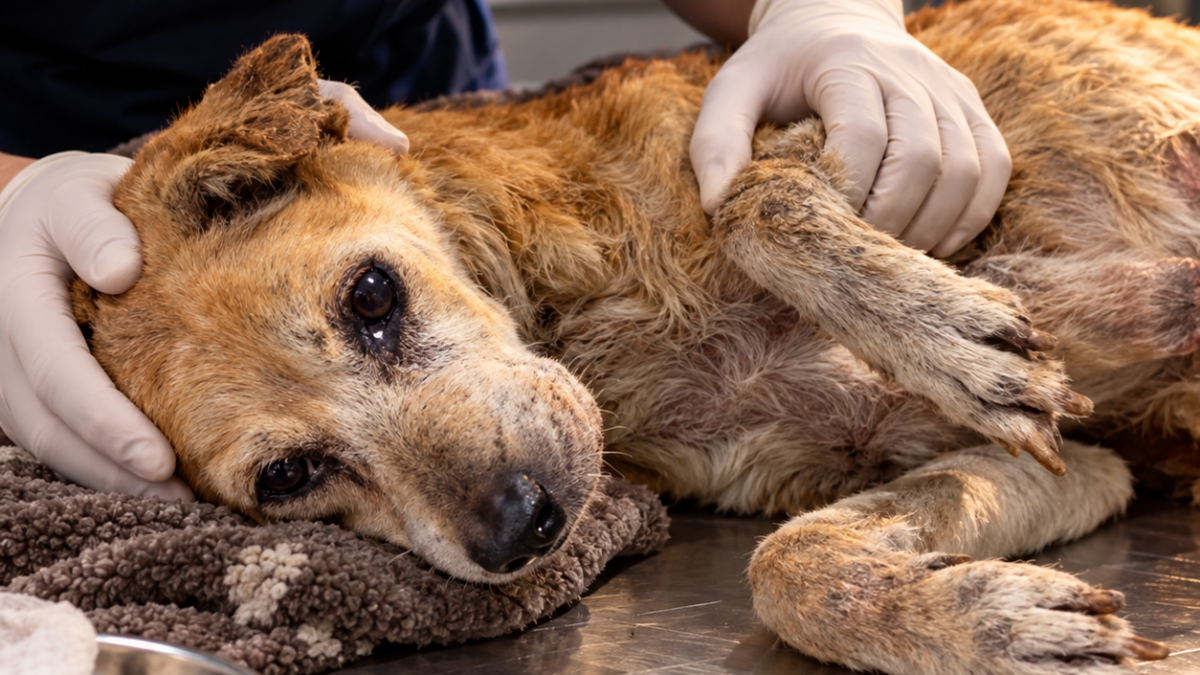
I stared through the glass toward the treatment room.
Clotilde lay on a blanket while a technician adjusted her IV.
She looked smaller under fluorescent lights.
Older.
More fragile.
“She was walking around like this.”
“Yes.”
“She was trying to eat.”
“Yes.”
“With that jaw.”
“Yes.”
I looked at Dr. Bernard.
“What kind of pain are we talking about?”
He paused.
“Significant.”
That was the clinical word.
Significant.
Rescue teaches you that medical language is sometimes mercifully plain because the real description would be harder to say.
Significant meant every bite hurt.
Every attempt to pick up food pulled damaged tissue.
Every movement of the mouth rubbed against infection.
Every drink of water probably stung.
And still she had walked.
Still she had searched.
Still she had approached food when I offered it.
I sat down.
“What do we do?”
“We stabilize her first. Fluids. Antibiotics. Pain control. Then surgery.”
“Can she handle anesthesia?”
“That’s our concern.”
I knew what he meant.
Old.
Underweight.
Infected.
Weak.
None of those words belonged beside anesthesia.
But leaving the jaw untreated wasn’t an option.
“What happens if we don’t operate?”
Dr. Bernard didn’t soften it.
“She will continue to deteriorate.”
“Then we operate.”
“We need to get her stable enough.”
“How long?”
“If she responds well, tomorrow.”
I looked through the glass again.
Clotilde lifted her head.
For one second, I thought she was looking at me.
Maybe she was.
Maybe she was simply following movement.
I walked into the treatment room.
The technician smiled.
“She’s sweet.”
Clotilde’s tail moved once.
I crouched beside the blanket.
“We need a name.”
The technician looked at me.
“You haven’t named her?”
“Not yet.”
“That seems unlike you.”
“It has to fit.”
Clotilde opened one eye.
Her face looked dignified somehow despite everything.
Old-fashioned.
Gentle.
Stubborn.
“Clotilde.”
The technician laughed.
“Clotilde?”
“Yes.”
“That is a grandmother’s name.”
“She’s an old lady.”
Clotilde’s tail moved again.
“See? She approves.”
The technician scratched behind her ear.
“Clotilde it is.”
I stayed until the clinic closed.
That night I went home with the smell of infection still in my clothes and the picture of her mouth in my head.
I had seen neglect before.
Too often.
Dogs with chains embedded in their necks.
Animals so thin they could barely stand.
Old dogs dumped when medical bills became inconvenient.
Females bred until their bodies wore out.
You tell yourself each case will become easier because you know what to do.
It doesn’t.
You just get better at continuing while it hurts.
Clotilde bothered me differently.
Maybe because she had not fought us.
Maybe because she had leaned into my hand.
Maybe because some part of her still believed human touch could mean something good.
I kept thinking about the moment she tried to eat on the street.
How carefully she picked up the food.
How quickly pain stopped her.
There is something especially cruel about hunger when food is right in front of you but your body cannot manage it.
I barely slept.
At six the next morning, Dr. Bernard called.
“She’s stable enough.”
“For surgery?”
“Yes.”
“When?”
“Midmorning.”
“I’m coming.”
“You don’t need to.”
“I know.”
I arrived before they prepared her.
Clotilde recognized me.
That time I was sure.
Her tail tapped the blanket twice.
“Hey, old girl.”
I sat beside her.
“You picked a terrible way to meet people.”
She tried to lift her head.
“Don’t.”
I stroked the top of it.
The infection had given her breath a terrible smell.
I did not care.
“You come back from this, okay?”
Her eyes stayed on me.
“I already named you. That means paperwork. I hate paperwork, so you are not allowed to make it pointless.”
One of the technicians smiled from across the room.
“You always talk to them like this?”
“Yes.”
“Does it work?”
“No idea.”
They wheeled Clotilde away at 10:17.
I remember the exact time because I looked at the clock.
Then I sat.
Rescue involves an extraordinary amount of waiting.
Waiting for blood results.
Waiting for imaging.
Waiting for surgeons.
Waiting for frightened dogs to approach.
Waiting for someone to choose them.
Waiting is the part nobody photographs.
For almost three hours, I answered shelter messages without understanding a word I read.
At 1:06, Dr. Bernard came through the doors.
He removed his surgical mask.
I stood.
“She’s alive.”
Everything after that sentence became easier.
“How bad?”
“Bad.”
“But?”
“We saved most of the lower jaw.”
I closed my eyes.
“Most?”
“There was tissue we couldn’t preserve. Some teeth had to come out. The infected material was cleaned. We stabilized what we could.”
“Will she eat?”
“That’s the hope.”
“Normally?”
“Probably not exactly normally.”
“Pain?”
“Much less once she heals.”
That was enough.
Not perfect.
Better.
In rescue, better is often the miracle.
I saw Clotilde later that afternoon.
Her face was swollen.
There were sutures around her mouth.
A feeding plan had been prepared.
She was groggy and looked offended by existence.
“Beautiful,” I whispered.
A technician stared at me.
“You have unusual standards.”
“She is.”
And she was.
Not because the surgery had repaired her face.
Not because wounds suddenly become pretty when you attach a rescue story to them.
She was beautiful because she was still there.
That night, she remained hospitalized.
The first meal after surgery was almost entirely liquid.
Clotilde sniffed it.
Licked once.
Stopped.
Everyone froze.
Then she licked again.
And again.
Ten seconds later, half the room was smiling.
To anyone else, it was a dog eating soft food.
To us, it was victory.
The next few days were slow.
Antibiotics.
Pain medication.
Wound care.
Small meals.
Frequent monitoring.
Clotilde slept more than anything else.
Her body had apparently been waiting for somewhere safe enough to stop.
On the third day, she wagged when one of the technicians entered.
On the fourth, she stood without encouragement.
On the fifth, she walked to the front of the kennel when I arrived.
“Look at you.”
Tail.
“You’re becoming demanding.”
More tail.
I opened the door.
She pressed her head against my thigh.
Carefully.
I crouched.
“How are we feeling?”
Clotilde licked my wrist.
Her tongue still came from one side because of the jaw damage.
It made the gesture awkward.
I loved it.
One week after surgery, Dr. Bernard brought in a bowl.
Soft food.
Not liquid.
Still very easy to swallow.
But food.
Clotilde approached.
We all watched.
“Don’t make this weird,” I told everyone.
Nobody moved.
She took the first bite.
Slow.
Chewed differently than a normal dog.
Swallowed.
Then another.
And another.
The technician beside me whispered:
“She’s eating.”
“I can see.”
“No, I mean really eating.”
I knew exactly what she meant.
Clotilde finished almost the entire bowl.
When she looked up, there was food smeared around her mouth.
Dr. Bernard laughed.
“Not elegant.”
“Perfect.”
I took a photograph.
Not for social media.
For myself.
The dog I found on the street had looked apologetic because she couldn’t eat.
This dog had food on her face and wanted more.
That photograph is still one of my favorites.
Recovery changed her quickly.
Not dramatically.
Not overnight.
But day by day.
Her eyes became brighter.
Her steps became more purposeful.
She began gaining weight.
Her coat improved.
The swelling around her mouth went down.
Her surgical site healed.
The smell of infection disappeared.
And then something unexpected happened.
Once pain stopped dominating every hour, Clotilde’s personality arrived.
She was funny.
Quietly funny.
She loved beds.
Not dog beds generally.
Specific beds.
The expensive orthopedic bed donated by a local supporter?
Ignored.
The folded blanket beside it?
Perfect.
She loved slow walks but disliked puddles.
She would step around one with the concentration of someone navigating a minefield.
She loved women immediately.
Men had to earn her trust.
Children fascinated her.
She didn’t want to play with toys.
At first.
Then a volunteer brought in a soft stuffed rabbit.
Clotilde picked it up.
Everyone stopped.
She carried it to her blanket.
Set it down.
Lay beside it.
From that day on, the rabbit belonged to her.
We called it Monsieur Lapin.
Clotilde disagreed with anyone touching Monsieur Lapin.
Not aggressively.
She simply took it back.
One volunteer, Thomas, moved it while cleaning.
Clotilde watched.
Thomas placed it on a shelf.
Clotilde stared at him.
He continued cleaning.
Clotilde stared.
Finally Thomas looked at her.
“What?”
Clotilde stared at the rabbit.
Thomas looked at the rabbit.
Then back at Clotilde.
“No.”
Clotilde stared.
“Absolutely not.”
Five seconds.
Ten.
Thomas sighed.
He gave it back.
Clotilde carried it to her bed.
I laughed.
“You’re weak.”
Thomas pointed at her.
“She manipulated me.”
“Correct.”
It was easy to forget where she had come from when she did things like that.
Then something reminded us.
A volunteer tried clipping a leash to her collar one morning.
Clotilde flattened.
Instantly.
Her body lowered.
Tail tucked.
Eyes wide.
The volunteer froze.
“Isabella?”
I came over.
The clip had made a metallic snap.
That was all.
No one knew what memory it touched.
I crouched.
“Hey.”
Clotilde wouldn’t look at me.
I removed the leash.
Sat beside her.
No touching.
After a minute, she glanced up.
“Nothing bad happened.”
Another minute.
She moved closer.
I placed my hand beside her.
She put her paw over my fingers.
That small gesture nearly undid me.
The past had not disappeared.
Healing does not erase history.
It gives the body new evidence.
Clip.
Nothing bad.
Hand.
Nothing bad.
Door closes.
Opens again.
Food arrives.
Food arrives again tomorrow.
People leave.
People return.
Clotilde needed repetition more than reassurance.
So we gave it to her.
Her medical recovery continued.
Her emotional recovery followed at its own pace.
Then the question arrived that every shelter eventually has to ask.
What next?
Clotilde could not live at the clinic forever.
The shelter could care for her.
But care is not the same as home.
She was older.
She had medical needs.
Her jaw would never look completely normal.
She required soft food.
Future dental issues were possible.
Her history was uncertain.
Those things make adoption harder.
People say they love rescue dogs.
Many do.
But when it comes time to adopt, puppies leave first.
Young dogs.
Healthy dogs.
Dogs with symmetrical faces and simple medical records.
Senior animals wait.
Clotilde waited.
At first I wasn’t worried.
“Someone will see her.”
A week passed.
Then two.
Visitors came.
They smiled at her.
Asked what happened.
Said how sad it was.
Then adopted someone else.
Clotilde never knew.
She greeted the next person exactly the same.
One Saturday, a family spent twenty minutes with her.
Mother.
Father.
Teenage daughter.
Clotilde liked the daughter immediately.
She leaned against her legs.
The girl scratched her neck.
“This is the one.”
My heart lifted.
Then the father asked about the jaw.
I explained.
Soft food.
Possible follow-up care.
Age estimate.
Unknown history.
He became quieter.
They left to “think about it.”
They adopted a younger dog at another shelter two days later.
I did not blame them.
Not entirely.
People have to choose the animal they can care for.
But I sat with Clotilde that evening longer than usual.
“You are terrible at marketing yourself.”
Clotilde rested her head on my knee.
“You should jump around more.”
She sighed.
“Fine. Don’t.”
I scratched her ear.
“Your person is slow.”
Days turned into weeks.
Then months.
Clotilde became a shelter favorite.
Volunteers signed up for her walks.
Visitors brought her soft treats.
Dr. Bernard checked her jaw regularly.
She gained almost fourteen pounds.
Her nails were trimmed gradually because the quicks had grown long.
Her coat became glossy.
The thin street dog disappeared.
But adoption inquiries remained rare.
That was when I started wondering whether her age frightened people more than her jaw.
“How old do you think she really is?” I asked Bernard.
“Eight? Nine? Maybe ten.”
“Helpful.”
“Sorry.”
“She could have five good years.”
“Maybe more.”
“People hear senior and imagine funeral bills.”
He looked at me.
“You can’t control that.”
“I know.”
“You sound like you don’t know.”
“I know and dislike it.”
He smiled.
One afternoon, an older woman came to the shelter.
Her name was Margaret Ellis.
Seventy-two.
Short silver hair.
Blue coat.
Walking cane.
She said:
“I want an old dog.”
I looked at her.
Most adopters don’t open with that.
“How old?”
“Old enough not to climb my curtains.”
“That narrows it.”
“I had Labradors for forty years.”
“What happened to your last one?”
“Cancer.”
Her face changed for half a second.
“How long ago?”
“Eleven months.”
I knew that pause.
Not ready to replace.
Ready to continue.
“What kind of dog are you looking for?”
Margaret shrugged.
“Quiet. Gentle. Doesn’t need five-mile runs. Preferably one nobody else wants.”
That last line made me stop.
“Why?”
“Because everyone wants puppies.”
I studied her.
Margaret raised one eyebrow.
“Are you interviewing me or judging my philosophy?”
“Both.”
“Good.”
I walked her toward Clotilde.
Clotilde was asleep.
Monsieur Lapin beneath her chin.
Margaret stopped outside the kennel.
She did not say:
Oh, poor thing.
I liked her immediately.
Instead:
“Well, she’s beautiful.”
Clotilde opened one eye.
Margaret crouched as far as her knees allowed.
“Hello.”
Clotilde stood.
Walked over.
Sniffed her fingers.
Then walked away.
Margaret laughed.
“Excellent.”
“What?”
“She has standards.”
Clotilde returned.
This time she pressed the side of her face against Margaret’s hand.
Margaret stopped laughing.
Her eyes filled.
“Oh.”
I looked away.
Some moments deserve privacy even when you are standing three feet away.
Margaret stayed for an hour.
She asked every difficult question.
Medical history.
Food.
Medication.
Mobility.
Nighttime behavior.
Other dogs.
Cats.
Visitors.
Car travel.
Veterinary costs.
Not one question about whether the scar would improve cosmetically.
Not one.
Before leaving, she said:
“I need to think.”
My stomach sank slightly.
Then she added:
“I have stairs to the back garden. I need a ramp before she comes.”
“Before she comes?”
Margaret looked at me.
“You didn’t think I’m leaving without her permanently, did you?”
I laughed.
“When?”
“Give me three days.”
She needed five.
A carpenter friend built the ramp.
Margaret bought two beds.
One for the living room.
One for the bedroom.
I warned her Clotilde might ignore both.
“She may sleep wherever she wants.”
“Dangerous sentence.”
“I survived marriage for forty-seven years. I can survive a dog choosing furniture.”
The adoption day arrived on a Thursday morning.
I had told myself I was ready.
I wasn’t.
Clotilde wore a soft harness.
Monsieur Lapin was packed.
Food.
Medication.
Medical file.
A blanket from the shelter.
Margaret signed the papers.
Then looked at me.
“You’re crying.”
“No.”
“You rescue people for a living and you’re a bad liar?”
“I rescue dogs.”
“Still bad.”
I knelt beside Clotilde.
She licked my hand.
“You have a house now.”
Tail.
“A proper one.”
Tail.
“With a woman who will probably feed you illegally large amounts of chicken.”
Margaret said:
“I heard that.”
“Good.”
I hugged Clotilde.
Carefully.
She leaned into me.
I whispered:
“You don’t have to come back.”
That was the part that broke me.
In rescue, success looks like losing them.
You spend weeks teaching an animal that you will not leave.
Then one day, if everything goes right, you do.
Clotilde walked out with Margaret.
At the car, she hesitated.
Looked back.
My heart stopped.
Then Margaret opened the back door.
Clotilde saw the blanket.
Monsieur Lapin.
A bag of treats.
She climbed in.
Traitor.
I laughed through tears.
The first update arrived that evening.
A photograph.
Clotilde asleep on Margaret’s sofa.
Not the dog bed.
Of course.
Monsieur Lapin beside her.
Caption:
SHE HAS DECIDED THE BED IS MINE AND THE SOFA IS HERS.
I replied:
SOUNDS LEGALLY BINDING.
The next morning:
Clotilde eating breakfast.
Then walking slowly through Margaret’s garden.
Then asleep beside Margaret’s chair.
The third day, Margaret called.
I panicked when I saw her name.
“What’s wrong?”
“Nothing.”
“Margaret.”
“I need you to settle something.”
“What?”
“Does she always stare when people eat?”
I sat down.
“Yes.”
“Like this?”
She turned on video.
Clotilde sat beside the kitchen table staring at Margaret with enormous soft eyes.
I laughed.
“She didn’t learn that here.”
“She is attempting psychological warfare.”
“Yes.”
“Effective.”
“Do not give her everything.”
Silence.
“Margaret?”
“I may have given her chicken.”
“Of course you did.”
Clotilde settled into home life as though she had been waiting years for it.
Maybe she had.
Margaret walked every morning.
Slowly.
Clotilde matched her pace.
There was something beautiful about that.
Two older ladies moving down the sidewalk together.
Neither in a hurry.
Neighbors learned Clotilde’s name.
A child three houses down began waiting by the gate to say hello.
The mail carrier carried soft treats.
Margaret claimed this was corruption.
Clotilde supported corruption.
Her favorite place became a patch of sunlight beside the living-room window.
In the shelter she slept lightly.
At Margaret’s house, she began sleeping so deeply that the first time she snored, Margaret called me.
“Is this normal?”
I listened through the phone.
A ridiculous vibrating snore.
“She’s sleeping.”
“She sounds broken.”
“She has earned the right to snore.”
Margaret laughed.
Months passed.
Clotilde’s jaw remained stable.
She ate soft food enthusiastically.
Very enthusiastically.
Too enthusiastically.
At one checkup, Dr. Bernard looked at her weight.
Then at Margaret.
“What are you feeding her?”
Margaret looked offended.
“Her prescribed diet.”
“And?”
“Nothing.”
Clotilde stared at her.
I stared at her.
Bernard stared at her.
Margaret sighed.
“Occasionally chicken.”
“How occasional?”
“Define occasional.”
Clotilde had gained three pounds beyond ideal.
Dr. Bernard ordered less chicken.
Margaret blamed him personally.
It was the most normal problem Clotilde had ever had.
That mattered.
People think happy endings are dramatic.
Sometimes they are.
Sometimes a happy ending is a veterinarian saying:
“Your formerly starving dog needs to lose three pounds.”
I took the longest way home after that appointment because I kept smiling.
We never learned exactly what happened to Clotilde before rescue.
There was no reliable microchip information.
No owner came forward.
No definitive record told us who fractured her jaw.
No witness explained how long she wandered.
No document proved whether she had been repeatedly bred, though her body strongly suggested it.
For a while, that lack of answers bothered me.
I wanted someone responsible.
A name.
A face.
A consequence.
Rescuers often do.
We see what arrives after people fail an animal.
We want the story before that moment to make sense.
It usually doesn’t.
Maybe someone hit her.
Maybe the jaw broke in an accident and no one treated it.
Maybe she was dumped because veterinary care cost money.
Maybe she escaped.
Maybe she belonged to someone who bred her repeatedly.
Maybe several bad things happened across several years.
We did not know.
And because we did not know, there was no dramatic arrest.
No courtroom.
No villain looking across a table while I told him what I thought.
At first, that felt unfinished.
Then Margaret changed my mind.
About eight months after the adoption, she invited me to lunch.
Clotilde met me at the door.
Not running.
She was never a runner.
But her tail moved so hard her whole rear end swayed.
“Hey!”
I crouched.
Clotilde pressed against me.
She smelled like shampoo and whatever expensive dog conditioner Margaret had bought.
“You’ve gone soft.”
Margaret called from the kitchen:
“She was always soft.”
“No, she smelled like a medical ward.”
“Don’t insult my daughter.”
I looked at Clotilde.
“Daughter?”
Margaret appeared holding a plate.
“She’s family.”
I smiled.
There it was.
The consequence I had been waiting for.
Someone had once treated Clotilde as disposable.
Now an elderly woman called her daughter.
Someone had allowed her jaw to rot.
Now Margaret pureed roast chicken when Clotilde’s mouth felt sensitive.
Someone had let her wander painfully thin.
Now Dr. Bernard complained she was getting chubby.
Someone may have used her body for litter after litter.
Now nobody asked anything from her except whether she wanted the sofa or the bed.
That was revenge enough.
Life was not done with them.
Neither of us knew that afternoon that Margaret would need Clotilde as much as Clotilde had needed her.
Almost a year after the adoption, Margaret fell in the kitchen.
She was reaching for a saucepan.
Her cane was in the hallway.
Her foot caught the edge of a mat.
She went down hard.
Her hip wasn’t broken.
But she struck her head and became disoriented.
The phone was on the counter.
Too high to reach.
Margaret later remembered lying on the floor and calling:
“Clotilde.”
Clotilde came.
She stood beside her.
Licked her face.
Margaret tried to push herself up.
Couldn’t.
“Go get someone.”
Clotilde stared.
Dogs do not understand sentences the way we wish they did.
But they understand tone.
Clotilde walked toward the back door.
Returned.
Went again.
Margaret had installed a dog flap months earlier.
Clotilde used it.
She crossed the garden.
The neighbor, Helen, was outside hanging laundry.
Clotilde began barking.
That mattered because Clotilde almost never barked.
Helen ignored the first bark.
Clotilde barked again.
Then walked to Margaret’s back door.
Back to Helen.
Back to the door.
Helen understood.
She found Margaret.
Ambulance.
Hospital.
Concussion.
Bruised hip.
No fracture.
When Margaret called me later, she said:
“She saved me.”
“Helen saved you.”
“Clotilde got Helen.”
“Fair.”
“I want it officially noted.”
“Noted.”
Clotilde stayed with me while Margaret spent three nights hospitalized.
The first evening, she walked around my house checking every room.
Looking.
For Margaret.
She wouldn’t eat dinner.
I sat on the kitchen floor.
“She is coming back.”
Clotilde stared at me.
“She did not abandon you.”
That word mattered to me even if it meant nothing to her.
“People come back now.”
She eventually ate.
The morning Margaret returned home, I drove Clotilde over.
I barely had the door open before Clotilde squeezed through.
“Slow!”
She ignored me.
Margaret sat in a chair.
Clotilde reached her.
Stopped.
Then pressed her entire body against Margaret’s legs.
Margaret cried.
“I came back.”
Clotilde licked her hand.
“See?”
I stood by the door.
People come back now.
Maybe that was Clotilde’s real recovery.
Not the jaw.
Not the weight.
Trust.
After that fall, Margaret’s daughter Emma visited more often.
Emma lived two hours away and had initially worried about her mother adopting an older dog.
Not because she disliked Clotilde.
Because she feared the medical responsibility.
Now she arrived with toys.
Clotilde still preferred Monsieur Lapin.
Emma brought an expensive orthopedic bed.
Clotilde slept beside it.
Family tradition.
The years became gentle.
That is the best word.
Gentle.
No more major emergencies for a while.
Just ordinary age.
Slower stairs.
Longer naps.
Annual bloodwork.
Occasional dental checks.
Soft meals.
Garden walks.
Sunlight.
Margaret talking to Clotilde while cooking.
Clotilde staring at chicken.
The seasons changed.
Her muzzle became whiter.
Her remaining teeth became fewer.
Her jaw healed into a shape that would never look completely normal.
Visitors sometimes noticed.
Children asked:
“What happened to her mouth?”
Margaret answered:
“She had a hard life before she came home.”
Then usually added:
“She has a very easy life now.”
I loved that.
No dramatic explanation.
No turning Clotilde into a tragedy.
Hard life before.
Easy life now.
Done.
Three years after I found her, we held a shelter fundraiser.
Margaret brought Clotilde.
I almost didn’t recognize her from across the courtyard.
Not because her markings changed.
Because posture changes a dog.
The Clotilde on the street had carried herself inward.
Head low.
Body tight.
Every movement economical.
This Clotilde walked beside Margaret with her head up.
Harness loose.
Tail moving.
People greeted her.
“She looks amazing.”
“She’s beautiful.”
Margaret answered each compliment as if she had personally designed the dog.
“Of course she is.”
At one point, I saw a woman crouch and touch Clotilde’s cheek.
“What happened to her?”
Margaret gave the usual answer.
“She survived.”
The woman smiled.
Then asked:
“Was she always yours?”
Margaret looked at me across the yard.
“No.”
She scratched Clotilde’s ear.
“She was waiting for me.”
I had to walk away after that.
Rescuers develop techniques.
Look at paperwork.
Pretend someone called you.
Suddenly remember a task.
Anything to avoid crying in public for the five hundredth time.
Marc, one of our volunteers, caught me hiding behind the supply table.
“You crying?”
“No.”
“Sure.”
“Go carry chairs.”
He laughed.
Clotilde became something of an unofficial ambassador for older rescue dogs.
Not because we planned it.
Because visitors met her.
People who had arrived saying:
“We want a puppy.”
Then Clotilde would slowly walk over.
Lean against them.
Look up.
Sometimes that was enough.
Over the next two years, several senior dogs were adopted after families spent time with her.
One couple arrived for a six-month-old puppy and left with an eleven-year-old beagle.
They blamed Clotilde.
I accepted no responsibility.
We began using her photograph in our senior adoption materials.
Not the street picture.
Not the surgery.
A photograph of Clotilde sitting beside Margaret in the garden.
Both looking slightly annoyed at the camera.
Caption:
**OLD DOESN’T MEAN FINISHED.**
That became one of our most shared shelter posts.
People asked about Clotilde.
“How is the jaw dog?”
I corrected them every time.
“Her name is Clotilde.”
The injury introduced her.
It did not define her.
There is a difference.
Eventually, age began winning battles medicine could not.
Clotilde developed arthritis.
Then mild kidney changes.
Nothing immediately catastrophic.
Diet adjustment.
Medication.
More frequent blood tests.
Margaret adjusted without complaint.
She installed another ramp.
Raised the food bowl.
Bought rugs for slippery floors.
I visited one afternoon and found half the house covered in mismatched carpets.
“What happened?”
“Her feet slip.”
“You turned your living room into a furniture warehouse.”
“Function over fashion.”
Clotilde was asleep under the table.
Monsieur Lapin had lost one ear by then.
Margaret had sewn it back twice.
The rabbit looked worse than Clotilde ever had.
“Maybe retire the toy.”
Margaret gasped.
“You monster.”
I apologized.
At around thirteen—our best estimate—Clotilde’s hearing faded.
We noticed when the refrigerator opened and she did not appear.
That was how serious it was.
Margaret began tapping the floor gently before approaching from behind so she would feel vibration.
Clotilde adapted.
Dogs do.
Sight remained good.
Nose remained excellent.
Especially where chicken was involved.
One afternoon, Dr. Bernard examined her and smiled.
“You know, when I first saw her, I didn’t think we’d be having this conversation years later.”
“What conversation?”
“Whether she needs joint supplements adjusted.”
Margaret looked offended.
“You underestimated her.”
“Yes.”
Clotilde licked his hand.
Bernard scratched her head.
“I apologize.”
There are animals who survive because of medicine.
There are animals who survive because someone finds them in time.
And then there are animals who seem to make survival part of their personality.
Clotilde had that.
She was never dramatic.
Never the dog crashing through doors.
Never the fighter people write slogans about.
Her strength was quiet.
Eat one bite.
Then another.
Trust one hand.
Then another.
Walk one block.
Then another.
Sleep one night safely.
Then another.
A life rebuilt through small repetitions.
By the fourth year after adoption, Margaret was seventy-six.
Clotilde was old enough that we stopped guessing.
She was simply old.
They moved at almost exactly the same speed.
Watching them walk together made people smile.
Margaret with her cane.
Clotilde with her stiff rear legs.
Neither willing to admit limitations.
One winter morning, Margaret called.
“She won’t eat.”
That sentence always changes the air.
“Since when?”
“Last night.”
“Water?”
“Some.”
“Energy?”
“Low.”
“I’ll call Bernard.”
At the clinic, bloodwork showed worsening kidney values.
Not end-stage.
But concerning.
Clotilde needed fluids.
Medication.
Monitoring.
Margaret sat beside her.
“What do we do?”
Bernard explained.
Hospitalization overnight.
Then reassess.
Margaret nodded.
Clotilde looked between us.
When staff came to take her, Margaret’s hand stayed on the harness.
Just a little too long.
“She’ll be here tomorrow?”
Bernard answered carefully.
“That is the plan.”
Margaret released.
I drove her home.
She sat silently for most of the ride.
Then:
“I hate empty houses.”
“I know.”
“I forgot how much.”
I glanced at her.
“You had dogs before.”
“Yes.”
“And after they died?”
“The silence is always the same.”
Clotilde came home two days later.
Better.
Not cured.
Kidney disease does not usually offer that word.
But better.
She ate.
Tail moved.
Walked into the house.
Margaret cried.
Clotilde immediately went to the kitchen.
“Look at that,” I said. “Emotional reunion over.”
Margaret laughed.
“I’ll take it.”
For almost another year, they managed.
Good days.
Bad days.
More good than bad.
Until they weren’t.
Clotilde began losing weight despite eating.
Her kidneys worsened.
Arthritis made getting up difficult.
She slept more.
Still wanted affection.
Still wanted food some days.
Still watched Margaret.
Quality of life becomes the hardest calculation.
Pain.
Appetite.
Mobility.
Interest.
Comfort.
Good days.
Bad days.
No single number tells you when love becomes asking too much.
Margaret called me one evening.
“I need you to come.”
I knew.
I drove over.
Clotilde lay on a thick blanket in the living room.
Monsieur Lapin under one paw.
Margaret sat beside her.
“She had a bad day.”
I knelt.
Clotilde’s eyes opened.
Her tail moved.
Once.
The same quiet greeting she had given me years earlier.
“Hey, old girl.”
I touched her head.
She leaned slightly into my palm.
Still her.
Always her.
Margaret asked:
“How do I know?”
There is no good answer.
So I did not pretend.
“You don’t know perfectly.”
“That isn’t helpful.”
“No.”
She looked at Clotilde.
“What would you do?”
I wanted to say fight.
One more treatment.
One more week.
One more miracle.
Rescuers are terrible at endings because our entire identity is built around preventing them.
But rescue is not about keeping an animal alive for us.
It is about protecting them.
Sometimes protection changes shape.
I asked:
“Did she have joy today?”
Margaret cried.
“A little.”
“Yesterday?”
“Not much.”
“Eating?”
“Barely.”
“Can she get up alone?”
“No.”
“Pain?”
“Bernard thinks we’re controlling it, but…”
She didn’t finish.
Clotilde exhaled.
Margaret stroked the side of her face.
The jaw that had once been broken.
The scar still visible.
“I promised her no more suffering.”
I nodded.
“I know.”
Dr. Bernard came to the house the next afternoon.
Margaret did not want Clotilde’s final memory to be the clinic.
Good decision.
Clotilde lay in her favorite patch of sunlight beside the window.
The sofa was behind her.
The expensive dog bed remained mostly unused.
Monsieur Lapin was there.
So was I.
Emma came.
Bernard sat on the floor.
No white coat.
Clotilde ate two small pieces of chicken.
Margaret laughed.
“Of course.”
I smiled.
“Breaking the diet to the end.”
“No one can stop me now.”
Clotilde swallowed.
Then rested.
Bernard gave a sedative first.
She became sleepy.
Her breathing slowed.
Margaret lay beside her despite her bad hip.
She pressed her forehead against Clotilde’s.
“I wish I’d found you sooner.”
That sentence destroyed me.
Because every rescuer thinks it.
Every adopter.
Every person who loves an animal with a hidden past.
If only sooner.
Before the injury.
Before the abandonment.
Before the hunger.
Before the fear.
But life does not give us access to before.
Only now.
Margaret continued:
“But I’m glad I found you at all.”
Clotilde’s eyes were nearly closed.
Her tail moved once.
Maybe reflex.
Maybe answer.
We chose answer.
Margaret whispered:
“You were a very good girl.”
Bernard gave the final medication.
Clotilde exhaled.
No struggle.
No fear.
Her head rested against Margaret’s arm.
Her heart slowed.
Then stopped.
For several minutes nobody moved.
The house seemed impossibly quiet.
Emma cried openly.
I stared at Monsieur Lapin.
Margaret kept one hand on Clotilde’s side.
Finally she said:
“She isn’t hurting.”
“No.”
“Her mouth doesn’t hurt.”
“No.”
“She isn’t hungry.”
“No.”
Margaret closed her eyes.
“Okay.”
That was goodbye.
Clotilde’s ashes were returned in a simple wooden box.
Margaret placed it beside a photograph in the living room.
Not the rescue photo.
Not the infected jaw.
The fundraiser photograph.
Margaret and Clotilde in the garden.
Old woman.
Old dog.
Both annoyed at the camera.
Monsieur Lapin sat beside the box.
I visited a week later.
Margaret made tea.
The sofa looked enormous without Clotilde.
“How are you?”
“Bad.”
I appreciated the answer.
People say fine too quickly.
“Eating?”
“Yes.”
“Sleeping?”
“No.”
“Want me to take Monsieur Lapin?”
“No.”
“Didn’t think so.”
She smiled slightly.
Then:
“I thought adopting an old dog would mean I had less time.”
“You did.”
“That sounds terrible when you say it.”
“Sorry.”
“No. It’s true.”
She looked at the photograph.
“I had less time.”
Then she smiled.
“But I got all of it.”
That sentence stayed with me.
People often reject senior animals because they fear grief.
Understandable.
But grief is not evidence you chose wrong.
Sometimes grief is the receipt for something worth having.
Margaret had Clotilde for almost five years.
Five years of walks.
Meals.
Snoring.
Vet appointments.
Chicken negotiations.
The kitchen fall.
Fundraisers.
Sunlight.
Five years somebody else had effectively thrown away.
That was Clotilde’s final revenge against whatever had happened before we met her.
Someone had looked at her aging body, her damaged mouth, her breeding history, her needs—whatever the circumstances were—and Clotilde ended up alone.
The street should have been the end.
Instead it became the middle.
Her jaw should have prevented her from eating.
Instead she became overweight enough for a veterinarian to argue about chicken.
Her age should have made her unwanted.
Instead one woman built ramps before adoption was even approved.
Her scars should have made people look away.
Instead visitors crossed rooms to meet her.
Her unknown past could have defined her.
It didn’t.
The rest of her life did.
Months after Clotilde died, Margaret returned to the shelter.
I saw her car and went outside.
She entered with her cane.
No dog.
That felt wrong.
“You okay?”
“No.”
“Tea?”
“No.”
She looked toward the kennels.
“I want to look.”
My heart stopped.
“At?”
“Old dogs.”
I said nothing.
Margaret pointed her cane at me.
“Do not make a face.”
“I did not make a face.”
“You did.”
“What kind of dog?”
“Old.”
“Again?”
“Especially again.”
We walked.
A twelve-year-old terrier mix named George had been waiting almost four months.
Cataracts.
Mild heart murmur.
Bad breath.
One ear permanently folded.
He barked at Margaret.
She looked at me.
“Rude.”
George barked again.
Margaret sat outside his kennel.
Ten minutes later he stopped.
Twenty minutes later he approached.
Thirty minutes later he put his chin on her shoe.
Margaret looked at me.
“Oh, no.”
I laughed.
“What?”
“I know this feeling.”
“Dangerous.”
“Very.”
George went home two weeks later.
Clotilde was not replaced.
Impossible.
But love continued.
Margaret sent me a photograph.
George asleep on the sofa.
Clotilde’s sofa.
Monsieur Lapin sat on a shelf safely above him.
Caption:
HE IS NOT ALLOWED TO TOUCH HER RABBIT.
I replied:
SHE WOULD APPROVE.
Years have passed since I first saw Clotilde standing quietly at the edge of that road.
I still think about her when someone brings us an older dog.
Especially the ones with difficult medical histories.
The ones people hesitate over.
I remember her broken jaw.
The infection.
The drool.
The missing teeth.
The long nails.
The ribs.
But those are not the strongest memories anymore.
I remember food smeared across her face one week after surgery.
I remember her stealing Monsieur Lapin back from Thomas.
I remember Margaret saying:
“Well, she’s beautiful.”
I remember Clotilde asleep so deeply she snored.
I remember a veterinarian telling a formerly starving dog to lose weight.
I remember her barking for help when Margaret fell.
I remember the fundraiser.
The ramps.
The mismatched rugs.
The kitchen chicken.
I remember her final patch of sunlight.
That is what rescue is supposed to do.
Not erase the beginning.
Outgrow it.
People sometimes ask what happened to the person who hurt Clotilde.
I tell them the truth.
We never knew.
No arrest.
No confession.
No perfect explanation.
For a long time, I hated that.
Stories feel cleaner when cruelty gets a name and consequences arrive in a courtroom.
Life is not always that generous.
Sometimes the person responsible disappears.
Sometimes evidence doesn’t exist.
Sometimes you never know whether one terrible person caused the damage or whether years of neglect did it piece by piece.
But eventually I understood something.
Justice for Clotilde was not limited to punishment.
Justice was treatment.
Justice was food without pain.
Justice was a bed.
Justice was a woman installing a ramp before adoption.
Justice was an old dog being called family.
Justice was the chance to grow even older.
There are worse punishments for cruelty than seeing its intended victim become deeply loved.
Whatever happened to Clotilde before we met her did not get the ending.
We did.
She did.
Margaret did.
Her surgeons did.
Every volunteer she manipulated into returning Monsieur Lapin did.
Every person who stopped to scratch her ears.
The ending belonged to the people who stayed.
Clotilde had wandered the streets with a broken, infected jaw and a body that suggested she had been asked to give far too much for far too long.
When I first saw her, I did not know whether she would let me touch her.
She did.
I did not know whether she would survive surgery.
She did.
I did not know whether she would eat comfortably again.
She did.
I did not know whether anyone would adopt an old dog with scars and medical needs.
Margaret did.
I did not know how long they would have.
Almost five years.
Never enough.
Still everything.
That is why, when new rescuers ask me which cases stay with you, I don’t tell them the most dramatic ones.
I tell them about Clotilde.
Because she taught me that survival is sometimes quiet.
It doesn’t always bark.
Doesn’t always fight.
Sometimes survival stands at the edge of a road with half a broken jaw and waits while a stranger places food on the ground.
Sometimes it takes one painful bite.
Then allows one hand closer.
Then one more.
Sometimes it gets lifted into a car.
Sometimes surgeons save what they can.
Sometimes healing looks like food on an old dog’s face.
And sometimes the happiest ending in the world is not becoming young again.
It is becoming old somewhere safe.
Clotilde got that.
She got gray hairs.
Arthritis.
Kidney medication.
Too much chicken.
A woman who worried every time she skipped breakfast.
A sofa that became hers.
A ridiculous stuffed rabbit.
A garden.
A family.
She got time.
And after everything she had survived before Isabella found her on that street, time was the one gift nobody could ever return to her.
So we gave her as much of it as we could.
And she filled every bit of it with a life worth remembering.








