PART 2: He Was Left to Freeze in a Warehouse at Only Two Months Old—Three Days Later, the Camera Footage Revealed Who Put Oreo There
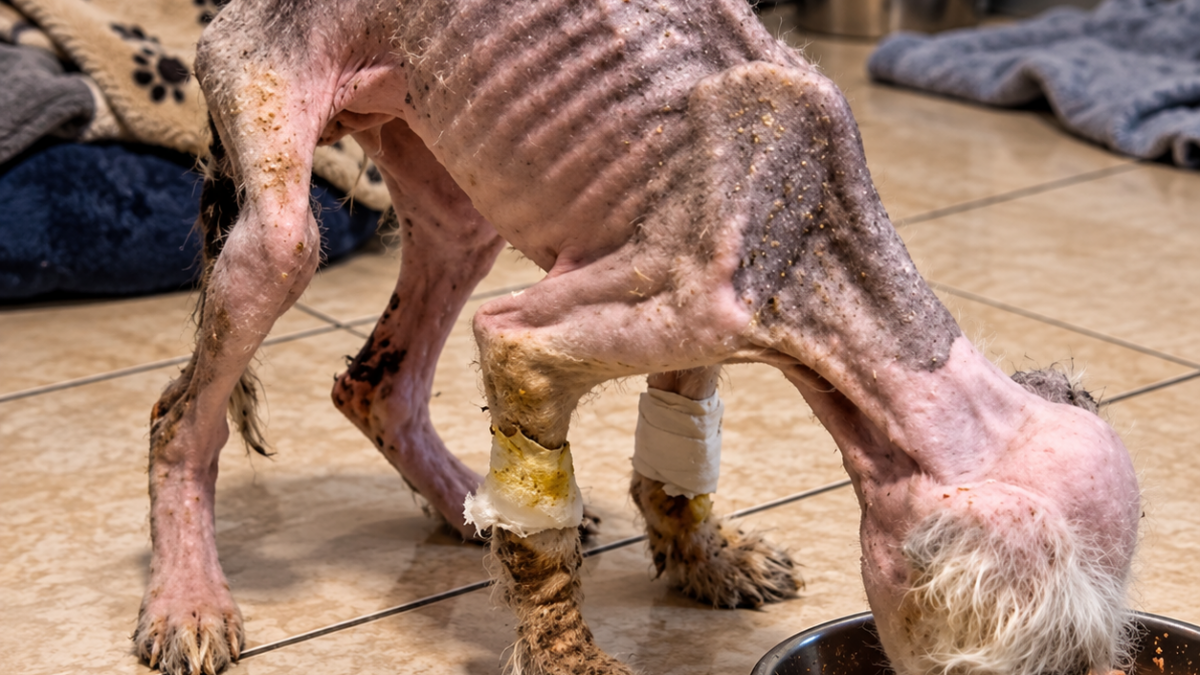
Oreo was only two months old when I carried him out of that freezing warehouse, and for the first few seconds I couldn’t tell whether the tiny body in my arms was still alive.
His breathing was so faint, his skin was so cold, and his head hung so loosely against my wrist that I remember thinking I might be holding him during the final moments of his life.
What I didn’t know then was that surviving the cold would only expose the beginning of what had happened to him—and somewhere inside that building, a camera had already recorded the answer.
I had been told there was a puppy inside.
That was all.
A small dog.
Weak.
Possibly abandoned.
I had seen sick puppies before, so I thought I knew what I was walking into.
I didn’t.
The warehouse was painfully cold.
Not cool.
Not uncomfortable.
Cold enough that every breath felt sharp when I inhaled.
The building was used for food processing, and parts of it were kept at temperatures that were dangerous for any young animal left there without protection.
I followed a worker farther inside.
“Where is he?”
“Back here.”
Then I saw something curled near the floor.
Black-and-white fur.
So still that for one horrible second I thought we were already too late.
I dropped down beside him.
“Oreo?”
No response.
I touched his side.
Cold.
Far too cold.
Then I felt it.
One breath.
So shallow I almost missed it.
Then another.
“Oh, baby.”
I slid both hands underneath him.
He did not resist.
Did not lift his head.
Did not whimper.
A healthy eight-week-old puppy should have been wiggling, crying, searching for warmth.
Oreo simply folded into my arms.
His body had almost no strength left.
As I stood, his head rolled against my elbow.
That was when I started crying.
Not quietly.
Not gracefully.
I carried him toward the exit with tears running down my face because I honestly did not know whether he would still be breathing by the time we reached the car.
“Stay with me.”
Nothing.
“Come on, sweetheart.”
I tucked him closer beneath my jacket.
“You don’t get to stop now.”
At the veterinary clinic, everything happened quickly.
Blankets.
Warming equipment.
Monitoring.
Bloodwork.
Fluids.
Hands moving over that tiny body while I stood uselessly nearby.
His temperature had fallen dangerously low.
The team tried to warm him gradually, carefully.
Too much heat too quickly could create additional problems.
But his temperature refused to stabilize.
One veterinarian looked at the monitor, then at me.
“How long was he in there?”
“I don’t know.”
“How long was that building this cold?”
“I don’t know.”
Those three words became unbearable.
I don’t know.
We didn’t know who had brought him there.
We didn’t know whether he had eaten.
We didn’t know how long he had been alone.
We didn’t know what had happened before he entered the warehouse.
We only knew that an eight-week-old puppy was fighting to keep his heart beating.
The first night, Oreo barely moved.
The second day, we were still waiting.
His caregivers checked him constantly.
Temperature.
Hydration.
Breathing.
Blood values.
Then, on the third day, someone brought a little food near his mouth.
Oreo sniffed.
At first, nothing.
Then his tongue moved.
One tiny lick.
Another.
He swallowed.
I covered my mouth.
A caregiver beside me whispered:
“He’s eating.”
It was hardly a meal.
To anybody walking into the room, it would have looked insignificant.
To us, it was enormous.
Then the blood results came back.
And suddenly nobody was smiling.
Oreo’s hematocrit had dropped dangerously low.
He was severely anemic.
He was losing red blood cells, and nobody yet understood why.
The veterinarian looked at me.
“He needs blood.”
I stared toward the puppy we had spent three days trying to keep warm.
“He just survived the warehouse.”
“I know.”
“And now this?”
“I know.”
Oreo lay beneath his blanket, unaware that the fight had changed again.
A transfusion was prepared.
And while the doctors tried to keep him alive, I made one phone call.
“Does that warehouse have security cameras?”
The answer came immediately.
“Yes.”
“Then save every second.”
Because by then I needed to know who had left Oreo in that cold.
And why.
PART 2
The veterinarian called me back into the treatment room before I could ask anything else about the cameras.
Oreo needed the transfusion now.
There was no time to stand in the hallway thinking about the person who had left him.
Anger could wait.
His body could not.
I went back inside.
The little puppy lay on his side beneath warming blankets.
An IV line ran into one leg.
A technician adjusted the equipment while another checked his gums.
They were pale.
Too pale.
The veterinarian explained what was happening, but I remember only pieces of it.
His red blood cell level had fallen.
He was severely anemic.
His body was already exhausted from hypothermia, malnutrition and whatever neglect had happened before we found him.
Now his blood was failing him too.
“Will the transfusion fix it?” I asked.
“It can help stabilize him.”
“Can?”
“We need to see how he responds.”
I hated every uncertain word.
Can.
Maybe.
Hopefully.
Possible.
I wanted someone to say:
He’s going to live.
Nobody would.
Because good veterinarians do not promise what they cannot know.
A donor dog provided the blood.
I watched the red line slowly move through the tubing.
It looked impossibly dramatic going into such a tiny body.
Oreo slept through most of it.
Or maybe he was simply too weak to react.
I sat beside him.
At one point, one of the nurses said:
“You should go home.”
“No.”
“He’s going to be monitored all night.”
“I know.”
“You can’t do anything here.”
“I know.”
She looked at me for a moment.
Then brought me a chair.
That was kindness.
Not trying to convince me anymore.
Just making it easier to stay.
Around midnight, Oreo moved his paw.
That tiny movement woke me immediately.
I leaned forward.
“Hey.”
His eyes opened halfway.
Dark.
Tired.
Confused.
“You’re still here.”
One blink.
“Good.”
He closed them again.
I rested my forehead against the edge of the kennel.
“Keep doing that.”
The first transfusion helped.
For a while.
His numbers improved.
His color looked slightly better.
His temperature finally began holding more consistently.
We allowed ourselves to hope.
Then the hematocrit dropped again.
When the veterinarian told me, I felt anger before fear.
“How?”
“We’re still investigating.”
“He already had blood.”
“Yes.”
“And he’s losing it again?”
“His body may be destroying cells. Parasites are another possibility. Severe neglect can create multiple problems at once.”
“So what do we do?”
“Another transfusion if needed. More tests. Supportive care.”
I looked through the glass.
Oreo was sleeping.
“He’s two months old.”
“I know.”
“He shouldn’t even know what a hospital is.”
The veterinarian did not answer.
There was nothing to say.
That evening, I finally got an update from the warehouse.
Security management had begun collecting surveillance footage.
The cameras covered entrances, loading areas and some interior corridors.
They were reviewing the previous days.
“Call me the moment you find anything.”
“We will.”
I drove home for the first time since Oreo arrived.
My house felt wrong.
Warm.
Quiet.
Safe.
I put my keys on the counter and stood there thinking about that freezing building.
I imagined Oreo alone.
A puppy that young should have been sleeping against another warm body.
His mother.
A sibling.
A person.
Anything.
Instead, he had been on a cold industrial floor.
I looked at my heater.
Then turned it higher even though I wasn’t cold.
I did not sleep much.
The next morning Oreo needed more blood.
His second transfusion.
I arrived before it started.
He looked terrible.
There’s no softer way to say it.
His body was thin.
His skin irritated.
His muscles looked almost nonexistent.
He could move his head now, but standing was impossible.
A caregiver lifted him to change the bedding.
His legs simply folded beneath him.
She cried.
Not loudly.
She turned away, wiped her face and continued working.
Afterward she said:
“I’ve never seen a puppy this young look this tired.”
Neither had I.
We started noticing that the warehouse could not explain everything.
Three days in severe cold could nearly kill a puppy.
That part was obvious.
But three days did not explain why Oreo had so little muscle.
It did not fully explain his skin.
It did not explain how underdeveloped and weak his body already seemed.
His condition suggested something had been wrong before he was left there.
That realization changed the question.
At first we asked:
Who put Oreo in the warehouse?
Now we were asking:
What was happening to him before that?
The veterinary team treated his skin.
They tested for parasites.
They adjusted nutrition carefully because feeding a severely compromised animal is not as simple as placing a full bowl in front of him.
Everything had to happen gradually.
His body had forgotten what normal was.
Warmth had to be gradual.
Food had to be measured.
Movement had to be supported.
Even standing would eventually need to be taught.
But first he had to survive.
The second transfusion improved his numbers again.
Then they fell.
Not as dramatically.
Still enough to concern everyone.
The veterinarian looked at me.
“If we need a third transfusion, we’ll do it.”
I laughed once.
Not because it was funny.
“This puppy is going to owe somebody a lot of blood.”
The veterinarian smiled.
“Let’s hope he grows up obnoxious enough to repay the debt.”
That became our new goal.
Not just alive.
Obnoxious.
I wanted Oreo stealing shoes.
Chewing furniture.
Running away with socks.
Keeping somebody awake at three in the morning.
Normal puppy crimes.
At that point he could not even stand.
The third transfusion came.
This time his hematocrit began moving in the right direction and, more importantly, staying there.
Nobody celebrated too loudly.
We had learned not to.
But you could feel the change in the room.
People smiled more easily.
One technician entered with his test results and simply raised a thumb.
I nearly hugged her.
“Up?”
“Up.”
“Holding?”
“So far.”
“So far is enough.”
His skin treatment began helping too.
The redness decreased.
He scratched less.
He ate more.
Oreo discovered food properly.
That became one of the happiest problems we had.
At first, he took tiny amounts.
Then he became interested.
Then demanding.
One morning he barked when his bowl was late.
Everyone in the room stopped.
Oreo barked again.
It was weak.
Small.
Absolutely perfect.
I pointed at him.
“You have opinions now?”
He barked.
A nurse laughed.
“He’s complaining.”
“Good.”
“What?”
“Let him complain.”
Oreo began to understand that meals arrived repeatedly.
Breakfast.
Lunch.
Dinner.
Another meal tomorrow.
There is something heartbreaking about watching a neglected animal learn consistency.
The first few days, Oreo ate as though food might disappear forever.
Then he started slowing down.
Eventually he left a little in the bowl.
I photographed it.
Someone asked:
“Why are you photographing leftover food?”
“Because he believes another meal is coming.”
She understood immediately.
That was recovery too.
Trusting tomorrow.
His biggest physical problem after the immediate crisis was muscle weakness.
He could not stand alone.
When we supported his chest, his paws touched the floor.
His legs trembled.
Then collapsed.
The first rehabilitation sessions lasted only minutes.
A towel sling supported his belly.
One caregiver held his front end.
Another positioned his feet.
“Come on, Oreo.”
His legs shook.
“Push.”
He tried.
Nothing.
His rear body sank into the sling.
We rested him.
Tried again later.
People imagine recovery as an upward line.
It isn’t.
One good morning.
One bad afternoon.
A step forward.
A fever.
Better appetite.
Blood result that scares everyone again.
Strong legs for ten seconds.
Exhausted for the rest of the day.
You learn to measure progress differently.
Oreo holding his head up for an extra minute mattered.
Oreo adjusting his own sleeping position mattered.
Oreo finishing food mattered.
Oreo trying to bite a towel mattered.
Especially the towel.
A puppy that wanted to play was still inside him.
One afternoon I brought a small rubber toy.
I squeezed it.
Squeak.
Oreo stared.
I squeezed again.
Nothing.
He looked at me as if I had committed some social offense.
“You don’t know toys?”
Squeak.
He tilted his head.
Then looked away.
I put it near his front paw.
He sniffed.
Touched it with his nose.
It rolled.
Oreo jumped slightly.
I laughed.
“Terrifying.”
He stared at the toy.
Later that evening, a caregiver sent me a video.
Oreo had the rubber toy between his paws.
He was chewing it.
Badly.
Weakly.
But chewing.
I watched the video about twenty times.
His little world was expanding.
Not just survival.
Objects.
People.
Play.
Comfort.
He developed a favorite place at the clinic.
A tiny fabric house someone had donated for small dogs.
At first we put him inside because he seemed to enjoy enclosed warm spaces.
Soon he went there voluntarily whenever he was tired.
His head would appear at the opening.
He looked ridiculous.
I called it Oreo’s mansion.
One nurse corrected me.
“It’s clearly a castle.”
“Fine.”
Oreo became King of the Fabric Castle.
He spent hours sleeping inside while his body repaired itself.
We played with him at the entrance.
Sometimes he pawed at fingers.
Sometimes he tried catching tiny toys.
Sometimes he just watched us.
Those were the moments when he stopped looking like a patient.
He looked like a puppy.
Then came the day he stood.
I almost missed it.
I arrived in the afternoon carrying supplies.
One of the caregivers met me near the rehabilitation room.
She had tears in her eyes.
My heart dropped.
“What happened?”
“Come here.”
“What happened?”
“Just come.”
I hated those words.
I followed her.
Oreo was on a padded mat.
No sling.
No hands holding him.
He was sitting.
I relaxed slightly.
Then the caregiver crouched several feet away.
“Oreo.”
He looked at her.
She tapped the mat.
“Come on.”
Oreo shifted.
Placed his front paws underneath himself.
His rear legs struggled.
He pushed.
For a second his body lifted.
Dropped.
He tried again.
I stopped breathing.
Front legs straightened.
Rear legs shook.
Then Oreo stood.
Alone.
Four paws.
No sling.
No person.
Standing.
He looked toward us.
I swear there was pride in that face.
Maybe that is me putting human feelings onto a dog.
I don’t care.
He looked like he wanted witnesses.
The caregiver covered her mouth.
“Look at you.”
Oreo held the position for maybe six seconds.
Then sat down abruptly.
Everybody started crying.
I knelt.
“You did that.”
Tail movement.
“You actually did that.”
He tried to stand again.
Failed.
Didn’t matter.
The first one counted.
From there, progress came faster.
Standing for six seconds became ten.
Ten became twenty.
Then one step.
Then three.
The first steps were terrible.
Wobbly.
Wide-legged.
Completely uncoordinated.
Beautiful.
We encouraged him.
Not too much.
His muscles needed time.
He tired quickly.
After rehabilitation, he slept hard.
Then ate.
Then slept again.
Growing stronger is exhausting when you are starting from almost nothing.
Meanwhile, the warehouse investigation continued.
Security footage had been located.
I knew before anyone told me that whatever it showed would make me angry.
I was right.
A manager called.
“We found him coming in.”
“Who?”
“The person with the puppy.”
“When?”
“Three days before Oreo was found.”
My hand tightened around the phone.
“Do you know him?”
“Yes.”
“Employee?”
“Yes.”
I sat down.
The footage showed a food-processing worker entering the warehouse area.
He had Oreo.
Two months old.
A puppy he had previously adopted.
Three days before we found him barely breathing.
Authorities interviewed the worker.
Eventually, he admitted bringing Oreo there.
The explanation was brutally simple.
He didn’t have time to care for him.
I read that sentence several times.
Didn’t have time.
I thought about the transfusions.
Three.
The nurses warming Oreo hour after hour.
The hematocrit tests.
The rehab.
The inflamed skin.
The wasted muscles.
The little fabric house.
The food measured carefully into bowls.
All that time strangers had given him because one person said he didn’t have time.
Anger can make you want dramatic things.
You imagine confronting someone.
Asking:
How could you?
You picture forcing them to see what you saw.
Oreo barely breathing.
Oreo too weak to stand.
Oreo receiving blood from another dog because his own body could not keep enough red cells.
But what answer could possibly improve that?
“I was busy.”
“I didn’t know.”
“I thought he would be found.”
None of those could change three freezing days.
What mattered was that the truth had been preserved.
The camera had seen him.
Oreo had not simply wandered inside.
He had been brought there.
That mattered.
The authorities now had an account of what happened.
And Oreo no longer belonged to the person who had failed him.
That mattered more.
The first time I looked at Oreo after hearing the truth, I expected to feel rage.
Instead I laughed.
He was attempting to murder a stuffed carrot.
His coordination was still poor, so every time he shook the toy, he nearly fell over.
“You know what?”
Oreo chewed harder.
“You are the best revenge.”
He had no idea.
That became something I thought about often.
People talk about revenge as making someone suffer.
I stopped seeing it that way.
The person who had decided Oreo wasn’t worth time had lost any right to define his value.
Every hour someone spent helping him contradicted that decision.
Every transfusion.
Every meal.
Every therapy session.
Every toy.
Every photo.
Every person cheering when he stood.
That was the answer.
You didn’t have time?
We did.
You left him in the cold?
We kept him warm.
You let his body waste away?
We taught him to stand.
You walked away?
We stayed.
That was enough for me.
Two months after rescue, I walked into the rehabilitation yard and a black-and-white blur nearly collided with my legs.
I shouted.
Oreo turned.
Ran.
Actually ran.
Not wobbling.
Not supported.
Ran.
He made a circle around the yard.
Then another.
His ears bounced.
His legs moved faster than seemed reasonable for a puppy who once couldn’t lift himself.
I laughed so hard I had to lean against the fence.
“Slow down!”
He did not.
Of course not.
A caregiver stood beside me.
“Remember when he couldn’t stand?”
“Yes.”
“You cried when he stood for six seconds.”
“You cried too.”
“I deny everything.”
Oreo ran toward us.
He tripped.
Rolled.
Immediately got up and kept going.
There.
That was the puppy I had wanted.
Obnoxious.
Fast.
Unreasonable.
Alive.
His body filled out.
The sharp angles disappeared.
Muscle developed.
His coat improved.
The inflamed skin healed.
His appetite remained excellent.
Too excellent.
He discovered that humans carrying food could be followed.
Everywhere.
He discovered shoes.
He discovered shoelaces.
He discovered that pants moved if you pulled hard enough.
One technician came into the room with Oreo attached to the bottom of her scrub pants.
“Your miracle is a menace.”
I laughed.
“Perfect.”
“He stole my pen.”
“Even better.”
“He ate part of the cap.”
“Maybe less perfect.”
Veterinary intervention was not required.
The pen cap survived.
The technician did not forgive him.
Oreo did not care.
Those ordinary complaints became the happiest part of the story.
Nobody was saying:
His temperature won’t stabilize.
His hematocrit dropped.
He may need another transfusion.
He can’t stand.
Now they said:
Oreo stole my glove.
Oreo knocked over the water.
Oreo escaped the playpen.
Oreo barked during a phone call.
Oreo destroyed his toy.
Normal.
There is no word I love more in rescue.
Normal.
Eventually, Oreo was healthy enough that the medical crisis was considered behind him.
He still needed monitoring.
Vaccines.
Deworming.
Routine puppy care.
Continued strengthening.
But he no longer needed us to save his life every day.
That created another question.
Where would he go?
I already knew the answer.
I just hadn’t admitted it.
The person who originally carried Oreo from the warehouse had continued visiting him throughout recovery.
She had cried the day she found him.
Cried during his first transfusion.
Cried when he ate.
Cried when he stood.
Cried when he ran.
At one point I said:
“You cry a lot.”
She answered:
“He gives me reasons.”
Fair.
Oreo recognized her.
Whenever she entered, his whole body changed.
Tail.
Ears.
Little hops.
The kind of joy dogs do not fake.
She sat with him during recovery.
Played with him inside the fabric house.
Helped him practice standing.
Fed him.
Cleaned him.
Carried him when he couldn’t walk.
Then one afternoon, when Oreo was strong enough to run across the room, she said quietly:
“I don’t think I can give him up.”
I smiled.
“Took you long enough.”
She looked embarrassed.
“I wanted to make sure I wasn’t deciding because I felt sorry for him.”
“And now?”
“I don’t feel sorry for him.”
Oreo was trying to pull a towel from a chair.
“He’s a disaster.”
“Correct.”
“I love him.”
That was the answer.
The adoption process took time.
There were formalities because the investigation had involved his previous caretaker.
Medical clearance.
Paperwork.
Documentation.
None of that interested Oreo.
He spent the waiting period perfecting criminal behavior.
He stole socks.
Only socks.
Never shoes.
Nobody understood why.
The first time he saw stairs, he barked at them.
Then climbed two.
Panicked.
Backed down.
Tried again.
Within a week, stairs became boring.
He hated the vacuum cleaner.
Loved cardboard boxes.
Was suspicious of mirrors.
The first time he saw his reflection, he growled.
Then hid behind his caregiver.
The reflection also hid.
Oreo looked around the side.
So did the enemy.
He barked.
We laughed until our stomachs hurt.
This was a puppy discovering the world late.
Toys had once been unfamiliar.
Now every object had to be investigated.
Leaves.
Plastic bottles.
Shoes.
Doors.
Birds.
Grass.
Grass became a major event.
When Oreo was finally strong enough for longer outdoor time, we took him to a safe fenced lawn.
He stepped onto the grass.
Stopped.
Lifted one paw.
Placed it down.
Sniffed.
Then ran.
Full speed.
Circles.
Again.
Again.
He dropped onto the grass.
Rolled.
Jumped up.
Ran again.
The same puppy who had spent three days on the floor of a freezing warehouse now seemed offended that no one had told him grass existed.
I sat on the ground laughing.
His caregiver filmed.
After several minutes, Oreo ran over and collapsed against my leg.
Panting.
Happy.
Warm.
I put my hand on his chest.
Heart fast.
Strong.
There was a time I had held him and wondered whether I would feel another heartbeat.
Now I was telling him:
“Calm down before you explode.”
That contrast never stopped affecting me.
Oreo went home shortly afterward.
A real home.
Warm bed.
Blankets.
Bowls.
Toys.
A person who knew exactly how precious every ordinary day was.
The first night, his caregiver sent a photograph.
Oreo asleep in a dog bed.
Body stretched out.
Belly exposed.
One paw hanging over the edge.
Caption:
HE HAS BEEN ASLEEP FOR THREE HOURS. I HAVE CHECKED HIS BREATHING SEVEN TIMES.
I understood.
When you first meet an animal close to death, normal sleep can frighten you for a long time.
I replied:
ONLY SEVEN?
She responded:
NINE NOW.
Oreo adjusted quickly.
Maybe because puppies do.
Maybe because safety is easier to learn when it arrives consistently.
He ate well.
Played.
Grew.
Slept.
Destroyed things.
Recovered.
His caregiver still watched him closely.
Probably too closely.
The first time he skipped part of a meal, she called the veterinarian immediately.
The diagnosis:
Oreo was full.
That was it.
“He’s full?” she repeated.
“Yes.”
“Are you sure?”
“Yes.”
“He always eats.”
“Today he is full.”
The veterinarian later told me she had never seen anyone look so relieved to hear a dog simply wasn’t hungry.
That became another normal milestone.
Oreo could leave food.
The starving puppy no longer believed every meal might be the last.
Weeks later, his caregiver sent a photograph of a half-finished bowl.
Only rescuers understood why that image mattered.
Safety creates waste sometimes.
And waste can be beautiful.
Oreo’s medical follow-ups continued.
His hematocrit remained stable.
No fourth transfusion.
That became a joke.
“You only needed three.”
Oreo wagged.
“Overachiever.”
His skin improved significantly.
His coat thickened.
His weight increased.
The muscle wasting reversed.
Nothing about him looked fragile anymore.
At around six months old, Oreo became surprisingly athletic.
He ran fast.
Very fast.
His caregiver sent videos from enclosed fields.
The little black-and-white shape that once lay motionless now crossed grass so quickly the camera struggled to keep him centered.
In one video, he disappeared entirely.
The camera swung left.
Right.
Then Oreo launched into frame and nearly knocked over the person filming.
I watched it repeatedly.
Not because it was extraordinary.
Because it was ordinary.
A puppy running too fast.
What a luxury.
The warehouse investigation eventually became less central to Oreo’s life.
That was healthy.
The footage had answered the essential question.
He had been brought there.
The worker who had previously adopted him admitted it.
He said he didn’t have time to care for Oreo.
That truth remained ugly.
But it did not deserve to become Oreo’s entire identity.
I stopped calling him “the warehouse puppy.”
So did everyone else.
He was Oreo.
The dog who loved grass.
The dog who stole socks.
The dog who hated the vacuum cleaner.
The dog who once couldn’t understand toys and later destroyed them within minutes.
The dog who sat inside his little house and watched people like a king receiving visitors.
The dog who had three blood transfusions and then grew strong enough to outrun everyone.
That was the story I preferred.
Still, there were reminders.
Winter came.
The first genuinely cold morning after his rescue, Oreo went outside.
Frost covered the grass.
His caregiver watched carefully.
Oreo stepped out.
Stopped.
Sniffed the air.
Then turned around and walked back inside.
No panic.
No dramatic fear response.
Just:
Absolutely not.
His caregiver laughed.
“Smart dog.”
She sent me the video.
Oreo stood inside the doorway staring suspiciously at the frozen yard.
I watched it and felt something tighten in my chest.
This time he had a choice.
Cold outside.
Warmth behind him.
Door open.
He chose warmth.
That mattered.
People sometimes asked whether Oreo remembered the warehouse.
We could not know.
Dogs remember associations.
Smells.
Sounds.
Sensations.
People.
But none of us could ask him what those three days meant.
I eventually stopped needing to know.
His present told me enough.
When cold air came through a door, he could walk away.
When he was hungry, food appeared.
When he was tired, he had a bed.
When something frightened him, somebody stayed.
Whether he remembered being denied those things did not change the fact that he had them now.
The first anniversary of Oreo’s rescue came almost unexpectedly.
His caregiver messaged me early.
DO YOU KNOW WHAT TODAY IS?
Of course I knew.
I still had the original photograph.
Oreo in blankets.
Eyes barely open.
Tiny.
Weak.
I hated looking at it.
She sent another picture.
One-year-later Oreo.
Standing on a trail.
Harness.
Tongue out.
Muscular legs.
Bright eyes.
The difference looked impossible.
She wrote:
SAME DOG.
I replied:
BARELY.
Then corrected myself.
EXACTLY THE SAME DOG. WE JUST FINALLY GOT TO MEET HIM.
That was closer to the truth.
Illness hides personality.
Pain hides it.
Hunger hides it.
Fear hides it.
The Oreo inside the warehouse was not a different dog.
He was the same dog buried under cold, weakness and neglect.
Recovery removed those layers.
Underneath was chaos.
Glorious chaos.
At his first birthday celebration, his caregiver gave him a small dog-safe cake.
Oreo stared at it.
Then at her.
Then at the cake.
“Go ahead.”
He approached cautiously.
One lick.
Then all caution vanished.
He tried to eat the entire cake at once.
Everyone shouted.
“Slow down!”
Some things never change.
He wore a ridiculous birthday hat for approximately three seconds.
Then ate part of that too.
We removed it.
He received toys.
A blanket.
A new ball.
He preferred the cardboard packaging.
Normal puppy.
I sat on the floor while Oreo carried a box past me.
His caregiver said:
“Do you remember the first toy?”
“Yes.”
“He had no idea what it was.”
“I remember.”
Oreo tore a strip from the box.
“Education complete.”
We laughed.
Later, after everyone left, Oreo fell asleep against his caregiver’s leg.
I watched them.
She looked down at him.
“You know I still sometimes think I’m going to wake up and find out none of this happened.”
“What part?”
“All of it.”
She touched Oreo’s ear.
“That he made it.”
I understood.
Miracles become ordinary if they stay long enough.
That is the best possible outcome.
Oreo’s survival had once been something doctors called remarkable.
Eventually it became:
Oreo needs a bath.
Oreo ate something disgusting.
Oreo barked at the mail carrier.
Oreo is due for vaccines.
Oreo gained two pounds.
Oreo stole laundry.
Ordinary problems.
That is what survival is for.
Not becoming a symbol forever.
Living.
A little over a year after rescue, Oreo met the donor dog who had provided blood for one of his transfusions.
The meeting was not dramatic.
Humans wanted it to be.
Oreo sniffed the larger dog.
The donor sniffed Oreo.
Then Oreo attempted to steal his toy.
The donor objected.
They ran around the yard.
Nobody understood that one had once literally carried part of the other’s life inside him.
Maybe that was beautiful too.
Animals don’t need ceremonies for everything.
We do.
I took a photograph.
Two dogs.
Alive.
That was enough.
As Oreo grew, his caregiver became involved in rescue work.
Not full time.
At first she volunteered once a month.
Then twice.
Then more.
She said:
“I can’t stop thinking about how close he came to nobody finding him.”
So she helped with other dogs.
Cleaning.
Transport.
Fostering occasionally.
Oreo became surprisingly good with frightened puppies.
Not perfect.
He was still Oreo.
His method of comfort often involved shoving a toy into someone else’s face.
But timid puppies watched him.
Followed him.
Learned from his confidence.
One foster puppy refused to leave a crate for two days.
Oreo lay outside.
Eventually he dropped his ball near the door.
The puppy sniffed.
Oreo backed away.
The puppy stepped out.
Nobody said anything.
We just watched.
Five minutes later they were playing.
His caregiver looked at me.
“Do you think he knows?”
“No.”
“What?”
“He knows how to be a dog. That’s enough.”
She nodded.
Sometimes we make rescued animals responsible for turning suffering into wisdom.
They don’t owe us that.
Oreo did not need to inspire.
He did not need to understand forgiveness.
He did not need to become a therapy dog because something terrible happened to him.
He just needed to live.
Everything beyond that was a bonus.
Still, his existence changed people.
The worker who had abandoned him said he did not have time.
Oreo created time in strangers.
Hours.
Days.
Weeks.
Veterinarians.
Nurses.
Rescuers.
Volunteers.
Donors.
The person who carried him out.
People who had never met him cared whether his blood count increased.
Whether he stood.
Whether he ran.
There was something almost poetic about that.
One person said Oreo wasn’t worth the time required to care for him.
Then dozens of people gave him theirs.
That remained the most satisfying answer.
Years passed.
Oreo became an adult.
The puppy softness disappeared from his face.
His body became lean and strong.
People meeting him for the first time never guessed his beginning.
Sometimes his caregiver told them.
Usually she didn’t.
“I don’t want every introduction to be about the worst thing that happened to him.”
I agreed.
That was something I had learned repeatedly.
A rescue story often starts with suffering because that is where we enter.
But the animal’s life should not be forced to remain there.
Oreo liked car rides.
Swimming, surprisingly.
The dog once nearly frozen discovered that water could be fun when warm weather and choice were involved.
He loved hiking.
Chicken.
Laundry theft.
Sleeping under blankets even when the house was warm.
He disliked nail trimming.
Thunderstorms.
Vacuum cleaners remained his lifelong enemy.
He learned to open partially closed doors with his nose.
He developed a habit of carrying one sock from the bedroom to the living room every morning.
Not two.
One.
No explanation.
His caregiver stopped trying to understand.
At three years old, Oreo was almost unrecognizable from the rescue photographs.
I printed two pictures once.
Then.
Now.
In the first, a tiny puppy almost disappearing beneath blankets.
In the second, Oreo running through grass.
I placed them side by side at the shelter office.
A visitor stopped.
“That’s the same dog?”
“Yes.”
“How?”
I looked at the photographs.
“Lots of people didn’t quit.”
That was the simplest answer.
Medicine mattered.
Blood transfusions mattered.
Nutrition.
Rehabilitation.
Warmth.
Treatment.
But behind each thing was a person choosing to continue.
Again.
Again.
Again.
Recovery is repetitive.
That is why neglect is so destructive.
Care takes time.
Exactly the thing Oreo’s previous caretaker said he didn’t have.
Years later, the phrase still made me angry.
But less.
Not because what happened became acceptable.
Because Oreo’s life became bigger than my anger.
That is another kind of recovery.
At first, every time I saw him I thought about the warehouse.
Eventually I thought:
There is Oreo.
Those are different things.
At five, Oreo started getting a few white hairs around his muzzle.
His caregiver was horrified.
“He’s aging.”
“That is generally how surviving works.”
“Not funny.”
“Very funny.”
“He was just a puppy.”
“Five years ago.”
She glared.
Oreo stole my glove.
“See? Still immature.”
She accepted that.
We celebrated each year quietly.
No more dramatic birthday hats.
Oreo had made his position clear.
Cake remained.
At six, his caregiver sent me a photograph during winter.
Oreo asleep near a radiator.
Blanket.
Head upside down.
One paw covering his nose.
Caption:
HE HAS NEVER FORGIVEN COLD WEATHER.
I stared at it for a long time.
Sometimes happy endings become strongest when nobody is trying to make them emotional.
A warm dog sleeping beside a radiator.
That was enough to make me cry.
Cold had once almost killed him.
Now cold was something happening outside a window.
He could sleep through it.
At seven, Oreo slowed slightly.
Still ran.
Just not forever.
At eight, arthritis began in one knee.
His caregiver immediately wanted every treatment available.
The veterinarian laughed.
“We’ll manage it.”
“He can’t stop running.”
“He can run less.”
“Tell him.”
Oreo ignored medical advice.
As always.
At nine, he developed a small benign lump.
His caregiver nearly had a breakdown while waiting for the biopsy.
Benign.
She called me crying.
“You know most people call when results are bad.”
“I know.”
“You’re crying because they’re good?”
“Yes.”
“Reasonable.”
At ten, Oreo began sleeping more.
Old dogs do.
The puppy who once could not stand had spent nearly a decade using those legs.
No one got to complain when they became tired.
His caregiver installed a small step near the couch.
Then a ramp into the car.
I teased her.
“You’ve turned the house into an accessibility project.”
“Correct.”
Oreo used the ramp twice.
Then jumped beside it out of spite.
Some personality traits survive age.
His bloodwork remained surprisingly good for years.
Every hematocrit check still carried emotional weight for those of us who remembered.
The number appeared on the screen.
Normal.
Normal.
Normal.
I never got tired of seeing that word.
Three transfusions as a puppy.
Years of producing his own healthy red cells afterward.
The body remembers how to live too.
When Oreo reached eleven, his caregiver called me one evening.
“Can you come over?”
I knew from her voice that something had changed.
He had stopped eating.
Not completely.
Enough to worry.
Bloodwork showed kidney disease.
Early.
Manageable.
Diet.
Medication.
Monitoring.
We adjusted.
Oreo considered the new food an insult.
Negotiations followed.
His caregiver became an expert at hiding medication.
Oreo became an expert at locating it.
She wrapped tablets in meat.
Oreo ate the meat and left the pill.
Cheese.
Same.
Special treats.
Same.
“You realize this dog survived three blood transfusions to defeat us with medication?”
“Yes.”
“Unfair.”
He lived almost two more good years.
Walks became shorter.
Runs became rare.
But he still stole socks.
Slowly.
I visited on his thirteenth birthday.
Oreo walked toward me.
Gray face.
Stiff legs.
Tail moving.
I crouched.
“Look at you.”
He leaned against me.
“You’re old.”
Tail stopped.
“I apologize.”
Tail resumed.
His caregiver brought out the original photograph from the warehouse.
She kept it in a drawer.
We almost never looked at it.
That evening we did.
Two-month-old Oreo.
Barely breathing.
Then we looked at the old dog standing in the kitchen waiting for chicken.
Thirteen years.
That was the final answer to the warehouse.
Thirteen years.
The person who abandoned him had given him three frozen days.
Everyone afterward gave him more than a decade.
I touched the photograph.
“I remember thinking he wouldn’t make the drive.”
His caregiver nodded.
“I remember thinking he wouldn’t make the first night.”
The veterinarian had once called his survival a miracle.
Maybe.
But miracles often require maintenance.
Years of it.
Vaccines.
Meals.
Walks.
Medicine.
Worry.
Bills.
Cleaning.
Love that becomes routine.
Nobody talks enough about routine love.
It is less dramatic than carrying a dying puppy from a warehouse.
More important in the long run.
Oreo’s final winter was mild.
I was grateful.
Cold still bothered him.
His caregiver kept blankets everywhere.
He developed a favorite one.
Blue fleece.
He slept beneath it with only his nose visible.
One morning he struggled to stand.
His caregiver helped.
The next morning again.
Then appetite dropped.
Kidney values worsened.
Pain from arthritis became harder to control.
The veterinarian adjusted medication.
For a while, better.
Then not.
One evening I sat beside him.
His head rested on my leg.
“Remember the fabric castle?”
His eyes opened.
“You probably don’t.”
Tail moved weakly.
“You were tiny.”
I scratched his ear.
“You had everybody terrified.”
Another small movement.
“You still do.”
His caregiver sat opposite.
“She says it’s getting close.”
I knew who she meant.
The veterinarian.
I looked at Oreo.
Nobody wants to answer that question.
We spend our whole relationship asking animals to stay.
Then one day love asks whether staying has become too hard.
His caregiver cried.
“I carried him out because I wanted him to live.”
“He did.”
“What if I’m giving up?”
“You’re not.”
“How do I know?”
I thought about that freezing warehouse.
His faint breath.
The warming blankets.
Three transfusions.
Rehabilitation.
The first stand.
Running.
Years.
“You don’t owe death the same fight forever.”
She looked at me.
I continued.
“We fought because he had a life waiting. He got it.”
Oreo slept.
“All of it.”
A few days later, Oreo stopped eating completely.
Not even chicken.
That was his answer.
His veterinarian came to the house.
No clinic.
No cold table.
No strange room.
Oreo lay on his blue blanket beside the person who had carried him from the warehouse more than a decade earlier.
I sat on the floor.
The veterinarian gave him a sedative first.
His body relaxed.
His caregiver pressed her face into his neck.
“You were supposed to be with me for a little while.”
Her voice broke.
Oreo’s tail moved once.
“You stayed forever.”
I looked away.
There are moments when even after years in rescue, there is nothing professional left in you.
Just grief.
She whispered:
“Do you remember when you couldn’t stand?”
Oreo breathed slowly.
“I remember.”
She kissed him.
“Then you ran.”
His eyes were nearly closed.
“You ran everywhere.”
Another breath.
“You were worth every minute.”
That sentence broke me.
Every minute.
The exact thing someone else had said they did not have.
Time.
His entire story came back to that.
Someone didn’t have time.
Then someone else gave him thirteen years.
The veterinarian gave the final medication.
Oreo’s breathing slowed.
Then stopped.
No freezing floor.
No weakness.
No fear.
Warm house.
Soft blanket.
Hands on him.
Home.
For a long time we sat there.
His caregiver did not let go.
Eventually she said:
“I thought his death would make the rescue feel pointless.”
I looked at her.
“It doesn’t.”
“No.”
She wiped her face.
“It makes it feel bigger.”
I understood.
Saving Oreo had never meant making him immortal.
It meant giving him the chance to become old.
That was the goal we didn’t know how to name when he was two months old.
Not just survive tonight.
Grow old.
Achieve gray hair.
Bad knees.
Kidney medication.
A ridiculous sock habit lasting more than a decade.
That was victory.
Oreo was cremated.
His ashes came home in a small wooden box.
His caregiver placed his first toy beside it.
Not the exact rubber toy from the hospital.
That one had died years earlier.
A similar one.
And the blue blanket remained on his bed for months.
She couldn’t move it.
Nobody asked her to.
Months later, she returned to volunteer.
The first day was hard.
There was a frightened puppy in intake.
Not freezing.
Not dying.
Just scared.
She sat outside the kennel.
No touching.
No forcing.
The puppy eventually came closer.
Then closer.
She smiled.
“What?”
I asked.
“Nothing.”
“You’re crying.”
“I know.”
The puppy sniffed her fingers.
She whispered:
“Oreo would’ve stolen your food.”
I laughed.
The work continued.
That is the part of rescue stories that matters most to me now.
They continue.
Oreo died.
But the time people gave him did not disappear.
It changed the people who gave it.
His caregiver helped more animals.
Veterinary staff remembered him when treating other anemic puppies.
People who heard his story understood why surveillance mattered.
Why abandonment inside an industrial building was not “giving a dog away.”
Why a young animal’s inability to stand could reveal neglect deeper than one incident.
The warehouse footage provided an answer.
But Oreo provided something better.
Proof that the condition we find an animal in is not necessarily the animal they are destined to become.
I still have two photographs.
The first:
Oreo at two months old.
Wrapped in blankets.
Tiny head down.
Eyes barely open.
Body so weak that everyone in the room was afraid to breathe too loudly.
The second:
Oreo at about two years old.
Running.
Every leg off the ground.
Mouth open.
Ears flying.
You could show those pictures to someone who didn’t know and they might hesitate.
Same dog?
Yes.
Same dog.
That is the point.
The warehouse was something done to him.
It was never who he was.
The anemia was something his body survived.
The transfusions were something he needed.
The weakness was temporary.
The neglect was someone else’s failure.
Not Oreo’s identity.
He was the dog underneath all of it.
The dog who barked when dinner was late.
The dog who learned toys.
The dog who stood and looked at us as if demanding applause.
The dog who ran.
The dog who stole one sock.
The dog who refused pills.
The dog who hated frost.
The dog who lived long enough to become gray.
Sometimes people ask what happened to the worker who brought him into the warehouse.
I tell them what mattered most.
The footage showed what happened.
The person admitted bringing Oreo there after previously adopting him.
He said he didn’t have time to care for the puppy.
The authorities had the truth.
Whatever formal consequences followed belonged to that process.
I stopped needing Oreo’s story to end with someone else suffering.
Oreo’s best revenge was simpler.
The person who didn’t have time for him became a short paragraph in a life that lasted years.
Think about that.
Three days in the warehouse.
More than thirteen years afterward.
Which part won?
Not the cold.
Not neglect.
Not the person who walked away.
Time won.
Care won.
Oreo won.
He was carried out barely breathing.
Then he breathed millions more times.
He could not stand.
Then he ran thousands of steps.
He did not understand toys.
Then he destroyed more than anyone could count.
He was dangerously thin.
Then somebody once had to tell his caregiver he was getting chunky.
He could not keep his body warm.
Then he spent winters sleeping beside a heater under a blue blanket.
He was alone.
Then his person stayed beside him until his final breath.
That is the ending I choose.
Not the warehouse.
The warm room.
Not the worker walking away.
The woman refusing to leave him.
Not the first photograph.
The last years.
Not the question:
How could somebody do this?
But the answer:
Look what happened when everybody else cared.
I remember the day Oreo first stood more clearly than almost anything.
He pushed his front legs beneath himself.
His rear legs trembled.
He struggled.
Then suddenly all four paws were holding him up.
He looked at us.
Six seconds.
Maybe seven.
Then he fell.
We cried like he had climbed a mountain.
Maybe he had.
Everything afterward began with those six seconds.
One step.
Three steps.
A walk.
A run.
A life.
Years later, when he could no longer stand without help, I thought about that moment again.
The first time, standing meant beginning.
The last time, needing help meant he had finally used up the strength we had once fought so hard to give him.
There was nothing tragic about that.
Sad?
Absolutely.
But not tragic.
Tragedy would have been the warehouse becoming his entire story.
It didn’t.
The warehouse got three days.
Oreo got the rest.
And whenever I think about that tiny puppy now, I no longer see him barely breathing in someone’s arms.
I see him running across grass for the first time.
Surprised by his own speed.
I see his caregiver laughing as the camera struggles to follow.
I see Oreo turn.
Look back.
Then run even faster.
As if he had somewhere wonderful to go.
As if his legs had always known they were meant for more than surviving a frozen floor.
Maybe that is what rescue gives an animal.
Not a debt.
Not a responsibility to inspire us.
Just more.
More mornings.
More meals.
More sunlight.
More ridiculous toys.
More chances to misbehave.
More people.
More time.
Oreo got all of that.
Someone once decided he wasn’t worth making time for.
A whole community answered by giving him enough time to become an old dog.
There is no revenge more complete than that.








